
- Guide – Health & Safety
Contractor management: coordinating, briefing and approving external fitters
By Tobias Schott · 23-minute read · Updated October 2026
Contractor management means that the company bringing external fitters onto its premises organises coordination, induction, approvals and sign-off. Because it does not hand over responsibility for safety on its site when it awards the contract.
An installation contractor moves in a machine, an electrical trade connects it, a service company overhauls the generator, and in between all of them your plant keeps running. Each of these companies brings its own people, equipment and hazards – and knows about your site only what you have told it. Contractor management is the part of your occupational safety organisation that closes this gap. In many companies it is not a system but a series of good habits. Plant security lets the fitters in, the foreman shows them the hall, somebody signs the permit to work. That works until two companies arrive at the same time, until work is done at night or until a near miss raises the question of who was responsible for what.
This guide builds on our article Subcontractor Assembly: Which Evidence You Can ask for. That guide covers the checks before you award the contract; this one covers what happens from the first day on your premises onward. We write from the perspective of the company that hires an installation contractor like us. It is about duties, the contractor coordinator, safety induction for external fitters, permits to work and approvals, coordination of several companies and sign-off. And about what a good installation contractor brings along of its own accord so that your effort stays manageable.
Key points at a glance
- Contractor management means selecting, preparing, inducting, authorising, coordinating and signing off external companies on your premises – a client duty, not a contractor service.
- Where several employers work at one location, they must coordinate; where hazards increase, the client appoints a coordinator in writing with authority on safety matters.
- The site-specific induction – premises, routes, alarms, plant hazards, approvals – is the client's responsibility; the task-related briefing of its people remains the contractor's.
- Permits to work for hot work, electrical installations, confined spaces and lifting operations are the moment when both sides see the same hazard.
- You coordinate several contractors through time, space and interface: fixed time slots, separate areas and a list of who hands over what to whom.
- Sign-off closes the loop: completion notice, return of passes and keys, re-energising, snagging list and documentation.
- A good installation contractor brings a risk assessment, proof of qualifications, a named supervisor and inspected equipment – and accepts your site rules without debate.
What is contractor management?
Contractor management is the systematic organisation of the deployment of external companies on your own premises – from selection and preparation through induction, approval and coordination to sign-off. The aim is that neither your own employees are endangered by the contractor nor the contractor's employees by your plant.
The term sounds like administration, but it means something very practical. A fitter entering your hall for the first time knows neither your escape routes nor your forklift traffic. Your shift supervisor knows neither the installation contractor's lift plan nor the load zone that nobody may enter. Contractor management ensures that both sides know about each other before the first hand is laid on anything.
Contractor, subcontractor, agency work – what is meant?

A contractor is any company that performs a contractually agreed service on your premises with its own employees – installation contractor, maintenance service, scaffolder. The subcontractor is the special case in which the contractor was commissioned not by you but by your contractor. You coordinate subcontractors on your premises like any other contractor.
The distinction from temporary agency work matters: under a contract for work or services, the contractor manages its own people – you commission the result, not the person. Instructions on safety matters on your premises are permitted and necessary. Instructions on how the work is carried out in detail belong to the contractor. Mixing the two moves towards agency work (Arbeitnehmerüberlassung – German rules on agency work are strict) – a point for your legal department.
Company premises or construction site?
Contractor management in the sense described here concerns the running plant in which a contractor works while you produce. On a construction site within the meaning of the BaustellV (German Construction Site Ordinance), the client appoints a health and safety coordinator, known as SiGeKo, who coordinates the trades. Where a SiGeKo has been appointed, you fall in line with his plan. Where there is none – the usual case for installation and maintenance in existing buildings – you coordinate yourself.
What duties does the client have when using contractors?

The client must select the contractor carefully and inform it about the hazards of its plant. It must coordinate the work with its own operations and with other contractors, appoint a coordinator where the hazard is increased and monitor compliance with the agreements. These duties remain with the client, even though the contractor is itself responsible for the safety of its own people.
Section 8 of the ArbSchG (German Occupational Safety Act) requires employers whose employees work at one workplace to cooperate on occupational safety and to inform each other about hazards. DGUV Regulation 1 specifies this in Section 6 and, where the hazard is increased, requires a person who coordinates the work and has authority to issue instructions for this purpose. Before a contractor starts, someone in your organisation must have told it what is dangerous on your premises. And it must be clear who decides where work overlaps. This guide is no substitute for legal advice. The exact arrangement depends on plant, contract and hazard. The process, however, can be divided into five phases. UK readers: compare regulation 11 of the Management of Health and Safety at Work Regulations 1999 (co-operation and co-ordination) and HSE guidance HSG159 “Managing contractors”.
| Phase | Client duty | Contractor contribution | Record |
|---|---|---|---|
| Selection | Check suitability: expertise, safety organisation, insurance, references | Provide evidence, prepare risk assessment for the job | Evidence file, prequalification |
| Preparation | Name plant hazards. Define time slots, areas, utilities and contacts. Appoint coordinator. | Name sequence, equipment, lift plan, personnel. Designate supervisor. | Coordination minutes, appointment of the coordinator |
| Induction and sign-off | Deliver site-specific induction, issue permits to work, arrange isolation | Brief own people, attend the induction, apply for permit to work | Briefing record, permits to work, isolation record |
| Execution | Coordinate, monitor, intervene on deviations | Work according to risk assessment, report deviations, respect stop-work authority | Site meeting, walk-through notes |
| Sign-off | Receive completion notice, arrange re-energising, accept area, end access | Clear area, name open items, return passes, hand over documentation | Completion notice, snagging list, handover report |
The selection phase is described in the parent article on subcontractor evidence. The four following phases are contractor management proper. If you appoint a contractor and never look again, you have met your duty of selection but not your responsibility. What remains with the operator and what can be transferred to individuals is explained in our guide to operator responsibility in maintenance.
Who is the contractor coordinator – and what does he do?

The contractor coordinator is the person appointed in writing by the client who accompanies the deployment of one or more contractors on the premises. He coordinates the work with the plant and between the contractors, issues or arranges permits and may issue instructions and stop work in the event of a hazard.
In smaller companies this is the maintenance manager or workshop foreman, in larger ones a safety specialist or a member of facility management. Three qualities are decisive. He knows the plant and its hazards, he is reachable during the work, and he is allowed to decide. A coordinator who has to clear every question with a superior first is not coordinating – they are delaying.
Tasks of the coordinator
- Preparation: Agree sequence, time slots and areas, name plant hazards, clarify interfaces.
- Induction and permits: Deliver and document the induction, issue or obtain permits to work, arrange isolations.
- Support and intervention: Walk-throughs, site meetings, issuing instructions or stopping work in the event of a hazard, agreeing changes.
- Sign-off: Receive completion notice, accept area, end access.
Three roles that must not be confused
The contractor coordinator is your role. The contractor provides a supervisor – in our case the installation manager or, for lifting operations, the appointed person for lifting operations – who leads its people. On a construction site, the client's SiGeKo is added. Three roles, three responsibilities. The coordinator represents the plant, the supervisor the contractor, the SiGeKo the overall project. At the start, the names of all three should be on one sheet – with telephone number and deputy.
Appoint in writing
The appointment belongs on paper: name, scope, tasks, powers including stop-work authority, deputy, signature. Nobody remembers a verbally assigned coordination when it matters. You give the same appointment to the contractor for information. Then the installation manager knows whose instruction applies on safety matters.
How does the safety induction for external fitters work?

The safety induction for external fitters is the site-specific induction by the client before work begins: access, traffic routes, alarm and rescue, plant hazards, approvals and conduct in the event of incidents. It supplements the task-related briefing that the fitters' employer owes them itself.
With contractors, briefing is a shared duty. Section 12 of the ArbSchG obliges every employer to brief its employees – before taking up the activity, when changes occur and at regular intervals. Briefing our fitters on handling chain hoists, round slings and MEWPs is our duty. Inducting them into your premises, your escape routes and your plant is yours. Only both together produce a fitter who can work safely. How companies organise cooperation with contractors is summarised in DGUV Information 215-830.
Contents of a contractor induction
- Access: Registration, passes, escort requirement, restricted areas.
- Traffic routes: Forklift and vehicle traffic, footpaths, transport routes, storage areas, lifts and their load capacity.
- Alarm and rescue: Alarm signals, assembly point, escape routes, first aiders, rescue access.
- Plant hazards: Installations under voltage, pressure or temperature, hazardous substances, explosion protection zones, automatically starting equipment, running conveyor systems.
- Approvals: Which work requires a permit to work, who issues it, who isolates.
- Conduct in the event of incidents: Whom to call in the event of an accident, near miss, damage to installations.
- House rules: Smoking, photography, additional protective clothing, housekeeping, waste.
- Sign-off: How and with whom to sign off at the end of the day and of the job.
Form, language, record
A good induction takes place where the work is done. A walk to the isolation point and the assembly point sticks better than slides. In mixed-language teams it must be understood, not just heard. Include language as a field in the record and have it translated where necessary. The record contains date, contents, inductor, participants with signature and language – and goes into your contractor file.
In security areas, a second level is added. In data centers, the induction usually runs with an access list and escort requirement. At the airport, it requires the background check and passes that must be applied for well in advance. What is different there is described in our guides to installation in data centers and installation at airports and in security areas.
Which permits to work and approvals do contractors need?

Contractors need a permit to work – a written permit with defined protective measures – for work with particular hazards. These are hot work, work on electrical installations, in confined spaces, lifting operations over installations or people and work in potentially explosive atmospheres. Plus any work that requires isolation of your installations.
The permit to work, known internationally by that name, has long been known in Germany as the Erlaubnisschein or work permit. The work permit for contractors is the core of every permit-to-work procedure. Its strength lies in the conversation it forces. Your coordinator and the contractor's supervisor go through together which hazard exists and which measures both sides take. Plus when the work begins and ends and who issues the completion notice. For maintenance work, the German technical rule TRBS 1112 (Maintenance) requires a permit procedure with coordination of all parties where several companies or hazards come together. Define which work on your premises does not start without a permit to work, and tell the contractor before it travels to site.
| Activity | Approval | Issued by | Prerequisite |
|---|---|---|---|
| Welding, grinding, flame cutting | Hot work permit | Coordinator or fire safety officer | Combustibles removed or covered, extinguishing agents, fire watch, follow-up check |
| Work on electrical installations | Isolation and handover. | Qualified electrician of the operator or the contractor as agreed | Five safety rules, locks and tagging, isolation record |
| Work on machinery and conveyor systems | Isolation with lockout against re-energising | Person in charge of the plant | Energies disconnected, stored energies released, personal locks |
| Confined spaces, vessels, shafts | Confined space entry permit | Coordinator | Gas-free measurement, ventilation, standby attendant, rescue plan |
| Lifting operations over installations or near people | Permission to lift based on the lift plan | Coordinator with appointed person for lifting operations | Lift plan, exclusion zone, banksman, inspected lifting accessories |
| Work with a risk of falling | Approval of access and fall protection | Coordinator | Protection according to risk assessment, rescue plan where fall protection PPE is used. |
How isolation, personal locks and the completion notice work in detail is explained in our guide to Lockout tagout in maintenance. For permission to lift, the lift plan is the basis – together with the installation contractor's risk assessment. What it must contain is explained in our guide to RAMS for installation work.
Permits to work need lead time
The most frequent conflict over permits to work is not the content but the timing. The team is at the gate in the morning, the signatory arrives later. So define beforehand which permits to work the job needs and who signs them when – if in doubt the day before, with a walk-through at the start of work. A permit to work from the office is a form. One that is countersigned on site is an approval.
How do you coordinate several contractors at the same time?
You coordinate several contractors by separating their work in time and space – separate time slots, areas and transport routes. For every point where two companies touch, you define who hands over what to whom in which condition.
The coordination of several employers is the moment when the administrative act becomes a planning task. Two companies that do not know each other on the same area: that is the constellation in which near misses arise. Not because one company works unsafely, but because neither knows about the other. Our lifting operations endanger the trade that wants to work under the load. Its welding work endangers our round slings. So ask every company beforehand what hazards it generates and what it cannot tolerate.
Time: time slots and site meeting
Who works when and where belongs in a joint schedule. It is reconciled in a short site meeting with your coordinator and the supervisors of all companies: announce lifting operations, agree exclusion zones, coordinate isolations. Three lines with date, participants and decisions are enough as minutes.
Space: areas, routes, bottlenecks
Every company needs its storage area, its work area and its route between them. And all of them need the same lifts, gates and ramps. A goods lift that three trades need at the same time is a coordination problem: who has it when, who reports it free? Mark areas on the floor, define transport routes and protect them. Otherwise the last company is held responsible for the damage caused by the others.
Interface: who hands over what?
Where one company stops and the next begins, a defined handover point is needed. The mechanical trade places the cabinet aligned and reports completion, the electrical trade takes over. Without this definition, both work on the same cabinet at the same time – or neither, because each is waiting for the other. An interface list with handover points, conditions and responsible persons is the tool for this. How to build one is shown in our guide to interfaces in large projects.

How do sign-off and handover work at the end of the job?
The sign-off of a contractor comprises the completion notice for the work area, the return of passes, keys and permits to work and the orderly re-energising of isolated installations. Plus the acceptance of the area with snagging list and the handover of documentation. Only then is the job on your premises finished.
Sign-off is the neglected child of the procedure. The job is done, everyone wants to go home. Yet this is where it is decided whether the next day starts safely. Is the installation switched on again – and by whom? Is there still tooling in the load zone? Has the hot work permit been closed and the follow-up check done?
The completion notice

The completion notice is the declaration by the contractor's supervisor that the work area has been vacated, tools and material removed, protective devices refitted and its people are out of the danger zone. Only on this basis does your coordinator arrange re-energising – never the other way round. With several companies on one installation, each reports completion for itself. Switching on happens when the last one has reported.
Daily and at the end
The daily sign-off is short: who has left the premises, in what condition does the work area remain overnight. The sign-off at the end of the job is an acceptance. It includes a walk-through with both sides, a snagging list with responsible persons and dates and the return of access media. And the handover of installation report, inspection records and photo documentation.
What does a good installation contractor bring along of its own accord?
A good installation contractor brings along, of its own accord, a risk assessment for your job, proof of qualifications of its people and a named supervisor with decision-making authority. Plus inspected equipment and lifting accessories and the willingness to accept your site rules without debate. And it asks for your induction before you offer it.
The effort of your contractor management depends on whom you commission. How to recognise the difference:
- Risk assessment for your job: not the company template, but an assessment with your plant, your access route, your lift plan. In our case in the form known internationally as RAMS.
- Named supervisor: a name, a telephone number, a deputy – and the authority to decide and to stop work on site.
- Proof of qualifications that match the people: crane operators, slingers, MEWP operators, qualified electricians – person-specific.
- Inspected equipment: lifting accessories with valid inspection, lifting gear with inspection tag, electrical equipment inspected – records in the vehicle, not in the office.
- Own briefing records: The contractor can prove the briefing of its people without being asked.
- Floor protection, barriers, housekeeping: protective plates, fleece, barrier tape, marking of the load zone – brought along, not expected from the client.
- Reporting culture: Near misses, damage and deviations are reported; concerns about a specified method of execution are notified in writing.
- Acceptance of your rules: If your site rules are stricter than the legal minimum – safety glasses at all times, no ladders, permit to work for more activities – then they apply without a debate on principles.
An installation contractor that brings all this along is not only safer but faster. What we deliver in industrial installation in existing buildings is described on our service page.
Which mistakes happen most often in contractor management?
The most frequent mistakes in contractor management are an induction that has become a formality, a coordinator without time and authority and permits to work without a walk-through. Plus a lack of coordination between companies working at the same time and a sign-off that nobody takes seriously. None of them is ill will, all of them arise in day-to-day business.
- The slide-deck induction: signature in the meeting room, nobody has seen the assembly point. Better: a walk to the points that are really dangerous here.
- The coordinator on paper: named, but not reachable and without authority. Better: time, deputy, stop-work authority in writing.
- The silent change: the sequence changes, the approval stays the old one. Better: every change of route, load or time goes through the coordinator.
- Instructions to the wrong party: the foreman instructs individual fitters of the contractor directly. Better: safety instructions at any time, work instructions via the supervisor.
- Records only with the contractor: briefing records, permits to work and completion notices are kept by the installation contractor. Better: a copy in your contractor file – you must be able to prove your monitoring.
How we do it in the Rhine-Main region
We experience contractor management in the Rhine-Main region every day from the other side – as the contractor. In data centers in Frankfurt and Offenbach, in logistics centres along the motorways, in the security restricted area of Frankfurt Airport, at machine builders in Hanau and Aschaffenburg and in food plants of the region. Each of these companies has its own procedure, and we know the full range. From plant security with pass and walk-round to safety induction with access list, escort requirement and permit to work for every activity.
For you as a client in the Rhine-Main region this means: you get an installation contractor from Rodgau that knows how an induction in a data center in Frankfurt works. That knows how permits to work are handled in a logistics centre in Raunheim and what a supervisor has to decide on your premises. And if your company is only just building up its contractor management, we tell you what has proven itself elsewhere. What we deliver for critical infrastructure is shown on our page on data center construction. For warehousing and loading, see the page on industrial installation for logistics.
Project examples
Two jobs from our project diary show contractor management from the contractor's perspective. A data center with several trades on the same area and a logistics centre with a changing team size.
160 power distribution cabinets in eight data halls: separation of trades as everyday routine
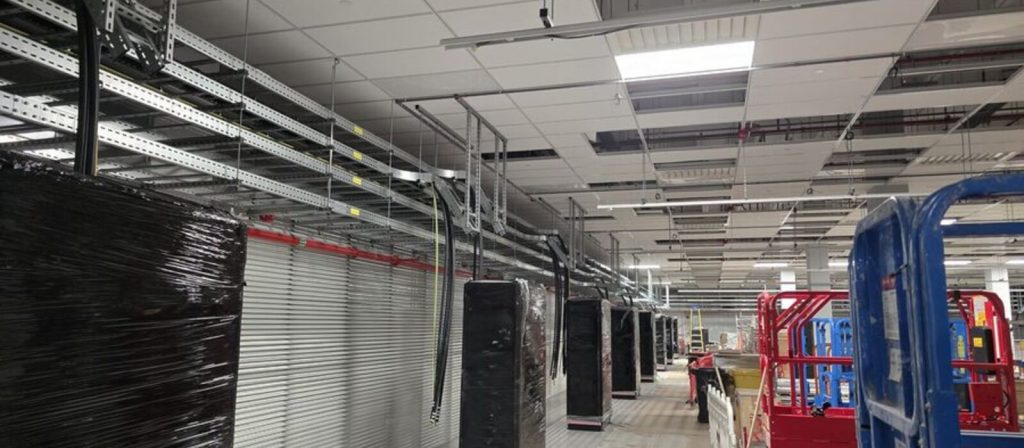
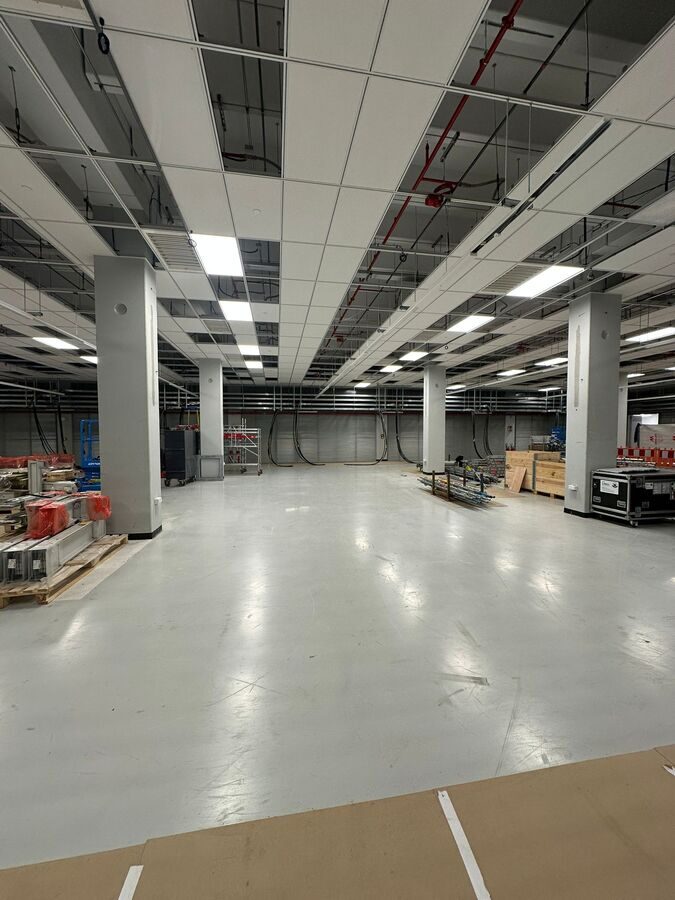
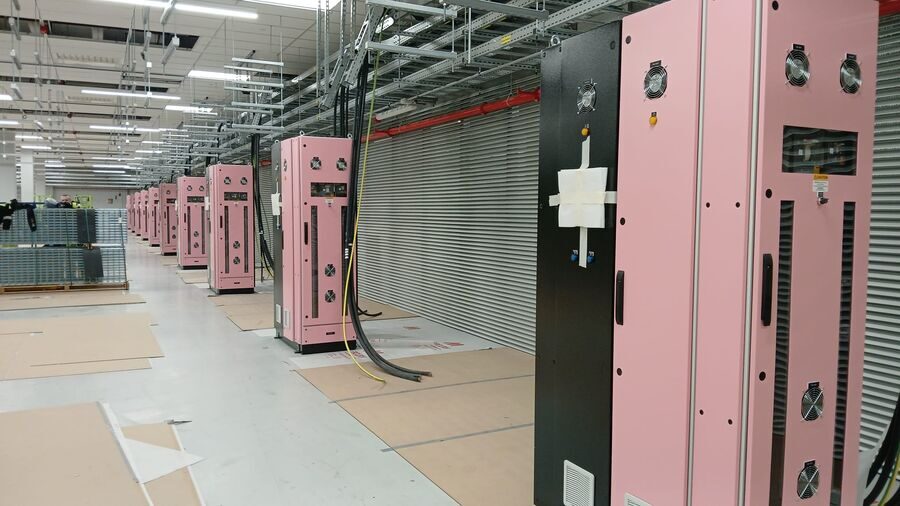
During the move-in and installation of 160 PDCs at a data center in the Rhine-Main region we moved in and positioned the complete power distribution cabinets in eight data halls, twenty cabinets per hall in two rows of ten. PDC stands for Power Distribution Cabinet, a distribution cabinet that passes the power from the main distribution to the server racks. Six lift-and-shift mechanics were on site for several weeks. The cabinets were distributed over four levels via a single goods lift. That lift thus became the bottleneck of the material flow and had to be coordinated over weeks.
For coordination in the project, the interface between trades was the decisive point. Our team took on the mechanical process from transport into the building through unpacking to laser-surveyed positioning – every cabinet in line with its row and under its cable outlet. The electrical connection work lay with the electrical trade. This separation only works if each trade handles its interface precisely. With 160 cabinets there was no rework. All travel and work routes were covered with protective plates and fleece, the walls protected with hanging covers – without a single instance of damage.
32 vehicle restraint systems near Leipzig: adapting the team, commissioning together
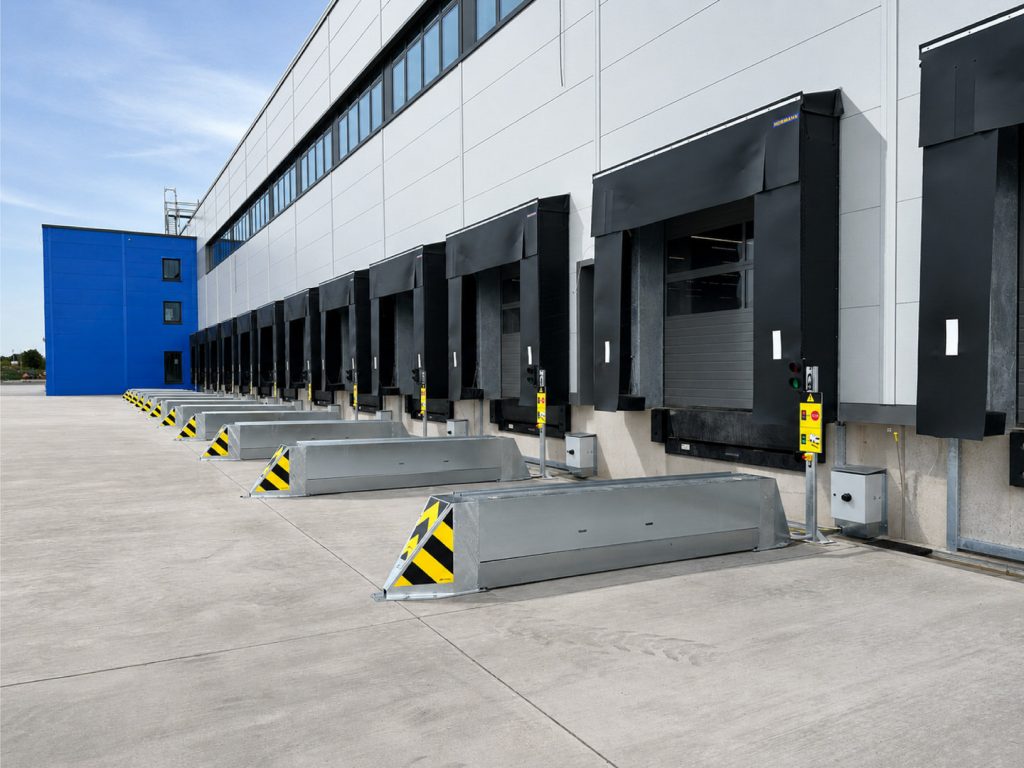
With the installation of 32 vehicle restraint systems at a logistics centre near Leipzig the job involved systems that prevent trucks from rolling away uncontrolled during loading and unloading. Our scope ranged from the mechanical installation – systems, hydraulic power units, traffic light systems, 32 control panels – to control cabinets, cable routes and electrical commissioning.
For the operator, the job shows two things. First, the changing team size. At the start, an eight-strong team of mechatronics technicians, mechanics and electricians was at work. After the main installation it was reduced to three specialists for final fitting and commissioning preparation. Every change in the crew means new faces on the premises – and thus induction, passes and up-to-date attendance lists. Second, the interface at the end. Commissioning took place together with the manufacturer of the systems; all 32 were inspected, tested and handed over to the operator on schedule. That is a handover point at which three parties need the same completion notice.
Is a job coming up where several companies will work on your premises – in Frankfurt, Offenbach, Hanau or elsewhere in the Rhine-Main region? Then get in touch with us. A joint site visit usually clarifies which approvals, areas and interfaces the job needs.
What this means for your role
For buyers: Include the requirements of your contractor management in the tender: site rules, induction requirement, permit-to-work procedure, named supervisor, records in the vehicle. In the bidder meeting, assess whether the provider asks about them before you mention them.
For designers: Plan in the areas that contractors need: storage areas, transport routes, crane standing areas, access to isolation points, lifts with the necessary load capacity. Where several trades work at the same time, define the handover points before the first contract is signed. The interface list belongs in the planning.
For project managers and site managers: As project manager, you ensure that the contractor coordinator is appointed and given the time before the first company arrives. The permit-to-work procedure and induction need room in the schedule. As site manager, you are often this coordinator yourself. You induct, approve, lead the site meeting, receive completion notices and decide where work overlaps.
For maintenance managers: You know the plant hazards that fit into no general induction. The installation that starts automatically, the line that stays under pressure despite shutdown, the area where no welding is done. Write these points into the induction and the permit to work. Name who in your team isolates and re-energises, and insist on the completion notice before re-energising.
For occupational safety specialists and HSE coordinators: Build contractor management as a procedure that works without you: appointment template for coordinators, briefing record, permits to work per activity, sign-off step with completion notice. Check the contractor's risk assessment to see whether it means your plant or is a template. Spot-check jobs with several companies by walking through them.
For facility managers and operators: In data centers and buildings in live operation, access list, escort requirement, maintenance window and permit interlock. Define which work by a contractor needs a maintenance window and which needs an isolation. Keep induction, permits to work and completion notices in your operating documentation – as evidence of your duty of supervision towards users, insurers and auditors.
Contractor briefing record: template on request
The contractor briefing record is a two-page template for the site-specific induction of external fitters. It contains a project header with job, site, contacts and coordinator and the induction contents from this article as a checklist. Plus a field for the briefing language and a participant list with date and signature. The record is the contractor management checklist for day one. It helps coordinators forget nothing and safety specialists make the induction verifiable. Request the record via our contact form – subject line “briefing record”.
Why Omega Mounting?
We are based in Rodgau near Frankfurt and work every day as a contractor on other people's premises. In data centers, logistics centres, at Frankfurt Airport, at machine builders between Hanau, Aschaffenburg and Darmstadt. The linked jobs show what that means: a clean interface to the electrical trade, changing team size, joint commissioning. We bring along a risk assessment, proof of qualifications, an installation manager with decision-making authority and inspected equipment, and we sign off before we leave. a single point of contact for installation, lifting, maintenance and repair, our own workshop in Rodgau, availability in the event of a breakdown by phone or WhatsApp and short distances in the Rhine-Main region. And a contractor that makes your contractor management easier rather than harder.
Conclusion
Contractor management is the duty of the company that brings external companies onto its premises: selection, preparation, induction, approval, coordination and sign-off. It is organised by a coordinator with time and authority and documented in the company's own file. The contractor briefs and leads its people. The plant inducts, approvals and coordinates. Where several companies work at the same time, schedule, area and interface decide whether trades complement or endanger each other. And a good installation contractor makes contractor management easy for you because it brings along what you would otherwise have to demand. If you would like to know how a job on your premises is prepared properly, send us the site, the planned work and the companies that will be on site at the same time. We will get back to you with an honest assessment of which approvals, areas and coordination the job needs.
Planning a move-in, installation or maintenance in the Rhine-Main region?
Tell us briefly what you need – we'll come back with an honest assessment.
Free, no-obligation callback
You may also be interested in these guides

About the author
Tobias Schott
Managing director of Omega Mounting GmbH, Rodgau · more than 20 years of hands-on experience in installation and maintenance
A trained mechatronics technician, working in maintenance, servicing and industrial installation since 2004 – first alongside his father, and with Omega Mounting since 2012: from overhead conveyors in Frankfurt to the crane system in a new-build hall. He plans and leads lifting operations as an appointed person (AP) in data centers and on industrial sites in the Rhine-Main region, trains and examines operators of cranes, mobile elevating work platforms and telehandlers, and is a qualified occupational safety specialist. On jobs abroad he is known as the “German Troubleshooter” – the person you call when a site gets stuck. He learned what quality means from his father, not from a manual: Made in Germany as a standard for his own work, not a label. That is why quality comes first at Omega Mounting – ahead of speed and price. He writes these guides from that practice: what works on our sites is in them – what exists only on paper is not.
Frequently asked questions
Contractor management comprises the selection of the contractor on the basis of evidence, the preparation with time slots, areas and contacts and the site-specific induction. Plus permits to work and isolations, coordination with the plant and other contractors, monitoring and sign-off. The client is responsible. It appoints a coordinator for this purpose.
The client appoints the coordinator in writing, with tasks, powers and deputy. Any person who knows the plant, is reachable during the work and is allowed to decide is suitable. Often this is the maintenance manager, the site manager or a safety specialist. The decisive factor is stop-work authority in the event of a hazard.
You have to induct them into your plant – access, routes, alarms, plant hazards, approvals – because only someone who knows the plant can do that. The task-related briefing on handling equipment, lifting gear and protective equipment is owed by the fitters' employer, i.e. the contractor. Both records should be in your contractor file so that you can prove your monitoring.
A permit to work is customary for hot work, for work on electrical installations and on machinery with isolation and for entering confined spaces. Likewise for lifting operations over installations or near people, for work with a risk of falling and in potentially explosive atmospheres. Which activities are included at your plant is determined by your risk assessment. Tell the contractor before it travels to site.
Through time, space and interface. That means: a joint schedule with a daily short briefing, separate areas and transport routes with rules for bottlenecks such as lifts. Plus a list of who hands over what to whom in which condition.
The SiGeKo is the health and safety coordinator whom the client appoints on a construction site under the BaustellV (Construction Site Ordinance) to coordinate the trades of the construction project. The contractor coordinator is the person a company designates for the deployment of contractors in live operation. For installation and maintenance in existing buildings there is usually no SiGeKo – then the plant coordinates alone.
Section 8 of the ArbSchG (German Occupational Safety Act) requires employers whose employees work at the same workplace to cooperate on occupational safety and to inform each other about hazards. Section 6 of DGUV Regulation 1 requires, where the hazard is increased, a coordinating person with authority to issue instructions. Informing the contractor about your plant hazards, appointing a coordinator, coordinating the work. This guide is no substitute for legal advice.
Yes. Our supervisors and fitters attend your site induction, work to your site rules and permit-to-work system and report to your contractor coordinator. We bring our own RAMS for the work, agree interfaces with other contractors at the coordination meeting and report incidents and near misses through your system.
With a short enquiry containing three pieces of information: site and area, planned work with time slot and the companies that will be on site at the same time. We send you our risk assessment and name our installation manager as supervisor. At a site visit, induction, permits to work, areas and interfaces are defined. Your contact is Tobias Schott – reachable via our contact form.
Yes. On international sites we name an English-speaking supervisor for the job, and Tobias Schott is your English-speaking contact from enquiry to handover. Documentation – RAMS, lift plans and reports – is provided in English.
 English
 German