
- Project report – load bank and generator installation at a Frankfurt data center
Installing load banks and generators at a Frankfurt data center with a 220-tonne mobile crane

Five heavy-haulage loads, a 220-tonne mobile crane, one long working day: generators and load banks taken from the kerbside to their final position
When a data center tests and extends its standby power supply, generators and load banks weighing many tonnes have to go exactly where they are needed – often into areas normal logistics cannot reach. That is where our work starts.
At a data center in Frankfurt am Main, a global provider of mobile power and temperature control hired us for the complete delivery, unloading and installation of generators and load banks. We handled the whole process: unloading the heavy-haulage lorries, setting up the mobile crane and lifting the containers precisely into the prepared steel structure.
What made the job special: every lift took place in one very long working day. That was only possible with detailed lift planning, a practised sequence and the right crane.
Project profile
Service
- Coordinating and unloading five heavy-haulage loads
- Installing generators and load banks
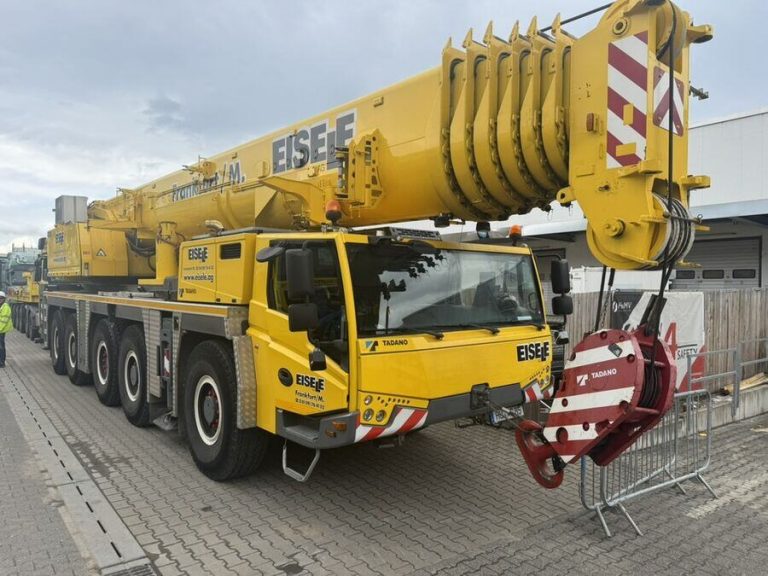
- Setting up and operating a 220-tonne mobile crane (Tadano ATF 220G-5)
- Preparing and agreeing the lift plans
- Rigging and slinging
- Lift and shift management on site
- Positioning all components in their final installation position
- Team
- 1 data center lift and shift manager (project lead on site)
- 3-person crane crew
- 5 lorry drivers on sequenced delivery runs
- Duration: 1 working day (long shift)
- Location: Data center in Frankfurt am Main (Rhine-Main region)
What is a load bank?
A load bank is a mobile test unit used to test a data center's standby power supply under real conditions. It simulates the electrical load of the servers and plant and proves that the generators deliver full output when it matters.
For load tests, load banks are set up and cabled on site together with the generators they test. Both arrive as heavy container modules, so installing them is classic lift and shift work: high weights, tight set-down areas and an environment where damage is not acceptable. In commissioning terms, load banks are the test equipment for the functional and integrated systems tests (Cx L4 and L5).
Frankfurt is one of Europe's largest data center markets, and jobs like this one come with tight space and tight time windows.
Why is installing plant at a data center so demanding?
In short: on a live data center site nothing is left to chance. Every lift, every route and every piece of equipment must be planned, documented and approved in advance.
On this job several factors came together:
- limited manoeuvring and standing space for the lorries and the crane
- precisely defined positions between the fuel tank, generators and existing plant
- lifts right next to a multi-storey steel structure
- the operator's strict safety and access rules
- a tight time window that required the whole installation in one day
We therefore fixed the set-down areas and crane positions at planning stage in a detailed site logistics and lift layout drawing. The drawings show how little space there was between the tank installation, the generators and the access road.
How were the crane lifts planned?
Every lift was calculated in a lift plan before the job and agreed with the operator – including load weights, radii, crane position and exclusion zones.
The lifts were made with a Tadano ATF 220G-5, a mobile crane in the 220-tonne class. With 71 tonnes of counterweight and a 30-metre boom, it still had about 28 tonnes capacity at a radius of around 20 metres – enough reserve to move the container modules safely and under control at all times.
The lift plans were uploaded to the operator's contractor management system and approved there; the first lift could only start after that approval. The crane's current periodic inspection certificate under the German Industrial Safety Ordinance (BetrSichV, Section 14) was part of the package – on a data center site every piece of equipment is documented and checked.
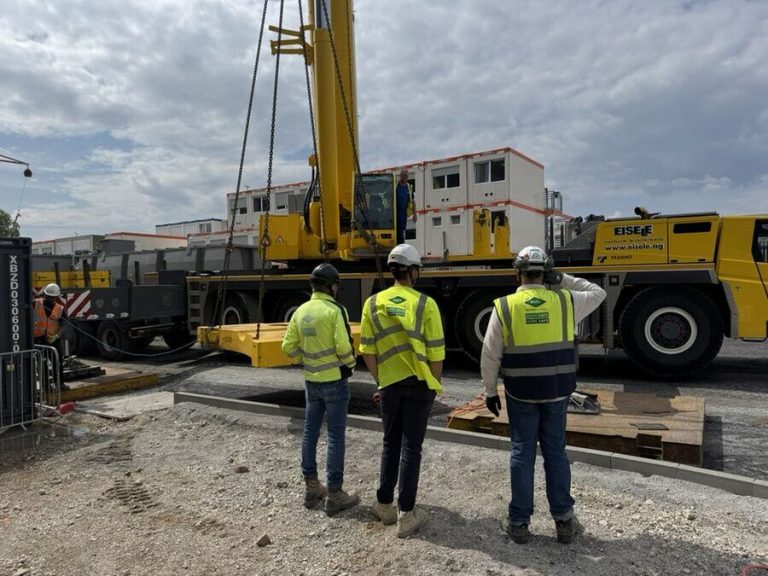
Our crew set up the mobile crane: counterweight, outriggers and configuration exactly as set out in the lift plan.

How did the delivery of the generators and load banks work?
The generators and load banks arrived on five low-loaders, sequenced so that unloading and installation ran without waiting time.
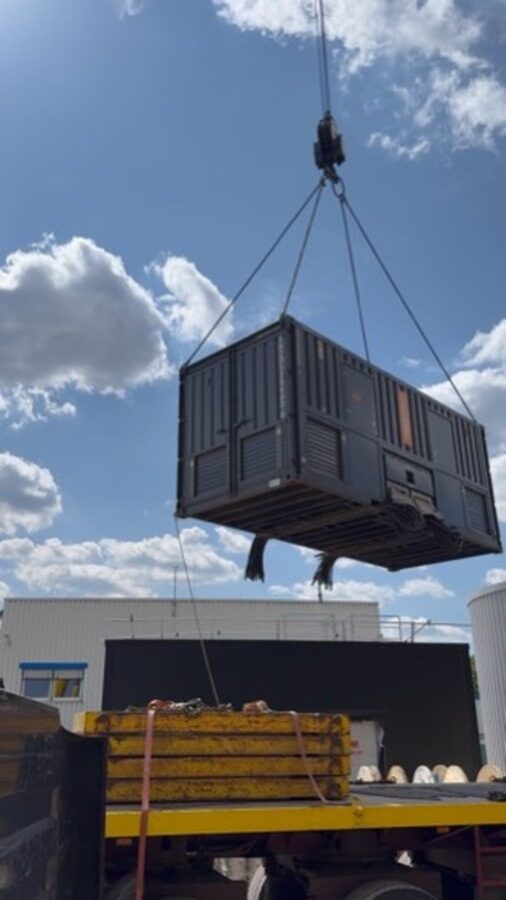
Our five drivers brought the lorries one after another to the planned unloading point. The photos show the line of low-loaders, container after container, ready for the lift. Alongside the units we had loaded all the material needed to set them up – cables, connectors and fixings.
Because transport, crane and rigging crew were closely sequenced, every low-loader was unloaded as soon as it arrived. Five heavy-haulage loads, one crane and a tight time window became one continuous operation.
How were the load banks lifted precisely into place?
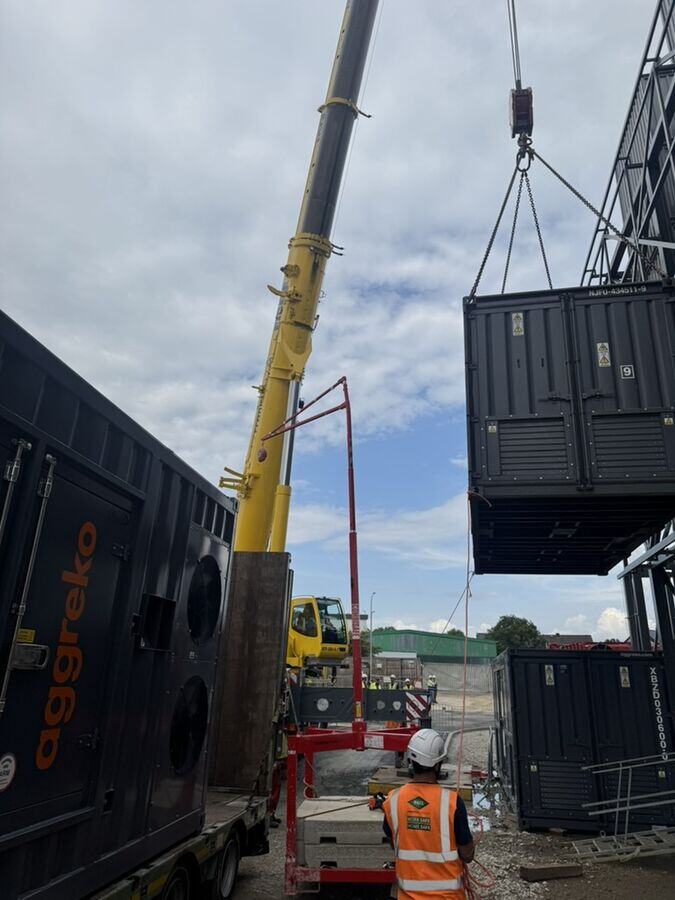
The container modules were slung with chain slings, guided over the steel structure by the mobile crane and set down to the centimetre – in places on several levels, one above the other.
The close-ups show how precise the work had to be: the load banks came down right beside the multi-storey steel frame they were set into. Our riggers controlled the loads with taglines to rule out any uncontrolled movement.
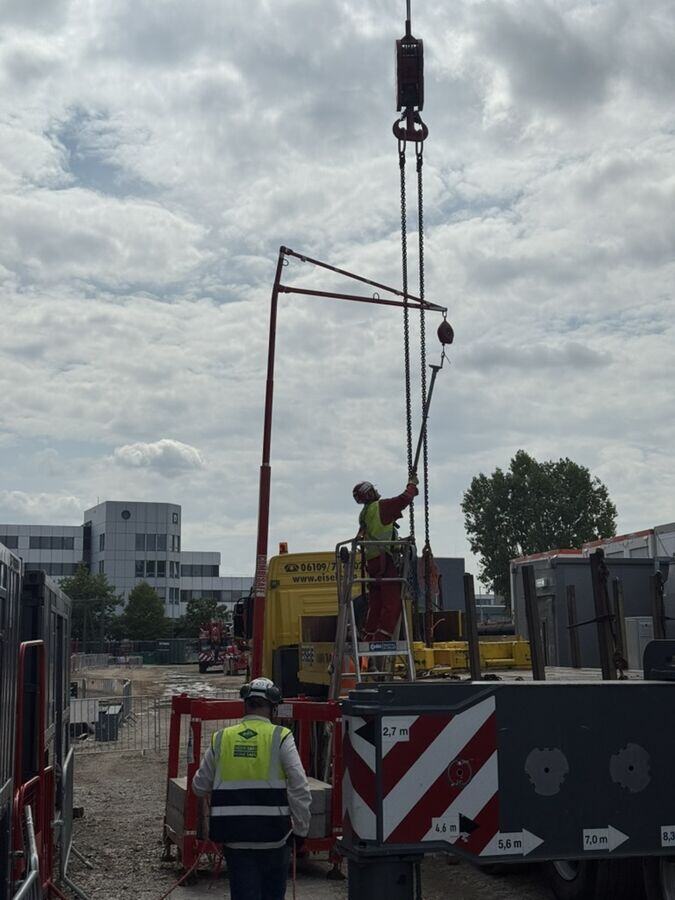
A mobile elevating work platform was used for slinging and unslinging at height. While one rigger released the chain slings, a colleague on the ground kept the area clear and stayed in constant contact with the crane operator. Every movement was made on command – slowly and under control, even at the end of a long day.
Health and safety and documentation on a data center site
Data center sites are among the most tightly controlled workplaces there are, and we work accordingly.
On this job that meant:
- inspected and documented crane equipment and inspected lifting accessories
- an approved lift plan for every lift
- cordoned-off slewing and exclusion zones
- every load controlled with taglines
- full PPE for the whole crew
- constant communication between crane operator, riggers and lift and shift manager
Our data center lift and shift manager coordinated the whole job, stayed in contact with the client throughout and made sure every step followed the plan and its approval.
From the kerbside to the installed unit
We took on the complete process – from the heavy-haulage lorries arriving at the kerbside to the units in position with all components installed.
That end-to-end responsibility is what clients value most. Instead of coordinating haulier, crane hire company, riggers and installation crew separately, they have one contact who plans, directs and is accountable for the whole sequence.
Our experience on data center sites paid off directly: we know the safety processes, documentation requirements and site routines, which is how we meet tight time windows reliably.
Why Omega Mounting for lift and shift in a data center?
We are an installation contractor from Rodgau in the Rhine-Main region, specialising in heavy lifts and plant installation – from planning to final positioning.
Our services include:
- Lift and shift and heavy installation
- Installing generators, load banks, CRAH units and other plant
- Crane and rigging work including lift plans
- Transport coordination and unloading of heavy haulage
- Data center installation under the operator's safety rules
- Project management by experienced lift and shift managers
- RAMS, risk assessments and permits to work
Conclusion
Five heavy-haulage loads, a 220-tonne mobile crane, nine people on site – and at the end of one long working day every generator and load bank was in position at the Frankfurt data center.
The job shows what lift and shift management involves: precise lift planning, documented safety, practised crews and the ability to combine transport, crane and installation into one sequence. For the client that meant one contact, one day on site and no delays, damage or rework.
Planning a plant installation or a lift and shift job?
Data center, industrial plant or power equipment: we take your job from the kerbside to final installation. From Rodgau we reach the whole Rhine-Main region quickly – Frankfurt, Offenbach, Hanau, Darmstadt or Aschaffenburg – and we work across Germany.
How does a standby power system get into place – from the tandem lift to installation in the generator room? Our overview Standby generator installation in data centers summarises this.
More about our work in the city, access routes and service areas: Industrial installation in Frankfurt.
Talk to us – request a callback for your project.
Project photos


Planning a similar project?
Tell us briefly what you need – we'll come back with an honest assessment.
Free, no-obligation callback
Related guides for this project
About the author
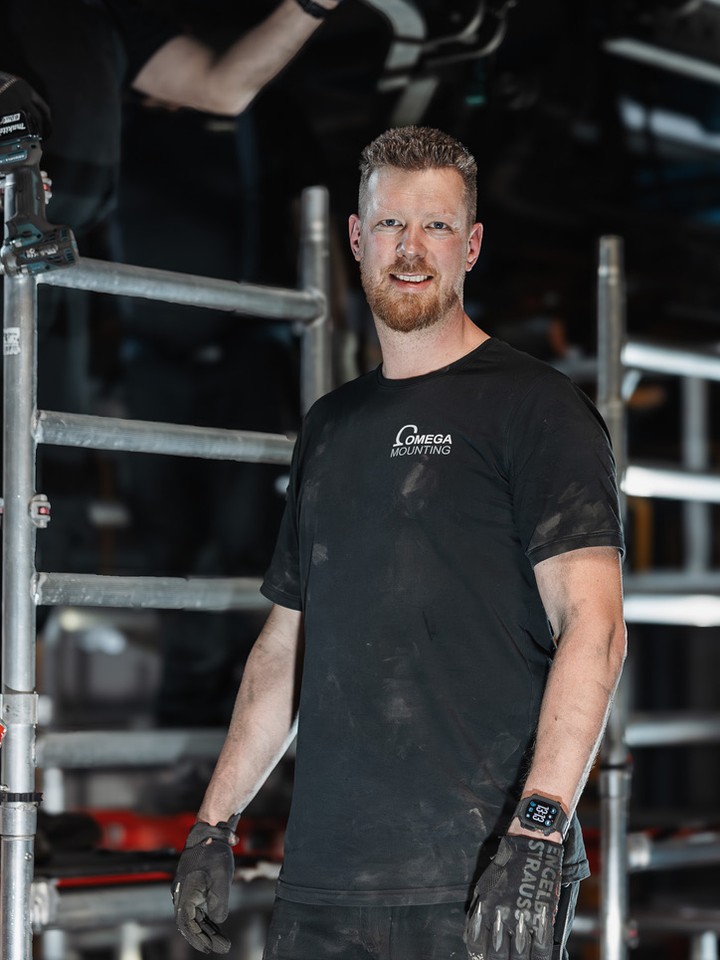
Tobias Schott
Managing director of Omega Mounting GmbH, Rodgau · more than 20 years of hands-on experience in installation and maintenance
A trained mechatronics technician, working in maintenance, servicing and industrial installation since 2004 – first alongside his father, and with Omega Mounting since 2012: from overhead conveyors in Frankfurt to the crane system in a new-build hall. He plans and leads lifting operations as an appointed person (AP) in data centers and on industrial sites in the Rhine-Main region, trains and examines operators of cranes, mobile elevating work platforms and telehandlers, and is a qualified occupational safety specialist. On jobs abroad he is known as the “German Troubleshooter” – the person you call when a site gets stuck. He learned what quality means from his father, not from a manual: Made in Germany as a standard for his own work, not a label. That is why quality comes first at Omega Mounting – ahead of speed and price. The project diary shows jobs his team has planned and carried out – without client names, but with everything there is to learn from them.
Frequently asked questions
A load bank is a mobile test unit that simulates the electrical load of a data center. It is used to prove that standby generators deliver their full output when it matters. For the tests, load banks arrive as container modules and are set up on site together with the generators.
The modules arrive by heavy haulage, are unloaded by mobile crane and lifted to their final position – into multi-storey steel structures where required. Every lift is calculated in advance in a lift plan and approved by the operator.
A lift and shift manager plans and directs the whole installation: lift plans, transport coordination, crane and rigging work, safety approvals and communication with the operator. They are the client's single point of contact and are responsible for running the job safely on site.
That depends on weight, radius and available space. On this job we used a Tadano ATF 220G-5 in the 220-tonne class – with 71 tonnes of counterweight and about 28 tonnes capacity at a 20-metre radius. The choice is always based on the lift plan.
Yes – with the right preparation. Sequenced heavy-haulage deliveries, a lift plan approved in advance and a practised crew made it possible to unload and install every generator and load bank in one long working day.
Yes. We are based in Rodgau near Frankfurt, so jobs in Frankfurt am Main, Offenbach, Hanau, Darmstadt and across the Rhine-Main region are everyday work for us. The short journey keeps us flexible even with tight time windows.
Yes. We coordinate and carry out the whole process from the kerbside to the installed unit: heavy-haulage coordination, unloading, crane work, rigging and positioning. On this job that meant five sequenced low-loader deliveries, one crane and one crew – with a single contact for the client from first lorry to last lift.
We do not operate mobile cranes ourselves: a crane hire company supplies crane, operator and counterweight and stays responsible for operating the machine safely. Our own spider cranes are operated by our own team. We plan the lift in the lift plan, select lifting accessories and lifting points, sling the load, give the signals and – through our AP – give permission for every lift. That way crane, transport and installation are coordinated by one contractor.
Yes. Load banks are the test equipment for the functional and integrated systems tests (Cx L4 and L5). We bring them in under an approved lift plan, set them in position and take them out again once testing is complete – on this job five container loads in one day. The electrical connection to the test points is part of the electrical scope.
 English
 German