
- Project report – automated storage units
Storage lift relocation from Frankfurt to Rodgau: six paternoster units out of a high-rise and into the new hall
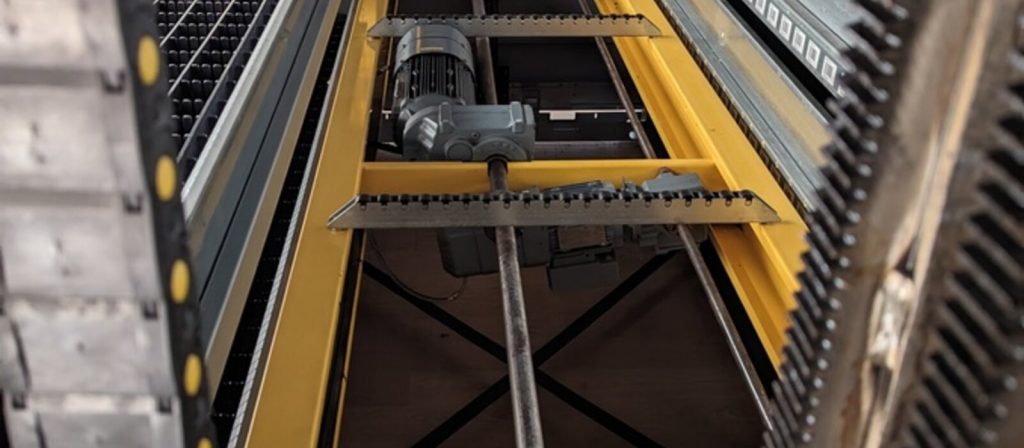
How our installation team stripped six storage lifts down to individual parts, carried them across parquet flooring out of an office tower – and reassembled them in Rodgau to the millimetre
Six automated storage units, an office tower in Frankfurt – and no chance of getting even one of them out in one piece. That was the task we faced at an international medical technology company: the paternoster storage lifts were to move out of an office and work complex in Frankfurt, right by the airport, and go back into operation in a hall – in Rodgau, right on our doorstep. For our team a real home fixture: short distances, familiar surroundings, fast response times throughout the installation phase.
The particular challenge: the office building had never been designed for such systems. The storage units barely fitted under the ceiling, doors and passageways were too low to move them in one piece – and on the way out there were three bottlenecks: internal doors through which every single part had to pass. On top of that, parquet flooring around the units that had to survive intact. Large machinery? No chance. Only skates and sheer muscle power.
Our answer: complete dismantling into documented, labelled individual parts, the move, reassembly with exact alignment of the entire drive geometry – and for the software and final acceptance we deliberately brought the manufacturer of the systems on board. The result: six storage units at the new site and a satisfied customer.
Project profile
- Scope: Dismantling six automated storage units (paternoster storage lifts) in a Frankfurt office tower – complete strip-down into transportable parts including documentation, labelling and photo records; removal by container; reassembly at the new site in a hall; mechanical alignment of toothed rails, gears, sensors and trays; commissioning and final acceptance together with the system manufacturer
- Team: Omega Mounting installation team (6 fitters on site during loading)
- Location: Frankfurt am Main, near the airport (dismantling) → Rodgau (reassembly – a home fixture for Omega Mounting); customer: international medical technology company (anonymised)
- Special feature: No machinery could be used – moving across parquet flooring that had to be protected was possible only with skates and muscle power
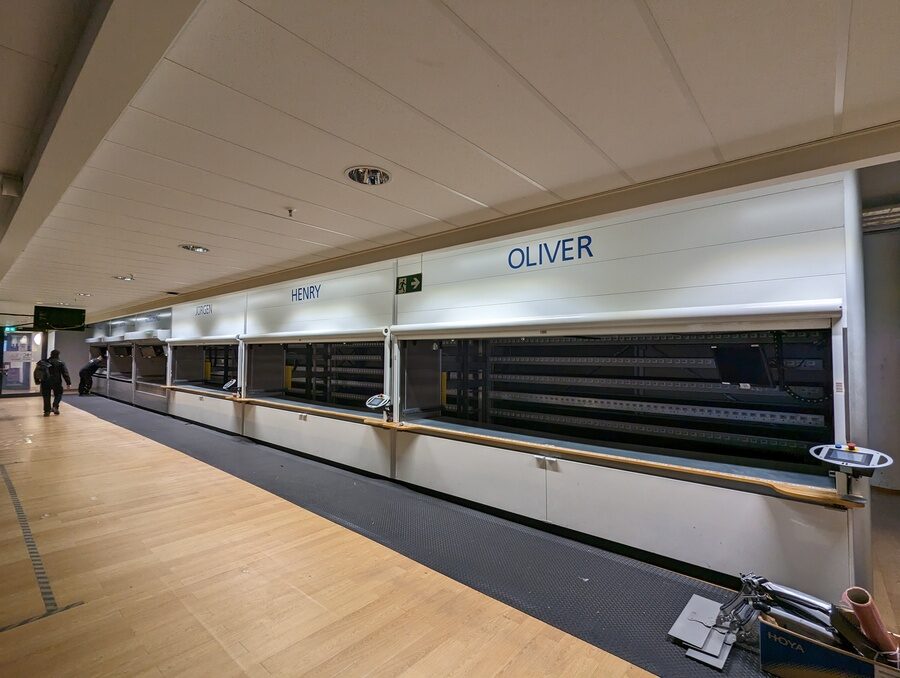
What is an automated storage unit (paternoster)?
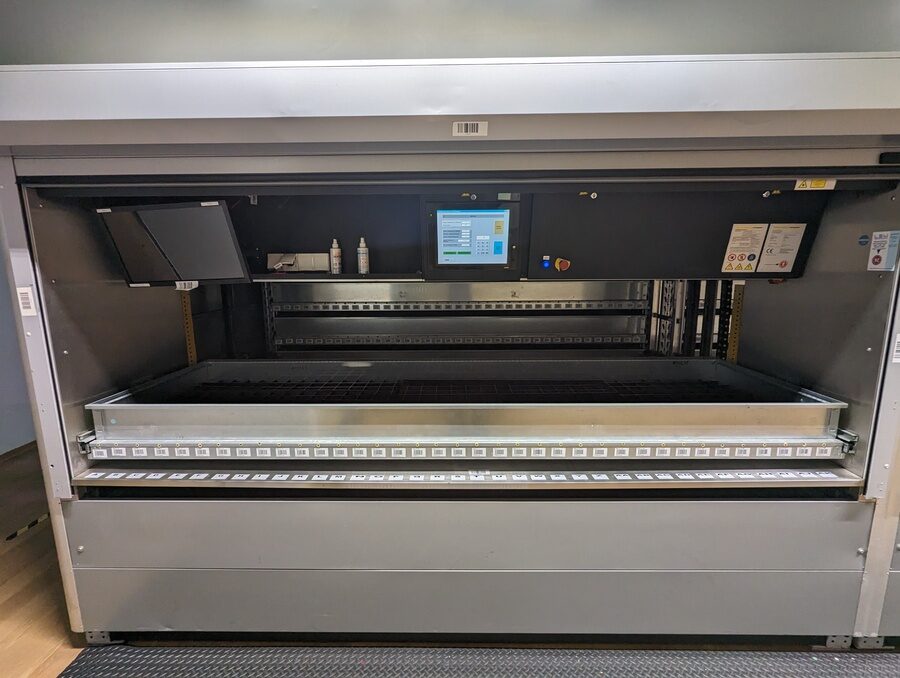
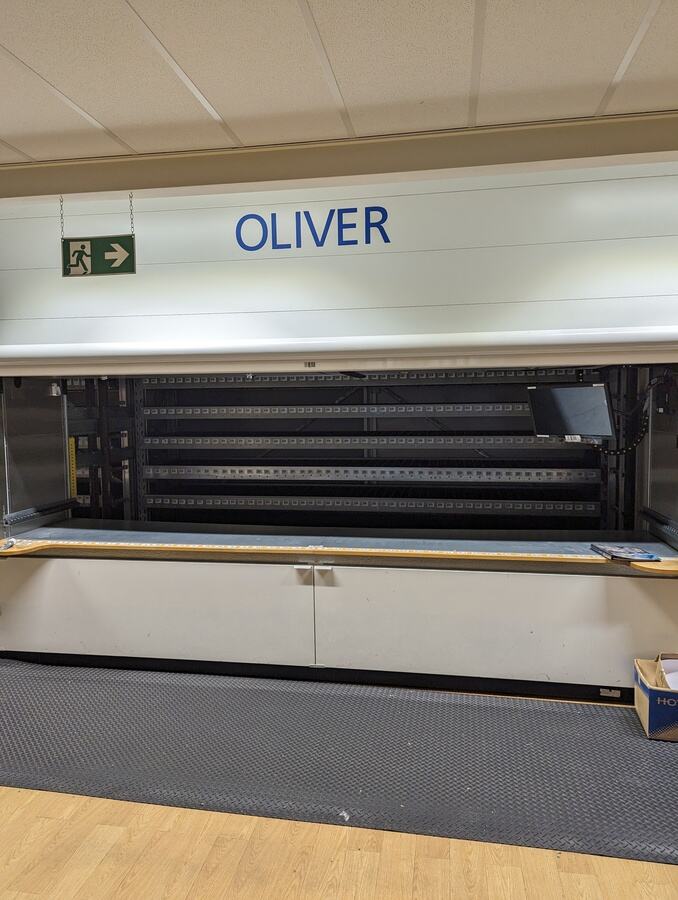
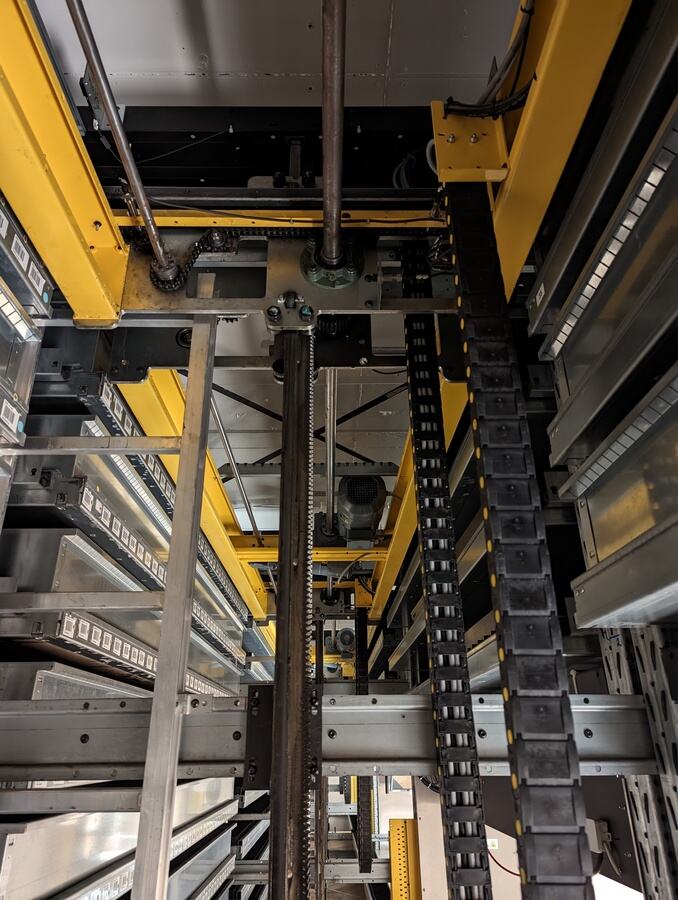
An automated storage unit – often called a paternoster or storage lift – is an enclosed racking system several metres high with automatic retrieval: the goods sit on dozens of trays that an electrically driven system brings to the access opening at the push of a button. The operator is presented with the right tray at an ergonomic height instead of walking through aisles of racking – “goods to person” instead of “person to goods”.
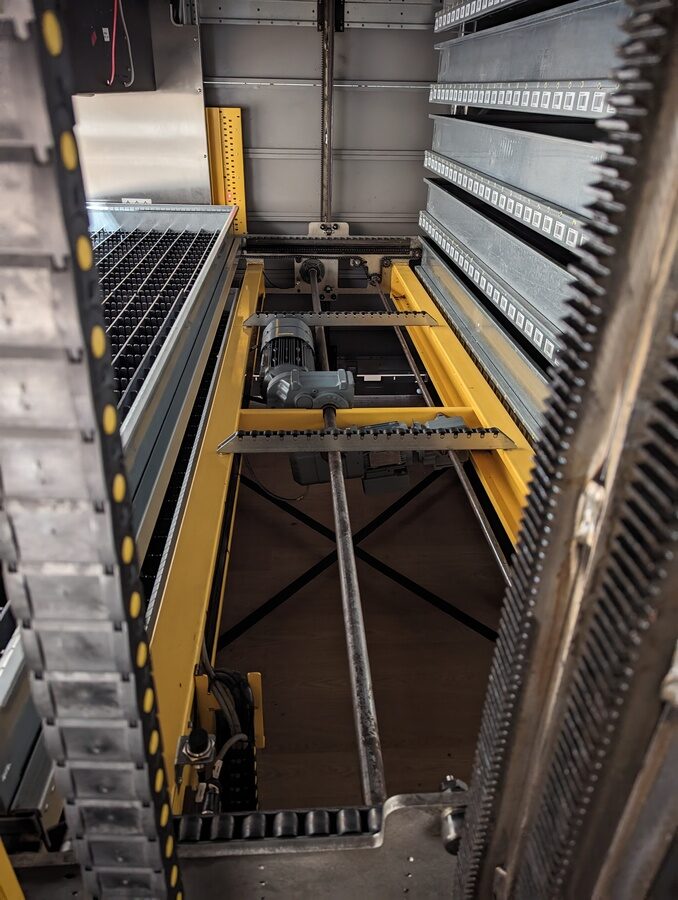
The principle saves an enormous amount of floor space because the full room height is used. That is exactly why such systems are long since found not only in industrial halls but also in office buildings, laboratories and service centres. Technically they consist of precisely matched assemblies: toothed rails and gears for the drive, chains, sensors for positions and safety – and control software that knows every tray to the millimetre.
And it is precisely that accuracy which makes a relocation demanding: a storage unit is not a cupboard you push across the room but a machine whose geometry has to be exactly right again after reassembly.
Why did the storage units have to be completely dismantled?
Because they simply did not fit through the doors – nor through the rooms. The tower had never been planned for storage units: the systems barely fitted the room height, passageways and doors were far too low to get even larger modules out in one piece. And the route from the installation point to the container passed through three bottlenecks – doors inside the building that set the maximum dimension for every component. Whatever did not fit through those three doors did not leave the building. Using a crane or forklift inside was likewise out of the question.
Those three bottlenecks became the planning basis for the entire dismantling: before the first screwdriver was picked up it was clear what sizes the parts had to be broken down to so every assembly could make the whole route – without damaging walls, door frames or parquet.
So there was only one way: dismantling the paternosters completely into individual parts. We deliberately used judgement here – only as much was taken apart as was necessary to make the parts manageable and movable on skates. Not every single bolt had to come out. Every component was documented, labelled and photographed, because at the other end – when moving in at the new site – everything had to fit together perfectly again.
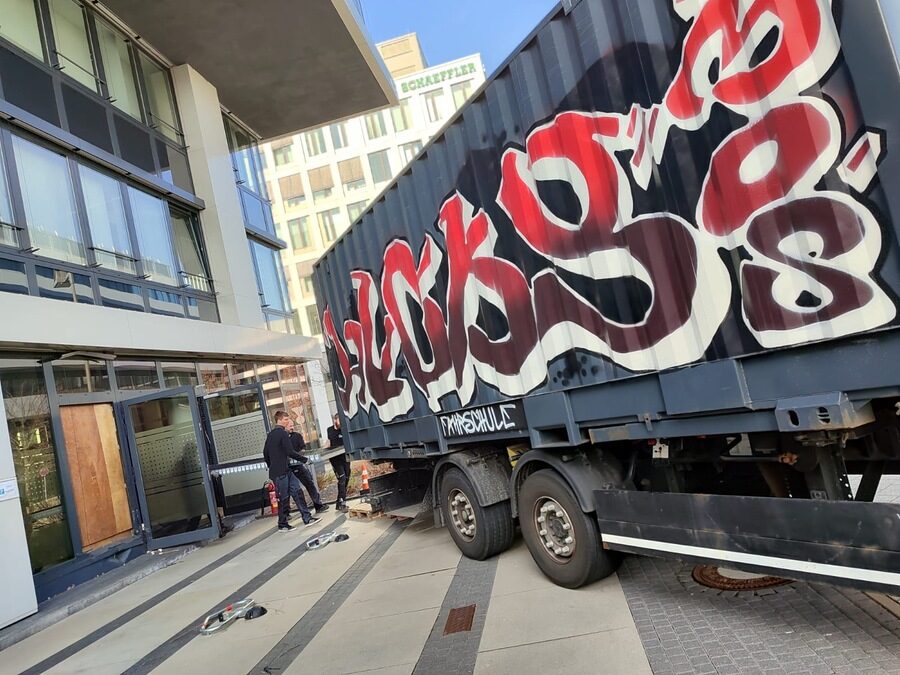
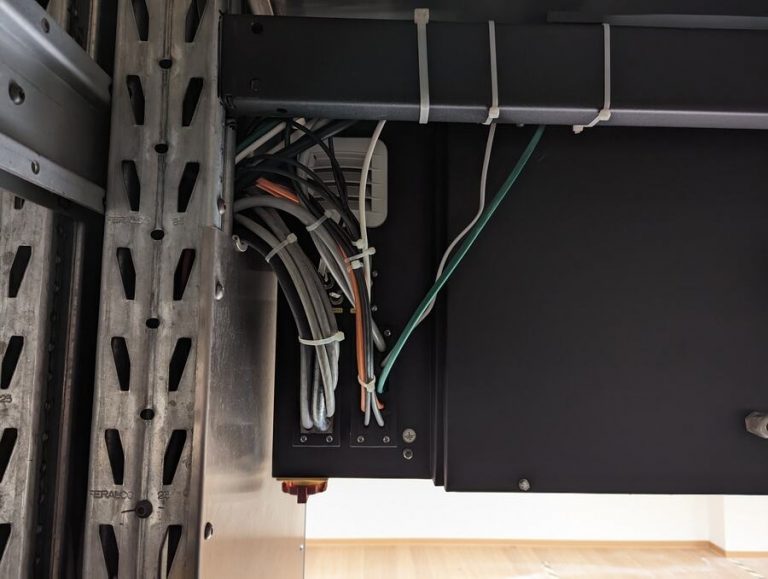
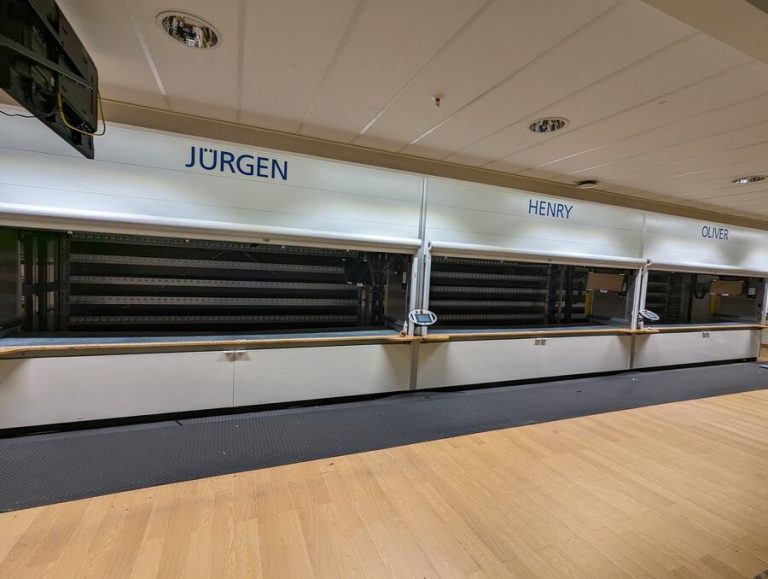
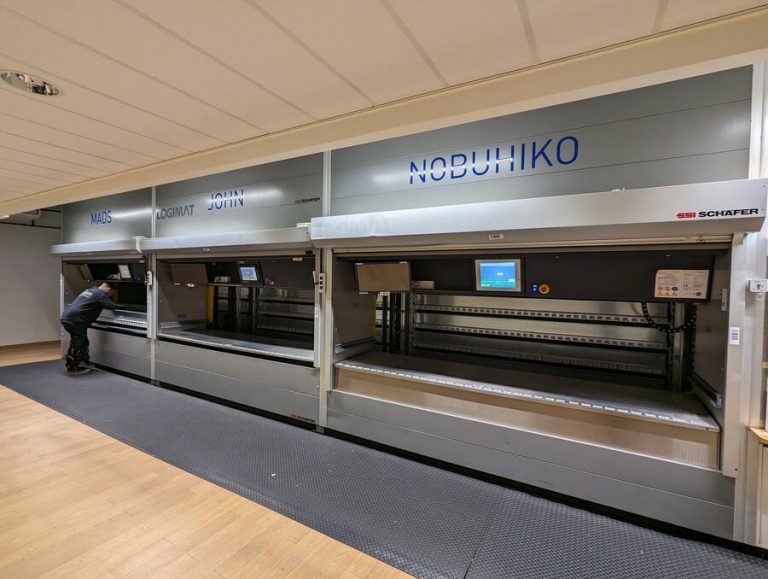
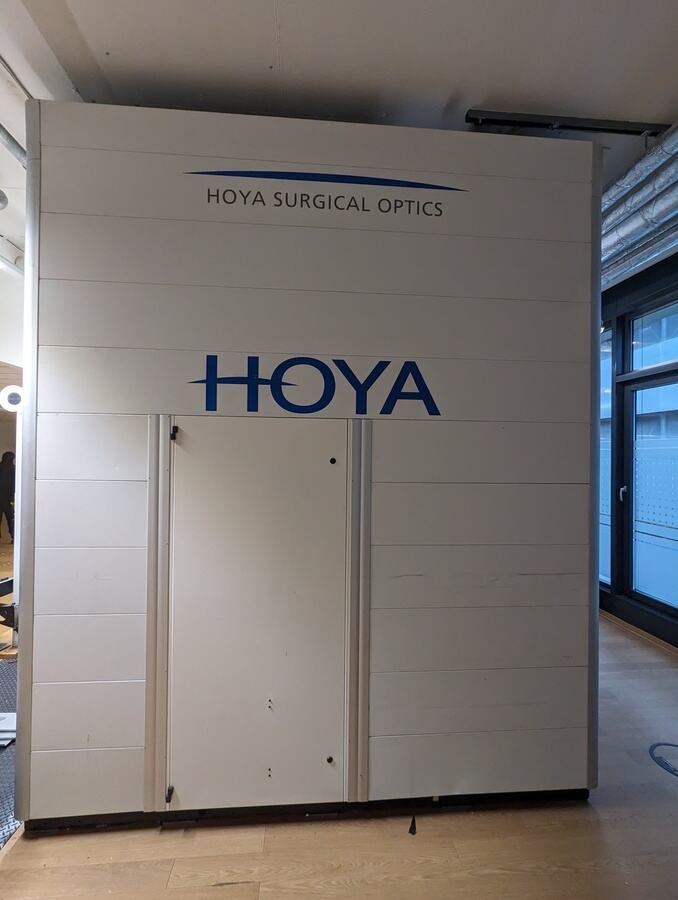
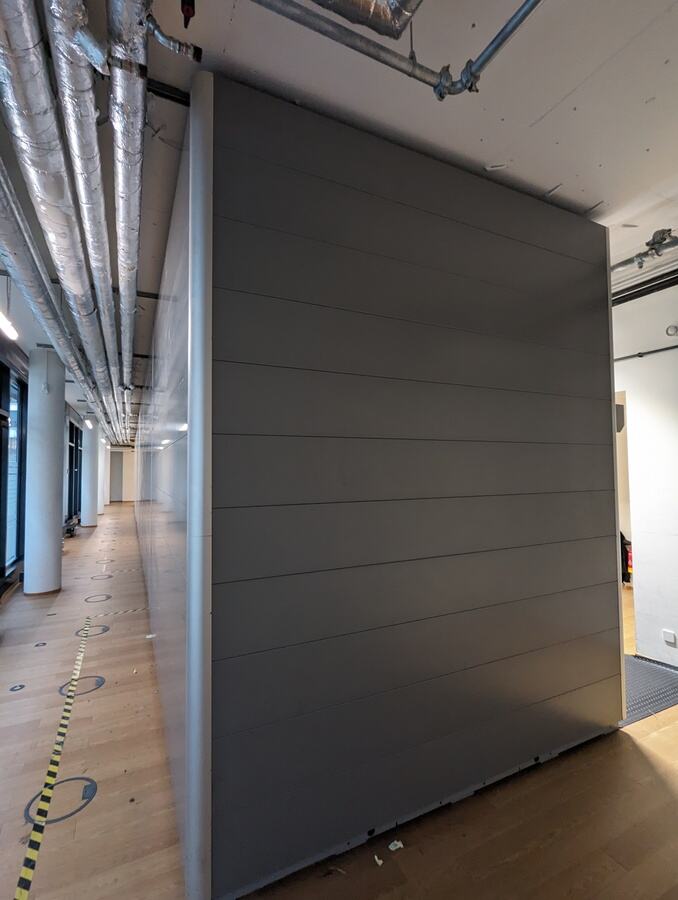
The photos show the result of that method: emptied systems, removed trays in neat stacks – and the loading, piece by piece, into the container provided.
How do you move plant weighing tonnes across parquet flooring?
With patience, skates and muscle power – and without a single large machine. Parquet flooring had been laid around the storage units and it had to survive. Forklifts, pallet trucks with point loads or heavy handling equipment would have damaged the floor. For our team that meant every single part – from the trays through the racking frames to the drive components – was moved by hand, set on skates, secured and rolled in a controlled way through the building to the container.
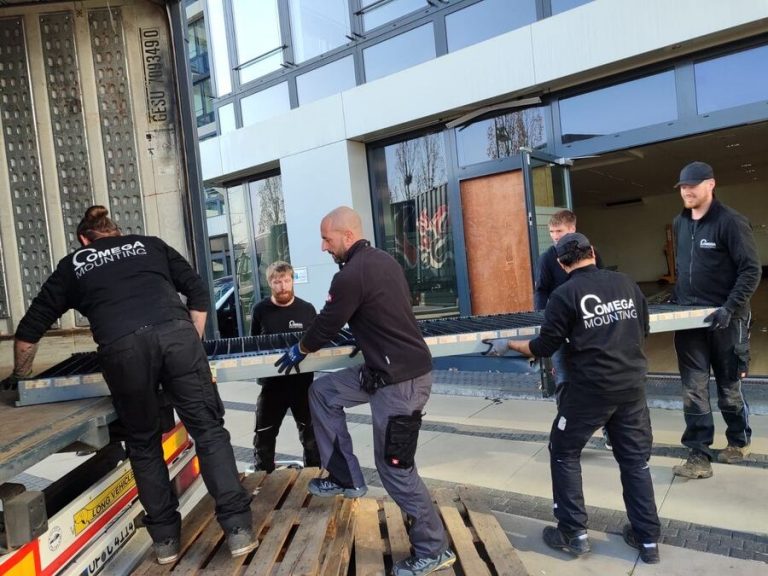
That sounds unspectacular, but it is heavy work with a system: load distribution on a sensitive floor, clear routes, every load secured and a well-drilled team working hand in hand. Every single load had to pass the three bottlenecks in the building – manoeuvring in the tightest of spaces, centimetre work at every door frame, hundreds of times over. The loading photos show clearly how the long trays travel out of the building to the container as a team lift – six fitters, one rhythm.
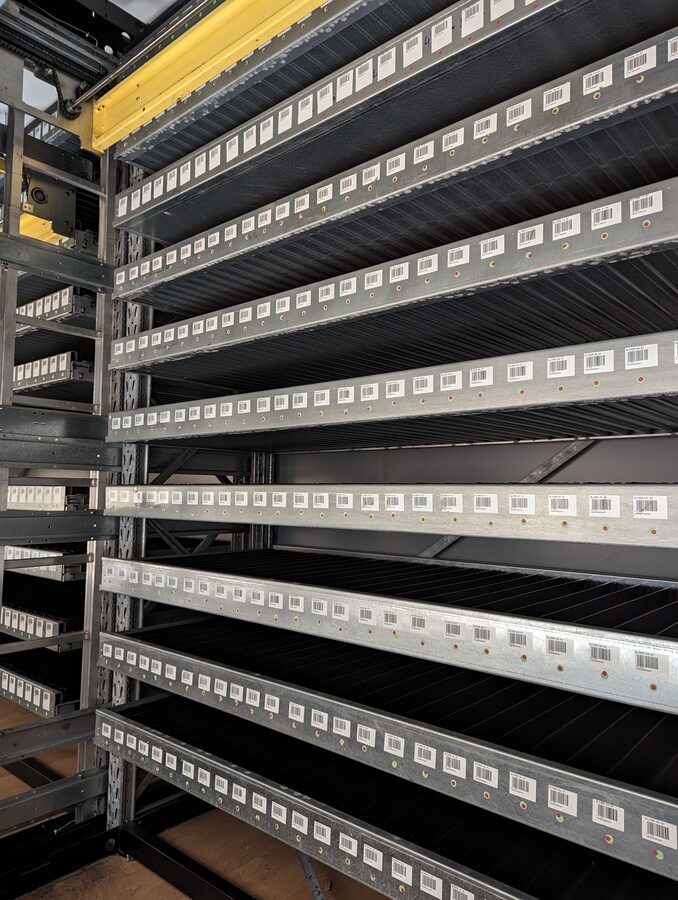
How do you make sure everything fits together again after the move?
Through rigorous documentation before and during dismantling. Each system was taken apart individually, every part labelled and photographed, relationships and installed positions recorded. That produced a clear, practice-based assembly plan for each of the six storage units – the basis for making sure no part is missing at reassembly, nothing is mixed up and every assembly goes back where it belongs.
During assembly in the new hall in Rodgau the real challenge lay in the geometry: gears, toothed rails, sensors and all guide elements have to be aligned so precisely that the trays are not twisted as they travel. Even small alignment errors lead to stresses, increased wear or faults in systems like these. This is where our experience in conveyor and machine installation counted: align carefully, measure, check – only then does power go onto the system.
How precisely do the mechanics and sensors in a paternoster have to be aligned?
To the millimetre – otherwise the system stops. Inside a storage unit many systems work together and have to be matched exactly: racks and gears transmit the drive force, chains and shafts synchronise the two sides of the unit, guide rails keep the trays on track – and sensors report every position, every level, every fault to the controller. Each of these systems is robust in itself. It gets critical at the interfaces: everything has to line up with everything else.
An example makes it tangible: if the racks are not properly levelled in height, the gears on the two sides no longer engage in sync. The result: the trays run out of true, jam in the guides and stick – the system faults out. What looks like an electronics problem in service is in truth often a mechanical one: a few millimetres of height offset in the wrong place.
So during reassembly we measured and levelled every rack, every guide and every shaft before the sensors even came into play. The order matters: first bring the mechanics into exact geometry, then position the sensors, then run it. A sensor can only reliably report what is mechanically correct – the other way round never works. Matching all the components to each other in exactly this way is the core of our mechatronics work.
Why did we bring the manufacturer on board?
Because honesty is part of the trade: our core competence lies in mechatronic subsystems – dismantling, transport, reassembly, mechanical and electrical alignment. Programming the system controller is not part of it, and we had no access to the manufacturer’s software either. Rather than improvise, on this project we deliberately decided to involve the manufacturer of the systems.
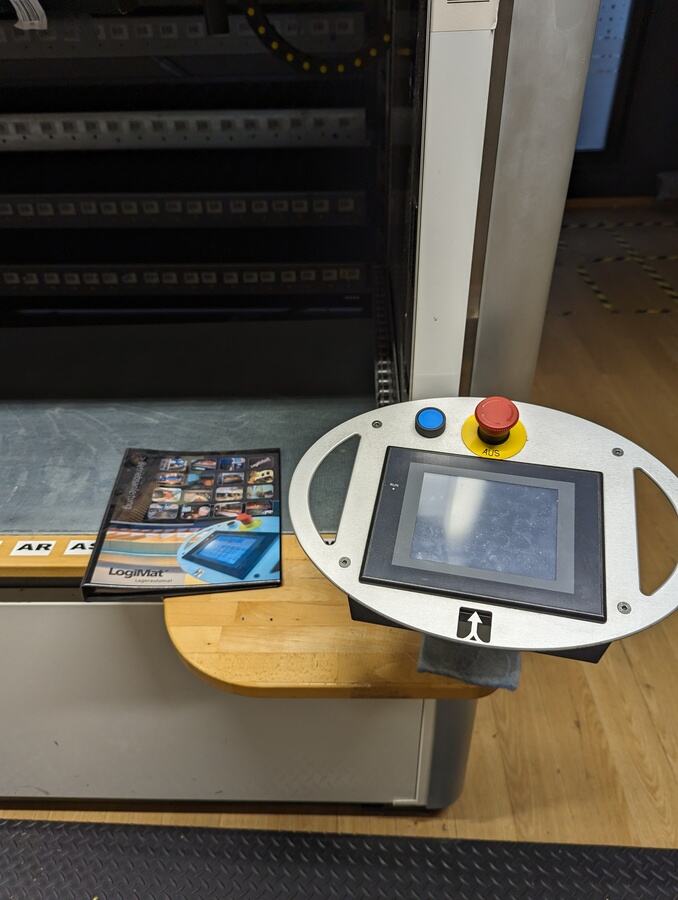
The manufacturer handled commissioning and final acceptance: all sensors were reset, the heights re-taught, the trays re-measured – and at the same time the controller received a software update. The cooperation worked excellently: we supply the perfect mechanical basis, the manufacturer sets the final full stop with its software. For the customer that means no interface problems, full manufacturer warranty on commissioning – and six systems that run at the new site just as they did at the old one.
Why Omega Mounting?
- Relocation instead of buying new: We relocate complete storage units, machines and plant – from a single unit to a fleet of six – preserving the value of existing equipment.
- Systematic dismantling: Dismantling with judgement, every part documented, labelled and photographed – so everything fits together again at the new site.
- Working within the building’s limits: Low doors, narrow passageways, sensitive floors – we find the route, even where no forklift and no crane can help.
- Mechatronics expertise: Toothed rails, drives, sensors – we align the mechanics so the system runs precisely again.
- Honest and collaborative: Where manufacturer software is required we bring the manufacturer in – coordinated by us, with no friction for the customer.
- Rooted in the region: Dismantling in Frankfurt by the airport, assembly at home in Rodgau – in the Rhine-Main region we are always close by, and we work throughout Germany.
Conclusion
Getting six paternoster storage lifts out of a Frankfurt tower near the airport that was never built for them – without machinery, across parquet, through three bottlenecks – and bringing them back into service in a hall in Rodgau to the millimetre: that is exactly the kind of project that calls for experience, documentation discipline and a well-drilled team. The customer has his six storage units at the new site, including manufacturer acceptance and a software update – and the parquet in the old building came through unscathed.
Are storage units, machines or entire plants facing a move at your site? Talk to us – we look for routes where at first glance there are none.
Request a callback for your project now – Omega Mounting GmbH, Rodgau. As an installation company from the Offenbach district we are quickly on site in Frankfurt, Hanau, Darmstadt and the whole Rhine-Main region – and we work throughout Germany.
Wie wir Maschinen und Anlagen in Frankfurt versetzen, transportieren und wieder aufbauen, steht auf unserer Seite Machine relocation Frankfurt.
Photo gallery of the job



Are you planning a project of this kind?
Tell us briefly what it is about – we will come back to you with an honest assessment.
100% free and without obligation
Passende Ratgeber zu diesem Einsatz
Über den Autor
Tobias Schott
Geschäftsführer Omega Mounting GmbH, Rodgau · über 20 Jahre Praxis in Montage und Instandhaltung
Gelernter Mechatroniker und seit 2004 in Wartung, Instandhaltung und Industriemontage zu Hause – zuerst an der Seite seines Vaters, seit 2012 mit Omega Mounting: von der Elektrohängebahn in Frankfurt bis zur Krananlage im Hallenneubau. Plant und leitet als Lifting Appointed Person Hebearbeiten in Rechenzentren und auf Industriebaustellen im Rhein-Main-Gebiet, ist Ausbilder und Prüfer für Krane, Hubarbeitsbühnen und Teleskopmaschinen sowie Sicherheitsbeauftragter. Bei Einsätzen im Ausland kennt man ihn als „German Troubleshooter“ – der, den man ruft, wenn es auf der Baustelle klemmt. Was Qualität heißt, hat er nicht aus einem Handbuch, sondern von seinem Vater gelernt: Made in Germany als Anspruch an die eigene Arbeit, nicht als Etikett. Deshalb steht sie bei Omega Mounting an erster Stelle – vor Tempo und vor Preis. Das Auftragstagebuch zeigt die Einsätze, die sein Team geplant und umgesetzt hat – ohne Kundennamen, aber mit allem, was man daraus lernen kann.
Frequently asked questions
Yes – whole fleets too. On this project six storage units were dismantled, relocated, reassembled at the new site and put back into service. Relocating preserves the value of the existing systems and is usually considerably cheaper than buying new.
Then it is dismantled into individual parts in a controlled way – but only as far as necessary. Every part is documented, labelled and photographed so everything fits together perfectly at reassembly. That is how systems can be taken through ordinary doors and low passageways.
By doing without heavy machinery: on this job all parts were moved solely with skates and muscle power. Add to that load distribution, clear routes and a team that secures every load – the parquet came through completely intact.
From the narrowest point: on this project three internal doors set the maximum dimension – every component was broken down so it would safely pass all three bottlenecks. The transport route is defined in advance, sensitive spots are protected and the team works the route load by load.
On the geometry: racks, gears, guides and sensors have to line up exactly so the trays are not twisted as they travel. If the racks are not properly levelled in height, for instance, the trays run out of true, stick and cause faults. Only once the mechanics are precisely aligned and levelled do the sensors, the teaching of heights and commissioning follow.
The mechanical and electrical installation in full – for the control software we bring in the system manufacturer where needed. On this project the manufacturer handled sensor settings, teaching, the software update and final acceptance; we coordinate the cooperation so the customer gets a single, seamless solution.
Yes – this project started in Frankfurt right by the airport and ended in Rodgau, practically on our doorstep. From our base in Rodgau (Offenbach district) we are quickly on site throughout the Rhine-Main region, from Frankfurt through Offenbach and Hanau to Darmstadt – and elsewhere in Germany on request.
 English
  German