
- Technology explained – technology and procedures
The pigging system in the paint shop: how a pig saves paint
By Tobias Schott · 6-minute read · Updated November 2026
A pigging system uses a plug, the pig, to push paint back out of a line before the colour is changed – this saves paint, solvent and time, but it demands a line without a single edge.
In a modern paint shop the colour often changes from one car body to the next. Every colour change means: the line to the atomiser is still full of the old colour. In the past this residue was flushed out with solvent and disposed of. A pigging system recovers it instead.
Here we explain how a pig works, how a colour change runs, which components make up a pigging system and why every transition must be exactly right during installation.
What is a pigging system?
A pigging system is a line system in which a closely fitting body – the pig – is pushed through the pipe to drive the product ahead of it or to empty the line. The German term is „Molchen“.
Pigs are used in many industries: in pipelines, in food and beverage technology, in chemicals. In paint shops the pigging system sits in the paint supply, in the lines between the paint mixing room, the colour changer and the atomiser. There the lines are short, the paints expensive and the changes frequent.
The pig itself is a small cylinder made of an elastic plastic. Its sealing lips rest against the pipe wall all the way round. Many pigs carry a magnet inside so that sensors can detect from outside where the pig is.
Key facts
- Task: Recover paint from the line, empty the line for the colour change.
- Key parts: Pig, launching and receiving station, piggable line, sensors, valves.
- Drive: Compressed air, solvent or the paint itself as the push medium.
- Benefit: less paint loss, less solvent, faster colour changes.
- Prerequisite: Line without offset, without edges, with wide bends.
- Interfaces: Plant manufacturer, paint supplier, specialist welding company, controls.
- Our part: mechanical installation, alignment, checking the transitions.
How a pig moves paint
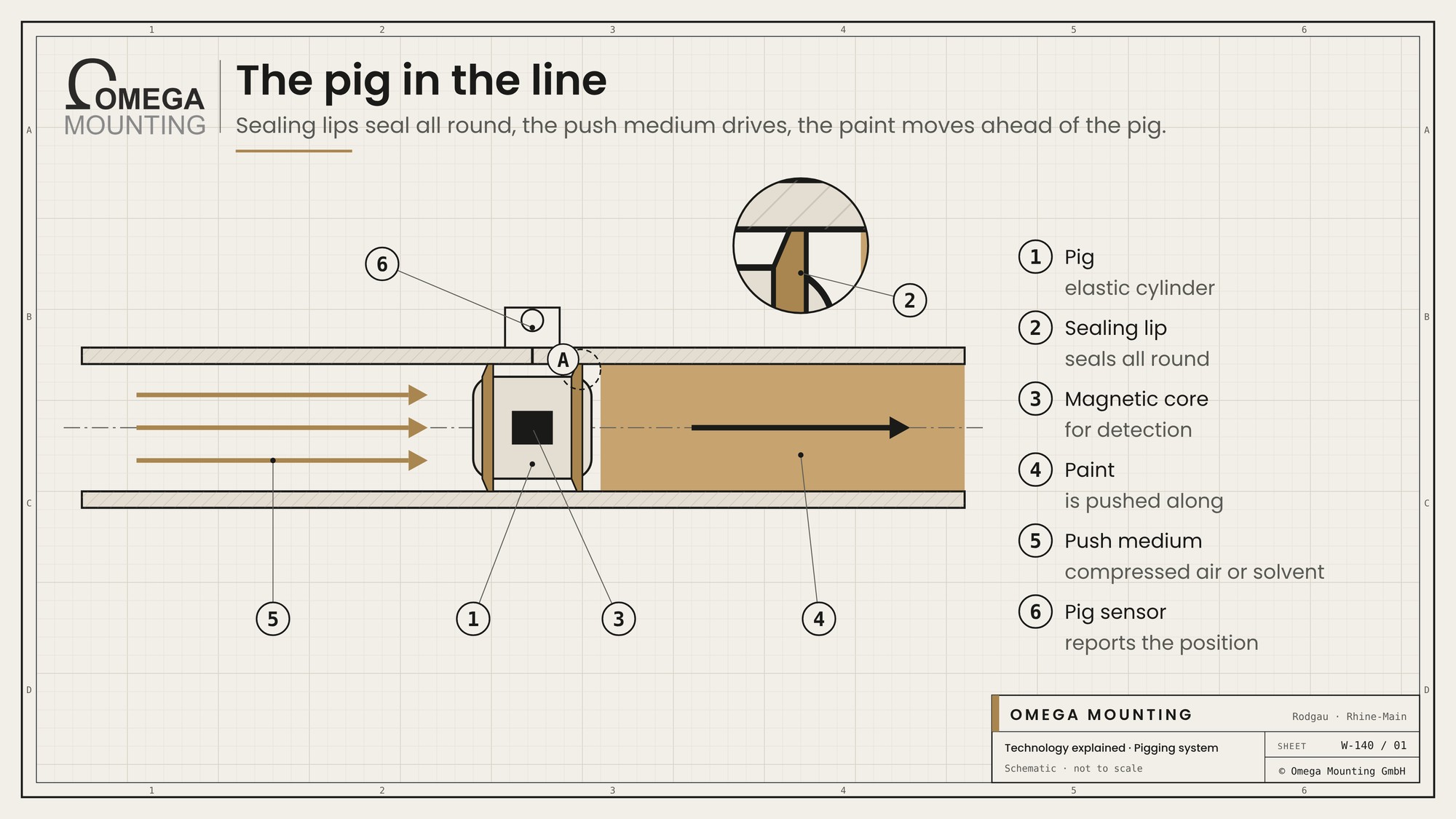
The pig works like a piston travelling through the line.
Behind the pig there is a push medium under pressure, usually compressed air, sometimes solvent or paint. Ahead of the pig lies the paint it sets in motion. Because the sealing lips seal all the way round, hardly any paint gets past it. Whatever lies ahead of the pig arrives at the end of the line.
This gives two operating modes:
- Conveying: The pig pushes a precisely measured quantity of paint to the atomiser. This makes sense for small quantities and special colours.
- Recovering: After painting, the pig pushes the residue back into the tank. The line is then almost empty.
Sensors on the line tell the controls when the pig has reached a station. Only then do the valves open or close. If a signal is missing, the plant stops. A pig that gets stuck somewhere therefore blocks the whole line.
The colour change step by step
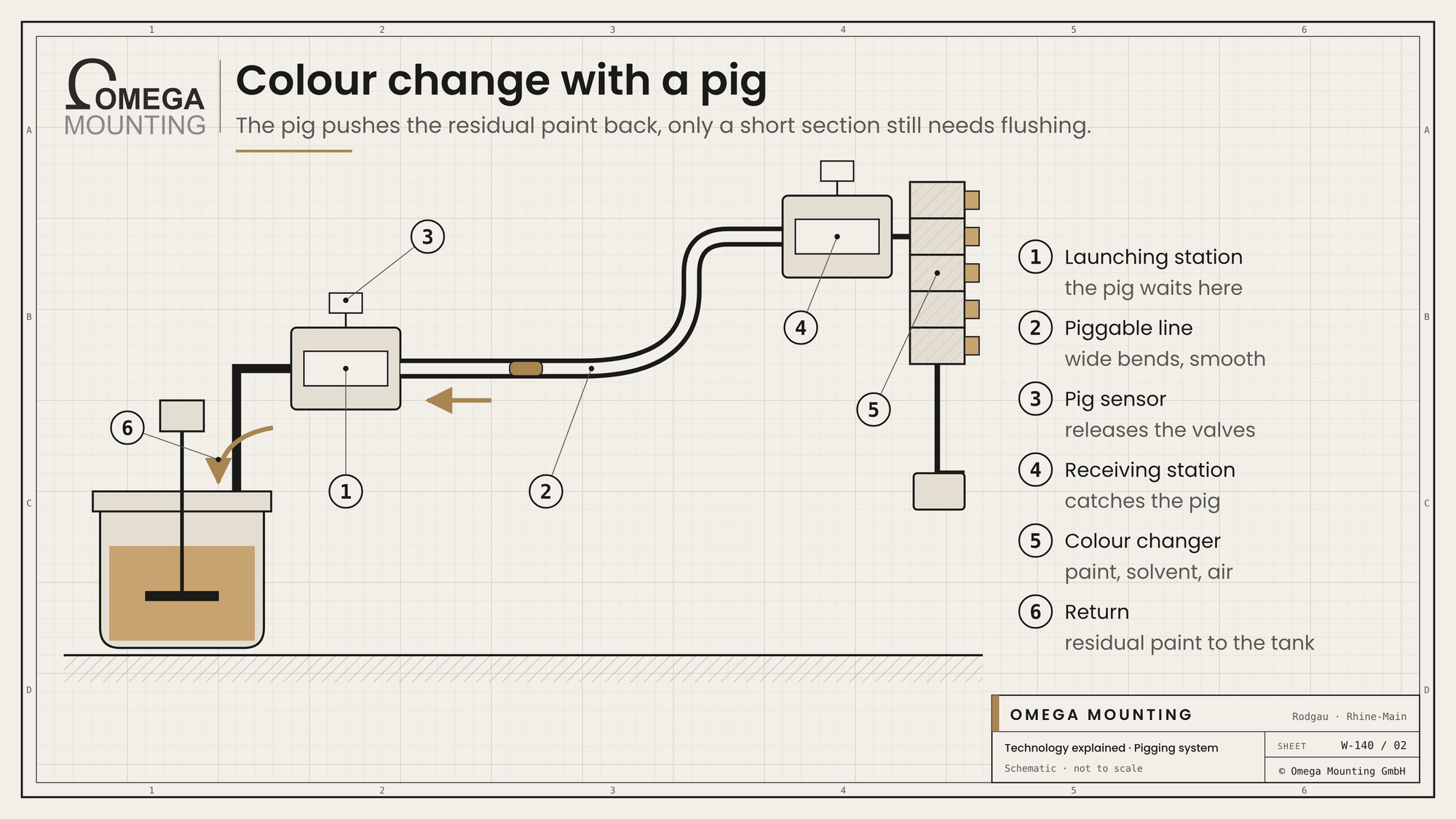
A colour change with a pig runs in fixed steps:
- Painting: The pig waits in the launching station, the line is filled with the current colour.
- Pushing back: The pig travels through the line and pushes the residual paint back into the tank.
- Flushing: Only the short section behind the pig and the colour changer are flushed with solvent.
- Drying: Compressed air blows out the residue.
- New colour: The line is filled with the next colour, the pig returns to its starting position.
Without a pig the whole line would have to be flushed. The residual paint would be lost, and the flushing mixture would have to be disposed of. With a pig the paint remains usable, and far less flushing agent is needed. Less solvent also means fewer emissions in the exhaust air.
For production this means: small batch sizes and many colours become economical. The colour change takes less time, and the line stands still less often. A special colour for a single vehicle no longer costs a whole line full of paint.
Components of a pigging system
| Component | Task | What matters |
|---|---|---|
| Pig | Pushes the paint, seals against the pipe wall. | Correct diameter, undamaged sealing lips. |
| Launching station | Starting point, the pig waits here. | Clean guidance, tight valves. |
| Receiving station | Destination of the pig, catches it safely. | Same diameter as the line. |
| Piggable line | Path of the pig. | Same inside diameter, smooth transitions. |
| Pig sensors | Report the position of the pig. | Correctly placed, easy to reach. |
| Colour changer | Selects the colour, connects the lines. | Aligned channels across all blocks. |
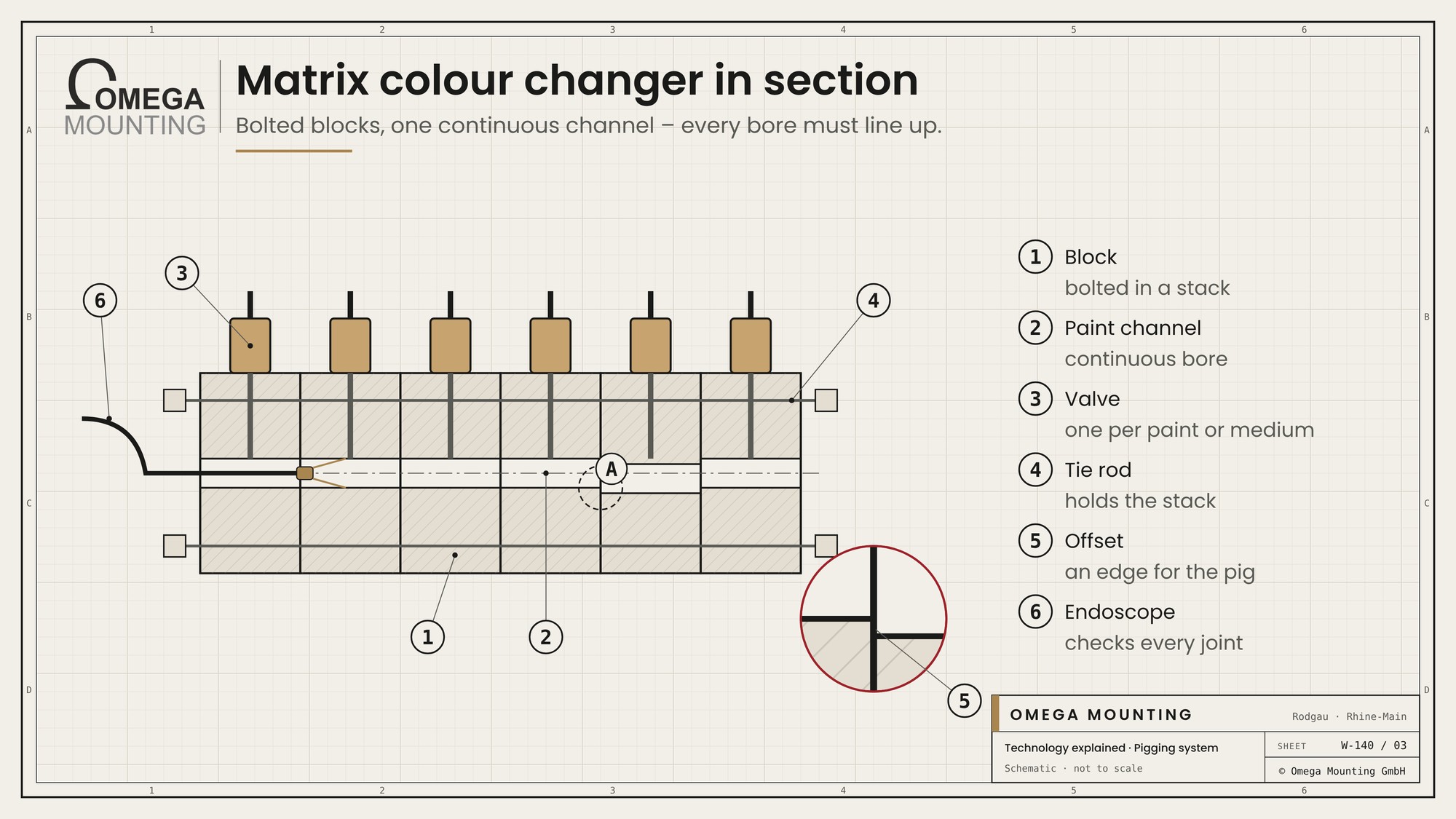
A special case is the matrix colour changer. It consists of a stack of bolted blocks through which the paint channels run. Each block carries valves for one colour or for solvent and air. The pig has to pass through this stack, across every block joint.
Why every transition must be right
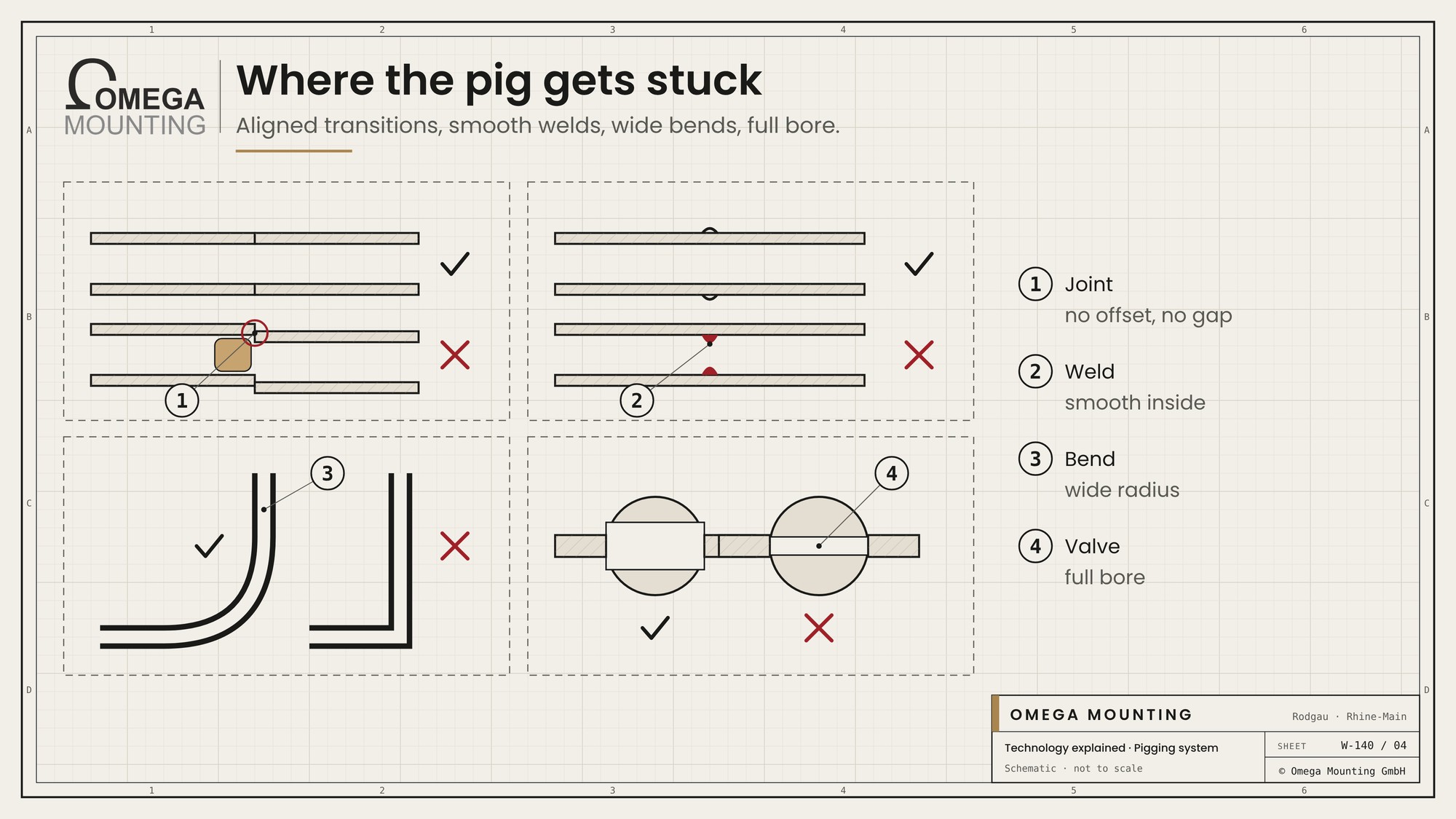
A pig forgives no edge.
An offset of a few tenths of a millimetre at a joint is enough for the pig to get stuck or to damage its sealing lips. A damaged pig no longer seals. Paint then runs past it, and the colours mix at the next change.
Four points are critical:
- Joints: Pipe ends and fittings must meet without offset and without a gap.
- Welds: The weld must be smooth inside. A root that protrudes into the pipe is an obstacle for the pig. That is why such lines are usually orbital welded.
- Bends: The pig needs wide bending radii. It cannot pass tight bends or sharp branches.
- Valves: Only full-bore valves are piggable. A normal valve with a reduced cross-section stops the pig.
When installing a matrix colour changer, we therefore checked with an endoscope during assembly that all bores lined up across the block joints. This check is laborious, but it is the only way to find an edge before the first pig runs through.
Maintenance and typical faults
Pigging systems need little, but regular, care.
- Replace the pig: Sealing lips wear. A worn pig is replaced before it starts to leak.
- Check the sensors: A wrong or missing signal stops the plant. Often a displaced sensor is the cause.
- Clean the stations: Dried paint in the station obstructs the pig.
- Check after modifications: Every joint that has been opened is a possible new edge.
Typical faults are a stuck pig, colour carry-over at the change and false sensor signals. The cause is often not the pig but a joint that no longer lines up cleanly after a repair.
What we pay attention to
When working on pigging systems and paint supplies, we keep the mechanics precise and the interfaces clear.
- We install lines and colour changers free of stress and without offset.
- We check transitions with an endoscope before the plant is filled.
- We keep pipes and components clean so that no dirt gets into the line.
- We label lines and components clearly according to the drawings.
- Orbital welding of the paint lines is carried out by an approved specialist welding company, programming and the paint process by the plant manufacturer.
Where we use it
When installing the paint supply of a paint shop in Italy, we assembled matrix colour changers, manifolds and stainless steel cabinets and checked the transitions block by block. A specialist welding company orbital welded the paint lines, we were responsible for the mechanical installation. Paint shops in operation are also part of our work: during the fan bearing replacement on a paint shop in Offenbach we carried out the maintenance in the middle of a running plant. More about our services for plant manufacturers can be found on our page on Industrial installation.
More technology explained
Technology explained
why the inside of the weld decides on paint lines.
Guide
our guide to what belongs in an installation quotation.
Do you have questions about how this works on your site?
Are you planning a pigging system or converting a paint supply? We take on the mechanical installation and check every transition. Request a callback.
Free, no-obligation callback

About the author
Tobias Schott
Managing director of Omega Mounting GmbH, Rodgau · more than 20 years of hands-on experience in installation and maintenance
A trained mechatronics technician, working in maintenance, servicing and industrial installation since 2004 – first alongside his father, and with Omega Mounting since 2012: from overhead conveyors in Frankfurt to the crane system in a new-build hall. He plans and leads lifting operations as an appointed person (AP) in data centers and on industrial sites in the Rhine-Main region, trains and examines operators of cranes, mobile elevating work platforms and telehandlers, and is a qualified occupational safety specialist. On jobs abroad he is known as the “German Troubleshooter” – the person you call when a site gets stuck. He learned what quality means from his father, not from a manual: Made in Germany as a standard for his own work, not a label. That is why quality comes first at Omega Mounting – ahead of speed and price. The Technology explained articles cover the equipment and techniques his team uses every day: what counts on site is in them – what only appears in the brochure is not.
 English
 German