- Data Center Services – Overview
Heavy equipment for critical infrastructure: data center installation from one partner
Omega Mounting installs, moves and maintains the heavy equipment inside data centers – from rigging multi-ton generators to series-installing complete cooling walls and 24/7 maintenance. Planned, documented and supervised by our in-house Lifting AP (Appointed Person). As a lift and shift contractor and rigging contractor in Frankfurt, we work in the data center (UK: data centre) environment every day.
14+
Years of industrial installation
23
Data centers – lift & shift, installation & commissioning
24/7
On-call service for critical equipment
1,000+
Tons of equipment installed
2,653
Days of data center experience – since May 20, 2019
Your installation partner for data centers in the Frankfurt Rhine-Main region
Founded in 2012 and based in Rodgau near Frankfurt, we work on job sites where there is no second chance. Today, data centers are our largest field of work: we have delivered lift & shift, installation and commissioning projects in 23 data centers – from bare shell to live operation.
We know the procedures of international general contractors from daily practice – RAMS, permits and lift plans in German and English, Avetta registration and security-vetted personnel.
This page gives you an overview of our data center services. Every claim on it can be verified: through the documented projects in our project diary.
Responsible for this page: Tobias Schott, managing director and appointed person for lifting operations (Lifting AP) at Omega Mounting GmbH.
At a glance
- Industrial installation since 2012 – based in Rodgau near Frankfurt
- Lift & shift, installation and commissioning projects in 23 data centers
- Lifting AP (Appointed Person) in-house
- 12 documented data center projects in our public project diary
- 24/7 on-call service for critical equipment
- Avetta-registered, security-vetted personnel
- RAMS & lift plans in German and English
What to expect on this page
Click any topic to jump straight to that section:
Our data center services
Seven service areas, one standard: every move is planned, documented and built to pass inspection.
Lifting & Rigging
Engineered lifts with an Appointed Person: lift plans, tandem lifts, crane supervision – every load under control.
Generators & Transformers
From the low-loader to the foundation: rigging, alignment, mechanical completion and the full exhaust line.
Installation & White Space
CRAH units, fan walls, steelwork: series installation on takt – from a single unit to 320 in one building.
Maintenance & 24/7
Shutdown windows, on-call service, mobile workshop: we keep critical equipment running.
Commissioning & Electrical
Connect, wire, test: our mechatronics engineers bring equipment to life – documented through to handover.
EHS & Certifications
Our own EHS Standard 2026, Avetta, vetted personnel, in-house trainers and examiners – safety that passes audits.
References
12 documented data center projects – anonymized, with real photos. Reference package on request.
Why Omega Mounting?
Data centers do not forgive improvisation. These six points make the difference between hiring fitters and gaining a partner for critical infrastructure:
- Lifting AP in-house: lifting operations are engineered and owned, not improvised.
- GC-proven: listed in the subcontractor programmes of international general contractors, Avetta-registered.
- One partner, all trades: mechanical work, electrical connection, steelwork and welding – from installation to commissioning, with cleanly defined interfaces.
- Our own workshop in Rodgau: custom fabrication, turning, milling – about 20 minutes from the Frankfurt data centers.
- Documentation that passes audits: RAMS, lift plans, handover records – bilingual German/English.
- A direct line: you talk to a decision-maker, not a hotline.
Working to data center standards
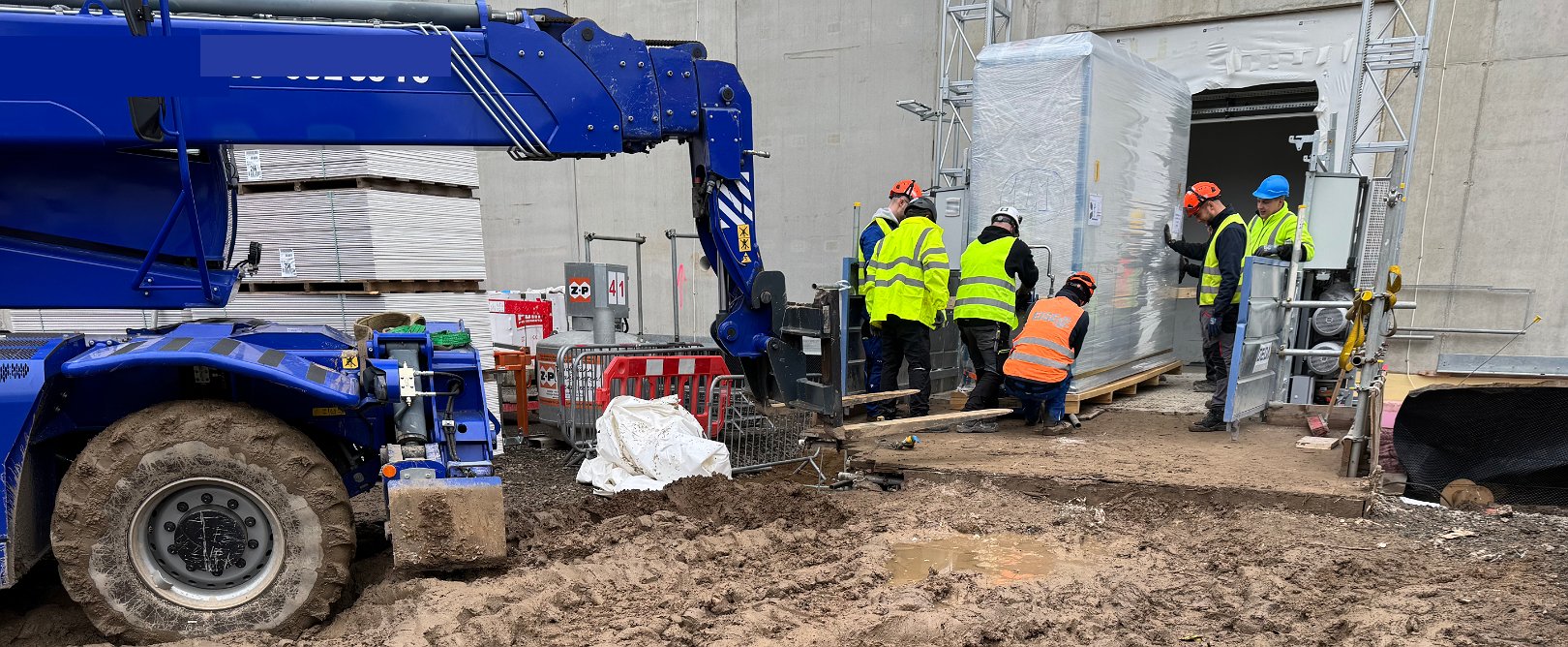
International general contractors and operators run data center sites to a common set of rules. We have built our way of working around them – so our crews fit into your process from day one instead of learning it on site.
Commissioning levels L1–L5
We work inside the operator’s commissioning process: Level 1 factory tests, Level 2 installation, Level 3 pre-functional checks, Level 4 functional tests, Level 5 integrated systems test. The tag sequence red → yellow → green → blue → white marks the progress, and tags are issued by the commissioning agent only. Our deliverable is Level 2A: rigged into place, anchored, inspected – ready for the red tag.
RAMS in the client's format
Risk assessment and method statement are prepared in the general contractor’s template, in English, and submitted at least three weeks before work starts. A rolling four-week look-ahead keeps the approvals ahead of the programme. No approved RAMS, no start of work.
Appointed person for every lift
Every lifting operation is planned and supervised by an appointed person for lifting operations – following the logic of BS 7121 and formally appointed in writing under Section 13 of the German Occupational Safety Act (ArbSchG). The appointed person has the authority to stop work at any time.
Photo documentation as a contract deliverable
Every lift is photographed before and after. Switchgear and panels are documented before they close: torque marks, terminations, earthing, cable entries. The photo record is part of the handover package, not an extra.
English-speaking supervision on site
Supervision on site is English-speaking throughout. We staff one foreman per 20 people and a full-time safety officer from 20 people on site. Incidents are reported verbally within one hour and in writing within 24 hours.
Handover without surprises
Before we ask for the tag: transport locks and wedges removed, lifting eyes removed where applicable, no foreign objects, no transport damage. Open items go onto the punch list, and the documentation is handed over in English.
How your project runs
1
Inquiry & first call
Describe your project – by phone or via the contact form. You speak directly with the Lifting AP.
2
Site survey & planning
We verify routes, loads and time windows on site and produce RAMS and lift plans – bilingual on request.
3
Execution
Installation on the site’s takt: documented, coordinated with GC and other trades, no surprises.
4
Handover & records
Handover with photos, test reports and inspection records – audit-proof for operator and GC.
Documented work instead of marketing claims: the project diary
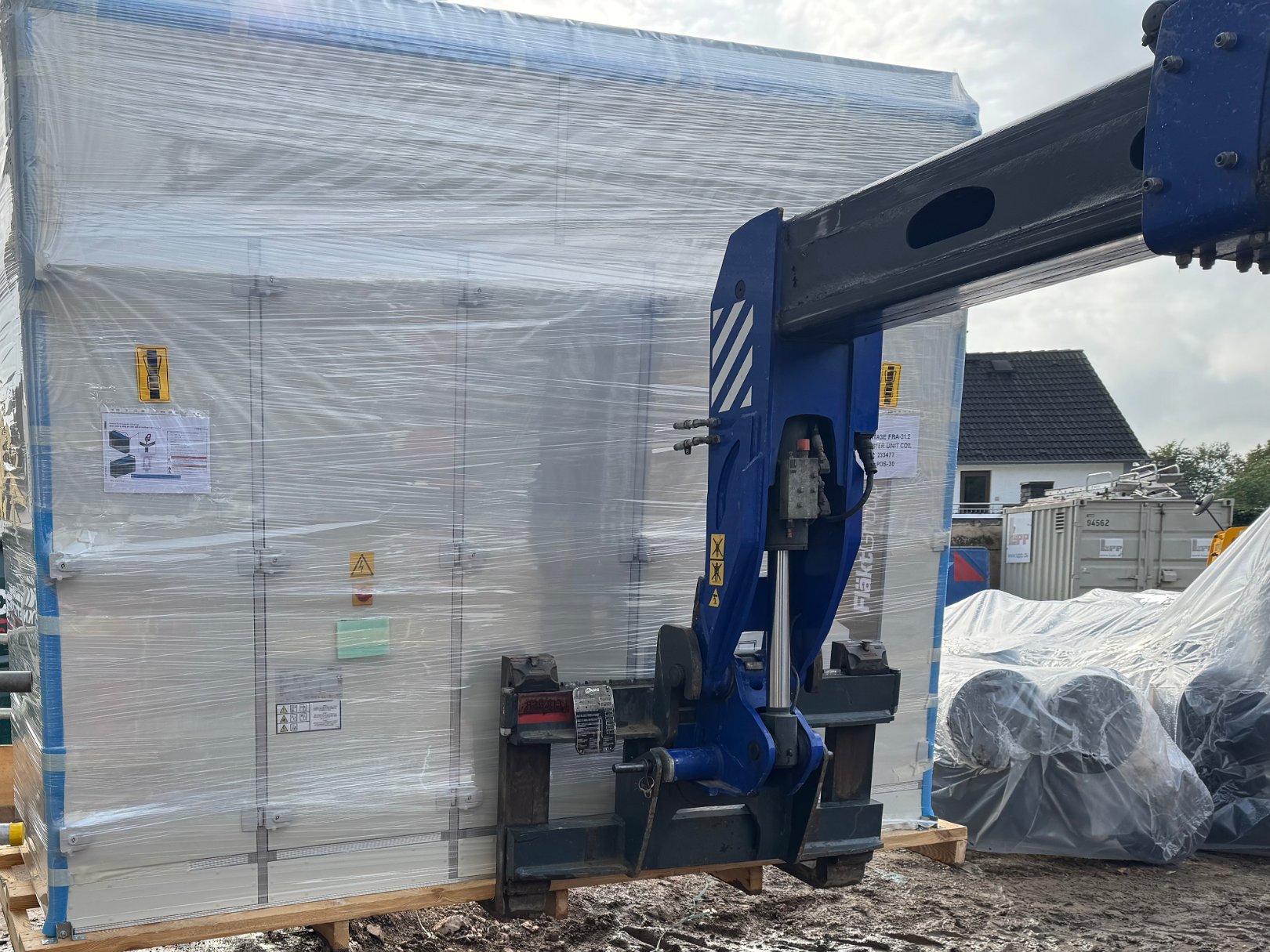
We document our jobs in a public project diary – real photos, honest details and the rules we work by. Twelve entries cover data centers: from extracting a spider crane out of a basement to a fan wall across every floor of a building.
Operators and clients are never named – in this industry, discretion is part of the service.
Guides and documented projects
Our English-language guides explain how data center work differs for subcontractors, what commissioning demands of the installation contractor and how CRAH units, chillers and standby power systems are replaced in live operation. The documented projects below show the same standards applied on real sites in the Frankfurt Rhine-Main region – without naming operators or clients.
Guides
Access, escort rules, commissioning tags and documentation: what subcontractors need to know before their first data center job. Read more →
Step-by-step checklist for swapping a CRAH unit while the data hall stays online. Read more →
Why rigging routes, openings and load paths for chillers should be planned from day one. Read more →
Takt planning, crew sizing and logistics for installing equipment in series across data halls. Read more →
Levels L1–L5, the tag system and the documentation the installation contractor owes at each stage. Read more →
Generators, tanks, switchgear, SCR and silencers: the components of a data center standby power system. Read more →
Documented projects
160 power distribution cabinets moved in and positioned across eight data halls in the Rhine-Main region – lift & shift. Read more →
Lift & shift of a CRAH unit in a live Frankfurt data center under the strictest safety requirements. Read more →
How a standby power system gets into the building: rigging route, skates and final positioning of the generator sets. Read more →
Five 100-cubic-metre diesel tanks lifted over the shoring wall into the pit at the Raunheim data center. Read more →
52-tonne transformers moved into a closed building at a Frankfurt data center on a skidding system. Read more →
Load banks and generators moved into a Frankfurt data center – lift & shift with a 220-tonne mobile crane. Read more →
Millimetre work: recovering a spider crane from the basement of the Raunheim data center. Read more →
Nitrogen gas suppression system installed in a cylinder room at a data center in the Frankfurt area. Read more →
Twelve turbo silencers installed against the whistling of the standby generators. Read more →
Emergency call-out: radiator repair on a standby generator, including pressure test. Read more →
The Frankfurt data center market: why specialisation wins
Frankfurt is continental Europe’s largest data center market. Around DE-CIX – one of the world’s most important internet exchanges – new builds follow one another year after year: hyperscale campuses in Raunheim, Kelsterbach and Hattersheim, colocation expansions across the metro area. For operators and general contractors this means full construction programmes, tight schedules – and qualified installation capacity as the bottleneck.
A data center is not an ordinary construction site. Working here means mastering the safety logic of international general contractors, delivering documentation in English, passing access and vetting procedures – and moving multi-ton, highly sensitive equipment with millimetre precision, often in buildings still under construction or already carrying live IT. Generalists hit their limits quickly. That is exactly why we specialised.
Omega Mounting has taken that path to its logical end: from first jobs as a subcontractor, through listing in the qualification programmes of the major general contractors, to today’s role as a direct installation partner with an in-house Lifting AP. If you build in the Frankfurt market, you get a partner who doesn’t have to learn the rules – we apply them every day.
Who we work for: four client groups, one standard
Our data center clients fall into four groups – each with different priorities that we adapt to:
- General contractors (GC): get a pre-qualified subcontractor who knows RAMS, permits and reporting from daily practice, keeps schedules and creates no interface disputes.
- Manufacturers and system vendors: get an installation partner who erects their equipment – from CRAH units to SCR systems – brand-neutrally, in series and fully documented, while they focus on product and commissioning.
- Operators and colocation providers: get a partner for swaps, retrofits and maintenance in live environments – discreet, clean and aligned with approval windows.
- Consultants and project managers: get installation expertise early: we prefer to verify rigging routes, load assumptions and time windows before they become schedule problems.
From first contact to framework partnership: our onboarding
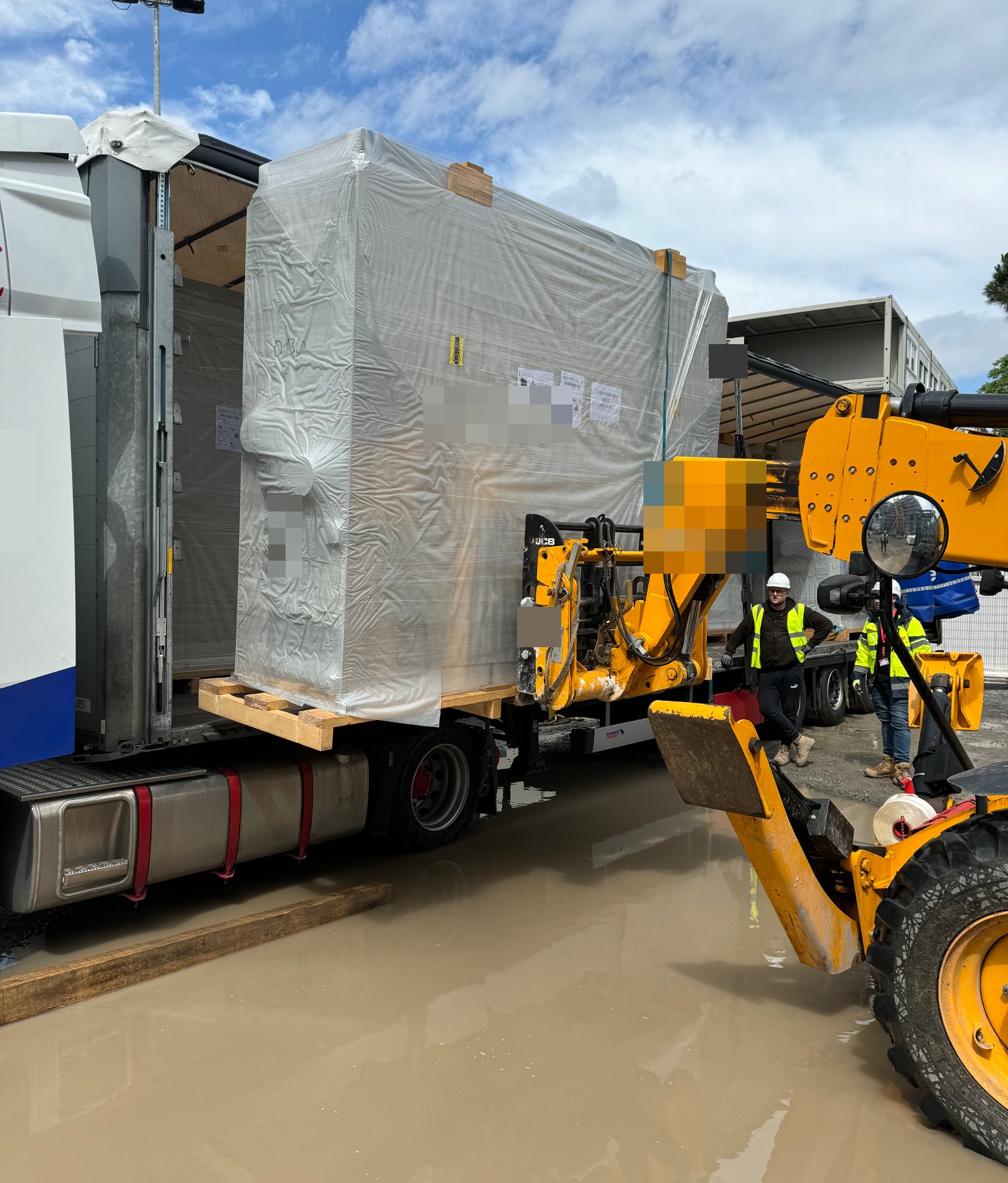
New data center clients rarely start with their biggest job – and that is a good thing. The proven path: pre-qualification, a cleanly delivered first project, then growing scopes up to a framework partnership.
We take as much of the formality off your desk as possible: our records – Avetta registration, insurance, certificates, EHS standard, qualification matrix – are bundled and ready for your vendor review. Our teams routinely complete inductions, access procedures and project-specific briefings; security-vetted personnel are available for restricted areas.
After that, only performance counts. Our ambition for every first project: deliver so that the second inquiry comes by itself. A large share of our current data center work started exactly that way – with a small first job that kept every promise the quotation made.
Scalable through the supervisor model
Data center projects breathe: weeks with two fitters are followed by phases where several crews work in parallel. To keep quality constant, we lead through the supervisor model: experienced leads, each with their own workshop van, run their crews, own safety and quality on site and are directly accessible to the client.
This scales capacity without diluting standards: every crew works to the same rules, the same documentation, the same ambition. Client assignments rotate deliberately – so your site is known not by one person but by a practiced team. For you, that means no key-person risk during holidays or illness, and a second opinion that is already familiar with your project.
And if a project grows faster than planned, we call on long-standing partner crews, led under our EHS standard and bound to our rules in writing. Responsibility always stays with us: you have one contract, one contact, one quality benchmark.
Our own equipment: available while others are still renting
Working to a data center construction schedule leaves no room for waiting on rental gear. We have therefore invested in equipment built for exactly this environment: electric mini cranes and lifting gear for indoor work, machine skates and heavy-load dollies, mobile gantry cranes with chain hoists, spreader beams and certified lifting tackle in every common configuration.
Two in-house developments have become trademarks: our lift & shift trailer, which rolls tooling and lifting equipment onto site as one complete unit, and our mobile data center workshop – praised by clients as a model solution, because repairs and adjustments happen on site instead of circulating for days.
What we don’t own ourselves – 220-ton-class mobile cranes, telehandlers, special-size access platforms – we source through long-term partners and coordinate end to end, lift plan included. What matters to you: the right machine at the right gate on the right day.
Schedule reliability on takt-driven projects
On a data center build, every milestone carries follow-on trades, test schedules and ultimately a go-live date agreed with the operator’s customers. Delay is not an inconvenience here – it is damage. Our answer is unspectacular and therefore effective: planning.
In practice: we verify rigging routes and load paths before delivery, not during. We prefabricate substructures and custom parts in our Rodgau workshop so site time is spent installing, not improvising. We schedule people and equipment with reserve, because a buffer you don’t need is cheaper than a standstill nobody pays for. And we flag deviations immediately – not in the weekly report.
Our project diary documents the results job by job: series installations that stayed on takt, weekend windows handed over on Monday morning, emergency call-outs that started the same day. “Unspectacular, because well planned” is not a slogan for us – it is the summary of our best projects.
What sets us apart from conventional installation companies
The market for industrial installation is large – the market for data-center-grade industrial installation is small. The difference is rarely the tooling and almost always the organisation: a conventional installer supplies fitters; a data center installation partner supplies a system of qualified people, proven processes, robust documentation and credentials that pass any vendor review.
Concretely, what separates us from generalists: an in-house Lifting AP instead of outsourced lift planning, a bilingual EHS standard instead of a binder collection, Avetta registration and security-vetted personnel instead of weeks of access lead time, our own workshop with real fabrication depth instead of dependence on delivery times – and a public project diary instead of an anonymous reference list. Each point can be copied individually; the combination cannot, because it grew over years on real job sites.
And perhaps the most important difference: we want this market. Data centers are not a sideline for us – they are the field we have aligned our equipment, training and organisation to. Specialists have to deliver. Hold us to it.
Your next step: the first conversation
Getting started is deliberately simple: a call or a message via the contact form, then 20 to 30 minutes about your project – with someone who knows job sites and is authorized to decide, not a call center.
Anything that describes your project helps: What needs to be moved, installed or maintained? In what timeframe? Under which conditions – new build or live environment, access rules, other trades involved? You don’t need perfect documents; asking the right questions is our part of the job.
You then receive an honest assessment: what is feasible, what it roughly costs, where we see risks – and also what we would not take on. On that basis you decide whether it becomes a quotation, a site survey, or nothing for now. No pressure, no follow-up loops: people who were advised well come back. We have relied on that since 2012.
Planning a data center project?
Talk directly to the Lifting AP – no call center, no hold music. Tell us briefly what it is about and you will get an honest assessment of feasibility, timing and effort.
100 % non-binding & free of charge · Direct line: +49 6106 239 25 88
Frequently asked questions
Omega Mounting handles the installation, lifting and commissioning of heavy data center equipment: rigging and positioning of generators, transformers and load banks, installation of CRAH units and fan walls, steelwork and custom fabrications, electrical connection work and commissioning, plus maintenance and fault response – all planned and supervised by our in-house Lifting AP (Appointed Person).
Our home market is the Frankfurt Rhine-Main region – Frankfurt, Raunheim, Offenbach, Kelsterbach and the surrounding area. We have delivered lift & shift, installation and commissioning projects in 23 data centers to date. Our base in Rodgau is roughly 20 minutes by road from the Frankfurt data center corridor; for larger projects we work throughout Germany.
Yes, daily. We are listed in the subcontractor qualification programmes of international general contractors, are Avetta-registered, and work with RAMS, permits and lift plans in German and English. Our own EHS Standard 2026 sets out how we work on site across 28 chapters.
Yes. With a 24/7 on-call service, our own warehouse in Rodgau and a mobile workshop, we respond very quickly across the Rhine-Main region – including nights and weekends. Emergency call-outs are part of our normal business, not an exception.
Yes. We maintain generators, cooling equipment and mechanical systems during planned shutdown windows – at night, on weekends or in live environments with segregated work areas. One example: we have supported a sorting facility at Frankfurt Airport on a 24/7 basis for more than a year.
You talk directly to the Lifting AP, not to a call center. After a short initial conversation – with a site visit where useful – you receive an honest assessment of feasibility, timing and effort.
Yes – it is our daily environment. Safety procedures, permits, reporting and documentation in English are standard for our teams, and our qualification records are bundled and ready for your vendor onboarding.
Through our supervisor model: experienced leads each run their own crew with identical standards and documentation. Projects can grow from two fitters to several parallel crews without losing quality – and mobilization in the Rhine-Main region is a matter of days, not weeks.
Absolutely. Many of our long-term client relationships started with a single unit swap or one weekend call-out. A small job, delivered cleanly, is the best possible start for both sides.
From a single equipment swap to series installations of several hundred units. There is no hard lower limit – and at the upper end we scale through parallel, supervisor-led crews.