
- Project report – Suppression cylinder room at a data center
Suppression cylinder room at a data center: nitrogen gas suppression system installed in the Frankfurt area
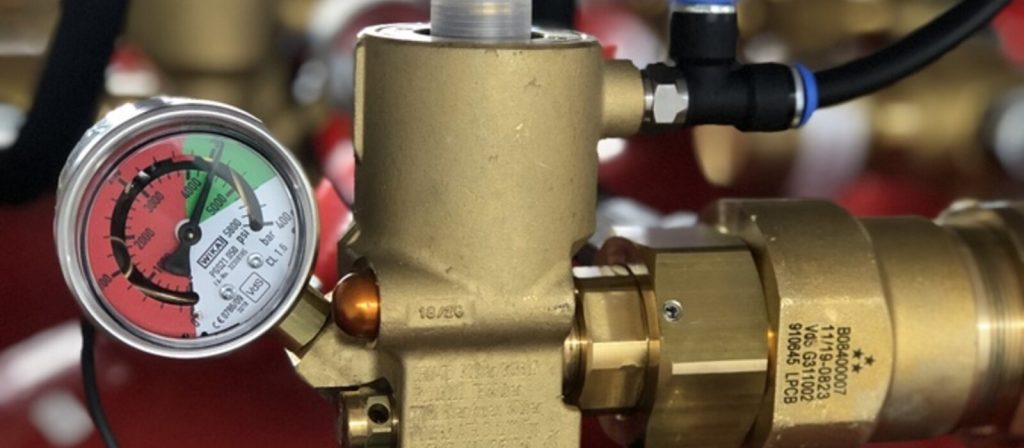
How 3 fitters installed cylinder racks, pipework and 240 nitrogen cylinders in 2 weeks – on behalf of one of the major fire protection companies
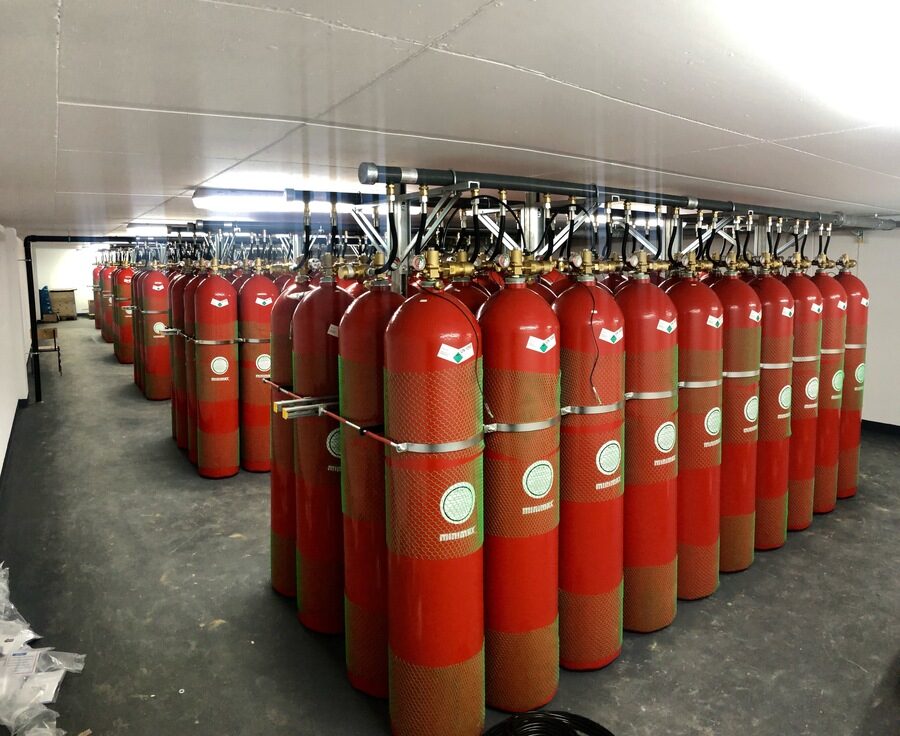
A data center without fire protection is unthinkable – and the premier class of fire protection for IT areas is the gas suppression system. At a data center in the Frankfurt area, we installed the complete suppression cylinder room: the cylinder racks, the pipework to the existing building network and 240 individually moved-in and connected nitrogen cylinders – six banks of 40 cylinders each. We were commissioned by one of the major fire protection companies – a classic partner job: the specialist company plans and commissions, we deliver the precise installation.
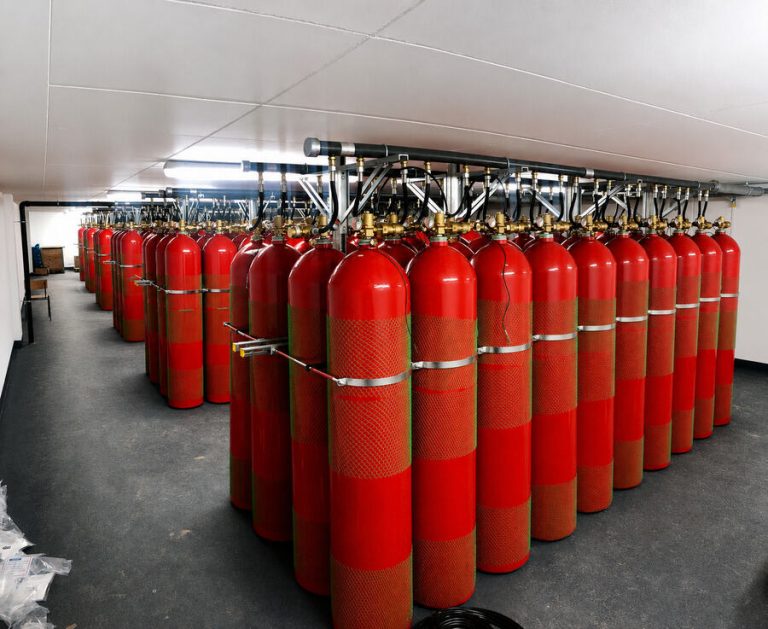
3 fitters, 2 weeks, and at the end there is a room full of neatly aligned red cylinder banks, with every valve, every pressure gauge and every hose sitting exactly where it belongs. The photos show the result – a suppression cylinder room straight out of the textbook.
Project profile
- Scope: Installation of a complete suppression cylinder room (nitrogen gas suppression system) at a data center – erection of the cylinder racks, installation and connection of the pipework to the existing building network, moving in and connecting 240 suppression gas cylinders (6 × 40) incl. valves, pressure gauges and high-pressure hoses
- Team: 3 fitters from Omega Mounting
- Project duration: 2 weeks
- Location: Data center in the Frankfurt area (operator and client anonymised)
- Client: One of the major fire protection companies – commissioning was carried out step by step by the client and operator
What is a nitrogen suppression system?
A nitrogen suppression system is a gas suppression system that fights fires without water, foam or powder: in the event of a fire, nitrogen flows from a cylinder bank into the protected room and lowers the oxygen content there to the point where flames are smothered – sensitive equipment remains completely intact. That is exactly why inert gas suppression technology is the standard for data centers, server rooms, archives and switchgear rooms: no extinguishing agent residue, no water damage, no conductive residues on the electronics.
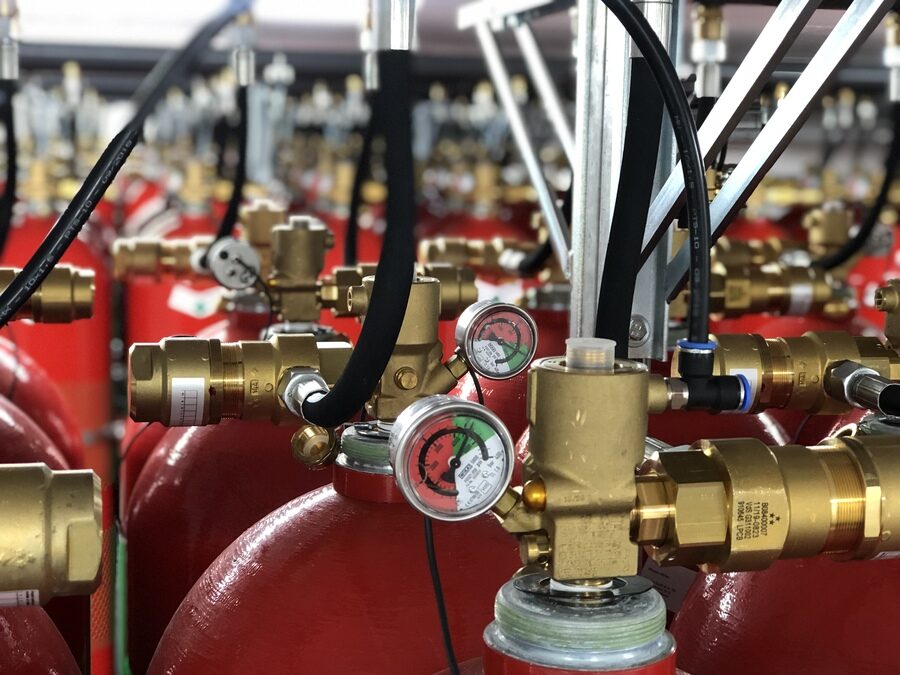
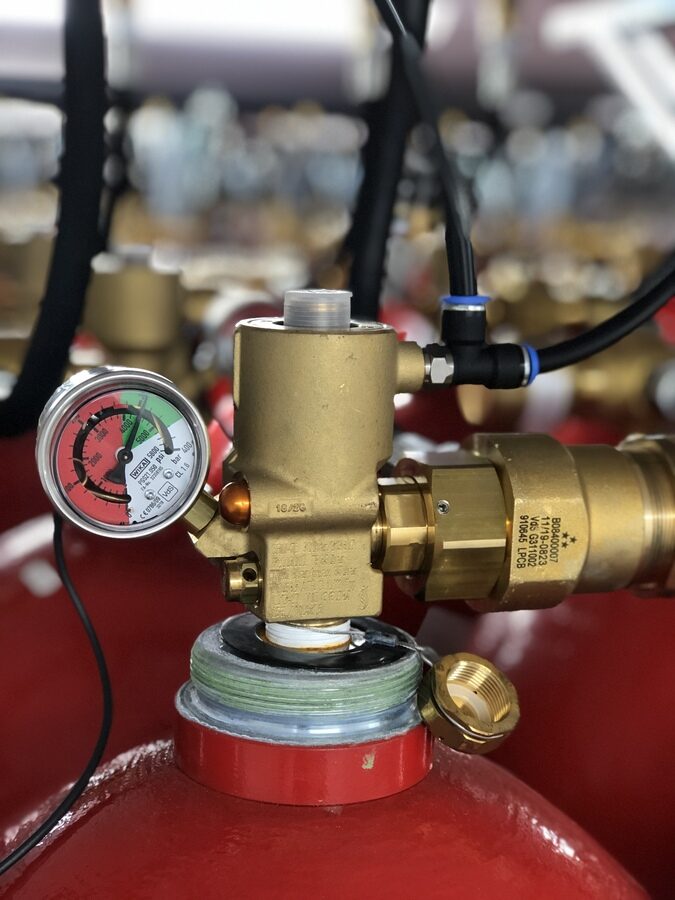
The heart of the system is the suppression cylinder room: long rows of high-pressure cylinders – here with nitrogen at around 300 bar – standing in sturdy racks, connected via connection hoses to a common manifold and, when triggered, releasing their quantity of suppression gas together within seconds into the pipework to the protected area. Each cylinder carries its own valve with pressure gauge – whether the pressure is correct can be seen at a glance.
How does the installation of a suppression cylinder room proceed?
In three clear steps – from an empty room to a system ready for connection. First, we installed the cylinder racks: the steel structures that will later hold every single cylinder securely and keep the rows exactly in order. Second, the pipework was installed and connected to the existing building network – the connection through which the suppression gas flows to the protected areas in the building in an emergency.
Only then came the third and most labour-intensive step: the cylinders. 240 high-pressure cylinders – six banks of 40 cylinders each – were moved into the room individually, placed in the racks, secured with brackets and connected one after the other. The photos show the result: row upon row of perfectly aligned cylinders, above them the manifold with the connection hoses – order that not only looks good, but is function when the system is triggered.
What matters when connecting?
Position, fittings and leak-tightness – on every single cylinder. During the connection work, care had to be taken that all components – valves, pressure gauges, hoses – sit in the correct position and everything is properly tightened. With a system at around 300 bar operating pressure, there is a simple reason for this: any leaking fitting would gradually lose pressure – and a suppression system that does not have its full pressure in an emergency is not a suppression system.
That is why the same care applies to every connection: valve in the correct orientation, pressure gauge positioned so it can be read, hoses routed to the manifold without tension or kinks, every fitting tightened in a controlled manner and checked for leaks. This allowed the system to be commissioned step by step by the operator and our client – section by section, without rework.
Why do fire protection companies work with installation partners like us?
Because everyone does what they do best. The fire protection company brings planning, suppression technology expertise, approvals and commissioning – we bring the well-practised installation team that installs racks, pipework and hundreds of heavy high-pressure cylinders on schedule, precisely and safely. For the end customer, the result is a system from a single mould; for our client, we are the extended workbench on site.
Add to that our data center routine: access rules, security areas, working next to sensitive infrastructure – we know the rules of data centers from many jobs in the Rhine-Main region. That makes the cooperation predictable for everyone involved.
Why Omega Mounting?
- Installation partner to specialist companies: Fire protection, refrigeration and plant engineering companies rely on our teams – we install, the partner commissions.
- Data center routine: Security areas, access, sensitive environment – data centers are our familiar terrain.
- Precision under pressure: At 300 bar, every fitting counts – we check position, alignment and leak-tightness on every single cylinder.
- Stamina in series work: Moving in, securing and connecting 240 cylinders individually – we maintain quality right through to the 240th connection.
- Everything from a single source: Racks, pipework, connection to the building network, cylinder installation – one site, one team.
- Rooted in the region: From Rodgau, we are quickly on site in the Frankfurt area, Offenbach and the entire Rhine-Main region – and work throughout Germany.
Conclusion
Cylinder racks installed, pipework connected to the building network, 240 nitrogen cylinders in six banks moved in individually and bolted leak-tight: after two weeks, a complete suppression cylinder room stood at the data center in the Frankfurt area – ready for step-by-step commissioning by our client. If you are a fire protection or plant engineering company looking for a reliable installation team, or your building needs a new suppression cylinder room, get in touch.
Request a callback for your project now – Omega Mounting GmbH, Rodgau. As an installation company from the Offenbach district, we are quickly on site in Frankfurt, Offenbach, Hanau and the entire Rhine-Main region – and work throughout Germany.
More about our work in the city, access routes and service areas: Industrial installation in Frankfurt.
Photo gallery of the job
Are you planning a project of this kind?
Tell us briefly what it is about – we will come back to you with an honest assessment.
100% free and without obligation
Related guides for this project

About the author
Tobias Schott
Managing director of Omega Mounting GmbH, Rodgau · more than 20 years of hands-on experience in installation and maintenance
A trained mechatronics technician, at home in maintenance, servicing and industrial installation since 2004 – first alongside his father, and since 2012 with Omega Mounting: from the overhead conveyor in Frankfurt to the crane system in a new-build hall. As appointed person for lifting operations, he plans and leads lifting operations in data centers and on industrial sites in the Rhine-Main region, is an instructor and examiner for cranes, aerial work platforms and telehandlers, and a safety officer. On assignments abroad he is known as the "German Troubleshooter" – the one you call when things get stuck on site. He did not learn what quality means from a manual, but from his father: Made in Germany as a standard for his own work, not as a label. That is why quality comes first at Omega Mounting – before speed and before price. The project diary shows the jobs his team has planned and carried out – without customer names, but with everything that can be learned from them.
Frequently asked questions
In the event of a fire, nitrogen flows from a high-pressure cylinder bank into the protected area and lowers the oxygen content until flames are smothered. Electronics remain intact – there are no water, foam or powder residues. That is why inert gas suppression technology is standard in data centers and server rooms.
The cylinder racks, the high-pressure cylinders with valves and pressure gauges, the connection hoses, the manifold and the pipework to the building network. On this project, all components were installed by us; commissioning was carried out by the fire protection company as the client.
Individually – on this project 240 of them in six banks of 40 cylinders each: every cylinder is moved into the room, secured in the rack and connected. What matters is that valves, pressure gauges and hoses sit in the correct position and everything is properly tightened and leak-tight – at around 300 bar filling pressure, there is no such thing as an "almost tight" connection.
Because a gas suppression system only works if the full pressure is available at the moment of triggering. Leaking fittings lead to gradual pressure loss – which is why every connection is tightened in a controlled manner and checked before the system goes into operation.
Yes, regularly: the specialist company plans and commissions, we install – racks, pipework, components, series connections. Teams that keep to schedule and clean handovers make us a reliable partner for specialist companies.
Yes – this suppression cylinder room was built at a data center in the Frankfurt area. From Rodgau, we are quickly on site throughout the Rhine-Main region, from Frankfurt via Offenbach to Hanau and Darmstadt – and throughout Germany on request.
 English
 German