
- Guide – Data Center
Commissioning in Data Centers: What the Installation Contractor Must Deliver
By Tobias Schott · Reading time approx. 22 minutes · Last updated: October 2026

Commissioning in a data center is a staged testing process from factory acceptance test to integrated systems test. The installation contractor delivers the lowest level: a documented, tagged installation reported free of defects, on which all further tests are built.
As project manager you manage the installation in the data center and you know: the end result is not a piece of plant set in place, but its proven function in interaction with all other systems. Between the moment a cabinet stands or a pipe is leak-tight and the moment the data center goes into operation lies commissioning. That is where it is decided whether the installation is recognised as a completed service or counts as an open construction site. The subject of this guide is therefore “commissioning in data centers from the installation perspective”: the interface between the installation level and the testing chain.
The problem from your point of view: the installation contractor delivers hands, lifting equipment and experience – but does it also deliver the documentation package the testing process needs? If a torque record, photo documentation or the tag on the unit is missing, the testing chain stops. And it does so precisely when the construction schedule is tightest and the handover to the operator is a fixed milestone.
This article describes commissioning in a data center from the installation perspective: which levels the testing process generally has and what role the installation contractor plays in it. It also covers which documentation the contractor must deliver and how acceptance, tagging and defect-free completion notice interlock. It is an in-depth follow-up to our foundation guide on data center installation.
Key points at a glance
- Commissioning in a data center is a staged testing process that runs from the factory acceptance test (FAT) via installation inspection and site acceptance test (SAT) to the integrated systems test of all systems.
- The installation contractor is responsible for mechanical completion: correctly positioned, levelled, connected, bolted, tagged and documented.
- The documentation package includes installation records per unit, torque and leak-test records, photo documentation, test certificates for the work equipment used, a tag list and the defect-free completion notice with punch list.
- Tagging is only usable if the same tag appears in the design, the delivery note, the layout plan, on the component and in the record.
- The acceptance of the installation work in the legal sense (contract for work, VOB/B) and the technical test levels of commissioning are two different things that must be kept cleanly separate.
- Typical gaps are photos that cannot be assigned, blanket records instead of unit-specific records, and defect-free completion notices with no reference to the test level.
- In the Rhine-Main region – Frankfurt, Offenbach, Raunheim, Hanau – we hand over installation work in such a way that the testing chain continues without queries.
What is commissioning in a data center?

Commissioning in a data center is the systematic process, structured in levels, by which it is demonstrated that every technical system and ultimately the interaction of all systems works as designed. This happens before operation begins. In Germany, the closest equivalent is commissioning management as described in the guideline VDI 6039 for building services systems.
The levels generally follow a logic from the individual to the whole:
| Level | What is checked | Who typically tests |
|---|---|---|
| Factory acceptance test (FAT). | Component at the manufacturer before delivery. | Manufacturer, design engineer, client. |
| Incoming inspection. | Condition, completeness and tagging on delivery. | Installation contractor, supplier. |
| Installation inspection / mechanical completion. | Position, fixing, connections, leak-tightness, tagging, cleanliness. | Installation contractor, site management. |
| Site acceptance test (SAT) / functional test per component. | Individual unit under voltage or with medium, sensors, actuators. | Specialist trade, manufacturer, Cx agent. |
| Systems test. | Interaction within one system, such as a cooling circuit or power distribution. | Cx agent, design engineer. |
| Integrated systems test (IST). | Interaction of all systems including failure scenarios under load, usually with load banks. | Cx agent, operator, design engineer. |
| Handover and documentation. | Complete evidence, training, punch list. | All parties. |
How many levels there are, what they are called and who signs them off is defined by each project individually. The logic stays the same: no level is entered before the one below it has been demonstrated. That is exactly why the installation level is so important – it carries everything that follows. And it is the level at which the white space (data hall) and grey space (plant areas) are still a construction site. With handover they become a live environment – live operation with maintenance windows, change requests and permits to work for every further intervention.
For the installation contractor this means a clear role: it is responsible for the lower levels and delivers to the following trades and the commissioning agents a service that can be tested. What else is different for subcontractors in a data center is described in our foundation guide on data center installation.
What role does the installation contractor play in data center commissioning?
In commissioning, the installation contractor is responsible for mechanical completion. It demonstrably ensures that every unit stands at the correct position, is correctly fixed and connected, and is leak-tight and clean. And it tags each unit so that it can be clearly identified in all subsequent test levels.
Mechanical completion means more than “it's standing”
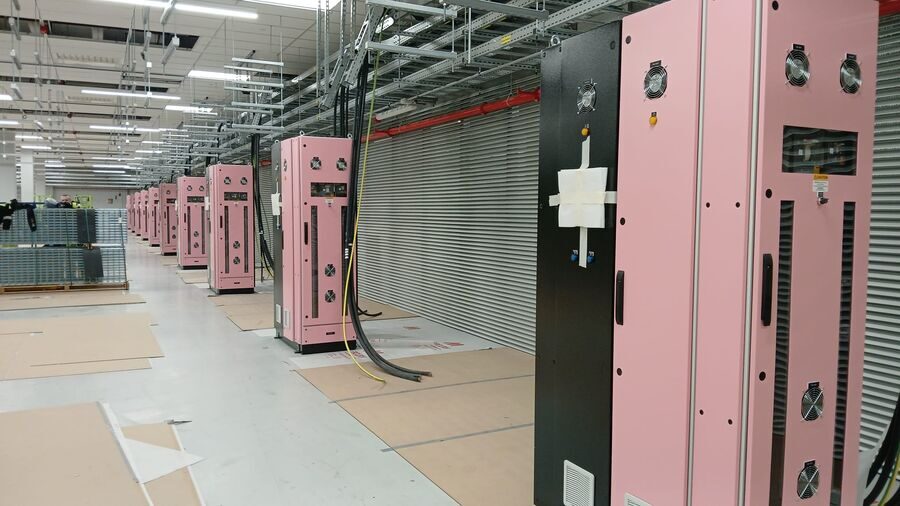
A cabinet standing at its position is not yet mechanically complete. It is mechanically complete when it has been positioned by survey according to the layout plan, aligned in the row and set plumb, fixed, checked for transport damage, tagged and documented. In addition, the floor protection on the raised floor around it must be intact and the work area must be reported clear for the following trade. During the rollout of 160 PDCs in a data center in the Rhine-Main region, this clean handover was decisive. The electrical connection work was carried out afterwards by the electrical contractor. With 160 cabinets there was exactly zero rework.
The interface to the following trade is the test level
Every handover from the installation contractor to a following trade – electrical, cooling, fire suppression, controls – is in effect a test level. In trade coordination it is a handover point in the takt. The following trade can only work cleanly if the installation level has been demonstrably completed. A misaligned cabinet or a bolted connection without a record is not noticed by the installation contractor but by the electrician – or only at the systems test, when the punch list should long since have been closed.
A special case is work equipment that the installation contractor installs itself – an overhead crane in the generator room, lifting points for later maintenance, a maintenance platform. For these, the German technical rule TRBS 1201 on the inspection of work equipment requires an inspection after installation and before first use, because safety depends on the installation conditions. For you this means: this inspection record belongs in the handover package, otherwise the following trade may not use the equipment.
What the installation contractor does not test
The boundary is just as important: functional tests under voltage or with medium, systems tests and the integrated systems test are the task of the specialist trades, manufacturers and commissioning agents. When installing a suppression cylinder room in the Frankfurt area, we installed cylinder racks, pipework and 240 nitrogen cylinders and bolted them leak-tight. Commissioning then took place step by step, section by section, by the specialist suppression contractor. The installation contractor delivers the prerequisite for this – not the test itself.
Participation in the higher levels
Even though the installation contractor does not test, it participates. It provides access to connection points, opens and closes panels, sets lifting accessories for test set-ups, moves test equipment in and out again. For load tests of the standby power systems and the UPS, load banks and generators are moved in – mobile load banks that simulate the electrical load of the servers. Their documented moving in with a lift plan is part of the prerequisites for the test. As soon as parts of the plant are already running in a live environment, every participation additionally needs a permit to work from the operator and takes place in a maintenance window. These participation obligations belong as line items in the scope of works so that they do not end up as change orders.
How does the acceptance of the installation work proceed?

The acceptance of the installation work runs on two separate tracks. One is the legal acceptance of the work under Section 640 of the German Civil Code (BGB) or Section 12 of the German construction contract procedures (VOB/B); the other is the technical release of the installation level in commissioning. Both need the same documentation but have different consequences.
Legal acceptance
With legal acceptance, the client declares that it recognises the work as essentially in accordance with the contract. With it, the warranty period begins and the burden of proof is reversed. Under VOB/B as the contractual basis, formal acceptance takes place at the request of either party and is recorded in an acceptance report. For unit price contracts, the measurement is part of it. For the project manager this means: acceptance of the installation is a legal act that must be documented – not a tacit continuation of work by the next trade.
Technical release of the installation level
Independently of this, the site management or the commissioning agent checks in an acceptance walk-down whether the installation level has been fulfilled as the prerequisite for the next test level. This release is often given per unit or per area, not for the whole trade at once. It can be given subject to open items that do not hinder progress.
Partial acceptances and area releases
For rollouts and installations in data centers across several areas, partial acceptances per hall or per section make sense. The suppression cylinder room in the Frankfurt area was commissioned section by section – which requires that the installation was documented and reported complete section by section. Partial acceptances create clarity about where the installation contractor's responsibility ends and the commissioning agent's begins. The BAuA practical guide on site set-up describes the same mechanism for the site set-up plan. Only formal release by the client fixes the status and creates a basis for invoicing and later claims. For you as project manager this means: every area release you issue in writing saves a discussion later.
Defects and open items
Every acceptance has open items – on international sites the list is called a punch list or snagging list. What matters is that open items are recorded with tag, location, description, responsible party and target date. And that it is clear whether or not they block the next test level. A punch list without a blocking note forces the commissioning agent into queries that the construction schedule cannot tolerate. A notice of defects after acceptance is the more expensive route.
Which documentation must the installation contractor deliver?
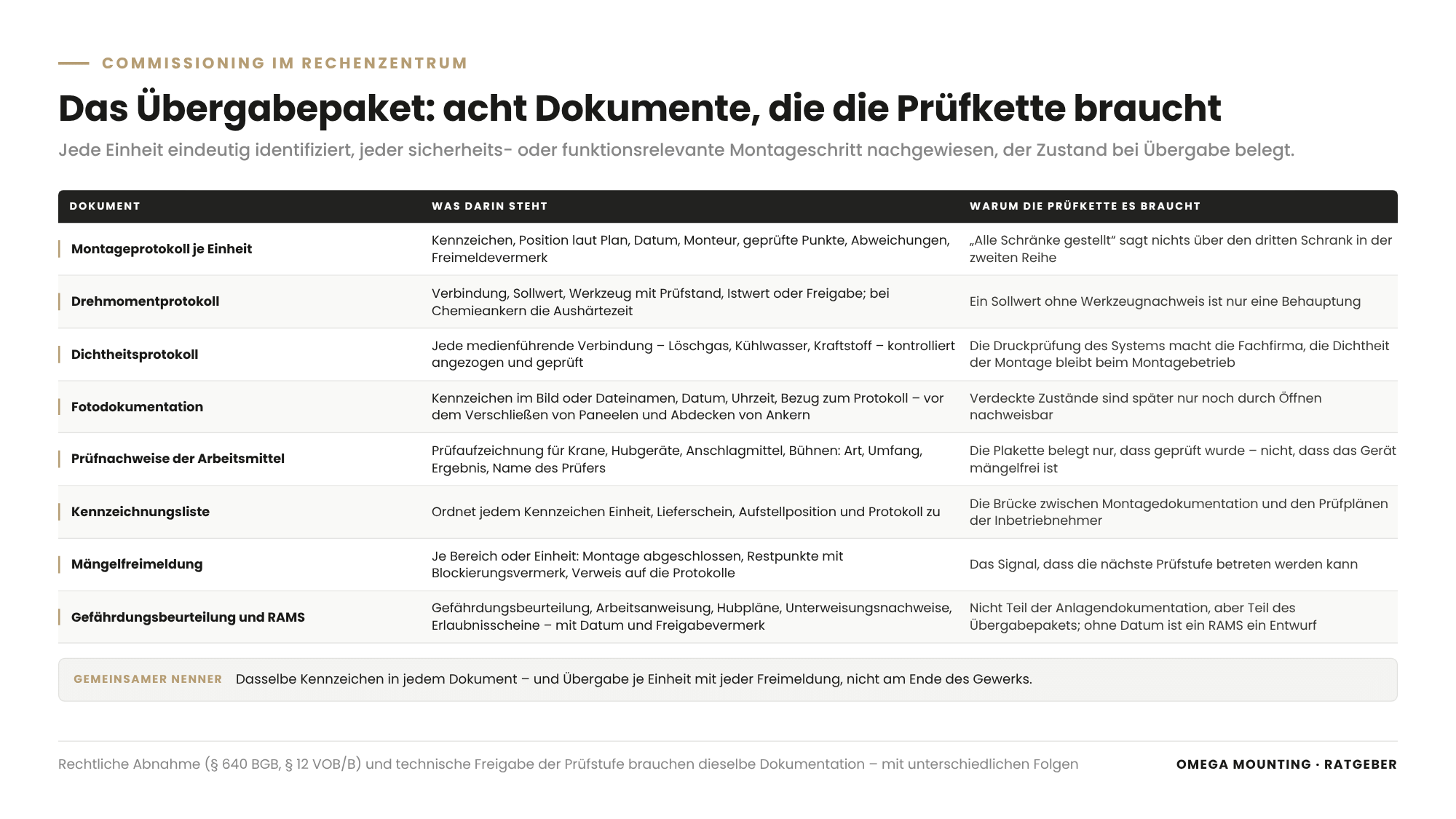
In a data center, the installation contractor must deliver handover documentation that clearly identifies every unit, demonstrates every safety- or function-relevant installation step and records the condition at handover. The format must be such that the subsequent test levels up to commissioning in the data center can use it without queries.
Installation record per unit
The installation record captures per unit: tag, installation position according to the plan, date, fitter, checked points (position, alignment, plumb, fixing, cleanliness, surface protection), deviations and completion note. In series installations such as the PDC rollout, the record per unit controls the takt. How this is organised is described in our article on series installation in data centers.
Torque record
Bolted connections on frames, flanges, anchor bolts and heavy-duty anchors, lock nuts and lifting points are tightened to the specified torque and recorded. The specification comes from the manufacturer's installation instructions or the design. The systematic calculation of highly stressed bolted joints is described in the guideline VDI 2230. The record names the connection, target value, tool with calibration certificate, and actual value or release. For many identical connections, recording per connection type with sample verification is often sufficient – what applies is defined by the design. For chemical (resin) anchors, the curing time before tightening is added as a separate record item.
Leak-test record
Wherever media are carried – suppression gas, cooling water, fuel – every connection requires a leak check. For the suppression cylinder room at around 300 bar operating pressure: every leaking fitting would gradually lose pressure. A suppression system without full pressure is not a suppression system. That is why every fitting was tightened under control and leak-tested – on each of the 240 cylinders. The actual pressure test of the system is the specialist contractor's job. The leak-tightness of the installation is the installation contractor's job.
Photo documentation
Photos are the fastest evidence – if they can be assigned. Every photo needs the unit's tag in the image or in the file name, date and time, and the reference to the record. Photos before closing panels, before covering anchorages and after reaching final position are mandatory, because these conditions are no longer visible later.
Test certificates for the work equipment used
Cranes, lifting devices, lifting accessories (round slings, chain slings, spreader beams, shackles) and work platforms are subject to periodic inspection by a competent person under the German Industrial Safety Ordinance (BetrSichV). This is recognisable by the test sticker and inspection log. The certificates belong to the installation documentation because the subsequent test levels assume that the installation was carried out with inspected work equipment. When moving generators and load banks into a data center in Frankfurt, proof of the current periodic crane inspection was among the documents available before the first lift and the lift release. What such a certificate must contain as a minimum is defined by the inspection rule: type and scope of the inspection, the result and the name of the inspector. The record must be kept until the next inspection, for cranes over the entire period of use. The rule also makes clear that a test sticker only proves that an inspection took place – not that the equipment is free of defects. For you this means: ask to see the inspection record, not just the sticker.
Tag list
The tag list assigns to each tag the unit, the delivery note, the installation position and the record. It is the bridge between installation documentation and the commissioning agents' test plans.
Defect-free completion notice
The defect-free completion notice – also called notice of completion or completion notice – declares per area or per unit that installation is complete. It names open items with a blocking note and refers to the associated records. It is the signal to the testing chain that the next level can be entered, and ultimately the core of the as-built records.
Risk assessment and work instruction
Not part of the plant documentation but part of the handover package to the client: the risk assessment under the German Occupational Safety Act and the work instruction, internationally combined as RAMS (method statement). Plus lift plans, briefing records, toolbox talk records and permits to work. The German technical rule on risk assessment, TRBS 1111, explicitly recognises lift plan and RAMS as forms of documenting the risk assessment. However, it requires them to be in place before the work equipment is first used and every review to be recorded with a date. For you as the reviewer this means: a RAMS without date and approval note is a draft, not evidence. What it contains and what the client should check is covered in our article on RAMS and risk assessment for installation work.
How are components tagged?
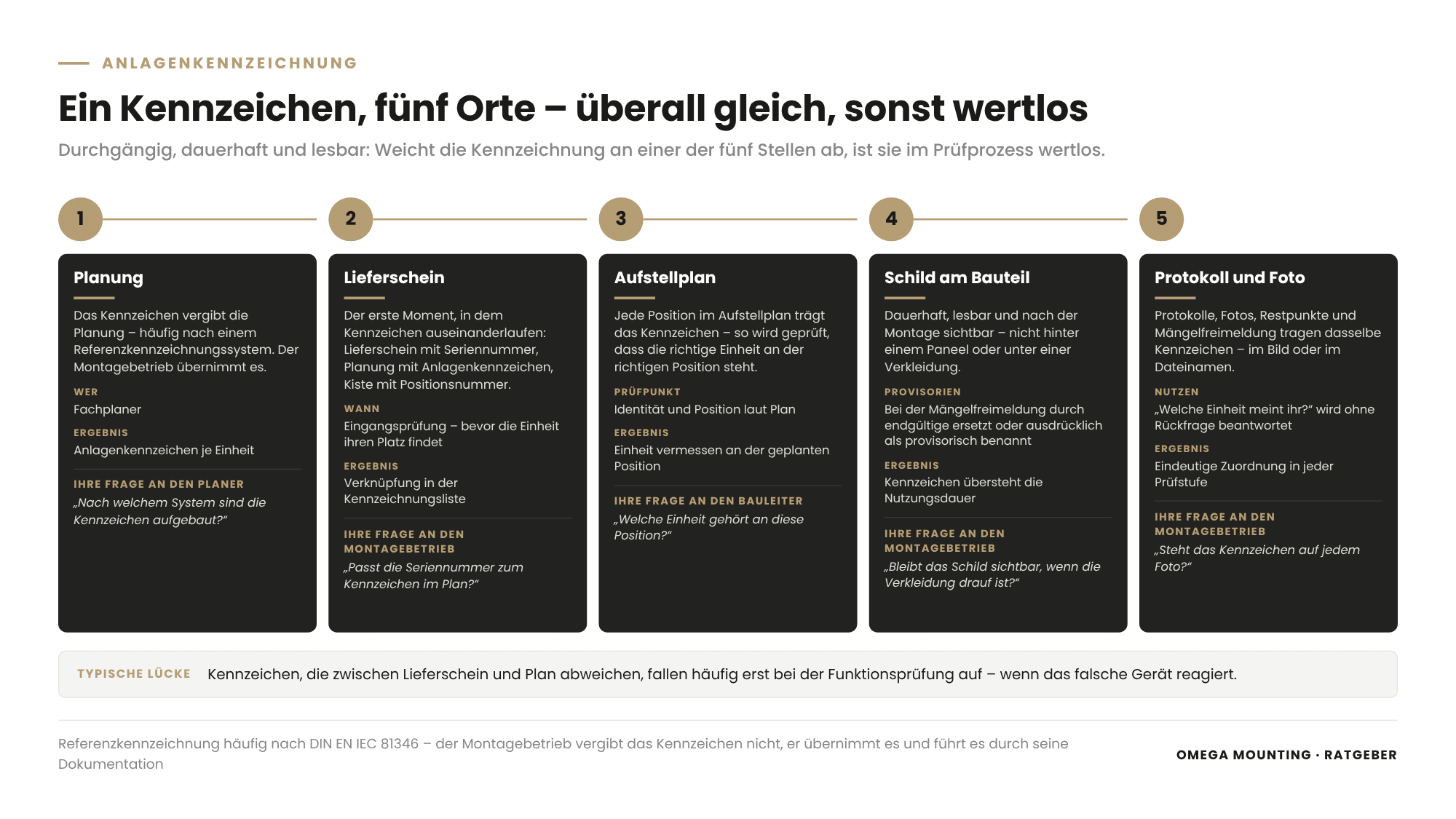
Components are tagged so that the same tag appears in the design, on the delivery note, in the layout plan, on the component itself and in the installation record – consistently, permanently and legibly. Equipment tagging that deviates at any one of these five places is worthless in the testing process.
Tags come from the design
The tag is assigned not by the installation contractor but by the design. It often follows a reference designation system as described in the DIN EN IEC 81346 series of standards for structuring principles and reference designation. The installation contractor adopts it, applies it and carries it through its documentation.
Checking tags at incoming inspection
The first moment at which tags can diverge is delivery. The delivery note gives a serial number, the design an equipment tag, the crate carries an item number. At incoming inspection these are checked against each other and linked in the tag list – before the unit finds its place.
Permanent and legible on the component
The label on the component must outlast the service life and remain visible after installation – not behind a panel or under cladding. Provisional tags from the construction phase are replaced by the final ones at the defect-free completion notice or explicitly identified as provisional.
Tag in every document
Records, photos, open items and the defect-free completion notice carry the same tag. This way, every question from the commissioning agent – “Which unit do you mean?” – can be answered without a query.
Commissioning in data centers: which gaps hold up the testing chain?
The testing chain is held up above all by gaps that are only noticed by the commissioning agent. Typical are photos that cannot be assigned, blanket records instead of unit-specific records, missing evidence of concealed conditions, and defect-free completion notices with no reference to the test level.
- Photos without tags. A hundred pictures of identical-looking cabinets without a tag in the image or file name are not evidence.
- One record for the whole hall. “All cabinets set and aligned” says nothing about the third cabinet in the second row.
- Concealed conditions not documented. Anchorages under covers, connections behind panels: whoever did not photograph them before closing has to open up.
- Torques without tool evidence. A target value without stating the torque wrench and its calibration is only a claim.
- Defect-free completion notice without open items. A notice that conceals open items costs trust; a notice that lists them without a blocking note costs time.
- Tags that differ between delivery note and plan. Often only noticed at the functional test – when the wrong unit responds.
- Test certificates for work equipment not attached. They are in the vehicle but not in the handover package.
- Open items not assigned to a trade. A punch list that does not state whether the item lies with the client, the preceding trade or the installation contractor becomes a discussion in the site meeting instead of a task.
- Language. On internationally managed sites, the documentation must be available in the agreed language – often bilingual. Subsequent translation is a source of errors in its own right.

Commissioning in data centers: how we do it in practice
Three jobs from our project diary show how installation documentation and staged testing interact in a data center.
Handover to the electrical contractor: 160 PDCs
During the rollout of 160 PDCs in eight data halls in the Rhine-Main region our contract ended with mechanical completion. Every hall was laser-surveyed, the set-down positions marked on the floor protection. Each cabinet was positioned in line with its row exactly beneath its cable drop. Only when position, alignment and levelling were right was the cabinet fixed and released for the next trade. The electrical connection work was carried out afterwards by the electrical contractor. The first functional test thus built on our installation level. With 160 cabinets there was zero rework – over several weeks in eight halls, without any damage to floors or walls.
Section-by-section commissioning: the suppression cylinder room
With the installation of a suppression cylinder room for a nitrogen gas suppression system in the Frankfurt area three fitters installed cylinder racks and connected pipework to the existing building network within two weeks. In addition, 240 nitrogen cylinders in six banks of 40 cylinders were moved in, secured and connected one by one. The same check applied to every cylinder: valve correctly oriented, pressure gauge readable, hoses to the manifold without tension or kinks. Every fitting was tightened under control and leak-tested. This allowed the system to be commissioned section by section by the specialist suppression contractor afterwards – without rework. The installation level was completed per section before the functional test began.
Prerequisite for the load test: load banks and generators
With the moving in of generators and load banks into a Frankfurt data center the task was the prerequisites for load tests of the emergency power supply. Load banks simulate the electrical load of the servers and ensure that generators deliver full output in an emergency. Five heavy haulage transports were lifted into a multi-storey steel structure on a single long working day with a 220-tonne-class mobile crane. The crane stood with 71 tonnes of ballast and a 30-metre boom; at around 20 metres of outreach, about 28 tonnes of lifting capacity remained. Every lift was defined and approved in advance in lift plans with load weights, outreach, crane position and safety zones. Proof of the current periodic crane inspection was available. The documented moving in was part of the prerequisites before the test could even begin.
Three jobs, three times the same rule: the installation level is only complete when it has been demonstrated. Do you have an installation coming up that has to pass into commissioning? Then get in touch with us – a coordination meeting with your commissioning agent usually clarifies within an hour which records are needed in which form.
What this means for your role
For buyers: Write the documentation package into the scope of works as separate line items – installation record per unit, torque and leak-test record, tag list, defect-free completion notice – and tie formal acceptance to its completeness. Partial acceptances per area with measurement records keep invoicing clean. Ask for samples of these documents in the bidder interview: whoever cannot show them will not deliver them on site. Clarify participation obligations in the higher test levels – opening panels, moving in test equipment, placing load banks – as line items or provisional items, not as change orders. Our service page on Lift & Shift describes what we take on in this respect.
For designers: Assign tags according to a consistent reference designation system so that they run through from delivery note to record. Define in the installation planning which connections are torque- and leak-relevant, which anchors are designed for which load assumptions and which conditions must be photographed before closing. Show in the installation sequence when the installation level must be complete for each area so that the construction schedule for SAT and integrated systems test holds. More about how we work in data center construction.
For project managers and site managers: Define in the scope of works which documents the installation contractor delivers per unit and per area, in which language and in which format. And when: not at the end of the trade, but with every completion notice. Agree acceptance walk-downs per hall or section and a punch list with blocking notes and trade assignment that you update in the regular site meeting. As site manager, check the complete handover package at the first unit, not only at the last, and only then release the area for the following trade.
For maintenance managers: The installation documentation is the first entry in your asset file and the basis for maintenance schedule, inspection intervals and inspection. Insist that tags, torque records, leak-test evidence and photos of concealed conditions are handed over per unit and not as a loose collection. This way you can update them in operation and access them at the first periodic inspection. What was not documented at initial installation you will have to establish yourself in the first maintenance window.
For safety officers and HSE coordinators: Separate the plant documentation from the occupational safety documents in the handover package and check both. RAMS, lift plans, briefing records and the test certificates for the work equipment used must be complete, so that the installation level was demonstrably carried out with inspected equipment and briefed personnel. When participating in higher test levels – opening panels, moving in test equipment – make sure that the risk assessment and permit to work cover activities next to plant under voltage or with medium. Isolation and LOTO must be regulated, and stop authority also applies during test operation.
For facility managers and operators: With the handover you take over what the testing chain has released, and you work with this documentation for years. Every later change request in the live environment draws on it. Define early in which structure, language and filing system records, tag list and defect-free completion notice enter your building file. Require that provisional tags are replaced by final ones before handover. A punch list with blocking notes shows you what you still have to demand before the start of operation, before the N+1 or 2N redundancy counts as demonstrated.
Documentation checklist: template on request
The documentation checklist for installation in data centers lists all documents that the installation contractor should deliver from incoming inspection to defect-free completion notice. It is structured by “per unit”, “per area” and “per trade”, with columns for “available”, “checked by” and “date”. It helps project managers to check the handover package completely before the first area release, and buyers to specify the documentation obligations completely in the scope of works. The checklist is kept general and can be adapted to the test levels of your project. Request the documentation checklist via our Contact form – reference “documentation checklist”.
Why Omega Mounting?
We are an installation contractor from Rodgau near Frankfurt and work in data centers in the Rhine-Main region as a stand-alone lift-&-shift trade. This ranges from moving in to the documented handover to electrical, cooling or fire suppression contractors. The jobs linked here demonstrate how we hand over: 160 cabinets without rework to the electrical contractor, 240 cylinders bolted leak-tight for section-by-section commissioning. Plus five heavy haulage transports with approved lift plans and inspected crane equipment in one day. Our own workshop in Rodgau manufactures brackets, adapters and protective structures when an installation needs them; via the 24-hour hotline we can be reached outside office hours too. How we work on site is shown on our page on industrial installation in Rodgau, and an overview of our services is given on the page Industrial installation. For you this means: a single point of contact for moving in, installation and handover documentation, short distances to Frankfurt, Offenbach and Hanau – and a handover package with which your testing chain continues at the first appointment. Sounds like your project? Then get in touch with us.
Conclusion
“Commissioning in data centers from the installation perspective” in a nutshell: the testing process is staged, and installation is its lowest level. What is not demonstrated here is noticed later – by the electrician, at the systems test or in operation. The installation contractor delivers mechanical completion with an installation record per unit, torque and leak-test records, assignable photo documentation, test certificates for the work equipment, consistent tagging and a defect-free completion notice with open items. Legal acceptance and technical release are two tracks that need the same documentation. Would you like an installation handed over so that the testing chain continues without queries? Then send us the scope of work, the test level plan and your preferred date – we will get back to you with an honest assessment of the scope, format and timing of the documentation.
Planning maintenance, moving in or installation in the Rhine-Main region?
Tell us briefly what it is about – we will come back to you with an honest assessment.
100% free and without obligation
You may also be interested in these guides

About the author
Tobias Schott
Managing director of Omega Mounting GmbH, Rodgau · more than 20 years of hands-on experience in installation and maintenance
A trained mechatronics technician, at home in maintenance, servicing and industrial installation since 2004 – first at his father's side, since 2012 with Omega Mounting: from the overhead conveyor in Frankfurt to the crane system in a new-build hall. Plans and leads lifting operations as appointed person in data centers and on industrial sites in the Rhine-Main region, is an instructor and examiner for cranes, mobile elevating work platforms and telehandlers, and a safety officer. On jobs abroad he is known as the “German Troubleshooter” – the one you call when things get stuck on site. He learned what quality means not from a manual but from his father: Made in Germany as a standard for his own work, not as a label. That is why it comes first at Omega Mounting – before speed and before price. He writes these guides from that practice: what works on our sites is in them – what only exists in the standard is not.
Frequently asked questions
Commissioning is the staged testing process by which it is demonstrated that every system and the interaction of all systems work as designed. It ranges from the factory acceptance test via installation and functional tests to the integrated systems test under load. In Germany, the equivalent is commissioning management, for example in accordance with VDI 6039.
The installation contractor is responsible for mechanical completion: correct position, fixing, connections, leak-tightness of the installation, tagging and documentation per unit. Site acceptance test (SAT), systems tests and the integrated systems test are the task of the specialist trades, manufacturers and commissioning agents. The installation contractor participates – moving in load banks, opening panels – but does not test itself.
Connection with tag, target torque value from manufacturer's specification or design, tool used with calibration certificate, actual value or release note, date and fitter. For many identical connections, the design may provide for recording per connection type with sample verification. The basis for designing bolted joints is described in VDI 2230.
Acceptance under a German Civil Code contract for work or VOB/B is a legal act by which the client recognises the work as in accordance with the contract. With it, the warranty period begins, and the acceptance report records open items. The technical release of a test level in commissioning confirms that the prerequisites for the next level are in place. Both need the same documentation but have different consequences – one for contract and warranty, the other for the construction sequence.
Every photo needs the unit's tag in the image or in the file name, date and time, and the reference to the record. Conditions that are later concealed – anchorages, connections behind panels – must be photographed before closing.
The certificates of the periodic inspections under the German Industrial Safety Ordinance (BetrSichV) for cranes, lifting devices, lifting accessories and work platforms used during the installation. These include the test sticker, inspection log or inspection report of the competent person. They demonstrate that the installation level was carried out with inspected work equipment and therefore belong in the handover package, not just in the vehicle.
Yes, data centers in Frankfurt, Offenbach, Raunheim and Hanau are among our regular places of work. The jobs linked here – PDC rollout, suppression cylinder room, load banks – took place in the Rhine-Main region; from Rodgau we are on site there in a short time.
The risk assessment under Section 5 of the German Occupational Safety Act (ArbSchG) must be documented, the briefing demonstrated and every item of work equipment used inspected under the Industrial Safety Ordinance (BetrSichV). These documents are not part of the plant documentation but belong, together with lift plans and permits to work, in the handover package to the client. Internationally they are often combined as RAMS.
The defect is entered in the punch list with tag, location and description, assigned to the installation contractor and given a target date. Whether it blocks the next test level is explicitly noted. After rectification, the installation level for this unit is reported complete again – with an updated record and photo. If the plant is already running, the rework needs a permit to work and a maintenance window.
Send us via the Contact form three pieces of information: the scope of work with component list, the test level plan or your commissioning agent's documentation requirements, and the time frame up to handover. We check which records, tags and certificates from the installation are needed for this, suggest a site visit if needed and get back to you with a written assessment. Your contact is Tobias Schott.
 English
 German