
- Project report – Moving in transformers at a Frankfurt data center
Moving in transformers at a Frankfurt data center: 52 tonnes into the closed building on a skidding system
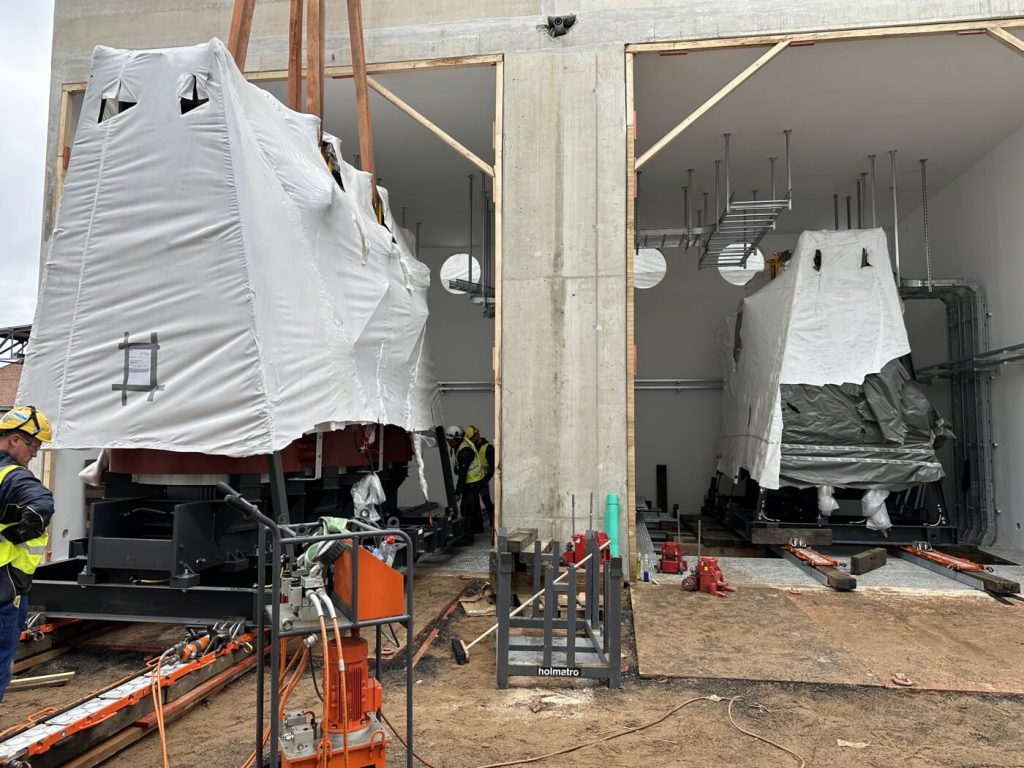
How two fitters and a Lifting Supervisor moved two transformers from the heavy-haulage low-loader onto the skidding system and step by step into their cell in a single day
When a transformer arrives, the building is usually already up. Roof on, walls closed, ceiling sealed – and that is exactly when a component has to go in that weighs more than a fully loaded articulated lorry. A crane can no longer do it. The way in is through the door.
On this project at a data center in the Frankfurt area, there were two transformers, each weighing around 52 tonnes – more than 100 tonnes in total on a single day. Our team was booked as subcontractor for the lifting and moving-in work: planning, coordinating and supervising the lift from the heavy-haulage low-loader – and operating the skidding system that then took the machine into its cell.
One long day, two fitters, one Lifting Supervisor. By the evening, both transformers were in place, the lorries were back on the road on time, and the client could begin the electrical connection.
Project profile
- Scope: Lifting and moving-in work for two transformers as subcontractor – planning and coordinating the lift, unloading from the heavy-haulage low-loader directly onto the skidding system, packing and levelling the skidding system, skidding the transformers into the transformer cell, preparing the set-down points in the pit, supervision through to the set-down condition
- Team: 2 fitters from Omega Mounting and 1 Lifting Supervisor
- Project duration: one long day on site for both transformers, May 2024
- Weight: around 52 tonnes per transformer – more than 100 tonnes in total in a single day
- Role: Subcontractor; the skidding system was provided by the client, we operated it
- Location: Data center in the Frankfurt am Main area
- Client: Heavy-haulage and crane company – not named at the client's request
- Special feature: The building was already closed. A crane lift from above was no longer possible – the transformer had to be skidded in at ground level
- Result: Both transformers set down in their cell on schedule and in the correct position, lorries released on time
What is a skidding system?
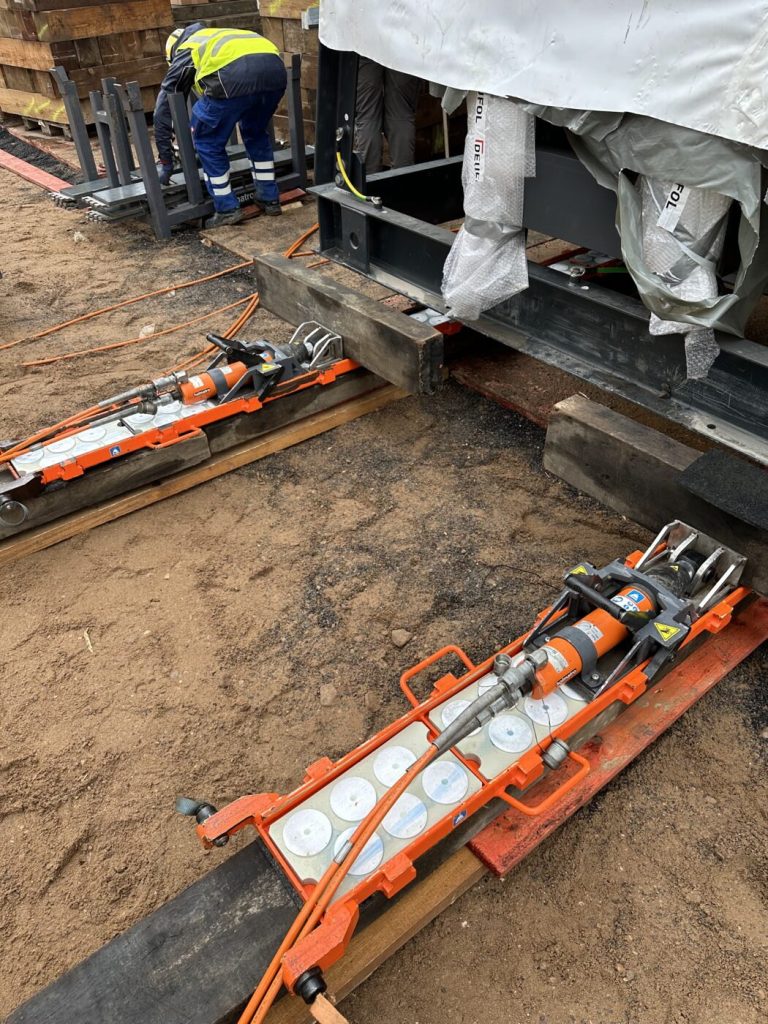
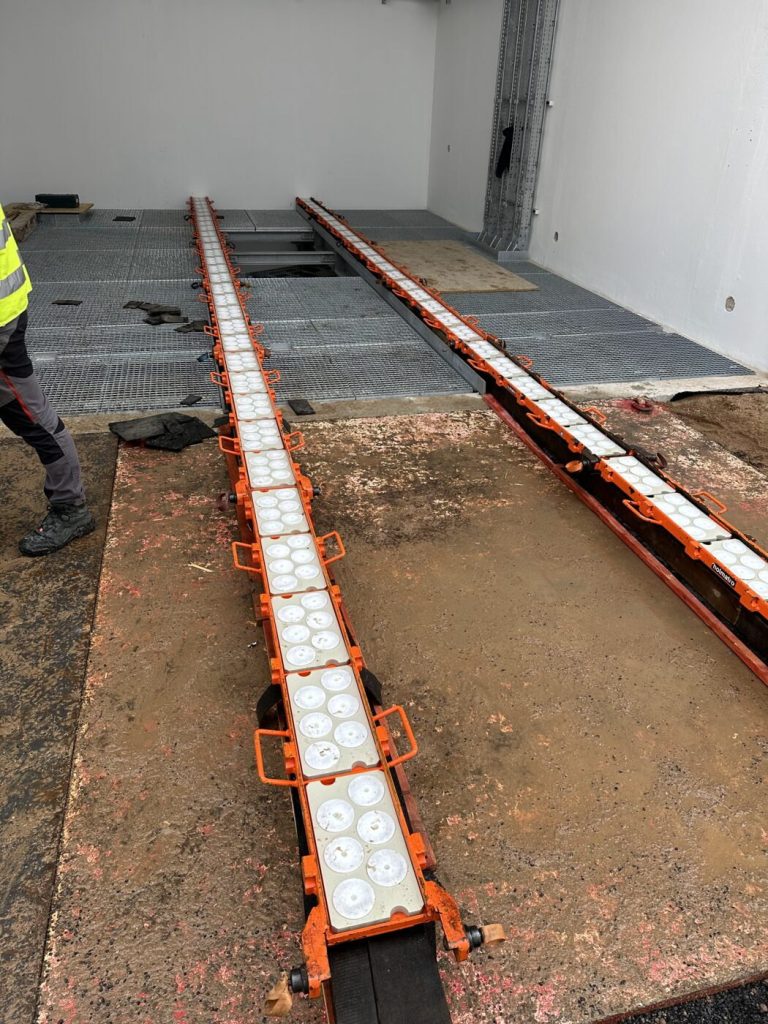
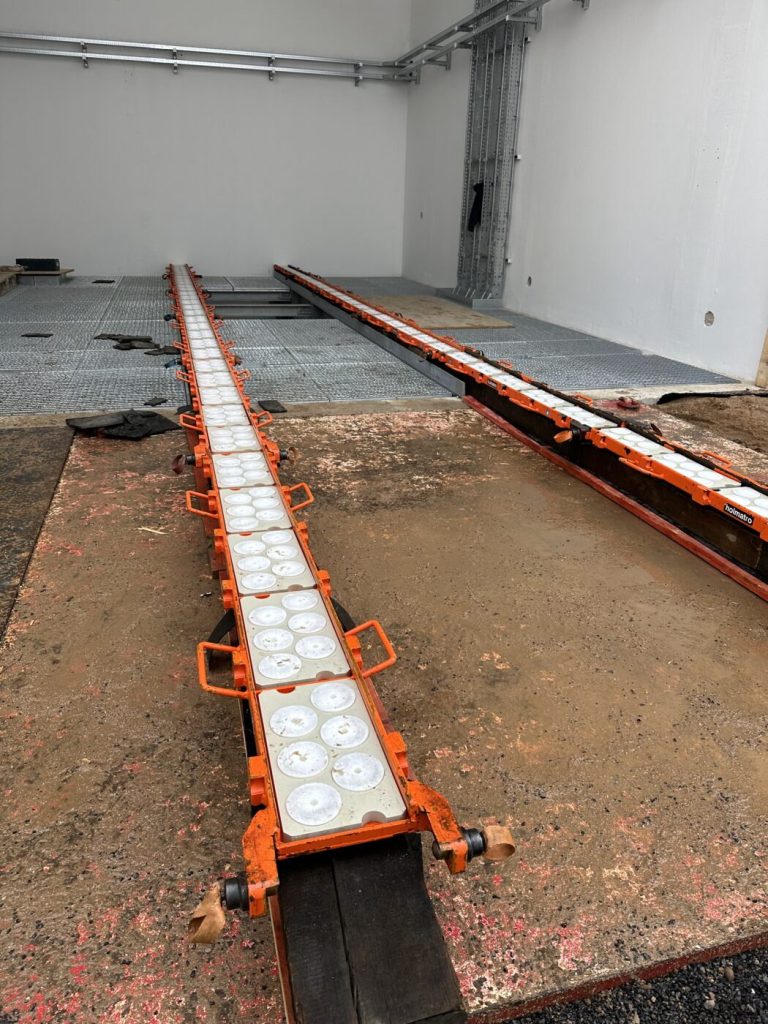
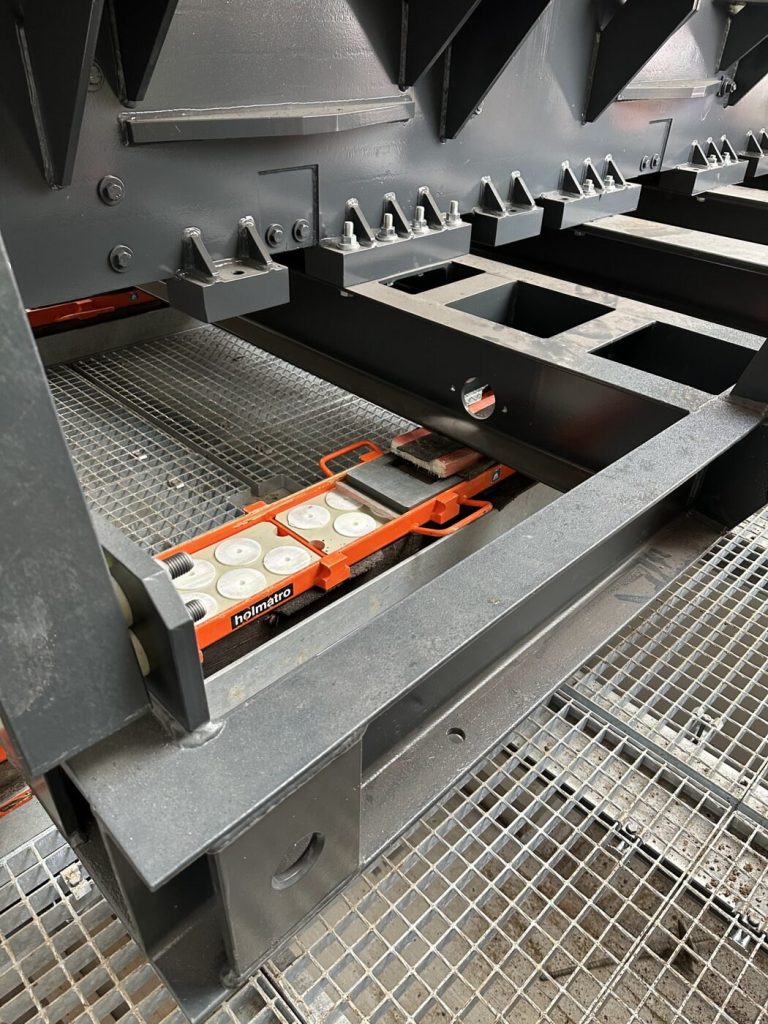
A skidding system is a hydraulic rail system for moving very heavy loads horizontally without lifting or rolling them. It consists of rail elements that line up to form a continuous track, and hydraulic cylinders that push the load forward along this track step by step.
The principle is that of a ratchet: the cylinder grips, pushes a short distance, resets, grips again and pushes again. The load does not move in jerks, but in short, controlled stages. That is exactly why the method is suited to components where any uncontrolled movement becomes expensive.
The big advantage over a crane: the skidding system needs no headroom. It works wherever there is a ceiling above the load – inside the building, in the basement, under a platform. Its disadvantage is that it reproduces the ground beneath it without compromise. A track that is not exactly level pushes the load askew. And a 52-tonne load that runs askew into a room cannot simply be nudged back into place.
The track for this job was provided by the client. We operated it – not everyone has experience with tonnages of this magnitude, and the operation decides the result.
Why wasn't the transformer simply lifted in by crane?
Because the roof was already on.
That is not a planning error, it is the normal case. Transformers rarely arrive during the shell construction phase. They arrive when the building is weathertight – and later, after ten or twenty years, they have to come out again without anyone opening a roof for them.
That is why most transformers stand on railway rails, which are set into the floor of the transformer cell and run all the way outside. The transformer sits on this rail on its rollers and can be pushed out of the building for a replacement. What works for moving in also works for moving out years later – in the other direction.
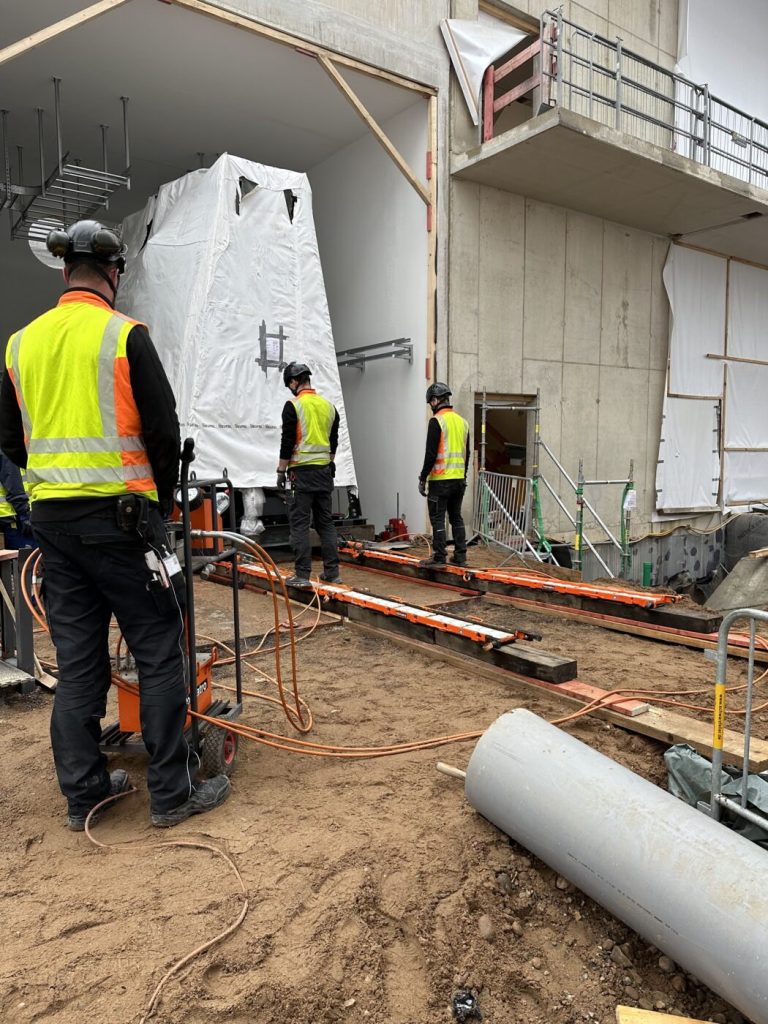
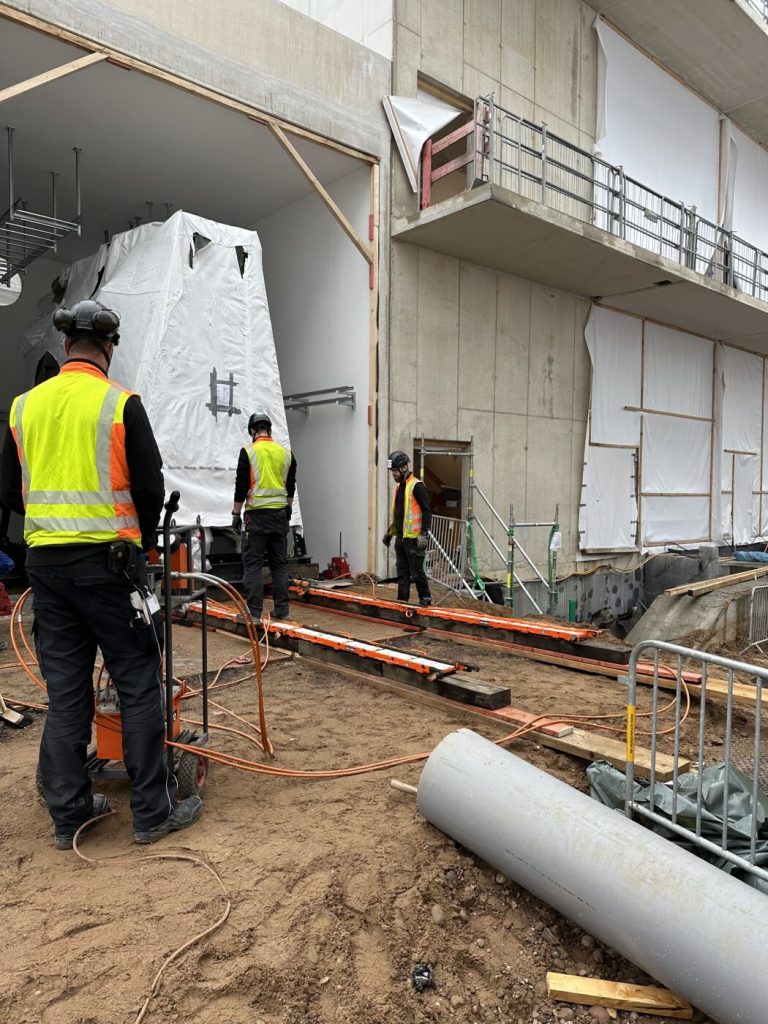
In this case, the rail inside the building was finished and load-bearing. Only outside it was not: nothing had yet been built in front of the building, no forecourt, no continuous level surface. It was precisely this gap between the low-loader and the building rail that the skidding system closed.
How does a 52-tonne transformer get from the low-loader onto the skidding system?
With a lift that takes place exactly once.
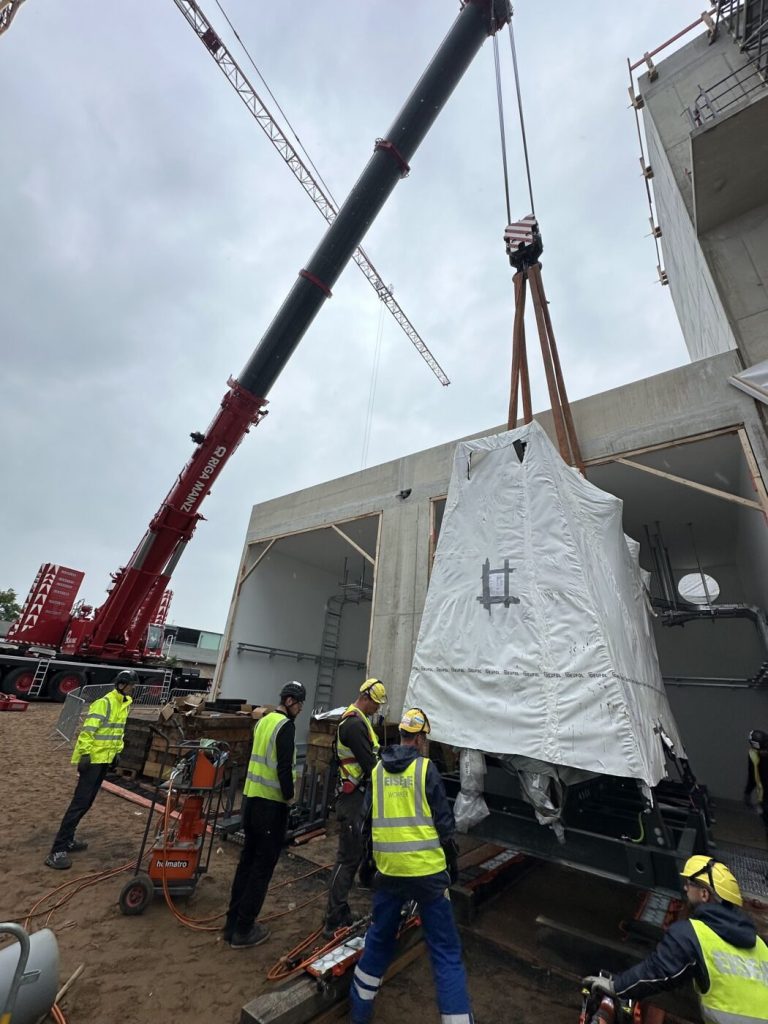
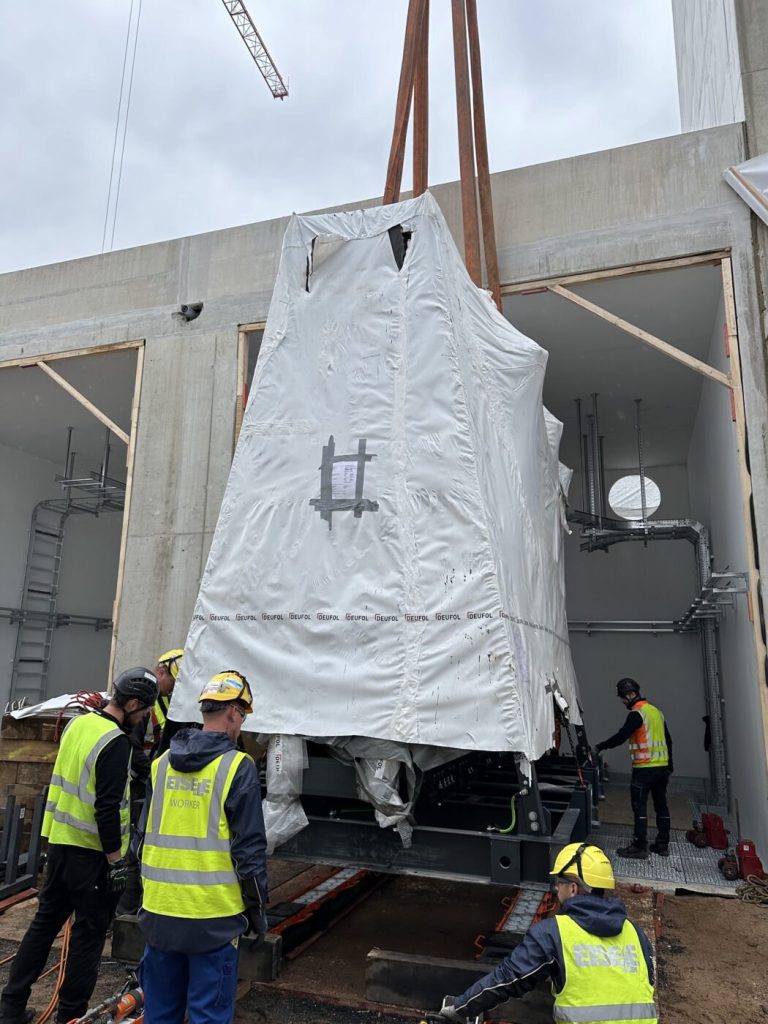
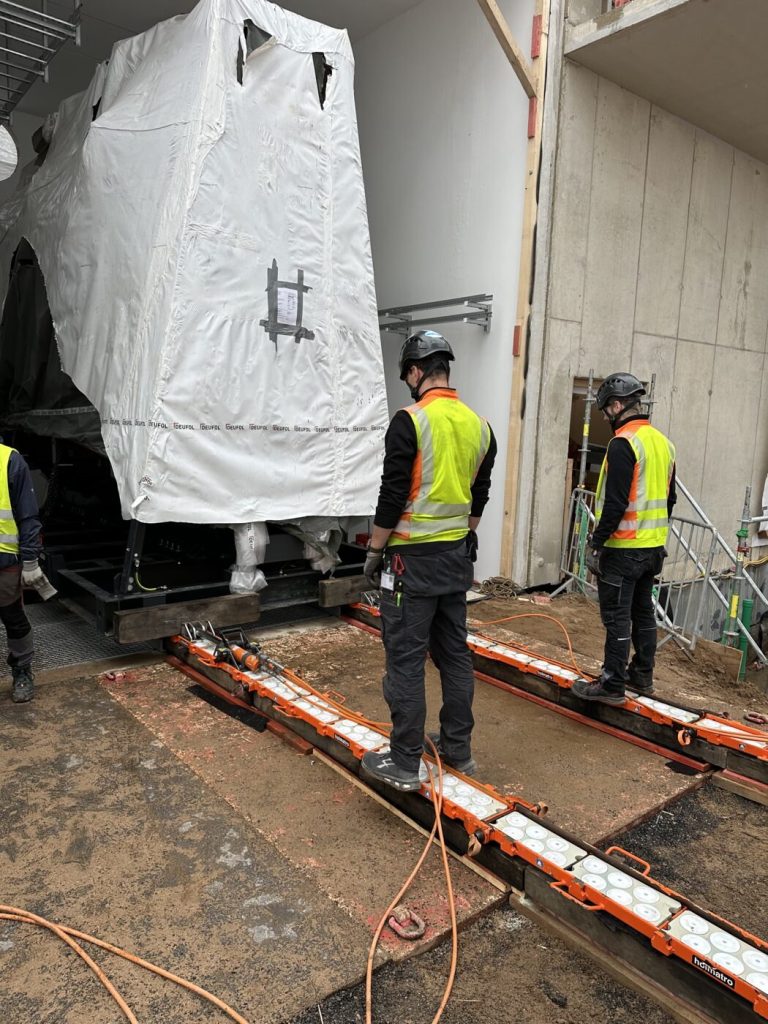
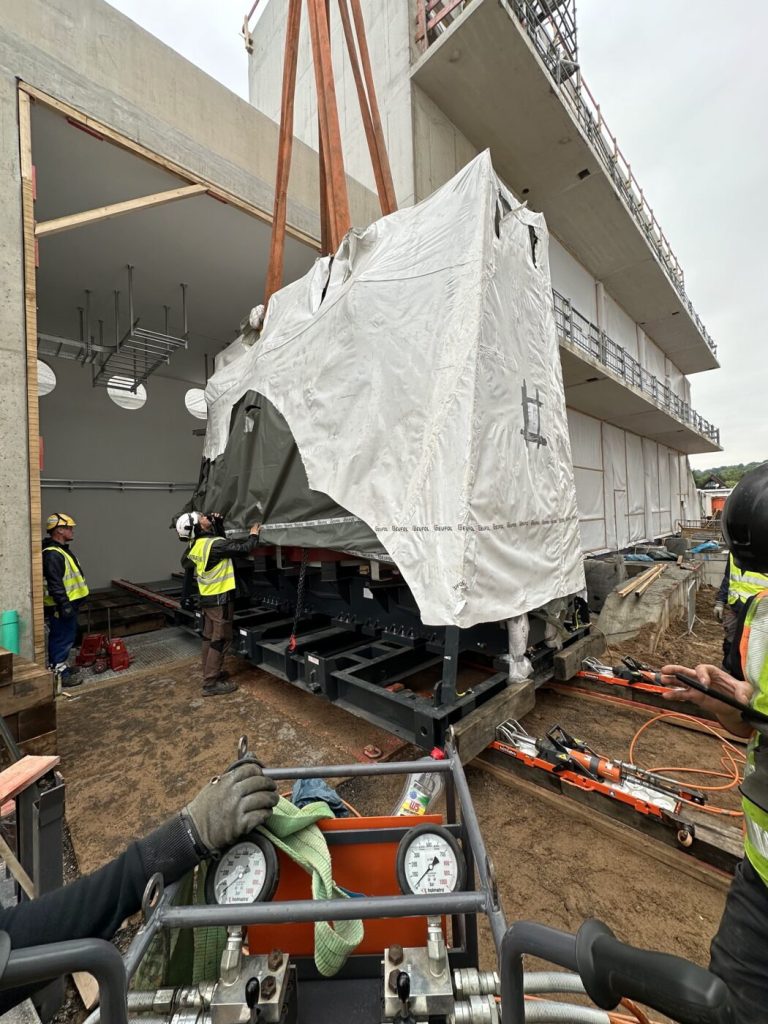
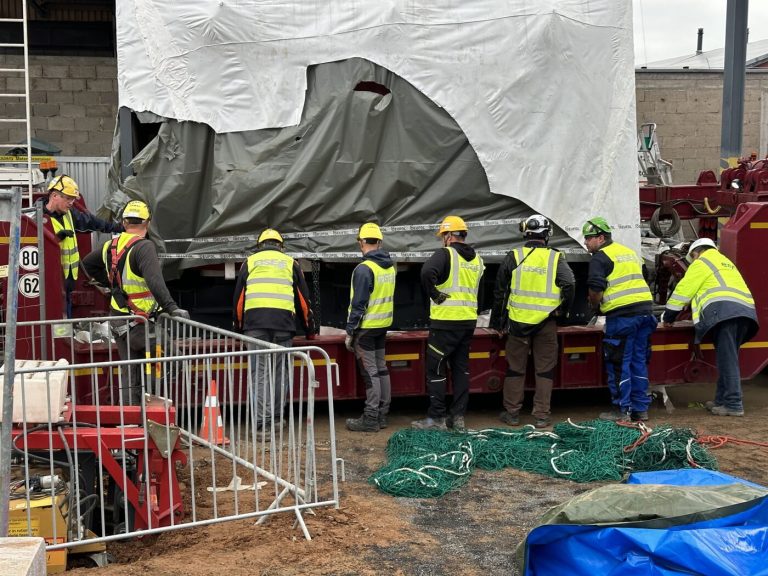
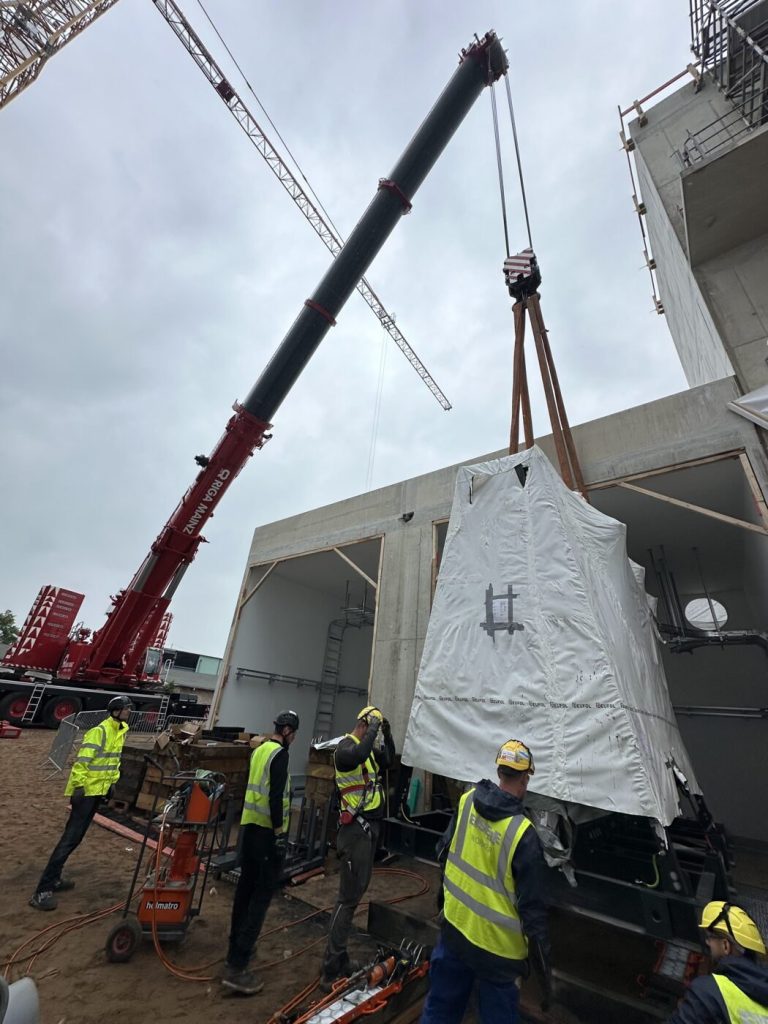
We were lucky with the location: the building had an access route via the rear. The heavy-haulage low-loader could drive up close enough, and the mobile crane could be positioned so that we could take the transformer directly from the trailer and place it on the skidding system without any intermediate set-down. Every intermediate set-down would be an additional lift – and every lift is additional risk and additional time with a lorry standing idle.
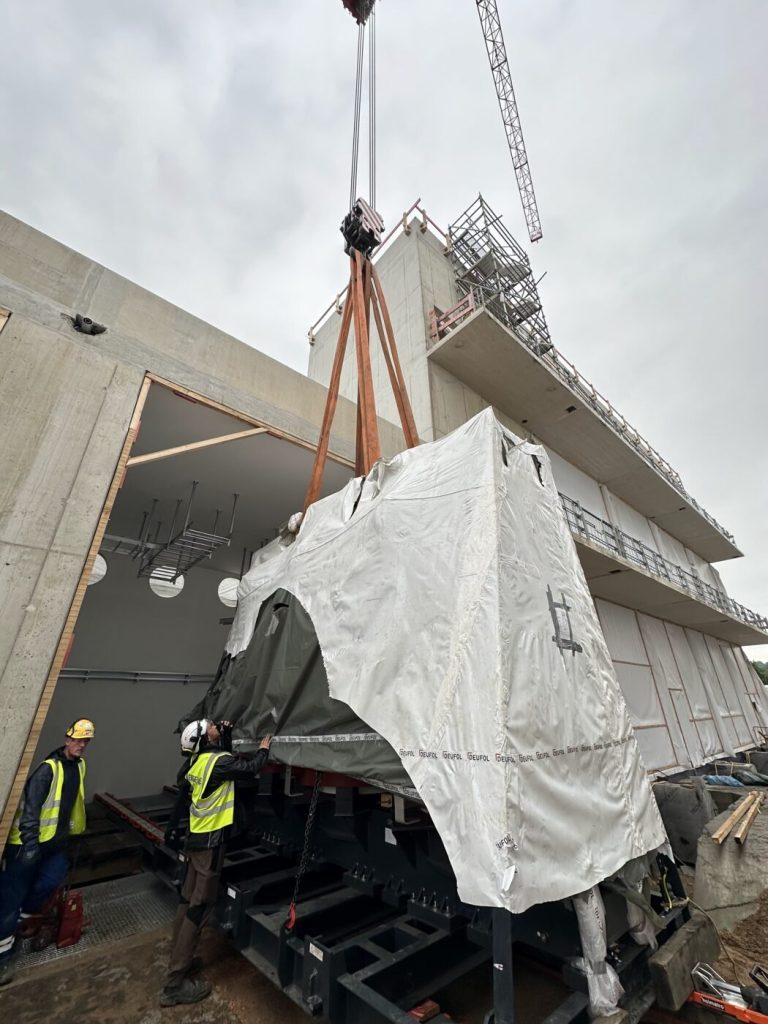
The photos clearly show the transformer hanging from the hook in its factory-fitted protective cover. The cover stays on until the very end: a transformer is not a piece of structural steel that you can brush off when it gets dirty.
Why levelling is the real work
That was the most difficult part of the day – and the one you do not see in any photo.
In front of the building, the skidding system rests on whatever is there. And on a construction site, whatever is there is never level. There was a ramp, there were differences in height between the outdoor area and the building rail, and there was no finished surface. So the entire track had to be packed and aligned before anything was pushed at all: pack beneath each element, measure, add packing, measure again.
The reason is simple: the track dictates the direction. If it is not exactly level and exactly in line, it pushes the transformer askew into the room – and then it does not sit above its set-down points. With a component of this mass, there is no correcting by hand afterwards.
Then there is the load distribution. 52 tonnes on a few support points create bearing pressures that no unprepared ground can take. Whatever lies beneath the track has to carry the load just as safely as the track itself.
Why skidding in takes more than an hour
Because a skidding system does not pull through in one go, it works in cycles.
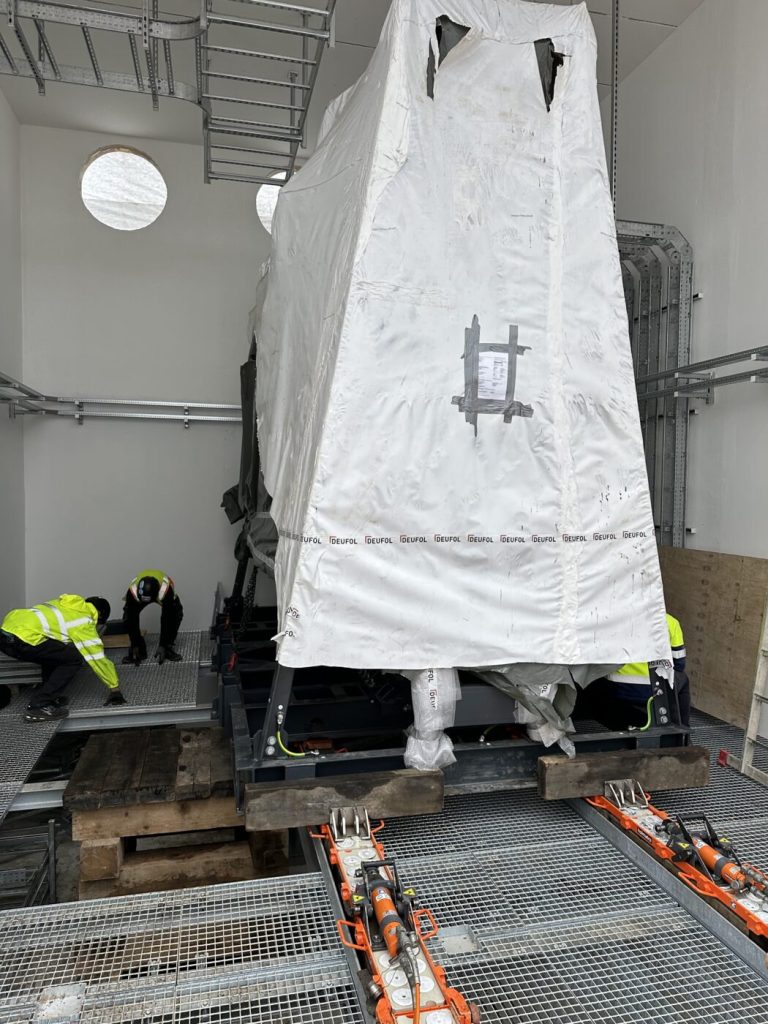
The hydraulic cylinder has a limited stroke. It engages in the track, pushes the load forward by this one stroke length, releases, retracts, engages in the next section and pushes again. Each of these cycles moves the transformer only a short distance. Over the entire distance from the low-loader into the cell, this adds up to a good hour of pure skidding time.
That is not lost time, it is the safety feature of the method. After every cycle, the load is at rest. You can check, re-measure and correct before the next cycle runs. Anyone who wants to speed things up here loses exactly the control for which the method was chosen in the first place.
How does the transformer get from the track onto its foundation?
It is raised, and the track is pulled out from underneath it.
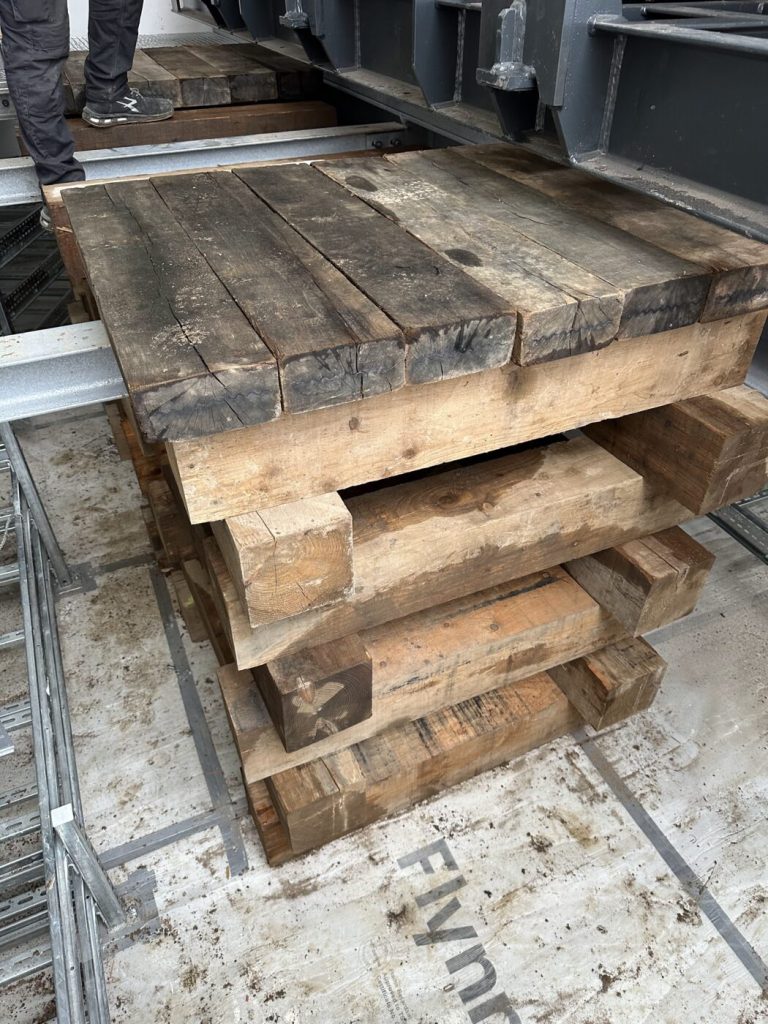
For this, in the transformer pit we had previously stacked timber baulks – as set-down points on which the transformer will later rest. Once the machine is at its final position, it is raised with hydraulic jacks far enough for the rail elements of the skidding system beneath it to come free. The elements are removed, the transformer is lowered and stands on its prepared points.
This step is easily overlooked in planning. People think as far as the final position – but the track on which the load rests also has to come out again. Anyone who does not build the set-down points beforehand ends up with 52 tonnes on a track that can no longer be removed.
Timber baulks are not a makeshift solution here, but have been the method of choice for decades: timber yields in a controlled manner, distributes the load and shows signs of overloading before it fails.
What does a Lifting Supervisor do on a site like this?
The Lifting Supervisor is responsible for the lift – from planning through to the release of every single movement.
On this project, we were not only on site with tools, but also booked in this role. That means: thinking through the sequence beforehand, specifying lifting points and lifting accessories, checking the crane position against the ground bearing capacity, agreeing the sequence with everyone involved and releasing – or stopping – the lifting operations during the work.
On data center construction sites, this is now standard. For lifting operations, the general contractor requires a named person, appointed in writing, who signs off responsibility for the lift. We bring this role with us instead of expecting the client to provide it.
Safety with loads of this magnitude
At 52 tonnes, there are no small mistakes.
Our personnel are SCC-certified and trained for working on and beneath suspended loads. During the lift, nobody stands beneath the load. During skidding, the team stands to the side, in visual contact, with clearly assigned roles: one operates the hydraulics, one watches the alignment, one watches the clearance to components and walls.
And because the track stops after every cycle, each of these cycles is also a checkpoint. The method enforces the control that would otherwise have to be maintained through discipline alone.
Why Omega Mounting?
- Lift and skidding from a single source: We plan the crane lift, supervise it and then operate the skidding system. Two trades, one point of contact, no interface in the middle of the critical moment.
- Experience with large tonnages on the hydraulics: Operating a skidding system is not a matter of pressing a button. With loads of this size, the hand on the valve decides the result.
- Lifting Supervisor in-house: We provide the appointed person for lifting operations, appointed in writing – now a prerequisite on data center construction sites.
- We think through to the set-down: Set-down points in the pit, hydraulic jacks, dismantling the track – the job does not end when the load is in position.
- Installation partner to specialist companies: We regularly work as a subcontractor for crane and heavy-haulage companies and fit into their workflow rather than demanding our own.
- Data center routine: Access control, security areas, coordination with other trades and documented procedures are everyday business for us – more than ten documented data center projects in the Rhine-Main region.
- Rooted in the region: From Rodgau, we are quickly on site in Frankfurt, Offenbach, Raunheim, Hanau and the entire Rhine-Main region – and work throughout Germany.
Conclusion
A closed building, two transformers of around 52 tonnes each – more than 100 tonnes in total – and no way in from above: by the end of the day, both machines stood in their cell in the correct position, the heavy-haulage low-loaders were released on time, and the client could begin connecting.
The real achievement lay not in the lift, but in the preparation. A skidding system that is properly packed and levelled pushes 52 tonnes to where they belong. One that is not pushes them somewhere else.
How we relocate, transport and reassemble machines and plant in Frankfurt is described on our page Machine relocation Frankfurt.
How we generally move in, set, align and – in the event of a replacement – move out transformers is described on our service page Moving in and installing transformers.
Request a callback for your project now – tell us briefly what it is about and we will get back to you with an honest assessment. Omega Mounting GmbH, Hügelstraße 5, 63110 Rodgau. As an installation company from the Offenbach district, we are quickly on site in Frankfurt, Offenbach, Raunheim, Hanau and the entire Rhine-Main region – and work throughout Germany. 100 % free of charge and without obligation.
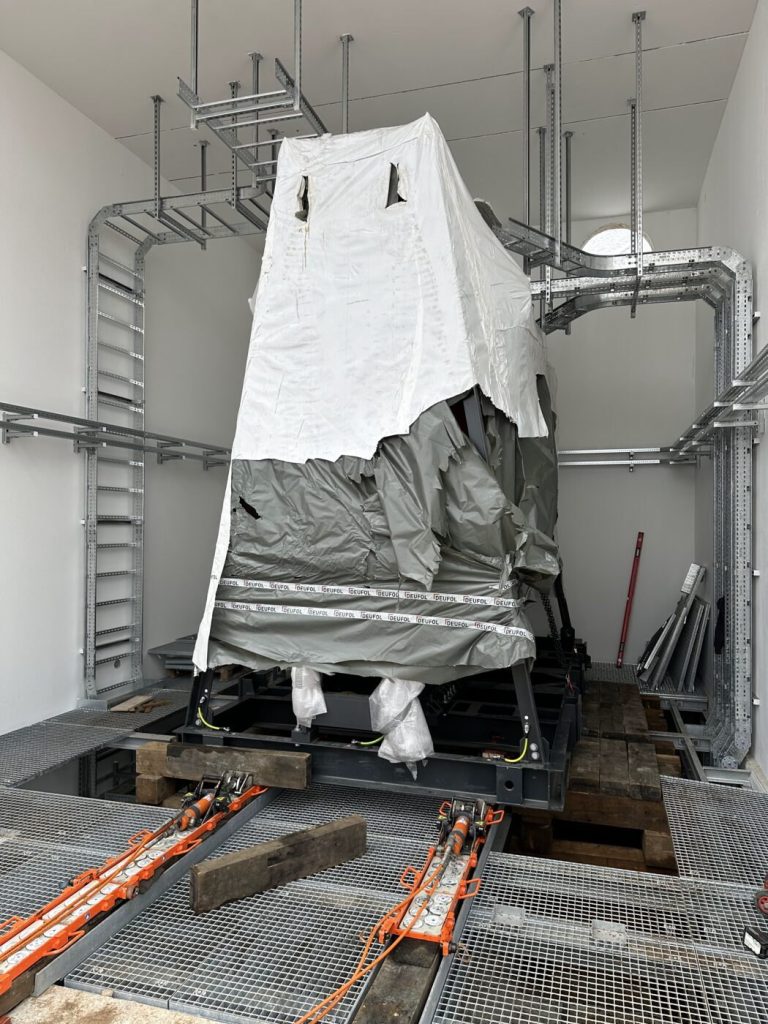
Photo gallery of the job
Planning a plant relocation or a transformer installation?
Tell us briefly what it is about – we will come back to you with an honest assessment.
100% free and without obligation
Related guides for this project

About the author
Tobias Schott
Managing director of Omega Mounting GmbH, Rodgau · more than 20 years of hands-on experience in installation and maintenance
A trained mechatronics technician, at home in maintenance, servicing and industrial installation since 2004 – first alongside his father, and since 2012 with Omega Mounting: from the overhead conveyor in Frankfurt to the crane system in a new-build hall. As appointed person for lifting operations, he plans and leads lifting operations in data centers and on industrial sites in the Rhine-Main region, is an instructor and examiner for cranes, aerial work platforms and telehandlers, and a safety officer. On assignments abroad he is known as the "German Troubleshooter" – the one you call when things get stuck on site. He did not learn what quality means from a manual, but from his father: Made in Germany as a standard for his own work, not as a label. That is why quality comes first at Omega Mounting – before speed and before price. The project diary shows the jobs his team has planned and carried out – without customer names, but with everything that can be learned from them.
Frequently asked questions
A skidding system is a hydraulic rail system that moves very heavy loads horizontally without lifting them. It is used wherever a crane can no longer reach – for example when a building is already closed, or the load has to go into a basement or beneath a ceiling. The load is pushed forward in short hydraulic cycles and comes to rest after each cycle.
Because transformers are usually only delivered once the building is weathertight. A crane lift from above would require an open roof area. That is why transformers are moved in at ground level – via the rail set into the floor or, if no surface has yet been built in front of it, via a skidding system.
So that they can come out again. A transformer has a service life of decades, but at some point it has to be replaced or removed for overhaul. The rail set into the floor runs from the transformer cell to the outside, so that the machine can be pushed out for replacement – without interfering with the building envelope.
The skidding alone took a good hour on this project. That is down to the method: the hydraulic cylinder pushes the load forward by one stroke length at a time, resets, re-engages and pushes again. After every cycle the load is at rest – that costs time and is at the same time the safety feature of the method.
A track that is not properly levelled. The skidding system dictates the direction: if it is not exactly level and in line, the load runs askew into the room and does not sit above its set-down points. That is why packing and aligning the track is the most demanding part of the work – not the skidding itself.
With hydraulic jacks. At the final position, the transformer is raised far enough for the rail elements beneath it to come free and be removed. It is set down on points prepared beforehand – on this project, on stacked timber baulks in the transformer pit. These set-down points must be built before the load even arrives in position.
Yes. If required, we provide the Lifting Supervisor, i.e. the appointed person for lifting operations, appointed in writing. This includes planning and coordinating the lift, specifying the lifting accessories, coordinating with everyone involved and releasing – or stopping – every single lifting movement.
Yes, that is one of our core areas. We take on the work at the load, the operation of skidding and lifting equipment and the responsibility for the lift – and fit into the client's workflow. For crane companies, this means a well-practised team on site without having to keep their own installation personnel on hand.
Yes. From our headquarters in Rodgau, we are on site in Frankfurt, Offenbach, Raunheim, Hanau and the entire Rhine-Main region in a short time. Data centers are our strongest field of references – and we also work throughout Germany.
 English
 German