
- Guide – Data Center
Replacing a CRAH Unit: Checklist for Live Data Center Operation
By Tobias Schott · 22-minute read · Updated October 2026
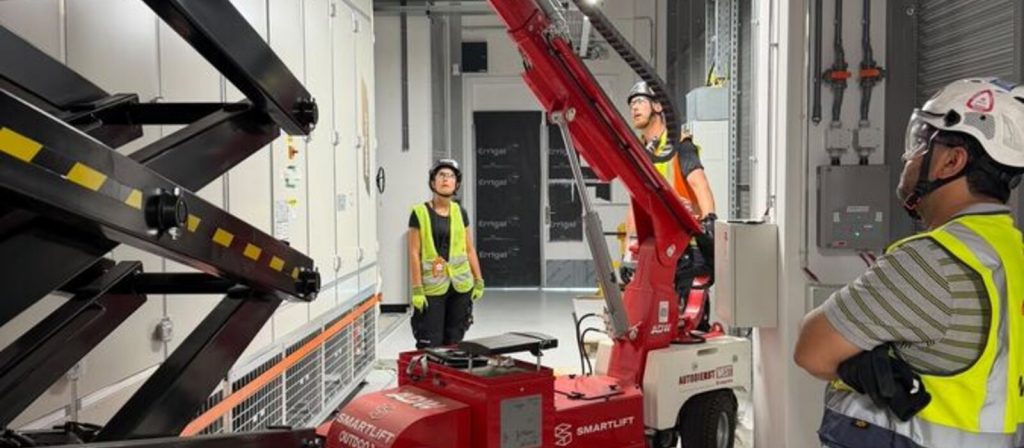
A CRAH unit can be replaced in a live data center if redundancy, load path, protection and the sequence of trades are fixed before the first move. The lifting equipment is then the smallest part of the job.
You need to replace a CRAH unit: the heat exchanger is damaged, the fan is at the end of its life, or the unit no longer suits the cooling concept. The data hall – the white space – stays live. The neighbouring units carry the load, and the maintenance window is tight. Every step has to be right, because a mistake does not affect an office air conditioner but the cooling of live servers.
As project manager you sit between the operator, the mechanical (cooling) contractor, the electrical contractor and the installation contractor. Who isolates what and when, who carries the load, who documents what? And how does a tall, heavy unit get through a narrow CRAH gallery without touching the neighbouring units or the raised floor? If these questions are still open on the day, you lose hours of your maintenance window.
This guide follows on from our overview guide “Data Center Installation: What's Different for Subcontractors”. It takes you through the replacement phase by phase: assessment, preparation, isolation, removal, installation, positioning and handover. It covers protection, floor load checks and acceptance – and ends with a checklist you can use to walk through the swap with everyone involved.
Key points at a glance
- A CRAH replacement is a multi-trade job with a clear split: installation contractor, cooling and electrical contractors and operator work in a fixed sequence, not at the same time.
- Redundancy (N+1 or 2N) is a precondition: the neighbouring units must carry the cooling load while one unit is out – the operator checks and approves this through change control.
- The load path from lorry to final position is measured, calculated and recorded in the lift plan in advance; pinch points, door widths and floor loads are the usual obstacles.
- Protective fleece, tape and covers for the neighbouring units go down before the first lift and stay until handover.
- The old unit is moved out under control, dismantled into modules where needed; the new one is positioned and levelled to the millimetre at the existing connection points.
- Refrigerant, water and electrical connections belong to the specialist trades; the installation contractor delivers the mechanical installation and its documentation.
- Handover is documented: position, alignment, bolting with torque record, photos, inspection certificates and signed handover certificate.
What is a CRAH unit?

A CRAH unit (computer room air handler) is a recirculating air handling unit that cools the warm exhaust air from the servers through a chilled-water coil and returns it to the data hall as cold air. A CRAC unit (computer room air conditioner), by contrast, has its own refrigeration circuit with a compressor.
CRAH units stand either in the data hall at the boundary between cold and hot aisle, or in a plant corridor next to it, usually called the CRAH gallery and counted as grey space. A unit consists of a casing, a heat exchanger with fin pack and copper tubes, a fan section, filters, control valves and controls. CRAH units are tall and heavy and firmly tied into the building through water connections, condensate drain and power supply; the chilled water comes from the chillers in the plant areas.
Replacing a computer room air handler is not a case of carrying a box out of the room. It means isolating, disconnecting, dismantling, moving, repositioning and reconnecting plant – in a room that keeps running. The basics of working in a data center, from access and dust control to the raised floor, are on our page on data center construction.
When does a CRAH unit need to be replaced?
A CRAH unit is replaced when repair is no longer technically possible or economic. Other triggers are end of service life and a changed cooling concept for the hall. Whether you repair or replace depends on the damage, spare parts availability and the installation route.
Typical triggers
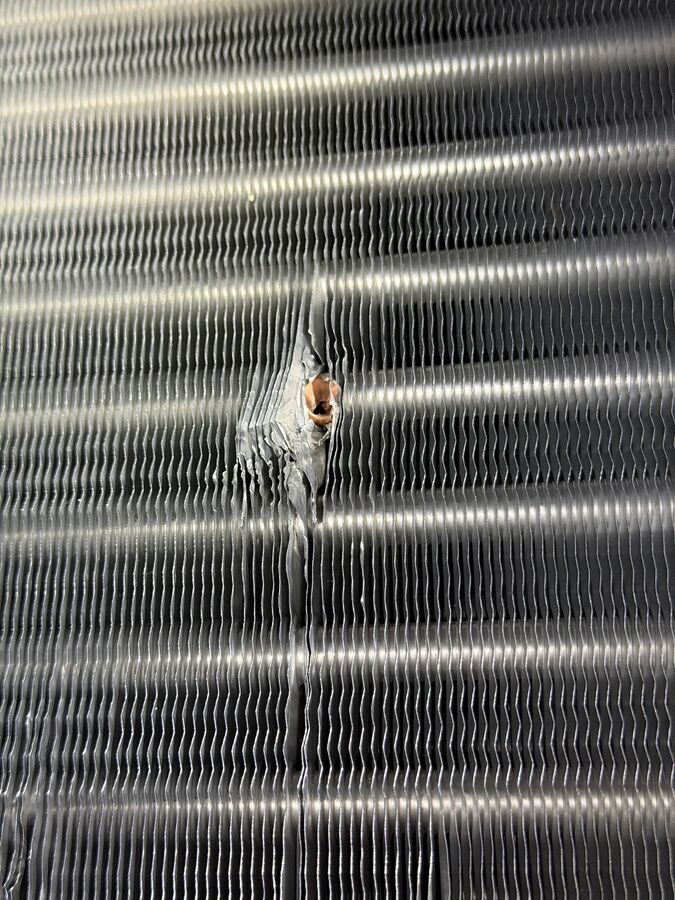
- Damaged heat exchanger: A fin pack torn open down to the copper tubes can rarely be repaired on site; leaks in the copper tubes even less so.
- Worn fan section: Bearing damage, imbalance, motor failure – often repairable, but spare parts for older units may no longer be available.
- Corrosion and leaks on the drip tray, connections or condensate pipework.
- Capacity adjustment: Higher rack loads need more cooling capacity or a different airflow arrangement.
- Change of cooling concept, for example different supply temperatures or a changed cold/hot aisle layout.
Repair or replace?
The decision is made by the operator and the cooling contractor, not by the installation contractor – based on the assessment, the damage and spare parts availability. The underlying question is whether the unit is obsolete and parts are only available remanufactured. What we contribute from our maintenance and servicing practice is the mechanical assessment: can the faulty module come out without moving the whole unit? Is there an installation route that gets the unit out in one piece? And what does replacement cost in time and effort compared with repair – in qualitative terms, not in figures.
How does a CRAH unit replacement work?

A CRAH replacement runs in six phases: assessment and decision, preparation, isolation by the specialist trades, removal of the old unit, installation and positioning of the new unit, and handover and commissioning.
| Phase | What happens | Who is responsible |
|---|---|---|
| 1. Assessment | Identify the damage, decide repair or replace, check redundancy | Operator, cooling contractor |
| 2. Preparation | Site survey, load path, lift plan, RAMS, change request, access list, protection material, maintenance window | Installation contractor, project management |
| 3. Isolation | Isolate electrically and lock off; shut off and drain the water side, disconnect the condensate | Electrical and cooling contractors |
| 4. Removal | Release the old unit, dismantle if needed, move it out, take it away | Installation contractor |
| 5. Installation and positioning | Bring in the new unit, position, level, fix | Installation contractor |
| 6. Handover and commissioning | Hand over documentation, connect, fill, test run, snagging list | Installation contractor, then specialist trades and operator |
Phase 1: Assessment and decision
It starts with one question: will the hall keep running safely without this unit? Redundancy is the precondition for any swap in a live facility – enough spare cooling capacity from the remaining units, designed as N+1 (one unit more than needed) or 2N (fully duplicated). The operator confirms this, usually through a change request, which registers and approves every intervention in live plant. Only then is the date set.
Phase 2: Preparation
Preparation is the longest part. On a site visit we measure the old unit and the load path, and check door widths, headroom, turning circles, lift capacity and floor loads. Then we prepare the lift plan and the RAMS – the risk assessment and method statement used on data center sites. We register people for the access list and machines for approval, and agree the maintenance window with all trades. How access, induction and machine approval work in a data center is explained in the overview guide.
Phase 3: Isolation
Before the installation contractor touches the unit, the electrical and cooling contractors have isolated it: dead and locked off (lockout/tagout, LOTO – lock and tag on the isolator), water side shut off and drained, condensate disconnected. The isolation is documented and handed over to us with the permit to work – the written authority to work in a defined area for a defined period. Without this written handover we do not start.
Phases 4 to 6
Removal, installation and handover are covered in detail in the sections below.
What protection do the floor and neighbouring units need?

Floor and neighbouring units are fully protected before the first lift. All walkways and routes are covered with protective fleece and taped down. Neighbouring units, cable trays and pipework are covered or shielded, and every machine is checked for suitable, non-marking tyres.
Floor protection
Protective fleece along the whole load path, taped at joints so that nothing slips and no edge becomes a trip hazard. For high point loads, load spreading plates or hardboard on top – on a raised floor always along the pedestal lines. The fleece stays until the next trade has taken over and the area has been cleaned.
Often forgotten in planning: the CRAH gallery is also the escape route for everyone working there. The BG BAU/BAuA information sheet on traffic routes on site, in line with ASR A2.3, requires a clear width of at least one metre for escape routes used by up to 20 people. So modules parked temporarily, packaging and protection material must never narrow the aisle so far that nobody can get past the unit. That is why the lift plan states where things may and may not be set down.
Protecting the neighbouring units
The neighbouring units keep running and carry the cooling load. They are protected against contact with lifting devices and loads by spacers, covers and a load path in the lift plan with defined clearances. Overhead cable trays and pipework along the route are marked and, where needed, mechanically protected. Dust control means no drilling, sawing or grinding in the CRAH gallery without extraction and approval. The BG BAU/BAuA information sheet on low-dust working sets the standard: extract dust at source, screen off the work area, clean only with a vacuum – no dry sweeping or compressed air. In a data center this is not a formality: particles in the filters of neighbouring units are exactly the damage the swap is meant to avoid.
Machines and supervision
Every machine movement is directed by the lift supervisor, under the lift plan approved by our appointed person for lifting operations (AP); no lifting device passes a pinch point without a banksman. The load area is cordoned off, and nobody stands under or beside a suspended load. Machines and lifting accessories are checked again before each use and the check is recorded. Each day starts with a toolbox talk that goes through sequence, hazards and stop authority with everyone involved.
What you as client should expect to see: Germany's technical rule TRBS 1201 requires lifting accessories and below-the-hook lifting devices to be inspected at least once a year, plus a check on every working day. Ask for the inspection certificates before work starts. An inspection tag only proves that an inspection took place – not that the item is free of defects today. That is why the daily check belongs in the work sequence, not just in the inspection log.
Which floor loads and transport routes need to be checked?

The whole load path from lorry to final position must be checked: unloading area, access doors, lifts, corridors, CRAH gallery. At every point along the route, the permitted distributed and point load of the floor applies.
The load path
CRAH units are rarely on the ground floor right behind the gate. The typical installation route runs from an unloading area via a heavy-duty or goods lift and corridors with fire doors to the CRAH gallery with its narrow aisles. Every pinch point is measured: door width, headroom, turning circle and swept path, thresholds, slopes. The dimensions of the new unit – packed and unpacked – are checked against them. If we are centimetres short, we plan how the unit can be tilted, turned or split.
Floor loads
For each section of the load path we obtain the load data: imposed and point load of the raised floor, slab capacity, lift capacity. We then check the actual load – unit plus lifting device plus wheels – against these values. What counts is the ground pressure under each wheel, not the total weight. Two compact lifting devices carrying a unit in sync spread the weight differently from one set of machine skates, and the lift plan must show that. If a point load exceeds the permitted value, we use load spreading plates or another route; in case of doubt, the operator's structural engineer confirms the values.
Behind this is a duty that makes your selection easier. Under Germany's technical rule TRBS 2111 Part 1, the suitability of a lifting device must be reassessed for each place of use. A CRAH gallery with a raised floor is a different place of use from a factory hall. So do not ask whether the contractor “has a lifting device” – ask whether the lift plan shows why this device, with this ground pressure, may work in this aisle.
Lift
The lift is often the bottleneck: capacity, car size, door width and whether the unit fits standing or lying down. If the lift is not enough, the remaining route is through an installation opening or shaft by crane – a different job with a different lead time.
How is the old CRAH unit removed?
Once isolation is documented, the old CRAH unit is released from its fixings under control and moved out step by step. It leaves the gallery either in one piece or in modules.
Releasing and securing

First the base bolts, connection flanges and cable and pipe penetrations are released – only the mechanical ones; the specialist trade has already disconnected water and power. The unit is secured against tipping before the last fixing comes out. Tall, narrow units have a high centre of gravity, which decides lifting points, lifting accessories and lifting equipment. A trial lift checks this first: raise a few centimetres, check, set down.
Moving
Once out of position, the unit travels on lifting devices, machine skates or hydraulic machine skates – always under direction and always watching the neighbouring units. In narrow aisles, heavy modules such as the fan section are secured on hydraulic skates and moved one by one, which reduces weight and height per move and spares the floor.
Dismantle or move in one piece?
Whether the unit is split depends on the load path and its condition. If the casing can be separated without damage, that is often the gentlest option. If the unit is scrap anyway, it can be cut – but not in the CRAH gallery with sparks and swarf. Cutting happens outside, or with extraction and a fire watch under a hot work permit. In a data center, that permit also covers isolating the fire alarm system in the section concerned.
Transport away
The old unit or its modules are packed, loaded and sent for disposal or back to the manufacturer. Refrigerant – if the unit has its own refrigeration circuit – may only be recovered by certified personnel under the German Chemicals Climate Protection Ordinance (ChemKlimaschutzV), the German counterpart to F-gas certification. That is the cooling contractor's job, not the installation crew's.
How is the new CRAH unit brought in and aligned?
The new unit travels along the checked load path and is unpacked close to its final position. Lifting devices set it to the millimetre at the existing connection points; it is then aligned and fixed to its plinth.
Move-in
From the lorry across the unloading area to the CRAH gallery, the unit follows the lift plan: unload, transfer to lifting device or skates, through doors and lift, and under direction through every pinch point. In a data center, external contractors are escorted by the operator. Packaging comes off only where no particles can reach the data hall – never in the white space.
Positioning

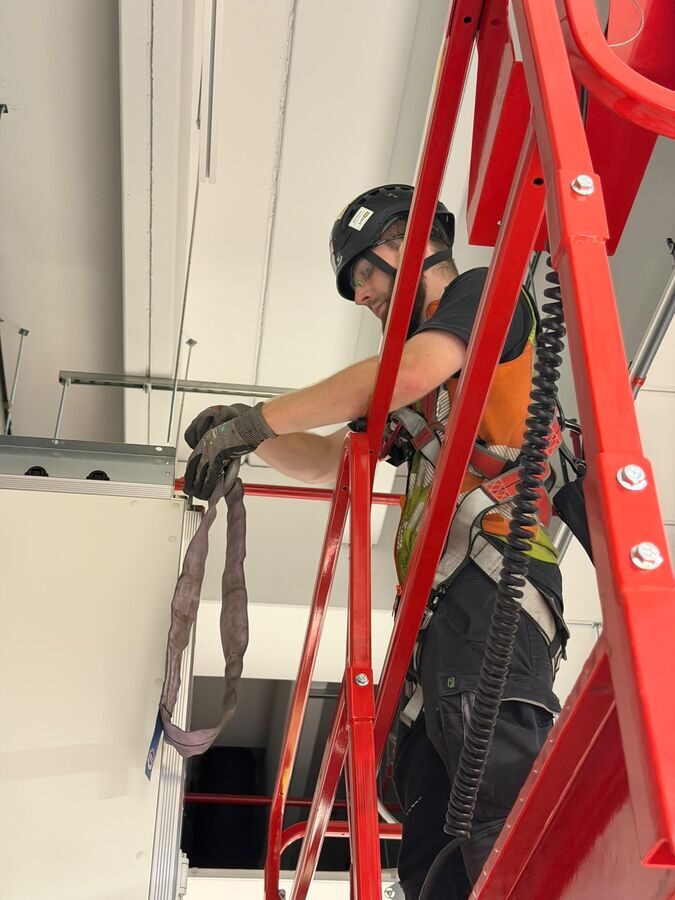
In the CRAH gallery, installation comes down to centimetres. Two synchronised compact lifting devices raise a tall unit evenly and move it along the narrow aisle without tipping or touching the neighbouring units. The existing connections – water, condensate, power, air path – define the target position. The unit is set out to them and, in long rows, aligned with its neighbours by laser.
Aligning and fixing
After set-down, the unit is levelled so that condensate drains and doors close, then bolted to its plinth or support frame. Torques are recorded where required. Then we check that every connection flange sits where the specialist trade needs it – a centimetre out on the water side means rework nobody wants inside the maintenance window.
What belongs to acceptance and handover?

Acceptance means the documented handover of the mechanically installed unit to the specialist trades: position, alignment, fixing, condition of the surroundings, photos, inspection certificates and signed handover certificate. Open items go on the snagging list and are closed before acceptance.
Handover by the installation contractor
- Position and alignment record (installation record)
- Proof of fixing, torque record where required
- Photos: unit, connection positions, neighbouring units, floor after removing the protection
- Inspection certificates for the machines and lifting accessories used
- Record of deviations, stoppages and near misses
- Handover certificate, snagging list and handover record, countersigned
Connection and commissioning
The cooling and electrical contractors then take over: connect the water side, fill, vent and check for leaks, then make the electrical connection, controls and BMS integration. On a new installation this is followed by the Cx tests – start-up and pre-functional checks (L3) and functional tests (L4), witnessed by the CxA. The unit then goes into normal operation. Only then is redundancy restored and the change request closed – and only then is the replacement complete.
Project examples
Two jobs from our project diary show the replacement and its context in the Rhine-Main region.
CRAH unit replaced in Frankfurt during live operation
In a data center in Frankfurt we replaced a CRAH unit during live operation. The finding: a damaged heat exchanger, fin pack torn open down to the copper tubes – no repair possible on site. One supervisor and three experienced lift and shift riggers needed two working days. The new unit was unloaded from the lorry and taken up to the second floor. In the narrow aisles of the CRAH gallery, two synchronised compact lifting devices set the tall unit to the millimetre. The faulty unit was picked up under control, moved out step by step and taken out of the gallery. Heavy modules such as the fan section travelled through the aisles on hydraulic machine skates. All walkways and routes were covered with protective fleece and taped down. Access was through several secured zones with security gates and interlocked doors. RAMS and detailed lift plans were approved before the start.
The spider crane that installed CRAH units
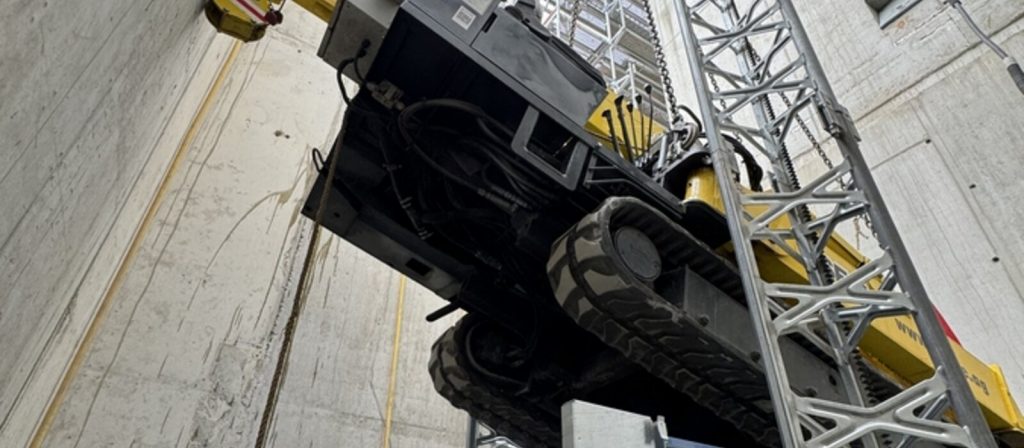
At a data center in Raunheim, a spider crane stood in the basement. It had been brought in during the structural phase and set CRAH units until the very end, by which time the building had been completed around it. Getting it out was a lift and shift job in its own right. The only route was a shaft occupied by a construction hoist that could not be dismantled, two centimetres short of the upright clearance. Four fitters retrieved the spider crane from the basement in a single day. The steps involved:
- Site survey and route planning through the fitted-out basement with partition walls and services, plus the lift plan
- Travel in electric mode on a long power cable – the diesel engine was banned in the data center
- Operator and banksmen at several positions, timber baulks under the construction hoist to spread the load
- Angled slinging with an adjustable chain on the four-leg chain sling to gain the missing clearance
- Lift up through the shaft by tower crane
For CRAH replacements this shows two things: which lifting equipment can work in the gallery at all depends on the building. And whatever goes in has to come out again.
Is a comparable replacement coming up for you – in Frankfurt, Offenbach, Hanau or elsewhere in the Rhine-Main region? Then get in touch with us. A site visit in the CRAH gallery usually settles within an hour whether the unit fits through in one piece, which lifting devices suit, and how long the maintenance window really needs to be.
What this means for your role
For buyers: Tender the replacement with a scope of works that lists lift plan, RAMS, protection and documentation as separate items; otherwise you compare quotations that contain different things. Define in an interface list what the client provides (isolation, proof of redundancy, access, lift) and what the cooling and electrical contractors deliver. Price waiting time at security gates or postponed maintenance windows as a provisional sum so that it does not come back as a variation. Evidence of suitability includes references for swaps in live facilities, the qualification of the appointed person for lifting operations and the inspection certificates for the lifting equipment.
For designers: Every CRAH unit installed today will be replaced at some point. Door widths, headroom in the gallery, lift capacity and car size, point and distributed loads of the raised floor and spare space for manoeuvring are the design parameters – later they decide between two days and two weeks. Record the installation route and load data in the installation design. Plan chillers, CRAH units and standby generators for replacement from day one – our guide on replacement in live data centers shows how.
For project managers and site managers: Fix the sequence of trades in the programme and make documented isolation under a permit to work the precondition for lift approval. Have the lift plan and RAMS submitted before delivery and walk the load path together on a site visit. As site manager you brief on site, coordinate the trades before and after in the gallery, sign off each phase and receive the handover certificate. Plan gate and security check times as working time, not as buffer. Everything in the overview guide on data center installation applies even more strictly here: the gallery is narrow and the neighbouring units are running.
For maintenance managers: You supply the assessment and damage report that trigger the replacement, and you take the new unit into your maintenance plan and inspection intervals after handover. Have the fault history, maintenance records and readings of the old unit ready so that the swap does not start with a root-cause analysis. At acceptance, check that access for filter changes, valves and controls is kept. Clarify spare parts for the new type and add the unit to your asset file with its commissioning data and inspection log.
For occupational safety specialists and HSE coordinators: A swap in a live CRAH gallery combines lifting, electrical isolation and work on water- or refrigerant-carrying pipework in a confined space. Check that the risk assessment under Section 5 of the German Occupational Safety and Health Act (ArbSchG), or the installation contractor's RAMS, covers the running neighbouring units, the escape route in the aisle, the load area and the interfaces with the specialist trades. Check that the permit to work references the isolation with LOTO. Require an induction and a toolbox talk for everyone involved. Define in writing who has stop authority: anyone may stop the lift, and only the lift supervisor restarts it.
For facility managers and operators: You take the swap through your data center's change process: change request, proof of cooling redundancy (N+1 or 2N during the work), maintenance window, access list and escort. Where your operation uses a method of procedure (MOP) for interventions in live plant, the contractor's RAMS should match it. Schedule the window so that your operations team is reachable, the BMS alarms are being watched and nothing falls into a shift change. Keep a fallback ready in case the window is not enough. At the end, ask for a documentation package you can show your customers or auditors – from the load path to the handover record with the snagging list closed.
CRAH replacement checklist: template on request
The CRAH replacement checklist puts the six phases and their checkpoints on one page:
- Assessment: damage, decision, redundancy
- Preparation: site survey, load path, floor loads, lift plan, RAMS, registration, protection material, time window
- Isolation: electrical, water, condensate, handover document
- Removal: securing, releasing, moving, dismantling, taking away
- Installation and positioning: load path, unpacking, positioning, aligning, fixing
- Handover: records, photos, inspection certificates, handover certificate, connection, test run
Each item has a responsibility column for installation contractor, cooling contractor, electrical contractor and operator. Project managers use it to walk through the swap with everyone beforehand; on the day it is a shared tick list, so the maintenance window holds and no trade waits for another. Request the checklist via our contact form – reference “CRAH replacement checklist”.
Why Omega Mounting?
Omega Mounting is based in Rodgau near Frankfurt, a few kilometres from the data center sites in Frankfurt, Offenbach, Raunheim and Hanau. The linked CRAH replacement in Frankfurt and the spider crane retrieval in Raunheim show how we deliver lift and shift in finished buildings – with our own lifting equipment, lift plans and documentation. Our workshop in Rodgau makes transport frames, load spreading plates and adapters when the installation needs them. And because CRAH failures do not keep office hours, you can reach us by phone or WhatsApp when a swap has to go into a short-notice maintenance window. With us you get a single point of contact for site survey, lift plan, lifting equipment and documentation – and a short line of communication if the gallery turns out different from the plan on the day.
Conclusion
Replacing a CRAH unit is less about lifting equipment than about organisation: redundancy confirmed, trades in sequence, load path measured, floor loads calculated, protection down, isolation documented. Then removal and installation take two controlled working days instead of a week of surprises. The checklist in this guide helps you cover every point. If a swap is coming up, send us the floor plan of the CRAH gallery, the type of unit and your preferred date – we will come back with an honest assessment of load path, lifting equipment and time needed.
Planning a move-in, installation or maintenance in the Rhine-Main region?
Tell us briefly what you need – we'll come back with an honest assessment.
Free, no-obligation callback
You may also be interested in these guides

About the author
Tobias Schott
Managing director of Omega Mounting GmbH, Rodgau · more than 20 years of hands-on experience in installation and maintenance
A trained mechatronics technician, working in maintenance, servicing and industrial installation since 2004 – first alongside his father, and with Omega Mounting since 2012: from overhead conveyors in Frankfurt to the crane system in a new-build hall. He plans and leads lifting operations as an appointed person (AP) in data centers and on industrial sites in the Rhine-Main region, trains and examines operators of cranes, mobile elevating work platforms and telehandlers, and is a qualified occupational safety specialist. On jobs abroad he is known as the “German Troubleshooter” – the person you call when a site gets stuck. He learned what quality means from his father, not from a manual: Made in Germany as a standard for his own work, not a label. That is why quality comes first at Omega Mounting – ahead of speed and price. He writes these guides from that practice: what works on our sites is in them – what exists only on paper is not.
Frequently asked questions
Yes, if the remaining units carry the cooling load during the swap – that is, if N+1 or 2N redundancy still holds with one unit out. The operator confirms this through change control before the maintenance window is set. The swap then takes place in the protected CRAH gallery under direction and escort, without touching the white space.
That depends on the load path, how much has to be dismantled and the maintenance window. For the Frankfurt replacement described here, one supervisor and three riggers needed two working days for removal and installation. Site survey, lift plan and access registration ran beforehand. Connection and commissioning by the specialist trades come on top in the programme.
The electrical and cooling contractors: they prove the unit dead, lock it off (LOTO), shut off and drain the water side and disconnect the condensate. The isolation is documented and handed to the installation contractor with the permit to work for the area, period and task. Without that handover, mechanical work does not start.
Not necessarily. The load path decides whether it goes in one piece or in modules: door widths, headroom, lift and the narrow aisles in the gallery. Heavy modules such as the fan section are often moved separately on machine skates to cut weight and height per move. Cutting with sparks needs a hot work permit and happens outside the CRAH gallery.
The permitted distributed and point load for each section of the load path: raised floor, structural slab, lift capacity. The installation contractor checks the actual load from CRAH unit, lifting device and wheels against these values; what matters is the ground pressure under each wheel. If values are missing, the structural engineer confirms them; if they are exceeded, the contractor lays load spreading plates or picks another route.
Yes. Every intervention in live plant runs through the operator’s change request, and our RAMS follow the approved method of procedure (MOP) for the swap. The electrical and cooling contractors isolate under the permit-to-work system and hand the area over to us in writing; without that handover we do not start. Stop authority applies to everyone throughout, and only the lift supervisor restarts a stopped lift.
Beforehand: lift plan, RAMS, inspection and qualification certificates. During the work: daily machine and lifting accessory checks, protective measures, deviations and near misses. At handover: installation record with position, alignment and torques, photos, snagging list and handover certificate. These documents are your evidence to the operator and belong in the as-built records.
In principle, yes – the six phases and the sequence of trades stay the same. Chillers and standby generators are heavier and usually stand in the grey space or on the roof, so mobile cranes, machine skates or installation openings come in. The logic also holds outside data centers, in production or logistics.
Yes. We work with our own lifting equipment – compact lifting devices that can run synchronised in pairs, hydraulic machine skates and winch stackers – and our own load spreading plates. On the Frankfurt job, two synchronised compact lifting devices moved the tall unit through the narrow gallery without touching the neighbouring units. Which device suits your gallery depends on door widths, headroom and floor loading, which we check on the site survey.
Yes. The swap is scheduled into the operator’s maintenance window, including nights and weekends. Preparation must be complete beforehand: site survey, load path, lift plan, RAMS, access list and documented isolation by the specialist trades. On the Frankfurt job, one supervisor and three riggers needed two working days for removal and installation. We plan security-gate time as working time.
 English
 German