
- Technology explained – standby generator installation
Installing standby generators: how a standby power system gets into a data center
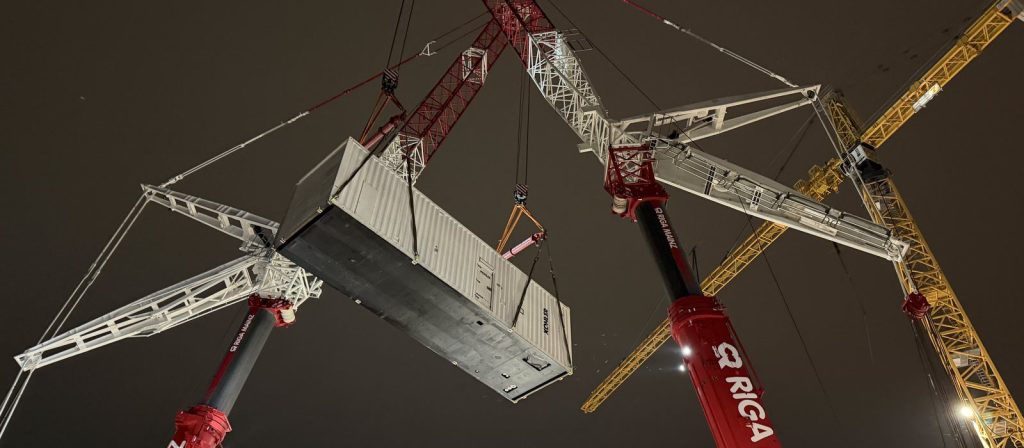
More than 60 generators installed over three years – from tandem lifts with two 650-tonne cranes to 16 metres up, through to a standby power system ready for connection
A standby generator has been ordered, built and delivered. It stands on the low-loader in front of the building. Then comes the part nobody thought much about beforehand: how does a unit weighing more than twenty tonnes get to the second floor?
Two kinds of client ask us this. One is the operators and general contractors of data centers having standby power installed. The other is the manufacturers and suppliers of the generators – specialist firms that build an excellent unit but keep no installation crew with lifting equipment of their own. For both, we take on the same scope: installation, positioning, fixing, full mechanical build-up and completion up to the point where only the manufacturer's commissioning remains.
Over the past three years we have installed more than 60 standby generators this way – the largest rated up to 3 MW, plus many smaller units in the megawatt range. The heaviest single generator weighed just over 20 tonnes; as complete containerised units we have lifted standby power systems of 54 tonnes.
This report describes how that works – including a new-build data center in the Frankfurt area, where we handled the complete installation and build-up of the generators for the general contractor. It also shows why the same task comes up across critical infrastructure: hospitals, universities, government data centers – wherever operations must not depend on the public grid.
Project profile
- Generators installed: more than 60 in three years
- Power classes: up to 2–3 MW on the largest systems, plus smaller units in the megawatt range
- Heaviest single unit: just over 20 tonnes
- Heaviest container solution: 54 tonnes
- Largest lifting equipment used: tandem lift with two 650-tonne mobile cranes
- Typical lift height to the second floor: around 16 metres
- Team: mechatronics technicians, electricians and industrial mechanics in mixed crews – on large projects on site continuously for months
- Scope of work: installation, positioning, fixing, complete mechanical build-up of indoor units and connection of containerised units to the building – ready for commissioning
- Client: general contractors and operators of data centers, and manufacturers and suppliers of standby power systems
What is a standby power system – and why is it more than just a generator?

A standby power system is the installation that takes over a building's power supply when the public grid fails – in everyday terms a standby generator or genset. Technically it is not a single machine but a system of modules that must work together.
At its core is a diesel engine driving an alternator. Around it sit the radiator cooling, the exhaust run with manifold, silencer and – on modern units – an SCR system (selective catalytic reduction) for exhaust after-treatment, the supply of fuel, coolant and AdBlue with their tanks, and the switchgear through which the unit is controlled and connected. Only all of this together makes an installation that takes over within seconds when needed.
One distinction matters for the installation work: container solution or indoor solution.
With the container solution the complete unit arrives ready to run in a container. The lift is correspondingly bigger – the heaviest containerised unit we have installed weighed 54 tonnes. The installation work lies in the connections: exhaust, cooling, fuel, control lines and power between container and building.
With the indoor solution, the generator stands in a dedicated room inside the building. In data center construction this is the normal case, because land is expensive and noise is easier to control indoors. It also means every single module has to be brought into the building and installed there.
It is exactly this difference that turns a delivery into an installation project.
Why installation is the critical point in the programme

Because it is the one step that cannot be moved without moving everything else. A generator room cannot be fitted out until the generator is in – and the generator no longer gets in once the wall is up. Installation is a window, not an activity.
We have seen this several times in data centers, and it is the reason we want to be involved in the planning early. During the removal of a spider crane from a data center basement the building had literally been completed around the machine. In the end two centimetres were missing, despite correct measurements. We solved it with angled slinging on an adjustable chain. Situations like this do not come from carelessness but from the months between planning and installation, in which a building changes.
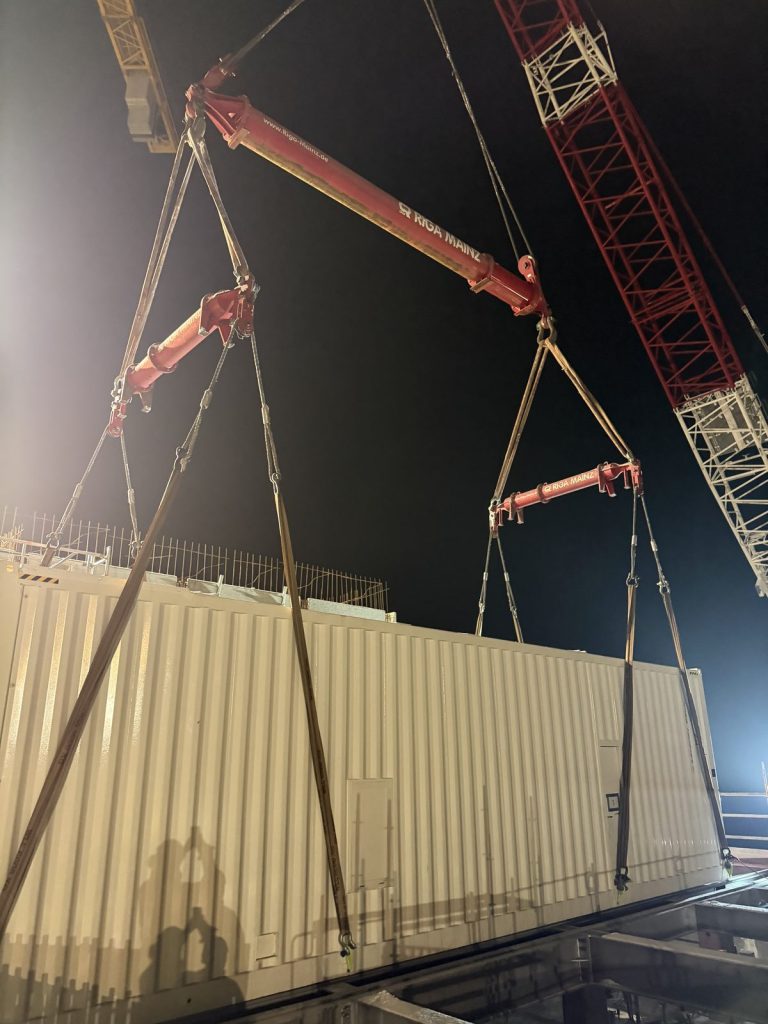
Standby generators are also heavy, bulky and sensitive at the same time. A unit tolerates no point load on the wrong component, no twisting of the frame and no slinging against casing parts not designed for it. The manufacturer specifies the lifting points, and those are the ones you use – even when another geometry would make the lift easier.
There is no spare machine
That is the sentence that separates every generator lift from every other lift. What hangs on the hook is not a steel component you can simply reorder. What hangs on the hook is a unit worth several hundred thousand euros, with long lead times and no replacement on the shelf.
And more depends on it than its purchase price: the unit is the resilience of the entire site. If it is damaged, it is not just a machine that breaks – the data center's commissioning slips by however long a replacement takes.
That is why we treat a generator lift differently from a pallet. Every lift is planned in detail in the lift plan: load data, sling geometry, crane position, radius, ground pressure, sequence of movements. Before the lift the whole crew is briefed – not only those at the crane but everyone moving through the area that day. People who know what is about to happen do not step aside on impulse.
This care is not over-caution, it is simply the conclusion of the arithmetic: the hours a proper plan costs are not measurable against the value of the load.
How does a generator get to the second floor? The three methods

There is no such thing as The method. There are three, and which one fits is decided by the building, not by the weight.
1. The crane lift – when the building can be reached from outside
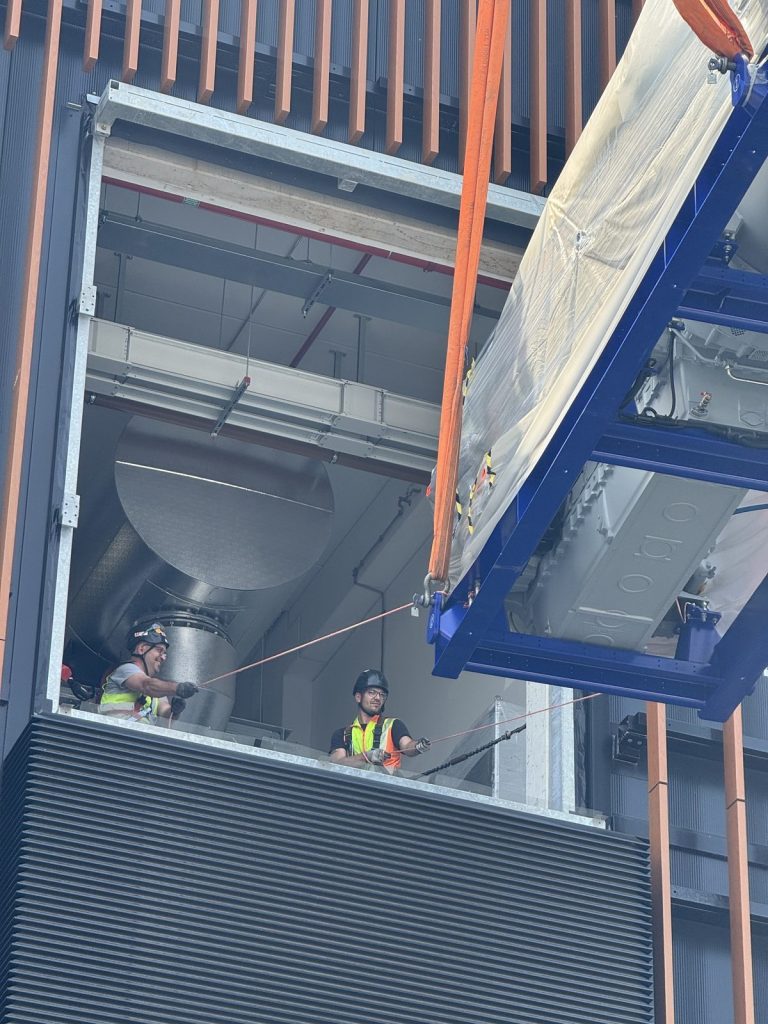
The normal case in new build: while the facade is still open or an opening has been left, a mobile crane lifts the unit straight onto its floor. That is fast and gentle on the component, because it is lifted once and set down once.
The work is in the preparation: check the crane standing area, calculate outrigger loads against the ground bearing capacity, determine radius and capacity at the target point, select slings to the manufacturer's specification, write the lift plan and have it approved. On data center sites the lift plan is not a formality but the basis for the general contractor's approval.
2. The tandem lift – two cranes, one component

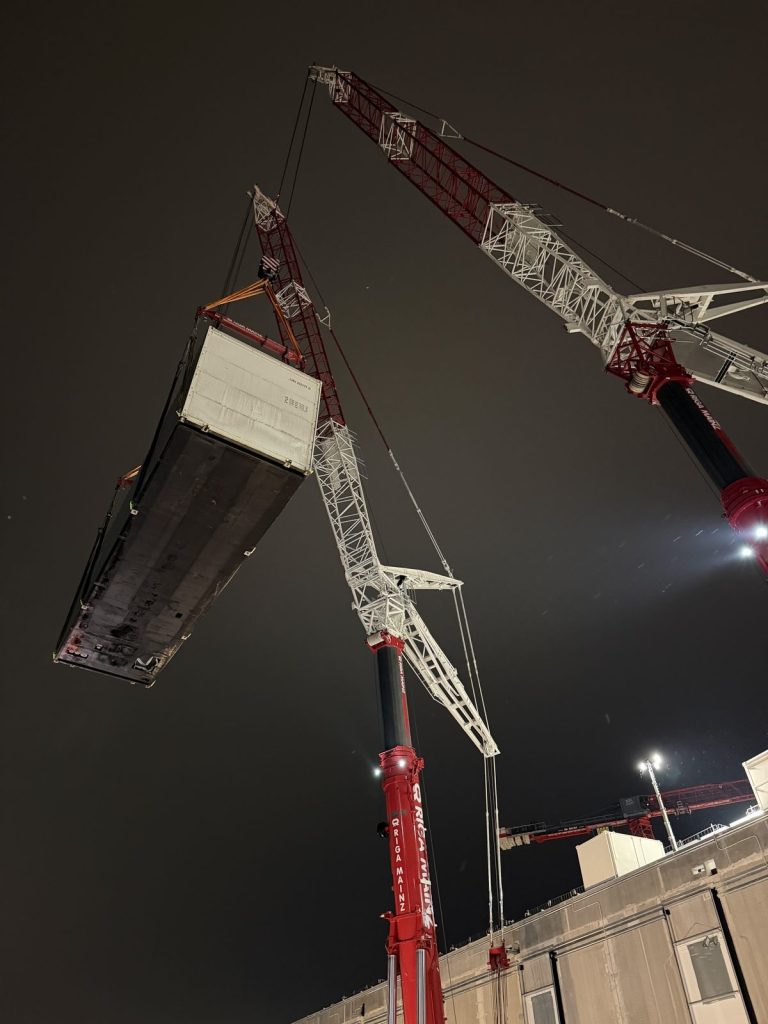
A tandem lift is the most demanding lift there is. Two mobile cranes lift the same component at the same time. It is used when one crane cannot handle the load at the required radius, when the component is so long it would tip on a single hook, or when it has to be threaded in at a particular attitude.
That was exactly the case on our project in the Frankfurt area: the generator rooms are on the first and second floors, and the units had to go in by tandem lift. In buildings like this the second floor typically means a lifting height of about 16 metres. The largest cranes we have used for tandem lifts were two machines of 650 tonnes capacity each – a figure that says less about the weight of the load than about the radius you are working at.
Why that is demanding fits in one sentence: Two cranes are not twice as safe as one, they are twice as complicated. Both cranes have to move in step. If one lags, the load shifts onto the other and the load split set out in the lift plan no longer holds; every deviation from level changes the forces at both hooks. That is why on a tandem lift exactly one person gives the commands and everyone else follows them. Our appointed person for lifting operations plans the lift; a lift supervisor appointed by the AP runs it on site – both named and appointed in writing.
3. Heavy-duty rollers and moving robots – when a crane can no longer reach
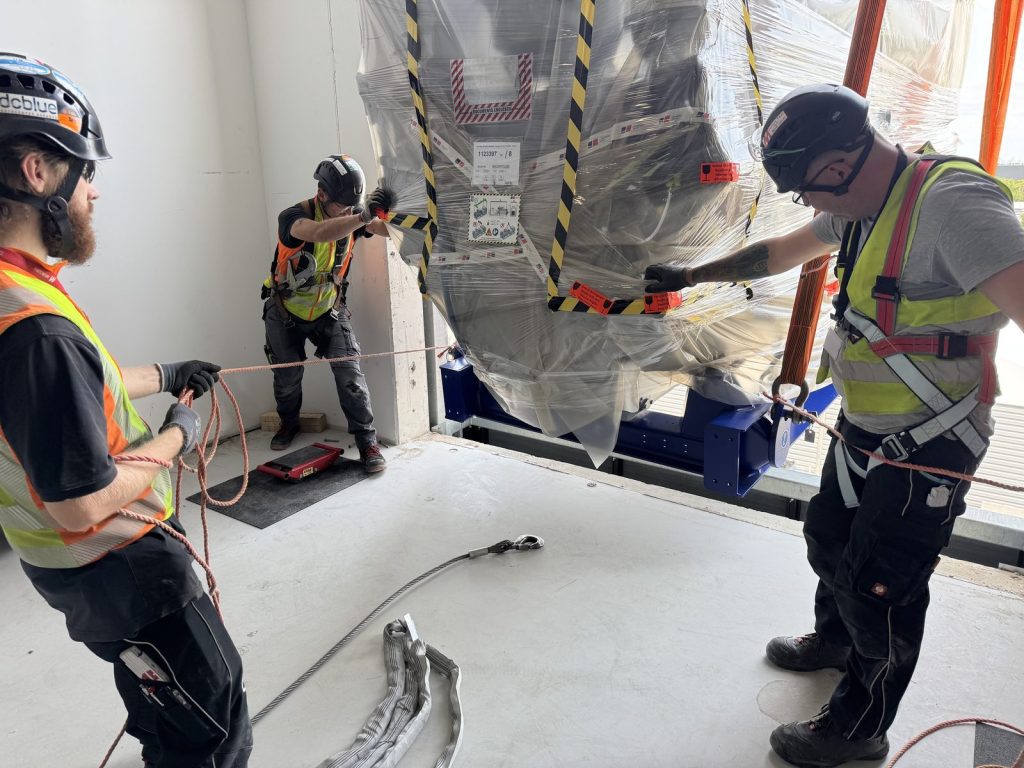
Once the building is closed, the crane is no longer an option. The unit then goes in across the floor: it is set on machine skates and moved to its position along the existing routes – through gates, up ramps, along service corridors. For the last few metres and for setting it down on the foundation to the millimetre we use remote-controlled load movers and lifting devices that still work where there is no room for a forklift.
This method is slower than a crane lift, but it is often the only one left. We have used it among other places on the installation of 160 PDCs in eight data halls and on moving load banks and generators into a data center in Frankfurt.
One particularity that data centers bring with them and that many underestimate: combustion engines are not permitted inside the building. No diesel forklift and no diesel lifting device in the white space or adjacent areas. Everything that goes in runs on electricity – and needs power, which is not always available on a construction site.
What comes after the lift: the complete build-up of the indoor unit
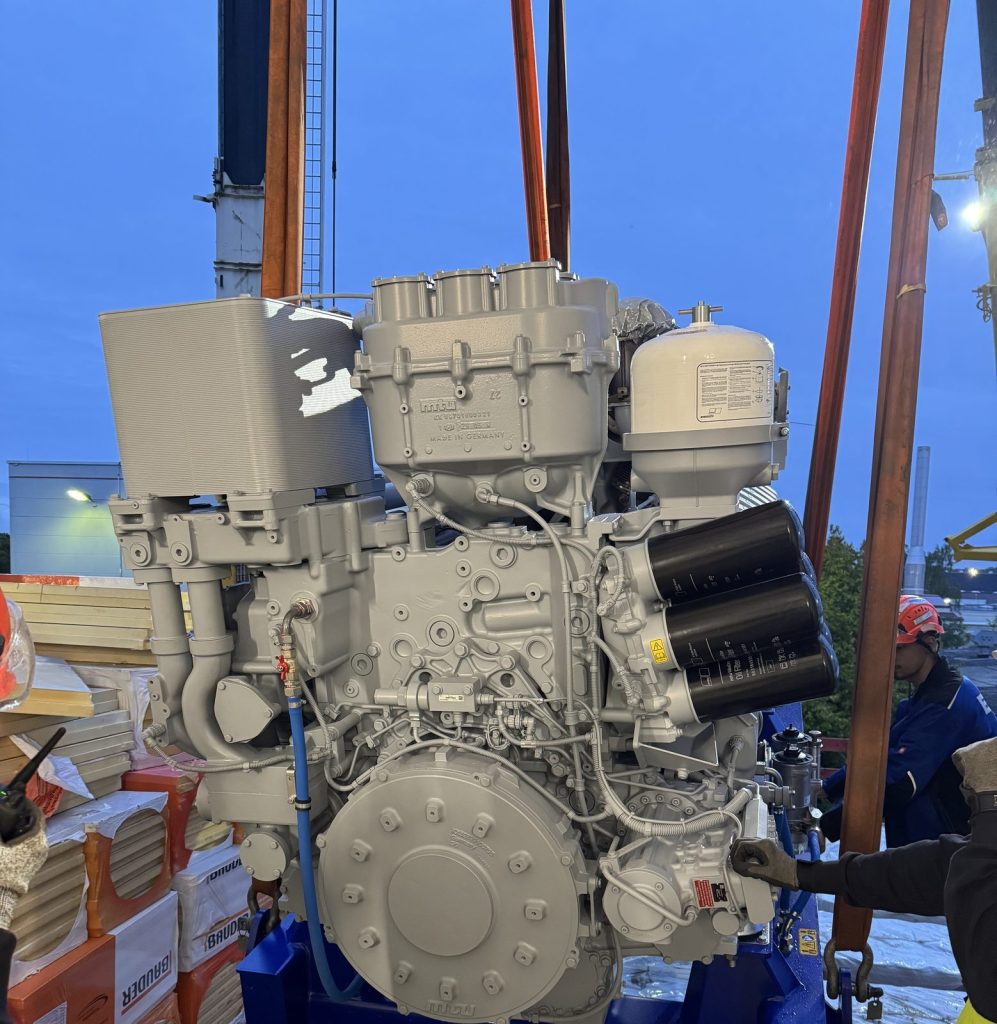
The lift is the visible part. The build-up is the long one. Once all modules were standing in the generator room, we assembled the installation component by component, until the parts became one machine.
That included:
- The radiator – the cooling of the unit, together with the pipework to the engine. How sensitive this assembly is can be seen in another job of ours: the radiator repair on a standby generator in Offenbach, where in the end there was only one question – is it tight?
- The SCR system for exhaust after-treatment, which reduces the diesel engine's nitrogen oxide emissions and is standard on new installations. SCR systems are heavy, must be mounted on a frame and usually sit directly above the generator – so the connection between the two has to absorb movement.
- The manifold and the rest of the exhaust run. How much work the exhaust side alone can mean is shown by the installation of twelve twin turbo silencers in a data center in Offenbach – noise control is no side issue for standby power systems in inhabited surroundings.
- All connectors: hoses, lines, coolant supply, AdBlue supply and the associated AdBlue tanks.
- The switchgear cabinets, set, aligned and connected.
At the end there was an installation on which only the commissioning was missing.
Three trades, because a standby power system needs three trades
On these jobs industrial mechanics, mechatronics technicians and electricians work in the same crew. That is a technical choice, not a staffing one: mechanics set and align, mechatronics technicians handle sensors and controls, the qualified electrician does the electrical side. If those were three companies, every interface would be a meeting.
On large data center projects our teams are therefore not on site by the day but continuously for months – for connecting container solutions to the building just as much as for the complete build-up of entire room solutions on behalf of the suppliers.
Why we do not do the commissioning ourselves – and why that is a strength
Here we deliberately draw a line. Commissioning a standby power system – test run under load, parameter setting, acceptance, handover of the test records – is done by the supplier that built the unit. They know their controls, they are liable for the performance data, and they issue the paperwork.
Our job ends at the point where the installation is ready for commissioning – mechanically complete, aligned, connected, tight and documented. The manufacturer arrives to an installation ready to start on, not a site they first have to clear.
We have worked this way – we install, the specialist firm commissions – in data centers for years and with several partners. It is why generator suppliers bring us in: they get an installation crew with its own lifting equipment without having to build one.
What matters when fixing the unit down

A generator is not put down, it is set. In operation it produces vibration, and that vibration must neither travel into the building nor fatigue its own attachments.
In practice: the foundation or base frame must be level – not roughly, but within the manufacturer's tolerance. We level, shim where necessary and check afterwards. The anti-vibration mounts must be loaded evenly, otherwise one of them carries the load alone. And every connection to the unit – exhaust, coolant, fuel – gets a flexible section wherever a moving module meets a rigid one. Rigid pipework on a vibrating engine will crack. Not at once, but certainly.
That is another point where experience pays off: you cannot tell from an installation on handover day whether it will still be tight in five years.
Safety: what a lift of this magnitude demands
Lifts involving standby generators bring three risks together: high loads, work under a suspended load, and surroundings in which other trades are working in parallel. Our procedure is therefore fixed, not improvised:
- Lift plan before the lift, with load assumptions, sling geometry, crane position, radius and approval. On tandem lifts additionally the load distribution across both cranes and the sequence of movements.
- Briefing for the whole crew before the lift – not only for those slinging and guiding.
- A named appointed person and lift supervisor. On a tandem lift exactly one person gives the commands.
- Secondary securing under a suspended load. Where people have to work under or beside a load, it is also secured mechanically – timber stacks, timber baulks, a second lifting device. On paper one means of securing is enough. With people underneath, paper is not enough.
- Slings to the manufacturer's specification, not to habit. Chains instead of round slings on sharp edges.
- Documentation to the client’s standard – RAMS, permits, risk assessment, photo documentation, in German or English, whichever the client requires. In data centers this is standard, and we bring it with us instead of having it explained to us.
The same task across critical infrastructure
Data centers are where we install the most standby power equipment. But the task is the same wherever a facility must not fail: hospitals, universities and research institutes, government buildings, utilities, and plants whose processes would not survive a grid failure.
The technology is identical. What differs is the setting:
- Operations continue. In a new build the site is the site. In an existing facility you work alongside live operations, often in tightly set windows, at night or at the weekend.
- Access is harder. Existing buildings have no open facade. Then machine skates, remote-controlled load movers and – where there is one – the installation shaft are the way in. On a generator service on a standby power system in the Rhine-Main region we worked through exactly such a shaft with the mobile crane.
- Entry is controlled. Security zones, access control, screened personnel, permits to work: for us that is routine – we work under such regimes regularly, including at Frankfurt Airport and on sites with background checks.
- Redundancy is the whole point. When an existing installation is replaced, the facility is unprotected in the meantime. An emergency call-out on a Sunday evening in Dietzenbach showed us what that means.
What standby power can do when it really matters we have also seen well away from any building site: on the setting up of the power supply for a relief camp in the Ahr valley, around a kilometre of cable and a 63 A distribution board, so that work could be done at all.
Why Omega Mounting?
- More than 60 standby generators installed over three years – up to 2–3 MW output, up to just over 20 tonnes as a single unit and up to 54 tonnes as a container solution. That is routine, not a reference list.
- Work in 26 data centers – from plant installation through CRAH units and fire suppression systems to retrieval from the basement. Access rules, security zones, lift plans and the diesel ban inside the building are everyday business for us, not a special case.
- Standby power equipment across the whole life cycle: installing, servicing, repairing, replacing. Radiator, exhaust run, SCR system, silencer, load bank test – documented in our own jobs, not as a sales promise.
- Our own lifting equipment and our own fitters. No brokering, no subcontractor chains: when needed, around 20 additional fitters from established partner companies join under our site management. Mechanical build-up, electrical work and welding come from the same installation crew – on large projects on site continuously for months.
- Installation capacity for manufacturers and specialist firms. You supply the unit and commission it, we bring it in and build it up. On request we appear neutrally and report progress to your project management.
- Our own workshop in Rodgau with metalwork shop, welding equipment and milling machine. If a fitting piece, an adapter or a reinforcement is missing on site, we make it rather than wait for a delivery date.
- Rooted in the region: From Rodgau we are quickly on site in Frankfurt, Offenbach, Hanau and Raunheim – and we work across Germany.
Conclusion
A standby generator is not a box you deliver and plug in. It is an installation project that starts with the question of how it gets into position at all – and ends only when every module is seated, every connection is tight and the system is ready for commissioning.
We have done that more than 60 times in the last three years: with crane lifts and tandem lifts using up to two 650-tonne machines, with machine skates and remote-controlled load movers in finished buildings, with units up to just over 20 tonnes and containerised systems up to 54 tonnes. On our Frankfurt-area project that meant tandem lifts into generator rooms on the first and second floors, about 16 metres up, followed by the complete build-up as indoor units – radiator, SCR system, manifold, coolant and AdBlue supply with tanks, switchgear, all connections.
The general contractor had one point of contact for the entire chain. The manufacturer found an installation they could start commissioning immediately. And not a single unit was damaged – which, with equipment for which there is no replacement, is the metric that actually counts.
Request a callback – Omega Mounting GmbH, Rodgau. New-build data center, replacement of an existing standby power system, or a unit going into a building that has stood for years: tell us what has to go where, and we look at the routes before we quote. On site in Frankfurt, Offenbach, Hanau, Raunheim and Aschaffenburg, among other places – and across Germany where needed.
After installation, the second part begins: the maintenance of standby power systems with oil change, filter change, exhaust system, AdBlue system and load test. And for the transformers that belong to the same power supply, there is the page Transformer move-in and installation.
Free, no-obligation callback.
Is a generator installation coming up?
Tell us briefly what you need – we'll come back with an honest assessment.
Free, no-obligation callback
Frequently asked questions
Our heaviest single unit weighed just over 20 tonnes, the heaviest complete containerised unit 54 tonnes. Weight is rarely the limit – what matters is the radius, the crane standing area and the capacity of the route inside the building. On tandem lifts we have worked with two cranes of 650 tonnes each.
In a tandem lift, two cranes lift the same component at the same time. It is needed when one crane cannot handle the load at the required radius, when the component would tip on a single hook, or when it must be threaded in at a particular attitude. It needs synchronised crane operation, a lift plan with the load split between both cranes, and one person giving all commands.
Yes, that is a regular model for us. The genset manufacturer subcontracts installation to us; we work under the GC’s site rules, permit-to-work system and induction, with our own RAMS and lift plans submitted for approval. We install, position and build up the unit ready for commissioning, and the manufacturer then commissions it. On request we work under the manufacturer’s name.
Yes, that is our focus. When a crane can no longer reach, we work with machine skates, remote-controlled load movers and our own lifting equipment along the existing routes – through gates, up ramps, along service corridors. Where needed we dismantle far enough for the modules to fit through the existing opening and reassemble them at the installation point.
No, deliberately. Commissioning is done by the company that built the unit – they know their controls and are liable for the performance data. We hand over the installation ready for commissioning: mechanically complete, aligned, connected, tight and documented.
Yes, that is a substantial part of this business. Manufacturers and specialist firms subcontract installation to us at the end customer's site – with our own crew, tools and lifting equipment. On large projects our crews are on site continuously for months. On request we work under your name and report directly to your project management.
A containerised unit arrives ready to run in a container and is set as a whole – the lift is bigger, and the installation work is connecting it to the building. An indoor unit stands in a room inside the building and is assembled there from its modules: radiator, exhaust run, SCR system, supply lines, tanks and switchgear, each brought in and installed separately. Indoor units are the normal case in data center construction and by far the more installation-intensive route.
Because exhaust fumes and soot have no place in areas with sensitive equipment and controlled airflow, everything that drives into a data center runs on electricity. That sounds like a detail but changes the planning considerably: electric lifting devices need charging, and that is not automatically available on a construction site.
Yes. Most of the generators we install are supplied by others – the manufacturer, the client or the GC’s vendor. We take over at the low-loader: lift plan, installation, positioning, fixing and mechanical build-up to the manufacturer’s specification, using the lifting points the manufacturer specifies. We record the condition on delivery, so any transit damage is documented before the unit is lifted.
Yes. With a containerised unit, the installation work lies exactly in these connections: exhaust run, cooling, fuel, control lines and power connections between container and building. Mechanics, mechatronics technicians and electricians work in one crew, and wherever a moving module meets a rigid one we fit a flexible section. Commissioning is done by the unit’s manufacturer.
 English
 German