


- Project report – Turbo
Turbo silencers at a data center in Offenbach: 12 silencers against the whistling of the standby generators
How 3 fitters made an urban data center quieter – moving in, installation and noise measurement under full load
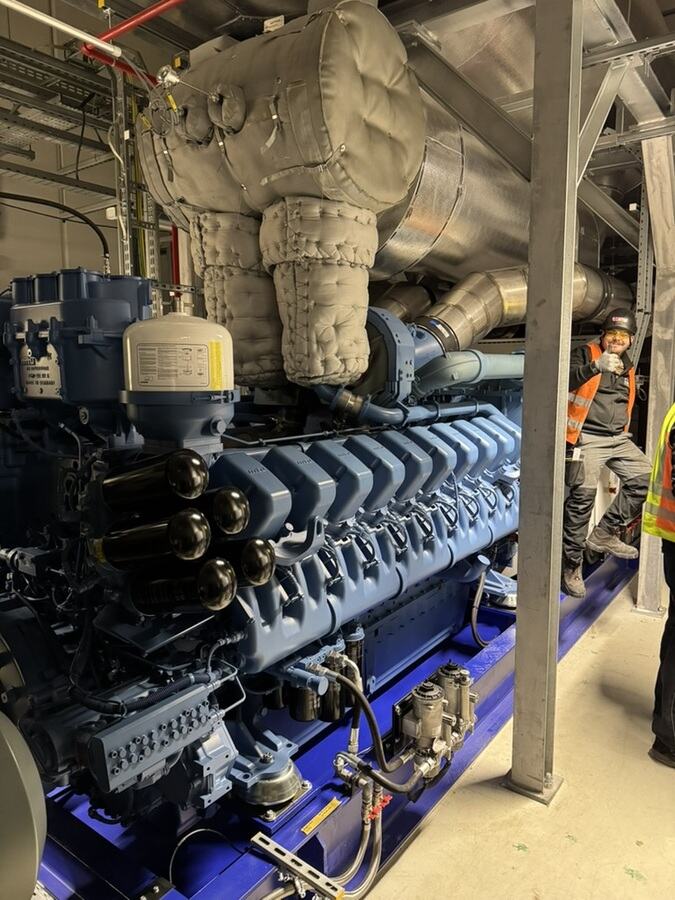
A data center in the middle of the city – only a street separates the generator rooms from an old industrial building full of offices. When the standby generators there run under full load, the turbochargers whistle so loudly that it is unacceptable for the neighbourhood. The solution: turbo silencers. At a data center in Offenbach am Main, Omega Mounting moved in 12 twin turbo silencers, distributed them to the floors via the goods lifts and installed them on specially fitted base frames above the generators – including filters, welded stainless steel pipework and a final noise measurement under full load.
Project profile
- Scope: Moving in and installation of 12 twin turbo silencers incl. base frames (over 2 m high), intake filters and welded stainless steel pipework with rubber sleeves – plus performance test and noise measurement under full load
- Team: 3 fitters from Omega Mounting
- Project duration: Several construction phases, spread over several weeks
- Location: Data center in Offenbach am Main
What is a turbo silencer?
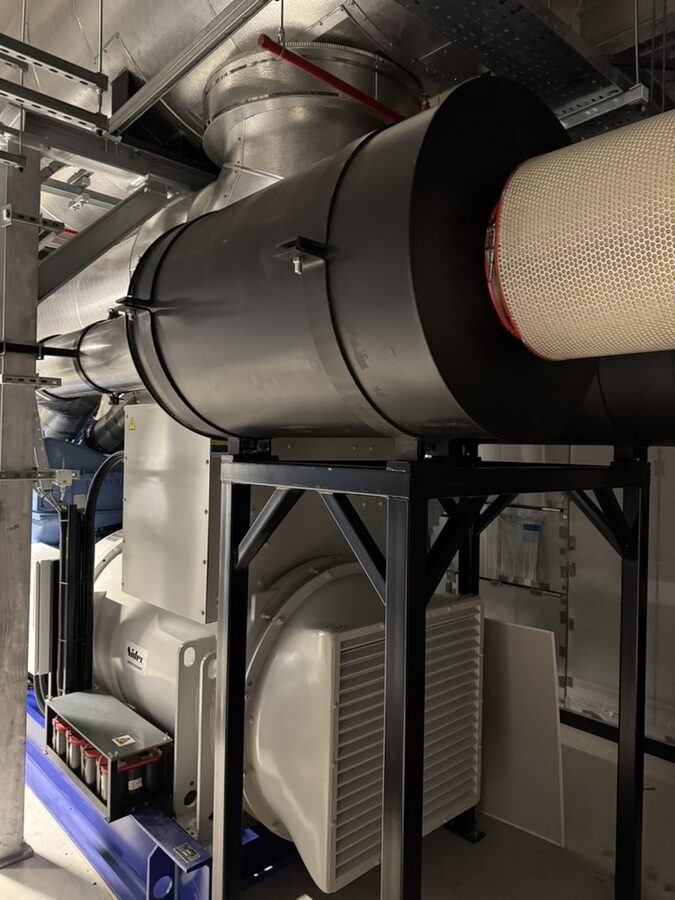
A turbo silencer is a silencer for the intake side of the turbocharger on large diesel engines. Under load, turbochargers produce a characteristic high-frequency whistle – hardly an issue with a single lorry, but a considerable source of noise with several standby generators in the megawatt range. The turbo silencer sits between the intake filter and the turbocharger and absorbs exactly these frequencies without throttling the airflow the engine needs for full output. For data centers in urban locations, silencers like these are often the prerequisite for operating the standby power system in compliance with its permit at all.
Why did this data center need turbo silencers?
Because it was built in the middle of the city. Only a street separates the silencers of the generator rooms from an adjacent old industrial building that now houses offices. During full-load tests of the standby generators, the whistling of the turbochargers was clearly audible – not an option in the long run for the neighbourhood and the noise control requirements. So a solution was needed: turbo silencers on every generator, retrofitted into a finished building that was already in operation. It is exactly this combination – tight space, live operation, heavy material – that is classic Omega Mounting work.
How do you get 12 twin turbo silencers into a finished data center?
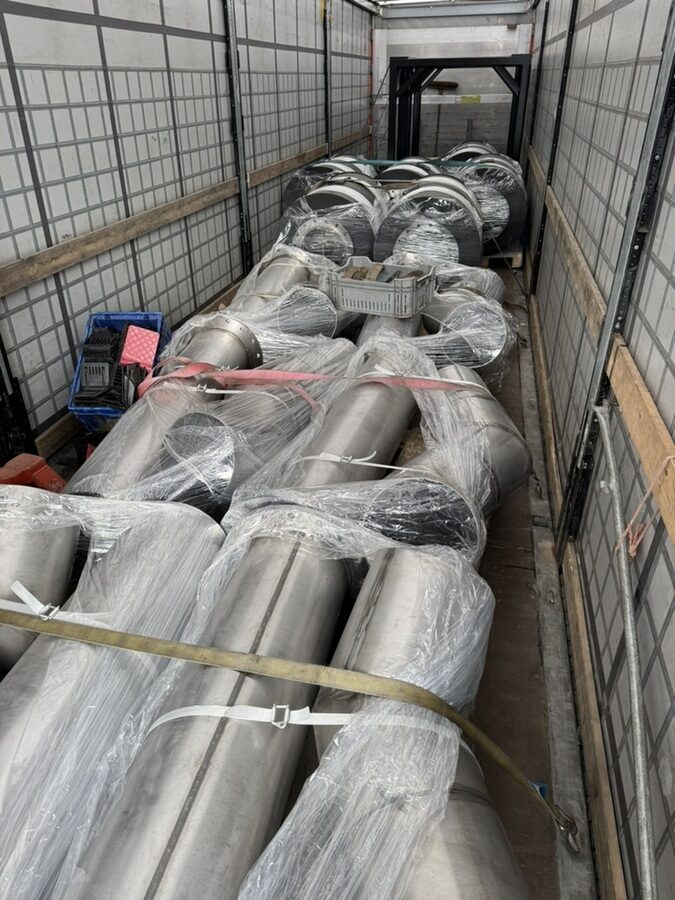
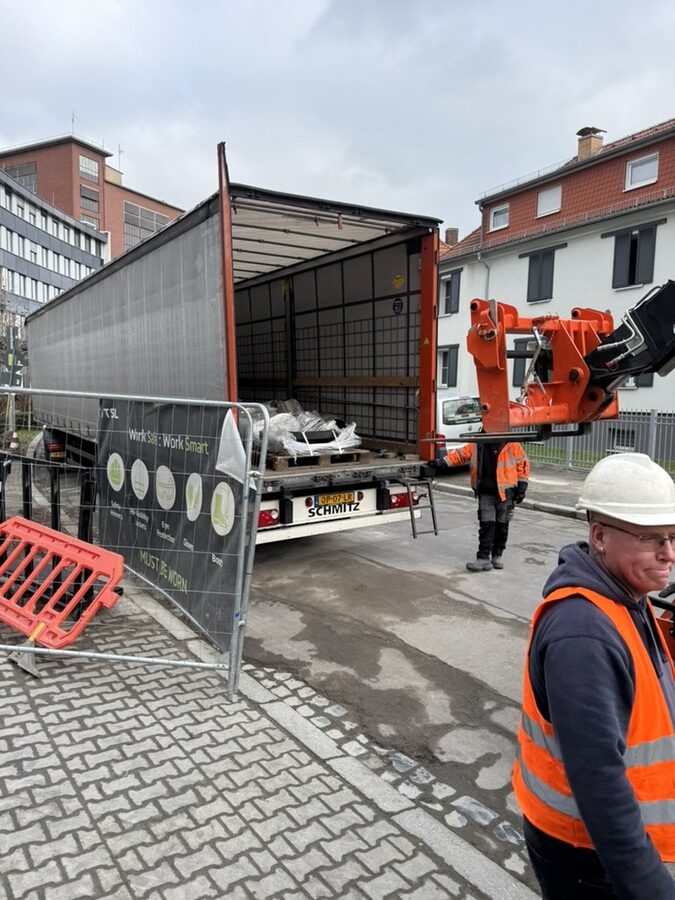
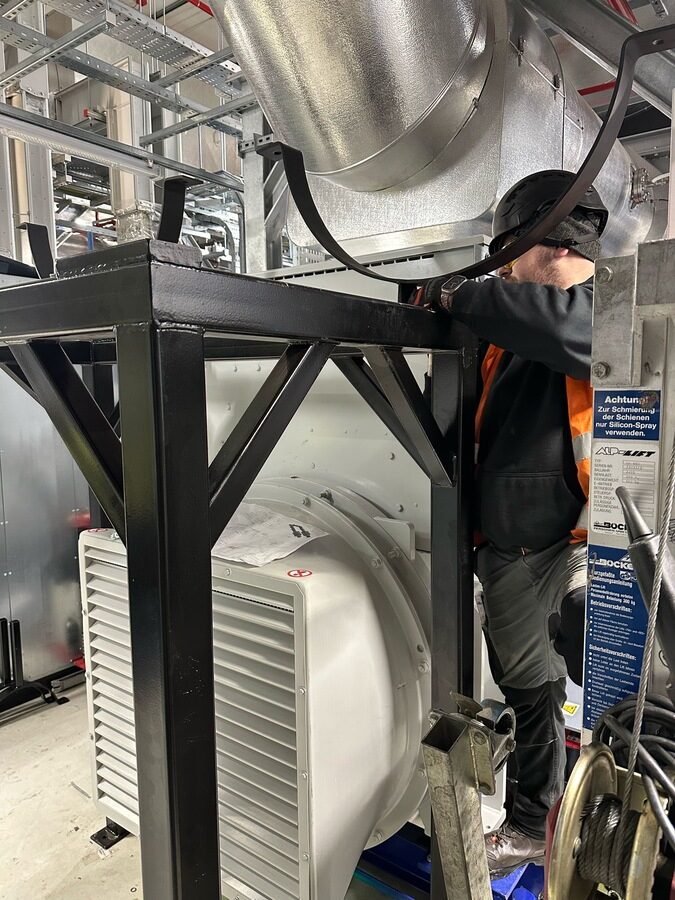
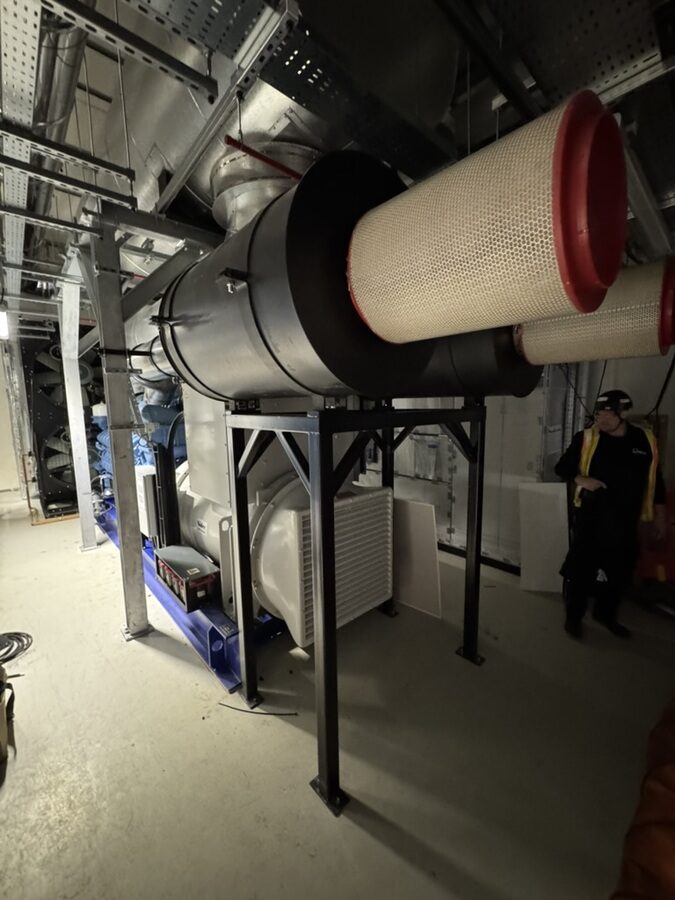
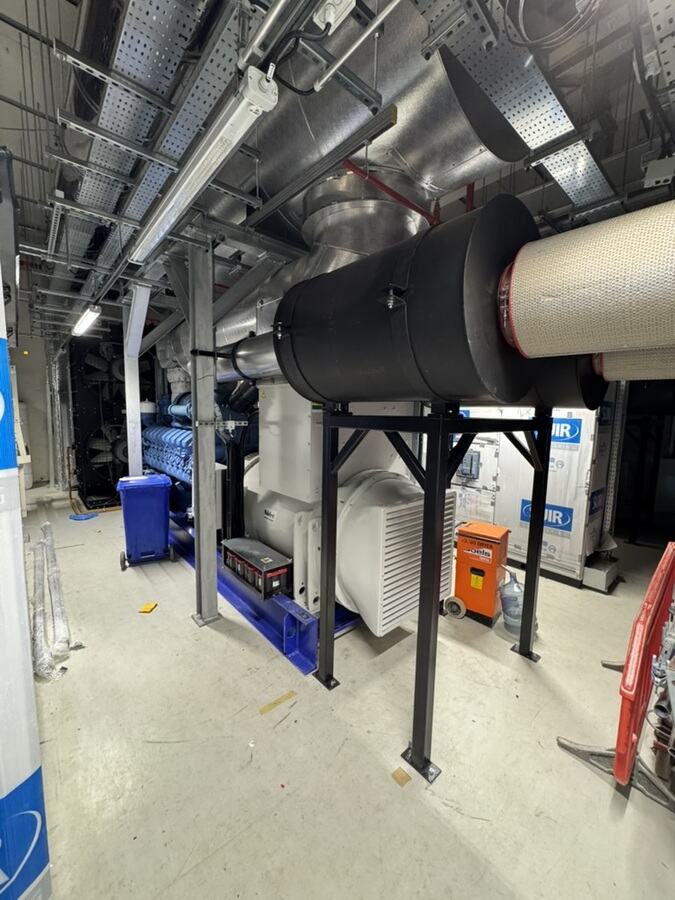
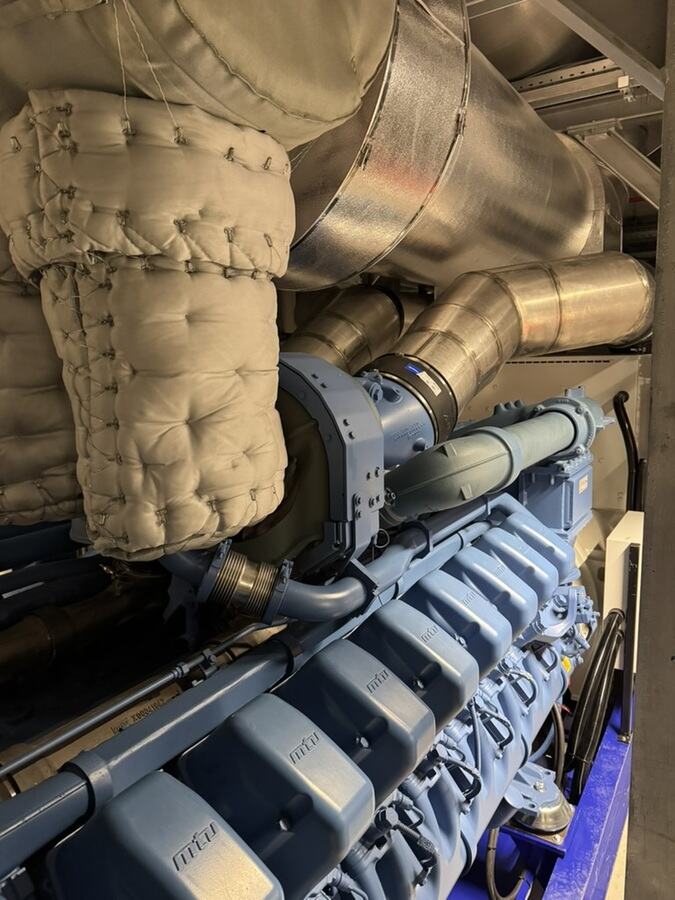
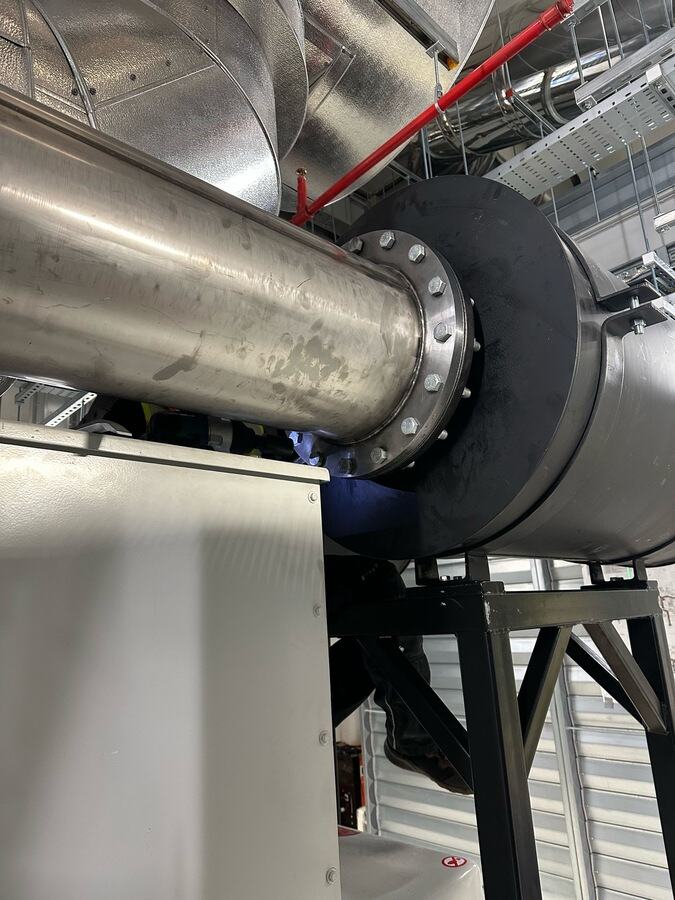
Via the goods lifts – and with a lot of planning. The silencers arrived by lorry, were unloaded in front of the building, transferred into the goods lifts and distributed to the individual floors. There was no crane available in the generator rooms themselves, so we worked with winch stackers: first, the base frame was fitted to each generator – a good 2 metres high, because the silencers sit above the generator. We then lifted the large silencers onto the frames with the winch stackers, aligned them and bolted them down firmly. Large intake filters were also fitted to the silencers.
How are the silencers connected to the turbochargers?
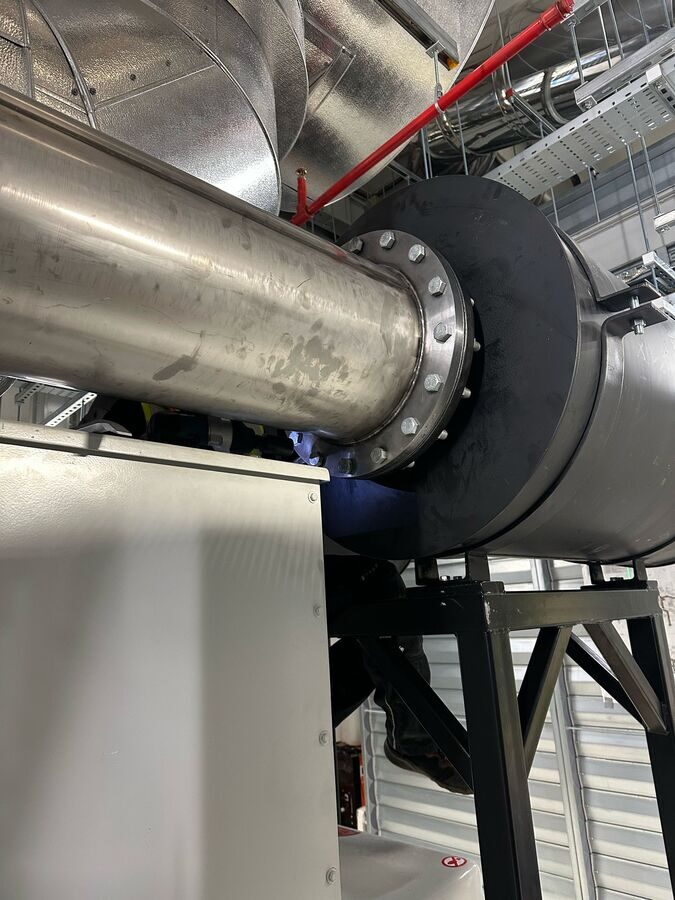
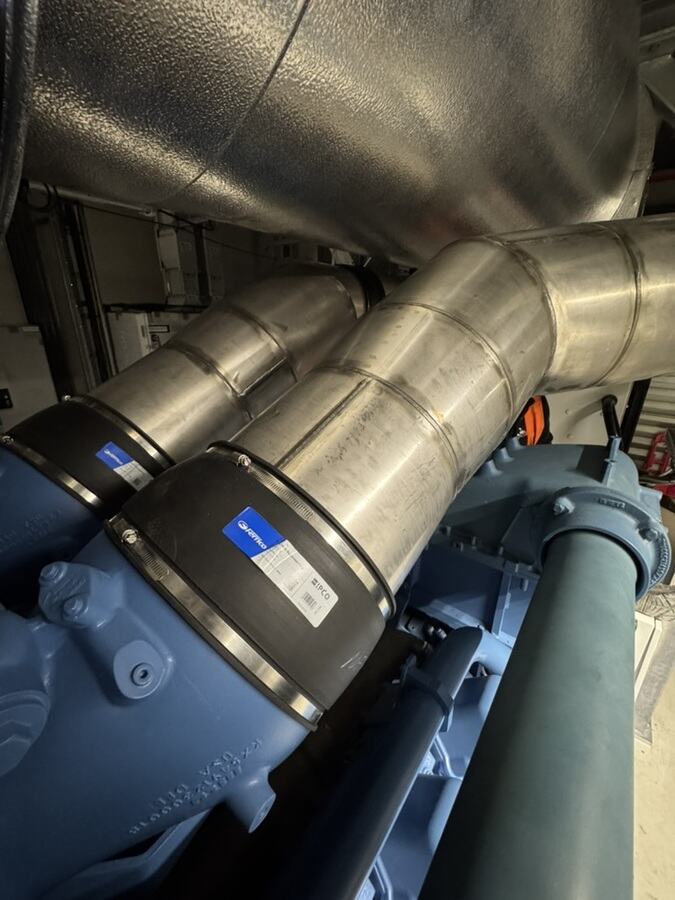
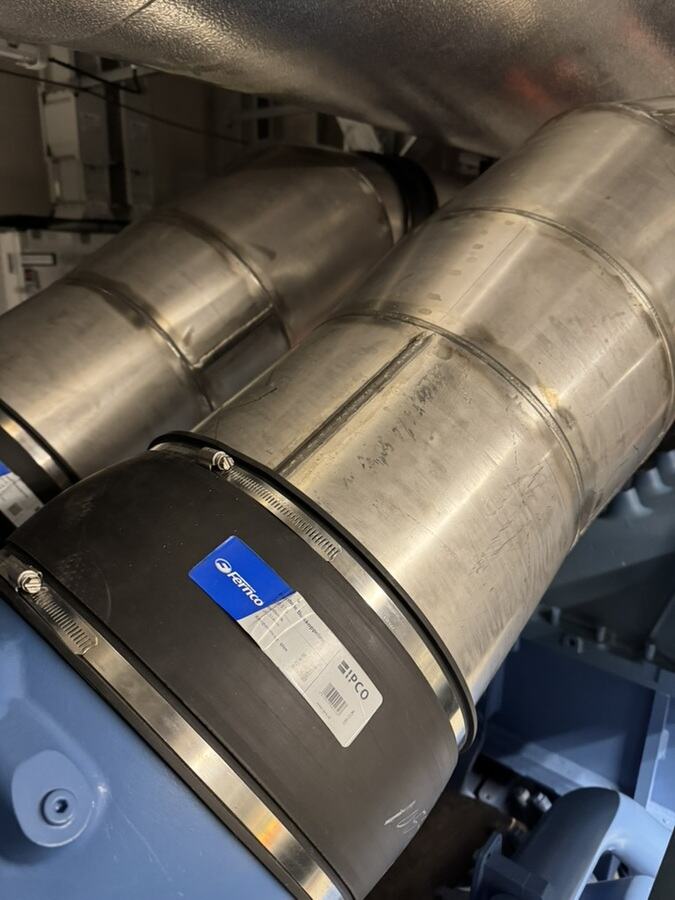
Via specially welded stainless steel pipes and rubber sleeves. The pipework ensures that the airflow fits exactly and the engine receives the full volume of air under full load. The rubber sleeves perform a second, decisive task: they mechanically decouple the turbochargers from the silencers. A generator of this size produces considerable vibration under full load – if the silencer and turbo were rigidly connected, the vibrations would be transmitted directly into the structure. That is why the entire installation was bolted and secured in such a way that even strong vibrations under full load cause no problems.
How do you check whether the silencers work?
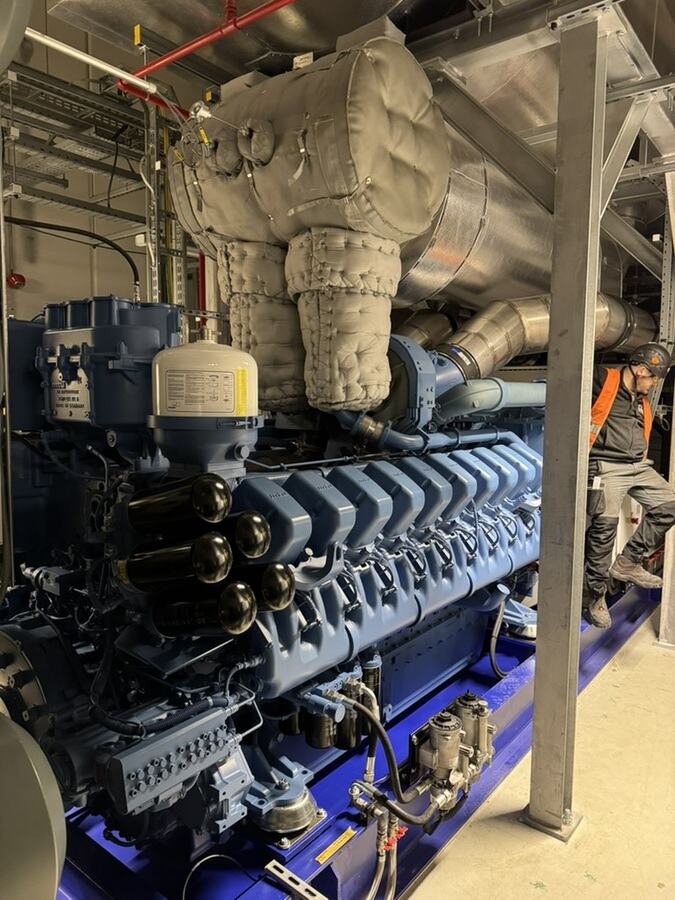
With a performance test and noise measurement under full load. At the end of the installation, the generators were run up and measured under full load – inside and outside. In the generator room itself it remains very loud even with hearing protection; that is in the nature of things. What matters is the outdoor area: there, the installation has shown its effect audibly – or rather, no longer audibly. The whistling of the turbochargers has disappeared from the neighbourhood, and the generators can run their full-load test runs without anyone looking up in the office across the street.
Data centers, generators, standby power systems: our core business
This job joins a long list: our teams work daily on international data center projects and are currently deployed in parallel at several data centers around Frankfurt and Offenbach. Around generators and standby power systems, in recent months we have carried out emergency radiator repairs, lifted generators through moving-in shafts by mobile crane for maintenance, moved in load banks for load tests, replaced CRAH units and set up PDC distribution cabinets in series. We know the safety and approval processes in data centers, the tight moving-in routes and the requirements for working next to live critical infrastructure. Once again, this expertise has paid off for our customer.
Why Omega Mounting?
- Data center routine, not the exception: We work in data centers every day and know access rules, safety processes and commissioning procedures inside out.
- Generator and standby power experience: From crane lift-outs and load bank logistics to emergency radiator repairs – standby power technology is one of our core topics.
- Moving in without a crane: Goods lifts, winch stackers, tight rooms – we bring heavy material even to where no crane can reach.
- Installation down to the last detail: Base frames, pipework, vibration decoupling, bolting – we deliver the complete mechanical installation from a single source.
- Measurable results: For us, a performance test and noise measurement under full load are part of the acceptance.
- Rooted in the region: From Rodgau, we are quickly on site in Offenbach, Frankfurt and the entire Rhine-Main region.
Conclusion
12 twin turbo silencers, 3 fitters, several construction phases – and a data center whose standby generators can now run under full load without disturbing the neighbourhood. Retrofitting noise control to standby power systems is precision work: moving heavy components into finished buildings, installing them to the millimetre above the generators and connecting them with vibration decoupling. If your site has a similar noise or installation problem, get in touch.
Request a callback for your project now – Omega Mounting GmbH, Rodgau. We work in the Rhine-Main region and throughout Germany.
How the generator, exhaust line and peripherals get into place in the first place is described in the overview article Moving in standby generators at the data center.
More jobs in the city and our route from Rodgau: Industrial installation in Offenbach.
Photo gallery of the job
Are you planning a project of this kind?
Tell us briefly what it is about – we will come back to you with an honest assessment.
100% free and without obligation
Related guides for this project
About the author
Tobias Schott
Managing director of Omega Mounting GmbH, Rodgau · more than 20 years of hands-on experience in installation and maintenance
A trained mechatronics technician, at home in maintenance, servicing and industrial installation since 2004 – first alongside his father, and since 2012 with Omega Mounting: from the overhead conveyor in Frankfurt to the crane system in a new-build hall. As appointed person for lifting operations, he plans and leads lifting operations in data centers and on industrial sites in the Rhine-Main region, is an instructor and examiner for cranes, aerial work platforms and telehandlers, and a safety officer. On assignments abroad he is known as the "German Troubleshooter" – the one you call when things get stuck on site. He did not learn what quality means from a manual, but from his father: Made in Germany as a standard for his own work, not as a label. That is why quality comes first at Omega Mounting – before speed and before price. The project diary shows the jobs his team has planned and carried out – without customer names, but with everything that can be learned from them.
Frequently asked questions
The high-frequency whistling is caused by the fast-rotating compressor wheels of the turbocharger on the intake side. With large generators in full-load operation, this noise becomes so loud that it becomes a problem for the neighbourhood and noise control in an urban environment.
It specifically attenuates the high-frequency intake noise of the turbocharger without throttling the airflow. The generator retains its full output, and the whistling in the outdoor area disappears – audibly confirmed on this project by noise measurements under full load.
Yes. On this project, all 12 twin turbo silencers were retrofitted: delivered by lorry, distributed to the floors via the goods lifts and lifted with winch stackers onto base frames over 2 m high above the generators – entirely without a crane.
For vibration decoupling. Generators produce strong vibrations under full load. The rubber sleeves between the stainless steel pipework and the turbocharger prevent these vibrations from being transmitted into the silencer structure and causing damage there.
So loud that it is still very loud even with hearing protection – which is why consistent hearing protection and short periods of stay are mandatory there. What matters for the surroundings, however, is the outdoor noise level, and that is exactly what the turbo silencers reduce considerably.
Yes, regularly. Our teams work daily in data centers in the Rhine-Main region – for example in Offenbach and Frankfurt – and know the safety, access and approval processes for working next to live critical infrastructure.
In the event of a power failure, the standby generators take over the supply of the server halls within seconds. So that they can be tested and operated at any time, noise control requirements must also be met – otherwise test operation may be restricted.