- Data Center Services – Generators & Transformers
Generators & transformers: from the low-loader to the operational system
We move backup generator sets, emergency power systems and transformers from the low-loader onto the foundation – aligned, mechanically completed and ready for commissioning. Plus the complete exhaust line: silencers, SCR systems, manifolds.
Backup power is not a trade like any other
The backup power supply is the backbone of every data center. We treat it accordingly: a lift plan for every lift, millimetre alignment, documentation down to the last bolt.
With refrigeration certification (Cat. II) in-house we also work on radiators and cooling circuits professionally – and with our 24/7 on-call service the equipment stays in good hands after installation.
At a glance
- Rigging & alignment on the foundation
- Mechanical completion through to operational readiness
- Exhaust line: silencers, SCR systems, manifolds
- Radiators & cooling circuits – refrigeration cert. Cat. II in-house
- Load bank positioning for load testing
- Maintenance, repair & emergency response
What to expect on this page
Click any topic to jump straight to that section:
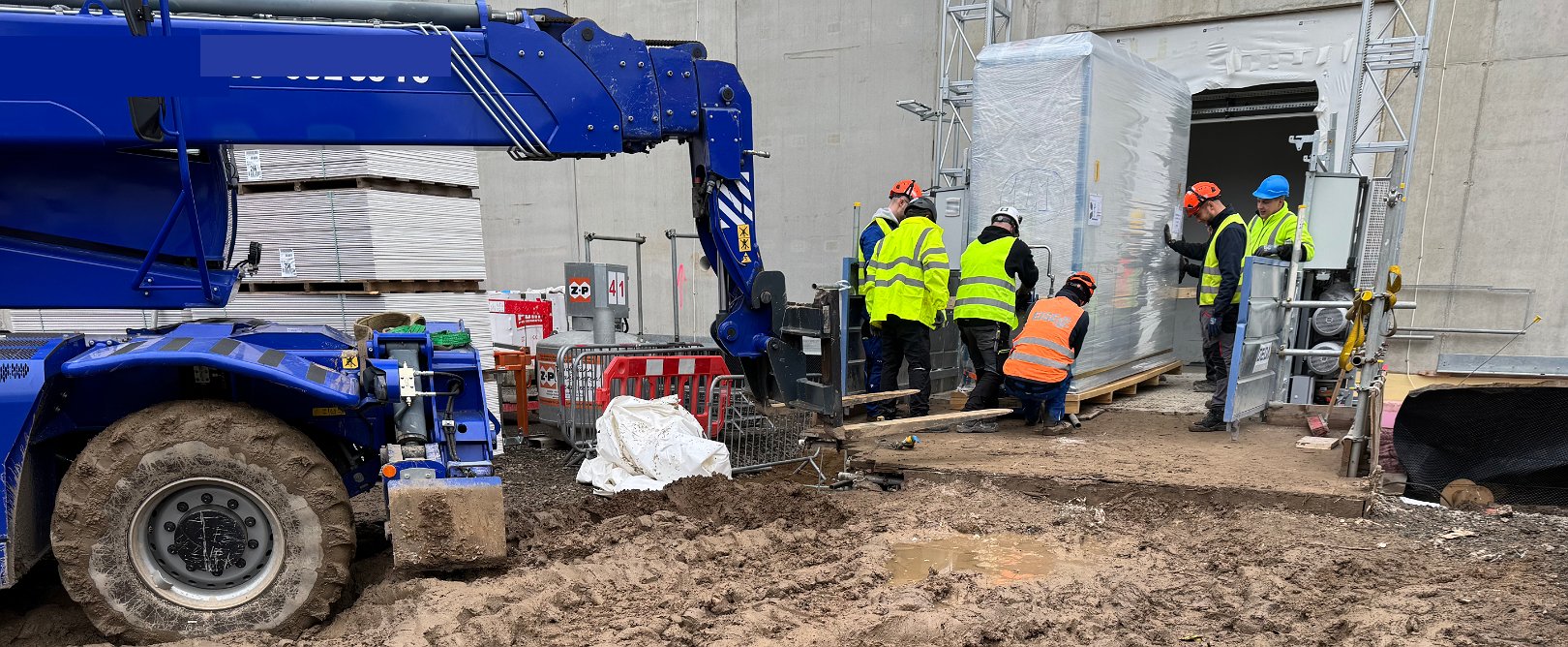
Rigging: the route from low-loader to foundation
The rigging phase decides the whole project: a generator standing wrong can hardly be corrected later – the engine does not wander. Our work therefore starts before the first lift: measuring routes, verifying loads, producing the lift plan, aligning time windows with the site.
From 220-ton-class mobile cranes to gantries and machine skates in the plant room: we choose the lifting equipment by the task – not by what happens to be available.
Mechanical completion & exhaust line
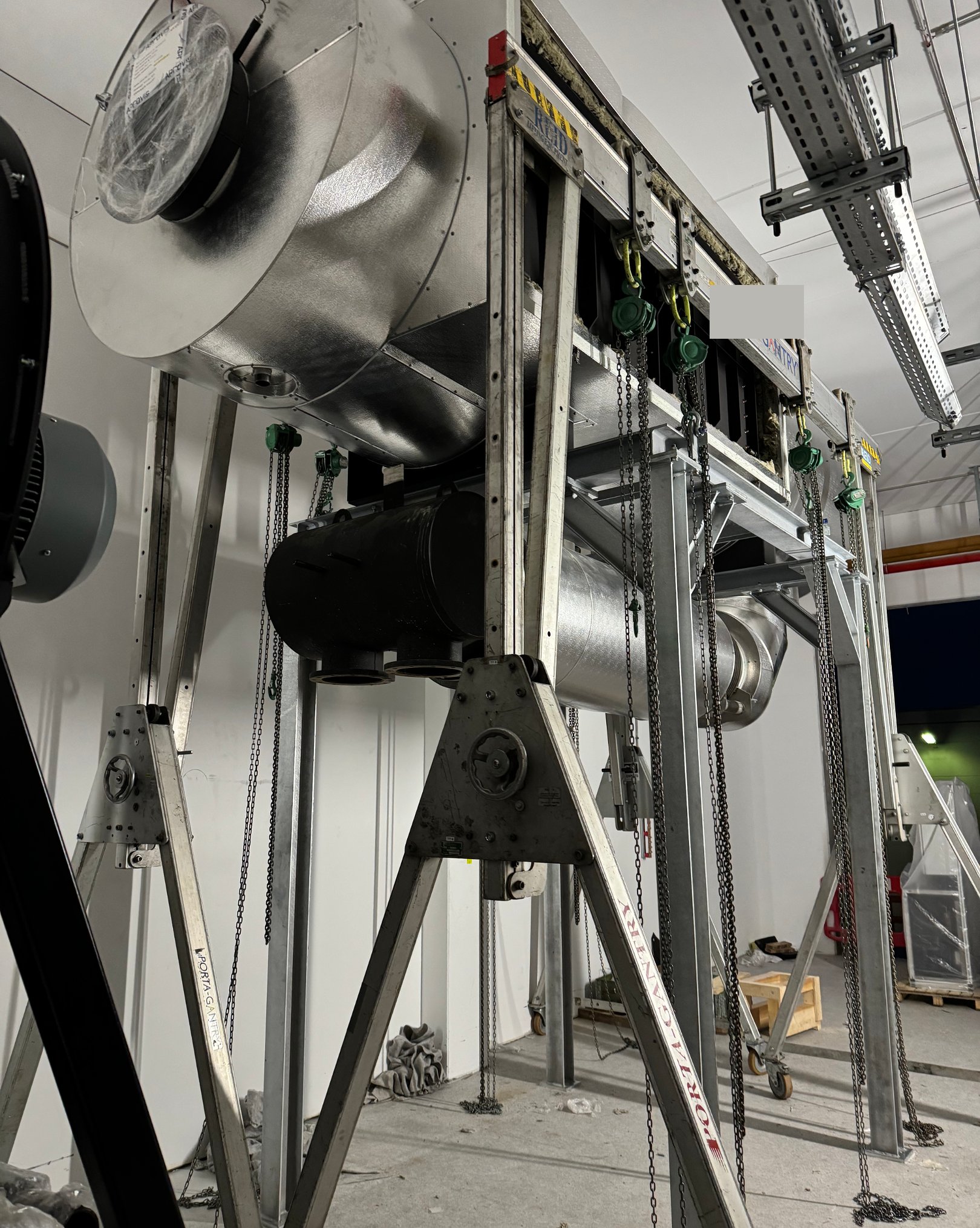
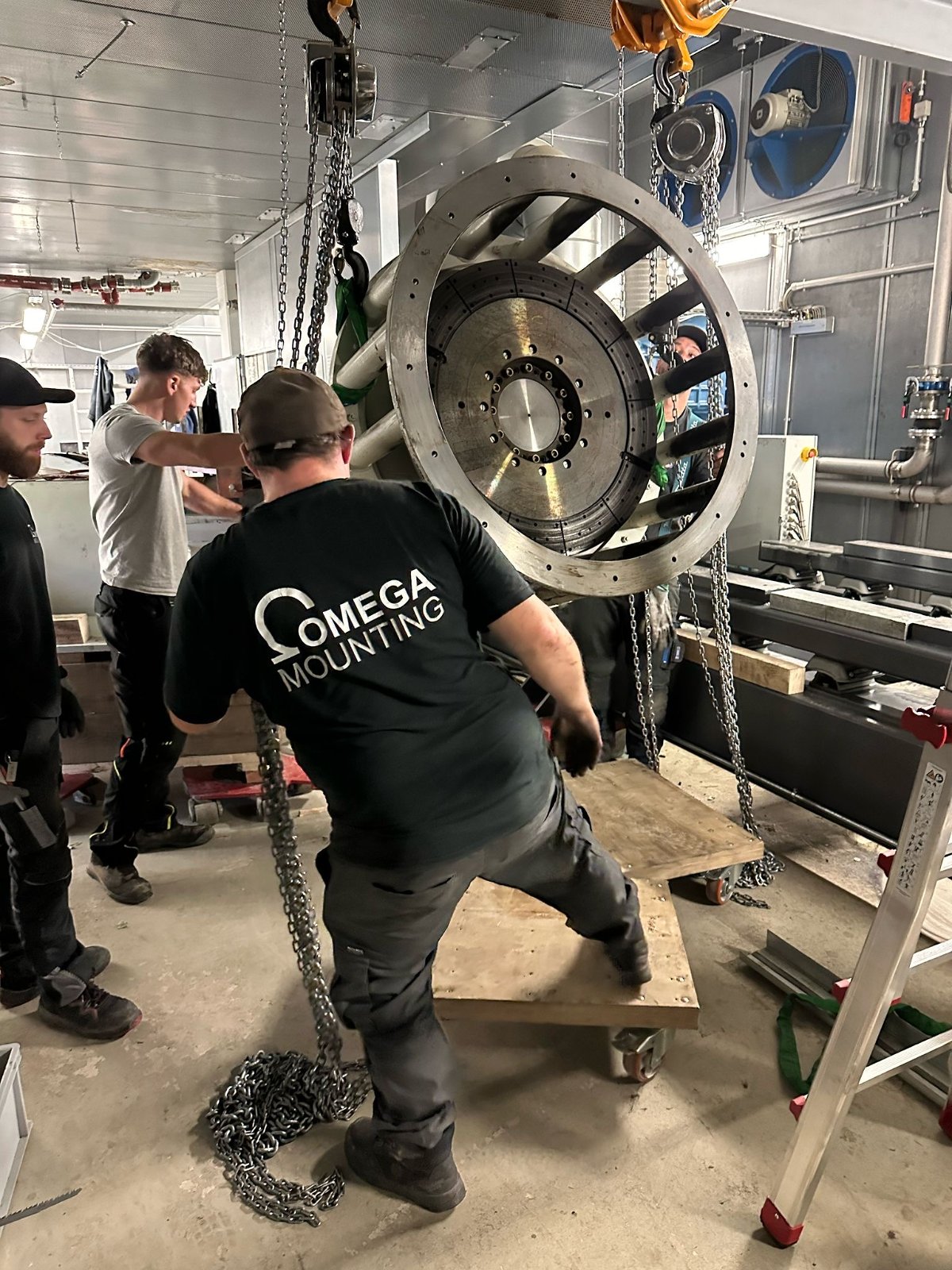
After set-down the real installation begins: aligning, bolting, mounting attachments, connecting the exhaust line. In a Frankfurt data center we installed and elevated 26 SCR exhaust-treatment systems in series – each lift with two gantry cranes and four chain hoists, each system precisely above its generator.
Vibration decoupling via flexible sections, manifold installation, silencers: the exhaust line is precision work – and one of the areas where clean installation pays off directly in uptime and emission compliance.
Commissioning support & load banks
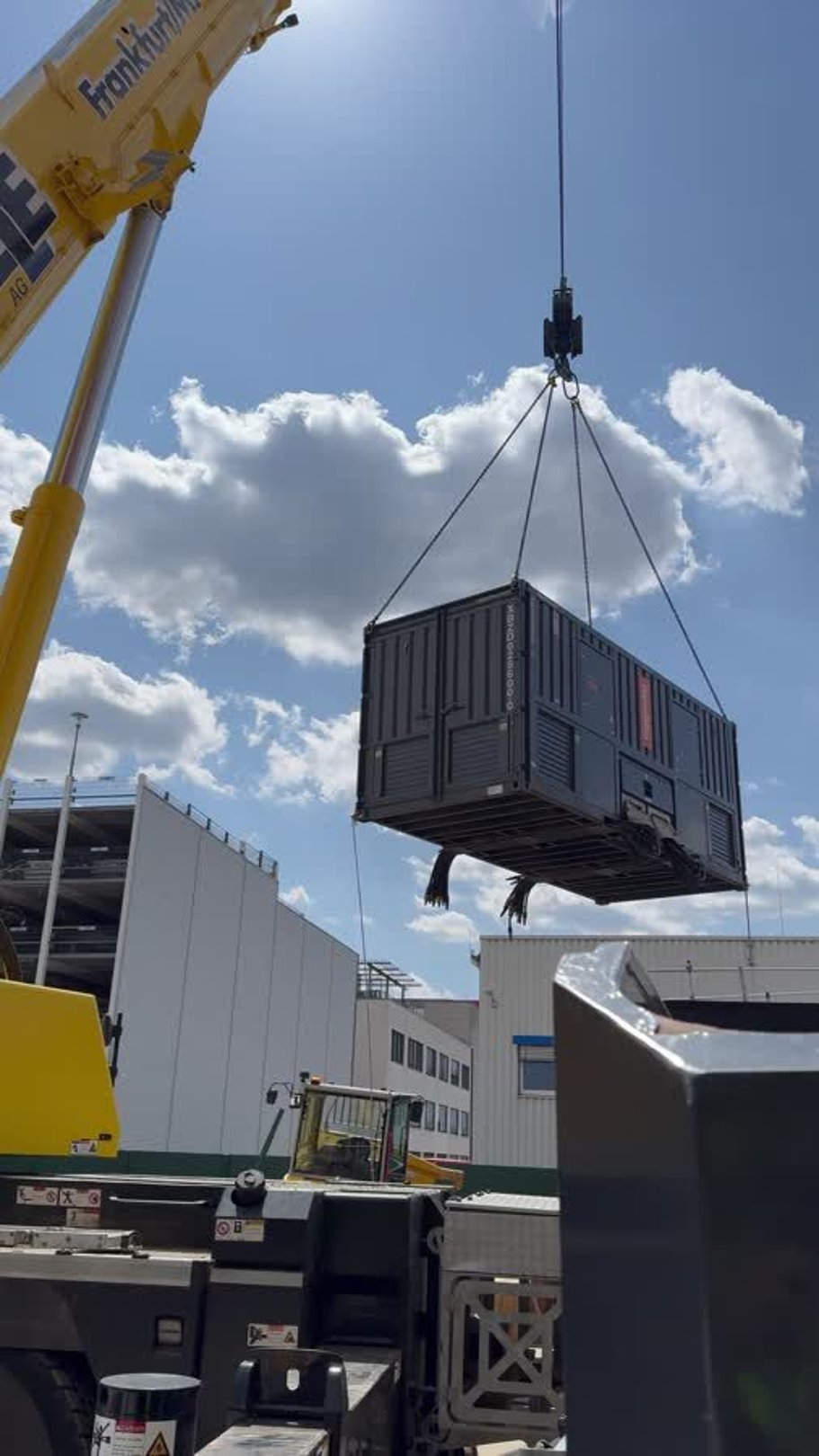
Before a data center goes live, its backup power systems are tested under full load. We position and connect the load banks, support the test runs and stand by on call during commissioning – so load tests never fail for logistics.
Maintenance: so the power comes when it must
A generator that never runs still has to perform every time. We maintain emergency power systems mechanically, replace components such as radiators or silencers and clear faults – in shutdown windows, at night or on weekends.
More on our page Maintenance & 24/7.
Backup power: the backbone of availability
Data centers promise availability levels where even minutes of downtime per year are too many. That promise rests on a multi-stage energy concept: grid feed, UPS systems for the first seconds – and emergency generator sets that pick up the full load and carry it for days if needed. Depending on the design, these systems are redundant: if one unit fails, the next steps in.
But redundancy only exists on paper if the installation is wrong. A generator out of alignment, an exhaust line transmitting vibration, a cooling circuit at its limits under full load – every such lapse consumes exactly the reserve the operator paid for.
That is why we treat every backup power system as what it is: the data center’s insurance policy. Installed to manufacturer specification and torque tables, aligned to the millimetre, documented to the last bolt – so the system performs in the one moment it has been waiting for all those years.
OFCI: when the owner supplies and we install
In data center construction, OFCI – Owner Furnished, Contractor Installed – is the standard model for major components: the operator buys generators, transformers or cooling systems directly from the manufacturer, and a specialised partner installs them on site. That partner is us.
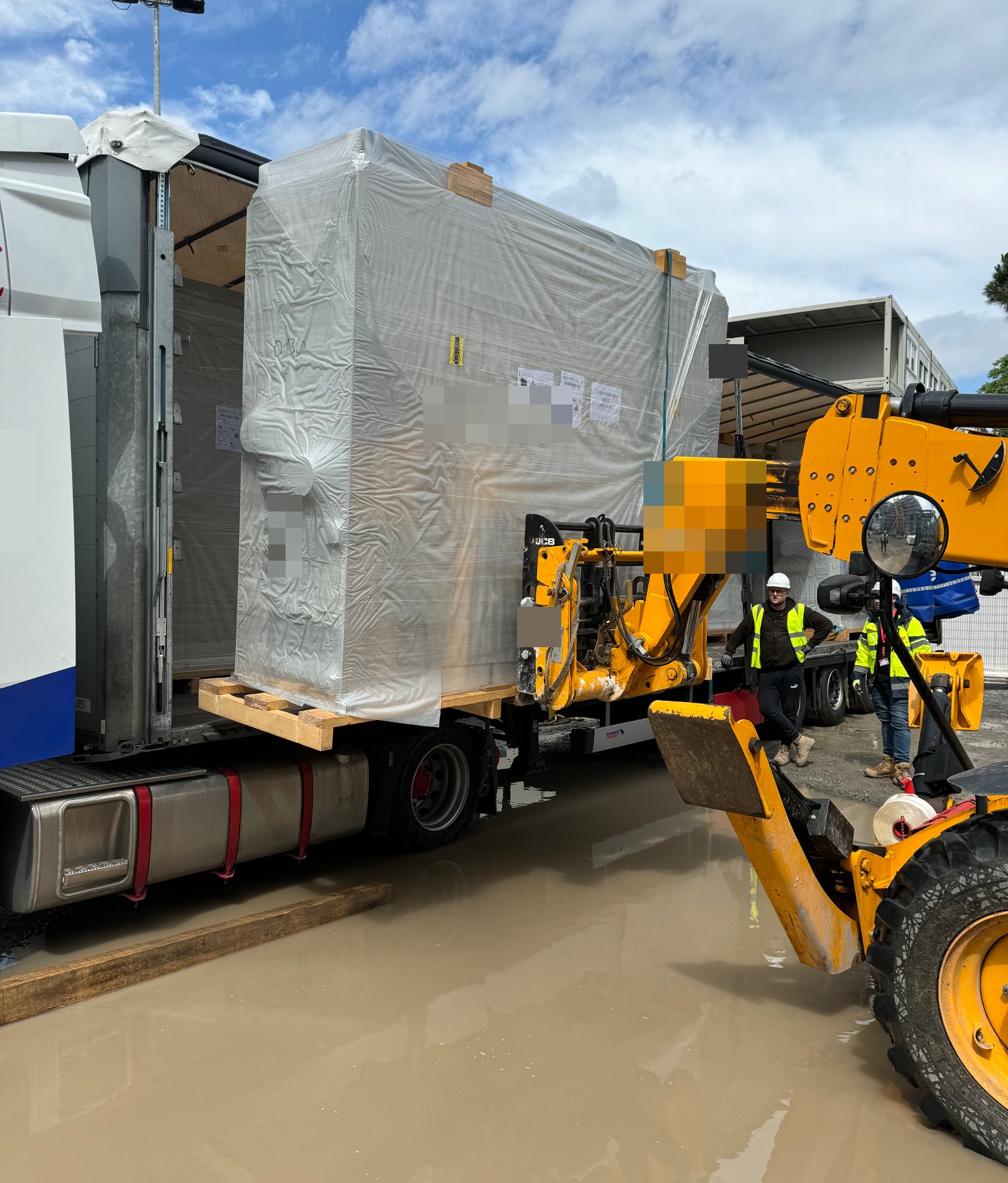
OFCI demands more than muscle: deliveries must be received, inspected and documented – including transport damage reports before the truck leaves the yard. Components must be stored properly, rigging windows coordinated with manufacturer, GC and logistics, and interfaces to the manufacturer’s commissioning cleanly defined. Sloppiness here produces standstills that cost three parties at once.
What clients value most in this model: an installation partner who thinks along. We flag what we notice about a delivery before it becomes a problem, and keep the documentation chain closed from goods receipt to commissioning handover.
The rigging chain in detail
Between delivery and foundation, a generator often travels several hundred meters – and every stage has its own rules. At the crane: capacity, radius, weather window. At the rigging shaft: centimeters – our documented projects include lifts with barely a hand’s width between load and structure. Inside the building: machine skates and heavy-load dollies – and the question of what screed, raised floor and slab can truly carry.
We plan this chain backwards, from the foundation to the low-loader. Only when every handover point is resolved – load spreading, protective coverings, maneuvering areas included – does delivery happen. It sounds elaborate, but it saves exactly the days lost when a 20-ton machine stands in front of a door it will not fit through.
On the foundation comes the discipline that decides everything: alignment. A generator that must later meet its SCR system, silencers and piping has no tolerance for “roughly”. We align to the millimetre – because the engine never moves again once it stands.
The complete exhaust line: silencers, SCR, manifolds
Modern backup power systems do not end at the engine: the exhaust line decides emissions, noise and permits. We install it completely – from turbo silencers through SCR exhaust-treatment systems to manifolds and insulated piping.
Two documented projects show the range: twelve twin turbo silencers installed in an Offenbach data center, and 26 SCR systems installed and elevated in series in a Frankfurt data center – connected via flexible sections for vibration decoupling, secured by the principle of double protection under suspended loads.
The knowledge behind it: an SCR system reduces nitrogen oxides with urea and is what makes large diesel gensets permissible at densely populated sites in the first place. Its performance depends on details – tight connections, correct orientations, decoupled joints. Exactly the details you choose an installation partner for who has built them in series.
Transformers and medium voltage: interfaces without grey zones
Transformers are among the heaviest and most delicate components of the power train. We handle their mechanical transport and placement: rigging, positioning on foundations or vibration dampers, alignment and mechanical completion – with the same lift-plan discipline as any critical lift.
Just as clearly, we name the boundary: work on the medium-voltage level itself and the grid connection belong to licensed specialist firms and utilities. We define that interface in writing before the first bolt is touched – who delivers, checks and owns what, up to which point.
This honesty has a reason: in a market where availability is everything, grey zones of responsibility are the biggest risk. Our clients prefer to know on day one where our scope ends – and in return get a partner who actively coordinates every handover instead of pointing at the other side.
Maintenance contracts for generator sets: planned, not reactive
An emergency power system ages even at standstill: seals, hoses, coolers, batteries and actuators wear whether the engine runs or not. Discovering a problem during the monthly test run is luck; discovering it during a grid failure is not.
Our maintenance contracts turn that risk into a plan: fixed intervals for visual and functional checks, mechanical maintenance to manufacturer specification, component replacement before wear becomes failure – documented in a system history that makes every decision traceable. A documented example: the radiator repair on a backup generator in an Offenbach data center, pressure test included – completed before cooling capacity became a problem.
And when speed is everything, the 24/7 on-call service takes over: one documented emergency began on a Sunday evening with a failed generator set and ended with a completely replaced unit. Details on our page Maintenance & 24/7.
Supply chains and schedule risk: fix your installer early
Major data center components have long lead times – generators, transformers and cooling systems are ordered years ahead. All the more surprising how late installation is often awarded: by the time the equipment is on the ship, the best rigging windows are gone and the planning options small.
Our recommendation to operators and GCs: involve the installation partner as soon as components are ordered. Rigging routes can then still be designed into the building, foundation details aligned with installation logic, and delivery windows reserved while there is still a choice. The cost of early involvement is minimal – its value shows at the latest when the first unit arrives at the gate.
For short-notice cases the same applies as always: we are used to joining running projects and orienting fast. Honestly though – with lead time, it gets better and cheaper for everyone.
Fuel, cooling, peripherals: the genset's support systems
A generator is only as reliable as its periphery. Mechanical completion therefore includes the support systems: fuel lines and connection to the tank system, cooling circuits with radiators, pumps and piping, intake and exhaust air paths, vibration dampers and fixings that hold through load steps.
Documented practice: the radiator overhaul on a backup generator including pressure test, and cooling-circuit work with Cat. II refrigeration certification in-house. On new installations we verify the periphery against manufacturer data – flow rates, line cross-sections, gradients – before the system sees its first test run.
The reason for this thoroughness is simple: statistically, backup power systems rarely fail at the engine – they fail at periphery and maintenance. Both are in our hands, and we treat them accordingly.
A generator, transformer or load bank to move?
Send us the equipment data and your time window – we will come back with an honest assessment and a proposal for the rigging route and sequence.
100 % non-binding & free of charge · Direct line: +49 6106 239 25 88
Frequently asked questions
It is the emergency power supply: diesel generator sets that take over the load within seconds of a grid failure. Because it must work in the one moment that matters, installation and maintenance are held to the same standards as the IT itself – there is no second chance.
SCR stands for Selective Catalytic Reduction – exhaust aftertreatment that reduces nitrogen oxides (NOx) from generator exhaust using urea. In a single data center we installed and elevated 26 SCR systems in series – including manifolds and connections.
Yes. Our mechatronics engineers handle electrical connection and wiring work and the mechanical-electrical commissioning – together with the manufacturer where needed. Medium-voltage level and grid connection are coordinated with the licensed specialist firms. Details on our Commissioning & Electrical page.
Yes. Work on existing plants is planned in shutdown windows or with segregated work areas – coordinated with operator and general contractor. For urgent cases there is our 24/7 on-call service.
Multi-ton equipment is our daily business: documented projects include a 16-ton load bank lift and rigging generators and load banks with a 220-ton-class mobile crane. What matters is not the weight but the planning – that is what our Lifting AP is for.
OFCI stands for Owner Furnished, Contractor Installed: the operator buys major components such as generators or cooling equipment directly from the manufacturer, and a specialised partner installs them on site. In this model we handle receipt, storage, rigging, installation and the documentation chain through to commissioning handover.
Both. Mini cranes, gantries and indoor lifting equipment are our own; mobile cranes up to the 220-ton class we coordinate through long-standing partners – including lift plan, briefing and supervision by our Lifting AP. For you it remains one contract with one responsible partner.
Yes. On OFCI projects we align rigging, mechanical completion and interfaces directly with the manufacturer teams and prepare their commissioning. We never name manufacturers publicly – discretion applies in both directions.
Ideally as soon as the major components are ordered: rigging routes, foundations and time windows can then still be designed rather than merely managed. Joining projects already under way is routine for us too – but earlier is better for everyone.
Yes. Documented examples include a complete generator set replacement and crane system removals: dismantle, cut into manageable sections and hand over to certified recycling – with full documentation.