
- Project report – Installing diesel tanks at the Raunheim data center
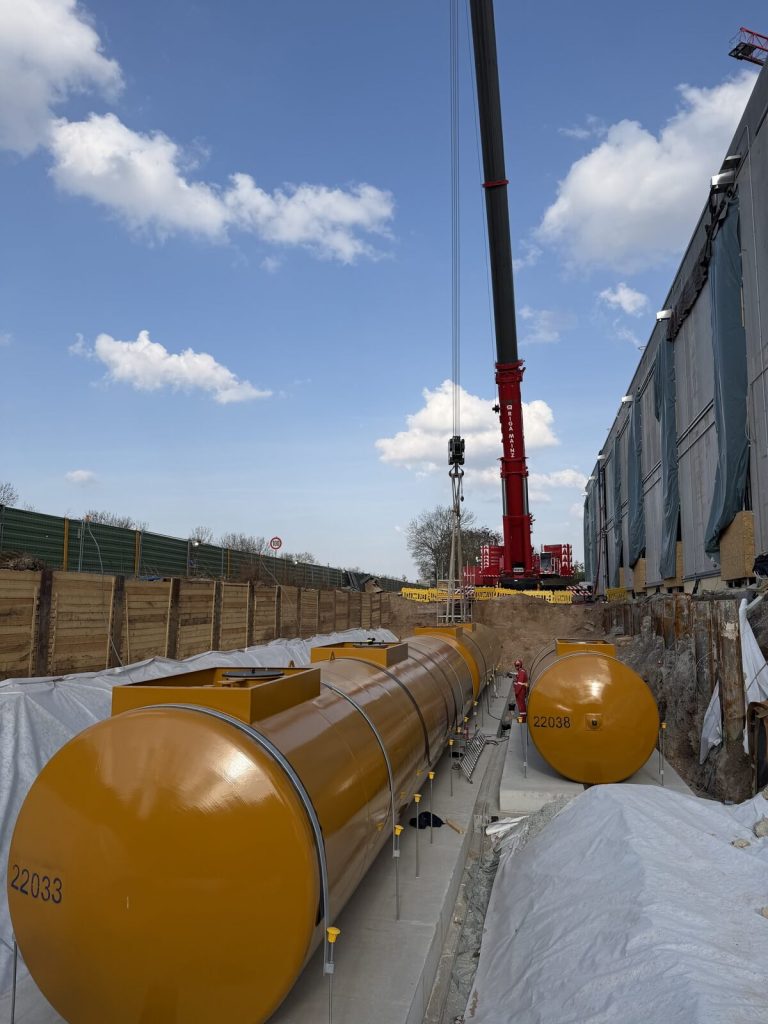
Installing diesel tanks at the Raunheim data center: five 100-cubic-metre tanks over the shoring wall into the pit
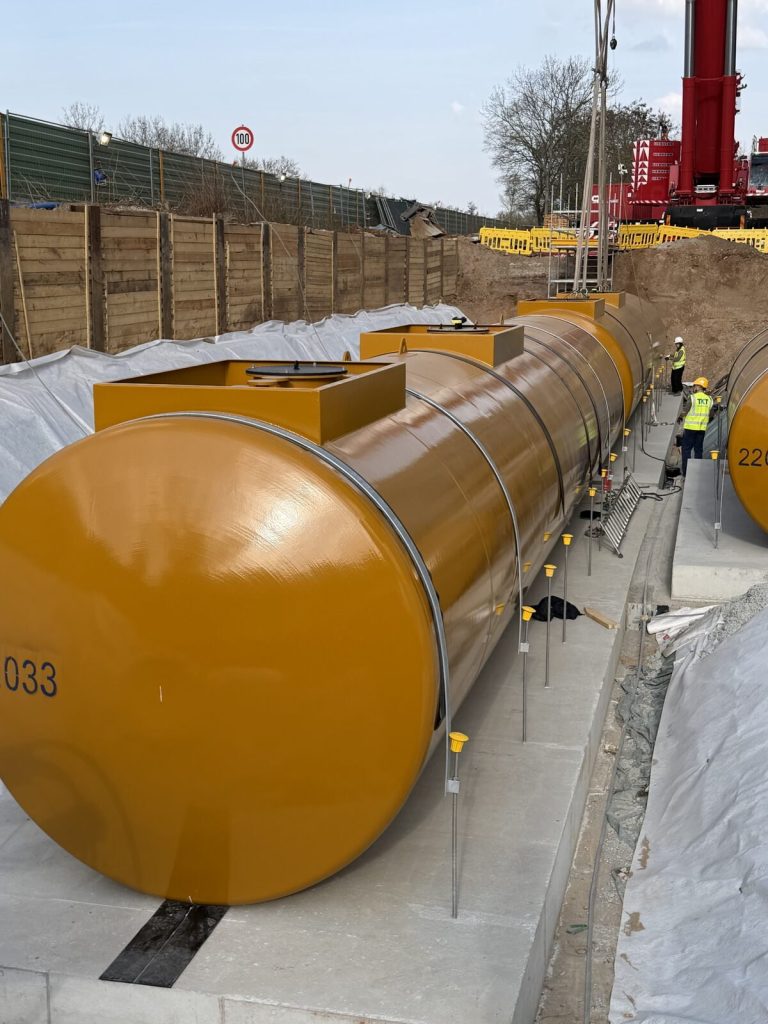
How a Lifting AP plans the lift when the data center stands in the middle of town, the crane may only be set up in one single spot – and the gate system has to be removed to make that possible
A data center keeps its own fuel in reserve. If the grid fails, the standby generators run, and they need diesel – not for a few minutes, but for days. This reserve is stored in tanks that are among the largest single components ever delivered to such a site: 100 cubic metres in volume, 16 metres long, almost three metres in diameter, 16 tonnes empty weight.
Five of these tanks had to be placed in their prepared pit at a data center in Raunheim in March 2026. The order came through the general contractor, and Omega Mounting was booked as the Lifting Appointed Person – in other words, not only for supervising the lift on the day of the operation, but for the complete lift planning beforehand.
And that planning was the real job. Because this data center stands in the middle of town. The access road runs through a residential street, the paths around the building were still a construction site themselves, and beneath the ground lie shafts and ducts that no crane may be set up on. The question was not whether 16 tonnes could be lifted. The question was from where.
Project profile
- Scope: Lifting Appointed Person for lifting in five diesel tanks – preparing the lift plan, defining the lifting equipment, measuring and calculating crane positions together with the crane company, checking and recalculating the lifting points on the tanks, lift supervision, slinging, signalling and aligning the tanks in the pit
- Team: 1 Lifting Appointed Person from Omega Mounting
- Project duration: 9 to 11 March 2026, three days on site
- Bauteile: 5 diesel tanks of 100 m³ each for the standby power system, each around 16 tonnes empty, 16.16 m transport length, 2.90 m diameter, 3.19 m transport height
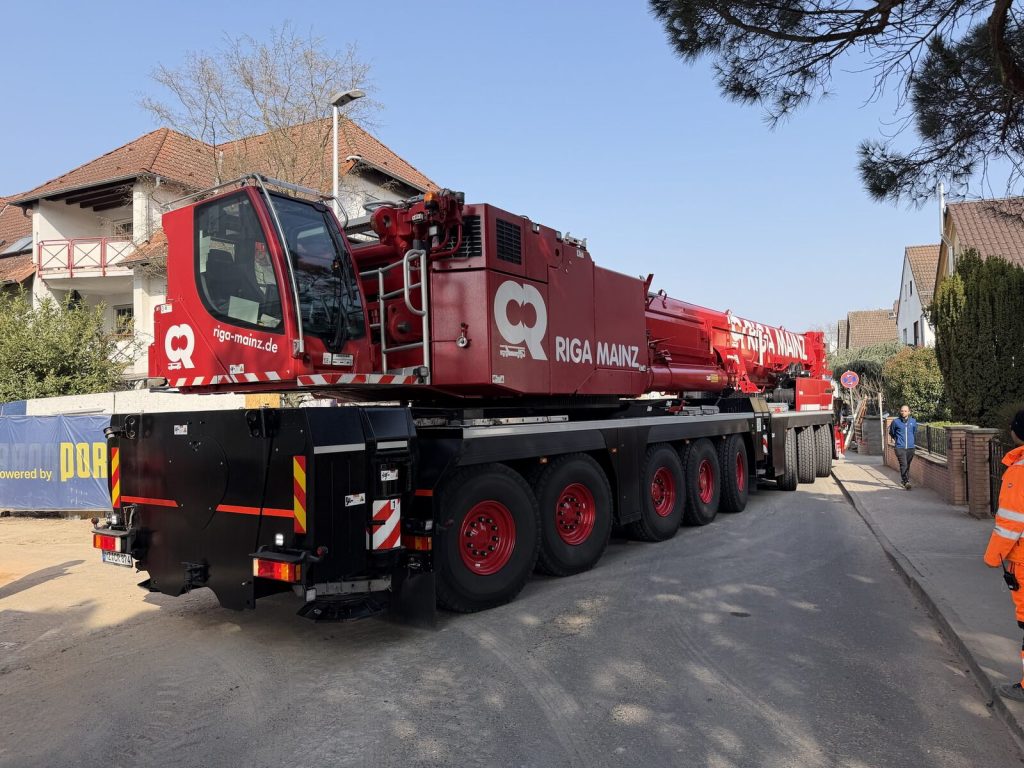
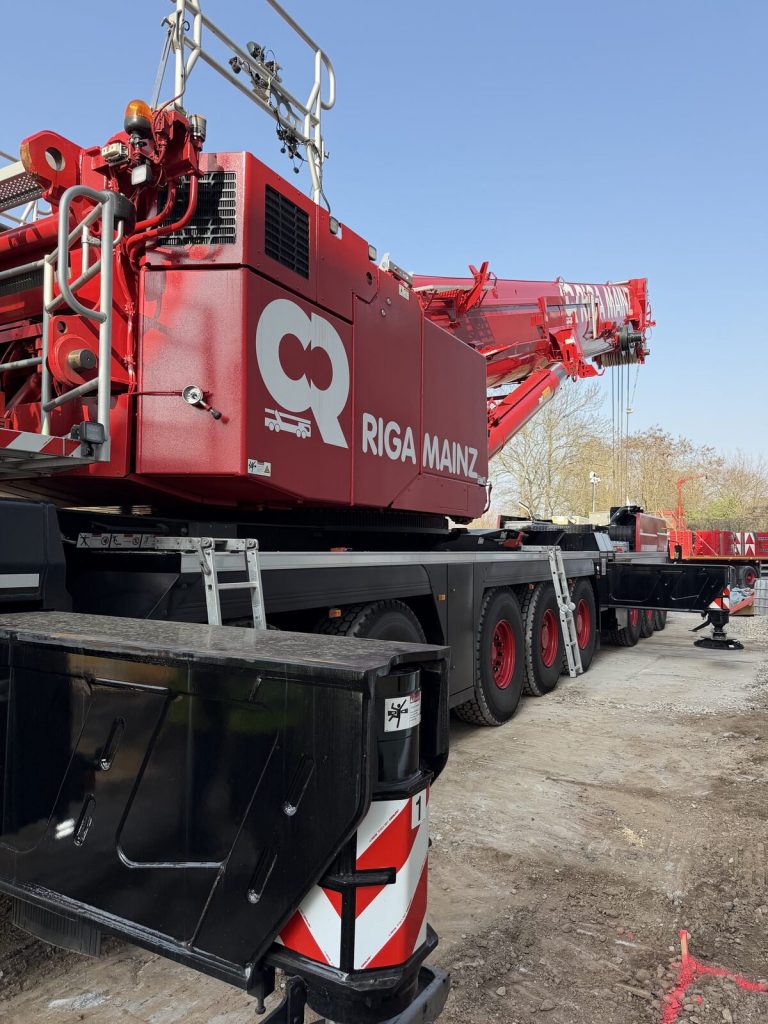
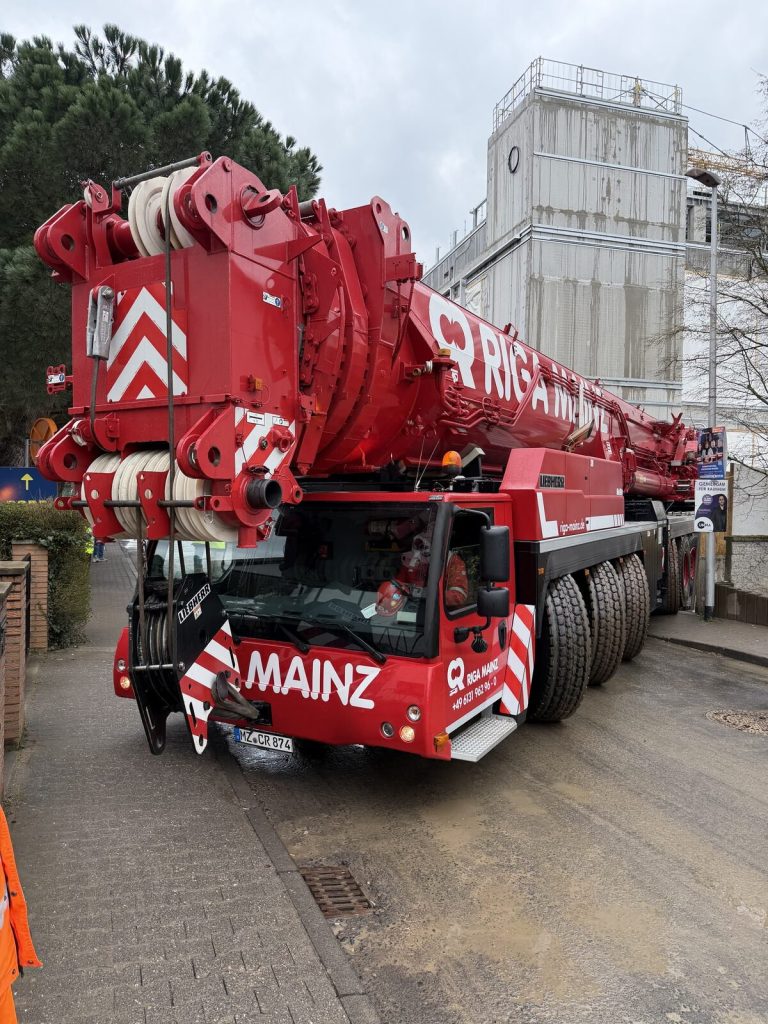
- Kran: Liebherr LTM 1650-8.1 from RIGA MAINZ for all five tanks, main boom 52.0 m, radius up to 44.0 m
- Role: Subcontractor to the general contractor, lift planning and lift supervision in close coordination with the crane company and the civil works contractor
- Location: Data center in Raunheim, Rhine-Main region
- Special feature: The gate systems had to be removed to give the crane access. The crane position then had to be dismantled again, because tanks were to be placed on that very area
- Result: All five tanks set down in the pit in the correct position, bolted down and released for filling
What does a Lifting Appointed Person do – and why does lifting in a tank need one?
The Lifting Appointed Person, or Lifting AP for short, is the person responsible for a lift. The term comes from the British standard BS 7121 and has become established on data center construction sites because many international clients work there. Under German law, it corresponds to a written delegation of duties under Section 13 of the German Occupational Safety Act (ArbSchG) in conjunction with Section 13 of DGUV Regulation 1.
The decisive point: the Lifting AP is not the crane operator, and not the slinger either. The Lifting AP is the authority that plans the lift, releases it and, if necessary, stops it. Most of this work takes place before the day of the lift.
For this project, that meant in concrete terms:
- Preparing the lift plan – the written sequence of the lift, from delivery to the tank set down in place
- Defining the lifting equipment – which round slings, which shackles, which working load limit, which length
- Measuring and calculating crane positions – together with the crane company, for each individual tank
- Checking the lifting points – inspecting the lugs welded onto the tank and recalculating the sling geometry
- On the day of the lift: Lift supervision, slinging, signalling, aligning in the pit
The advantage for the client is that this responsibility sits in one place and is not pushed back and forth between the crane company, the general contractor and the supplier. If something does not fit, one person says stop – and that person has the documentation to justify it.
Why space dictated the entire planning
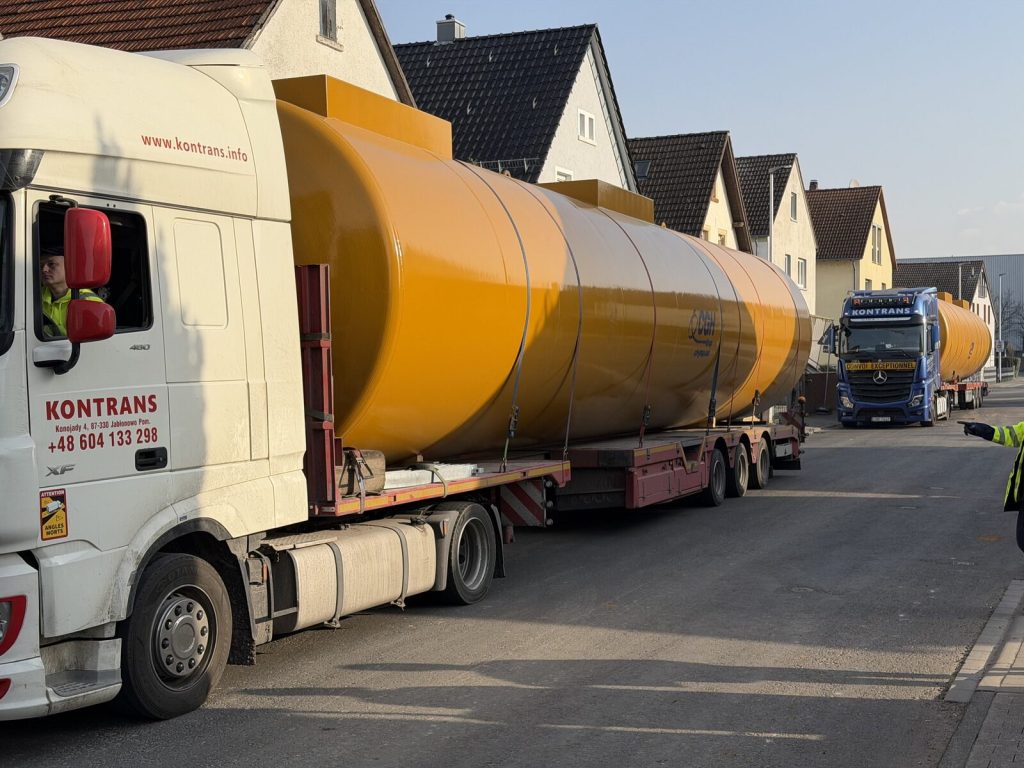
It is easy to see in the photos: the data center is not located on a greenfield site in an industrial estate, but embedded in an established residential area. Neighbouring buildings stand close by, and the access road is an ordinary residential street with trees and pavements.
A crane needs two things: an area to stand on, and ground that can take the outrigger loads. Both were in short supply.
At that time, the paths around the building were still a construction site themselves. Beneath them lie shafts, ducts and basement light wells – structures that cannot take the concentrated loads from a crane outrigger. So before any crane planning came a survey of the existing conditions: what lies where, which areas are off-limits, where there are openings in the building that can be used, and which surface will actually bear the load.
Only then could we say where the crane may stand. And because there were very few such spots, everything else followed from that: the radius had to reach from these positions, and that in turn determined the size of the machine.
The mistake you can make at this point is reaching for the bigger crane. But more lifting capacity also means more weight, a larger outrigger footprint, higher outrigger loads and more space needed for rigging. On a site in the middle of town, the bigger crane does not solve the problem, it makes it worse. What we were looking for was the machine that just reaches from the permitted set-up areas.
How does a crane of this size even get onto the site?
The second bottleneck was the approach. A mobile crane is surprisingly manoeuvrable thanks to its all-wheel steering, but it is also long. Every millimetre was measured for the turn from the street onto the site.
The result was inconvenient, but unambiguous: It did not fit. The gate systems had to be removed.
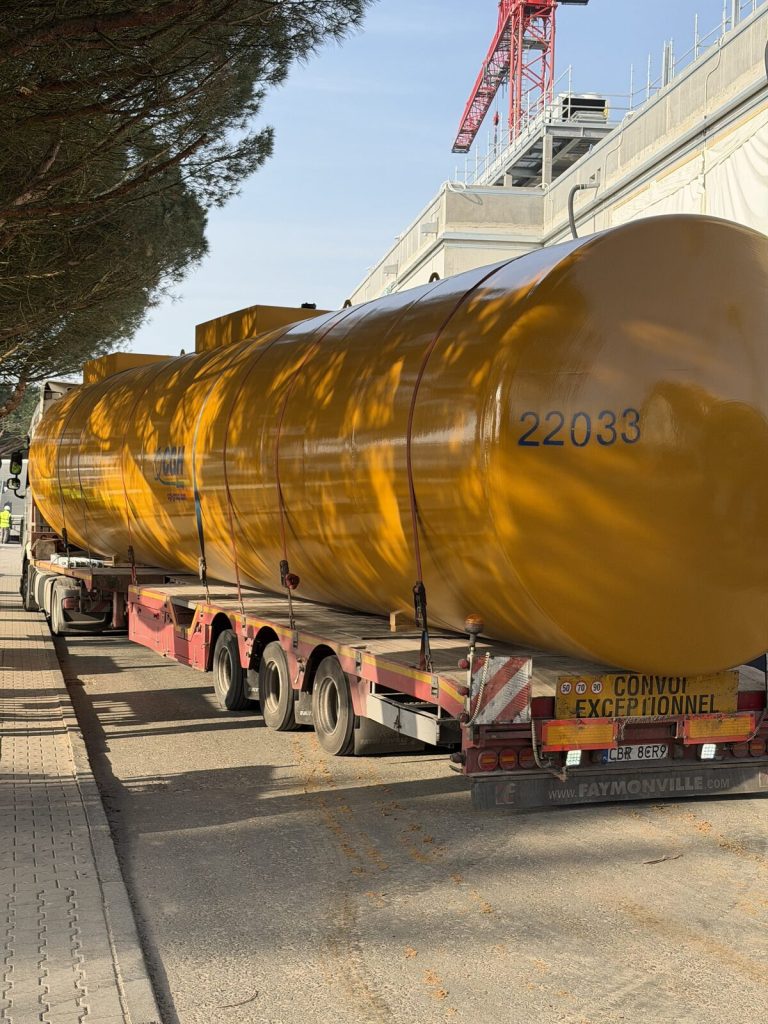
You want findings like this before the day of the lift, not on the morning when the crane and three abnormal loads are waiting at the entrance. In the same way, we checked in advance whether the low-loaders with the 16-metre-long tanks could get in at all – first roughly by sketch, then calculated in CAD. The tanks arrived individually, each on its own low-loader as an abnormal load, through the residential street right up to the building.
How do you sling a tank weighing 16 tonnes and 16 metres long?
A tank of this design is not a compact block, but a long, thin-walled tube with torispherical heads. The load is distributed over the entire length, and the outer shell is coated – any contact with a lifting accessory in the wrong place would mean damage.
Simply wrapping a round sling around the shell would therefore be no solution. It would damage the coating and put concentrated stress on the thin wall – and the tank would be ruined before it ever reached the pit.
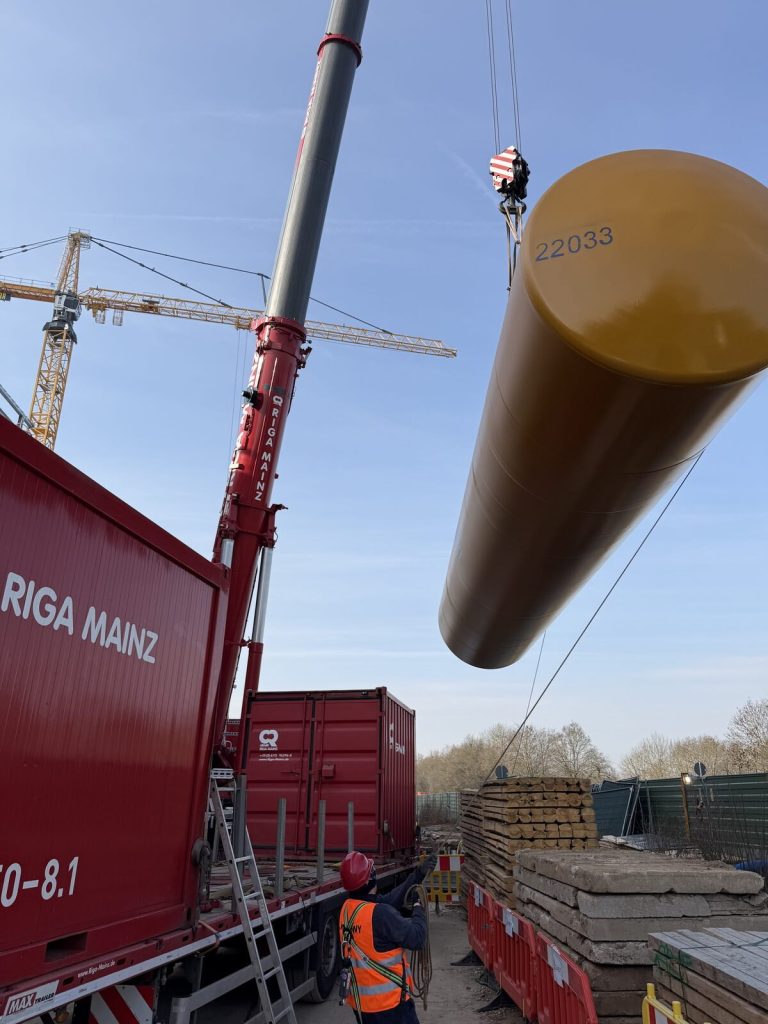
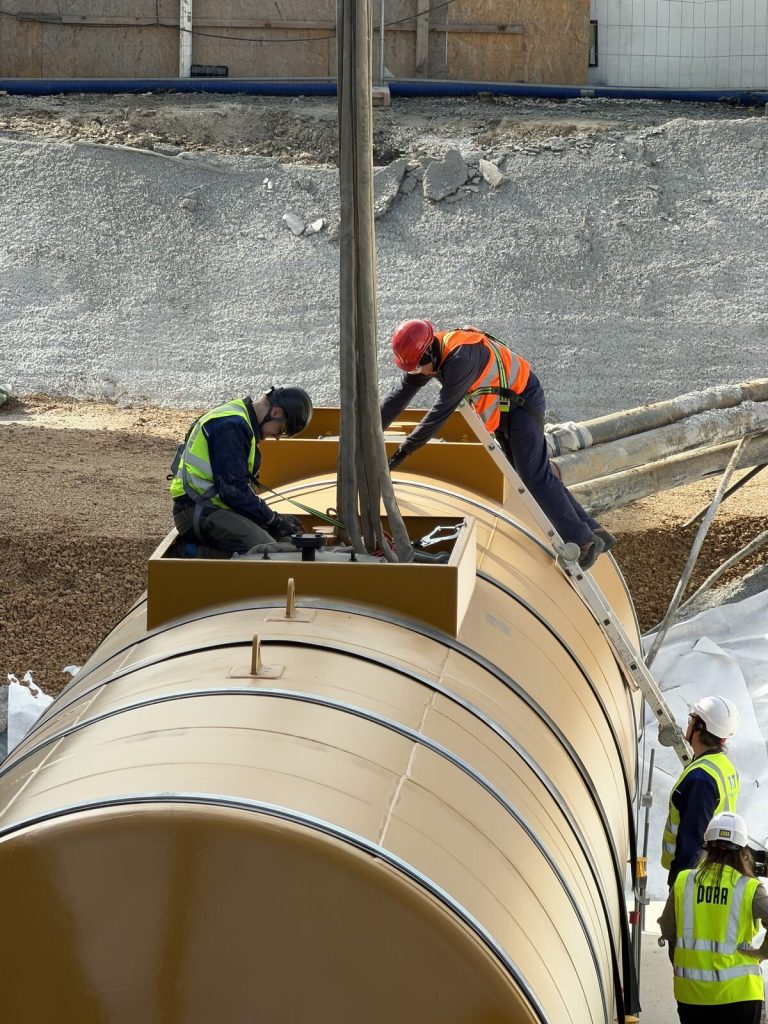
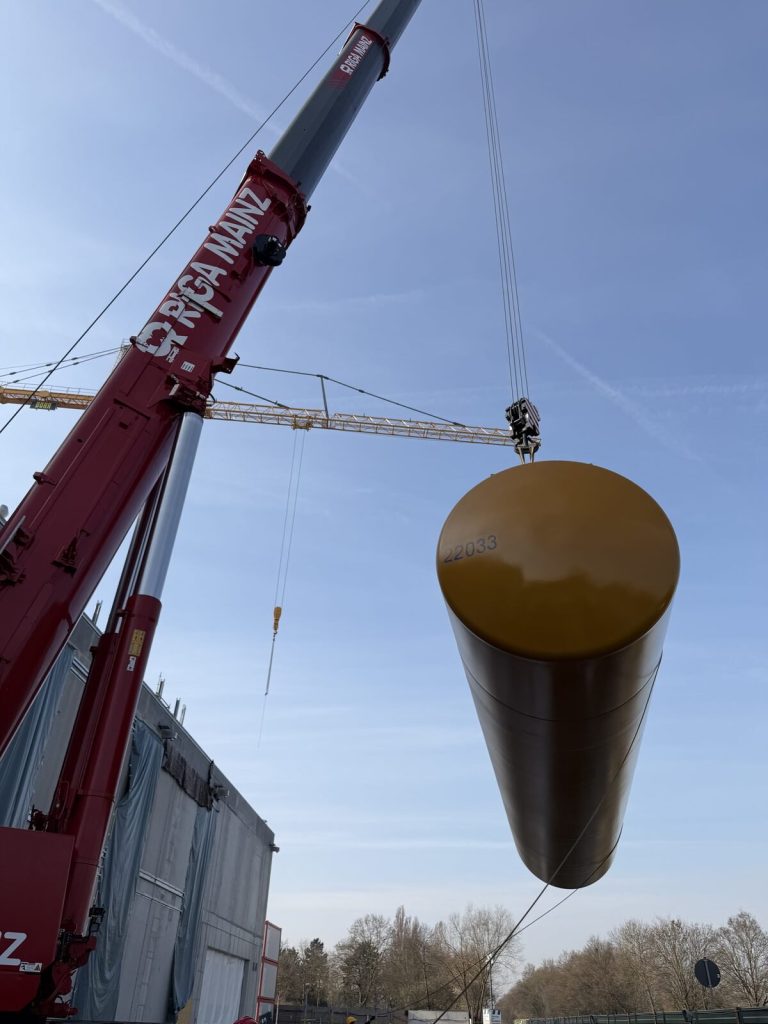
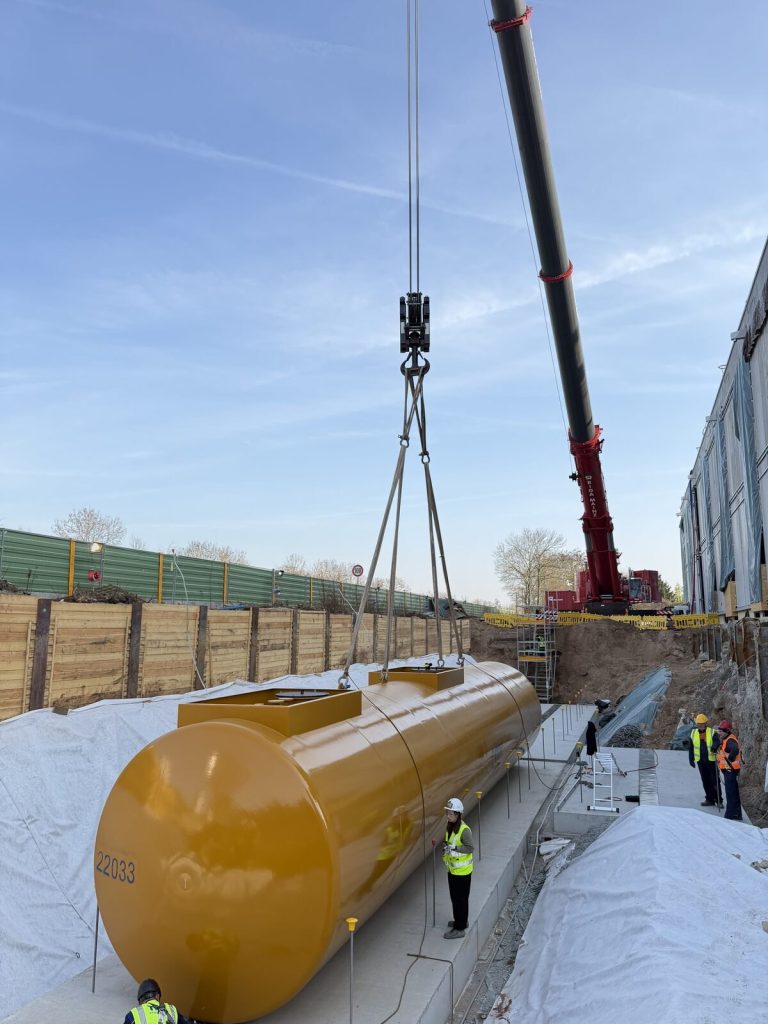
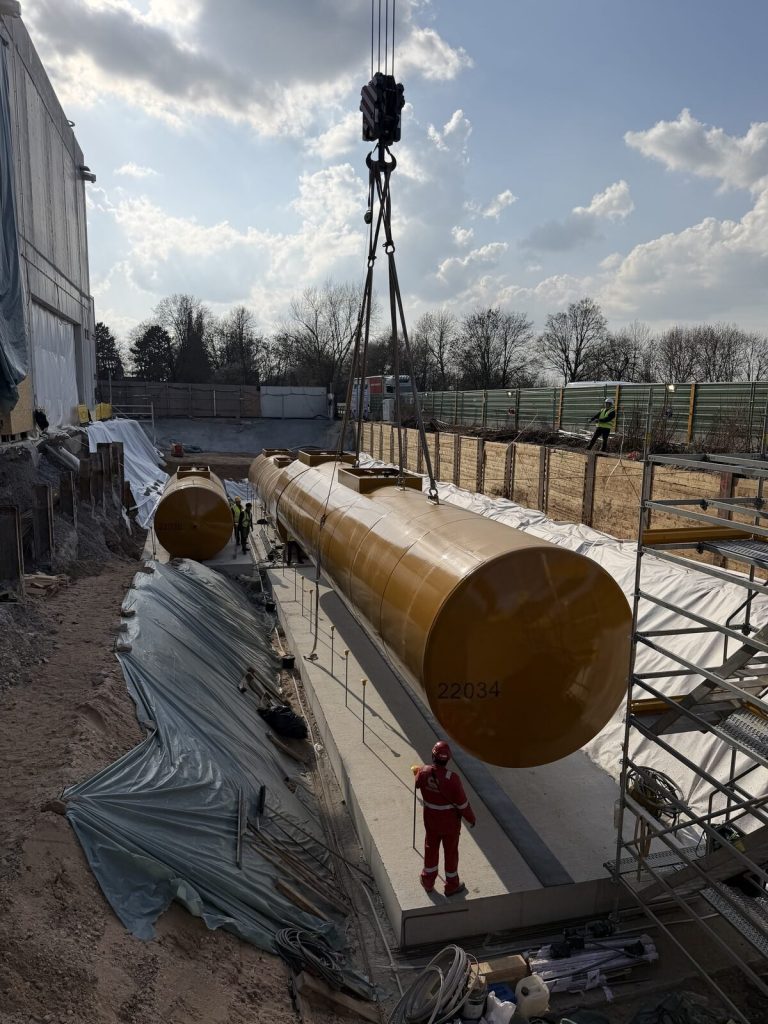
Instead, the tank manufacturer has welded four lifting points onto the crown of the tank. A sling assembly of round slings and shackles attaches to these, distributing the load across all four points and keeping the tank level. The sling length, working load limit and sling angle required for this are specified in the lift plan – that is exactly the calculation work that happens before the day of the lift.
Two aspects of this are underestimated from the outside.
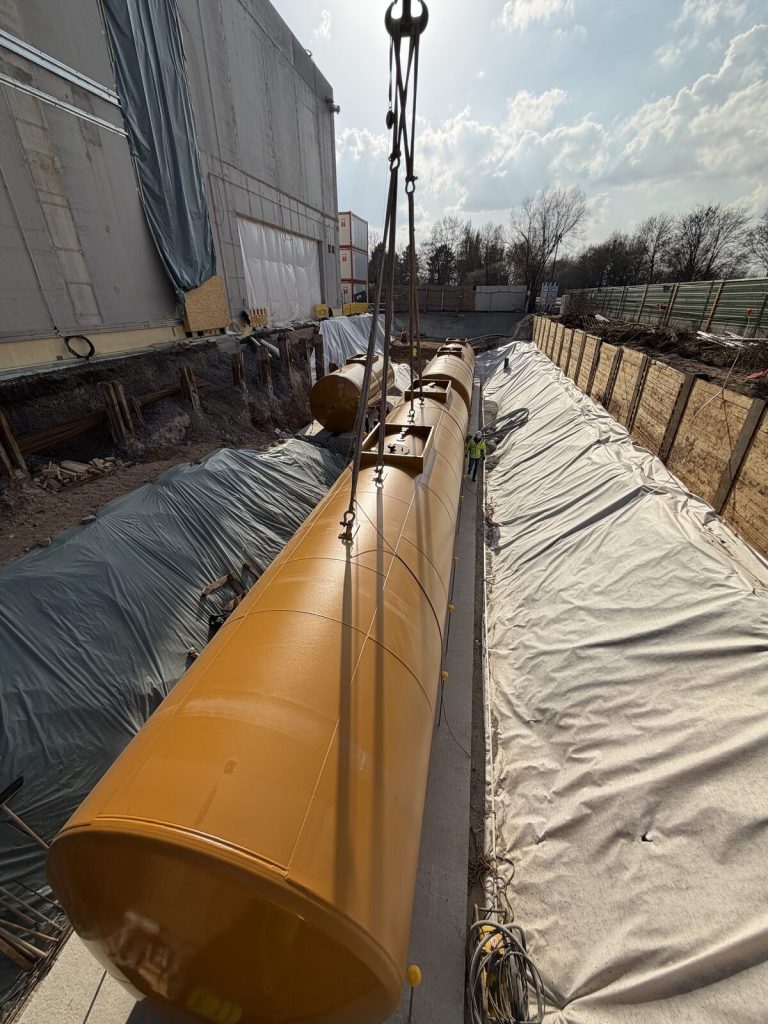
First, the headroom of the sling assembly. For the sling angle to be correct, the slings have to converge well above the tank. As a result, the sling assembly stands as tall as a small house – and this height is added to the lifting height. Anyone who only calculates up to the edge of the pit is off by several metres.
Second, the sling angle itself. The flatter the slings, the greater the force in each individual leg – for the same load weight. The angle is therefore a deliberately chosen compromise between leg force and sling assembly height, not a matter of chance.
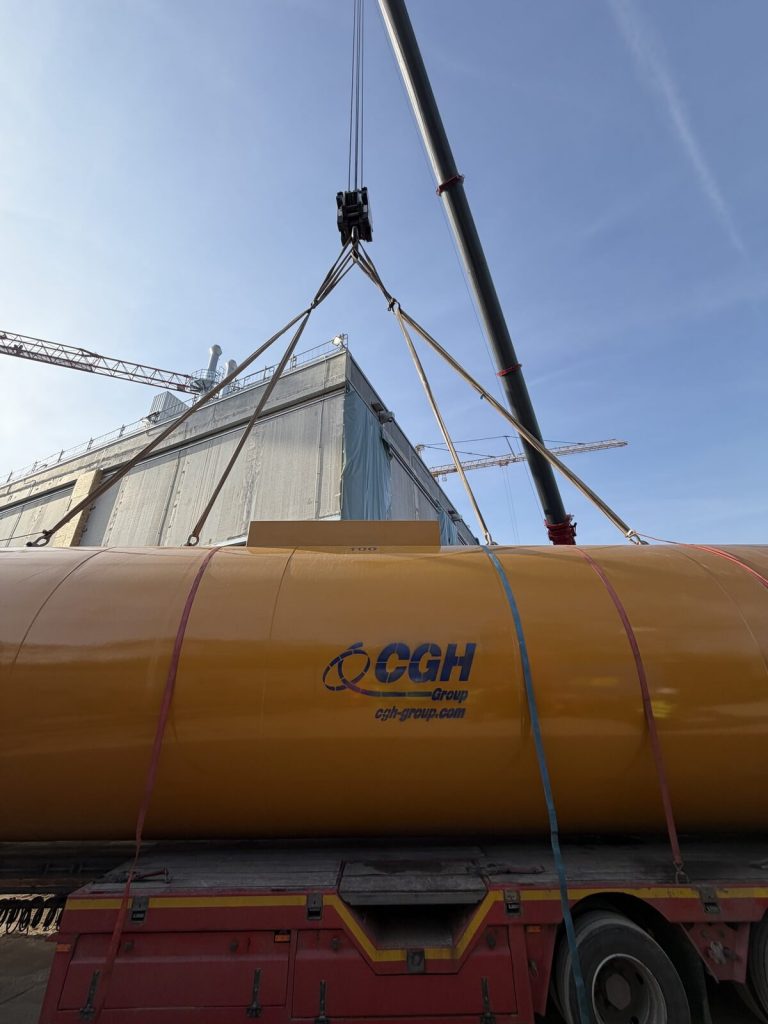
Why we recalculate third-party lifting points
The lifting lugs had been welded on by the tank manufacturer and were marked with their specifications. Nevertheless, checking them is one of the duties of the Lifting AP – and that is not mistrust, it is procedure.
Two things were checked:
- The condition of the welds. Visual inspection at every single lifting point before slinging. A tank has transport behind it, often over hundreds of kilometres.
- The sling geometry. The manufacturer's figures were recalculated and cross-checked: do the four points suit the planned sling angle, are the leg forces correct, is the centre of gravity positioned so that the tank hangs level?
Whoever pulls on a third-party component with the hook bears the responsibility for that pull. The figure on the delivery note is a basis, not a release.
The lift: over the shoring wall into the pit
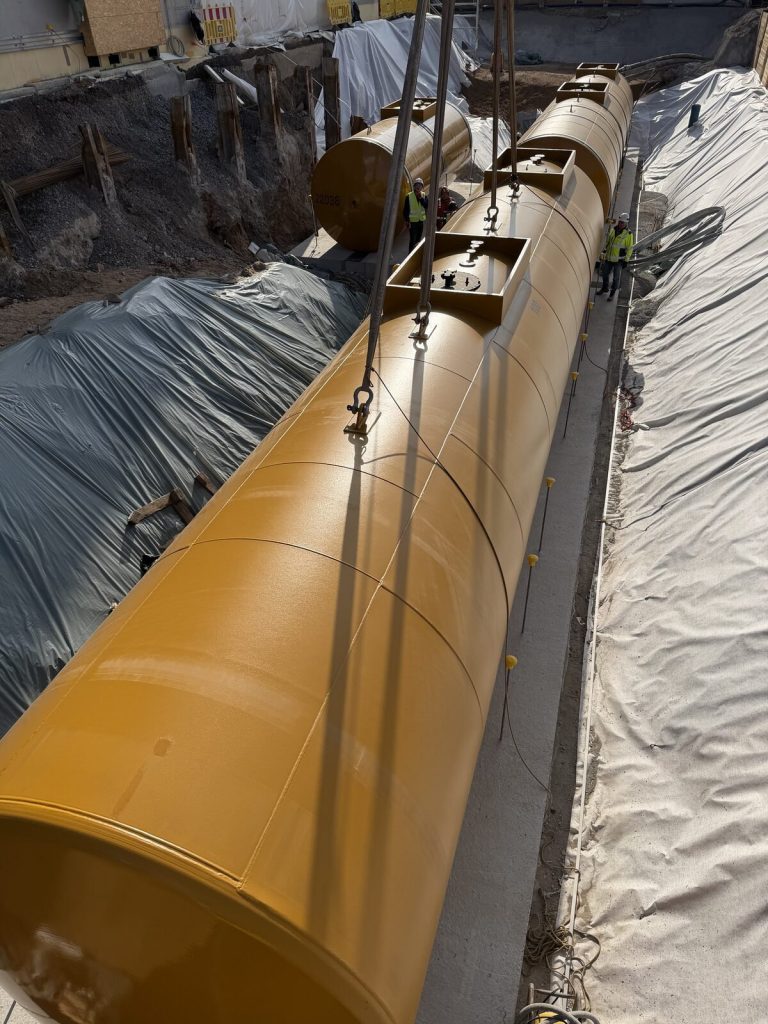
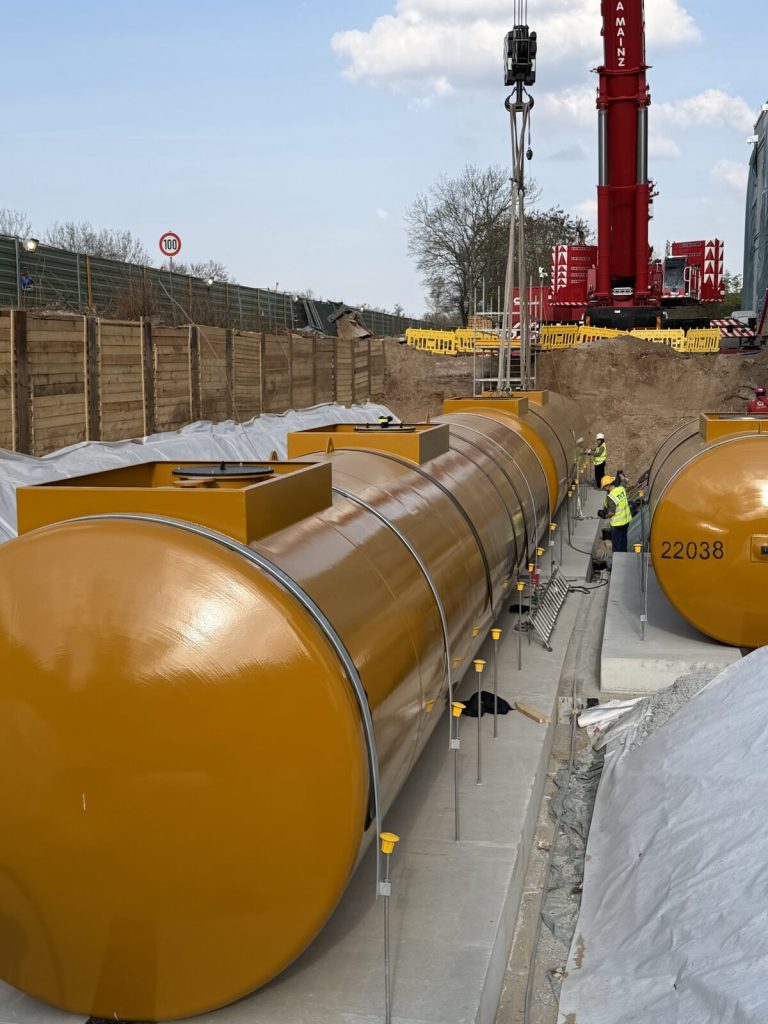
The tanks do not sit on the surface, but in an excavated pit secured with sheet piling and timber shoring. Its base is concreted and lined with a membrane, with the saddle supports sitting on top.
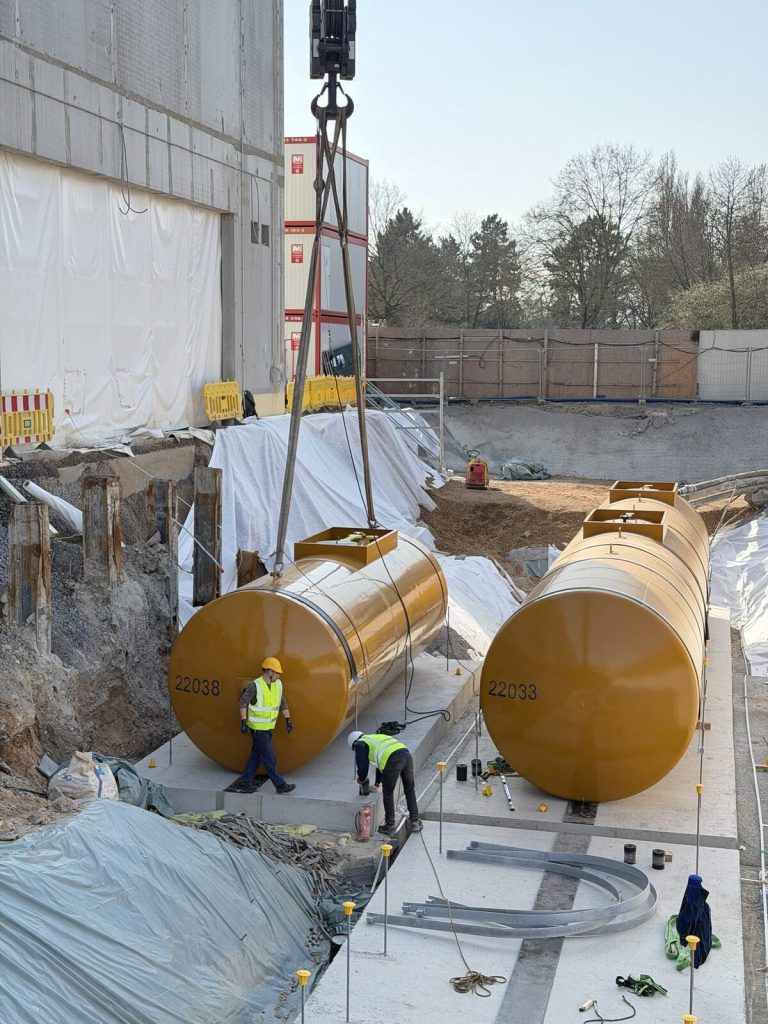
The sequence was the same for every tank: low-loader in position, attach the sling assembly, check the lifting points, lift, slew over the shoring wall, set down. Setting down is the slowest part, because a 16-metre-long tank has to land exactly on its supports without damaging either the coating or the membrane in the pit. There is little clearance between tank and shoring wall – the photos show how narrow the gap is that the tank goes into.
During alignment, the lift supervisor and fitters work against a simple problem: the crane operator cannot see the pit completely from the cab. Everything that happens down there happens on instruction. That is why the Lifting AP stands where both can be seen – the load and the target point – and guides the last few centimetres.
Why the crane position itself had to disappear in the end
The twist in this project lies in the sequence. The few areas that were suitable as crane positions were partly the very areas where tanks were to be placed in the end.
This means the crane stood on a spot that subsequently had to be dismantled so that the next tank could be placed there. So each lift not only had to work on its own, but also had to take place in the right order – and be coordinated with the civil works contractor, because the tanks had to be filled after being installed and bolted down.
That is the difference between a lift and a moving-in operation. A lift is done in an hour. Moving in is a chain of lifts, modifications and releases that only works if someone has thought it through from back to front beforehand.
Other trades were involved on those three days, which are not named here. Coordinating with each other was the part that made the planning so demanding – and the part that ultimately ensured everything fitted without rework.
Why Omega Mounting?
We are an installation company from Rodgau in the Offenbach district and have been working on data center construction sites in the Rhine-Main region for years – with transformers, standby generators, load banks, cooling units and, as here, tanks.
What sets us apart from a plain installation crew on projects like this is the planning that comes first. We provide the Lifting Appointed Person, prepare lift plans, define lifting accessories, check third-party lifting points and agree crane positions with the crane company. On site, we are then the ones who guide and release the lift.
For general contractors and crane companies, this has a practical value: they get one point of contact for the lifting operations who provides the documentation the client demands and who is on site on the day of the lift.
On this project we worked closely with RIGA MAINZ – on projects like this, crane planning and lift planning are not done one after the other, but together at the same table.
Conclusion
Five diesel tanks of 100 cubic metres and 16 tonnes each are no special load for a crane of this class. What made this project difficult was everything surrounding the lift: a data center in the middle of town, access through a residential street, shafts and ducts beneath the few free areas, a gate system in the crane's way, and crane positions that ended up becoming tank space themselves.
This was not solved on the day of the lift, but in the weeks before – with a lift plan, CAD swept-path analysis, joint crane position calculation and a fully calculated slinging concept. On the three days in March, every tank then landed exactly where it belonged.
Request a callback for your project now – tell us briefly what it is about and we will get back to you with an honest assessment. Omega Mounting GmbH, Hügelstraße 5, 63110 Rodgau. As an installation company from the Offenbach district, we are quickly on site in Raunheim, Frankfurt, Rüsselsheim, Kelsterbach, Hanau and the entire Rhine-Main region – and work throughout Germany. 100 % free of charge and without obligation.
Photo gallery of the job
Planning a heavy lift or need a Lifting Appointed Person?
Tell us briefly what it is about – we will come back to you with an honest assessment.
100% free and without obligation
Related guides for this project

About the author
Tobias Schott
Managing director of Omega Mounting GmbH, Rodgau · more than 20 years of hands-on experience in installation and maintenance
A trained mechatronics technician, at home in maintenance, servicing and industrial installation since 2004 – first alongside his father, and since 2012 with Omega Mounting: from the overhead conveyor in Frankfurt to the crane system in a new-build hall. As appointed person for lifting operations, he plans and leads lifting operations in data centers and on industrial sites in the Rhine-Main region, is an instructor and examiner for cranes, aerial work platforms and telehandlers, and a safety officer. On assignments abroad he is known as the "German Troubleshooter" – the one you call when things get stuck on site. He did not learn what quality means from a manual, but from his father: Made in Germany as a standard for his own work, not as a label. That is why quality comes first at Omega Mounting – before speed and before price. The project diary shows the jobs his team has planned and carried out – without customer names, but with everything that can be learned from them.
Frequently asked questions
The Lifting Appointed Person, or Lifting AP for short, is the person who plans, releases and is responsible for a lifting operation. The Lifting AP prepares the lift plan, specifies the lifting equipment, checks lifting points and load assumptions, agrees the crane position and has the authority to stop the lift on the day. The term comes from the British standard BS 7121 and is common on data center construction sites; under German law it corresponds to a written delegation of duties under Section 13 of the German Occupational Safety Act (ArbSchG) and Section 13 of DGUV Regulation 1. The Lifting AP is neither the crane operator nor the slinger – it is the responsible authority above both.
Because the standby power supply has not only to start, but to keep going. If the public grid fails, the standby generators take over, and they consume diesel. For a data center to remain self-sufficient for the guaranteed period, fuel is stored on site – in this project, in five tanks of 100 cubic metres each.
Empty, a tank of this design weighs around 16 tonnes. It is about 16 metres long and has a diameter of 2.90 metres. Lifting is always done empty; filling only takes place once the tank has been set down and bolted.
Via four lifting points welded onto the crown, to which a sling assembly of round slings and shackles attaches. A round sling directly around the shell would be no alternative: it would damage the coating and put concentrated stress on the thin wall. Working load limits, sling lengths and sling angles are specified and recalculated in the lift plan for each lift – and the headroom of the sling assembly has to be included, because it is added to the actual lifting height.
Yes. The manufacturer's figures are a basis, not a release. The Lifting AP checks the welds at every lifting point in their as-found condition on site and recalculates the sling geometry – leg forces, sling angle and centre of gravity. Whoever pulls with the hook is responsible for the pull.
Because more lifting capacity also means more dead weight, a larger outrigger footprint, higher outrigger loads and more space for rigging. On a confined plot with shafts, ducts and basement light wells underground, the bigger crane makes the problem worse instead of solving it. The right machine is the one that just reaches from the permitted set-up areas.
Then it is measured before it arrives. On this project, the swept-path analysis showed that the turn from the street onto the site was too tight – so the gate systems were removed beforehand. The same applies to the abnormal loads: whether a low-loader with a 16-metre-long tank can get into the access road is checked in CAD in advance, not tried out on the day.
The actual operation on this project ran over three days. The greater effort came before that: surveying the available areas, calculating the crane positions, lift plan, slinging concept and coordination with the crane company, the civil works contractor and the other trades.
Yes, that is the normal case. On this project, the tanks came from the supplier, the crane from RIGA MAINZ and the site from the general contractor – the lift was planned, checked and led by us. We work both as a subcontractor to general contractors and directly for crane and heavy haulage companies.
 English
 German