
- Guide – Lift & Shift
Spider crane or mobile crane: which lifting method for moving in
By Tobias Schott · Reading time approx. 23 minutes · Last updated: October 2026
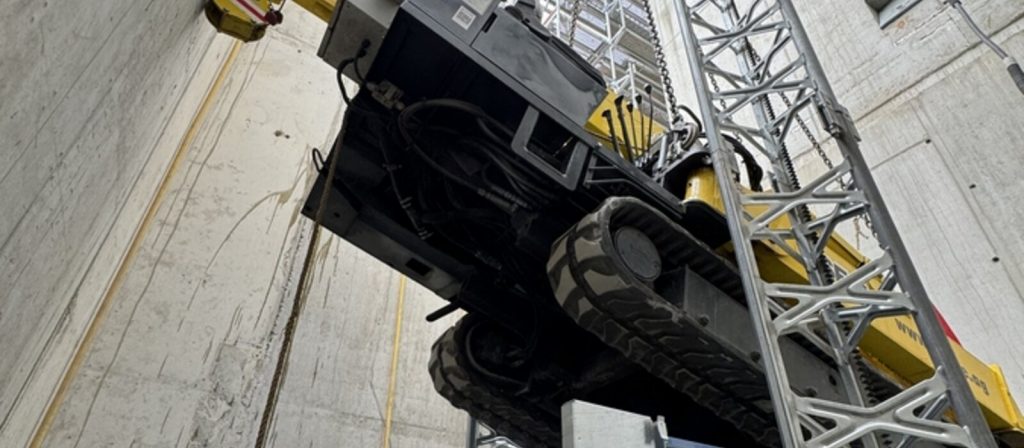
Whether spider crane or mobile crane, gantry crane, machine skates or skidding system – the lifting method follows from five questions: how heavy is the load, how much space is there along the route, what will the floor bear, how high and how far does it have to go, and how finished is the building on the installation day?
As a designer, you define openings, routes and areas long before anyone knows which machine will bring the equipment in. As a project manager, you receive quotations that say mobile crane in one, mini crane in another and “skidding” in a third. Anyone then searching for “spider crane or mobile crane moving in” wants an answer for their building.
The methods are not interchangeable. A mobile crane needs a load-bearing crane set-up area and loses capacity with every metre of radius. A spider crane fits through door openings but lifts only what its outriggers and load chart allow. A skidding system moves 50 tonnes into an enclosed building, but only horizontally and only when levelled to the millimetre.
This guide explains the limits of use of the common lifting methods for moving in, shows how we combine them and gives you a decision matrix. The examples come from data centers in Frankfurt and Raunheim, a paint shop in Offenbach and a bakery near Fulda. It builds on our guide on the sequence of the installation day from T-4 weeks to T+1.
Key points at a glance
- The lifting method is derived from weight, space, floor, route and state of construction – not from habit or equipment availability.
- The mobile crane is the standard method when a load-bearing crane set-up area is available outside and the load at the required radius is still within the load chart.
- Spider cranes and mini cranes fit through door openings and work electrically in enclosed rooms, but have limited capacity and need space for their outriggers.
- Gantry cranes and hydraulic gantries lift loads vertically indoors and are ideal for rows, narrow plant aisles and component replacement in existing plants.
- Machine skates and skidding systems move loads horizontally – the skidding system even beyond 50 tonnes into the enclosed building, without lifting the load.
- In practice, methods are combined: crane up to the opening, then skates or skidding; tower crane plus spider crane through the shaft.
- Every method has a lift plan, inspected equipment, a cordoned-off load zone and an appointed person for lifting operations with the authority to stop – the occupational safety rules do not change with the machine.
What is a lifting method for moving in?
A lifting method for moving in is the combination of lifting equipment, slinging technique and path of movement by which a heavy unit is brought from the delivery vehicle to its installation position. For example, a mobile crane with a chain sling over the facade, or a skidding system with hydraulic cylinders through the door.
The term covers more than the machine. It includes whether the load is lifted or only moved horizontally, where the lifting equipment stands and what it loads in the process. And with which lifting accessories the load is slung and who guides it as slinger and banksman. Two moving-in jobs with the same crane are different methods if one swings over a retaining wall into a pit and the other lifts vertically through a shaft.
You will find how this fits into the overall picture in our overview of lift & shift of heavy equipment and in the guide Lift & shift: what the term means.
Which five questions decide the lifting method?
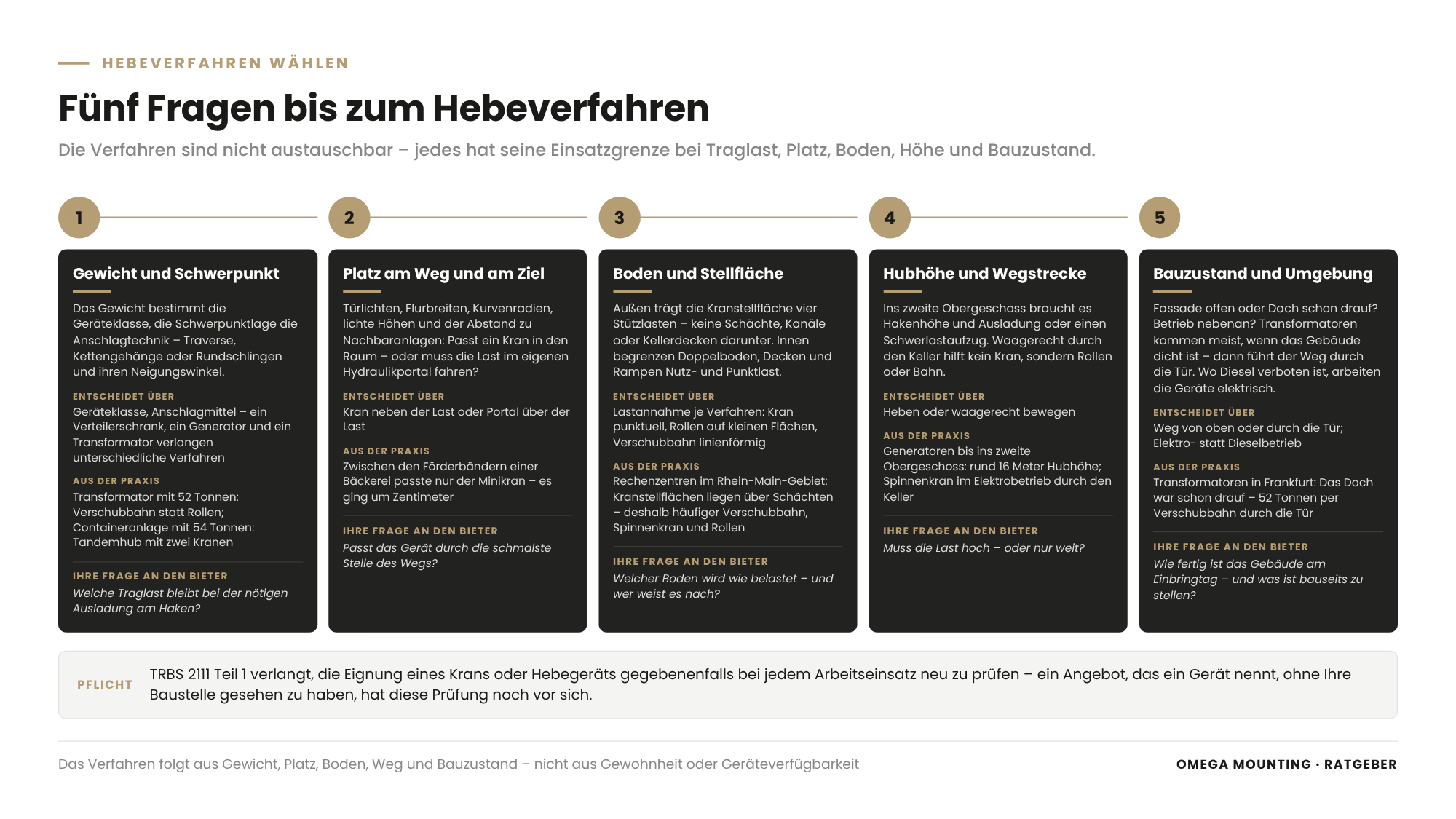
Five things decide the lifting method: the weight of the load with its centre of gravity, the available space along the moving-in route and at the destination, the load-bearing capacity of floor and crane set-up area. Plus the required hook height and distance, and the state of construction and the surroundings on the installation day.
The five questions are the practical form of an obligation. The German technical rule TRBS 2111 Part 1 (mobile work equipment) requires the suitability of a crane or lifting device to be re-examined, where appropriate, for every single job – explicitly at changing locations. For you this means: a quotation that names a machine without having seen your site still has this examination ahead of it.
1. Weight and centre of gravity
The weight determines the equipment class, the centre of gravity the slinging technique – spreader beam, chain sling or round slings and their sling angle. A distribution cabinet in the tonne range, a generator of 20 tonnes, a containerised unit of 54 tonnes and a transformer of 52 tonnes require different methods – not just bigger machines.
2. Space along the route and at the destination
Door openings, corridor widths, turning radii, clear heights and the distance to neighbouring plant decide whether a crane fits into the room at all. Or whether the load has to be moved in its own hydraulic gantry. Between conveyor belts in a bakery it came down to centimetres. A larger crane simply would not have fitted between the production lines.
3. Floor and set-up area
A mobile crane transfers its outrigger load via outrigger pads onto four points. The ground bearing pressure beneath must not have to be absorbed by shafts, ducts or basement ceilings. Inside the building, raised floors, slabs and ramps limit the permissible imposed load and point load. Each method distributes the load differently: the crane at points, skates on small contact areas, the skidding system in a line over packed rail elements. The structural engineer needs a separate load assumption for each.
4. Lifting height and distance
If the load has to go to the second floor – typically around 16 metres of lifting height for generators – a crane with the corresponding hook height and radius is needed. Or a heavy-duty lift with suitable capacity. If it has to travel horizontally through a basement level, no crane will help, but skates or a skidding track will.
5. State of construction and surroundings
Is the facade still open, is the roof already on, are operations running next door? Transformers usually arrive only when the building is weathertight – then the route leads through the door. Where no combustion engines may run, spider crane and lifting devices must work electrically.
When is the mobile crane the right method?
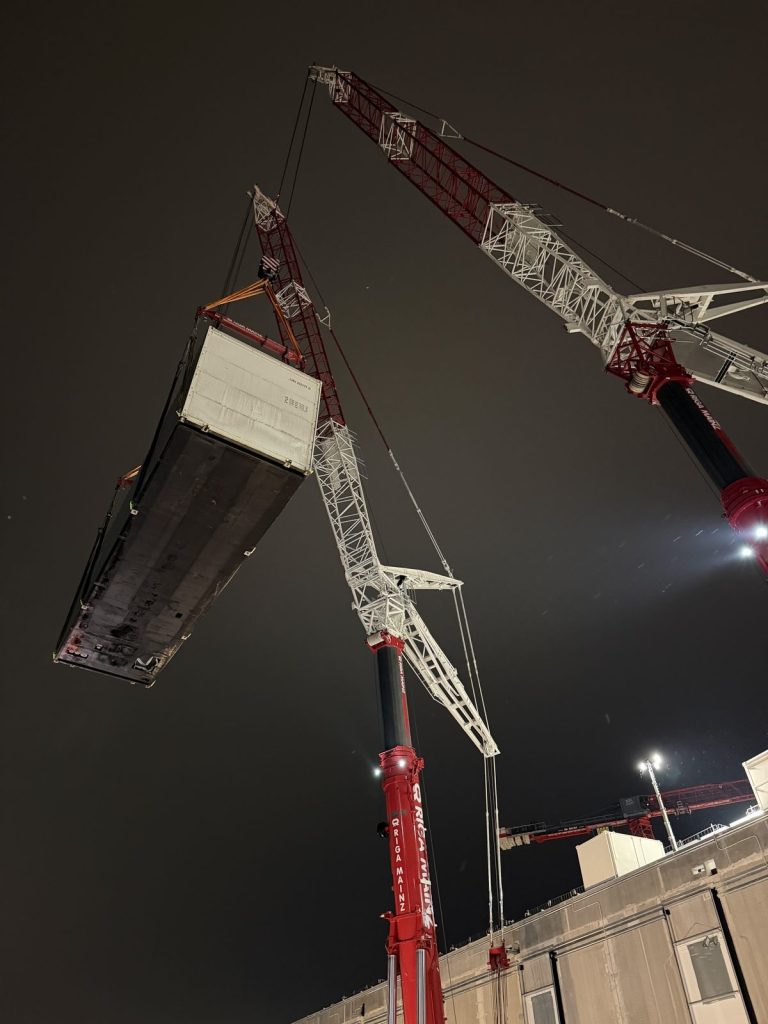
The mobile crane is the right method when a load-bearing crane set-up area is available outside within reach of the installation position and the load at the required radius is still within the load chart. In addition, the installation opening – facade, roof, shaft or pit – must be accessible from above or from the side.
Limits of use of the mobile crane
- Crane set-up area: The crane needs space for the vehicle, fully extended outriggers and counterweight. The ground bearing pressure under the outrigger pads must be borne by the ground – shafts, ducts and underground car parks are exclusion criteria or require structural verification with load spreading plates. If the crane stands next to an excavation, the minimum distances under DIN 4124 apply, as named in the BG BAU/BAuA module “Site set-up – large equipment”. For sloped pits at least 1.00 metre for machines up to 12 tonnes and at least 2.00 metres up to 40 tonnes; for non-cohesive or filled ground, twice the pit depth. Heavier cranes need the structural engineer's approval.
- Radius versus capacity: With every metre of radius, the load moment rises and the capacity falls. A mobile crane of the 220-tonne class with 71 tonnes of counterweight and a 30-metre boom still has about 28 tonnes on the hook at a radius of around 20 metres. The type designation says nothing about what can be lifted at your position.
- Slewing range and overhead lines: Neighbouring buildings, trees and site set-up limit the slewing range; the load zone beneath is cordoned off as a danger zone. For overhead lines, the “large equipment” module specifies safety distances: at least 1.00 metre up to 1,000 volts, 3.00 metres up to 110 kilovolts, 4.00 metres up to 220 kilovolts and 5.00 metres up to 380 kilovolts. If the voltage is unknown, 5.00 metres always apply. For you this means: clarify in advance which line hangs over the plot – otherwise the largest distance applies.
- Wind limit: Wind limits crane operation. TRBS 2111 Part 1 gives no value for this but requires the employer to define the permissible wind speed – which is why it is stated in the lift plan. As our own rule, we work with a limit of 10 metres per second for lifting operations, below the manufacturers' values for many cranes.
- Access: Crane and low-loader have to get there – swept paths, gates, road width, special use permit and traffic order in public space. As a guide value, the module “Site set-up – traffic areas” names a clearance profile of at least 4.50 metres height for site roads.
Tandem lift: two cranes, one load
If one crane is not enough – for example for a containerised standby power system of 54 tonnes going to the second floor – two cranes lift together. In a tandem lift, the load distribution between the two machines is defined in the lift plan, both crane operators move synchronously, and exactly one person – the appointed person for lifting operations (lifting supervisor) – gives the commands. We have run two mobile cranes with a capacity of 650 tonnes each in tandem for such a containerised unit.
If a tower crane is on site anyway, it can lift loads vertically through shafts without a mobile crane having to come. Its capacity at the jib tip is limited, but often sufficient for mini cranes, cooling units or sub-assemblies.
Spider crane or mini crane instead of mobile crane: when does that suit moving in?
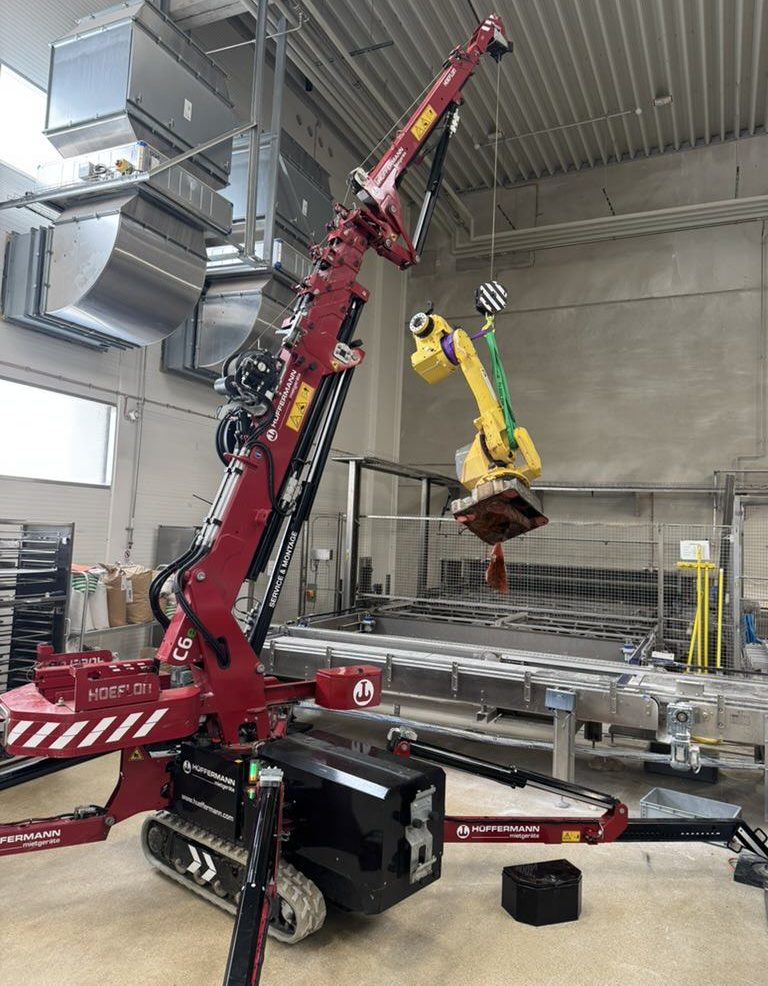
A spider crane or mini crane suits moving in when the load has to be lifted inside the building and a mobile crane cannot reach the position. Door openings and corridors must let the machine through, floor and slab must bear the outrigger forces, and the crane's capacity must be sufficient at the required radius.
A spider crane is a compact crawler crane with four fold-out outriggers – hence the name – and a telescopic boom. Mini cranes are the class below: even more compact, often for loads in the range of a few hundred kilograms to a few tonnes.
Strengths
- Fits through standard doors and small hall gates, turns almost on the spot.
- Runs on hybrid or electric drive in enclosed rooms – important wherever diesel is prohibited.
- Lifts vertically and sets down precisely: for example CRAH units (precision air-conditioning units) onto their plinths in the data hall, or a robot over the production line.
Limits of use
- Capacity and radius: As with the mobile crane, the load chart applies – reaching over a conveyor belt or a plant, often only a fraction of the nominal capacity remains.
- Outrigger area: The four outriggers transfer point loads onto raised floor, screed or slab; load spreading plates and the structural engineer's verification are part of it.
- Height: The clear height limits boom and hook height.
- Site power: In electric mode, an adequately sized connection must be provided by the client at the point of use – in Raunheim a three-phase cable was laid through the basement for this.
- The way back: A spider crane that drove in during the shell construction has to come out again after completion. In Raunheim, two centimetres were missing for this upright.
During the dismantling of an industrial robot weighing around 600 kilograms in a bakery near Fulda, the mini crane was the only machine that fitted through the gates and between the conveyor belts. Slung with inspected round slings, balanced on the centre of gravity and guided centimetre by centimetre over the plant. The team: appointed person for lifting operations, crane operator and two mechatronics technicians, one day.

When is a gantry crane or lifting frame the better choice?
A mobile gantry crane or a lifting frame is the better choice when the load has to be lifted vertically indoors and moved over short distances. Typically when no crane fits next to the load and the clear height is limited – for example when setting up cabinets in rows or replacing a component deep inside a plant.
A mobile gantry crane is a frame of two legs and a cross beam that is rolled over the load on castors. A chain hoist or trolley hangs in it. A lifting frame is the lighter variant assembled on site – for example from aluminium beams with a chain hoist. The load hangs from it on round slings or a lifting beam.
Strengths
- Stands over the load, not next to it – needs no outrigger area to the side.
- Distributes the load onto four castors or feet that can be guided on protective panels and load spreading plates.
- Can be carried in parts through door openings and assembled in the room.
- Ideal for series: lift pallets with distribution cabinets, move the cabinet, set down, next.
Limits of use
- Lifting height and span: Limited by ceiling height and beam length.
- Capacity: For loads in the tonne range; heavy units require skates or a skidding track.
- Route: Only short distances on level, load-bearing floors.
Gantry crane plus rail: component replacement in an existing plant
In a paint shop in the Offenbach area, a motor-fan unit was buried so deep inside the plant that no crane could reach it. The solution was a rail welded on site on which the unit was moved out, and a gantry crane that lifted it off for overhaul. How that went during the weekend shutdown is described in the practice section.
When are machine skates, hydraulic gantries and skidding systems used?
Machine skates, hydraulic gantries and skidding systems are used when the load has to be moved horizontally inside the building and no crane can reach the position any more. Skates for medium loads on level floors, hydraulic gantries for lifting and setting down without a crane, the skidding system for loads in the order of 50 tonnes and more into the enclosed building.
Machine skates (heavy-duty skates)
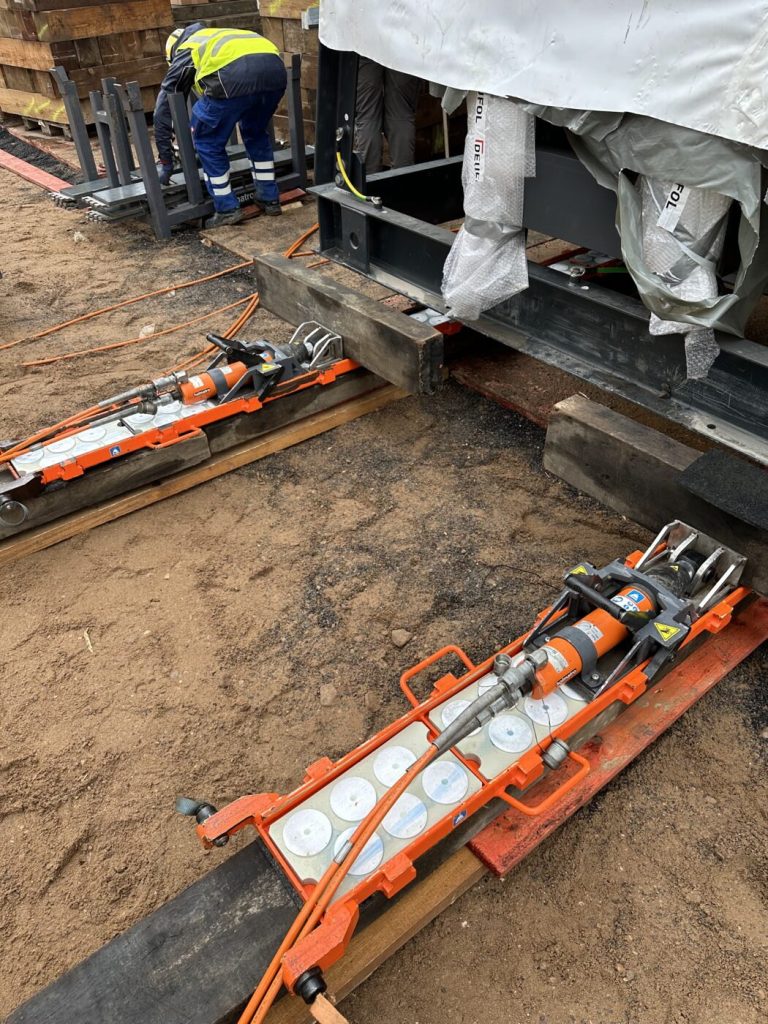
Machine skates – called tank rollers on site – are compact heavy-duty skates with swivel or fixed rollers that are placed under the load. The load is lifted with hydraulic cylinders, set down on the skates and moved with a tractor, winch or by hand. Strengths: simple, fast, flexible in existing buildings. Limits: small contact areas put high point loads on the floor, thresholds and joints have to be bridged. Gradients are critical, and it must be possible to pack the load cleanly.
Hydraulic gantries and lifting jacks
A hydraulic gantry consists of four lifting cylinders on travelling units connected by beams. The load is hydraulically raised and lowered between them. Lifting jacks lift in place – for example to remove a track from under the load or to set a machine on vibration dampers. Both replace the crane where there is none.
Skidding system (hydraulic skidding)
A skidding system is a hydraulic track system that moves heavy loads horizontally without lifting them. Track elements are laid from the unloading point to the target position, the load rests on slide plates or skid shoes. A push cylinder grips, pushes the load one cylinder length, resets, grips again and pushes again – on the inchworm principle.
For two transformers of 52 tonnes each in a data center in the Frankfurt area, this was the only way, because the roof was already on. The real work is not the pushing but levelling the track to the millimetre – details in the practice section. A 52-tonne load that runs crooked into a room cannot be nudged back into place.
Limits of use of skates and skidding track
Both methods work only horizontally. Differences in level require ramps or packing, the floor must bear the line or point loads, and the load needs a flat underside or a transport frame. Skidding is slow but controlled at all times – after every stroke a pause in which checks are made.
Spider crane or mobile crane for moving in? The decision matrix
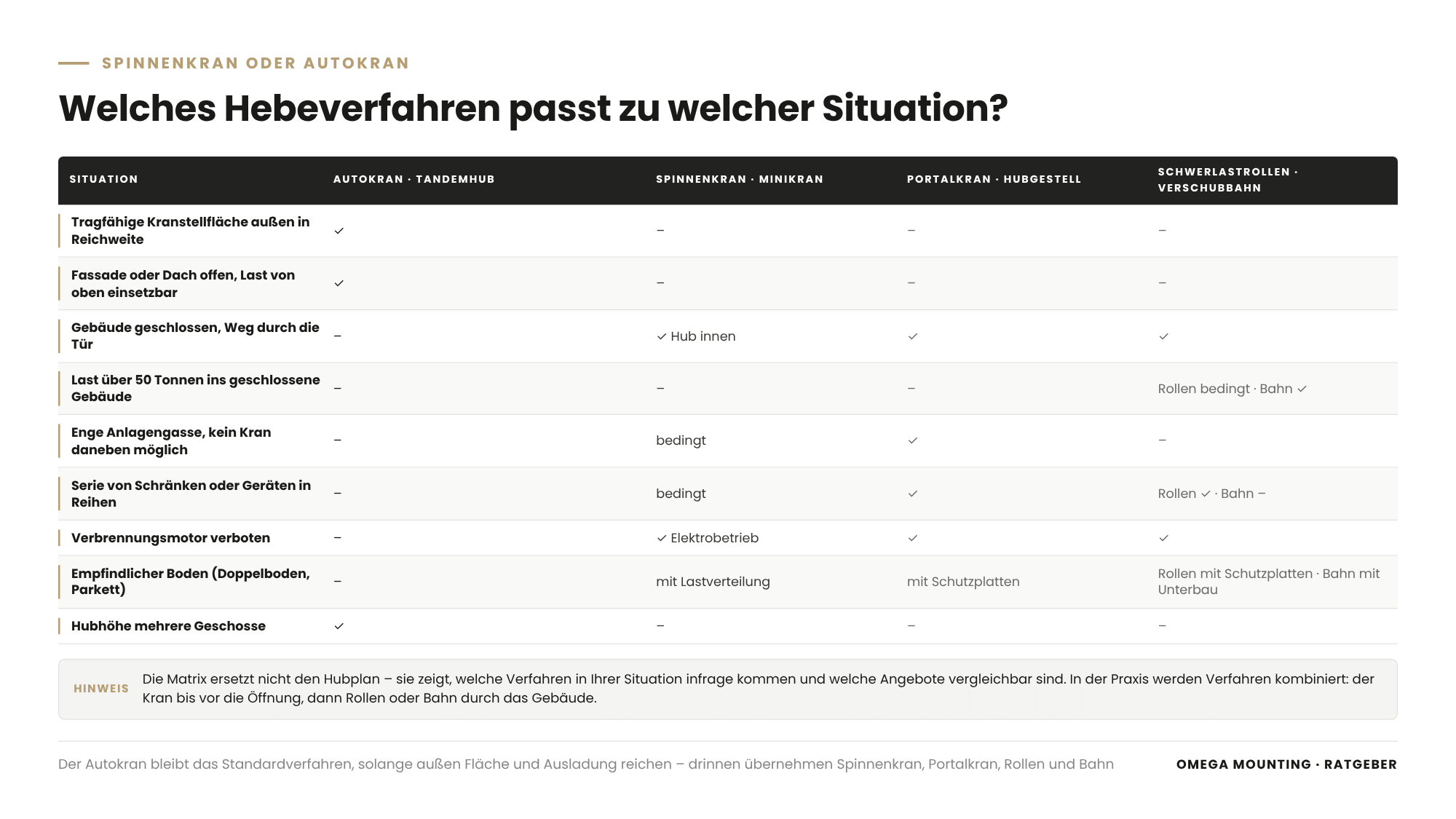
The question “spider crane or mobile crane for moving in” is answered by the decision matrix. It assigns to the five questions – weight, space, floor, route, state of construction – the method that most often fits in practice.
| Situation | Mobile crane | Tandem lift | Spider crane / mini crane | Gantry crane / lifting frame | Machine skates | skidding system |
|---|---|---|---|---|---|---|
| Load-bearing crane set-up area outside within reach. | ✓ | ✓ | – | – | – | – |
| Facade or roof open, load can be placed from above. | ✓ | ✓ | – | – | – | – |
| Building enclosed, route through the door. | – | – | ✓ (lift indoors). | ✓ | ✓ | ✓ |
| Load over 50 tonnes into the enclosed building. | – | – | – | – | Limited. | ✓ |
| Narrow plant aisle, no crane possible alongside. | – | – | Limited. | ✓ | – | – |
| Series of cabinets or units in rows. | – | – | Limited. | ✓ | ✓ | – |
| Combustion engines prohibited. | – | – | ✓ (electric). | ✓ | ✓ | ✓ |
| Sensitive floor (raised floor, parquet). | – | – | With load distribution. | With protective panels. | With protective panels. | With packing. |
| Lifting height several storeys. | ✓ | ✓ | – | – | – | – |
The matrix does not replace the lift plan, but it shows which methods are an option in your situation – and which quotations are comparable.
How are lifting methods combined?
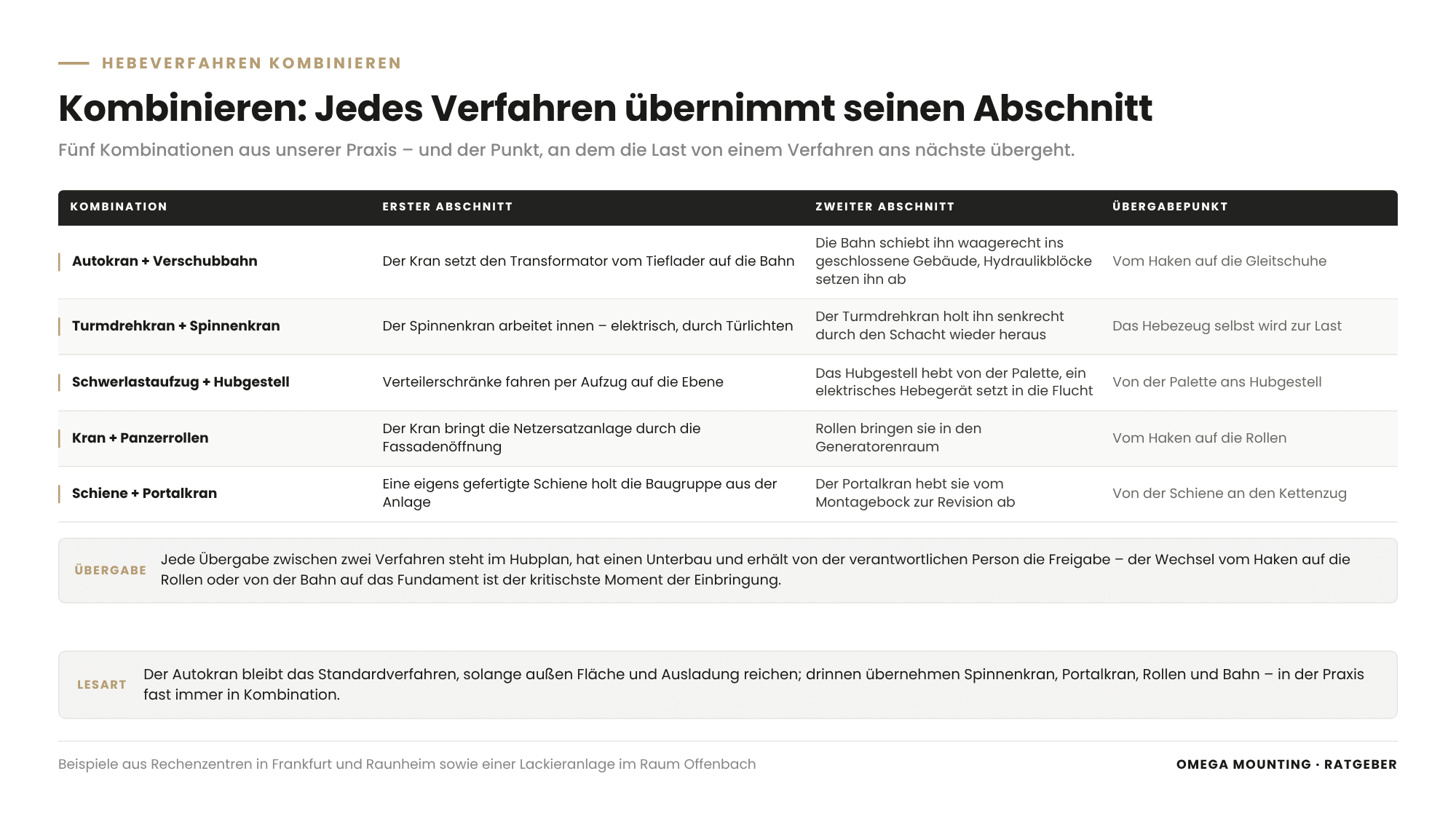
Lifting methods are combined by each method taking on the stage it was built for. The crane up to the installation opening, skates or skidding track through the building, hydraulic gantry or hydraulic cylinders for setting down on the foundation.
Typical combinations from our practice:
- Mobile crane plus skidding system: The crane sets the transformer from the low-loader onto the track, the track brings it into the building, hydraulic blocks set it down.
- Tower crane plus spider crane: The spider crane works inside, the tower crane brings it back out through the shaft.
- Heavy-duty lift plus lifting frame: Distribution cabinets travel by lift to the level, are lifted off the pallet with the lifting frame and set into line with an electric lifting device.
- Crane plus machine skates: The crane brings the standby power system through the facade opening, skates bring it into the generator room.
- Rail plus gantry crane: A purpose-made rail brings the assembly out of the plant, the gantry crane lifts it off for overhaul.
Every handover between two methods is in the lift plan, has packing and receives clearance from the appointed person. The change from the hook to the skates or from the track to the foundation is the most critical moment of the moving in.
Which occupational safety rules apply to each method?
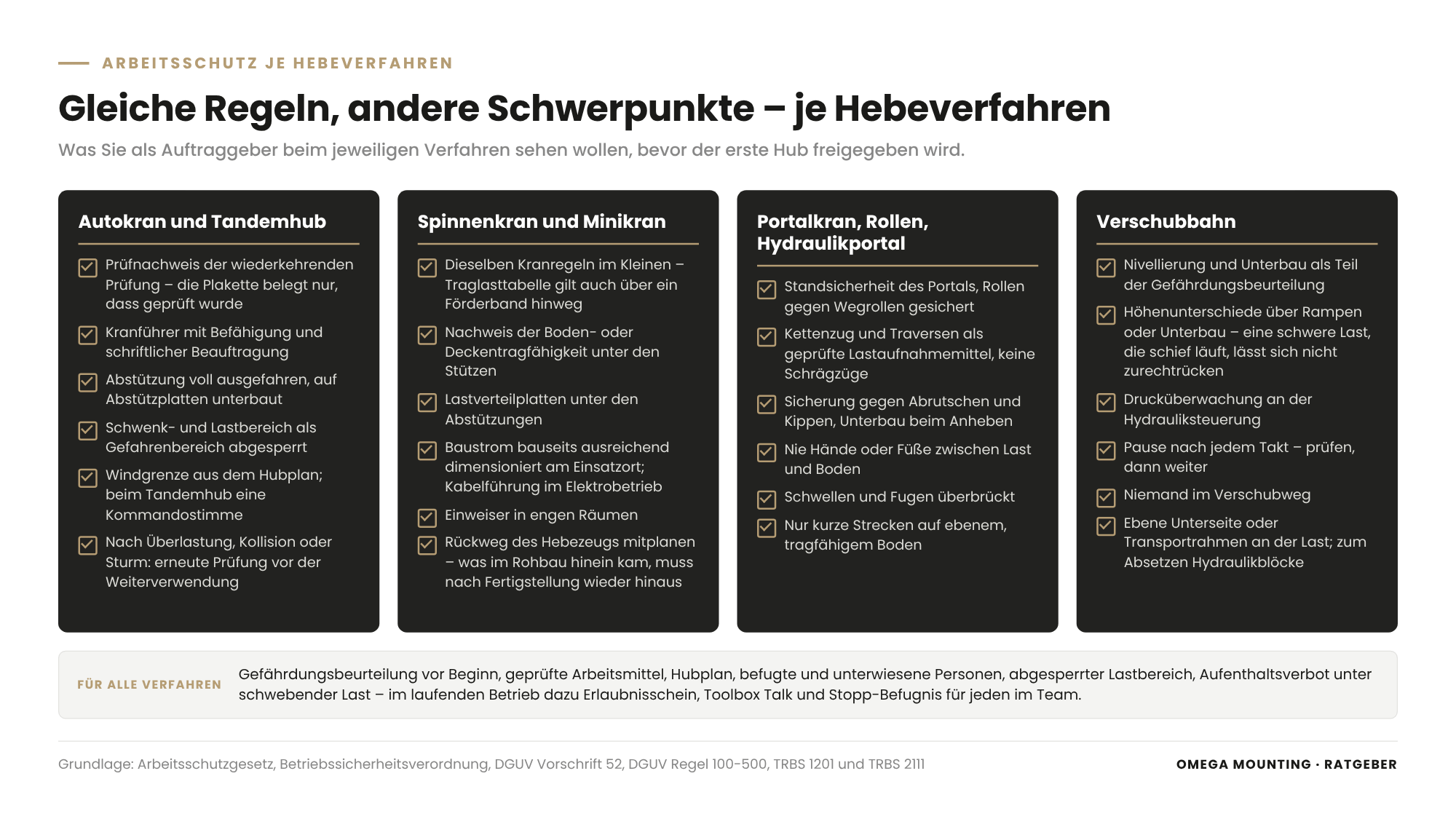
The same basic rules from the ArbSchG (German Occupational Safety Act), the BetrSichV (Industrial Safety Ordinance), DGUV Regulation 52 and DGUV Rule 100-500 apply to all lifting methods. That means: risk assessment before the start, inspected work equipment, lift plan, authorised and briefed persons, cordoned-off load zone, no standing under suspended loads. Only the priorities shift with the machine.
- Mobile crane and tandem lift: Record of the periodic inspection under Section 14 of the BetrSichV, crane operator with proof of competence and written appointment, outriggers fully extended and supported on outrigger pads. Slewing and load zone cordoned off as a danger zone, wind limit, one command voice for the tandem lift. TRBS 1201 (inspections of work equipment) adds two points you as the client can use directly. After an exceptional event – overload, collision, storm – a crane must be re-inspected before further use. And an inspection sticker only proves that an inspection took place, not that the machine is free of defects. So ask to see the inspection record, not just the sticker.
- Spider crane and mini crane: the same crane rules on a small scale; in addition, verification of the floor or slab load-bearing capacity under the outriggers, cable routing in electric mode, banksmen in confined rooms.
- Gantry crane and lifting frame: stability of the gantry, chain hoist and beams as inspected load-handling attachments, no angled pulls, castors secured against rolling away.
- Machine skates and hydraulic gantries: securing against slipping and tipping, packing when lifting, never hands or feet between load and floor, thresholds and joints bridged.
- Skidding system: levelling and packing as part of the risk assessment, pressure monitoring on the hydraulic control, pause after every stroke, nobody in the skidding path.
- For all methods during ongoing operations: the operator's permit to work, short briefing (toolbox talk) before the first lift, authority to stop for everyone in the team in case of danger.
Slinging technique – round sling, chain sling, spreader beam, shackle, edge protection, sling angle – is equally important for all lifting methods. Read more in the guide Slinging heavy loads. Who prepares the lift plan and clears every lift is described in the guide Appointed person for lifting operations.
How we do it in the Rhine-Main region
In the Rhine-Main region, scarce space and finished buildings decide the lifting method. That is why every choice of method with us begins with a site survey and not with the question of which machine happens to be free.
Data centers in Frankfurt, Offenbach and Raunheim stand in dense development. Crane set-up areas lie over shafts, access routes are residential streets, buildings are often already weathertight when the heavy equipment arrives. Here skidding system, spider crane and skates are used more often than on greenfield sites. In industrial plants in Offenbach, Dietzenbach or Hanau, narrow plant aisles and short maintenance windows call more for gantry crane and auxiliary structures.
How we do it in practice
Spider crane plus tower crane: two centimetres short
With the retrieval of a spider crane from the basement of a data center in Raunheim the machine itself was the load. The crane had installed CRAH units on their plinths during the shell construction. Then the building was completed around it, and in the retrieval shaft stood a construction hoist that could not be dismantled. Upright, two centimetres were missing.
Four fitters drove the crane in electric mode through the narrow basement passages and packed the platform of the construction hoist with timber baulks. With a shortenable chain sling they deliberately slung the crane at an angle – that way it needed less space. The site's tower crane pulled it slowly through the shaft, banksmen maintained the line of sight. One day, no damage. The lesson for designers: the way back for the lifting equipment belongs in the planning.
Skidding system: 52 tonnes through the door
During the moving in of two transformers with the skidding system into a data center in Frankfurt a crane lift into the building was out of the question. The roof was already on. The mobile crane set each of the 52-tonne transformers directly from the low-loader onto the track, which had been laid from the building entrance into the transformer cell. Then the push cylinder worked in strokes: grip, push, reset, grip again – a good hour per unit.
The most difficult part of the day was packing and levelling the track over differences in level and over the transformer pit. At the destination, hydraulic blocks lifted the load, the track elements were removed, and the transformer came to rest on stacked timber baulks in the pit. Two mechanics and one lifting supervisor, one working day, both units in their cells on time.
Gantry crane and rail: fan bearing during the weekend shutdown
During the replacement of a fan bearing in a paint shop in the Offenbach area the motor-fan unit with its fan wheel of around 1.40 metres sat so deep inside the plant that no crane and no forklift could reach it. On the preparation day, our fitters welded a rail system from square steel tubing. On it, the unit was moved out of the plant as if on a railway, and the mobile gantry crane lifted it off the mounting stand.
Bearing replaced, motor overhauled, fan wheel refitted, unit moved back, sealed, connected and tested by our electricians. All during the weekend shutdown; on Monday production was running. Two working days, one of them at the weekend.
You will find more examples in the reports on the robot dismantling with the mini crane in a bakery near Fulda and on the moving in of standby generators in the data center.
Do you have a load in front of a door, a shaft or a pit, and the quotations name three different machines? Then get in touch with us. A site survey usually settles within an hour which lifting method fits and which quotations are comparable.
What this means for your role
For buyers: In the scope of works, do not tender the machine but the task – load, moving-in route, target position, state of construction, time window. Have the bidder justify the lifting concept in the bidder questions or in the bidder meeting. Crane provision, load spreading plates and auxiliary structures belong as separate items or in the interface list, otherwise they come as a change order.
For designers: Define installation openings, moving-in routes, floor loads for the transport state and crane set-up areas with radius, hook height and ground bearing pressure so that at least two methods remain possible. That is, a crane route from outside and a floor route through the building. Plan the way back for the lifting equipment, reserve areas and replaceability at the same time and coordinate the installation sequence with the construction sequence. Read more in the guide Planning moving in: openings, floor loads, crane set-up areas.
For project managers and site managers: Ask about the method and its assumptions for every quotation. Which crane set-up area, which radius, what capacity remains, which floor is loaded how, what has to be provided by the client? Two quotations with different methods are only comparable once these assumptions are on the table. As site manager, you plan the method into the construction schedule – crane set-up area and closure for the mobile crane, a clear work area for skates or skidding track, site power for the spider crane. You issue the lift clearance only when the work area has been cleared.
For maintenance managers: When replacing components in an existing plant, the lifting method decides how long your plant stands still. A gantry crane with rail works during the weekend shutdown where a crane cannot even get close. Check with the installation contractor in advance which methods fit into your plant aisles, what your floor bears under outriggers and skates and whether combustion engines are permitted in your rooms.
For manufacturers and system builders looking for an installation partner: Your equipment determines, through weight, centre of gravity, lifting points and permissible transport orientation, which methods are an option at all. Include this information in full in your installation documents at the works/site interface. Ask the installation partner which methods they run themselves and which they buy in, and whether they can manufacture auxiliary structures such as spreader beams or rails for your assemblies.
Lifting method decision tree: on request
The lifting method decision tree puts this guide on one page. Four questions lead to the method recommendation: can a crane reach the installation position from outside? Is the building enclosed on the installation day? Is the load over around 50 tonnes? Do doors, floors and slabs allow a mini crane? At the end stands mobile crane, tandem lift, spider crane, gantry crane, machine skates, skidding system or a combination.
On the back is what information we need for the decision: on the load, the building and the area. The decision tree helps designers in the design phase and project managers when comparing quotations. Request the lifting method decision tree via our Contact form – keyword “Lifting method decision tree”.
Why Omega Mounting?
We are based in Rodgau near Frankfurt and are available at short notice for the site survey in the Rhine-Main region. We have run the methods described ourselves in the linked projects in Raunheim, Frankfurt, Offenbach and near Fulda. Our own workshop in Rodgau manufactures rails, packing and spreader beams when the standard machine does not fit. We provide the appointed person for lifting operations, prepare the lift plan and can be reached via our 24-hour hotline at weekends and at night too. For you this means: one point of contact for choice of method, lifting technology and installation, short distances from Rodgau to Frankfurt, Offenbach, Hanau or Darmstadt. And a contractor that adapts the method to your building instead of the other way round – get in touch with us, before a quotation fixes the equipment.
Conclusion
Spider crane or mobile crane for moving in – this search question is answered not by the machine but by the building: weight, space, floor, route and state of construction. The mobile crane remains the standard method as long as area and radius suffice outside. Inside, spider crane, gantry crane, skates and skidding track take over, often in combination. Anyone who decides this early gets comparable quotations and a calm installation day. If you are facing this decision: Send us a floor plan, the weight and your preferred date – we will come back to you with an honest assessment of which method will work for you.
Planning maintenance, moving in or installation in the Rhine-Main region?
Tell us briefly what it is about – we will come back to you with an honest assessment.
100% free and without obligation
You may also be interested in these guides

About the author
Tobias Schott
Managing director of Omega Mounting GmbH, Rodgau · more than 20 years of hands-on experience in installation and maintenance
A trained mechatronics technician, at home in maintenance, servicing and industrial installation since 2004 – first at his father's side, since 2012 with Omega Mounting: from the overhead conveyor in Frankfurt to the crane system in a new-build hall. Plans and leads lifting operations as appointed person in data centers and on industrial sites in the Rhine-Main region, is an instructor and examiner for cranes, mobile elevating work platforms and telehandlers, and a safety officer. On jobs abroad he is known as the “German Troubleshooter” – the one you call when things get stuck on site. He learned what quality means not from a manual but from his father: Made in Germany as a standard for his own work, not as a label. That is why it comes first at Omega Mounting – before speed and before price. He writes these guides from that practice: what works on our sites is in them – what only exists in the standard is not.
Frequently asked questions
A spider crane is better for moving in when the load has to be lifted inside the building and no mobile crane can reach the position. Reasons are a missing crane set-up area, a closed facade or too large a radius. It fits through door openings, turns on the spot and works electrically in enclosed rooms. Its limits are capacity at radius, outrigger area on floor or slab and the clear height.
That depends on the radius, not on the type designation. A mobile crane of the 220-tonne class with 71 tonnes of counterweight and a 30-metre boom still had about 28 tonnes of available capacity at a radius of around 20 metres. What matters is the value from the load chart for your crane set-up area and your installation position – it is stated in the lift plan.
A skidding system is a hydraulic track system that moves heavy loads horizontally without lifting them: the load rests on slide plates, a push cylinder pushes it forward stroke by stroke. You need one when a very heavy load – for example a transformer of 52 tonnes – has to go into an already enclosed building that no crane can reach into any more. The decisive work is levelling the track.
For medium loads on level, load-bearing floors, yes: machine skates are quicker to set up and more flexible. With very heavy loads, the point loads under the skates become critical and control over the movement decreases. Then the skidding system with packed rail elements and stroke-by-stroke feed that can be stopped at any time is the safer method.
A mobile crane transfers outrigger loads at points via outrigger pads onto four areas outside; shafts and ducts beneath are critical. A spider crane loads raised floor, screed or slab at points under its outriggers. Skates generate high point loads on small areas, the skidding system distributes the load in a line over packed rail elements. Which imposed and point loads are permissible is clarified by the structural engineer; the installation contractor supplies the load assumptions.
In Frankfurt, Offenbach and Raunheim, heavy equipment and dense development meet. Crane set-up areas are scarce, buildings are often already enclosed when transformers and generators arrive, combustion engines are prohibited inside. The question “spider crane or mobile crane for moving in” arises here on almost every project. Besides the mobile crane, it is above all skidding systems, electric spider cranes, machine skates and lifting frames that are used – frequently combined.
Yes. A mini crane brings a robot out of a bakery, a gantry crane with rail replaces a fan bearing in a paint shop, skates move a press in mechanical engineering. The criteria – weight, space, floor, route, state of construction – are the same in every industry. Hygiene requirements, production windows or access rules change the framework conditions, not the logic of choosing the method.
Risk assessment, inspected work equipment with periodic inspection, the crane regulation and the rules for load-handling attachments apply to all methods. Added to this are the lift plan, a cordoned-off load zone with no standing under suspended loads, briefed persons and an appointed person with the authority to stop who clears every lift. The machine changes the priorities of the risk assessment, not the rules.
Send us via the Contact form three details: the weight and dimensions of the load, a floor plan or photos of the moving-in route and target position, and the desired period. We check which methods are an option and come for the site survey. You then receive a written assessment with method, crane set-up area or floor route and the prerequisites to be provided by the client. Your contact is Tobias Schott.
 English
 German