
- Guide – Lift & Shift
Lift and Shift Installation: What the Term Means and What We Deliver
By Tobias Schott · Reading time approx. 24 minutes · Last updated: October 2026
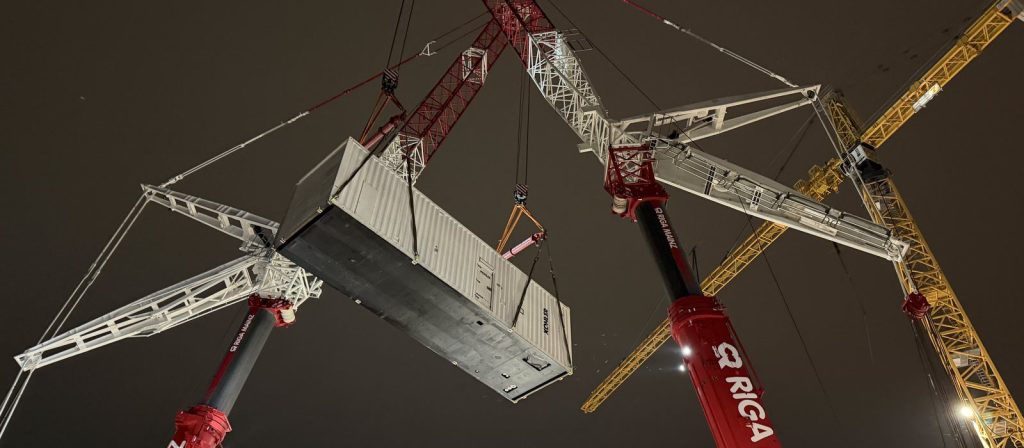
Lift and shift installation means: a heavy, often sensitive piece of equipment is lifted in a planned way, moved under control and set down to the millimetre in its final position – and the responsibility for every single lift rests with a named person.
You are planning the moving in of a standby power system, a transformer, a cooling unit or a whole row of distribution cabinets. The scope of works contains an item “lift and shift installation”, the construction schedule contains a date, and somewhere in between lies the question: who actually does what – the haulier, the crane contractor, the manufacturer or the installation contractor?
It is precisely at this interface that the expensive misunderstandings arise. The load is on the low-loader in front of the building, but nobody has measured the clear door opening. The mobile crane has been ordered, but the crane set-up area sits over a basement shaft. The unit is inside, but nobody has aligned it, and the follow-on electrical trade is waiting.
This guide explains what lift and shift installation means at its core, how the term differs from heavy haulage, installation and rigging, which roles are involved in a lift, how a project runs and which documents you as the client may expect. The examples come from our own projects in the Rhine-Main region – data centers in Frankfurt and Raunheim, industrial plants in Offenbach and Rodgau.
Key points at a glance
- Lift & shift describes the planned lifting, moving and setting down of heavy equipment from the delivery vehicle to its final installation position inside the building.
- The term is distinct from heavy haulage (road) and from installation (connection, commissioning) – lift & shift is the stage in between.
- Every lift is prepared in a lift plan that defines weight, centre of gravity, lifting points, lifting accessories, lifting equipment, radius and the load zone to be cordoned off.
- A named appointed person for lifting operations (lifting supervisor) issues the lift clearance and holds the authority to stop.
- Typical lifting equipment includes mobile cranes, tandem lifts with two cranes, spider cranes, hydraulic gantries, machine skates and skidding systems – the choice depends on weight, space, ground bearing pressure and the state of construction.
- Inside buildings, combustion engines are often prohibited; lifting equipment must then be electrically powered.
- The legal basis includes the ArbSchG (German Occupational Safety Act), the BetrSichV (Industrial Safety Ordinance) and the accident prevention regulation for cranes.
What is lift & shift?
Lift & shift is the planned lifting (lift), moving (shift) and precise setting down of heavy or bulky equipment from the delivery point to its final installation position – including lift planning, slinging technique and the clearance of every lift.
The term comes from English-language construction site vocabulary and has become established above all in data center construction, because many international general contractors and operators work there. In German technical language it corresponds most closely to “Einbringung” (moving in) or “Anlagenverbringung” (equipment transfer). The meaning is the same: the unit arrives packed, and at the end it stands aligned, secured and ready for handover on its foundation.
The decisive word is “planned”. A lift and shift installation is not a spontaneous lift with the nearest forklift: before any movement, weight and centre of gravity are established, lifting equipment and lifting accessories are selected and inspected, the moving-in route has been measured, and one person carries the responsibility.
What is included – and what is not?
Lift & shift includes unloading from the low-loader, the lift by crane or hydraulic gantry, horizontal movement inside the building on machine skates or a skidding system, setting down on the foundation, vibration dampers or raised floor, levelling and aligning in line and height, and anchoring with heavy-duty or bonded anchors. Added to this are the lift plan, risk assessment and installation report.
Not included, as a rule, are road transport (heavy haulage with permits and escort vehicles), the electrical or hydraulic connection (specialist trades) and commissioning (usually the manufacturer). Anyone who fails to draw this line cleanly in the scope of works and the interface list will experience it as a change order.
How does lift & shift differ from heavy haulage, installation and rigging?
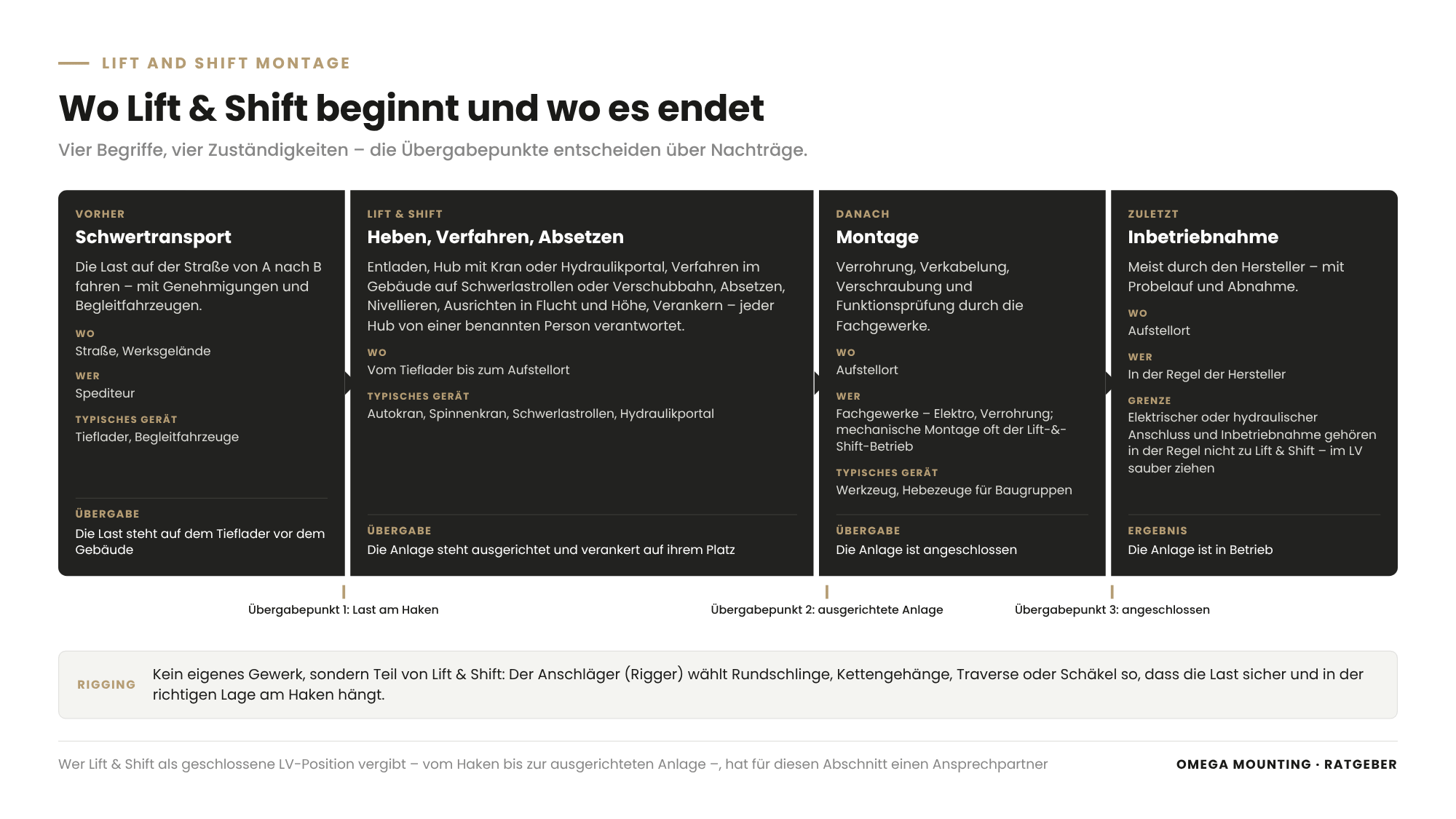
Lift & shift is the link between heavy haulage on the road and the actual installation inside the building – it begins at the low-loader and ends when the unit stands aligned in its place.
The four terms are often mixed up in everyday use. For your tender and for the question of liability, it pays to keep them apart.
| Term | Where | Task | Typical equipment |
|---|---|---|---|
| Heavy haulage | Road, factory premises | Drive the load from A to B, permits, escort | Low-loader, escort vehicles |
| Lift & Shift | Low-loader to installation site | Lift, move, set down, align, take responsibility for the lift | Mobile crane, spider crane, machine skates, hydraulic gantry |
| Installation | Installation site | Piping, cabling, bolting, functional testing | Tools, lifting gear for sub-assemblies |
| Rigging | Wherever lifting takes place | Slinging the load, selecting and inspecting the lifting accessories | Round sling, chain sling, spreader beam, shackle |
Rigging is not a separate trade but part of lift & shift: the rigger or slinger selects round sling, chain or spreader beam so that the load hangs safely and in the correct attitude on the hook. In our projects we take on lift & shift including rigging – and frequently the subsequent mechanical installation as well, such as radiators, exhaust runs or tanks on a standby power system.
Why the distinction is worth money to you
Every handover between two companies is a risk. If the load is on the low-loader and nobody feels responsible for unloading it, a heavy haulage vehicle waits with the clock running. If the unit is in the room but “only roughly” positioned, another crew has to come to align it. Anyone who awards lift & shift as a closed scope item – from the hook to the aligned unit – has one point of contact for this stage.
Which loads and equipment are moved by lift & shift?
Lift & shift is used to move all equipment that is too heavy, too large or too sensitive for forklifts and pallet trucks – from distribution cabinets in the tonne range to standby power systems and transformers of more than 50 tonnes. Moving in heavy equipment of this class is heavy-lift installation in the true sense: every load has its own geometry, its own centre of gravity and its own route into the building.
The typical orders of magnitude can be read clearly from our published projects:
- Distribution cabinets (PDC, power distribution cabinet): switchgear cabinets weighing tonnes, set up in rows with exact alignment – in a data center near Frankfurt there were 160 units in eight data halls.
- Standby power systems (standby generators): single units up to about 20 tonnes, containerised solutions up to 54 tonnes, lifted as high as the second floor.
- Diesel tanks: storage tanks with a volume of 100 cubic metres, each around 16 tonnes empty, over 16 metres long.
- Load banks: test resistors used to test the emergency power supply under load, often delivered as a container module.
- Transformers: units with a single weight of 52 tonnes that have to go into an already enclosed building.
- Cooling technology (CRAH units): precision air-conditioning units set onto prepared plinths in the data hall.
- Machines and robots: industrial robots, automated storage systems, presses or test rigs during a machinery relocation.
What they all have in common: there is no spare machine. A damaged transformer not only shifts the date, it often shifts the commissioning of an entire section of the building.
Which roles are there in lift & shift?
In every lift and shift installation there is an appointed person for lifting operations, a crane operator or equipment operator, slingers and banksmen, and the fitters who guide and align the load.
Because English is frequently spoken in data center construction, these roles often carry English names – behind them stand German legal duties.
Appointed person for lifting operations (lifting supervisor, appointed person)
This person plans the lift, prepares or checks the lift plan, briefs the team, clears every lift and may stop it at any time. The term “appointed person” comes from the British standard BS 7121; in Germany the responsibility is transferred by written delegation of duties under the ArbSchG (German Occupational Safety Act). In a tandem lift with two cranes, it is precisely this one person who gives the commands. Read more in the guide Appointed person for lifting operations.
Crane operators and equipment operators
The crane operator operates the mobile crane, tower crane or spider crane and is responsible for the load moment, outrigger support and wind limit of their machine. They need proof of competence and a written appointment by their employer (DGUV Regulation 52). The German technical rule TRBS 1116 (qualification, briefing, appointment) makes two things clear that you as the client can make use of. The appointment always applies only to the specific work equipment named – a forklift licence does not qualify anyone to operate a spider crane. And in the case of external or foreign certificates, the employer must, if in doubt, verify theoretically and practically before appointing. So do not just ask “Does he have a crane licence?” but “Which machine is he appointed for?”.
Slinger (rigger, slinger)
The slinger – in the international environment the rigger or slinger – selects the lifting accessories, checks lifting points and edge protection, attaches and detaches the load. They must be able to assess the working load limit of round sling, webbing sling or chain sling as a function of the sling angle. Read more in the guide Slinging heavy loads.
Banksman (signaller)
The banksman maintains the line of sight between load and crane operator when the operator cannot see the load – in a shaft, behind a retaining wall or in a basement corridor. They relay the commands using defined hand signals or by radio. In narrow passages, several banksmen often work at the same time. The German technical rule TRBS 2111 Part 1 (mobile work equipment) requires a safety distance with an exclusion zone for the slewing range of a mobile lifting appliance. As a means of enforcing this exclusion, it names the posting of a sentry – a safety sentry with no secondary tasks. For you this means: a banksman who is also carrying timber baulks is not a banksman. We plan this role as a separate person and show it in the quotation.
Fitters and mechanics
They guide the load on taglines, pack underneath with timber baulks and planks, set machine skates, level the unit, align it in line and plumb and anchor it. With us, these are industrial mechanics, mechatronics technicians and electricians working in mixed crews.
How does a lift and shift installation proceed?
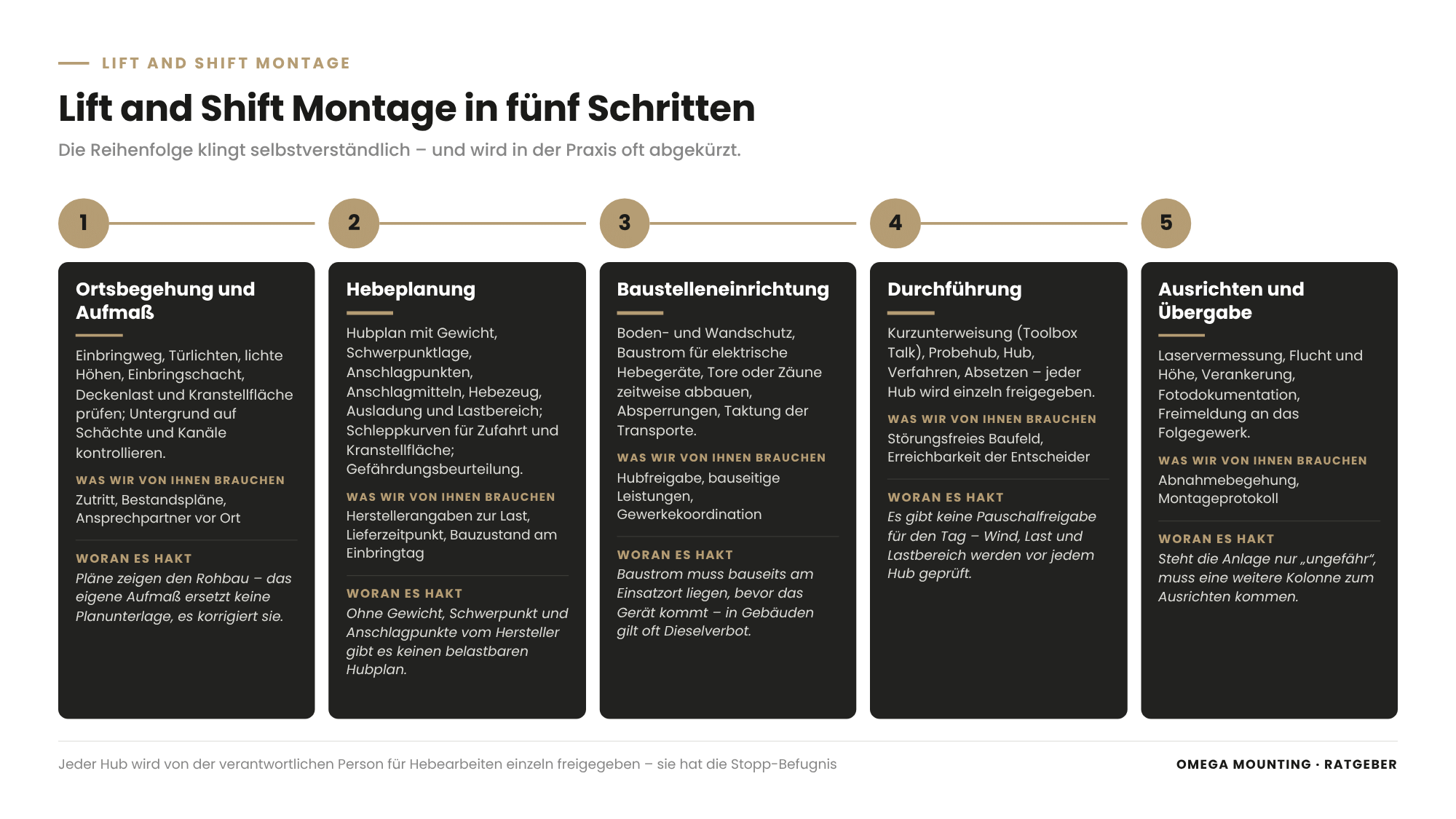
A lift and shift installation proceeds in five steps: site visit and site survey, lift planning with lift plan, site set-up, execution of the lifts with lift clearance and finally alignment, anchoring and handover.
| Phase | What happens | What we need from you |
|---|---|---|
| 1. Site visit and site survey | Check moving-in route, door openings, clear heights, installation shaft, floor load, crane set-up area; check the ground for shafts and ducts | Access, as-built drawings, contact person on site |
| 2. Lift planning | Lift plan with weight, centre of gravity, lifting points, lifting accessories, lifting equipment, radius, load zone; swept paths for access and crane set-up area; risk assessment | Manufacturer data on the load, delivery time, state of construction on the installation day |
| 3. Site set-up | Floor and wall protection, site power for electric lifting equipment, temporary removal of gates or fences, barriers, scheduling of the transports | Lift clearance, works provided by the client, coordination of trades |
| 4. Execution | Short briefing (toolbox talk), trial lift, lift, move, set down – every lift cleared individually | Undisturbed work area, availability of decision-makers |
| 5. Alignment and handover | Laser survey, line and height, anchoring, photo documentation, completion notice to the follow-on trade | Acceptance walk-through, installation report |
In practice the sequence is often cut short. In particular, your own site survey cannot be replaced by a drawing: when retrieving a spider crane from a data center basement in Raunheim, exactly two centimetres were missing compared with the shell-construction state, because the building had been completed around the machine. You only see that on site.
The lift plan as the centrepiece
The lift plan is the document that describes a lift before it takes place: load weight and centre of gravity, lifting points and lifting accessories, lifting equipment with radius and capacity according to the load chart, crane set-up area with outrigger pads and ground bearing pressure, load zone and barriers, wind limit, people involved and communication route. For a tandem lift it additionally contains the load distribution between the two cranes.
For the crane position, the BG BAU/BAuA module “Site set-up – large equipment” provides the minimum distances that we adopt in the lift plan: from a sloped excavation, a crane with a total weight of up to 12 tonnes keeps a distance of at least one metre, between 12 and 40 tonnes at least two metres (DIN 4124); from overhead lines of unknown voltage at least five metres; the outrigger force spreads through the ground at about 45 degrees, which is why outrigger pads or timber baulks belong under every support. For you this means: if the only possible crane set-up area is next to an excavation or under a power line, the feasibility of the lift is decided by these distances – and not only when the crane is standing in the yard.
An example of the orders of magnitude: when moving load banks and generators into a Frankfurt data center, a mobile crane of the 220-tonne class stood with 71 tonnes of counterweight and 30 metres of boom length. At a radius of around 20 metres, about 28 tonnes of capacity remained – this figure determines what may go on the hook, not the crane's type designation.
Which lifting and transport equipment is used?
In lift & shift, depending on weight, space, ground bearing pressure, hook height and state of construction, mobile cranes, tandem lifts, tower cranes, spider cranes, hydraulic gantries, compact lifting devices, machine skates and skidding systems are used.
- Mobile crane: the standard machine when there is space outside for the set-up area and radius. For five diesel tanks in Raunheim, a mobile crane with a 52-metre main boom and a radius of up to 44 metres worked over a retaining wall.
- Tandem lift: two cranes lift a load together, for example a 54-tonne containerised unit. Both crane operators listen to one voice.
- Tower crane: already present on construction sites and ideal for lifting loads vertically through shafts.
- Spider crane (mini crane): compact crawler crane that fits through doors, turns on the spot and may work in enclosed rooms with hybrid or electric drive. For example, for installing CRAH units on their plinths.
- Hydraulic gantry and gantry crane: a frame above the load that lifts it with hydraulic cylinders or a chain hoist – for distribution cabinets in rows or motors in narrow plant aisles.
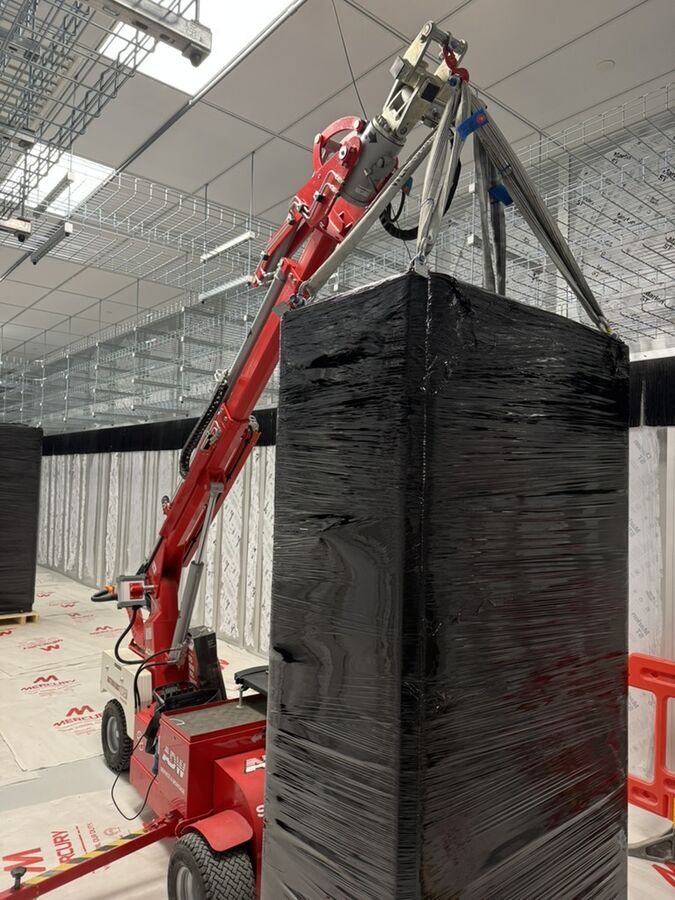
- Compact lifting device: an electric mobile machine with a lifting arm that moves cabinets and panels indoors without vibration.
- Machine skates: heavy-duty skates under the load for horizontal routes in existing buildings where no crane can reach any more.
- Skidding system: a hydraulic track system of slide plates and push cylinders that pushes loads of 50 tonnes and more horizontally into the enclosed building without lifting them.
Which combination fits is a decision based on geometry and weight – not habit. How we make it is described in the guide Skidding system, spider crane, gantry crane or mobile crane.
Electric instead of diesel inside the building
In data centers and many industrial halls, combustion engines may not run in enclosed rooms – because of exhaust fumes, fire risk and sensitive technology. Spider cranes then run in electric mode, forklifts and lifting devices are electric. For the site set-up this means: site power as a three-phase connection must be provided by the client at the point of use before the machine arrives.
The lift in the site set-up plan
On a construction site with a general contractor, the crane position is not a free parameter but part of the site set-up plan. The BAuA practice brochure on site set-up provides that crane positions and their changes are drawn into this plan, that a sectional view is available for cranes close to neighbouring buildings, and that the client approves the plan before execution. For you this means: register the lift & shift operation early with the site manager and the health and safety coordinator so that the crane set-up area, access and exclusion zone are included in the site set-up plan – a lift that is not shown there gets no clearance on the installation day.
Which documents belong to lift & shift?
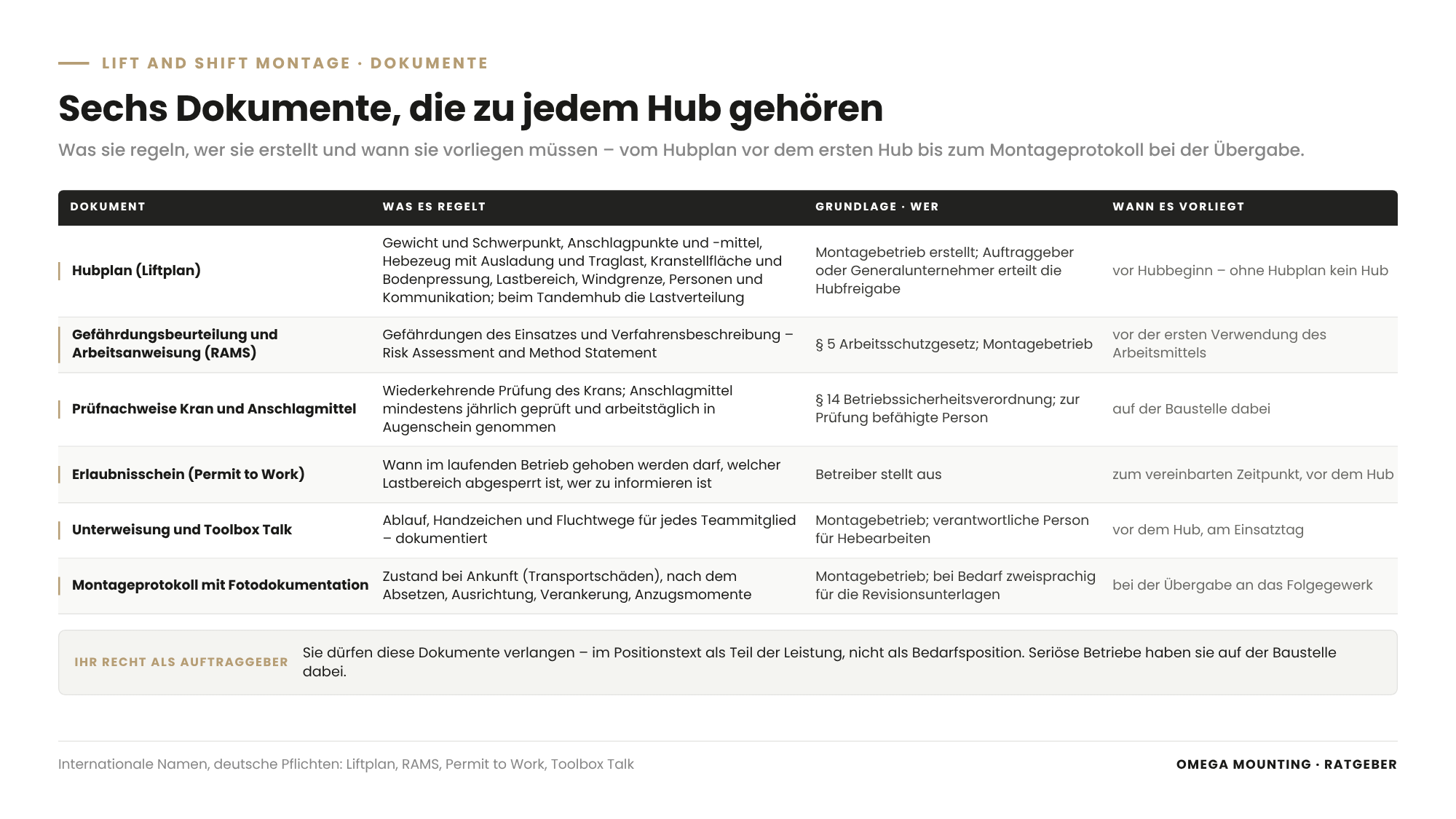
A lift and shift installation includes the lift plan, the risk assessment with work instruction (called RAMS in the international environment), the inspection records for crane and lifting accessories, the permit to work, the briefing records and the installation report with photo documentation of the handover.
- Lift plan: describes every lift, see above. Receives the lift clearance from the client or general contractor before the lift begins.
- Risk assessment and work instruction: Mandatory under the ArbSchG (German Occupational Safety Act). In the English-speaking environment the document is called RAMS – Risk Assessment and Method Statement. In content it corresponds to a risk assessment plus a method description. Read more in the guide RAMS and risk assessment for installation work.
- Inspection records: Cranes are subject to periodic inspection under the BetrSichV (Industrial Safety Ordinance); lifting accessories are inspected at least annually by a competent person and visually checked every working day. Both records belong on site.
- Permit to work: regulates that lifting may take place during ongoing operations at the agreed time, which load zone is cordoned off and who has to be informed.
- Briefing and toolbox talk: every team member is briefed before the lift on sequence, hand signals and escape routes – documented.
- Installation report with photo documentation: condition of the unit on arrival (transport damage), after setting down, alignment, anchoring and tightening torques. Bilingual if required for the as-built records.
As the client, you may demand these documents. If the lift plan is missing, the basis for the lift is missing.
Which legal bases apply to lifting operations?
Lifting operations are governed by the ArbSchG (German Occupational Safety Act – risk assessment, delegation of duties), the BetrSichV (Industrial Safety Ordinance – provision and inspection of work equipment), DGUV Regulation 52 for cranes and DGUV Rule 100-500 for the operation of load-handling attachments.
Some principles from these shape every lift:
- No standing under suspended loads: nobody enters the load zone while the load is on the hook.
- The permissible working load limit of crane and lifting accessories is not exceeded; the sling angle reduces the working load limit and is taken into account in the lift plan.
- Sharp edges require edge protection or chain slings instead of round slings.
- Slewing range and load zone are cordoned off as a danger zone, the crane's outriggers are fully extended and supported on outrigger pads over load-bearing ground.
- Crane operator, slingers and banksmen must be able to communicate – by line of sight, hand signals in accordance with workplace rule ASR A1.3, or radio. If a vehicle has to reverse within the work area, the same technical rule considers a camera-monitor system suitable, the mirror alone is not – or a banksman with line of sight.
On construction sites with several companies, the BaustellV (Construction Site Ordinance) with the health and safety plan and the health and safety coordinator comes into play, separating the lifting operations in time and space from other trades. In case of doubt, the stricter rule applies.
In which industries is lift & shift needed?
Lift & shift is needed wherever heavy technology has to go into existing or almost finished buildings: in data centers, in energy and emergency power supply, in logistics centres, in food and automotive plants, and in mechanical and plant engineering.
Data centers are the largest application around Frankfurt. Standby power systems, transformers, UPS systems (uninterruptible power supply), CRAH units and PDCs arrive in series, often in a tight time window before commissioning. Read more on our page on data center construction and lift & shift in the data center.
Energy and standby power: generators, tanks, switchgear for hospitals, industry and infrastructure – also outside data centers.
Logistics: conveyor systems, sorters, ramps and racking technology, frequently during ongoing operations at airports and in distribution centres.
Food and automotive: robots, ovens, paint and process plants where hygiene and production windows set the pace.
Mechanical engineering and workshop equipment: automated storage systems, test rigs, presses – the classic machinery relocation with dismantling, transport and reassembly.
How we do it in the Rhine-Main region
In the Rhine-Main region, lift & shift almost always means: little space, many neighbours and a time window that cannot be moved.
Data centers in Frankfurt, Offenbach, Hanau or Raunheim are rarely on greenfield sites. In Raunheim, the access to a data center ran through an ordinary residential street; the crane set-up area was possible in only a few places, and the ground was criss-crossed by shafts and ducts that cannot take ground bearing pressure from outrigger pads. Gate systems were temporarily removed for the heavy haulage, and the crane set-up area itself became the tank area after the job.
In Frankfurt, the manoeuvring areas for low-loaders and crane are often so tight that the transports have to arrive on a schedule – each one exactly when the hook is free. In Offenbach and Rodgau, by contrast, we often work in industrial plants where the machine has to be moved inside without a crane ever seeing the building.
Our advantage is proximity: from Rodgau we are quickly on site in Frankfurt, Offenbach, Darmstadt, Hanau and Raunheim – for the site visit, for the installation day and for follow-up work.
How we do it in practice
160 distribution cabinets in eight data halls: lift and shift installation as a series
During the installation of 160 PDCs in a data center in the Rhine-Main region the point was not a spectacular lift but repeatability. Eight data halls with 20 cabinets each in two rows, spread over four levels from the basement to the second floor. The heavy-duty lift was the bottleneck for the entire material flow.
Six lift & shift mechanics surveyed every hall by laser and marked the set-down positions. The pallets were lifted with a gantry made of aluminium beams and a chain hoist, the cabinets were moved with a compact lifting device over floor protection of protective panels and fleece and set into line to the millimetre. Over several weeks there was no rework and not a scratch on the floor or existing equipment – then the electrical trade took over.
Five diesel tanks over the retaining wall into the pit
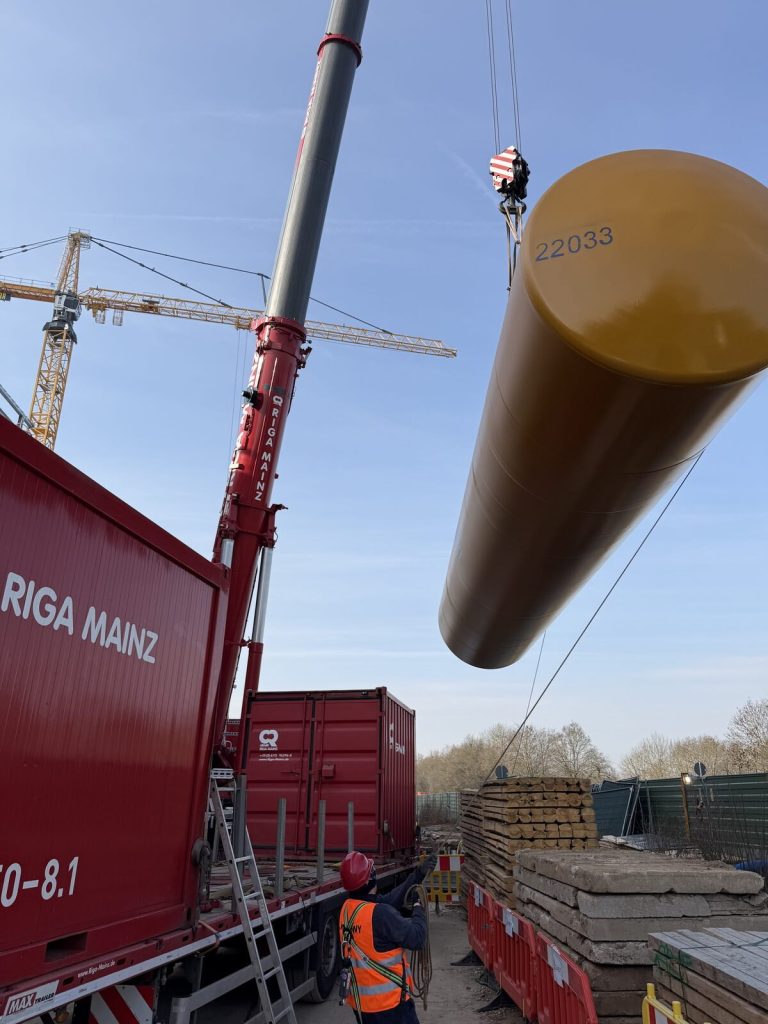
During the placement of five 100-cubic-metre diesel tanks into a data center in Raunheim you can see what lift planning means. Each tank weighed around 16 tonnes empty, was 16.16 metres long and 2.90 metres in diameter. The crane stood on the road with a 52-metre main boom and swung the tanks over a retaining wall into the pit at a radius of up to 44 metres.
Before the first lift, our appointed person for lifting operations checked the four welded-on lifting points on the tank crown by visual inspection of the weld seams and recalculated the sling geometry – leg forces, sling angles, centre of gravity. Slinging was done with round slings and shackles. Three working days from 9 to 11 March 2026, several weeks of lead time for swept paths, crane position and lift plan.
A spider crane that no longer fitted out of the basement
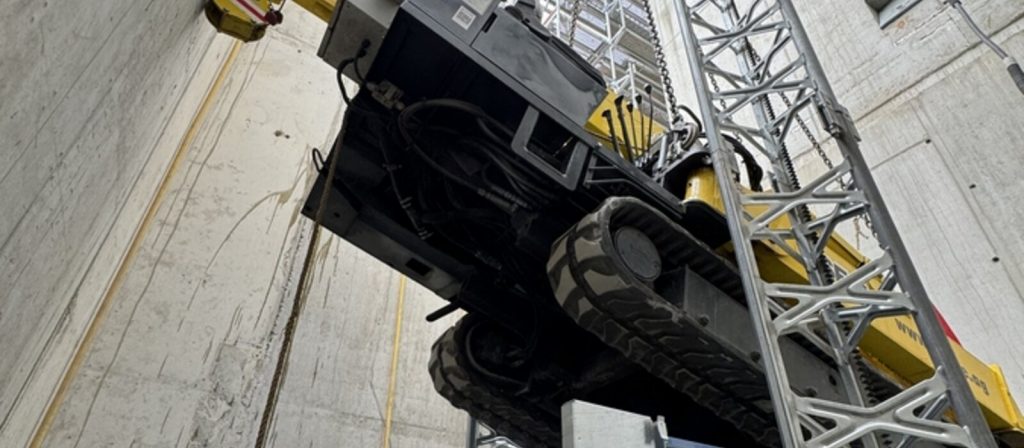
With the retrieval of a spider crane from the basement of a data center in Raunheim the load was our own lifting equipment. The crane had installed CRAH units during the shell construction; then the building had been completed around it, and in the shaft stood a construction hoist that could not be dismantled. Upright, two centimetres were missing.
Four fitters drove the crane through the basement in electric mode, packed the platform of the construction hoist with timber baulks and deliberately slung the crane at an angle with a shortenable chain sling – hanging at an angle, it needed less space. A tower crane pulled it slowly through the shaft, banksmen maintained the line of sight to the crane operator. One day, no damage to building, construction hoist or machine.
You will find more projects of this kind in our overview of lift & shift of heavy equipment and in the report on moving in load banks and generators with a 220-tonne mobile crane in Frankfurt. Are you facing a comparable moving in – a series, a heavy single lift or a load that no longer really fits through the door? Then get in touch with us – a site visit usually settles within an hour which route and which equipment are right.
What this means for your role
For buyers: Tender lift & shift as a separate scope item from the hook to the aligned unit and fix the handover points to heavy haulage and the specialist trades in the interface list – every open interface is a future change order. Require lift plan, risk assessment and inspection records in the item text as part of the service, not as an optional item, and assess in the suitability criteria whether the bidder provides the appointed person for lifting operations themselves.
For designers: Define the moving-in route, installation opening, door openings, clear heights, floor load and crane set-up area as design parameters from the outset – and also for the replaceability of the equipment years later. A spider crane that no longer fits out of the basement is a matter of installation planning in the design phase, not an installation issue on the installation day.
For project managers and site managers: Plan the installation day backwards in the construction schedule – a clear work area, site power, barriers, scheduling of the heavy haulage and lift clearance must all be in place before the lift. A site visit with the executing contractor before the crane is ordered saves surprises on the day; in the regular progress meeting the lift belongs on the agenda as a milestone. Read more in the guide The installation day: sequence, lead times, interfaces.
For maintenance managers: For you, lift & shift is not a new-build topic but the route by which a major component leaves the building during repair work in an existing plant and the new one comes in. Record the weights, centre of gravity and lifting points of your equipment in the plant file so that in the event of a breakdown no survey is needed first and the downtime stays short. Check at every inspection whether moving-in routes and installation openings are still clear – otherwise cable routes and partition walls added later will blow the maintenance window.
For manufacturers and system builders looking for an installation partner: When you deliver your machine to the customer, your responsibility rarely ends at the kerb – the customer expects the machine installed and aligned. An installation partner who takes on lift & shift with their own appointed person for lifting operations extends your delivery up to handover without you having to keep lifting equipment and installation staff on hand. Clarify at the works/site interface who prepares the lift plan and risk assessment and how lifting points, centre-of-gravity data and layout drawings from your design are handed over.
Lift & shift enquiry sheet: template on request
Our lift & shift enquiry sheet summarises on one page the information we need for a reliable assessment – weight, dimensions, centre of gravity and lifting points of the load, moving-in route with door openings and floor load, crane set-up area, state of construction, time window and works provided by the client. Anyone who fills it in usually saves the second site appointment. Request the enquiry sheet via our Contact form – keyword “Lift & shift enquiry sheet”.
Why Omega Mounting?
We are based in Rodgau near Frankfurt and are on site in the region at short notice – in data centers in Frankfurt, Offenbach and Raunheim as well as in industrial plants in Hanau, Darmstadt or Aschaffenburg. Our teams of industrial mechanics, mechatronics technicians and electricians move in loads from distribution cabinets to 52-tonne transformers, plan the lifts themselves and provide the appointed person for lifting operations. Our own workshop in Rodgau manufactures sub-frames and auxiliary structures when the site needs them. Via the 24-hour hotline you can reach us even when a lift is scheduled at the weekend or on the night shift. The linked projects show how we work – and for you this means: a single point of contact from site survey to the aligned unit, lifting technology, installation and workshop from a single source, short distances in the Rhine-Main region.
Conclusion
Lift and shift installation is the planned lifting, moving and setting down of heavy equipment – the stage between low-loader and commissioning that most often falls between two stools in tenders. Anyone who awards it as a closed scope gets a lift plan, inspected equipment, a responsible person and an aligned unit. The examples from Frankfurt and Raunheim show that the work is not decided at the hook but during the site survey and in the planning. Send us a floor plan, the weight and your preferred date – we will come back to you with an honest assessment of route, equipment and time window.
Further reading: How the machine gets safely onto the truck after lifting is shown in the guide Load securing for heavy goods. New in the knowledge base: What is industrial installation? Services, process and scope and Commissioning industrial installation: enquiry, quotation and award.
Planning maintenance, moving in or installation in the Rhine-Main region?
Tell us briefly what it is about – we will come back to you with an honest assessment.
100% free and without obligation
You may also be interested in these guides

About the author
Tobias Schott
Managing director of Omega Mounting GmbH, Rodgau · more than 20 years of hands-on experience in installation and maintenance
A trained mechatronics technician, at home in maintenance, servicing and industrial installation since 2004 – first at his father's side, since 2012 with Omega Mounting: from the overhead conveyor in Frankfurt to the crane system in a new-build hall. Plans and leads lifting operations as appointed person in data centers and on industrial sites in the Rhine-Main region, is an instructor and examiner for cranes, mobile elevating work platforms and telehandlers, and a safety officer. On jobs abroad he is known as the “German Troubleshooter” – the one you call when things get stuck on site. He learned what quality means not from a manual but from his father: Made in Germany as a standard for his own work, not as a label. That is why it comes first at Omega Mounting – before speed and before price. He writes these guides from that practice: what works on our sites is in them – what only exists in the standard is not.
Frequently asked questions
Lift & shift literally means “lift and move” and describes the moving in of heavy equipment from the delivery vehicle to its final installation position. In German usage this corresponds to “Anlagenverbringung” or “Einbringung”. The term is common above all in data center construction, because work there is international.
No. Heavy haulage brings the load by road to the site and ends at the low-loader. Lift & shift begins there: unloading, lifting, moving inside the building, setting down and aligning. Both services are often provided by different companies, and the handover should be described precisely in the scope of works.
The responsibility rests with an appointed person for lifting operations named in writing, who prepares or checks the lift plan, briefs the team and clears or stops every lift. The legal basis is the written delegation of duties under the ArbSchG (German Occupational Safety Act). The crane operator remains responsible for the safe operation of their machine.
A lift plan contains the weight and centre of gravity of the load, lifting points and lifting accessories, the lifting equipment with radius and available capacity, the crane position with outrigger support and ground bearing pressure, exclusion zones, weather limits and the people involved and their communication. For a tandem lift, the load distribution between the two cranes is added. Without an approved lift plan, no lift takes place.
You may stipulate the lift plan, the risk assessment with work instruction, the inspection records for crane (periodic inspection) and lifting accessories (annual inspection by a competent person), the equipment-specific appointment of crane operator and slingers, and the briefing records. Reputable contractors carry these documents with them on site.
In the enclosed rooms of data centers and many industrial halls, combustion engines are not permitted because of exhaust fumes, fire risk and sensitive technology. Spider cranes, forklifts and lifting devices then run electrically or in hybrid mode. For the site set-up this means: an adequately sized site power connection must be provided by the client at the point of use before the machine arrives.
In the Rhine-Main region, manoeuvring and crane set-up areas are scarce, data centers are located in residential and commercial areas, and time windows are tight. That is why heavy haulage is scheduled in slots, crane set-up areas are checked for shafts and ducts, gate systems are temporarily removed and lifts are frequently carried out in night or weekend windows. An installation contractor from the region can carry out the site visit at short notice and adjust flexibly on the installation day.
The effort depends on the weight and dimensions of the load, hook height and radius, the state of construction of the building, access routes and crane set-up areas, the time window (night, weekend) and the works provided by the client. A reliable statement is only possible after a site visit and clarification of these factors. On this basis we prepare a quotation with clearly defined items.
Lifting operations are among the activities with the highest hazards on a construction site, which is why a risk assessment comes before the start. The BetrSichV (Industrial Safety Ordinance) governs the provision and inspection of crane and lifting accessories, the accident prevention regulation governs crane operation. The basic rules are: no standing under suspended loads, a cordoned-off load zone, inspected equipment, unambiguous communication and one person with the authority to stop who is responsible for the lift.
Send us via the Contact form three details: the weight and dimensions of the load (a data sheet is enough), a floor plan or photos of the moving-in route with door openings, and your preferred date with the state of construction. We will get back to you, arrange a site visit and summarise the result in a written assessment with lifting method, roles and works provided by the client. Your contact is Tobias Schott.
 English
 German