
- Guide – Lift & Shift
Lifting accessories for heavy loads: round sling, chain or spreader beam?
By Tobias Schott · Reading time approx. 23 minutes · Last updated: October 2026
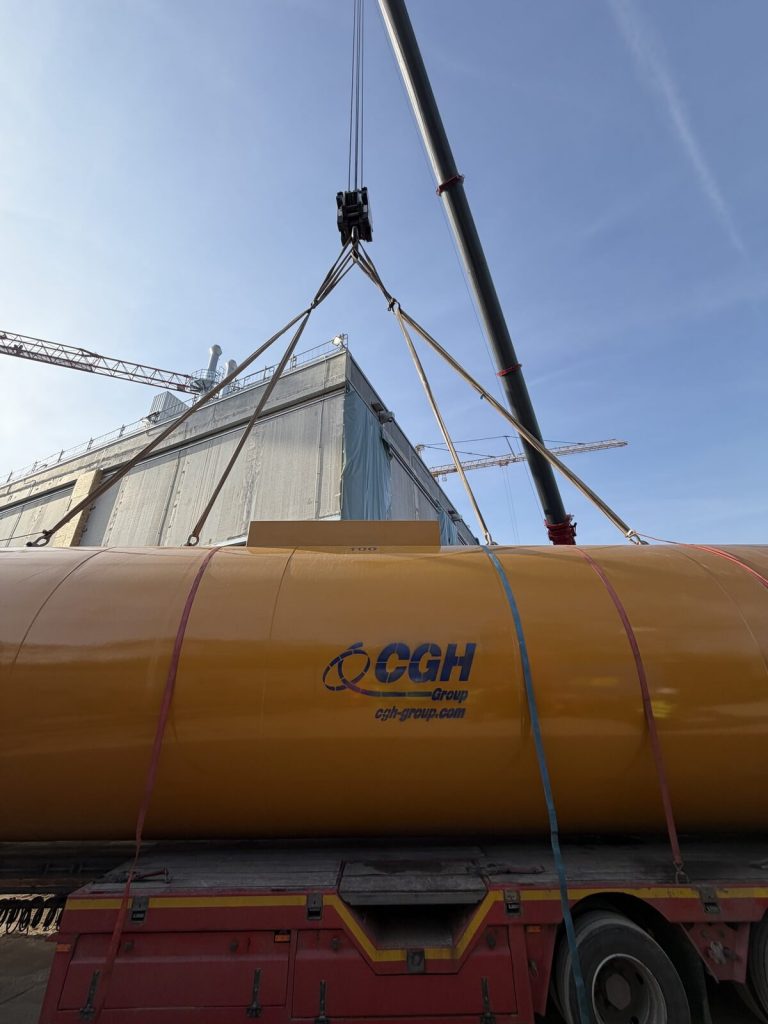
The right lifting accessory is not the strongest one, but the one whose working load limit – according to sling angle, hitch type and edge position – matches the load, and which was inspected before every lift.
A machine, a tank or a switchgear cabinet arrives on the low-loader, the crane is in position, and now the load has to go onto the hook. For that you need lifting accessories designed and inspected for heavy loads. What looks simple decides the whole installation day: does the load hang crooked because the centre of gravity was misjudged? Does a round sling tear on a sharp sheet-metal edge? Is the chain sling sufficient when the sling angle becomes flatter than planned because of the low hall ceiling?
For project managers, site managers and safety officers, the subject of “lifting accessories for heavy loads” is often a black box. The installation contractor brings its rigging gear, the slinger attaches the load, the crane operator nods, the lift begins. This article opens the box. It explains which lifting accessories exist, how round sling, chain and spreader beam differ and why the sling angle is so decisive. It also covers how lifting points are checked and which rules apply to slinging – illustrated with projects from Raunheim, Fulda and the Rhine-Main region.
Key points at a glance
- Lifting accessories connect the load to the crane hook; round slings, webbing slings, chains and wire ropes each have their own strengths and clear limits of use.
- Round slings protect sensitive surfaces but are vulnerable to sharp edges and heat; chains tolerate edges and temperature but need edge protection for the load.
- The sling angle of the legs to the vertical determines the working load limit of the sling assembly: above 45 degrees it drops significantly, above 60 degrees slinging is not permitted.
- With four legs, you calculate with only three load-bearing legs, because all four never carry equally.
- A spreader beam is needed when lifting points cannot tolerate angled pull, the lifting height is insufficient for a steep sling assembly or the load would be deformed when lifted.
- Lifting accessories must be visually checked by the slinger before every use and inspected at least once a year by a competent person; accessories that meet a discard criterion must be withdrawn immediately.
- Every lift of a heavy load belongs in a lift plan that defines lifting accessories, sling angle, lifting points, edge protection and the cordoned-off load zone in advance.
What are lifting accessories?
Lifting accessories are devices that connect a load to the load hook of a lifting appliance and are not a permanent part of the crane – round slings, webbing slings, chain slings, wire rope slings and connecting components such as shackles, hooks and master links.
To be distinguished from these are load-handling attachments: spreader beams, grabs, C-hooks or pallet forks that hang between crane hook and load and are themselves a load-bearing structure. Together, both are called “load-handling equipment” in the regulations.
A sling assembly is the combination of several lifting accessories into one unit – for example four chains on a master link. Its working load limit is never the sum of its legs but depends on the sling angle.
Which lifting accessories for heavy loads are there – and what are they suitable for?

Four types of lifting accessory come into question for heavy loads – round sling, webbing sling, chain sling and wire rope sling – and each has a typical area of use and a weakness that decides its suitability.
| Lifting accessory | Strengths | Limits | Typical use |
|---|---|---|---|
| Round sling (polyester endless sling with protective sleeve). | Light, flexible, protects surfaces, wraps around round loads. | Vulnerable to sharp edges, heat, chemicals, UV. Protective sleeve hides the core. | Painted machines, vessels, switchgear cabinets, pipes. |
| Webbing sling (flat woven sling with eyes). | Wide bearing surface distributes pressure, good positional stability. | Edge-sensitive like the round sling. Less adaptable. | Crates, panels, machines with smooth bearing surfaces. |
| Chain sling (round steel chain grade 8 or 10 with hooks and shortening clutches). | Insensitive to edges, heat, dirt. Adjustable in length. High working load limit in little space. | Heavy, can damage surfaces. Shortening clutches must be correctly engaged. | Steelwork, tanks with lifting lugs, lifts with centre-of-gravity compensation. |
| Wire rope sling (steel wire rope with ferrules). | Dimensionally stable, good edge tolerance with a large radius. | Stiff, wire breaks hard to detect, not adjustable. | Long goods, construction site use, continuous lifting. |
Separate rules apply to connecting components. Shackles may only be loaded in the pin and at the bow crown, not sideways. The screw pin must be fully screwed in and secured against loosening. Hooks need a working safety latch and are loaded at the hook bowl, not at the tip.
You can recognise round slings at a glance by the colour of their protective sleeve. Under DIN EN 1492-2, violet stands for 1 tonne, green for 2, yellow for 3 and grey for 4 tonnes. Red stands for 5, brown for 6, blue for 8 and orange for 10 tonnes and more. This applies to a straight pull with one leg. All other hitch types change the value.
Round sling or chain: which lifting accessory for heavy loads?
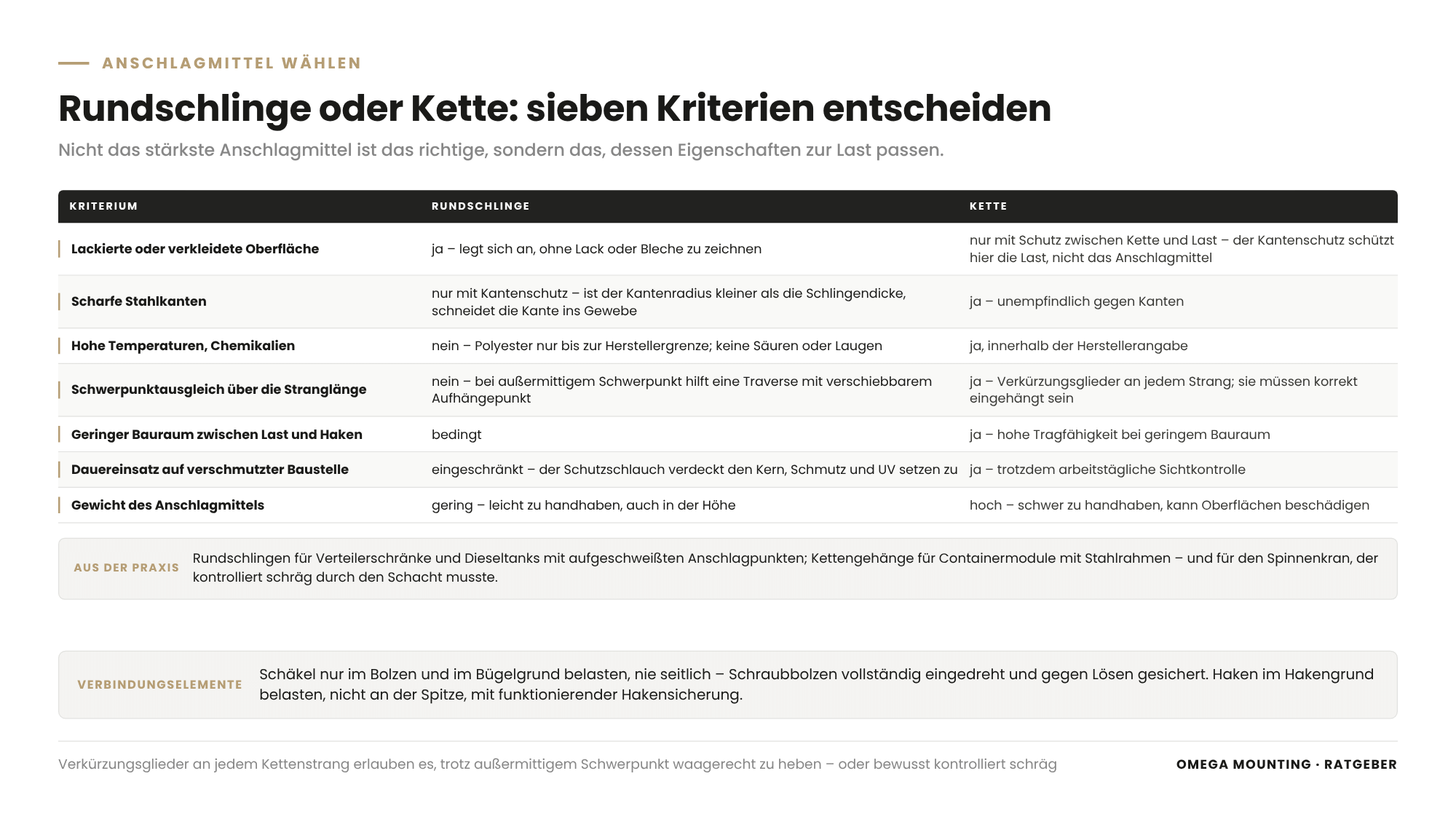
The choice between round sling and chain depends on the surface, edges, temperature and adjustment needs of the load. Sensitive surfaces and round shapes favour the round sling. Sharp edges, heat and a centre of gravity that needs compensating favour the chain.
When the round sling is the better choice
Round slings are our standard choice when the load is painted, clad or finished. That applies to almost everything that remains visible in the end in a data center or a production hall. When installing 160 power distribution cabinets (PDCs) in a data center, the round sling wrapped around each enclosure without marking paint or sheet metal. When lifting in five 100-cubic-metre diesel tanks in Raunheim, the sling assembly also consisted of round slings and shackles. We describe both projects in the practice section.
Their limit lies with sharp edges and heat. For textile lifting accessories, an edge counts as sharp when its radius is smaller than the thickness of the lifting accessory. It then cuts into the fabric under load. Polyester round slings can also only be used up to about 100 degrees Celsius and must not come into contact with acids or alkalis.
When the chain is the better choice
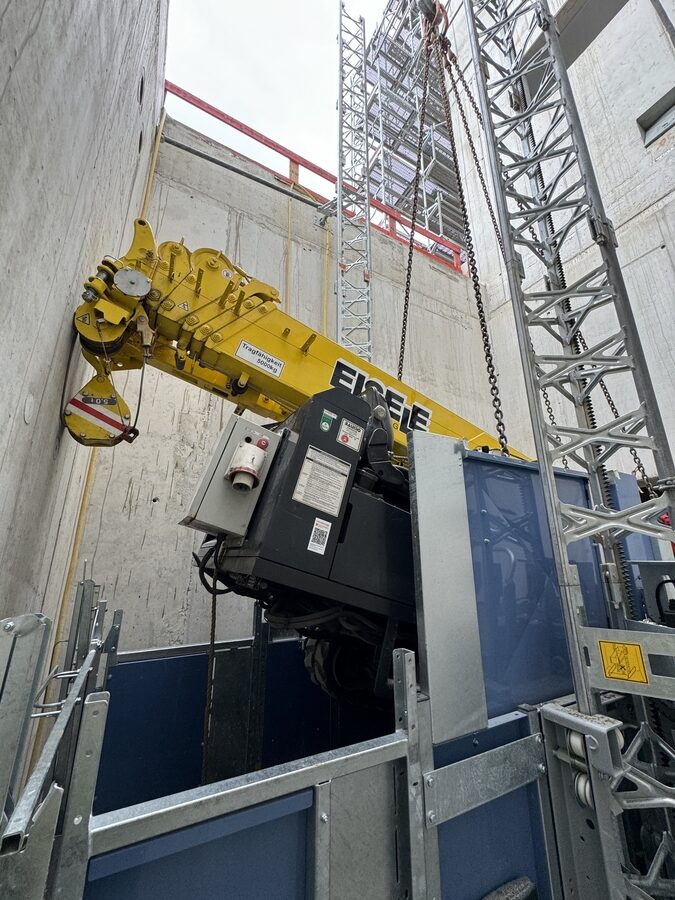
We use chains when the load has steel edges, may be hot, is dirty or when we have to compensate the centre of gravity via the leg length. Shortening clutches on each leg allow the load to be lifted level despite an off-centre centre of gravity – or deliberately at an angle. During the retrieval of a spider crane from the basement of a data center in Raunheim two centimetres were missing for the upright passage through the shaft. The solution was a four-leg chain sling with shortening clutches, from which the crane hung at a controlled angle. With round slings this fine adjustment would not have been possible.
During the moving in of generators and load banks into a data center in Frankfurt chain slings on the 220-tonne-class mobile crane were the means of choice. Container modules with steel frames, defined lifting points, several lifts in succession. All loads were guided with taglines against turning and swinging. Here, robustness counts.
The decision matrix
| Criterion | Round sling | Chain |
|---|---|---|
| Painted or clad surface. | Yes. | Only with protection. |
| Sharp steel edges. | Only with edge protection. | Yes. |
| Temperature above 100 °C. | No. | Yes, within the manufacturer's specification. |
| Centre-of-gravity compensation via leg length. | No. | Yes, via shortening clutches. |
| Little space between load and hook. | Limited. | Yes. |
| Continuous use on a dirty construction site. | Restricted. | Yes. |
| Weight of the lifting accessory. | Low. | High. |
Why the sling angle determines the working load limit
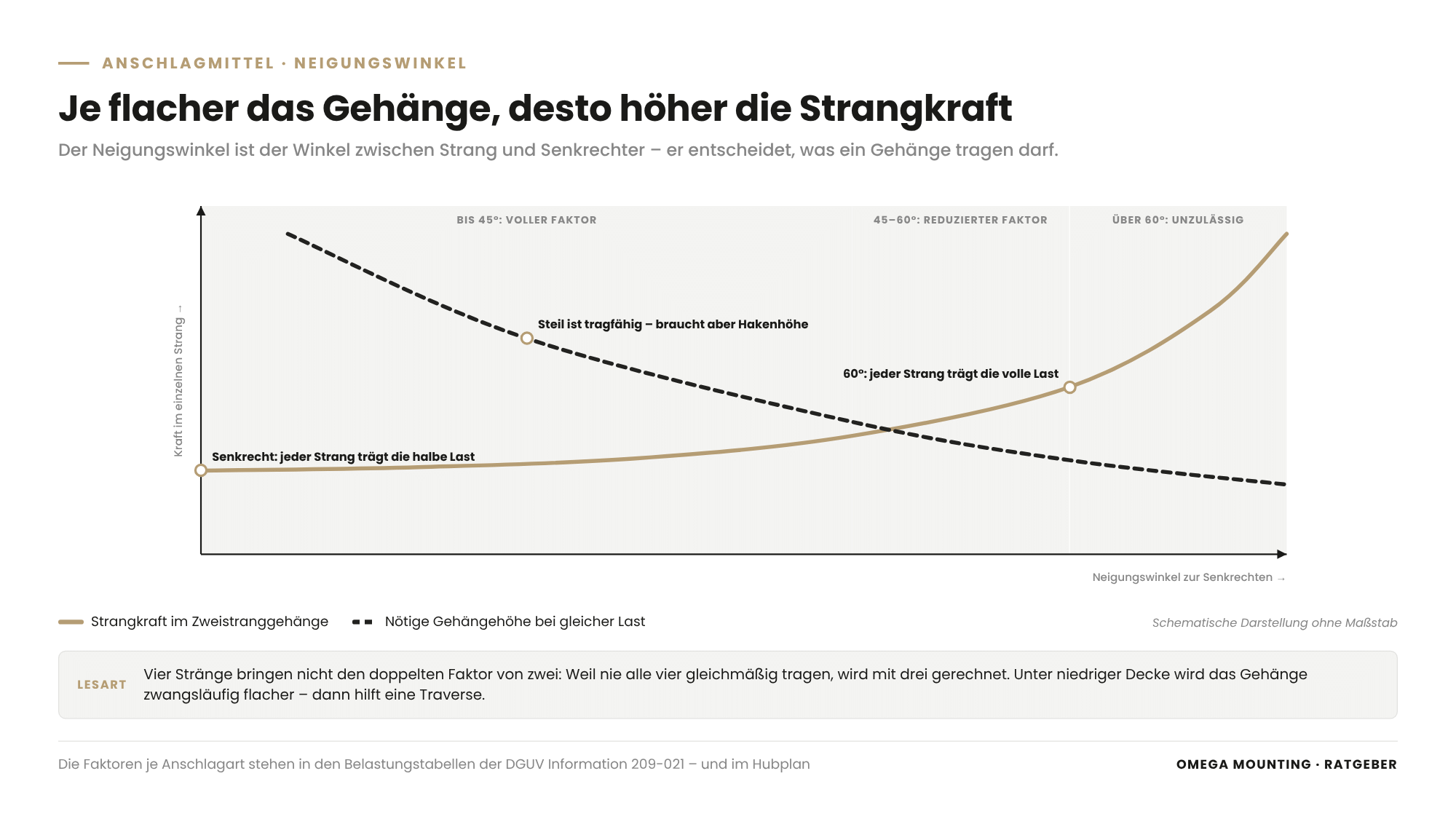
The sling angle – the angle between a leg and the vertical – determines the force acting in each individual leg. The flatter the sling assembly, the greater the leg force. From 60 degrees, slinging is not permitted.
The physics behind it is simple. If a load hangs from two vertical legs, each carries half. If the legs spread, a horizontal component is added to the lifting force, pulling the legs against each other. At a sling angle of 60 degrees, each of the two legs already carries as much as the full weight of the load. That is why the load tables for lifting accessories – summarised in DGUV Information 209-021 – give factors by which the working load limit of the single leg is multiplied.
| Hitch type | Sling angle 0–45° | Sling angle 45–60° | over 60° |
|---|---|---|---|
| Single leg, vertical. | 1,0. | – | – |
| Two-leg. | 1,4. | 1,0. | Not permitted. |
| Three- and four-leg. | 2,1. | 1,5. | Not permitted. |
| Round sling in choke hitch. | 0,8. | – | – |
| Round sling in basket hitch, legs parallel. | 2,0. | – | – |
Two things stand out. First: four legs only give the factor 2.1 – not 2.8. The reason is that in a four-leg sling assembly, all four legs never carry equally. You calculate with three. Second: in a choke hitch, the round sling is wrapped around the load and pulled through itself. This reduces the working load limit to 80 per cent because the sling is kinked at the turn.
Why the lifting height is linked to the angle
A steep sling assembly has a higher working load limit but needs headroom. In a hall with little clear height or under an overhead crane with limited hook height, the sling assembly inevitably becomes flatter – and loses working load limit. For designers, the hook height above the installation site is therefore a design parameter. Anyone who does not add the sling height to the lifting height discovers on the lift day that the crane can manage the load, but not the height.
How do you find and check the lifting points on the load?
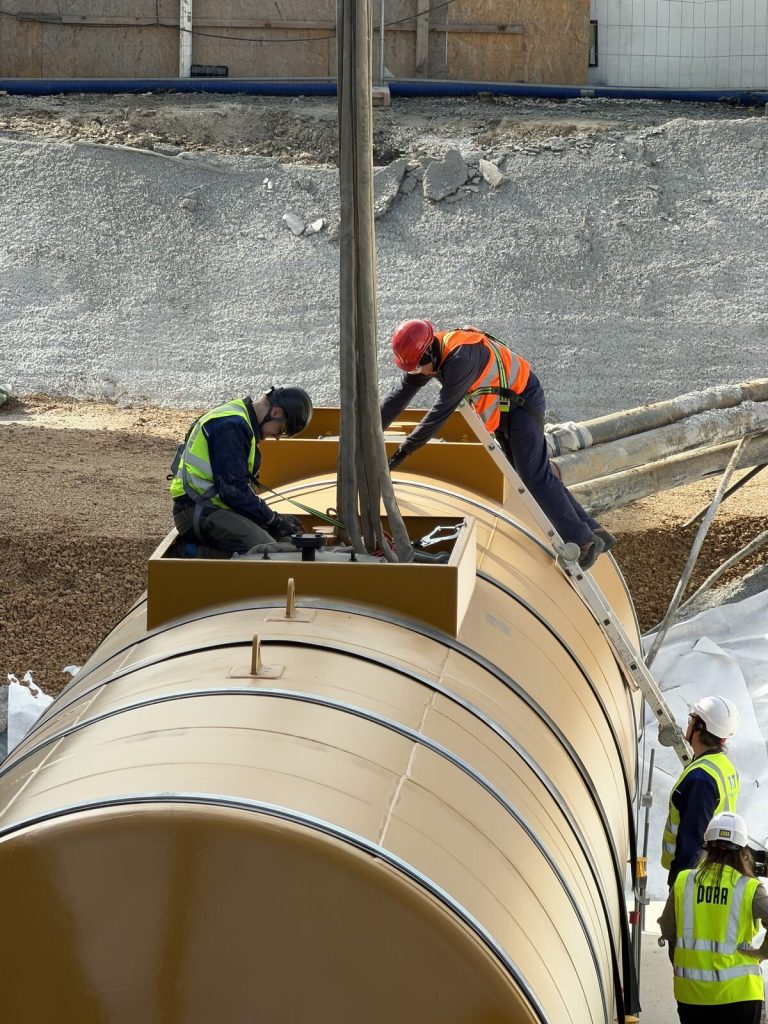
Lifting points – lifting eyes, lifting lugs or swivel lifting points – are the places provided by the manufacturer or designer at which a load may be lifted. They must be designed for the weight, the direction of pull and the number of legs, and must be visually checked before every lift.
The types of lifting point
- Eyebolts to DIN 580 may only be fully loaded in the axial direction. Under angled pull their working load limit drops sharply, and they must be fully screwed in and seated flat.
- Swivel or rotating lifting points align themselves in the direction of pull and are designed for angled pull – the first choice when a multi-leg sling assembly attaches to a machine.
- Welded-on lifting points or lifting lugs are part of the structure. Their working load limit is specified by the manufacturer; the weld seam must be visually inspected before the lift.
- Bonded or laminated-in eyes on plastic vessels (GRP) generally tolerate only vertical pull – any angled pull can tear them out of the vessel.
- Transport eyes and fork pockets on machines can be found in the operating instructions; they also state whether they are designed for the complete machine or only for one module.
Never sling to pipework, railings, handles, cladding or eyebolts of unknown origin.
The check before the lift
When lifting in the diesel tanks in Raunheim, the tank manufacturer had welded four lifting points onto the crown of each tank. We did not rely on that but visually checked every point before slinging and recalculated the sling geometry. This check is the task of the appointed person for lifting operations (lifting supervisor), who is responsible for the lift plan and issues the lift clearance. How the installation day runs as a whole is described in our basic guide The installation day: sequence, lead times and interfaces from the project manager's perspective.
If certified lifting points are missing – on existing machines, dismantled assemblies or vessels without eyes – the load is wrapped, lifted on a transport frame or picked up with a spreader beam. Beforehand, it must be clarified whether the structure can absorb the forces at the wrapping points.
When do you need a spreader beam?
You need a spreader beam when the lifting points cannot tolerate angled pull or the available lifting height is insufficient for a sufficiently steep sling assembly. This also applies when the load would be compressed or deformed when lifted, or when several lifting points in a line have to be loaded evenly.
A spreader beam is a load-handling attachment – a beam of steel or aluminium that hangs from the crane hook and at whose ends the lifting accessories run vertically to the load. It converts the problem of “angled pull” into the problem of “own weight and headroom”. It is therefore not a universal solution but a targeted answer to four situations:
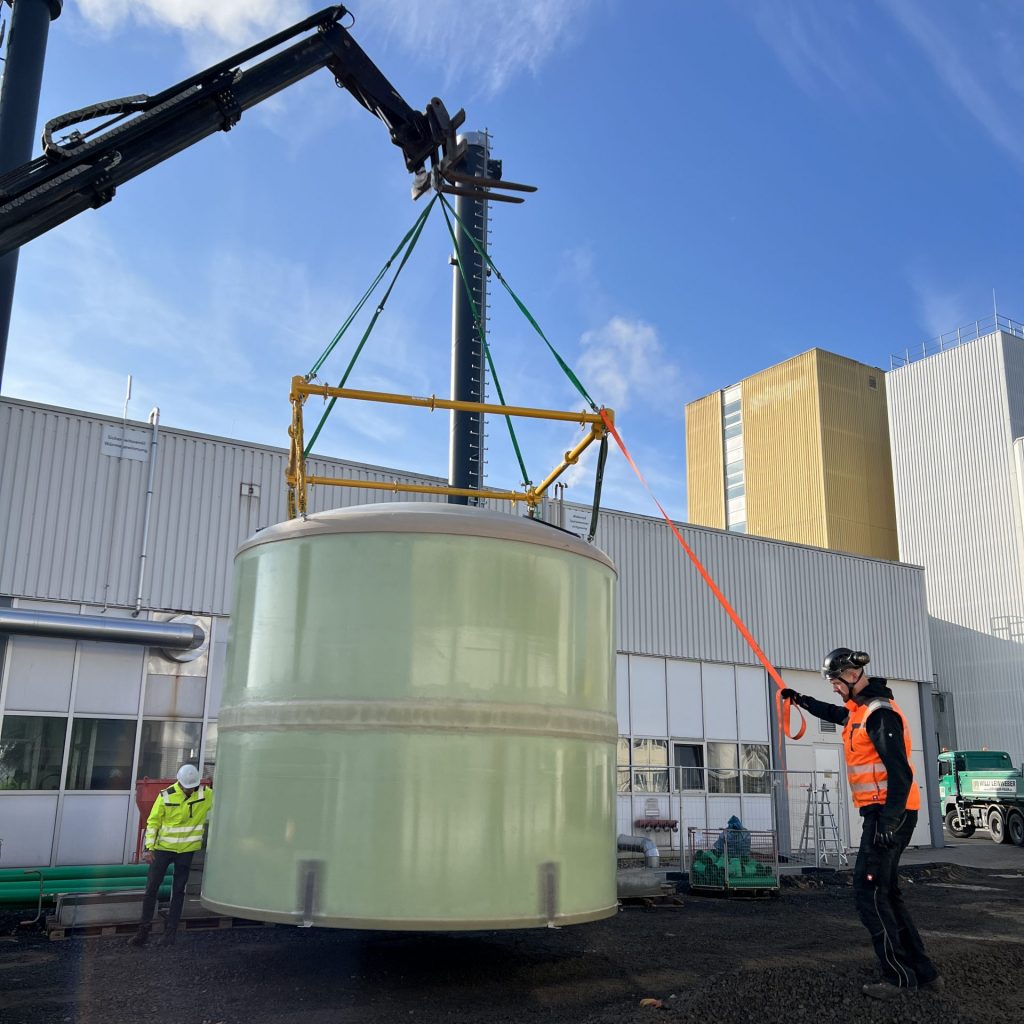
- Sensitive lifting points. When installing GRP tanks for a burner system in Fulda, the lifting eyes were bonded to the vessels. An angled pull could have torn them out of the tank. We used a specially made lifting beam so that the legs attached vertically to the eyes. The tanks were additionally secured against swinging with a tagline.
- Too little lifting height. Under a low hall ceiling or an overhead crane with limited hook height, the spreader beam replaces the steep sling assembly: instead of two metres of sling height, it often needs only the height of its own suspension point.
- Long or flexible loads. Pipes, beams, crane bridges or machine beds would sag or be compressed on a two-leg sling assembly. The spreader beam keeps the lifting points apart.
- Multi-point lifting. When a load has to be picked up evenly at four or more points, a spreader beam with equalising beams or equalising sheaves provides the load distribution that a rigid sling assembly cannot.
Spreader beams count as machinery within the meaning of the Machinery Directive. They need a CE marking, a declaration of conformity, a working load limit marked on the component and operating instructions – even as a one-off. For special cases, we manufacture spreader beams and auxiliary structures in our own workshop in Rodgau. Read more on our page Custom fabrication from our own workshop. The spreader beam's own weight counts towards the crane load and is therefore stated in the lift plan.
What role do edge protection, centre of gravity and angled slinging play?
Edge protection, centre of gravity and a controlled angled sling decide whether a sling assembly that is right on paper holds in practice. Edges destroy textile lifting accessories, a misjudged centre of gravity makes the load tip. And only what has been calculated for it may hang at an angle.
Edge protection
Sharp edges are the most common cause of damaged round slings and webbing slings. Edge protection – protective sleeves, edge protectors of plastic or steel, timber baulks or rubber pads – increases the radius at the turn and distributes the pressure. It is part of every lift with textile lifting accessories on steel or concrete edges. Likewise part of every lift with chains on loads that must not be damaged. The lift plan states where it sits. The surroundings also need protection. In Raunheim we packed the construction hoist and ramp with timber baulks before the spider crane drove over them.
Centre of gravity
The crane hook must be vertically above the centre of gravity of the load, otherwise it tips towards the heavy side when lifted. For machines with an off-centre centre of gravity – motor at one end, control cabinet at the other – the leg lengths are adjusted or a spreader beam with an adjustable suspension point is used. A trial lift of a few centimetres shows whether the calculation is right. Only then does the appointed person clear the lift. If the centre of gravity is not in the manufacturer's documents, it is estimated from drawings, weight distribution and experience. Then the trial lift becomes all the more important.
Controlled angled slinging
Sometimes a load has to hang at an angle – because a shaft is too narrow, a door opening too low or the final position requires it. With the spider crane in Raunheim, the missing two centimetres were gained by an angled sling on the shortenable chain sling. What was calculated: centre of gravity, leg forces, securing against swinging. Our principle on this is: “With us, angled means controlled angled, not ‘it'll probably hold’.” An unplanned angled sling, on the other hand – because a leg was too short or a lifting point wrongly chosen – is grounds for the authority to stop. The lift is aborted.
How often must lifting accessories be inspected – and when are they due for discard?

Lifting accessories must be visually checked by the slinger for obvious defects before every use and inspected at least once a year by a competent person. As soon as a discard criterion is reached, they may no longer be used.
The inspection obligations
The BetrSichV (Industrial Safety Ordinance) requires the periodic inspection of work equipment. The inspection rule TRBS 1201 specifies this for lifting accessories and names the intervals. The periodic inspection by a competent person takes place once a year, at shorter intervals under intensive use or harsh conditions. Round steel chains and webbing slings with vulcanised sheathing are additionally tested for freedom from cracks every three years. The inspection result is documented, and the record must be kept at least until the next inspection.
For you as the client, one passage of the inspection rule is particularly useful. At changing locations, a sticker, a stamp or a copy of the inspection record counts as evidence. But the sticker only proves that an inspection took place, not that the accessory is free of defects. So on the lift day, ask for the evidence and a look at the lifting accessory itself.
Alongside this is the check on every working day, which the inspection rule explicitly prescribes. The slinger does it before the first lift: label legible? Protective sleeve undamaged? Chain without deformation? Hook with safety latch? On many sites of international clients, a weekly documented visual inspection with colour-coded monthly marking is added. It does not replace the annual inspection but supplements it. When replacing a CRAH unit in a live data center in Frankfurt, we re-inspected all lifting accessories before every use.
Discard criteria: when a lifting accessory is withdrawn
| Lifting accessory | Discard when |
|---|---|
| Round sling. | Damaged protective sleeve with visible core, missing or illegible label. Knots, heat or chemical damage, hardening. |
| Webbing sling. | Yarn breaks, cuts at the edges, damaged seams. Missing label, discolouration from chemicals. |
| Chain sling. | Elongation of more than 5 per cent, reduction in cross-section of more than 10 per cent. Cracks, bent or twisted links, corrosion pitting, missing marking. |
| Wire rope sling. | Wire breaks in larger numbers, birdcaging, kinks. Crushing, loosening of the ferrules, corrosion. |
| Hook. | Widening of the hook throat by more than 10 per cent. Missing or defective safety latch, incipient cracks, deformation. |
| Shackle. | Bent bow, damaged thread. Missing pin or securing, missing working load limit marking. |
A lifting accessory due for discard is taken out of use immediately – not used further “for light loads”. The rule on mechanical hazards (TRBS 2111) goes a step further and requires defective lifting accessories to be made recognisably unusable so that they do not accidentally get back into circulation. A missing label alone is enough for withdrawal, because without a working load limit marking nobody knows what the accessory can carry.
Which rules apply to lifting accessories for heavy loads?
DGUV Rule 100-500 “Operating work equipment” governs the operation of load-handling equipment in lifting appliance operation – from selection through slinging and load transport to inspection and discard criteria. It is thus the central rule for everyone who slings heavy loads.
The most important principles from it for your site:
- Lifting accessories must be selected according to working load limit, hitch type, sling angle and the nature of the load. Only marked, inspected and undamaged accessories may be used.
- Loads must be slung so that they cannot slip, tip or fall. Hooks must be secured, shackles correctly loaded, sharp edges protected.
- No standing under suspended loads: the load zone is cordoned off, loads are not guided over people.
- Unambiguous communication between slinger, banksman and crane operator must be ensured – only one person gives signals. The hand signals for this are defined in workplace rule ASR A1.3. Anyone who knows the signals can tell on the lift day whether banksman and crane operator speak the same language.
- Lifting accessories must be inspected regularly by a competent person and the results documented.
- Who may sling must be clearly defined and recorded in writing – as the client, you may ask who belongs to the authorised user group on your site.
Separate rules also apply to crane operation; DGUV Information 209-013 “Slingers” serves as the briefing basis for slingers. The risk assessment defines the measures for the specific lift. The lift plan is its practical implementation. The work instruction for lifting accessories and the short briefing (toolbox talk) before the lift bring them to the team. Anyone who provides slingers must have briefed them and be able to prove their competence – a point you as the client may demand.
How we do it in practice
In our projects, the lift plan defines which lifting accessories bring heavy loads onto the hook. Angles and lifting points are fixed before the load hangs. Three examples.
Five diesel tanks on a round sling assembly in Raunheim
During the placement of five 100-cubic-metre diesel tanks into the pit of a data center in Raunheim each tank hung from a sling assembly of round slings and shackles. Each tank weighed around 16 tonnes empty, was 16.16 metres long and 2.90 metres in diameter. The sling assembly attached to four welded-on lifting points on the crown. Length and working load limit of the round slings were defined in the lift plan. The sling angle was calculated as a compromise between leg force and sling height, and the sling height added to the lifting height. Before every slinging came the visual check of the lifting points. The mobile crane swung the tanks over the retaining wall into the pit, where little room remained between shoring and concrete slab. After three working days, all five tanks lay on their supports.
GRP tanks on the spreader beam in Fulda
During the installation of GRP tanks for a burner system in Fulda the lifting accessory was dictated by the vessel. The eyes were bonded on, and an angled pull could have torn them out of the tank. We lifted with a specially made lifting beam so that the legs attached vertically. The tanks were secured with a tagline against uncontrolled swinging. Communication between banksman and crane operator ran via radio and hand signals – a second man as banksman was a fixed part of the sequence.
160 switchgear cabinets on the beam gantry in the Rhine-Main region
During the moving in and installing 160 power distribution cabinets in eight data halls of a data center in the Rhine-Main region it was not about one big lift but about 160 identical ones. 20 cabinets per hall, in two rows of ten, spread over four levels. The cabinets were lifted on their pallets with a gantry of aluminium beams and a chain hoist and slung with round slings. They were then set down under control onto the floor protection and aligned in line at laser-surveyed positions. Six lift & shift mechanics, several weeks, no damage. In series lifts, what decides is not the working load limit reserve but the discipline of doing the same visual check on the 140th cabinet as on the first.
Do you have a load without clear lifting points, with an off-centre centre of gravity or under a low ceiling? Then get in touch with us. With the manufacturer's documents and a few photos, we usually settle within an hour whether round sling, chain or spreader beam fits.
What this means for your role
For buyers: Do not tender slinging as a matter of course but as a service with evidence in the item text. This includes the lift plan with lifting accessories and sling angles, valid inspection records of the accessories used as proof of suitability, and briefed slingers. Edge protection and, where applicable, a spreader beam appear as optional items. In the bidder questions, ask how the bidder deals with loads without certified lifting points. Anyone who can answer that has understood your equipment.
For designers: You determine whether a unit can be slung safely at all. Request lifting points with working load limit, centre of gravity and permissible direction of pull from the manufacturer and include this information in your documents. Plan enough hook height and clear height above the installation site for a steep sling assembly or a spreader beam. For large units, provide assembly beams or a crane runway with documented load-bearing capacity – a ceiling that is too low turns a simple lift into a special problem. For vessels made of plastic or with bonded eyes, the note “vertical pull only” belongs in the design.
For project managers and site managers: Demand the lift plan before the lift day – ideally in the regular progress meeting before the installation day. Read the line on lifting accessories in it: type, working load limit, hitch type, sling angle, edge protection, lifting points. Do the lifting points match the manufacturer's documents for the equipment? Is the sling height taken into account in the hook height? Is the load zone in the work area cordoned off and are the preceding and follow-on trades informed? As site manager, you issue the lift clearance only when these questions have been answered – that saves hours on the lift day.
For maintenance managers: If your staff do the slinging themselves with the overhead crane, everything said here applies to you too – including annual inspection by a competent person, inspection logbook, discard checks and briefing. For loads that fall outside the routine – off-centre centre of gravity, no lifting points, repair work in an existing plant – the installation contractor with lift plan and spreader beam is worthwhile.
For safety officers and HSE coordinators: Check the inspection records of the lifting accessories for validity, the briefing records of the slingers and the delegation of duties to the appointed person for lifting operations. During the walk-through on the lift day, watch for what is not in the risk assessment and lift plan. That means round slings over sheet-metal edges without protection, chains with incorrectly engaged shortening clutches, hooks without safety latches, people in the load zone under a suspended load. Each of these points justifies the authority to stop – and should be reported as a near miss if it was close.
Lifting accessories inspection checklist: on request
Our lifting accessories inspection checklist is a one-page checklist for the visual check before use. For round sling, webbing sling, chain, wire rope, hook and shackle, it lists the discard criteria that lead to immediate withdrawal. Added to this are fields for sling angle, working load limit factor, hitch type, edge protection and clearance by the appointed person. It helps slingers with the daily check, safety officers during the walk-through and project managers as an annex to the lift plan. Request the lifting accessories inspection checklist via our Contact form – keyword “Lifting accessories inspection checklist”.
Why Omega Mounting?
We are based in Rodgau near Frankfurt and sling heavy loads in data centers in Frankfurt, Raunheim and Offenbach, in industrial plants in Hanau, Darmstadt and Aschaffenburg and beyond as far as Fulda. The linked projects show how we work: lift plan before the lift, check lifting points rather than trust them, spreader beam from our own workshop when the standard sling assembly does not fit. Our services in the field of Lift & shift – moving in heavy equipment cover planning, slinging, lifting supervision and documentation from a single source. Via our 24-hour hotline you can reach us at short notice too. For you this means: a single point of contact for lift plan, lifting accessories and spreader beam, inspected gear with evidence on site. And short distances in the Rhine-Main region when a lift comes sooner than planned.
Conclusion
Lifting accessories for heavy loads are not a question of the largest working load limit marking but of the right combination of lifting accessory, hitch type, sling angle, lifting point and edge protection. Defined in the lift plan, checked before the lift, documented with an inspection record. Round slings protect the load, chains tolerate edges and allow centre-of-gravity compensation, spreader beams solve the problem of angled pull. And the best sling assembly is useless if it is due for discard or nobody has recalculated the angle. If you are looking for a partner for your next project who takes slinging as seriously as the lift itself: Send us the weight, the manufacturer's documents and your preferred date. We will come back to you with an honest assessment of how your load gets safely onto the hook.
Planning maintenance, moving in or installation in the Rhine-Main region?
Tell us briefly what it is about – we will come back to you with an honest assessment.
100% free and without obligation
You may also be interested in these guides

About the author
Tobias Schott
Managing director of Omega Mounting GmbH, Rodgau · more than 20 years of hands-on experience in installation and maintenance
A trained mechatronics technician, at home in maintenance, servicing and industrial installation since 2004 – first at his father's side, since 2012 with Omega Mounting: from the overhead conveyor in Frankfurt to the crane system in a new-build hall. Plans and leads lifting operations as appointed person in data centers and on industrial sites in the Rhine-Main region, is an instructor and examiner for cranes, mobile elevating work platforms and telehandlers, and a safety officer. On jobs abroad he is known as the “German Troubleshooter” – the one you call when things get stuck on site. He learned what quality means not from a manual but from his father: Made in Germany as a standard for his own work, not as a label. That is why it comes first at Omega Mounting – before speed and before price. He writes these guides from that practice: what works on our sites is in them – what only exists in the standard is not.
Frequently asked questions
Lifting accessories – round slings, webbing slings, chains, ropes, shackles – connect the load to the crane hook. Load-handling attachments such as spreader beams, grabs or C-hooks are load-bearing structures in their own right between hook and load and count as machinery with CE marking and operating instructions. Together, both are called load-handling equipment in the regulations.
In a choke hitch – the sling is placed around the load and pulled through itself – a round sling carries only 80 per cent of its nominal working load limit, because it is kinked at the turn. In a basket hitch with parallel legs, by contrast, it carries double. Both values are on the label and in the load tables.
At a sling angle of 60 degrees to the vertical, each leg of a two-leg sling assembly already carries as much as the entire weight of the load. Above that, the leg force rises so steeply that small deviations lead to overload. That is why the load tables end at 60 degrees, and slinging above that is not permitted. Anyone who has to sling flatter needs a spreader beam.
Before every use, the slinger visually checks the lifting accessory for obvious defects. At least once a year, a competent person inspects it in accordance with the inspection rule TRBS 1201; more often under harsh operating conditions. Round steel chains are additionally tested for cracks every three years. Inspection results are documented in the inspection logbook or via an inspection sticker and must be verifiable on site – the contractor using the accessories is responsible for this.
A chain sling is due for discard when it has elongated by more than 5 per cent or the cross-section of a link has decreased by more than 10 per cent. The same applies when links are bent, twisted or cracked, corrosion pitting is present or the marking is missing. Hooks are due for discard when the hook throat has widened by more than 10 per cent or the safety latch is missing.
On data center sites in Frankfurt, Raunheim or Offenbach, additional requirements from internationally managed clients frequently apply alongside the German inspection obligation: weekly documented visual inspections, shorter evidence periods for inspection certificates, colour coding of inspected accessories. We run both in parallel – the German inspection regime remains the basis. Round slings dominate because of the sensitive surfaces; chains are used for containers, generators and steel structures.
Yes – which lifting accessories may carry heavy loads does not depend on the industry. Sling angle, discard criteria, inspection obligation and edge protection apply to the crane bridge in steel construction just as much as to the injection moulding machine at the automotive supplier, the tank in food production or the racking in the logistics centre. Only the typical loads differ – and with them the answer to the question of round sling, chain or spreader beam.
Only persons who have been briefed for it and whose competence the employer has established may sling loads; the basis is DGUV Rule 100-500. The risk assessment defines the measures for the specific lift, the work instruction makes them binding for the slinger. As the client or safety officer, you may demand briefing and competence records for the slingers – and the written definition of who belongs to the authorised user group.
Send us via the Contact form three details: the weight and dimensions of the load with the manufacturer's documents on lifting points and centre of gravity, photos or drawings of the installation site and hook height, and the desired period. We check which lifting accessories suit your heavy load and come for a site visit if required. You receive a written assessment with a draft lift plan, lifting accessories and, if necessary, a spreader beam from our workshop. Your contact is Tobias Schott.
 English
 German