
- Guide – Occupational safety
Appointed person for lifting operations: who is responsible for the lift
By Tobias Schott · Reading time approx. 24 minutes · Last updated: October 2026
Every lift on your site needs exactly one appointed person for lifting operations. They plan the lift, release it, direct it and may abort it at any time – and they must be appointed in writing.
You know the situation: the mobile crane is set up on its outriggers on the crane set-up area. The low-loader with the equipment rolls in. Three trades are waiting in the work area for the moment the load is in the air. And then comes the question nobody answered in the progress meeting – who actually gives the lift release now? It is precisely in this gap that the accidents happen which, in hindsight, everyone saw coming.
An appointed person for lifting operations closes this gap. Internationally, they are called the Lifting Appointed Person or Lifting AP for short, on site often the Lifting Supervisor. Anyone searching for the German term "verantwortliche Person Hebearbeiten" therefore often ends up with English terminology. In Germany, however, the role is not an invention of British or international construction standards. It can be derived cleanly from German occupational safety law.
This article explains what the role covers and on which legal basis it stands. It shows how it differs from the crane operator, slinger and banksman and what must be in the appointment – using jobs in the Rhine-Main region as examples.
Key points at a glance
- An appointed person for lifting operations plans every lift, releases it, directs it and may stop it at any time.
- The legal basis for the appointment is the delegation of duties under the ArbSchG (German Occupational Safety Act) and the accident prevention regulation: to a reliable, competent person – in writing, with tasks and powers.
- The term Appointed Person comes from the British crane code of practice; the function has long existed in German law under a different name.
- The appointed person neither operates the crane nor slings the load – they have technical authority to issue instructions regarding the lift, but no disciplinary authority over those involved.
- The core of their work before the lift is the lift plan: load data, centre of gravity, lifting points, lifting accessories, crane set-up area, load path, cordoned-off load area, communication.
- On the day of the lift, they check the crane, lifting accessories and surroundings, give the lift release for each individual lift and remain responsible until the component is set down and secured.
- Without a written appointment signed by the appointed person, the role is not effectively delegated – responsibility then remains with the employer.
What is an appointed person for lifting operations?
An appointed person for lifting operations is a competent and reliable person appointed in writing by the employer. They take on the planning, release, execution and abortion of lifting operations on a construction site or in a plant on their own responsibility.
The employer bears responsibility for occupational safety. They cannot get rid of it, but they can delegate individual tasks to persons who are closer to the action. In lifting operations, that is the person who has the crane hook, the load and the surroundings in view at the same time.
On international construction sites you will encounter two terms. The Lifting Appointed Person (AP) is responsible for the planning and the overall system of the lifting operation. The Lifting Supervisor supervises execution on site. On many sites, both roles are combined in one person. On large projects with many parallel lifts, they are staffed separately.
Where do the terms Lifting AP and Lifting Supervisor come from?
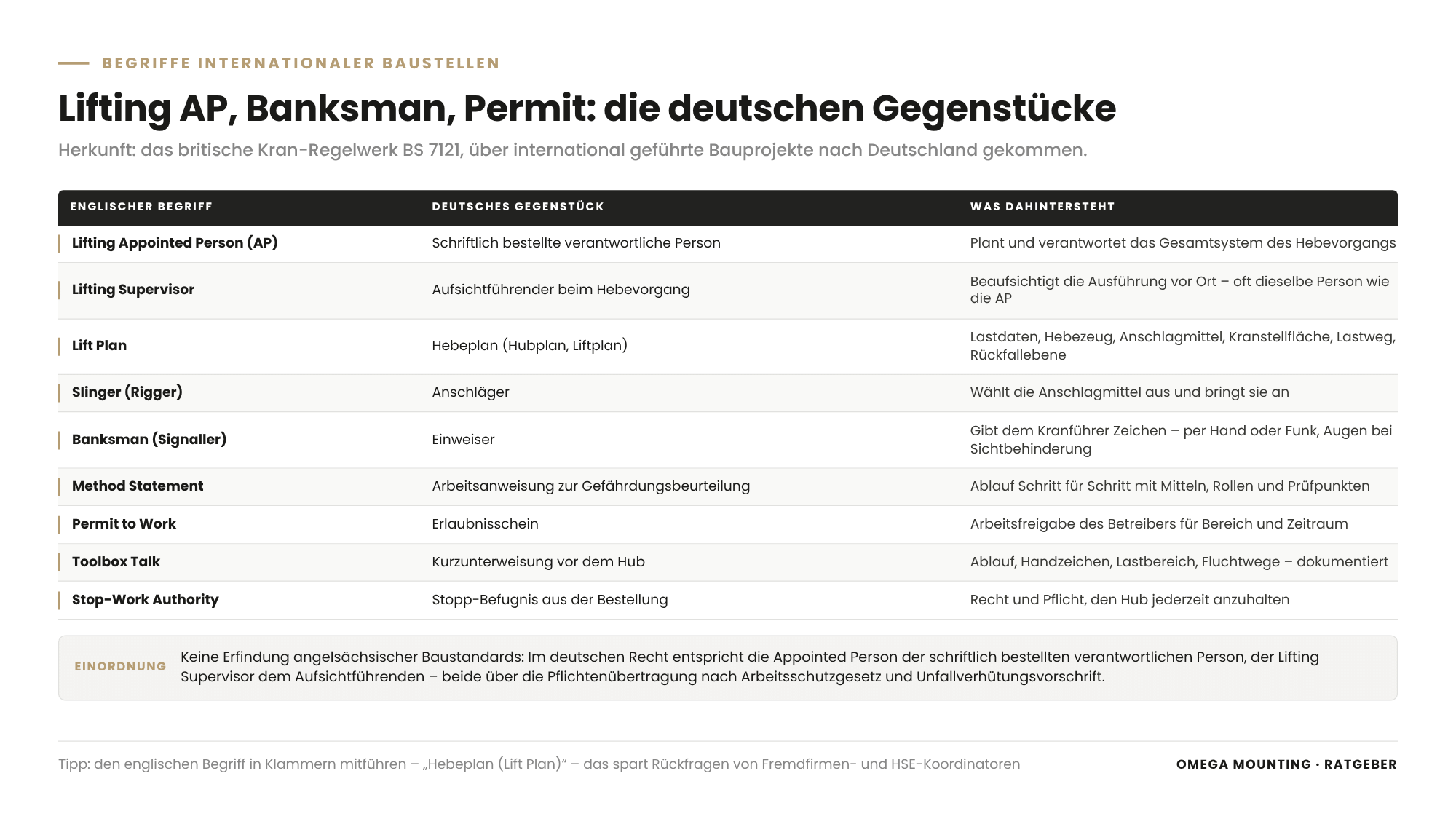
The terms Appointed Person and Lifting Supervisor come from the British standard BS 7121, the code of practice for the safe use of cranes. They came to Germany via internationally managed construction projects.
Especially in data center construction, logistics real estate and energy infrastructure, you frequently work with general contractors from the Irish-British legal sphere. Their safety systems require a named Appointed Person for every lift, a written lift plan and a release before lifting. That is just another language for something German occupational safety law also requires:
- Lift Plan: the lift plan (Hebeplan) under German regulations.
- Slinger: the Anschläger.
- Banksman: the Einweiser.
- Method Statement: the work instruction accompanying the risk assessment.
- Permit to Work: the Erlaubnisschein.
- Toolbox Talk: the short briefing before the lift.
- Stop-Work Authority: the authority to stop work set out in the appointment.
Anyone who carries the English term in brackets in the German document – "Hebeplan (Lift Plan)" – saves themselves queries from the contractor coordinator in Hanau as well as from the HSE coordinator in Frankfurt.
What is the legal basis for the appointment in Germany?
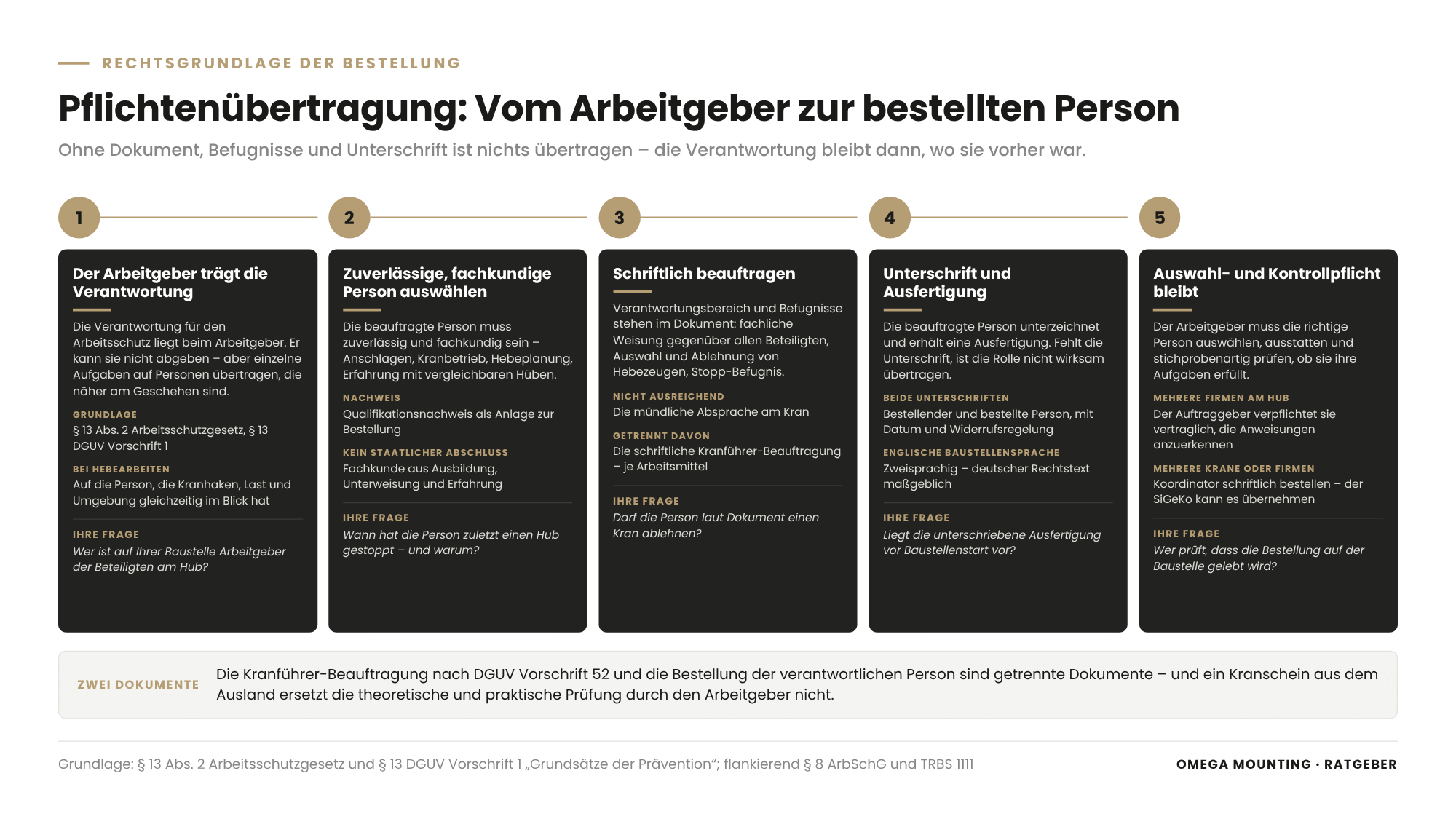
The appointment of an appointed person for lifting operations is based on Section 13 ArbSchG (German Occupational Safety Act) and Section 13 DGUV Regulation 1 "Principles of Prevention". Both provisions allow the employer or company owner to appoint reliable and competent persons in writing. These then perform occupational safety tasks on their own responsibility.
ArbSchG (German Occupational Safety Act): responsible persons
The Act opens up the possibility of appointing further persons in writing in addition to those who are responsible anyway – such as legal representatives. Three features are decisive: the person must be reliable and competent – the appointment must be made in writing and it delegates tasks to be performed on their own responsibility.
Accident prevention regulation: delegation of duties
The accident prevention regulation puts this into concrete terms. The appointment must define the area of responsibility and the powers, must be signed by the appointed person, and a copy must be handed to them. This is why a verbal agreement at the crane is not enough: without a document, powers and signature, nothing is delegated – in the event of damage, responsibility remains where it was before. The employer also retains their duty of selection and supervision: they must select the right person, equip them and check on a random basis whether they are fulfilling their tasks.
The accompanying regulations
- Cooperation of several employers (Section 8 ArbSchG): If trades can endanger each other, a person must be designated to coordinate the work. In lifting operations, in practice this is the appointed person, on construction sites under the BaustellV (Construction Site Ordinance) in conjunction with the health and safety coordinator (SiGeKo) and their SiGe plan. The German technical rule TRBS 1111 (Risk Assessment) becomes specific here. In the case of increased hazard – it expressly names several cranes, great heights and heavy machine parts – this coordinator must be appointed in writing; the SiGeKo can take on the task. For you, this means: as soon as two cranes or two companies are involved in one lift, a name must be on paper.
- DGUV Regulation 52 "Cranes" requires that only competent and briefed insured persons operate cranes; for mobile power-driven cranes, this designation must be made in writing. TRBS 1116 (Qualification, Briefing, Appointment) adds: the appointment always applies only to the named work equipment. Foreign or unclear certificates must be verified theoretically and practically – a crane licence from abroad does not replace this check. Crane operator appointment and appointment of the appointed person are therefore two separate documents.
- DGUV Rule 100-500 covers the operation of load handling attachments in hoisting operations – slinging, selection and inspection of lifting accessories. The appointed person must be able to apply this rule.
- The BetrSichV (Industrial Safety Ordinance) requires the periodic inspection of work equipment. The inspection records for the crane and lifting accessories are among the documents the appointed person reviews before the lift.
Which tasks does the appointed person take on before the lift?
Before the lift, the appointed person prepares or checks the lift plan and specifies the crane, lifting accessories and crane set-up area. They coordinate the cordoning-off of the load area and communication and make sure that everyone involved has the same picture of the sequence.
The lift plan as the core of preparation
A lift plan – in German Hebeplan or Hubplan – is the written description of a lifting operation from delivery to the component being set down and secured. It contains at least:
- Load data: weight, dimensions, centre of gravity, lifting points and their load capacity.
- Lifting equipment: crane type, configuration, counterweight, radius, rated capacity according to the load chart in the planned position, inspection record.
- Lifting accessories: type (round sling, chain sling, spreader beam, shackle), working load limit, length, sling angle, edge protection, inspection record.
- Crane set-up area: ground conditions, outrigger loads, ground bearing pressure under the outrigger pads, distance to shafts, ducts and embankments.
- Load path: hook height, slewing range, obstacles, load area and danger zone with cordoning.
- Communication: banksman, radio channel, hand signals, communication when visibility is restricted.
- Responsibilities: who releases, who slings, who signals, who stops.
- Fallback: what happens if the wind limit is exceeded, in rain, in the event of a technical fault or delay.
For lifts in confined buildings, the plan is no formality – for example in the spider crane retrieval in Raunheim described in the practice section. It is the basis for our team, the crane operator and the site having the same picture in mind.
Do not believe load data – check it
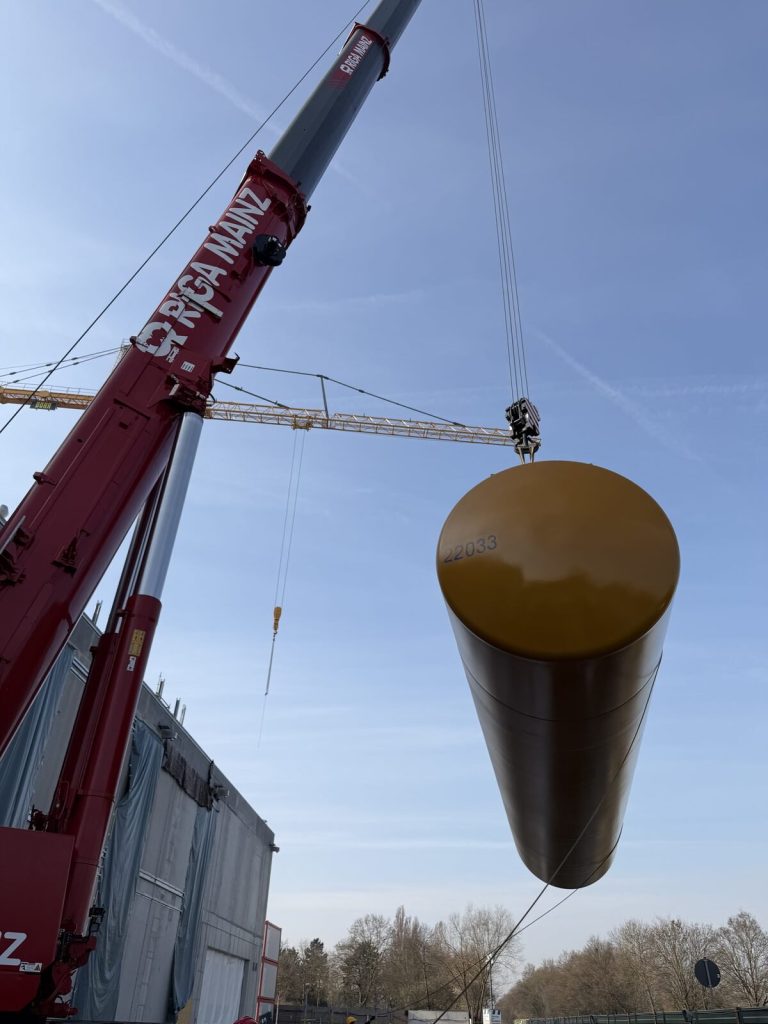
One of the most important tasks before the lift is recalculating. When lifting in five diesel tanks in Raunheim, our appointed person inspected the lifting points welded on by the tank manufacturer and recalculated the sling geometry: leg forces, centre of gravity, sling angle, sling height. Nobody does this calculation on the side.
Crane set-up area, access, coordination
The lift plan does not end at the crane hook. Together with the crane hire company, the appointed person clarifies where the crane may stand, which shafts and ducts lie beneath the ground and whether load spreading plates and ground bearing pressure match. For the diesel tanks, the crane set-up areas were calculated with CAD and the low-loader's access was checked using a swept-path analysis. Before the day of the job, they coordinate the plan in the site meeting with the client, crane hire company, preceding and following trades and – where present – the SiGeKo. During the moving in of generators and load banks into a data center in Frankfurt the lift plans for each individual lift were calculated in advance and agreed with the operator. The record of the periodic crane inspection was part of the documents.
What happens on the day of the lift: release, direction, authority to stop work
On the day of the lift, the appointed person checks the crane, lifting accessories and surroundings against the lift plan and holds the toolbox talk. They expressly give the lift release for each individual lift, direct it via banksman and crane operator and abort it as soon as conditions deviate from the plan.
The check before the first lift
Before the hook descends for the first time, the appointed person goes through the plan against reality: is the crane standing on the planned crane set-up area? Is the configuration correct? Are the lifting accessories those from the plan, with a legible label and valid inspection record? Is the load area cordoned off, radio tested, banksman positioned, the operator's permit to work in place? When replacing a CRAH unit (precision air conditioning unit) in Frankfurt, we re-checked all machines and lifting accessories before each shift, even though they had already been in use the day before. This repetition is method.
The release of each individual lift
Lift release means: the appointed person expressly says that lifting may proceed. Not the crane operator decides, not the site manager, not the construction schedule. On a data center construction site in Frankfurt, five heavy haulage transports arrived on one day at timed intervals and were unloaded with a 220-tonne-class mobile crane. Each lift was released individually after a trial lift – despite the tight time window. While the load is in the air, the appointed person holds communication together. They stand where they can see the load, load path and danger zone, and enforce the ban on standing under suspended loads. They make sure that exactly one person gives commands to the crane operator – via the banksman when visibility is restricted.
The authority to stop work
The authority to stop work is the right and duty of the appointed person to halt or abort a lift at any time if safety is no longer assured. This applies regardless of schedule, costs or the opinion of other parties involved. It arises from the appointment and is supported by the ArbSchG, which allows employees to leave the danger zone in the event of immediate serious danger.
A principle we never water down: anyone who stops work because of safety concerns has acted correctly – even if the concern turns out to be unfounded. If it was close, the incident is reported as a near miss. And the lift is not over when the load touches the ground: it ends when the component has been set down, levelled, anchored or bolted and the lifting accessories have been released.
How does the role differ from crane operator, slinger and banksman?

The appointed person for lifting operations is neither crane operator nor slinger nor banksman – they plan, release and are responsible for the lift, while the three other roles carry it out.
| Role | Task | Qualification | Responsible for |
|---|---|---|---|
| Appointed person for lifting operations (Lifting AP). | Lift plan, release, direction, stop, documentation. | Written appointment, expertise, experience with comparable lifts. | The overall system of the lift. |
| Lifting supervisor. | Supervision of execution on site. | Expertise, instructions from the appointed person. | Implementation of the plan. |
| Crane operator. | Operation of the crane according to the lift plan and manufacturer's specifications. | Certificate of competence, written appointment by the employer. | Safe crane operation. |
| Slinger (rigger). | Selection and attachment of lifting accessories, edge protection, visual check. | Briefing and competence in slinging. | Correct slinging. |
| Banksman (signaller). | Signalling to the crane operator, eyes when visibility is restricted. | Briefing in hand signals and radio. | Clear communication. |
The BG BAU/BAuA module "Site set-up – large equipment" also emphasises that banksmen and equipment operators bear their own responsibility. It expressly places responsibility for safe operation on the equipment operator and the signalling person. For hand signals, it refers to the relevant workplace rule ASR. For you, this means: whoever signals on the day of the lift must be named and briefed – a fitter who happens to be standing nearby is not a banksman.
A special case in which the technical rules expressly require the supervisor is the exceptional lifting of persons with the crane, for example in a work basket during installation at great height. The German technical rule TRBS 2121 requires a specially briefed supervisor to be present, a written task-specific appointment of the crane operator and a last periodic crane inspection no more than three months old. For you, this means: if an installation contractor proposes a personnel basket on the crane, ask about these three points – and whether a MEWP would not be better.
The most common misunderstanding is that the crane hire company brings the responsibility with it. It is responsible for the crane and the crane operator. Load, lifting points, set-down location and interfaces between trades lie outside its remit – unless it is expressly appointed for them.
Technical authority to issue instructions, not disciplinary: what this means for your site
The appointed person for lifting operations has technical authority to issue instructions to everyone involved in the lift, but no disciplinary authority. They can stop a lift and give instructions for safe execution, but cannot issue warnings to, transfer or dismiss anyone.
This separation is important because employees of several companies are often involved in a lift: the crane operator from the crane hire company, the slingers from the installation contractor, the electrician from the specialist trade. None of them is an employee of the appointed person – nevertheless, all must follow their instructions as far as the lift is concerned. The solution lies in the appointment: it declares the appointed person's instructions binding for all parties, and the client contractually obliges the companies to recognise this. The BAuA practice brochure on site set-up recommends the same approach for coordination on site. The companies should be contractually obliged to make their work methods, equipment use and the results of their risk assessment available to the coordinator – the lift plan is precisely this information. And it reminds us that the mere use of a subcontractor means "several employers", i.e. triggers the coordinator duty. Disciplinary responsibility remains with the respective employer; anyone who defies a technical instruction is excluded from the lift. Clarify this chain of command in the site rules before the first lift, not during it.
What must be in the written appointment?
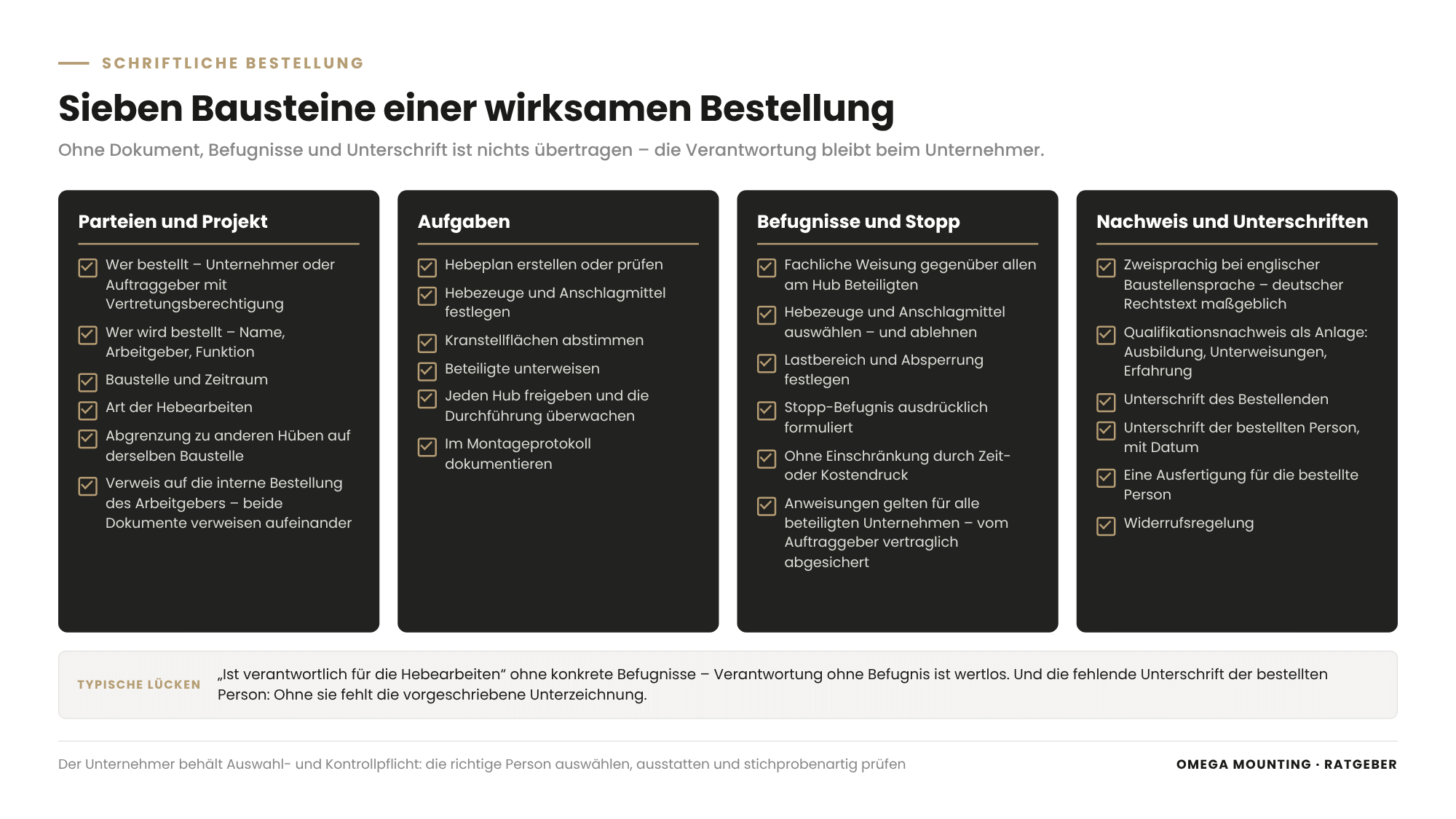
An effective appointment of an appointed person for lifting operations names the parties and the project and describes the delegated tasks and powers, including the authority to stop work. It documents the qualification and bears the signatures of both sides.
The seven building blocks
- Parties: who appoints (employer or client with authority to represent), who is appointed (name, employer, function).
- Project and scope: construction site, period, type of lifting operations, where applicable delimitation from other lifts on the same site.
- Tasks: prepare or check the lift plan, specify lifting equipment and lifting accessories, coordinate crane set-up areas, brief those involved, release each lift, supervise execution, document in the installation report.
- Powers: technical instructions to everyone involved in the lift, selection and rejection of lifting equipment and lifting accessories, definition of load area and cordoning.
- Authority to stop work: expressly worded, without restriction by time or cost pressure.
- Evidence of qualification: as an annex – training, briefings, experience with comparable lifts, where applicable crane operator or slinger qualification.
- Signatures and copy: signature of the appointing party and the appointed person, date, a copy for the appointed person, revocation clause.
Typical gaps
Most often, the specific powers are missing: it says "is responsible for the lifting operations" but not whether the person may reject a crane or stop a lift. Responsibility without power is worthless. The signature of the appointed person is also frequently missing – and with it the required signing. On sites where English is the site language, the appointment should be bilingual, with the German legal text as the authoritative version.
When does your site need an appointed person for lifting operations?
You need an appointed person for lifting operations whenever a lift is not routine – and wherever the client requires one.
Criteria in favour of an appointment
- The load is heavy or bulky in relation to the lifting equipment and space, or its centre of gravity is off-centre.
- The lifting points are not certified by the manufacturer or have to be recalculated.
- The lift passes through installation openings, shafts or over obstacles with tight tolerances.
- Several lifting devices (tandem lift) or several companies are working on the lift or in its danger zone.
- The lift takes place during ongoing operations – in a data center, in production, at an airport.
- The crane set-up area is critical: shafts, ducts, underground car parks, embankments.
- The client or their safety system requires a person appointed by name.
Where the role is standard – and where it should become so
In data center construction in the Rhine-Main region, the appointed person for lifting operations is now standard on practically every site – whether in Frankfurt, Raunheim, Offenbach or Hanau. The same increasingly applies to logistics real estate and energy infrastructure. Our services in the area of Lift & shift – moving in heavy equipment therefore include the appointed person as a fixed component. But the appointment is also worthwhile for industrial companies in Rödermark, Dietzenbach or Seligenstadt as soon as a lift falls outside routine. Examples are the machine replacement under the overhead crane or the replacement of a generator set through the installation shaft. The appointment costs a sheet of paper and an hour of coordination – its absence can cost the lift, the equipment or a human life.
How do you recognise a qualified appointed person?
You recognise a qualified appointed person for lifting operations by demonstrable expertise in slinging and crane operation and by documented experience with comparable lifts. They can prepare and calculate a lift plan themselves. And they understand the stop as a normal part of the work.
Evidence you may require:
- Training and briefing certificates as a slinger and ideally as a crane operator.
- Training in planning lifting operations, load calculation and lifting accessories.
- References for comparable lifts: load class, environment, lifting equipment – without customer names, but with verifiable facts.
- Examples of self-prepared lift plans, anonymised.
- The employer's internal appointment as appointed person.
In Germany there is no state-regulated qualification for this role. Expertise results from training, briefing and experience – which is why the evidence of qualification as an annex to the appointment is so important. How to qualify subcontractors for lifting and installation work as a whole is covered in our fundamentals guide Qualifying subcontractors for lifting and installation work: which evidence you may require. For the tender meeting, one question is often enough: when did you last stop a lift – and why?
How we do it in practice
In our jobs in the Rhine-Main region, the appointed person for lifting operations is a fixed component of every lift-&-shift project – three examples.
Five diesel tanks over the retaining wall in Raunheim
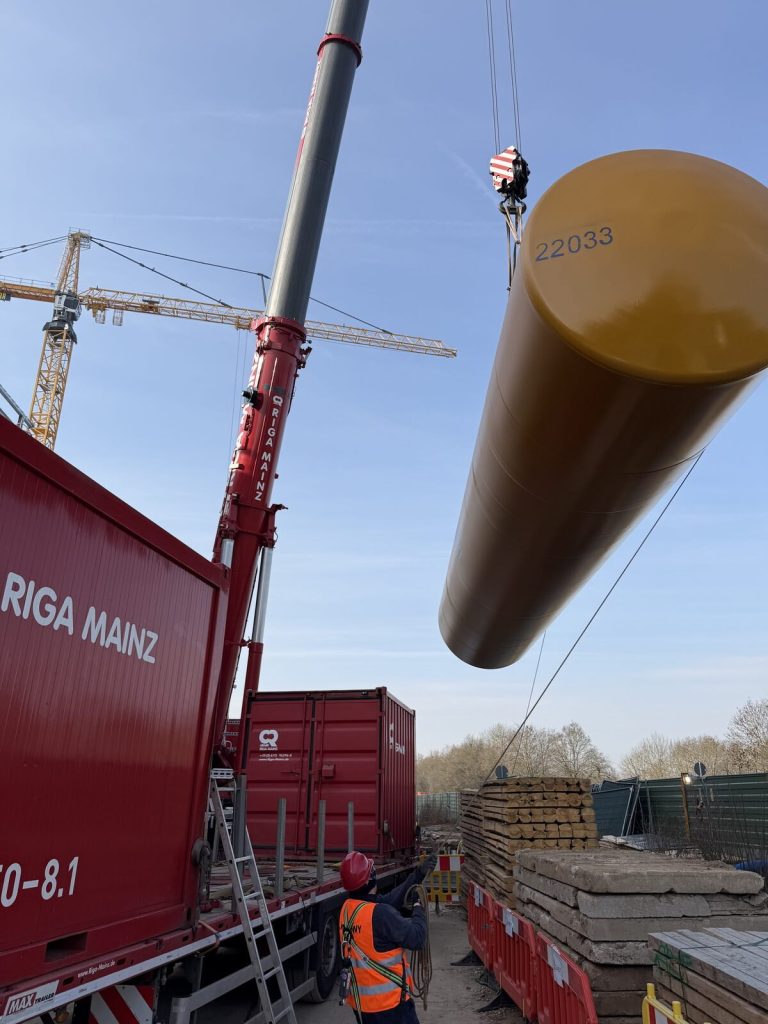
During the placement of five 100-cubic-metre diesel tanks into the pit of a data center in Raunheim we provided the appointed person for lifting operations. This was a separate service, independent of the crane hire company. Each tank weighed around 16 tonnes empty, was 16.16 metres long and had a diameter of 2.90 metres. Our task: prepare the lift plan, define lifting equipment and lifting accessories – round slings and shackles – and survey the crane set-up areas together with the crane hire company. In addition, check and recalculate the four lifting points welded onto the crown, then lifting supervision, slinging, signalling and alignment in the pit. The data center is in the middle of the town, with shafts and ducts beneath the ground; the mobile crane worked with a 52-metre main boom and a radius of up to 44 metres. After three days on site, every tank was where it belonged – responsibility sat in one place and was not pushed back and forth between the trades.
A spider crane out of the basement in Raunheim
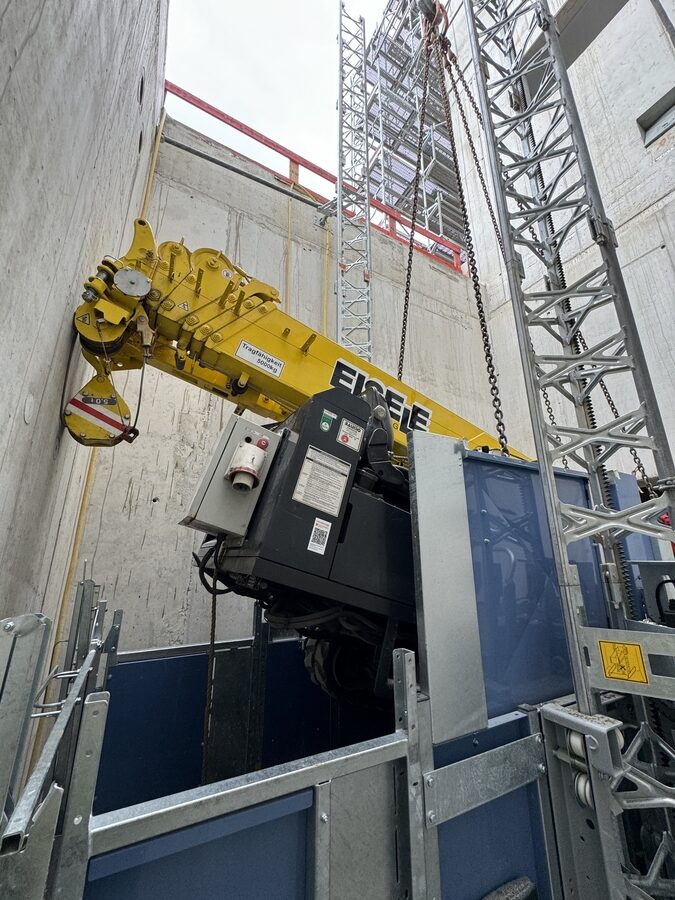
With the retrieval of a spider crane from the basement of a data center in Raunheim the building had been completed around the machine. In the retrieval shaft stood a construction hoist that could not be moved. Four fitters, one day. For the lift with the tower crane, a lift plan was drawn up with lifting points, geometry, sequence and responsibilities. The survey showed: hanging upright, two centimetres were missing. The solution was a controlled angled slinging on a four-leg, shortenable chain sling – with recalculated centre of gravity, leg forces and securing against swinging. "For us, angled means controlled angled, not 'it'll probably hold'."
CRAH replacement in a live data center in Frankfurt
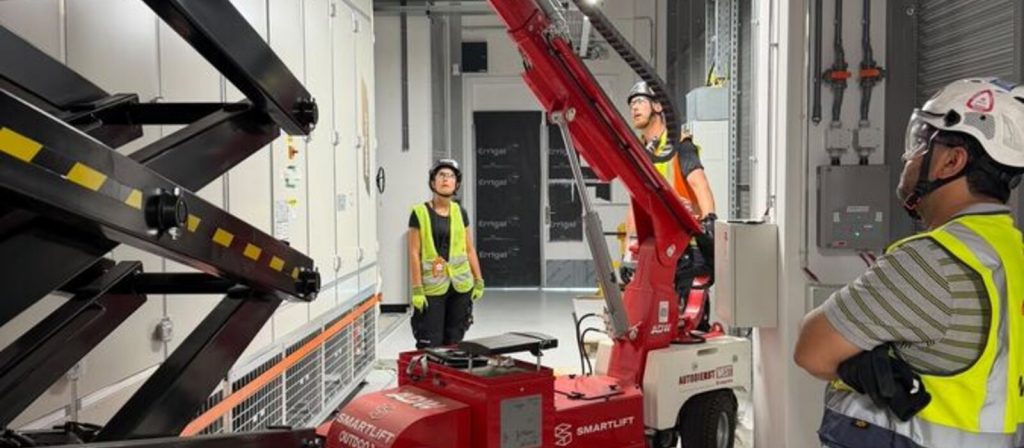
During the replacement of a CRAH unit in a live data center in Frankfurt a lifting supervisor and three riggers (slingers) worked two working days during ongoing operations. The new unit had to go up to the second floor, the defective one out of the plant gallery – through narrow aisles, over finished and accepted floors, past sensitive building services. Detailed lift plans were available for all lifting operations: load weights, lifting points, load handling attachments, machine positions, load paths, safety distances. At critical points, no machine moved without the supervisor's direction. Result: positioned in alignment to the millimetre, no damage, immediate completion notice for the work areas to the operator. You can find out more about our work in data centers on the page Installation and lift & shift in data center construction.
Do you have a lift coming up for which nobody is yet responsible for the release – or does your client require a person appointed by name? Then get in touch with us: with load data and a site plan, we can usually clarify within an hour whether we fill the role for you or supplement your internal appointment.
What this means for your role
For buyers: Include the appointed person for lifting operations as a separate item in the scope of works. Appointment, evidence of qualification and lift plan belong in it as part of the scope of supply, not as an optional item. Make the delegation of duties a criterion of suitability. Ask in the tender meeting who specifically fills the role and which comparable lifts this person has been responsible for.
For designers: The appointed person works with what you have planned – crane set-up areas with radius and ground bearing pressure, installation openings, floor loads, hook heights. Provide them with the planning parameters the lift plan needs: location of shafts and ducts beneath possible set-up areas, load assumptions for floors and lifting points on the supporting structure, transport data with centre of gravity and lifting points. And make provision in the detailed design for lift planning to take place before the date is fixed in the construction schedule.
For project managers and site managers: Clarify in writing before the first lift who the appointed person is. Introduce them to all parties at the site meeting and reserve time for them to prepare the lift plan. As site manager, you ensure that the work area and load area are cleared and cordoned off for the lift release, that the permit to work is in place and that preceding and following trades know the lift date. Accept a stop as part of the procedure, not as a disruption to your construction schedule – and receive the completion notice after the last lift.
For maintenance managers: In your plant too, every lift that falls outside routine needs a person who plans it, releases it and may stop it. This applies under your own overhead crane during repairs as much as to the replacement of a generator set through the installation shaft in the maintenance window. Check whether your internal delegation of duties covers this role or whether responsibility has so far tacitly rested with the crane operator. If you bring in an installation contractor, define who gives the release on the day of the lift and who provides isolation and the permit to work.
For safety officers and HSE coordinators: Check the appointment for completeness – tasks, powers, authority to stop work, evidence of qualification, both signatures – and the lift plan for plausibility: are load data, sling angles, outrigger loads and cordoning of the load area correct? Integrate the delegation of duties into the risk assessment for the lifting operations and coordinate it with the SiGe plan. Make sure that the briefing and toolbox talk before the lift are documented.
Sample appointment: template to request
Our sample appointment for an appointed person for lifting operations is a neutral, bilingual template (German/English) with which clients, general contractors and installation contractors can delegate the role. It contains the table of parties and project, the list of tasks from lift planning to the release of each lift, and the powers including the authority to stop work. Added to these are an annex placeholder for the evidence of qualification, revocation and acceptance clauses with signature fields and a checklist for appointments received. Request the sample appointment via our Contact form – keyword "Appointed person for lifting operations".
Why Omega Mounting?
We are based in Rodgau near Frankfurt and provide the appointed person for lifting operations as a stand-alone service or as part of our lift-&-shift projects. This applies in data center construction in Frankfurt, Raunheim and Offenbach as much as in industrial companies throughout the Rhine-Main region. The linked jobs show how we understand the role: lift plan before the lift, release for each individual lift, stop without discussion. Our workshop in Rodgau manufactures auxiliary structures where needed, and via our 24-hour hotline you can reach us even when a lift has to be re-planned at short notice. For you, this means: a person appointed in writing with evidence of qualification, lift plan, slinging and lifting supervision from a single source – and a contact who can be on your site in the Rhine-Main region at short notice. Whether we can fill the role on your project is something we clarify after a brief description of the lift – just ask us.
Conclusion
The appointed person for lifting operations is not a foreign additional requirement of international construction sites but a function that German occupational safety law has long provided for via the delegation of duties. They plan the lift, release it, direct it and stop it when necessary – with technical authority to issue instructions to everyone involved, but without disciplinary power. The role only becomes effective through a written appointment with tasks, powers, evidence of qualification and both signatures. Appointed person for lifting operations – under this heading the role belongs in the invitation to tender, the appointment and the lift plan. If you need one for your next project or would like your tender documents checked for it: Send us load data, site plan and lift date. We will get back to you with an honest assessment of what the lift needs in terms of planning and supervision.
Planning maintenance, moving in or installation in the Rhine-Main region?
Tell us briefly what it is about – we will come back to you with an honest assessment.
100% free and without obligation
You may also be interested in these guides
Occupational safety

About the author
Tobias Schott
Managing director of Omega Mounting GmbH, Rodgau · more than 20 years of hands-on experience in installation and maintenance
A trained mechatronics technician, at home in maintenance, servicing and industrial installation since 2004 – first at his father's side, since 2012 with Omega Mounting: from the overhead conveyor in Frankfurt to the crane system in a new-build hall. Plans and leads lifting operations as appointed person in data centers and on industrial sites in the Rhine-Main region, is an instructor and examiner for cranes, mobile elevating work platforms and telehandlers, and a safety officer. On jobs abroad he is known as the “German Troubleshooter” – the one you call when things get stuck on site. He learned what quality means not from a manual but from his father: Made in Germany as a standard for his own work, not as a label. That is why it comes first at Omega Mounting – before speed and before price. He writes these guides from that practice: what works on our sites is in them – what only exists in the standard is not.
Frequently asked questions
The Lifting Appointed Person is responsible for the planning and overall system of the lifting operation; the Lifting Supervisor supervises execution on site. On smaller sites, one person takes on both functions; on large projects, they are staffed separately. In German law, the Appointed Person corresponds to the appointed person designated in writing (verantwortliche Person), the Supervisor to the Aufsichtführender.
Yes. Section 13 ArbSchG (German Occupational Safety Act) and DGUV Regulation 1 require a written appointment that defines the area of responsibility and the powers and is signed by the appointed person. A verbal agreement delegates nothing in legal terms – responsibility then remains entirely with the employer.
Both occur. The installation contractor appoints its employee internally by delegation of duties as the appointed person for its own lifting operations. In addition, the client or general contractor can name this person as the Appointed Person for the site and contractually oblige the companies involved – crane hire company, subcontractors, specialist trades – to follow their instructions. It makes sense for both documents to refer to each other.
On data center construction sites in Frankfurt, Raunheim or Offenbach, the appointed person named in writing is standard. The installation contractor submits the appointment with evidence of qualification before work starts on site, prepares a lift plan for each lift and has it approved before the day of the job. On the day of the lift, the appointed person releases each lift individually. The German legal basis and the requirements of international general contractors can be brought together in one bilingual document.
The role makes sense in every sector in which lifts fall outside routine. Examples: machine replacement in production, lifting in tanks or generator sets, crane erection in structural steelwork, moving in equipment in logistics halls or in the security area of an airport. The legal basis is the same; only the environment and trades differ. In data center construction, the role simply became standard earlier.
The stop is part of the procedure, not its failure. The appointed person names the reason, those involved remedy it – a different lifting accessory, an additional load spreading plate, waiting for a wind window below the wind limit – and then the lift is released again. As site manager, you inform the following trades and the haulier about the postponement and keep the fallback from the lift plan ready. A construction schedule that cannot absorb a single stop was too tight from the start.
There is no state-regulated qualification in Germany; the law requires reliability and expertise, which result from training, briefing and experience. Customary are qualifications as a slinger, ideally as a crane operator with written appointment, training in lift planning and load calculation, and demonstrable experience with comparable lifts. The evidence of qualification belongs as an annex to the appointment.
The health and safety coordinator (SiGeKo) under the BaustellV (Construction Site Ordinance) coordinates the work of the various trades across the entire construction site and draws up the SiGe plan. The appointed person for lifting operations is responsible for the individual lifting operation – with considerably deeper expertise in crane and slinging technology. Both work together: the SiGeKo regulates the interfaces and danger zones between the trades, the appointed person the lift. Under the technical rule on risk assessment, the SiGeKo can at the same time be the coordinator appointed in writing for the lifting operations of several employers – or they delegate this task to the appointed person.
Send us three details via the Contact form, keyword "Appointed person for lifting operations": load data with weight, dimensions and lifting points, a site plan with a possible crane set-up area and the planned lift date. We check whether a site visit is necessary and send you a written assessment with the scope of lift planning, staffing of the role and the draft appointment with evidence of qualification. Your contact is Tobias Schott.
 English
 German