
- Guide – Lift & Shift
What is industrial installation? Services, process and scope
By Tobias Schott · Reading time approx. 24 minutes · Last updated: October 2026
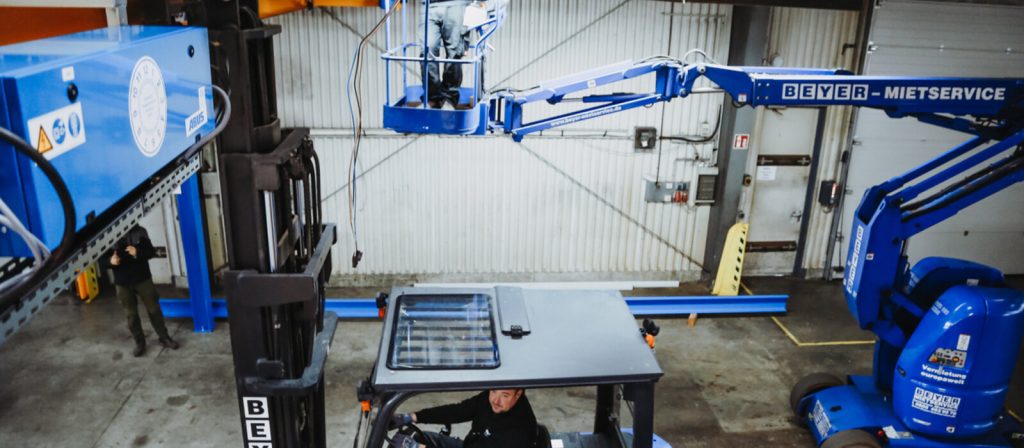
Industrial installation is the mechanical installation of machines, plant and steel structures at the operator's site – from moving in through alignment and anchoring to handover. Those who know the term know what service they are requesting, where the trade ends and what information an installation contractor needs to give an honest answer.
The enquiry sounds simple: “We need someone to set up the new machine.” Behind it lies an entire trade. The machine has to get through the gate, onto the foundation, into alignment, to torque, onto compressed air and power – and finally into the acceptance report. Anyone searching for “what is industrial installation” usually wants to know exactly that: which services are included, how such a job runs, and where the installation contractor's responsibility ends?
The answer decides the award. One quotation that includes moving in, another that assumes it is provided by the client, and a third that does not mention the electrics at all: all three call themselves industrial installation. Only those who know the service modules and phases can bring the quotations to the same scope.
This guide is the foundation page for our installation guides. It explains the term, distinguishes it from plant engineering, electrical installation, building services and haulage, shows the seven service modules, the process in phases, the roles on site and the English terms. Written from the perspective of an installation contractor from Rodgau near Frankfurt that has been doing exactly this for years – and says what it does not do.
Key points at a glance
- Industrial installation is the mechanical installation of machines, plant and steel structures at the operator's site: moving in, setting up, aligning, anchoring, connecting, commissioning, handing over.
- It is distinct from plant engineering (designs and supplies), from electrical installation (power supply and electrical testing), from building services (utilities and construction) and from haulage (transport on the road).
- Seven service modules belong to it: new installation, moving in, relocation, dismantling, conversion in existing facilities, maintenance and custom fabrication.
- An installation job runs in seven phases: enquiry, site visit, installation planning, site set-up, installation, alignment and anchoring, handover.
- There are fixed roles on site: installation supervisor, appointed person for lifting operations, the client's coordinator, slinger and banksman, qualified electrician.
- Industrial installation, machinery relocation and rigging are the English equivalents – they come up in data centers and with international clients.
What is industrial installation? A definition
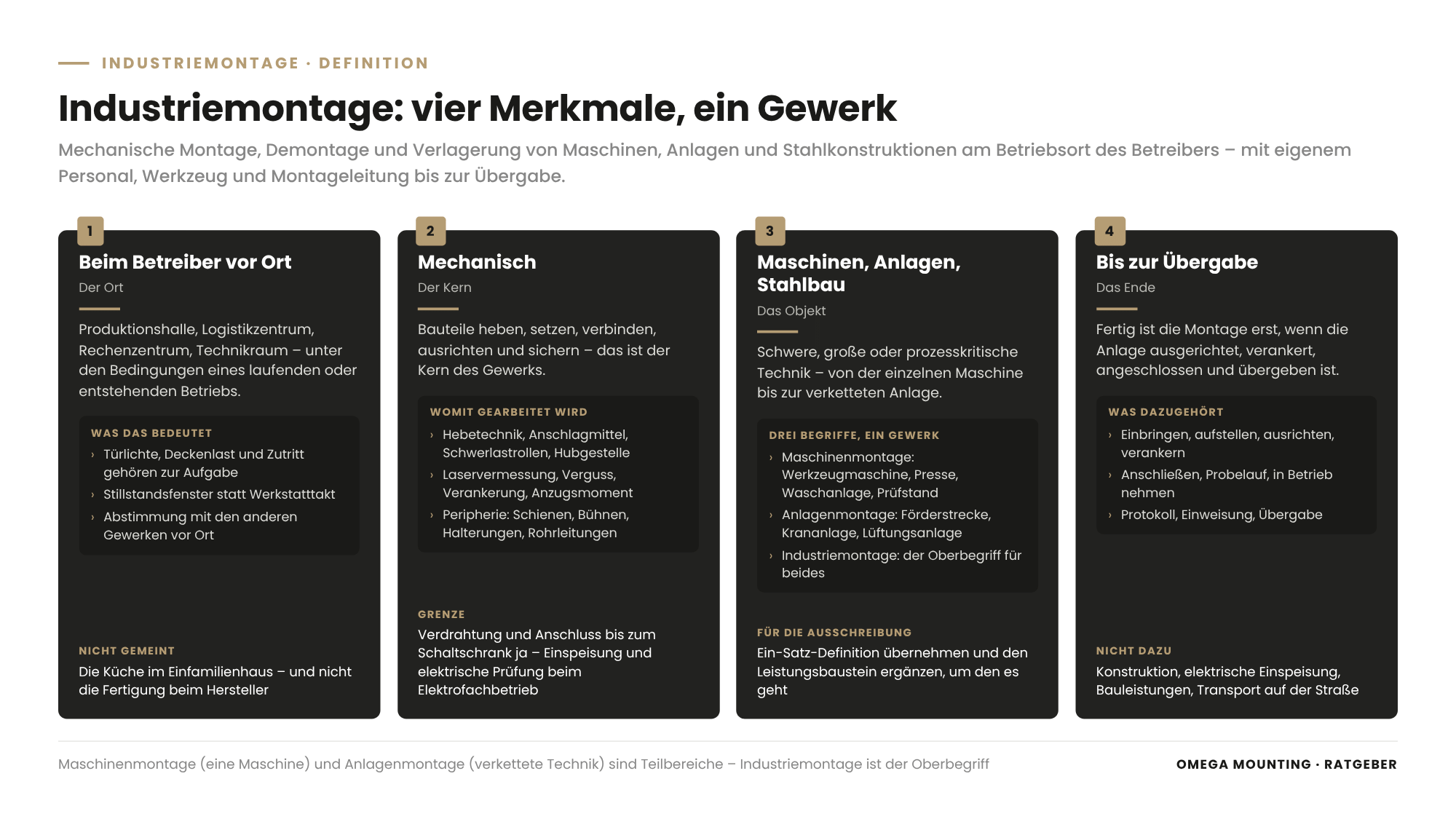
Industrial installation is the mechanical installation, dismantling and relocation of machines, plant and steel structures at the operator's premises – carried out by an installation contractor with its own personnel, its own tools and its own installation supervision, until the plant is aligned, anchored, connected and handed over.
The German term “Industriemontage” has two parts. “Montage” means assembling and setting up components into a functional unit. “Industrie” means the place and the object: not the kitchen in a family home, but the production hall, the logistics centre, the data center, the plant room. It refers to the installation of heavy, large or process-critical equipment under the conditions of a running or emerging operation.
Mechanical installation as the core
The core of industrial installation is mechanical installation: lifting, setting, connecting, aligning and securing components. This includes lifting equipment and lifting accessories, machine skates and gantries, laser surveying, grouting and anchoring, bolting to torque and the installation of mechanical peripherals – rails, platforms, brackets, pipework. An installation contractor that employs mechatronics technicians often also takes on the wiring of the plant and the connection up to the control cabinet. The power supply from the building and the electrical testing remain with the electrical contractor.
Industrial installation, plant installation, machine installation – the same trade
The terms plant installation and machine installation describe sub-areas of the same trade. Machine installation is the installation of a single machine – machine tool, press, washing system, test rig. Plant installation is the installation of interlinked equipment – conveyor line, crane system, ventilation system, vehicle restraint systems at many gates. Industrial installation is the umbrella term. Anyone who needs a definition of industrial installation for a tender can adopt the one-sentence definition above and add the service module in question.
What is industrial installation not? Distinction from plant engineering, electrical installation, building services and haulage
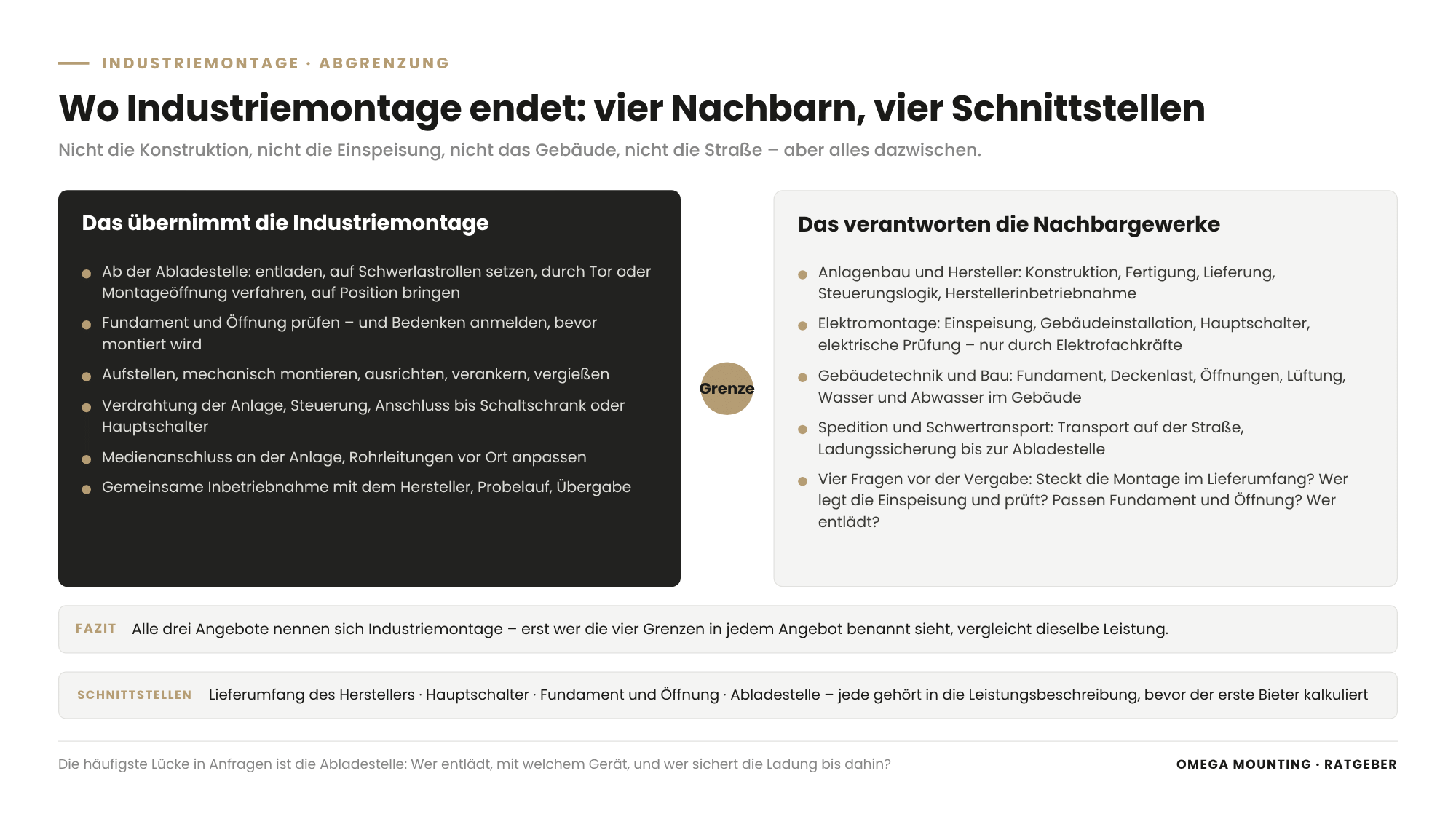
Industrial installation is not the design of the plant, not the electrical power supply, not the construction of the building and not the transport on the road – at each of these four boundaries lies an interface that must be clarified before the award.
| Neighbouring trade | What it is responsible for | Where industrial installation begins |
|---|---|---|
| Plant engineering and manufacturer | Design, manufacture, delivery, control logic, manufacturer commissioning. | Entladen, einbringen, aufstellen, mechanisch montieren, gemeinsame Inbetriebnahme. |
| Electrical installation | Power supply, building installation, main switch, electrical testing. | Wiring of the plant, control system, connection up to the control cabinet or main switch. |
| Building services and construction | Foundation, floor load, ventilation, water and drainage in the building, openings. | Checking the foundation, media connection at the plant, adapting pipework on site. |
| Haulage and heavy transport | Transport on the road, load securing up to the unloading point. | From the unloading point: unloading, moving inside the building, moving in through the opening. |
Industrial installation and plant engineering
The plant engineer develops, manufactures and supplies the plant. The installation contractor sets it up at the operator's site. It often works as the installation partner on behalf of the manufacturer – as with the installation of 32 vehicle restraint systems at a logistics centre near Leipzig, which was commissioned together with the manufacturer. Anyone buying a plant should therefore ask whether installation is included in the scope of supply or is awarded as a separate trade.
Industrial installation and electrical installation
The boundary runs at the main switch. For the double-girder overhead crane in the Aschaffenburg area, our fitters installed conductor rails, control system and the connection up to the main power switch. From there, the customer's plant electrician took over. Under DGUV Vorschrift 3 (DGUV Regulation 3), work on the building's electrical installation may only be carried out by qualified electricians. For you this means: clarify before the award who lays the power supply and who carries out the electrical testing.
Industrial installation and building services
Foundation, floor load, openings and utilities in the building are construction services. The installation contractor checks whether foundation and opening suit the plant and raises concerns before installing. Pipework directly at the plant often belongs to the installation again: for a parts washer in Kassel, the supply and exhaust air was adapted on site as a welded stainless steel pipe system.
Industrial installation and haulage
The haulier brings the plant to the unloading point. From there, moving in begins: unloading, placing on machine skates, moving through the gate or installation opening, bringing into position. The interface at the unloading point is the most common gap in enquiries – who unloads, with what equipment, and who secures the load until then?
Which services belong to industrial installation?
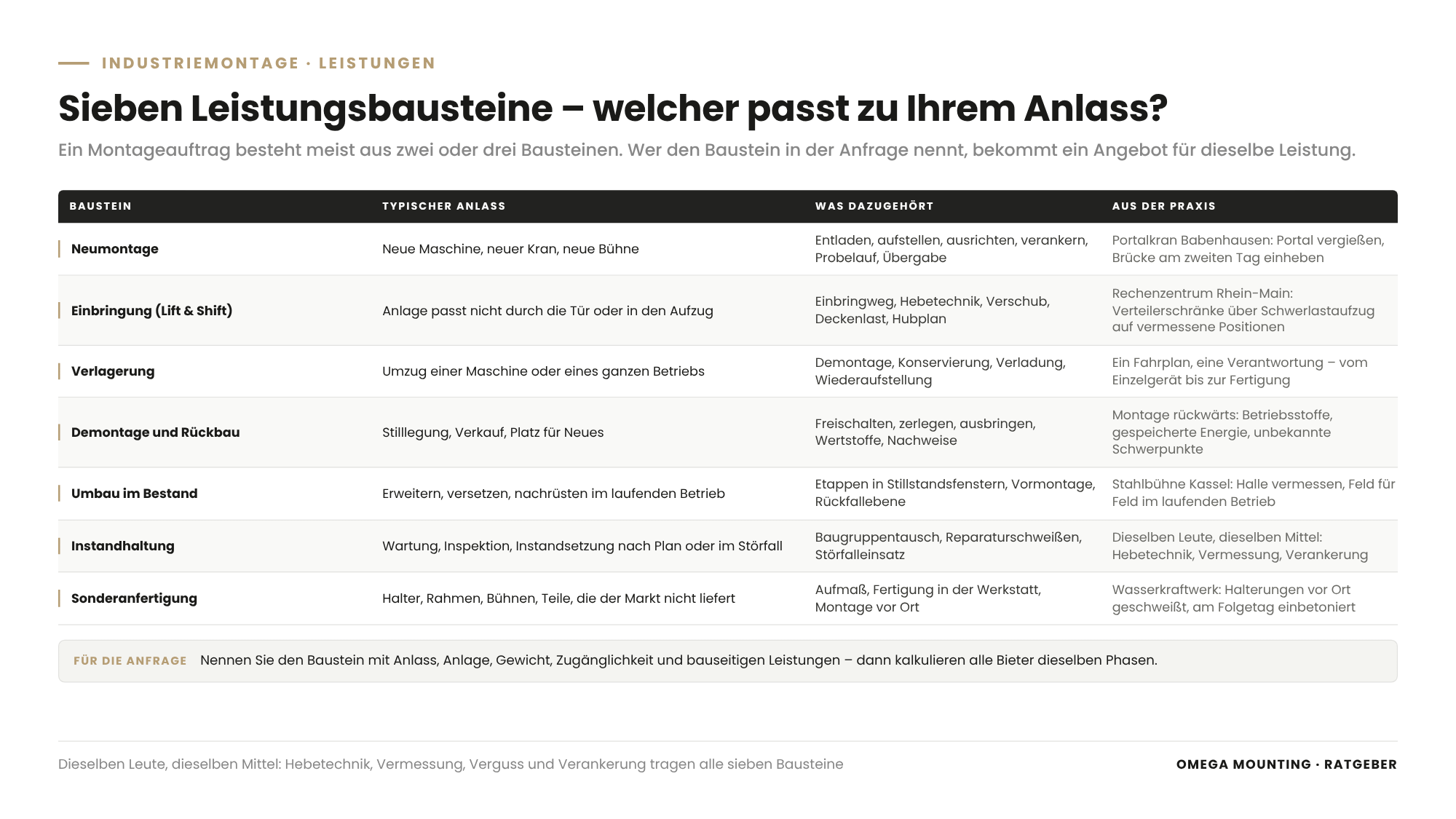
Industrial installation comprises seven service modules: new installation, moving in, relocation, dismantling, conversion in existing facilities, maintenance and custom fabrication – an installation job usually consists of two or three of them. Which industrial installation services we offer in detail is shown on our service page Industrial installation; the table arranges the modules with trigger, content and further reading.
| Module | Typical trigger | What is included | Further reading |
|---|---|---|---|
| New installation | New machine, new crane, new platform. | Unloading, setting up, aligning, anchoring, connecting, trial run, handover. | Aligning and anchoring a machine. |
| Moving in (Lift & Shift) | Plant does not fit through the door or into the lift. | Access route, lifting equipment, skidding, openings, floor load, lift plan. | Lift & Shift installation, moving-in sequence. |
| Relocation | Relocation of a machine or an entire operation. | Dismantling, preservation, loading, reinstallation, commissioning. | Machinery relocation by a contractor, machinery relocation service. |
| Dismantling and removal | Decommissioning, sale, space for something new. | Isolating, disassembling, moving out, separating recyclables, documentation. | Industrial dismantling. |
| Conversion in existing facilities | Extension, repositioning, retrofitting during live operations. | Stages in maintenance windows, pre-assembly, fallback level. | Maintenance during live operations. |
| Maintenance | Servicing, inspection, repair to plan or in a breakdown. | Assembly replacement, repair welding, crane runway survey, breakdown call-out. | Installation contractor in the Rhine-Main region. |
| Custom fabrication | Brackets, frames, platforms, parts the market does not supply. | Site survey, fabrication in the workshop, installation. | Custom metal fabrication. |
New installation
New installation is the classic case: a delivered machine or plant is set up and made ready for operation. For the gantry crane in Babenhausen, that meant: erect the gantry from columns, head pieces and runway girders, laser-survey it, grout the base plates, lift in the pre-assembled bridge on the second day and install the conductor rail, limit switches and control system. What counts when setting up is described in our guide on aligning and anchoring machines.
Moving in – Lift & Shift
Moving in means: a plant that does not fit through the door still reaches its position – via installation openings, goods lifts, skidding systems or crane lifts. The English term Lift & Shift is common in data centers. For 160 power distribution cabinets in a data center in the Rhine-Main region, distribution ran via the goods lift across four levels, lifting with gantry and chain hoist, setting down on laser-surveyed positions. The basics are in our guides on Lift & Shift installation and on the sequence of a moving-in day.
Relocation and machinery relocation
In a relocation, a machine or an entire operation moves. Dismantling, preservation, loading, transport, reinstallation and commissioning form one coherent schedule with one responsibility. Our guide on machinery relocation by a contractor describes the steps; our service page Machinery relocation the scope from a single machine to an entire production line.
Dismantling and removal
Dismantling is installation in reverse – with different risks: operating fluids, stored energy, unknown centres of gravity, separation of recyclables and documentation. What to consider is in the guide on industrial dismantling and plant removal.
Conversion in existing facilities
Conversion in existing facilities is industrial installation during live operations: extending a line, inserting a platform, retrofitting a gate, repositioning a plant – in maintenance windows, with pre-assembly outside the plant and a fallback level for each stage. The installation of a steel platform in a production hall at Kassel Airport is one such case: laser-survey the hall, set the columns of the first bay and check the diagonal, place the floor plates with the overhead crane, install railings and stairs with the first plates. What needs to be planned before such a platform is in the guide on planning a steel platform; how work alongside production is organised is described in the guide on Maintenance during live operations.
Maintenance
According to DIN 31051, maintenance is the sum of servicing, inspection, repair and improvement. For the installation contractor this means: replacing assemblies, surveying crane runways, repair-welding cracks, coming out in a breakdown. It belongs to industrial installation because the same people work with the same means – lifting equipment, surveying, anchoring. What this looks like on crane systems is shown in the guide on maintenance and replacement of crane systems. What proximity is worth in a breakdown is shown in the guide on the installation contractor in the Rhine-Main region.
Custom fabrication
Not every part comes from the catalogue. Brackets, frames, consoles, platform elements and spare parts that the market no longer supplies are made to site survey in the workshop. During the Installation of a hydropower plant in an existing building brackets and supports were welded on site before being concreted in the following day. More in the guide on custom metal fabrication with installation.
How does an installation job run? Seven phases from enquiry to handover
An installation job runs in seven phases: enquiry, site visit, installation planning, site set-up, installation, alignment and anchoring, handover – and each phase leaves a document by which you can later tell whether it took place. The industrial installation process is the same for a two-day job as for a project over weeks; only the depth of each phase changes.
Phase 1: enquiry
The enquiry states the plant, weight and dimensions, location, accessibility, preferred date or maintenance window and the services provided by the client. A photo without dimensions is not an enquiry. What belongs in a complete enquiry and what a reliable quotation consists of is described in our guide on commissioning industrial installation. For larger awards, the scope of works for installation and moving in is the basis.
Phase 2: site visit
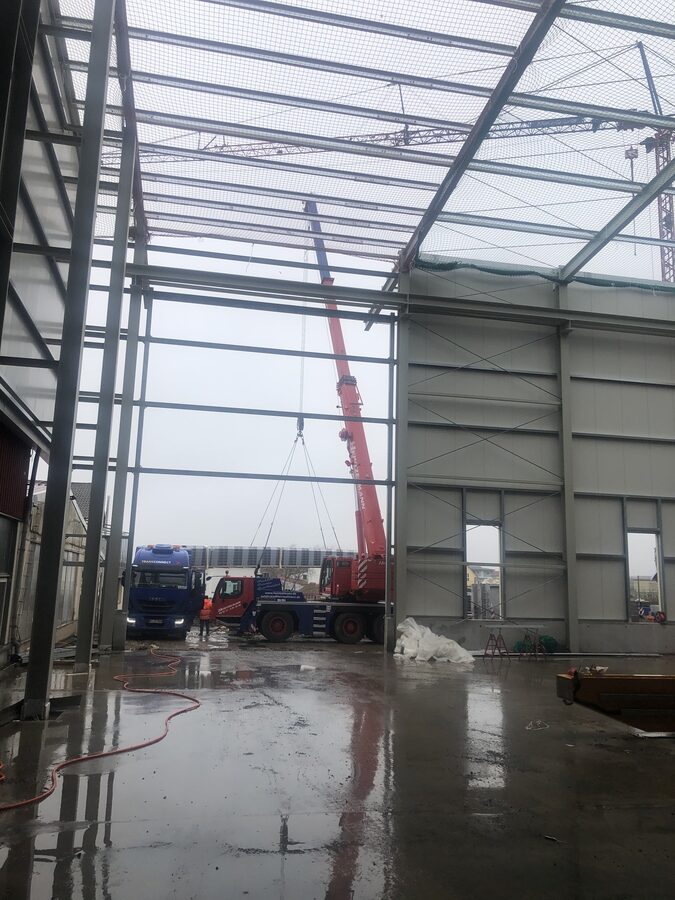
The site visit checks what the enquiry claims: door clearance, floor load, crane set-up area, foundation, utilities, access. For the overhead crane in the Aschaffenburg area, the crane's diagonal dimension decided the route through the hall – and the still-open wall bays made the lift-in easy. The site visit is the moment when an installation contractor can honestly say what is possible.
Phase 3: installation planning
Installation planning defines the installation sequence, lifting equipment, personnel, tools and safety. For lifting operations, a lift plan and risk assessment are produced – for international clients as a method statement and RAMS, i.e. work instruction with risk assessment. How both are structured is shown in the guide on RAMS and risk assessment for installation. In large projects, the interface list is added, described in the guide on interfaces in large projects.
Phase 4: site set-up
Site set-up creates the conditions for installation: access, set-down areas, floor protection, barriers, storage areas, power. In the data center, that means protective plates and fleece on travel and work routes. At the hydroelectric power plant, it meant: reinforcing a dilapidated access road with steel plates, keeping the riverbed dry with timber shoring, sandbags and pumps, propping girders with steel shores. Only then did the first lift begin.
Phase 5: installation
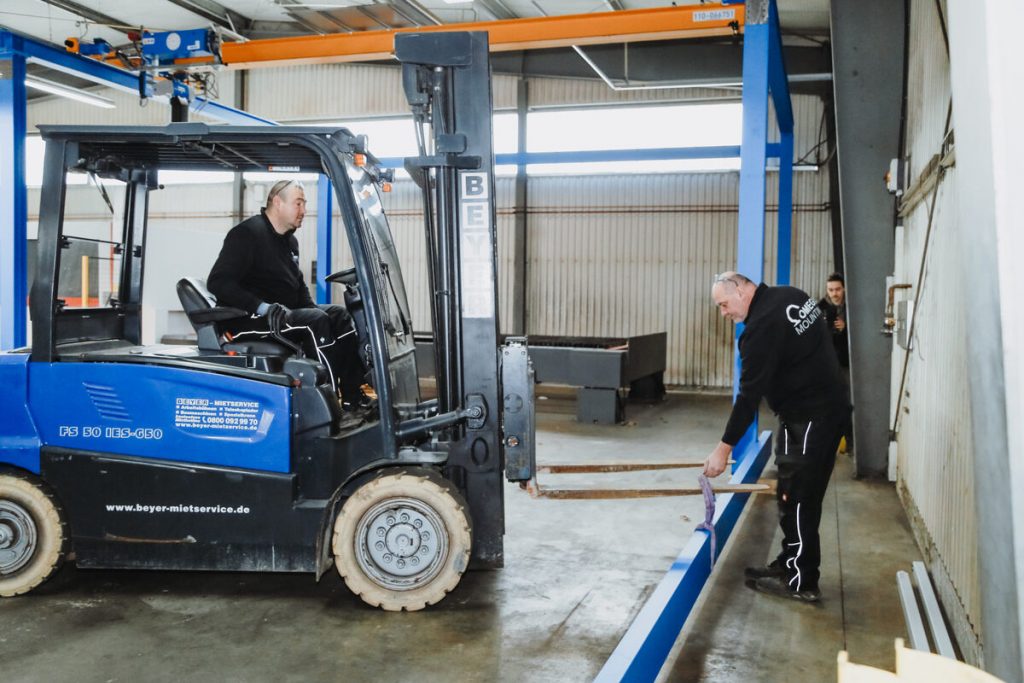
Installation is the phase everyone thinks of: pre-assembly on the ground, lifting in, setting, connecting. For the gantry crane, the bridge was pre-assembled on the ground with chain hoist, travel units and cable guide and then lifted in with the forklift. Pre-assembly outside the window is the most effective way to save time in the window.
Phase 6: alignment and anchoring
Alignment and anchoring decide the service life of the plant: laser surveying, levelling, alignment and diagonal, grouting, anchors or anchor bolts, torques, curing time. In Babenhausen, the gantry's base plates were grouted and cured overnight before the bridge arrived. For the parts washer in Kassel, the plant only stood correctly once the parts ran centred in the basket. Media connection and trial run follow.
Phase 7: handover
The handover concludes the job: trial run, functional test, briefing, installation record, punch list, acceptance. Under the BetrSichV (German Industrial Safety Ordinance), an installed item of work equipment whose safety depends on the installation must be inspected before first use – for you this means that the inspection before commissioning belongs in the schedule, not in the week after. How handover and acceptance run properly is described in the guide on commissioning and handover of a plant.
Who does what on the installation site? Roles and responsibility
On an installation site, there are five roles that must always be filled: the installation contractor's installation supervisor, the appointed person for lifting operations, the client's coordinator, slinger and banksman, and the qualified electrician – regardless of whether two or eight industrial fitters are on site.
Installation supervisor and site manager
The installation supervisor leads the installation team, is responsible for the sequence, quality and safety of their own work and is the site manager's point of contact. The client's site manager briefs, coordinates the trades and gives releases. Under a contract for work, the installation contractor brings the installation supervision; under temporary agency work, the right to issue instructions would lie with the customer. Which model suits which site is explained in the guide on external industrial fitters.
Appointed person for lifting operations
Every lift has a responsible person: the person who releases the lift plan, lifting accessories, crane set-up area and exclusion zone and directs the lift – in English, lifting supervisor or appointed person. Who that is and what they decide is described in the guide on the appointed person for lifting operations.
The client's coordinator
If several companies work at the same location, the client must coordinate the work and appoint a coordinator – this is required by DGUV Vorschrift 1 (DGUV Regulation 1). For you this means: before the first installation day, name who at your company briefs, issues permits to work and gives releases. How this is organised is shown in the guide on contractor management.
Slinger, banksman, crane operator
The slinger selects the lifting accessories and attaches the load. The banksman gives signals to the crane or forklift operator. The crane operator drives. When moving in a runway girder by forklift in Babenhausen, these roles were split between two fitters. Their appointment is a credential you may ask for.
Qualified electrician
Everything beyond the main switch belongs to the qualified electrician – at the installation contractor or at the customer. A team of mechatronics technicians, fitters and electricians, as in Leipzig, covers mechanics and plant electrics. The power supply and the electrical testing remain with the electrical contractor.
Which qualifications and credentials does an installation contractor need?
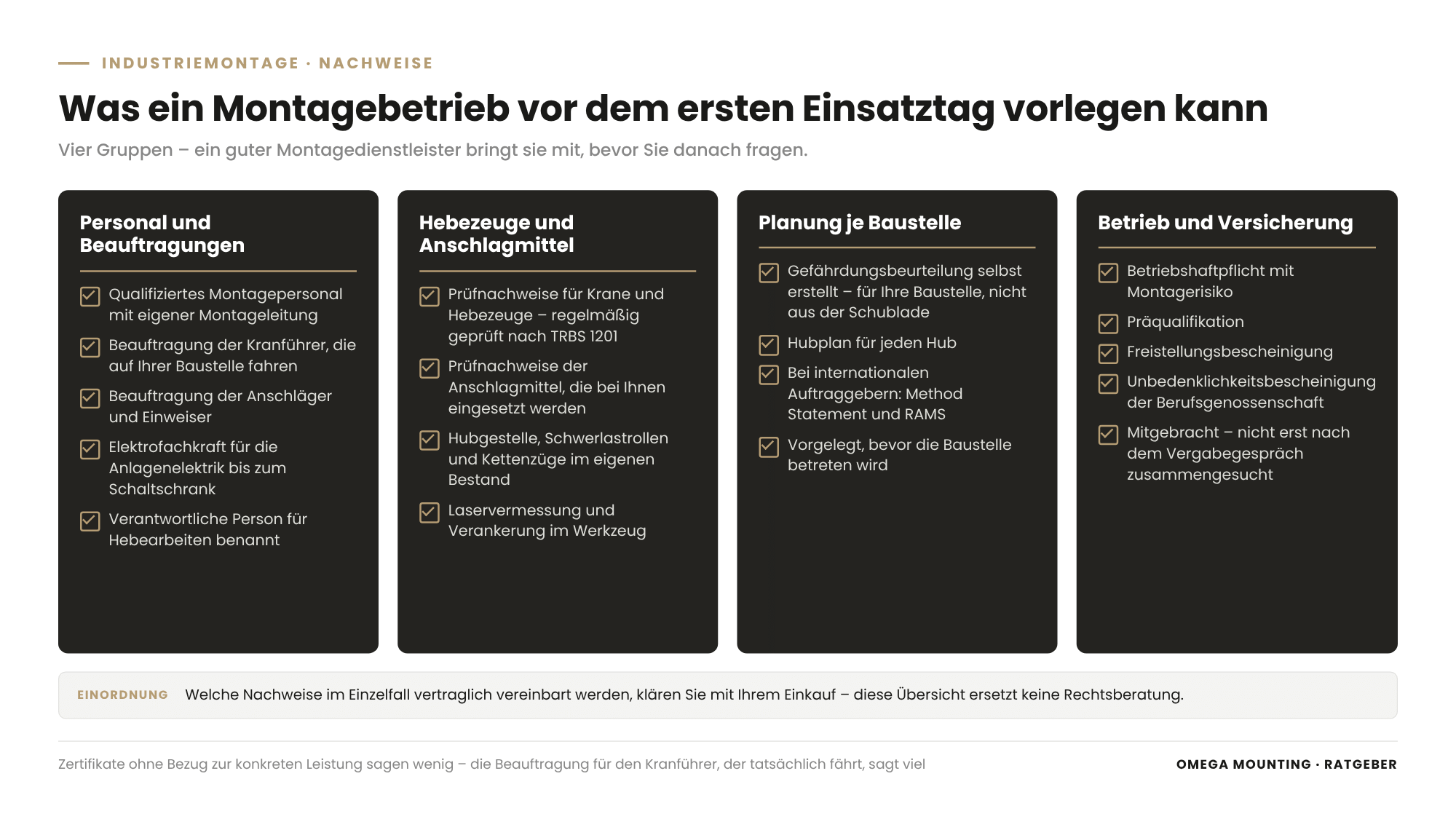
An installation contractor needs demonstrably qualified personnel, appointed crane operators and slingers, inspected lifting equipment and lifting accessories, public liability insurance covering installation risk and the ability to produce the risk assessment and lift plan itself – and it must be able to present these credentials before the first day on site.
The German technical rule TRBS 1201 stipulates that cranes, lifting equipment and lifting accessories are inspected regularly. For you this means: ask to see the inspection records of the lifting accessories used on your site. Which credentials you may demand from a subcontractor and which say nothing is explained in the guide on subcontractor credentials in installation.
What installation service providers should bring of their own accord
A good installation service provider does not wait to be asked. It brings prequalification, tax exemption certificate, clearance certificate from the employers' liability insurance association, appointments and inspection records, and presents the risk assessment and lift plan before entering the site. Those who only gather the documents after the award meeting do not have them in daily practice. This guide is no substitute for legal advice – which credentials are contractually agreed in the individual case is for you to clarify with your purchasing department.
Industrial installation, machinery relocation, rigging: the English terms
Industrial installation is the English equivalent of Industriemontage, machinery relocation of Maschinenverlagerung and rigging of Hebe- und Anschlagtechnik – on installation sites in data centers and with international clients, these terms come up daily. The table arranges the most important pairs.
| English | German | What is meant |
|---|---|---|
| Industrial installation | Industriemontage. | Mechanical installation of machines and plant at the operator's site. |
| Machinery relocation | Maschinenverlagerung. | Dismantling, transport and reinstallation of a machine. |
| Rigging, Rigger | Hebe- und Anschlagtechnik, Anschläger. | Slinging, lifting, moving and setting down loads. |
| Lift and Shift | Einbringung. | Lifting and moving heavy plant inside the building. |
| Lifting Supervisor, Appointed Person | Appointed person for lifting operations. | Release and direction of every lift. |
| Banksman, Signaller | Einweiser. | Signals for crane and forklift operators. |
| Slinger | Slinger. | Selection and attachment of lifting accessories. |
| Method Statement, RAMS | Arbeitsanweisung mit Gefährdungsbeurteilung. | Description of how the work is done and with which protective measures. |
| Permit to Work | Erlaubnisschein. | Release for work involving particular hazards. |
| Handover | Übergabe. | Conclusion with record and punch list. |
Anyone tendering an industrial installation therefore means an Industriemontage – and should carry the German terms in the specification so that all bidders understand the same thing. What additionally applies in data centers is described in the guide on installation in data centers.
How industrial installation works with us in the Rhine-Main region
For us, industrial installation in the Rhine-Main region means: crane systems in steel construction and production companies in Babenhausen, Aschaffenburg and Hanau, power distribution and cooling in data centers in Frankfurt and Offenbach, conveyor technology in logistics centres near Darmstadt, machines and platforms in workshops from Rodgau to Kassel. As an installation contractor in Rhine-Main, distances are short: site visit, installation and rectification without overnight travel – and reachable via the 24-hour hotline when a plant is down.
What we bring is the trade from a single source: mechatronics technicians who cover mechanics and plant electrics, lifting equipment from chain hoist to coordinating the mobile crane, laser surveying, grouting and anchoring, on-site welding and a workshop in Rodgau for brackets, frames and parts that are missing. Where we are not responsible, we say so: design and control logic with the manufacturer, power supply and electrical testing with the electrical contractor, transport on the road with the haulier.
How we do it in practice
Four jobs from our project diary show four service modules and the same way of working: survey instead of assume, pre-assemble instead of improvise in the window, clarify the boundary to the neighbouring trade beforehand.
Babenhausen: gantry crane in two days on site
With the installation of a gantry crane in Babenhausen a steel construction company needed a crane that brings its own supporting structure so that the hall is not loaded. On the first day, two fitters erected the gantry from columns, head pieces and runway girders, laser-surveyed it for height and diagonal and grouted the base plates – curing overnight. On the second day, the 2 t single-girder bridge was pre-assembled on the ground with electric chain hoist, travel units and cable guide, lifted onto the gantry runway with the forklift and completed with conductor rail, pre-limit and end limit switches and control system.
For your new installation, this means: grouting and curing time belong in the schedule. Those who want to see the bridge on the first day get a crane out of alignment on the second.
Aschaffenburg area: double-girder overhead crane in one day on site
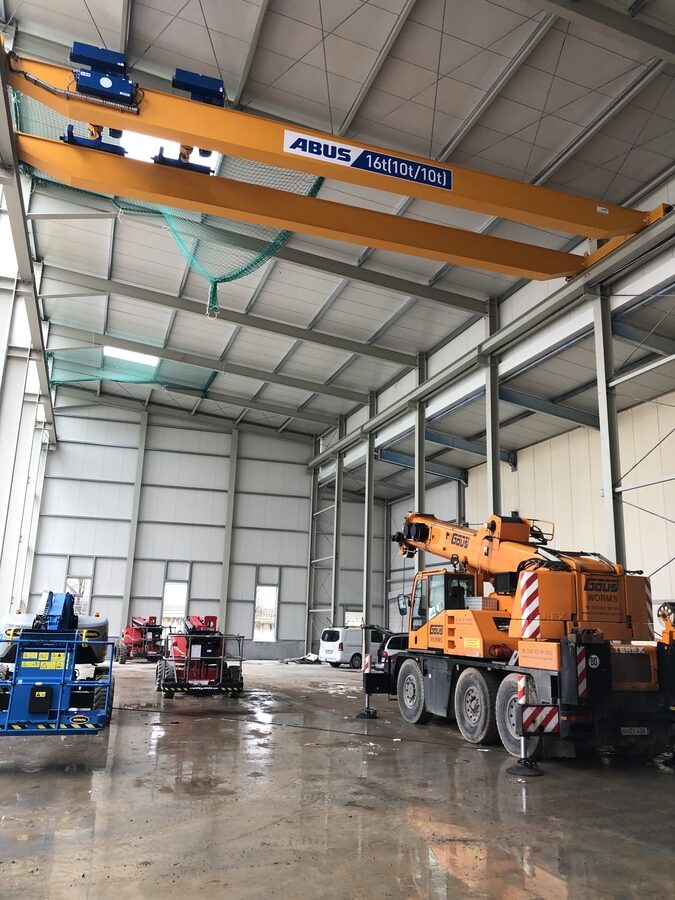
With the installation of a double-girder overhead crane near Aschaffenburg the job was a crane with 16 t total capacity and two hoist trolleys of 10 t each that can work in tandem – in a new hall. Delivery by lorry into the hall, pre-assembly on the ground, lift-in with the mobile crane, turning onto the crane runway. Then conductor rails, pre-limit and end limit switches, radio control and the connection up to the main power switch. From there, the customer's plant electrician took over. Two fitters, one day on site.
For your crane installation, this means: the point in the construction sequence is decisive. Open wall bays turn a moving-in into a lift-in – those who order the crane after the facade is closed pay in effort.
Kassel: parts washer with all utilities in one day
With the installation of a parts washing system at a vehicle workshop in Kassel two mechatronics technicians covered mechanics and electrics: moving in and aligning the plant including feeder trolley and rail so that heavy parts roll into the machine without lifting, electrical supply up to the control cabinet, compressed air with pressure gauges and shut-off valves, fresh water and drainage connection, supply and exhaust air via a welded stainless steel pipe system adapted on site. Commissioning took place together with the customer; the first parts were washed on installation day.
For your machine installation, this means: utilities are installation. Those who leave compressed air, water and exhaust air open as “by the client” get a machine that stands but does not run.
Rhine-Main region: 160 power distribution cabinets in eight data halls
During the installation of power distribution cabinets in a data center in the Rhine-Main region six Lift & Shift fitters installed 160 PDCs – central power distribution units that pass energy from the main distribution to the server racks – in eight data halls over several weeks, 20 per hall in two rows. The cabinets arrived in wooden crates, were distributed across four levels via the goods lift, lifted off the pallet with gantry and chain hoist, aligned on laser-surveyed and marked positions under the cable outlets, fixed and handed over to the electrical trade. Travel and work routes were covered with protective plates and fleece.
For your series installation, this means: surveying and floor protection before the first cabinet save on every subsequent one. The handover to the next trade is an interface with a record, not a shout across the hall.
Industrial installation at your site: is a new installation, a moving-in or a relocation coming up?
Then get in touch with us. During a site visit in Frankfurt, Offenbach, Hanau, Aschaffenburg or elsewhere in the Rhine-Main region, we walk the access route, foundation, utilities and window with you and tell you honestly which service module suits your situation – and where another trade comes in.
What this means for your role
For buyers: Do not tender “installation” but the service module with trigger, plant, weight, accessibility and client-provided services – and require every bidder to name the four interfaces to plant engineering, electrics, building and haulage in the quotation. Two quotations with different understandings of these boundaries are not comparable.
For designers: Plan the installation along with the plant, not just the plant: access route with door clearance and floor load, crane set-up area, foundation and curing time, utilities at the plant and the point in the construction sequence when wall bays are still open. What you should know about floor load is in the guide on planning a move-in by floor load.
For project managers and site managers: As project manager, you keep the seven phases with their documents in the schedule – site visit record, lift plan, site set-up plan, installation record, acceptance – and set a date for the inspection before commissioning. As site manager, you brief, name the coordinator, issue permits to work and release isolation and trial run.
For maintenance managers: For you, industrial installation is the trade you need in conversion, in a breakdown and in reinstallation. Check whether your installation partner covers assembly replacement, crane runway survey, repair welding and remanufacturing – then repairs stay with the same people who set the plant.
For operations and plant managers: Every installation in existing facilities costs production space, windows and your people's attention. Release the windows the installation plan needs and demand a fallback level for each stage – a plant that is half-installed on the evening of installation day is more expensive than one more weekend.
For manufacturers and system builders looking for an installation partner: An installation partner takes on the installation of your plant at the end customer's site on your behalf – with its own installation supervision, its own tools and commissioning together with your technician. Clarify interfaces, documentation and points of contact before the first project, then the cooperation carries across many sites.
Industrial installation service overview: decision aid on request
The industrial installation service overview is a one-page matrix “Which installation service do I need?”: on the left the trigger – new machine, plant does not fit through the door, relocation, decommissioning, conversion during live operations, recurring maintenance, part not available –, in the middle the matching service module, on the right the information an enquiry needs and the guide that goes deeper. It deliberately contains no figures, amounts or manufacturer details. Request the overview via our Contact form – quoting the keyword “Industrial installation service overview”.
Why Omega Mounting?
We are based in Rodgau near Frankfurt, reachable via our 24-hour hotline, and have our own workshop for brackets, frames and parts that would otherwise hold up an installation. The linked jobs show how we understand industrial installation: a gantry crane in Babenhausen in two days on site with grouting overnight, a double-girder overhead crane near Aschaffenburg in one day up to the main power switch, a parts washer in Kassel with all utilities up to the first washed part, 160 power distribution cabinets in a data center on laser-surveyed positions. For you this means: a single point of contact for moving in, installation, alignment, plant electrics and maintenance, a clear statement of where our service ends – and short distances in the Rhine-Main region.
Conclusion
What is industrial installation? The mechanical installation of machines, plant and steel structures at the operator's site – from unloading to handover, with our own installation supervision, lifting equipment, surveying and anchoring. Seven service modules belong to it, from new installation to custom fabrication, and every job runs through the same seven phases. The boundaries to plant engineering, electrical installation, building services and haulage are not a side issue but the points where quotations become incomparable and projects expensive. If you would like to know which module suits your project, send us the plant, weight and dimensions, location and preferred date – we will get back to you with an honest assessment of what we take on and what needs another trade.
Further reading: The two in-depth guides to this foundation article: Commissioning industrial installation: enquiry, quotation and award and External industrial fitters: contract for work, service contract or temporary agency work?.
Planning maintenance, moving in or installation in the Rhine-Main region?
Tell us briefly what it is about – we will come back to you with an honest assessment.
100% free and without obligation
You may also be interested in these guides

About the author
Tobias Schott
Managing director of Omega Mounting GmbH, Rodgau · more than 20 years of hands-on experience in installation and maintenance
A trained mechatronics technician, at home in maintenance, servicing and industrial installation since 2004 – first at his father's side, since 2012 with Omega Mounting: from the overhead conveyor in Frankfurt to the crane system in a new-build hall. Plans and leads lifting operations as appointed person in data centers and on industrial sites in the Rhine-Main region, is an instructor and examiner for cranes, mobile elevating work platforms and telehandlers, and a safety officer. On jobs abroad he is known as the “German Troubleshooter” – the one you call when things get stuck on site. He learned what quality means not from a manual but from his father: Made in Germany as a standard for his own work, not as a label. That is why it comes first at Omega Mounting – before speed and before price. He writes these guides from that practice: what works on our sites is in them – what only exists in the standard is not.
Frequently asked questions
Industrial installation is the mechanical installation, dismantling and relocation of machines, plant and steel structures at the operator's premises, carried out by an installation contractor with its own personnel, tools and installation supervision up to handover. It includes moving in, setting up, alignment, anchoring, media connection, trial run and documentation. It does not include design, electrical power supply, construction services and road transport.
The plant engineer designs, manufactures and supplies the plant; the installation contractor sets it up at the operator's site and makes it ready for operation. The two often work together: the manufacturer supplies and commissions, the installation partner moves in, installs, aligns and connects. Anyone buying a plant should clarify whether installation is included in the scope of supply or awarded separately.
Partly. The wiring of the plant, control system and the connection up to the control cabinet or main switch are part of the scope for an installation contractor with mechatronics technicians. The power supply from the building, the building installation and the electrical testing remain with the qualified electrician of the electrical contractor or the customer. The boundary belongs explicitly in the specification.
The effort of an industrial installation is made up of personnel and days on site, lifting equipment and aids, pre-assembly, site set-up, waiting times due to access and releases, work outside regular hours and the client-provided services that the company takes on itself or not. A figure without a site visit is therefore no statement. What a reliable quotation consists of and how to make quotations comparable is explained in our guide on commissioning industrial installation.
You may demand appointments for crane operators and slingers, inspection records for lifting equipment and lifting accessories, risk assessment and lift plan for your site, public liability insurance covering installation risk, tax exemption certificate and clearance certificate from the employers' liability insurance association. Certificates without reference to the specific service say little. The guide on subcontractor credentials puts them in context.
The client coordinates the work of several companies and appoints a coordinator; the installation contractor brings risk assessment, lift plan, appointed personnel and inspected lifting accessories. An installed item of work equipment whose safety depends on the installation is inspected before first use. Nobody stands under a suspended load, and work on the building's electrics is carried out only by the qualified electrician.
Yes, the seven phases and the roles are the same in production, logistics, data center, energy and food businesses. What changes are the boundary conditions: floor protection and access in the data center, hygiene in the food business, security areas at the airport, maintenance windows in production. The installation logic – survey, pre-assemble, set, align, hand over – remains.
From Rodgau, Omega Mounting takes on new installation, moving in, relocation, dismantling, conversion in existing facilities, maintenance and custom fabrication – in Frankfurt, Offenbach, Hanau, Darmstadt, Aschaffenburg and beyond, as far as Kassel and Leipzig. Site visit and installation run with short distances, in a breakdown via the 24-hour hotline.
With a short enquiry containing three details: plant with weight and dimensions, location with accessibility, and preferred date or maintenance window. We arrange a site visit, walk the access route, foundation, utilities and interfaces with you and send you a written assessment of which service module fits and what needs to be clarified on the client side. Your contact is Tobias Schott – reachable via our Contact form.
 English
 German