
- Guide – Lift & Shift
Scope of works for installation and moving in: tendering without change orders
By Tobias Schott · Reading time approx. 24 minutes · Last updated: October 2026
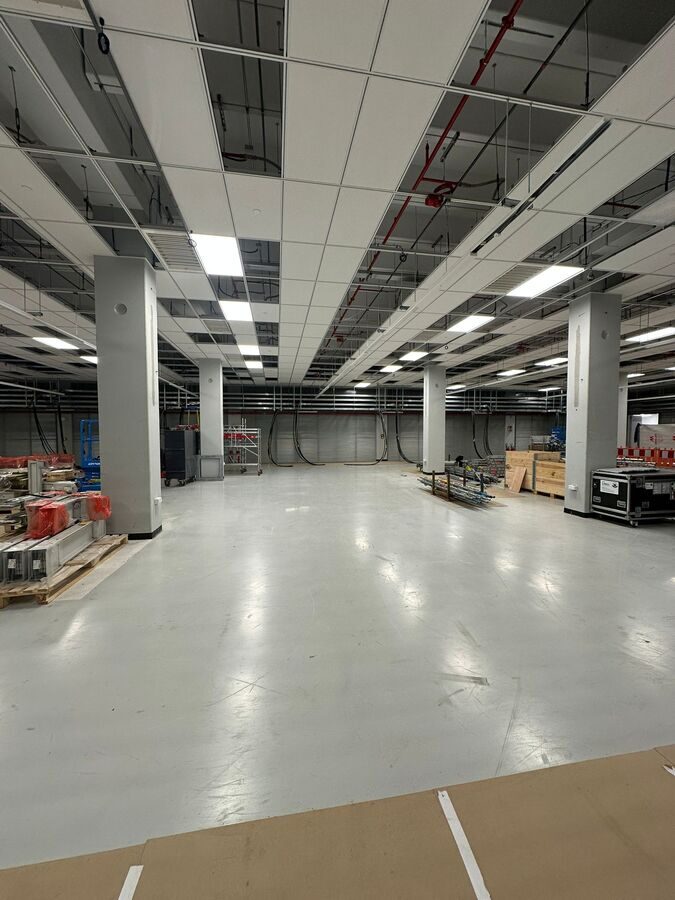
A scope of works for installation and moving in prevents change orders when it describes interfaces, client-provided works, time windows and access so unambiguously that every bidder prices the same service.
You have to put moving in or installation work out to tender – perhaps for the first time, perhaps for the tenth time, but with the uneasy feeling that there will be change orders again in the end. The term “scope of works for installation and moving in” stands for the document that decides whether you can compare quotations or merely place figures side by side.
The problem is rarely bad faith. Installation and moving in are services that depend heavily on the location: on door openings, floor loads, crane set-up areas, access control and on whether the hall keeps producing in the meantime. Whatever is not in the scope of works, the bidder has to assume – and every assumption that turns out to be wrong on site becomes a change order or a notice of hindrance.
This guide shows you how an installation scope of works is structured and which items are regularly missing. You will learn how to delimit client-provided works and interfaces cleanly and by which suitability criteria you should compare bidders. We deliberately do not quote prices – this is about the structure that makes fair prices possible in the first place.
We write from the perspective of the executing installation contractor. Omega Mounting from Rodgau near Frankfurt takes on Industrial installation, lift & shift and machinery relocations in the Rhine-Main region and nationwide – and has read a great many scopes of works.
Key points at a glance
- A scope of works for installation and moving in describes not only the result but the boundary conditions under which it has to be achieved.
- Most change orders arise from missing information on transport routes, client-provided works, time windows and waiting times – not from the actual installation work.
- An interface list defines for every service who provides it: the client (“by the client”), the installation contractor, the equipment manufacturer or another trade.
- A site visit before the quotation is submitted is the single most effective measure against change orders and should be scheduled as a fixed bidder appointment in the award procedure.
- Time windows, crane provision, access and escort staff belong in the scope of works as separate items, because they drive the effort more than the weight of the equipment does.
- Suitability criteria such as qualification records, references for comparable moving-in projects and the bidder's own risk assessment make quotations comparable before price comes into play as an award criterion.
- A questionnaire for bidders uncovers gaps in the scope of works before they become a problem – and shows you which bidder has really thought the project through.
What is a scope of works for installation and moving in?
A scope of works for installation and moving in is the structured description of all partial services, boundary conditions and interfaces that an installation contractor has to provide in order to bring a machine or plant from the delivery point to its operational installed position.
Anyone who types “scope of works installation moving in” into a search engine mostly finds item lists – a good scope of works is more than that. In construction, the principle applies that a service must be described unambiguously and exhaustively. All bidders should understand it in the same sense and be able to price it without extensive preliminary work. This idea comes from the VOB/A (German construction contract procedures) and the General Technical Contract Conditions (DIN 18299) – it also applies in spirit when you, as a private industrial company, award contracts freely.
For installation and moving in, “unambiguous and exhaustive” means: the bidder must know from the scope of works what is located where, where it is supposed to go and what route lies in between. They must know who carries out which preparatory work, when work is permitted and what is handed over at the end.
The three levels of an installation scope of works
A good installation scope of works has three levels that interlock:
- Work items with item text – what is done: unload, move in, position, align, connect, commission, document. Anything uncertain becomes an optional item (contingency item) that is only paid for when called off.
- Boundary conditions – under what circumstances: time window, access control, ongoing operations, protective measures, cleanliness requirements, site rules, language on site.
- Interfaces – who supplies what: client-provided works, manufacturer services, preceding and follow-on trades, items provided free of charge.
If one of these levels is missing, every bidder prices their own version of the project – and the cheapest bidder is often the one who has left the most open.
Where do change orders in installation and moving in come from?
Change orders in installation and moving in almost always arise from boundary conditions that were missing from the scope of works or were different on site from what was described – not from the installation work itself.
A change order is a contractor's claim for additional payment or construction time because the actual service deviates from the one commissioned. It is usually announced by a notice of concerns or a notice of hindrance under VOB/B. From our practice, the typical causes can be grouped into six categories.
1. The moving-in route was different from what was assumed
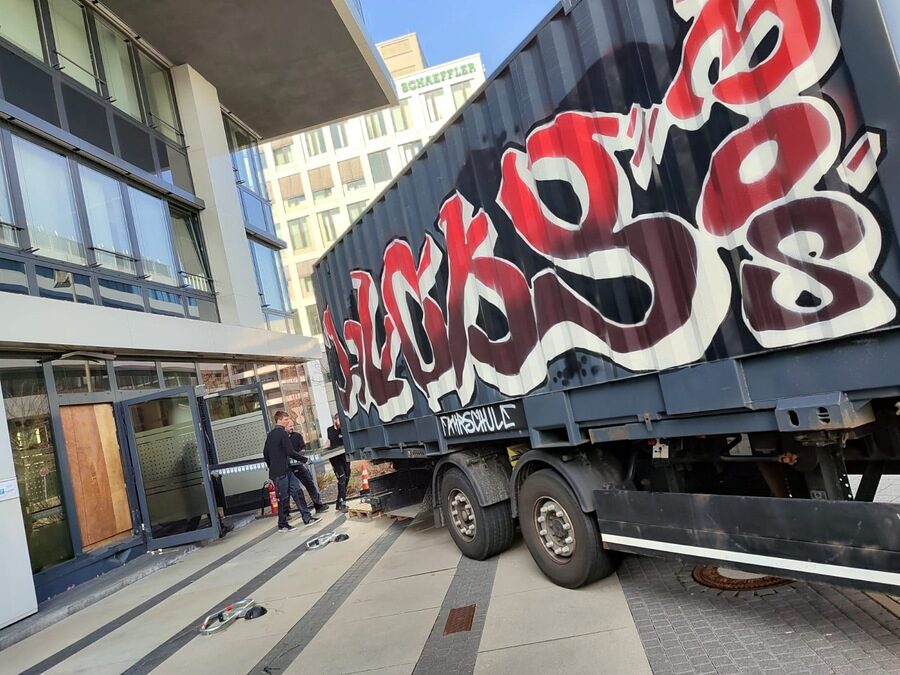
Moving in stands or falls with the moving-in route. Door openings, clear heights, swept paths, stairs, lift capacity, floor covering and floor loads determine whether a unit travels in one piece or has to be dismantled. In the relocation of six automated storage units from a Frankfurt office building three interior doors were the critical pinch points. The floor was parquet, so machinery could not be used – the units were therefore completely dismantled and moved on dollies. If something like this is not in the scope of works, a bidder prices transport in one piece and later reports additional effort.
2. Client-provided works were not finished
Foundation, base, utility connections, crane set-up area, site power, lighting: everything that the client or a preceding trade is supposed to prepare must be finished on the installation day. On site this is called a clear work area. If it is not given, the installation crew stands idle. The notice of hindrance due to waiting time is one of the most frequent reasons for change orders of all.
3. The time window was tighter than described
“Installation during the night shift” sounds unambiguous, but it is not. Does the window begin when production stops, or when the plant has been isolated, locked out and handed over? Who isolates? How long does the hand-back take? A night window that has eight hours on paper and five in reality forces additional shifts.
4. Access and approvals cost time
In data centers, at airports, in security areas and in plants with their own plant security, hours often pass between arrival and start of work. Reasons: access control, induction, tool inspection, permit to work, escort requirement. If the scope of works says nothing about this, this time is not priced.
5. The scope ended in the wrong place
“Position and align” – and who connects? “Move in to the installation site” – and who unpacks, disposes of the packaging, removes the transport locks? “Commissioning” – with or without the manufacturer's technician? Every unclear boundary is a potential change order.
6. Protective measures were not part of the scope
Floor protection, covering of neighbouring plant, dust protection, cleanliness during ongoing operations: if the protection is not tendered, one bidder prices it in and the other does not.
How do you structure the scope of works for installation and moving in?

A scope of works for installation and moving in is best structured along the real sequence: from preparation through moving in, positioning and connection to commissioning and documentation. It is supplemented by boundary conditions and an interface list.
The following structure has proven itself in our projects. It is also the framework of the scope-of-works outline that you can request at the end of this article.
| Item group. | Typical contents. | Common gap. |
|---|---|---|
| 0 General. | Site, equipment, weights and dimensions, contact persons, site rules, language. | Weights “approx.” instead of from the data sheet. |
| 1 Preparation. | Site visit, lift plan, risk assessment, registration, induction. | Lead time for access checks. |
| 2 Unloading and moving in. | Entladen, Zwischenlagern, Einbringweg, Hebeverfahren (Autokran, Spinnenkran, Hydraulikportal, Schwerlastrollen), Bodenschutz. | Interim storage area missing. |
| 3 Positioning and alignment. | Positioning, levelling, load spreading plates, anchoring, laser survey. | Tolerances missing. |
| 4 Mechanical connection. | Connections, pipework, exhaust air, utility couplings. | Boundary to the specialist trade unclear. |
| 5 Electrical connection. | Supply cable, termination, testing, labelling. | Who isolates and re-energises? |
| 6 Commissioning and acceptance. | Trial run, functional test, manufacturer involvement, acceptance report. | Manufacturer's scope not delimited. |
| 7 Documentation. | Installation report, photo documentation, torque record, inspection records, handover. | Format and extent undefined. |
| 8 Ancillary works. | Packaging disposal, cleaning, floor protection, site set-up. | “Included” without description. |
| 9 Boundary conditions. | Time window, access control, ongoing operations, escort requirement, rule for waiting times and daywork. | No rule for waiting times. |
| S Interface list. | Who supplies what: by the client, installation contractor, manufacturer, neighbouring trade. | Missing entirely. |
Weights and dimensions: from the data sheet, not from memory
Weight, centre of gravity, dimensions and lifting points belong in the scope of works with their source. Lifting points are the lifting eyes or points at which a load may be safely slung. A bidder selects lifting equipment, lifting accessories (round sling, chain sling, spreader beam) and method accordingly. If the scope of works says “approx. 2 t” and the unit weighs significantly more, that is not just a change order but a safety problem.
Tolerances: say how precisely “aligned” has to be
“Aligning” is not a service as long as it is not stated how precisely. For storage technology, robots, distribution cabinets in rows or machines with feeders, the tolerance for alignment, plumb and height decides the method. Spirit level or laser survey – that also determines the time required. Define the tolerance or refer to the manufacturer's specification.
Documentation: specify extent and form
Installation report, photo documentation, torque record with the tightening torques of the anchoring, inspection records of the lifting accessories, acceptance report: if you need this for your as-built records, tender it. If you need it as a file in a specific format, write that down too.
Which client-provided works belong in the interface list?
The interface list should contain all services that are not provided by the installation contractor but are prerequisites for their work. This includes the name of the person responsible and the date by which they must be finished.
Client-provided works – “by the client” for short in the scope of works – are services that the client provides itself or through third parties. The interface list is the document that prevents two parties from each assuming the other is providing the same service.
That this is not a problem specific to installation is shown by the BAuA practice brochure on site set-up. It requires the client to assign every site set-up service to a tender lot and to record the delimitation unambiguously in the specification and the contract. It also names the facilities that most often fall between two stools on sites with several companies: lifting appliances and hoists, traffic and storage areas, utility connections, access routes and fencing, first-aid facilities. For you this means: precisely these points belong in your interface list with a name behind them. Site rules and the health and safety plan belong as annexes in every tender – otherwise they do not apply to the bidder.
Typical interfaces in moving in and installation
- Base and foundation: Who ensures that the installation site is load-bearing, level and approved? For a container facility for the plant security service on a site in the Taunus the levelled base of concrete slabs and steel plates was part of our scope. It could just as well have been a client-provided work. What matters is that it is written down somewhere.
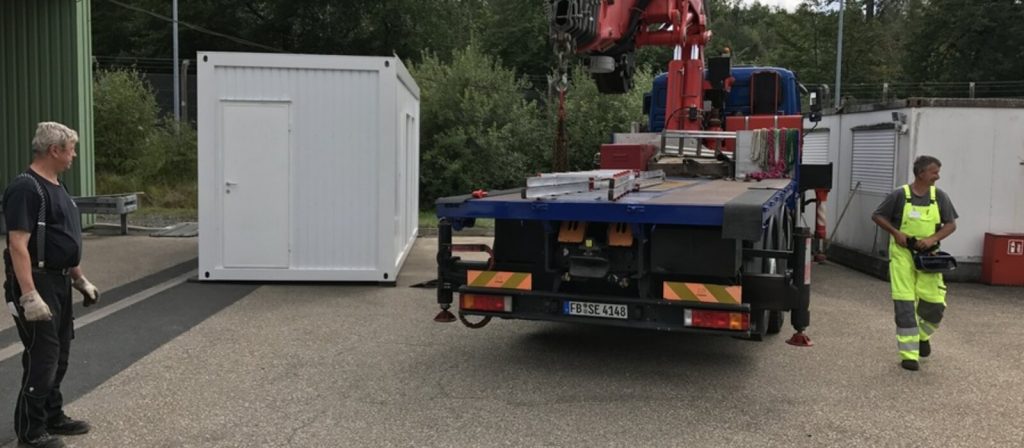
- Crane set-up area and crane provision: Who provides the mobile crane, who checks the ground bearing pressure under the outrigger pads, who applies for the road closure and traffic order? For the container facility, the crane coordination was ours. The containers hung on lifting hooks with a working load limit of 12.5 tonnes each.
- Utility connections: Power, water, waste water, compressed air, cooling water, exhaust air – up to where by the client, from where by the installer? For the same container facility we connected power via external plug connections, fresh water with trace heating and waste water in a sand bed. Another scope of works would have drawn the line at the building edge.
- Isolation and re-energising: Who de-energises the existing plant, who locks it out against re-energising (lockout/tagout, LOTO), who releases it again? This is a question of electrical safety and must be clearly assigned.
- Manufacturer services: Calibration, software update, final acceptance. During the relocation of automated storage units to Rodgau, the equipment manufacturer took on the calibration of the sensors and the final acceptance. We took on dismantling, transport and reassembly. This boundary was clear beforehand, so there was no discussion.
- Interim storage areas, site power, disposal: Where do crates and tool trolleys go, who provides power and light, who takes away the packaging and the old plant?
The interface list as a table
In the end, an interface list is a simple table: service, responsible party (client, installation contractor, manufacturer or other trade), finished by, evidence. It becomes part of the contract. With every change order, it is the first document that comes onto the table.
Why is the site visit before quotation submission mandatory?

The site visit before quotation submission is mandatory because no scope of works describes the moving-in route, the floor loads, the floor covering and the access rules as completely as an experienced fitter captures them in an hour on site.
Plan the site visit as a fixed procedural step – with a date, list of participants and site visit minutes. Their content goes to all bidders as an answer to bidder questions. Anyone who makes the visit optional gets two kinds of quotations: realistic ones from those who were there, and seemingly cheap ones from those who were not.
The BAuA practice brochure describes the same mechanism from the executing contractor's point of view. If the conditions on site deviate from the tender documents, the differences must be clarified with the client before planning begins. The site set-up plan approved by the client, with crane set-up area, storage area and access, fixes the planning. It serves as the basis for settling later claims. For you as the client this means: what you show during the visit and record in the minutes is later your strongest argument against a change order. What you did not show is the bidder's strongest argument for one.
What a good site visit captures
- Delivery situation: truck access with swept path, manoeuvring area, unloading point, crane set-up area and radius.
- Moving-in route: door openings, gates, corridors, stairs, lifts with capacity, floor covering, raised floor with pedestal grid, floor loads, turning radii.
- Installation site: space for manoeuvring, neighbouring plant, utility connections, lighting.
- Operations: what keeps running during installation? Who may be where and when?
- Access: registration, site passes, tool inspection, escort requirement, lead times for checks.
- Protection: what has to be covered, which cleanliness and dust protection rules apply?
Site survey instead of assumption
A site survey – measuring the actual dimensions on site, recorded in the survey report – replaces assumptions with facts. For the series installation of 160 distribution cabinets in eight data halls, we laser-surveyed every hall before setting and marked the set-down positions. Only then was it certain that the planned positions could be implemented everywhere. This survey belongs in every scope of works in which rows are to align to the millimetre.
How do you describe time windows, crane provision and access correctly?

You describe time windows, crane provision and access correctly by showing three things as separate items: start and end of the usable window, responsibility for crane and set-up area, and all access requirements with lead times.
Time window: usable time instead of calendar time
Define when the installation team can actually work: from isolation and handover of the plant, not from the end of production. Define when the plant must be handed back and who accepts the trial run and functional test. State noise and dust limits if work continues next door. Night windows, weekend windows and maintenance windows – planned periods without production – drive the effort differently. Name the window clearly.
Crane provision: who, what, where, how long
If a mobile crane, a mini crane (a compact crawler crane for indoor use) or a spider crane is needed, define in the lift and shift tender who provides it. Define who checks the crane set-up area for ground bearing pressure and who applies for the road closure and traffic order. Name who, as the appointed person for lifting operations (lifting supervisor), issues the lift clearance. A lift plan belongs in the scope of works as a service of the installation contractor. This is the written planning of a lift with weight, centre of gravity, lifting accessories, crane set-up area and radius.
Access: lead times as a contractual parameter
In security areas, access requirements decide the schedule. Background checks under Section 7 of the German Aviation Security Act at airports or under Section 12b of the German Atomic Energy Act in nuclear facilities are tied to the individual and need weeks of lead time. Plant security registrations, inductions, site passes and tool lists need days. Write into the scope of works what is required and how long it takes. Then the bidder can name a team that meets these requirements.
Waiting times: a rule in advance
Agree how waiting times for which the installation contractor is not responsible are handled. How are they documented, from when do they apply, who confirms them? Are they paid as daywork or hourly rates? A clear rule in the scope of works is better than a discussion on site.
By which criteria do you compare quotations for installation and moving in?
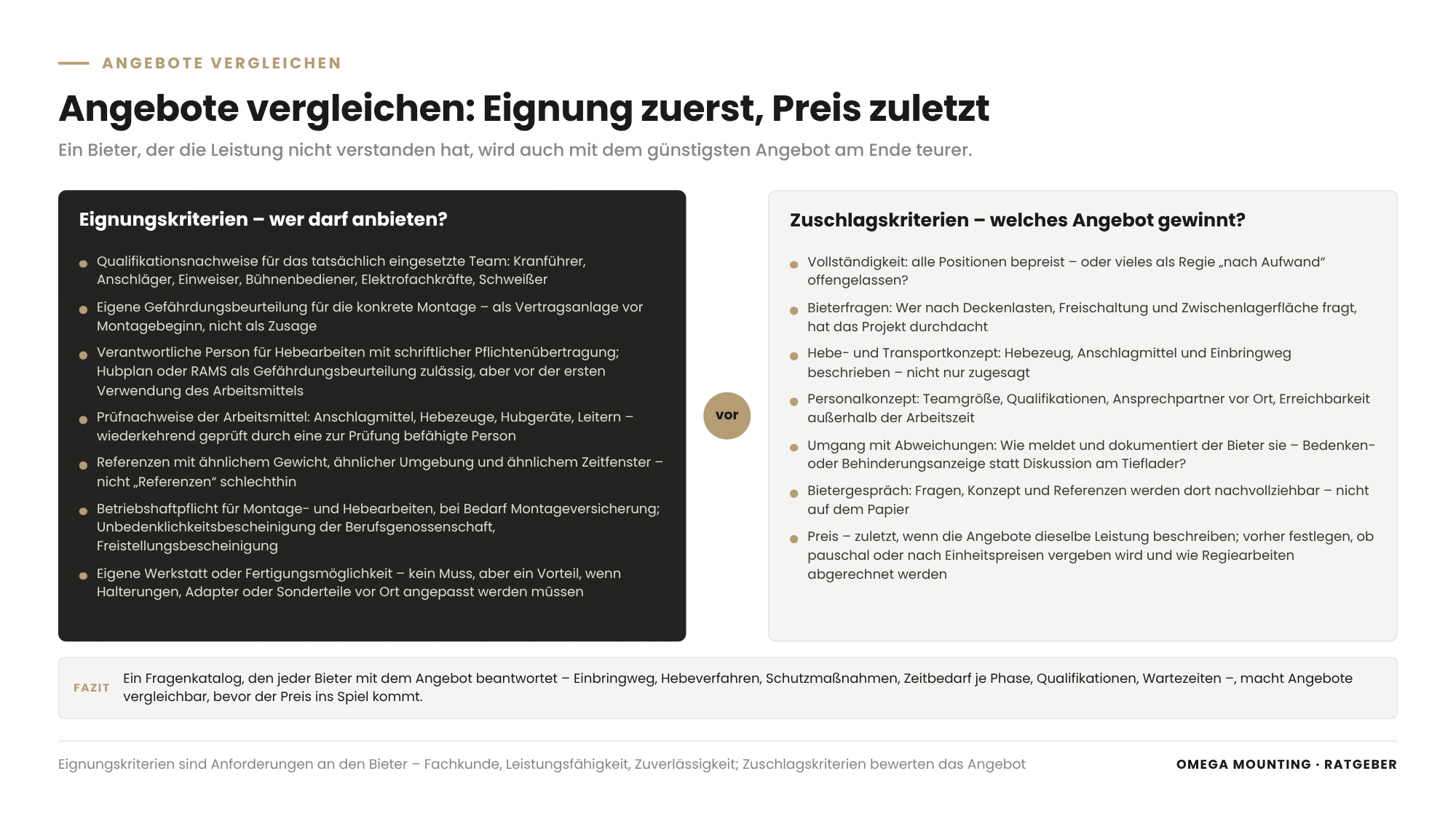
You compare quotations for installation and moving in by suitability and understanding of the service first and by price last. A bidder who has not understood the service will end up more expensive even with the cheapest quotation.
Suitability criteria are the requirements on the bidder itself: its expertise, capability and reliability, proven by evidence of suitability or a prequalification. Award criteria evaluate the quotation. Both can be formulated without a single figure.
Suitability criteria you should require
- Qualification records of the personnel deployed: crane operators, slingers (riggers), banksmen, operators of MEWPs and industrial trucks, qualified electricians, welders with valid certification. What matters is the evidence for the team actually deployed, not just for the company.
- Occupational safety organisation: The bidder's own risk assessment under Section 5 of the ArbSchG (German Occupational Safety Act) for the specific installation, briefing records, an appointed person for lifting operations named by delegation of duties. The German technical rule TRBS 1111 allows a lift plan or RAMS to document the risk assessment. RAMS is the English-language combination of risk assessment and method statement. The document must be available before the work equipment is first used; a simplified assessment is excluded for cranes and changing site conditions. For you this means: demand the document as a contract annex before installation begins, not the promise “will be provided”.
- Inspection records of the work equipment: Lifting accessories, lifting appliances, lifting devices and ladders must be periodically inspected by a competent person in accordance with the BetrSichV (Industrial Safety Ordinance). A reputable bidder can present the records.
- References for comparable services: Not “references”, but references with similar weight, similar environment and similar time window.
- Insurance and clearance certificates: Business liability insurance with adequate cover for installation and lifting work, if required an erection all-risks insurance for damage to the equipment being moved. In addition, a clearance certificate from the employers' liability insurance association (Berufsgenossenschaft) and an exemption certificate under Section 48b of the German Income Tax Act (EStG).
- Own workshop or manufacturing capability: Not essential, but an advantage if brackets, adapters or special parts have to be adapted on site.
Award criteria beyond price
- Completeness of the quotation: Has the bidder priced all items or left items open as daywork “according to effort”?
- Bidder questions: Which questions did the bidder ask? A bidder who asks about floor loads, isolation and interim storage area has thought the project through. This becomes apparent at the latest in the bidder meeting.
- Lifting and transport concept: Has the bidder described how they will move the equipment? With which lifting equipment, which lifting accessories, on which moving-in route – or only that they will do it?
- Staffing concept: Team size, qualifications, contact person on site, availability outside working hours.
- Handling of deviations: How does the bidder report deviations, how do they document them?
The bidder questionnaire as an audit tool
A bidder questionnaire – a list of questions that every bidder must answer with the quotation – makes quotations comparable. It forces every bidder to take a position on the same points. These include moving-in route, lifting method, protective measures, time required per phase, qualifications and handling of waiting times. The questionnaire is part of the working document at the end of this article.
What distinguishes the tender for a series installation from a single moving-in job?
A series installation differs from a single moving-in job in that the scope of works must describe the cycle, the material flow, the interim storage and the quality assurance per unit – not just the installation of one unit.
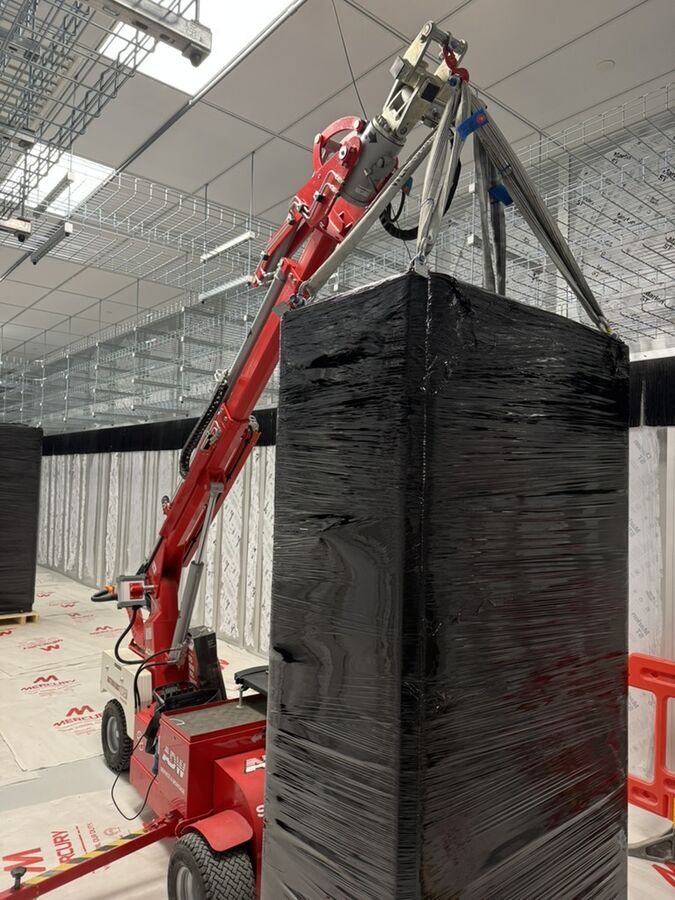
During the series installation of 160 distribution cabinets in eight data halls on four levels of a data center in the Rhine-Main region, the installation of a single unit was never the problem. PDCs (power distribution cabinets) distribute the power to the rack rows in data centers. What mattered was the flow: transport into the building, distribution via the heavy-duty lift, interim storage in wooden crates under the prepared cable trays. Then unpacking, moving with lifting device and beam gantry, aligning according to the laser survey, completion notice to the follow-on electrical trade.
For the scope of works of a series installation this means:
- Describe the material flow as cycle planning: delivery rhythm, interim storage areas per level, routing.
- Define the quality assurance per unit: what is checked per unit, documented in the installation report, reported as complete?
- Define the separation of trades: for the PDCs our service ended with the aligned cabinet ready for connection.
- Tender the surface protection over the entire duration – in series installations it is a cost driver in its own right.
How we do it in practice
Three projects from our project diary show how gaps in the scope of works can be avoided – or how a clear scope carries the process.
Series installation in the data center: survey before the first cabinet stands
During the installation of 160 PDCs in eight data halls of a data center in the Rhine-Main region a team of six lift & shift mechanics worked for several weeks. Each hall took 20 cabinets in two rows of ten; on the second floor there were 40. Before setting, every hall was laser-surveyed and the set-down positions were marked. The hall floor lay under protective panels and fleece. The cabinets were stored temporarily in wooden crates and positioned with a compact lifting device and a beam gantry with chain hoist. The separation of trades from the electrical work was unambiguous. Result over the entire duration: no damage, no rework, no punch list. For you as a buyer, the lesson is: laser survey, floor protection and trade boundary belong in the scope of works as items.
Automated storage unit relocation: the route determines the method
During the relocation of six vertical carousel storage lifts from an office building in Frankfurt to Rodgau the transport route itself was the real job. Three interior doors formed pinch points, the floor was parquet, forklifts or pallet trucks were out of the question. The units were therefore completely dismantled into documented individual parts. Each component was labelled and recorded in a photo log, then moved through the building on dollies and taken away by container. Six fitters were deployed for loading. During reassembly, racks and gears had to align to the millimetre before the manufacturer calibrated the sensors and took over the final acceptance. A scope of works that does not describe this route would have received quotations for transport in one piece – and a change order on the first day.
Container facility in the Taunus: all trades in one scope
With the installation of a container facility for the plant security service on a site in the Taunus access was only possible after a security check. Three fitters created the levelled base of concrete slabs and steel plates in around a week and coordinated the mobile crane including the lift plan. They joined and bolted the modules, installed two split air-conditioning units and connected power, fresh water with trace heating and waste water in a sand bed. The advantage for the client: one point of contact, one interface list, no coordination effort between civil works, electrical and plumbing. This is a deliberate decision when tendering. It pays off where access and lead time make every additional company expensive.
A fourth example in brief: in the installation of a parts washing system at a vehicle workshop in Kassel the scope covered moving in, alignment, electrics, compressed air, water and a stainless-steel exhaust duct welded on site. Two mechatronics technicians, one working day, first wash cycles on the installation day itself. Are you preparing a comparable tender right now? Then get in touch with us – a joint site visit before tendering usually settles within an hour which items your scope of works really needs.
What this means for your role
For buyers: Your most important tool is structure. Build the scope of works along the sequence, attach the interface list as part of the contract and schedule the site visit as a bidder appointment. Evaluate suitability criteria before price. Define whether you award on a lump-sum basis or by unit prices and how daywork is settled. A bidder questionnaire costs you an hour and saves every change order negotiation arising from an unclear boundary.
For designers: You supply the design parameters with their source: weights, dimensions, centre of gravity, lifting points, tolerances, floor load and payload of the moving-in route, door openings and clear heights. Check whether the drawn moving-in route is the one the building actually allows. Check whether the crane set-up area works out with radius and ground bearing pressure. A joint site visit with the future installation contractor before tendering is the shortest way to do this.
For project managers and site managers: You supply procurement with the boundary conditions from everyday site life: night, weekend or maintenance windows, access control, site rules, separation of trades, protective measures and the state of the work area on the installation day. The more precisely you describe what applies on site, the less you have to moderate in the regular progress meeting. Define the rule for waiting times before the contract is signed, not afterwards. Make sure that lift clearance and completion notice to the follow-on trade have a responsible person in the scope of works.
For maintenance managers: You know the plant that is being replaced or extended and the operation that has to keep running in the meantime. Give procurement the rules for isolation, lockout against re-energising and recommissioning. State the shutdown and maintenance windows and the protection requirements for neighbouring plant as precisely as in a work instruction. Also check whether the documentation items in the scope of works deliver what you will later need for periodic inspections, the inspection logbook and the maintenance schedule.
For manufacturers and system builders looking for an installation partner: If you award moving in and installation to an installation partner, the interface list is your most important contract component. It cleanly separates your commissioning and calibration services from the mechanical installation. Put your tolerance and slinging specifications from your own installation instructions directly into the scope of works instead of sending them as an annex. For series installation, a framework agreement with call-off orders per site is worthwhile. Demand from the installation partner a lifting and transport concept that suits your equipment – not just the promise that they will move it.
Scope-of-works outline and bidder questionnaire: template on request
The working document for this guide is a scope-of-works outline for installation and moving in with a bidder questionnaire. It contains the ten item groups from this article with typical item texts, a template for the interface list, a time window matrix and 25 bidder questions. It deliberately contains no prices. It helps buyers structure the tender and project managers contribute the boundary conditions. Request the scope-of-works outline with questionnaire via our Contact form – keyword “Scope of works outline – installation”.
Why Omega Mounting?
Omega Mounting is based in Rodgau near Frankfurt and is therefore in Offenbach, Hanau, Darmstadt, Aschaffenburg and at Frankfurt Airport in a short time. That applies to site visits before quotation submission just as much as to the installation day. Our fitters are mechatronics technicians and lift & shift mechanics who combine mechanics, electrics and plant engineering in one person. That shortens your interface list. In our own workshop in Rodgau we manufacture brackets, adapters and special parts when something does not fit on site. Via the 24-hour hotline we can also be reached when something in the night window goes differently from plan. You will find more projects in our References. For you this means: one point of contact for moving in, installation and connection, a short interface list and a contractor from the Rhine-Main region that comes to the site visit before writing a quotation. Get in touch, whenever your tender is coming up.
Conclusion
A scope of works for installation and moving in is good when every bidder prices the same service. That only succeeds if transport route, client-provided works, time window, access and protective measures are described as unambiguously as the installation itself. The interface list, the site visit as a procedural step and a bidder questionnaire are the three measures with the greatest effect against change orders. Evaluating suitability criteria before price protects you from the bidder who has left the most open. Send us your draft scope of works or the key data of the equipment – weight, installation site, time window. We will come back to you with an honest assessment of which items and interfaces are still missing.
Planning maintenance, moving in or installation in the Rhine-Main region?
Tell us briefly what it is about – we will come back to you with an honest assessment.
100% free and without obligation
You may also be interested in these guides
Maintenance & Servicing
Maintenance & Servicing

About the author
Tobias Schott
Managing director of Omega Mounting GmbH, Rodgau · more than 20 years of hands-on experience in installation and maintenance
A trained mechatronics technician, at home in maintenance, servicing and industrial installation since 2004 – first at his father's side, since 2012 with Omega Mounting: from the overhead conveyor in Frankfurt to the crane system in a new-build hall. Plans and leads lifting operations as appointed person in data centers and on industrial sites in the Rhine-Main region, is an instructor and examiner for cranes, mobile elevating work platforms and telehandlers, and a safety officer. On jobs abroad he is known as the “German Troubleshooter” – the one you call when things get stuck on site. He learned what quality means not from a manual but from his father: Made in Germany as a standard for his own work, not as a label. That is why it comes first at Omega Mounting – before speed and before price. He writes these guides from that practice: what works on our sites is in them – what only exists in the standard is not.
Frequently asked questions
As a minimum it must contain: site and equipment with weights, dimensions and lifting points from the data sheet, the transport route with pinch points, the installation site with tolerances. In addition, the boundary to connection and commissioning, the time window, the access requirements and an interface list of the client-provided works. If one of these points is missing, the bidder has to assume – and assumptions become change orders.
You avoid change orders through a site visit with all bidders before quotation submission and an interface list with responsible parties and dates. Add to this clearly defined time windows from isolation and a rule for waiting times and daywork agreed in advance. A questionnaire that every bidder answers uncovers the remaining gaps before they land on site as a notice of hindrance.
An interface list is a table that defines for every service who provides it and by when it must be finished. The responsible party can be the client, the installation contractor, the equipment manufacturer or another trade. You need it because most change orders arise not from the installation but from services that both sides assumed the other was providing.
It is better to specify the result and the boundary conditions – weight, moving-in route, space, floor load, time window – and have the bidder describe the lifting concept. An experienced installation contractor chooses between mobile crane, mini crane, spider crane, hydraulic gantry or machine skates according to the conditions on site. Specify a method only if the building strictly requires it.
In the Rhine-Main region – whether a logistics centre in Dietzenbach, a production plant in Hanau or a data center in Frankfurt – tender the time window as usable time from isolation. Name noise and dust limits for parallel operations. Define who provides escort staff and who issues the permit to work. Plan the site visit so that bidders see the operation in its normal state – only then can they realistically estimate the protection effort.
You may demand a project-specific risk assessment under Section 5 of the ArbSchG (German Occupational Safety Act), qualification records for crane operators, slingers and qualified electricians, and briefing records. In addition, the delegation of duties to the appointed person for lifting operations and the inspection records of the work equipment used in accordance with the BetrSichV (Industrial Safety Ordinance). These records are suitability criteria, not harassment – a reputable bidder has them to hand.
Define in the interface list which services you provide as the equipment manufacturer – for example calibration, software update or final acceptance – and up to which point the installation partner delivers. During the relocation of automated storage units to Rodgau, the boundary was the reassembly aligned to the millimetre. Calibration and acceptance lay with the manufacturer. The clearer the boundary, the smoother the commissioning.
Send us via the Contact form three details: the equipment with weight and dimensions (a data sheet is enough), the installation site with a floor plan or photos of the moving-in route, and the planned time window. We will get back to you and arrange a site visit. We summarise the result in a written assessment – with the items, interfaces and client-provided works that your scope of works needs. Your contact is Tobias Schott.
 English
 German