
- Guide – Lift & Shift
Interfaces in large projects: planning installation with manufacturer, subcontractor and maintenance team at one table
By Tobias Schott · Reading time approx. 23 minutes · Last updated: October 2026
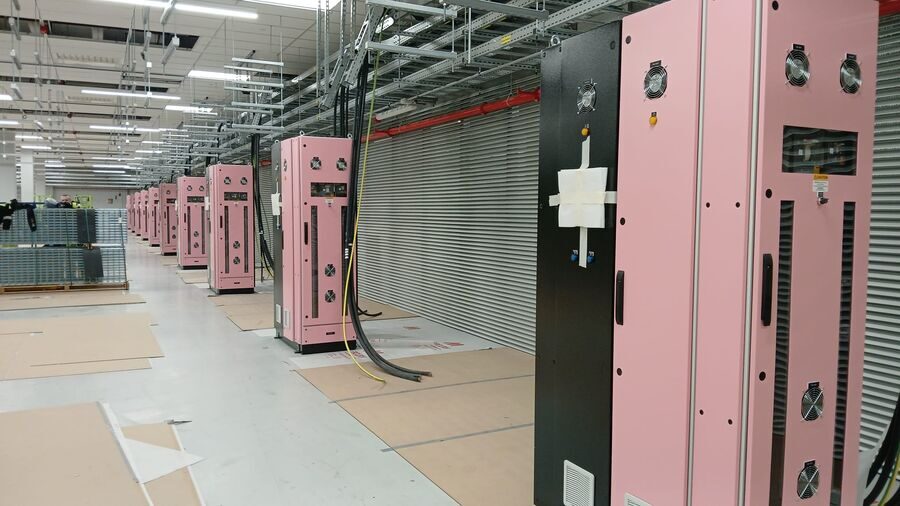
Most delays and change orders in installation work on large projects do not arise at the plant but at the interfaces. Where nobody has defined where one trade ends and the next begins.
A data center with eight data halls, a production line with a steel platform, a suppression cylinder room with 240 cylinders: large projects bring manufacturers, specialist companies, subcontractors, designers and site management onto one site. Each supplies a part of the whole. Interfaces in large installation projects are the points at which these parts have to come together – spatially, in time and technically. That is exactly what anyone searching for “interfaces large project installation” is asking about. Those who do not clarify it beforehand clarify it on installation day, under time pressure, with a following trade that is waiting.
This article builds on our guide to the scope of works for installation and moving in. That guide is about tendering an installation service so that no change orders arise. This one is about what lies between the services. And about how to set up an interface list, a responsibility matrix and clean handover points that work on site.
We write from the perspective of the installation contractor, which in large projects usually works as a subcontractor to a manufacturer, a specialist company or a general contractor. At the end it hands the plant over to the future maintenance team. Three projects from our project diary show what this looks like: 160 power distribution cabinets in a data center in the Rhine-Main region, a gas suppression system in the Frankfurt area and a steel platform at Kassel Airport.
Key points at a glance
- Interfaces have three dimensions: spatial (where does my component end?), temporal (when is the preceding trade finished?) and technical (who is responsible for function and verification?). All three must be clarified.
- An interface list names, for each interface, the preceding trade, following trade, handover point, verification and date. It is an annex to the contract, not the minutes of the site meeting.
- A responsibility matrix shows, for each task, who is responsible, who contributes and who is informed – and reveals where nobody or two parties are in charge.
- Client-side provisions – isolation, crane set-up area, lift, access, utility connections – are the most frequent source of obstructions and belong in the list with a date.
- Manufacturer and specialist company design and commission, the installation contractor installs: this division of labour works only with a documented handover point before commissioning.
- The future maintenance team should sit at the table before installation – accessibility, spare parts and documentation can hardly be changed afterwards.
- Where several employers work on one site, the ArbSchG (German Occupational Safety Act) requires them to cooperate. The BaustellV (Construction Site Ordinance) appoints a coordinator for this – the interface list is their best tool.
What are interfaces in large installation projects?
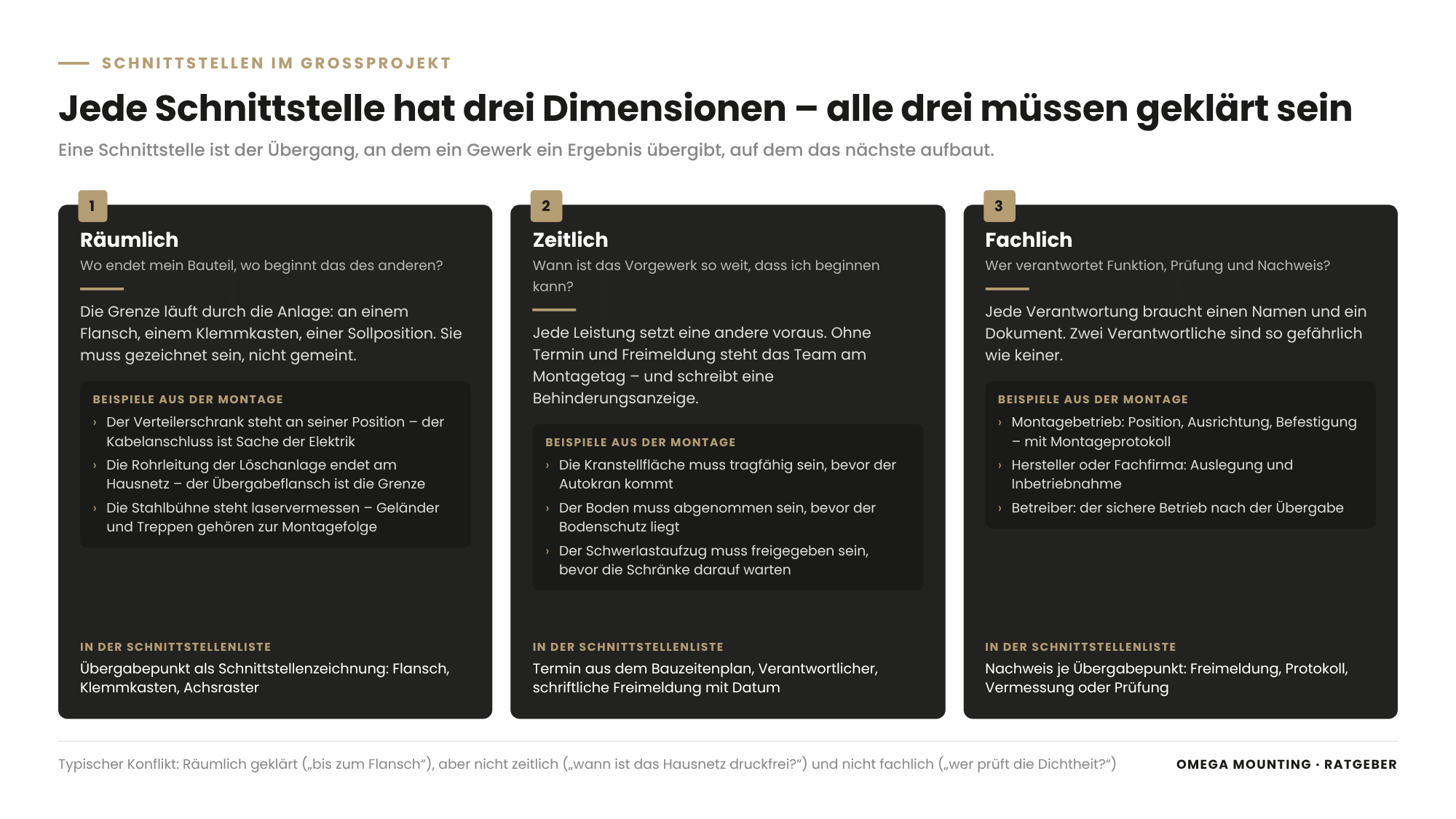
Interfaces in large projects are the transitions between the services of different parties, at which one trade hands over a result on which the next one builds. The parties are the client, designers, general contractor, manufacturers, specialist companies, subcontractors and the future operator. In installation work these are typically the transitions between construction and technology, between delivery and placement, between placement and connection, and between connection and commissioning.
The term trade denotes a defined service with its own expertise – steelwork, electrical, refrigeration, fire protection, installation. Separation of trades is normal and sensible in large projects, because everyone does what they do best. It only works if every dividing line is defined as an interface: preceding trade, following trade, handover point, verification.
Three dimensions of every interface
- Spatial: Where does my component end, where does the other party's begin? The distribution cabinet stands in its position – the cable connection is the electrical trade's business. The pipework of the suppression system ends at the building network – the handover flange is the boundary.
- Temporal: When is the preceding trade far enough along for me to start? The crane set-up area must be load-bearing before the mobile crane arrives. The floor must be accepted before the floor protection is laid. The heavy-duty lift must be released before 160 cabinets are waiting for it.
- Technical: Who is responsible for function, testing and verification? The installation contractor is responsible for position, alignment and fixing. The specialist company is responsible for design and commissioning. The operator is responsible for safe operation.
Most conflicts arise when only one dimension has been clarified. For instance the spatial one (“up to the flange”), but not the temporal one (“when is the building network depressurised?”) or the technical one (“who tests for tightness?”).
Why large projects are particularly vulnerable
The more parties, the more interfaces. Their number grows faster than the number of parties. Added to this in large projects are takt planning, parallel trades on the same area and bottlenecks such as a single heavy-duty lift. And chains of responsibility across three contract levels: client – general contractor – manufacturer – installation contractor. What the client agreed with the general contractor often reaches the installation contractor only as “by others”.
Which interfaces exist in installation work on large projects?
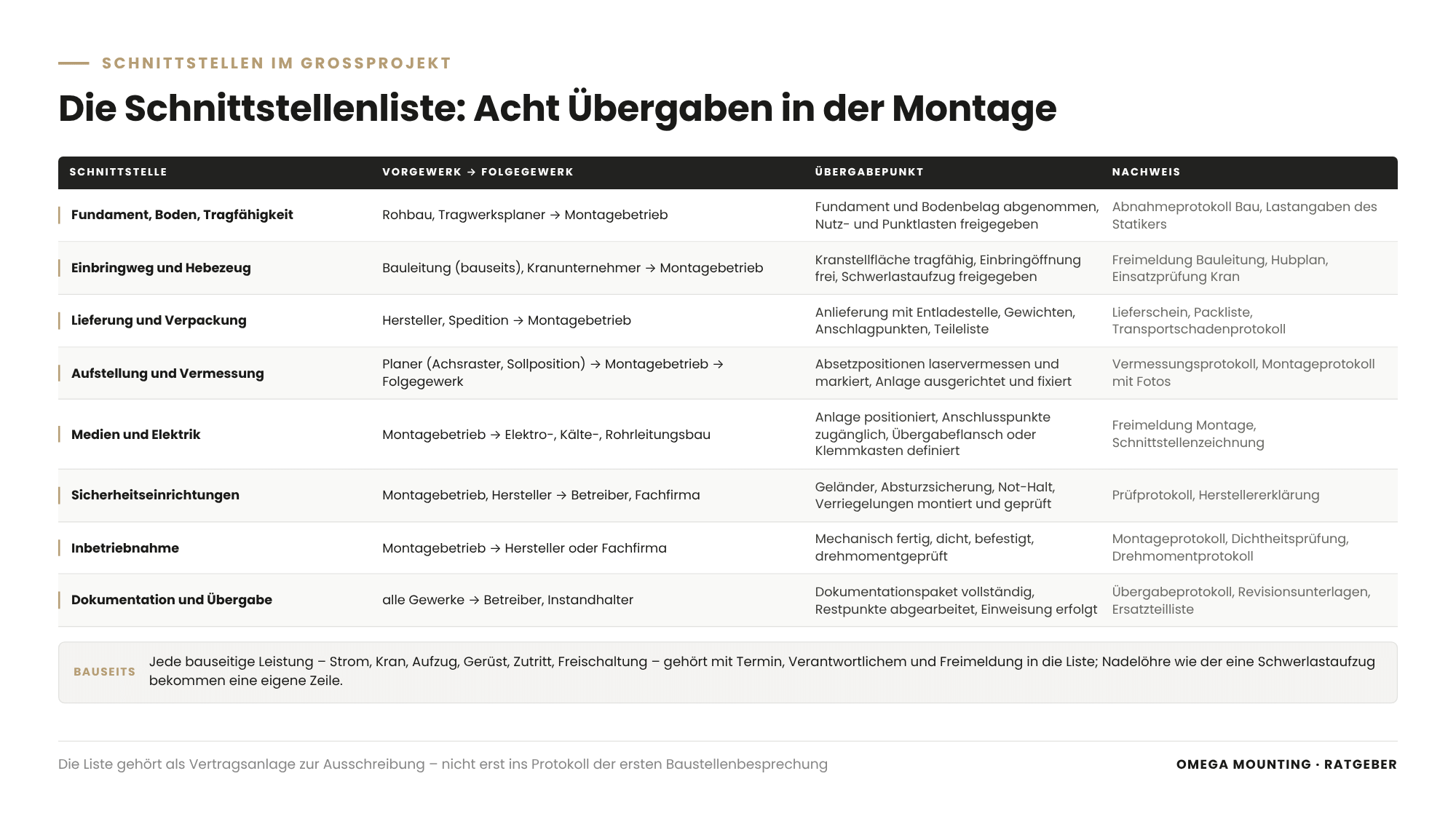
In installation work on large projects, interfaces occur at eight points. These are construction and foundation, installation route and lifting gear, delivery and packaging, placement and surveying. Plus utilities and electrical, safety devices, commissioning, and documentation and handover to the operator. The following interface list shows them with preceding trade, following trade, handover point and verification.
| Interface | Preceding trade (supplies) | Following trade (builds on it) | Handover point | Record |
|---|---|---|---|---|
| Foundation, floor, load-bearing capacity. | Shell construction, structural engineer. | Installation contractor. | Foundation accepted, imposed load and point loads released, floor covering accepted. | Construction acceptance report, structural engineer's load data. |
| Installation route and lifting gear. | Site management (by others), crane contractor. | Installation contractor. | Crane set-up area load-bearing, installation opening clear, heavy-duty lift released, transport routes cleared. | Completion notice from site management, lift plan, crane pre-use inspection. |
| Delivery and packaging. | Manufacturer, haulage company. | Installation contractor. | Delivery with unloading point, weight data, lifting points, parts list. | Delivery note, packing list, transport damage report. |
| Placement and surveying. | Designer (axis grid, target position). | Installation contractor → following trade. | Set-down positions laser-surveyed and marked, plant aligned and fixed. | Survey report, installation report with photos. |
| Utilities and electrical. | Installation contractor. | Electrical, refrigeration, pipework contractors. | Plant positioned, connection points accessible, handover flange or terminal box defined. | Installation completion notice, interface drawing. |
| Safety devices. | Installation contractor, manufacturer. | Operator, specialist company. | Railings, fall protection, emergency stop, interlocks installed and tested. | Test report, manufacturer's declaration. |
| Commissioning. | Installation contractor. | Manufacturer or specialist company. | Mechanically complete, tight, fixed, torque-checked. | Installation report, tightness test, torque record. |
| Documentation and handover. | All trades. | Operator, maintenance team. | Documentation package complete, punch list worked off, briefing given. | Handover report, as-built documents, spare parts list. |
“By others” – the most dangerous words in the contract
“By others” (German: bauseits) means: the client provides something the contractor needs for its service – power, crane, lift, scaffolding, access, isolation, utility connection. The words are short, the consequences are long. If the client-side provision is not there on installation day, the team stands idle. The installation contractor must then issue a notice of obstruction – the written notification that it cannot perform its service because a prerequisite is missing. Every client-side provision therefore belongs in the interface list with date, responsible person and completion notice. Not just with the words “by others” in the scope of works.
Recognising the bottleneck
In every large project there are bottlenecks that several trades need at the same time: the one heavy-duty lift, the one installation opening, the one crane set-up area, the one access gate. These bottlenecks are interfaces of a special kind because they have to be scheduled. Anyone who gives them their own row in the interface list, with an occupancy schedule and a responsible person, avoids one thing: three trades standing in front of the same lift on the same morning.
How do you create an interface list?
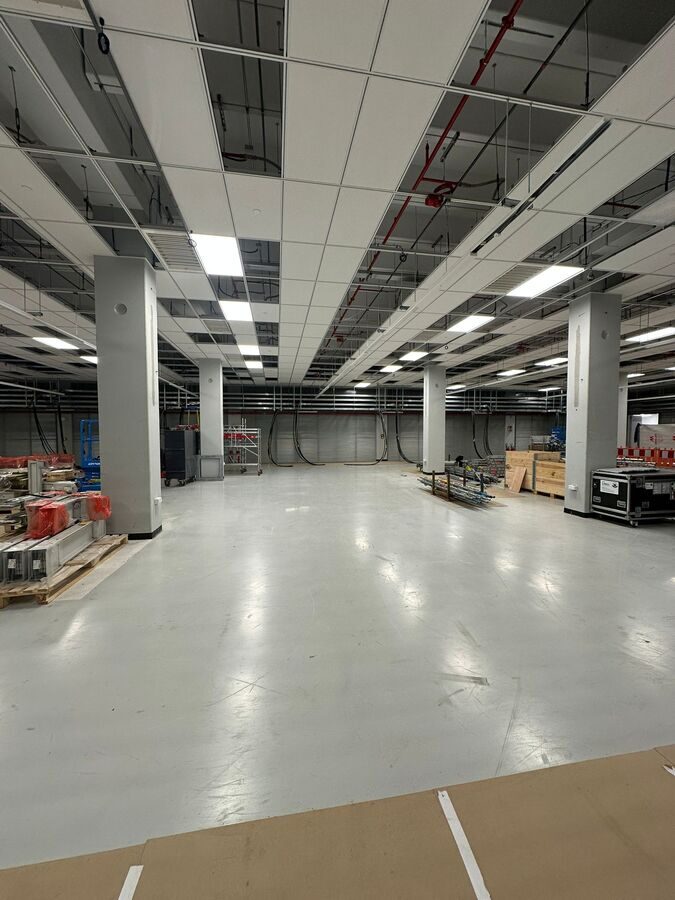
You create an interface list by asking, for every service in the project, what it requires and what builds on it. You write every interface found into a table with preceding trade, following trade, handover point, verification, date and responsible person. You agree this as a contract annex – not only on site. The list grows with the project and is updated at every site meeting.
Five steps to the list
- List the services: All trades with their service – from scopes of works, manufacturers' quotations, design services.
- Ask about prerequisites: For each service: what must be finished for it to start? Every answer is an interface to a preceding trade.
- Ask about consequences: For each service: who builds on its result? Every answer is an interface to a following trade.
- Define handover point and verification: How does the following trade recognise that it can start? Completion notice, report, survey, test. Without verification, the interface is just a hope.
- Enter date and responsible person: Who gives the completion notice and when? The date comes from the construction schedule, the responsible person from the responsibility matrix.
The list is a contract annex
An interface list that is only created at the first site meeting comes too late. By then the contracts are signed, the prices calculated and the client-side provisions allocated – or not. Attach the list to the tender and have bidders comment on it. Bidders' questions about interfaces are not a nuisance but a pointer to where the list still has gaps.
What the installation contractor contributes
As a subcontractor we often see only our section of the project. But there we know the interfaces better than anyone else. What load-bearing capacity does the floor need for the lifting equipment, what door clearance must the transport route provide, how long does a cabinet stand at the lift, what lifting points must a delivery have? Ask the installation contractor about its interfaces before the award. It will give you a list the designer does not know in this form.
What does a responsibility matrix look like?
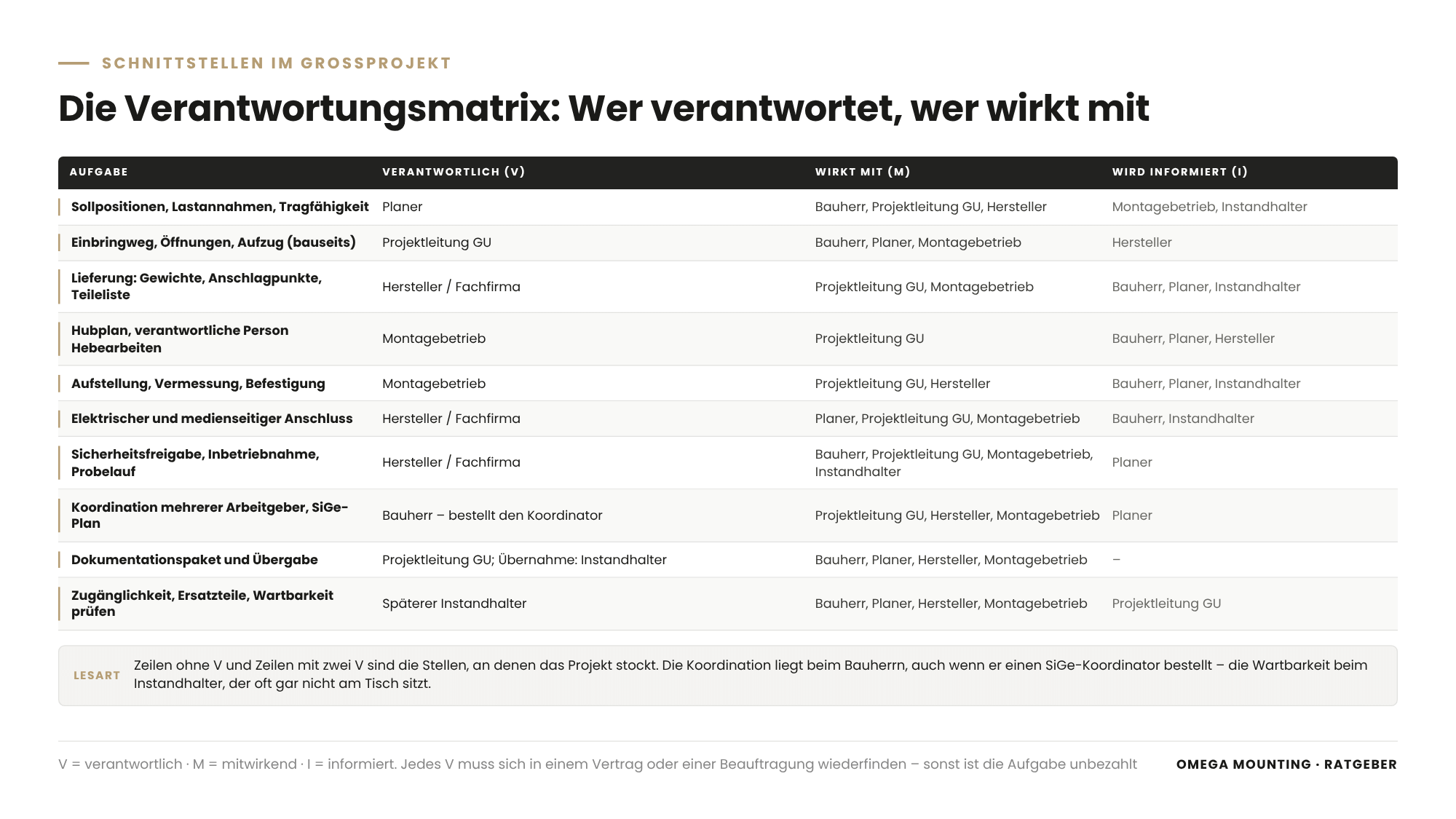
A responsibility matrix is a table that records, for each task in the project, which party is responsible for it, who contributes and who is informed. In international project management this tool is called a RACI matrix. In everyday German construction practice the abbreviations V (verantwortlich – responsible), M (mitwirkend – contributing) and I (informiert – informed) suffice. Its value lies in the gaps: rows without a V and rows with two Vs are the points where the project later stalls.
| Task | Client / operator | Designer | GC project management | Manufacturer / specialist company | Installation contractor | Future maintenance team |
|---|---|---|---|---|---|---|
| Define target positions, axis grid, load assumptions. | I | V | M | M | I | I |
| Verify load-bearing capacity of floor, ceiling, crane set-up area. | M | V | M | I | I | – |
| Provide installation route, openings, lift (by others). | M | M | V | I | M | – |
| Delivery with weights, lifting points, parts list. | I | I | M | V | M | I |
| Lift plan, lifting equipment, appointed person for lifting operations. | I | I | M | I | V | – |
| Placement, surveying, alignment, fixing. | I | I | M | M | V | I |
| Electrical and utility connection. | I | M | M | V | M | I |
| Test and release safety devices. | M | I | M | V | M | I |
| Commissioning, trial run, functional test. | M | I | M | V | M | M |
| Coordination of several employers, health and safety plan. | V | I | M | M | M | – |
| Documentation package and handover. | M | M | V | M | M | V (takeover). |
| Check accessibility, spare parts, maintainability. | M | M | I | M | M | V. |
Reading the matrix
Two rows deserve particular attention. First, “coordination of several employers”: here the V sits with the client, because the BaustellV (Construction Site Ordinance) obliges the client to appoint a coordinator when several employers work on one site. Even if the client delegates the task to a health and safety coordinator. Second, “accessibility, spare parts, maintainability”: here the V sits with the future maintenance team. In many projects they are not at the table at all. That is exactly the gap that takes its revenge in every later maintenance window.
Bringing matrix and contract together
The responsibility matrix does not replace a contract, but it tests it. Every V must be found in a scope of works, a contract for work or an appointment. If the matrix contains a V that appears in no contract, the task is unpaid. And is therefore not done.
How do manufacturer, specialist company and installation contractor work together?
Manufacturers and specialist companies design, supply and commission. The installation contractor moves in, places, installs and hands over. This division of labour works if the handover point between “mechanically complete” and “commissioned” is documented. And if the installation contractor as subcontractor provides the same evidence the manufacturer owes its client. For manufacturers, the installation partner is the extended workbench on site. For the client, the result should be a plant made from a single mould.
What the manufacturer needs
A manufacturer commissioning an installation partner needs three things. Schedule reliability, because its commissioning builds on the installation. Precision, because its warranty depends on installation quality. And evidence, because it has to pass it on to its client. Which evidence a subcontractor should provide, from public liability insurance through qualifications to the employers' liability insurance clearance certificate, is described in our guide to subcontractor evidence for installation work.
What the installation contractor needs
Conversely, the installation contractor needs from the manufacturer weights and centres of gravity, lifting points, installation instructions with torques and a parts list. Plus a contact person who answers questions about the plant before they arise on site. If the weight is missing, no lift plan can be produced. If the lifting point data is missing, installation day becomes improvisation.
Responsibility for lifting operations
Wherever lifting takes place, an appointed person for lifting operations is needed who is responsible for the lift plan, lifting accessories and release of each lift. In international usage this person is called a Lifting Supervisor or Appointed Person. In large projects it must be clarified in writing whether this person is provided by the installation contractor, the crane contractor or the general contractor. Who takes on this role and what it covers is described in our guide to the appointed person for lifting operations.
Several employers, one site
As soon as manufacturer, installation contractor and electrical company are on site at the same time, Section 8 of the ArbSchG (German Occupational Safety Act) applies. The employers must cooperate in implementing safety measures and inform each other about hazards. DGUV Regulation 1 requires coordination for this and, where necessary, a supervising person with authority to give instructions. For you this means: the interface list is not just a scheduling tool. It is the place where you record who informs whom about what – for instance that hot work is going on next to the installation area or that the lift is closed for heavy loads.
Which handover points do you need – and how do you document them?
You need handover points at every interface at which a following trade builds on the result of a preceding trade. Every handover point is documented with a completion notice, a report or a test. That way both sides know that the handover has taken place – and what was handed over. The difference between “finished” and “completion notified” is the difference between opinion and verification.
Four handover points in installation work
- Release of the area (by others → installation): Floor accepted, load-bearing capacity confirmed, transport routes clear, lift released. Document: completion notice from site management with date.
- Placement complete (installation → electrical/utilities): Plant at laser-surveyed position, aligned in line, fixed, connection points accessible. Document: installation report with survey and photos.
- Mechanically complete (installation → commissioning): All connections bolted, torques checked, tightness tested, safety devices installed. Document: installation report, torque record, tightness test report.
- Handover to operations (project → operator): Documentation package complete, punch list worked off, maintenance team briefed. Document: handover report with signatures from both sides.
Photo documentation as proof of the interface
One photo per handover point, with date, position and condition, is the cheapest insurance against later disputes. Was the cabinet in line before the electrical trade arrived? Was the floor free of scratches before the following trade took over the area? Was the bolted connection tightened before the specialist company commissioned the system? Whoever photographed it does not have to prove it.
Staged commissioning
In large projects, everything is rarely commissioned at once. The specialist company commissions section by section, the electrical trade connects hall by hall. This requires handover points per section. And a list that shows which section is at which stage. How the staged tests in data centers proceed and what the installation contractor has to deliver for them is described in our guide to commissioning in the data center.

Why should the future maintenance team be at the table from the start?
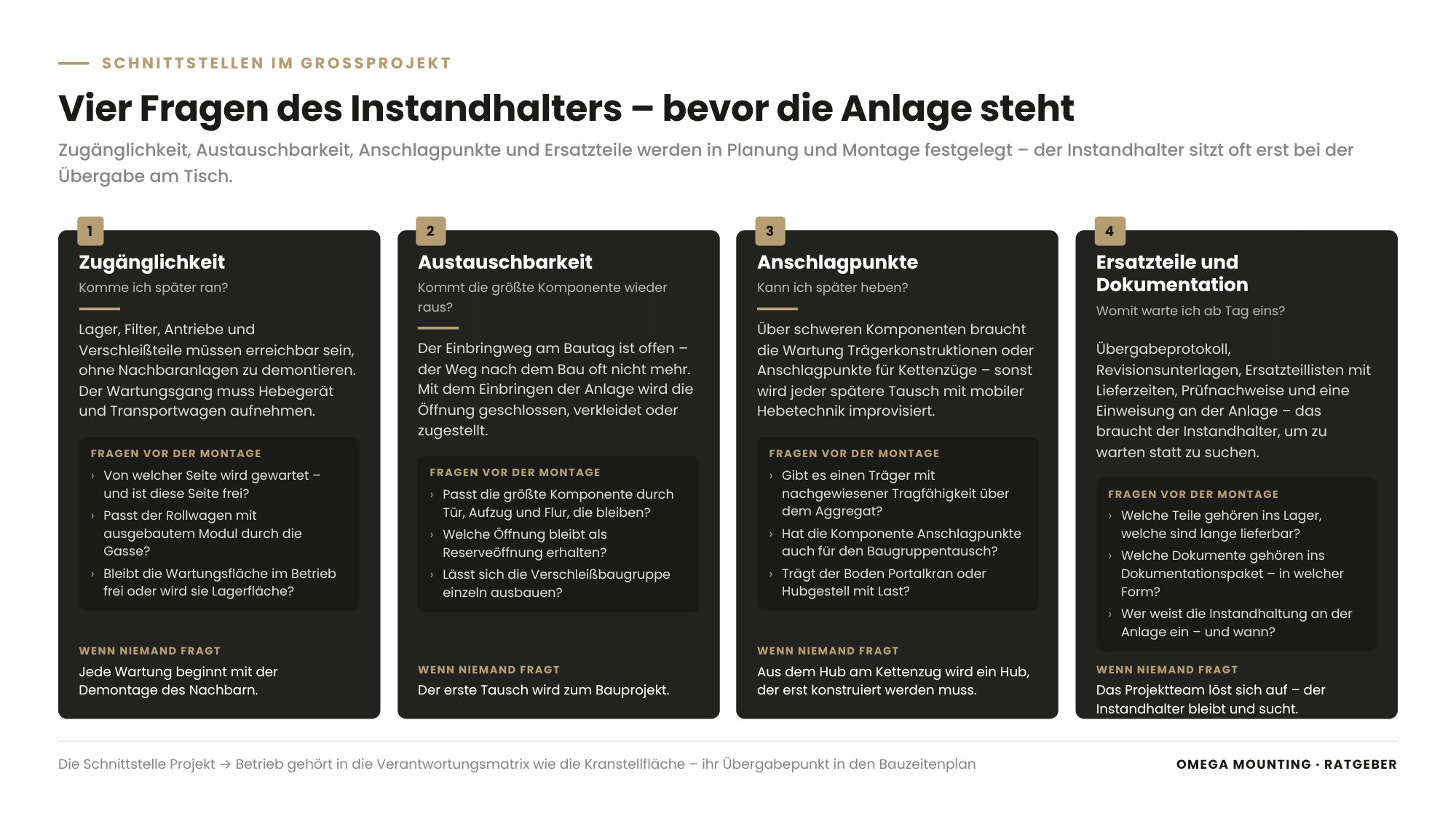
The future maintenance team belongs at the table from the start because accessibility, maintenance areas, lifting points, replaceability and spare parts stocking are determined during design and installation. After commissioning they can hardly be changed. The maintenance team is the party that lives with the plant longest. And in most projects only finds out at handover what it has been given.
What the maintenance team contributes before installation
- Accessibility: Can bearings, filters, drives and wearing parts be reached without dismantling neighbouring plant? Is the maintenance aisle wide enough for lifting equipment and transport trolleys?
- Replaceability: Does the largest component fit through the installation route that remains after construction if it has to be replaced? Or is the opening closed when the plant is moved in?
- Lifting points: Are there support structures or lifting points for chain hoists above heavy components? Or will every later replacement have to be improvised with mobile lifting equipment?
- Spare parts and documentation: Which parts belong in stock, which documents in the documentation package, which briefing in the handover?
The interface project → operations
The last interface of every large project is the one between project and operations. The project team disbands, the maintenance team remains. They need the handover report, as-built documents, spare parts lists with lead times, test certificates and a briefing at the plant in order to maintain from day one instead of searching. This interface belongs in the responsibility matrix with the same weight as the crane set-up area. Its handover point belongs in the construction schedule.
How we do it in the Rhine-Main region
In the Rhine-Main region we almost always work on large projects as installation partner – on behalf of manufacturers, specialist companies and general contractors. They want their plant placed and installed in data centers in Frankfurt and Offenbach, in logistics centres near Hanau and Darmstadt or in production halls in the surrounding area. From Rodgau the distances are short. What can be long are the interfaces.
Anyone who contacts us with the keyword “interfaces large project installation” therefore first gets questions back: what is by others, what does the manufacturer supply, what do we do – and how do we recognise that we can start? We write the answers into an interface list that we submit with the quotation. What we contribute in installation services is described on our page on industrial installation in existing buildings. What makes data centers special in terms of interfaces is described on our page on data center construction in the Rhine-Main region.
Our own workshop in Rodgau is often the solution for an interface nobody planned. A transport frame for a delivery without lifting points, a lifting gantry for a hall without a crane runway, a bracket missing between plan and reality. When the manufacturer delivers from another federal state and the general contractor coordinates from a third, the installation contractor from the region is the one who is there on installation day. And who knows where to get steel in Frankfurt at six in the morning.

How we do it in practice
Three projects from our project diary show what “interfaces large project installation” means in concrete terms. Between installation and electrical, between installation contractor and specialist company, between delivery and hall.
160 distribution cabinets, one interface to the electrical trade: data center in the Rhine-Main region
During the moving in and placing 160 power distribution cabinets in a data center in the Rhine-Main region , the separation of trades was clear from the start. We took on the entire mechanical process: transport into the building, distribution across four levels from the basement to the second floor via the heavy-duty lift, unpacking, lifting off the pallets, laser surveying and positioning to the millimetre. The electrical connection work followed by the electrical trade.
The interface was a handover point in the literal sense. Every cabinet stood exactly at its laser-surveyed position, in line with its row and under its cable outlet, before it was released for the next trade. Eight data halls with 20 cabinets each in two rows of 10, six lift-and-shift fitters, several weeks. And with 160 cabinets, zero rework for the electrical trade. The bottleneck was the heavy-duty lift. With four floors, 160 cabinets and a duration of several weeks, the material flow had to be scheduled just as precisely as the installation – an interface that deserves its own row in the list.
Specialist company designs and commissions, we install: suppression cylinder room in the Frankfurt area
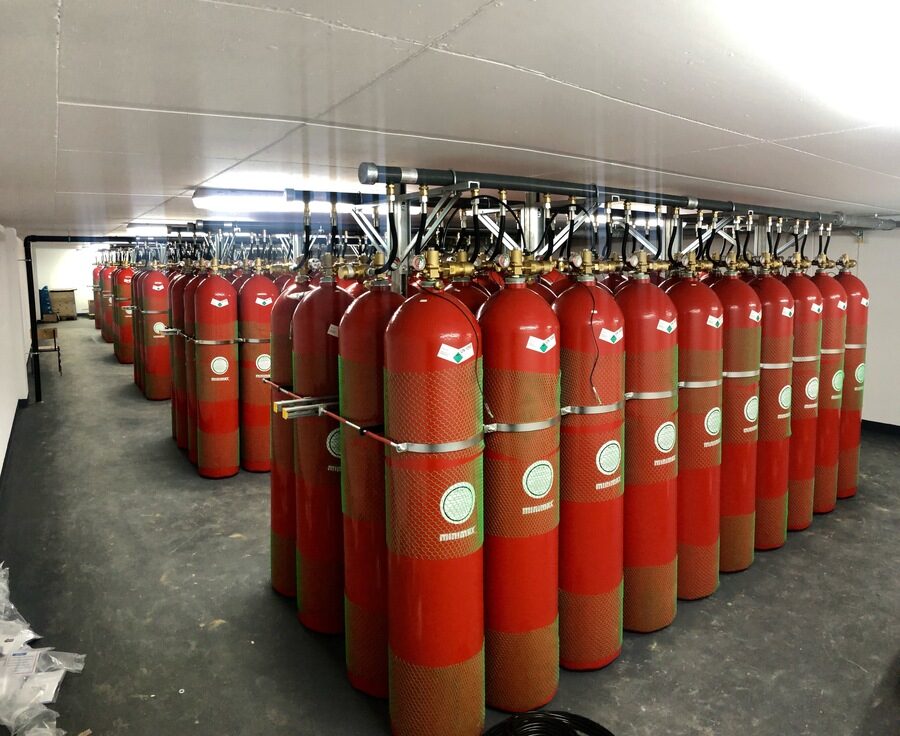
With the installation of a nitrogen gas suppression system in a data center in the Frankfurt area , we worked on behalf of a fire protection specialist company – a classic partner project. The specialist company designs, brings suppression technology expertise and approvals, and commissions. We deliver the installation. In two weeks, three fitters installed the cylinder racks, the pipework up to the existing building network and 240 nitrogen cylinders in six banks of 40 cylinders. Each was moved in, secured and connected individually.
The technical interface was the handover point “mechanically complete and tight”. At around 300 bar operating pressure, every leaking bolted connection would gradually lose pressure. That is why every connection was tightened under control and tested for tightness. Only then could the client commission the system section by section – without rework. The spatial interface was the connection to the existing building network. That is where our pipework ended and where the operator's responsibility for its network began.
Plan and reality: steel platform at Kassel Airport
With the installation of a steel platform for a manufacturing company at Kassel Airport , the platform was delivered ready-made. The interface between delivery and hall showed itself immediately: between plan and reality there is almost always a deviation. That is why the hall was laser-surveyed before installation and all important points were marked. Only when the first bay stood, was precisely aligned and the diagonal dimensions were correct did installation continue.
Two further interfaces are typical. The lifting gear – here an existing overhead crane for the heavy floor plates. Where there is none, the customer provides a forklift or telehandler. And the safety devices, which were installed together with the first plates so that nobody falls. Railings and stairs are not a following trade but part of the installation sequence.
Do you have a large project coming up in which manufacturers, specialist companies and installation have to come together? Then get in touch with us. An interface meeting before the award usually clarifies within two hours what is by others, what the manufacturer supplies and where the installation contractor hands over.
What this means for your role
For buyers: Attach the interface list to the tender and demand a statement on it from every bidder. Anyone who stays silent has not read the interfaces. Write client-side provisions into the scope of works with date and responsible person, not just with the words “by others”. Regulate how notices of obstruction and change orders at interfaces are handled. A responsibility matrix with contract references shows you whether every V is also paid for.
For designers: Draw the interfaces into your plans: handover flanges, terminal boxes, target positions with axis grid, load assumptions for lifting equipment, installation routes that remain after construction. Ask the installation contractor about its interfaces before design approval – door clearances, load-bearing capacities, lift dimensions, lifting points. Bring the future maintenance team to the table for accessibility and replaceability.
For project managers and site managers: As project manager, you keep the interface list and responsibility matrix as living documents. Updated at every site meeting, with dates from the construction schedule and bottlenecks as separate rows. As site manager, you are the one who gives completion notices for handover points: area clear, lift clear, placement complete, mechanically complete. Give completion notices in writing, with date and photo, and demand the same from every trade. The completion notice is the moment at which the interface becomes real.
For maintenance managers: Get yourself invited to the table before the plant is in place. If nobody invites you, invite yourself. Check accessibility, maintenance areas, lifting points, replaceability of the largest component and the spare parts list with lead times before the installation opening is closed. At handover, demand a complete documentation package, a worked-off punch list and a briefing at the plant.
For manufacturers and system builders looking for an installation partner: Give your installation partner what it needs for the lift plan – weights, centres of gravity, lifting points, installation instructions with torques, parts list. Agree the handover point “mechanically complete” with a report before your commissioning begins. Demand the subcontractor evidence you owe your client. Clarify in writing who provides the appointed person for lifting operations. An installation partner from the region is there on installation day when you cannot be.
For safety officers and HSE coordinators: Check whether the interface list also contains the occupational safety interfaces: who informs whom about hot work, lifts, closed routes and lifts? Who is the supervising person when several employers work at the same time? Has the coordinator under the BaustellV been appointed and is their health and safety plan coordinated with the installation sequence? The German technical rule TRBS 1111 requires that a coordinator is appointed in writing and given authority to issue instructions. Demand this appointment before the first trade arrives.
Interface list on request
The templates for scope of works and interface list that you need for the tender are described in our guide to the scope of works for installation and moving in. The interface list with the eight interfaces from this article helps buyers with the tender and project managers in the site meeting. Request it via our Contact form – keyword “installation interface list”.
Why Omega Mounting?
From Rodgau near Frankfurt, Omega Mounting works as installation partner in large projects. On behalf of manufacturers, specialist companies and general contractors, in data centers, logistics centres and production halls in the Rhine-Main region and beyond. The linked projects show what interface work means for us. 160 distribution cabinets handed over to the electrical trade without rework. 240 suppression gas cylinders handed over tight for commissioning by the specialist company. A steel platform set into a hall after laser surveying that was different from the plan. With our workshop in Rodgau we close gaps between plan and reality. With our own lifting equipment and an appointed person for lifting operations we take responsibility for every lift. Via our 24-hour hotline we can be reached when an interface gets stuck at the weekend. With us you get a single point of contact, who reads your interface list, adds to it and keeps to it on installation day – with short distances in the Rhine-Main region.
Conclusion
Interfaces in large projects decide the schedule, quality and change orders of the installation – not the plant itself. Anyone who clarifies every interface spatially, temporally and technically writes it into an interface list with preceding trade, following trade, handover point and verification. Anyone who distributes responsibilities in a matrix without gaps and duplications and involves the future maintenance team from the start gets a plant from a single mould – even if five companies built it. There is no more to the search term “interfaces large project installation” than that, and less is not enough. Send us your project description, the construction schedule and the list of trades involved. We will get back to you with an honest assessment of which interfaces in your project need attention.
Planning maintenance, moving in or installation in the Rhine-Main region?
Tell us briefly what it is about – we will come back to you with an honest assessment.
100% free and without obligation
You may also be interested in these guides
Maintenance & Servicing
Maintenance & Servicing

About the author
Tobias Schott
Managing director of Omega Mounting GmbH, Rodgau · more than 20 years of hands-on experience in installation and maintenance
A trained mechatronics technician, at home in maintenance, servicing and industrial installation since 2004 – first at his father's side, since 2012 with Omega Mounting: from the overhead conveyor in Frankfurt to the crane system in a new-build hall. Plans and leads lifting operations as appointed person in data centers and on industrial sites in the Rhine-Main region, is an instructor and examiner for cranes, mobile elevating work platforms and telehandlers, and a safety officer. On jobs abroad he is known as the “German Troubleshooter” – the one you call when things get stuck on site. He learned what quality means not from a manual but from his father: Made in Germany as a standard for his own work, not as a label. That is why it comes first at Omega Mounting – before speed and before price. He writes these guides from that practice: what works on our sites is in them – what only exists in the standard is not.
Frequently asked questions
The scope of works describes what a contractor performs. The interface list describes what lies between the services – who hands over what to whom and when, and how this can be recognised. The two belong together: every client-side provision in the scope of works needs a row in the interface list with date, responsible person and completion notice. Without the list, interfaces are negotiated on installation day.
In principle the client or its general contractor. The BaustellV (Construction Site Ordinance) obliges the client to appoint a coordinator when several employers work on one site. Under VOB/B (German construction contract procedures), the client has to coordinate the services of the various contractors. The employers themselves must cooperate under Section 8 of the ArbSchG and inform each other about hazards. The responsibility matrix makes visible who performs these tasks.
“By others” means that the client provides a prerequisite – power, crane, lift, scaffolding, isolation, access. The problem is the missing date. Without a date and responsible person it is not clear when the provision must be in place, and on installation day it is missing. Write every client-side provision into the interface list with date, responsible person and completion notice.
With a written completion notice or a report containing date, condition and signatures from both sides, supplemented by photos of the area or plant handed over. For “mechanically complete”, the installation report, torque record and – for pressurised systems – a tightness test report are included. What is photographed and signed does not have to be proven later. This does not replace a legal review of your contract documents.
Before design approval and at the latest before the installation is awarded – i.e. before installation routes, maintenance areas, lifting points and spare parts lists are fixed. After commissioning, accessibility and replaceability can hardly be changed. Handover to operations is the last interface of the project and belongs in the responsibility matrix with the same weight as the crane set-up area.
The same evidence the manufacturer owes its client: public liability insurance, proof of qualification for crane operators, slingers and MEWP operators, clearance certificate from the employers' liability insurance association, tax exemption certificate. Plus the risk assessment for its own activities and, wherever lifting takes place, an appointed person for lifting operations appointed in writing, with a lift plan. A prequalification bundles this evidence once.
Keep the lift as a separate row in the interface list with an occupancy schedule and responsible person. Schedule the material flow with the installation and define who decides in the event of conflicts. When placing 160 distribution cabinets on four levels in a data center in the Rhine-Main region, the heavy-duty lift was the bottleneck that determined the entire takt.
Yes, the logic applies to every project with several trades. In food plants, hygiene acceptances are added as handover points; in logistics centres, the interface between conveyor technology and controls; in mechanical engineering, the one between foundation, machine and utilities. Only the rows of the interface list change – the columns stay.
From Rodgau, Omega Mounting works as installation partner for manufacturers, specialist companies and general contractors in Frankfurt, Offenbach, Hanau, Darmstadt and throughout the Rhine-Main region. We submit an interface list with the quotation, provide the appointed person for lifting operations and hand over to the following trade with an installation report and photo documentation.
Via a short enquiry with three details: a project description with the trades involved, the construction schedule or the milestones, and the list of what has so far been designated as “by others”. We arrange an interface meeting, on site or with drawings, and add the installation interfaces to your list. You receive a written assessment with handover points and verifications. Your contact is Tobias Schott – reachable via our Contact form.
 English
 German