
- Guide – Maintenance & Servicing
Custom fabrication in metalwork with installation: workshop or catalogue?
By Tobias Schott · Reading time approx. 23 minutes · Last updated: October 2026
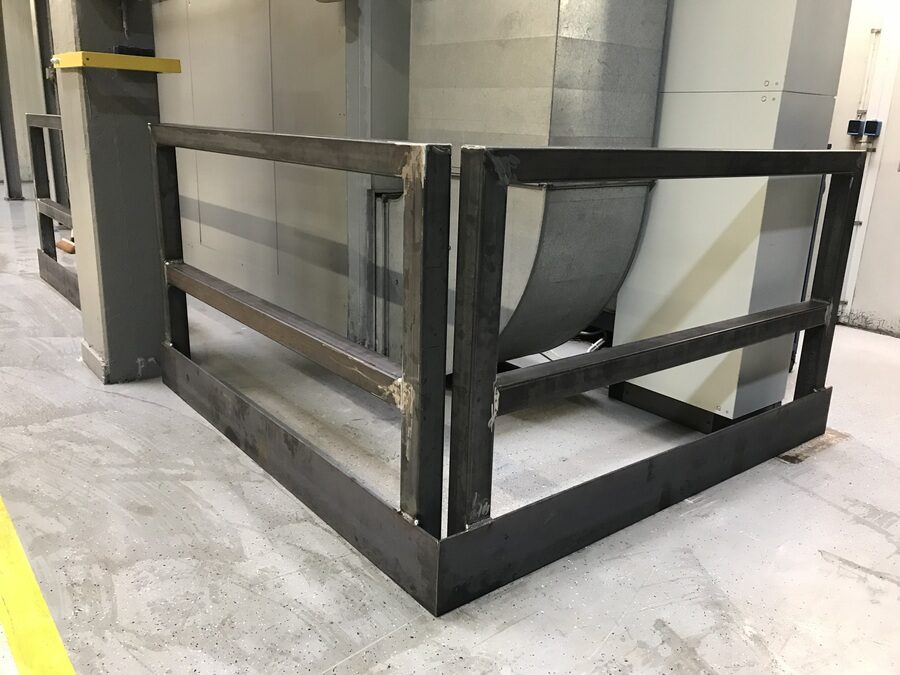
A custom fabrication in metalwork is the better answer when geometry, load, connection to the existing plant or delivery time deviate from what a standard component was built for. In all other cases the tested catalogue part is faster and cheaper.
The bracket does not fit because the new plant has different hole patterns from the old one. The impact protection from the catalogue cannot withstand the forklift traffic. No manufacturer stocks the spare part for the plant from the nineties any more. The oil pan would have to fit exactly around a concrete foundation that exists only once. Anyone working in maintenance, planning or purchasing knows these moments. The search for custom metalwork fabrication with installation then begins with the question of whether workshop and installation from a single source are the better answer than the matching standard part.
The question is not trivial. Standard components have advantages that a workshop cannot beat: tested load assumptions, documentation, availability from stock, interchangeability. Custom fabrications have advantages that no catalogue offers. They fit the plant, not the plant to them; they carry the load that actually occurs; and they are often there sooner than a part with a delivery time.
This guide provides the decision logic: which five questions decide, what the route from site survey through fabrication to installation in the plant looks like, which materials and surfaces are available. Plus where the limits lie and how to enquire about and tender a one-off from the workshop so that no change order arises. It builds on our introductory article on the scope of works for installation and moving in, because the custom fabrication is the item most often missing there.
Key points at a glance
- A custom fabrication pays off when geometry, load assumptions or connection to the existing plant deviate from the standard. Likewise when the standard part is no longer available or its delivery time extends the downtime.
- A standard component is preferable if it fits, is tested and is available from stock – a workshop should not replicate the catalogue part but start where there is none.
- The route runs via site survey, sketch or drawing, choice of material and surface, fabrication in the workshop or adaptation on site, and installation during ongoing operations – ideally by the same team.
- For spare parts of older plant without spare parts supply, maintenance becomes fabrication: remake from a sample or drawing, if necessary by reverse engineering from the old part.
- Load-bearing components of a building fall under DIN EN 1090 and belong with a manufacturer certified for this; plant equipment, fixtures, brackets and protective structures on plant are the core business of the workshop.
- In the scope of works, the custom fabrication belongs as a separate item described with site survey, material, surface, interfaces and installation conditions – otherwise it becomes a change order.
- A workshop within reach turns delivery time into fabrication time: in the Rhine-Main region, we fabricate in Rodgau and install in Offenbach, Frankfurt, Hanau or Aschaffenburg, often in the same job.
What is a custom fabrication in metalwork with installation?
A custom fabrication in metalwork is a component or structure made of steel, stainless steel or aluminium, manufactured as a one-off to site survey, sketch or drawing for a specific installation situation. The standard component, by contrast, is mass-produced for a typical application. Typical custom fabrications from steel construction and the metalwork shop for industry are brackets, mountings, adapter plates, intermediate frames, impact protection and collision guards, drip trays, fixtures and auxiliary structures for installation. Plus guardrails and small platforms as well as spare parts such as pins, bushes, shafts and levers.
Compared with a Repair a custom fabrication differs in that something new is created – whereas a repair makes an existing part functional again, for example by repair welding. In practice, the two merge: a cracked bracket is not welded but replaced by a reinforced new fabrication; a worn shaft is repaired with a re-manufactured pipe segment.
Compared with a standard component a custom fabrication differs by its batch size of one and by its fit to the plant: the catalogue part brings its own dimensions, the custom fabrication takes over the dimensions of the plant. That is why every custom fabrication starts with the site survey and not with the data sheet.
Compared with a structural steelwork in the building sense it differs in its subject matter. It is plant equipment, machine attachment or fixture, not a load-bearing component of a building – to which DIN EN 1090 applies, more on this below.
Standard component or custom fabrication: which five questions decide?
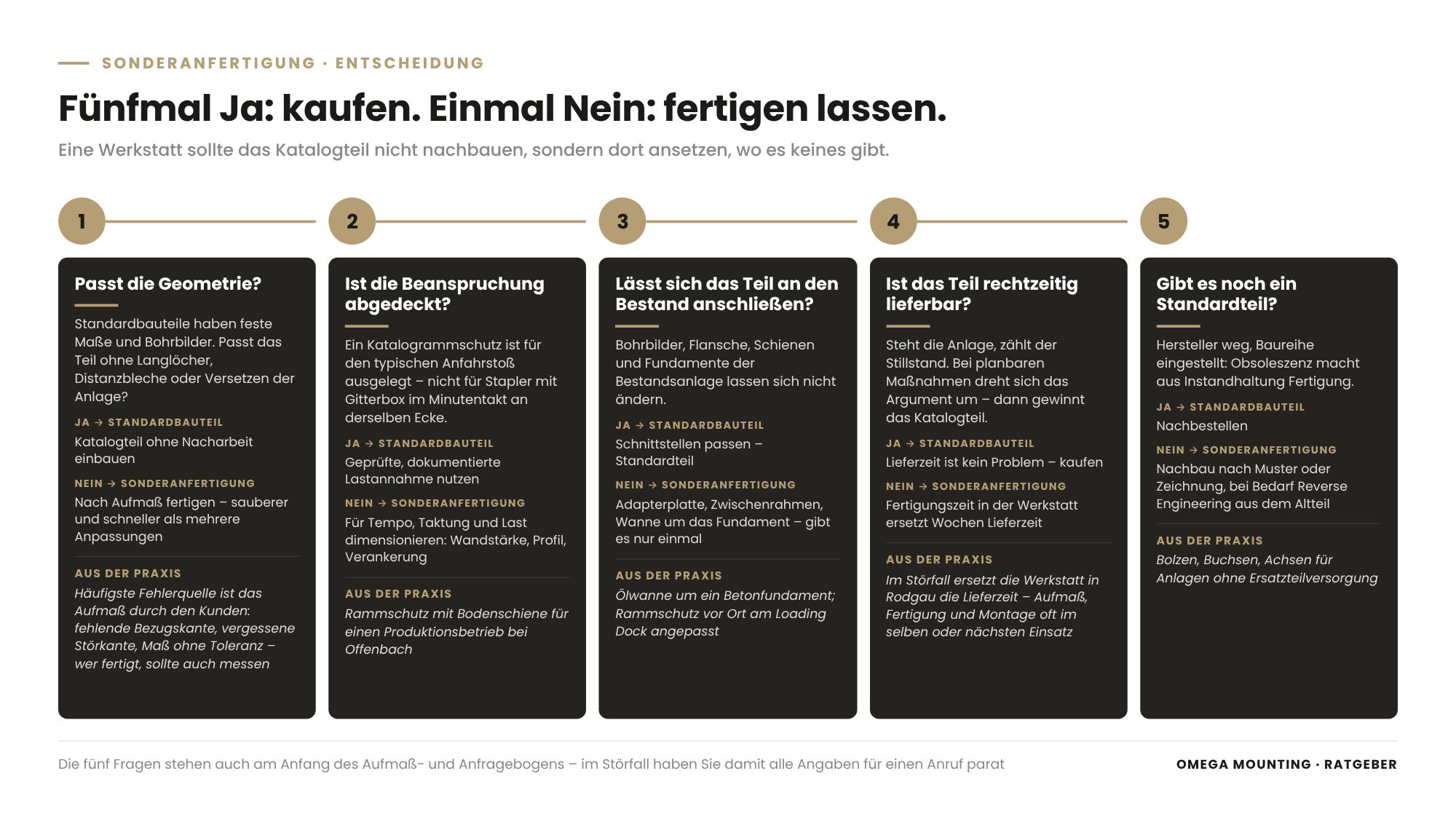
Five questions decide whether a standard component is enough or the workshop is the better answer. Does the geometry fit? Is the loading known and covered by the standard? Can the part be connected to the existing plant? Can it be delivered in time – and is there still a standard part at all? Anyone who answers all five with yes buys. Anyone who says no once has it fabricated.
Question 1: Does the geometry fit?
Standard components have fixed dimensions and hole patterns. If the part fits without rework – without filing out slots, improvising shims or moving the plant – it is the right choice. As soon as several adaptations become necessary, the custom fabrication to site survey is usually cleaner and faster.
Question 2: Is the loading covered?
A catalogue impact guard is designed for a typical impact. If a forklift with a mesh box passes the same corner every minute at high speed, the actual loading lies outside what the standard part was built for. Then only a structure dimensioned for speed, cycle rate and load will help – with wall thickness, section and anchoring that suit the situation.
Question 3: Can the part be connected to the existing plant?
Existing plant has hole patterns, flanges, rails and foundations that cannot be changed. An adapter plate between new unit and old foundation, an intermediate frame between replacement motor and existing bracket, a pan that runs exactly around a foundation. These do not exist in the catalogue because the situation exists only once.
Question 4: Can the part be delivered in time?
If the standard part has weeks of delivery time and the plant is down, a custom fabrication from the workshop in days or hours is the more economical solution. Not because it is cheaper, but because it shortens the downtime. For plannable measures, the argument reverses: then delivery time is not a problem, and the catalogue part wins.
Question 5: Is there still a standard part?
For plant whose manufacturer no longer exists or no longer carries the series, there is no standard part any more. Obsolescence – the unavailability of spare parts – turns maintenance into fabrication: remaking from a sample or drawing is then the only way to keep the plant running.
| Criterion | standard component | Custom fabrication |
|---|---|---|
| Geometry. | Fixed dimensions, hole patterns, heights. | To site survey of the plant. |
| Load assumptions. | Tested and documented for the typical case. | Dimensioned for the actual loading. |
| Connection to existing plant. | Only with matching interfaces. | Adapters, intermediate frames, fitted pieces included. |
| Availability. | From stock or with delivery time. | Fabrication time in the workshop, often days. |
| Documentation. | Data sheet, manufacturer's test certificate. | Sketch/drawing, material certificate, installation report. |
| Interchangeability. | Can be reordered at any time. | Can be remade to drawing. |
| Typical case. | New plant, standard situation, plannable procurement. | Existing plant, breakdown, obsolescence, special load. |
How does a custom fabrication in metalwork proceed from site survey to installation?
A custom fabrication in metalwork proceeds in six steps: site survey, sketch or drawing, definition of material and surface, fabrication in the workshop or adaptation on site, installation in the plant and documentation. Anyone who keeps these steps in one hand avoids the interface at which most custom fabrications fail. It lies between the one who measures, the one who fabricates and the one who installs.
Step 1: the site survey
The site survey is the measurement of the installation situation on site – with tape measure, laser, template or impression. It records not only the part but its surroundings: obstructing edges, floor unevenness, existing holes, service lines, travel routes, tolerances of the existing plant. A survey by the customer is possible but the most common source of error: missing reference edge, forgotten obstructing edge, dimension without tolerance. Our experience: whoever fabricates should also measure.
Step 2: sketch or drawing
Not every custom fabrication needs a CAD drawing. A dimensioned hand sketch is enough for brackets, mountings and simple frames. A drawing with tolerances is needed when fits matter – for pins, bushes, adapter plates with hole patterns. Likewise when the part is to be remade later or the customer wants an approval before fabrication.
Step 3: material and surface
Material and surface follow from loading and environment – see the next section.
Step 4: fabrication – in the workshop or on site
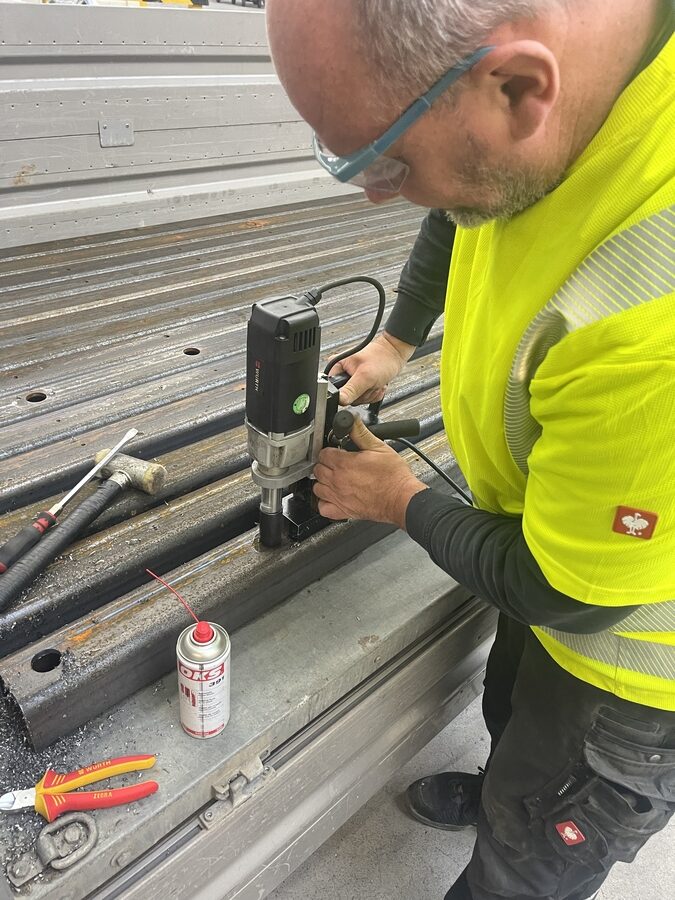
What can be fabricated in the workshop is fabricated there: cutting, welding, drilling, milling, turning, coating. There, conditions are controlled, with extraction and without the operator's fire protection requirements. What has to be adapted to the existing plant is adapted on site: drilling with the magnetic drill on the existing steel, tapping threads, welding in corners.
Step 5: installation in the plant
Installation and retrofitting during ongoing operations follow the rules of every job in an existing facility. Release by the operator, cordoning of the work area, for welding or cutting work a permit to work for hot work with fire watch. Plus anchoring with heavy-duty or chemical anchors to manufacturer's specification, visual inspection and completion notice. In a data center, the ban on grinding and welding in the data hall is added. There, prefabrication takes place in the workshop and only bolting is done on the technical areas (grey space). What to watch out for in repair welding in an operating plant is described in our guide on repair welding on industrial plant – the same applies to custom fabrications.
Low-dust adaptation and anchoring
Abrasive cutting, grinding and drilling anchor holes are the most dust-intensive steps of an on-site installation. Angle grinders and drills are among the hand-held machines with high dust emission. Drilling into concrete or masonry produces mixed dust with respirable crystalline silica, which is classified as carcinogenic – according to the BG BAU/BAuA module "Site set-up – low-dust working". The measures follow the STOP principle. The most effective substitution is prefabrication in the workshop, where welding and grinding are done with extraction. What remains on site runs with technical safeguards: rotary hammer with extraction at the drill bit, dust class M extractor, wet methods for cutting concrete, air cleaners with exhaust filtration and fresh air supply in enclosed rooms. Dry sweeping or blowing off dust deposits with compressed air is not permitted under the Hazardous Substances Ordinance (GefStoffV). Cleaning is done by vacuuming or wet methods.
Step 6: documentation
Sketch or drawing, material specification, coating system, anchoring, photo documentation, installation report. For spare parts, additionally the dimensions in a form in which the part can be remade next time without a site survey.
Which materials and surfaces come into consideration?
Material and surface of a custom fabrication follow from loading, environment and visibility. Structural steel with coating for most industrial applications, stainless steel for food, wet areas and chemicals, aluminium where weight counts. Plus a surface that ensures corrosion protection and visibility for as long as the part is in use.
Materials
- Structural steel (unalloyed steel of the usual strength grades) is the standard for brackets, frames, impact protection and fixtures: readily weldable, available in all sections, economical. It needs corrosion protection.
- Stainless steel is mandatory in food and beverage plants, in wet areas and under chemical exposure – also for cleanability and hygiene. It is more demanding to weld and machine.
- Aluminium comes into consideration where weight counts – for covers or fixtures that are moved by hand.
- Quenched and tempered and case-hardening steels are chosen for pins, shafts and bushes that must withstand wear and high surface pressure. Here, material selection is part of tribology, the science of friction and wear of the pairing.
Surfaces
- Primer and top coat is the standard for indoor areas: anti-corrosion primer, with a hard-wearing top coat on top – for impact protection and barriers in signal colour, so that the part is seen before it is hit.
- Hot-dip galvanising is the choice for outdoor areas, wet rooms and wherever a long service life without recoating is required; it demands galvanising-compatible design with vent holes and consideration of distortion.
- Powder coating provides a uniform, impact-resistant surface for visible components, but needs an external coater and therefore time.
- Bare or oiled remain fitted parts and wear parts that run lubricated anyway.
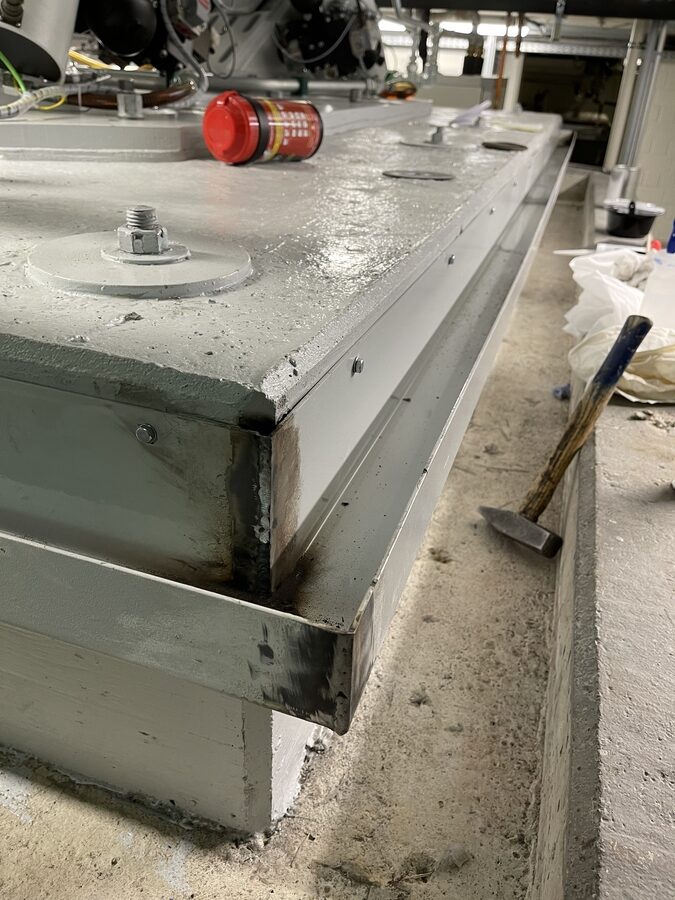
The surface also includes preparation: welds are ground flush, edges broken, scale removed. A coating on an unground weld does not hold – and on a drip tray, the ground, primed and painted weld is also the sealing plane.
When does maintenance become fabrication?
Maintenance becomes fabrication when a part has to be replaced that can no longer be bought. Or that never existed because the plant was modified over its lifetime. For maintenance managers, this is the most common reason to need a workshop: not for the big conversion, but for the pin, bush or bracket without which the plant stands still.
Remake from a sample
If the old part is available, it is measured and remade – with an eye on the cause of the wear. A pin that has worn is made to the same dimension, but if necessary from a more wear-resistant material or with a different bush pairing. Reverse engineering, recovering the manufacturing dimensions from the component, replaces the missing drawing. What this looks like for conveyor technology is shown in our guide on wear on overhead conveyors using the example of pins and bushes.
Remake with improvement
Maintenance according to DIN 31051 recognises, besides servicing, inspection and repair, improvement – increasing reliability without changing the function. The custom fabrication is the tool for this. The bracket that has cracked twice gets a stiffening rib the third time. The impact guard that was bent gets a floor rail that directs the forces into the floor instead of the plant.
Avoiding substantial modification
One limit must be observed. Anyone who modifies a component in such a way that the function, safety or performance of the machine changes may trigger a substantial modification within the meaning of product safety law – with new obligations for the operator. A dimensionally identical remake or a reinforcement without change of function is usually not that. A conversion that affects safeguards or extends the use may be. If in doubt, we clarify this with you before fabrication and document the decision.
Where are the limits of custom fabrication?
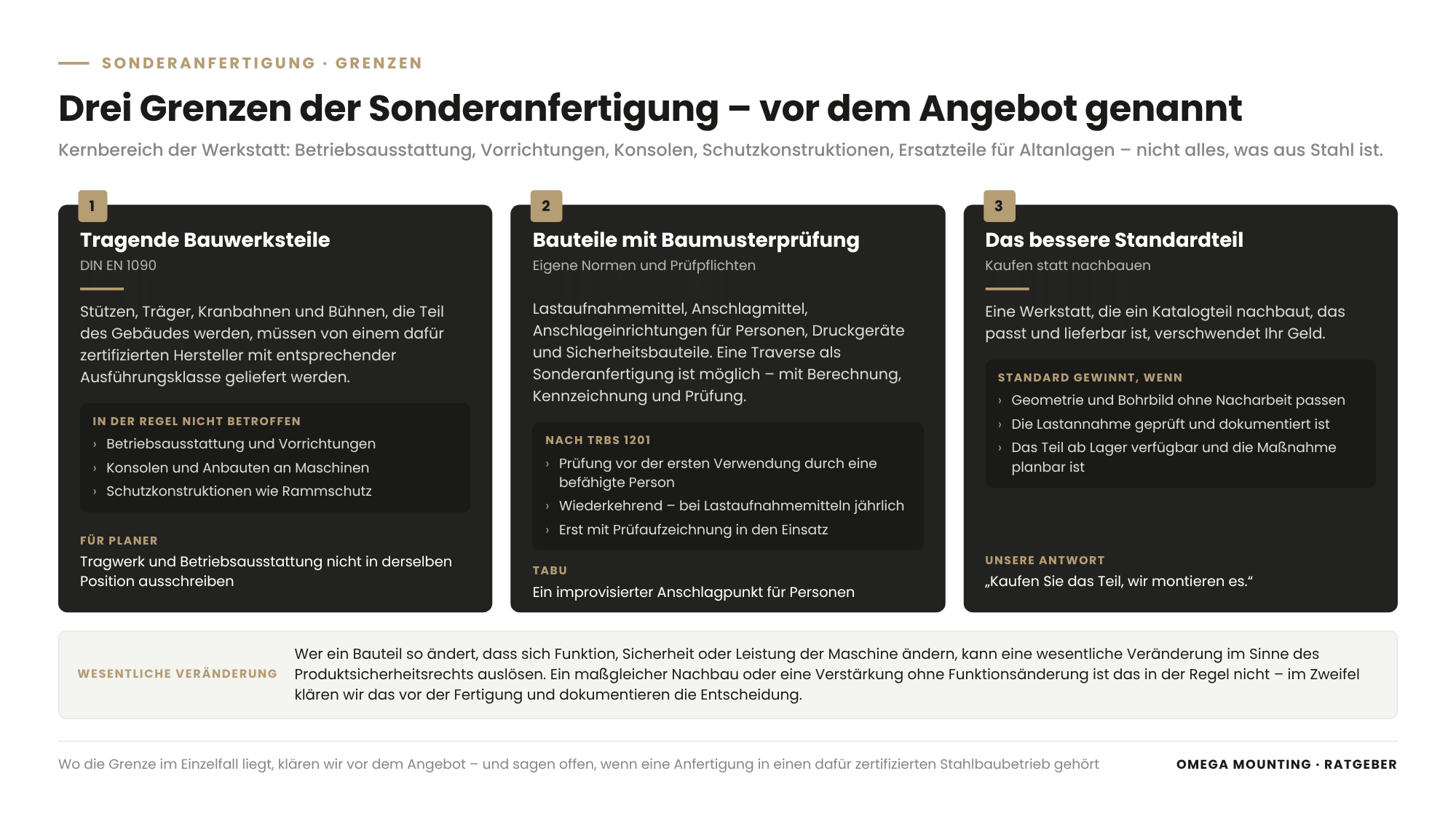
Custom fabrication has three limits: load-bearing components of a building, components with statutory type examination, and cases in which the standard part is simply better.
Load-bearing building components: Columns, beams, crane runways, platforms that become part of the building fall under DIN EN 1090 "Execution of steel structures and aluminium structures". They must be supplied by a manufacturer certified for this with the appropriate execution class. Plant equipment, fixtures, brackets on machines and protective structures are usually not affected. Where the line lies in the individual case, we clarify before the quotation – and tell you openly if a fabrication belongs with a steel construction company certified for this.
Components with type examination: Load-handling attachments, lifting accessories, anchor devices for persons, pressure equipment and safety components are subject to their own standards and inspection duties. A spreader beam as a custom fabrication is possible, but needs calculation, marking and inspection in accordance with the German technical rule TRBS 1201 (inspections of work equipment). It requires inspection before first use by a competent person and periodically thereafter, annually for load-handling attachments. For you this means: a fabricated part that lifts or carries loads goes into service only with an inspection record. An improvised anchor point for persons is taboo.
The better standard part: A workshop that replicates a catalogue part that fits and is available wastes your money. The right answer to an enquiry is therefore sometimes: "Buy the part, we will install it."
How do you enquire about and tender a custom fabrication?
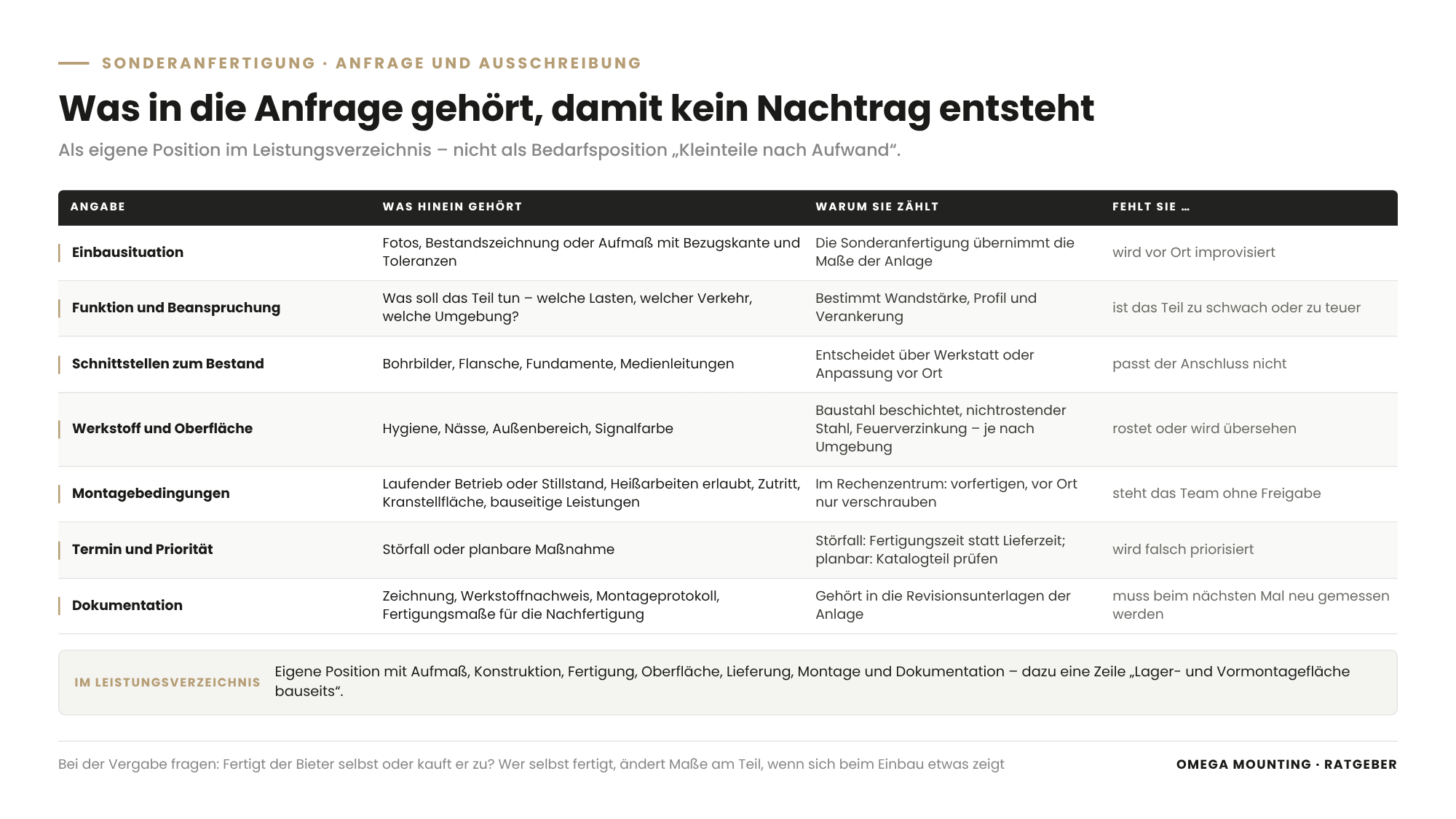
A custom fabrication is enquired about and tendered so that the bidder knows the installation situation, the loading, the interfaces and the installation conditions – then everyone prices the same service and no change order arises. In the scope of works, it belongs as a separate item – for example "custom fabrication metalwork/installation" – described with site survey, design, fabrication, surface, delivery and installation, not as a contingent item "small parts on a time basis".
What belongs in the enquiry:
- Installation situation with photos and, if available, as-built drawings or site survey.
- Function and loading: what is the part supposed to do, what loads, what traffic, what environment?
- Interfaces to the existing plant: hole patterns, flanges, foundations, service lines.
- Material and surface requirements, such as hygiene, outdoor area, signal colour.
- Installation conditions: ongoing operations or maintenance window, hot work permitted, access, crane set-up area, works by others.
- Date and priority: breakdown or plannable measure.
- Documentation requirements: drawing, material certificate, installation report.
When awarding, it is worth asking about the workshop: does the bidder fabricate in-house or buy in? Anyone who fabricates in-house can rework in a breakdown, can change dimensions on the part if something shows up during installation, and needs no second company for the installation. Why proximity to the workshop counts in a breakdown is explained in our guide on the installation contractor in the Rhine-Main region.
How does the custom fabrication get safely to the site?
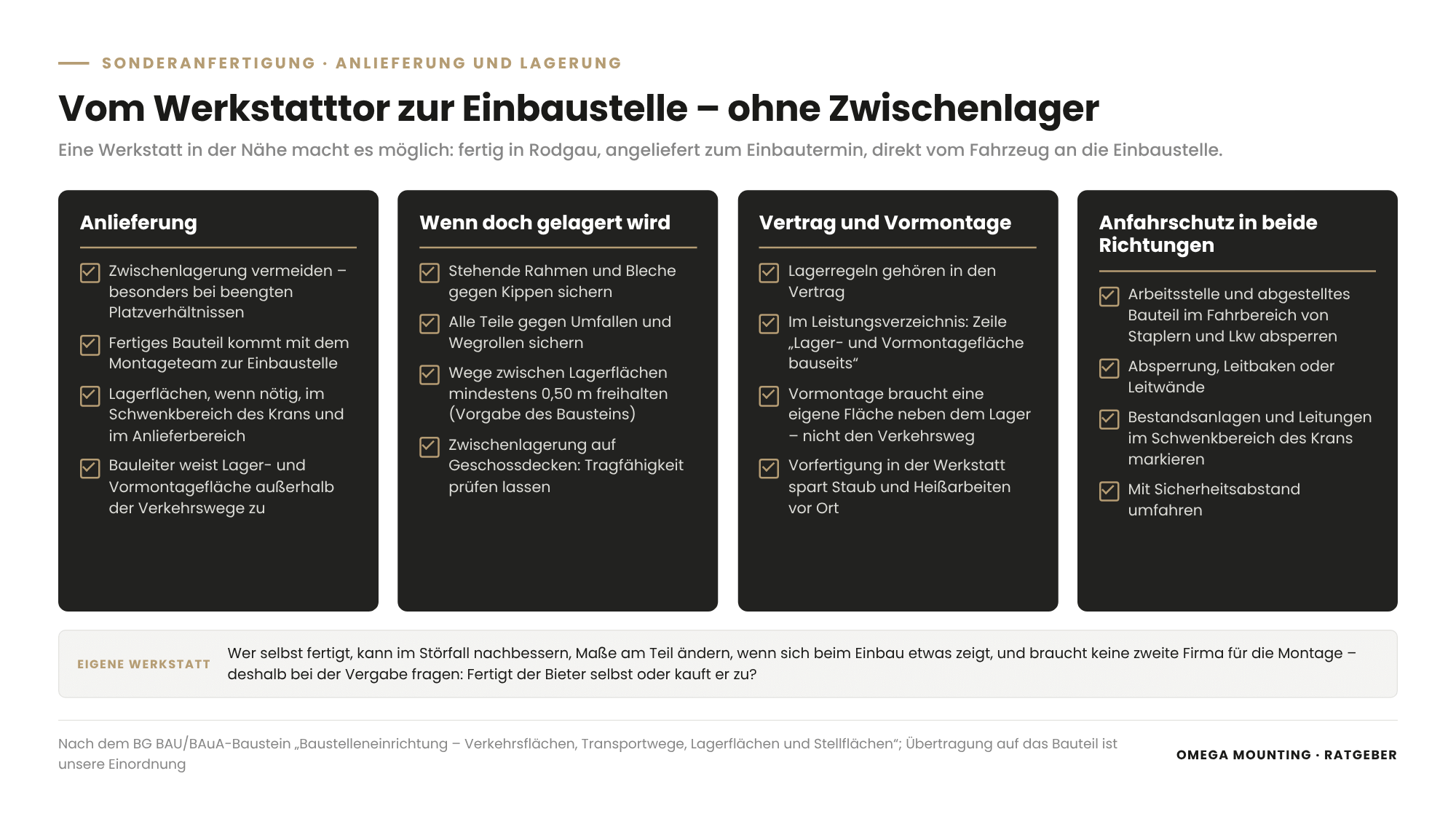
A custom fabrication gets safely to the site when delivery, interim storage and protection of the component before installation are planned – ideally without interim storage. The BG BAU/BAuA module "Site set-up – traffic areas, transport routes, storage areas and parking areas" recommends avoiding interim storage, especially in confined spaces, and arranging storage areas within the crane's slewing range and in the delivery area. A nearby workshop makes this possible: the frame is finished in Rodgau and arrives with the installation team at the installation point.
If storage is nevertheless required, the module's rules apply. Secure frames and sheets stored upright against tipping, all parts against falling over and rolling away. Keep routes of at least 0.50 metres (module requirement) clear between storage areas and have the load capacity checked for interim storage on upper floor slabs. Storage rules belong in the contract – in the scope of works as a line "storage and pre-assembly area by others". Pre-assembly needs its own area next to the storage, not the traffic route.
Collision protection applies in both directions. Workplace and parked component in the travel area of forklifts and trucks are protected with barriers, guide posts or guide walls. Conversely, existing plant and service lines within the crane's slewing range are marked and bypassed at a distance.
How we do it in practice
In our practice, custom fabrications come in three forms. Planned from the workshop, adapted on site to the existing plant, and improvised from the material when something is missing. Four jobs from our project diary show all three.
Impact protection from the workshop: Offenbach
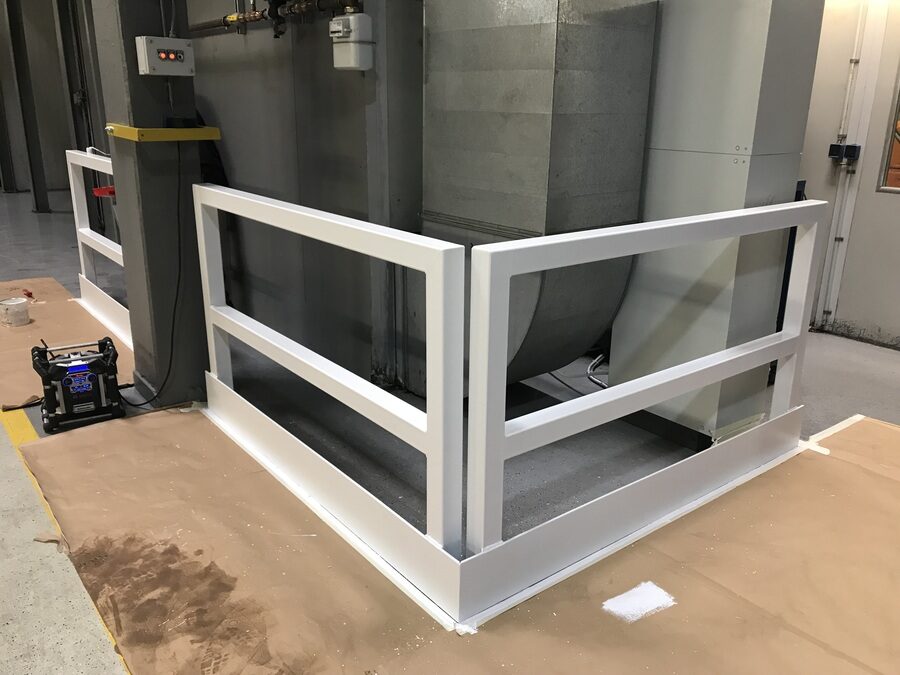
For a production company near Offenbach, where forklifts with mesh boxes pass sensitive plant technology every minute, we built a custom-made impact protection – a 200 × 100 × 10 millimetre steel angle as an anchored floor rail, on top of it a frame of 80 × 80 × 5 millimetre steel tube, anchored in the floor with heavy-duty anchors, primed and painted in signal yellow. Two people welded the structure in our workshop in Rodgau in about a day, two metalworkers installed it in a single working day. The decision against the catalogue part was made at question 2: the loading from speed, cycle rate and load lay outside what standard impact protection is built for. The decision logic behind this is described in our guide Impact protection: buy standard or have it custom made?
Adaptation on site: loading dock at Frankfurt Airport
At a logistics facility at Frankfurt Airport, we built impact protection made of square tube with ten millimetre wall thickness against incoming dollies. Three metalworkers, four days, adaptation and installation entirely on site at the existing plant. The square tubes were pre-drilled with the magnetic drill, the loading dock drilled and tapped. Then the tubes were installed, the corners welded in and painted in a matching colour. Here question 3 was decisive: the connection dimensions to the dock's existing steel could not be taken to the workshop – so the workshop came to the plant.
Oil pan around a foundation: test facility of a car manufacturer
In the test facility of a car manufacturer in southern Germany, we converted the hydraulic lines of a test rig and installed a continuous oil pan at the concrete foundation. Two fitters, three days. The pan segments were set around the foundation, fixed with anchors and bolts, every corner and every transition welded leak-tight using the TIG process. The gap to the concrete wall was sealed with oil-resistant sealant, the welds ground flush, primed and painted. Welding was done in the basement with welding fume extraction and fresh air supply. A bought-in part would not have fitted here – the foundation exists exactly once.
Improvised from the material: cable reel in Aschaffenburg port
In Aschaffenburg port, a cable reel weighing around 22 tonnes was to be enclosed in two layers of UV-protection tarpaulin and loaded. The tarpaulin came with eyelets but without the announced fastening system – and the low-loader was already waiting. Three fitters enclosed and loaded the cable reel while suspended: while two prepared the reel for the lift on site, the third procured clamps, wire ropes, lashing straps and cable ties from suppliers. From these, attachment points on the reel flange were created that had not existed before – removable without damage, because the reel goes back into circulation. After a few hours, the low-loader was loaded. From Rodgau to Aschaffenburg: around 35 kilometres.
Are you missing a part that cannot be bought – or does the catalogue part not fit your plant? Then get in touch with us. With photos of the installation situation, we can usually tell you the same day whether workshop or catalogue is the better answer.
What this means for your role
For buyers: Include the custom fabrication as a separate item in the scope of works – with site survey, design, material, surface, delivery, installation and documentation. Do not hide it under "sundries on a time basis". When awarding, ask whether the bidder has its own workshop, and rate proximity and response time as a suitability criterion. In a breakdown, fabrication time decides the downtime.
For designers: Plan interfaces so that later custom fabrications remain possible. Access to foundations and brackets via inspection openings, space for adapter plates, reserve in hole patterns, moving-in routes and installation openings with sufficient clear width for prefabricated frames. Define which components fall under DIN EN 1090 so that plant equipment and load-bearing structure are not tendered in the same item. Specify material and surface requirements from the environment – hygiene, wet conditions, outdoor area – not from the catalogue.
For project managers and site managers: The project manager clarifies drawing approval, date and installation window before fabrication. The site manager ensures on site that survey and installation situation match, that hot work runs with permit to work and fire watch, and that anchors are set to manufacturer's specification. Both should agree one rule. What turns out to deviate during installation is documented and resolved with the workshop – not on site with a hammer. The site manager also assigns the delivery a storage and pre-assembly area outside the traffic routes.
For maintenance managers: For your critical plant, define which wear parts are no longer available and have drawings or samples made before the last old part fails. Use every repair for improvement according to DIN 31051: what has broken twice is made reinforced the third time. And record which workshop within reach can fabricate at the weekend.
For warehouse and logistics managers: Impact protection, collision guards, racking protection and transfer points are the most common custom fabrications in logistics, because forklift traffic, doors and docks are different everywhere. After every impact damage, check whether the standard part was up to the loading. If not, the custom fabrication with floor rail and suitable wall thickness is the more durable solution. During installation, also protect the workplace and the delivered component with barriers and safety distance.
For manufacturers and system builders looking for an installation partner: When installing your plant in an existing facility, something is almost always missing – a bracket, an adapter, a fitted piece. An installation partner with its own workshop solves this in the same job, instead of interrupting the site and asking you for a replacement part. Clarify in advance which adaptations the installation partner may fabricate itself and how they are documented, so that your declaration of conformity remains unaffected.
Site survey and enquiry form for custom fabrication: template on request
Our site survey and enquiry form for custom fabrication is a one-page template with which buyers, designers and maintenance staff describe a custom fabrication so that it can be quoted without queries. It contains the five decision questions, installation situation with reference edges and tolerances, loading, material and surface, interfaces, installation conditions, date – and a sketch area for the site survey. Request the form via our Contact form – keyword "custom fabrication enquiry form".
Why Omega Mounting?
In our own metalwork shop in Rodgau near Frankfurt – with welding equipment and milling machine – we fabricate one-offs for existing plant. Pins, bushes, shafts, levers and mountings, remakes from samples, fitted pieces and adapters, reinforcements and brackets, made-to-measure collision and impact protection, fixtures and aids. Site survey, design, fabrication and installation come from a single source, as the jobs in Offenbach, at Frankfurt Airport, in Aschaffenburg port and in the test facility in southern Germany show. From Rodgau, we are quickly on site in Offenbach, Frankfurt, Hanau, Dietzenbach and Aschaffenburg, and via the 24-hour hotline also in a breakdown. More about our custom fabrications for existing plant can be found on the service page. For you this means: metalwork in the Rhine-Main region with one contact for site survey, fabrication and installation – and a workshop that replaces delivery time in a breakdown. Get in touch with us, before you adapt the next catalogue part.
Conclusion
Custom fabrication or standard component is not a matter of faith but a decision along five questions: geometry, loading, connection to the existing plant, delivery time and availability. If the catalogue part fits, buy it. If it does not fit, the workshop is the better answer – with site survey, drawing, suitable material, the right surface and installation by the same team. Custom metalwork fabrication with installation has two limits: load-bearing building components and tested safety components – an honest workshop names them before the quotation. Send us photos of the installation situation, the approximate dimensions and your date – we will get back to you with an honest assessment of whether we measure, fabricate and install, or whether you are better off buying.
Planning maintenance, moving in or installation in the Rhine-Main region?
Tell us briefly what it is about – we will come back to you with an honest assessment.
100% free and without obligation
You may also be interested in these guides
Maintenance & Servicing

About the author
Tobias Schott
Managing director of Omega Mounting GmbH, Rodgau · more than 20 years of hands-on experience in installation and maintenance
A trained mechatronics technician, at home in maintenance, servicing and industrial installation since 2004 – first at his father's side, since 2012 with Omega Mounting: from the overhead conveyor in Frankfurt to the crane system in a new-build hall. Plans and leads lifting operations as appointed person in data centers and on industrial sites in the Rhine-Main region, is an instructor and examiner for cranes, mobile elevating work platforms and telehandlers, and a safety officer. On jobs abroad he is known as the “German Troubleshooter” – the one you call when things get stuck on site. He learned what quality means not from a manual but from his father: Made in Germany as a standard for his own work, not as a label. That is why it comes first at Omega Mounting – before speed and before price. He writes these guides from that practice: what works on our sites is in them – what only exists in the standard is not.
Frequently asked questions
A custom fabrication in metalwork with installation is a one-off made of steel, stainless steel or aluminium that is manufactured to site survey, sketch or drawing for a specific installation situation and then installed. Typical examples are brackets, adapter plates, impact protection, drip trays, fixtures or spare parts. The difference from the standard component is the fit to the plant: the catalogue part brings its own dimensions, the custom fabrication takes over the dimensions of the existing plant.
When geometry or hole pattern do not fit, when the actual loading lies outside what the standard part is designed for, or when the part has to be connected to existing plant. Likewise when the delivery time extends the downtime or there is no standard part any more. If the catalogue part fits, is tested and is available from stock, it is the better choice.
With sketch or drawing, material specification, coating system, details of anchoring, photo documentation and installation report. For spare parts, additionally with manufacturing dimensions so that the part can be remade next time without a site survey. These documents belong in the plant's as-built documentation.
Reverse engineering is the recovery of manufacturing dimensions from an existing component when no drawing exists any more. The old part is measured, wear is calculated out, and the part is remade – if necessary from a more wear-resistant material. For plant without spare parts supply, this is often the only way to keep it running.
No. DIN EN 1090 applies to load-bearing components of buildings – columns, beams, crane runways, platforms that become part of the building – and requires a certified manufacturer for them. Plant equipment, fixtures, brackets on machines and protective structures such as impact protection are usually not affected. Where the line lies in the individual case should be clarified before the quotation.
The same as for every job in an existing facility: release by the operator, cordoning of the work area, for welding and cutting work a permit to work for hot work with fire watch and extraction. Plus anchoring to manufacturer's specification and a risk assessment under Section 5 of the ArbSchG (German Occupational Safety Act) for the job. When working in confined or poorly ventilated rooms, welding fume extraction with fresh air supply is added. Dust is avoided according to the STOP principle: prefabrication in the workshop, extraction at drill and grinder, dust class M extractor instead of broom or compressed air. If the fabricated part carries or lifts loads, it is inspected before first use in accordance with TRBS 1201.
Both, depending on the component. What can be fabricated under controlled conditions is made in our workshop in Rodgau. What has to take connection dimensions from the existing plant is adapted on site, for example by drilling with the magnetic drill on the existing steel. Often it is a combination: prefabricated in Rodgau, adapted and installed at the customer's.
That depends on component, material and surface – the proximity of the workshop shortens the chain. Site survey in Offenbach, Hanau or Aschaffenburg, fabrication in Rodgau, installation often in the same or next job. In a breakdown, the fabrication time in the workshop replaces the delivery time of a catalogue part – which is why the workshop is part of our breakdown readiness via the 24-hour hotline.
Via a short enquiry with three details: photos of the installation situation, the approximate dimensions or an as-built drawing, and the date – breakdown or plannable measure. We will first tell you whether a standard part is enough. If not, we come for the site survey, clarify material, surface and installation conditions on site and send you a written quotation with sketch. Your contact is Tobias Schott – reachable via our Contact form; our site survey and enquiry form guides you through all the details.
 English
 German