
- Guide – Occupational safety
Repair welding on industrial plant: processes, hot work, permits
By Tobias Schott · Reading time approx. 24 minutes · Last updated: October 2026
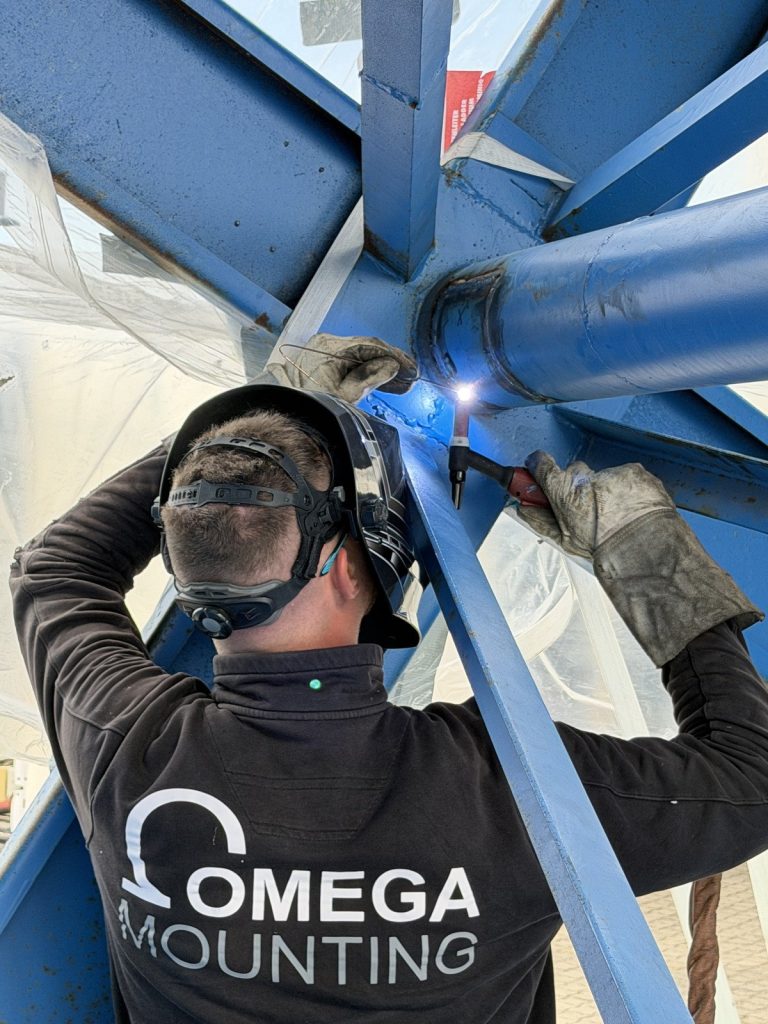
Repair welding in live operation is one third welding, two thirds preparation: clarify the material, grind out the seam, organise fire safety, record release.
A crack in a bracket, a broken weld on the loading dock, a leaking pan under the test rig. When steel fails on a plant, it is usually not just a component that stops but a process. Repair welding on industrial plant is therefore rarely about whether welding is possible – but about how to do it safely, durably and with the shortest possible downtime.
This is exactly where the problems arise in practice. Anyone who simply welds over the crack will have it back within a few weeks. Anyone who strikes the arc in a hall full of cardboard, hydraulic oil or cable reels without fire protection and a permit to work risks more than a component. And anyone who welds on a load-bearing part without knowing the structural design merely shifts the problem to the next periodic inspection.
This guide explains how we at Omega Mounting approach repair welding on plant. Which process suits which situation, how a weld is prepared, what belongs in the hot work permit, what inspection and acceptance look like – and when to keep your hands off welding altogether. With examples from our jobs in the Rhine-Main region.
Key points at a glance
- Repair welding is the repair of a damaged component by welding, on site or in the workshop, with the aim of restoring its original function and load-bearing capacity.
- The choice between TIG, MAG and MMA depends on material, wall thickness, accessibility and environment – not on the machine that happens to be in the van.
- A weld is only as good as its preparation: the crack must be ground out completely into sound base material, otherwise it continues to propagate beneath the new weld.
- Welding, cutting, brazing and abrasive cutting in an operating plant are hot work, requiring a written permit to work, a prepared fire protection zone and a fire watch during and after the work.
- Welding fume must be extracted at the point of origin; in basements and confined spaces, a fresh air supply is added.
- Load-bearing components of cranes, platforms, racking and steel structures are only welded with structural approval and documented welder qualification – no structural check, no weld.
- Every repair is followed by an inspection: at least a documented visual inspection of every weld, and for plant subject to mandatory inspection, re-inspection by a competent person with an entry in the inspection logbook.
What is repair welding on industrial plant?
Repair welding on industrial plant is the repair of a damaged or worn component by welding. Cracked, broken or eroded areas are removed and replaced by newly deposited weld metal or fitted replacement pieces. The component then regains its original function and load capacity.
The difference from welding new parts lies in the boundary conditions: in manufacturing, the material is known and the part lies in the flat position on the bench. For repairs on industrial plant, the material is often only estimated, the component hangs overhead in a constrained position, and three metres away production is running or flammable material is stored. Repair welding therefore has to answer two questions at once: will the weld hold? And is the way to get there safe?
In the language of DIN 31051, repair welding is corrective maintenance – the measure that restores the target condition after inspection and assessment have identified the damage. In practice we distinguish three cases. The repair weld closes a crack or a broken weld. The replacement-piece repair cuts out the damaged area and inserts a new segment. Build-up welding restores worn material. All three follow the same sequence: assessment with damage pattern and root cause analysis, clarify the material, weld preparation, welding, finishing, inspection.
Which welding process suits which repair?
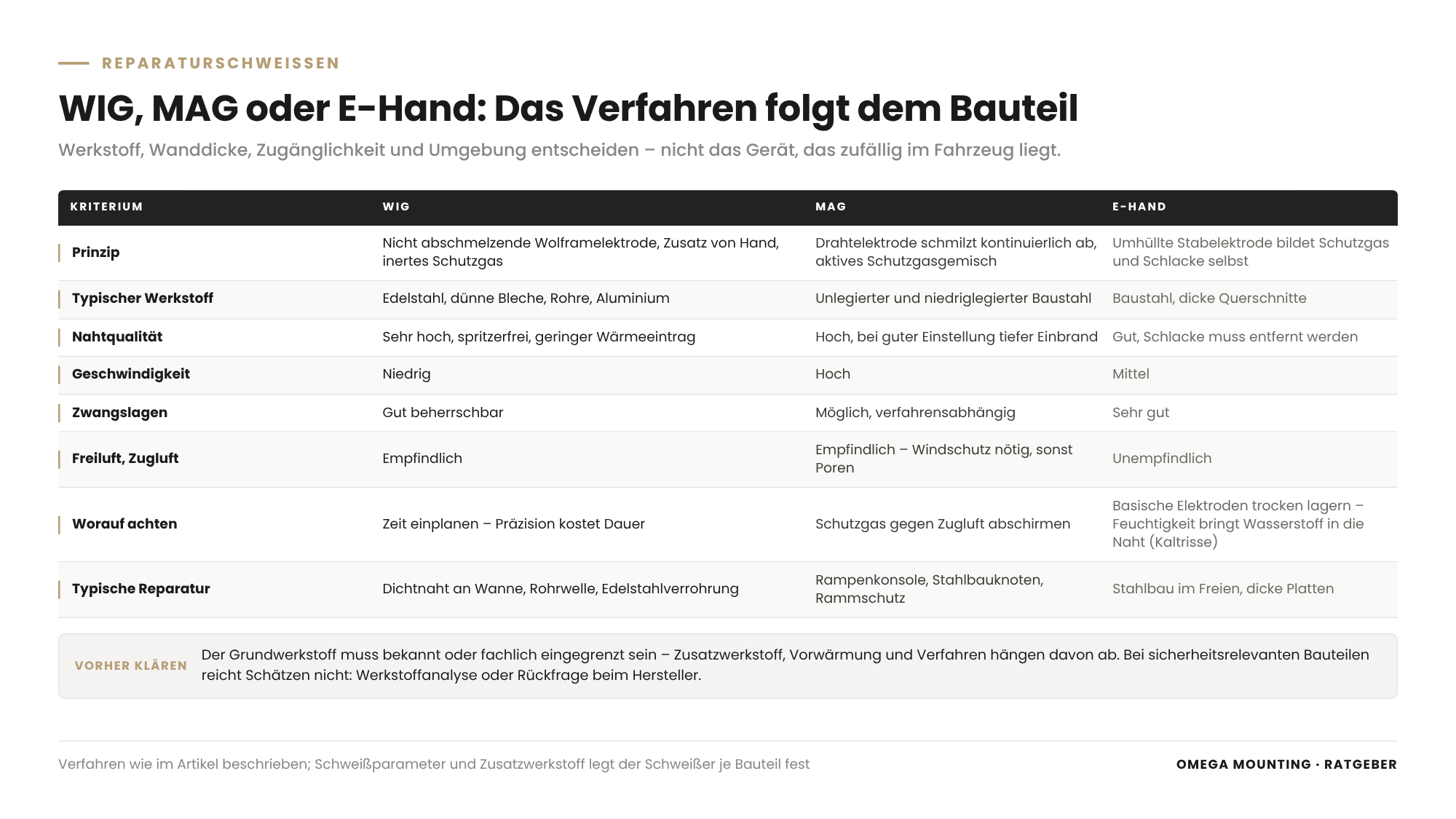
The right welding process follows from material, wall thickness, accessibility and environment. TIG suits thin sheet, stainless steel and leak-tight welds; MAG suits structural steel with deep penetration in the hall. MMA suits thick sections, constrained positions and windy outdoor sites.
TIG: precise, clean, slow
TIG stands for tungsten inert gas welding. The arc burns between a non-consumable tungsten electrode and the workpiece. The filler metal is fed by hand, and an inert shielding gas protects the weld pool. The result is low-spatter, highly controlled welds. TIG is our process of choice when the weld must be leak-tight (pans, tanks, pipe joints), for thin material and stainless steel, and when heat input must stay low. The price is time.
MAG: power for structural steel
MAG stands for metal active gas welding – a wire electrode feed melts continuously, and an active shielding gas mixture protects the pool. The process deposits a lot of weld metal in a short time and, correctly set, achieves deep penetration, i.e. a good bond right into the base material. For brackets, docks, structural steel nodes and anything made of unalloyed structural steel, MAG is the standard process in the hall. Its weakness: draughts blow the shielding gas away. Outdoors, MAG needs wind protection, otherwise porosity results.
MMA: robust when conditions are poor
Manual metal arc welding with a coated stick electrode – MMA for short – needs no shielding gas cylinder, because the coating itself forms shielding gas and slag as it melts. It is insensitive to wind and works in every position. For thick sections on outdoor sites, MMA is often the pragmatic solution. Note: basic electrodes must be stored dry, otherwise moisture introduces hydrogen into the weld – a main cause of cold cracking.
The decision matrix
| Criterion | TIG | MAG | MMA |
|---|---|---|---|
| Typical material. | Stainless steel, thin sheet, pipes, aluminium. | Unalloyed and low-alloy structural steel. | Structural steel, thick sections. |
| Weld quality. | Very high, spatter-free. | High, deep penetration when set correctly. | Good, slag must be removed. |
| Speed. | Low. | High. | Medium. |
| Constrained positions. | Well manageable. | Possible, process-dependent. | Very good. |
| Outdoors / draughts. | Sensitive. | Sensitive, wind protection required. | Insensitive. |
| Typical repair. | Leak-tight weld on pan, tubular shaft, stainless steel piping. | Dock bracket, structural steel node, impact protection. | Structural steel outdoors, thick plates. |
How do you clarify the material before welding?
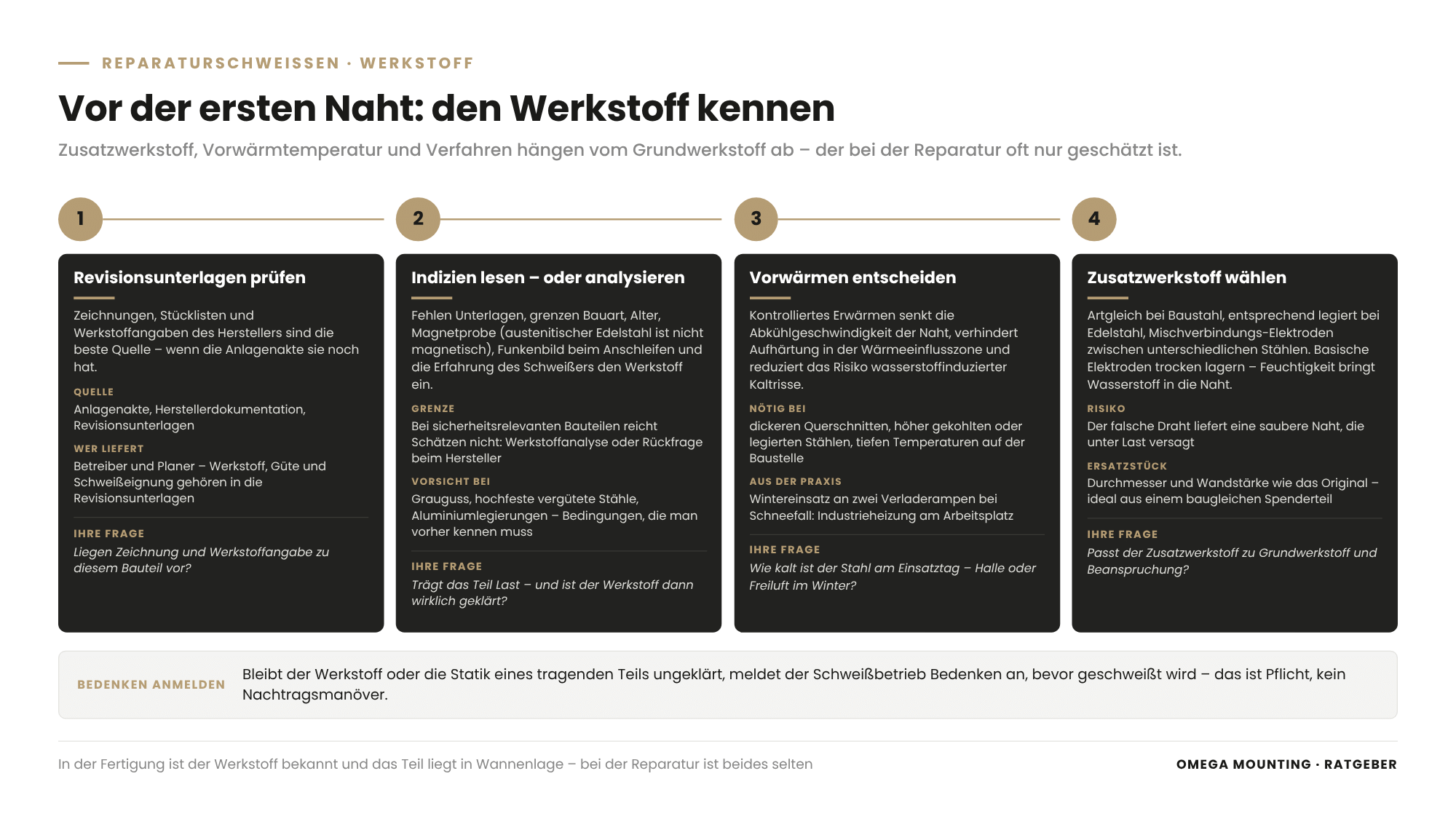
Before every repair weld, the base material must be known or at least narrowed down by an expert, because filler metal, preheating temperature and process depend on it.
The best source is the plant's as-built documentation: drawings, parts lists, manufacturer's material specifications. If these are missing, indicators help – design, age, magnet test (austenitic stainless steel is non-magnetic), spark pattern when grinding, and the welder's experience. For safety-relevant components, guessing is not enough; then a material analysis or a query to the manufacturer is the cleaner route.
Preheating: when and why
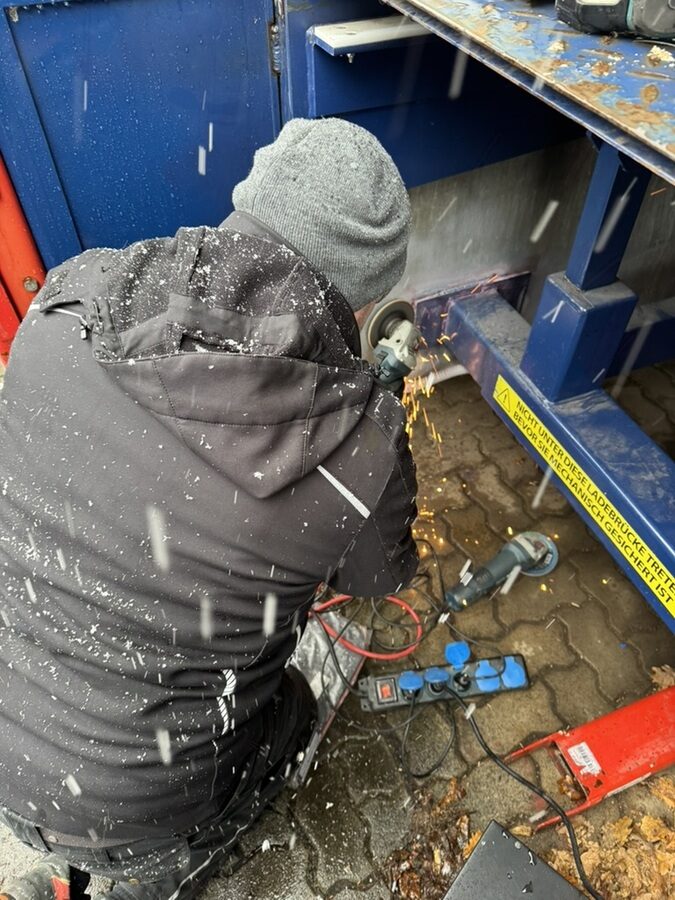
Preheating is the controlled heating of the component before welding to reduce the cooling rate of the weld. This prevents hardening in the heat-affected zone and reduces the risk of hydrogen-induced cold cracking. It becomes necessary with thicker sections, higher-carbon or alloyed steels, and low temperatures on site. During a winter job on two loading docks in snowfall and sub-zero temperatures, we therefore set up an industrial heater – cold steel welds differently from steel at room temperature.
Selecting the right filler metal
The filler metal must match the base material and the loading: matching grade for structural steel, correspondingly alloyed for stainless steel, with dissimilar-joint electrodes between different steels. The wrong wire produces a clean weld that fails under load.
How is a repair weld prepared?
A repair weld is prepared by removing the damage completely into sound base material. The groove is then opened for the chosen weld build-up and the surrounding area cleaned to bright metal. Only then is welding carried out.
Finding the crack – all of it
A crack is almost always longer than it appears. That is why the visible crack is not simply welded over but ground out until the crack tip is clearly in sound material – confirmed by dye penetrant testing if in doubt. If necessary, the crack tip is drilled to stop crack propagation. On our cable reel in Aschaffenburg port, we cut out the damaged pipe sections of the shaft completely and ground out all cracks into sound base material. Only then was a new segment fitted.
Removing old welds and coatings
Old, defective welds are ground out with an angle grinder down to the bright metal surface. Paint, scale, oil and galvanising must disappear from the weld zone, otherwise porosity and lack of fusion result. With galvanised parts, this is also a health issue: zinc fume demands consistent extraction. Grinding dust is not a minor matter either. The BG BAU/BAuA module "Site set-up – low-dust working" requires dust to be extracted at the point of origin. Deposits are removed with a dust extractor, not by sweeping or blowing off. Whoever grinds in your hall therefore brings the extraction – otherwise the metal dust later ends up in your plant and filters.
Replacement piece instead of patchwork
When the damage is extensive, a fitted replacement piece is usually better than a large build-up weld. It must match the original in diameter and wall thickness – ideally from an identical donor part, like the repair pieces for the tubular shaft of the cable reel. For special cases we manufacture fitted pieces in our workshop in Rodgau – more on our page on custom fabrications and spare parts from our own workshop.
Tacking, controlling distortion, planning the pass sequence
Before the actual weld, the parts are tacked and the geometry checked – with rotating components, concentricity counts. Thick sections are welded in multiple passes; each pass is cleaned of slag and spatter before the next. The transition to the surface should be free of notches, because the next crack starts at a notch.
What belongs in the permit to work for hot work?
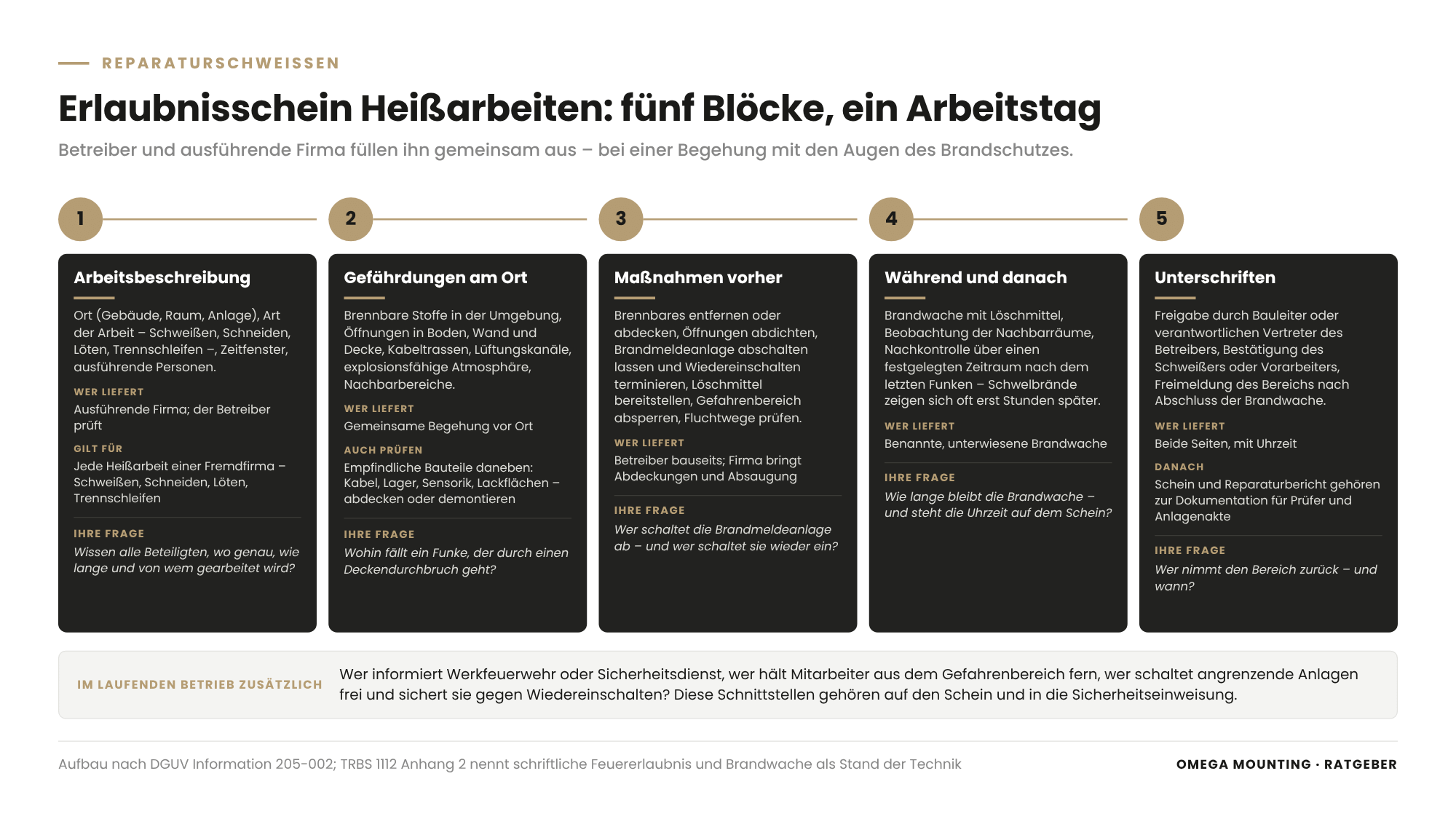
The permit to work for hot work – known on international sites as a hot work permit – is the written release document between the operator and the executing company. Before starting, both record where and what is to be welded and which fire hazards exist. Added to this are the protective measures before, during and after the work, the fire watch, and the signatures for release and handback.
Legally, this is backed by the employer's risk assessment and the obligation of several employers to coordinate their work – from which operating instructions and briefings follow. The procedure is specified in DGUV Information 205-002 "Fire protection during work involving fire hazards", which contains a model permit. That this is not a recommendation but state of the art for maintenance work is laid down in the German technical rule TRBS 1112 (maintenance). Hot work requires a written hot work permit and a fire watch. A welding contractor who starts without a permit is therefore not being pragmatic but working below the rule. You as the operator share the responsibility. On construction sites with a health and safety coordinator (SiGeKo), the health and safety plan (SiGe-Plan) also regularly requires a work release for work involving fire hazards.
The five blocks of a good permit to work
- Work description: Location (building, room, plant), type of work (welding, cutting, brazing, abrasive cutting), time window, persons carrying out the work.
- Hazards at the location: flammable substances in the vicinity, openings and penetrations in floor, wall and ceiling, cable trays, ventilation ducts, explosive atmosphere (explosion protection), adjacent areas.
- Measures beforehand: remove or cover flammable material, seal openings, have the fire alarm system in the area switched off or shielded (and schedule the reactivation), provide extinguishing agents, cordon off the danger zone, check escape and rescue routes.
- Measures during and after the work: fire watch with extinguishing agent, observation of adjacent rooms, follow-up check of the area over a defined period after the last spark.
- Signatures: Release by the site manager or the operator's responsible representative, confirmation by the welder or foreman, completion notice for the area after the fire watch has ended.
Anyone seeing this for the first time considers it bureaucracy – until a spark falls through a ceiling penetration into a cable tray. The permit to work forces both sides into a joint walk-round with the eyes of fire protection.
Special feature: ongoing operations
In ongoing operations, interfaces are added. Who switches off the fire alarm system, who informs the works fire brigade or security service? Who keeps employees away from the danger zone, who isolates adjacent plant and secures it against reactivation? These questions belong on the permit and in the induction by the contractor coordinator.
How do you protect plant, surroundings and people during welding?
Plant, surroundings and people are protected during repair welding by three sets of measures. These are fire protection in the work area with a fire watch, welding fume extraction at the point of origin, and personal protective equipment (PPE) and shielding against radiation, sparks and noise. The order of priority follows the hierarchy of controls in occupational safety: technical first, then organisational, personal last.
Fire protection and fire watch
Flammable substances are removed from the vicinity of the workplace. What cannot be removed is covered with flame-retardant blankets or boards. The fire protection rule specifies concrete distances for this. Openings in floors and walls are closed, because sparks and glowing grinding particles travel between floors. Extinguishing agents are kept within reach.
The fire watch is a named and briefed person who observes the area during the work and for a defined period afterwards. Smouldering fires often only become visible hours later. This follow-up check belongs in the permit to work, with time and signature. A smouldering fleece is a near miss that is reported, not just stamped out.
Fire protection includes the reporting chain. The BG BAU/BAuA module "Site set-up – emergencies and rescue" requires emergency numbers – fire brigade, fire safety officer, site management, first aiders – to be posted as an alarm plan and demonstrably communicated to the companies. For your hot work this means: the permit to work states whom the fire watch calls, and the first aid kit is at the workplace.
Protecting the plant itself
Often it is not the building but the component next to it that is most sensitive. With the cable reel in Aschaffenburg port, a high-voltage cable weighing several tonnes lay directly beside the welding point. It stayed on the reel, protected by heat-resistant covers against sparks, spatter and grinding dust. The same applies to bearings, seals, sensors, painted surfaces and electronics nearby: they are covered or removed. Earth cables are placed so that the welding current does not flow through bearings or control systems.
Extracting welding fume
Welding fumes are classified as carcinogenic. The TRGS 528 "Welding work" therefore requires the fumes to be captured and extracted as close as possible to the point of origin. In an open hall, a mobile extraction unit with capture arm is often sufficient. In basements, pits and confined spaces, a fresh air supply is added so that no oxygen deficiency or accumulation occurs. This is how we welded an oil pan in the basement of a test facility.
The basement raises a second question that is often only asked on site: where does the shielding gas cylinder go? The TRBS 3145 (transportable pressurised gas containers) prohibits placing gas cylinders in stairwells, corridors, passageways and escape routes. For rooms below ground level, it allows exceptions only with cordoning, ventilation and supervision. Cylinders are only moved with the valve closed and valve protection fitted, and are secured against falling over. Therefore clarify in advance whether the cylinder stays upstairs and the hose is extended – usually simpler than a ventilation concept for the basement.
Personal protective equipment and surroundings
Auto-darkening welding helmet, flame-retardant protective clothing, welding gloves, S3 safety boots and hearing protection when grinding are standard. For the surroundings, glare protection by welding curtains and cordoning off the danger zone count, so that no bystanders get into the spark trajectory or the load zone of a lifted component. When welding from a MEWP or at a fall edge, fall arrest PPE is added. When working in constrained positions, ergonomics count: regular rotation, a second person within calling distance and a functioning rescue chain. If welding is done from scaffolding, the BG BAU/BAuA module "Site set-up – working and protective scaffolds" applies. The scaffold is inspected by the erector and marked with a release document before it is accessed. Only the erector may modify it. A welder who "quickly adjusts" a scaffold lift cancels the release.
How is a repair weld inspected and accepted?
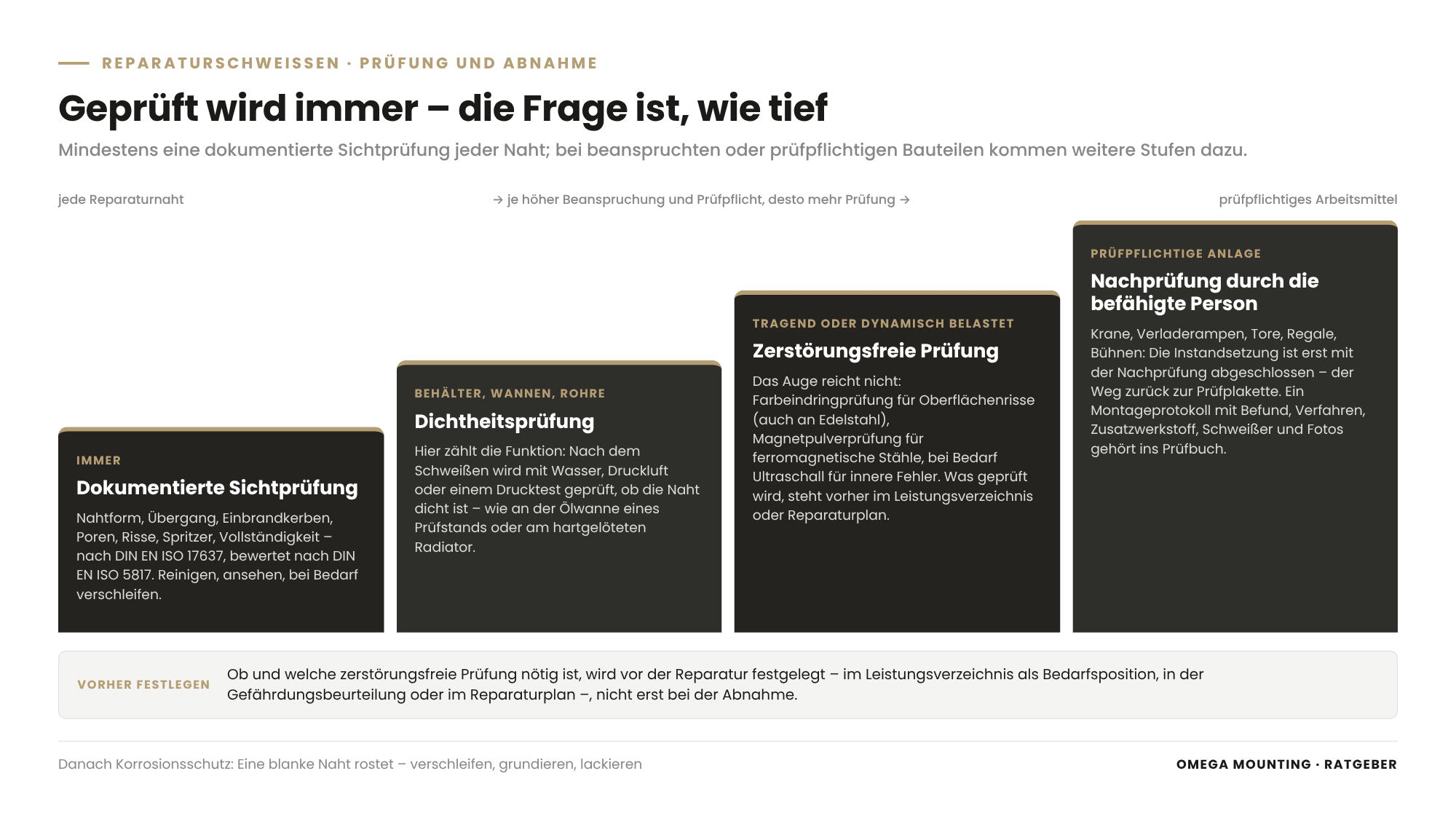
A repair weld is accepted at least by a documented visual inspection of every weld. For highly loaded components or those subject to mandatory inspection, non-destructive testing and re-inspection by a competent person follow. Only then is the plant released again.
Visual inspection as the mandatory minimum
Visual inspection in accordance with DIN EN ISO 17637 is the first and most important step. Weld shape, weld toe, undercut, porosity, cracks, spatter and completeness of the weld are checked. The evaluation criteria are the quality levels for imperfections in accordance with DIN EN ISO 5817.
Non-destructive testing when it matters
For load-bearing or dynamically loaded components, the eye is not enough. Then dye penetrant testing (for surface cracks, including on stainless steel) or magnetic particle testing (for ferromagnetic steels) come into play, and ultrasonic testing for internal defects if required. Whether and what is tested is defined beforehand – in the scope of works, in the risk assessment or in the repair plan – not at acceptance.
Leak test for tanks and pans
For pans, tanks and piping, function counts: after welding, the weld is tested for tightness with water, compressed air or a pressure test.
Re-release of plant subject to mandatory inspection
Cranes, loading docks, doors, racking and platforms are subject to periodic inspections with inspection interval and inspection sticker. If a defect from such an inspection has been rectified by welding, the repair is only complete with re-inspection by the competent person. For our loading docks, that was the way back to the inspection sticker. An installation report with findings, process, filler metal, welder and photo documentation makes the inspector's decision easier and belongs in the plant's inspection logbook.
Do not forget corrosion protection
A bare weld rusts. After inspection, the repaired areas are ground flush, primed and painted.
When should you not weld?
Welding should not be carried out if the structural design of the load-bearing component is unclear or the material cannot tolerate welding. This also applies if the heat input would destroy the component or its surroundings, or if operations do not permit the fire protection measures. Then replacement, brazing, bonding, bolting or a maintenance window are the better answer.
Load-bearing parts without structural check
Crane bridges, crane runways, work platforms, racking uprights and structural steel nodes carry loads for which they were designed – their load assumptions are in the structural calculation, not on the component. A repair weld changes cross-section, microstructure and residual stresses. Therefore: without approval by the manufacturer or a structural engineer, no welding is done on load-bearing parts. Anyone pressed to do so anyway raises formal concerns. For repair welding in structural steelwork, the requirements of DIN EN 1090 for execution and qualification also apply. The welders need a valid welder qualification test in accordance with DIN EN ISO 9606-1. For cranes, DGUV Regulation 52 prescribes an inspection before recommissioning after substantial modifications. A weld on the load-bearing structure can be such a substantial modification. More on this in our guide on crane systems as soon as it is published.
Materials that cannot tolerate an arc
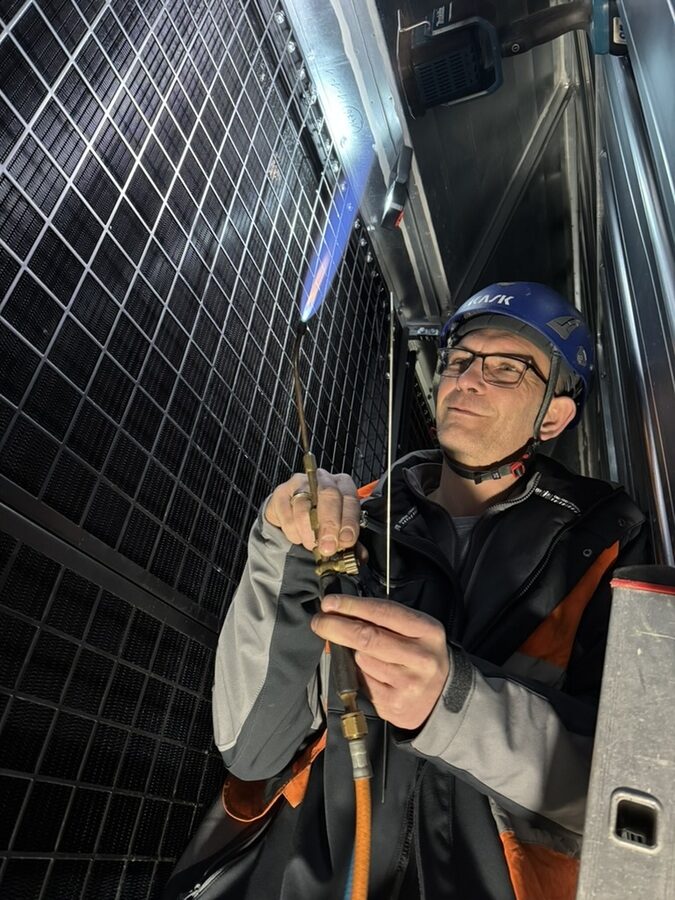
Thin copper cooling fins of a generator radiator are a good example: the high heat input during welding would destroy the material. For a leak on the standby power system (the standby generator) of a data center in Offenbach, we therefore brazed and then sealed the spot with a metal adhesive. That was a professional interim solution with pressure test until the radiator can be removed in a planned follow-up measure. Read about the job at Radiator repair on the standby generator in Offenbach. Grey cast iron, high-strength quenched and tempered steels and aluminium alloys also impose conditions that you need to know beforehand.
Surroundings that cannot tolerate fire
Potentially explosive areas, rooms with fire loads that cannot be removed, the white space of a data center with live IT (live environment), food areas without a cleaning window. Here welding needs a maintenance window, an enclosure with dust protection or relocation to the workshop. It is often more sensible to dismantle a component, weld it in Rodgau and reinstall it than to make the hall fit for welding.
When replacement is the better repair
A component with several cracks, extensive wear or unknown history is sometimes not worth repairing – its wear reserve is used up. Then the spare part – purchased, stocked or re-manufactured – is the more durable solution. We make this judgement during the assessment, not after the third re-weld.
Repair welding on industrial plant – how we do it in practice
Three jobs from our project diary show the principles of this guide in reality.
Tubular shaft of a cable reel in Aschaffenburg port
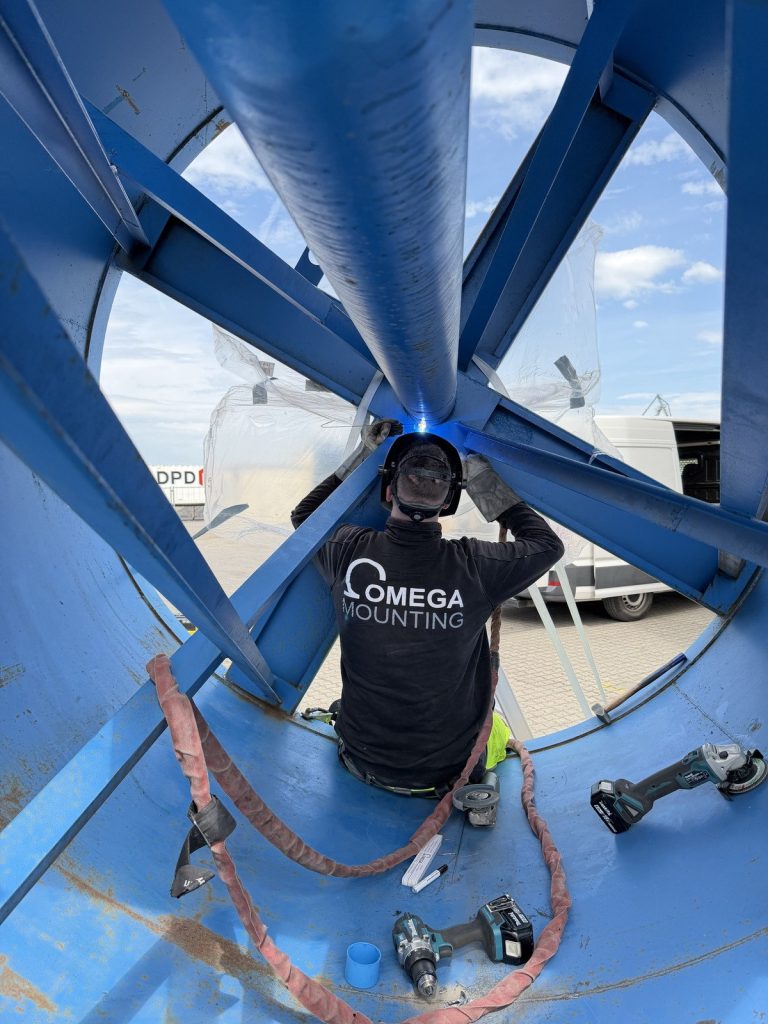
The central tubular shaft of a cable reel for high-voltage cables had cracked. The root cause analysis revealed improper slinging: a lifting chain directly on the shaft instead of on the designated lifting points. After the damage assessment in April 2026, two fitters carried out the repair at the end of May in half a day. Repair pieces from an identical donor reel were fitted to the millimetre and welded all round with mobile TIG equipment. The work was done in constrained positions inside the reel between the struts, kneeling, sitting and overhead. After cleaning and recoating, the shaft runs exactly on its bearing points again. Read the whole job at Repairing a cable reel in Aschaffenburg port – weld repair on the tubular shaft. For jobs in the Bavarian Lower Main region, you can also find us via our page on industrial installation in Aschaffenburg.
Oil pan on a vehicle test rig welded leak-tight
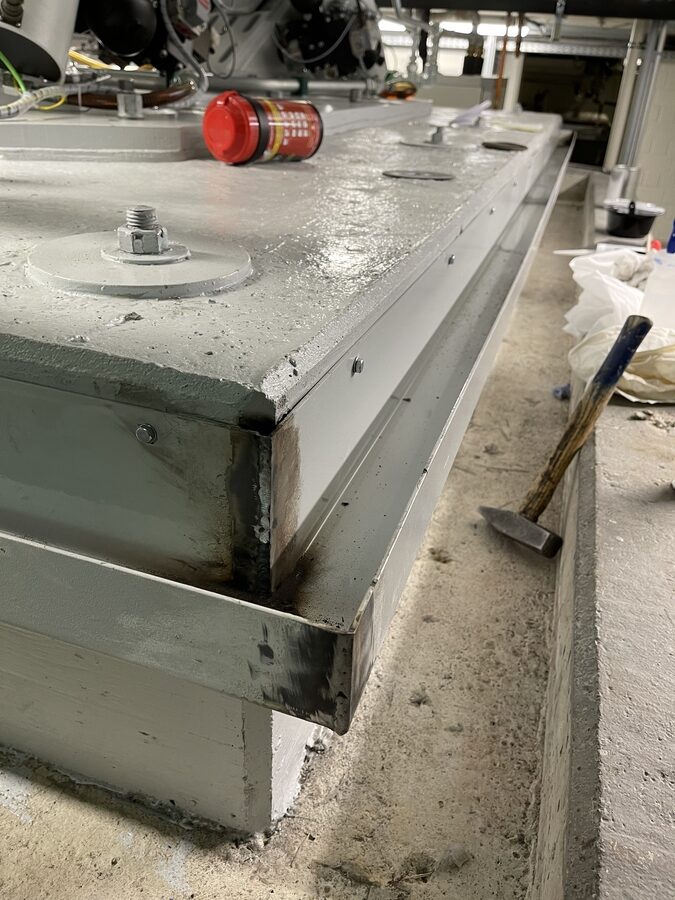
In an automotive test facility, two fitters adapted the hydraulic lines of a vehicle test rig to a new configuration in three days. They also installed a continuous oil pan around the concrete foundation. All joints, corners and transitions were TIG-welded, the welds ground flush, primed and painted, and the gap to the concrete wall sealed oil-resistant. The workplace was a basement – hence welding fume extraction with fresh air supply, permit to work and fire watch. Details at Test rig conversion: hydraulics adapted and oil pan welded leak-tight.
UVV defect on two loading docks in snowfall
At a logistics service provider in the Rhine-Main region, a loading bay was closed. The accident-prevention (UVV) inspection – the periodic inspection under the accident-prevention regulations – had classified welds on the dock brackets as a safety-relevant defect. In a single working day, two fitters ground out the rejected welds on two docks and re-welded them using the MAG process, partly in multiple passes – in snowfall and sub-zero temperatures, with an industrial heater at the workplace. After visual inspection, priming and painting, the way to re-inspection was clear. Read more at UVV defect on the loading dock: weld seams re-welded, door released again.
How we do it in the Rhine-Main region
From Rodgau, Offenbach, Frankfurt, Hanau, Dietzenbach and Aschaffenburg are short distances. That counts double in repair welding. We come for a site visit and assessment before we write the quotation. And we take a component to our workshop in Rodgau when the hall is not fit for welding. For logistics centres where doors and docks must not stand idle for long, this is often the decisive difference – see our page Industrial installation for logistics and intralogistics.
Has a weld cracked, a pan sprung a leak or a bracket been rejected at your plant? Then get in touch with us. An on-site assessment usually clarifies within an hour whether we weld on site, take the component to the workshop or whether replacement is the more durable solution.
What this means for your role
For buyers: Do not award repair welding as pure hourly work but with a scope of works. Its item descriptions name assessment, material clarification, weld preparation, welding, inspection and documentation – non-destructive testing as a contingent item. Require valid welder qualification tests as proof of suitability, and for load-bearing parts the appointment of a welding coordinator, plus business liability insurance and a clearance certificate from the employers' liability insurance association. Specify that formal acceptance only takes place after re-inspection by the competent person. Expect a formal notice of concern if the structural design remains unclear – that is an obligation, not a manoeuvre for a change order.
For designers: Whether welding on a load-bearing component is permissible is decided by you as the structural engineer – not by the welder on site. Record material, grade, weldability and load assumptions in the as-built documentation and define which repairs require structural approval or a recalculation. Where you already provide for replaceability in the design, for example through bolted brackets, inspection openings and accessible lifting points, hot work in an operating plant becomes a simple component replacement.
For project managers and site managers: Plan the repair weld as a small project with site visit, material clarification, permit to work and re-inspection – not as "the welder drops by". As site manager, you brief the welders on site rules and escape routes. You coordinate isolation of adjacent plant and switching off the fire alarm system with the operator. You release the hot work and take the area back via completion notice after the fire watch. Clarify early whether a maintenance window is needed or whether the work can be done with an enclosure during ongoing operations – with a fallback in case the material on site differs from expectations.
For maintenance managers: Document every repair weld in the plant's inspection logbook – with assessment, damage pattern, process, filler metal and photo documentation. At the next periodic inspection, that is the difference between a query and an inspection sticker. Ask about the cause during the assessment: a weld that cracked due to overload or incorrect slinging will crack again if the cause does not change. And check whether a weld on the load-bearing structure triggers an inspection before recommissioning as a substantial modification.
For safety officers and HSE coordinators: The permit to work for hot work is your lever. Require it for every welding, cutting, brazing and abrasive cutting job by external contractors. Check the contractor's risk assessment and operating instructions, the welding fume extraction in enclosed spaces, the appointment of the fire watch with follow-up time, and the cordoning of the danger zone. Ask about welder qualification when load-bearing parts are affected, and make sure everyone on site knows the stop-work authority.
Hot work permit template on request
Our permit to work template for hot work summarises on one page what this guide describes. It contains the work description with location and time window, a checklist of hazards at the workplace, and the protective measures before, during and after the work. Added to this are fields for fire watch and follow-up time, as well as signatures for release and handback. It helps operators without their own release procedure and site managers who want to give external contractors a uniform basis. It follows the structure of the accident insurers' model permit and can be adapted to your site rules. Request the template via our Contact form – keyword "hot work permit".
Why Omega Mounting?
Omega Mounting is based in Rodgau near Frankfurt, in the heart of the Rhine-Main region, and can be reached via the 24-hour hotline – even when a door is closed at the weekend. We weld on site with mobile TIG, MAG and MMA equipment and in our own workshop in Rodgau, where fitted pieces are also made. The linked jobs show how we work: assessment before quotation, preparation before weld, inspection before release. For us, repair welding is part of maintenance and servicing of industrial plant, not an isolated trade. With us you get a single point of contact for assessment, welding, fitted pieces from the workshop, lifting equipment and documentation for the inspector. The short distances between Frankfurt, Hanau and Aschaffenburg ensure that a closed door does not stay closed longer than necessary.
Conclusion
Repair welding on industrial plant succeeds when the sequence is right. Clarify the material, grind out the damage completely, choose process and filler metal to match, organise fire protection and extraction, fill in the permit to work together, weld, inspect, document. Anyone who skips one of these stages pays for it later – with a second crack, a refused sticker or fire damage. And anyone who knows when it is better to braze, bolt or replace repairs more durably than someone who welds everything. If a weld has cracked on your plant, send us photos of the damaged area, details of the component and your possible maintenance window, keyword "repair welding industrial plant". We will get back to you with an honest assessment of process, approvals and time required.
Planning maintenance, moving in or installation in the Rhine-Main region?
Tell us briefly what it is about – we will come back to you with an honest assessment.
100% free and without obligation
You may also be interested in these guides
Occupational safety
Maintenance & Servicing

About the author
Tobias Schott
Managing director of Omega Mounting GmbH, Rodgau · more than 20 years of hands-on experience in installation and maintenance
A trained mechatronics technician, at home in maintenance, servicing and industrial installation since 2004 – first at his father's side, since 2012 with Omega Mounting: from the overhead conveyor in Frankfurt to the crane system in a new-build hall. Plans and leads lifting operations as appointed person in data centers and on industrial sites in the Rhine-Main region, is an instructor and examiner for cranes, mobile elevating work platforms and telehandlers, and a safety officer. On jobs abroad he is known as the “German Troubleshooter” – the one you call when things get stuck on site. He learned what quality means not from a manual but from his father: Made in Germany as a standard for his own work, not as a label. That is why it comes first at Omega Mounting – before speed and before price. He writes these guides from that practice: what works on our sites is in them – what only exists in the standard is not.
Frequently asked questions
Yes, if the risk assessment permits it and the protective measures are implemented. As a rule, this means: permit to work for hot work, fire protection zone with fire loads removed or covered, fire watch with follow-up check, welding fume extraction and shielding of the danger zone. Where this is not possible, the work is moved into a maintenance window, or the part is removed and welded in the workshop.
The basis is the ArbSchG (German Occupational Safety Act) with the risk assessment and the obligation to coordinate the work of several employers. Fire protection during welding, cutting and brazing work is specified in DGUV Information 205-002 with its model permit. For welding fume, the TRGS 528 "Welding work" applies.
That depends on the component. TIG produces very clean, leak-tight welds on thin sheet, stainless steel and pipes with low heat input, but is slow. MAG quickly deposits a lot of weld metal with deep penetration on structural steel, but needs wind protection. For thick sections outdoors, MMA is often the most robust choice.
With thick sections, higher-carbon or alloyed steels and low temperatures on site: preheating reduces the cooling rate, prevents hardening in the heat-affected zone and reduces the risk of cold cracking. During a winter job on loading docks in sub-zero temperatures, we set up an industrial heater for this.
Only with approval by the manufacturer or a structural engineer and with welders holding a valid welder qualification test, because a weld changes the cross-section and microstructure of designed components. For cranes, the accident-prevention regulation requires an inspection by a competent person before recommissioning after substantial modifications, and the repair belongs in the inspection logbook.
The follow-up time is defined in the permit to work and depends on the fire load and construction of the area. Smouldering fires can only become visible hours later. It is set jointly by the operator or site manager and the executing company. What matters is that the time is documented with a signature and that the fire watch really observes the area before issuing the completion notice.
At least by a documented visual inspection of every weld with evaluation according to the quality levels for welds. For load-bearing parts, non-destructive testing is added; for pans and pipes, a leak or pressure test. For work equipment subject to mandatory inspection, the repair is only complete with re-inspection by the competent person – only then does formal acceptance with an acceptance report make sense.
From Rodgau, Frankfurt, Offenbach, Hanau, Darmstadt and Aschaffenburg are a short drive away, and our 24-hour hotline is staffed at weekends too. First comes the on-site assessment, then the decision whether to weld on site or take the component to the workshop – under a framework agreement as a call-off order with an agreed response time.
Via a short enquiry with three details. Photos of the damaged area with a scale, what you know about the component and material (drawing, type, age), and whether the plant is accessible during ongoing operations or has a maintenance window. We come for the assessment, clarify process, approvals and permit to work with you, and send you a written assessment with sequence and time required. Your contact is Tobias Schott – reachable via our Contact form, keyword "repair welding industrial plant".
 English
 German