
- Guide – Occupational safety
Lockout Tagout in Maintenance: Isolating, Securing, Permit to Work
By Tobias Schott · Reading time approx. 24 minutes · Last updated: October 2026
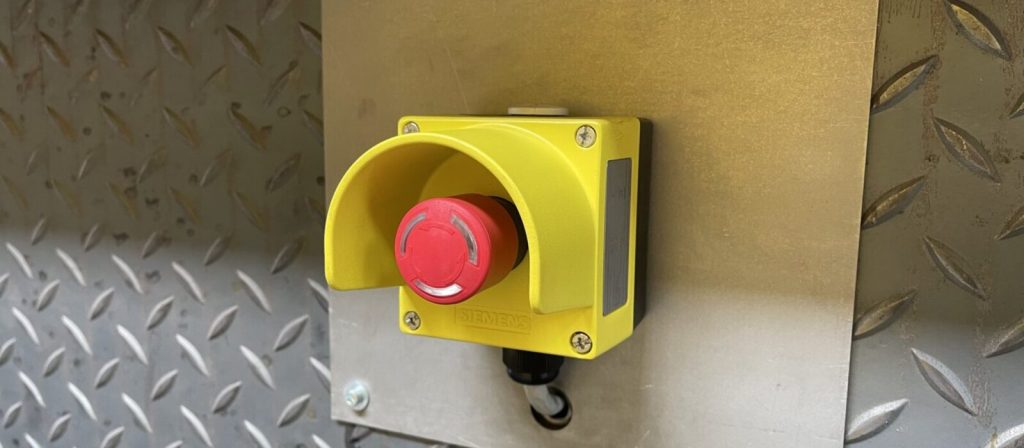
Lockout/tagout is, in German terms, isolating and securing against reconnection – with lock, tag and permit to work, for all energies of a plant, for every person working on it.
The most dangerous minutes of a maintenance job are not those in which bolts are turned or welds are made, but those in which someone believes the plant is off – and it is not. A colleague presses the start button because production is pushing. A hydraulic accumulator is still under pressure. A fan is still running down. A raised load drops as soon as the valve is opened. Accidents in maintenance happen in exactly these moments. They often hit external contractors who do not know the plant – and that is precisely what lockout tagout in maintenance is directed against.
Lockout tagout in maintenance – internationally known as LOTO – is the procedure that rules out these moments. Disconnect energy sources, lock the isolation points with a personal lock, tag them, verify zero energy. Only reconnect when every person involved has removed their lock. In German occupational safety, this has long been embedded in the five safety rules, the BetrSichV (Industrial Safety Ordinance) and other regulations – it is just called something different there.
This guide translates lockout/tagout into German practice. It explains which legal bases apply, which energies must be dissipated and how key control and multi-person lockout work. It also covers what goes in a permit to work, how external contractors are integrated and how the plant is properly handed back at the end. It builds on the fundamentals guide on maintenance during ongoing operations and planning maintenance windows by adding the part that decides over life and health.
Key points at a glance
- Lockout/tagout means, in German terms, isolating and securing against reconnection with a lock (lockout) and a tag (tagout). The legal basis is the BetrSichV (Industrial Safety Ordinance) and other regulations – above all the five safety rules of electrical engineering.
- An emergency stop button is not isolation: it stops the plant in an emergency but does not disconnect it from the energy supply and is not secured against reconnection.
- All energies are isolated – electrical, pneumatic, hydraulic, mechanical (springs, counterweights, elevated position), thermal, chemical – and stored energies are dissipated or secured.
- Every person working on the plant attaches their own lock to the isolation point; multi-lock hasps and group lock boxes make this practicable with several persons and external contractors.
- The permit to work documents what has been isolated, who is responsible, which additional hazards exist and when the plant is handed back – it is a means of communication, not paperwork.
- With external contractors, the client must coordinate the work and release the plant; the installation contractor brings procedure, materials and qualification.
- The completion notice runs in reverse order: people and tools out, guards on, locks off, test run, handover – and it is documented.
What does lockout/tagout mean in maintenance – and what is it called in German?
Lockout/tagout (LOTO) is a procedure in which all energy sources of a plant are disconnected before maintenance work. The isolation points are locked against reconnection with personal locks (lockout) and marked with tags (tagout) until every person involved has finished their work and removed their lock. The term comes from Anglo-American occupational safety and is the usual designation on internationally managed construction sites in the Rhine-Main region.
The German equivalent
In German regulations, the same thing is called "Freischalten und gegen Wiedereinschalten sichern" – isolating and securing against reconnection. For electrical installations, the five safety rules of DIN VDE 0105-100 describe the sequence: isolate, secure against reconnection, verify absence of voltage, earth and short-circuit, cover or screen off adjacent live parts. DGUV Regulation 3 "Electrical installations and equipment" requires that work on electrical installations is carried out in a de-energised state as a matter of principle and that this state is ensured for the duration of the work. For all other energies, the BetrSichV (Industrial Safety Ordinance) and the German technical rule TRBS 1112 (Maintenance) apply – referred to below as "the maintenance rule". They require work equipment to be secured before maintenance work so that no hazard arises from unexpected start-up, stored energies or movements. For this, the maintenance rule expressly names "systems for the release of specific work" and "personalised blocking and locking systems" – i.e. permit to work and personal lock. For you, this means: anyone who requires lockout/tagout is not requiring anything foreign, but what German regulations provide for anyway. DGUV Information 209-015 "Maintenance – carrying it out safely and practically" summarises this for operational practice.
Lockout, tagout and what is missing in between
Lockout is the physical locking: a lock on the main switch, valve or plug connector that only the holder of the key can remove. Tagout is the marking: a tag with name, company, activity and date. Tagout alone – a note on the switch – is not a safeguard; where a lock is technically not possible, an equivalent measure is needed (more on this below).
Why an emergency stop is not isolation
An emergency stop button interrupts the control system and brings the plant to a safe stop – that is its job in an emergency. But it does not disconnect the plant from the energy supply, cannot be locked and can be reset by anyone. The same applies to mode selector switches, guard door switches and "plant in manual mode": all control, no isolation.
Which legal bases apply to isolation and lockout in Germany?
For maintenance work in Germany, the BetrSichV (Industrial Safety Ordinance) with the maintenance rule, the accident prevention regulation for electrical installations with the five safety rules, and the risk assessment under the ArbSchG (German Occupational Safety Act) apply. Where several companies work on one plant, the coordination duties under the ArbSchG and DGUV Regulation 1 are added. None of these regulations uses the term lockout/tagout; all of them require exactly that in substance.
What the operator must do
The operator of the plant must define in their risk assessment how the plant is made safe for maintenance work. This includes which isolation points exist, which energies are stored, how they are dissipated, who may isolate and how the release is documented. The result is operating instructions and – for complex plants – isolation procedures that describe isolation point by isolation point. Under the operator's duties, maintenance work may only be carried out by competent, appointed employees.
What the qualified electrician must do
Work on electrical installations may only be carried out by qualified electricians or, under their direction and supervision, by electrically instructed persons. In practice, the operator's plant electrician often isolates and the installation contractor attaches its lock. For work on the electrics themselves, the installation contractor provides its own qualified electricians.
What applies with several companies
As soon as an external contractor works on a plant, the ArbSchG obliges both employers to cooperate. The accident prevention regulation requires a coordinator who coordinates the work where there is mutual hazard. What a client receives from us for this is described in our guide on RAMS and risk assessment for installation work.
Which stored energies must be dissipated before work?
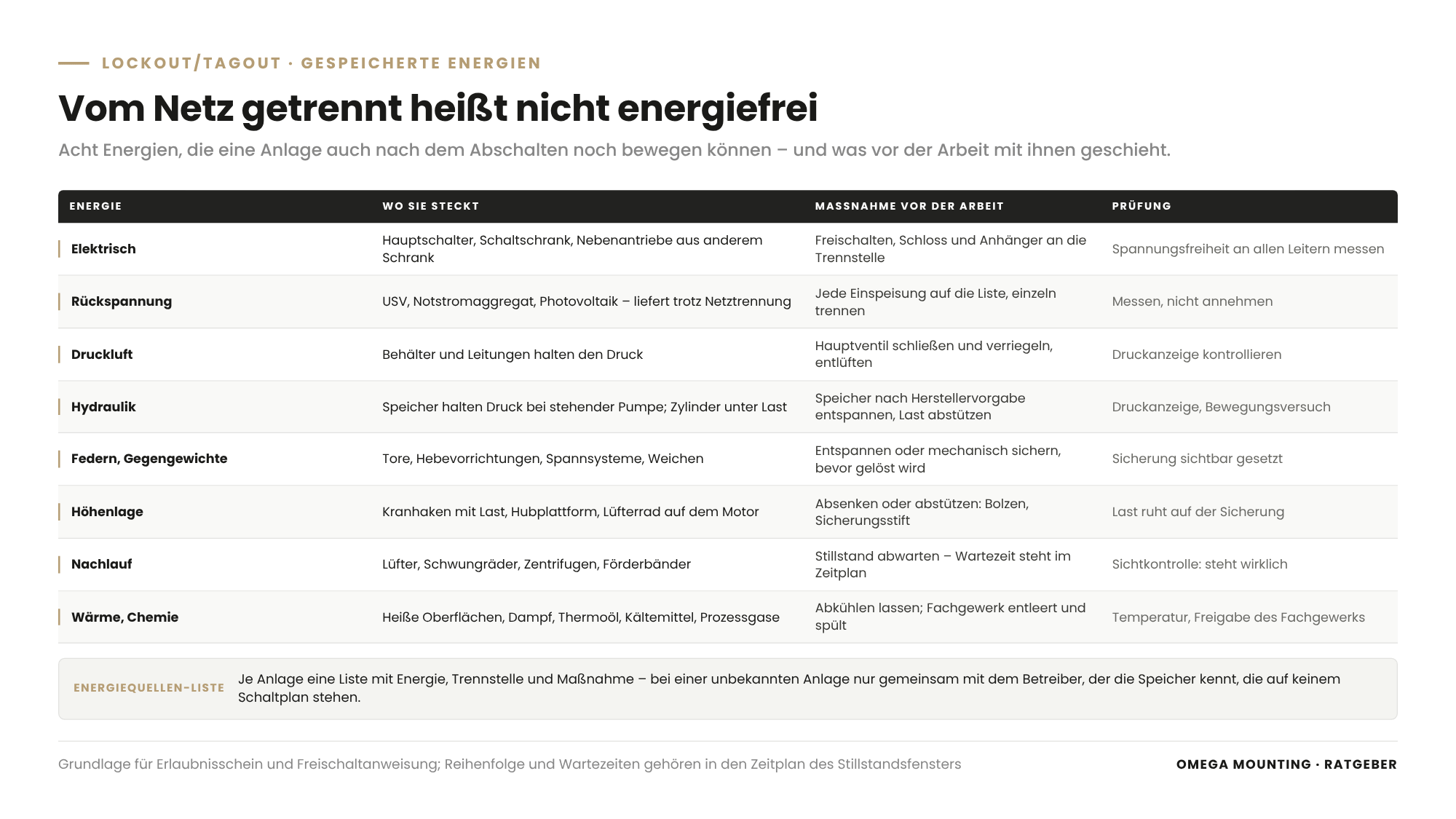
Before work, all energies must be dissipated or secured that can still move a plant even after it has been disconnected from the mains. These are compressed air in lines and vessels, pressure in hydraulic accumulators and cylinders, tensioned springs, counterweights and raised loads. In addition, rotating masses running down, hot or cold media, capacitors and batteries. Electricity is the most obvious energy – and rarely the one that is decisive in maintenance accidents.
Pneumatics and hydraulics
Compressed air systems store energy in vessels and lines. After the main valve is closed, pressure is still present. Therefore: close and lock the main valve, depressurise the system via a vent valve, check the pressure gauge. Hydraulic systems have accumulators that hold high pressure even when the pump is stopped, and cylinders that are under load. A valve opened in the wrong order drops a load or extends a cylinder. Hydraulic accumulators are discharged according to the manufacturer's specifications, loads mechanically supported, before lines are disconnected.
Mechanical energy: springs, counterweights, elevated position
Doors, lifting devices and clamping systems work with springs or counterweights. A released bolt releases the stored force abruptly. Raised loads fall as soon as the support is gone – a crane hook with load, a lifting platform, a fan impeller on a motor that is removed from its mounting. The measure is always the same: bring into the low-energy position (lower, release tension) or secure mechanically (support, bolt, locking pin) before releasing.
Run-on, heat, chemicals
Fans, flywheels, centrifuges and conveyor belts run on after switching off. Hot surfaces, steam and thermal oil need cooling time. Refrigerants, cleaning agents and process gases need a specialist trade to drain and flush the line. These waiting times belong in the schedule of the maintenance window.
Back-feed from UPS and standby power
An electrical installation can be disconnected from the mains and still be live – through back-feed from an uninterruptible power supply (UPS), a standby generator or a photovoltaic system. The maintenance rule expressly lists this case in its annex and refers to the five safety rules: absence of voltage is measured, not assumed. For you, this means: in data centers, hospitals and plants with a standby power system, every feed-in belongs on the energy source list – including the one that only supplies in the event of a breakdown.
The energy source list
For every plant, we draw up a list of energy sources with isolation point and measure before isolation – the basis for the permit to work. For a plant we are seeing for the first time, this can only be done together with the operator. They know the accumulators that are not on the circuit diagram and the auxiliary drives from the other control cabinet.
How does isolation proceed step by step?
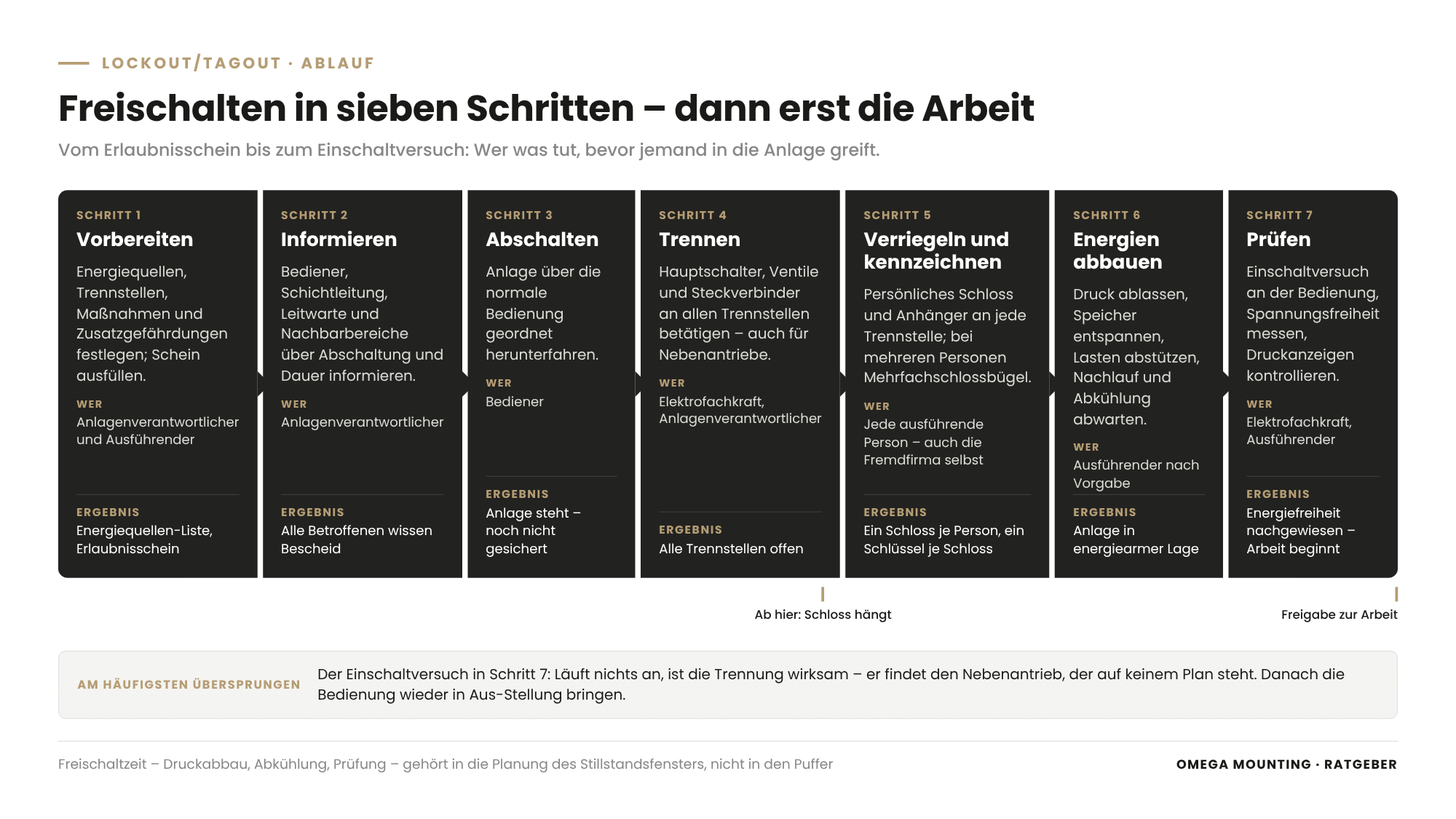
Isolation proceeds in seven steps: preparation with energy source list, informing the employees affected, orderly shutdown of the plant, disconnection of all energy sources at the isolation points. Then locking and tagging of every isolation point, dissipation of stored energies and verification of zero energy by attempted restart and measurement. Work begins only after the last step.
| Step | What happens | Who |
|---|---|---|
| 1 Prepare. | Define energy sources, isolation points, measures and additional hazards; complete the permit to work. | Person in charge of the plant and person carrying out the work. |
| 2 Inform. | Inform operators, shift management, control room and neighbouring areas about the shutdown and its duration. | Person in charge of the plant. |
| 3 Shut down. | Shut down the plant in an orderly manner via normal operation. | Operator. |
| 4 Isolate. | Operate main switches, valves, plug connectors at all isolation points. | Qualified electrician, person in charge of the plant. |
| 5 Lock and tag. | Personal lock and tag on every isolation point; multi-lock hasp with several persons. | Every person carrying out the work. |
| 6 Dissipate energies. | Release pressure, discharge accumulators, support loads, wait for run-on to end. | Person carrying out the work, as specified. |
| 7 Verify. | Attempted restart at the controls, measure absence of voltage, check pressure gauges, attempt movement. | Qualified electrician, person carrying out the work. |
The attempted restart
The most important and most frequently skipped step is verification: after locking, an attempt is made at the controls to start the plant. If nothing starts, the isolation is effective. The controls are then returned to the off position so that the plant does not start unexpectedly when unlocked later. For electrical work, the measurement of absence of voltage with a suitable test instrument is added – on all conductors, not just one.
Isolation points far from the workplace
In many existing plants, the main switch is in a switch room and the workplace far away in the hall. Then the isolation point needs lock and tag and the workplace a marking that the plant has been isolated. With plants with many drives – a sorting system, an overhead conveyor with many switches – the assignment of drive to isolation point is the real planning work.
Working power separate from the isolated plant
Tools, work lighting and extraction are never supplied from the plant that is being isolated. Otherwise there is the temptation to reconnect "just for the lamp". The BG BAU/BAuA module "Site set-up – utility supply" rules out supplying an installation site directly from existing fixed installations. It refers to special supply points: a site power distribution board or, at an existing socket, a portable residual current device PRCD-S. As a guide value, the source gives an inspection of the equipment every six months and a daily test of the residual current device.
How does key control work with several persons and external contractors?
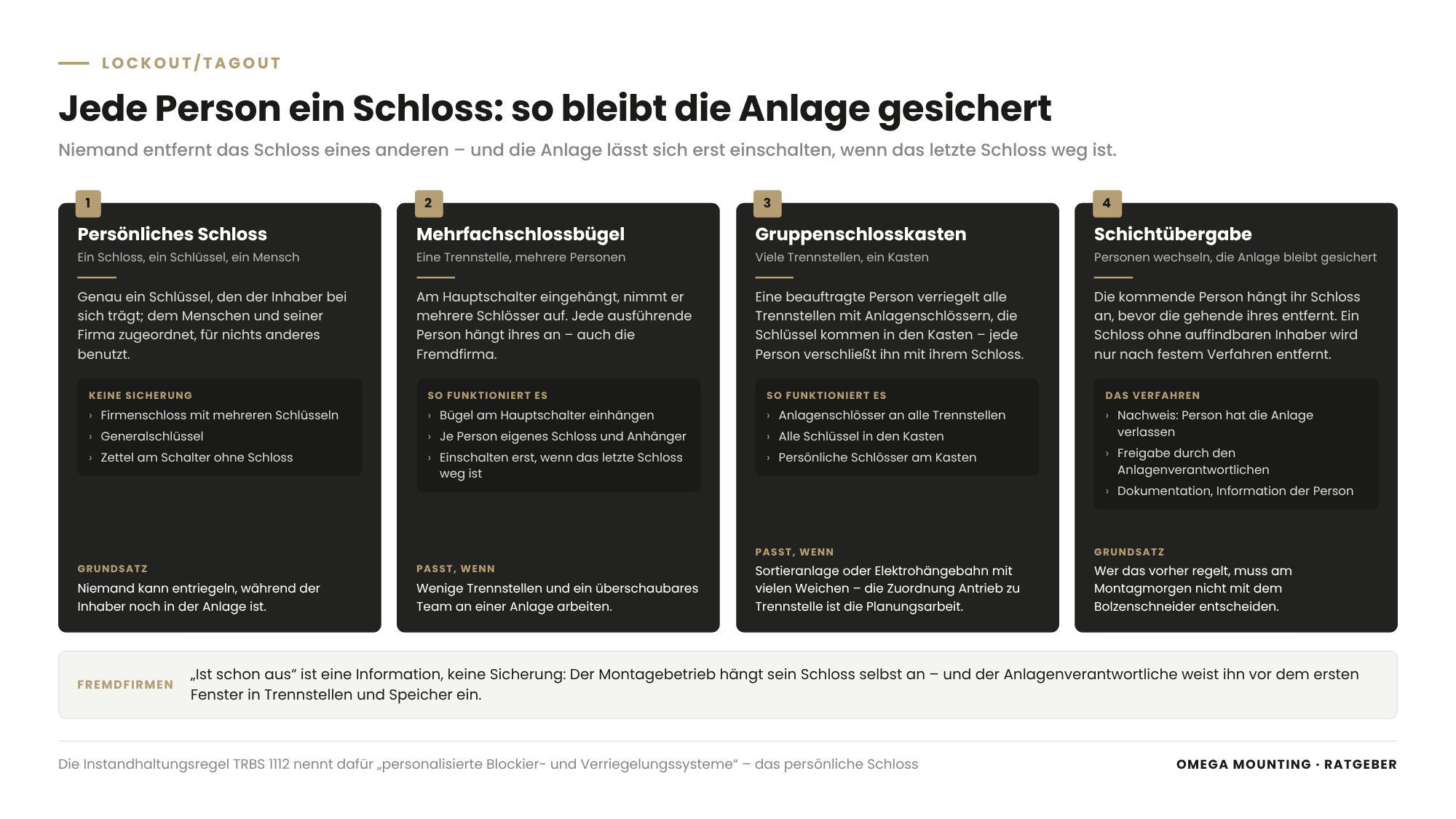
With several persons, every person carrying out work attaches their own lock to the isolation point – via a multi-lock hasp or a group lock box. Nobody may remove another person's lock, and the plant cannot be switched on again until the last lock is gone.
Personal lock, one key
The personal lock has exactly one key, which the holder carries with them. It is assigned to them and their company and is used for nothing else. Company locks with several keys or master keys contradict the principle. Then someone else can unlock while the holder is still in the plant.
Multi-lock hasp and group lock box
The multi-lock hasp is hooked onto the main switch and takes several locks. For plants with many isolation points, an appointed person locks all isolation points with plant locks and places their keys in a group lock box. Every person carrying out work locks the box with their personal lock. The result is the same: no key is accessible until everyone has finished.
Shift handover and forgotten locks
In weekend windows with several shifts, the people change, the plant remains isolated. The incoming person attaches their lock before the outgoing person removes theirs. A lock whose holder cannot be found is removed only according to a defined procedure. Required are evidence that the person has left the plant, release by the person in charge of the plant and documentation. Anyone who regulates this beforehand does not have to decide with bolt cutters on Monday morning.
External contractors in the procedure
As an installation contractor, we bring personal locks, tags, multi-lock hasps and valve lockouts with us. We always attach our lock ourselves – even if the operator has already isolated. "It's already off" is information, not a safeguard. Added to this is the briefing: TRBS 1116 (Qualification, Briefing and Appointment) treats a new plant or working environment like a first-time use. For you, this means: your person in charge of the plant briefs the external contractor on isolation points, accumulators and particularities of the plant before the first window. Conversely, we accept the client's operating rules if they are stricter than our standard – such as a separate lock system or a central permit-to-work coordinator. Which evidence a client may require from an installation contractor for this is described in our guide on evidence for subcontractors in installation work.
What goes in a permit to work for maintenance work?

A permit to work for maintenance work documents on which plant which work is carried out in which period. It records which energy sources have been isolated at which isolation points and secured with which locks, and how zero energy was verified. Added to this are the additional hazards and protective measures as well as the persons who hand over as person in charge of the plant and take over as person carrying out the work. At the end comes the hand-back section with completion notice.
The components
- Plant and work area with unambiguous designation, description of work and period of validity.
- Energy source list with isolation point, measure, lock number and verification result per energy.
- Additional hazards: work at height, hot work, confined spaces, hazardous substances, neighbouring plant in operation. In addition, the associated measures or the reference to separate permits, for example for hot work.
- Persons involved with company and qualification, coordinator, contact details.
- Signatures: release by the person in charge of the plant, acceptance by the person carrying out the work, where applicable acknowledgement by the operator.
- Hand-back section: work completed, persons and tools out of the plant, guards fitted, locks removed, test run carried out, handover with signature and time.
One permit or several?
For hot work, a separate permit to work with fire protection measures and fire watch applies. Our guide on repair welding on industrial plant describes it. The permit to work for maintenance is the framework that references such additional permits. In the end, one document says what happens on this plant in this window.
What the permit to work is not
A permit to work is no substitute for risk assessment, operating instruction and briefing, but their application to a specific day. A permit signed on Monday for the whole week protects nobody.
How is the plant handed back and put back into operation after the work?
The completion notice runs in the reverse order to isolation: complete the work and check the work area, remove tools and materials, fit guards and covers, all persons out of the plant. Then inform operators, remove locks and tags, reconnect energies in an orderly manner, test run under observation, handover with signature. Every step is ticked off in the hand-back section of the permit to work.
Check before reconnection
Before the last lock is removed, the plant is walked through. Is there still a tool lying on a rail, is a locking pin inserted, is a cover open, is a support still under a load? This includes checking that all persons have left the plant. With extensive plants such as an overhead conveyor, this is a separate item with an attendance list.
Test run and load run
If work was carried out on the electrical equipment, the qualified electrician tests before reconnection. The accident prevention regulation for electrical installations requires tests not only before first commissioning but also before recommissioning after modifications or repairs. After reconnection comes a test run without load under observation of the work location: direction of rotation, end positions, emergency stop, noises and vibrations. Then the load run or the step-by-step recommissioning with production. For safety devices – such as newly installed emergency stop buttons – the entire safety circuit is tested, not just the new unit.
Documentation
Permit to work with hand-back section, installation report, photos and inspection records go to the operator. Evidence for supervisory authority and insurer, energy source list for the next job. How completion notice and documentation are embedded in conveyor technology is shown in our guide on maintenance of conveyor technology.
Which typical mistakes happen in lockout/tagout maintenance work – and how do you avoid them?
The typical mistakes in lockout/tagout maintenance work are: emergency stop instead of isolation, forgotten auxiliary drives and accumulators, company lock instead of personal lock, no verification after locking. In addition, the permit to work as a weekly blanket and unlocking by third parties under production pressure. Each of these mistakes can be avoided organisationally. What is needed is an energy source list, a personal lock system, an attempted restart and a person in charge of the plant with the authority to stop work who uses it.
Production pressure
A maintenance window planned too tightly tempts people not to wait for run-on, to skip the attempted restart or to move a drive "briefly" without a lock. That is why the isolation time – pressure release, cooling, verification, completion notice – belongs in the planning of the window, not in the buffer.
Plants without lockable isolation points
Older plants have main switches without locking facility, valves without lockout, plug connectors in control cabinets. For these there are retrofittable switch lockouts, valve covers and plug lockouts. Where nothing helps, the qualified electrician removes the fuses, keeps them safe and marks the installation location. A plant that cannot be isolated is a finding for the risk assessment and a case for retrofitting.
What is part of the emergency organisation in the maintenance window?
The emergency organisation in the maintenance window includes an alarm plan with emergency numbers and the address of the work location, a working means of raising the alarm, and first aiders and a first aid kit in the team. In addition, a guide for the emergency services at the gate and a rescue plan for workplaces that are difficult to access. In the weekend window, the works fire brigade, company paramedics and gatekeeper are often not on duty – the installation team is alone in the hall.
Alarm plan and reporting route
The BG BAU/BAuA module "Site set-up – emergencies and rescue measures" requires the address and telephone number of the emergency services to be displayed at a clearly marked location. Where mobile phone reception is not reliable, additional means of raising the alarm via landline or radio must be provided. We therefore clarify before the window from where the emergency call is made, which gate number is given to the emergency services and who receives them at the gate. In the event of an electrical accident, it must be clear who isolates before anyone touches the injured person. The isolation procedure has already named the isolation points for this.
First aiders, materials, rescue from the plant
The source specifies: with up to 20 employees, at least one first aider must be present, from 21 two. Added to this are a first aid kit and first aid log, from 21 also a stretcher. For an installation team, this means: one first aider per shift, first aid kit at the workplace rather than in the vehicle. For work at height, a rescue plan is part of it, agreed with the operator before the window.
How we do it in the Rhine-Main region
In the Rhine-Main region, we work with isolation procedures in three very different worlds. First, in production plants in Offenbach, Hanau, Rodgau and Darmstadt, whose plants have grown over time and often have no consistent isolation procedure. Second, in logistics and sorting systems around Frankfurt Airport, Dietzenbach and Raunheim with many drives, shift operation and tight time windows. Third, in data centers in Frankfurt and the surrounding area, where the operator's permit-to-work system shapes the site language and English runs alongside.
In production plants, we start with the energy source list together with the plant electrician and the person in charge of the plant – often the first written isolation procedure for this plant. In data centers, we adopt the operator's procedure but bring our own locks and our own verification. A permit to work with our name on it is checked by us, not just signed.
How we do it in practice
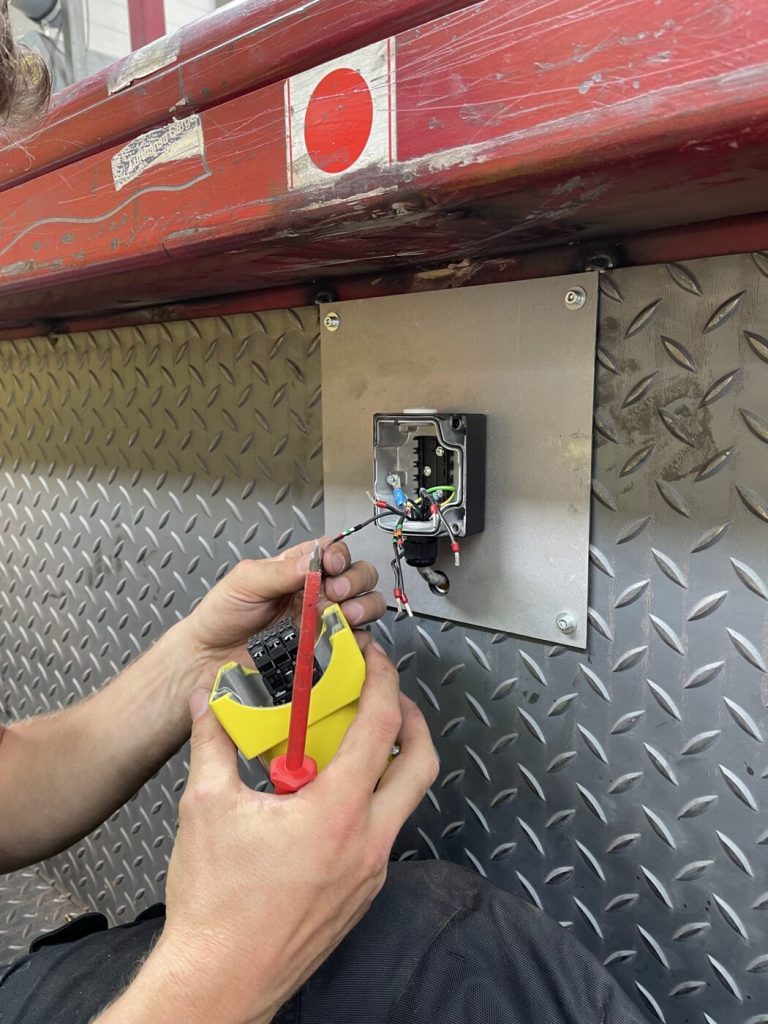
Emergency stop buttons in a sorting system at Frankfurt Airport. With the installation of emergency stop buttons on a parcel sorting system at Frankfurt Airport two fitters integrated 32 emergency stop buttons and several sensors into the existing system and extended the safety circuit in two days on site. Work was carried out during the day in agreed maintenance windows. Every unit was connected on the isolated system, and at the end the function of the entire circuit was tested. The example shows the distinction on which this guide is based: the emergency stop is the safety component for operation. For the installation itself, isolation and lockout were necessary.
Bearing replacement on a process air fan in Offenbach. During the bearing replacement on a fan of a paint shop in Offenbach the fan impeller, around 1.40 metres in diameter, sat directly on the drive motor, installed between narrow aisles of control cabinets. The job ran over two working days. On the preparation day, a custom-made rail system was welded on site. In the weekend shutdown, the motor was disconnected, the motor-fan unit was moved out on the rails and lifted with a gantry crane. Then the bearing was replaced, the unit pushed back, connected and handed over after a function check. Several energies came together here: the electric drive, the run-on of a large fan impeller, the elevated position of a unit weighing tonnes on rails and crane. Each had to be secured before the next step.
Switch maintenance on an overhead conveyor in Frankfurt. With the maintenance of an overhead conveyor around 30 years old in a Frankfurt production plant 100 switches in two operating areas were inspected, prioritised and repaired step by step. This took place in weekend shutdowns with a window of 36 hours between the end of production on Saturday and restart on Monday. Each weekend, four technicians were deployed with mobile scaffold towers, ladders and additional work lighting. For the isolation procedure, this is the demanding case: several persons simultaneously at different switches of an extensive plant, work at height, conductor rail as energy source and a shift handover within the window. Key control, attendance check before reconnection and the completion notice on Sunday are the core of the organisation here.
Do you have a repair in a maintenance window coming up, or does your plant still lack an isolation procedure? Then get in touch with us. A joint walk-through with your plant electrician usually produces the energy source list within a few hours, on which everything else is built.
What this means for your role
For buyers: Include the isolation procedure in the scope of works. Who isolates, who provides locks and permit to work, how much time is planned for isolation and completion notice in the maintenance window? Require from the installation contractor the risk assessment, evidence of qualification of the qualified electricians and a described lock system as evidence of suitability.
For designers: Design plants to be isolatable: lockable main switches and valves close to the workplace, unambiguous assignment of drives to isolation points. In addition, venting and discharge facilities for pneumatics and hydraulics and mechanical safeguards for raised loads. An energy source list belongs in the plant documentation that you hand over to the operator.
For project managers and site managers: Before the maintenance window, define who is the person in charge of the plant, who issues the permit to work and who has the authority to stop work. The site manager briefs on site, releases the plant and takes it back. The project manager ensures that isolation time, run-on and completion notice are in the schedule. With several trades, name the coordinator in writing. Before a weekend window, the site manager displays the alarm plan with gate number.
For maintenance managers: Draw up an isolation procedure with energy source list and isolation points for every plant. Introduce a personal lock system and define the procedure for forgotten locks and shift handovers. Check existing plants for isolation points that cannot be locked. Make the attempted restart after locking a habit – it finds the auxiliary drive that is on no drawing.
For safety officers and HSE coordinators: Translate lockout/tagout into the German terms and regulations so that two procedures do not exist side by side. Check permits to work for completeness of energy sources – not just electricity – and for the hand-back section. Brief operators that another person's lock is never removed, and check whether the external contractor's team brings a first aider and first aid kit.
For operations and plant managers: You decide whether production pressure is an argument against isolation time – and the answer must be no. Give your persons in charge of the plant the authority to keep a plant locked until the completion notice is complete. Plan maintenance windows so that isolation and restart have room in them.
Permit to work template "Maintenance": template to request
The template is a two-page form for maintenance and installation work. Page one contains plant designation, description of work, period of validity, energy source list with isolation point, measure, lock number and verification result, additional hazards, persons involved and signatures. Page two contains the hand-back section for checking the work area, guards, removal of locks, test run and handover. It helps maintenance managers as the basis of their own procedure, site managers as a release document and safety officers as a checking grid for the permits of their external contractors. Request the template via our Contact form – keyword "Permit to work maintenance".
Why Omega Mounting?
From Rodgau near Frankfurt, we maintain and repair conveyor technology, crane systems, fans, drives and safety devices in production plants, logistics centers, airport facilities and data centers in the Rhine-Main region. Almost always in the maintenance window, almost always on plants that do not belong to us. That is why we bring our isolation procedure with us: personal locks, multi-lock hasps, valve lockouts, test instruments, qualified electricians and a risk assessment that names energy sources. Via our 24-hour hotline you can reach us even when a breakdown at the weekend forces a repair. More on our service page Maintenance and servicing for industrial plants. For you, this means: an installation partner that does not first have to learn the isolation procedure, short distances in the Rhine-Main region and a completion notice that is documented. Get in touch, if you would like to check this for your next maintenance window.
Conclusion
Lockout/tagout in maintenance is, in German terms, isolating and securing against reconnection. It is a procedure in which the name matters less than completeness: all energies, all persons, every isolation point with a lock, every isolation verified, every completion notice documented. Emergency stop, a note and "it's already off" are not safeguards. Anyone who plans the energy source list, personal lock system and permit to work as a fixed part of their maintenance window gains safety. The plant runs on Monday, and everyone who worked on it goes home. If you are setting up your isolation procedure, extending it to external contractors or planning a repair in a maintenance window, send us the plant type, energy sources and your time window. We will get back to you with an honest assessment of how isolation and work can be organised within it.
Further reading: How isolation and release work when only one person is on site at night or at the weekend is covered in the guide on lone working in maintenance.
Planning maintenance, moving in or installation in the Rhine-Main region?
Tell us briefly what it is about – we will come back to you with an honest assessment.
100% free and without obligation
You may also be interested in these guides
Maintenance & Servicing
Maintenance & Servicing

About the author
Tobias Schott
Managing director of Omega Mounting GmbH, Rodgau · more than 20 years of hands-on experience in installation and maintenance
A trained mechatronics technician, at home in maintenance, servicing and industrial installation since 2004 – first at his father's side, since 2012 with Omega Mounting: from the overhead conveyor in Frankfurt to the crane system in a new-build hall. Plans and leads lifting operations as appointed person in data centers and on industrial sites in the Rhine-Main region, is an instructor and examiner for cranes, mobile elevating work platforms and telehandlers, and a safety officer. On jobs abroad he is known as the “German Troubleshooter” – the one you call when things get stuck on site. He learned what quality means not from a manual but from his father: Made in Germany as a standard for his own work, not as a label. That is why it comes first at Omega Mounting – before speed and before price. He writes these guides from that practice: what works on our sites is in them – what only exists in the standard is not.
Frequently asked questions
In German, lockout/tagout means "Freischalten und Sichern gegen Wiedereinschalten" – isolating and securing against reconnection. Lockout is locking the isolation point with a personal lock, tagout is marking it with a tag. For electrical installations, the procedure is described in the five safety rules of electrical engineering, for all other energies in the BetrSichV (Industrial Safety Ordinance) and its technical rule on maintenance.
No. An emergency stop stops the plant via the control system but does not disconnect it from the energy supply, cannot be locked and can be reset by anyone. For maintenance work, the plant must be isolated at the isolation points, locked, tagged and verified for zero energy – and stored energies must have been dissipated.
Compressed air in lines and vessels, pressure in hydraulic accumulators and cylinders, tensioned springs, counterweights and raised loads, rotating masses running down, hot or cold media, process gases and refrigerants, as well as capacitors and batteries. Each of these energies needs its own isolation point or safeguard and is listed in the plant's energy source list.
Electrical installations are isolated by a qualified electrician or by an electrically instructed person under their direction and supervision. They also verify absence of voltage. For other energies, the operator defines in their risk assessment who may isolate – usually the person in charge of the plant or appointed maintenance staff. Independently of this, every person carrying out work attaches their own lock.
Not on your own authority. Another person's lock is removed only according to a defined procedure. Required are evidence that the person has left the plant, release by the person in charge of the plant, documentation and informing the person. This procedure belongs in the company's isolation procedure so that it is not improvised in an emergency.
The risk assessment describes in principle which hazards an activity has and which measures apply. The permit to work applies this to a specific day, a specific plant and specific persons and documents isolation, verification, responsibility and hand-back. The two belong together – the permit without the assessment is empty, the assessment without the permit remains theory.
The operator makes the plant available isolated and verified, provides information on residual hazards and names the person in charge of the plant. With several companies, they name a coordinator as required by the accident prevention regulation. The external contractor brings its procedure, its personal locks and its risk assessment and attaches its locks itself. Both are brought together in the permit to work and signed.
Decisive are the BetrSichV (Industrial Safety Ordinance) with TRBS 1112 (Maintenance) and DGUV Regulation 3 with the five safety rules. Added to these are the risk assessment under the ArbSchG (German Occupational Safety Act) and – with several companies on one plant – the coordination duties under the ArbSchG and the accident prevention regulation. None of these regulations names lockout/tagout, all of them require exactly that in substance.
Send us via the Contact form three details: plant type with the known energy sources, the work that is pending and your maintenance window. We will get back to you and arrange a walk-through with your plant electrician and person in charge of the plant – from Rodgau at short notice in Frankfurt, Offenbach, Hanau or Darmstadt. You will receive a written assessment with energy source list, isolation time and sequence of the completion notice. Your contact is Tobias Schott. In the event of a breakdown at the weekend, you can reach us via the 24-hour hotline, and we have isolation materials in the vehicle.
 English
 German