
- Guide – Maintenance & Servicing
Conveyor system maintenance: keeping overhead conveyors, sorters and conveyors on schedule
By Tobias Schott · Reading time approx. 24 minutes · Last updated: October 2026
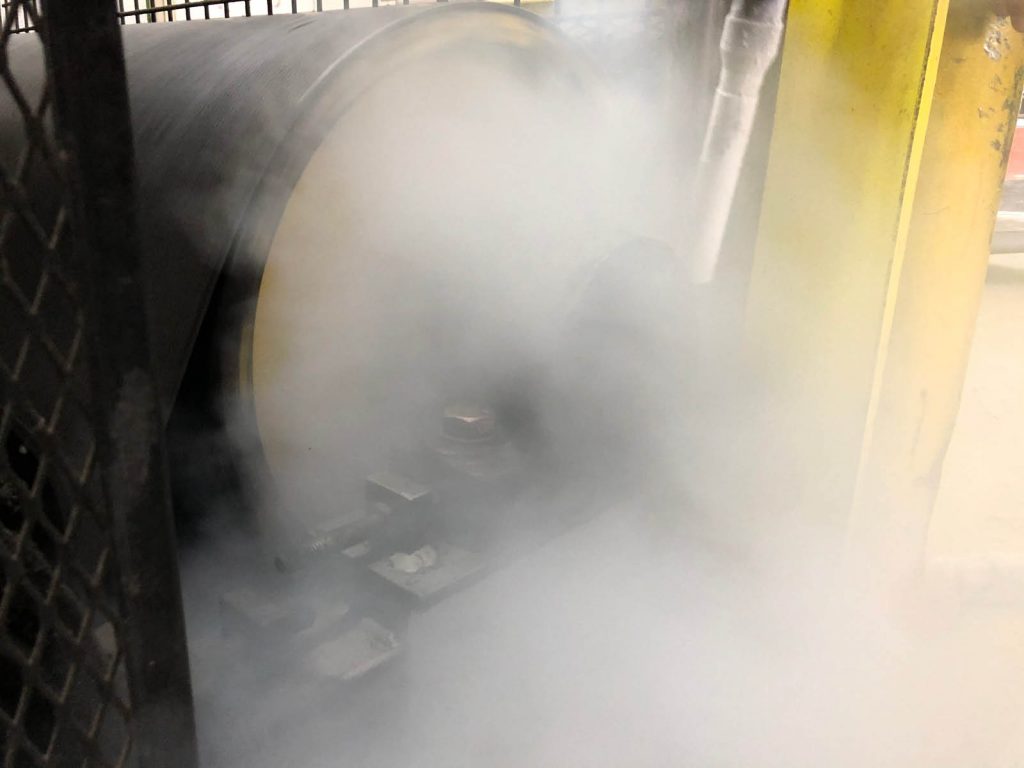
Conveyor systems rarely fail suddenly – they wear at a few known points. Monitoring these component by component moves repairs into planned windows.
A conveyor system at a standstill is not an isolated problem but a chain problem. If the roller conveyor in front of the high-bay warehouse does not run, picking, dispatch and goods receipt stop. If a switch on the overhead conveyor jams, the production cycle behind it stops. Conveyor technology maintenance is therefore not the care of individual machines but securing the availability of a linked system. And that is only as reliable as its weakest bearing.
You know the dilemma: the system runs in two or three shifts, downtime costs output. Anyone wanting to maintain the conveyor system only gets the breakdown during operation, never the scheduled maintenance. Over the years, a backlog of wear builds up that at some point can no longer be worked off in shift breaks. This applies in the logistics centre just as much as in the production plant.
This guide organises the maintenance of conveyor technology by assembly: drives, load-bearing and running elements, bearings and joints, sensors and control, safety devices. You will learn which wear patterns are typical, what is different about overhead conveyors and how to plan cleaning, emergency stop testing, maintenance windows and spare parts. This is backed up by jobs from the Rhine-Main region, from the sorting system at Frankfurt Airport to the overhead conveyor of a food plant.
Key points at a glance
- Conveyor technology maintenance comprises inspection, servicing and repair of continuous conveyors, sorting systems and overhead conveyors with the aim of keeping the linked system available.
- Most failures occur at five assemblies: drives, load-bearing and running elements, bearings and joints, sensors and safety devices – each with its own wear mechanism.
- Contamination accelerates every one of these mechanisms; cleaning is therefore maintenance, not cosmetics – for drives, dry ice blasting has proven itself because it works without residue.
- Emergency stop devices are part of the system and are subject to the same inspection intervals as drives; retrofits must be integrated into the existing safety chain and inspected before recommissioning.
- Overhead conveyors additionally wear on rails, switches, conductor rail and carrier pins – they need their own chapter in the maintenance schedule.
- Spare parts stocking decides the duration of a breakdown: what is on site is replaced the same day; what has to be ordered determines the downtime.
- A maintenance schedule that shows the downtime requirement for each task can be translated into weekend, night and daytime windows.
What is conveyor technology maintenance?
Conveyor technology maintenance is the totality of all measures by which continuous conveyors, sorting systems and overhead conveyors are kept in, or returned to, a functional and safe condition. According to DIN 31051, it is divided into inspection, servicing, repair and improvement.
By conveyor technology we mean here all systems that move unit loads or containers continuously or in cycles. These include roller and chain conveyors, belt conveyors, sorting systems with cross-belt or tilt-tray elements, vertical conveyors and stacker cranes with their pre-zone. Added to these are overhead conveyors (EHB), in which carriers run on a rail beneath the hall ceiling. The safety requirements for continuous conveyors for unit loads are governed by DIN EN 619.
The four terms of the standard are important for planning. Inspection establishes the actual condition – visual inspection, measurement, reading out the fault memory, in short: assessment. Maintenance preserves the target condition – lubricating, cleaning, retensioning, adjusting. Instandsetzung (repair and overhaul) restores the target condition – replacing rollers, bearings, chains, gears. Improvement increases reliability without changing the function – for example a retrofitted emergency stop device or a reinforced mounting. This includes the wear reserve: the stock of functionality that a component still has up to the wear limit. Maintenance means knowing and using it, rather than using it up at random.
Which of these measures takes place when is defined by the maintenance strategy : preventive at fixed intervals, condition-based after findings, or only after failure. The German technical rule TRBS 1112 (maintenance) requires the operator to define this strategy in the risk assessment. Maintenance work may only be carried out by qualified, authorised and briefed persons. For you this means: a maintenance schedule for conveyor technology is not a voluntary document but the answer to an operator duty. A service provider who implements it must be able to prove the qualification of its fitters. How to decide in principle between reactive and planned maintenance is shown in our overview on maintenance strategy.
What distinguishes conveyor technology from individual machines is the linking. A single drive costs little, but its failure shuts down the entire material flow behind it. Redundancy is rare in a conveyor line. Conveyor technology maintenance is therefore not based on the value of a component but on its effect on the availability of the chain.
Which five assemblies wear in every conveyor system?
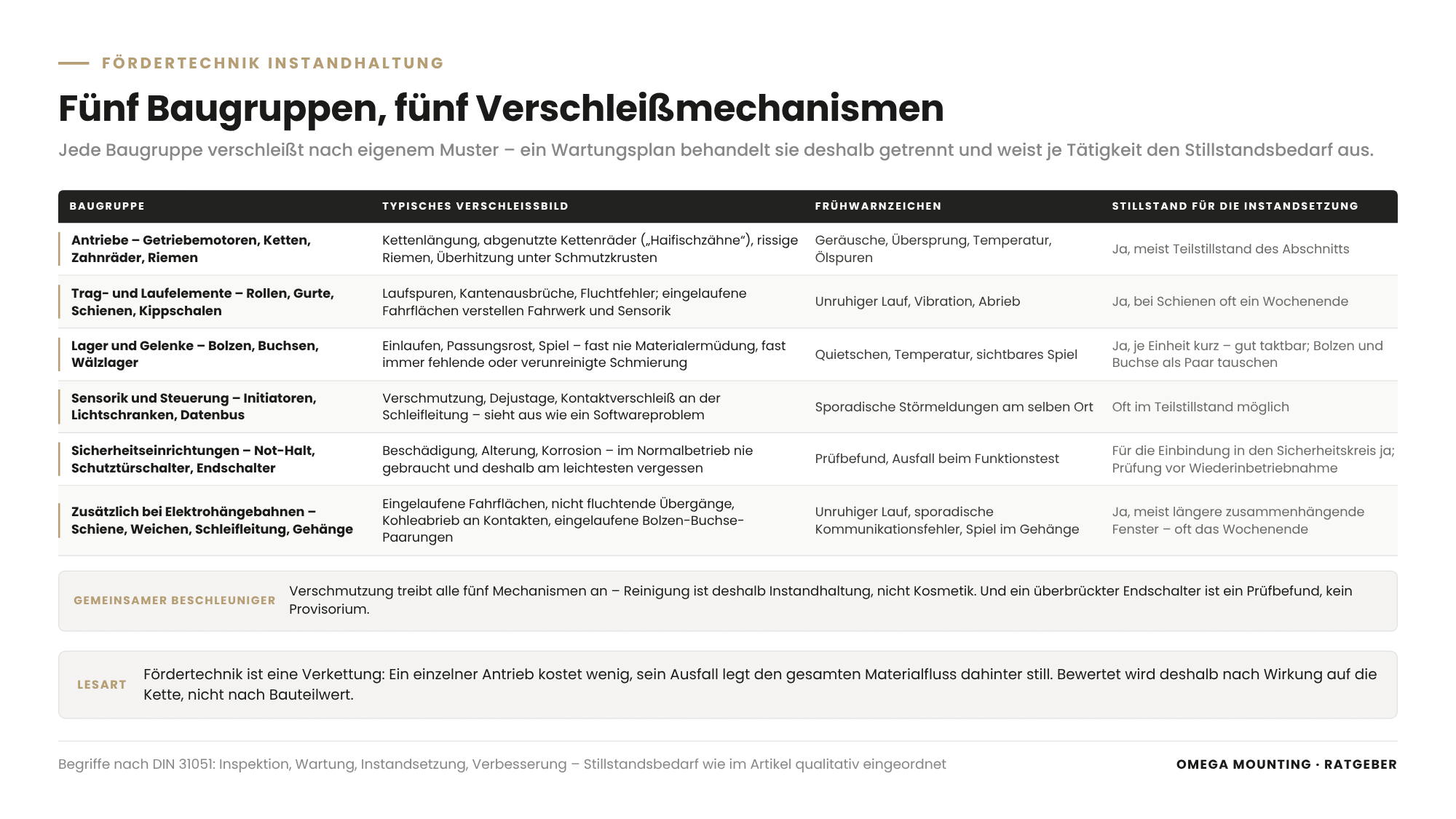
In every conveyor system, five assemblies wear according to their own pattern. Drives through load and contamination, load-bearing and running elements through abrasion and fatigue, bearings and joints through loss of lubrication. Sensors through contamination and misalignment, safety devices through mechanical damage and ageing.
Drives: geared motors, chains, gears, belts
Drives of conveyor systems often run continuously under varying load. Typical wear patterns are elongated drive chains, worn sprockets with "shark teeth", hardened or cracked belts, leaking gearboxes and motors that overheat under crusts of dirt. A worn gear can block a chain and cause it to jump. That is exactly what the root cause analysis at a high-bay warehouse at Frankfurt Airport revealed. Troubleshooting on site led to the roller conveyor, the repair to the drive of the chain conveyor: drive chains and gears renewed, chain systems readjusted, trial run, recommissioning.
Load-bearing and running elements: rollers, belts, rails, tilt trays
Carrying rollers wear in, belts fray at the edges, rails develop running marks, tilt trays and cross-belts wear at their bearing points. The wear pattern is usually uniform until it tips: a worn-in running surface changes the position of the running gear, which in turn moves current collectors and sensors out of position.
Bearings and joints: pins, bushes, rolling bearings
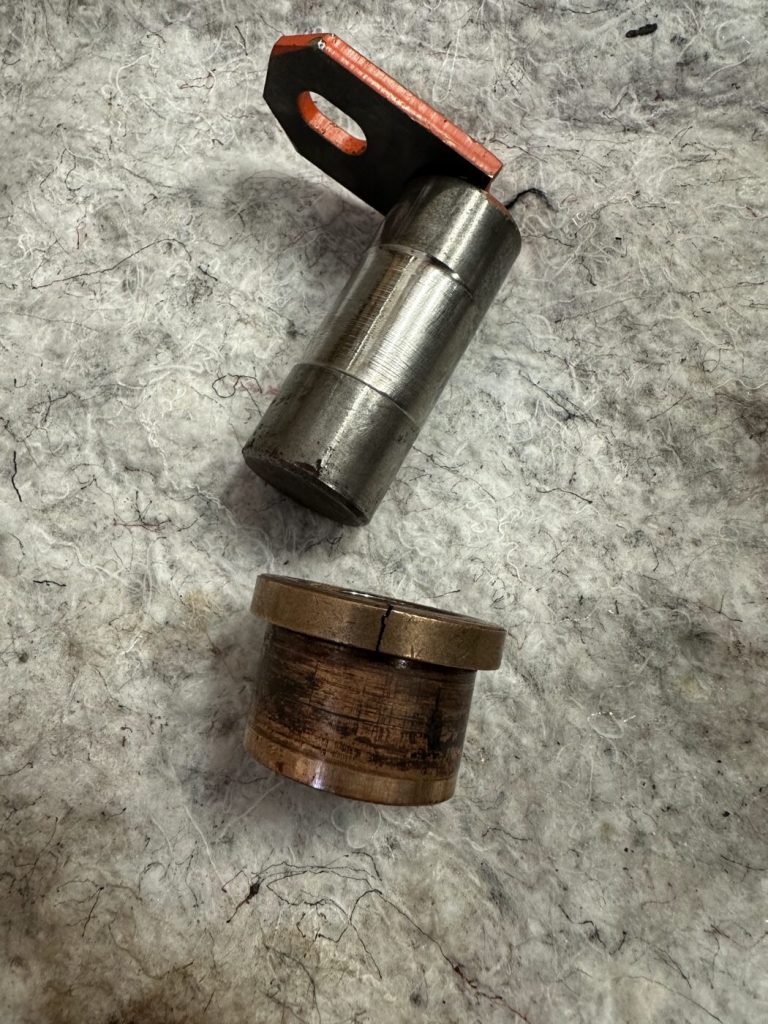
Bearings almost never fail because of material fatigue but because of missing or contaminated lubrication. Pin-and-bush pairings in carriers, joints and tilt mechanisms wear in when the lubricating film is missing. Fretting corrosion is the visible damage pattern – the rust-brown discolouration on seating surfaces that move microscopically under load. Rolling bearings in rollers and motors announce themselves through running noise and temperature. Important: pin and bush share the wear and are replaced as a pair, never individually. They belong in the spare parts stock with nominal dimension and wear limit.
Sensors and control: proximity switches, light barriers, data bus
Proximity switches – inductive or optical – and light barriers fail through contamination and misalignment, not through defect. The control then reports "carrier not detected" or "position not reached", and troubleshooting begins at the wrong end. With overhead conveyors, data transmission via conductor rail or rail contacts is added. Worn or dirty contact areas produce sporadic communication errors that look like software problems.
Safety devices: emergency stop, guard fences, limit switches
Emergency stop buttons, guard door switches, limit switches and enabling switches get mechanically damaged, dirty or age. They are the part of the system that is never needed in normal operation – and therefore most easily forgotten. Their periodic inspection belongs with an inspection interval in every maintenance schedule, their retrofitting in every improvement.
One rule is non-negotiable here: bridged limit switches or fixed guard door switches are not permitted under TRBS 1115 (safety-related measurement, control and regulation devices). In operation, they are often intended as a makeshift for set-up mode or troubleshooting. Anyone who has to disable a safety device for set-up needs substitute measures that are set out in the operating instructions. For you this means: a limit switch "temporarily" fixed with a cable tie is not a cosmetic flaw but an inspection finding that can shut down the system.
| Assembly | Typical wear pattern | Early warning signs | Downtime for repair |
|---|---|---|---|
| Drives. | Chain elongation, gear wear, belt cracks, overheating. | Noise, chain jump, temperature, oil traces. | Yes, usually partial downtime of the section. |
| Load-bearing/running elements. | Running marks, edge breakouts, misalignment. | Rough running, vibration, abrasion. | Yes, for rails often at the weekend. |
| Bearings/joints. | Wearing in, fretting corrosion, play. | Squeaking, temperature, visible play. | Yes, short per unit – easy to schedule in cycles. |
| Sensors/control. | Contamination, misalignment, contact wear. | Sporadic fault messages at the same location. | Often possible during partial downtime. |
| Safety devices. | Damage, ageing, corrosion. | Inspection finding, failure during function test. | Yes, for integration into the safety circuit. |
What role does cleaning play in conveyor technology maintenance?
In conveyor technology maintenance, cleaning is not a minor matter but the measure that slows down all other wear mechanisms. Dirt insulates motors, gums up contacts, binds abrasion in bearings and conceals cracks that should be seen during inspection.
Why dirt accelerates wear
Dust, chips, product residues and oil form crusts on drives that trap heat. In bearings, dirt acts as an abrasive. On conductor rails and contact areas, abrasion and deposits combine into insulating layers. And under a layer of dirt, nobody sees the hairline crack on a weld. A system that has not been cleaned cannot be assessed – and without assessment, no repair can be planned.
Dry ice blasting as a cleaning method for drives
Dry ice blasting accelerates pellets of solid carbon dioxide onto the surface with compressed air. The dry ice is around −78.5 °C cold. On impact, it makes deposits brittle and flake off, and sublimates in the process, i.e. passes directly from the solid to the gaseous state. What remains is only the detached dirt, which is vacuumed up – no water, no solvent, no blasting medium. Motors, belts and neighbouring components remain undamaged.
On a system with 25 drive stations that had not been maintained for 20 years, it was the method that prevailed against the deposits – more on this in the practice chapter. Ventilation must be considered: sublimating CO₂ displaces oxygen in enclosed areas, and the process is loud. Both belong in the risk assessment and the operating instructions. Blasting is only done on drives that are isolated and secured against reactivation.
Including cleaning in the maintenance schedule
Cleaning belongs in the maintenance schedule with maintenance interval, method and responsibility. In food plants, hygiene cleaning is added. This in turn creates its own stresses – moisture and cleaning agents on bearings and contacts. Anyone who plans the cleaning plans the subsequent inspection at the same time, because that is when the system is visible.
How do you maintain emergency stop and safety chain?
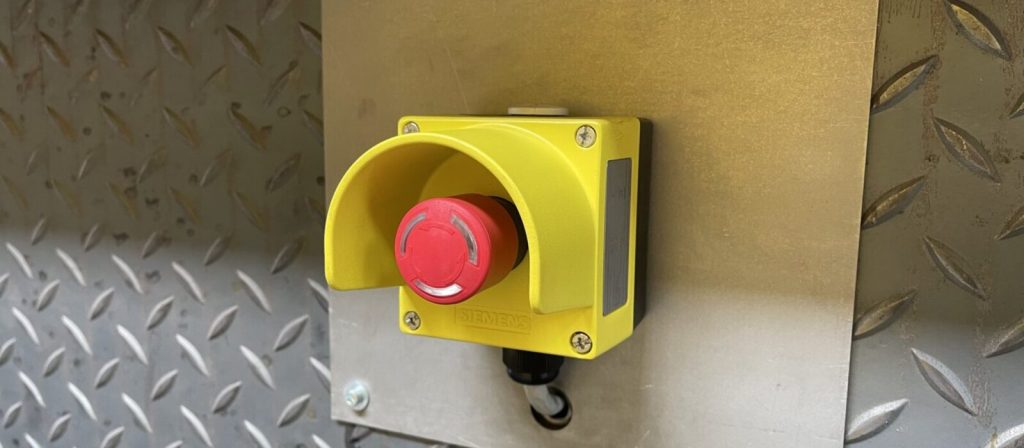
You maintain emergency stop devices by testing every button for function at a defined inspection interval and reassessing the entire safety chain with every change. You integrate retrofits professionally into the existing safety circuit – with inspection by a competent person and an entry in the inspection logbook before recommissioning.
Emergency off, emergency stop and safety chain
On the shop floor they are called emergency-off buttons. Technically, they usually trigger an emergency stop function in accordance with DIN EN ISO 13850 that stops the hazardous movement. The safety chain or emergency-off circuit is the series connection of all safety-related switching elements of a system. If one opens, the system stops. The requirements for the safety-related parts of the control system – wiring, relays, safety PLC – are described in DIN EN ISO 13849-1 via the so-called Performance Level. This is a measure of the reliability of the safety function.
Test, do not just look
A visual inspection is not enough for emergency stops. Every button must be pressed, the system must stop, the control must report the correct button, and after resetting, the system must not restart by itself. This belongs in the maintenance schedule as a function test, and the test must be documented in the inspection logbook. The operator duty requires work equipment to be inspected periodically and after safety-relevant repairs by a competent person.
How often to inspect is defined by the operator in the risk assessment. TRBS 1201 (inspections and checks of work equipment) requires the inspection record to contain type, scope and result of the inspection and the name of the inspector. It must be kept at least until the next inspection. The inspection rule also requires an inspection before further use after exceptional events – for example after a collision, an overload or a standstill that lasted longer than the inspection interval. For you this means: a conveyor system that was switched off for six months is not simply switched on again but inspected first. Plan this into the restart.
Retrofitting during operation
When sorting systems are extended, workstations relocated or access routes changed, the emergency stop of the conveyor system is often missing within reach. The retrofit is an improvement within the meaning of the standard and at the same time a change to the work equipment. Under the BetrSichV (Industrial Safety Ordinance), it must be carried out safely and inspected before recommissioning. Whether it counts as a substantial modification is clarified by the risk assessment. That such a retrofit can be done in daytime windows if mounting plates, housings and wiring are prepared is shown by the sorting system at Frankfurt Airport in the practice chapter.
What is different about overhead conveyors?
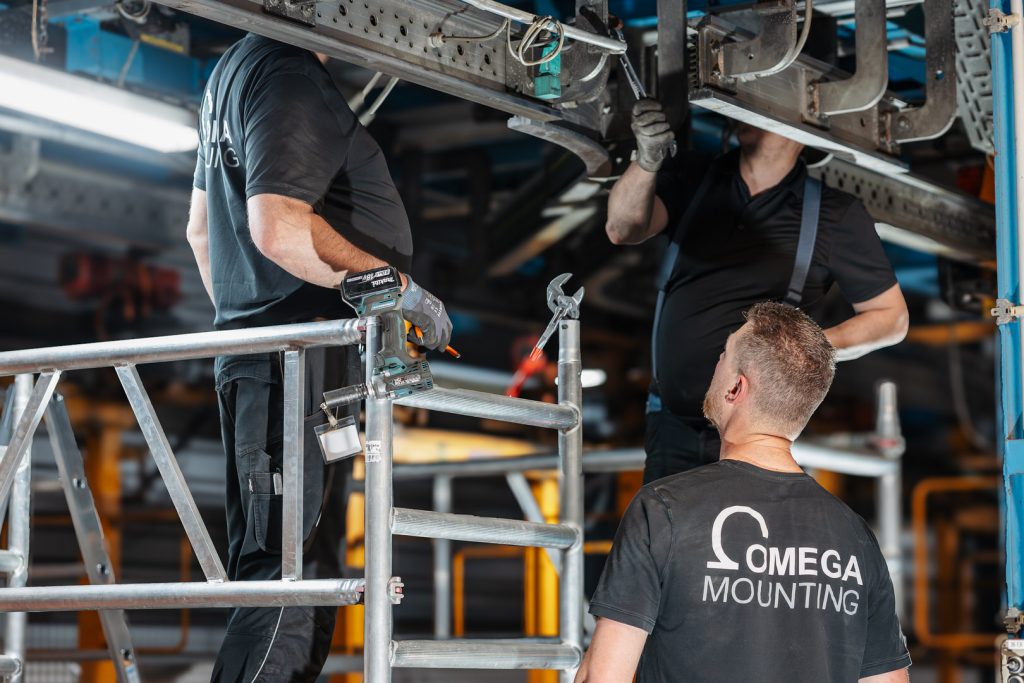
In addition to the five assemblies, overhead conveyors wear on rail, switches, conductor rail and carrier pins. The reason: the load is moved suspended overhead, energy and data transmission run via sliding contacts, and every switch is a separate mechanical and electrical system.
Overhead conveyor maintenance is a separate chapter of conveyor technology maintenance, which we cover in more depth elsewhere. The overhead conveyor maintenance checklist describes assemblies, warning signs and intervals. The guide on the wear points of the overhead conveyor and the question of "repair or replace" covers the decision logic. Here only what you as maintenance manager need for overall planning.
Rail and switches carry the highest forces
Curve profiles and switches absorb the centrifugal forces and impact loads. Worn-in running surfaces and transitions out of alignment cause rough running, increased wear on drive rollers, damaged current collectors and faulty data transmission. How a switch overhaul on around 100 switches proceeds is shown in the practice chapter – right up to relocating worn-in running rails so that the end positions lie on less worn areas.
Conductor rail and current collectors
The conductor rail supplies the carriers with energy and often also with data. Carbon abrasion, contamination and worn contact areas lead to sporadic faults that the control reports as communication errors. Cleaning and assessment of the contact areas therefore belong in every maintenance window. Carbon brushes are wear parts with discard criteria and belong in the stock.
Carriers and pins
The pin-and-bush pairings in the carriers bear the load with every load cycle. They are not maintenance-free, even if they look it. One pulled pin shows the condition of the whole fleet. At a food plant, exactly this assessment led to the repair of all 80 carriers.
Intervals as empirical values
In our overhead conveyor guide, we recommend as an empirical value a six-monthly visual inspection and an annual main maintenance with measurement, cleaning and repair according to findings. With high cycle rates, contaminated hall air or high system age, the intervals shorten. The specific inspection intervals result from the risk assessment and manufacturer's specifications.
How do you plan maintenance windows for conveyor technology?
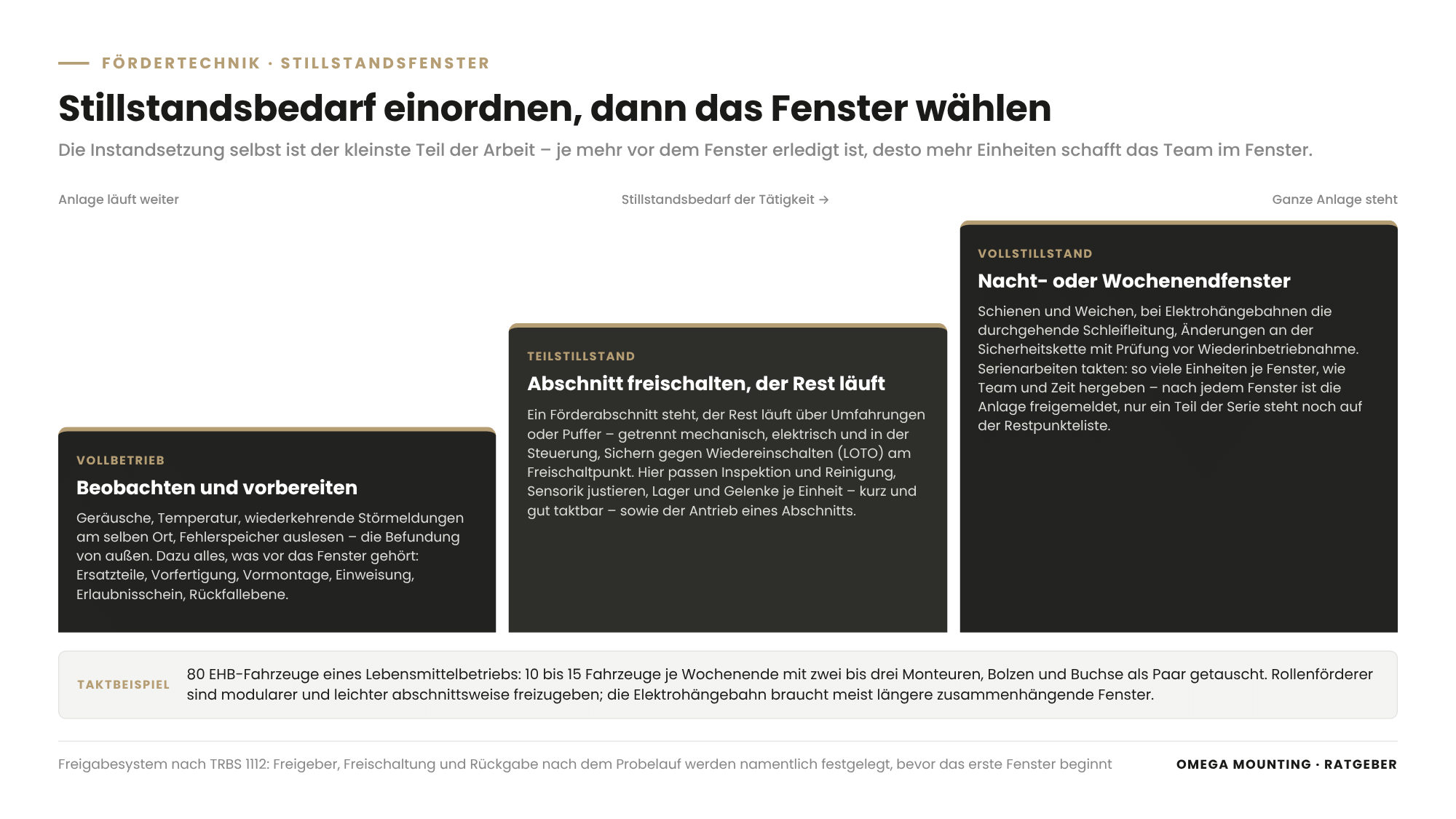
You plan maintenance windows for conveyor technology by classifying every maintenance task by its downtime requirement: full operation, partial downtime of the section or full downtime. Then you place the tasks in the windows that your operation allows: shift breaks, night windows, weekend windows.
Section by section instead of all at once
Linked systems can often be released section by section. One conveyor section stops, the rest continues via bypasses or buffers. The prerequisite is an isolation that safely separates the section from the rest – mechanically, electrically and in the control system. Added to this is securing against reactivation (lockout/tagout, LOTO) with padlock and tag at the isolation point. With overhead conveyors with a continuous conductor rail, this is more complex than with modular roller conveyors.
The maintenance rule names release systems for this. This is a defined procedure for who releases a part of the system for maintenance, who confirms the isolation and who signs the return to operation after the trial run. For you this means: name the releaser and the person issuing the completion notice before the first window begins.
Preparation before the window
The repair itself is the smallest part of the work. Assessment, spare parts procurement, prefabrication of mountings and adapters, pre-assembly of assemblies and allocation of parts to the work areas belong before the window. Likewise the induction of the team, the permit to work for hot work and a fallback in case a switch is not finished by the restart. The more of this is done before the window, the more units the team manages within the window.
Scheduling series work in cycles
Many tasks in conveyor technology are series work: 100 switches, 80 carriers, 32 buttons, 25 drives. Series can be scheduled in cycles: as many units per window as team and time allow. For the 80 overhead conveyor carriers at the food plant, it was 10 to 15 carriers per weekend with two to three fitters. The advantage: after every window, the system is fully operational and released. Only part of the series remains on the punch list.
Which spare parts strategy does conveyor technology need?
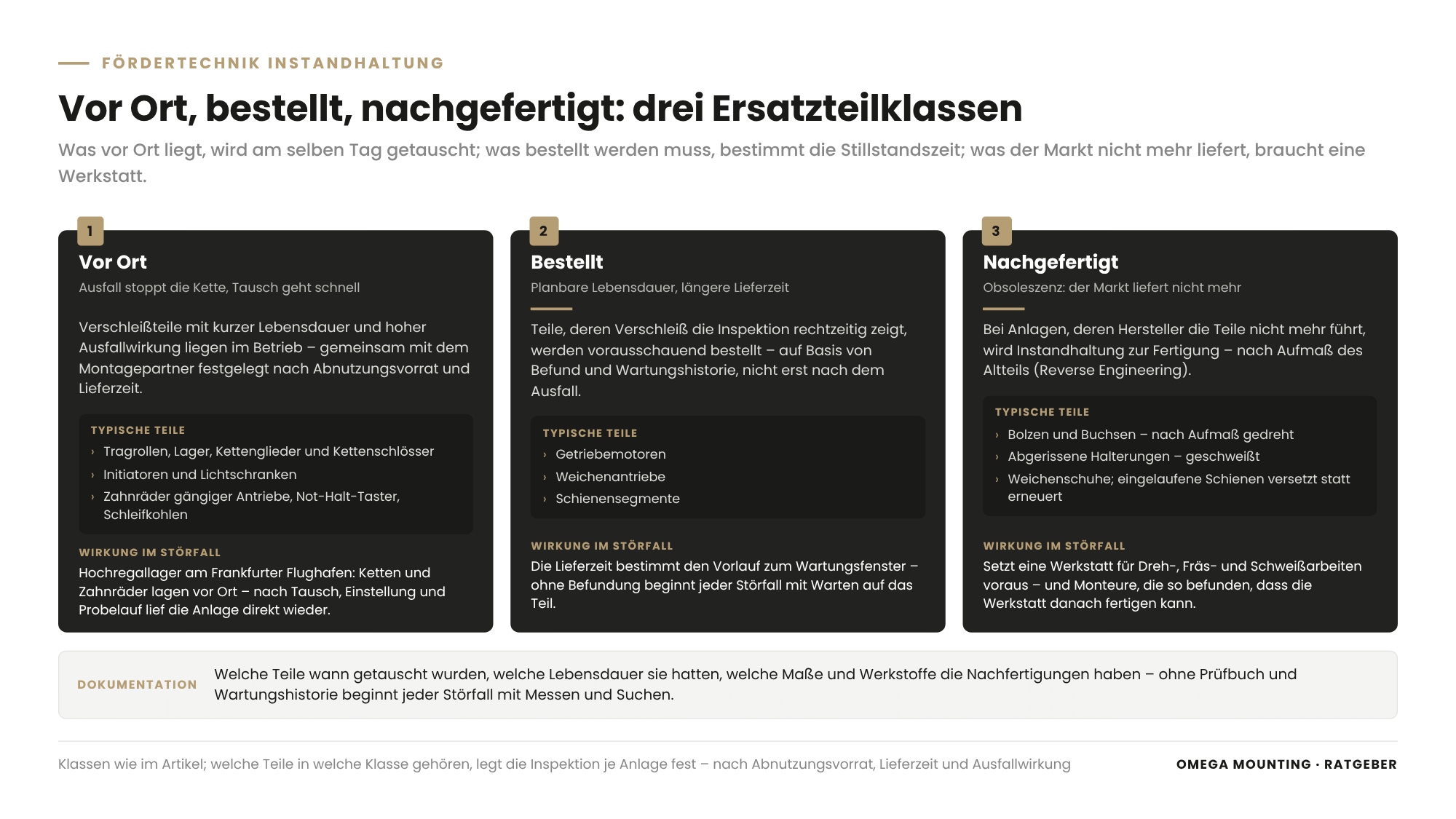
Conveyor technology needs a spare parts strategy that stocks wear parts with short service life and high failure impact on site and orders parts with long delivery times in advance. For components without spare parts supply – obsolescence, the end of availability – it has a repair or re-manufacturing solution.
On site, ordered or re-manufactured
Three classes are enough for practice. On site are parts whose failure stops the chain and which can be replaced at short notice. These are rollers, bearings, proximity switches, chain links, gears of common drives, emergency stop buttons. What this is worth is shown by the high-bay warehouse at Frankfurt Airport in the practice chapter. Ordered are parts with plannable service life and longer delivery time: geared motors, switch drives, rail segments. Re-manufactured are parts that the market no longer supplies. These are pins, bushes, mountings, switch shoes for systems whose manufacturer no longer carries them.
Old systems: repair instead of replace
A 30-year-old overhead conveyor rarely has a complete spare parts supply. Then maintenance of existing systems becomes fabrication. Pins and bushes are turned to the dimensions of the old part (reverse engineering), torn-off mountings welded, worn-in rails relocated instead of renewed. This requires a workshop that carries out turning, milling and welding work at short notice. And fitters who document the assessment so that the workshop can fabricate from it.
Documentation as part of the strategy
A spare parts concept lives from the maintenance history in the inspection logbook and the as-built documentation. Which parts were replaced when, what service life did they have, what dimensions and materials do the re-manufactured parts have? Without this documentation, every breakdown begins with measuring and searching.
How we do it in practice
In practice, we organise the maintenance of conveyor technology by assembly, assess before the window and schedule series work into the times that the operation allows. Three jobs from the Rhine-Main region show what this looks like.
Switch overhaul on an overhead conveyor in Frankfurt
With the maintenance of an overhead conveyor in Frankfurt with overhaul of around 100 switches , the system was around 30 years old and had been used intensively for decades. The assessment showed heavily worn-in running surfaces, damaged or torn-off running and guide rollers and rail transitions out of alignment. Plus damaged mountings, mechanically decommissioned switches and wear on the electrical contact areas. We documented every switch with its damage pattern and assigned it to a defect class. Spare parts were prepared, the sequence defined by degree of damage and production importance.
In weekend windows of around 36 hours between the end of production on Saturday and restart on Monday, four technicians worked in parallel. The work per switch:
- Replace guide and running rollers, if necessary with complete dismantling of the switch.
- Renew and adjust switch shoes and switch pins, align rail transitions, set end positions.
- Check switch motors and limit switches, assess contact areas.
- Weld torn-off mountings, repair decommissioned switches and put them back into operation.
- Relocate worn-in running rails instead of renewing them.
Work was carried out at height and in confined spaces, with mobile scaffold towers, ladders and additional work lighting, on the isolated line. Every window ended with a trial run, installation report and completion notice to production.
dry ice cleaning of 25 drive stations
With the Cleaning drives by dry ice blasting , 25 complete drive stations had not been maintained for over 20 years. Deposits of dust, chips and production emissions had solidified to such an extent that normal cleaners had no effect. Dry ice was the choice because it needs nothing but dry ice and air and is gentle on motors, belts and neighbouring components. The drives could then be assessed and maintained in a clean environment.
Emergency stop retrofit on a sorting system at Frankfurt Airport
With the retrofit of 32 emergency stop buttons on a sorting system at Frankfurt Airport , the key lay in pre-assembly. Mounting plates, housings with cable glands, terminals and labelling were prepared and sorted by installation point. In the system's downtime windows – during the day – two fitters for mechanics and electrics set the mounting plates, aligned the switches and integrated them into the existing safety chain. Two working days were enough. What access, time windows and escort at the airport mean for maintenance is summarised in our guide on maintenance at Frankfurt Airport.
In addition, the repair of the drive unit of a high-bay warehouse at Frankfurt Airport showswhat a spare parts stock is worth. And the refurbishment of 80 overhead conveyor carriers at a food plant stands for series work in cycles. 10 to 15 carriers per weekend, pin and bush replaced as a pair.
Does your conveyor system carry a similar wear backlog, or is a retrofit on a running system coming up? Then get in touch with us. A walk-round with a look at drives, switches and safety chain usually shows within a few hours which work fits into which window.
What this means for your role
For buyers: Award maintenance and servicing services for conveyor technology as a maintenance contract or framework agreement with call-off orders per window and a defined response time for breakdowns. In the scope of works, separate inspection and assessment from repair. Set up series work as a unit price item per unit and re-manufacturing as a contingent item. Require as proof of suitability mechanics and electrics from a single source, workshop capacity for re-manufacturing and references for series work in cycles. These three criteria decide whether a window is enough.
For designers: Maintainability is created in the layout. For conveyor systems, provide inspection openings and access to drives, switches and sensors without dismantling neighbouring assemblies. Plan bypasses, buffers and reserve areas that allow a section-by-section partial downtime. Place isolation points so that a section can be safely separated from the rest mechanically, electrically and in the control system. Replaceability is a design parameter. For overhead conveyors, maintenance platforms, removal points for carriers and access to the conductor rail belong in the installation planning from the outset.
For project managers and site managers: If you are managing a repair or retrofit on running conveyor technology, the work begins before the window: assessment, spare parts, pre-assembly and allocation of parts to the work areas. Agree in the regular meeting with the operation which section is isolated when. Clarify which condition the system must have reached at the end of each window at minimum and which fallback applies if it is not reached. As site manager, you brief, obtain the release, keep the punch list and issue the completion notice for the section after the trial run. After changes to the safety chain, the inspection before recommissioning belongs in your schedule, not in the night shift.
For maintenance managers: Organise your maintenance schedule by the four basic measures of maintenance and the five assemblies. Show inspection interval, maintenance interval and downtime requirement for each task. Use partial downtimes for inspection and cleaning so that the large windows remain free for repairs. Name who accepts the periodic inspections as competent person. Keep the inspection logbook and maintenance history in such a way that your spare parts stock follows from them – on site, ordered, re-manufactured – and obsolescence does not only become apparent in a breakdown.
For warehouse and logistics managers: For you, conveyor technology is the rhythm of goods receipt, picking and dispatch. Every maintenance competes with this rhythm. Together with maintenance, name the maintenance windows in which sections can stand still without consequences for throughput. In the briefing, make sure that your staff do not accept recurring fault messages at the same location as normal but report them. A wear backlog shows up first in your lead times, long before the system stops.
For operations and plant managers: Evaluate conveyor technology by failure impact on the availability of the chain, not by component value. A wear backlog that in-house maintenance cannot reduce during operation is not a staffing problem but a window problem. Plan it as a project with external support in weekend or night windows, with milestones and a completion notice after every window.
Maintenance schedule structure for conveyor technology: template on request
Our maintenance schedule structure for conveyor technology is an assembly-by-assembly template. With it, you build a maintenance schedule for continuous conveyors, sorting systems and overhead conveyors or check an existing schedule for gaps.
The structure lists the typical tasks for each assembly – for the five assemblies, and for overhead conveyors additionally rail, switches, conductor rail and carriers. Six columns: interval, task, assessment criterion (how do I recognise the need for action), downtime requirement (full operation, partial downtime, full downtime), spare parts source (on site, ordered, re-manufactured) and documentation.
It helps maintenance managers plan windows and technical managers make the wear backlog visible. Buyers use it to formulate a scope of works in which it is clear what the operation does itself and what is awarded externally. Request the maintenance schedule structure via our Contact form – keyword "conveyor technology maintenance schedule".
Why Omega Mounting?
We maintain conveyor technology in the Rhine-Main region from Rodgau near Frankfurt – with short distances to Offenbach, Hanau, Dietzenbach, Darmstadt, Mainz and Wiesbaden. Our fitters cover mechanics and electrics. In our own workshop, pins, bushes, mountings and adapters are re-manufactured when the market no longer supplies them. The jobs in this guide show the range from series repair in the weekend window to retrofitting in the daytime window. In a breakdown, you can reach us around the clock via the 24-hour hotline. For planning your maintenance schedule, we start with a joint walk-round and assessment of your system. This gives you one contact for assessment, repair, re-manufacturing and breakdowns – and you do not have to coordinate mechanics, electrics and workshop separately. Get in touch, if you would like to explore this route.
Conclusion
Conveyor technology maintenance is securing a linked system, and linked systems fail at a few known points. These are drives, load-bearing and running elements, bearings, sensors, safety devices – for overhead conveyors additionally rail, switches, conductor rail and carriers. Anyone who assesses these assemblies separately, understands cleaning as maintenance and schedules series work into windows turns unplanned downtimes into planned ones. A spare parts strategy with the classes "on site, ordered, re-manufactured" decides how long a fault lasts. If your system carries a wear backlog that ongoing operations can no longer reduce, send us the system type, system age and your maintenance windows. We will get back to you with an honest assessment of what can be scheduled and how.
Further reading: Two in-depth guides on conveyor technology: Maintaining conveyor belts and belt conveyors and Modernising conveyor and sorting systems – retrofit instead of new build. New in the knowledge base: Conveyor systems at a glance, Overhead conveyor maintenance by assembly, Maintaining power-and-free conveyors, Roller conveyor maintenance, Sorting system maintenance, Stacker crane maintenance and Conveyor system down: rectifying the fault.
Planning maintenance, moving in or installation in the Rhine-Main region?
Tell us briefly what it is about – we will come back to you with an honest assessment.
100% free and without obligation
You may also be interested in these guides
Maintenance & Servicing
Maintenance & Servicing
Maintenance & Servicing

About the author
Tobias Schott
Managing director of Omega Mounting GmbH, Rodgau · more than 20 years of hands-on experience in installation and maintenance
A trained mechatronics technician, at home in maintenance, servicing and industrial installation since 2004 – first at his father's side, since 2012 with Omega Mounting: from the overhead conveyor in Frankfurt to the crane system in a new-build hall. Plans and leads lifting operations as appointed person in data centers and on industrial sites in the Rhine-Main region, is an instructor and examiner for cranes, mobile elevating work platforms and telehandlers, and a safety officer. On jobs abroad he is known as the “German Troubleshooter” – the one you call when things get stuck on site. He learned what quality means not from a manual but from his father: Made in Germany as a standard for his own work, not as a label. That is why it comes first at Omega Mounting – before speed and before price. He writes these guides from that practice: what works on our sites is in them – what only exists in the standard is not.
Frequently asked questions
According to DIN 31051, maintenance of conveyor technology includes inspection (establishing the condition) and servicing (preserving the target condition – lubricating, cleaning, adjusting). Added to these are repair (restoring the target condition – replacing rollers, bearings, chains, gears) and improvement (increasing reliability – for example retrofitting emergency stops). Which measure applies when is defined by the operator's maintenance strategy.
The maintenance intervals result from manufacturer's specifications, risk assessment and operating conditions – number of shifts, load, hall air, system age. For overhead conveyors, we recommend as an empirical value a six-monthly visual inspection and an annual main maintenance, shortened for three-shift operation or contaminated air. Safety devices must be inspected periodically by a competent person at the defined inspection interval. Emergency stop buttons belong in every maintenance window with a function test.
Because sensors get dirty and misaligned, not because they are defective. A dirty proximity switch reports "carrier not detected", a displaced light barrier "position not reached". The control shows the symptom, not the cause. That is why cleaning and adjustment of the sensors belong in every window. Recurring faults at the same location are an early warning sign of mechanical wear behind them.
Dry ice blasting is suitable for drives with solid, encrusted deposits where water and solvents are undesirable. It sublimates without residue and is gentle on motors, belts and neighbouring parts. Noise, ventilation because of the released CO₂ and sensitive surfaces must be considered. Whether it is the right choice is decided during the walk-round. Sometimes conventional cleaning is enough, sometimes a drive is so worn that replacement is the better repair.
Retrofitted buttons are integrated into the existing safety chain, the series connection of all safety-related switching elements. Then every button stops the system, and the control reports the actuated button. The retrofit is a change to the work equipment and must be inspected by a competent person before recommissioning and documented in the inspection logbook. Mounting plates, housings and wiring can be pre-assembled so that only setting, aligning and integrating remain for the downtime window.
With an overhead conveyor, the load hangs overhead, and energy and data transmission run via conductor rail and contacts. Every switch is a separate mechanical-electrical system, and carrier pins bear the load with every load cycle. Roller conveyors are more modular and easier to release section by section. The overhead conveyor usually needs longer continuous windows.
The on-site spare parts stock should contain parts whose failure stops the chain and which can be replaced at short notice. These are carrying rollers, bearings, proximity switches and light barriers, chain links and chain locks, gears of common drives, emergency stop buttons and safety switches. During the repair of the roller conveyor of a high-bay warehouse at Frankfurt Airport, we were able to repair immediately because the operator had the parts in stock. Parts with long delivery times are ordered in advance, parts affected by obsolescence are re-manufactured.
Yes, the assembly logic applies equally to conveyor systems in logistics centres, production plants, food plants and airports. The differences lie in the boundary conditions. These are hygiene cleaning in the food industry, access and escort rules in security areas, three-shift operation in production with correspondingly short windows. The questions remain: which assembly wears how, what is on site, and which window does the repair fit into?
The basis is the BetrSichV (Industrial Safety Ordinance), which governs maintenance, modification and periodic inspection of work equipment, and the risk assessment under the ArbSchG (German Occupational Safety Act). It defines intervals and protective measures. This is specified by the German technical rules TRBS 1112 (maintenance), 1201 (inspections) and 1115 (safety devices). DIN EN 619 applies to continuous conveyors, DIN EN ISO 13849-1 to emergency stops and control safety.
Send us via the Contact form three details: system type (roller conveyor, sorter, overhead conveyor), system age with maintenance status and the windows that your operation allows. We will get back to you and arrange a walk-round with on-site assessment – in the Rhine-Main region from Rodgau at short notice, from Frankfurt via Offenbach to Aschaffenburg. You receive a written assessment with assemblies, downtime requirement and spare parts source. Your contact is Tobias Schott. In an ongoing breakdown, you can reach us via the 24-hour hotline.
 English
 German