
- Guide – Maintenance & Servicing
Frankfurt Airport: maintenance, installation and servicing in 24/7 operation
By Tobias Schott · Reading time approx. 38 minutes · Last updated: October 2026
Maintenance at Frankfurt Airport differs from every other kind of industrial maintenance in three respects. Access is regulated by law, operations never stop, and every system is part of a chain that reaches all the way to departure. Anyone who maintains, installs or repairs here plans access and time windows first – and the technology only afterwards.
You are responsible for a sorting system, a baggage handling or cargo conveyor system, a high-bay warehouse, loading ramps or doors at a site at Frankfurt Airport or in its surroundings. In Kelsterbach, Raunheim, Mörfelden-Walldorf or Neu-Isenburg. Then you know the problem: the same technical rules apply to Frankfurt Airport maintenance as everywhere else, but the framework conditions are different. A fitter without a background check does not get in. A maintenance window that does not exist during the day has to take place at night. And a chain conveyor that stands still does not just hold up a warehouse – it holds up a supply chain with departure times.
This costs you time and nerves at points that have nothing to do with technology. Lead time for ID passes, escort arrangements, tool lists for the security check, permits for hot work, documentation for every subcontractor deployed. And it costs downtime if, in a breakdown, your partner first has to file applications before they can move out.
This guide is our overview of installation, maintenance and servicing at Frankfurt Airport. It is the parent page for our in-depth guides on access and time windows in the security area, on maintenance of conveyor technology, on maintenance of loading ramps and doors and on the custom-made impact protection. It explains what makes the airport special as a place of work, how maintenance is organised in 24/7 operation and which systems are typically affected. It also covers which documents and permits are required, how breakdown response works from Rodgau – and what this means for your role. The examples come from our own projects at Frankfurt Airport and in logistics centres across the region.
Key points at a glance
- Maintenance at Frankfurt Airport begins with access. For unescorted work in security areas, every person needs a background check under the German Aviation Security Act, aviation security training and an ID pass. This determines the earliest possible start date.
- Operations run around the clock. Maintenance windows fall in off-peak periods and are short, so everything that can be done elsewhere – pre-assembly, material, security check, briefing – belongs before the window.
- Typical systems are sorting, baggage handling and cargo conveyor systems, overhead conveyors, high-bay warehouses with chain conveyors, loading ramps, doors and loading docks as well as impact protection. They wear at known points and can be maintained on a planned basis.
- Emergency stop buttons, sensors and safety devices can be retrofitted during live operation if pre-assembly, electrical work and integration into the safety circuit come from a single source.
- Hot work requires a permit to work with a fire watch. Bolted structures avoid it and keep components replaceable.
- Subcontractors at the airport must provide evidence of vetted personnel, qualifications, written appointments and insurance – once as prequalification, then for each call-off.
- In a breakdown, what counts is whether your partner turns up with vetted personnel, an emergency vehicle and short distances from the Rhine-Main region – or first has to file the application.
What is maintenance at Frankfurt Airport?
Maintenance at Frankfurt Airport is the entirety of all measures that keep technical systems on the airport site and in its logistics surroundings in working order. That means servicing, inspection, repair and improvement – under the conditions of a security area and an operation that never stands still. The four basic measures come from DIN 31051, which structures maintenance as follows: servicing delays wear, inspection determines the condition, repair restores function, improvement increases reliability.
At the airport this primarily covers the systems that move goods and baggage: sorting systems, baggage handling systems, cargo conveyor systems, overhead conveyors, roller and chain conveyors, high-bay warehouses with their conveyor technology. Plus loading ramps, dock levellers, doors, loading docks and the impact protection in front of them. Add to that installation services – moving in new systems, extending systems, retrofitting safety technology. And custom fabrication when a spare part is no longer available or a protective structure can only be made to fit.
The term therefore covers more than “Frankfurt Airport servicing” in the narrow sense. Anyone searching for “Frankfurt Airport maintenance” needs installation, servicing, repair, welding, electrical work and lifting technology as one coherent service – and a partner whose staff are actually allowed in. What we typically deliver there is shown on our page Industrial installation for airports and security areas.
Distinction from maintenance in the surrounding area
Many of the systems that depend on airport operations are not located in the security area. They are in cargo and logistics properties in Kelsterbach, Raunheim, Mörfelden-Walldorf, Neu-Isenburg or in the south of Frankfurt. There, a company access procedure – works pass, access list, induction – replaces the official background check. The operating logic is the same: cycle times, night windows, supply chains with fixed departure times. This guide covers both, because maintenance managers in this region are usually responsible for both.
What makes Frankfurt Airport special as a place of work?
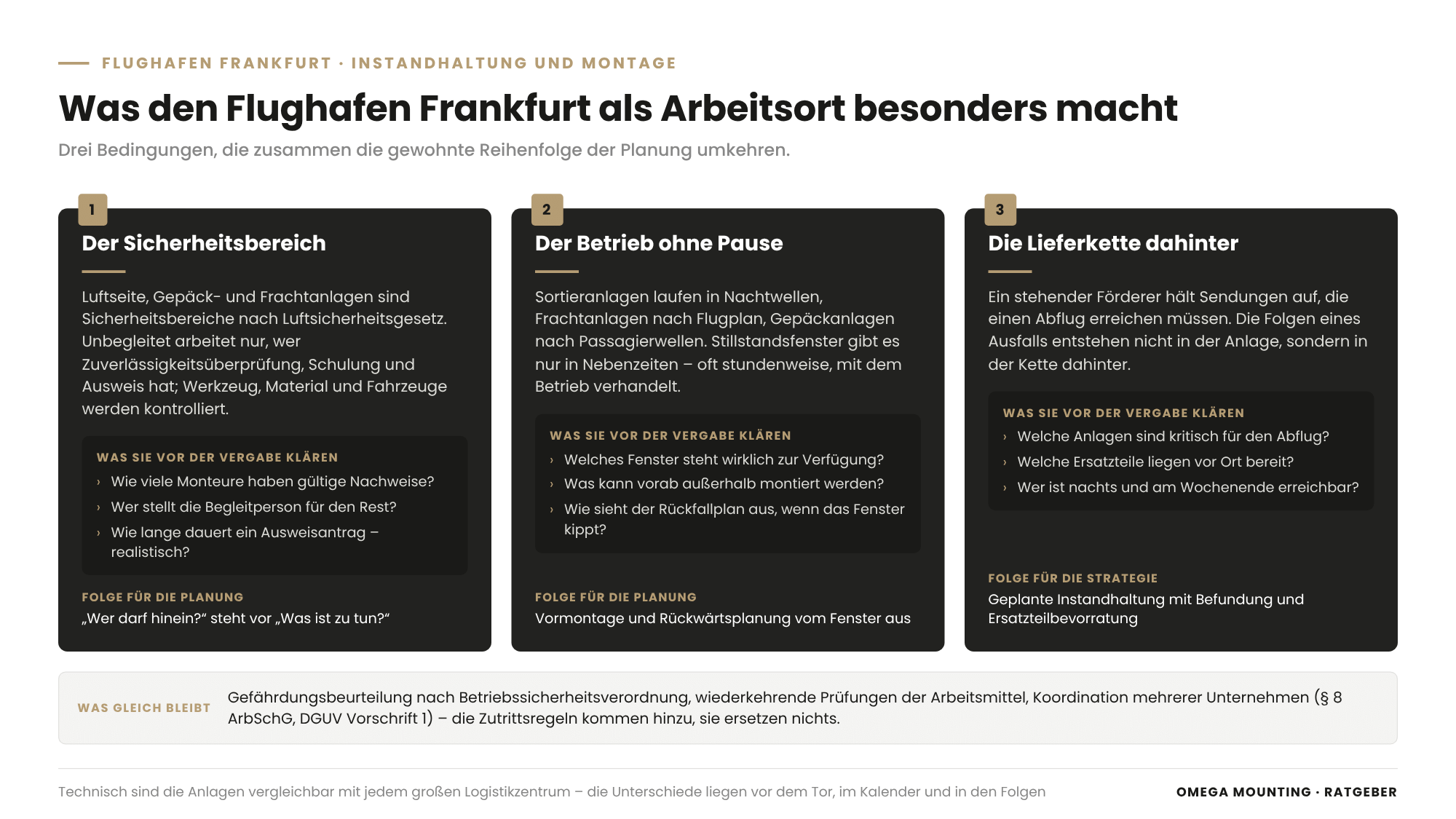
Frankfurt Airport is special as a place of work for installation and maintenance because a legally regulated security area, an operation without a break and tightly scheduled logistics all come together there. Each of these conditions on its own changes the planning; all three together reverse the usual order. Technically, the systems are comparable to those in any large logistics centre. The differences lie in front of the gate, in the calendar and in the consequences of a failure.
The security area
The areas of an airport that are not open to the public – the airside with apron, baggage and cargo facilities – are security restricted areas within the meaning of the German Aviation Security Act (LuftSiG). Anyone working there unescorted needs an official background check, aviation security training and an ID pass that defines the areas the person is allowed to enter. Tools, material and vehicles are checked. For planning this means: the question “Who is allowed in?” comes before the question “What needs to be done?”.
Operation without a break
Airport logistics knows no closing time. Sorting systems run in night waves, cargo systems follow the flight schedules, baggage systems follow the passenger waves. A maintenance window – the time in which a system is scheduled to stand still and maintenance is possible – exists only in off-peak periods, often only for a few hours. It is negotiated with operations, not dictated. Anyone who wants to service during office hours will not find a system that is standing still.
The supply chain behind it
A chain conveyor in front of a high-bay warehouse in an ordinary warehouse holds up order picking. The same conveyor at the airport holds up consignments that have to make a departure. The consequential costs of a failure – we deliberately do not quantify them here – arise not in the system but in the chain behind it. That changes the maintenance strategy. Where a failure has an immediate knock-on effect, planned maintenance with condition assessment and spare parts stocking pays off more than any “fix it when it breaks”. Why, is explained in our fundamentals guide on maintenance strategy.
What stays the same
The operator's duties are no different from anywhere else. The risk assessment under the Industrial Safety Ordinance (BetrSichV), the periodic inspections of work equipment and the coordination of several companies at the same location under the German Occupational Safety Act (ArbSchG) and the accident prevention regulations apply at the airport just as they do in a plant in Hanau or Darmstadt. The access rules are added on top; they replace nothing.
Which access requirements apply to fitters in the security area?

Fitters who work unescorted in the airport's security area need a passed background check under Section 7 of the German Aviation Security Act (LuftSiG), aviation security training and an airport ID pass for the respective areas. Without these three stages, only escorted work with a visitor pass is possible. The check is person-specific, is applied for via the employer, takes weeks of lead time and cannot be accelerated by the client.
For you as a buyer or project manager, this leads to a simple rule. Do not ask whether a contractor has “airport experience”, but how many of its fitters currently hold a valid background check, training and ID pass. The check belongs to the person, not the company. A contractor with vetted personnel can turn up in a breakdown. A contractor without first files the application.
Escorted work as the exception
Persons without a background check may generally only work under constant escort by an authorised person – including during breaks. For a short job, this is a viable route. For an installation lasting several days, it ties up one escort per group for the entire period. Whoever provides the escort is listed in the interface list as a service provided by the client. Clarify this before awarding the contract.
Tools, material, vehicles
At the access control, tools and material are checked and reconciled on leaving. A tool list with description and quantity speeds up both. Vehicles in the security area need their own authorisation and drivers with an apron driving permit. Material is frequently transferred at a handover point. Gases, paints, adhesives and batteries must be registered in advance.
Everything else – the sequence on the day of work, the tool list, backward planning from the window – is covered in our in-depth guide Installation work at airports and in security areas: access, screening, time windows. This overview leaves it at the classification. Access is the first milestone of every airport project.
How does maintenance work in 24/7 operation – and where are the maintenance windows?
Maintenance in 24/7 operation works by placing maintenance in low-traffic off-peak periods and breaking it down into short windows. It is prepared in such a way that only what absolutely has to be done on the stationary system happens inside the window itself. The system sets the pace, not the fitter. At Frankfurt Airport, maintenance windows typically fall between the operating waves: in the early morning hours, during the day between sorting runs, at weekends or in phases with lower volumes. They are coordinated with operations.
Off-peak periods instead of shutdown
A system that runs around the clock cannot be “shut down”. It can be released in sections. That is why we divide maintenance scopes into packages that fit into a window: one conveyor section, one drive, one group of switches, one door. Whatever is not finished in this window must still leave the system in a condition in which operations can restart. We define this minimum state beforehand. Plus a fallback plan in case security check, release or escort cost time.
Pre-assembly before the window
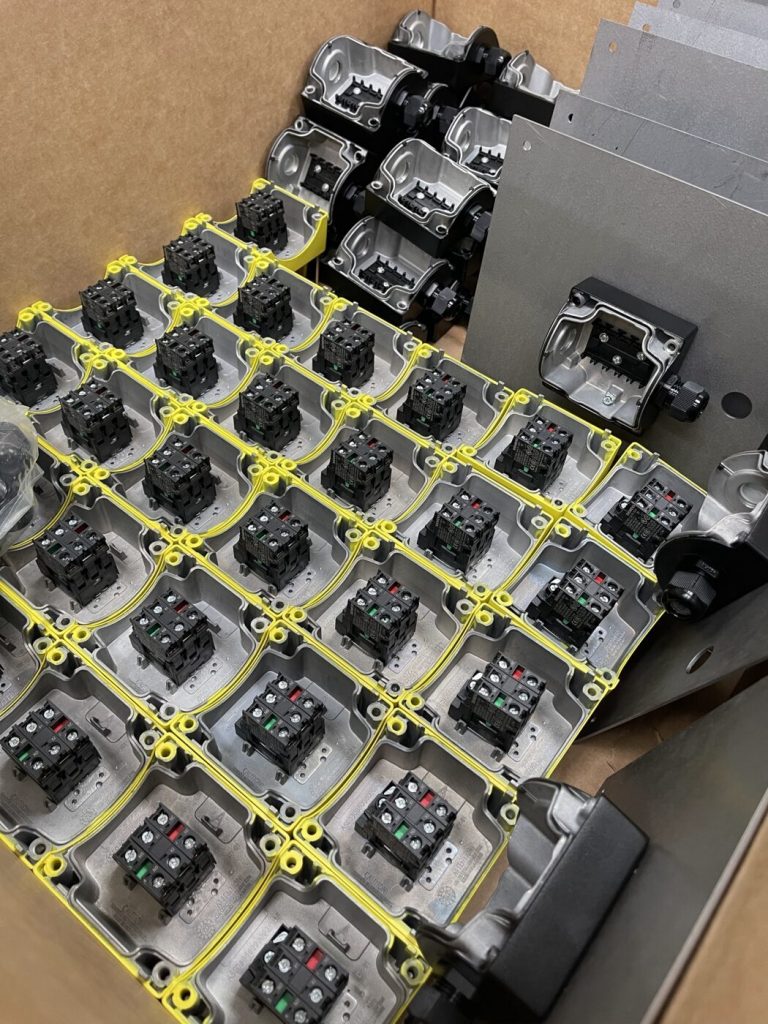
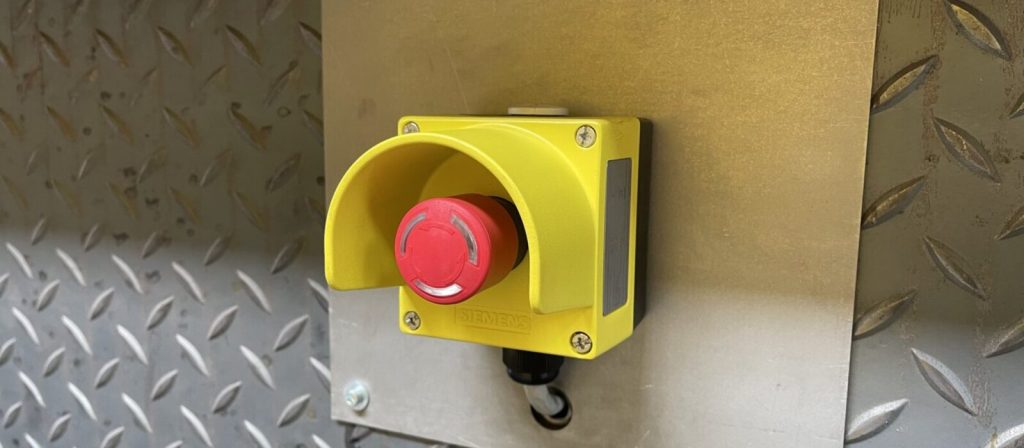
When retrofitting 32 emergency stop buttons on a parcel sorting system at Frankfurt Airport, stainless steel mounting brackets were pre-assembled. Each housing was prepared with cable gland, terminals and labelling and sorted by installation point. What remained for the window was setting, aligning, bolting and connecting. Two fitters, two working days during daytime standstill periods. Sorting operations continued. That is the principle: every working hour that moves ahead of the window extends the window.
Weekend windows for large scopes
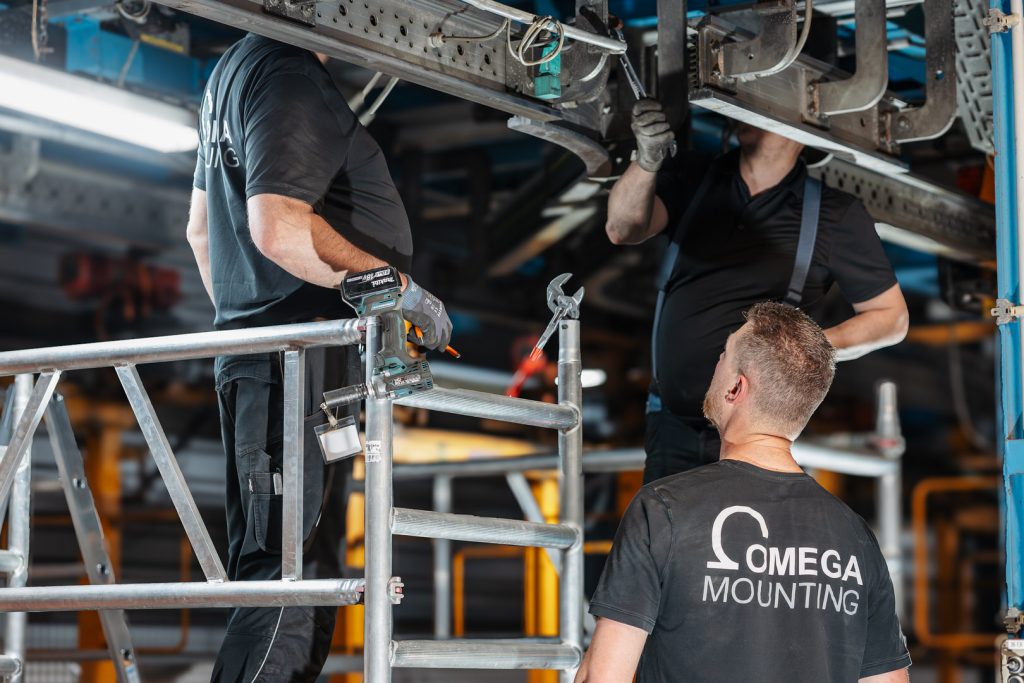
For extensive overhauls, hours are not enough. For the maintenance of a roughly 30-year-old overhead conveyor in Frankfurt with around 100 switches in two operating areas, a series of weekend standstills was used. Around 36 hours between end of production on Saturday and restart on Monday, four technicians per weekend. Every switch had been assessed beforehand and prioritised by urgency. The approach transfers to airport systems: assess during live operation, procure parts, work in parallel inside the window.
Release and isolation
Every window begins with release by the person responsible for the system: system stopped, isolated, locked out against re-energising, release documented. The German technical rule TRBS 1112 (Maintenance) requires a release procedure for such work and coordination when several companies are involved. For you this means: define who releases, who isolates and who issues the completion notice at the end. One person per step, not “the shift supervisor”. How isolation and lockout work in detail is shown in our guide on lockout/tagout in maintenance. How to plan maintenance windows in general is shown in the guide Maintenance during live operations.
What drives the effort
We describe the cost factors of airport maintenance qualitatively. Night and weekend windows, waiting times at security check and handover point, escorts, short windows with many set-up operations, separate routes for personnel and material. Each of these factors can be reduced through planning. Through pre-assembly, fixed access lists, bundling work into one window and spare parts on site. None of them can be negotiated away.
Which conveyor technology runs at the airport – and what wears on it?
Conveyor technology of every design runs at the airport, and it all wears at the same five assemblies: drives, load-bearing elements, bearings, sensors and safety devices. The designs range from baggage handling systems with belt conveyors and switches, through sorting systems with cross-belt or tilt-tray sorters, to cargo conveyor systems with roller conveyors and chain conveyors. Plus overhead conveyors in production and handling areas. Anyone who knows these five groups can plan the maintenance of baggage handling systems and the maintenance of sorting systems instead of waiting for the failure.
Drives and gearboxes
Motors, gearboxes, drive chains and gears carry the continuous load. The damage pattern of the emergency repair at the high-bay warehouse at Frankfurt Airport is typical. A worn gear on the drive unit caused the drive chain to jam and skip. That stopped the chain conveyor and with it the entire high-bay warehouse. Worn gears announce themselves – through noise, chain tension and running pattern. An inspection inside the window finds them before the chain skips.
Load-bearing elements: rollers, belts, rails, switches
Rollers, belts, running rails and switches are wearing parts in the literal sense. On the overhead conveyor in Frankfurt, the condition survey showed heavily worn running surfaces, deep wear tracks, damaged rollers and mechanically stressed rail sections. Running and guide rollers were replaced, switch shoes replaced and adjusted, misaligned rail joints realigned. Worn running rails were offset by several centimetres instead of being replaced completely. On a baggage handling system the parts have different names, but the principle is the same: define wear limits, measure, replace in good time.
Bearings and lubrication
Bearing points on rollers, deflections and drive shafts rarely fail suddenly. They become loud, hot and stiff. A lubrication schedule with intervals that match the system's cycle rate is more important at the airport than elsewhere. The system takes no break in which a bearing could “recover”.
Sensors and data transmission
Light barriers, proximity switches, barcode readers, position encoders and the data transmission between vehicles and controller are the eyes of the system. Contamination, vibration and torn-off brackets lead to misreads and incorrect diverts. These are faults that initially feel like software errors and often have mechanical causes. On the overhead conveyor in Frankfurt, data transmission problems were part of the findings list. Torn-off brackets were welded.
Safety devices
Emergency stop buttons, guard doors, limit switches, pull-cord switches and enabling switches are part of the conveyor technology and must function. And precisely when everything else fails. The German technical rule TRBS 1115 (Safety devices) makes clear what is often forgotten in everyday practice. Safety devices must not be bypassed or put out of action, and their function must be checked regularly. For you this means: every maintenance job ends with a function test of the safety circuit, not just of the mechanics.
Which inspection points per assembly belong in the maintenance plan and how to build a maintenance strategy for conveyor technology is explored in depth in our guide Conveyor technology maintenance: overhead conveyors, sorters and conveyors. Specifically for overhead conveyors there is the overhead conveyor maintenance checklist.
Emergency stop and safety devices: how do you retrofit without disrupting operations?
You retrofit emergency stop buttons and safety devices without disrupting operations by preparing all units outside the system and breaking the installation down into short cycles during standstill periods. Mechanical and electrical work come from a single source, and each unit is tested in the safety circuit immediately after connection. That sounds obvious. In practice, however, it often fails because the mechanical fitters and electricians come from two companies and need two windows.
Why retrofits happen
Systems are extended, workstations move, risk assessments are updated, inspectors demand additional control devices at hand height or sensors at new access points. The emergency stop function itself is described in DIN EN ISO 13850. That is the standard which defines how an emergency stop device must look and act: red on a yellow background, reachable from every operating position, latching after actuation. For you this means: a retrofitted button must fit into the existing safety circuit and must not change the stop category of the system. The electrician clarifies this with the control documentation before installation, not inside the window.
The procedure
When a parcel sorting system at Frankfurt Airport was extended by 32 emergency stop buttons and numerous sensors, the steps ran as follows. Record the installation situation at each mounting point, prefabricate stainless steel mounting brackets to fit and pre-assemble them. Prepare each housing with cable gland, terminals and labelling, sort all units by installation point. Inside the window: fix the mounting plate to the system frame, mount the button at hand height, terminate the conductors, fit the strain relief, test the function, integrate into the safety circuit. Two fitters – one mechanical, one electrical – in two working days, during daytime standstill periods.
What you should prepare
Provide the control documentation for the system and define the installation points together with the inspector or your safety officer. Specify who will accept and document the function test of the entire safety circuit after the retrofit. A retrofit that has not been accepted is, from the perspective of the Industrial Safety Ordinance, not yet complete.
Loading ramps, loading docks and doors: what belongs in maintenance?
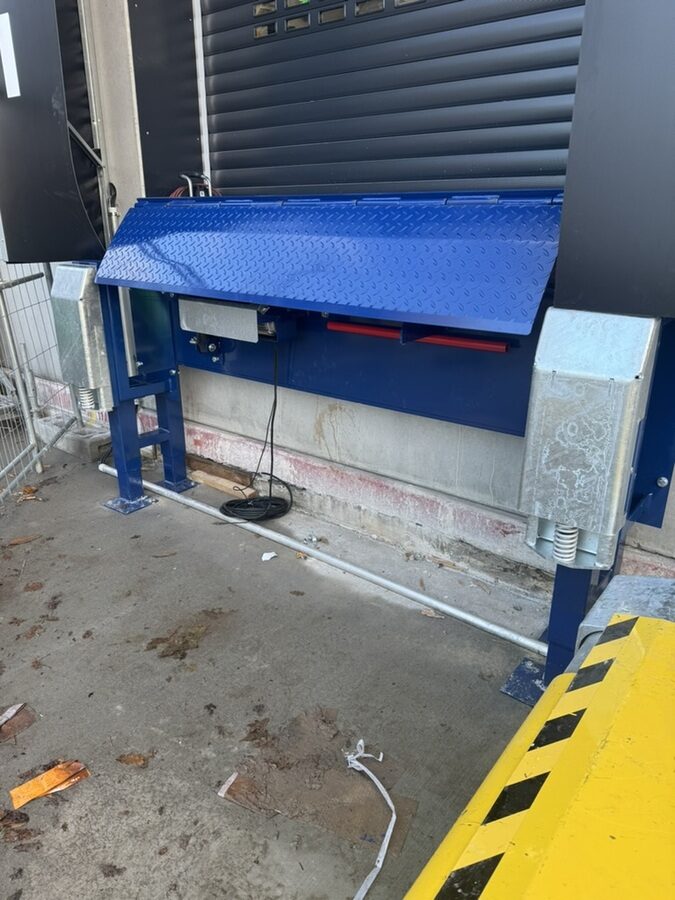
Maintenance of loading ramps, loading docks and doors at the airport covers the dock levellers and folding ramps with their hydraulics and the doors with drive, control and safety devices. Plus the dock bumpers and take-off rollers at the dock edge, the door seals and the impact protection in front of them. Inspection is carried out at fixed intervals, repairs inside the window between two loading waves. Loading bays are the point where airport logistics and the road meet. If a loading ramp at the airport fails, vehicles back up, not just parcels.
Ramps and dock levellers
Hydraulic dock levellers and folding ramps wear at cylinders, seals, hinge strips, lips and controls. Manually operated ramps wear at springs, joints and locks. When replacing two manually operated folding ramps with hydraulic ones at a logistics centre in Frankfurt, two mechatronics technicians dismantled the old ramps with an angle grinder and positioned the new ones with a forklift in a single working day. The hinge strips were welded to the existing steel structure using the MAG process – metal active gas welding with a high deposition rate and fast weld build-up. Then hydraulics and electrics were installed and two control cabinets with door control and operating boxes with traffic lights were set up. The worn dock bumpers of the old loading bay showed why the conversion was due.
Doors
Power-operated doors must be inspected at least once a year by a competent person in accordance with workplace rule ASR A1.7. For you this means: inspection sticker and inspection log for every door. And a partner who fixes defects in the closing edge safety device, light barrier, anti-fall device and drive in the same visit instead of merely noting them. Door seals and dock shelters are also an energy issue. A leaky loading bay cools the whole hall in winter.
Take-off rollers, bumpers, dock edge
The dock edge absorbs the impacts of the vehicles. Dock bumpers, take-off rollers and the steel structure of the edge therefore belong in every inspection. Cracks in welds are not uncommon there and are professionally re-welded – with a permit to work, as described in the chapter on hot work. What inspection, defect classes and repair of ramps and doors mean in detail is shown in our guide Maintaining loading ramps: inspecting doors and dock levellers safely.
Impact protection at the airport: why collision guards here are often custom-made
Impact protection at the airport is often custom-made because the points to be protected rarely match the geometry for which catalogue products are designed. This applies to take-off rollers at loading docks, system frames, controllers and supports of conveyor sections. In addition, the protection has to be installed during live operation without long standstills and must later be replaceable segment by segment. A standard product is the faster choice when geometry and load assumptions match the catalogue. At the airport they frequently do not.
The loading dock example
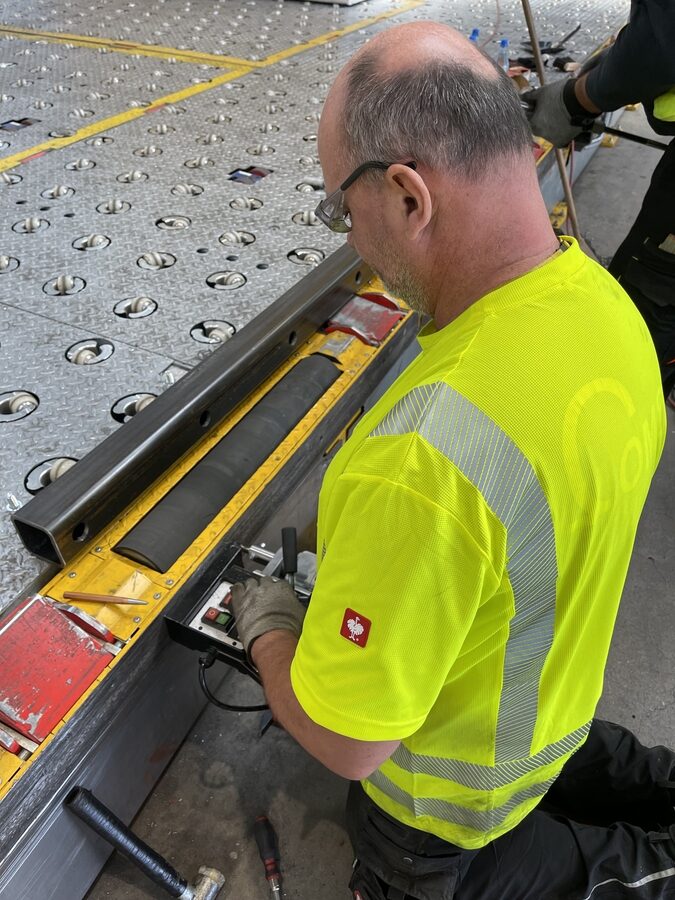
For the impact protection at a loading dock at Frankfurt Airport, sensitive take-off rollers were to be protected against impacts from transport trailers. Three fitters fabricated a guard tube from square hollow section with a wall thickness of ten millimetres on site in four days. Adapt the design to the existing system, pre-drill the tubes with the magnetic drill, drill and tap threads at the dock, weld the corner areas, paint in a matching colour. The chamfered, welded-in corners act as approach ramps and deflect the impact. The bolted connection allows individual segments to be replaced later without welding again.
What matters
Impact protection only protects if it directs the impact energy to where it is allowed to go. Into the ground or into a structure designed for it, not into the system behind it. Impact protection at the airport is therefore always also a question of anchoring: anchors in the concrete, bolting to the dock structure or welded base plates. At the airport there is the added factor that vehicles, trailers and industrial trucks with different heights and approach angles hit the same spot. A site walk with an eye on the traffic clarifies more than any drawing. You will find the comparison of standard versus custom-made with decision criteria in our guide Impact protection: custom-made or standard?. What our workshop in Rodgau fabricates is described on the page Custom fabrication.
High-bay warehouses and storage technology: how do you keep racking and chain conveyors available?
You keep high-bay warehouses and storage technology at the airport available by inspecting the racking installation regularly and maintaining the upstream conveyor technology on a planned basis – chain conveyors, roller conveyors, lifts, stacker cranes. For the assemblies whose failure paralyses the entire racking, you stock spare parts on site. A high-bay warehouse is only as available as the conveyor in front of it. If that stops, no bay can be reached.
Racking inspection
Racking installations must be inspected at least every twelve months by a qualified person in accordance with DIN EN 15635. In addition, the operator carries out regular visual checks. For you this means: an inspection calendar for each racking installation. Damage to uprights, beams, bracing and locking devices is classified by severity; damaged components are replaced, not straightened. How the classification works and what to do after a collision is explained in our guide Racking inspection: inspecting, classifying damage, repairing.
The conveyor technology in front of it
The emergency repair at the high-bay warehouse at Frankfurt Airport shows the sequence in a breakdown. The enquiry essentially read “The high-bay warehouse is not working”. Many emergency enquiries start this way, because there is often no specialised maintenance staff on site to narrow down the fault. The team moved out with the emergency vehicle and narrowed the fault down to the roller conveyor system. It found the worn gear on the drive unit that had jammed the chain. The chain conveyor was dismantled, all drive chains and gears were replaced with new parts, everything was readjusted and put back into operation.
Spare parts on site
The decisive factor was that the customer had suitable spare parts in stock. Without this spare parts stocking, the repair would have had to wait for procurement – in the security area, with an additional security check on every delivery. Which parts you should keep in stock follows from the condition assessment: drive chains, gears, rollers, sensors, drive motors of the critical conveyors. The live article draws the conclusion we share. Conveyor systems and high-bay systems in time-critical operations should be maintained preventively – before they stop in an emergency.
Installation and lift & shift on the airport site: what is different?
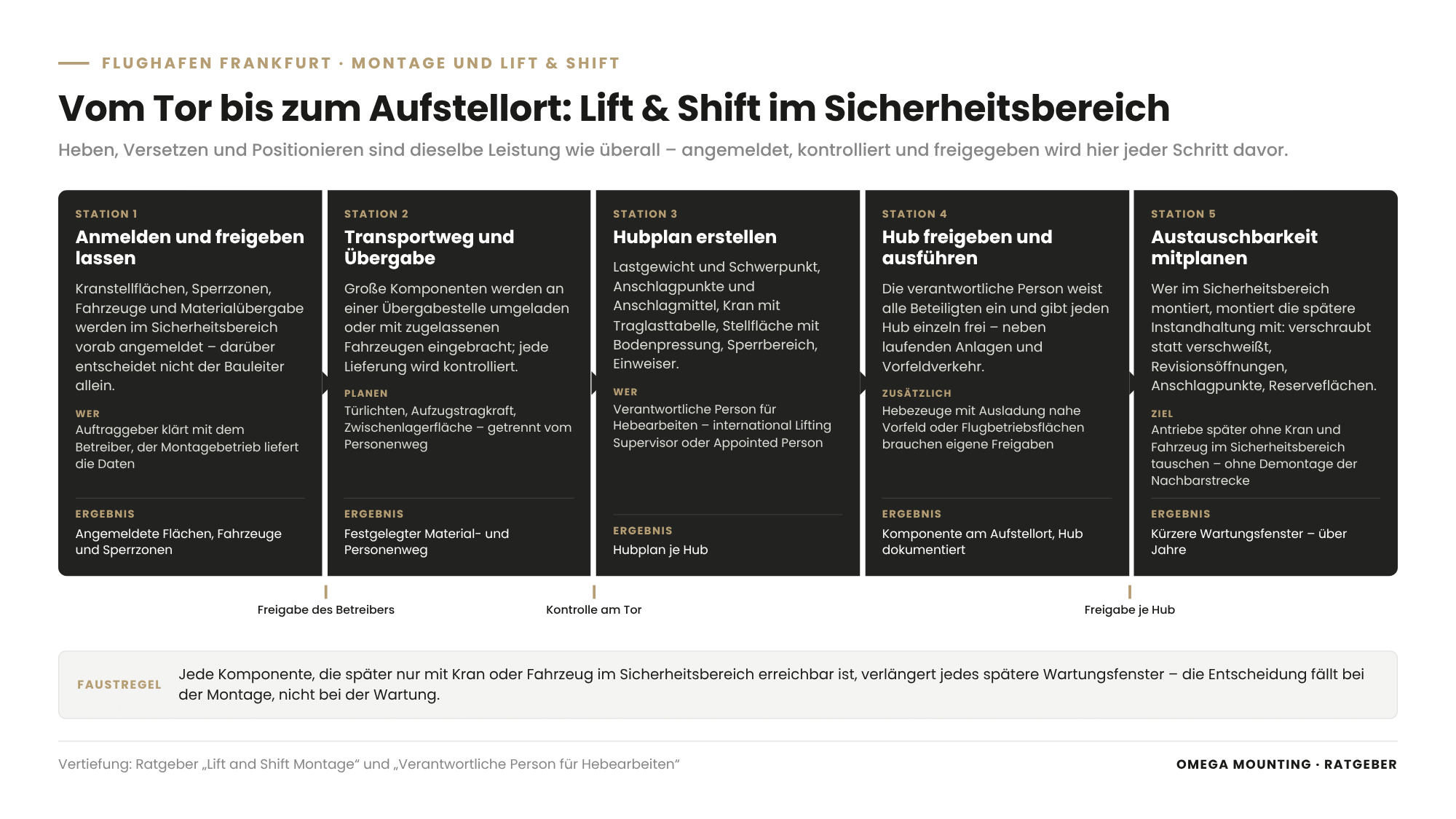
Installation and lift & shift on the airport site differ from other moving-in jobs in three respects. Transport routes, crane set-up areas, vehicle authorisations and material handovers in the security area have to be registered and released. Lifting operations take place next to running systems and apron traffic. And every component should be planned so that it can later be replaced without a crane and vehicle in the security area. Lift & shift – the planned lifting, moving and positioning of heavy equipment from the vehicle to the installation location – is technically the same service as anywhere else. The logistics around it are different.
Transport route and handover
Material entering the security area is checked. Large components – drive stations, sorter elements, structural steel for platforms, control cabinets – are therefore often transferred at a handover point or brought in with authorised vehicles. Plan the transport route, door clearances, lift capacity and intermediate storage area separately from the personnel route. Register crane set-up areas and exclusion zones in advance. In the security area, the site manager does not decide this alone.
Lift plan and appointed person
Every lifting operation needs a lift plan: load weight and centre of gravity, lifting points and lifting accessories, crane or hoist with load chart, crane set-up area with ground bearing pressure, exclusion zone, banksman, release. Responsible for this is a named person for lifting operations, internationally known as the lifting supervisor or appointed person. This person draws up the lift plan, briefs those involved and releases every lift. What this role delivers and how it is appointed is described in our guide on the appointed person for lifting operations. At the airport there is the added factor that lifting equipment with a working radius close to the apron or aircraft movement areas requires its own clearances. The client clarifies this with the operator; the installation contractor supplies the data.
Planning for replaceability
Anyone who installs a system in the security area also installs its future maintenance. Bolted instead of welded connections, inspection openings, lifting points for the later replacement of drives, reserve areas for lifting equipment. Each of these decisions shortens every future maintenance window. The bolted impact protection at the loading dock is the small example. Large examples are drive stations that can be replaced without dismantling the neighbouring section. You will find the basics on lift plan, roles and sequence in our guide Lift and Shift Installation: Meaning, Process, Roles and on the service page Lift & Shift.
Hot work and permit to work: when is welding allowed at the airport?
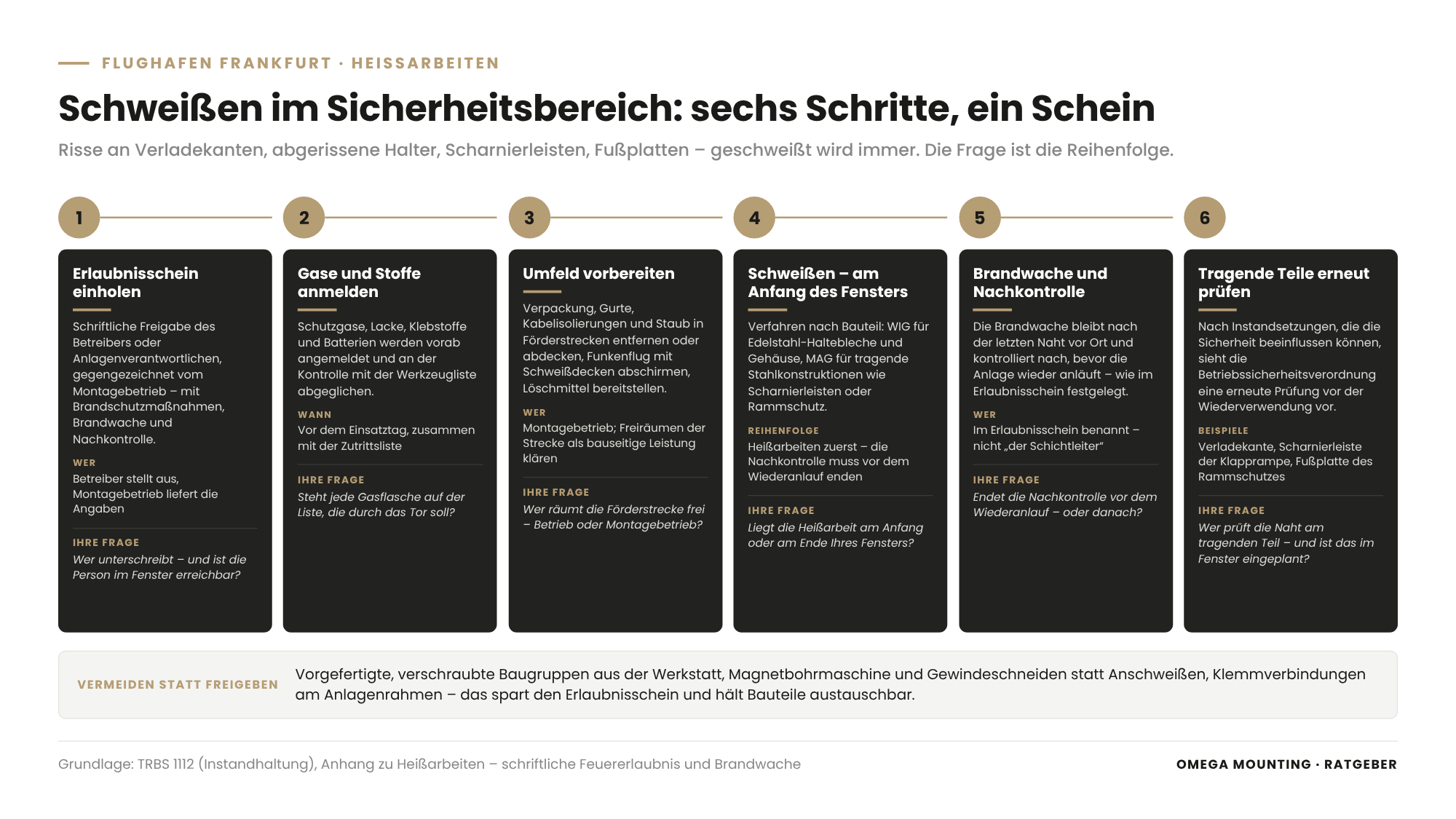
Welding, cutting, soldering or grinding is allowed at the airport if a permit to work has been issued for it. This is a written release from the operator or the person responsible for the system with defined fire protection measures, fire watch and follow-up check. In addition, the gases and consumables must be registered, and the work must be scheduled within the window so that a follow-up check is possible before the end of work. Hot work is unavoidable in maintenance. Cracks at dock edges, torn-off brackets on conveyor sections, hinge strips of folding ramps, base plates of impact protection – all of this is welded.
What the permit to work regulates
The permit to work (internationally also known as hot work permit) is the operational form of a general rule. In its annex on typical maintenance work, TRBS 1112 names the written fire permit and the fire watch for hot work. For your maintenance window this means: hot work belongs at the start of the window so that the fire watch can complete its follow-up check before the system restarts. Combustible materials in the vicinity – packaging, belts, cable insulation, dust in conveyor sections – are removed or covered. Flying sparks are shielded with welding blankets, extinguishing agents are kept ready.
Process and material
Which welding process is suitable is decided by the component. TIG – tungsten inert gas welding for clean seams on stainless steel and thin sheet – for mounting brackets and housings. MAG for load-bearing steel structures such as hinge strips, ramp frames or impact protection. For load-bearing parts, repair welding includes the question of whether an inspection is required before the part is used again. The Industrial Safety Ordinance provides for a re-inspection after repairs that could affect safety. Processes, materials and approvals are explored in depth in our guide on repair welding on industrial plant.
Avoiding hot work
Wherever possible, we avoid hot work in the security area: prefabricated, bolted assemblies from the workshop in Rodgau, magnetic drill and thread tapping instead of welding on, clamp connections on system frames. This not only saves the permit to work, it keeps components replaceable. At the airport, where every future window is short, that is a value in its own right.
Which documents and which prequalification do subcontractors need at the airport?
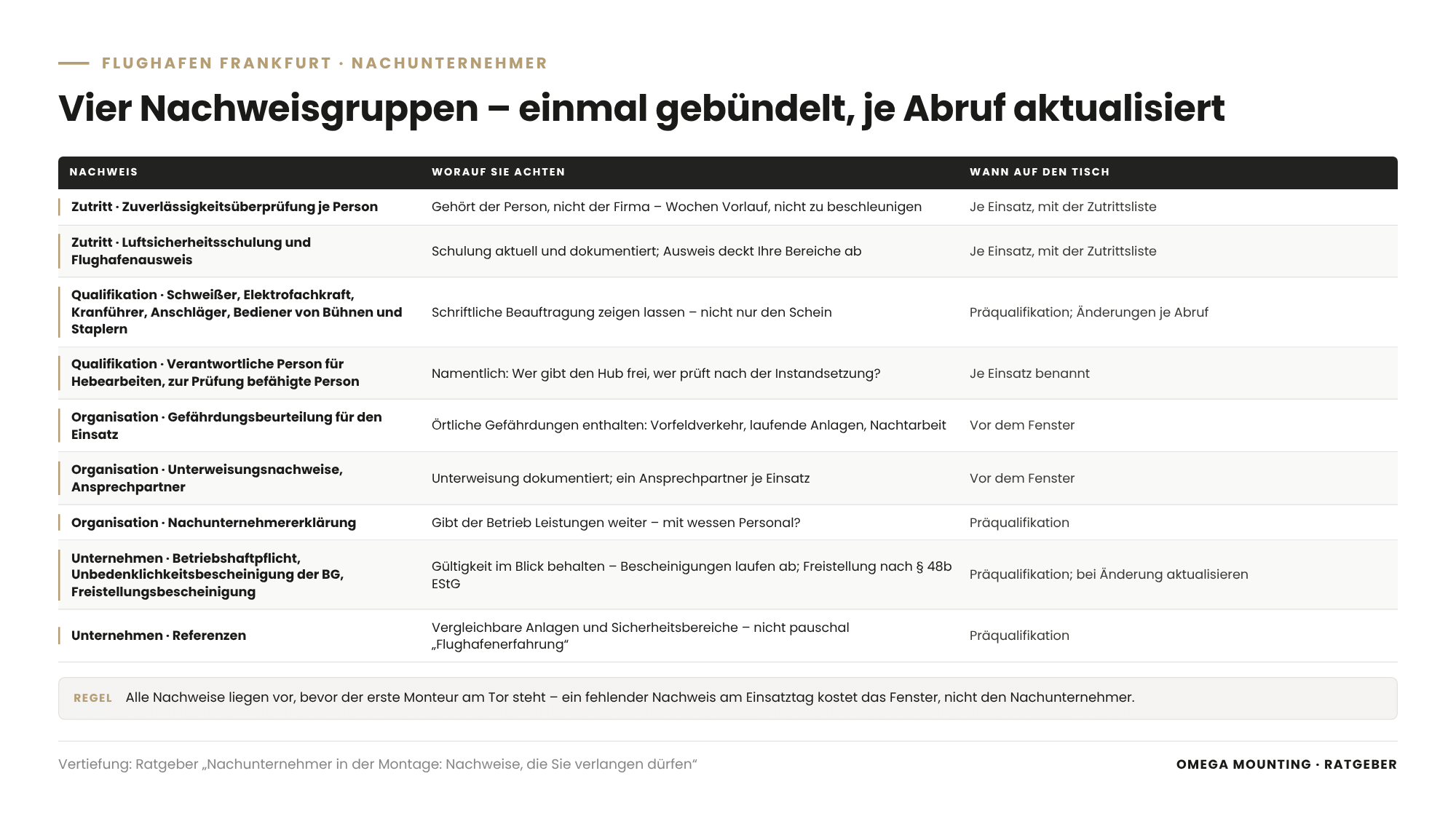
Subcontractors at the airport need documents in four groups. Access: background check, aviation security training, ID passes per person. Qualification: welders, qualified electricians, crane operators, slingers, operators of MEWPs and industrial trucks with written appointment. Organisation: risk assessment, briefing records, contact persons, subcontractor declaration. Company: public liability insurance, clearance certificate from the employers' liability insurance association (Berufsgenossenschaft), tax exemption certificate under the German Income Tax Act, references. A prequalification bundles these documents once. After that, only what has changed is updated per call-off.
Why the appointment counts, not just the licence
For cranes, MEWPs and industrial trucks, an operator's licence is not enough. The operator's employer must appoint them in writing after having checked their qualification. So ask to see the appointment, not just the licence. The same applies to the appointed person for lifting operations and to the competent person who inspects after a repair.
Check the documents before the window begins
All documents belong on the table before the first fitter is standing at the gate. Ideally together with the access list. A missing document on the day of work costs the window, not the subcontractor. Which documents you may demand, how to check third-party documents and how a prequalification is structured is explored in depth in our guide Subcontractors in installation: the documents you may demand.
Framework agreement instead of individual awards
For recurring work at the airport, a framework agreement with call-off orders has proven effective. Suitability is checked once, response times and documentation standards are agreed, every job is called off rather than re-awarded. For critical systems, a maintenance contract with fixed intervals is added. Which model suits which system is explained in our guide Maintenance contract or individual order.
Breakdown and 24-hour availability: how quickly does help arrive from Rodgau?
In a breakdown, help from Rodgau arrives as quickly as three things fit together. A contact person who can be reached around the clock. Fitters with a valid background check and ID pass who are allowed into the security area without an application. And a short route – from Rodgau via the A3 or the B45 towards the Frankfurter Kreuz and the airport, without crossing the city. We do not quote minutes. They depend on time of day, traffic and the security check at the gate. What we commit to is set out per system in the contract.
What “response time” means at the airport
Response time is three separate commitments: acknowledgement, arrival on site, restoration of function. At the airport, a fourth variable is added. The time from the gate to the system, with ID check, tool check and, where applicable, escort. A partner whose fitters hold ID passes skips the longest part of this chain. Agree all variables separately – then the commitment can be verified.
The emergency vehicle
A breakdown response includes the material in the vehicle: tools, measuring equipment, consumables, common wearing parts. Plus the tool list for the security check, so that access does not fail at the count. Whatever is system-specific belongs in your spare parts store on site. The high-bay warehouse repair at Frankfurt Airport shows how much that is worth.
The hotline
Our 24-hour hotline is the entry point. That is where the fault report lands, and from there it is decided who goes and what goes with them. The more precise your report – system, symptom, condition, access rules, contact person on site – the less fault-finding the first window costs. The overall advantages that regional proximity brings in a breakdown – a workshop for refabrication, local knowledge, short distances – are explained in our fundamentals guide Installation contractor in the Rhine-Main region: using proximity in a breakdown.
What documentation does maintenance at Frankfurt Airport require?
Maintenance at Frankfurt Airport requires the same documentation as any industrial maintenance: maintenance report per job, findings list with defect class, inspection records, photo documentation, continuously updated plant file. It is supplemented by the records the security area demands: access lists, tool lists with completeness check, permits to work for hot work, release and completion protocols per window. At the airport, documentation is not an ancillary service. It is the evidence that system and operation are verifiably safe at all times.
Inspection records
For work equipment subject to inspection – doors, cranes, hoists, racking, lifting accessories, MEWPs – the results of the inspections under the Industrial Safety Ordinance must be recorded and kept at least until the next inspection. The German technical rule TRBS 1201 (Inspections and checks of work equipment) names the minimum contents: type, scope and result of the inspection, date, name and signature of the inspector. For you this means: demand every maintenance report in this form, then it serves as inspection evidence. Which system has to be inspected, how often and by whom: the operator defines this in the risk assessment. The partner provides the records; the duty remains with you.
Findings list as the basis for planning
The findings list from the last window is the plan for the next one. Which switch, which drive, which door first, which parts need to be procured, where work can be done in parallel. With around 100 switches, the difference between “knowing” and “searching” is an entire weekend. At the airport there is the added factor that parts which have to go into the window pass through the security check beforehand. The findings list plans that too.
Photo documentation in the security area
Photos are standard in maintenance. At the airport, restrictions apply to photography in the security area. Clarify with the operator in advance what may be photographed for documentation purposes. Document the rest in writing with sketch and measured values. Documentation that is missing because of a photography ban is no argument towards the inspector.
Cargo and logistics properties in the surrounding area: how we do it in the Rhine-Main region
Around Frankfurt Airport lie cargo and logistics properties, parcel and express hubs, handling companies and technical sites that live off the airport. In Kelsterbach, Raunheim, Mörfelden-Walldorf, Neu-Isenburg and in the south of Frankfurt. They place the same demands on maintenance: scheduling by flight plan, night windows, availability without compromise. For us in Rodgau, this is the neighbourhood. Via the A3 or the B45 to the Frankfurter Kreuz, from there to the airport, to Kelsterbach and Raunheim. Via the B45 and the A661 to Neu-Isenburg and the south of Frankfurt. To Mörfelden-Walldorf via the A5 – without crossing the city.
What is typical in the region
Maintenance in logistics around Frankfurt revolves around three families of systems. Conveyor and sorting technology in parcel and cargo hubs. Loading technology – ramps, doors, loading docks, impact protection – at the docks of the logistics halls. And storage technology with racking, chain conveyors and lifts. Add to that workshop equipment and infrastructure: fencing and perimeter systems, containers and modular units, steel platforms, working platforms. Cargo logistics asks the same questions as the airport itself – who is allowed in when, in which window, with which documents. Only with company rather than official access rules.
Our location pages
What we do in each of these towns is shown on our pages on industrial installation in Kelsterbach, on industrial installation in Raunheim, on industrial installation in Mörfelden-Walldorf and industrial installation in Neu-Isenburg. As the installation contractor for Kelsterbach, Raunheim and Mörfelden-Walldorf, we are where the airport's supply chains begin and end. With the same crew that also works in the security area.
Workshop in Rodgau
The second advantage of proximity is our workshop in Rodgau. Mounting brackets, consoles, guard tubes, fitting pieces and reinforcement plates are prefabricated there and brought to site ready for bolting. That way, only installation remains inside the window at the airport. If a spare part is missing that the market no longer supplies, we refabricate it from site measurements or a sample. For logistics in Frankfurt, Offenbach and the surrounding area, our page Industrial installation for logistics and intralogistics describes the scope of services. For planned maintenance, see the page Maintenance and servicing for industrial plants.
How we do it in practice
Five jobs from our project diary show how installation, maintenance and servicing run at Frankfurt Airport and in the region's logistics. From breakdown to planned retrofit.
Retrofit of 32 emergency stop buttons on a sorting system, Frankfurt Airport
With the retrofit of emergency stop buttons on a sorting system at Frankfurt Airport we extended an existing parcel sorting system by 32 emergency stop buttons and numerous sensors and integrated them electrically into the existing safety circuit. The stainless steel mounting brackets were pre-assembled. Each housing – yellow housing, red mushroom button – was prepared with cable gland, terminals and labelling, tested and sorted by installation point. Inside the window: mounting plate on the system frame, button at hand height, terminate the conductors, fit the strain relief, test the function. Two fitters – mechanical and electrical from a single source – needed two working days, during daytime standstill periods. Sorting operations remained undisturbed.
Impact protection for a loading dock, Frankfurt Airport
During the impact protection project for a loading dock at Frankfurt Airport the take-off rollers of a loading bay were to be protected against impacts from transport trailers. Three fitters fabricated a guard tube from square hollow section with a wall thickness of ten millimetres on site in four days. Adapt the design to the existing system, pre-drill the tubes with the magnetic drill, drill and tap threads at the dock, weld the corner areas, paint in a matching colour. The chamfered, welded-in corners act as approach ramps; the bolted connection allows individual segments to be replaced later. Installation took place during live operation with ID passes for the security area already in hand.
Emergency repair at a high-bay warehouse, Frankfurt Airport
With the emergency repair at a high-bay warehouse at Frankfurt Airport the conveyor system had failed. The enquiry essentially said only that the high-bay warehouse was not working. The emergency vehicle moved out for fault-finding. The condition assessment narrowed the fault down to the roller conveyor system: a gear on the drive unit was worn, the drive chain had jammed and skipped. Chain conveyor and the entire high-bay warehouse were at a standstill. The chain conveyor was dismantled, all drive chains and gears were replaced with new parts, readjusted and put back into operation. This was possible so quickly because the customer had suitable spare parts in stock.
Replacement of two folding ramps, logistics centre Frankfurt
During the replacement of two folding ramps at a logistics centre in Frankfurt two manually operated folding ramps were replaced with hydraulic ones. Two mechatronics technicians dismantled the old ramps with an angle grinder in one working day and positioned the new ones with a forklift. They welded the hinge strips to the existing steel structure at the concrete edge using the MAG process and installed hydraulics and electrics. They also set up two control cabinets with door control, sockets and operating boxes with traffic lights for the two doors. The worn dock bumpers of the old loading bay were part of the findings that had triggered the conversion.
Switch overhaul on an overhead conveyor, Frankfurt
With the maintenance of a roughly 30-year-old overhead conveyor in Frankfurt around 100 switches in two operating areas were due for inspection and repair. Work was carried out in a series of weekend standstills of around 36 hours between end of production on Saturday and restart on Monday, with four technicians per weekend. The condition survey showed worn running surfaces, deep wear tracks, damaged rollers, torn-off components and brackets as well as data transmission problems. Inside the window, running and guide rollers were replaced, switch shoes replaced and adjusted, rail joints realigned, brackets welded. Decommissioned switches went back into operation; worn running rails were offset by several centimetres instead of being replaced. The job stands here as evidence of how conveyor technology in Frankfurt is maintained on a planned basis inside the window. The same approach applies to baggage handling and cargo conveyor systems.
Five jobs, one pattern: access first, pre-assembly before the window, mechanical and electrical from a single source, spare parts on site, documentation at the end. Is maintenance, a retrofit, a repair or an installation coming up at your airport site or in its surroundings? Then get in touch with us. A site visit usually clarifies within an hour which window is realistic, what can be pulled ahead of the window and which documents you need from us.
What this means for your role
For buyers: Make vetted personnel, qualifications with written appointment and proof of insurance your suitability criteria. Obtain these documents as a prequalification before you send out scopes of works. Award recurring work at the airport via a framework agreement with call-off orders and separately agreed response times – acknowledgement, arrival, restoration. Award critical systems via a maintenance contract with fixed intervals. Include escort, material handover, releases and photography rules as client-side services in the interface list. Regulate how notices of hindrance are handled when security check or release shortens a window.
For designers: For new and extended systems in the security area, plan the future maintenance from the start. Material handover points and transport routes with sufficient door clearances, reserve areas for lifting equipment and intermediate storage, inspection openings, lifting points for replacing drives, bolted instead of welded connections. Position emergency stop points, protective devices and isolation points so that retrofitting and inspection are possible without dismantling the neighbouring section. Every component that can only be reached with a crane or vehicle in the security area extends every future maintenance window.
For project managers and site managers: Plan every job backwards from the window. First access and documents, then site visit and pre-assembly, then registration of persons, vehicles, tools, hazardous substances and hot work, and finally the window itself. As site manager, you brief on site, obtain release and isolation and define the minimum state and the fallback plan. You keep the punch list and issue the completion notice for the system at the end. Clarify escort, material route and permits to work in the regular coordination meeting with the operator – not at the gate.
For maintenance managers: Rank your systems by the consequences of failure for the supply chain. Define for each system what happens on a planned basis inside the window, what under the framework agreement and what in a breakdown. Build up a stock of spare parts in the security area – drive chains, gears, rollers, sensors, drives of the critical conveyors. Have a partner with vetted personnel and an agreed response time in place before the breakdown occurs. Maintain findings lists, inspection log and isolation points so that an external fitter can find them at night.
For warehouse and logistics managers: Your loading bays, doors, racking and conveyors are the systems that operations bump into every day – literally. Report collision damage to racking, bumpers, take-off rollers and impact protection immediately. Have damaged racking components replaced rather than straightened. Define the off-peak periods in which your docks and conveyor sections can be released for maintenance. Train your shift supervisors to report faults in a way that keeps fault-finding short: system, symptom, condition, last intervention.
For safety officers and HSE coordinators: The access rules of the security area do not replace the risk assessment – they are added on top. Check whether the installation contractor's risk assessment and operating instructions include the local hazards: apron traffic, running conveyor systems, danger zones beneath lifting equipment, escorted work, night work. Check whether permit to work, fire watch and follow-up check are regulated for hot work. Align the operator's induction and the installation contractor's briefing so that release and lockout against re-energising are unambiguously assigned to one person. Clarify stop authority and the rescue chain behind the access control.
Checklist “Working at the airport”: template on request
The checklist “Working at the airport” is a four-page planning aid for clients and installation contractors. In four blocks it bundles everything that must be clarified before the first day of work. Access: Background check per person, training, ID pass, access list, vehicles, escort. Documents: Qualifications and written appointments, risk assessment, briefings, insurance, prequalification. Time window: Off-peak periods, release and isolation, minimum state, fallback plan, completion notice. Tools: Tool list with quantities, hazardous substances, hot work and permit to work, completeness check on leaving.
It helps maintenance managers organise jobs at the airport and in its surroundings in the same way. It helps buyers request suitability documents and client-side services in full, and site managers start the day of work without surprises at the gate. Request the checklist via our Contact form – keyword “Working at the airport”.
Why Omega Mounting?
Omega Mounting is based in Rodgau near Frankfurt, a short distance from Frankfurt Airport and the logistics sites in Kelsterbach, Raunheim, Mörfelden-Walldorf and Neu-Isenburg. Our fitters hold the background checks and aviation security training that access to the security areas requires. Our workshop in Rodgau prefabricates mounting brackets, protective structures and spare parts, and our 24-hour hotline can be reached in a breakdown. The jobs linked here show that we deliver mechanical, electrical, welding and lifting technology from a single source and stay within the window: emergency stop retrofit and impact protection at Frankfurt Airport, emergency repair at the high-bay warehouse, folding ramp replacement and switch overhaul in Frankfurt. For you this means: one contact for installation, maintenance and breakdowns at the airport, whose team is already vetted when your window begins. With short distances in the Rhine-Main region and a workshop that fabricates the missing part instead of waiting for it. If that is what your systems need, get in touch with us.
Conclusion
Frankfurt Airport maintenance is technically industrial maintenance – organisationally it is something else. Access to the security area determines who is allowed to work at all. 24/7 operation determines when. The supply chain behind it determines how much a failure costs. Anyone who clarifies access and documents before the technology and breaks maintenance down into prepared packages in off-peak periods keeps their systems available. That includes maintaining conveyor technology, ramps, doors, racking and impact protection at their known wear points on a planned basis, keeping spare parts on site and having a partner with vetted personnel in the Rhine-Main region – for projects as well as breakdowns. If you would like to know what this looks like for your systems at the airport or in its surroundings, send us the system, location, access rules and your preferred window. We will get back to you with an honest assessment.
Planning maintenance, moving in or installation in the Rhine-Main region?
Tell us briefly what it is about – we will come back to you with an honest assessment.
100% free and without obligation
You may also be interested in these guides

About the author
Tobias Schott
Managing director of Omega Mounting GmbH, Rodgau · more than 20 years of hands-on experience in installation and maintenance
A trained mechatronics technician, at home in maintenance, servicing and industrial installation since 2004 – first at his father's side, since 2012 with Omega Mounting: from the overhead conveyor in Frankfurt to the crane system in a new-build hall. Plans and leads lifting operations as appointed person in data centers and on industrial sites in the Rhine-Main region, is an instructor and examiner for cranes, mobile elevating work platforms and telehandlers, and a safety officer. On jobs abroad he is known as the “German Troubleshooter” – the one you call when things get stuck on site. He learned what quality means not from a manual but from his father: Made in Germany as a standard for his own work, not as a label. That is why it comes first at Omega Mounting – before speed and before price. He writes these guides from that practice: what works on our sites is in them – what only exists in the standard is not.
Frequently asked questions
All measures that keep technical systems on the airport site and in its logistics surroundings in working order. That means servicing, inspection, repair and improvement of sorting, baggage handling and cargo conveyor systems, overhead conveyors, high-bay warehouses with chain conveyors, loading ramps, doors, loading docks and impact protection. Add to that installation, retrofitting of safety technology and custom fabrication of parts that are no longer available. All under the conditions of a security area and an operation without a break.
For unescorted work: a passed background check under the German Aviation Security Act, aviation security training and an airport ID pass for the respective areas. The check is person-specific, is applied for via the employer and takes weeks of lead time. Without it, only escorted work with a visitor pass is possible. Details can be found in our guide on installation in the security area.
In low-traffic off-peak periods between the operating waves – early in the morning, during the day between sorting runs, at weekends or in low-volume phases – and coordinated with operations. The windows are short. That is why maintenance is broken down into packages that fit in, and everything non-essential is done beforehand: pre-assembly, material transport, tool check, briefing. Weekend windows are used for major overhauls.
Five assemblies. Drives with gearboxes, chains and gears; load-bearing elements such as rollers, belts, running rails and switches; bearing points; sensors and data transmission; safety devices. A worn gear that jams the drive chain or worn running surfaces on an overhead conveyor are typical damage patterns. All five groups announce themselves and can be inspected and replaced on a planned basis.
Yes, during standstill periods of the system, if all units are prepared. On a parcel sorting system at Frankfurt Airport, 32 emergency stop buttons and numerous sensors were retrofitted by two fitters in two working days. Mounting brackets pre-assembled, housings prepared with terminals and labelling, set inside the window, connected, tested and integrated into the safety circuit. Sorting operations remained undisturbed.
Power-operated doors must be inspected at least once a year in accordance with the workplace rule. Racking installations must be inspected at least every twelve months by a qualified person in accordance with the racking standard. For dock levellers and lifting equipment, the operator sets the inspection intervals in the risk assessment under the Industrial Safety Ordinance, usually annually. Inspection results must be recorded and kept at least until the next inspection. A maintenance contract includes these inspections in the maintenance plan.
Because take-off rollers, system frames and dock structures rarely match the geometry for which catalogue products are designed. And because the protection has to be installed during live operation and must later be replaceable segment by segment. At Frankfurt Airport, three fitters adapted, bolted and painted a guard tube from square hollow section with a wall thickness of ten millimetres in four days – with chamfered corners as approach ramps.
Yes, with a permit to work: a written release from the operator or the person responsible for the system, countersigned by the installation contractor, with fire protection measures, spark containment, fire watch and follow-up check. Gases and consumables must be registered in advance. Hot work belongs at the start of the window. Wherever possible, bolted, prefabricated assemblies avoid welding in the security area altogether.
Access documents per person (background check, training, ID pass) and qualifications with written appointment (welders, qualified electricians, crane operators, slingers, operators of MEWPs and industrial trucks). Plus organisational documents (risk assessment, briefings, subcontractor declaration) and company documents (public liability insurance, clearance certificate from the employers' liability insurance association, tax exemption certificate, references). A prequalification bundles all of this once.
That depends on time of day, traffic and the security check at the gate. And on whether the fitters already hold a background check and ID pass. From Rodgau, the route runs via the A3 or the B45 to the Frankfurter Kreuz and the airport without crossing the city. The same applies to Kelsterbach, Raunheim, Mörfelden-Walldorf and Neu-Isenburg. We make a reliable commitment on acknowledgement, arrival and restoration per system in the contract, not as a blanket statement.
Yes. Data centers, factory sites with plant security, nuclear facilities and logistics centres work with comparable access systems, regulated officially or by the company. And with operating models that know no standstills. The pattern is the same: access first, pre-assembly before the window, release and isolation per window, spare parts on site, documentation at the end. Only the deadlines and responsibilities differ.
Send us via the Contact form three details: the system or task with its location (security area or surroundings), the access rules at your site and the desired time window or the known off-peak periods. We check which documents and ID passes must be in place and propose a site visit. You receive a written assessment covering lead time, pre-assembly, the sequence inside the window and documentation. Your contact is Tobias Schott.
 English
 German