
- Guide – Occupational safety
Operator inspection duties: what, how often, by whom – and the evidence
By Tobias Schott · Reading time approx. 24 minutes · Last updated: October 2026
Anyone who operates a plant must have it inspected. Which inspection, at what interval and by whom follows from the type of plant and your risk assessment. The only valid evidence is an inspection record naming type, scope, result and inspector.
Overhead crane, forklift, racking, loading dock, MEWP, lifting accessories, overhead conveyor, standby power system: a medium-sized plant quickly has a dozen types of equipment, each with its own inspection duties. Anyone searching for the operator's inspection duties under German law finds ordinances, accident-prevention regulations, technical rules and standards – and responsibilities that nobody in the company has ever brought together. The forklift is inspected because the rental company organises it. The racking is inspected because the warehouse manager knows about it. The loading dock slips through because nobody had it on the list.
The result is rarely an accident, usually a stoppage: a closed loading bay, an overhead crane without a valid inspection before an important lift, a racking aisle with a defect list ahead of stocktaking. And if something does happen, the employers' liability insurance association (Berufsgenossenschaft) and the insurer ask first: when was the last inspection, by whom, and where is the evidence?
This guide is written for everyone who has to answer that question without being a lawyer. It shows in one table which plant is inspected how often and by whom, and explains the types of inspection and the levels of inspector. It explains what happens after a defect is found and what evidence must look like to stand up in an audit. The legal bases are collected at the end for reference; this is not legal advice. For the individual types of equipment we refer to our in-depth guides on UVV defects, racking, loading docks, lifting accessories and MEWPs.
Key points at a glance
- The inspection duty lies with the operator as the employer. In the risk assessment, the operator specifies which work equipment is inspected when and by whom – the Betriebssicherheitsverordnung (BetrSichV, the German Industrial Safety Ordinance) requires this for every item of work equipment.
- There are four inspection triggers: before first use, periodically at fixed intervals, after modifications or repairs, and after exceptional events such as overloading or collision.
- Cranes, MEWPs, industrial trucks, lifting accessories and racking are inspected once a year as a rule. Your risk assessment may shorten the interval; extending it requires justification.
- Who may inspect depends on the risk: from the operator with a daily visual check, through the competent person, to the authorised expert and the approved inspection body.
- A defect that creates a hazard means a ban on use until repair and re-inspection – not a matter of discretion, but an obligation.
- The evidence that counts is the inspection record stating type, scope, result and the inspector's signature. The sticker only proves that an inspection took place.
- An inspection calendar for each item of plant, with interval, inspector, next date and filing location, is the tool with which companies get their inspection duties under control.
What are operator inspection duties?
Operator inspection duties are the employer's legal obligations under German law to have work equipment and plant inspected by qualified persons and to record the result. They apply before first use, periodically at defined intervals, and after modifications, repairs and exceptional events. The basis is the Betriebssicherheitsverordnung (BetrSichV, the German Industrial Safety Ordinance). It requires a risk assessment for every item of work equipment – and, within it, the definition of type, scope and interval of the inspections.
The "operator" here is not the owner but whoever provides the equipment to their employees. Rented forklift, leased overhead crane, loading bay door installed by the landlord: the operator duties lie with you as soon as your people work with it. You can contractually delegate the organisation of the inspection – the responsibility for ensuring that it was inspected stays with you.
Inspection, check, maintenance: three different things
An inspection is carried out by a qualified person to establish whether the plant can be used safely, and it is recorded. An operator check is the operator's daily look before use: visual check of the lifting accessory, function test of the crane brake, a glance at the dock's hydraulics. Maintenance slows down wear: lubricating, adjusting, replacing wear parts. All three belong together but do not replace each other. A maintained plant is not automatically an inspected one. If a maintenance contract does not include the inspection, the evidence is missing at the end of the year even though the technician was there four times.
Which plant must be inspected how often?
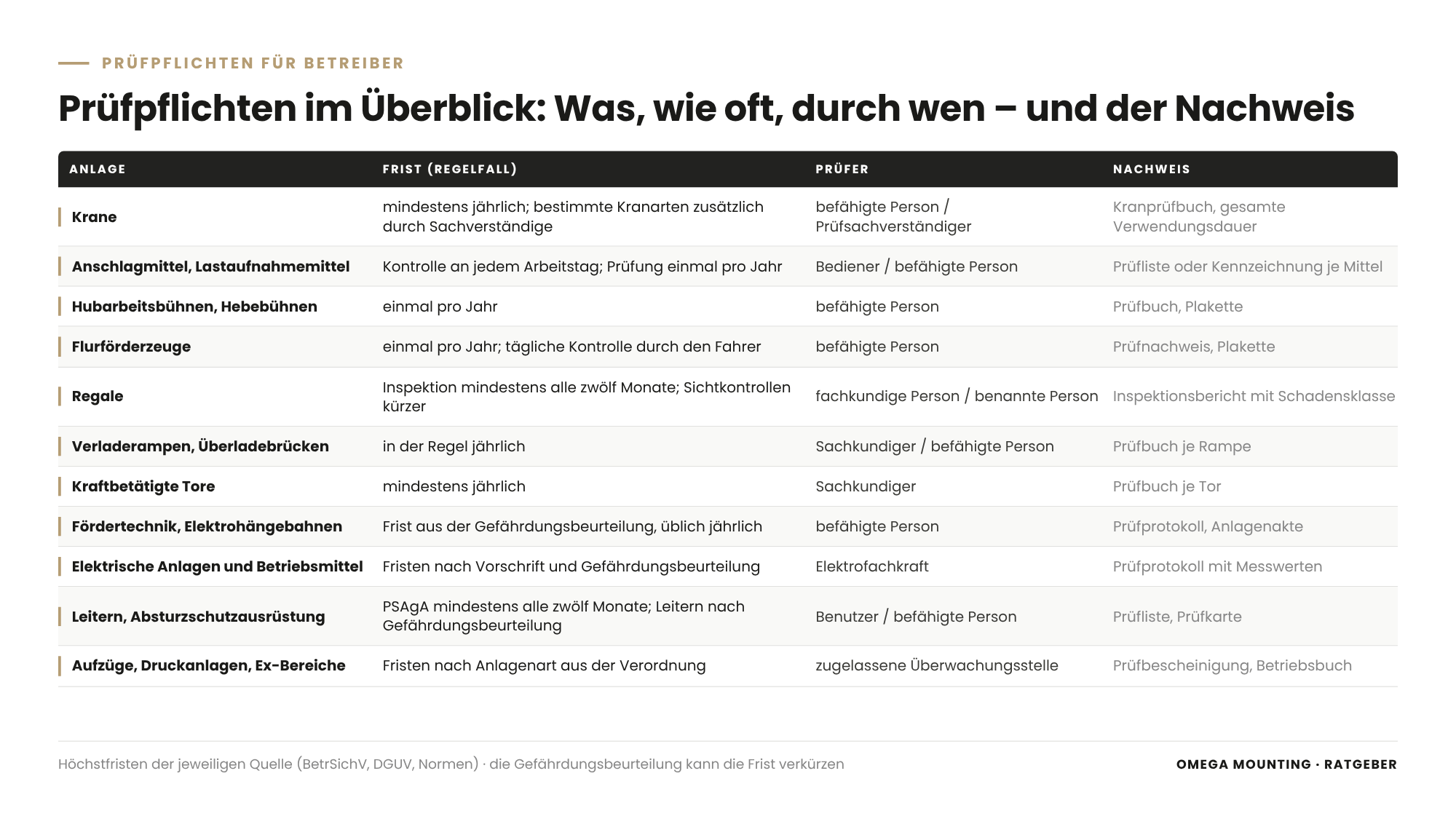
For most plant in industry and logistics, a periodic inspection at least once a year by a competent person applies. The interval in the individual case is set by your risk assessment. For cranes, lifts and pressure equipment, inspections by authorised experts or inspection bodies are added. The table gives the maximum intervals from the respective source; the sources are listed in the chapter on legal bases.
| Machine. | Type of inspection. | Interval (standard case). | Inspector. | Evidence. |
|---|---|---|---|---|
| Cranes (overhead crane, gantry crane, pillar jib crane, crane runway). | Inspection before first use and after installation. Periodic inspection. After substantial modifications. | At least annually. Certain types of crane additionally at longer intervals by an authorised expert. | Qualified person or competent person. Authorised expert for certain cranes. | Crane inspection logbook, kept for the entire service life. |
| Lifting accessories, load-handling attachments (round slings, chains, spreader beams). | Check before every use. Periodic inspection. | Check on every working day. Inspection once a year. | Operator (check). Competent person. | Inspection list or marking for each item. Record kept until the next inspection. |
| MEWPs, lifting platforms. | Periodic inspection. Visual check before use. | Once a year. | Competent person. | Inspection logbook, sticker on the platform. |
| Industrial trucks (forklifts, pallet trucks). | Periodic inspection. Daily check by the driver. | Once a year. | Competent person. | Inspection record, sticker. |
| Racking (pallet racking, shelving, cantilever racking). | Expert inspection. Regular visual checks. | Inspection at least every twelve months. Visual checks at shorter intervals defined by the company. | Qualified person (inspection). Nominated person in the company (visual check). | Inspection report with damage class, inspection sticker on the racking. |
| Loading docks, dock levellers. | Periodic inspection. Visual check. | Usually annually. | Qualified person or competent person. | Inspection logbook per dock. |
| Power-operated doors (sectional doors, high-speed doors). | Periodic inspection. | At least annually. | Qualified person. | Inspection logbook per door. |
| Conveyor technology, overhead conveyors, continuous conveyors. | Periodic inspection according to risk assessment. | Interval from the risk assessment, usually annual. Maintenance intervals as per manufacturer. | Competent person. | Inspection report, plant file. |
| Electrical installations and equipment. | Periodic inspection of fixed installations and portable equipment. | Intervals according to regulation and risk assessment, depending on operating conditions. | Qualified electrician. | Inspection report, measured values. |
| Ladders, step stools, fall protection equipment. | Visual check before every use. Periodic inspection. | Fall protection equipment at least every twelve months. Ladders according to risk assessment. | User. Competent person or qualified person. | Inspection list, inspection card, marking. |
| Lifts, pressure equipment, plant in potentially explosive atmospheres. | Inspection before commissioning. Periodic inspection as plant requiring monitoring. | Intervals by type of plant from the ordinance. | Approved inspection body, in some cases competent person. | Inspection certificate, operating logbook. |
Two things stand out. First: "at least annually" is the most frequent answer. That is why most inspection duties can be mapped onto an annual calendar. Second: the table gives the standard case. Where plant runs in multi-shift operation, in damp, dusty or cold conditions, the risk assessment shortens the interval.
What is not in the table
Standby power systems, air-conditioning units or hydraulic power units have no uniform statutory interval. Here, manufacturer specifications and the risk assessment set the framework. Test run, function test and electrical inspection belong in the maintenance schedule. How to reflect this contractually is shown in our guide on the maintenance contract for industrial maintenance.
Who may inspect – competent person, qualified person, authorised expert or inspection body?
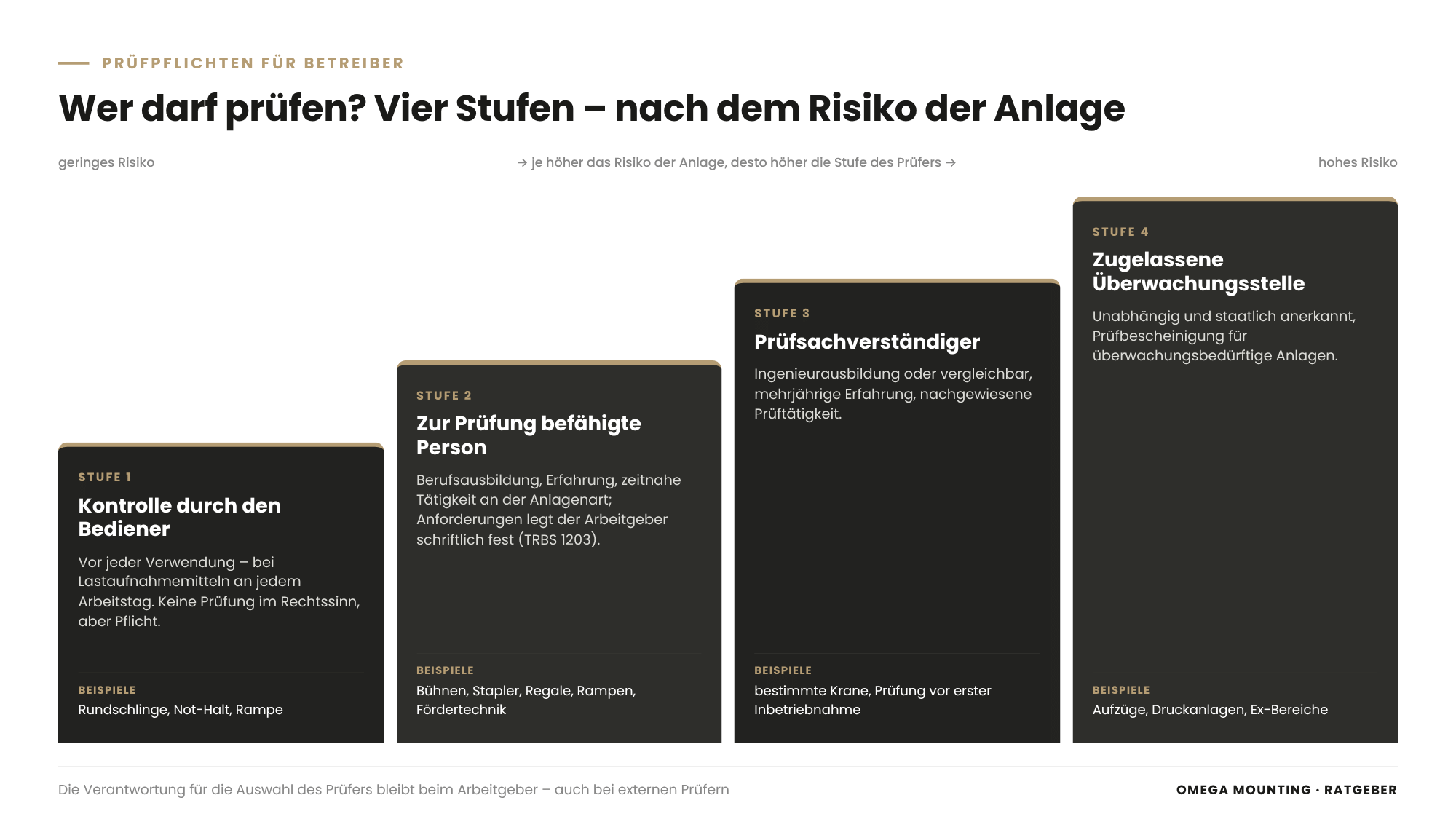
Who may inspect depends on the risk of the plant. For most work equipment, a competent person is sufficient. Certain cranes require an authorised expert; plant requiring monitoring, such as lifts and pressure equipment, requires an approved inspection body. The daily check before use is the operator's job.
Level 1: the check by the operator
Before every use, the operator takes a look: are round sling and chain undamaged, does the emergency stop work, is the dock showing hydraulic leaks? This is not an inspection in the legal sense, but it is an obligation – for lifting accessories expressly on every working day. It catches what happens between two inspections.
Level 2: the competent person
The competent person (zur Prüfung befähigte Person) is the central figure of the BetrSichV. This is someone with relevant vocational training, professional experience and recent activity with the type of plant, who carries out and evaluates the inspection independently. "Sachkundiger" (qualified person) in the older accident-prevention regulations essentially means the same thing. The German technical rule TRBS 1203 requires you as the employer to define the requirements for this person in writing. The responsibility for the selection stays with you, even if the inspector comes from outside. For you this means: ask to see your inspector's qualifications and file them with the plant records.
Whether the competent person comes from your own company or from outside is legally equivalent. In practice, external inspection has the advantage of judging independently of production pressure. Moreover, the qualifications for cranes, platforms, racking and docks are rarely combined in one person.
Level 3: the authorised expert
For certain cranes and for inspections before first use, the regulations require an authorised expert (Sachverständiger). This person has an engineering degree or comparable qualification, several years of experience and proven inspection activity. Which cranes this applies to is set out in the accident-prevention regulation for cranes.
Level 4: the approved inspection body
Lifts, pressure equipment and plant in potentially explosive atmospheres are plant requiring monitoring. Here an approved inspection body (zugelassene Überwachungsstelle, ZÜS) inspects – independent, state-recognised, with an inspection certificate. In most companies this concerns the goods lift and the compressed-air receiver.
What types of inspection are there – and when are they due?
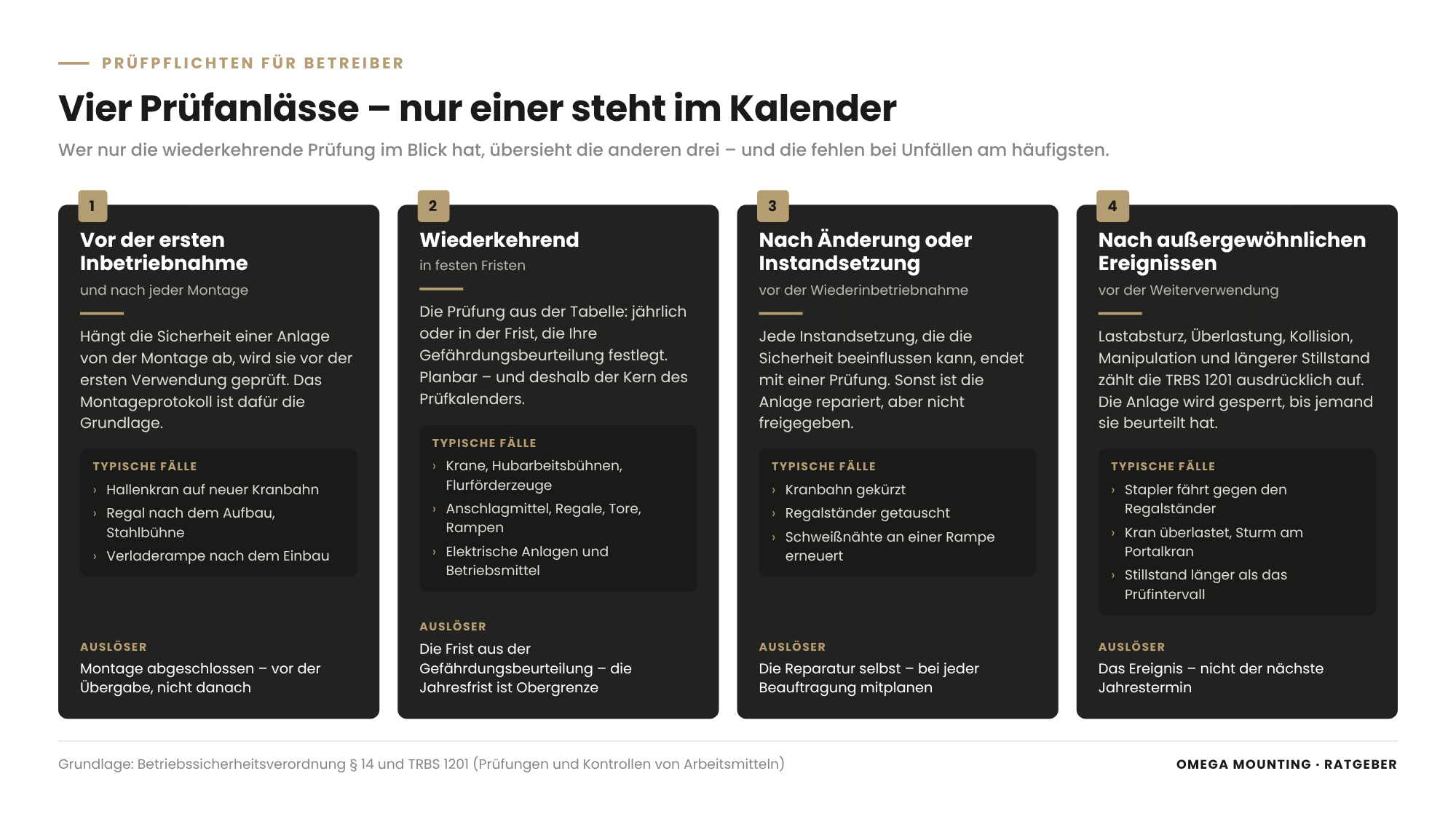
The BetrSichV recognises four inspection triggers: the inspection before first use or after installation, the periodic inspection at defined intervals, the inspection after modifications and repairs, and the inspection after exceptional events. Anyone who only has the periodic inspection in the calendar overlooks the other three.
Before first use and after installation
Plant whose safety depends on its installation is inspected before first use. Examples: an overhead crane on a new crane runway, racking after erection, a steel platform, a loading dock after fitting. In the installation of a crane runway for an overhead crane that was precisely the final step: only after the survey by the plant's own maintenance department was the crane placed on the runway. The installation contractor supplies the installation report with levelling, diagonal measurements and anchoring. The inspection before first use confirms that the plant may be operated in this condition.
Periodic at fixed intervals
The periodic inspection is the one from the table: annually or at the interval from your risk assessment. It can be planned – and is therefore the core of the inspection calendar.
After modifications and repairs
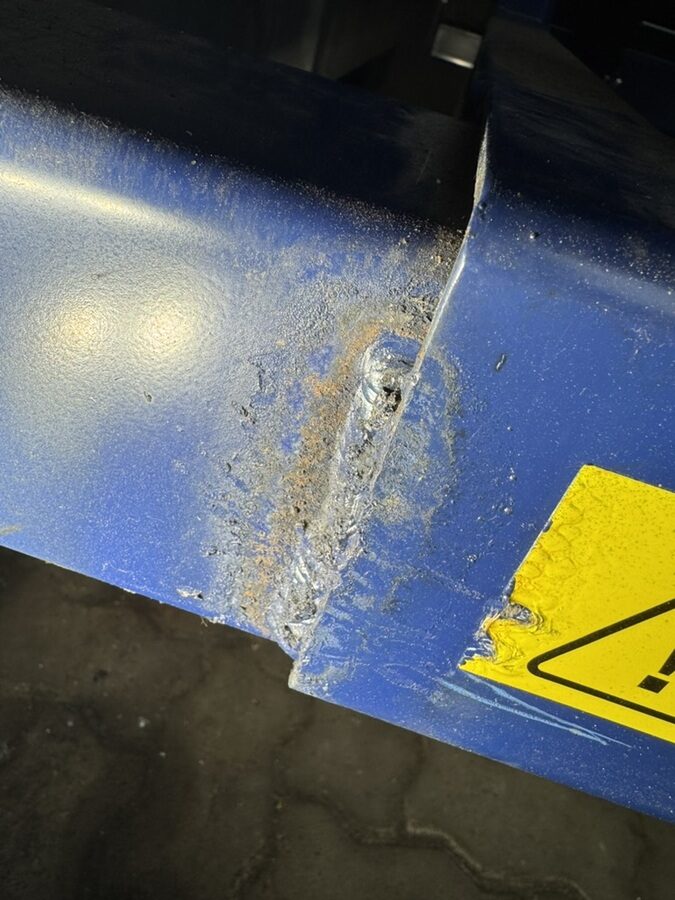
Anyone who modifies a plant – shortens a crane runway, replaces a racking upright, renews welds on a dock – inspects it before it goes back into service. This applies to every repair that could affect safety. Plan this inspection with every repair. Otherwise the plant is repaired but not released.
After exceptional events
A forklift hits a racking upright, a crane is overloaded, a storm hits the outdoor gantry crane, a plant has stood idle for longer than its inspection interval. Each of these events triggers an inspection before further use. The German technical rule TRBS 1201 (inspections and checks of work equipment) expressly lists load drop, overloading, collision, tampering and extended downtime. For you this means: a racking that has been hit is taken out of service until someone has assessed it – not just at the annual date. The same applies to lifting accessories after any overloading. What to watch out for is described in our guide on lifting accessories for heavy loads.
How do you set inspection intervals – and may you extend them?
You set inspection intervals in the risk assessment for each item of work equipment, starting from the maximum intervals in the regulations and standards and the actual operating conditions. You may always shorten them. You may only extend them if the risk assessment justifies it and no maximum interval stands in the way. The annual interval is therefore the upper limit, not the standard.
Four factors shorten the interval:
- Loading: Multi-shift operation, high cycle rates, load cycles at the limit of the rated capacity.
- Environment: Damp, cold, dust, aggressive media, outdoor use.
- Past findings: Anyone who had defects at the last inspection inspects again sooner. The inspection rule expressly names a shortened interval as a consequence of defects without immediate hazard.
- Age and history: Plant without a complete inspection history starts with short intervals until the findings justify confidence.
Aligning inspection and maintenance
Place the inspection at the end of the maintenance interval: first replace and adjust wear parts, then inspect. Otherwise the inspection documents defects that would have been rectified three weeks later anyway. Anyone who bundles inspection and maintenance with one partner records in the contract that the inspection is a separate service with its own record.
What happens if the inspection finds a defect?
If the inspection finds a defect that endangers safety, the plant may not be used until it has been repaired and re-inspected. Defects without immediate hazard must be rectified within a deadline. Until then, the inspection interval can be shortened or use restricted. The ban on use in the event of a hazard is laid down in the BetrSichV. It is not a recommendation by the inspector but your obligation as the operator.
In practice it looks like the loading dock at a logistics service provider: the annual inspection classifies the welds as defective, the loading bay is closed, every truck has to be redirected. The closure is correct – it only becomes expensive without preparation for the repair.
The three steps after the finding
- Classify: Which defect creates an immediate hazard, which does not? The inspection report should state this. Racking inspections work with damage classes, crane inspectors with defect categories. If the classification is missing, ask for it.
- Lock out or restrict: Defect with hazard – lock out, label, secure against use. Defect without hazard – set a deadline, reduce operating limits, enter the date.
- Repair and re-inspect: The repair is carried out by a specialist contractor who knows the type of plant. The competent person then inspects again and lifts the lock-out. How to get from the defect list to release is described in our guide on rectifying UVV defects step by step.
Two traps are typical. First, continuing to operate "until the technician arrives": anyone who uses a locked-out crane acts without insurance cover and with personal liability. Second, repair without re-inspection: the crack is gone, the door is opened, but nobody has assessed and recorded the repair. Which other mistakes are typical of do-it-yourself repairs is shown in our guide on the mistakes in in-house maintenance.
How do you prove inspections – inspection record, sticker, logbook?
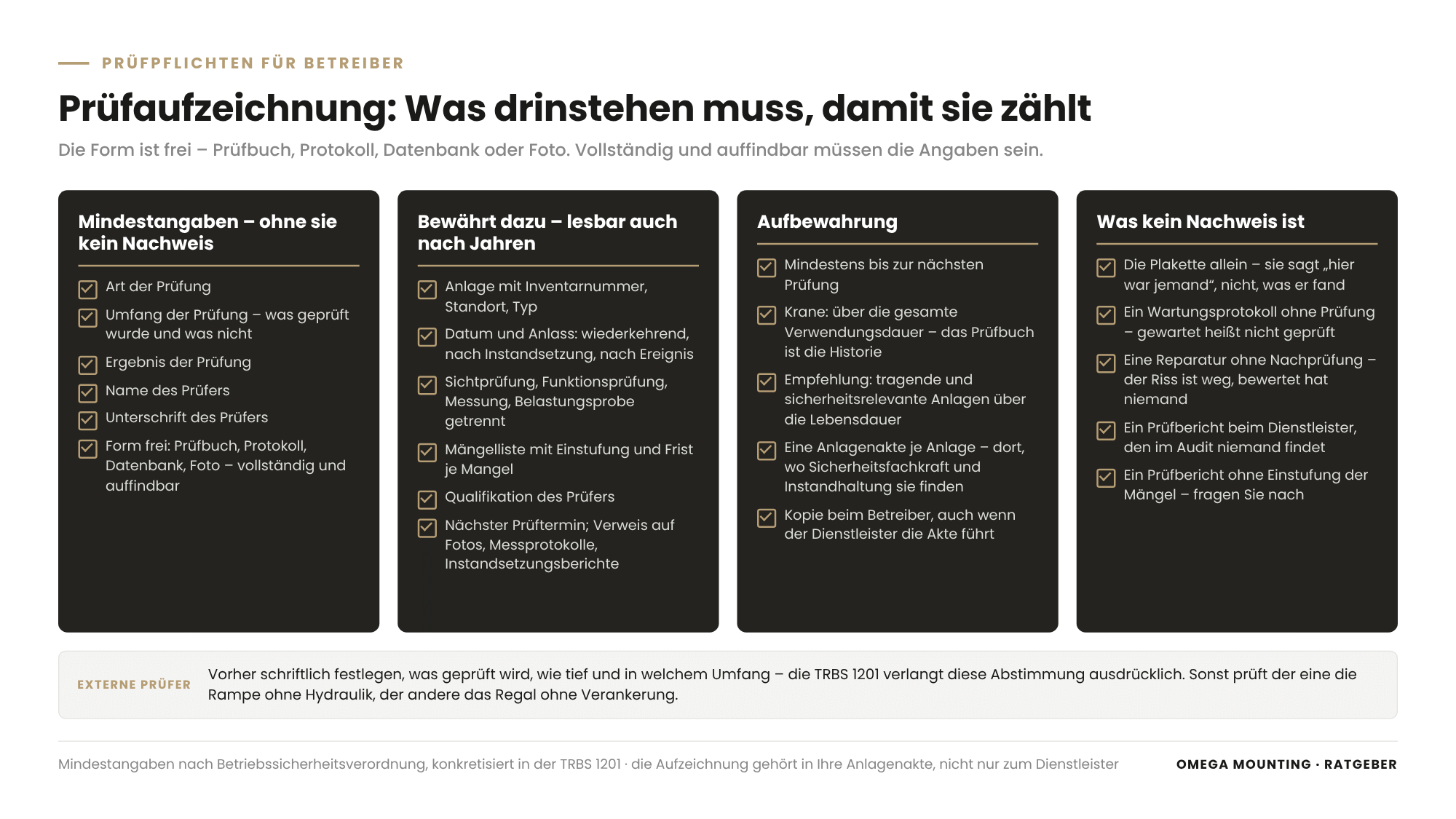
An inspection is only proven by an inspection record that contains at least the type and scope of the inspection, the result, and the name and signature of the inspector. It is kept at least until the next inspection. The sticker on the plant only proves that an inspection took place, not that the plant is free of defects. These are the minimum requirements of the BetrSichV, specified in the inspection rule. The form is up to you: logbook, report, database, photo. Anything is permissible as long as the details are complete and can be found.
What belongs in a usable inspection record
Beyond the minimum details, this content has proven useful:
- Plant with unique identification (inventory number, location, type).
- Date and trigger of the inspection (periodic, after repair, after event).
- Type and scope: visual inspection, function test, measurement, load test – what was inspected and what was not.
- Result with defect list, classification of each defect and deadline.
- Inspector with name, qualification and signature.
- Next inspection date and reference to photos, measurement reports, repair reports.
Retention: until the next inspection – or longer
The ordinance requires retention at least until the next inspection. For cranes, the entire service life applies, because the crane inspection logbook is the history of the plant. We recommend this for all load-bearing and safety-relevant plant. During a repair you want to know what was there before. In the event of damage, the question is not "When was the last inspection?" but "Had the defect been found before?". How to keep inspection and maintenance records so that they stand up in an audit is described in our guide on maintenance documentation for audits.
The sticker is not evidence
An inspection sticker on the forklift or the platform says: someone was here. It does not say what they found. At changing locations – MEWP on the construction site, lifting accessories at the customer's – it at least shows the site manager that the work equipment is within its interval. The record must then be available at the company or as a copy. What a site manager should demand of a rented platform is set out in our guide on installation work with a MEWP.
External inspectors: agree in advance
If the inspector comes from outside, define in writing beforehand what they inspect, how deeply and to what extent. The inspection rule expressly requires this agreement. Otherwise one inspects the dock without the hydraulics, the other the racking without the anchoring.
How do you organise inspection duties in the company – the inspection calendar?
You organise inspection duties with a plant register that names, for each item of plant, the type of inspection, interval, inspector, next date and filing location of the evidence. Added to this are a nominated person who keeps the calendar, and a lead time before each date in which maintenance, spare parts and maintenance windows are planned. Without register, responsible person and lead time, inspections end up with whoever happens to think of them. Four steps lead to the inspection calendar:
- Record all plant – on the shop floor, not in the accounts. The controlling department's asset list knows the overhead crane but not the lifting accessories in the cabinet or the racking in the side store.
- Assign type of inspection, interval and inspector to each item of plant – using the table in this article and your risk assessment. For plant without a statutory interval, the manufacturer's interval and test run apply.
- Nominate a responsible person and plan lead time – usually the maintenance manager. They receive the inspection reports, enter defects and deadlines and trigger the repair. Before each date, maintenance, spare parts and maintenance windows are coordinated. Which maintenance strategy lies behind this – reactive, preventive or condition-based – is described in our introductory guide on maintenance strategy.
- Collect evidence in one place – inspection reports, installation reports, repair reports and photos in one plant file per item. Digital or on paper, but where the safety officer, maintenance manager and management can find them. Anyone who leaves inspection records with the service provider does not have them in the audit.
Operator inspection duties: legal bases for reference
The most important legal bases for operators' inspection duties in Germany are the Betriebssicherheitsverordnung (BetrSichV) with its technical rules, the regulations and rules of the statutory accident insurance (DGUV), the workplace rules (ASR) and – for racking – the European racking standard. This chapter is a reference section.
- Betriebssicherheitsverordnung (BetrSichV, Industrial Safety Ordinance): Risk assessment with type, scope and intervals of inspections. Ban on use for defects with hazard. Inspection triggers, records, retention. Plant requiring monitoring.
- TRBS 1201 (inspections and checks) and TRBS 1203 (competent persons): Maximum intervals, daily check of lifting accessories, exceptional events, handling of defects, minimum content of the inspection record. Requirements for competent persons and authorised experts.
- DGUV Regulations 52 (cranes), 68 (industrial trucks) and 3 (electrical installations): annual inspection by qualified persons or a qualified electrician. Certain cranes by authorised experts. Crane inspection logbook.
- DGUV rules on work equipment and fall arrest PPE: Lifting accessories, continuous conveyors. Fall protection equipment at least every twelve months.
- ASR A1.7 (doors and gates): power-operated doors at least annually.
- DIN EN 15635 (static steel storage systems): Expert inspection at least every twelve months, visual checks, damage classes.
You should no longer cite repealed rules from old inspection reports.
How we do it in the Rhine-Main region
In the Rhine-Main region, at companies in Frankfurt, Offenbach, Hanau, Darmstadt and Aschaffenburg, we almost always find the same starting point: the inspections exist, but they are scattered. The forklift rental company inspects the forklifts, the qualified electrician the equipment, a racking inspector the racking. For crane, crane runway, dock and conveyor technology it is unclear who was last there. Our contribution is above all what comes before and after the inspection: rectifying the findings, maintenance before the date, the installation after which an inspection is required, and the re-manufacture of parts.
Specifically: we repair crane runways, racking, loading docks, overhead conveyors and conveyor technology so that the re-inspection passes at the first attempt. We agree with your inspector which repair they want to see and supply reports for your plant file. For the types of plant we maintain, we can also organise the inspection by competent persons on request – more on our page on maintenance and servicing of industrial plant. From Rodgau, the distances are short enough to turn an inspection finding in Frankfurt or Hanau into a repair within a few days.
How we do it in practice
Three jobs from our project diary show the finding with lock-out, the repair after years of neglect, and the inspection after installation.
Finding, lock-out, repair, re-inspection: loading dock at a logistics service provider
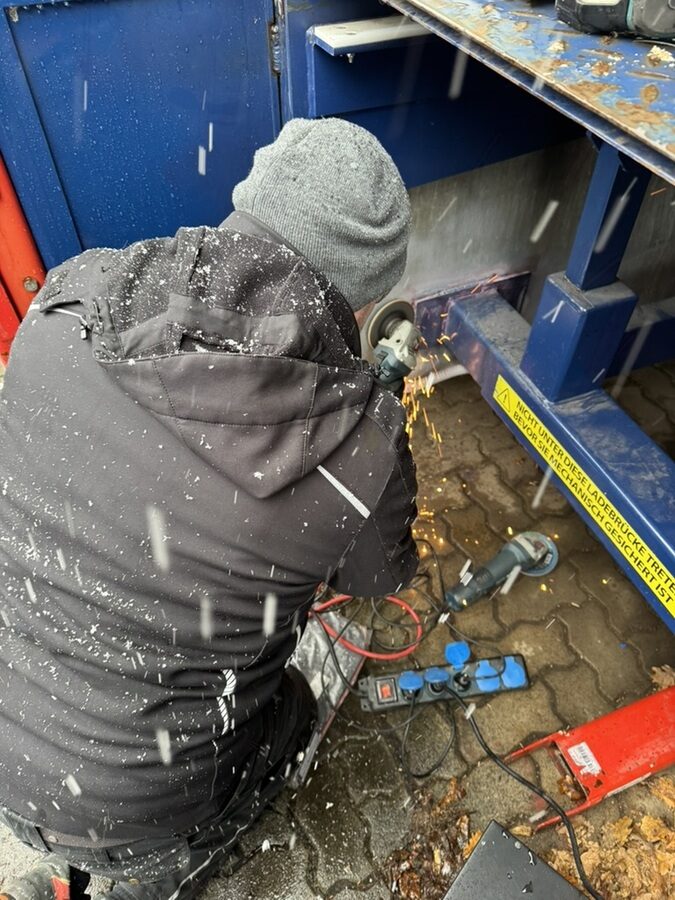
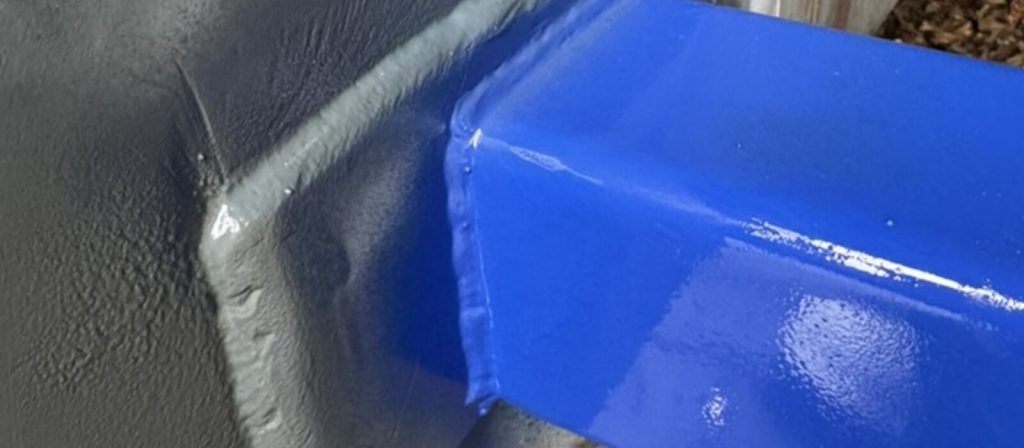
At a logistics service provider, a loading dock had failed the annual accident-prevention (UVV) inspection: the welds on the bracket had been classified as defective, and the entire loading bay was closed. Two fitters repaired the dock in a single working day – in snowfall. The cracked welds were completely ground out with an angle grinder, the bracket re-welded using the MAG process with deep penetration, then primed and painted. An industrial heater kept the base material warm so that the weld would not become brittle. The cause was not an installation error but fatigue: forklift crossings, docking impacts and folding movements generate load cycles that crack weak welds. The case shows both sides of the inspection duty. The inspection found the crack before the bracket failed – and the closure only ended with the re-inspection. What regularly wears on docks can be read in our guide on maintenance of loading ramps.
Defect list after twenty years without maintenance: racking repair in Fulda
With the Racking Repair in Fulda a defect list from an inspection was already on the table. The inspection showed that the operator had not carried out any proper maintenance for two decades. Damaged uprights and beams were replaced, the bracing renewed, the installation cleaned of years of deposits and retrofitted with sensors for monitoring. The job ran during ongoing operations. Individual racking aisles were closed and emptied, the team worked with a lifting platform, and after two days everything was completed. The subsequent racking inspection certified the operator one year until the next inspection. The case shows what an inspection gap costs: not the inspection, but the accumulated findings. Which damage classes racking inspectors assign is explained in our guide on racking inspection.
Inspection after installation: crane runway for an overhead crane
With the installation of a crane runway for an overhead crane we supported the plant's in-house maintenance team with the erection: the crane runway was shortened, new end stops and support blocks welded on. Because a crane runway allows hardly any tolerance despite its dimensions, all posts were positioned, the diagonal measurements checked and the columns levelled to the same height with a rotating laser. The base plates were set with chemical anchors and grouted, the crane runway welded to the steel beam. Only after the survey by the maintenance department was the crane placed on the runway. This survey is the basis of the inspection before first use – and the installation report is the first entry in the crane inspection logbook.
Do you have an inspection finding on your desk, a plant without inspection history or an installation after which an inspection is required – in Frankfurt, Offenbach, Darmstadt or elsewhere in the Rhine-Main region? Then get in touch with us. A site visit usually clarifies within an hour which findings need to be dealt with immediately, by a deadline or with the next maintenance.
What this means for your role
For buyers: In contracts, separate the inspection from the maintenance – as a separate item with its own record. Require every service provider who inspects to provide proof of the competent person's qualifications and a sample report. For rented work equipment, the inspection duty belongs in the rental contract, with a copy of the record to you. Award repairs following inspection findings with the re-inspection as part of the scope.
For designers: Design plant so that it can be inspected: access to crane runways and trolleys, space for the MEWP at the racking, inspection openings on conveyor technology, anchor points for the inspector. Define which inspection before first use is required and who commissions it. For cranes, racking and platforms, it belongs in the construction schedule before handover.
For project managers and site managers: As a project manager, hand over every installed plant with an installation report and inspection before first use – not with the promise that the inspection "is still to come". As a site manager, check on site that rented cranes, platforms and lifting accessories are within their interval. Ask to see sticker and record, and take work equipment without evidence out of service before the first lift begins.
For maintenance managers: You keep the inspection calendar. Record all plant, assign type of inspection, interval and inspector, and collect the records in the plant file. Make sure that the inspection is triggered after every repair and every event – not just at the annual date.
For safety officers and HSE coordinators: Check the risk assessments to see whether type of inspection, interval and competent person are named and defined in writing for each item of work equipment. Spot-check whether defects from inspection reports have a deadline and a completion note – this gap is the most frequent finding in audits.
For warehouse and logistics managers: Racking, docks, doors and forklifts are your plant, and they are the ones hit most often. Set up the visual check as a fixed walk-round with a reporting path. Take damaged racking bays and docks out of service immediately, not at the next inspection date.
Inspection calendar template on request
The inspection calendar template consists of one page per item of plant with type of plant, type of inspection, interval, inspector, inspection trigger, next date and filing location of the evidence. Added to this is an overview page for the annual calendar, in which all plant with dates and lead times is set out side by side. It helps maintenance managers build the plant register and managing directors keep track of whether the company is within its intervals. Request the template via our Contact form – keyword "inspection calendar".
Why Omega Mounting?
We are based in Rodgau near Frankfurt and repair plant that attracts attention during inspections: loading docks, racking, crane runways, overhead conveyors, conveyor technology. We install plant so that the inspection before first use passes at the first attempt. The linked jobs show this: the dock that was ready for re-inspection after one working day, the racking that was given a one-year inspection interval after two days, the crane runway whose survey was the basis for acceptance. Parts without which a defect cannot be rectified, we re-manufacture in our workshop in Rodgau. With us you get a single point of contact for repair, maintenance, installation and coordination with your inspector. Plus short distances in the Rhine-Main region and a 24-hour hotline when a lock-out cannot wait until Monday.
Conclusion
Operator inspection duties – it sounds like legal paragraphs, but it is manageable as soon as everything is in one place: a table of which plant is inspected how often by whom, a calendar with lead time and a plant file with the records. All four inspection triggers belong in this calendar, not just the annual date. A defect with hazard means lock-out until re-inspection. Evidence is only a record with type, scope, result and signature. Send us your plant register, the latest inspection reports and your maintenance windows. We will get back to you with an honest assessment of which findings should be dealt with and when.
Further reading: For two types of plant we go deeper: Crane systems – maintenance, inspection and replacement and Retrofitting safety devices on older machines.
Planning maintenance, moving in or installation in the Rhine-Main region?
Tell us briefly what it is about – we will come back to you with an honest assessment.
100% free and without obligation
You may also be interested in these guides
Occupational safety
Maintenance & Servicing

About the author
Tobias Schott
Managing director of Omega Mounting GmbH, Rodgau · more than 20 years of hands-on experience in installation and maintenance
A trained mechatronics technician, at home in maintenance, servicing and industrial installation since 2004 – first at his father's side, since 2012 with Omega Mounting: from the overhead conveyor in Frankfurt to the crane system in a new-build hall. Plans and leads lifting operations as appointed person in data centers and on industrial sites in the Rhine-Main region, is an instructor and examiner for cranes, mobile elevating work platforms and telehandlers, and a safety officer. On jobs abroad he is known as the “German Troubleshooter” – the one you call when things get stuck on site. He learned what quality means not from a manual but from his father: Made in Germany as a standard for his own work, not as a label. That is why it comes first at Omega Mounting – before speed and before price. He writes these guides from that practice: what works on our sites is in them – what only exists in the standard is not.
Frequently asked questions
In the risk assessment, the operator must specify for every item of work equipment which inspections are carried out at what interval and by whom. The operator must have these inspections carried out and record the results. Inspection triggers are first use, periodic intervals, modifications and repairs, and exceptional events. For plant requiring monitoring, such as lifts and pressure equipment, inspections by an approved inspection body are added.
Cranes, industrial trucks and MEWPs are inspected as a rule at least once a year by a competent person. Racking receives an expert inspection at least every twelve months in accordance with the racking standard, with regular visual checks in between. The annual interval is the upper limit. With heavy loading, harsh environments or defects in the past, the risk assessment shortens the interval.
The competent person (zur Prüfung befähigte Person) is the BetrSichV's term for someone with vocational training, professional experience and recent activity with the type of plant. "Sachkundiger" (qualified person) is the older term of the accident-prevention regulations for essentially the same thing. An authorised expert (Sachverständiger) has a higher qualification – an engineering degree or comparable, several years of experience, proven inspection activity. They are required for certain cranes and inspections before first use. Plant requiring monitoring is inspected by an approved inspection body.
Defects with hazard mean a ban on use: lock out, label, repair, re-inspect, then release. Defects without immediate hazard receive a deadline by which the repair must be completed. Until then, the inspection interval can be shortened or use restricted. Every defect needs a completion note in the plant file – and every safety-relevant repair needs a re-inspection before the plant runs again.
At least the type and scope of the inspection, the result, and the name and signature of the inspector. In addition, plant, date, trigger, defect list with classification and deadline, and the next inspection date have proven useful. Records are kept at least until the next inspection, for cranes over the entire service life. For load-bearing and safety-relevant plant we recommend retention over the entire lifetime. The sticker alone is not evidence.
The BetrSichV applies to every item of work equipment in every industry. In data centers, food plants and security areas, operator requirements on access, approvals and documentation are added, which supplement the statutory duty but do not replace it. An overhead crane in a bakery, a lifting accessory in a data center and a loading dock at an airport are subject to the same interval as everywhere else. Only the organisation around it is more demanding.
From Rodgau, Omega Mounting repairs plant in Frankfurt, Offenbach, Hanau, Darmstadt, Aschaffenburg and the entire Rhine-Main region that has attracted attention during inspections: loading docks, racking, crane runways, overhead conveyors and conveyor technology. We coordinate the repair with your inspector and supply reports for the plant file. For plant we maintain, we can also organise the inspection by competent persons.
Via a short enquiry with three details: your plant register or a list of plant with locations, the latest inspection reports with open defects, and your possible maintenance windows. We arrange a site visit and assign type of inspection, interval and inspector to each item of plant. You receive a written assessment of which findings should be dealt with immediately, by a deadline or with the next maintenance – with a proposal for the inspection calendar. Your contact is Tobias Schott – reachable via our Contact form.
 English
 German