
- Guide – Maintenance & Servicing
Maintenance strategy: why run-to-failure is more expensive in the end
By Tobias Schott · Reading time approx. 24 minutes · Last updated: October 2026
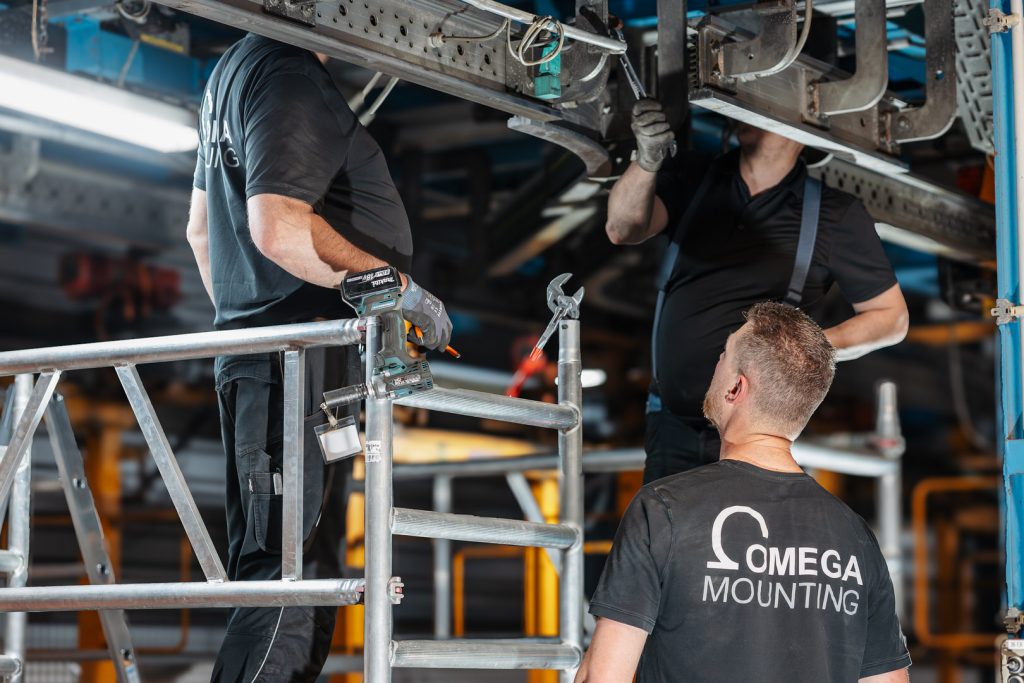
Those who deliberately run plants to failure save on maintenance and pay for it with downtime, consequential damage and rush procurement – a maintenance strategy defines per plant where that is acceptable and where it is not.
Most companies do not have a bad maintenance strategy. They have none at all – they have a maintenance crew that reliably repairs whatever has just failed. That works for years. It works until, one Sunday evening, the standby generator does not start, until an overhead conveyor squeaks so badly that production keeps stopping, or until around 100 switches of a conveyor system are so worn at the same time that no shift is long enough to repair them.
The problem is not the repair. The problem is that nobody has decided which plant may run to failure and which may not. Run-to-failure – deliberately operating until failure – is a legitimate strategy for plant whose failure costs nothing but the spare part. For everything else, it is not a strategy but the absence of one.
This guide explains which maintenance strategies exist, why reactive maintenance on critical plant ends up costing more than planned maintenance, how to find the right strategy for each plant and how to introduce it without disrupting production. The examples come from our jobs in the Rhine-Main region. We name costs by type, not in figures; the calculation method is provided by the companion article on downtime costs.
Key points at a glance
- A maintenance strategy defines for each plant whether it is maintained reactively, preventively at fixed intervals, condition-based according to findings or predictively according to measurement data.
- Run-to-failure is only right where a failure affects neither production nor safety and the spare part arrives faster than the damage grows.
- Reactive maintenance on critical plant costs more than the repair: it costs downtime, consequential damage to neighbouring components, rush procurement, weekend surcharges and work under time pressure.
- According to DIN 31051, maintenance consists of servicing, inspection, repair and improvement – a strategy says which of these basic measures takes place when and by whom.
- The German technical rule TRBS 1112 requires the operator to define type, scope and intervals of maintenance in the risk assessment – a strategy is therefore also evidence.
- The route from reactive to planned begins with an assessment of the actual condition and a prioritisation by failure consequence, not with a software project.
- In practice, the right answer is almost always a mixed model: a few critical plants planned, many non-critical ones reactive – with a partner who masters both.
What is a maintenance strategy?
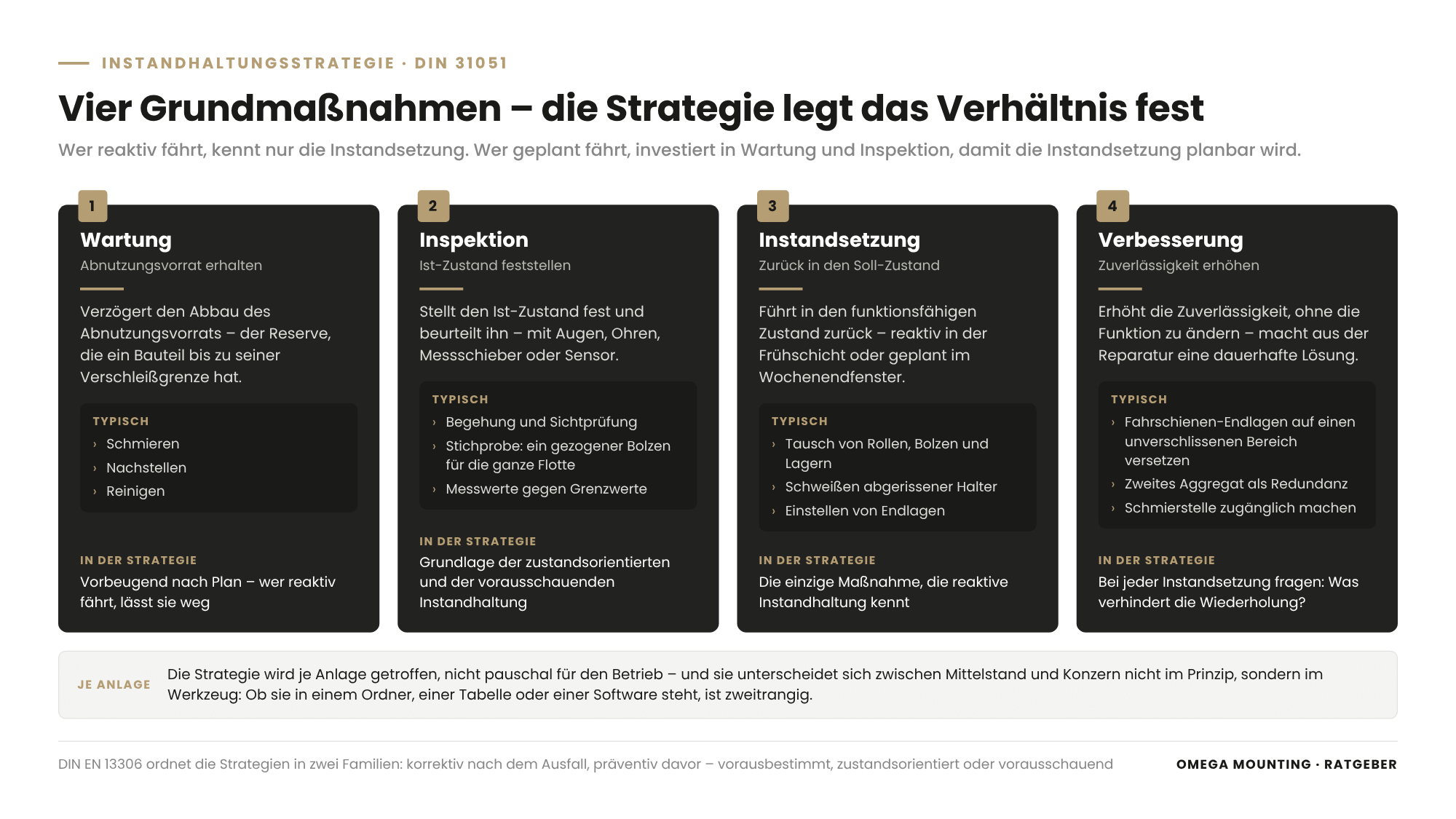
A maintenance strategy is the deliberate definition of the principle by which a plant is maintained: reactively after failure, preventively at fixed intervals, condition-based according to findings or predictively according to measurement data. It is decided for each plant, not across the board for the whole company.
The terms for this are provided by DIN 31051, which divides maintenance into four basic measures:
- Maintenance slows down the depletion of the wear reserve through lubricating, adjusting and cleaning. The wear reserve is the reserve a component has until its wear limit.
- Inspection establishes the actual condition and evaluates it.
- Instandsetzung (repair and overhaul) returns the plant to a functional condition.
- Improvement increases reliability without changing the function.
The strategy decides the ratio in which these four measures stand to each other. Anyone who runs reactively knows only repair. Anyone who runs planned invests in servicing and inspection so that repair becomes plannable.
The European terminology standard DIN EN 13306 classifies the strategies into two families: corrective maintenance after failure and preventive maintenance before failure. The latter is either predetermined by time or running performance, condition-based according to inspection findings or predictive according to the evaluation of measurement data. This classification is entirely sufficient for practice; you do not need more theory for the decision.
Strategy is not a question of company size
A maintenance concept for a medium-sized company differs from that of a corporation not in principle but in the tools. The question "What happens if this fails?" is the same. Whether the answer is in a folder, a spreadsheet or software is secondary.
Which maintenance strategies are there?
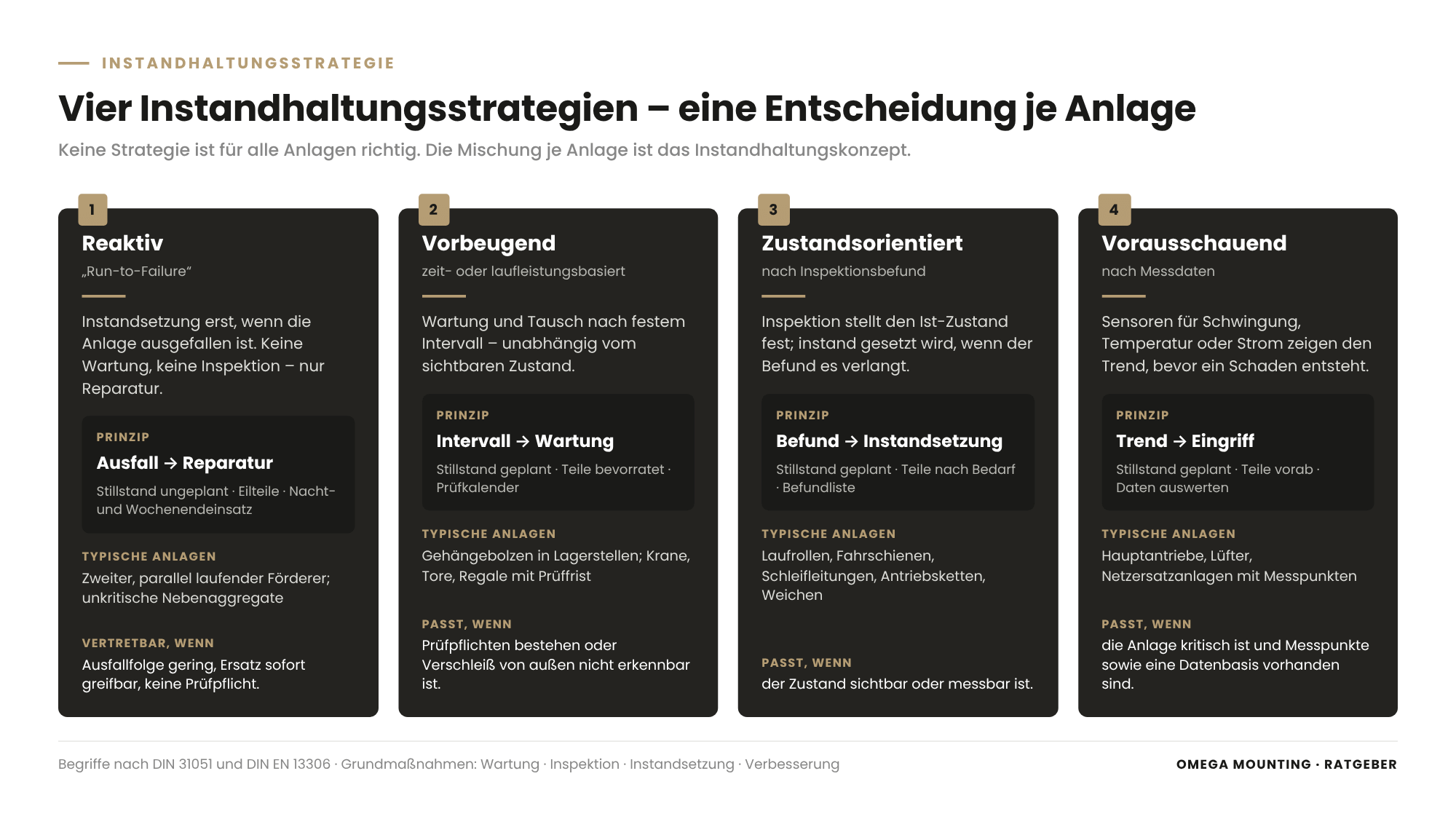
There are four basic strategies – reactive, preventive, condition-based and predictive – which differ in what triggers the intervention: the failure, the calendar, the finding or the measurement. The following overview shows what each strategy requires and where it fits.
| Strategy | Trigger for intervention | Prerequisite | Suits | Typical weakness |
|---|---|---|---|---|
| Reactive (run-to-failure) | Failure. | Spare part available, failure consequence low. | Redundant or non-critical plant, simple wear parts. | Downtime at the worst possible moment, consequential damage. |
| Preventive (time- or running-performance-based) | Calendar, operating hours, cycle count. | Maintenance schedule, known wear rates. | Plant subject to mandatory inspection, lubrication points, wear parts with known service life. | Replacement of functional parts, effort without findings. |
| Condition-based | Inspection finding. | Regular inspection, assessment by specialists, documentation. | Conveyor technology, cranes, lifting equipment, drives – anything whose condition can be recognised. | Depends on the quality of the inspection. |
| Predictive (predictive maintenance) | Measurement data and limit values. | Sensors, data basis, evaluation. | Highly available plant with measurable wear parameters. | Retrofit effort, data basis missing for older plant. |
The table already shows why no company can manage with a single strategy. The conductor rail of an overhead conveyor – the rail from which the carriers draw their power – is maintained condition-based, because wear on current collectors and contact surfaces is visible and measurable. The starter battery of a standby power system is replaced preventively, because its condition can hardly be judged from outside. And the hall light is replaced reactively, because it costs nothing if it fails.
Predictive is not automatically better
Predictive maintenance – maintenance based on sensor data – is the most demanding level, not the best. It needs a measurable parameter that announces wear early enough, and a data basis for limit values; with a conveyor system around 30 years old, both are rarely available. There, condition-based maintenance with eyes, ears and calliper is the realistic choice.
Why does run-to-failure end up more expensive?
Run-to-failure is more expensive on critical plant because the failure never costs only the defective component. It costs the downtime at an unplanned time, the consequential damage to neighbouring components, the rush procurement of spare parts and the work under time pressure outside business hours. Plus the repetition, because the cause was not eliminated.
We deliberately name these cost types here without figures. Every company has different contribution margins, different shift models and different contractual penalties; anyone wanting to insert their own values will find the calculation method in the guide on calculating downtime costs. What can be said without figures: the following items always arise with reactive maintenance, rarely with planned maintenance.
Cost type 1: the downtime comes when it wants
A planned downtime lies in the weekend window, the night window or the shift break. An unplanned one lies in the middle of the early shift or – as with our emergency call-out on a Sunday evening – shortly before the production start on Monday at four o'clock. And it begins with detecting, reporting, searching and procuring before any repair takes place; this lead time disappears with planned maintenance because material, team and releases are there beforehand.
Cost type 2: consequential damage to components that were still good
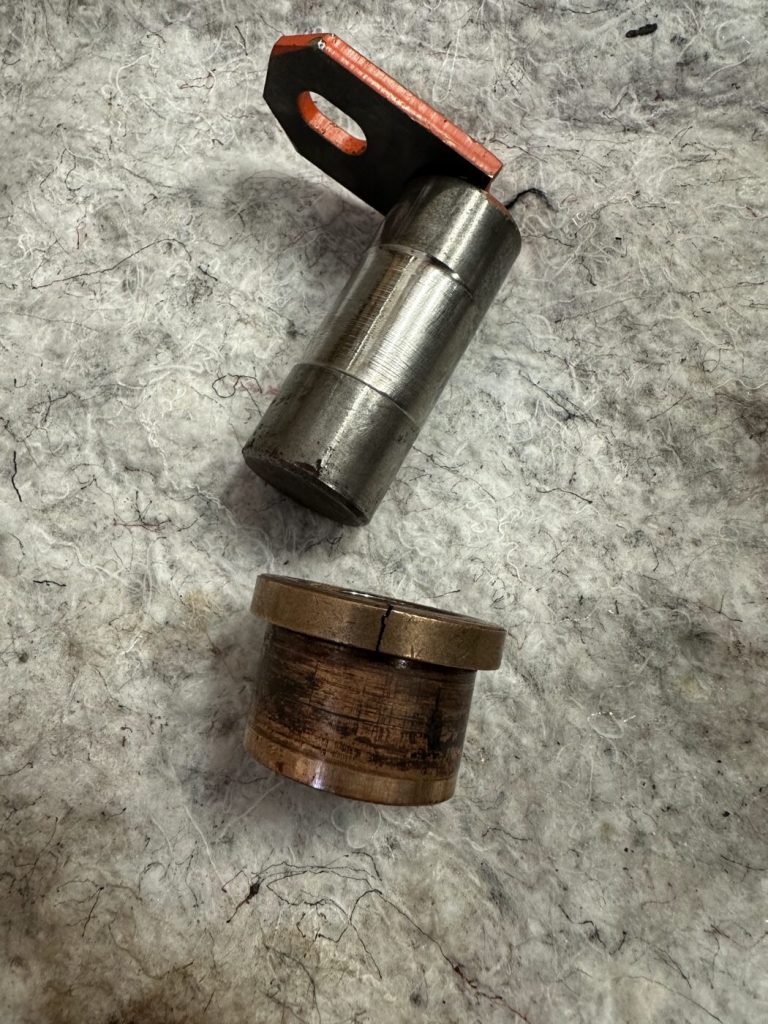
Wear does not stay with the component where it begins. At the food plant where we refurbished the carrier pins of 80 overhead conveyor carriers, the missing lubricating film had worn in the pin – and with it the bearing seat and rear bearing, which had to be replaced as a pair. In Frankfurt, the rollers had worked themselves so deeply into the running rails over the years that rail transitions no longer aligned and the carriers' current collectors, drive rollers and data contacts wore with them. A worn switch that keeps running generates wear on every carrier that passes it. Anyone who waits until it fails ends up paying for the carriers as well.
Cost type 3: rush procurement and improvisation
On a Sunday, no spare parts warehouse delivers. During the emergency call-out at the logistics company, the replacement generator delivered at short notice had a different terminal panel from the old one; nobody had the matching cable lugs and heat-shrink tubing to hand that night, not even friendly electrical contractors. The night went on a temporary supply via batteries and on phone calls and emails so that the material would be there in the morning. Planned, the same work would have taken place in one day – with terminal panel, cable cross-sections and earthing clarified beforehand.
Cost type 4: work under time pressure
Reactive repair takes place while everyone is waiting. Under this pressure, whatever restores operation is repaired – not what eliminates the cause: the squeak is greased away, the cracked bracket welded over, the limit switch bridged. Each of these makeshift solutions is the beginning of the next failure. Planned maintenance has time for root cause analysis – and therefore repairs less often.
Cost type 5: the major overhaul that nobody planned for
The most expensive consequence of reactive maintenance is the point at which the small repairs are no longer enough. With the overhead conveyor in Frankfurt, the in-house maintenance team had kept the system running for many years – but during ongoing operations there was only time for the immediately necessary; larger dismantling was not possible during production hours. So the wear accumulated until around 100 switches had to be completely overhauled in a series of weekend shutdowns. A good decision – but one that a maintenance strategy years earlier would have made much smaller.
When is reactive maintenance nevertheless right?
Reactive maintenance is right when the failure of a plant affects neither production nor safety nor inspection duties, the spare part is available and the repair succeeds without preparation – then every preventive measure is effort without benefit.
That is not an exception but a large part of every plant inventory: lighting, small drives with a spare motor on the shelf, redundant pumps, doors in secondary areas, tools. For these plants, run-to-failure is the economically correct maintenance strategy – provided someone has deliberately classified them that way and the spare part is actually on the shelf.
The three conditions for deliberate run-to-failure
- No failure consequence beyond the component: Production continues, no employee is endangered, no neighbouring component is damaged, no inspection duty is violated.
- Replacement arrives faster than the damage grows: The part is on site or available at short notice, and the replacement needs no lifting equipment, no isolation by a specialist trade, no maintenance window.
- The decision is documented: The plant list says "reactive", with justification. Then run-to-failure is a strategy – without this entry it is chance.
Redundancy can turn a plant from "critical" into "reactive acceptable": a second unit that takes over the load turns the failure of the first into a plannable replacement. That is exactly what we recommended to the logistics company after the Sunday evening job, and the company implemented it. What else to consider with standby power systems is described in our guide on the maintenance of standby generators.
How do you find the right maintenance strategy for each plant?
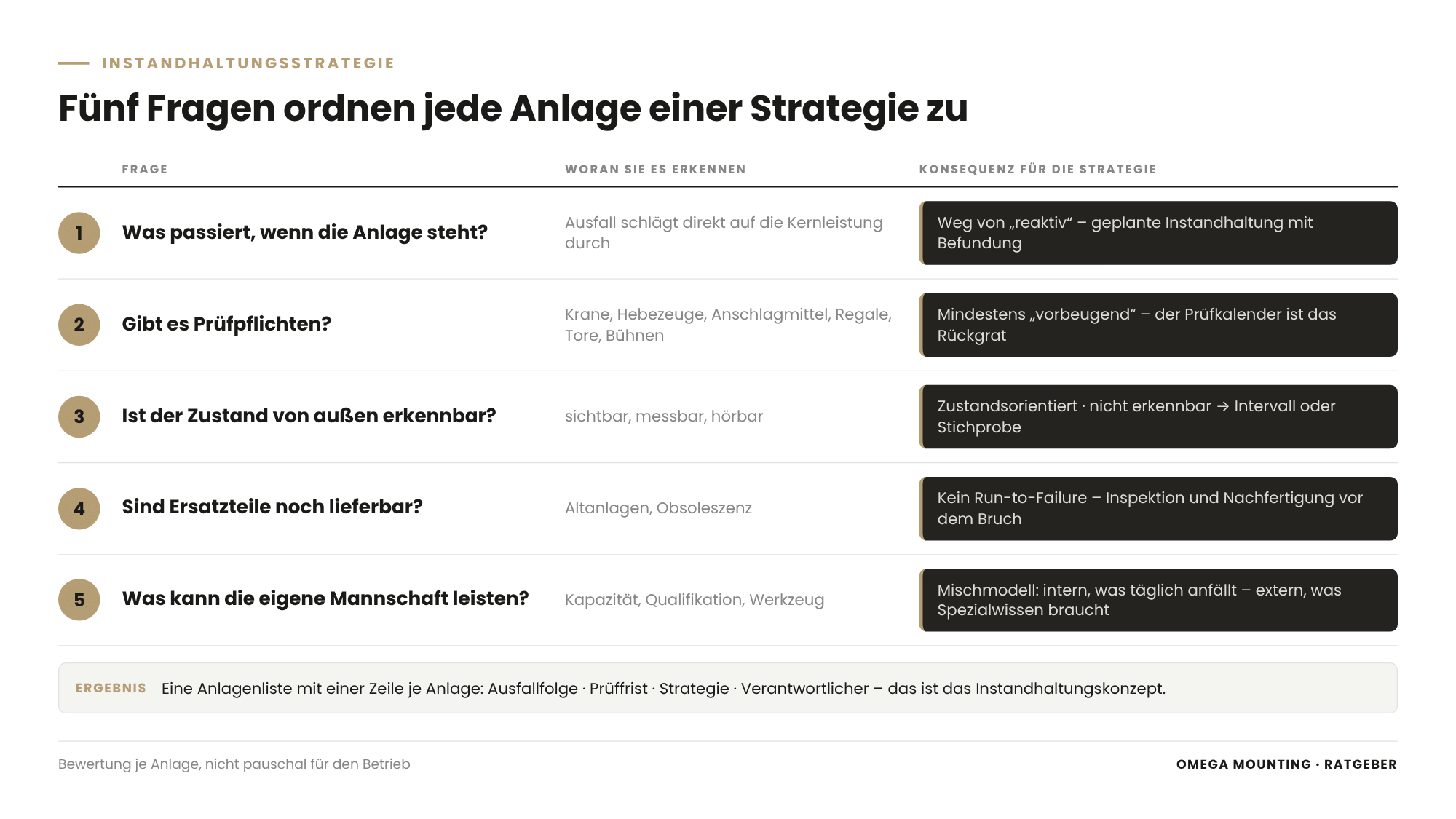
You find the right maintenance strategy by evaluating each plant against five criteria – failure consequence, inspection duty, recognisability of condition, spare parts situation and in-house capacity – and deriving one of four answers from the result: reactive, preventive, condition-based or mixed.
Criterion 1: what happens if the plant stops?
This is the question with which everything begins – evaluating the failure consequences. An overhead conveyor that is the only transport route between two production areas has a different failure consequence from a second one running in parallel. A standby generator in a plant that does not yet have a grid connection at all is production itself. The more directly the failure hits your core service, the further away from "reactive" the plant belongs.
Criterion 2: are there inspection duties?
Cranes, lifting equipment, lifting accessories, racking, power-operated doors, MEWPs, pressure equipment: for many items of work equipment, the BetrSichV (German Industrial Safety Ordinance) prescribes periodic inspections, whose intervals the employer defines in the risk assessment. Plant subject to mandatory inspection cannot be maintained reactively – the inspection is already a preventive measure with a date. For these plants, the strategy is at least "preventive", and the inspection calendar is its backbone.
Criterion 3: is the condition recognisable from outside?
Condition-based maintenance only works if someone can recognise the condition. Running rollers, running rails, conductor rails, drive chains, switch shoes: visible, measurable, audible – so condition-based. Carrier pins inside a bearing point: cannot be judged from outside. There, only pulling a pin as a sample or a fixed replacement interval helps – so preventive. Which assemblies of an overhead conveyor wear and how is described in our guide on wear on overhead conveyors.
Criterion 4: what about spare parts?
For plant beyond twenty or thirty years of operation, obsolescence plays a part – the phasing out of spare parts on the market. Where parts are no longer available, run-to-failure is ruled out, because the failure becomes a procurement or re-manufacturing task with weeks of lead time. Such plant needs condition-based inspection so that re-manufacturing begins before the part breaks – and a partner with its own workshop.
Criterion 5: what can your own crew deliver?
A strategy that nobody implements is paper. A maintenance technician who keeps production running has no time for the complete overhaul of switches. That is not a reproach but a question of capacity – and the answer is usually a mixed model of in-house crew and external partner. What stays internal and what goes external is covered by the guide on outsourcing maintenance.
The result: a plant list with a strategy per line
At the end of these five questions stands not a fundamental decision but a list: every plant, its failure consequence, its inspection interval, its strategy and the person responsible. This list is the maintenance concept – the document a buyer needs for awarding and an inspector wants to see when asking about the maintenance strategy.
What do the regulations require of the operator?
The regulations do not require a particular maintenance strategy from the operator, but they require that there is one: type, scope and intervals of maintenance must be defined in the risk assessment, and whoever carries it out must be qualified, authorised and briefed for it.
That is what the German technical rule TRBS 1112 (maintenance), which specifies the BetrSichV, says. For you this means: a company that runs its plant exclusively reactively without having defined this anywhere has not only an economic problem but also a gap in the risk assessment under Section 3 BetrSichV. The plant list with a strategy per line closes this gap – provided it is part of the risk assessment and not just a spreadsheet in purchasing.
Two further points from the regulations argue against pure run-to-failure for plant subject to mandatory inspection. First: under TRBS 1201 (inspections and checks of work equipment), defects that mean a hazard lead to a ban on use; less serious defects shorten the inspection interval or restrict use. Anyone who finds wear and ignores it therefore loses the basis for continued operation. Second: after a repair that could affect safety, a renewed inspection by a competent person is required – a person with training, professional experience and recent activity with the type of plant. A reactive repair at three in the morning without this inspection is not a recommissioning but a makeshift solution.
For building servicing and inspection schedules, VDI guideline 2890 provides instructions – helpful for orientation, not required reading. What matters is that the schedule exists, suits the plant and is lived.
How do you introduce a maintenance strategy without disrupting operations?
You introduce a maintenance strategy in five steps – inventory, assessment, prioritisation, implementation in maintenance windows and documentation – and none of them requires production to stop for it.
Step 1: inventory – what do you actually have?
A plant list with location, year of manufacture, operating hours or cycle count, critical assemblies and known inspection intervals. Many companies have this list in parts – in purchasing, in accounting, in the head of the longest-serving maintenance technician. The first step is to bring it together in one place.
Step 2: assessment – how are the plants really doing?
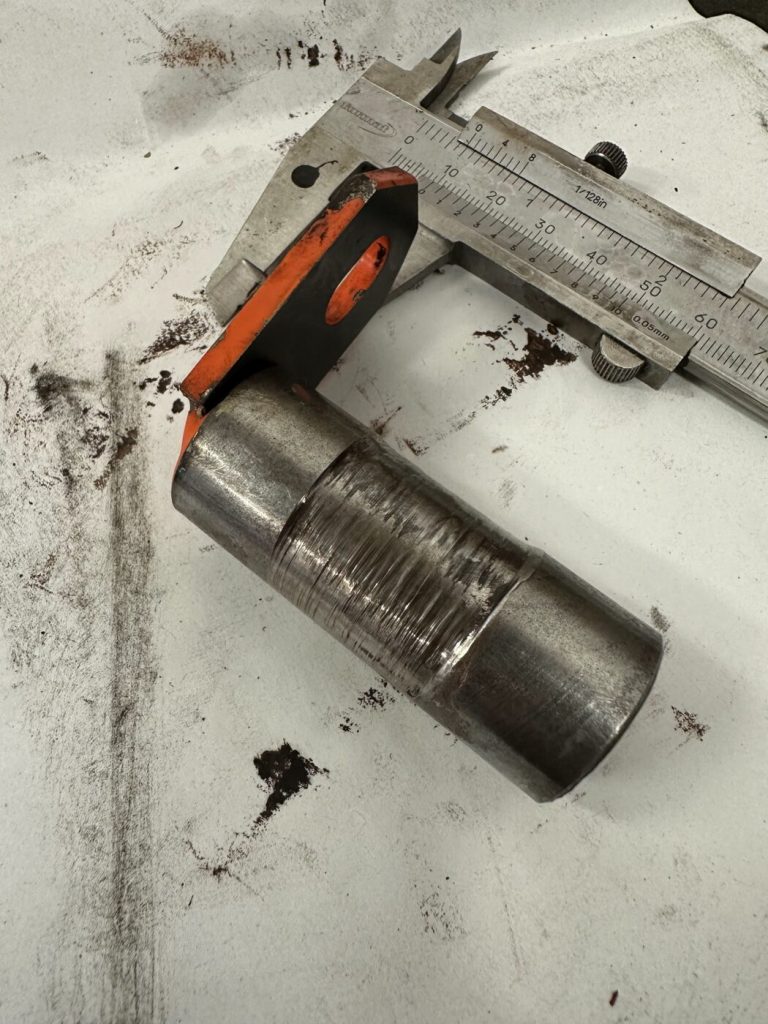
The assessment – systematically establishing and evaluating the actual condition – is the step that turns assumptions into knowledge. In Frankfurt, before the switch overhaul, we went through each of the roughly 100 switches, documented their condition and evaluated them by damage pattern; from this came spare parts requirement, scope of work and sequence. At the food plant, a single pulled pin was enough to know the condition of all 80 carriers: grooves, cracks, material loss, hardly any grease left. A sample on the right component often replaces inspecting the whole fleet.
Step 3: prioritisation – what first?
Not everything at once. Plant with high failure consequence and poor findings comes first; plant with good findings gets an inspection interval; non-critical plant is deliberately classified as reactive. In Frankfurt, switches with severe damage or high importance for the production flow were worked on first – that is prioritisation by failure consequence, not by order in the hall.
Step 4: implementation in maintenance windows
The backlog from years of reactive maintenance is worked off in planned windows – weekend by weekend, night window by night window. The roughly 100 switches in Frankfurt ran as a series of weekend shutdowns of around 36 hours each with four technicians; the 80 carriers at the food plant as a series programme with 10 to 15 carriers per weekend until the fleet was done. How to plan such windows so that they are sufficient is described in our guide on Maintenance during live operations.
Step 5: documentation – so that the strategy survives
Every job leaves a report: findings, measure, parts used, open points, next due date. From this grows the plant file, from the plant file the maintenance schedule, from the maintenance schedule the next maintenance window. Without documentation, every window begins with searching – and the strategy falls back to reactive at the first change of personnel.
Creating a maintenance schedule – without buying software
A maintenance schedule is a table: plant, assembly, measure, interval, responsible person, last and next due date. For most medium-sized companies, a spreadsheet is enough. What belongs in the schedule of a conveyor system is shown in our guide on maintenance of conveyor technology.
How do you increase plant availability with the strategy?
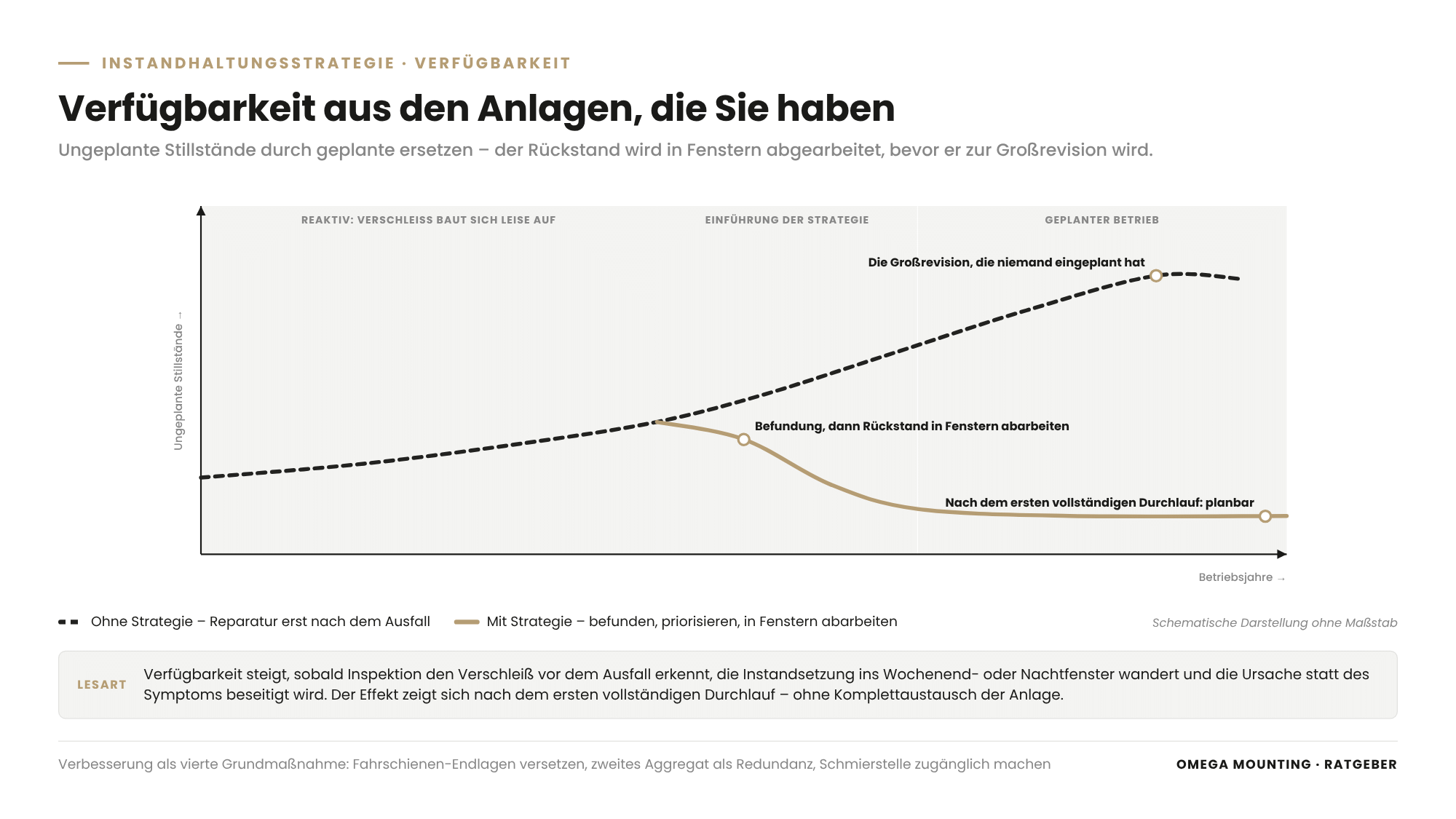
Plant availability increases when unplanned downtimes are replaced by planned ones – and that succeeds as soon as inspection recognises wear before failure, repair moves into the window and the cause rather than the symptom is eliminated.
The effect shows after the first complete cycle. After the complete overhaul in Frankfurt, acute faults could be eliminated and consequential damage to carriers, drives, current collectors and data contacts reduced; the system became more plannable, the service life of the existing plant extended – without complete replacement. That is availability that comes not from new plant but from a strategy for the existing one.
Improvement as the fourth basic measure
Improvement under DIN 31051 turns a repair into a permanent solution: running rails whose end positions are relocated to an unworn area; a second unit that creates redundancy; a lubrication point that is made accessible. Anyone who asks with every repair what prevents the repetition improves the plant with every job.
How we do it in the Rhine-Main region
In the Rhine-Main region, at companies in Frankfurt, Offenbach, Hanau, Darmstadt and Aschaffenburg, we mainly encounter one situation. An experienced, small maintenance team that has been working reactively for years because it lacks the time for more – and plant whose wear has built up quietly. Our task is then not to replace the maintenance team but to give it the strategy it cannot set up alone. That means: walk-round, assessment of the critical plant, samples, conversation with the operators – they hear the squeak first – then an assessment for each plant. What we take on in servicing, inspection, repair and re-manufacturing is described on our page on maintenance and servicing of industrial plant. And what counts in a breakdown – response time, workshop, local knowledge – is set out in the guide on the installation contractor in the Rhine-Main region.
How we do it in practice
Three jobs from our project diary show the three stages of a maintenance strategy: the breakdown without a strategy, the backlog from years of reactive maintenance – and the transition to a planned programme.
The breakdown without a strategy: emergency call-out on a Sunday evening
A logistics company still under construction generated its power with a standby generator. When starting up on a Sunday evening, the generator caused problems; production was due to start on Monday at four o'clock, with the first goods being put into and taken out of storage. During our emergency call-out on a Sunday evening troubleshooting revealed that the generator was no longer operational. Disconnect cables, drain operating fluids, lift the generator off the containment station – with torches, floodlights and the vehicle's lights. The replacement generator had a different terminal panel; a temporary supply via batteries kept emergency operation going, the material arrived in the morning, and by Monday midday the new generator was running with the auxiliary tank connected and the earthing measured. Our proposal afterwards: a second generator as redundancy – the company implemented it. That is the moment when a breakdown becomes a strategy.
The backlog: around 100 switches of an overhead conveyor in Frankfurt
With the maintenance of a roughly 30-year-old overhead conveyor in Frankfurt wear had built up over years: worn-in running surfaces, worn and torn-off rollers, rail transitions out of alignment, switches that had already been decommissioned because of torn-off components. We assessed each of the roughly 100 switches in two operating areas, documented them and prioritised them by degree of damage and importance for production. The repair ran as a series of weekend shutdowns of around 36 hours each with four technicians. Running and guide rollers, switch shoes and switch pins replaced, rail transitions aligned, end positions set, switch motors and limit switches checked, torn-off mountings welded, worn-in running rails relocated by several centimetres instead of completely replaced. A programme that a strategy years earlier would have completed in smaller windows.
The transition: 80 overhead conveyor carriers at the food plant
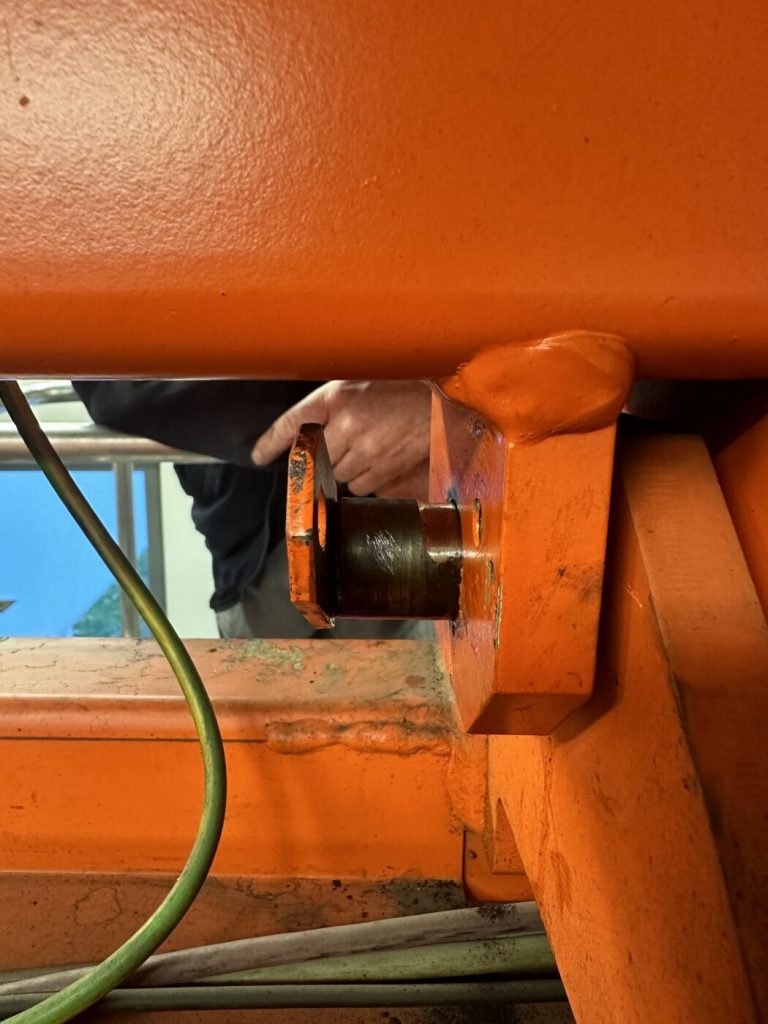
With the refurbishment of the hanger pins on 80 overhead conveyor carriers in a food plant the trigger was a squeak – and recurring failures during production time. The internal maintenance team had assumed the pins were maintenance-free; a mistake we often encounter and for which nobody is to blame. One pulled pin provided the finding: pin, bearing seat and rear bearing completely worn in, lubrication practically gone, deep grooves, cracks, material loss. This became a series programme: jack up the carrier, pull the pin, check the bearing seat, replace the bearing, insert a new pin – 10 to 15 carriers per weekend with two to three fitters until the fleet was done. The system can take the cycle rate again and runs quietly. And the company now knows which components must be seen at which interval – that is the transition from reactive to planned.
Do you recognise your company in one of these three stages – in Frankfurt, Hanau, Darmstadt or elsewhere in the Rhine-Main region? Then get in touch with us: a walk-round of your plant inventory usually clarifies within an hour which plants need a strategy and where reactive is entirely sufficient.
What this means for your role
For buyers: A maintenance strategy is the basis of every award – without it you buy hourly rates, with it availability. Before tendering, require the plant list with a strategy per line, and award planned maintenance as a scope of works per interval, breakdowns as a framework agreement with response time. Which form of contract suits which plant is shown in our guide on the maintenance contract for industrial maintenance.
For designers: The strategy of a plant is defined in the design, whether you want it or not: a lubrication point without access is never serviced, a switch without inspection opening never inspected, a generator without a moving-in route never overhauled. Plan accessibility, lifting points, reserve areas and redundancy as maintainability – and hand over wear parts lists and maintenance intervals as part of the documentation.
For project managers and site managers: Your project ends with the handover; maintenance begins there. As project manager, you hand over the plant with a strategy – inspection intervals, maintenance schedule, spare parts list, contacts – not just with an acceptance. As site manager, you ensure that initial inspection and briefing of the maintenance team take place on site and are recorded.
For maintenance managers: Organise your plant inventory by failure consequence, inspection duty, recognisability, spare parts situation and in-house capacity, and write down the strategy for each plant – even where it is called "reactive". For assemblies whose condition cannot be judged from outside, take samples instead of trusting "maintenance-free". And work off the backlog in planned windows before it becomes a major overhaul.
For operations and plant managers: The decision for a strategy is yours, because it costs maintenance windows before it saves downtime. Release the windows that planned maintenance needs – weekends, night shifts, shift breaks – and measure your maintenance by unplanned downtimes, not by the number of repairs.
For facility managers and operators: You bear the operator responsibility for work equipment, even if a maintenance team or a service provider carries it out. Check whether your risk assessment contains the maintenance strategy for each plant and whether the inspection intervals in it match the maintenance schedule – that is the point an inspector asks about.
Maintenance strategy check: template on request
The maintenance strategy check is one page with which you assign each plant to a strategy using the five criteria from this article. The criteria: failure consequence, inspection duty, recognisability of condition, spare parts situation and in-house capacity. The answer: reactive, preventive, condition-based or mixed. It helps maintenance managers organise the plant inventory, buyers prepare the award and management with the question of where maintenance pays off and where it does not. Request the template via our Contact form – keyword "maintenance strategy check".
Why Omega Mounting?
We are based in Rodgau near Frankfurt and see both sides of maintenance: the breakdown via our 24-hour hotline and the planned programme in the weekend window. We assess, prioritise and repair – on overhead conveyors, conveyor technology, crane technology and standby power systems, on overhead conveyors for over 15 years – and we re-manufacture parts that no longer exist in our own workshop in Rodgau. The linked jobs show that we do not just repair but look for the cause and show the way to a strategy – from the pulled pin to the recommended redundancy. With us you get a single point of contact for assessment, maintenance schedule, repair, re-manufacturing and lifting equipment – maintenance from a single source, with short distances in the Rhine-Main region and a team that also comes on a Sunday evening, but prefers a planned Saturday.
Conclusion
A maintenance strategy is not a question of reactive or planned for the whole company but a decision for each plant. Where a failure costs nothing but the spare part, run-to-failure is right. Where it affects production, safety or inspection duties, it ends up more expensive than any maintenance – through untimely downtime, consequential damage, rush procurement and the major overhaul that nobody planned for. Anyone who organises their plant by failure consequence, inspection duty, recognisability, spare parts situation and in-house capacity, assesses the actual condition and works off the backlog in planned windows gets availability from the plant they have. If you would like to know which of your plants needs which strategy, send us your plant list, the known inspection intervals and your maintenance windows – we will get back to you with an honest assessment for each plant.
Further reading: How the chosen strategy becomes a concrete plan is shown in the guide Creating a maintenance schedule – from manufacturer's manual to annual plan.
Planning maintenance, moving in or installation in the Rhine-Main region?
Tell us briefly what it is about – we will come back to you with an honest assessment.
100% free and without obligation
You may also be interested in these guides
Maintenance & Servicing
Maintenance & Servicing

About the author
Tobias Schott
Managing director of Omega Mounting GmbH, Rodgau · more than 20 years of hands-on experience in installation and maintenance
A trained mechatronics technician, at home in maintenance, servicing and industrial installation since 2004 – first at his father's side, since 2012 with Omega Mounting: from the overhead conveyor in Frankfurt to the crane system in a new-build hall. Plans and leads lifting operations as appointed person in data centers and on industrial sites in the Rhine-Main region, is an instructor and examiner for cranes, mobile elevating work platforms and telehandlers, and a safety officer. On jobs abroad he is known as the “German Troubleshooter” – the one you call when things get stuck on site. He learned what quality means not from a manual but from his father: Made in Germany as a standard for his own work, not as a label. That is why it comes first at Omega Mounting – before speed and before price. He writes these guides from that practice: what works on our sites is in them – what only exists in the standard is not.
Frequently asked questions
Reactive maintenance only intervenes after failure and consists of repair; preventive maintenance intervenes beforehand – by calendar or running performance, by inspection finding or by measurement data – and consists of servicing, inspection and planned repair. The difference lies in the trigger, not in the work itself: the bearing replacement is the same; planned, it takes place in the weekend window, reactive, in the early shift.
When the failure affects neither production nor safety nor inspection duties, the spare part is available and the replacement succeeds without preparation. Lighting, redundant pumps or small drives with a spare on the shelf are typical examples. What matters is that the classification is documented – otherwise run-to-failure is not a strategy but chance.
Plant whose failure stops the core service or endangers people, work equipment subject to mandatory inspection such as cranes, lifting equipment, racking and power-operated doors, standby power systems without redundancy, and older plant for which spare parts must be re-manufactured. For these, the failure is never just a component but a downtime with consequential damage and procurement time.
The German technical rule TRBS 1112 requires the employer to define type, scope and intervals of maintenance in the risk assessment under the BetrSichV and that the maintenance personnel are qualified, authorised and briefed. It does not prescribe a particular strategy – but a company without defined maintenance has a gap in its risk assessment. This note does not replace legal advice.
With an assessment: go through the plant, evaluate critical assemblies, take a sample of components that cannot be seen – such as a carrier pin – and talk to the operators about noises and faults. This produces an actual condition, from the actual condition a prioritisation and a first maintenance schedule. The missing history is rebuilt from the first job onwards.
Yes, the five criteria apply to every plant: failure consequence, inspection duty, recognisability of condition, spare parts situation, in-house capacity. Whether overhead conveyor in the car plant, chain conveyor in the logistics centre, standby power system in the data center or fan in a paint shop – the answers differ, the questions do not. In food plants, hygiene windows are added; in data centers, approvals and redundancy rules.
With a walk-round of the plant inventory from Rodgau – in Frankfurt, Offenbach, Hanau, Darmstadt and Aschaffenburg at short notice – an assessment of the critical plant, an evaluation for each plant and working off the backlog in planned maintenance windows. We do not replace your maintenance team but supplement it where time, specialist knowledge, lifting equipment or workshop are lacking.
Via a short enquiry with three details: your plant list or a description of the critical plant (type, age, location), the known inspection intervals and recent faults, and the maintenance windows your operation allows. We arrange a walk-round, assess the critical plant and send you a written assessment for each plant – with a proposal for what should run planned, what condition-based and what deliberately reactive. Your contact is Tobias Schott – reachable via our Contact form.
 English
 German