
- Guide – Maintenance & Servicing
Installation contractor in the Rhine-Main region: what proximity is worth in a breakdown
By Tobias Schott · Reading time approx. 23 minutes · Last updated: October 2026
Anyone who commissions an installation contractor in the Rhine-Main region is buying not just fitter hours, but response time, a reachable workshop and local knowledge. It is precisely these three things that decide between hours and days of downtime in a breakdown.
A plant is down. The conveyor line is blocked, the standby generator does not start, the fan in the paint shop is running rough. At this moment, what counts for you as maintenance manager or buyer is not who has the finest reference list, but who will be standing at your gate in two hours with the right tools. An installation contractor in the Rhine-Main region who knows your plant and comes from nearby is therefore not a soft location factor but a hard factor in your availability.
The problem: regional proximity is hard to write into a scope of works. The item text says “response time 24 hours”, and on paper many bidders meet that. Whether the fitter then actually drives from Rodgau to Offenbach or has to travel from another federal state only becomes apparent when things go wrong. Then it is the availability of your plant that is at stake, not the contractual penalty. Anyone searching for “installation contractor Rhine-Main” is in truth searching for availability.
This guide explains what regional proximity is actually worth in maintenance and in a breakdown, and how to recognise a truly regional installation partner. It shows how to get proximity into the award as a suitability criterion and how to prepare your operation so that the first 30 minutes after a fault are not lost. The examples come from our own projects between Frankfurt, Offenbach, Babenhausen and Aschaffenburg.
Key points at a glance
- Regional proximity works three ways in a breakdown: a short journey, fast access to workshop and spare parts, and a team that knows your plant and your site.
- An installation contractor with its own workshop can fabricate brackets, adapters and auxiliary structures to site measurements within a single call-out, instead of waiting for delivery times.
- Temporary repairs are legitimate if they are executed properly, inspected and documented as temporary – and the permanent repair is scheduled.
- The first 30 minutes after a fault decide the further course: isolate and lock out, document the damage pattern, call with the right information, prepare access road, site access and permits.
- Mechanical, welding and electrical work from a single source save trade coordination in a breakdown – and therefore time.
- Local knowledge covers access roads, access control, crane set-up areas and security areas – for example at Frankfurt Airport or in data centers in Frankfurt and Offenbach.
- Maintenance during live operation and on-call service for breakdowns belong together: whoever maintains the plant regularly reaches the cause faster in a breakdown.
What is a regional installation contractor in the Rhine-Main region?
A regional installation contractor in the Rhine-Main region is an industrial service provider for installation, maintenance, repair and dismantling of machinery and plant. Its base, its workshop and its fitters are located in the same economic area as its customers' plants. In concrete terms: the company is based between Frankfurt, Hanau, Darmstadt and Aschaffenburg. It reaches every industrial plant in this area – in Hesse as well as in the neighbouring Bavarian Untermain region – without an overnight stay and without travelling the day before.
The installation contractor differs from the classic machine manufacturer in its independence from manufacturers. It works on plant of any make, combines mechanical work, steel construction, welding and electrical work, and steps in where the manufacturer no longer supplies or is too far away. It differs from a pure metalworking shop in its ability to do lift & shift. That means: lifting, moving and installing heavy plant components with crane, heavy-duty skates or hydraulic gantry, planned in a lift plan and executed with inspected lifting accessories. Added to this is work in sensitive environments such as data centers and airports.
For you as client, it is the combination that counts: a partner who comes in a breakdown, gets to know the plant during planned maintenance and sends the same team for a later conversion or relocation. Contractually, this is usually a framework agreement with call-off orders and agreed on-call service.
What happens in a breakdown – and where is time lost?
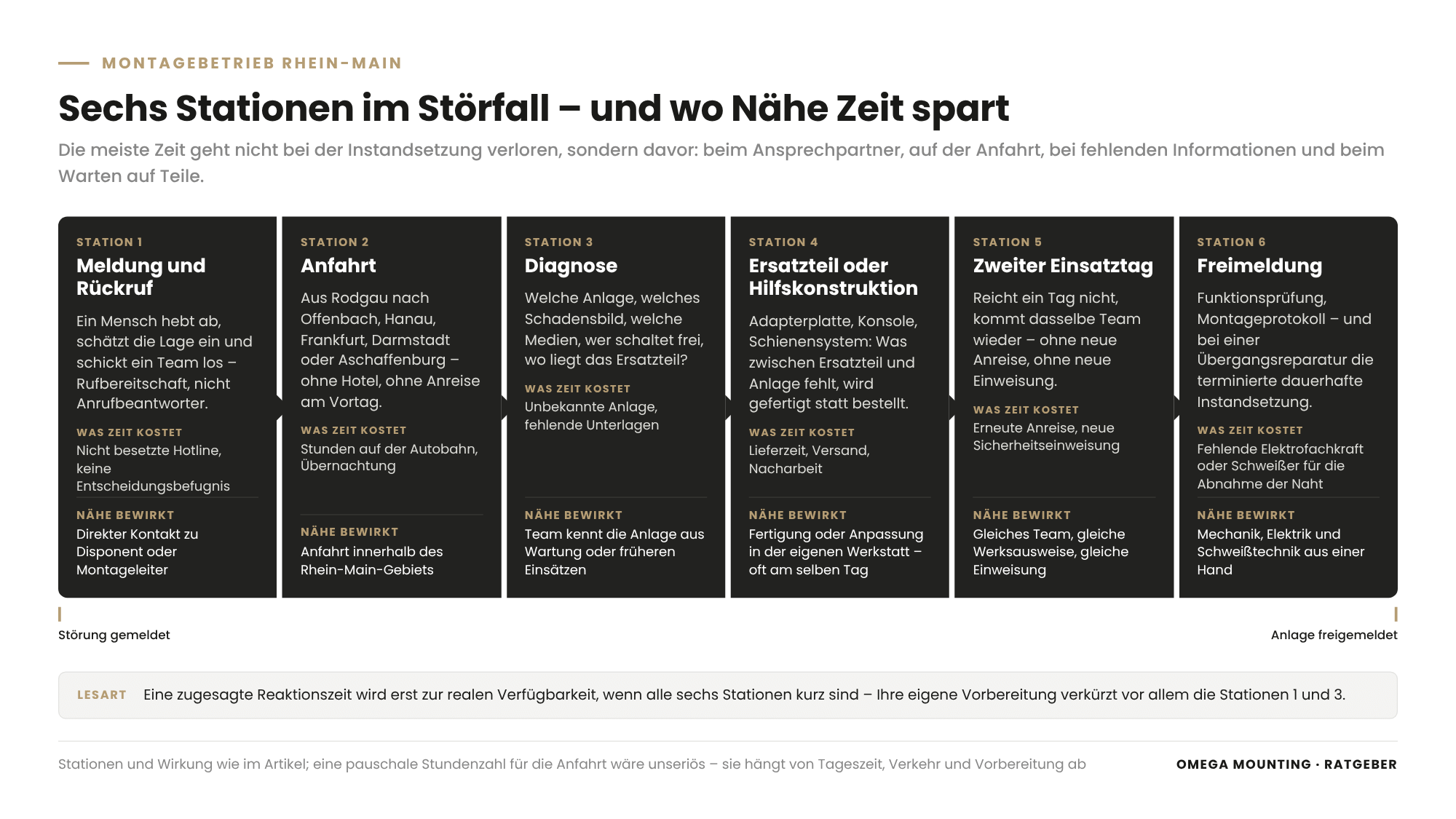
In a breakdown, most time is lost not during the repair but before it. The four time wasters: searching for the right contact, the journey, missing information for the condition assessment and waiting for parts. Anyone who knows them can shorten them considerably with preparation and by choosing a regional partner. Only then does a promised response time become real availability.
Time waster 1: the fault report arrives in the wrong place
A fault on Sunday evening often lands at a head office that is only staffed on Monday. A genuine emergency service with a 24-hour hotline means that a person picks up who can assess the situation and send out a team – on-call service, not an answering machine. Ask your installation partner who is actually reachable at the weekend and what decision-making authority that person has.
Time waster 2: the journey
This is where regional proximity has its most immediate effect. A team from Rodgau is in Offenbach, Hanau or Dietzenbach in a short time, and in Frankfurt, Darmstadt or Aschaffenburg likewise without a hotel stay. A company with several hours of travel loses this time afresh on every call-out – and has to spend it again on a second working day.
Time waster 3: missing information on site
Which plant, which damage pattern, which utilities are connected, who isolates, who issues the permit to work, where is the spare part? Every question the fitter first has to clarify on site costs minutes – and delays condition assessment and root cause analysis. The breakdown checklist at the end of this article structures exactly this information.
Time waster 4: parts and auxiliary structures
The spare part is not in stock, the bracket does not fit, the old console is warped. Without a workshop of your own, this means: order and wait. With a workshop within reach, it means: drive back, fabricate, install – often on the same day.
The following overview shows at which stations of a breakdown call-out the proximity of the installation contractor has an effect:
| Station in the breakdown | What costs time | What regional proximity achieves |
|---|---|---|
| Report and callback. | Unstaffed hotline, no decision-making authority. | Direct contact with dispatcher or installation supervisor. |
| Journey. | Hours on the motorway, overnight stay. | Journey within the Rhine-Main region without a hotel. |
| Diagnosis. | Unknown plant, missing documentation. | Team knows the plant from maintenance or earlier call-outs. |
| Spare part / auxiliary structure. | Delivery time, shipping, rework. | Fabrication or adaptation in our own workshop. |
| Second working day. | Another journey, new induction. | Same team, same works passes, same induction. |
| Completion notice. | No qualified electrician or welder available to sign off the weld. | Mechanical, electrical and welding from a single source. |

Why is having our own workshop so decisive in a breakdown?
In a breakdown, a workshop of your own turns delivery time into fabrication time. Instead of waiting for a part that arrives in days, a bracket, an adapter or an auxiliary structure is fabricated and installed in hours. Our workshop for custom fabrication in Rodgau is therefore not a sideline but part of our breakdown readiness.
What typically gets made in a workshop during a breakdown
Most often it is not spare parts in the narrower sense, but whatever is missing between the spare part and the plant:
- Adapter plates and intermediate frames when a replacement unit has different dimensions from the old one.
- Consoles, brackets and mounting plates that were warped, cracked or never there in the first place.
- Auxiliary structures for removal: rail systems, assembly stands, spreader beams – lifting attachments that pick up a load evenly at several points.
- Guard tubes and impact protection after collision damage.
- Repair-welded components that can be released after visual inspection.
- Refabrication of parts affected by obsolescence – i.e. no longer available on the market – from site measurements or by reverse engineering from the old part.
Example: a rail system for a fan that cannot be reached
During a fan bearing replacement on a paint shop in Offenbach, the fan wheel, around 1.40 metres in diameter, sat directly on the motor. It lay deep inside the plant, between control cabinets, with no access from outside. The solution was not a catalogue part but a rail system welded on site from square steel tubes on the preparation day. The motor-fan unit was run out on it in a controlled manner and lifted off the assembly stand with a gantry crane. On Monday, production started without restriction.
This kind of auxiliary structure can only be planned and built when workshop and site are close together – or when the contractor, as here, does the welding work directly on site.
How important is the spare parts question for the response time?
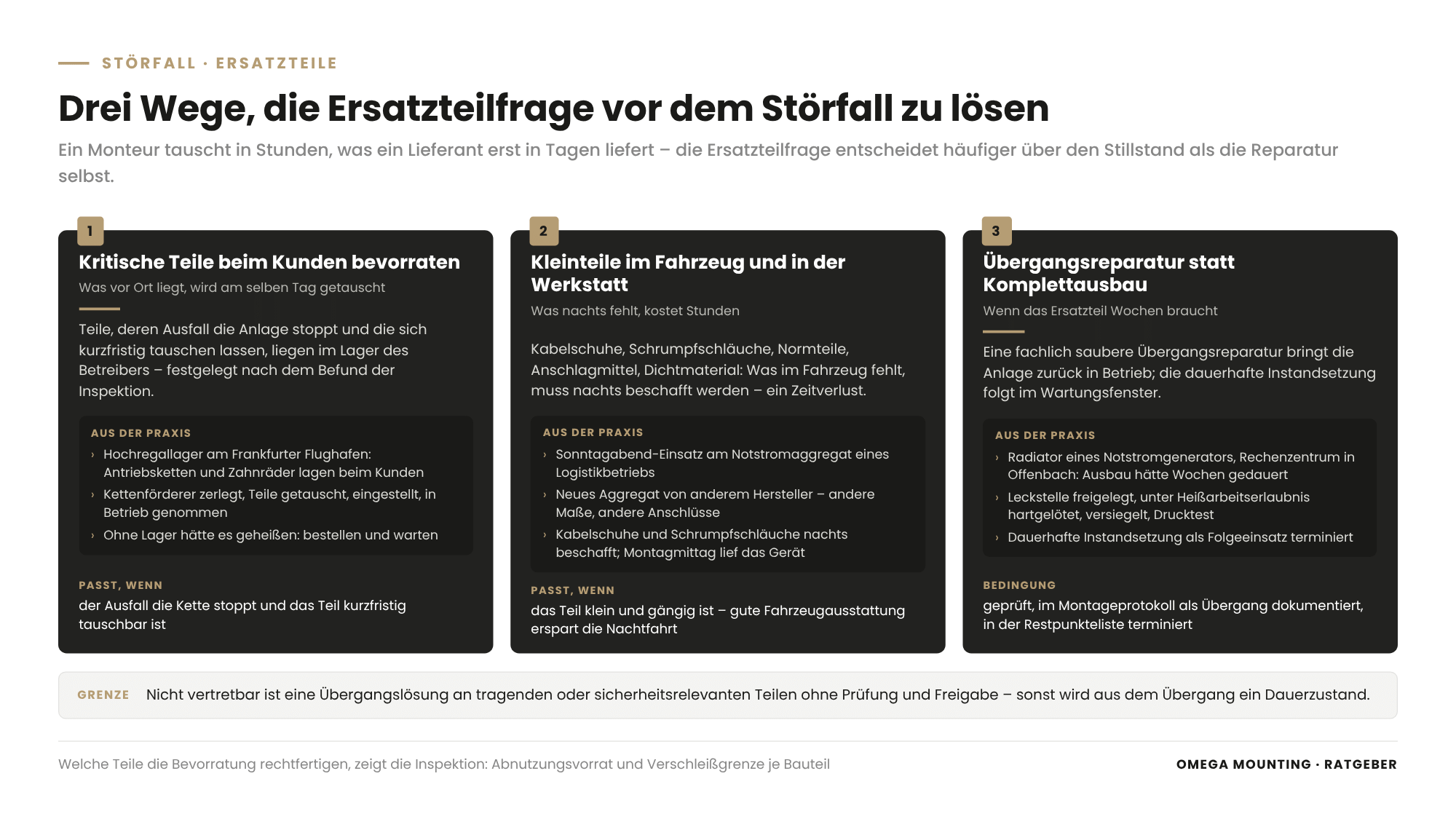
The spare parts question decides the duration of a standstill more often than the actual repair. A fitter can replace in hours what a supplier only delivers in days. Three strategies shorten this time, and all three work better with a regional installation partner.
Strategy 1: stock critical parts at the customer's site
During a high-bay warehouse fault at Frankfurt Airport, a jammed drive unit could be repaired quickly because the customer had stocked spare parts on site. Drive chains and gears were replaced with new parts, the chain conveyor was dismantled, readjusted and put into operation. A regional partner can define together with you which parts justify this spare parts stocking. The basis is what it sees in terms of wear reserve and wear limit during the inspection.
Strategy 2: small parts in the vehicle and in the workshop
Cable lugs, heat-shrink tubing, standard parts, lifting accessories, sealing material: whatever is missing from the vehicle has to be procured at night. During our Sunday evening call-out on a standby generator, cable lugs and heat-shrink tubing were procured during the night. That is feasible in a conurbation like the Rhine-Main region, but a loss of time that good vehicle equipment avoids.
Strategy 3: temporary repair instead of complete removal
When the spare part takes weeks, a professionally executed temporary repair is often the better way. On the radiator of a standby generator in a data center in Offenbach, complete removal of the cooler would have taken weeks. Four days before go-live, that was not an option. The leak was exposed, brazed under a hot work permit, sealed over a large area and checked for acceptance readiness with a pressure test. The permanent repair was planned as a follow-up call-out in the maintenance window. The decisive factor is that the temporary solution is inspected, documented in the installation report and scheduled in the punch list. Otherwise the temporary becomes permanent.
What role does local knowledge play for industrial plants in the Rhine-Main region?
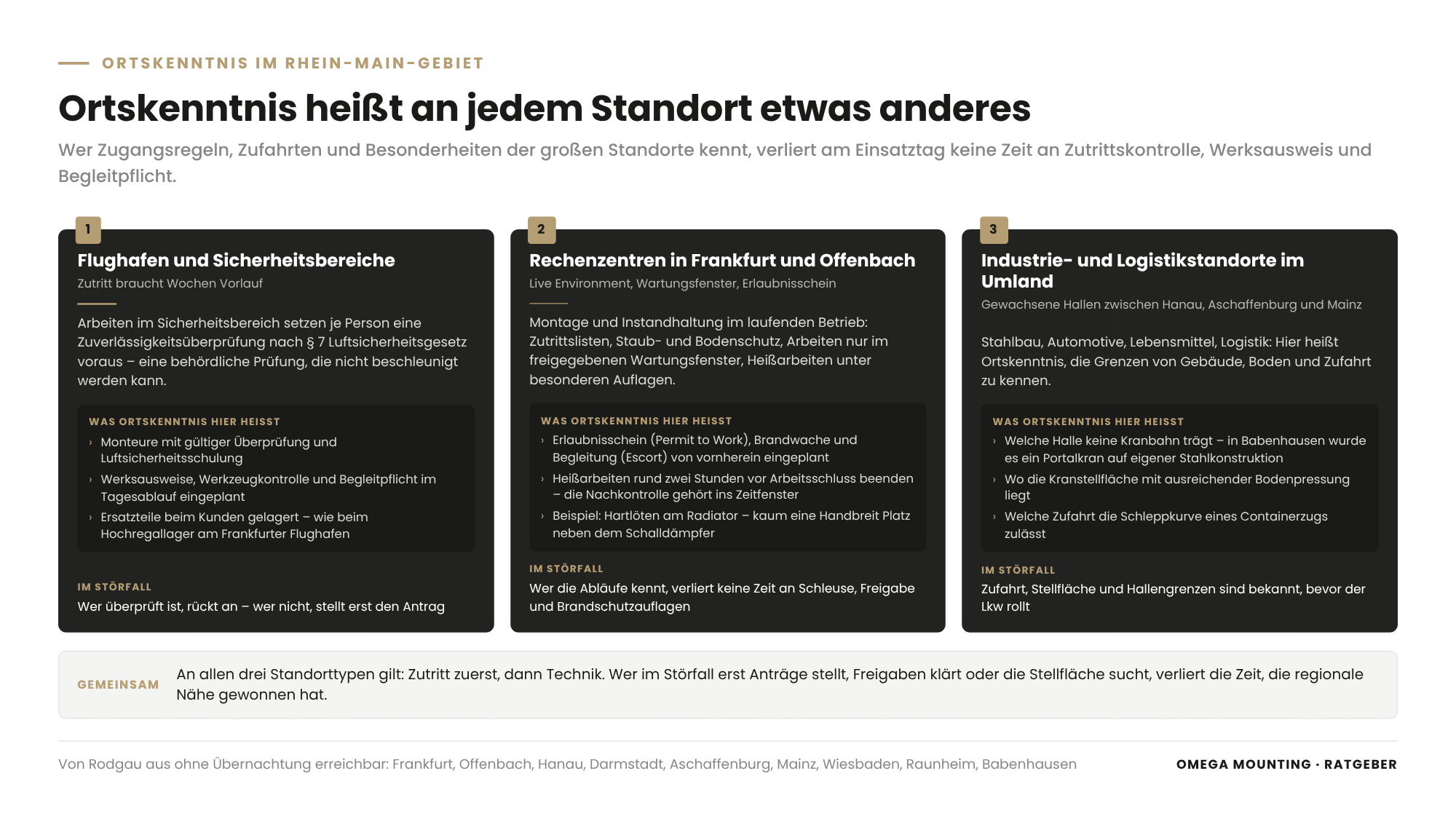
In the Rhine-Main region, local knowledge means above all knowing the access rules, access roads and particularities of the major industrial sites. These are the airport, data centers, industrial parks, logistics centres and grown company sites with cramped halls. Anyone who knows these rules loses no time on the day of work at access control, works pass, induction and mandatory escort.
Frankfurt Airport and security areas
Work in the security area of an airport requires that the fitters have passed a background check under Section 7 of the German Aviation Security Act (LuftSiG). That is an official check of the person which needs weeks of lead time. An installation contractor whose fitters can already produce this check and the associated aviation security training can turn up in a breakdown, while another first files the application. What this means in detail is described in our guide on installation at airports and in security areas (coming soon). An overview is given on our page Industrial installation for airports and security areas.
Data centers in Frankfurt and Offenbach
The Rhine-Main region is one of the major data center locations in Europe. Installation and maintenance there mean access lists, dust protection and floor protection as well as work in a live environment within the released maintenance window. Hot work under special conditions is often added – as with the brazing on the radiator in Offenbach, where there was barely a hand's width of space between cooler and silencer. Anyone who knows the procedures plans permit to work, fire watch and escort in from the outset. That this is not a data center peculiarity is shown by the BG BAU/BAuA module “Site set-up – emergencies and rescue measures”. During hot work, combustible materials within a radius of about ten metres must be removed or covered, and an additional person provides the fire watch. The work is released via a permit to work and finished about two hours before the end of work so that smouldering fires are still noticed. For you as operator this means: anyone who has brazing or welding done in a breakdown plans these two hours of follow-up checks into the time window.
Industrial and logistics sites in the surrounding area
Between Hanau, Aschaffenburg, Darmstadt and Mainz lie steel construction, automotive, food and logistics companies with grown halls. Here local knowledge means: knowing which hall cannot carry a crane runway, where the crane set-up area with sufficient ground bearing pressure is and which access road allows the swept path of a container truck. For the gantry crane in Babenhausen, the hall structure was not designed for a conventional crane runway. The solution was a gantry crane on its own steel structure, which leaves the building unloaded.
How our installation contractor works in the Rhine-Main region
From Rodgau, we reach the industrial sites of the Rhine-Main region without an overnight stay. Babenhausen is a few minutes away, Offenbach, Frankfurt and Hanau are neighbours, Aschaffenburg, Darmstadt, Mainz and Wiesbaden are daily commuting distances. This shapes the way we work as an installation contractor in Rhine-Main for maintenance and breakdowns.
For planned maintenance and servicing of industrial plant – whether maintenance in Frankfurt or industrial installation in the Rhine-Main region – this means: we come with the same team that knows your plant. A weekend window can be combined with a preparation day during the week without the journey dictating the construction schedule. In a breakdown it means: the 24-hour hotline is staffed, and the way to the workshop is short if a part is missing.
We are regularly on site in the towns of the Rhine-Main region. Examples are industrial installation in Offenbach, industrial installation in Hanau, industrial installation in Aschaffenburg, industrial installation in Darmstadt, industrial installation in Mainz and industrial installation in Raunheim right next to the airport. On these pages you will find which services we typically provide on site.
How do you prepare your operation for a breakdown?
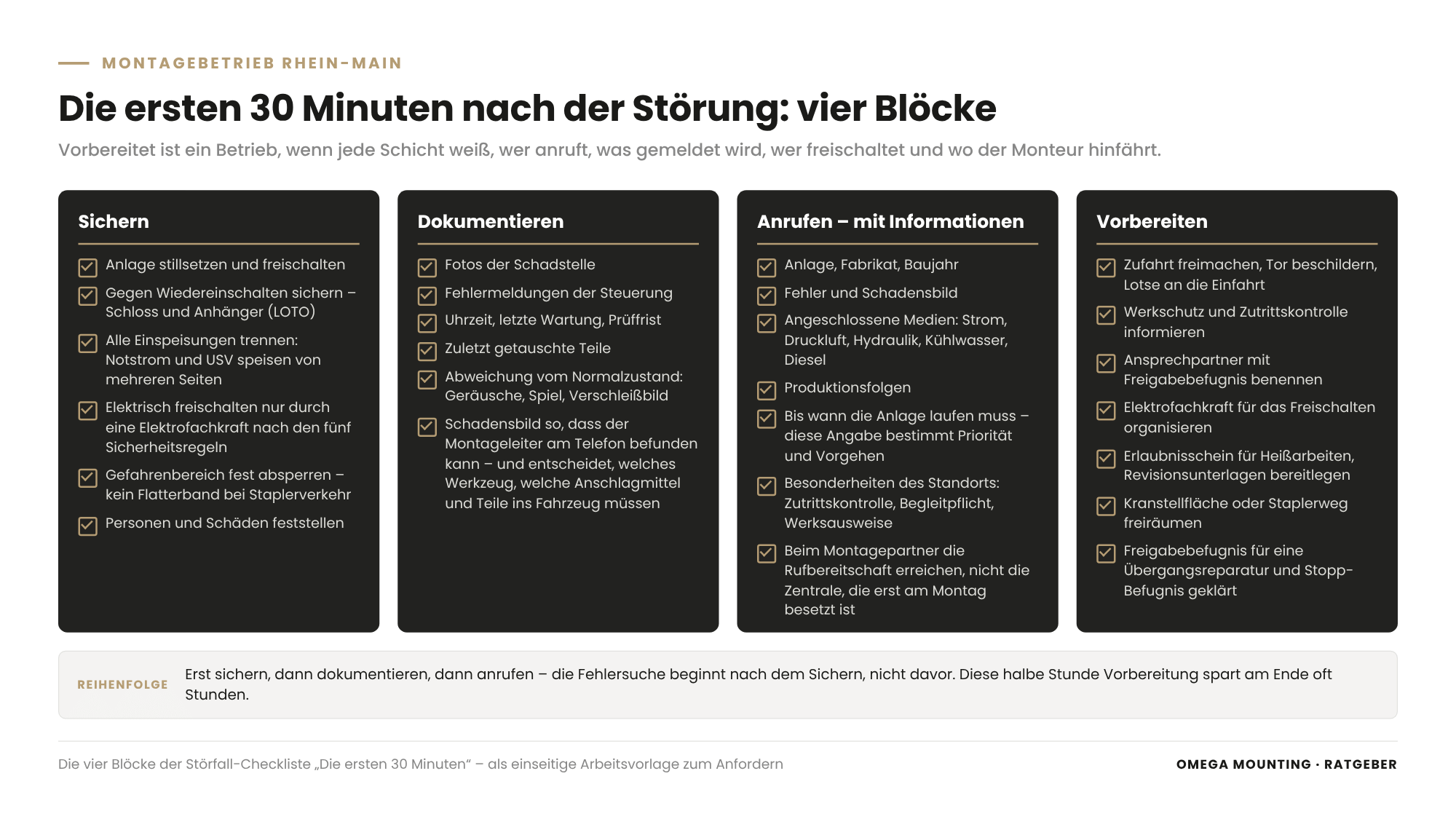
An operation is prepared for a breakdown when every shift knows who calls, what is reported, who isolates and where the fitter is heading. This information must not reside in the head of a single person. The following points are the core of our breakdown checklist.
In the first 30 minutes: secure
Stop the plant, isolate it and lock it out against re-energising – with lock and tag, internationally lockout/tagout (LOTO). Then cordon off the danger zone, establish persons affected and damage. This duty follows from the risk assessment under Section 5 of the German Occupational Safety Act (ArbSchG) and from the Industrial Safety Ordinance (BetrSichV), which requires work equipment to be in a safe condition. Only then does fault-finding begin.
Two details here decide the safety of the fitters who are about to arrive. First, the cordon: the BG BAU/BAuA module “Site set-up – site security” considers barrier tape sufficient only where no work takes place in the immediate vicinity. In live operation with forklift traffic, the fault location needs fixed barrier elements. Second, back-feed: the German technical rule TRBS 1112 (Maintenance) expressly points out for standby generators and UPS that a plant can be live from several sides. Isolation there means: all feeds, in accordance with the five safety rules of electrical engineering, by a qualified electrician.
In the first 30 minutes: document
Photo documentation of the damaged area, fault messages from the controller, time, last maintenance and inspection deadline, parts most recently replaced. This damage pattern shortens the condition assessment considerably – often the installation supervisor can already decide on the phone which tools, which lifting accessories and which parts have to go in the vehicle.
In the first 30 minutes: call – with the right information
Which plant, which make and year of construction, which fault, which utilities (power, compressed air, hydraulics, cooling water, diesel)? What are the consequences for production, by when must the plant be running? During the Sunday evening call-out on the standby generator, the decisive information was: production starts Monday at four o'clock. It determined priority and approach.
Before arrival: prepare
Clear the access road, inform plant security and access control, name a contact person with release authority. Organise a qualified electrician for isolation, prepare the permit to work for hot work, lay out the plant records, clear the crane set-up area or forklift route. Anyone working in a security area clarifies mandatory escort and works passes. The module on emergencies and rescue measures recommends signposting gates for the emergency services, naming the gate when raising the alarm and placing a guide at the entrance. What applies to the emergency doctor helps the installation crew at 10 pm on an unfamiliar company site just as much. This half hour of preparation often saves hours in the end.
Which services should come from a single source?
In a breakdown, mechanical, welding and electrical work should come from a single source, because every interface between trades creates waiting time. You wait for the electrician who disconnects, for the welder who straightens the console, for the fitter who reconnects. An installation contractor that combines these three trades in one team works straight through. The interface list between operator and service provider stays short.
For the fan bearing replacement in Offenbach, this meant: disconnect the motor, run out the unit, replace the bearing, dismantle and refit the fan wheel, push the unit back, seal, connect, function check. One sequence, one team, one weekend. For the retrofit of emergency stop buttons on a sorting system at Frankfurt Airport, mounting brackets were pre-assembled, mechanically fitted and electrically integrated into the existing safety circuit. Here too there was no handover between companies.
For you as buyer this means: do not just ask for references, but for the proof of qualifications within the team. That means a qualified electrician, welders with a valid certificate, crane operators and slingers, plus a clearance certificate and public liability insurance. In a breakdown, these documents are what make the difference between “we'll have a look at it” and “we're signing the plant off”.
Maintenance and breakdowns: why the two belong together
Anyone who maintains a plant regularly reaches the cause faster in a breakdown because they know its normal condition. Noises, play, wear patterns, documentation – everything is familiar. Maintenance under DIN 31051 comprises inspection (determining the actual condition), servicing (preserving the target condition), repair (restoring the target condition) and improvement. A breakdown is repair under time pressure. The maintenance before it determines how much time pressure arises. TRBS 1112 requires the operator to have a maintenance strategy that also plans fault rectification in advance. This includes competent, appointed personnel and a defined procedure for release after repair. For you this means: a breakdown is not a state of exception without rules, but a case that must feature in your maintenance strategy – including the question of who comes.
From practice: 25 drive stations of a conveyor system, not maintained for over 20 years, so contaminated that maintenance was hardly possible. Only after dry ice cleaning was the plant maintainable again. The process removes contamination with dry ice pellets and air without attacking motors or belts. Anyone who waits that long has no documentation, no reference condition and no chance of a quick diagnosis in a breakdown.
A regional installation partner who covers both maintenance and breakdowns closes this loop. During inspection, wearing parts are assessed, spare parts stocking is defined, inspection deadlines and inspection log are maintained. In a breakdown, the team that knows all of this then comes.
How we do it in practice
Three jobs from the Rhine-Main region show how proximity, workshop and local knowledge work together.
Sunday evening, a standby generator, production start Monday at four. During a emergency call-out on a Sunday evening the standby generator of a logistics company was no longer operational. Fault-finding, dismantle cables, drain operating fluids, lift the old generator set off the containment tray, position the new one. All of this with torches and floodlights, because there was no lighting. The new generator set came from a different manufacturer and had different dimensions. Cable lugs and heat-shrink tubing were procured during the night, diesel lines connected, earthing measured. By Monday midday the new unit was running and production started. Afterwards we recommended a redundant second generator set, which the customer implemented.
Six automated storage units from Frankfurt to Rodgau. During the relocation of six automated storage units from a Frankfurt office building the units did not fit through any door. Three internal doors formed the bottlenecks around which the dismantling was planned. The parquet floor, which had to be protected, did not allow heavy machinery, so six fitters loaded the units into the container on dollies. At the new location in Rodgau, racks and guides were aligned to the millimetre before commissioning followed. The parquet floor remained undamaged.
A gantry crane in Babenhausen, two days, two fitters. With the installation of a gantry crane at a steel construction company in Babenhausen the existing hall was not designed for a crane runway. Day one: erect columns, end carriages and runway girders, align them for height and diagonal dimension by laser survey. Grout the base plates and let them cure overnight. Day two: pre-assemble the crane bridge with a lifting capacity of two tonnes on the ground and lift it in. Install the conductor rail and limit switches, complete the electrical installation. Two fitters, two working days, a few minutes' journey from Rodgau.
In addition, see the fan bearing replacement at a paint shop in Offenbach and radiator repair on a generator in a data center in Offenbach, which show how workshop work on site and temporary repair under time pressure function.
Five jobs, five industries. Each time, journey, workshop and local knowledge made the difference. Are you looking for an installation company for Offenbach, Frankfurt or the surrounding area that comes in a breakdown and knows the plant beforehand? Then get in touch with us – a site visit usually clarifies within an hour which plant is critical and what should be prepared.
What this means for your role
For buyers: Specify response time in the scope of works as three items – acknowledgement, arrival, restoration. Add on-call service for your shift times. Include the team's location, own workshop and proof of qualifications as suitability criteria: qualified electrician, welder certificate, crane operator, slinger, background check for security areas, clearance certificate, public liability insurance. Evaluate every breakdown call-out afterwards in your supplier assessment. Viewed as a whole, a framework agreement with call-off orders for maintenance and breakdowns is often more economical than the sum of the cheapest maintenance and time-and-materials work in the most expensive emergency.
For designers: Whether a breakdown becomes one working day or a project is decided at the design stage. Keep drives, bearings and units accessible via inspection openings without dismantling neighbouring components. Provide reserve areas for lifting equipment, assembly stands and MEWPs and plan crane set-up areas with sufficient load capacity. Document weights, centre of gravity and lifting points in the plant records that the operator later passes on to the installation contractor. What you enter as reserve area today is the space for the temporary repair tomorrow.
For project managers and site managers: In a breakdown, you run the call-out like a small construction site: briefing of the team, release of the work area, permit to work for hot work, cordoning off the danger zone, coordination with live operation. At the end comes the completion notice with installation report and punch list for the permanent repair. Define the fallback plan in advance: which condition is enough for production to start if the complete repair does not fit into the window? Follow it up in the next regular coordination meeting. For new plant and conversions, plan moving-in routes, crane set-up areas and replaceability from the start. The fan that could only be reached via a self-built rail system is the textbook example.
For maintenance managers: Define spare parts stocking with your installation partner – which wearing parts must be on site based on wear reserve and delivery time. Define who calls in a breakdown and what information the report contains. Use the inspections under DIN 31051 to maintain inspection log, findings and damage patterns together. After every repair, check whether an inspection by a competent person is due before the plant restarts. TRBS 1201 (Inspections of work equipment) uses the term exceptional event for this. After collision damage, an overload, a dropped load or a standstill that lasts longer than the inspection interval, the work equipment must be inspected before further use. This applies regardless of when the next regular inspection would be due. That is your insurance for a breakdown.
For operations and plant managers: For you, what counts in a breakdown is the moment at which production restarts. This moment is determined above all by preparation. Make sure that every shift knows the breakdown routine and that release authority for temporary repairs and stop authority are clarified. The installation partner should know your site and your plant from planned maintenance. A regional partner with its own workshop belongs in your availability calculation just like spare parts stock and redundancy.
Breakdown checklist “The first 30 minutes”: template on request
The breakdown checklist “The first 30 minutes” is a one-page working template for shift supervisors and maintenance staff. It structures the path from the fault report to the arrival of the fitter. It contains four blocks – secure, document, call, prepare – with tick-box items. Added to this are a template for the fault report with all the details the installation contractor needs on the phone, and a field for the company's own contacts and persons with release authority.
The checklist helps maintenance managers define the breakdown routine across shifts, and buyers formulate the requirements for the installation partner in concrete terms. Request the breakdown checklist via our Contact form – keyword “The first 30 minutes”.
Why Omega Mounting?
Omega Mounting is based in Rodgau near Frankfurt, with its own workshop for custom fabrication and a 24-hour hotline that is staffed in a breakdown. Our fitters combine mechanical, welding and electrical work in one team and are vetted for security areas at airports and in data centers. The jobs linked here – from the Sunday evening on the standby generator through the automated storage units from Frankfurt to the gantry crane in Babenhausen – show how we work: close by, prepared and through to release. For you this means: one contact for maintenance, breakdowns, lifting technology and custom fabrication, short distances in the Rhine-Main region – and a team that already knows your plant when it matters. If you are looking for an installation contractor in Rhine-Main with a staffed hotline: Get in touch, a list of your plant is enough to start with.
Conclusion
In a breakdown, regional proximity is not a comfort but an availability factor: short journey, reachable workshop, familiar plant. An installation contractor in Rhine-Main that covers maintenance and breakdowns from a single source shortens the time between fault and release at every station – from the hotline to the auxiliary structure. The preparation on your side is just as important: whoever structures the first 30 minutes gets the most out of proximity. If you would like to know what a breakdown concept for your plant could look like, send us your plant list, location and your shift times. We will get back to you with an honest assessment and come from Rodgau for the site visit.
Further reading: Fundamentals on the trade and on awarding contracts: What is industrial installation? Services, process and scope, Commissioning industrial installation: enquiry, quotation and award and External industrial fitters: contract for work, service contract or temporary agency work?.
Planning maintenance, moving in or installation in the Rhine-Main region?
Tell us briefly what it is about – we will come back to you with an honest assessment.
100% free and without obligation
You may also be interested in these guides

About the author
Tobias Schott
Managing director of Omega Mounting GmbH, Rodgau · more than 20 years of hands-on experience in installation and maintenance
A trained mechatronics technician, at home in maintenance, servicing and industrial installation since 2004 – first at his father's side, since 2012 with Omega Mounting: from the overhead conveyor in Frankfurt to the crane system in a new-build hall. Plans and leads lifting operations as appointed person in data centers and on industrial sites in the Rhine-Main region, is an instructor and examiner for cranes, mobile elevating work platforms and telehandlers, and a safety officer. On jobs abroad he is known as the “German Troubleshooter” – the one you call when things get stuck on site. He learned what quality means not from a manual but from his father: Made in Germany as a standard for his own work, not as a label. That is why it comes first at Omega Mounting – before speed and before price. He writes these guides from that practice: what works on our sites is in them – what only exists in the standard is not.
Frequently asked questions
Installation contractor Rhine-Main means: base, workshop and fitters are located in the Rhine-Main region, and the company reaches the industrial sites between Frankfurt, Hanau, Darmstadt, Aschaffenburg and Mainz without an overnight stay. The decisive factors are a short journey, access to its own workshop and knowledge of the regional access rules – for example at Frankfurt Airport and in data centers.
That depends on time of day, traffic and preparation. A blanket number of hours would not be serious. What matters is that the journey takes place within the Rhine-Main region without an overnight stay and without travelling the day before. And that the team sets off with the right information and parts. Our 24-hour hotline takes the report and clarifies exactly that.
Plant, make and year of construction, damage pattern and fault messages, connected utilities, consequences for production and the time by which the plant must be running. Photo documentation of the damaged area and details of the last maintenance and inspection deadline help with the condition assessment on the phone. Our breakdown checklist contains a template for this.
Yes, if it is executed professionally, inspected and documented in the installation report as temporary. The permanent repair must be scheduled in the punch list. On the radiator of a standby generator in Offenbach, the brazed and sealed spot was checked with a pressure test before the generator was released again. What is not justifiable is a temporary solution on load-bearing or safety-relevant parts without inspection and release.
The Industrial Safety Ordinance (BetrSichV) requires that work equipment is used only in a safe condition. After repairs that could affect safety, and after exceptional events such as collision damage or overload, TRBS 1201 provides for an inspection by a competent person. For electrical installations, DGUV Regulation 3 also applies, under which work is carried out only by or under the supervision of a qualified electrician. The risk assessment under Section 5 of the German Occupational Safety Act must cover the breakdown situation.
Because in a breakdown it is usually not the spare part that is missing, but what lies between the spare part and the plant: adapter plates, consoles, mounting plates, auxiliary structures for removal. A reachable workshop fabricates these parts within the call-out instead of waiting for delivery times. For the fan in Offenbach, this is how a rail system came about without which the bearing replacement would not have been possible.
Access requires vetted personnel. At the airport, that is the background check under Section 7 of the German Aviation Security Act; in data centers, the site's access list and access control. Added to this are tool and material checks, mandatory escort, dust and floor protection as well as permits to work for hot work in live operation. An installation contractor whose team already meets these requirements can turn up immediately in a breakdown.
Anyone who inspects and maintains the plant regularly knows its normal condition. They have assessed wearing parts, defined spare parts stocking and maintained the inspection log. In a breakdown, this shortens condition assessment and the search for parts considerably. Without maintenance – as with the 25 drive stations not maintained for over 20 years – every reference condition is missing in a breakdown.
At least one qualified electrician for isolation and reconnection and welders with a valid certificate for repair welding. Plus crane operators and slingers for lifting operations as well as knowledge of hydraulics and pneumatics. For security areas, the corresponding checks and training are added. Ask for this proof at the award stage – as a suitability criterion, not only in a breakdown.
Send us via the Contact form three details: your plant list with the critical plant, the location and your shift times. We check which plant needs spare parts stocking or maintenance and come from Rodgau for the site visit. We then get back to you with a written assessment of maintenance scope, on-call service and preparation for breakdowns. Your contact is Tobias Schott.
 English
 German