
- Guide – Lift & Shift
External industrial fitters: contract for work, service contract or temporary agency work?
By Tobias Schott · Reading time approx. 24 minutes · Last updated: October 2026
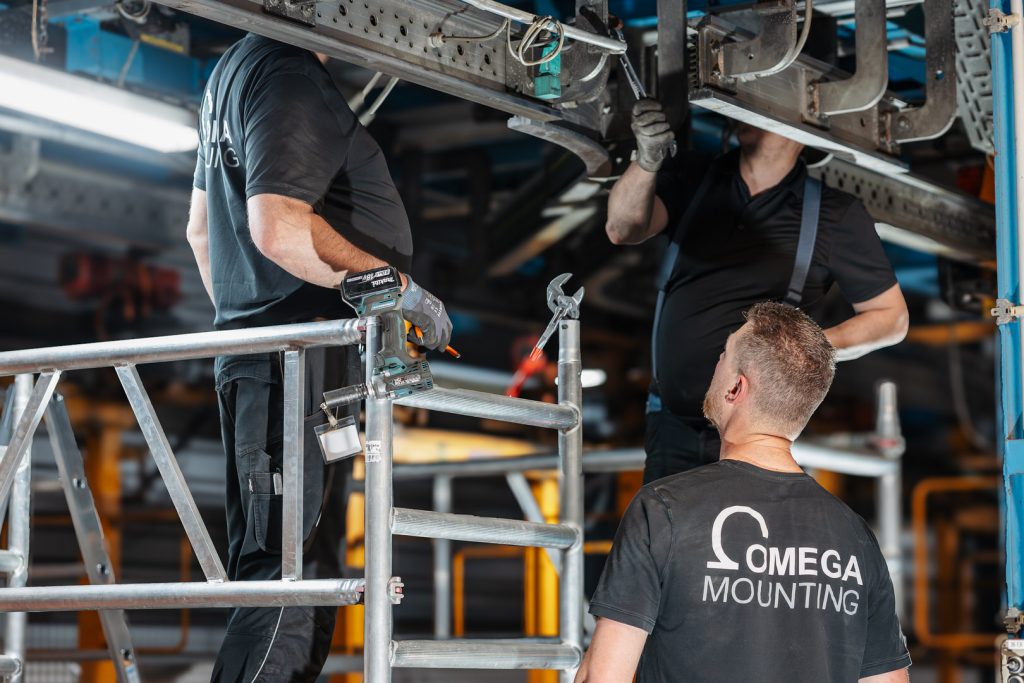
External industrial fitters come into your company in three ways: through a contract for work that owes a result, through a service or framework contract that owes work by effort with the provider's own organisation, or through temporary agency work, where the fitters work under your instructions. Which model fits is decided not by the heading of the contract, but by your site.
“We need two fitters for three weeks.” That is how many enquiries begin – and this very sentence already contains the question this guide is about. Do you want two people your foreman assigns? Or do you want an installed plant, a repaired conveyor line, a running generator? Anyone bringing in external industrial fitters makes a decision with their answer about instructions, responsibility, billing and liability – often without noticing.
The consequences only show later. A contract for work in which your site manager assigns the fitters daily does not match the paper. A service without a scope description ends in a discussion about what was ordered. And an agency arrangement that nobody called by that name brings obligations nobody had planned for.
This guide explains the three models objectively, shows how to recognise them in practice and assigns them to four situations: project, live operations, peak load and emergency. It is the in-depth companion to our foundation article What is industrial installation? and says openly which model we offer as an installation contractor from Rodgau – and which we do not.
Key points at a glance
- A contract for work owes a result: the plant is in place, aligned and accepted – the installation contractor leads its own people and brings tools and installation supervision.
- A service or framework contract owes an activity by effort – with the service provider's own organisation, typical for servicing, maintenance and on-call duty.
- In temporary agency work, the fitters work under your instructions and within your organisation; the agency needs an official licence for this, and the contract must openly name the model.
- Four characteristics reveal the model in practice: who instructs the how, who assigns the work, whose tools are used, and what is documented at the end – acceptance or timesheet.
- A project with a clear result points to the contract for work, maintenance during live operations to the framework contract, peak load and emergency to a service with the provider's own installation supervision.
- Omega Mounting offers contracts for work and services with its own installation supervision – no temporary agency work.
- Six contract elements avoid disputes: scope description, interfaces, acceptance, changes, liability and insurance, points of contact.
What are external industrial fitters?
External industrial fitters are skilled workers of an installation or maintenance contractor who install, dismantle, relocate or maintain machines, plant and steel structures on another company's premises – on the basis of a contract between the two companies. This means industrial mechanics, mechatronics technicians, fitters, welders and installers with lifting experience who are not part of the workforce of the company in which they work.
The term says nothing yet about how the cooperation is legally structured. The same fitters can install a crane system as a contractor for work, service an overhead conveyor as a service provider or work alongside your shift as agency workers. The difference lies in who leads them and what is owed.
Installation service provider, external company, external personnel – three terms, two worlds
An installation service provider delivers a service with its own organisation – it is an external company on your premises that you coordinate but do not lead. External personnel in the narrower sense are agency workers whom you deploy like your own employees. Anyone who speaks of “external personnel in industry” often means both – this blurring causes discussions later. How to coordinate, brief and release external companies is described in our guide on contractor management. This guide is about the question that comes before: which model do you choose?
Which three models are there? Contract for work, service contract, temporary agency work
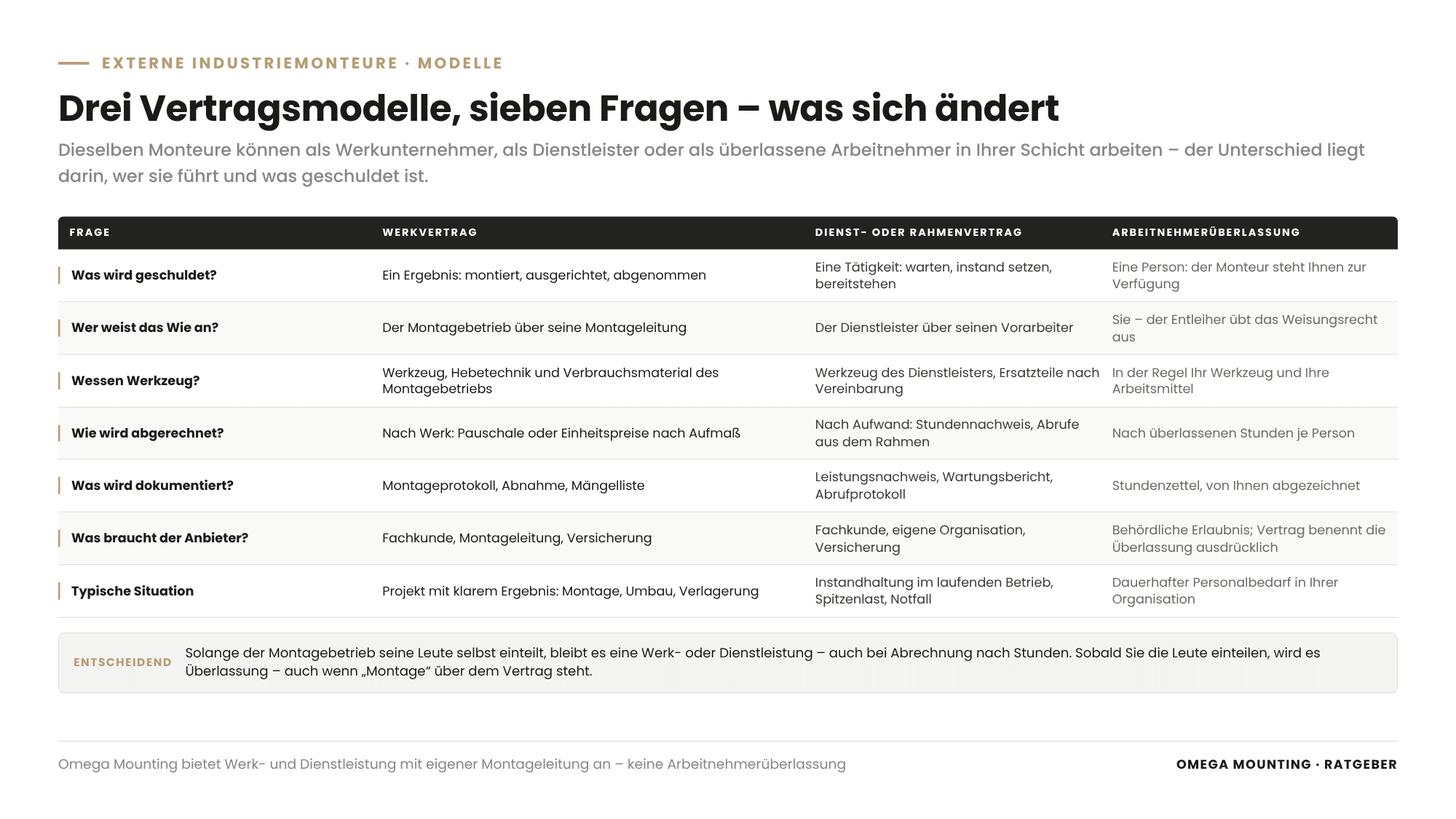
External fitters come into your company via three contract models: the contract for work, which owes a result, the service or framework contract, which owes an activity by effort with the provider's own organisation, and temporary agency work, in which an agency provides you with workers whom you instruct yourself. The table sets the three models side by side.
| Question | Contract for work | Service or framework contract | Temporary agency work |
|---|---|---|---|
| What is owed? | A result: installed, aligned, accepted. | An activity: servicing, repairing, being on call. | A person: the fitter is at your disposal. |
| Who instructs the how? | The installation contractor through its installation supervision. | The service provider through its foreman. | You – the hirer exercises the right to issue instructions. |
| Whose tools? | Tools, lifting equipment and consumables of the installation contractor. | The service provider's tools, spare parts as agreed. | As a rule, your tools and your work equipment. |
| How is it billed? | By the work: lump sum or unit prices by site survey. | By effort: timesheet, call-offs from the framework. | By hours provided per person. |
| What is documented? | Installation record, acceptance, defects list. | Service record, maintenance report, call-off record. | Timesheet, signed off by you. |
| What does the provider need? | Expertise, installation supervision, insurance. | Expertise, own organisation, insurance. | Official licence for temporary agency work. |
Contract for work: a result owed
With a contract for work, you order a result – the installed plant, the welded oil pan, the aligned crane – and the installation contractor organises how to get there itself. The German Civil Code (BGB) distinguishes the contract for work from the service contract at exactly this point: one owes the outcome, the other the activity. For you this means: you describe what should be in place at the end, accept it and have warranty claims if it does not fit. You do not instruct in which order the fitter tightens the bolts. In return, the installation contractor brings its own installation supervision, its own tools and its own lifting equipment and bears the risk that the work succeeds.
Service and framework contract: work by effort with the provider's own organisation
With a service or framework contract, you order an activity – servicing, repair, on-call duty – and pay by effort, while the service provider continues to lead its own people. Typical is the framework contract with call-offs: you agree once on types of service, response, credentials and points of contact and then call off jobs. What you should compare in doing so is in our guide on comparing maintenance quotations. The difference from agency work lies in the organisation: the service provider's foreman decides who comes, how the work is done and when the team changes. You define time windows, scope and sequence together – as coordination between two companies, not as instructions to individual persons.
Temporary agency work: fitters under the customer's right to issue instructions
In temporary agency work, an agency provides you with fitters whom you integrate into your company and instruct yourself – like your own employees, only with a different employer. The AÜG (German Temporary Employment Act) attaches clear conditions to this: the agency needs an official licence, the contract must expressly designate the arrangement as agency work, the assignment is limited in time, and the agency fitters are placed on an equal footing with your own employees in the essential working conditions. For you this means: this model fits when you actually want to bring personnel into your organisation – with your shift plan, your tools and your supervision. It does not fit when you are really ordering a result.
Hybrid forms and where they belong
Intermediate forms can be clean: a contract for work with a time-and-materials share for the unforeseen, a framework contract with maintenance packages and call-offs by effort, an on-call service with an agreed response. What remains decisive is who leads. As long as the installation contractor assigns its own people, it remains a contract for work or services – even when billed by the hour. As soon as you assign the people, it becomes agency work – even if “installation” is written above the contract.
How do you recognise the model in practice? Instructions, integration, tools, documentation
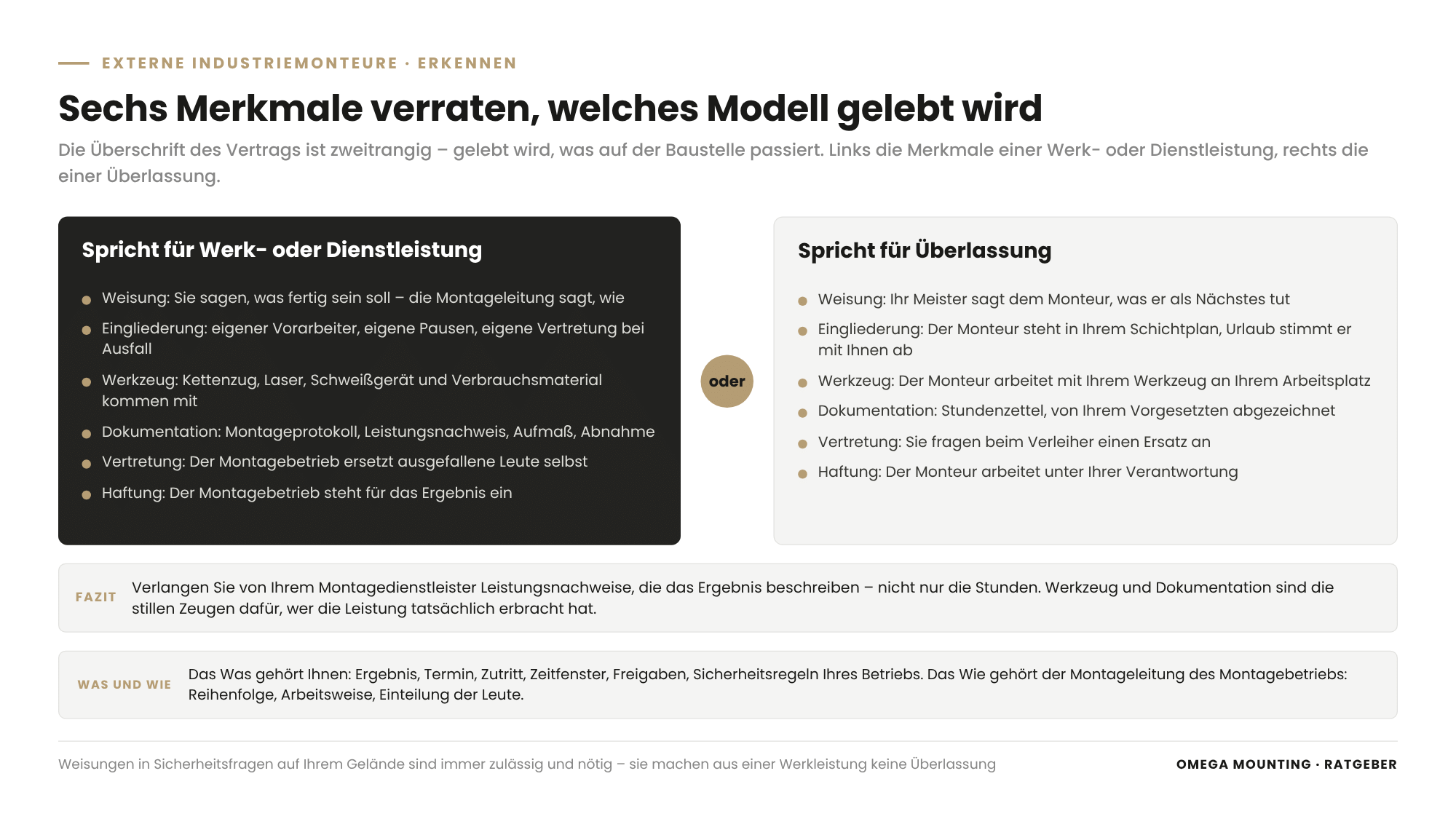
In practice, four characteristics reveal which model is actually practised: who instructs the how, who assigns the fitters, whose tools are used and what is documented at the end. The heading of the contract is secondary – what is practised is what happens on site.
| Characteristic | Points to contract for work or services | Points to agency work |
|---|---|---|
| Instructions. | You say what should be finished; the installation supervision says how. | Your foreman tells the fitter what to do next. |
| Integration. | Own foreman, own breaks, own replacement in case of absence. | The fitter is on your shift plan and agrees holidays with you. |
| Tools. | Tools, lifting equipment and consumables come along. | The fitter works with your tools at your workplace. |
| Documentation. | Installation record, service record, acceptance. | Timesheet, signed off by your supervisor. |
| Replacement. | The installation contractor replaces absent people itself. | You ask the agency for a replacement. |
| Liability. | The installation contractor is answerable for the result. | The fitter works under your responsibility. |
Instructions: the what is yours, the how belongs to the installation contractor
The most important boundary runs between what and how. You say what should be finished, by when and under which conditions of your company – access, time windows, releases, safety rules. Instructions on safety matters on your premises are always permissible and necessary. How the work is carried out in detail is decided by the installation contractor's installation supervision.
Integration: own foreman instead of your shift plan
An installation contractor brings its own leadership: an installation supervisor or foreman who decides on site and is the point of contact for your site manager. The fitters are on the installation contractor's deployment plan, not on your shift plan. For lifting operations, the appointed person for lifting operations is added, provided by the installation contractor.
Tools and documentation: the silent witnesses
Whoever brings chain hoist, laser, welding set and consumables is working as a contractor. Whoever hands over an installation record, site survey or maintenance report at the end has delivered a service. A timesheet signed off by your supervisor, by contrast, documents hired working time. For you this means: demand service records from your installation service provider that describe the result – not just the hours.
Which model suits which situation? Project, live operations, peak load, emergency
A project with a clear result points to the contract for work, maintenance during live operations to the framework contract, peak load to a service with the provider's own installation supervision – and the emergency to the service provider who comes when called and decides on site. Temporary agency work fits where you permanently need personnel in your own organisation and want to lead them accordingly.
| Situation | Suitable model | Advantage | Disadvantage or condition |
|---|---|---|---|
| Project with a clear result (installation, conversion, relocation). | Contract for work. | Result, acceptance and warranty; installation supervision included. | Scope description must be complete; changes become change orders. |
| Maintenance during live operations. | Framework contract with call-offs. | Well-rehearsed team, familiar plant, plannable windows. | Define the scope per call-off, otherwise effort grows unnoticed. |
| Peak load (overhaul, shutdown, series work). | Service with own installation supervision or contract for work per work package. | Team scales with progress; your people stay in their role. | Clarify interfaces with your employees beforehand. |
| Emergency (plant down, generator fails). | Service by effort, on-call duty from the framework contract. | Service provider decides on site, organises parts and a temporary solution. | Scope is open; releases and points of contact must be reachable at night. |
| Permanent personnel requirement in your organisation. | Temporary agency work through a licensed agency. | You lead the people yourself, like your own employees. | Limited in time, equal treatment, agency licence; Omega does not offer this. |
Project with a clear result: contract for work
If something should be in place at the end that you can accept, the contract for work is the natural route. The crane installation, the test rig conversion, the relocation of a machine – each with scope description, dates, interfaces and acceptance. What belongs in an enquiry and what a reliable quotation consists of is described in our guide on commissioning industrial installation. The more clearly the result is described, the less reason for instructions during the work.
Maintenance during live operations: framework contract
With recurring maintenance, the result is harder to describe than the activity. A framework contract defines types of service, credentials, response and points of contact; each call-off names plant, window and scope. The team knows the plant, your maintenance department keeps control without instructing every move. How work alongside production is organised is shown in the guide on Maintenance during live operations; what belongs in a maintenance contract, in the guide on the maintenance contract in industrial maintenance.
Peak load: service with own installation supervision
Overhaul, annual shutdown, series installation – for a few weeks you need more hands than your company has. The reflex of “hiring fitters” often leads to agency work, although a service with the provider's own installation supervision fits better: the installation contractor takes on a work package, brings leadership and tools and adapts the team to progress. How work packages are bundled in a shutdown is described in the guide on shutdown planning in maintenance.
Emergency: the service provider who decides on site
In an emergency, there is no scope description, only a goal: the plant should run again. What counts here is that the service provider decides on site – troubleshooting, temporary solution, parts procurement – and you grant the releases your company requires. An on-call arrangement from the framework contract regulates beforehand who calls, who comes and what is documented. What proximity is worth in a breakdown is shown in the guide on the installation contractor in the Rhine-Main region.
What do we offer as external industrial fitters – and what not?
Omega Mounting offers contracts for work and services with its own installation supervision: installation, moving in, relocation, dismantling, conversion in existing facilities and maintenance as a contract for work, individual order or framework contract with call-offs – no temporary agency work. Our fitters come to your site with a foreman or installation supervisor, their own tools, their own lifting equipment and their own risk assessment, and leave with an installation record, service record or acceptance.
There is a practical reason for this. Our service depends on mechatronics technicians, fitters and lifting equipment working as a team – with one person who decides on site. Anyone who asks us for “two fitters for three weeks” therefore receives a quotation for a work package or a framework call-off with installation supervision – and the question of what should be finished at the end. Which service modules we offer in detail is shown on our service page Industrial installation.
This guide is no substitute for legal advice. Whether a contract in an individual case is to be assessed as a contract for work, a service contract or agency work depends on the practice actually followed and, in case of doubt, is a matter for your legal department or a specialist lawyer. What we contribute is a contract and a site organisation that match what we do.
How does cooperation on site work? Induction, coordination, lone working, credentials
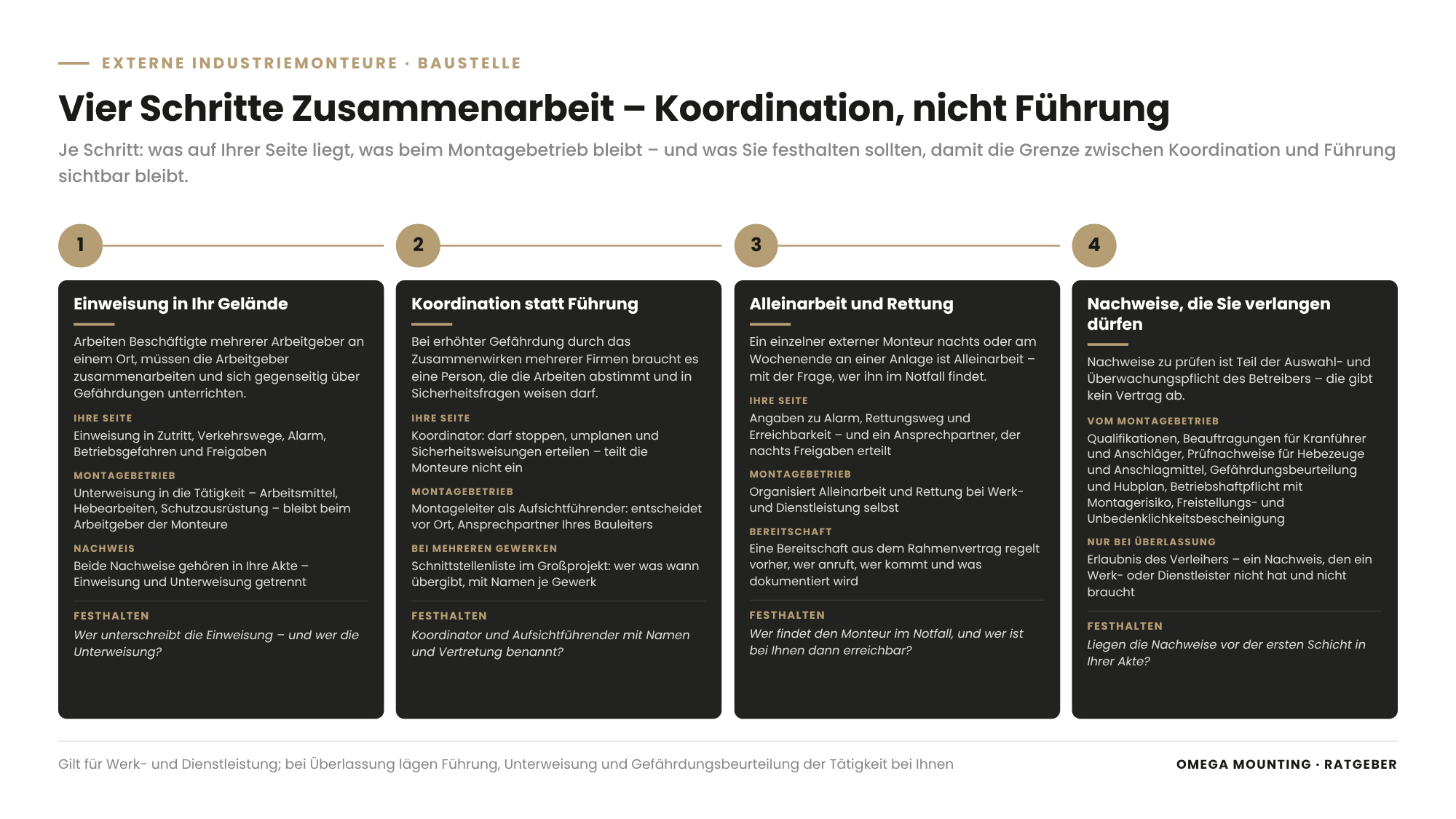
Cooperation with external fitters runs in four steps: you induct them to your premises, you coordinate the work with your company and other firms, you clarify lone working and rescue, and you have the installation contractor's credentials presented to you. None of this is leadership of the fitters, but coordination between two companies.
Induction to your premises
If employees of several employers work at one location, the ArbSchG (German Occupational Safety Act) requires the employers to cooperate and inform each other about hazards. For you this means: you induct our fitters on access, traffic routes, alarms, operational hazards and releases; the briefing on the activity itself – work equipment, lifting operations, protective equipment – remains with us as the employer. Both records belong in your file. The procedure in detail is described in the guide on contractor management, of which this article is the in-depth companion.
Coordination instead of leadership
Where the interaction of several firms increases the hazard, a person is needed who coordinates the work and has authority to issue instructions on safety matters – this is required by DGUV Vorschrift 1 (DGUV Regulation 1). This coordinator is your role; on our side, the installation supervisor acts as the supervisor in charge. The coordinator may stop, replan and issue safety instructions – they do not assign our people. Anyone who records both roles with names and deputies has drawn the line between coordination and leadership. In large projects with several trades, the interface list is added, described in the guide on interfaces in large projects.
Lone working and rescue
A single external fitter at a plant at night or at the weekend is lone working – with the question of who finds them in an emergency. In a contract for work or services, the installation contractor organises this itself, but needs your information on alarms, escape routes and reachability. What needs to be regulated is in the guide on lone working in maintenance.
Credentials you may demand
From an installation contractor, you may demand proof of qualifications, appointments for crane operators and slingers, inspection records for lifting equipment and lifting accessories, risk assessment and lift plan for your site, public liability insurance covering installation risk, as well as tax exemption and clearance certificates. The guide on subcontractor credentials in installation sets out which of these mean something and which do not. For agency work, the agency's licence is added – a credential that a contractor for work or services does not have and does not need.
Which contract contents avoid disputes? Scope description, acceptance, liability, insurance
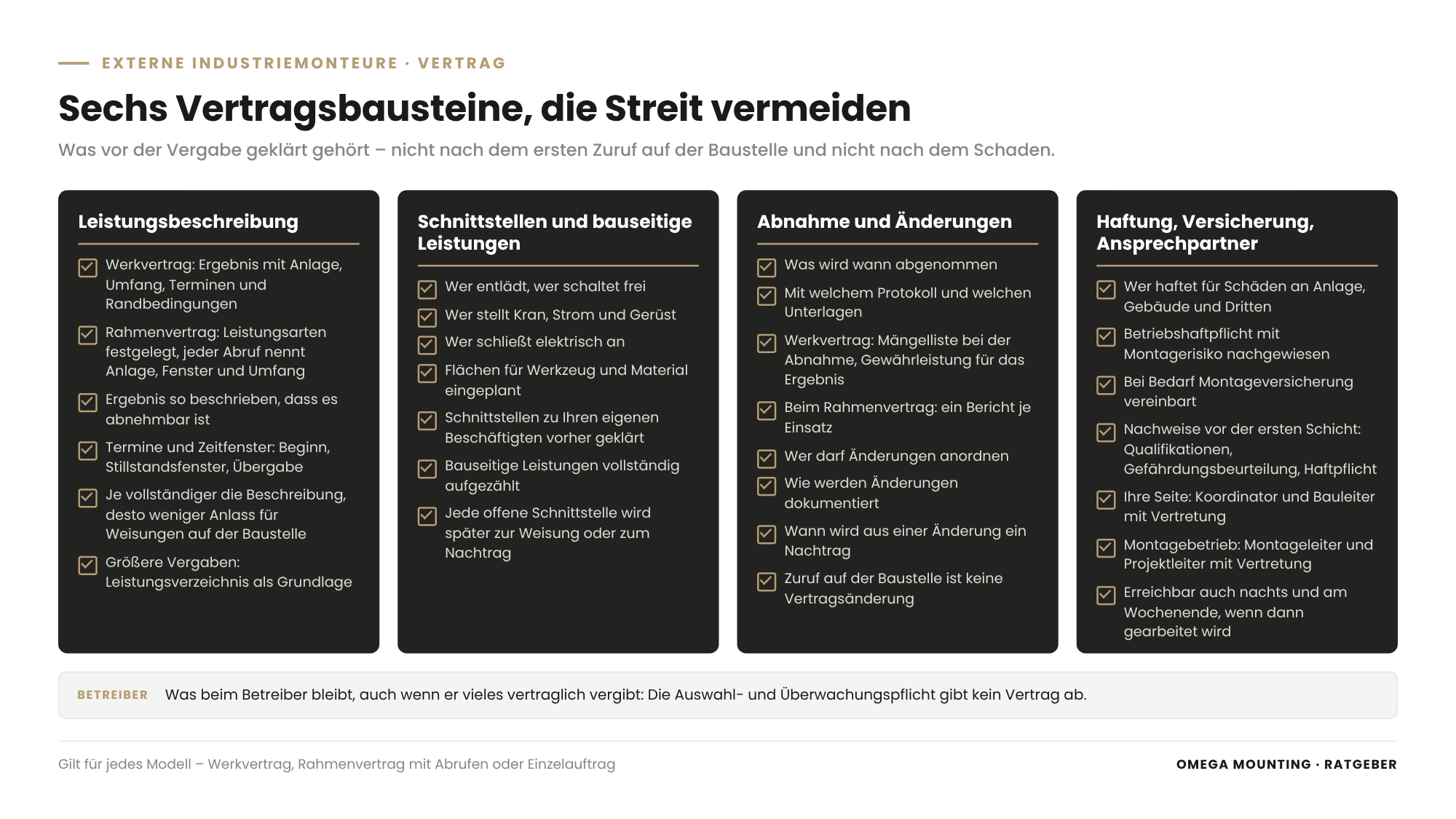
Six contract elements avoid most discussions with external fitters: a scope description with result or extent, the interfaces and client-provided services, acceptance with documentation, the handling of changes, liability and insurance, and the points of contact on both sides with deputies. They belong in every contract – regardless of the model.
- Scope description. For a contract for work, the result with plant, extent, dates and boundary conditions; for a framework contract, the types of service and the call-off. For larger awards, the scope of works for installation and moving in is the basis.
- Interfaces and client-provided services. Who unloads, who isolates, who provides crane, power and scaffolding, who makes the electrical connection – every open interface later becomes an instruction or a change order.
- Acceptance and documentation. What is accepted when, with which record, and which documents belong to it. How handover and acceptance run properly is shown in the guide on commissioning and handover of a plant.
- Changes and change orders. Who may order changes, how they are documented, and when a change becomes a change order. Otherwise every shout across the site becomes a contract amendment.
- Liability and insurance. Who is liable for damage to plant, building and third parties, and which insurance covers what – public liability insurance covering installation risk, erection all-risks insurance if required. This needs to be clarified before the award, not after the damage.
- Points of contact and deputies. On your side, coordinator and site manager; on ours, installation supervisor and project manager – reachable at night and at weekends too, if work is done then.
What remains with the operator even when much is contracted out is explained in the guide on operator responsibility in maintenance: no contract hands over the duty to select and supervise.
External industrial fitters in the Rhine-Main region: how we work
Anyone looking for external industrial fitters in the Rhine-Main region gets from us a team with installation supervision that reaches Frankfurt, Offenbach, Hanau, Darmstadt and Aschaffenburg from Rodgau with short distances – and travels further when needed, as far as Munich or Leipzig. Proximity pays off differently for each model: for a contract for work as a site visit before the quotation and rectification without overnight travel, for a framework contract as the same team in every weekend window, in an emergency as reachability via the 24-hour hotline.
The industrial fitters from Rodgau bring the trade from a single source: mechatronics technicians for mechanics and plant electrics, lifting equipment from chain hoist to coordinating the mobile crane, on-site welding and a workshop for parts that are missing. Whether a production plant in Hanau, a logistics centre near Darmstadt or a data center in Frankfurt – always as an external company with its own leadership that submits to your site rules.
How we do it in practice
Five jobs from our project diary show the four situations – and the same way of working: take on a result or work package, lead our own people, coordinate with your company.
Munich: test rig conversion as a contract for work with a clear result
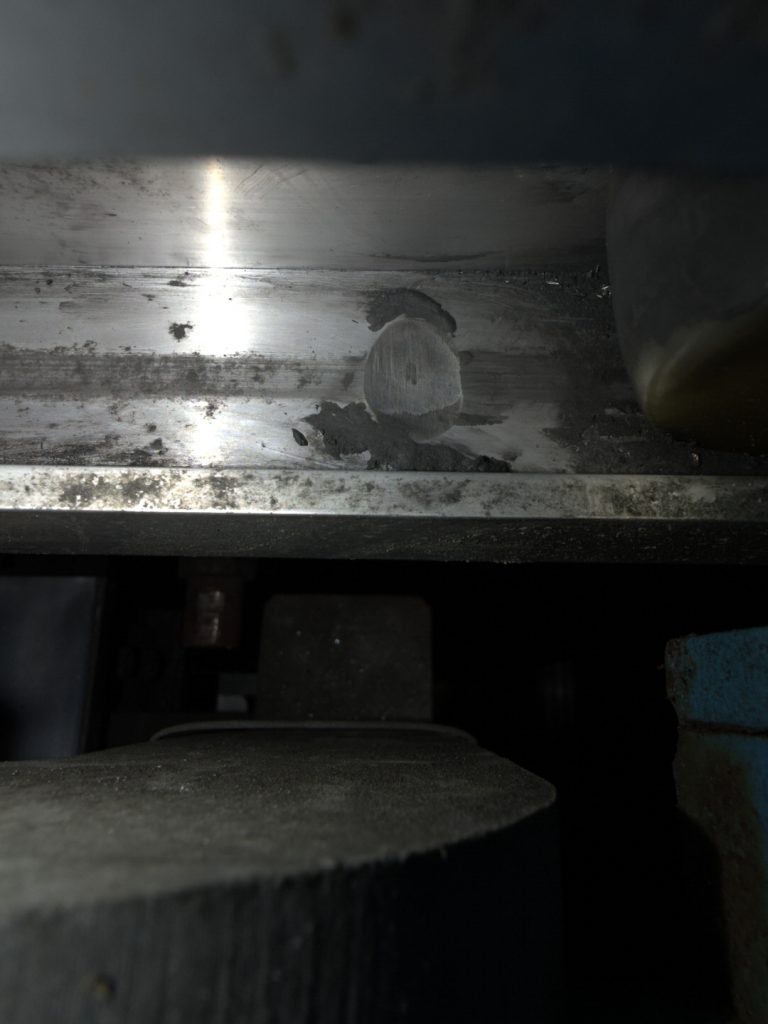
During the conversion of a hydraulically operated test rig in Munich the result was clearly described: a surrounding oil pan around the concrete foundation that collects escaping oil in a controlled manner. Our fitters modified the existing hydraulic line, anchored and bolted the pan, welded corners and transitions leak-tight, fitted drain cocks and hoses, ground, primed and painted the seams and sealed the gap to the concrete wall oil-resistant. Welding was done in a cramped basement room with welding fume extraction and fresh air supply.
For your contract for work, this means: the customer described what should be leak-tight – how to weld and seal was decided by the installation supervision on site. This separation makes a work acceptable.
Crane installation at over 30 m: one day, three fitters, other trades
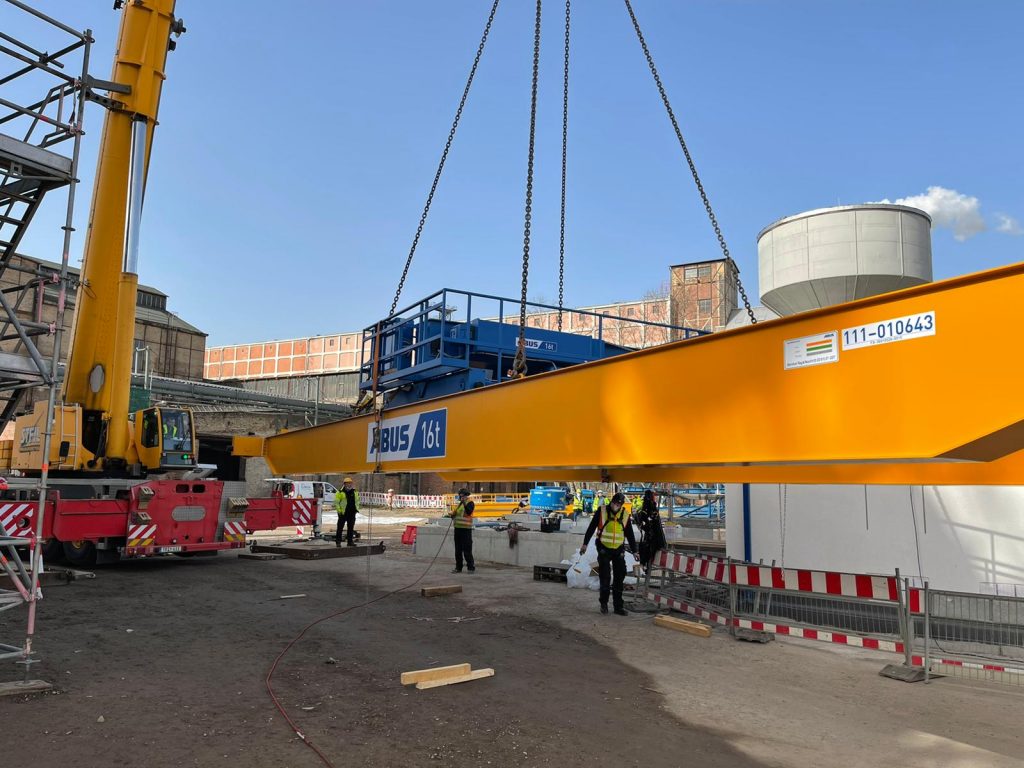
With the installation of a 16 t crane at a height of over 30 m three of our fitters worked together with other trades in one day – at a customer in the hygiene and healthcare sector where safety was particularly important. The job went to plan.
For your project, this means: where several trades work together in one day, each needs its own leadership and the client needs a coordinator. Three fitters with installation supervision are a contractor for work – three fitters assigned by the site manager would be something else.
Frankfurt area: overhead conveyor as a framework service in weekend shutdowns
With the maintenance of an overhead conveyor in the Frankfurt area the in-house maintenance team kept a roughly 30-year-old system with around 100 switches running, but had no time for major interventions during live operations. We first recorded every switch and assessed its condition. Spare parts, scope and sequence were defined together with the customer – heavily damaged and operationally important switches first. The work ran in several weekend shutdowns with windows of up to around 36 hours, each with four technicians working in parallel.
For your maintenance, this means: coordinating scope and sequence with the customer is cooperation between two companies. Who removes which switch in which order on Saturday was decided by our team – that is the difference between a framework contract and agency work.
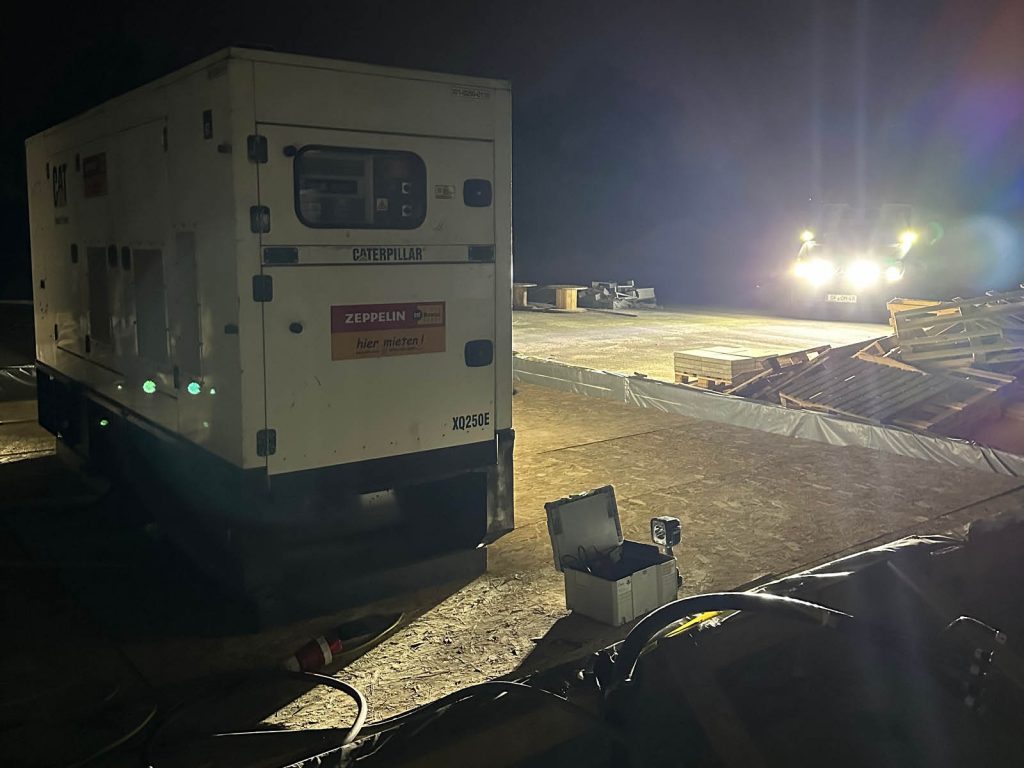
Sunday evening: emergency call-out on a standby generator
During the emergency call-out on a Sunday evening a logistics company under construction called whose standby generator supplied the site and was no longer operational – production was due to start on Monday at 4 am. Our team disconnected cables, drained operating fluids and lifted the old generator out of the drip tray – by the light of torches and floodlights. The new generator procured by the customer had a different connection panel; we set up a temporary solution with batteries, organised the connection parts overnight and connected generator, diesel lines and earthing in the morning. By Monday midday the generator was running; later, on our suggestion, a second was added for redundancy.
For your emergency, this means: what was commissioned was neither a result nor a number of hours, but “come and decide on site”. Only a service provider with its own organisation can do that – and with a point of contact at your company who grants releases at night.
Leipzig: peak load with a team that the installation contractor adapts
With the installation of 32 vehicle restraint systems at a logistics centre near Leipzig we provided eight technicians – mechatronics technicians, fitters and electricians – in the first project week; after that, three took over the precision assembly and the preparation for commissioning. Mechanics, hydraulic power units, traffic light systems, 32 control desks and cable routes came from a single source, so no further electrical firms had to be coordinated. Commissioning took place together with the manufacturer.
For your peak load, this means: the team grew and shrank with progress – decided by the installation contractor, not by the customer. That is peak load as a service with own installation supervision, not as hired heads.
External fitters at your site: is a project, a weekend window or an overhaul coming up?
Then get in touch with us. During a site visit in Frankfurt, Offenbach, Hanau, Darmstadt or elsewhere in the Rhine-Main region, we clarify whether your situation is a contract for work, a framework call-off or a work package with installation supervision – and what you need to prepare on your side.
What this means for your role
For buyers: Decide on the model before you enquire – result, activity or personnel – and write it into the contract. Compare quotations only within the same model: a contract for work and an hourly quotation are not the same service.
For designers: Plan installation and maintenance as an external service with its own organisation: areas for tools and material, time windows, interfaces with your trades and client-provided services. The more complete the scope description, the less reason for instructions on site.
For project managers and site managers: As project manager, you keep scope description, acceptance and change orders under control and name points of contact with deputies. As site manager, you induct, coordinate and release – and tell the installation supervisor what should be finished, not the fitter what to do next.
For maintenance managers: For you, the framework contract with call-offs is the model that brings a well-rehearsed external team to your plant without you having to lead it. Define scope and sequence per call-off together and demand a report per job – then control stays with you and execution with the installation contractor.
For safety officers and HSE coordinators: Check that coordinator and supervisor in charge are named and that induction and briefing are documented separately. In a contract for work or services, the risk assessment of the activity remains with the installation contractor; in agency work it would lie with you – a difference that affects your documentation.
For operations and plant managers: Anyone who deploys external installation personnel like their own people takes on leadership and responsibility without noticing. Choose consciously: a service with own installation supervision for a work package, agency work through a licensed agency for personnel in your organisation.
Distinction checklist contract for work/service/agency work: on request
The distinction checklist is a one-page list of characteristics to tick: Who instructs the how? Who leads and provides replacements? Whose tools? How is it billed? What is accepted? In each row, the tick points to the model you are actually practising – and makes visible where contract and practice diverge. It is not a legal opinion, but it helps to ask the right question before the award. Request the list via our Contact form – quoting the keyword “Distinction checklist contract for work”.
Why Omega Mounting?
We are based in Rodgau near Frankfurt, reachable via our 24-hour hotline, and have our own workshop for brackets, frames and parts that would otherwise hold up an installation. The linked jobs show how we work as external fitters: a test rig conversion in Munich with a clearly described result, an overhead conveyor in the Frankfurt area in weekend windows with four technicians, an emergency on a Sunday evening and a series installation near Leipzig with a team that shrank from eight to three. For you this means: a single point of contact for installation, maintenance and lifting with our own installation supervision, a contract that matches what we do – and short distances in the Rhine-Main region.
Conclusion
External industrial fitters come into your company via a contract for work, a service or framework contract or temporary agency work – and the right model follows from the situation: project with a result, maintenance during live operations, peak load or emergency. What is decisive is not the heading of the contract, but who instructs the how, who assigns, whose tools are used and what is documented. We offer contracts for work and services with our own installation supervision, no agency work – because our service depends on a team with leadership deciding on site. If you would like to know which model suits your site, send us the plant, the situation and the time window – we will get back to you with an honest assessment of whether it becomes a contract for work, a framework call-off or a work package.
Planning maintenance, moving in or installation in the Rhine-Main region?
Tell us briefly what it is about – we will come back to you with an honest assessment.
100% free and without obligation
You may also be interested in these guides

About the author
Tobias Schott
Managing director of Omega Mounting GmbH, Rodgau · more than 20 years of hands-on experience in installation and maintenance
A trained mechatronics technician, at home in maintenance, servicing and industrial installation since 2004 – first at his father's side, since 2012 with Omega Mounting: from the overhead conveyor in Frankfurt to the crane system in a new-build hall. Plans and leads lifting operations as appointed person in data centers and on industrial sites in the Rhine-Main region, is an instructor and examiner for cranes, mobile elevating work platforms and telehandlers, and a safety officer. On jobs abroad he is known as the “German Troubleshooter” – the one you call when things get stuck on site. He learned what quality means not from a manual but from his father: Made in Germany as a standard for his own work, not as a label. That is why it comes first at Omega Mounting – before speed and before price. He writes these guides from that practice: what works on our sites is in them – what only exists in the standard is not.
Frequently asked questions
In a contract for work, the installation contractor owes a result and leads its fitters itself – with its own installation supervision, its own tools and acceptance at the end. In temporary agency work, an agency provides you with fitters whom you integrate into your company and instruct yourself. The difference therefore lies not in the person, but in who instructs the how and what is owed.
Yes – on safety matters on your premises always, and on the what of the service in any case: result, dates, time windows, releases, site rules. The instruction on how the work is carried out in detail belongs, in a contract for work or services, to the installation contractor's installation supervision. Anyone who instead assigns the fitters like their own people is practising agency work in reality.
A framework contract pays off when the same plant is serviced or repaired recurrently and a well-rehearsed team is worth more than awarding each job separately. It defines once the types of service, credentials, response and points of contact; each call-off names plant, window and scope. Individual orders fit self-contained projects with a clear result.
No. We work as a contractor for work or services with our own installation supervision – as a contract for work, individual order or framework contract with call-offs. Our fitters come as a team with foreman, tools and lifting equipment and remain within our organisation. Anyone who wants to bring personnel into their own shift needs an agency with an official licence.
The effort depends on the model and the situation: for a contract for work on scope, lifting equipment, pre-assembly and client-provided services; for a framework contract on types of service and call-offs; in an emergency on time on site, parts and work outside regular hours. A figure without a site visit or without a scope description is therefore no statement. What a reliable quotation consists of is explained in our guide on commissioning industrial installation.
Contracts for work and service contracts are governed by general contract law, agency work by the AÜG (German Temporary Employment Act) with its licensing and labelling requirements. In occupational safety, several employers at one location must cooperate, inform each other about hazards and appoint a coordinator where hazards are increased. The assessment in the individual case is a matter for your legal department.
Yes, the three models and the four characteristics apply equally in production, logistics, data center, energy and food businesses. What changes are the boundary conditions: access and escort requirement in the data center, hygiene in the food business, releases in sensitive plants. The question of who instructs the how remains the same.
From Rodgau, Omega Mounting provides installation teams with installation supervision for Frankfurt, Offenbach, Hanau, Darmstadt, Aschaffenburg and the rest of the Rhine-Main region – as a contract for work for projects, as a framework contract for maintenance and in an emergency via the 24-hour hotline. Jobs extend as far as Munich and Leipzig.
With a short enquiry containing three details: plant or situation, desired result or scope, and time window or maintenance window. We arrange a site visit, walk through interfaces, releases and client-provided services with you and send you a written assessment of whether it becomes a contract for work, a framework call-off or a work package with installation supervision. Your contact is Tobias Schott – reachable via our Contact form.
 English
 German