
- Guide – Lift & Shift
Commissioning and handover of a plant: from construction to operation
By Tobias Schott · Reading time approx. 24 minutes · Last updated: October 2026
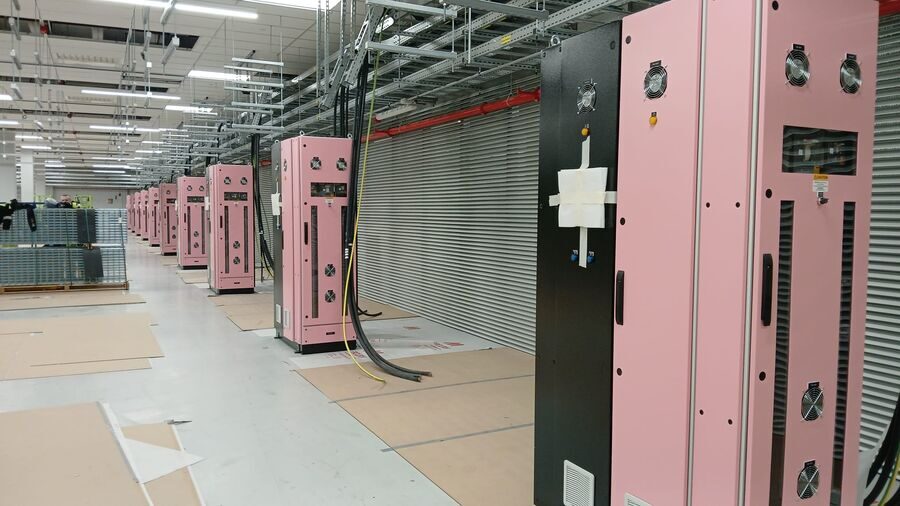
The commissioning and handover of a plant succeeds when every phase between the end of installation and the first day of operation has a responsible person and a document. That ranges from the completion notice through testing, trial run and acceptance to the briefing of those who will maintain the plant in future.
The installation is finished, the plant stands aligned in its place, the fitters are packing up. For the site manager, the phase now begins that is often just one line in the construction schedule and in reality decides weeks. Anyone searching for “commissioning handover plant” usually has exactly these questions: Who tests before the first switch-on? Who runs the trial run, who the load run? When is the plant accepted – and when does the warranty begin? And which documents must the maintenance manager have in hand before taking over the plant?
These questions usually come up in projects in Frankfurt, Offenbach or Darmstadt when they are already pressing. Production wants to start up, the data center operator wants to keep its date, the documentation is in three different formats at three companies. What is missing is not noticed at handover but at the first breakdown. Then nobody can find the circuit diagram, and the spare parts list is with the manufacturer.
This guide is the continuation of our article on the sequence of a moving-in day. There the story ends with the aligned plant; here it continues through to operation. We show the phases between the end of installation and handover, the document list and the documentation check. Plus the classification of acceptance and start of the warranty and the special features in the data center – with examples from Frankfurt and the surrounding area.
Key points at a glance
- Commissioning is not a point in time but a sequence of phases: completion notice, pre-commissioning inspection, cold and hot commissioning, load run, acceptance and handover. Each has its own responsible person and a document.
- Before the first switch-on of a plant whose safety depends on the installation, an inspection is required – the BetrSichV (Industrial Safety Ordinance) demands it, and the installation report is its basis.
- The handover needs ten types of document: operating instructions, circuit diagrams, conformity documents, spare parts lists, test reports, software and parameter versions, maintenance schedule, punch list, acceptance report and photo documentation.
- A documentation check examines completeness, agreement with the as-built condition, legibility and storage location – before signing, not afterwards.
- Acceptance is the legal turning point: with it, under VOB/B (German construction contract procedures), risk passes and as a rule the period for defect claims begins. That is why it belongs in a formal procedure, with a report and reservations, not tacitly.
- Briefing the operating personnel and handing over to maintenance are part of commissioning, not an appendix: those who will maintain the plant in future should be present at the trial run.
- In the data center, commissioning and handover run as staged tests up to the integrated systems test – the installation delivers mechanical completion with verifications on which everything else builds.
What is the commissioning and handover of a plant?
The commissioning of a plant is the process in which a fully installed plant is gradually put under voltage, pressure, medium and load, tested and brought to its agreed function. The handover is the subsequent act in which the contractor hands the plant over to the client and its operations with documentation, briefing and report. In between lies acceptance: the client's declaration that the service has been essentially performed in accordance with the contract.
Three terms are mixed up in everyday use and should be kept separate. Mechanical completion means: the plant is installed, aligned, anchored and connected, but not yet in operation. Internationally this is called Mechanical Completion. Commissioning means: the plant is put into operation and tested in stages. Acceptance means: the client declares that it accepts the service as being in accordance with the contract. Handover, finally, is the organisational change from project to operations. A plant can be in operation without being accepted. It can be accepted without being handed over. Every gap between these states costs time later.
Who hands over to whom?
With a plant involving several parties, there are several handovers. The installation partner hands mechanical completion over to the plant builder or the electrical trade. The plant builder hands the commissioned plant over to the client, the project manager hands over to operations. The site manager knows this chain and ensures that a report is produced at every point. What our installation contributes in this chain is described on our page on industrial installation in existing buildings.
Which phases lie between the end of installation and operation?
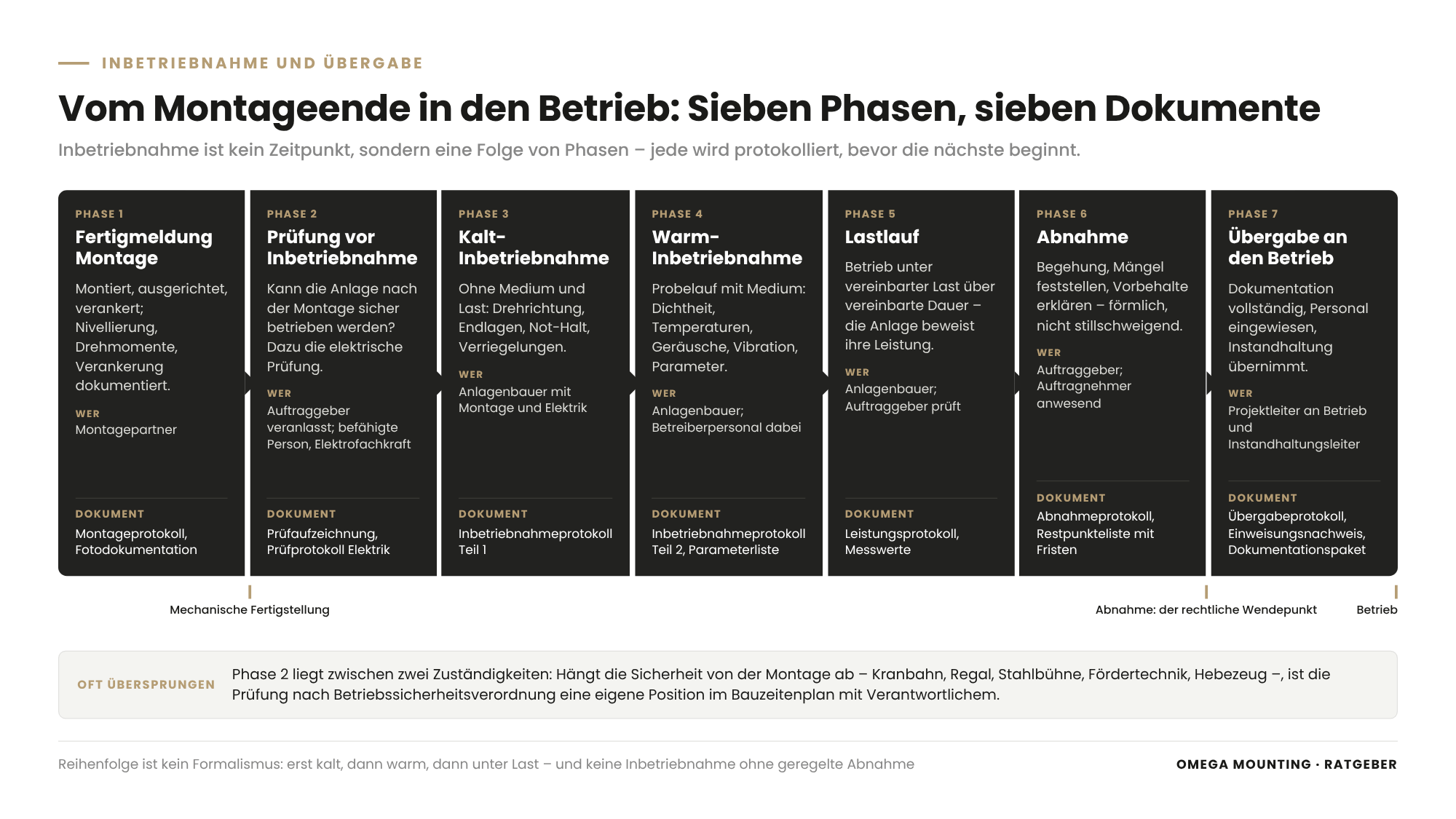
Between the end of installation and operation lie seven phases: the installation completion notice with installation report, the pre-commissioning inspection, cold commissioning without medium and load, hot commissioning with trial run. Then follow the load run or performance test, acceptance with punch list, and handover with briefing and documentation. The table shows who is responsible in each case and which document is produced.
| Phase | What happens | Responsible (typically) | Document |
|---|---|---|---|
| Installation completion notice. | Plant installed, aligned, anchored. Levelling, torques, anchoring documented. | Installation partner. | Installation report, photo documentation, completion notice. |
| Pre-commissioning inspection. | Inspection by a competent person to check whether the plant can be operated safely after installation. Electrical test. | Arranged by the client. Competent person / qualified electrician. | Inspection record, electrical test report. |
| Cold commissioning. | Functional test without medium and load: direction of rotation, end positions, safety devices, emergency stop, interlocks. | Plant builder with installation and electrical trades. | Commissioning report part 1, safety device checklist. |
| Hot commissioning / trial run. | Operation with medium, without or with partial load. Tightness, temperatures, noise, vibration, parameters. | Plant builder. Operator personnel are involved. | Commissioning report part 2, parameter list. |
| Load run / performance test. | Operation under agreed load for an agreed duration. Verification of performance values. | Plant builder. Client checks. | Performance report, measured values. |
| Acceptance. | Walk-through, identification of defects, reservations, declaration of acceptance. | Client. Contractor present. | Acceptance report, punch list with deadlines. |
| Handover to operations. | Documentation complete, personnel briefed, handover to maintenance. | Project manager to operations / maintenance manager. | Handover report, briefing record, documentation package. |
The pre-commissioning inspection
One phase is regularly skipped because it falls between two areas of responsibility: the inspection before first commissioning. If the safety of a plant depends on the installation – crane runway, racking, steel platform, conveyor technology, lifting gear – it must be inspected after installation and before first use. The BetrSichV (Industrial Safety Ordinance) requires this. The German technical rule TRBS 1201 (Inspections and checks of work equipment) specifies what the inspection record must contain. For you as site manager this means: the inspection is a separate item in the construction schedule with a responsible person – not the expectation that “the manufacturer will do it as part of the job”. The installation report with levelling, diagonal dimensions, torques and anchoring is the basis of this inspection. Which plant needs which inspection is set out in our basic guide to the inspection obligations for operators compiled in a table.
Cold before hot, hot before load
The sequence of commissioning is not a formality. Anyone who starts a pump with medium before direction of rotation and end positions have been checked risks the pump. Anyone who puts a generator under load before protective devices have been tested risks more. Therefore: first the function without medium (cold), then with medium without load (hot), then under load. Each stage is recorded before the next begins. And each stage has an abort criterion.
Which documents belong to the handover of a plant?
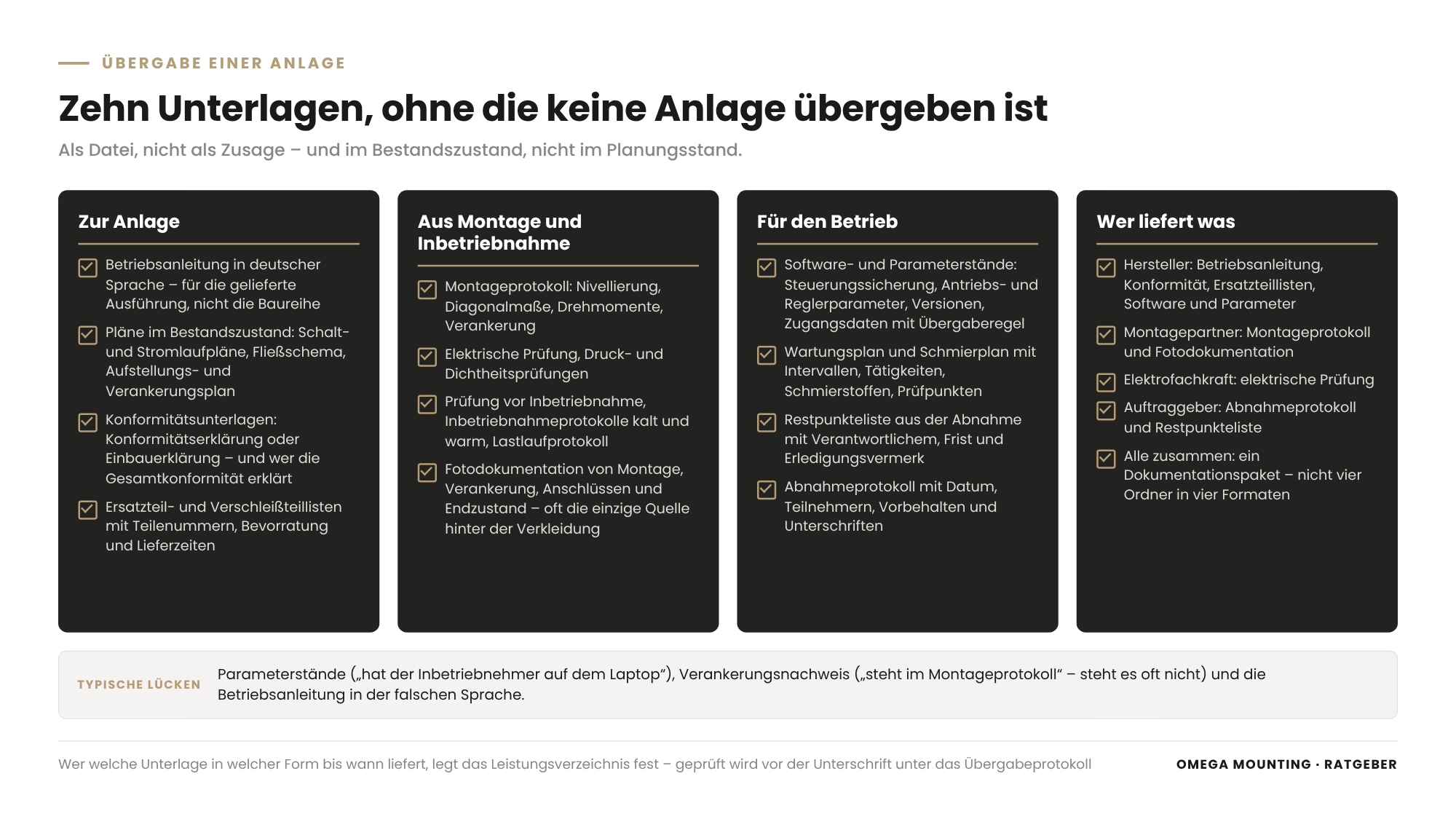
The handover of a plant includes ten types of document: the manufacturer's operating instructions, the circuit and wiring diagrams as well as flow and layout drawings in as-built condition, the conformity documents, the spare and wearing parts lists. Plus the test reports from installation and commissioning, the software and parameter versions, the maintenance schedule with lubrication schedule, the punch list, the acceptance report and the photo documentation. If one of them is missing, it is not missing at handover but at the first breakdown at three in the morning.
The document list
- Operating instructions from the manufacturer in German, for the version supplied – not the series. With information on transport, installation, operation, maintenance and troubleshooting.
- As-built drawings: Circuit diagrams and wiring diagrams, flow diagram for utilities, layout drawing with actual positions, foundation and anchoring drawing. As built, not as planned.
- Conformity documents: Declaration of conformity with marking for complete machinery. For partly completed machinery that is only assembled into a plant on site, the declaration of incorporation and clarification of who declares overall conformity. This point should be settled before the award, not at handover.
- Spare and wearing parts lists with part numbers, recommended stock levels and lead times. Plus the list of parts already replaced during commissioning.
- Test reports: Installation report (levelling, diagonal dimensions, torques, anchoring), electrical test, pressure and tightness tests, pre-commissioning inspection, cold and hot commissioning reports, load run report.
- Software and parameter versions: Backup of the control programs, parameter lists of drives and controllers, version numbers, access data with handover rule. So that the plant runs after a controller replacement as it did on handover day.
- Maintenance schedule and lubrication schedule with intervals, activities, lubricants and inspection points. It is the basis for the operator's risk assessment and a later maintenance contract.
- Punch list from acceptance with responsible person, deadline and completion note for each item.
- Acceptance report with date, participants, reservations and signatures.
- Photo documentation of installation, anchoring, connections and final condition. Often the only source when something is later hidden behind cladding.
Who supplies what
The list shows why handover is a coordination task. Operating instructions, conformity, spare parts and software come from the manufacturer. Installation report and photo documentation from the installation partner, electrical test from the qualified electrician, acceptance report and punch list from the client. So that a documentation package is produced at the end, and not four folders in four formats, the scope of works defines who supplies which document in which form by when. How to word this is shown in our guide to the scope of works for installation and moving in.
How do you check the documentation before handover?
You check the documentation before handover in four steps: completeness against the document list, agreement with the actual as-built condition, legibility and usability for operations. The fourth step is filing in a location known to maintenance and operator. The check takes place before the handover report is signed. Afterwards the leverage to enforce subsequent deliveries is gone.
Step 1: Completeness
Go through the ten types of document and tick off what is available – as a file, not as a promise. Typical gaps: parameter versions (“the commissioning engineer has them on his laptop”), anchoring verification (“it's in the installation report” – often it is not). And the operating instructions in the wrong language.
Step 2: Agreement with the as-built condition
Drawings that show the design status are worthless for maintenance if the plant was built differently. Check on a sample basis: Does the plant stand where the layout drawing shows it? Do the terminal designations in the circuit diagram match the switchgear cabinet? Have subsequent changes from commissioning been incorporated? When installing power distribution cabinets in a data hall, the laser survey with marked set-down positions is exactly this comparison. Every position is surveyed before the cabinet is placed and documented after setting down.
Step 3: Legibility and usability
Documentation is written for operations, not for the project. Can the maintenance manager build an inspection calendar from the maintenance schedule? Can the qualified electrician find the fuse they are looking for in the wiring diagram? Is the spare parts list labelled so that purchasing can order? If not, the documentation exists but has not been handed over.
Step 4: Filing
Define before handover where the documentation package is kept (plant file, digital maintenance system, project folder). And define who keeps it up to date. The best documentation is useless if, after the project, it sits on the drive of a project manager who has left.
When does the warranty begin – and what does acceptance have to do with it?
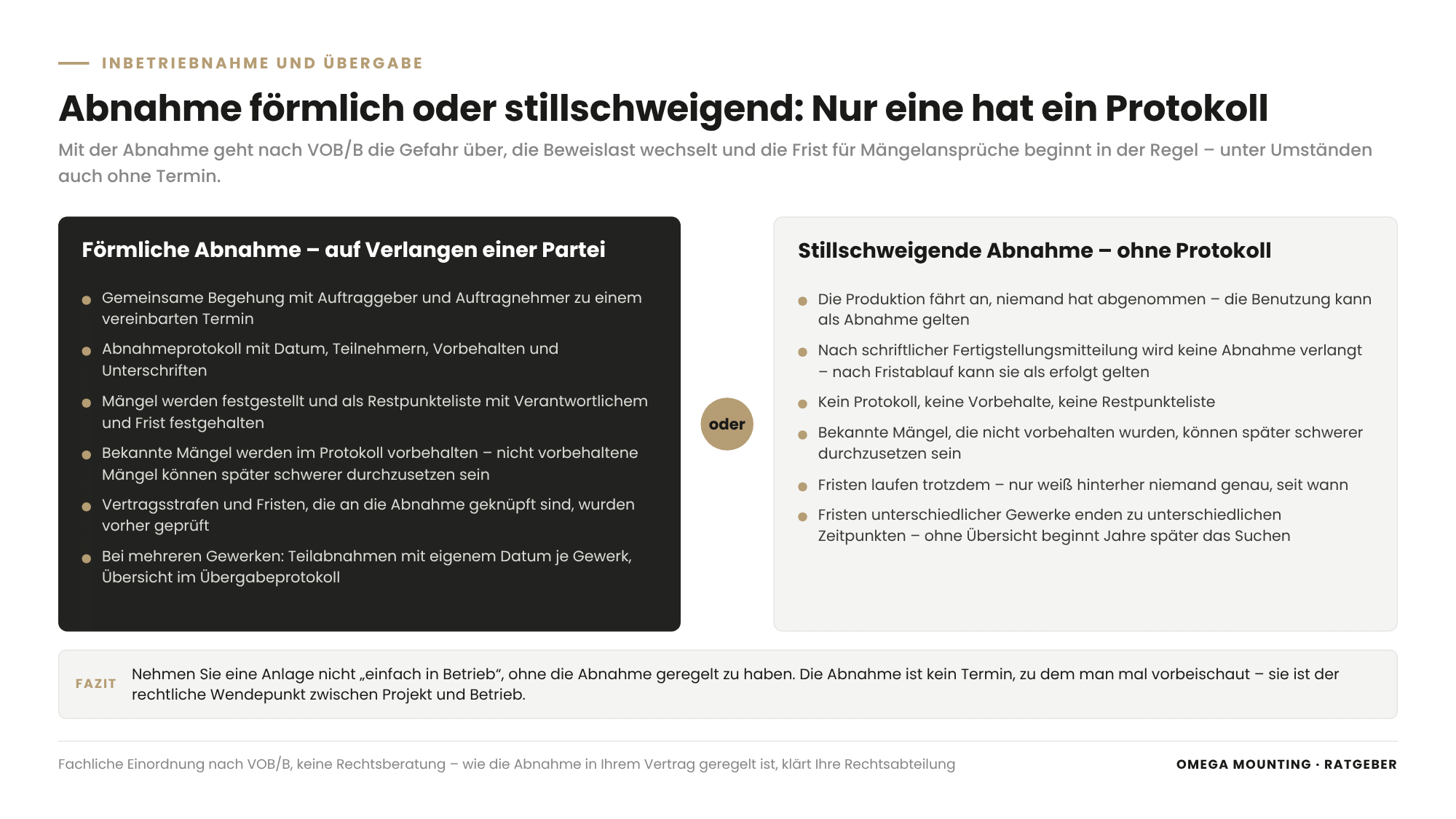
The warranty – more precisely: the period for defect claims – generally begins with acceptance for construction and installation services. That is why acceptance is the legal turning point between project and operations. With it, the risk for the service passes to the client, and the burden of proof for defects shifts. This classification follows VOB/B (German construction contract procedures), which is agreed as the contractual basis in many installation contracts. For a pure contract for work under the German Civil Code (BGB), comparable principles apply with their own periods. This chapter is a technical classification and not legal advice. How acceptance is regulated in your contract is something to clarify with your legal department or contract lawyer.
Formal, not tacit
VOB/B provides for formal acceptance at the request of either party – with a joint walk-through, report, identification of defects and reservations. But it also provides for deemed acceptance. If no acceptance is requested within a period after written notification of completion, or if the service is taken into use, acceptance may be deemed to have taken place. For site managers this results in a clear rule: do not “simply put a plant into operation” without having settled acceptance. Anyone who starts production before acceptance runs the risk of declaring acceptance tacitly. That has all the consequences for periods and burden of proof, but without a report and without reservations.
Reservations and punch list items
Known defects that are not reserved at acceptance can be harder to enforce later. That is why the punch list belongs in the acceptance report, each item with a responsible person and deadline. And that is why acceptance is not an appointment to “drop by” for. Contractual penalties and deadlines linked to acceptance should be checked beforehand.
Partial acceptances for plants with many parties
For plants created by several trades, partial acceptances are advisable: the installation partner's mechanical completion, the electrical installation, the plant builder's commissioning. Each partial acceptance starts the period for its part. For the client this means that the periods of different trades end at different times. An overview in the handover report of who was accepted when saves a lot of searching three years later.
What role does the briefing of operating personnel play?
The briefing of operating personnel is the part of the handover that turns a documented plant into an operable one. Operators learn operation, fault behaviour and limits of the plant. Maintenance learns maintenance points, lubrication points, spare parts and isolation points. The operator thereby also fulfils part of its obligation under the BetrSichV to brief personnel before the first use of work equipment. For you this means: the briefing is a separate item with an attendance list, not a conversation on the sidelines of the trial run.
Two briefings, two target groups
Operators need operation, fault messages, emergency stop, restart and the limits within which they may intervene themselves. Maintenance needs something different: maintenance points and intervals, lubrication points and lubricants, wearing parts and their inspection. Plus isolation points for electricity, compressed air and hydraulics, lifting points and installation routes for the later replacement of large components. Ideally the second briefing takes place during commissioning. Anyone who was present at the trial run knows the plant differently from someone who takes it over as a finished object.
Handover to maintenance as a separate step
We recommend holding the handover to maintenance as a separate appointment. The maintenance schedule is gone through, spare parts stocking is defined, the inspection calendar is set up, the isolation concept is shown, the lubrication schedule is handed over, the first maintenance is scheduled. This is the occasion when it becomes clear whether the documentation passes step 3 of the check – whether it is written for operations. And it is the occasion to clarify who will maintain the plant in future and whether a contract will be concluded for this.

What is different about commissioning and handover in the data center?
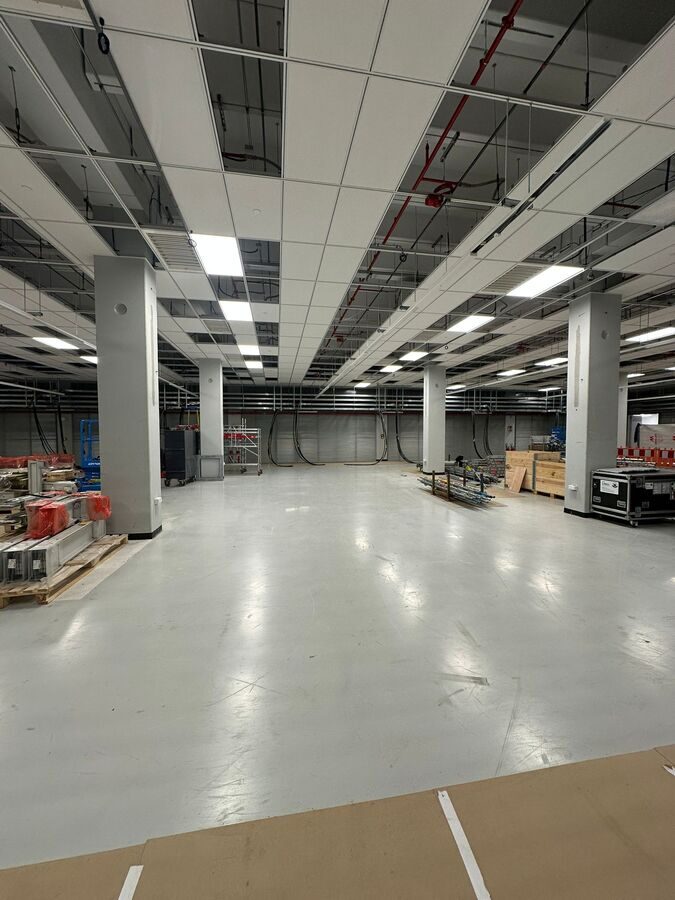
In the data center, commissioning runs as a staged sequence of tests. It ranges from factory acceptance of the components through individual testing on site to the integrated systems test, in which cooling, power supply and standby power systems run together under load. Handover is not to a production department but to an operation that is to run without interruption from day one. For this, the installation delivers mechanical completion with verifications on which every further stage builds. A power distribution cabinet that does not stand where the cable route expects it holds up the entire test.
Load banks: the standby power system under load
One term from this world is instructive for every commissioning: the load bank. This is a device that generates a defined electrical load in order to test generators, standby power systems and power distribution under real conditions before real consumers are connected. Without a load run, a standby power system is not ready for handover, because nobody knows whether it will carry the load in an emergency. In other industries this step is called performance test or load run. The principle is the same: the plant proves its performance before operations depend on it.
Further reading
What the installation has to deliver specifically in the staged tests of a data center is described in our guide to commissioning in the data center as a deeper dive into this chapter: verifications, reports, punch list items, coordination with the commissioning team. You can find our services for data centers on the page data center construction.
Commissioning and handover of a plant: which mistakes cost the most time?
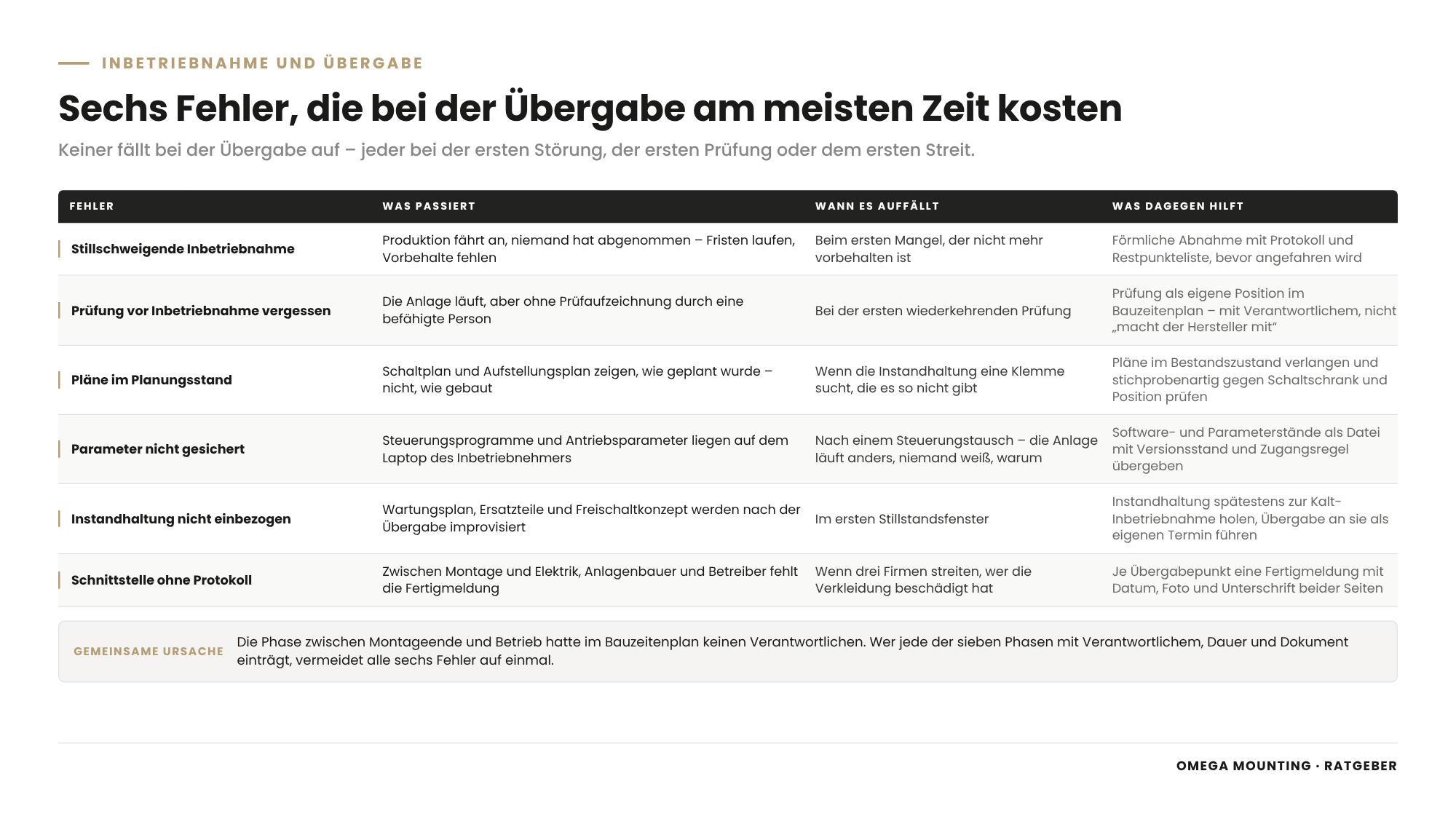
The most expensive mistakes in commissioning and handover are tacit commissioning without acceptance, the skipped pre-commissioning inspection and documentation in design status instead of as-built condition. Added to these are parameters and software on the commissioning engineer's laptop, the maintenance team that only learns of the plant after handover, and the interface between trades at which nobody writes the report. All six have the same cause: the phase between the end of installation and operation had no responsible person in the construction schedule.
- Tacit commissioning: Production starts up, nobody has accepted – periods are running, reservations are missing.
- Pre-commissioning inspection forgotten: The plant is running, but without an inspection record – it is noticed at the first periodic inspection.
- Drawings in design status: Maintenance looks for a terminal that does not exist in that form.
- Parameters not backed up: After a controller replacement, the plant runs differently than on handover day – and nobody knows why.
- Maintenance not involved: Maintenance schedule, spare parts and isolation concept are improvised after handover.
- Interface without a report: Between installation and electrical, between plant builder and operator, the completion notice is missing – later three companies argue about who damaged the cladding. Which evidence you should demand from every party is set out in our guide to subcontractor credentials. How to regulate such handover points between trades from the outset is shown in our guide to interfaces in large projects.
Commissioning and handover of a plant in the Rhine-Main region: how we do it
In the Rhine-Main region we usually hand over plants at one of two points. The first is mechanical completion, when a plant builder or the electrical trade takes over commissioning – typical in data centers in Frankfurt, Offenbach and Raunheim. The second lies after trial run and functional check, when we have relocated, repaired or converted a plant in an existing facility. In both cases the same applies: the handover point is agreed before the job, and it is documented with a report and photos.
For us, the completion notice includes levelling, alignment, anchoring and torques with measured values and the photo documentation of anchoring and connections. Plus the list of open items we found ourselves – before the client finds them. Those who will maintain the plant later receive from us, on request, a separate briefing on lifting points, installation routes and isolation points. Often it is we ourselves who come back years later to replace a component – and are then glad of the report from back then.
From Rodgau we can reach sites in Hanau, Darmstadt, Aschaffenburg and Wiesbaden at short notice. That counts when a punch list item appears at acceptance that has to be dealt with before start-up.
How we do it in practice
Three projects from our project diary show three handover points. These are mechanical completion as the basis for electrical commissioning, the moving in of the components for the load run, and installation before concreting.
160 power distribution cabinets, aligned and ready for connection
During the installation of 160 power distribution cabinets in a data center in the Rhine-Main region our handover point was mechanical completion. The cabinets were moved into the building and distributed via the heavy-duty lift across four levels – basement, ground floor, first and second floor – and eight data halls. There they were unpacked, raised with lifting equipment and a spreader-beam gantry and positioned to the millimetre. The basis was the laser survey of each hall with marked set-down positions. All routes were protected with protective plates and fleece. Six lift-and-shift fitters worked on site for several weeks. What was handed over per hall was a condition the record describes as: “aligned and ready for electrical connection”. The electrical trade and later the staged tests could build on these surveyed positions.
Load banks and generators for commissioning in Frankfurt
With the moving in of generators and load banks at a Frankfurt data center the job concerned the components with which a standby power system proves its performance. Five heavy haulage transports were coordinated. A 220-tonne class mobile crane with 71 tonnes of counterweight and a 30-metre boom lifted the container modules – around 28 tonnes of load at around 20 metres of outreach. All components were positioned to the millimetre in one extended working day. Deployed: a lift-and-shift manager as project lead, a three-person crane crew and five lorry drivers. The job shows what a load run means logistically. The test equipment for commissioning is itself heavy plant that has to be moved in, positioned and moved out again after the test. It needs its own place in the construction schedule.
Hydroelectric power plant in an existing building: handover before concreting
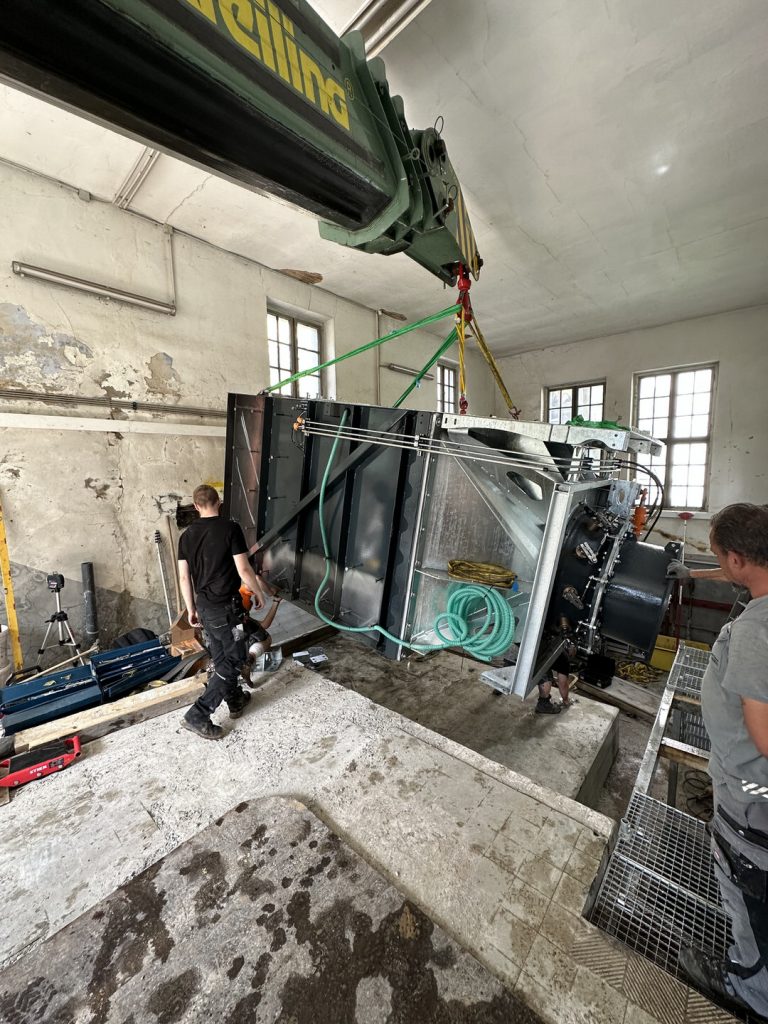
With the Installation of a hydropower plant in an existing building the handover point was before concreting. The building was still being refurbished, and the dilapidated access road could not bear a crane. So large steel plates were laid out over which crane and machine skates could travel safely. A compact crane that can travel with a raised load moved the components in. The funnel was set in place with chain hoists, the riverbed drained with timber shoring and sandbags. Electric motor, hydraulic power unit and arch were moved in, fixed and supported. Only then was the concrete poured, and only then did commissioning by the plant builder begin. A handover point at which nothing can be corrected any more. That is why position, alignment and support were documented before the concrete.
Is a plant of yours about to be commissioned and handed over – in Frankfurt, Hanau, Darmstadt or Aschaffenburg? Then get in touch with us: a site visit usually clarifies within an hour which handover points your project has and which verifications should be produced at each of them.
What this means for your role
For buyers: Write commissioning, acceptance and handover into the scope of works as separate items. These include the document list, the format of the documentation, the briefing with attendance list and the handover point per party. Regulate who arranges and pays for the pre-commissioning inspection. Link final payments to the complete documentation package, not to the completion notice.
For designers: Plan for commissioning: space and connections for load banks and test equipment, accessibility of test points, measuring points, isolation points. Define which as-built drawings are to be supplied and in which format. Clarify who declares the overall conformity of a plant made up of several components. This question belongs in the design, not in the acceptance.
For project managers and site managers: As project manager, you enter the seven phases in the construction schedule, each with a responsible person, duration and document. That way you prevent tacit commissioning. As site manager, you bring together the completion notices of the trades on site, arrange the pre-commissioning inspection and organise the acceptance walk-through and punch list. You make sure that maintenance is present at the trial run. The documentation check is your last task before signing.
For maintenance managers: Get yourself brought into the project early – at the latest for cold commissioning. Check the maintenance schedule, spare parts list and isolation concept for usability. Set up the inspection calendar before handover and demand parameter versions and software backup as files. Do not take over any plant without the inspection record of the pre-commissioning inspection.
For facility managers and operators: From handover you bear the operator's responsibility. Check whether the documents are sufficient to build up the risk assessment, inspection calendar and briefing. Also check whether the acceptances of all trades are documented with dates, because the periods for defect claims end at different times. In the data center this includes the overview of which staged tests have been passed and which punch list items are still open.
For manufacturers and system builders looking for an installation partner: Agree the handover point with your installation partner before the job: mechanical completion, trial run or acceptance. Define which verifications you receive at this point: levelling, torques, anchoring, photos, punch list items. An installation partner who supplies these verifications makes your commissioning plannable and your acceptance shorter.
Handover checklist on request
The plant handover checklist guides you on two pages through the seven phases from mechanical completion to handover to maintenance, each phase with responsible person and result. It contains the document list to tick off, the punch list, the briefing record and the handover report as a template. It helps site managers plan the phase between the end of installation and operation. It helps maintenance managers take over a plant with everything they need for the first maintenance cycle. Request the checklist via our Contact form – keyword “handover checklist”.
Why Omega Mounting?
We are based in Rodgau near Frankfurt and hand over plants in such a way that the next phase can build on them. That means: surveyed positions, documented anchoring and alignment, photo documentation and a list of open items we found ourselves. The linked projects show this: 160 distribution cabinets aligned and ready for connection, the components for the load run moved in within a day, a hydroelectric power plant fixed and documented before the concrete arrived. We know both sides of the handover, because we not only install plants but also maintain, relocate and replace components years later. Parts and auxiliary structures that are missing for this we manufacture in our workshop in Rodgau. With us you get a single point of contact for moving in, installation, handover and later maintenance. Plus short distances in the Rhine-Main region and a 24-hour hotline if a punch list item still has to be dealt with before start-up.
Conclusion
Commissioning and handover of a plant – this is not an appendix to the installation but a project phase in its own right with seven stations, ten types of document and a legal turning point, the acceptance. Anyone who gives every station a responsible person and a document, plans the pre-commissioning inspection, checks the documentation before signing and brings maintenance to the trial run hands over a plant that runs on the first day of operation. And that does not fail at the first breakdown because of a missing document. Send us your construction schedule, the plant list and the planned handover date. We will get back to you with an honest assessment of which handover points and verifications your project needs.
Planning maintenance, moving in or installation in the Rhine-Main region?
Tell us briefly what it is about – we will come back to you with an honest assessment.
100% free and without obligation
You may also be interested in these guides

About the author
Tobias Schott
Managing director of Omega Mounting GmbH, Rodgau · more than 20 years of hands-on experience in installation and maintenance
A trained mechatronics technician, at home in maintenance, servicing and industrial installation since 2004 – first at his father's side, since 2012 with Omega Mounting: from the overhead conveyor in Frankfurt to the crane system in a new-build hall. Plans and leads lifting operations as appointed person in data centers and on industrial sites in the Rhine-Main region, is an instructor and examiner for cranes, mobile elevating work platforms and telehandlers, and a safety officer. On jobs abroad he is known as the “German Troubleshooter” – the one you call when things get stuck on site. He learned what quality means not from a manual but from his father: Made in Germany as a standard for his own work, not as a label. That is why it comes first at Omega Mounting – before speed and before price. He writes these guides from that practice: what works on our sites is in them – what only exists in the standard is not.
Frequently asked questions
Commissioning is the technical process in which an installed plant is put under voltage, medium and load in stages and tested. Acceptance is the client's legal declaration that the service is essentially in accordance with the contract. As a rule, the period for defect claims begins with it. Handover is the organisational change from project to operations with documentation and briefing. A plant can be in operation without being accepted or handed over. Anyone searching for “commissioning handover plant” usually means all three steps together.
Operating instructions in German, circuit and layout drawings in as-built condition, conformity documents, spare and wearing parts lists, test reports from installation and commissioning. Plus software and parameter versions as files, maintenance and lubrication schedule, punch list, acceptance report and photo documentation. Define the list and format in the scope of works and check them before signing the handover report.
Yes, if its safety depends on the installation – for example crane runways, racking, steel platforms, conveyor technology and lifting gear. In these cases the BetrSichV (Industrial Safety Ordinance) requires an inspection after installation and before first use by a person competent to inspect, with an inspection record. The installation report with levelling, torques and anchoring is the basis of this inspection. It belongs in the construction schedule as a separate item.
For contracts under VOB/B, the period for defect claims generally begins with acceptance. For a contract for work under the German Civil Code (BGB), comparable principles apply with their own periods. Because acceptance can also be deemed to have taken place tacitly through commissioning or after a notification of completion, you should carry it out formally with a report and reservations. This is a technical classification, not legal advice – the specific regulation is in your contract.
Every identified defect or open item with description, location, responsible person, deadline and completion note. Plus the classification of whether the item hinders commissioning or operation. The list is part of the acceptance report and is updated until completion. Items that were known at acceptance and not reserved can be harder to enforce later.
That it takes place as a separate appointment, ideally during commissioning. The maintenance and lubrication schedules are gone through, spare parts stocking is defined, the inspection calendar is set up, isolation points and lifting points are shown, the first maintenance is scheduled. Maintenance should be present at the trial run. It receives parameter versions and software backup as files, not as a promise.
From Rodgau, Omega Mounting installs plants in Frankfurt, Offenbach, Hanau, Darmstadt, Aschaffenburg and throughout the Rhine-Main region. Handover takes place at an agreed point – mechanical completion, trial run or acceptance – with installation report, photo documentation and punch list. Electrical and process commissioning is taken on by plant builders and the electrical trade. We supply the verifications on which they build.
The seven phases apply everywhere; what differs is depth and form. In the data center, commissioning and handover run as staged tests up to the integrated systems test. In food plants, hygiene approvals and lubricant specifications are added; in production, the focus is on the load run under takt conditions. The document list and the documentation check are the same in all industries.
Via a short enquiry with three details: which plant it concerns (type, weight, location), which trades are involved and when commissioning and handover are planned. We arrange a site visit and clarify the handover points between installation, electrical, plant builder and operations. Then we send you a written assessment with the verifications that should be produced at each point – with the handover checklist as a working aid. Your contact is Tobias Schott – reachable via our Contact form.
 English
 German