- Project report – hydropower plant
Installation of a hydropower plant in an existing building
Project report: installation of a hydropower plant in an existing building
Moving in and installation support under difficult site conditions
Not every project can be planned by the textbook. When moving a modern hydropower plant into an existing building, the Omega Mounting installation team faced a particularly tricky task: a dilapidated access road, confined space and a riverbed that had to be drained before installation could even begin.
Our task was to move the individual plant components into the building and actively support the installation team on site – from crane logistics to the final positioning of the components. This project report shows how hydropower plants can be installed successfully even under difficult starting conditions.
A challenging starting situation on site
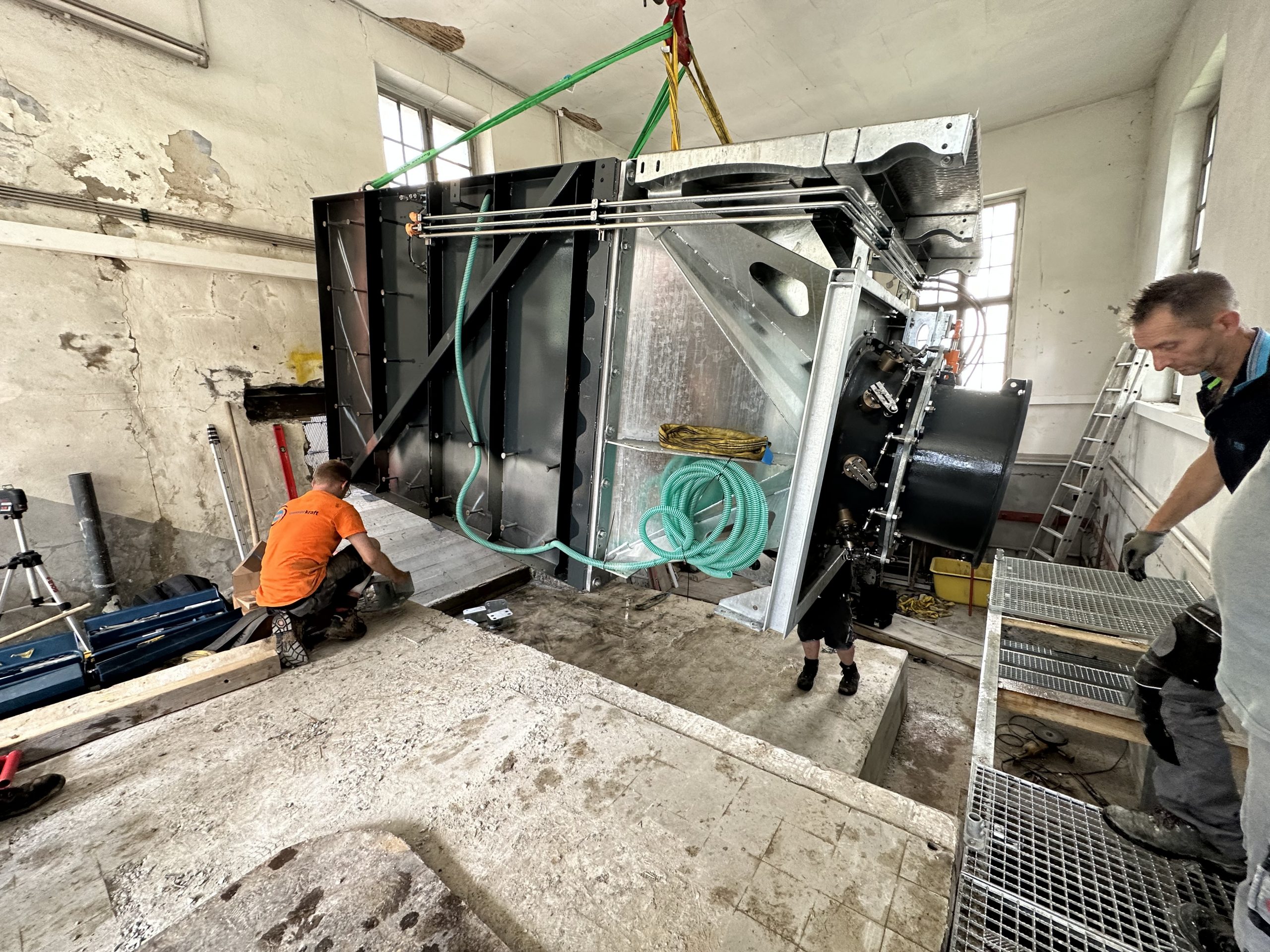
The installation crew in action
At the time of the project, the building was still being refurbished. This brought a number of challenges that had to be solved first.
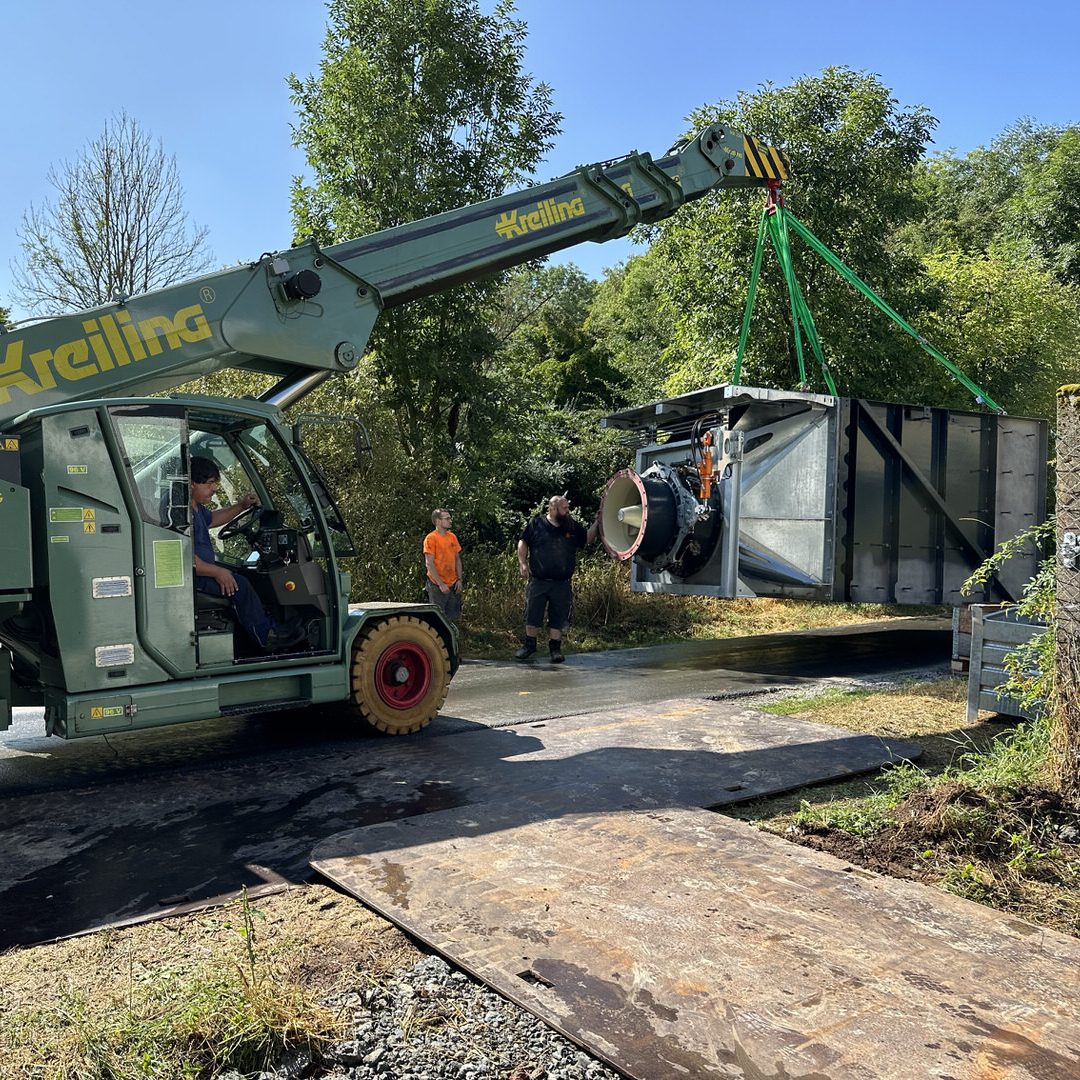
The entrance to the building was in poor condition; in some places the concrete had already worn away. Driving the crane directly across it was therefore not possible.
To ensure the access road could bear the load, large steel plates first had to be delivered and laid out so that both the crane and our machine skates could travel safely over them. Only then could the actual installation begin.
The right crane for confined spaces
The V-Kart crane
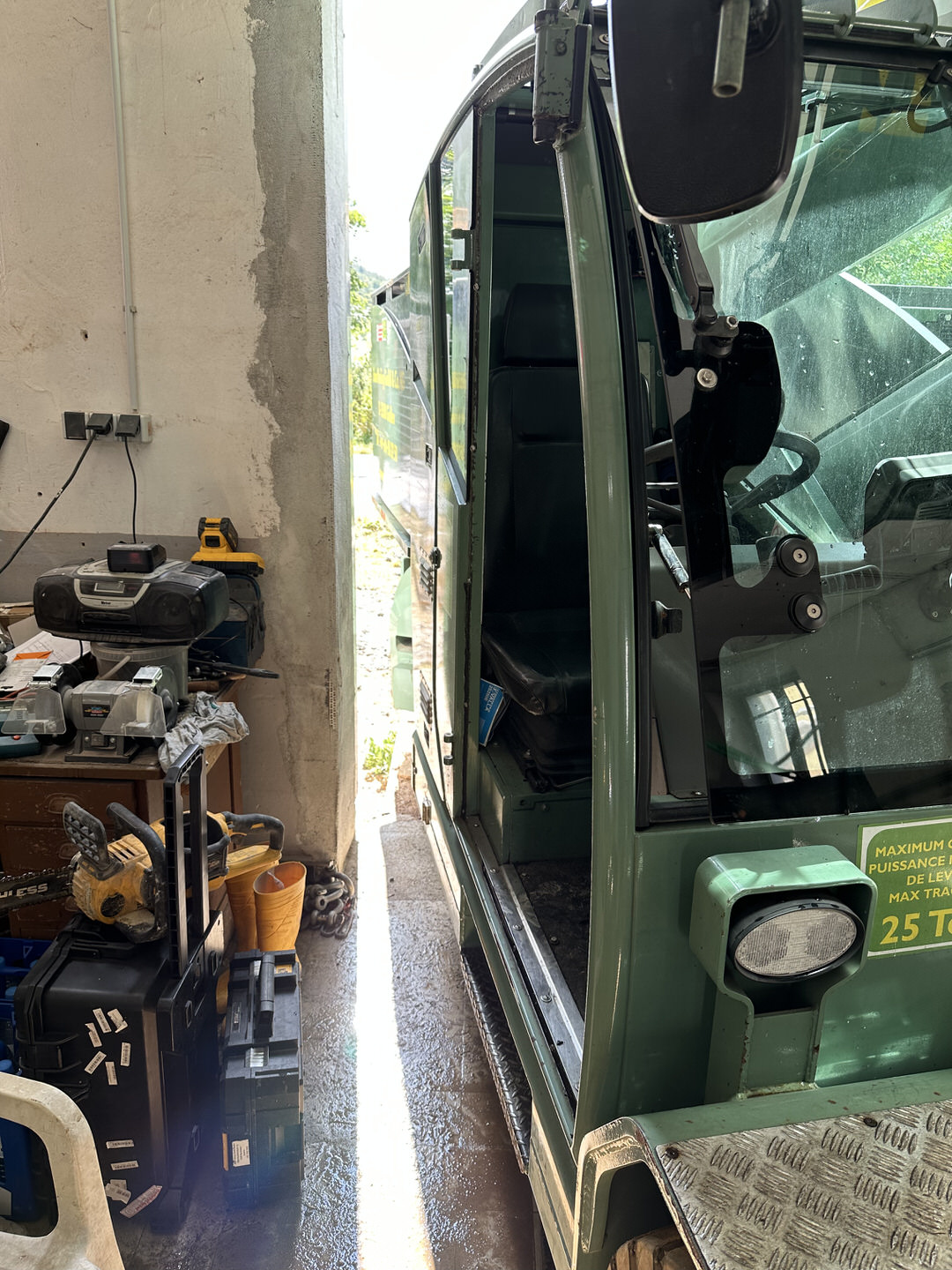
A V-Kart crane was used for this project – compared with a conventional mobile crane, it offers several decisive advantages: it is more manoeuvrable, can travel with a raised load and, thanks to its low, compact design, is ideal for jobs with little space.
The drawback on this site: the tyres, which are not designed for off-road use, and the resulting low ground clearance. That is precisely why laying the steel plates beforehand was so crucial – it was what made using the crane on the uneven ground possible in the first place.
Dewatering & first moving in: the hopper
Once the access road had been secured with steel plates, installation could finally begin. The first component to be moved in was the hopper.
To do this, it was lifted in from the river side and initially set down on planks. We then used chain hoists to pull it precisely into the opening in the building provided for it.
To prevent water from entering the work area during installation, the riverbed and the building were sealed off with timber shoring and numerous sandbags.
Throughout the entire installation period, pumps kept the area reliably dry.
Safety and shoring on site
There are not always ideal lifting points or a ready-made standard solution. On projects like this, it is important to assess directly on site what is feasible – and which safety measures are needed to ensure the components can be lifted in smoothly.
To achieve sufficient stability, several beams were supported with steel props and timber baulks were driven into existing structures at specific points. This ensured that the structure could safely withstand the loads occurring during the rest of the installation.
Moving in the main components of the hydropower plant
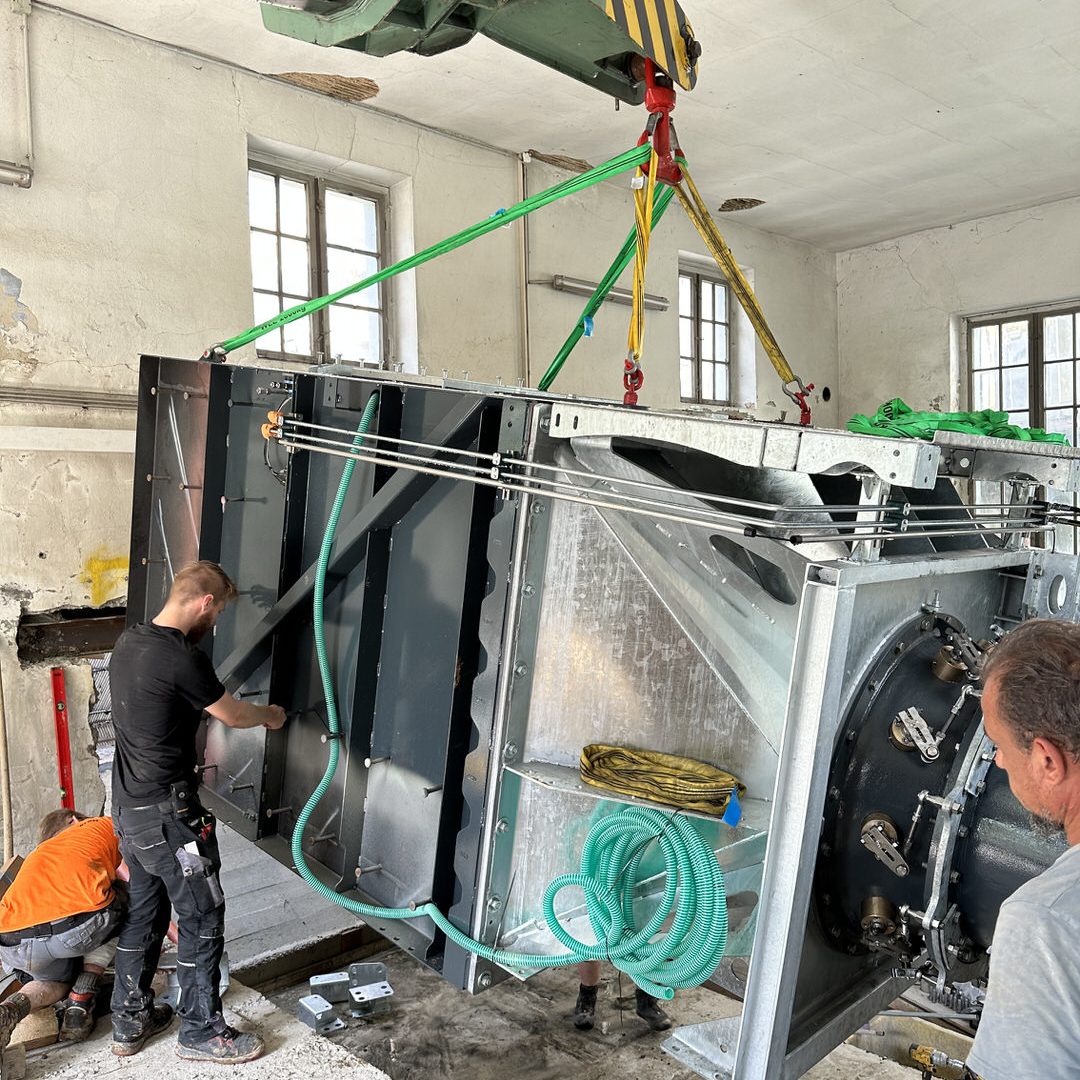
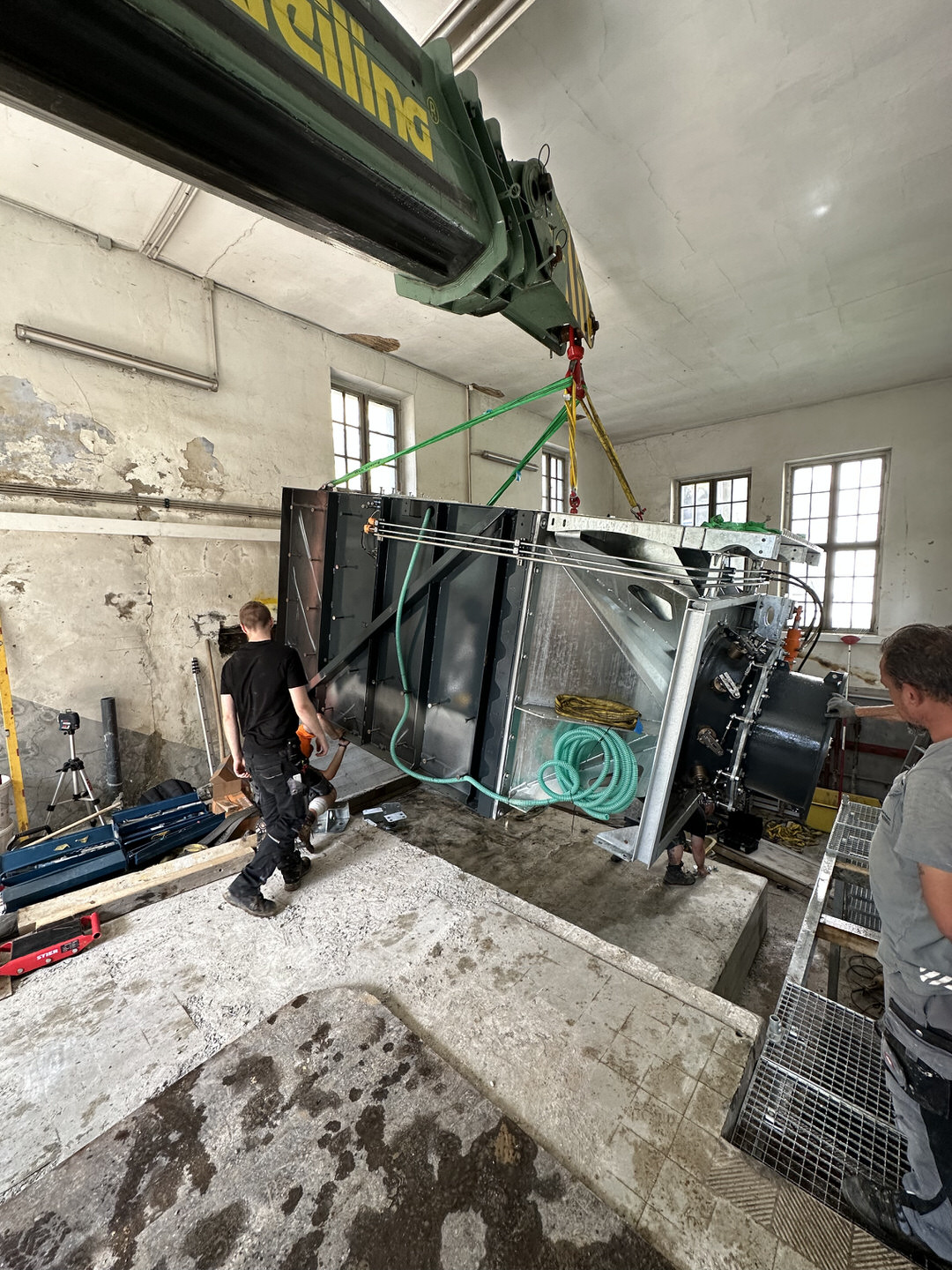
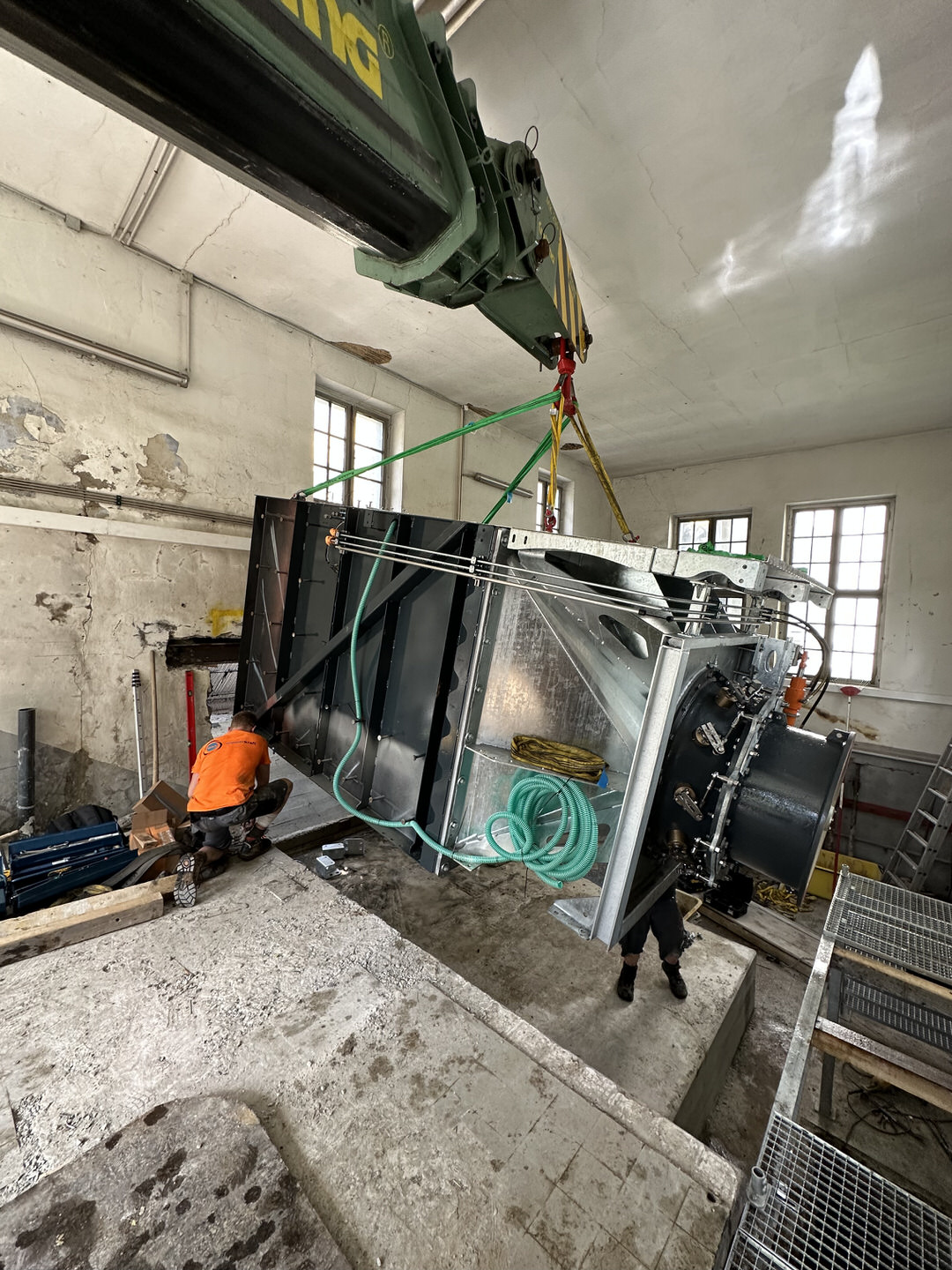
Once the hopper was firmly in place, the actual hydropower plant could be moved in. The biggest difficulty: defining the lifting accessories so that there was enough space during moving in while the load hung exactly level. In addition, the lifting accessories could not be too long, as the distance between ceiling and floor left only limited room for manoeuvre.
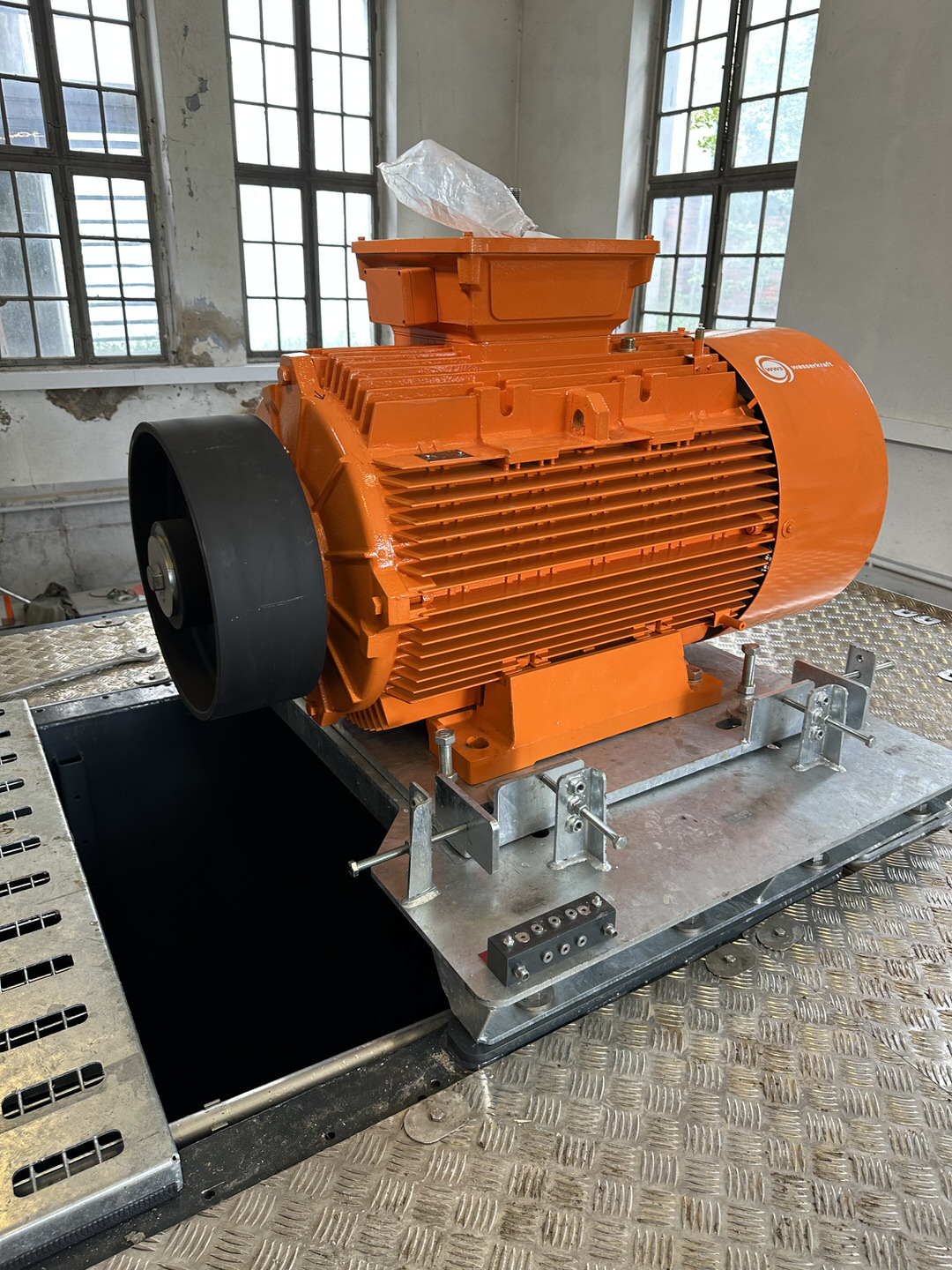
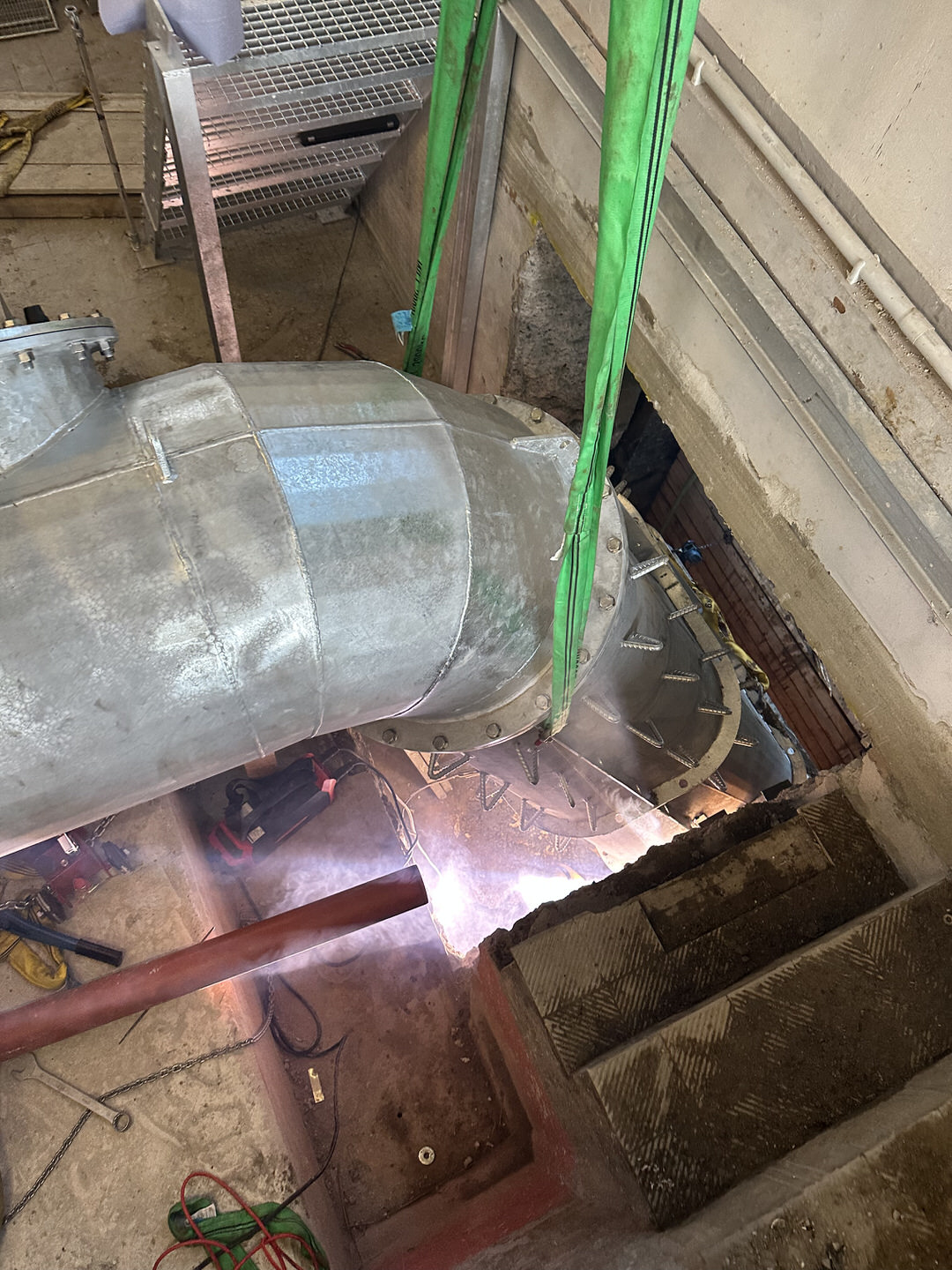
Thanks to clearly defined lifting points and their compact design, moving in the large electric motor and the hydraulic power unit was comparatively straightforward. Positioning the arch was more demanding: it had to be carefully brought into the right position using a round sling and a chain hoist so that it could be fitted precisely.
Securing and handover to the concrete works
Once all components had been aligned and positioned, the last step before final fixing followed: additional supports were installed to hold the plant securely. Using a welding set, we also fitted brackets and supports at the appropriate points.
The following day, the plant could finally be concreted in and thus permanently anchored in the building.
Why companies choose Omega Mounting
Your advantages with Omega Mounting
Projects like this show what really matters in demanding industrial installations: experience in dealing with unpredictable site conditions, technical know-how in crane and slinging techniques, and the ability to find the right solution quickly on site.
Omega Mounting supports manufacturers, plant engineers and industrial companies with the installation of demanding technical systems – throughout Germany and across Europe. Whether hydropower plants, loading technology or complex industrial plants: our customers benefit from a well-coordinated team that works precisely and safely even under difficult conditions.
Are you planning to install a technical system under demanding site conditions? Get in touch – together we will find the right solution for you, from crane logistics to final commissioning.
Related guides for this project

About the author
Tobias Schott
Managing director of Omega Mounting GmbH, Rodgau · more than 20 years of hands-on experience in installation and maintenance
A trained mechatronics technician, at home in maintenance, servicing and industrial installation since 2004 – first alongside his father, and since 2012 with Omega Mounting: from the overhead conveyor in Frankfurt to the crane system in a new-build hall. As appointed person for lifting operations, he plans and leads lifting operations in data centers and on industrial sites in the Rhine-Main region, is an instructor and examiner for cranes, aerial work platforms and telehandlers, and a safety officer. On assignments abroad he is known as the "German Troubleshooter" – the one you call when things get stuck on site. He did not learn what quality means from a manual, but from his father: Made in Germany as a standard for his own work, not as a label. That is why quality comes first at Omega Mounting – before speed and before price. The project diary shows the jobs his team has planned and carried out – without customer names, but with everything that can be learned from them.
 English
 German