
- Guide – Lift & Shift
Levelling and anchoring a machine: foundation, anchors and alignment
By Tobias Schott · Reading time approx. 23 minutes · Last updated: October 2026
A machine is only installed when it is level, in line and force-locked to the foundation – and when a report shows what it was measured with, what it was anchored with and when it was released.
The machine stands in the hall. The crane has been derigged, the low-loader has gone. Now begins the part that decides whether the plant runs precisely for years or soon reports its first bearing damage: aligning and anchoring the machine. Anyone who treats this step as an appendix to the moving-in pays for it later with wear, rework, vibration problems in the neighbourhood or a warranty that the manufacturer rejects with reference to its installation drawing.
For designers the question arises earlier: which machine foundation does the plant need, will the hall floor bear it, where are the utilities? For site managers it is the question of sequence – what is fixed when, when may connections be made? For maintenance managers it is the question of whether the machine they take over tomorrow stands so that bearings, guides and drives do not work against a crooked base plate.
This guide builds on our article Moving in a machine: the sequence of the moving-in day. There the day ends with setting down; here it continues: check the ground, choose the type of foundation, level, align, anchor, isolate, connect, trial run. With examples from Kassel, Leipzig, Munich, Fulda and Rodgau.
Key points at a glance
- Before installation, the ground is checked: load-bearing capacity, flatness, cracks, joints, reinforcement and services in the floor – when in doubt with the structural engineer.
- The type of foundation follows from the weight, dynamics and accuracy requirements of the machine: hall floor, pad or block foundation, or a vibration-isolated foundation.
- Levelling means: bringing the machine level with machine feet, shims or wedges, checking, fixing and grouting if necessary – in this order.
- Aligning means: establishing position, line and height relative to the peripherals – with precision level, laser and diagonal measurement.
- Anchoring is done according to the manufacturer's installation drawing: anchor type, embedment depth, spacing, tightening torque – with a torque record; grout and bonded anchors cure before load is applied.
- Vibration isolation protects neighbours and measuring equipment from the machine, or the machine from its surroundings – and is planned together with the anchoring.
- Utility connection and trial run come after fixing; inspection before first commissioning and the installation report complete the installation.
What is the aligning and anchoring of a machine?
Aligning and anchoring a machine is the work step between setting down and utility connection. The machine is brought into its target position in terms of location, height, level and line, and connected to the foundation so that it remains in this position under operating loads, vibrations and temperature changes.
Three terms are often confused here. Levelling means bringing the machine into the horizontal – its reference surfaces are level. Aligning – also called lining up in installation jargon – means positioning the machine in relation to something else: hall axes, a conveyor line, a second machine, a rail. Anchoring means connecting the machine positioned in this way to the foundation in a force-locked manner with anchors, anchor bolts or grout. Anyone who anchors before aligning drills twice.
How the topic fits into the sequence of a site relocation is shown in our guide Machinery relocation for your company. What Omega Mounting provides in installations in existing buildings is described on our page industrial installation in existing buildings.
How do you check the ground before installation?
Before installation, the ground is checked for load-bearing capacity, flatness, condition and embedded items. Does the floor slab have the load-bearing capacity for the machine with all operating loads? Is the surface flat and clean, are there cracks, joints or voids? And where are the reinforcement and services that would be in the way when drilling?
This check does not begin on installation day but at the site visit – with the same questions a designer should answer in the layout phase.
Load-bearing capacity: floor slab or foundation?
An industrial floor slab is designed for distributed loads – forklifts, racking, pallets. A machine brings point loads under its feet and often dynamic loads as well. Whether the existing slab bears this is stated in the as-built documents or must be assessed by a structural engineer. What applies to floor loads, load spreading and ground bearing pressure when moving in is described in our guide Planning a moving-in operation: floor loads, openings and crane set-up areas – the same logic applies to the installation location, only permanently.
Flatness and condition
Concrete surfaces are never perfectly flat; building construction has its own flatness tolerances for this, but they say nothing about what your machine needs. The manufacturer's installation drawing is decisive. We compensate for unevenness during levelling – with shims, machine feet or grout. When setting up tanks for a heating system in Fulda, we first cleaned the concrete foundations and compensated for minor unevenness in the concrete with a protective rubber mat. Only then were the tanks anchored with heavy-duty anchors.
Cracks, spalled edges, voids and expansion joints are exclusion criteria for anchors: an anchor in a joint or at the edge of a crack does not carry what its data sheet promises. That is why the surface is tapped and inspected before marking out.
What lies in the floor
Before drilling, the reinforcement is located and the question is asked what else lies in the floor: electrical cables, compressed air, underfloor heating, drainage channels, earthing strips. As-built drawings help but do not replace location – drawings show what was planned, not what was built.
Which types of foundation are there – and when is the hall floor sufficient?
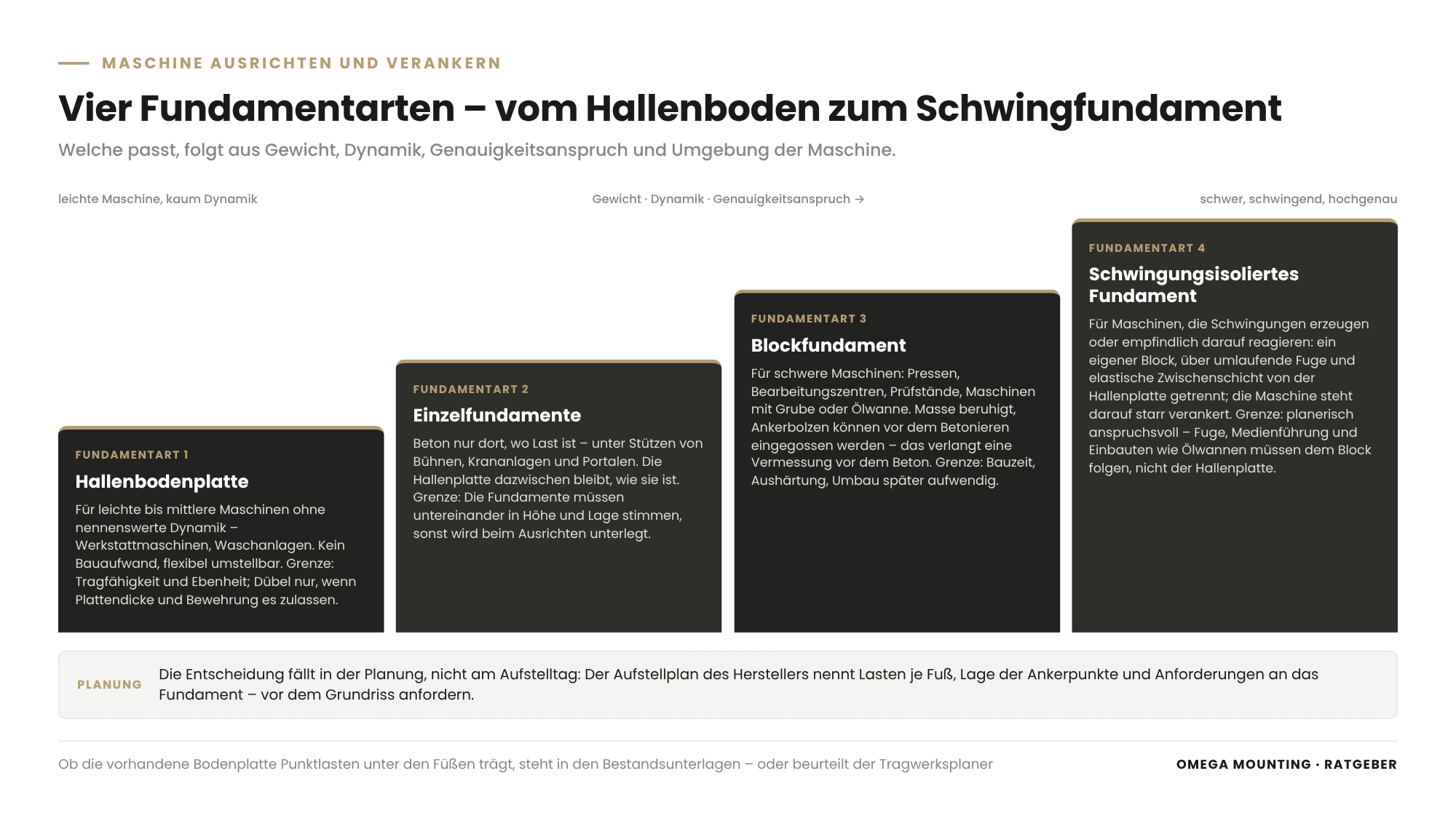
For machine installation there are four typical solutions: the existing hall floor slab, pad foundations under feet or columns, a continuous block foundation and a vibration-isolated foundation separated from the floor slab. Which one fits depends on the weight, dynamics, accuracy requirements and surroundings of the machine.
| Type of foundation | Typical use | Advantage | Limit |
|---|---|---|---|
| Hall floor slab. | Light to medium machines without significant dynamics, workshop machines, washing systems. | No construction work, flexible to relocate. | Load-bearing capacity and flatness are limiting. Anchors only if slab thickness and reinforcement allow. |
| Pad foundations. | Columns of platforms, crane systems, gantries. | Concrete only where there is load. | Foundations must agree with each other in height and position. |
| Block foundation. | Heavy machines, presses, machining centres, test rigs, machines with pit or oil pan. | Mass calms, anchor bolts can be cast in. | Construction time, curing, later conversion laborious. |
| Vibration-isolated foundation. | Machines that generate vibrations or react sensitively to them. | Separation from the surroundings. | Demanding to design; joint and utility routing must fit. |
The decision is made in the design, not on installation day. For the designer this means: the manufacturer's installation drawing is the first document you should request – before the floor plan. It states the loads per foot, the position of the anchor points and the requirements for the foundation.
Pit, oil pan, channel
Some machines need more than a flat surface: chip channels, hydraulic pits, oil collection pans. When converting a test rig in Munich, we installed an oil pan all around the concrete foundation and welded it tight. Such built-in items belong in the foundation design because they determine anchor positions and utility routes.
How do you level a machine?
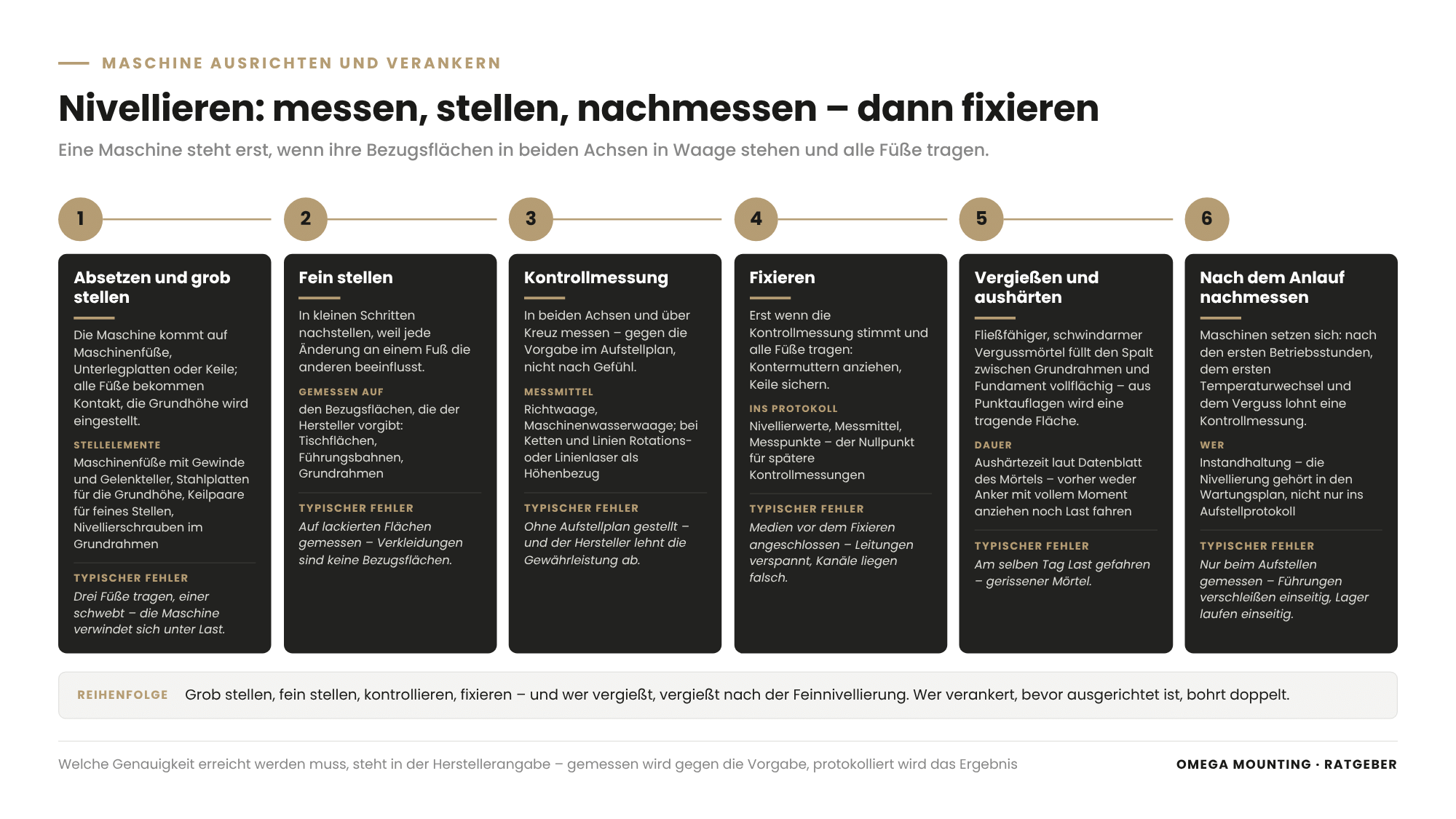
A machine is levelled by adjusting it on adjustable machine feet, shims or wedges and re-measuring until its reference surfaces are level in both axes and all feet bear. Only then is it fixed and, if necessary, grouted.
This is where most corners are cut. A machine standing on three feet twists under load. A machine with a slope lets parts roll, liquids stand or guides wear on one side.
The adjusting elements
- Machine feet with thread and swivel pad are the standard solution for machine tools and production machinery: height-adjustable, readjustable, often with an elastomer pad against structure-borne noise.
- Shims and wedges made of steel go under base frames that are later grouted: wedge pairs allow fine adjustment, plates create the base height.
- Levelling screws in the base frame adjust the machine before grout takes over the force transmission.
- Grout – a flowable, low-shrinkage mortar – fills the gap between base frame and foundation over the full area and turns point supports into a load-bearing surface.
The sequence
Rough adjustment, fine adjustment, check, fix. Measurement is taken on the reference surfaces specified by the manufacturer – table surfaces, guideways, base frame – in both axes and crosswise. Readjustment is done in small steps, because every change at one foot affects the others. Only when the check measurement is correct and all feet bear are lock nuts tightened or wedges secured.
If grouting is done, the mortar comes after fine levelling. The grout must cure before anchor bolts are tightened to full torque or the machine runs under load. The curing time is stated in the mortar's data sheet.
After levelling is before levelling
Machines settle. After the first hours of operation, after the first temperature change, after grouting, a check measurement is worthwhile – for precision machines the manufacturer frequently prescribes it. For maintenance managers this means: levelling belongs in the maintenance schedule, not only in the installation report.
How do you align machines and plant to each other?
Machines and plant are aligned to each other by defining common reference axes – hall axes, a conveyor line, a rail or a lead machine. Each unit is brought into position, height and line with these axes using precision level, laser and diagonal measurement before it is fixed.
A single machine only has to be level. As soon as it is part of a chain, it has to fit its neighbours. A feeder hands over to a rail, a robot reaches into a machine, a crane runway runs on two girders through the hall. Here the line – the common straight line of several components – decides function and wear.
Measuring equipment
- Precision level and machinist's level for the horizontal of the individual machine.
- Rotating laser and line laser for heights and lines over longer distances – a height reference plane through the hall. Laser alignment matches every machine to it and replaces the string line on long lines.
- String line and diagonal measurement for squareness and position of simple frames.
- Dial gauges and feeler gauges for the fine alignment of shafts, couplings and guides.
- Plumb line and plumb laser for the vertical alignment of columns, gantries and pillars.
The accuracy that must be achieved is stated in the manufacturer's specification – we measure against the specification and record the result.
Why line decides function
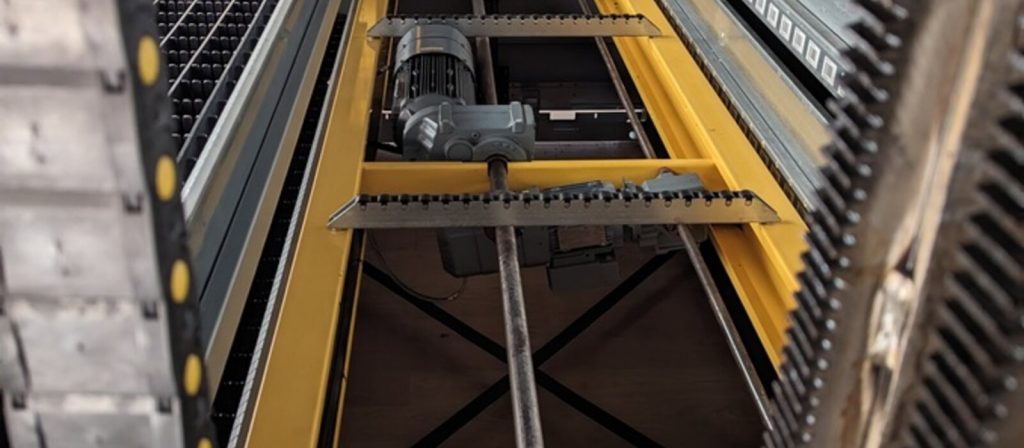
In a parts washer in Kassel, the parts in the washing basket roll over a rail from the feed trolley into the machine. A small offset or slope, and the operator is working against gravity. In storage lifts we reassembled in Rodgau, the gears no longer engage synchronously with the racks as soon as these are not cleanly levelled in height. In both cases the same sequence applies. Survey and level, establish heights and line, only then position sensors and attachments, then run and test.
How do you anchor the machine in the foundation?
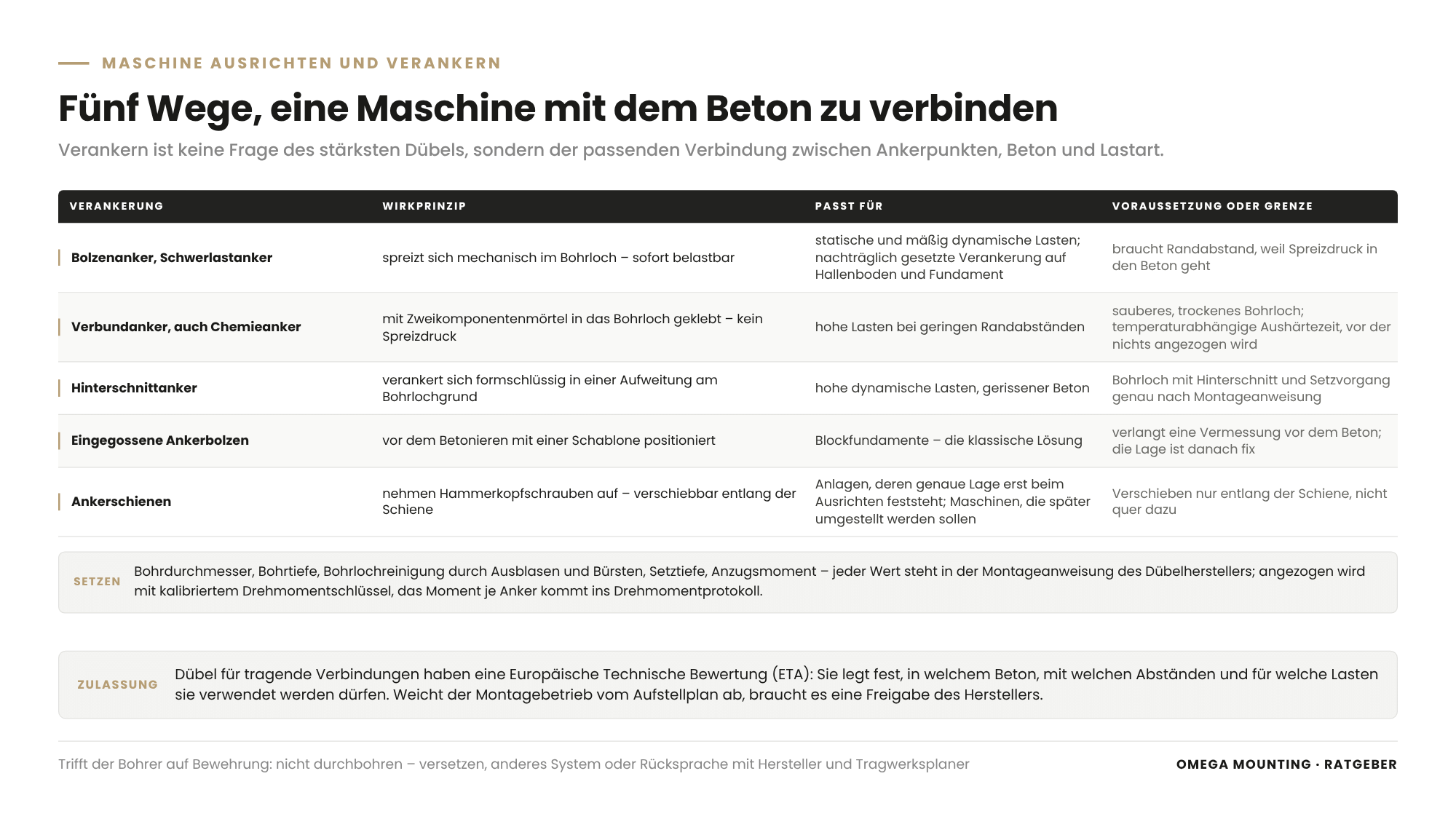
A machine is anchored by connecting it to the foundation after alignment via the anchor points provided by the manufacturer – with post-installed anchors, cast-in anchor bolts or anchor channels. Anchor type, drilling depth, hole cleaning, spacing and tightening torque follow the specifications of the machine and anchor manufacturers and are recorded in the torque record.
Anchoring is not a question of the strongest anchor but of the right connection. It connects a machine with defined anchor points, a concrete with an unknown interior and a type of load that can be static, dynamic or alternating.
Types of anchor – in general terms
- Expansion anchors and heavy-duty anchors expand mechanically in the drill hole and can be loaded immediately – for static and moderately dynamic loads. They need edge distance because they introduce expansion pressure into the concrete.
- Bonded anchors, also called chemical anchors, are bonded into the drill hole with a two-component mortar: no expansion pressure, smaller edge distances, high loads. In return they need a clean, dry drill hole and a temperature-dependent curing time, before which nothing is tightened.
- Undercut anchors anchor themselves form-locked in a widening at the bottom of the drill hole – the choice for high dynamic loads and in cracked concrete.
- Cast-in anchor bolts are positioned with a template before concreting – the classic solution for block foundations, which requires a survey before the concrete.
- Anchor channels take T-head bolts and allow sliding along the channel – for plant whose exact position is only determined during alignment.
Which anchor fits is a question of approval. Anchors for load-bearing connections have a European Technical Assessment, ETA for short, which specifies in which concrete, with which spacing and for which loads they may be used. For you this means: have the anchor type, approval and installation instructions shown to you and check whether they match the specification in the machine manufacturer's installation drawing. If the installation contractor deviates from this, a release from the manufacturer is needed, otherwise the warranty is in question.
Setting: what the installation instructions say applies
Drill diameter, drilling depth, cleaning of the drill hole by blowing out and brushing, embedment depth, tightening torque. Each of these values is stated in the anchor manufacturer's installation instructions, and each of them decides the load-bearing capacity. An uncleaned drill hole reduces the holding force of a bonded anchor unpredictably – which is why cleaning is done, always. Tightening is done with a calibrated torque wrench, and the torque per anchor is recorded in the torque record.
If the drill hits reinforcement, it is not drilled through; a decision is made instead. Move the hole within the permissible tolerance of the installation drawing, use a different anchor system with a smaller embedment depth, or consult the manufacturer and structural engineer.
Grouting and curing
Whether grout under the base frame or mortar in the drill hole – both need time, and both are under time pressure because the site manager wants to commission. We plan the curing from the outset: level and grout first, tighten and connect afterwards.
When does a machine need vibration isolation?
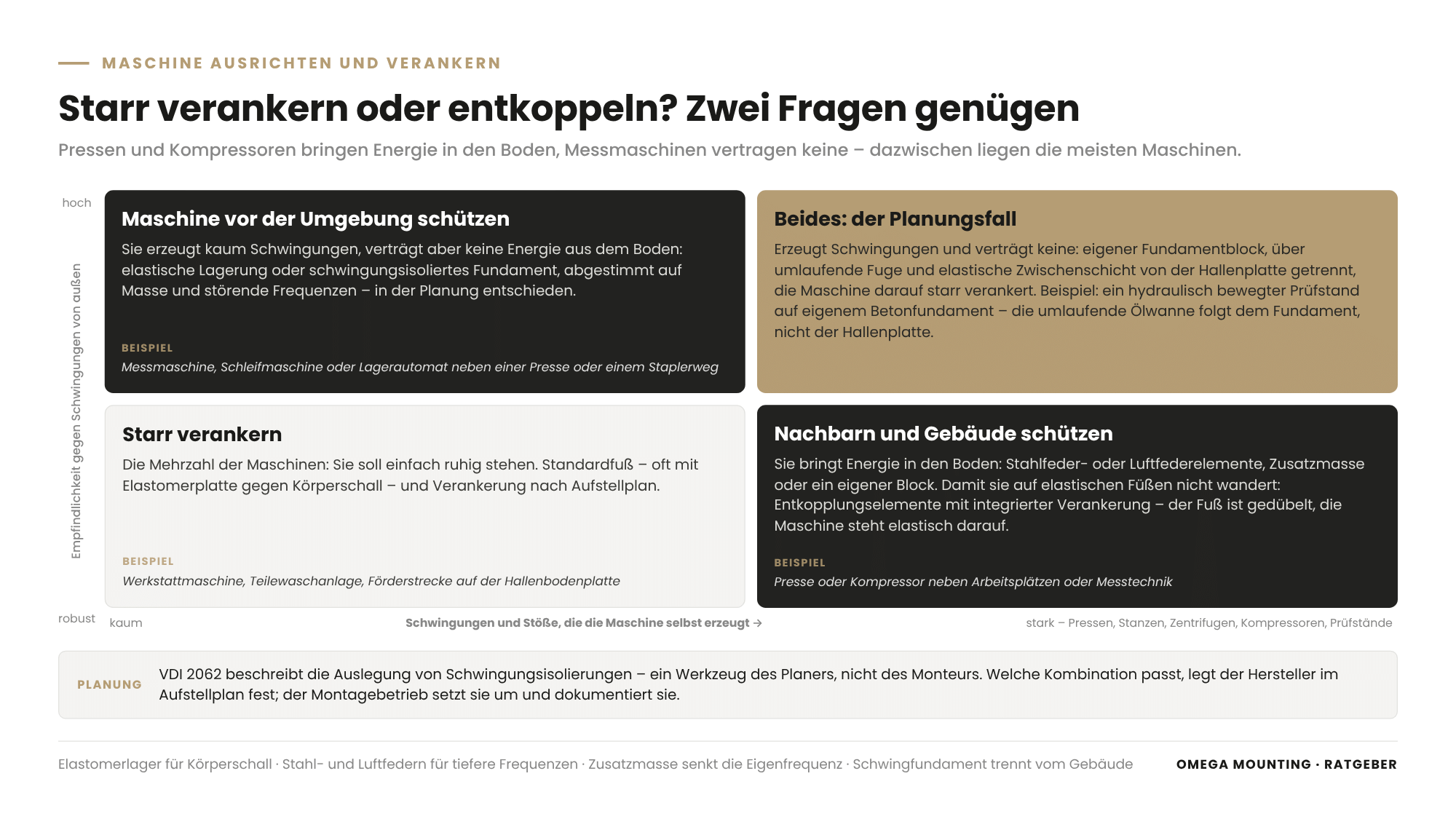
A machine needs vibration isolation when it itself generates vibrations or shocks that would disturb neighbours, buildings or measuring equipment. Or, conversely, when it is so sensitive that vibrations from the surroundings would impair its accuracy.
Presses, punching machines, centrifuges, compressors and test rigs with moving masses put energy into the floor. Measuring machines, grinding machines and storage lifts with precise positioning cannot tolerate energy from the floor. In between lie most machines, which simply have to stand still.
The means
- Elastomer mounts and machine feet with damping pad isolate structure-borne noise and light vibrations – often already included in the standard foot.
- Steel spring and air spring elements isolate lower frequencies and heavy machines; they are tuned to mass and excitation frequency.
- Vibration-isolated foundations separate a foundation block from the hall slab via a surrounding joint and an elastic intermediate layer.
- Additional mass – a heavy foundation block – lowers the natural frequency of the system and calms the machine.
The guideline VDI 2062 describes the fundamentals of vibration isolation and the design of such elements. It is the designer's tool, not the fitter's. For you this means: if a machine has dynamic loads or sensitive neighbours, the vibration question belongs in the design. At the latest when the manufacturer provides for or excludes damping elements in its installation drawing.
Anchoring and isolating – a contradiction?
Only apparently. A rigidly anchored machine transmits everything into the floor. A machine standing freely on elastomer feet can wander. That is why there are isolation elements with integrated anchoring – the foot is anchored, the machine stands elastically on it – and vibration-isolated foundations on which the machine is rigidly anchored. The hydraulically driven test rig in Munich sat on its own concrete foundation. The surrounding oil pan had to follow this foundation, not the hall slab. Which combination fits is determined by the manufacturer. We implement it and document it.
What happens after anchoring: utility connection and trial run?
After anchoring come utility connection, functional test and trial run. Only when the machine is fixed and grout and anchors have cured are electrics, compressed air, hydraulics, water and exhaust air connected. Every connection is checked, the plant is commissioned step by step and the result is recorded in the installation report.
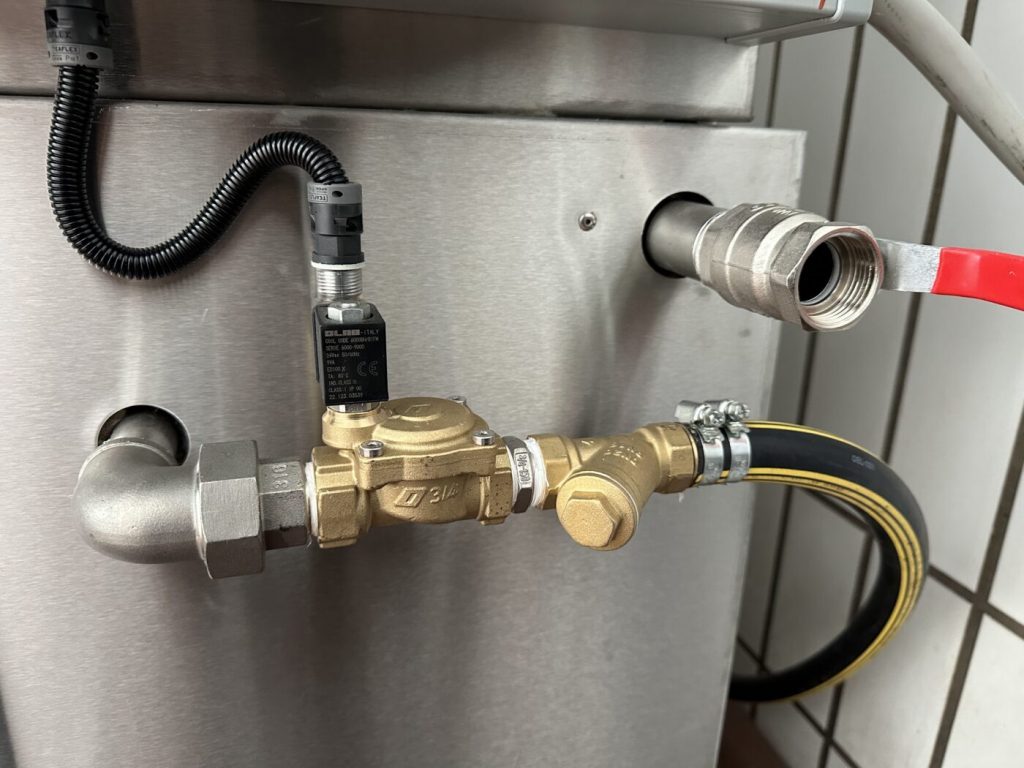
The sequence is not a formality. A machine that is piped before alignment can no longer be adjusted without straining pipes. A cable duct laid before fixing ends up next to the penetration. That is why our rule is: utilities come after fixing.
Four trades, one sequence
Electrics, compressed air, water and exhaust air come in a fixed order: supply line to the switchgear cabinet, compressed air with shut-off valves, fresh water and drainage, supply and exhaust air. Every connection is checked for tightness before switching on. Anyone who commissions the four trades separately coordinates four companies with four dates. Mechatronics technicians who master mechanics and electrics do them in one go.
The electrical connection belongs in the hands of a qualified electrician, and the installation is tested before switching on. DGUV Regulation 3 for electrical installations and equipment requires this. For you this means: clarify before installation day who lays the supply line, who terminates and who signs the initial test. The installation contractor, your in-house technician or an electrical company.
Inspection before first commissioning
Machines whose safety depends on the installation conditions – practically every anchored machine, every crane system, every platform – must be inspected after installation and before first use. The BetrSichV (Industrial Safety Ordinance) requires this in Section 14, and the German technical rule TRBS 1201 (Inspection of work equipment) describes scope and recording. For you this means: define before installation day who inspects – a competent person from your company, the manufacturer or an inspector. Give this person the installation report. Whoever inspects must know what was used for anchoring and how levelling was done.
Trial run and handover
The trial run begins without load: check functions, directions of movement, end positions, emergency stop, safety devices. Then follows the run with material. For a washer the first wash cycles, for a storage lift the travel of the trays, for a series of loading docks the check of each individual unit together with the client. The handover concludes with the installation report, the briefing and the documentation of the connections.
Which mistakes cost the most when aligning and anchoring a machine?
The most expensive mistakes in machine installation are those that only become visible in operation. A machine that twists on three feet. An anchorage that was tightened before curing. Anchors in a joint or too close to the edge, utilities before alignment. And a missing report with which nothing can be proven in a warranty case.
- Installing without an installation drawing. Anyone who does not know the manufacturer's specifications aligns by feel – and the manufacturer rejects the warranty.
- Measuring on painted surfaces. Cladding is not the machine's reference surface.
- Three feet bear, one floats. The machine twists under load; guides jam, bearings run on one side.
- Skipping the curing time. Anyone who runs under load on the same day has cracked mortar.
- Drilling through reinforcement. What is missing is missing from the slab permanently.
- Utilities before fixing. Pipes are strained, ducts lie in the wrong place.
- Handing over without a report. Torques, levelling and measuring equipment must be documented.
The final setting down onto the foundation is also part of the installation: avoid angled pull, transfer the load slowly, protect the lifting points. Which lifting accessories suit this is described in our guide Lifting accessories for heavy loads.
How we do it in the Rhine-Main region
Installing machines in the Rhine-Main region for us usually means: existing halls in Offenbach, Hanau, Darmstadt or Aschaffenburg, floor slabs without as-built documents, neighbouring machines in ongoing operation. Plus a weekend window in which alignment, anchoring and connection must be completed.
Our installations begin with a site visit at which we clarify three things. The ground, the reference axes and the utilities – where they come from and who connects them. From this we produce a sequence with order and curing times that fits the maintenance window. We request the manufacturer's installation drawing in advance. If it is missing, we obtain the data before we quote.
In our own workshop in Rodgau we manufacture substructures, adapter plates, brackets and lifting beams when anchor points and foundation do not match. And because Rodgau lies between Frankfurt, Offenbach and Hanau, we are back on site for the check measurement after the first weeks of operation without great effort.

How we do it in practice
Five projects from our project diary show aligning and anchoring in practice.
Parts washer in Kassel: unit, trolley and rail level
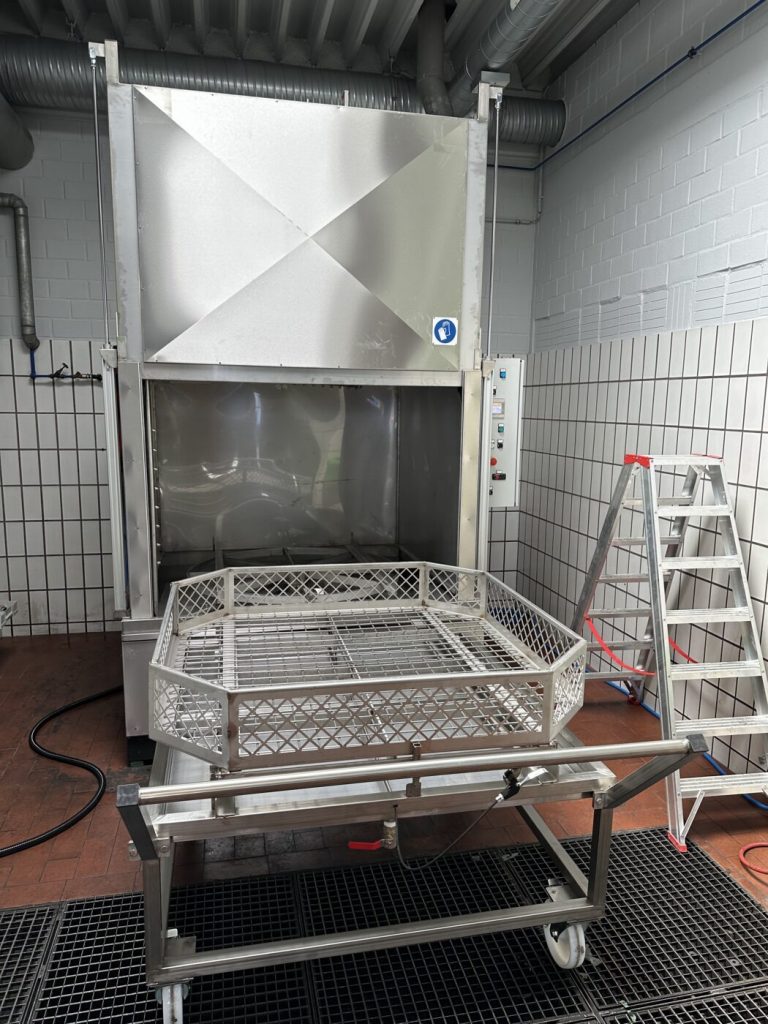
At a car and commercial vehicle workshop in Kassel we moved in, aligned and fully connected a parts washer – one working day, two mechatronics technicians. The unit is loaded via a feed trolley, and the washing basket rolls over a rail into the machine. Unit, trolley and rail had to fit each other exactly and be level. After fixing came the electrics, compressed air with pressure gauges and shut-off valves, fresh water and drainage and a stainless steel exhaust system welded on site, then joint commissioning. The first parts ran through the unit on installation day itself.
32 loading docks near Leipzig: a series with individual alignment
At a logistics centre near Leipzig we installed 32 truck restraint systems – vehicle restraint systems that secure lorries at the loading dock. Each of the 32 loading docks had to be prepared individually and installed precisely: aligned, mechanically fixed and connected to hydraulic power units, control panels, traffic light systems and signalling equipment. At the same time all supply lines were installed and the controls wired. Eight technicians were deployed at the start of the project, followed by a three-person team for fine assembly and electrical details. Finally, all units were tested and commissioned together with the client.
Test rig in Munich: oil pan on the concrete foundation
At a car manufacturer in Munich we converted a hydraulically driven test rig. Hydraulic line converted, an oil pan installed all around the concrete foundation – fixed with anchors and bolts, welded tight at corners and transitions, with drain cocks for the event of a leak. The gap to the concrete wall was sealed oil-resistant. Welding was done in a confined basement room with welding fume extraction and fresh air supply.
Tanks in Fulda: foundation cleaned, heavy-duty anchors set
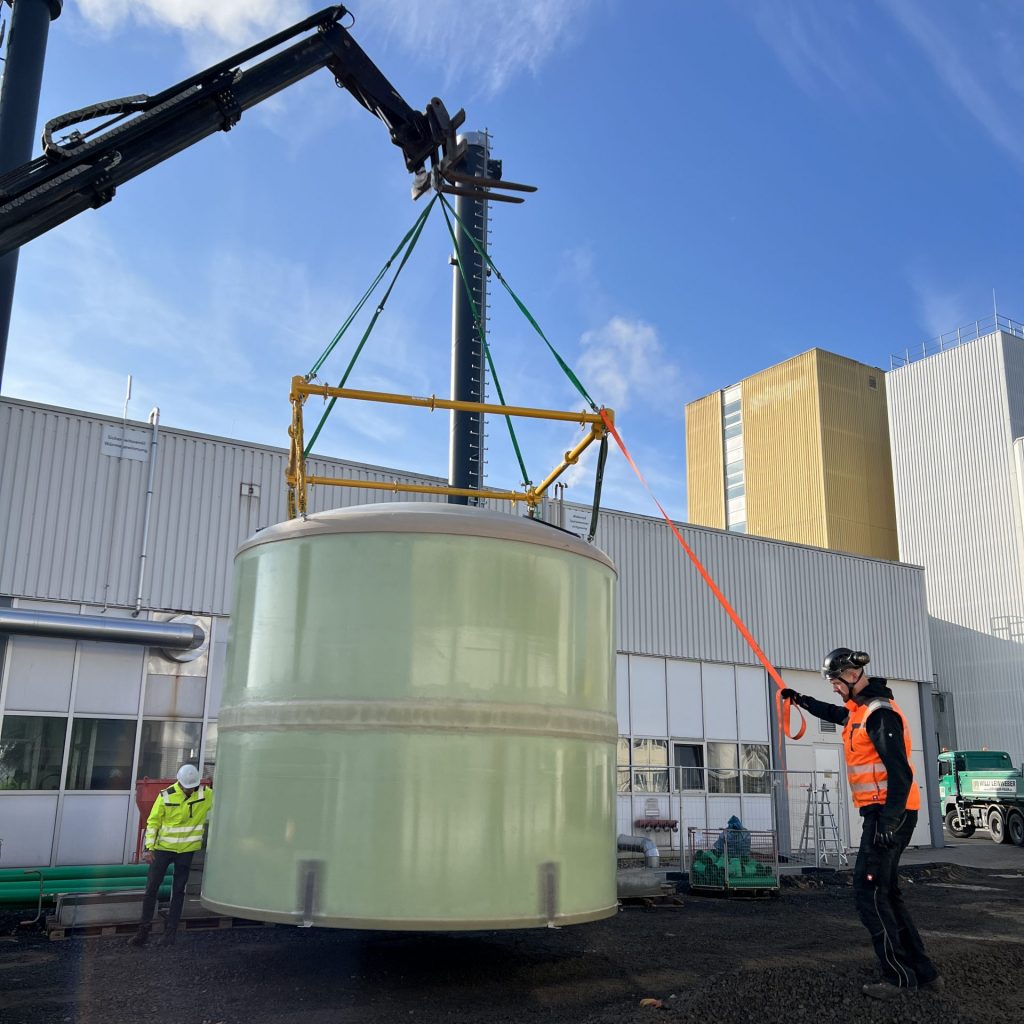
For a heating system in Fulda we set up and anchored plastic tanks by crane. Lifted on a purpose-made lifting beam so that no angled pull would damage the bonded-in eyes – according to lift plan, with banksman and tag line. Set down on previously cleaned concrete foundations. A protective rubber mat compensated for minor unevenness, and heavy-duty anchors fixed the tanks permanently.
Storage lifts in Rodgau: level the racks, then the sensors
We took six storage lifts from a Frankfurt office building and disassembled them and reassembled them in Rodgau. During reassembly, gears, racks, proximity switches and all guide elements had to be aligned so precisely that the trays would not be distorted when travelling. First survey and level, align heights, only then position the sensors, then run and test.
Do you have a machine due for installation – new, relocated or after a move? Then get in touch with us. A site visit usually clarifies within an hour whether the floor bears, what the alignment is referenced to and who connects which utilities.
What this means for your role
For buyers: Write aligning, anchoring, grouting, utility connection and installation report into the scope of works as separate items – “installation” as a lump-sum item ends in a change order. Demand that the bidder knows the manufacturer's installation drawing and names the anchor type with approval. Clarify who arranges the inspection before first commissioning and which services are provided by the client.
For designers: Request the manufacturer's installation drawing before the floor plan – with loads per foot, anchor points, flatness requirement, utility positions and vibration data. Decide the type of foundation and vibration isolation in the design, define reference axes and plan space for anchors, maintenance areas and check measurement. If as-built documents for the floor slab are missing, bring in the structural engineer before the machine is ordered.
For project managers and site managers: As project manager, you include curing times in the schedule and define when which utilities are available from the client. As site manager, you release the installation area – cleaned, scanned, dry – and define the reference axes on site. You release drilling and tightening and accept the installation with torque and levelling records before the trial run begins.
For maintenance managers: Demand the installation report with measuring equipment, levelling values, anchor type and torques – it is the zero point against which you measure later changes. Include check measurement and visual inspection of the anchoring in the maintenance schedule and have the location of the reference surfaces shown to you at handover.
For operations and plant managers: Release a maintenance window that includes curing times. Decide early whether the machine will ever be relocated; this determines whether anchor channels or cast-in bolts are the better choice.
For manufacturers and system builders looking for an installation partner: Your installation drawing is our working basis. We align to your specifications, anchor with the systems you have released and hand over a report with which your commissioning can begin. Deviations – reinforcement in the way, foundation different from the drawing – we coordinate with you before implementing them.
Machine installation report: template on request
The machine installation report records on two pages what was checked, measured, anchored and released during an installation. Ground, position and line, levelling, anchoring with anchor type, embedment depth and tightening torque, grouting, vibration isolation, utility connections, trial run and handover – with signature fields for installation contractor, client and manufacturer. It helps site managers at acceptance, maintenance managers as a zero point and buyers as an annex to the scope of works. Request the template via our Contact form – keyword “installation report”.
Why Omega Mounting?
From Rodgau near Frankfurt, Omega Mounting installs machines and plant in the Rhine-Main region and beyond. With mechatronics technicians who align, anchor, pipe, connect electrically and commission. With our own workshop for substructures, adapter plates and lifting beams and with the lifting equipment that gets a machine onto its foundation in the first place. The linked projects from Kassel, Leipzig, Munich, Fulda and Rodgau show what that means. Via our 24-hour hotline you can also reach us when a machine has to be realigned at short notice after damage. For you this means: a single point of contact for moving in, installation, anchoring and utility connection, one report instead of four trades with four handovers. And short distances in the Rhine-Main region when the check measurement is due after the first weeks of operation.
Conclusion
Aligning and anchoring a machine means doing three things in the right order. Level until all feet bear. Align until position, height and line to the peripherals are correct. Anchor with the system that the manufacturer and the approval specify – and let it cure before utilities and load come. Anyone who requests the installation drawing before the floor plan, checks the ground before drilling and has a report in hand at the end has a machine that runs the way it was bought. Send us the installation drawing or data sheet, floor plan with installation location and your preferred date – we will get back to you with an honest assessment before the foundation is poured or the crane is ordered.
Planning maintenance, moving in or installation in the Rhine-Main region?
Tell us briefly what it is about – we will come back to you with an honest assessment.
100% free and without obligation
You may also be interested in these guides

About the author
Tobias Schott
Managing director of Omega Mounting GmbH, Rodgau · more than 20 years of hands-on experience in installation and maintenance
A trained mechatronics technician, at home in maintenance, servicing and industrial installation since 2004 – first at his father's side, since 2012 with Omega Mounting: from the overhead conveyor in Frankfurt to the crane system in a new-build hall. Plans and leads lifting operations as appointed person in data centers and on industrial sites in the Rhine-Main region, is an instructor and examiner for cranes, mobile elevating work platforms and telehandlers, and a safety officer. On jobs abroad he is known as the “German Troubleshooter” – the one you call when things get stuck on site. He learned what quality means not from a manual but from his father: Made in Germany as a standard for his own work, not as a label. That is why it comes first at Omega Mounting – before speed and before price. He writes these guides from that practice: what works on our sites is in them – what only exists in the standard is not.
Frequently asked questions
Levelling brings the machine itself into the horizontal: its reference surfaces are level in both axes, all feet bear. Aligning relates the machine to something else – hall axes, a conveyor line, a rail, a neighbouring machine – and establishes position, height and line relative to it. A single workshop machine only needs to be levelled; as part of a chain it must also be aligned.
For light to medium machines without significant dynamics, often yes. Prerequisite: the floor slab bears the point loads under the feet, is flat enough, and slab thickness and reinforcement allow anchors to be set. Whether this applies is stated in the as-built documents or must be assessed by a structural engineer. Heavy, vibrating or high-precision machines generally need their own block or vibration-isolated foundation, which is defined in the design.
This is determined by the machine manufacturer's installation drawing and the anchor's approval – not the fitter's preference. In general, expansion and heavy-duty anchors are available for static loads, bonded anchors for high loads with small edge distances and undercut anchors for dynamic loads and cracked concrete. For block foundations, cast-in anchor bolts and anchor channels are added. Have the anchor type, approval and installation instructions shown to you and insist on a torque record.
As long as the mortar's data sheet specifies at the actual temperature and layer thickness – there is no universally valid value, and we deliberately do not give one. The same applies to bonded anchors. We plan the curing from the outset: level and grout first, tighten and connect afterwards.
When it generates vibrations or shocks that would disturb neighbours, buildings or measuring equipment – presses, punching machines, compressors, test rigs. Or when it is itself so sensitive that vibrations from the surroundings impair its accuracy. The means range from elastomer feet through spring elements to the vibration-isolated foundation. The decision belongs in the design because it affects foundation, anchoring and utility routing.
Because a machine that is piped or wired before alignment can no longer be adjusted without straining lines. First it is levelled, aligned and fixed, then grout and anchors cure, then come electrics, compressed air, water and exhaust air. Every connection is checked for tightness and function before the machine runs for the first time. In Kassel this was done in one day because the sequence was right.
From Rodgau, Omega Mounting aligns and anchors machines and plant in Frankfurt, Offenbach, Hanau, Darmstadt, Aschaffenburg and throughout the Rhine-Main region. With mechatronics technicians for mechanics and electrics, our own workshop and the lifting equipment for setting down on the foundation. Kassel, Leipzig and Munich show that we also work outside the region.
The basis is the risk assessment under Section 5 of the ArbSchG (German Occupational Safety Act) for the installation work itself. The BetrSichV (Industrial Safety Ordinance) requires in Section 14 that work equipment whose safety depends on the installation conditions is inspected before first commissioning. TRBS 1201 describes the scope and recording of this inspection. The electrical connection falls under DGUV Regulation 3. This guide does not replace legal advice; which inspection your machine specifically needs is determined with your competent person and the manufacturer.
Via a short enquiry with three details: installation drawing or data sheet of the machine with weight and anchor points, a floor plan with installation location and utility connections, and your preferred date or maintenance window. We arrange a site visit and check the ground, reference axes and utilities on site. You then receive a written assessment with sequence, curing times and interfaces to your trades. Your contact is Tobias Schott – reachable via our Contact form.
 English
 German