
- Guide – Lift & Shift
Company Machine Relocation: From Dismantling to Commissioning
By Tobias Schott · Reading time approx. 24 minutes · Last updated: October 2026
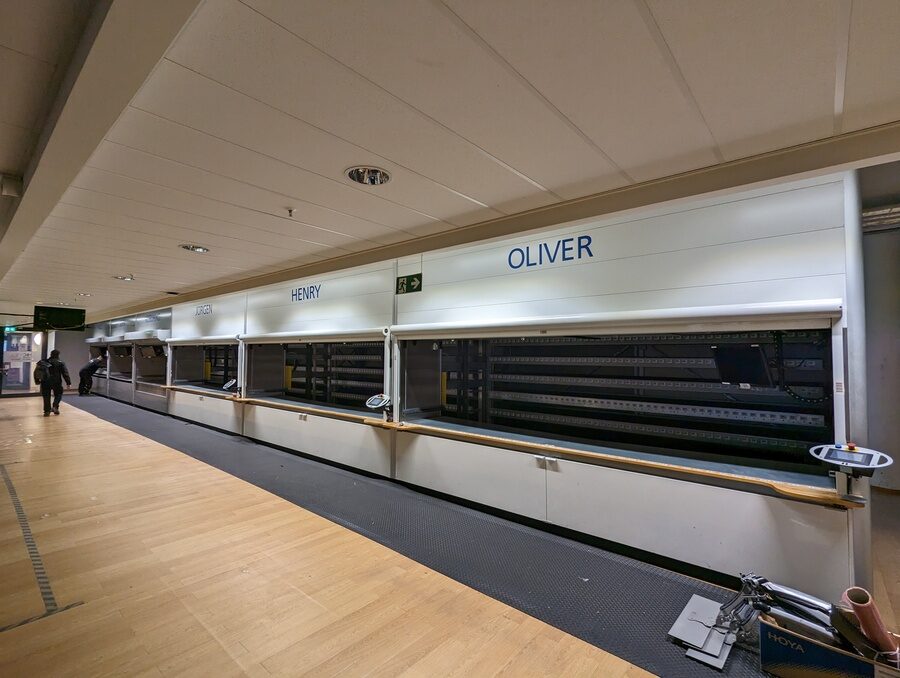
A machine relocation is only complete when the machine is producing again at the new site. Whether that succeeds on the first day is decided during the inventory, when disconnecting the utilities and when labelling every single component.
Anyone searching for “company machine relocation” usually has one of three plans: a machine is to be repositioned within the hall. A production line is moving to a new site. Or a used machine has been bought and needs to be collected. What sounds like transport is in reality a project with seven phases – and the actual journey is the least critical of them.
The risk lies at the edges: if a utility is not disconnected cleanly, a qualified electrician will be standing in front of an unlabelled wiring harness at reconnection. If a component is not labelled, the sequence is missing during reassembly. If the machine is not levelled at the new site, it runs – but not the way it should. And each of these points costs production days that no construction schedule allowed for.
This guide describes the machine relocation for your company from inventory to acceptance: sequence of steps, responsibilities, scope of works, involvement of the manufacturer and inspections after reassembly. Omega Mounting from Rodgau near Frankfurt takes on machine relocations in the Rhine-Main region and nationwide – from the single machine to the dismantled production line.
Key points at a glance
- A machine relocation runs in seven phases: inventory, disconnecting utilities, dismantling and labelling, packaging, transport, positioning and alignment, commissioning and acceptance.
- The on-site inventory decides whether a machine travels in one piece or is dismantled – door openings, floor load and floor covering of the transport route matter more than the weight.
- Utilities – power, compressed air, hydraulics, cooling water, data lines – are disconnected, secured and labelled according to fixed rules; the five safety rules of electrical engineering apply without exception.
- Every dismantled component is labelled and photographed before it leaves the hall – the photo log is the assembly instruction for reassembly.
- Levelling and alignment at the new site determine whether the machine runs within its tolerances; with systems that have racks, sensors or feeders, it comes down to millimetres.
- The manufacturer should be involved wherever calibration, software or warranty are affected – everything else can be taken on by a qualified installation contractor.
- After reassembly, safety-relevant inspections are due before the machine goes back into operation – at least the electrical inspection, and for cranes the inspection after relocation.
What is a machine relocation?
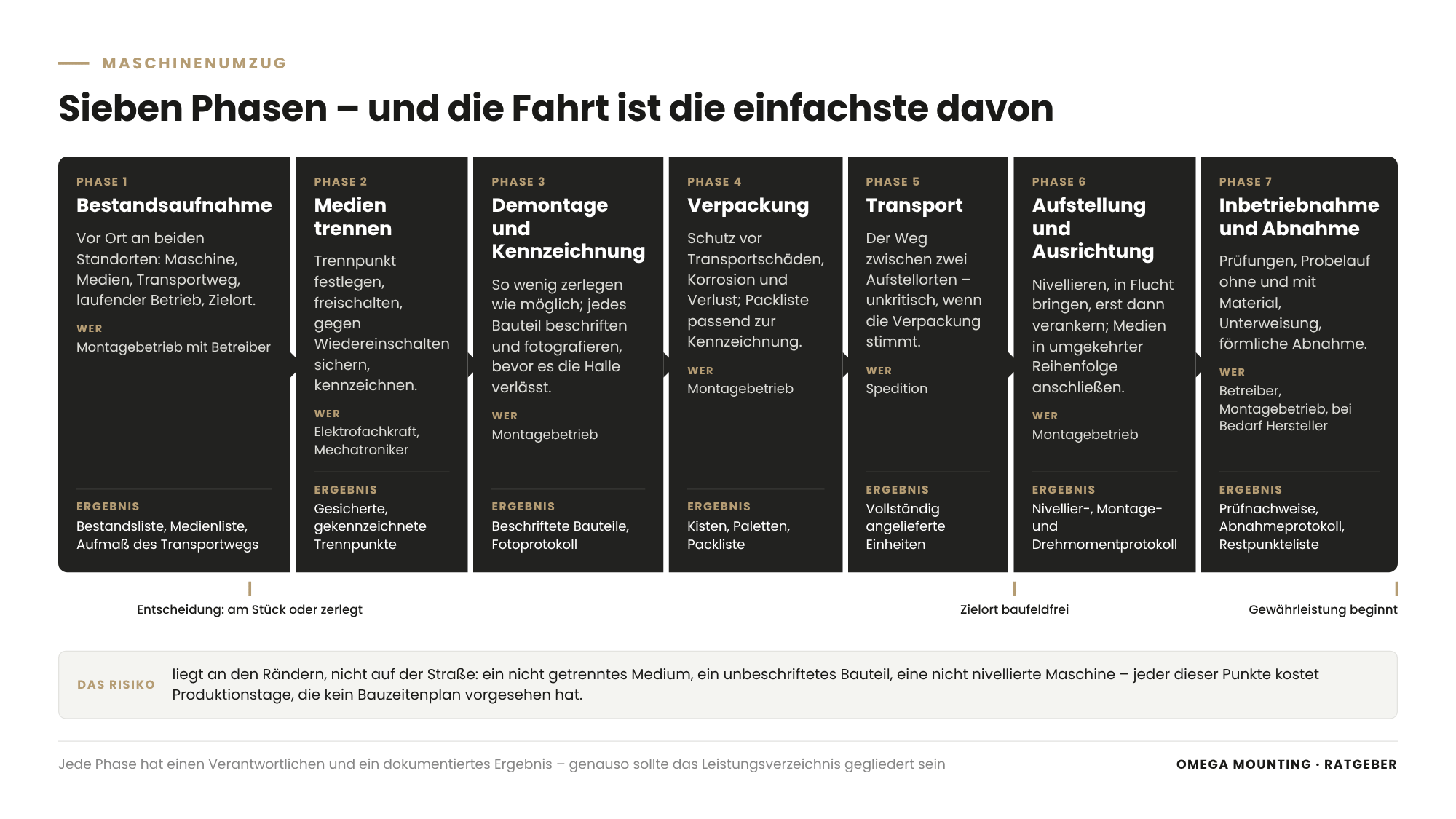
A machine relocation is the planned transfer of a machine or plant from one installation site to another, including disconnection, dismantling, transport, reassembly and commissioning. That can be within a hall, between sites or to a new owner.
The term machine transfer is used synonymously. A machine relocation is to be distinguished from pure heavy haulage, which covers only the route between two loading ramps. Likewise from new installation, in which a machine is delivered from the factory and set up for the first time. A relocation adds what new installation lacks: a running machine first has to be shut down, disconnected and dismantled – with everything that has been added over years of operation.
Three typical occasions
- Relocation within the hall: Layout change, new line, space for an extension. Short route, but often ongoing operations alongside.
- Relocation between sites: Relocating a production operation, merging plants. Transport on public roads, packaging, two sites.
- Relocation to a buyer or seller: A used machine changes owner. Often with little documentation and no contact with the manufacturer.
The seven phases at a glance
| Phase | Objective | Result |
|---|---|---|
| 1 Inventory. | Knowing what is there, what is connected, how it gets out and in. | Inventory list, utilities list, survey of the transport route. |
| 2 Disconnecting utilities. | Safely detaching the machine from all supplies. | Freigeschaltete, gegen Wiedereinschalten gesicherte, gekennzeichnete Trennpunkte. |
| 3 Dismantling and labelling. | Transportable units with unambiguous assignment. | Labelled components, photo documentation. |
| 4 Packaging. | Protection against transport damage, corrosion, loss. | Crates, pallets, packing list. |
| 5 Transport. | Route between two installation sites. | Delivered, complete units. |
| 6 Positioning and alignment. | Machine stands levelled, in line and fixed. | Levelling record, anchoring, installation report. |
| 7 Commissioning and acceptance. | Machine produces within tolerances. | Inspection records, acceptance report, punch list. |
Why does the inventory decide your company's machine relocation?
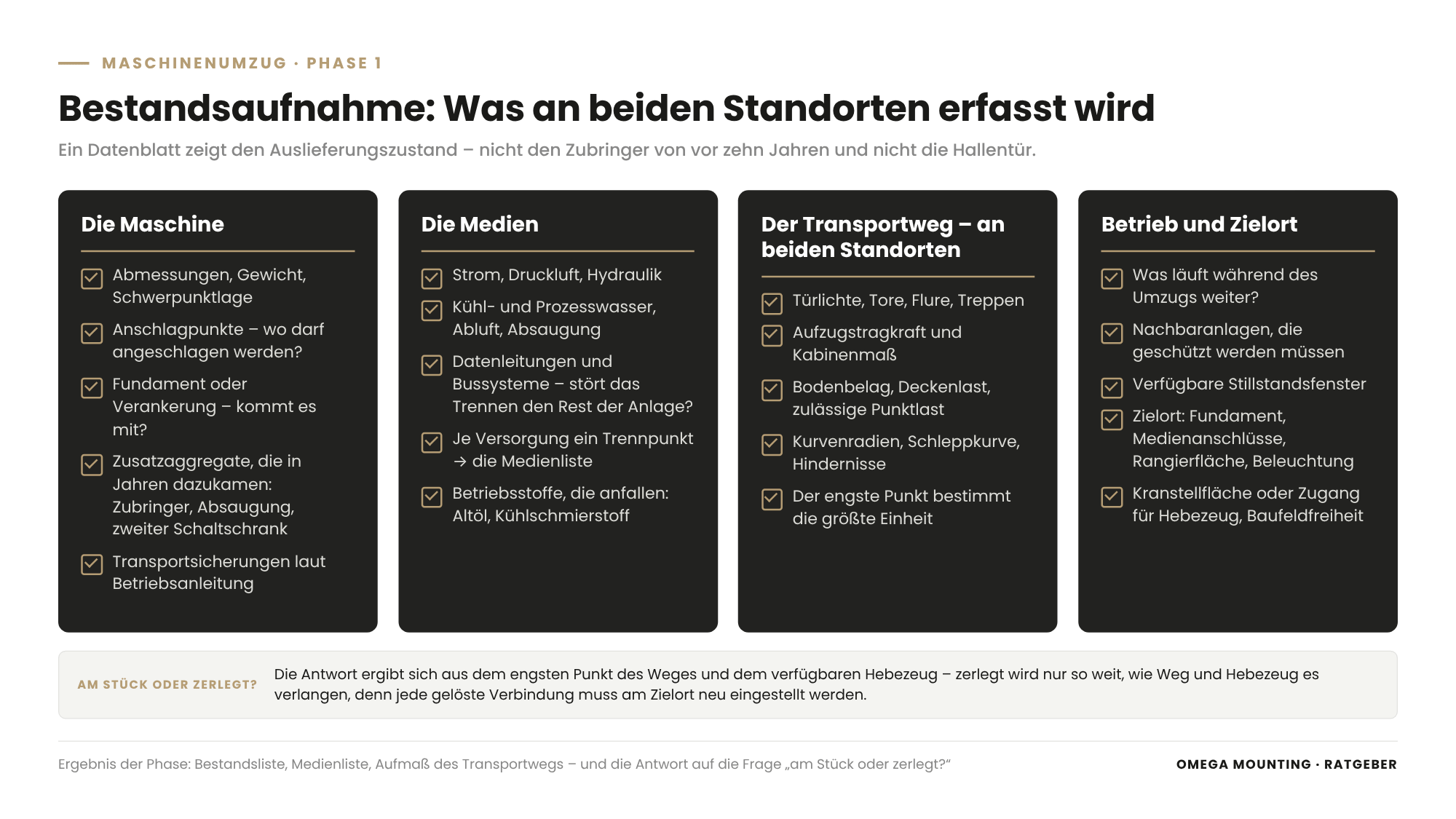
The inventory decides the whole machine relocation because it defines method, lifting method, utilities list and time required. Only after it is it clear whether the machine is moved in one piece or dismantled, which lifting equipment is an option and how much time reassembly needs.
It takes place on site – at both sites. A data sheet tells you the weight and dimensions of the machine as delivered. It does not tell you that in ten years a feeder, an extraction system and a second control cabinet have been added. It is silent about the fact that the machine stands on a foundation that is not coming along – and that the hall door is narrower than the machine is wide.
What is recorded
- The machine itself: Dimensions, weight, centre of gravity, lifting points – the points at which the load may be slung –, foundation or anchoring, auxiliary units.
- The utilities: Every supply line with its disconnection point – power, compressed air, hydraulics, cooling water, process water, exhaust air, extraction, data lines, bus systems.
- The transport route: Door openings, gates, corridors, stairs, lift capacity, floor covering, floor load and permissible point load, turning radii and swept path, obstacles – at both sites.
- Operations: What keeps running during the relocation? Which neighbouring plant has to be protected? Which maintenance windows are there?
- The destination: Foundation, utility connections, manoeuvring area, lighting, crane set-up area or access for lifting equipment, a clear work area.
In one piece or dismantled?
The answer follows from the narrowest point of the route and from the available lifting equipment. In the relocation of six storage lifts from an office building in Frankfurt to Rodgau three interior doors were the pinch points. The floor was parquet, and forklift, pallet truck or crane were out of the question. The units were therefore completely dismantled into individual parts and moved on dollies. For an injection moulding machine whose heaviest single part weighed 95 tonnes, the question did not arise – it is dismantled for transport anyway. In between lies the large range in which the inventory decides.
How do you disconnect utilities safely?
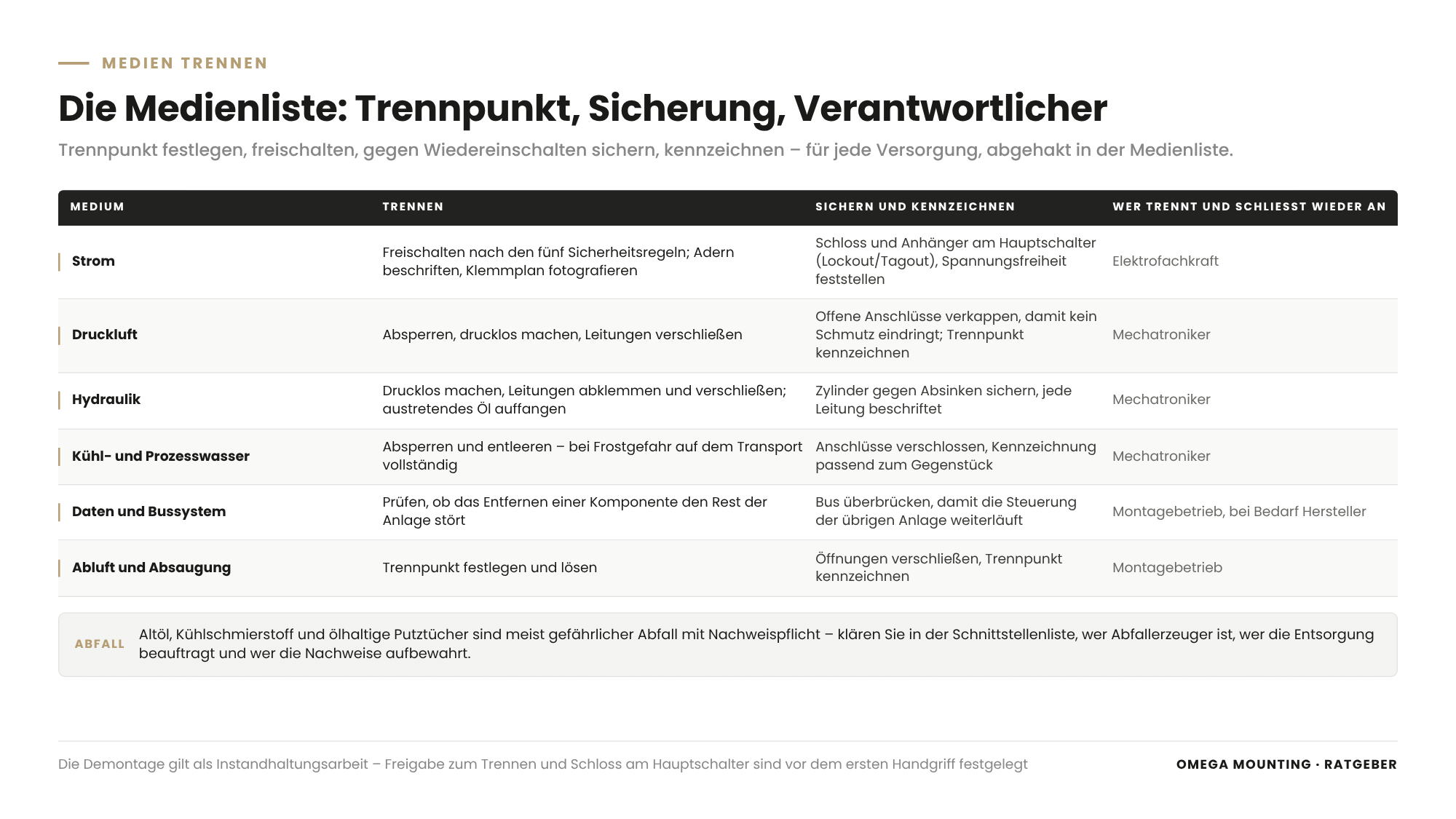
You disconnect utilities safely by defining the disconnection point for each supply, isolating, locking out against re-energising, verifying the absence of voltage and pressure and labelling the disconnection point. Securing is done with lock and tag – internationally lockout/tagout (LOTO) – and everything is documented in a utilities list.
Disconnecting the utilities is the moment when a machine in operation becomes a transport item. This is where the mistakes happen that cost the most later – and the most dangerous ones. From an occupational safety point of view, dismantling is maintenance work. The German technical rule TRBS 1112 (maintenance) names permit systems and personalised blocking and locking systems – i.e. lockout/tagout – as protective measures for dismantling. For you this means: before the first hands-on step, define who in your company issues the clearance to disconnect and who holds the lock on the main switch.
Power: the five safety rules
For electrical installations, the five safety rules under DIN VDE 0105-100 apply without exception. They are: isolate, secure against re-energising, verify absence of voltage, earth and short-circuit, cover or shield adjacent live parts. The work is carried out by a qualified electrician – a person with the professional qualification to assess electrical work and recognise hazards. Before disconnecting, all conductors are labelled and the terminal diagram photographed. For systems with a bus system – a data network linking control and components – it is checked whether removing a component disturbs the rest of the system. In the removal of an industrial robot at a bakery near Fulda the bus system was bypassed so that the control of the rest of the plant kept running.
Compressed air, hydraulics, water
Compressed air lines are shut off, depressurised and closed; open connections are capped so that no dirt gets in. Hydraulics are depressurised, lines are disconnected, closed and labelled; escaping oil is collected, cylinders are secured against lowering. Cooling and process water is shut off and drained – completely if there is a risk of frost during transport. Every connection gets a label that matches its counterpart.
What arises in the process is waste – and often hazardous waste at that: waste oil, cooling lubricant, oily cleaning cloths. The BG BAU/BAuA module “Site set-up – waste separation and waste disposal” reminds us: for hazardous waste there is an obligation to provide evidence and keep a register, and the evidence is kept electronically. Scrap metal goes to recycling, separated by type. For you as the operator this means: clarify in the interface list who is the waste producer, who commissions the disposal and who keeps the records. Otherwise the drum of waste oil will still be standing in your hall after the relocation.
The utilities list
The utilities list is a table of all supplies: utility, disconnection point, who disconnects, how secured, how labelled, who reconnects at the destination. It is part of the inventory and is ticked off during disconnection. If it is missing, the knowledge of where everything belongs is missing at reconnection.
How do you dismantle and label correctly?
Dismantling correctly means breaking the machine down into transportable units that come back together at the destination in reverse order. Labelling correctly means labelling and photographing every component, every connection and every setting before loosening it.
Transportable units instead of individual parts
The aim is not to dismantle as much as possible, but as little as possible – just enough for the units to fit through the route and be lifted safely. Every connection that is loosened is a connection that has to be readjusted at the destination. For precision systems, it is therefore defined beforehand which assemblies stay together.
Labelling and photo log
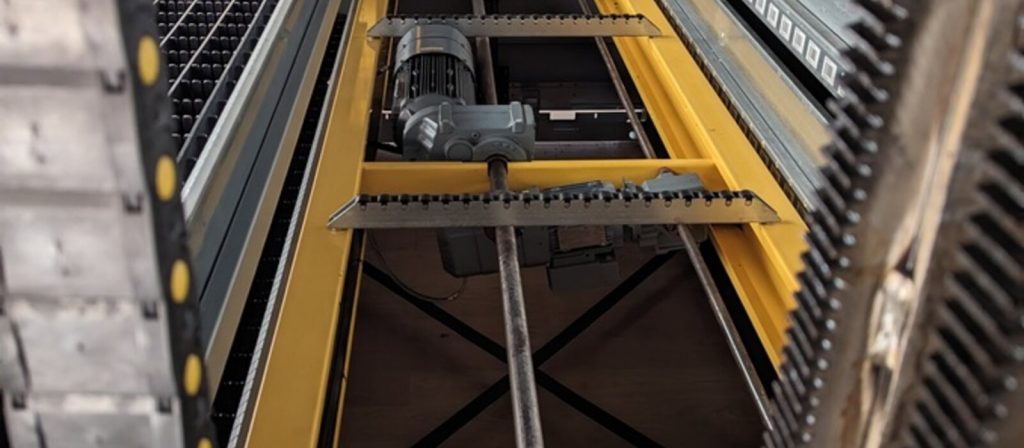
During the relocation of the automated storage units to Rodgau, every component was labelled and recorded in a photo log before it left the hall. During reassembly, racks, gears and proximity sensors – inductive sensors that detect positions – had to be accurate to the millimetre. Without the labelling, that would have been a reconstruction; with it, it was assembly by instruction.
What is labelled:
- Every component with position and installation direction.
- Every connection with its counterpart – plug and socket, flange and mating flange.
- Every setting that is lost when loosening – dowel pins, stops, shims, alignment dimensions.
- Every bolted connection with a specified tightening torque.
Transport securing
Moving axes, slides, doors and covers are secured, loose parts dismantled or lashed down. Sensitive components – controls, screens, sensors – are packed separately. What the manufacturer provides for transport is in the operating instructions; what is missing, the installation contractor adds.
How does the machine get out of the hall and into the new one?
The machine gets out of the hall and into the new one with the lifting and transport method that suits weight, route and space. The range extends from dollies via machine skates, pallet trucks and forklifts to overhead crane, mini crane, spider crane or mobile crane.
The right lifting method
The installation contractor makes the choice after the inventory and records it in the lift plan. This states load weight, centre of gravity, load-handling attachments and lifting accessories, crane set-up area and ground bearing pressure, banksmen and load zone.
- Dollies and machine skates – also called tank rollers – when no machine fits into the hall or the floor is sensitive. Load spreading plates take up the point load where the floor cannot bear it.
- Pallet trucks and forklifts, when capacity and space are sufficient. In the dismantling of a paternoster storage unit and a hall office side panels were set down with forklift and round slings, trays and drive parts were lifted out of the housing with an electric pallet truck. The side panels that were too wide were then moved out of the hall on dollies after all.
- Overhead crane, if present and with sufficient capacity. In the relocation of an injection moulding machine an overhead crane, a forklift and a 100-tonne-class lifting device for machine bed and platens were used.
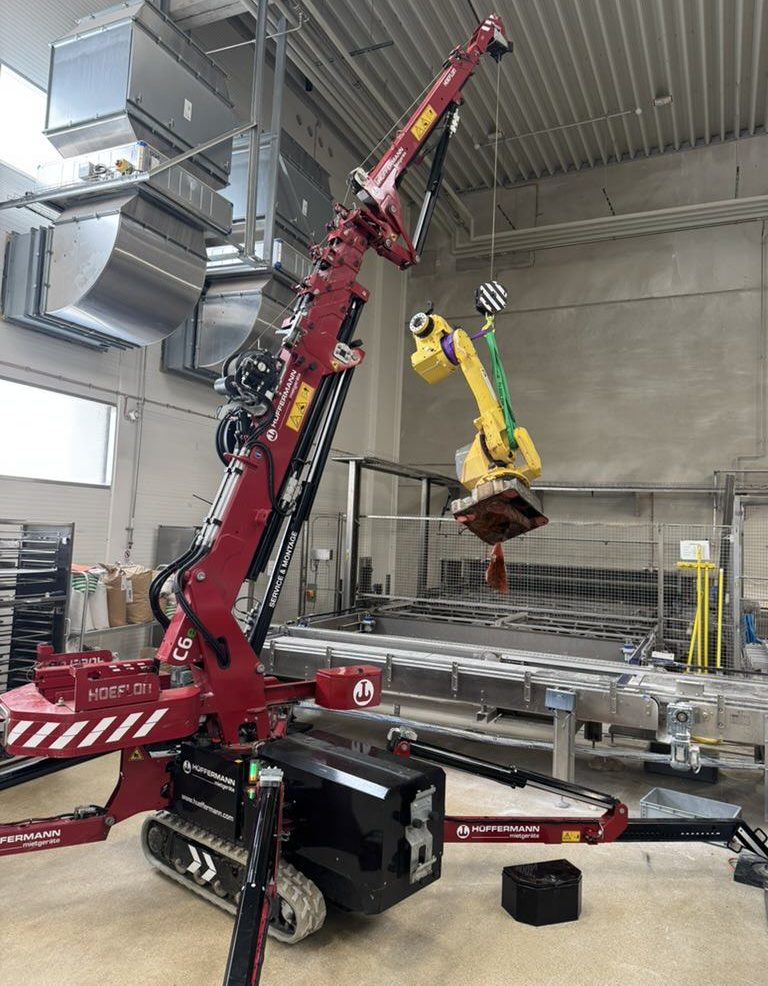
- Mini crane, a compact crawler crane for indoor use, when lifting over obstacles is required. In the bakery near Fulda, a mini crane lifted the robot weighing around 600 kilograms centimetre by centimetre over the production line after the robot base had been pulled forward from under the conveyor belt.
- Mobile crane, when moving in via the roof or through an external opening.
Protecting routes, protecting operations
Floor protection with hardboard or protective fleece, covering of neighbouring plant, cordoning off the load zone and separation of trades from the traffic routes are part of every relocation during ongoing operations. They are defined in the risk assessment and discussed during the briefing before the first lift. Two rules from the module “Site set-up – traffic areas, transport routes, storage and set-up areas” affect you directly here: pedestrian and vehicle traffic are routed separately, and escape and rescue routes remain clear. An escape route for up to 20 people needs a clear width of at least 1.00 metre under workplace rule ASR A2.3. Nothing combustible may be stored next to it, so no transport crates or packaging film either. For you this means: the interim storage areas for dismantled assemblies are defined on the hall plan beforehand, not in the corridor on the day of dismantling. In food plants, hygiene rules are added – hairnet, face mask and stainless steel instead of mild steel for reinforcements on the safety fence.
Packaging and transport
For transport on public roads or overseas, units are packed in wooden crates and containers, protected against corrosion and provided with a packing list that matches the labelling. The transport itself is then the least critical phase – if the packaging is right.
How do you align the machine at the new site?
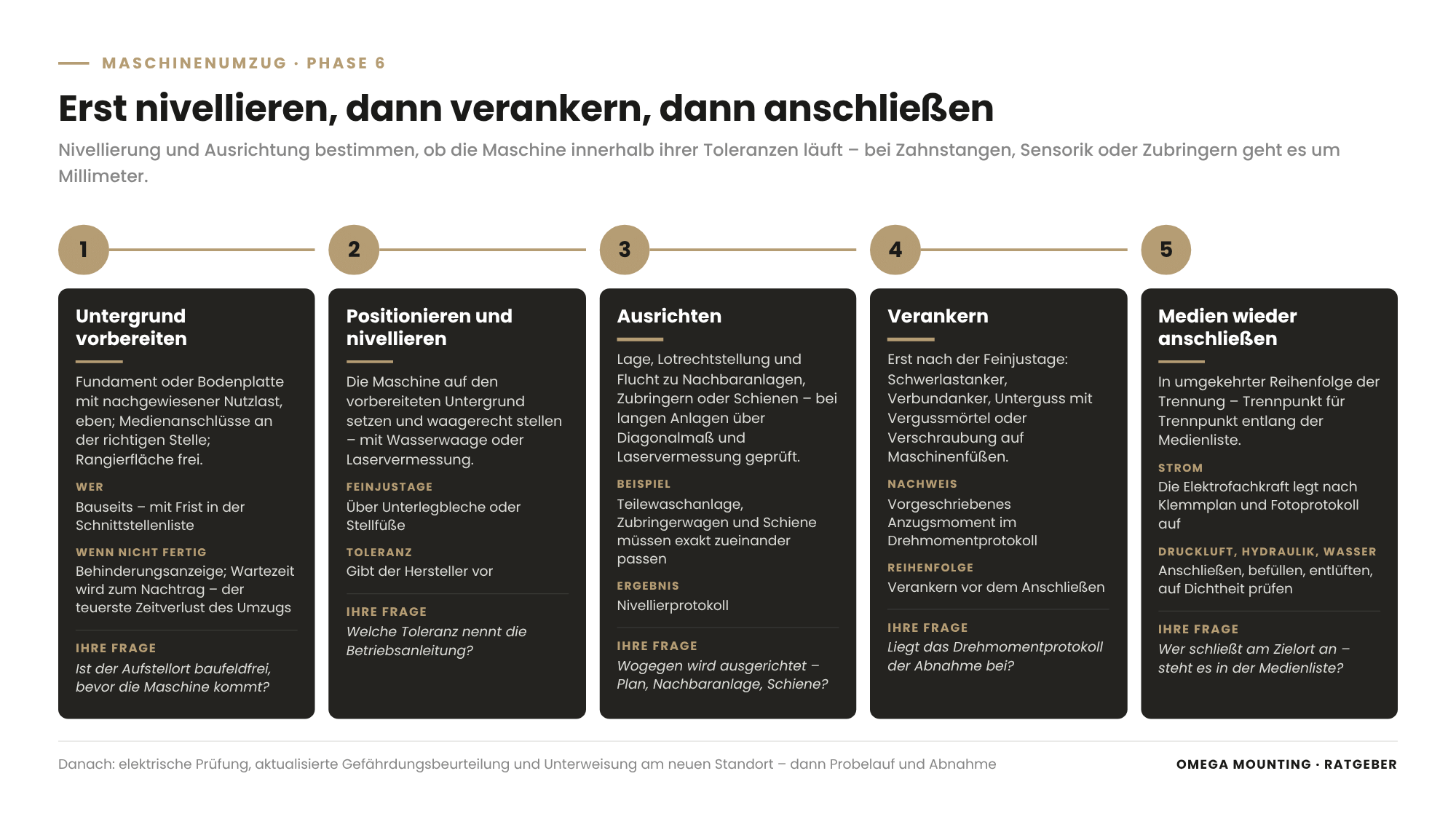
At the new site you align the machine by positioning it on a load-bearing, prepared base and levelling it with a spirit level or laser survey. Then you fine-adjust via shims or levelling feet and only anchor after that.
Base and foundation
The installation site must be prepared before the machine arrives: foundation or floor slab with verified imposed load and level, utility connections in the right place, manoeuvring area clear – a clear work area. Anyone who awards this as a client-provided work defines in the interface list by when it must be finished. If it is not finished on the installation day, a notice of hindrance follows, and waiting time becomes a change order – the most expensive loss of time in the whole relocation.
Levelling and alignment
Levelling means setting the machine horizontal. Aligning means bringing it into position, plumb and line with neighbouring plant, feeders or rails. For long systems, this is checked via diagonal measurement and laser survey. The tolerance is specified by the manufacturer. In the installation of a parts washing system at a vehicle workshop in Kassel the system, feed trolley and rail had to match each other exactly. Only when the system is properly level does the wash load run centred in the basket. Two mechatronics technicians completed moving in, alignment and all connections in one working day.
Anchoring and connecting
Anchoring comes only after fine adjustment – with heavy-duty anchors, bonded anchors (anchor rods in bonding mortar), grouting with grout or bolting on machine feet. Every connection gets the specified tightening torque and is recorded in the torque record. Then the utilities are reconnected in the reverse order of disconnection, disconnection point by disconnection point along the utilities list. The qualified electrician terminates according to the terminal diagram and photo log; compressed air, hydraulics and water are connected, filled, bled and tested for leaks.
When do you involve the manufacturer – and who carries out acceptance?
You involve the manufacturer when calibration, software versions, safety functions or warranty issues are affected. Acceptance takes place formally and jointly: you as the operator, the installation contractor and – where involved – the manufacturer. The warranty for the installation service begins with it.
Clearly delimiting manufacturer services
A qualified installation contractor takes on disconnection, dismantling, transport, positioning, alignment and reconnection. The manufacturer comes into play where specific knowledge or access is needed: calibration of sensors and axes, software updates, parameterisation, release of safety functions, preservation of the warranty. During the relocation of the automated storage units to Rodgau, this boundary was in the interface list beforehand – which is why there was no discussion about who was responsible for what.
Inspections before recommissioning
After a relocation, a machine is newly installed from an occupational safety point of view. That means:
- The electrical installation is inspected by a qualified electrician in accordance with DGUV Regulation 3 before recommissioning.
- The risk assessment under Section 5 of the ArbSchG (German Occupational Safety Act) is updated for the new installation site – traffic routes, neighbouring plant and escape routes have changed. The inspection intervals at the new site also follow from this.
- After relocation, cranes are inspected by a qualified person – a competent person for inspections – before recommissioning, as DGUV Regulation 52 provides for substantial modifications and changes of location.
- If the machine is converted or extended during the relocation, it must be checked whether a substantial modification within the meaning of the Machinery Directive exists – in which case a new conformity assessment would be necessary. A pure relocation without conversion generally is not.
- Operators are briefed again at the new site. TRBS 1116 (qualification, briefing, appointment) treats a new working environment like a first use of the work equipment – with documentation of date, content and names. For you this means: plan the briefing as a separate appointment between trial run and start of production, not as an aside at acceptance.
Trial run and acceptance
Commissioning begins with the trial run without material, then with material, then as a load run under production conditions. For the parts washing system in Kassel, the first wash cycles were run together with the operator on the installation day itself. The acceptance report records what was checked, which tolerances are met and which points remain open in the punch list – signed by both sides. Defects that appear later are handled as a notice of defects within the warranty.
Company machine relocation in the Rhine-Main region: how we do it
With us, a machine relocation in the Rhine-Main region works so that inventory and relocation come from a single source. For a machine relocation in Offenbach, Hanau, Darmstadt, Aschaffenburg or Frankfurt, the journey from Rodgau is short, and our own workshop backs us up.
Proximity pays off three times over. First, in the inventory: we are quickly on site for a walk-through, at both locations, and can repeat it if necessary. Second, in the relocation itself: if an adapter, a transport plate or a bracket does not fit, we make it in the workshop in Rodgau instead of waiting for a delivery. Third, afterwards: if something needs readjusting in the first days of operation, we are there.
Our fitters are mechatronics technicians – they disconnect and reconnect utilities themselves, instead of you coordinating electrician, plumber and fitter separately. For relocations in logistics centres in Dietzenbach or Rodgau, production plants in Hanau or workshops in Darmstadt, the same procedure applies as for the overseas transport of an injection moulding machine – only the route is shorter.
How we do it in practice
Three relocations from our project diary show the seven phases under very different conditions.
Six automated storage units from Frankfurt to Rodgau: dismantle, label, realign
During the relocation of six vertical carousel storage lifts from a Frankfurt office building to Rodgau the route determined the method: three interior doors as pinch points, parquet floor, no machinery possible. The units were completely dismantled into documented individual parts, moved through the building on dollies and taken away by container. Six fitters were deployed for loading. During reassembly, racks and gears had to align to the millimetre, the proximity sensors had to be exactly levelled, chains and shafts had to run synchronously. The manufacturer then calibrated the sensors, installed a software update and accepted the units. A relocation in which the labelling was the real service.
Injection moulding machine: 500 tonnes over three weekends with production running
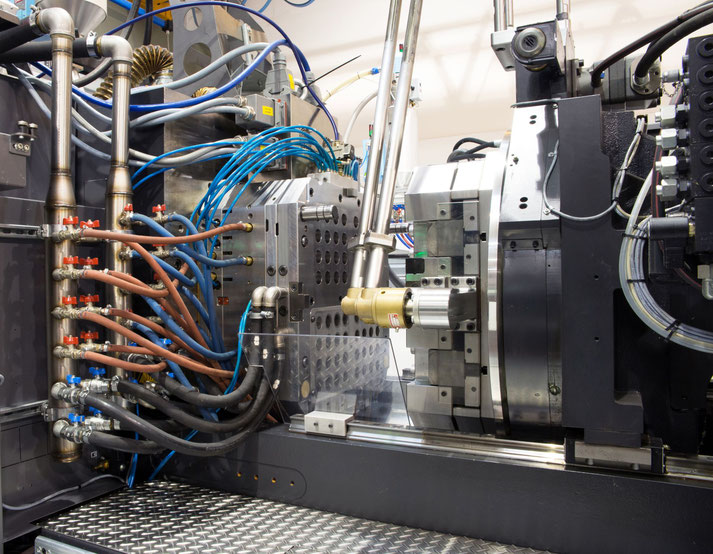
During the relocation of an injection moulding machine six fitters dismantled the machine together with its guarding, removal robot and conveyor belts in three weekend windows. In the same hall, other injection moulding machines kept producing – separation of trades during ongoing operations. In total, around 500 tonnes of material went into wooden crates and containers for overseas transport; the heaviest single part, the moving platen, weighed 95 tonnes. Lifting was done with the overhead crane with a capacity of 50 tonnes, a forklift with 4 tonnes and a 100-tonne-class lifting device for machine bed and platens. The schedule was decisive: every weekend ended with a hall that could produce again on Monday.
Industrial robot in a bakery near Fulda: bypass the bus, lift in one piece
During the removal of an industrial robot at a bakery near Fulda space was tight. The robot, weighing around 600 kilograms, lay between conveyor belts with centimetres of clearance. A lifting manager – the appointed person for lifting operations –, a crane operator and two mechatronics technicians disconnected power, water and compressed air and bypassed the bus system so that the plant control kept running. They then slung the robot with inspected round slings and lifted it with a mini crane centimetre by centimetre over the production line – undamaged and in one piece. In the following days, during the production shutdown, the former robot access points were removed and stainless steel reinforcements were TIG-welded into the safety fence system. Hygiene requirements – hairnet, face mask – applied the whole time.
Is a comparable relocation coming up in your company – a line being repositioned, a used machine to be collected? Then get in touch with us. A walk-through at both sites usually shows within an hour whether the machine travels in one piece or is dismantled and which maintenance window is realistic.
What this means for your role
For buyers: Tender the machine relocation with a scope of works in seven phases – one item text per phase with a responsible person, plus optional items for re-manufacturing and auxiliary units that only the inventory reveals. As evidence of suitability, demand references for comparable relocations, qualifications for qualified electrician, crane operator and slinger, business liability insurance including damage to property being worked on, as well as clearance certificate, exemption certificate and subcontractor declaration. An inventory at both sites before quotation submission and an interface list for client-provided and manufacturer services are your best protection against change orders; acceptance and warranty are regulated under VOB/B or the German Civil Code (BGB). A quotation without a walk-through is an estimate.
For designers: If you are planning a new layout or a new site, define how the existing machines will get there. Door openings, gates, floor load, turning radii and crane runways at the destination must match the transport dimensions of the dismantled units, not just the installation dimensions. Draw utility connections and foundations with load assumptions so that they match the utilities list of the existing machine, and keep manoeuvring areas and crane set-up areas clear for the installation day. An early walk-through with the installation contractor shows you which assembly your layout constrains most tightly.
For project managers and site managers: Your most important document is the construction schedule with maintenance windows – the planned periods without production –, milestones per phase and a fallback plan. Make sure that the destination is a clear work area before the machine arrives, and that the manufacturer and qualified electrician are there at the right time. On the installation day, the site manager gives the briefing, clears the lift, coordinates preceding and follow-on trades and keeps the punch list until acceptance. Plan the inspections before recommissioning – they are not a buffer that can be cut.
For maintenance managers: Use the relocation as an inspection window under DIN 31051. A machine that is being dismantled anyway can be assessed, cleaned and reassembled with new wear parts. Check the wear reserve of bearings, guides and chains before they come back together, and build up the spare parts stock for the new site. Update documentation, terminal diagrams, inspection intervals and risk assessment – after the relocation the old ones no longer apply.
For operations and plant managers: For you, the machine relocation is a question of production capability. Which maintenance windows can you release, what keeps running in the meantime, and from when must the machine deliver again at the new site? Define these key points before tendering so that the installation contractor plans the relocation around your production and not the other way round. Demand a fallback plan in case recommissioning takes longer than planned.
For manufacturers and system builders looking for an installation partner: When your customers relocate a system, the interface between the installation partner and your commissioning decides the warranty. Define up to which point the partner dismantles, transports and aligns and from when your calibration and software release begin. An installation partner who works to your labelling and tolerance specifications and supplies the photo log makes your commissioning shorter and your product more predictable for the customer.
Company machine relocation checklist: seven phases on request
The working document for this guide is a machine relocation checklist for your company in seven phases. For each phase it contains the check points from this article with fields for responsible persons and dates. Added to this are a template for the utilities list with disconnection point, lockout and labelling, a labelling rule for components and connections, and the inspections before recommissioning. It does not contain prices or cost estimates. It helps buyers set up the scope of works and project managers manage the relocation. Request the machine relocation checklist via our Contact form – keyword “Machine relocation checklist”.
Why Omega Mounting?
Omega Mounting is based in Rodgau near Frankfurt and is quickly on site for inventories and relocations in the Rhine-Main region – Offenbach, Hanau, Darmstadt, Aschaffenburg, Mainz – nationwide and beyond if required. Our mechatronics technicians disconnect and reconnect utilities themselves, label every component, align to the millimetre and commission together with you. Our own workshop in Rodgau manufactures transport frames, adapter plates and brackets when something is missing on site. The linked projects – automated storage units through three pinch points, an injection moulding machine over three weekends, a robot between conveyor belts – show the range. Via the 24-hour hotline you can reach us even when something goes differently from plan at the weekend. You will find more projects in our References. For you this means: one point of contact for all seven phases, dismantling, lifting technology and reconnection from a single source – and an interface list that stays short. If that fits your project, get in touch with us.
Conclusion
Behind the search term “company machine relocation” lies a project in seven phases, and the journey is the simplest of them. The inventory at both sites decides method and time required, disconnecting the utilities decides safety. The labelling decides reassembly, and the alignment decides whether the machine runs at the new site as it did at the old one. Manufacturer and inspections should be scheduled wherever calibration, software and occupational safety are affected. Are you planning a machine relocation? Send us the machine list, hall plans of both sites and your preferred maintenance window – we will come back to you with an honest assessment before the first quotation is written.
Further reading: Inspecting a used machine and Preserving a machine as special cases; fundamentals: What is industrial installation?. If the whole production is moving: Planning a plant relocation; if the machine is only changing its place: Repositioning a machine within the hall.
Planning maintenance, moving in or installation in the Rhine-Main region?
Tell us briefly what it is about – we will come back to you with an honest assessment.
100% free and without obligation
You may also be interested in these guides

About the author
Tobias Schott
Managing director of Omega Mounting GmbH, Rodgau · more than 20 years of hands-on experience in installation and maintenance
A trained mechatronics technician, at home in maintenance, servicing and industrial installation since 2004 – first at his father's side, since 2012 with Omega Mounting: from the overhead conveyor in Frankfurt to the crane system in a new-build hall. Plans and leads lifting operations as appointed person in data centers and on industrial sites in the Rhine-Main region, is an instructor and examiner for cranes, mobile elevating work platforms and telehandlers, and a safety officer. On jobs abroad he is known as the “German Troubleshooter” – the one you call when things get stuck on site. He learned what quality means not from a manual but from his father: Made in Germany as a standard for his own work, not as a label. That is why it comes first at Omega Mounting – before speed and before price. He writes these guides from that practice: what works on our sites is in them – what only exists in the standard is not.
Frequently asked questions
Anyone who wants to relocate a machine goes through seven phases. They begin with the inventory at both sites, followed by disconnecting and labelling the utilities, dismantling with labelling and photo documentation, packaging and transport. The conclusion is positioning with levelling and alignment, and commissioning with inspections and acceptance. Each phase has a responsible person and a result that is documented – and that is exactly how the scope of works should be structured, with an interface list for client-provided and manufacturer services.
No – it is dismantled only as far as the transport route and lifting equipment require. If the machine fits through all pinch points in one piece – door opening, turning radius, floor load – and can be lifted safely, it stays together. Every connection that is loosened has to be readjusted at the destination. The on-site inventory gives the answer.
Electrical work is carried out by a qualified electrician – according to the five safety rules of electrical engineering: isolate, secure against re-energising, verify absence of voltage, earth and short-circuit, cover adjacent live parts. Before recommissioning, the electrical installation is inspected in accordance with DGUV Regulation 3. An installation contractor with mechatronics technicians brings this qualification with them.
The manufacturer should be involved when calibration, software versions, safety functions or the warranty are affected. During the relocation of automated storage units to Rodgau, the manufacturer took on the calibration of the sensors, a software update and the final acceptance after our reassembly. Disconnection, dismantling, transport, positioning and reconnection can be taken on by a qualified installation contractor.
That depends on size, degree of dismantling, transport route and maintenance windows. A parts washing system in Kassel was ready for operation in one working day, including moving in, alignment and all connections. An injection moulding machine with around 500 tonnes of material was dismantled and packed over three weekends. The duration only becomes reliable after the inventory – then it can be recorded in the construction schedule with milestones and a fallback plan.
At least the electrical inspection by a qualified electrician and an updated risk assessment for the new installation site, from which the new inspection intervals also follow. Cranes are inspected by a competent person after relocation. If the machine was converted during the relocation, it must be checked whether a substantial modification within the meaning of the Machinery Directive exists.
In the Rhine-Main region – whether Hanau, Offenbach, Darmstadt or Frankfurt – we plan the relocation in maintenance windows, often weekend windows, with floor protection, cordoning off the load zone and separation of trades from the operations alongside. The short journey from Rodgau allows repeated walk-throughs before the relocation and quick readjustment afterwards; missing adapters or brackets are made by our workshop in Rodgau.
Yes, the seven phases apply to every industry – from storage technology in an office building via the robot in food production to the washing system in a vehicle workshop. What changes are the framework conditions: hygiene in the food industry, cleanliness and access in the data center, background checks at the airport. The core – inventory, utilities, labelling, alignment, inspection – remains the same.
Then the relocation becomes a machine dismantling: the machine is disconnected, dismantled, separated by recyclable material type and properly disposed of or packed for sale. Operating fluids such as waste oil are handled as hazardous waste with a disposal certificate during the machine relocation. When dismantling a vertical carousel unit, the power supply was removed, side panels were set down with forklift and round slings, trays and drive parts were lifted out with an electric pallet truck and everything was loaded into containers and big bags.
Send us via the Contact form – subject “Company machine relocation” – three details: the machine list with type, weight and dimensions, hall plans or photos of both sites and the desired maintenance window. We arrange an on-site inventory – for a used machine at the seller's location, looking at condition, utilities, degree of dismantling and transport route – and send you a written assessment with a sequence in seven phases and an interface list. Your contact is Tobias Schott.
 English
 German