
- Guide – Lift & Shift
Machine preservation: mothballing, storage and recommissioning
By Tobias Schott · Reading time approx. 23 minutes · Last updated: October 2026
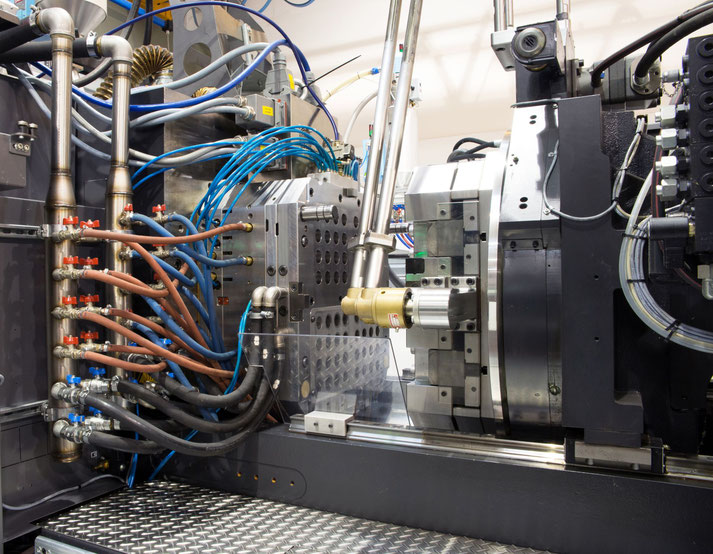
Preserving a machine means freezing its condition: isolated, drained or deliberately filled, cleaned, protected against corrosion and moisture, documented. That way it starts up again after weeks, months or years with a planned inspection rather than a repair.
A production line pauses because orders dry up. A machine moves and waits until the new foundation is ready. A plant is to be sold, but the buyer needs another six months. Or you have bought a machine from an insolvency that has been standing in a cold hall for months. In all four cases, the first days of the shutdown decide what recommissioning will cost later. Anyone who wants to preserve a machine therefore needs above all to know how shutdown, preservation, storage and recommissioning are connected.
The problem: anyone who has to shut down a machine in a business rarely finds a standard for it. So the main switch is turned off, a tarpaulin is laid over it – and after a year the guideways have rusted, seals have become brittle, the controller's backup battery is flat and the parameters are gone.
This guide builds on our article Machinery relocation for your company: from dismantling to commissioning. That guide is about the route from A to B; this one is about the time in between: reasons, shutdown, preservation steps, storage conditions, documentation and recommissioning after a standstill with inspection and trial run. With examples from Frankfurt, Fulda, Rodgau and a relocation across the ocean.
Key points at a glance
- The reason – relocation, sale, production pause, purchase from insolvency or second-hand, standby plant – determines storage duration, storage location and depth of preservation.
- Shutting down means isolating according to the five safety rules, disconnecting utilities, releasing stored energy, documenting the condition and visibly marking the plant as “out of service”.
- Preservation follows the sequence clean – drain or deliberately fill – corrosion protection per component group – secure electrics and controls – pack with desiccant.
- Condensation during temperature changes is the greatest enemy of a stored machine; the storage location matters more than the preservation agent.
- During storage the machine needs inspection rounds: desiccant, film, traces of corrosion, turn shafts, re-preserve.
- Before recommissioning come de-preservation, assessment, operating fluids, electrics, pre-commissioning inspection and a staged trial run – not reaching for the main switch.
- The preservation report with parts list, photo log and parameter backup makes recommissioning plannable.
What does it mean to preserve a machine?
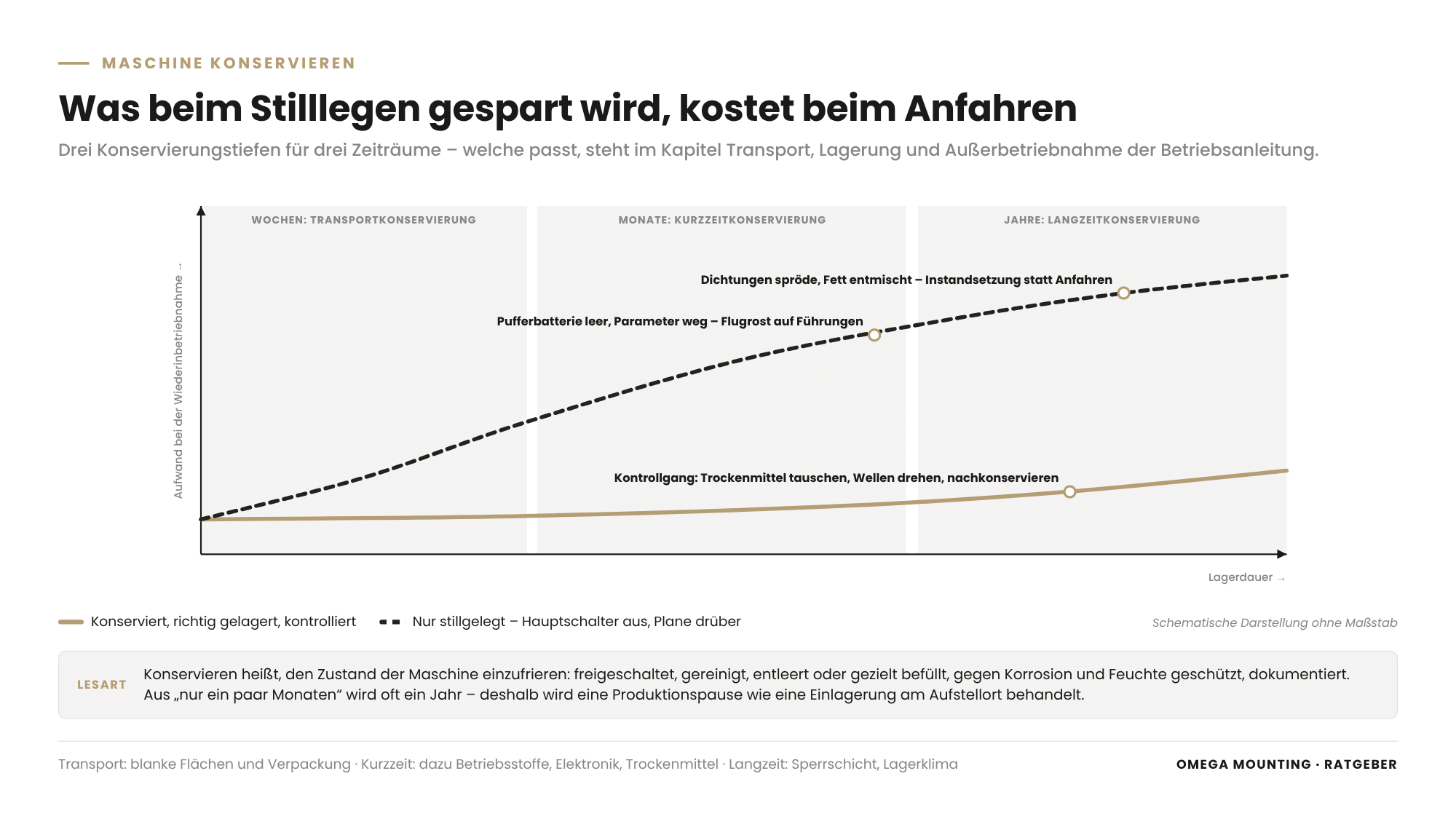
Preserving a machine means cleaning it after shutdown, draining or filling it, protecting it against corrosion, moisture and ageing, packing it and documenting it. The aim: it remains without loss of substance over the planned storage period and can afterwards be recommissioned with reasonable effort.
The term has two neighbours. The decommissioning of a machine – the shutdown – is the step before: taking it out of operation, isolating, securing. The storage is the step after: the time in a place that suits the machine. In everyday plant language people say “mothball the machine” and mean all three together – and exactly this blurring leads to gaps. Anyone who only shuts down has not preserved; anyone who stores in the wrong place has preserved in vain.
Three depths of preservation
- Transport preservation for the duration of a relocation: protection of bare surfaces, securing of moving parts, packaging against weather and impact – for weeks, not for years.
- Short-term preservation for a production pause or sales phase of a few months: in addition, operating fluids regulated, electronics secured, desiccant, inspection intervals.
- Long-term preservation for years: draining or filling with preservation media as specified by the manufacturer, barrier packaging, climatically suitable storage location, re-preservation.
Which depth is appropriate is stated in the operating instructions – every machine has a chapter there on transport, storage and decommissioning. It is rarely read; we open it first before every preservation job.
What reasons are there to shut down and preserve a machine?
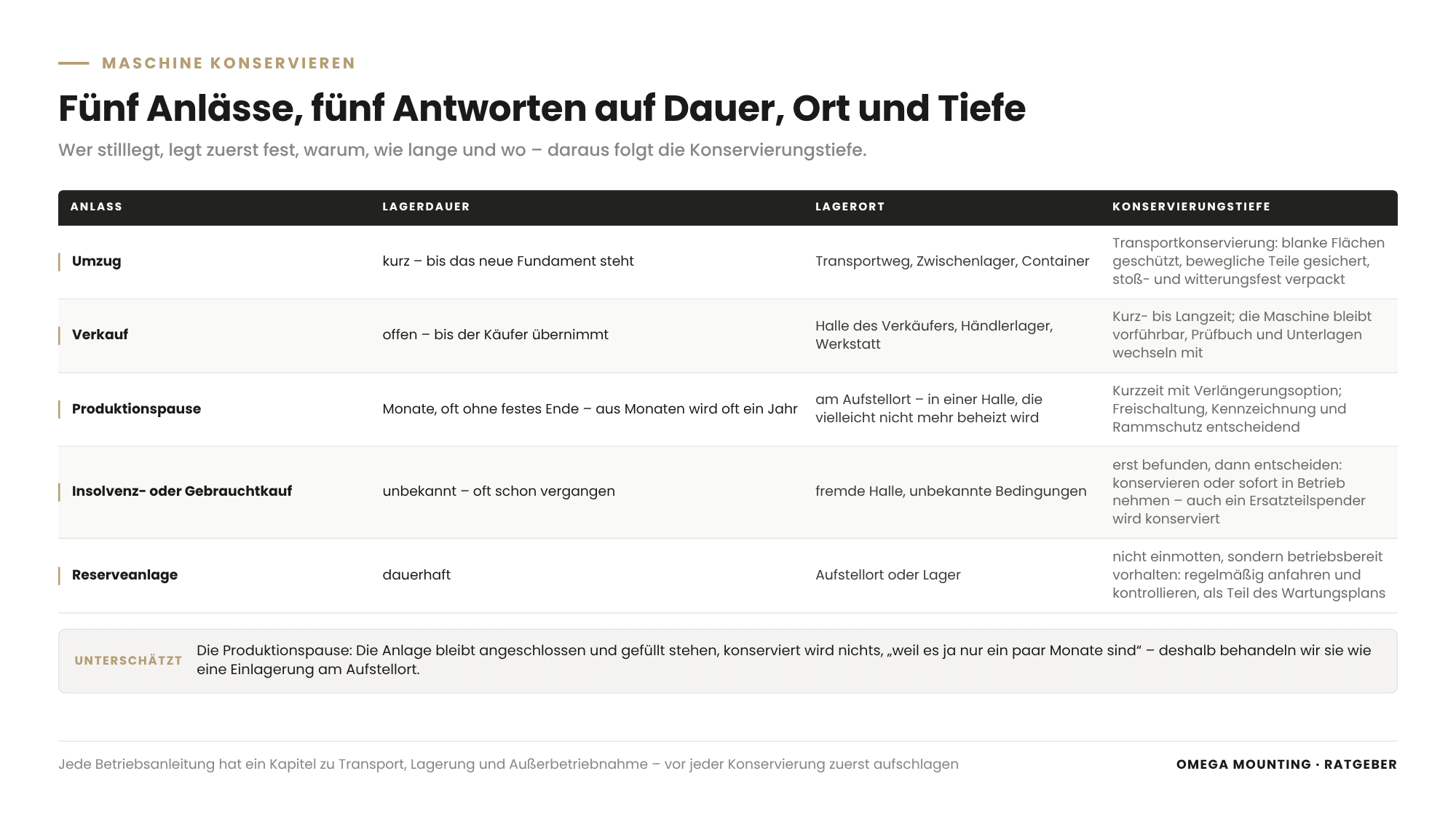
A machine is shut down and preserved when it is relocated, sold, rests during a production pause, was bought from an insolvency or second-hand, or is kept as a standby plant. Each of these five reasons places different demands on storage duration, storage location and depth of preservation.
| Reason | Storage duration | Storage location | Depth of preservation |
|---|---|---|---|
| Relocation. | Short, until the new foundation is ready. | Transport route, interim storage, container. | Transport preservation, packed impact- and weatherproof. |
| Sale. | Open-ended, until the buyer takes over. | Seller's hall, dealer's warehouse, workshop. | Short- to long-term, machine remains presentable. |
| Production pause. | Months, often without a fixed end. | At the installation site. | Short-term with extension option, isolation decisive. |
| Purchase from insolvency or second-hand. | Unknown, often already elapsed. | Third-party hall, unknown conditions. | Assess first, then preserve. |
| Standby plant. | Permanent. | Installation site or warehouse. | Keep ready for operation rather than mothball. |
Production pause: the underestimated variant
Anyone who has to shut down a plant during a production pause usually leaves it where it stands. Connected, filled with operating fluids, in a hall that may no longer be heated. Nothing is preserved because “it's only a few months”; months often turn into a year. That is why we treat a production pause like storage at the installation site.
Purchase from insolvency or second-hand: assess first, then preserve
When buying from an insolvency or the second-hand market, you do not know the history. The machine may have stood unpreserved for months, the cutting fluid may have turned, the controller may be without parameters. Anyone who wants to store a used machine therefore has it assessed first and then decides whether to preserve it or commission it immediately. What to look out for before the purchase is described in our guide Checking a used machine before purchase. If the purchase serves only to recover spare parts, preservation is still necessary – a parts donor that rusts no longer donates anything; more on this in our guide No more spare parts? Obsolescence in legacy plant.
How do you shut down a machine safely?
A machine is shut down safely by having a qualified electrician isolate it according to the five safety rules and secure it against reconnection. All utilities – compressed air, hydraulics, water, gas, cutting fluid – are disconnected, drained or shut off, and stored energy is released. The condition is documented and the plant visibly marked as “out of service”.
Shutting down is maintenance work, and we treat it as such. The German technical rule TRBS 1112 (Maintenance) requires a defined release procedure, securing against reconnection with personalised padlocks and coordination when several companies are involved. For you this means: before the first hands-on step, define who isolates, who signs the clearance and who carries the key. This applies especially during a production pause, when at some point someone wants to switch on “just for a moment”. How isolation and lockout work in detail is described in our guide Lockout tagout in maintenance.
Isolating electrically – and backing up the data first
Isolation means: disconnect all poles, secure against reconnection, verify absence of voltage, earth and short-circuit, cover adjacent live parts. These are the five safety rules that DGUV Regulation 3 requires for work on electrical installations. For storage, one step comes before: before the controller is de-energised, parameters, programs and software versions are backed up. A backup battery holds data only for a limited time – and a controller that wakes up after a year without parameters is an expensive surprise.
Disconnecting utilities, releasing energy
Compressed-air reservoirs are depressurised, hydraulic cylinders moved to a defined position and relieved, springs released, counterweights secured, capacitors discharged. Water, gas and refrigeration circuits are shut off and, depending on the storage location, drained. Which energy is stored where is listed in the risk assessment under Section 5 of the ArbSchG (German Occupational Safety Act), which precedes the shutdown and is at the same time the basis for recommissioning. In Fulda, before removing a robot, our mechatronics technicians checked and disconnected all supply lines – electricity, water and compressed air – and bypassed the bus system so that the rest of the plant kept running.
Marking and recording the condition
A shut-down machine carries a marking that nobody can overlook: “Out of service – do not switch on”, with date, responsible person and reference to the preservation report. The condition at shutdown is photographed and described – operating hours, defects, wear pattern, fill levels; whatever is different at start-up happened during storage.
Preserving a machine: which steps are involved?
Preserving a machine comprises five steps in a fixed sequence: clean thoroughly, drain operating fluids or deliberately fill with preservation media, protect bare and moving parts against corrosion. Then secure electrics and controls against moisture and data loss, and pack the machine with desiccant and suitable film.
The sequence counts: corrosion protection on dirty surfaces does not protect, and packaging over damp components seals the moisture in.
| Component group | Risk during standstill | Preservation measure |
|---|---|---|
| Bare surfaces: guideways, spindles, clamping surfaces, piston rods. | Surface rust, pitting from fingerprints and condensation. | Clean, degrease, corrosion protection oil or wax, cover. |
| Hydraulics. | Condensation in the tank, seals dry out. | Leave filled or drain as specified by the manufacturer, retract cylinders. |
| Cutting fluid, process water. | Turns, corrodes trays and lines. | Drain, flush the circuit, dry. |
| Bearings, gearboxes, drives. | Standstill marks, grease separates, belts deform. | Check grease filling, turn shafts, slacken belts. |
| Seals, hoses, elastomers. | Become brittle, UV damage. | Protect from light, plan replacement for long-term storage. |
| Electrics, controls, screens. | Condensation, leakage currents, backup battery flat. | Back up parameters, keep switchgear cabinet dry, document or remove batteries. |
| Pneumatics. | Condensate in the system, seals stick. | Depressurise, drain condensate, seal connections. |
| Housings, cladding, paintwork. | Scratches, damage during handling. | Clean, edge protection, padding. |
Cleaning: the step most often missing
Product residues, swarf, cutting fluid mist, dust – every contamination binds moisture and becomes a source of corrosion. Cleaning therefore does not mean wiping down but emptying and drying process chambers, trays, channels and swarf areas; in the food industry, hygiene is added. When the six storage lifts were relocated from a Frankfurt office building, the tray levels were completely emptied before dismantling began. Whatever remains in the plant travels with it and arrives damaged.
Drain or fill – the manufacturer's question
Whether hydraulic oil stays in the tank or is drained is decided by the operating instructions, not by gut feeling. Many manufacturers recommend leaving hydraulic systems filled or filling them with a preservation oil so that seals do not dry out. Cooling water circuits are drained to avoid frost and corrosion – see our guide to winter maintenance of plant. Cutting fluid is always drained: it turns and then attacks what it protected during operation.
Corrosion protection for storage: oil, wax, VCI
For bare surfaces there are three tools: corrosion protection oils for short periods, corrosion protection waxes with a firmer film for longer ones, and VCI materials. These are films and papers that release volatile corrosion inhibitors and build up a protective atmosphere in a closed packaging space. They work only in a sealed space and on a clean surface. For overseas, barrier packaging is added: a sealed aluminium composite film with desiccant that binds the residual moisture. This is how the parts of an injection moulding machine with a total weight of around 500 tonnes were packed by packaging specialists into wooden crates and containers.
Packaging protects – and it conceals. That is why lifting points, centre of gravity and labelling are applied on the outside, and crates are packed so that inspection rounds remain possible without destroying the barrier layer.
What storage conditions does a stored machine need?
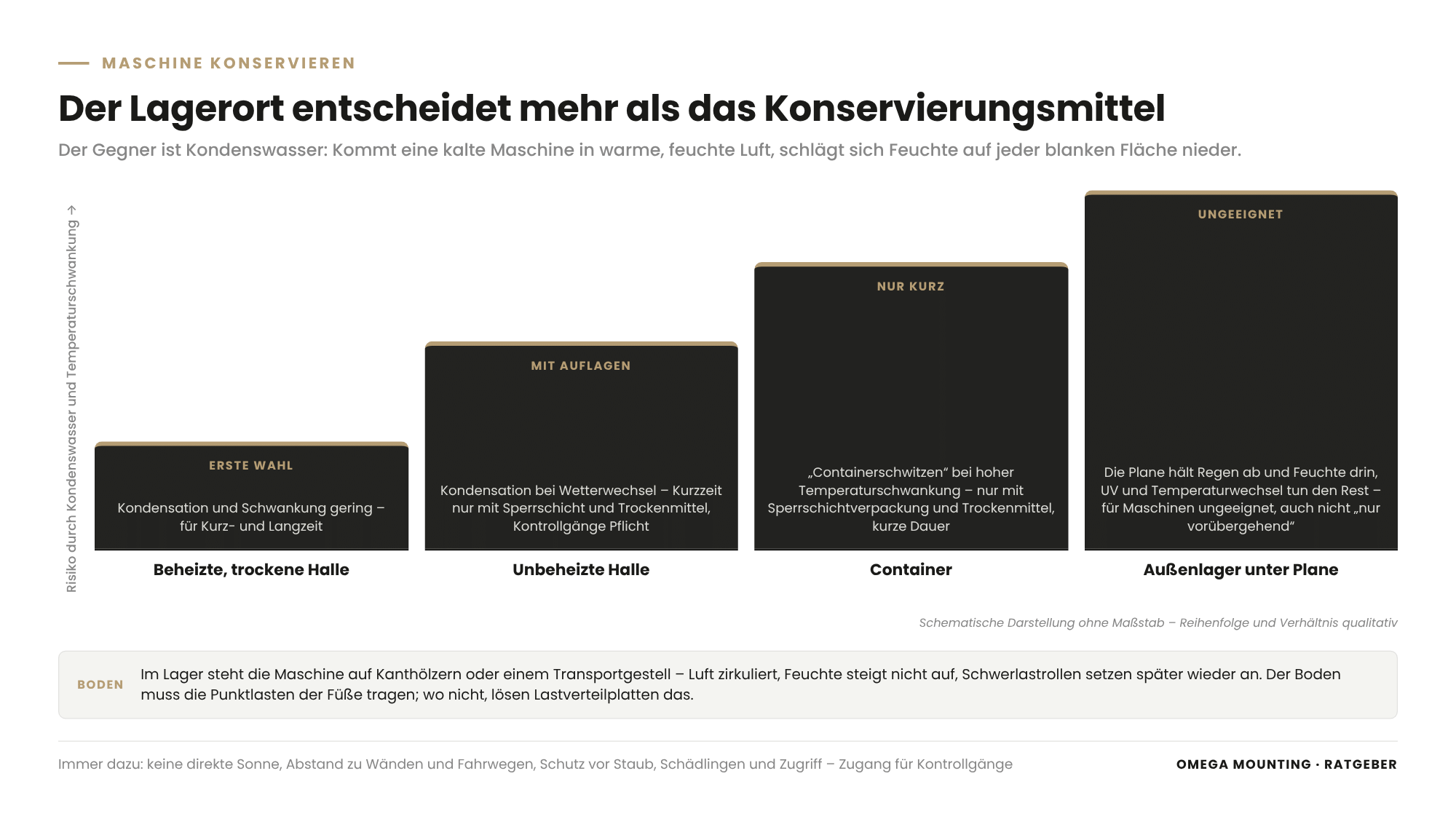
Anyone who wants to store a machine needs a dry storage location that is as temperature-stable as possible, without direct sunlight, a level, load-bearing floor with load spreading, and distance from walls and traffic routes. Plus protection against dust, pests and unauthorised access – and access for inspection rounds.
The storage conditions of a machine matter more than any preservation agent. The enemy is condensation. If a cold machine meets warm, humid air – in the morning in an unheated hall, when opening a container in summer – moisture settles on every bare surface. The storage location must therefore above all avoid fluctuations.
| Storage location | Condensation | Temperature fluctuation | Suitability |
|---|---|---|---|
| Heated, dry hall. | Low. | Low. | Long- and short-term, first choice. |
| Unheated hall. | During weather changes. | Medium to high. | Short-term with barrier layer and desiccant, inspection rounds mandatory. |
| Container. | High, “container sweating”. | High. | Only with barrier packaging and desiccant, short duration. |
| Outdoor storage under tarpaulin. | Very high, tarpaulin traps moisture. | Very high. | Unsuitable for machines – not even “just temporarily”. |
Floor, support, load spreading
In storage, a machine does not stand directly on the hall floor but on timber baulks or a transport frame. That way air circulates, moisture does not rise, and machine skates can be positioned again later. The floor must bear the point loads of the machine feet; where it does not, load spreading plates solve the problem.
During a production pause, the storage location is the company's own hall: if the heating is switched off, the preservation must follow suit – desiccant, covering, inspection rounds. Impact protection or barriers prevent it from ending up on a forklift fork.
How do you document and mark a preserved plant?
A preserved plant is documented with a preservation report that records what was preserved when, with what and by whom. It states which operating fluids have been drained or filled, which parameters were backed up and when the next inspection is due. It is supplemented by a parts list, photo log, condition record and a marking on the outside of every crate and on the machine.
The documentation is the part of the preservation that saves time at recommissioning: anyone who does not know whether the hydraulic tank contains preservation oil or operating oil has to drain it. Anyone who did not write down the setting dimensions during disassembly has to set up again from scratch during reassembly.
What belongs in the preservation report
- Reason, storage duration, responsible person with the date of shutdown.
- Isolation: who, when, which utilities; where the key and clearance are kept.
- Condition record: operating hours, defects, wear pattern, photos.
- Operating fluids: per circuit “drained” or “filled with …”.
- Corrosion protection: agent per component group, date of application, protection period according to the agent's manufacturer.
- Electrics and controls: data backup with storage location, software version, batteries.
- Packaging: type of film, desiccant and indicator, crate numbers, parts list per crate.
- Storage location and inspection plan: where is what, when is which inspection due, who carries it out.
- Setting values for reassembly: levelling, alignment, preloads, reference positions.
Marking on the outside
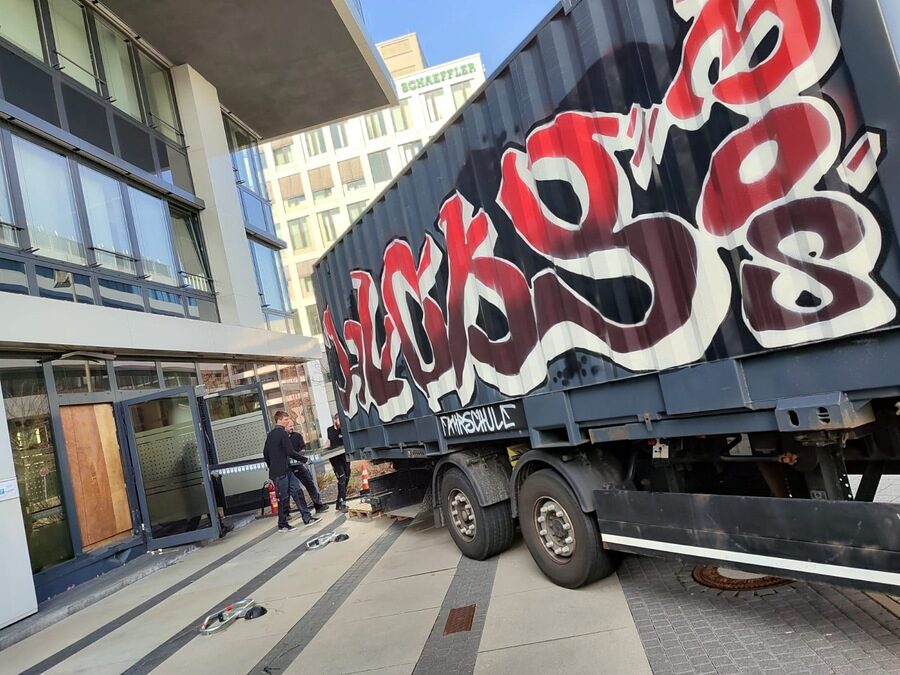
Every crate, every pallet, every assembly carries plant, assembly and position number, weight, centre of gravity and slinging markings as well as the preservation note (“VCI – do not open film”). When the storage lifts were relocated from Frankfurt to Rodgau, every component was documented, labelled and photographed before it went into the container. This produced a practical construction plan for each of the six units. For preservation over months this is not optional: the team's memory lasts until the next project, the parts list until recommissioning.
Inspection log, operating instructions, circuit diagrams, declaration of conformity and spare parts lists belong with the machine – in storage too, and they change hands with it when sold.
What happens during storage?
During storage, the machine is inspected at defined intervals – desiccant indicators and tightness of the film, traces of corrosion on bare surfaces, seals and hoses, storage climate, pests, damage. If necessary, it is re-preserved, desiccant is replaced and shafts are turned by hand.
Preservation does not maintain itself: desiccant eventually becomes saturated, corrosion protection oil evaporates, a film gets a hole when restacking. How often inspections take place is determined by the storage location and the manufacturer's specification – less often in an air-conditioned hall, more often in a container, after every change in the weather in unheated storage.
Turning shafts against standstill marks
Rolling bearings that stand still under load for a long time can develop marks that later become audible as running noise. Where the manufacturer provides for it, shafts are turned by hand at every inspection round and spindles and guideways are moved along their length to distribute the lubricant film.
The most frequent change during storage is the extension. A short-term preservation that is to last a second year is upgraded during the inspection round – barrier layer instead of simple film, preservation oil instead of protective film, seals onto the replacement list.
How does the recommissioning of a preserved machine proceed?
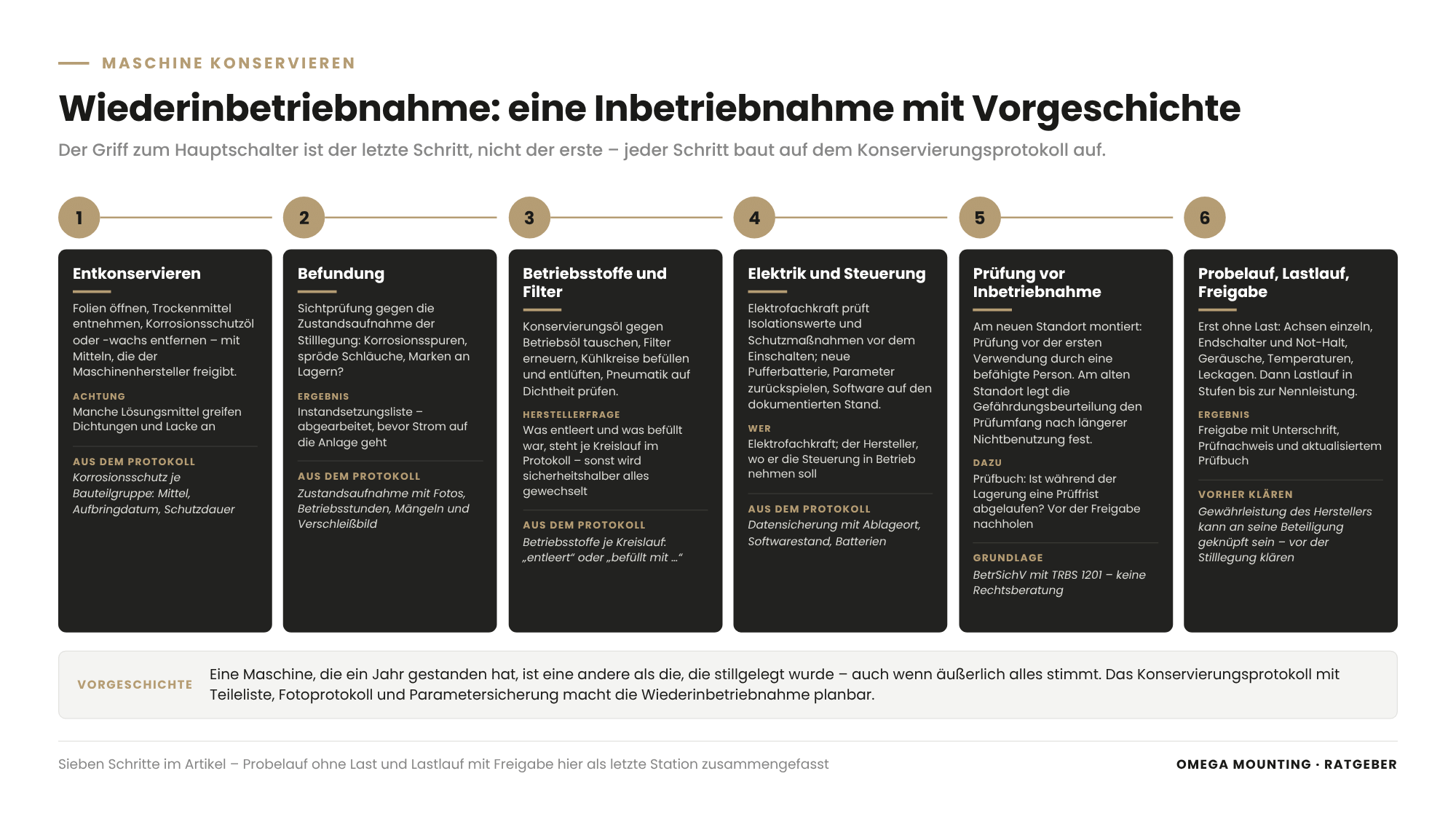
The recommissioning of a preserved machine proceeds in seven steps: de-preservation, visual inspection and assessment against the condition record, renewing or topping up operating fluids and filters. Then checking electrics and controls and restoring parameters, pre-commissioning inspection by a competent person, trial run without load, load run with release and documentation.
Reaching for the main switch is the last step, not the first. A machine that has stood for a year is a different one from the one that was shut down – even if everything looks right on the outside. That is why we plan a recommissioning after standstill like a commissioning with a history. How the transition from installation to operation proceeds in principle is described in our guide commissioning and handover of a plant.
De-preserving and assessing
Films are opened, desiccant removed, corrosion protection oil or wax removed – with agents approved by the machine manufacturer, because some solvents attack seals and paintwork. Then follows the comparison with the condition record: traces of corrosion, brittle hoses, marks on bearings? Whatever is found goes on the repair list before power goes to the plant.
Operating fluids, electrics, controls
Preservation oil is replaced with operating oil, filters renewed, cooling circuits filled and vented, pneumatics checked for tightness. The qualified electrician checks insulation values and protective measures before switching on – no formality after months in a humid environment. The controller gets a new backup battery, the backed-up parameters are restored, the software is brought to the documented version. Where the manufacturer is to commission the controller, it is brought in now – as with the storage lifts in Rodgau, where it put the finishing touch after our installation.
The inspection before recommissioning
A machine that is installed at a new location after storage must be inspected before first use. The BetrSichV (Industrial Safety Ordinance) requires this for work equipment whose safety depends on the installation conditions. The German technical rule TRBS 1201 (Inspection of work equipment) describes what this inspection looks like and what is recorded. For a machine that has remained at its old location: prolonged non-use can affect safety. Your risk assessment determines whether and to what extent an inspection is carried out before start-up. For you this means in both cases: check the inspection log to see whether a periodic inspection deadline expired during storage, and carry out the inspection before release. Which deadlines apply and who may inspect is summarised in our guide inspection obligations for plant operators . This guide does not replace legal advice; the competent person and the safety specialist define the scope of inspection.
Trial run, load run, release
First the machine runs without load: move axes individually, check limit switches and emergency stop, observe noise, temperatures, leaks. Then follows the load run in stages up to rated output. Only then is the machine released – with signature, inspection certificate and updated inspection log. The manufacturer's warranty may be tied to its involvement; clarify this before the shutdown, not at start-up.
How we do it in the Rhine-Main region
In the Rhine-Main region we encounter machine preservation in three contexts. In machinery relocation, when weeks lie between removal in Frankfurt or Offenbach and installation in Hanau or Darmstadt. At businesses that pause a line. And in the sale of existing plant that is to remain presentable.
Our procedure begins with a site visit at which we clarify the reason and realistic storage duration, the operating instructions and the storage location with its climate. From this we produce a preservation plan with interfaces: who isolates, who backs up the controller data, who removes refrigerant or hazardous substances, who packs, who inspects. What we provide in machinery relocation – dismantling, moving, start-up is set out on our services page; preservation bridges the time between dismantling and start-up.
In our workshop in Rodgau, components are stored temporarily, cleaned, preserved or prepared for sale, and there we manufacture transport frames for assemblies without a standing surface. The short distances to Frankfurt, Offenbach, Hanau, Darmstadt and Aschaffenburg make it possible to take on inspection rounds and to turn up for recommissioning with the same team that preserved the machine. For machine storage in the Rhine-Main region this means: one point of contact from shutdown to load run.
How we do it in practice
Four projects from our project diary show the range – from documented disassembly through transport preservation to shutdown with recycling.
Six storage lifts: disassemble, document, bring back into geometry
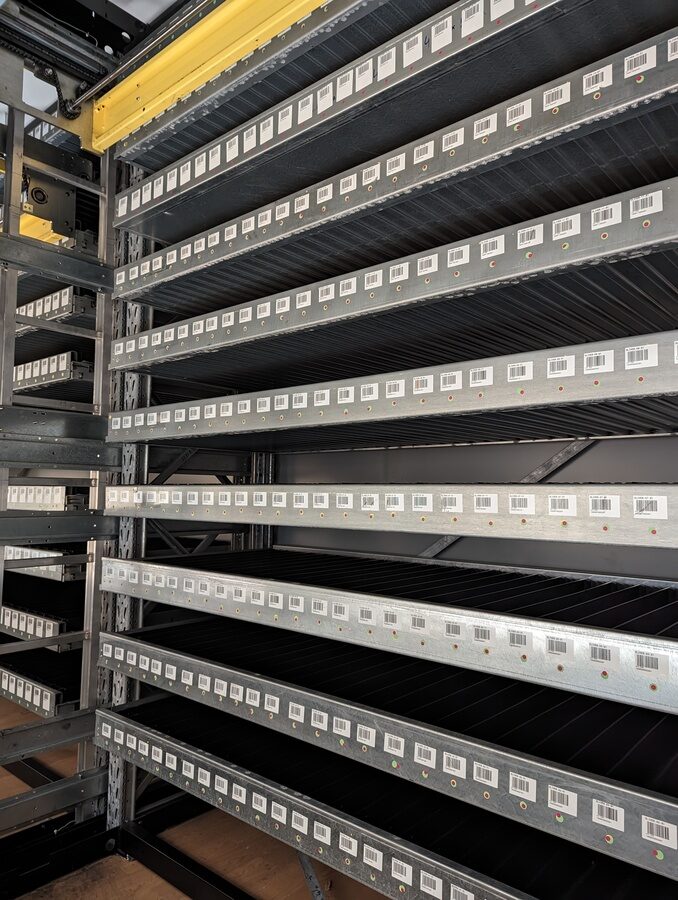
From a Frankfurt office tower near the airport we dismantled six storage lifts and reassembled them in Rodgau. Three interior doors dictated the maximum dimension of every component, and the parquet flooring had to be preserved – no machinery, only dollies. The units were emptied, disassembled into transportable individual parts, each part documented, labelled, photographed and loaded into containers; six fitters were deployed for loading. During reassembly, racks, guideways and shafts were surveyed and levelled before the sensors came; the manufacturer took over sensor adjustment, teaching, software update and final acceptance. For preservation this is the textbook example: a disassembled plant is worth only as much as the parts list with which it is put back together.
Injection moulding machine: transport preservation for the ocean
During the Relocation of an injection molding machine , it was all about tonnage. The heaviest single component, a moving platen, weighed around 95 tonnes; in total around 500 tonnes had to be moved. Six fitters worked over three weekends in a running production hall in which the other injection moulding machines could neither be disturbed nor obstructed during set-up. Additional lifting equipment from a partner was brought in for the heaviest components. After dismantling, packaging specialists packed the parts for overseas transport into wooden crates and containers – reassembly was the customer's responsibility. The interface: whoever dismantles defines what must be protected; whoever packs implements it; whoever reassembles needs both documented.
Robot in Fulda: shutting down without stopping the line
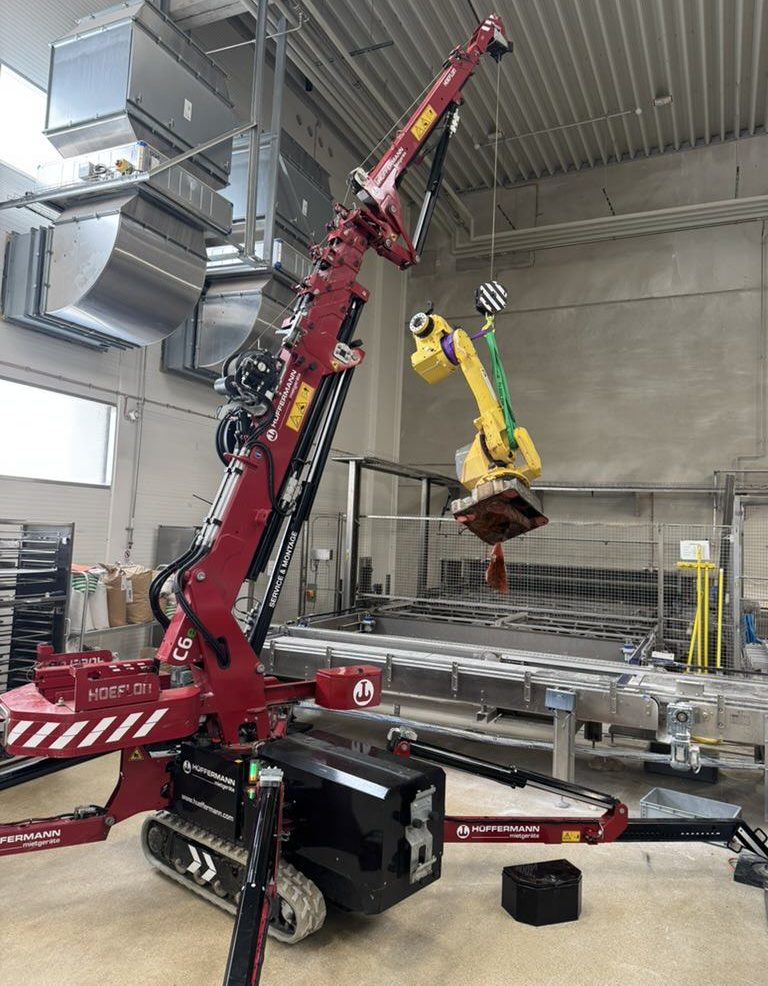
At a bakery near Fulda we removed an industrial robot weighing around 600 kilograms with the mini crane. In one piece, from a cell between running conveyor belts, undamaged for further use. Before the crane arrived, our mechatronics technicians disconnected all supply lines and bypassed the bus system so that the rest of the plant kept running. The removal took one day; deployed were one appointed person for the lifting operations, one crane operator and two mechatronics technicians, wearing hairnets and face masks throughout. For shutdown this is the core: disconnect utilities individually, protect neighbouring plant, secure the condition.
Paternoster in Rodgau: shutdown with recycling as the goal
Not every shutdown ends in preservation. At a business in Rodgau we dismantled an outdated paternoster. Power supply switched off and removed, unit disassembled, side panels set down with forklift and round slings and taken out of the hall on dollies, recyclables separated into containers and big bags. If recycling is the goal, separation and records count instead of preservation – see our guide to Industrial dismantling.
Is a machine of yours facing a pause, a relocation or a sale? Then get in touch with us. A site visit with the operating instructions in hand usually clarifies within an hour which depth of preservation your plant needs and where it will best survive the time.
What this means for your role
For buyers: Write shutdown, preservation, storage and recommissioning into the scope of works as separate items – with depth of preservation, storage duration, inspection rounds and report. A quotation for “dismantling and storage” without a preservation plan generates the change order at start-up. For sale and purchase, clarify contractually in which state of preservation the machine is handed over and who supplies the plant file.
For designers: When relocating or restructuring, plan the interim period too: where will the machine stand, for how long, in what climate, on what floor? Define storage areas with load-bearing capacity and access, and schedule inspection and trial run at the new installation site – not just the moving-in day.
For project managers and site managers: As project manager, you keep the preservation report as the handover document between dismantling, storage and installation phases – the common thread when teams and months change. As site manager, you release isolation and clearance, check labelling and packaging before removal and, at recommissioning, have the inspection done first, then the start-up.
For maintenance managers: You know the machine – its operating fluids, its controls, its quirks. Back up parameters and software versions before isolation, and use the operating instructions to define what is drained and what is filled. Keep the inspection log going during storage and plan inspection rounds like maintenance appointments.
For operations and plant managers: During a production pause, decide early whether the machine will really start up again. If so, release the preservation while the machine is still warm and clean. A plant that stands “just for a few months” costs more at start-up than the preservation saved. And define who ensures that the shut-down machine does not become a dumping ground.
For manufacturers and system builders looking for an installation partner: If your machine has to be stored temporarily before delivery or refurbished after a buy-back, you need a partner who preserves and documents according to your operating instructions. At recommissioning, the partner hands over the mechanical basis so that your software can put the finishing touch – as with the storage lifts in Rodgau.
Preservation checklist on request
The preservation checklist summarises on two pages what has to be ticked off from shutdown to recommissioning. It ranges from reason and storage duration through isolation, cleaning, operating fluids, corrosion protection, controls, packaging and storage conditions to inspection rounds, de-preservation, inspection, trial run and release. It helps maintenance managers as a working list and buyers as a basis for the scope of works. Request the checklist via our Contact form – keyword “preservation checklist”.
Why Omega Mounting?
From Rodgau near Frankfurt, Omega Mounting shuts down machines and plant, preserves them, stores components temporarily and recommissions them. For this we have mechatronics technicians who understand a machine before they mothball it, our own lifting equipment from mini crane to machine skates, and a workshop for transport frames and refurbishment. The linked projects show what is involved: disconnecting supply lines individually as in Fulda, documenting every part as in Frankfurt, packing for the ocean as with the injection moulding machine. Via our 24-hour hotline you can also reach us when a machine has to leave production at short notice. For you this means: a single point of contact from isolation to load run, short distances in the Rhine-Main region. And a recommissioning that begins with the preservation report rather than with troubleshooting.
Conclusion
Preserving a machine is not a question of the right oil but of the right sequence: define the reason and storage duration, isolate and disconnect utilities, clean. Drain or fill operating fluids as specified by the manufacturer, protect bare surfaces and controls, pack with desiccant. Then store in the right place and inspect – and inspect before starting up. Anyone who does this in the first days of the shutdown gets back, after months or years, a machine that runs as before. Anyone who skips it gets a repair. Send us the machine type, operating instructions, planned storage duration and a few photos of the storage location – we will get back to you with an honest assessment of which depth of preservation your plant needs.
Planning maintenance, moving in or installation in the Rhine-Main region?
Tell us briefly what it is about – we will come back to you with an honest assessment.
100% free and without obligation
You may also be interested in these guides

About the author
Tobias Schott
Managing director of Omega Mounting GmbH, Rodgau · more than 20 years of hands-on experience in installation and maintenance
A trained mechatronics technician, at home in maintenance, servicing and industrial installation since 2004 – first at his father's side, since 2012 with Omega Mounting: from the overhead conveyor in Frankfurt to the crane system in a new-build hall. Plans and leads lifting operations as appointed person in data centers and on industrial sites in the Rhine-Main region, is an instructor and examiner for cranes, mobile elevating work platforms and telehandlers, and a safety officer. On jobs abroad he is known as the “German Troubleshooter” – the one you call when things get stuck on site. He learned what quality means not from a manual but from his father: Made in Germany as a standard for his own work, not as a label. That is why it comes first at Omega Mounting – before speed and before price. He writes these guides from that practice: what works on our sites is in them – what only exists in the standard is not.
Frequently asked questions
Shutdown takes the machine out of operation: isolate, disconnect utilities, release energy, mark. Preservation then protects it against corrosion, moisture and ageing: clean, drain or fill, corrosion protection, packaging. Storage is the time at the storage location with inspection rounds. Anyone who wants to mothball a machine needs all three steps – a shutdown without preservation is the most common mistake.
As long as depth of preservation, storage location and inspection rounds match – transport preservation lasts weeks, long-term preservation with barrier packaging in a suitable hall lasts years. The limit is set by seals, hoses and electronics, which age even without operation.
That is decided by your machine's operating instructions. Many manufacturers recommend leaving hydraulic systems filled or filling them with a preservation oil so that seals do not dry out. Cutting fluid and process water, on the other hand, are always drained because they turn and corrode. What was done belongs in the preservation report – otherwise everything is changed at start-up to be on the safe side.
A container is suitable only for short durations with barrier packaging, desiccant and regular inspections, because temperature changes inside generate condensation. Outdoor storage under a tarpaulin is unsuitable for machines – even temporarily: the tarpaulin keeps rain out and moisture in, and UV and temperature changes do the rest. The right storage location is a dry hall that is as temperature-stable as possible.
Before isolation, parameters, programs and software versions are backed up and the storage location documented, because a controller's backup battery holds data only for a limited time. The switchgear cabinet stays dry, batteries are documented or removed as specified by the manufacturer. At recommissioning, a new battery goes in, the data is restored – and the manufacturer is brought in where it is to commission the controller.
If the machine is installed at a new location, an inspection is necessary before first use because its safety depends on the installation conditions; the BetrSichV (Industrial Safety Ordinance) and TRBS 1201 govern this. If it remains at the old location, your risk assessment determines whether and how an inspection is carried out after prolonged non-use. In any case, check whether a periodic inspection deadline expired during storage and carry out the inspection before release.
Yes, the sequence – shut down, clean, regulate operating fluids, corrosion protection, secure electrics, pack, inspect, test – is the same in all industries. The emphasis shifts. In conveyor technology, drives, chains and rails dominate; in food plants, hygienic cleaning comes before any preservation. For standby power systems and refrigeration technology, fuel, refrigerant and batteries go to the specialist trades first.
From Rodgau, Omega Mounting shuts down machines in Frankfurt, Offenbach, Hanau, Darmstadt, Aschaffenburg and throughout the Rhine-Main region and preserves them as specified by the manufacturer. We store components temporarily in our own workshop and take on inspection rounds and recommissioning. Lifting equipment, transport frames and documentation come from a single source; we integrate your qualified electrician and the specialist trades into the preservation plan.
Via a short enquiry with three details: machine type with operating instructions, reason and planned storage duration, and photos of the installation site and the intended storage location. We arrange a site visit, clarify isolation, operating fluids, controller data and storage conditions on site and send you a written assessment with depth of preservation, inspection plan and the interfaces to your specialist trades. Your contact is Tobias Schott – reachable via our Contact form.
 English
 German