
- Guide – Lift & Shift
Inspecting a used machine: condition assessment, suitability for relocation and hidden costs
By Tobias Schott · Reading time approx. 23 minutes · Last updated: October 2026
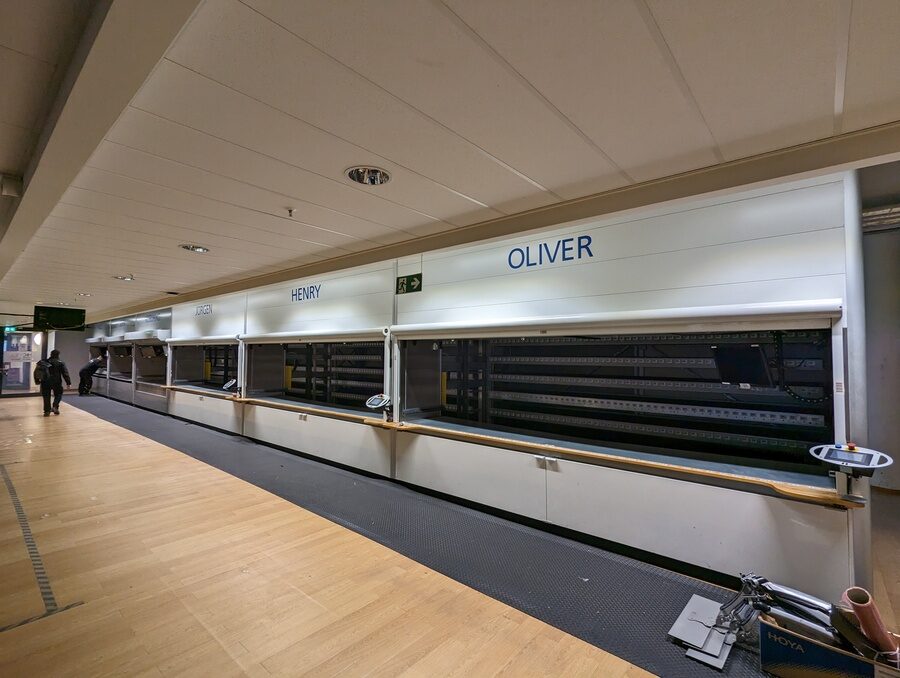
Inspecting a used machine means more than assessing its condition. Will it get out of the old hall and into the new one? And what costs follow the purchase price?
A used injection moulding machine from a plant closure, a test rig from a factory that is relocating, storage equipment from a building that is being converted. For many companies, the second-hand market is the fastest route to additional capacity. Lead times for new machines are long, and the machine is already there and running. That is exactly where the trap lies: a machine that runs at the seller's premises is not yet a machine that runs at yours.
Anyone who wants to inspect a used machine before buying it therefore needs more than a glance at the nameplate and the operating hours. They need an on-site technical assessment that evaluates the machine's condition, and an honest look at documents, inspection records and modifications. Plus the answer to how the machine will be dismantled, transported and set up again – and a list of the cost types that follow the purchase price.
This guide builds on our article Machinery relocation for your company: from dismantling to commissioning. There, the relocation starts with the inventory; here, it starts before the purchase contract.
Key points at a glance
- Inspecting a used machine means answering four questions: condition, conformity, relocatability and follow-on costs – the purchase price can only be judged once all four have been answered.
- The inspection takes place on the running machine: running behaviour, play, leaks, electrics, control system and safety devices can only be assessed in operation.
- Documents are part of the machine: operating instructions, drawings, declaration of conformity, inspection records and modification history decide whether you may and can commission the machine at your site.
- Undocumented modifications can legally turn a used machine into a new one – the test questions on substantial modification belong in every assessment.
- Dismantling and transport feasibility are decided by door clearances, floor loads, lifting points, centre of gravity and how far the machine can be broken down – at the old site and the new one.
- After the purchase come dismantling, transport, foundation, connection, retrofitting, inspection and commissioning – cost types that must be on the table, at least qualitatively, before the decision.
- Before the first commissioning at the new site comes an inspection by a competent person – regardless of how well the machine ran at the seller's premises.
What is a technical assessment of a used machine?
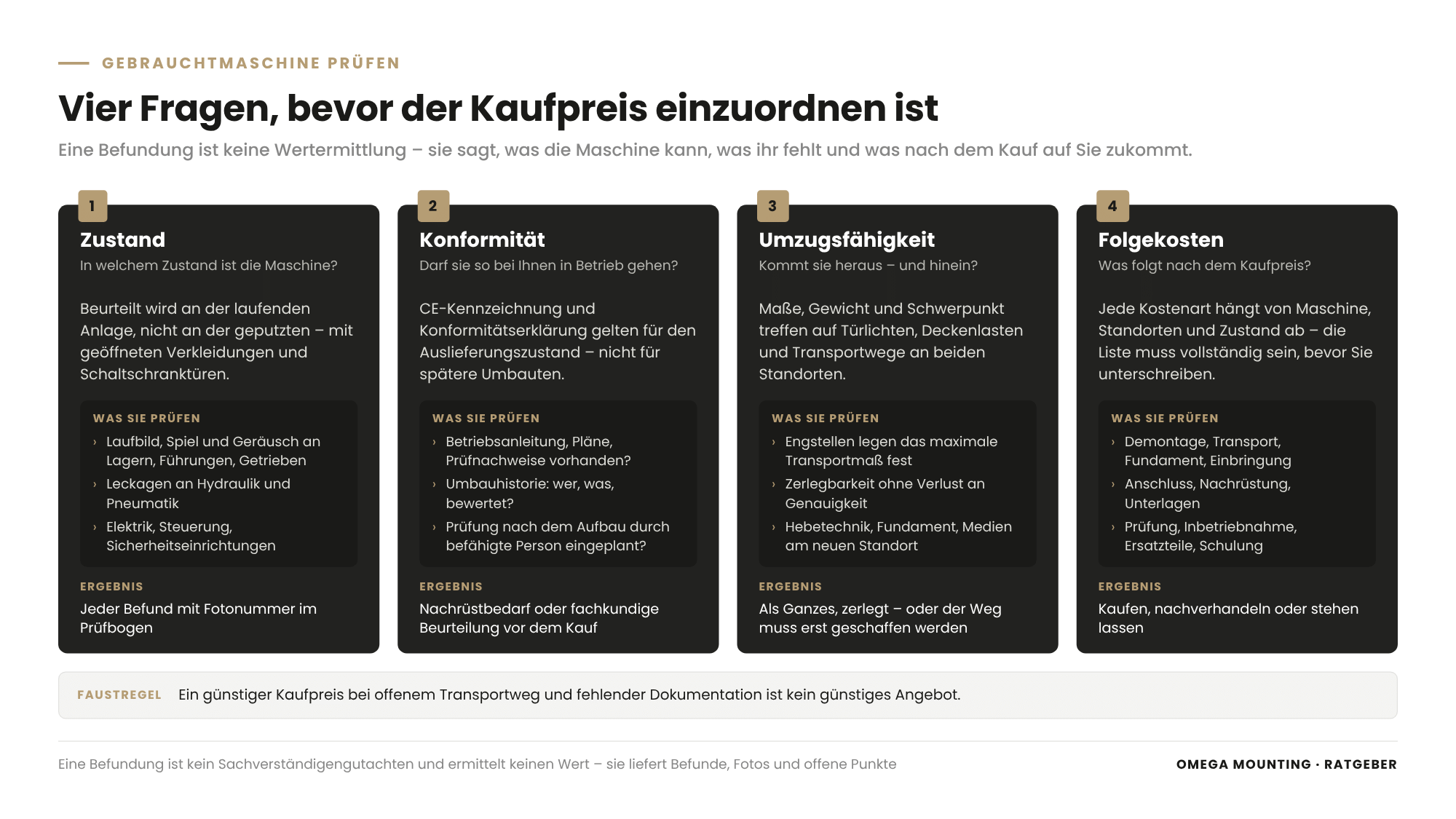
A technical assessment of a used machine is the systematic technical evaluation of a machine's condition, documentation, conformity and relocatability before purchase. It is carried out on the running machine at the seller's site and recorded in an inspection sheet with photos, findings and open items.
The term comes from maintenance practice: recording the actual condition of a machine as the basis for deciding what needs to be done. Before a purchase, the decision is not “repair or replace” but “buy, renegotiate or walk away”. An assessment is neither a valuation nor an expert appraisal. It does not tell you what the machine is worth, but what it can do, what it lacks and what you will face after the purchase.
Four questions, one decision
Every assessment answers four questions: What condition is the machine in? May it be put into operation at your site as it is – conformity, modifications, safety devices, inspection records? Will it get out of the old hall and into the new one, and what has to be dismantled for that? And which cost types follow the purchase price up to the first unit produced? A low purchase price with an unresolved transport route and missing documentation is not a good offer.
Which documents do you request before the inspection?
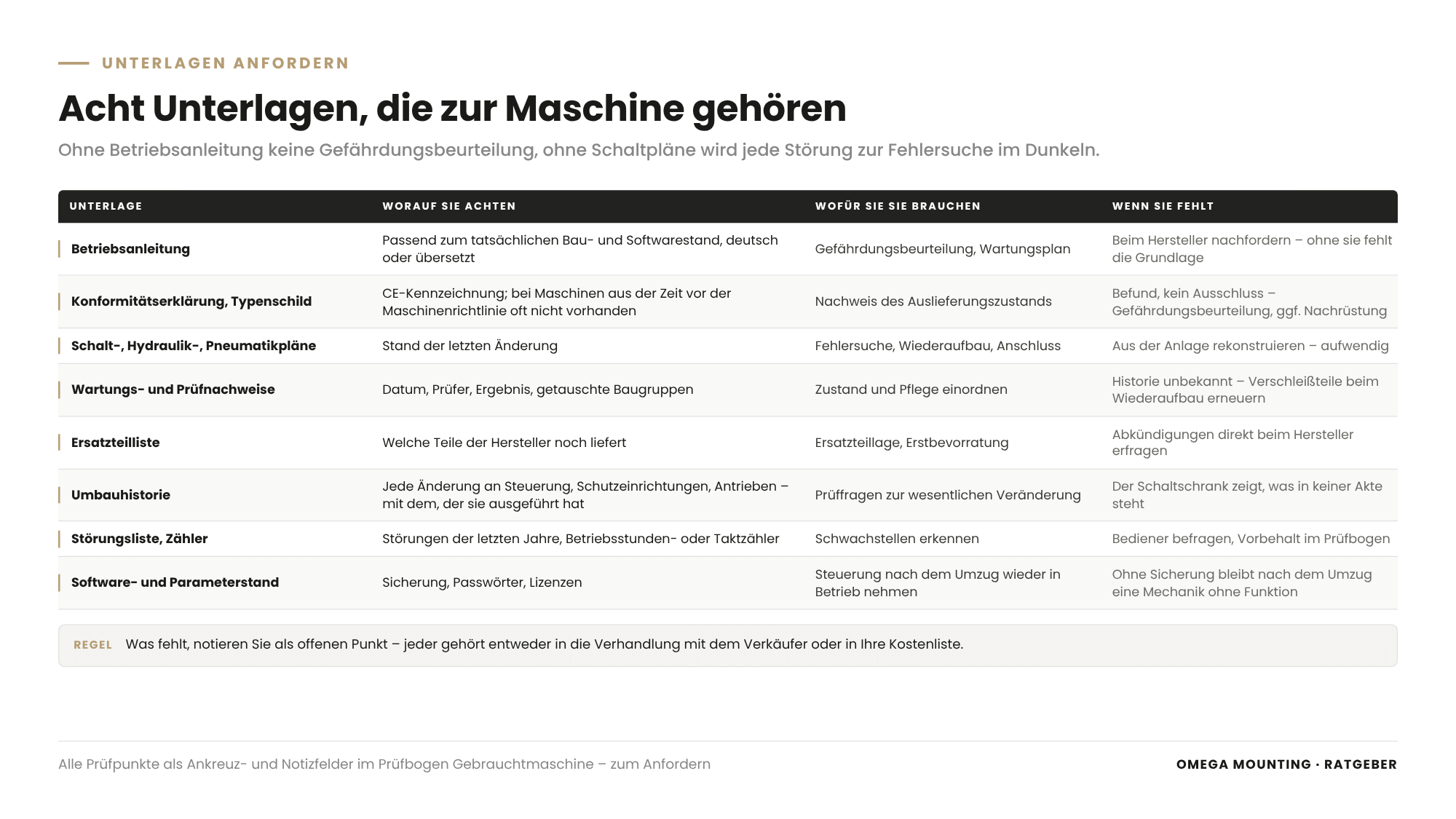
Before the inspection, request the operating instructions, the declaration of conformity with CE marking, circuit and hydraulic diagrams, maintenance and inspection records, spare parts list, modification history and the fault log of recent years. A machine without documents is a machine whose history you will have to reconstruct yourself.
Without operating instructions there is no basis for the risk assessment and the maintenance plan. Without circuit diagrams, every fault becomes troubleshooting in the dark. Without a modification history, you do not know whether the machine is still the one the declaration of conformity applies to.
The list for the seller
- Operating instructions matching the actual build and software status, in a language your team can work with or with a translation.
- Declaration of conformity and nameplate with CE marking – often not available for machines from before the Machinery Directive; in that case it is a finding, not a deal-breaker.
- Circuit, hydraulic and pneumatic diagrams as of the last modification.
- Maintenance and inspection records – work carried out, assemblies replaced, periodic inspections with date, inspector and result.
- Spare parts list indicating which parts the manufacturer still supplies.
- Modification history – every change to the control system, protective devices, drives or peripherals, with the name of whoever carried it out.
- Fault log of recent years, operating hours or cycle counter.
- Software and parameter status of the control system with backup, passwords and licences.
Note anything missing as an open item: some things the manufacturer can supply later, some can be reconstructed from the machine itself, some are gone. All three cases have a price.
Which checkpoints are part of inspecting a used machine on site?
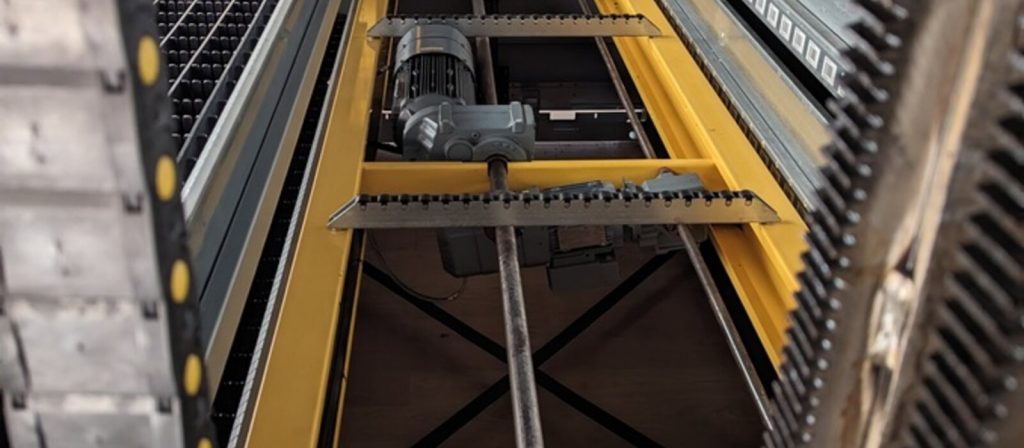
When you inspect a used machine on site, the checkpoints include running behaviour under load, play and noise at bearings, guides and gearboxes, and leaks in hydraulics and pneumatics. Add to that the condition of the electrics, control cabinet and control system, plus the function and integrity of the safety devices. The inspection is carried out on the running machine, not the cleaned one.
Insist on seeing the machine in operation, ideally with the product or load case you intend to run yourself. A machine that is “not connected at the moment” cannot be assessed – in that case, record the rest as a reservation. Take the inspection sheet with you, photograph every finding with its number and have guards and control cabinet doors opened.
Mechanics: running behaviour, play, noise
The running behaviour shows how a machine has been treated. Check guides and slideways (scoring, uneven wear), spindles and racks (play on reversal), bearings and gearboxes (running noise, temperature after warm-up), chains and belts (elongation, tension). On storage and conveyor equipment, the drive aisle reveals more than any data sheet. Where racks, chains and guides bear evenly, the machine was aligned and lubricated; where one side has run bright, something was out of true. Also check machine feet and anchors for cracks, loosening and settlement.
Hydraulics and pneumatics: leaks
You see leaks on the floor, at fittings and on the underside of the machine. Typical signs: oil traces under cylinders, cracked hoses, fittings treated with sealant, an oil level below minimum, a filter indicator in the red. Ask about the age of the hoses and the last oil change, and have the containment shown to you. Where a hydraulic unit stands on bare concrete without a drip tray, you have one more item on the list at the new site.
Electrics, control cabinet and control system
The control cabinet reveals the modification history that appears in no file. Look for retrofitted cables without labelling, bridged terminals, components of different ages, hand-amended diagrams, scorch marks and the inspection sticker from the last electrical test. For the control system, there are three questions: Is the hardware still available? Is the software and parameter status backed up and available, with access data? And who will recommission the control system after the relocation?
Safety devices
Check safety devices for presence, function and integrity: emergency stop buttons that actually work, guard doors with functioning interlocks, light curtains and safety mats without bridging, two-hand controls, covers, limit switches. A bridged guard door is not a cosmetic flaw but a sign that the machine may not be put into operation in this state – and that the reason for the bridging will persist at your site. How to handle such defects until re-release is described in our guide Rectifying UVV defects.
Finally, clarify the scope of supply: tools, fixtures, feeders, extraction, control cabinets – anything linked to neighbouring equipment often stays with the seller.
What do CE marking and conformity tell you about modified machines?

The CE marking and the declaration of conformity state that the manufacturer declared the machine to conform with the Machinery Directive in the condition in which it was placed on the market. They say nothing about modifications made since – and with used machines, such modifications are the rule.
This section provides orientation; it is no substitute for legal advice. You should distinguish three cases. The machine is unchanged, CE marking and declaration of conformity are available – the simplest case. Or it was placed on the market before the Machinery Directive applied (mandatory since 1995) and bears no CE mark. That is permissible, but as the operator you must ensure through the risk assessment that it can be used safely, and retrofit where necessary. Or it was modified – new control system, altered protective devices, additional axes, interlinking – and nobody has checked whether that constituted a substantial modification.
The test questions on substantial modification
In an interpretation paper, the German Federal Ministry of Labour and Social Affairs has described when a modification turns a machine into a new one. Simplified: Has the modification created a new hazard or increased a risk? If so: can it be controlled with simple protective devices? If not, a substantial modification is likely. Whoever carried it out is then responsible for the machine like a manufacturer – with conformity assessment, a new declaration and new marking. For you as the buyer, this means: for every visible or documented modification, ask who did it, whether it was assessed and whether the documents were updated. If the answer is unclear, have the modification assessed by an expert before the purchase – not once the machine is already standing at your site.
Inspection before commissioning at the new site
Regardless of CE status, the BetrSichV (German Industrial Safety Ordinance) requires the operator to assess the hazards before using any work equipment. If safety depends on the installation conditions, an inspection by a competent person is required after assembly and before first commissioning. For you this means: the used machine goes into operation at your site not because it ran at the seller's, but because it was inspected and released after reassembly. Plan this inspection in and clarify who will carry it out.
How do you check whether the used machine can be dismantled and transported?
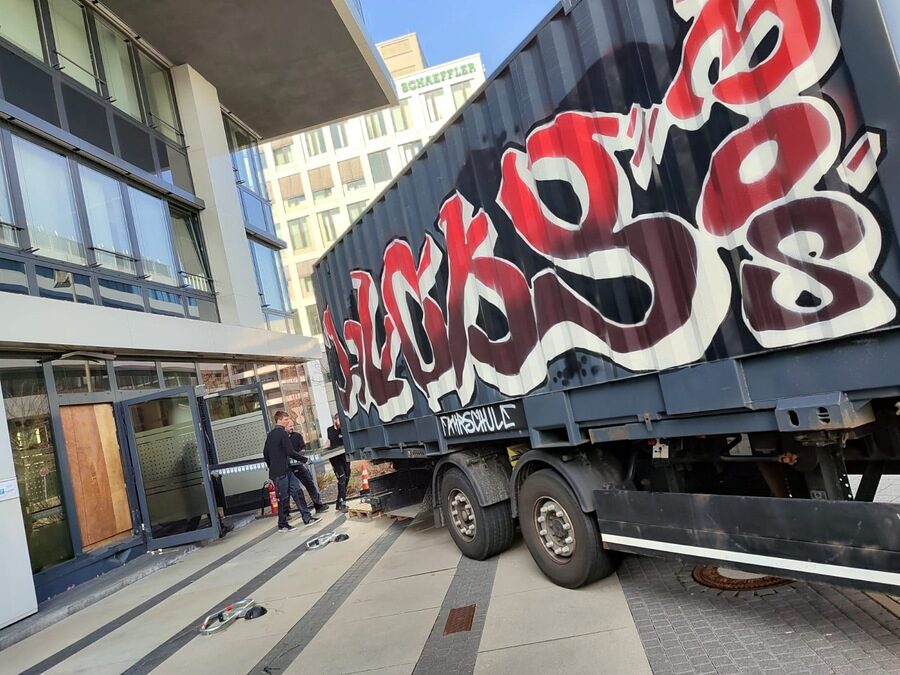
You check the dismantling and transport feasibility of a used machine by comparing its dimensions, weight and centre of gravity with the door clearances, floor loads and transport routes at the old and the new site. From this you determine whether the machine can be moved as a whole or has to be broken down into documented individual parts.
This question is the one most often overlooked at purchase – and it often decides more effort than the condition of the machine. A machine that came into the hall years ago through an installation opening that has long since been bricked up will not leave by the same route.
At the old site
- Dimensions and weight: Nameplate and operating instructions give nominal values; attachments, control cabinets, tooling and media come on top.
- Centre of gravity and lifting points: Does the machine have lifting eyes or fork pockets, are they intact, is the centre of gravity known?
- Transport route: Door clearances, headroom, stairs, lifts with load capacity, floor coverings to be protected, turning radii for machine skates. Every pinch point sets the maximum transport dimension.
- Dismantling depth: Can the machine be split into assemblies that fit through the pinch points – and be rejoined without loss of accuracy? Where the function depends on the alignment of racks, guides and sensors, reassembly becomes precision work.
- Media and peripherals: Which supply lines (power, water, compressed air, hydraulics, data) have to be disconnected, who isolates them, what happens to operating fluids, which linked peripherals have to be bypassed?
- Lifting equipment on site: Overhead crane with sufficient capacity, access for a mobile crane, or a mini crane inside the hall?
At the new site
- Access route and installation position: Gate, installation opening, floor load along the route, space for lifting equipment, accessibility for later maintenance.
- Foundation: Does the floor carry the weight and dynamics of the machine, or does it need its own foundation with vibration isolation and grouting?
- Media and environment: Are power, compressed air, water, drainage, extraction and data available at the installation position? Do hall climate, neighbouring equipment, traffic and escape routes fit?
What needs to be planned for an installation day, from four weeks before to the day after is covered in a separate guide. If the machine is being decommissioned at the old site rather than taken over, the same logic applies as for Industrial dismantling. For the purchase, this means: have the transport route walked at both sites before you sign. An installation contractor can see within an hour whether the machine can go as a whole, has to be dismantled, or whether the route has to be created first.
What about spare parts, control system and manufacturer support?
You assess the spare parts supply for an older machine by clarifying whether the manufacturer still supports the machine and which assemblies and control components have been discontinued. You also check whether wear parts are available as standard parts or only as manufacturer parts, and whether documents exist for remanufacturing.
A machine whose control system is no longer available runs until the first module fails – after that, maintenance becomes a procurement task. Ask the manufacturer directly: Is the type still supported, until when, and can the control system, drives or operator panel be retrofitted? For mechanical wear parts – pins, bushes, guides, racks, welded assemblies – the situation is often better than feared: anything that can be remanufactured from a sample or a site survey keeps a machine alive. What you can do when parts are no longer available – remanufacturing, retrofit or replacement – is a separate topic in our knowledge base.
The control system is the most sensitive part
With many used machines, it is not the mechanics but the control system that decides whether the relocation succeeds. Sensors have to be readjusted, heights re-taught, positions re-measured – and often only someone who knows the software can do that. Before the purchase, clarify who will commission the control system, and have the program and parameter backup, passwords and licences handed over before dismantling. A machine whose control system nobody can commission any more is, after the relocation, mechanics without function.
Which hidden costs arise after the purchase?
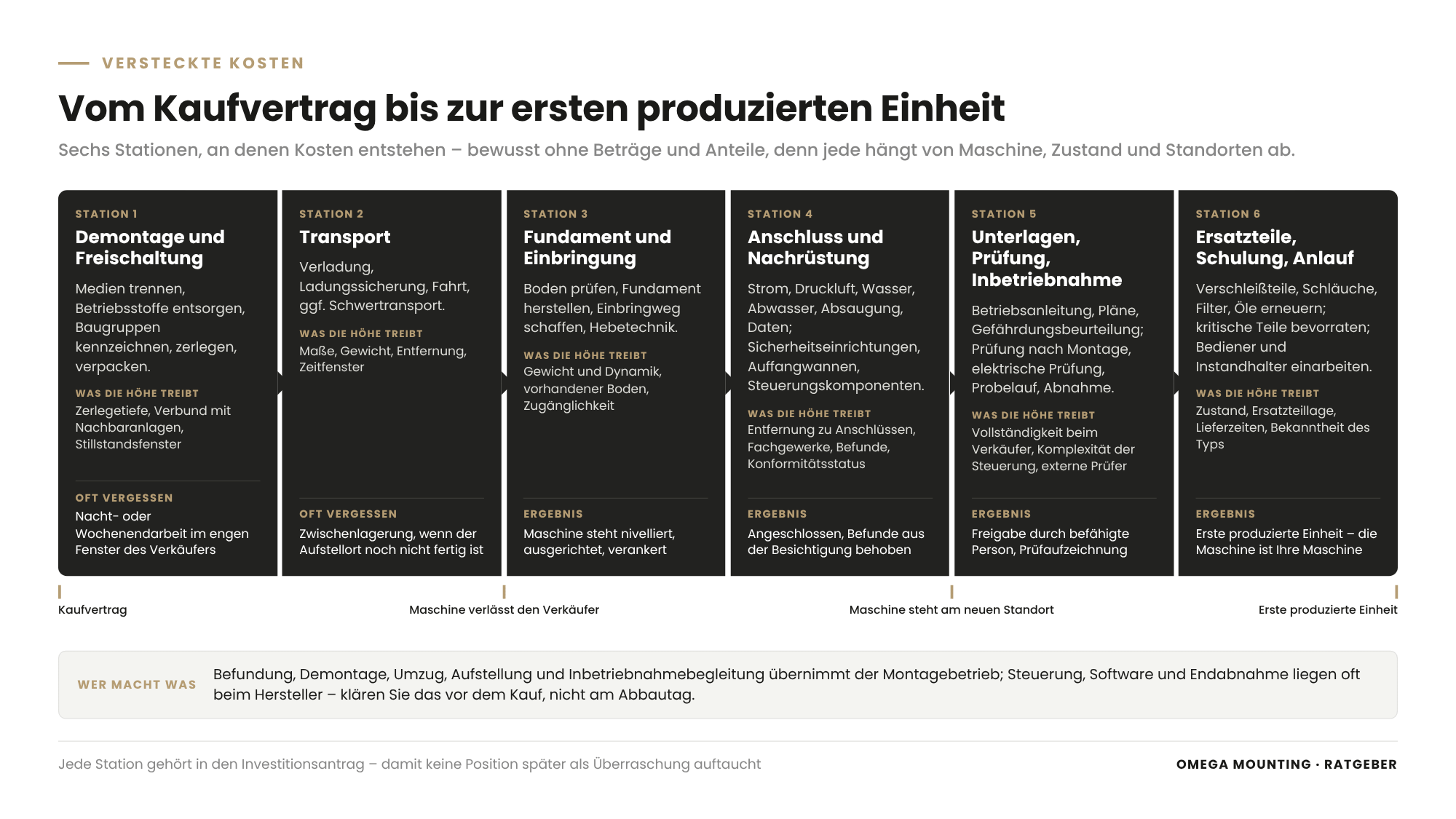
After buying a used machine, costs arise for dismantling and isolation, transport and packaging, foundation and moving in, media connection, retrofitting of safety devices and missing documents, inspection and commissioning, spare parts and training. These cost types must be known before the decision, even if their amounts are only determined after the site visit.
We deliberately give no amounts and no percentages: every cost type depends on the machine, the sites and the condition. What we give you is the complete list – so that no item is missing from the investment request that later turns up as a surprise.
| Cost type | What it covers | What drives the amount |
|---|---|---|
| Dismantling and isolation | Medien trennen, Betriebsstoffe entsorgen, Baugruppen kennzeichnen, zerlegen, verpacken | Dismantling depth, links to neighbouring equipment, maintenance window |
| Transport | Loading, load securing, journey, heavy haulage if required, interim storage | Dimensions, weight, distance, time window |
| Foundation and moving in | Checking the floor, building the foundation, creating the access route, lifting equipment | Weight and dynamics, existing floor, accessibility |
| Media connection | Power, compressed air, water, drainage, extraction, data | Distance to connections, power demand, specialist trades |
| Retrofitting | Safety devices, covers, drip trays, control components | Findings, age, conformity status |
| Documents | Operating instructions, drawings, risk assessment, operating procedures | Completeness at the seller, manufacturer support |
| Inspection and commissioning | Inspection after assembly, electrical testing, control system, trial run, acceptance | Dismantling depth, complexity of the control system, external inspectors |
| Spare parts and initial stock | Renewing wear parts, hoses, filters, oils; stocking critical parts | Condition, spare parts situation, lead times |
| Training and ramp-up | Training operators and maintenance staff, ramp-up losses | Familiarity with the type, documentation |
Particularly often forgotten: the tight maintenance window at the seller's site that makes night or weekend work necessary, and interim storage if the installation position is not yet ready.
How does the takeover work: dismantling, relocation, installation and commissioning?
The takeover of a used machine runs in five steps: isolating and disconnecting media, documented dismantling with labelling of every component, transport with packaging and load securing. Then installation with levelling, alignment and anchoring, and finally connection, inspection, trial run and release.
Dismantling begins with isolating all energy sources and securing against reconnection – how to organise this properly is shown in our guide Lockout tagout in maintenance. Then supply lines are disconnected and labelled, operating fluids drained and verifiably disposed of, assemblies released in the order in which they will later come back together. Every part is labelled and photographed, and its installation position recorded.
Installation means alignment
At the new site, the machine is placed on the inspected foundation, levelled, aligned and anchored before a single line is connected. On machines with guides, racks and sensors, alignment decides whether the machine runs as it did at the seller's. A distorted base frame wears out in months what previously lasted years. Then come the media, every connection tested.
Inspection, trial run, release
Before first commissioning comes the inspection by a competent person, and for electrical installations the test under the accident prevention regulation DGUV Vorschrift 3 (DGUV Regulation 3). For you this means: the qualified electrician tests the reconnected installation before it is energised, and documents this. The inspection record under the German technical rule TRBS 1201 captures the type, scope and result of the inspection as well as the inspector. Include these details in your handover record, and the reassembly doubles as proof of inspection. Then the trial run: without load, with product, under production conditions. Only with the release does the used machine become your machine. What we contribute here is described on our service page for Machinery relocation.
How we do it in the Rhine-Main region
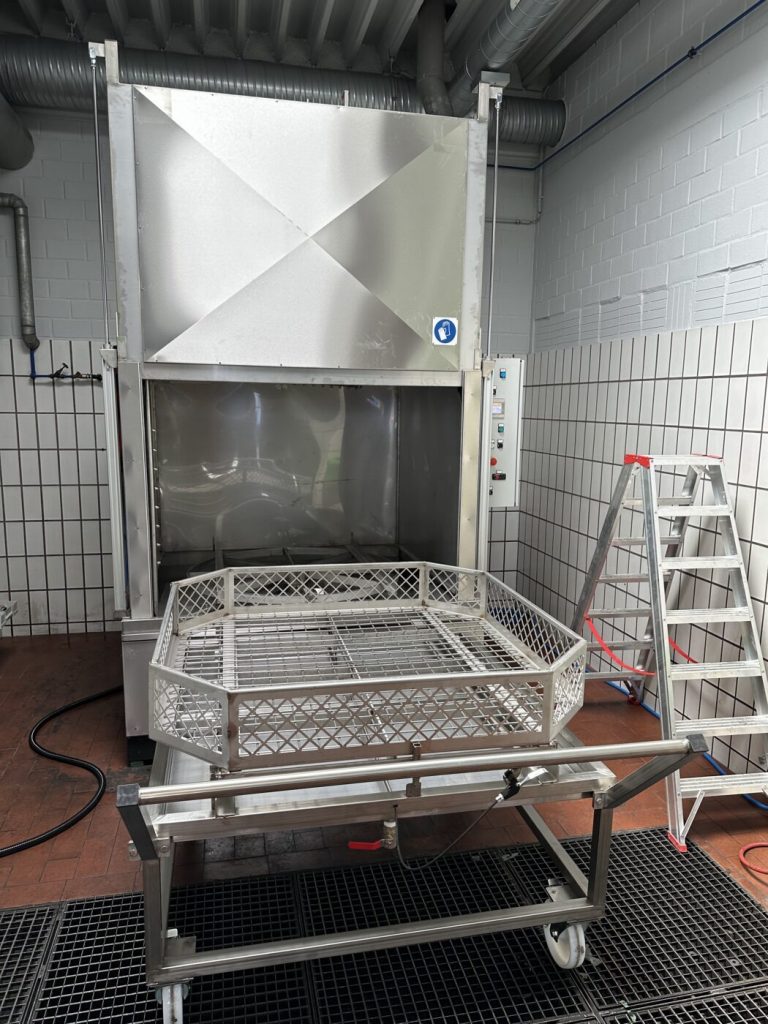
In the Rhine-Main region, we accompany buyers of used machines from the inspection to the trial run. We travel with you to the seller in Frankfurt, Hanau, Darmstadt or Aschaffenburg, assess the machine technically and walk the transport route. Before you sign, we tell you what dismantling, relocation and installation will involve – as an installation contractor, not as a dealer.
From Rodgau, the inspection in Offenbach, the site visit at the new location in Dietzenbach and the coordination with your qualified electrician can be done in a single day. Remanufactured parts come from our workshop in Rodgau; we bring the lifting equipment, from mini crane to machine skates. If the machine comes from further afield, we handle the dismantling there and the reassembly here – with the same team.
How we do it in practice
Four jobs from our project diary show what matters when taking over a machine – from the transport route to the trial run.
Six storage lifts from a Frankfurt office tower: the transport route determines the dismantling depth
During the relocation of six storage lifts from Frankfurt to Rodgau it was clear from the outset that none of the units would leave the building in one piece. The route to the container passed through three pinch points – doors inside the building – and the units were surrounded by parquet flooring that had to be preserved. So everything was dismantled completely, every part labelled and photographed, installation positions recorded in the photo log, and everything moved with dollies and muscle power. Six fitters were on site for the loading.
The reassembly showed the other side: gears, gear racks, proximity sensors and all guide elements had to be aligned so precisely that the trays would not be distorted when travelling. The manufacturer handled commissioning and final acceptance – sensors readjusted, heights re-taught, trays re-measured. The lesson for buyers: the transport route decides the dismantling depth, and the dismantling depth decides how much precision and manufacturer know-how the reassembly requires.
A robot from a bakery near Fulda: check the supply lines, lift as a whole
With the dismantling of an industrial robot with a mini crane at a bakery near Fulda the subject was a robot weighing around 600 kilograms between running conveyor belts. Before the lift, all supply lines – power, water, compressed air – were checked and disconnected and the bus bypassed so that the rest of the line could keep running. Then the robot was lifted out as a whole with the mini crane, slung with certified round slings, with centimetres to spare. The removal was completed in one day; one lifting manager, one crane operator and two mechatronics technicians were on site.
For the assessment, this job shows what “peripherals” means: a robot in a production line depends on the energy, media and data of the neighbouring equipment. Whoever buys it must know what belongs to it and what keeps running at the seller's – and whether there is room to lift it out as a whole.
A test rig in southern Germany: hydraulics under the machine
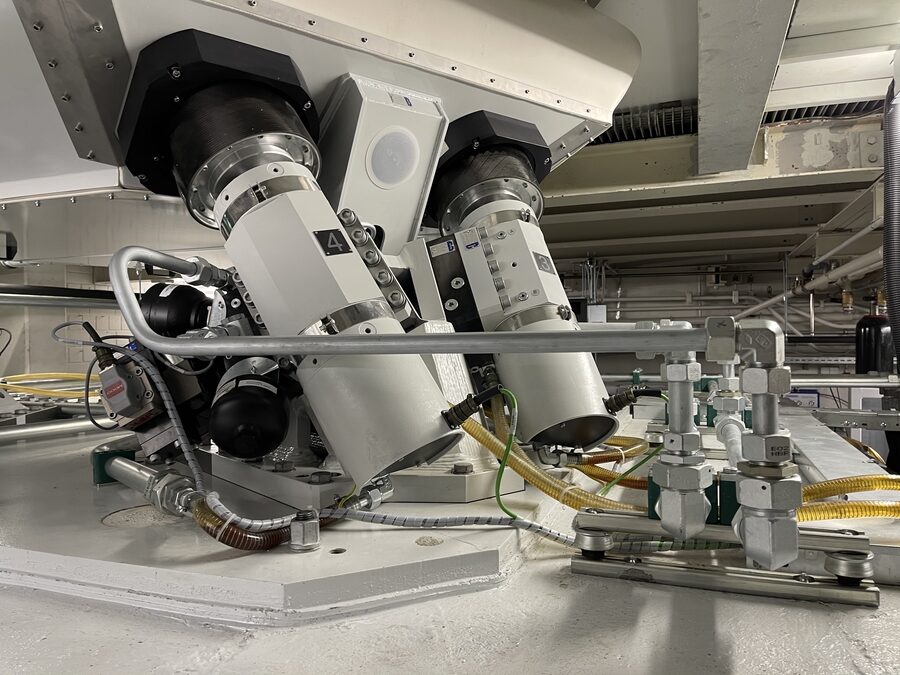
During the conversion of a vehicle test rig with an oil pan two fitters adapted the hydraulic lines and fitted a surrounding oil pan to the concrete foundation in three days. With drain cocks, TIG-welded leak-tight, ground, primed, painted and sealed oil-resistant against the concrete wall.
For buyers, this is an example of the hydraulics assessment field. Under a hydraulic machine, cylinders, piping and floor show whether it has run leak-free – and whether a containment has to be created at the new site that the old one never had.
A parts washer in Kassel: set up, connect, wash
With the installation of a parts washer at a car and commercial vehicle workshop in Kassel two mechatronics technicians needed a single day on site. That covered moving in, alignment, electrical supply, compressed air, water and drainage, exhaust air ducting and commissioning with a trial run. The first parts were washed on installation day. The machine was new; the procedure for a used one is the same: align first, then test every connection for leaks, then the trial run.
Are you about to buy a used machine – in Frankfurt, Offenbach, Hanau or elsewhere in the Rhine-Main region, or at a seller further away? Then talk to us before you sign. A joint inspection with a walk of the transport route usually clarifies within a few hours whether the machine suits you and what the route to the trial run will involve.
What this means for your role
For buyers: Make the inspection sheet the basis of the negotiation. Every finding – missing documents, bridged guard door, discontinued control system, dismantling because of pinch points – is an item that either the seller rectifies or that goes onto your cost list. In the purchase contract, define the scope of supply (tooling, peripherals, documents, software backup, access data), responsibility for dismantling and handover documentation. Obtain the quote for dismantling, transport and installation before you sign off the purchase price.
For designers: Check at the new site whether the foundation, the floor load along the access route, door clearances, media connections, extraction and maintenance areas suit the used machine. That means the machine with attachments and control cabinet, not the nominal dimension from the data sheet. A used machine brings different connected loads, vibrations and dimensions than the model you would have planned new.
For project managers and site managers: As project manager, you coordinate two sites with two schedules – the maintenance window at the seller's and the completion of foundation and media at your site – without unplanned interim storage in between. As site manager, you brief the installation team, ensure isolation, access and lifting equipment, release the access route and installation position, and take receipt of the dismantling record and photo documentation before the container rolls.
For maintenance managers: You are the most important person at the inspection: you hear the bearing noise, see the play on reversal and recognise in the control cabinet what appears in no file. Define which wear parts are always renewed during reassembly, and add the machine to the maintenance plan and inspection calendar before it runs. Insist that the software backup and spare parts list come with the machine.
For operations and plant managers: A used machine promises capacity without lead time – but only if the route from purchase to trial run is planned through. Release the maintenance window and installation area early, and plan the ramp-up with training and running-in time.
For manufacturers and system builders looking for an installation partner: Do you take back used machines of your type to refurbish them and install them at the next customer's site? Then you need a partner who handles dismantling, transport and installation with full documentation. Mechanics, lifting equipment and connection are ours; software and final acceptance are yours.
Used machine inspection sheet: checklist on request
The used machine inspection sheet is the checklist for anyone planning to buy a used machine: a two-page inspection form with the checkpoints from this article. It covers documents, mechanics, hydraulics and pneumatics, electrics and control system, safety devices, modification history and conformity, spare parts situation, dismantling and transport feasibility at both sites, and cost types after the purchase. All as tick boxes and note fields with a column for photo numbers, without scores, amounts or market prices. It helps buyers document the inspection completely, and maintenance managers overlook nothing that will later become expensive. Request the inspection sheet via our Contact form – quoting the keyword “Used machine inspection sheet”.
Why Omega Mounting?
We are based in Rodgau near Frankfurt and, for used machines, we take on the part between the purchase contract and the trial run. That includes on-site technical assessment, walking the transport routes, documented dismantling, relocation with our own lifting equipment and installation with levelling, alignment, connection and commissioning support. The linked jobs show what that means. Six storage lifts that were broken down into documented individual parts because of three doors and realigned precisely. A robot that was lifted out as a whole between conveyor belts after all supply lines had been disconnected. A hydraulic unit that received a leak-tight pan. We do not trade in machines and do not produce valuations – we tell you what the technical situation is. For you this means: one point of contact for assessment, dismantling, relocation and installation and a workshop in Rodgau for parts that are missing at reassembly. Plus short distances in the Rhine-Main region and a team that, at the end, has not just installed the machine but got it running.
Conclusion
Inspecting a used machine means answering four questions before the purchase. What condition is it in? May it be put into operation as it is? Will it get out of the old hall and into the new one? And which cost types follow the purchase price? The answers are not in the data sheet, but on the running machine, in the documents, in the control cabinet and along the transport route. Those who obtain them before signing buy a machine that runs – those who obtain them afterwards buy a construction site. If you have a used machine in mind, send us the type, the seller's location and your planned installation site. We will get back to you with an honest assessment of inspection, dismantling, relocation and installation.
Planning maintenance, moving in or installation in the Rhine-Main region?
Tell us briefly what it is about – we will come back to you with an honest assessment.
100% free and without obligation
You may also be interested in these guides

About the author
Tobias Schott
Managing director of Omega Mounting GmbH, Rodgau · more than 20 years of hands-on experience in installation and maintenance
A trained mechatronics technician, at home in maintenance, servicing and industrial installation since 2004 – first at his father's side, since 2012 with Omega Mounting: from the overhead conveyor in Frankfurt to the crane system in a new-build hall. Plans and leads lifting operations as appointed person in data centers and on industrial sites in the Rhine-Main region, is an instructor and examiner for cranes, mobile elevating work platforms and telehandlers, and a safety officer. On jobs abroad he is known as the “German Troubleshooter” – the one you call when things get stuck on site. He learned what quality means not from a manual but from his father: Made in Germany as a standard for his own work, not as a label. That is why it comes first at Omega Mounting – before speed and before price. He writes these guides from that practice: what works on our sites is in them – what only exists in the standard is not.
Frequently asked questions
Four fields: the technical condition on the running machine (running behaviour, play, leaks, electrics, control system, safety devices) and the documents (operating instructions, declaration of conformity, drawings, inspection records, modification history). Plus the dismantling and transport feasibility at both sites and the cost types after the purchase. Take an inspection sheet with you and photograph every finding.
Machines placed on the market before the Machinery Directive applied often bear no CE mark; buying them is possible. As the operator, however, you must ensure through the risk assessment under the BetrSichV (German Industrial Safety Ordinance) that the machine can be used safely, and retrofit safety devices where necessary. A cost type that belongs on the list before the purchase. This note is no substitute for legal advice.
A modification can legally turn a machine into a new one if it creates a new hazard or increases a risk that cannot be controlled with simple protective devices. In that case, whoever carried out the modification is responsible like a manufacturer. For every modification, ask who did it and whether it was assessed, and have unclear cases assessed by an expert before the purchase. This too is orientation, not legal advice.
Yes, if its safety depends on the installation conditions – and that applies to almost every installed machine. The BetrSichV (German Industrial Safety Ordinance) requires an inspection by a competent person after assembly and before first commissioning. Electrical installations are tested by a qualified electrician under DGUV Vorschrift 3 (DGUV Regulation 3). The inspection record with type, scope, result and inspector belongs in your machine file.
By comparing the dimensions, weight and centre of gravity of the machine including attachments with the door clearances, headroom, stairs, lifts, floor loads and floor coverings along the transport route at both sites. Every pinch point sets the maximum transport dimension; whatever does not fit is dismantled. An installation contractor can see this quickly during a site visit – before the purchase, not on dismantling day.
Dismantling and isolation, transport, foundation and moving in, media connection, retrofitting of safety devices and documents, inspection and commissioning, spare parts, training and ramp-up. Night work because of the maintenance window at the seller's and interim storage if the new site is not ready are often added. The amounts depend on the machine, its condition and the sites; figures from other projects rarely fit.
Yes, the four assessment fields – condition, conformity, relocatability, follow-on costs – are the same for every used machine; the weighting shifts. On injection moulding and machine tools, hydraulics, guides and foundation dominate; on storage equipment, the alignment of racks and sensors during reassembly; on test rigs, media and containment; on robots, peripherals and control system. The inspection sheet stays the same, the critical lines change.
Yes. From Rodgau, we travel with you to sellers in Frankfurt, Offenbach, Hanau, Darmstadt or Aschaffenburg, assess the machine technically and walk the transport route. Then we tell you what dismantling, relocation and installation will involve. If the machine is further away, we handle the dismantling there and the reassembly at your site. We do not trade in machines and do not produce valuation reports.
With a short enquiry containing three details: which machine it is (type, year of manufacture, weight and dimensions, as far as known), where it stands and where it is going. We arrange a joint inspection at the seller's with a walk of the transport route and check the installation site at your premises. Then we send you a written assessment of findings, dismantling, transport, installation and the open items before the purchase. Your contact is Tobias Schott – reachable via our Contact form.
 English
 German