
- Guide – Occupational safety
Rectifying an accident prevention (UVV) defect: from inspection report to re-release of the equipment
By Tobias Schott · Reading time approx. 23 minutes · Last updated: October 2026
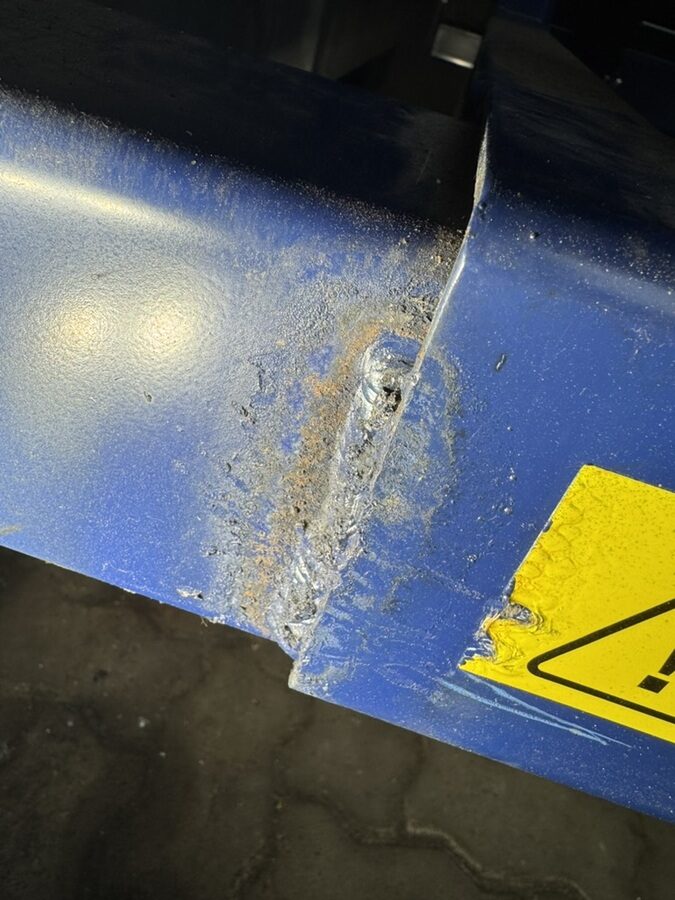
Rectifying a UVV defect means assessing the finding, locking off the plant if hazardous, repairing it properly and documenting re-release by re-inspection.
The inspection report is on the table, the sticker has been refused, and a sign saying "locked out" hangs on the loading dock. For you as maintenance or warehouse manager, the phase now begins in which rectifying a UVV defect means more than a repair. You have to classify the finding by defect class, secure the plant, commission a specialist contractor and have the repair accepted. In the end, you have to prove that everything is in order again. Every day this takes costs throughput or production space.
The uncertainty usually arises not in the repair itself but at the transitions: may the plant continue to run with the defect? Who decides that? Does the inspector have to come again? Who signs at the end? This guide answers these questions – for doors, loading docks, racking, platforms and cranes, the plant with the most findings in warehouses and production. Jobs from our project diary show the route from finding to release in practice.
Key points at a glance
- "UVV inspection" refers to the periodic inspection of work equipment under the BetrSichV (German Industrial Safety Ordinance) and the accident-prevention regulations (UVV); it is carried out by a competent person or a qualified person.
- The inspection report identifies defects, but the decision on lock-out, deadline and continued operation is made by the operator on the basis of the defect class – with safety-relevant defects, continued operation is not permitted.
- Defects on load-bearing parts – brackets, welds, racking uprights, crane runway girders – may only be repaired by qualified personnel. The aim is the original condition or one verified by structural calculation. Anyone who changes the design creates a substantial modification with a new assessment obligation.
- After every repair that could affect the safety of the plant, a renewed inspection by a competent person is required; only this leads to re-release with an inspection sticker.
- The documentation comprises inspection report, lock-out note, repair report with photo documentation, re-inspection and release – to be kept in the inspection logbook at least until the next inspection.
- Anyone who does not eliminate the cause of the defect, such as forklift impacts on an unprotected plant corner, will get the same finding again next year.
- A specialist contractor offering repair, welding work and re-manufacture from a single source considerably shortens the time between lock-out and release.
What is a UVV defect?
A UVV defect is a deviation from the safe condition identified during the periodic inspection of an item of work equipment. It is documented in the inspection report and, depending on severity, given a deadline for rectification or a ban on continued operation. The term comes from the German accident-prevention regulations (Unfallverhütungsvorschriften, UVV), which are today called DGUV Regulations; the other legal basis for the inspection duty is the Betriebssicherheitsverordnung (BetrSichV, Industrial Safety Ordinance).
UVV inspection, qualified person inspection, inspection by competent person – what is what?
In practice, the terms mean the same procedure from two regulatory worlds. The ordinance speaks of the "competent person" (zur Prüfung befähigte Person) and specifies its requirements in a separate technical rule; the accident-prevention regulations and the associated rules speak of the "qualified person" (Sachkundiger). In each case, a person is meant who, through training, professional experience and recent professional activity, has the expertise to assess the condition of the work equipment. For certain plant, an authorised expert (Sachverständiger) may additionally be required – a different qualification level.
What the inspection report does – and what it does not
The report establishes the actual condition and assesses it – it is the result of an inspection, not the repair. It is neither a repair order nor a release. The responsibility for drawing the right conclusions from the finding lies with the operator as the employer. That is the core of the ordinance: work equipment may only be used if it is safe.
Which legal bases apply to inspection and rectification of defects?
Inspection and rectification of defects are governed by the BetrSichV with its technical rules as well as the accident-prevention regulations and rules of the employers' liability insurance associations for the respective type of plant. For racking, doors and platforms, the associated standards and workplace rules are added. The most important provisions at a glance:
- Risk assessment: Under the ordinance, the employer defines type, scope and intervals of the inspections. The intervals from accident-prevention regulations and standards are minimum requirements; the risk assessment may require shorter intervals.
- Maintenance: Maintenance measures must be carried out in such a way that the safety of employees is ensured; they may only be carried out by qualified and authorised persons.
- Inspection: Work equipment whose safety depends on the installation conditions must be inspected by a competent person before first use, periodically and after repair work that could impair safety. The results must be recorded and kept at least until the next inspection.
- Inspection rule TRBS 1201: specifies types of inspection, scope of inspection, documentation and the consequence of a defect – referred to below as "the inspection rule".
- DGUV Regulation 1 – Principles of prevention: governs, among other things, the cooperation of several contractors at the same location, i.e. also the coordination between you and the repair contractor.
- Plant-specific: For each type of plant there is a separate inspection basis – accident-prevention regulation or rule of the employers' liability insurance association, standard or workplace rule. Which one that is, is shown in the table in the next chapter.
The logic behind all this is simple: the operator must know the condition of their plant, act on defects and be able to prove both. Which inspection is due for which plant at which interval is summarised in our overview of the inspection obligations for operators .
Which plant is typically affected – and how often is it inspected?
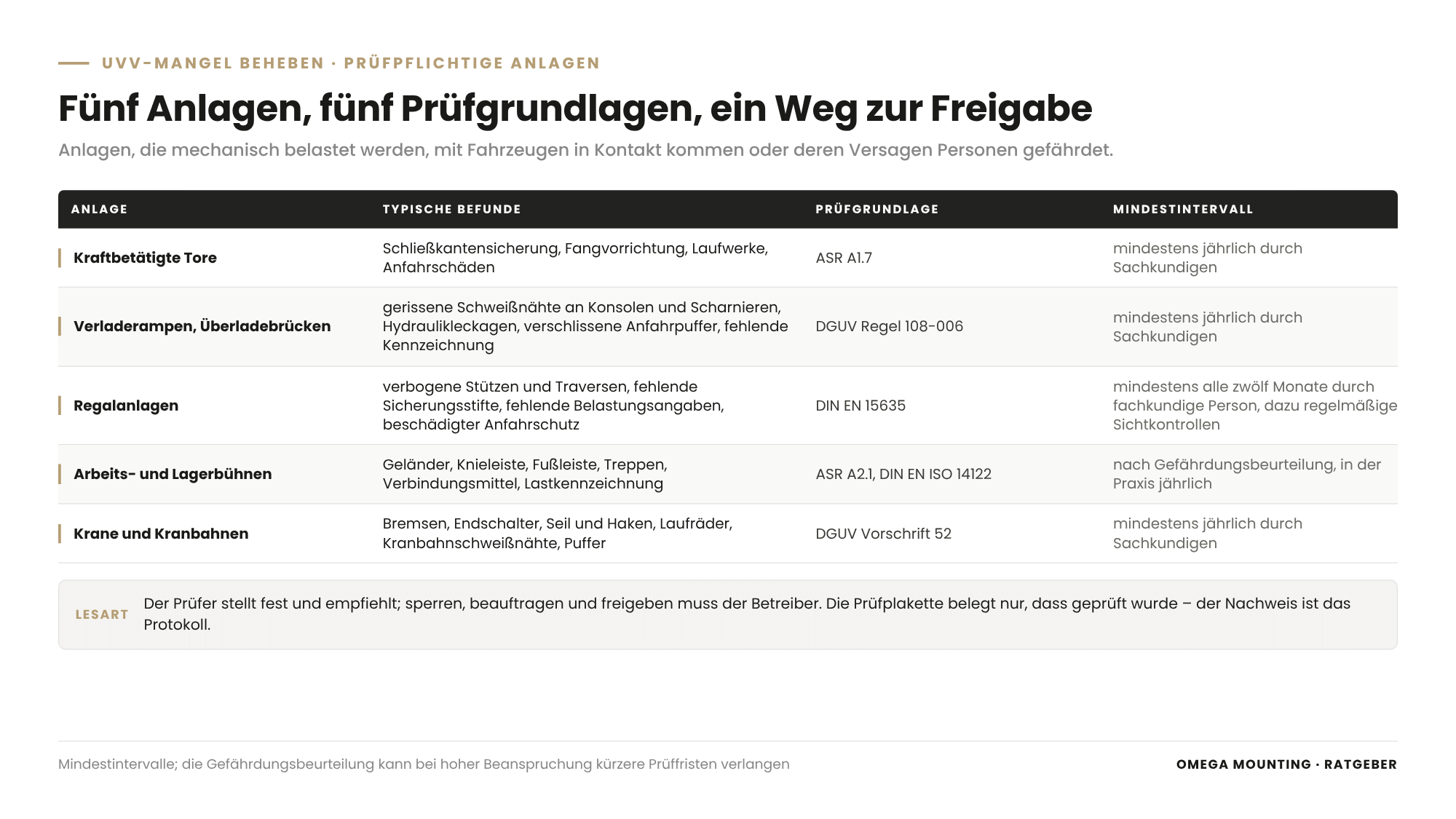
Mainly affected are doors, loading docks and dock levellers, racking installations, work and storage platforms, and cranes – plant that is mechanically loaded, comes into contact with vehicles or whose failure endangers people. The minimum intervals and inspection bases differ:
| Plant | Inspection basis | Minimum interval | Typical findings |
|---|---|---|---|
| Power-operated doors. | ASR A1.7. | At least annually by a qualified person. | Closing edge protection, safety catch, running gear, impact damage. |
| Loading docks, dock levellers. | DGUV Rule 108-006. | At least annually by a qualified person. | Cracked welds on brackets and hinges, hydraulic leaks, worn dock bumpers, missing labelling. |
| Racking installations. | DIN EN 15635 (racking standard). | At least every twelve months by a qualified person. Plus regular visual checks. | Bent uprights and beams, missing safety pins, missing load notices, damaged impact protection. |
| Work and storage platforms. | ASR A2.1 (protection against falls). | According to risk assessment, in practice annually. | Guardrails, knee rail, toe board, stairs, connecting elements, load labelling. |
| Cranes and crane runways. | DGUV Regulation 52. | At least annually by a qualified person. | Brakes, limit switches, rope and hook, wheels, crane runway welds, buffers. |
The table gives minimum intervals; under heavy loading, the risk assessment may require shorter inspection intervals. Whether door inspection, racking inspection or crane inspection – the route from finding to release is the same in all cases.
How are defects classified – and when must the plant be locked out?
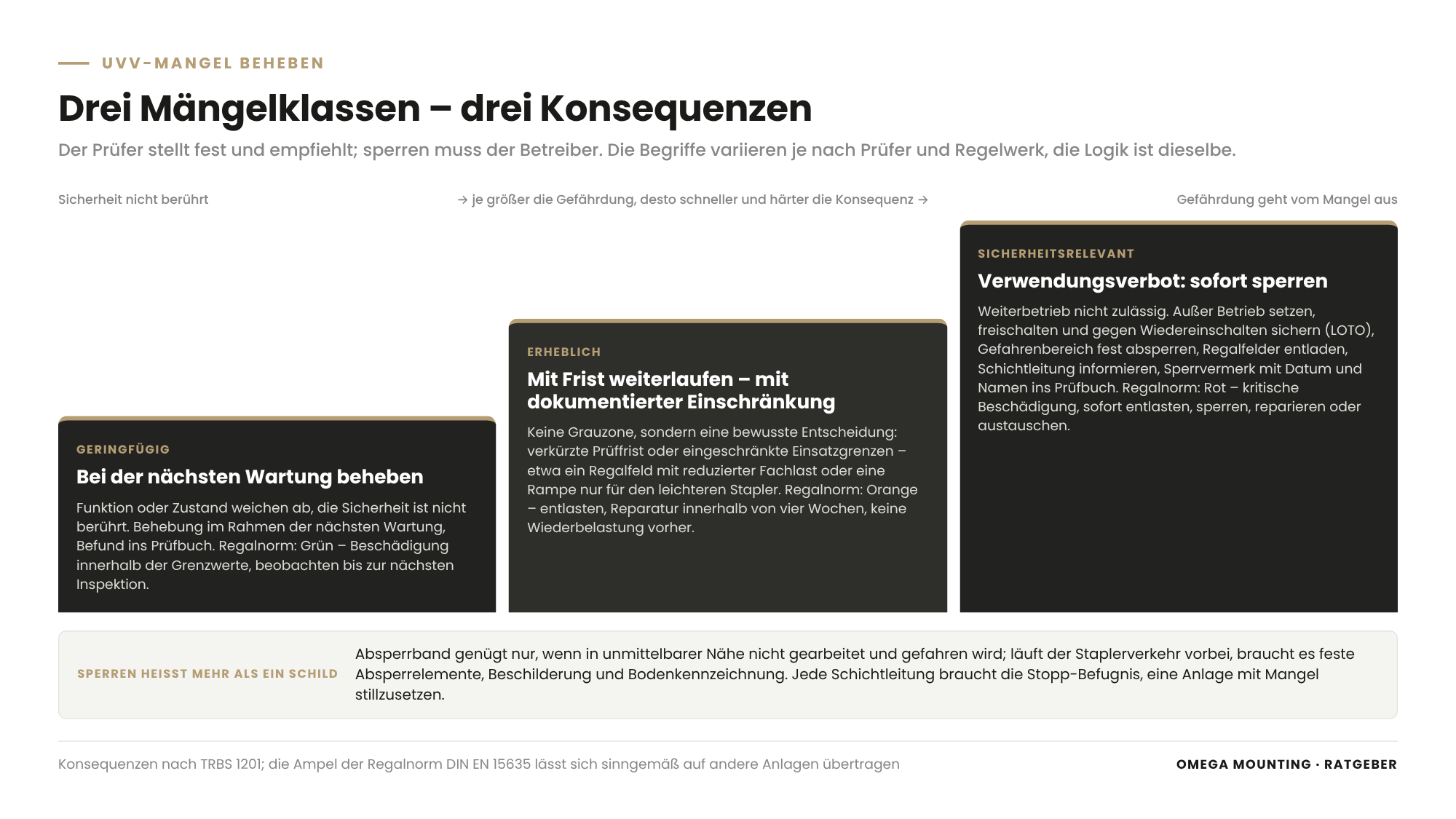
Defects are classified into defect classes according to their effect on safety. With safety-relevant defects, continued operation is not permitted and the plant is locked out immediately. With significant defects, a deadline for rectification applies; with minor defects, rectification as part of the next maintenance is sufficient. The terms vary depending on inspector and regulations, the logic is the same. The decisive factor is whether the wear limit has been reached – or, for lifting accessories, ropes and chains, the discard criteria, i.e. the condition in which a component may no longer be used.
The inspection rule summarises the consequence in two sentences: a defect that creates a hazard leads to a ban on use; for other defects, a shortened inspection interval or restricted operating limits come into consideration. For you this means: "continuing with a deadline" is not a grey area but a deliberate decision with documented restriction until repair. Examples are a racking bay with reduced shelf load or a dock that is only driven over by the lighter forklift.
The example of the racking standard
The classification is most clearly codified in the racking standard. It distinguishes three levels:
- Green: Damage within the limits, observation until the next inspection.
- Amber: Limits exceeded. Unload the racking area as soon as the load can be removed, repair within four weeks, no reloading before repair.
- Red: critical damage. Unload immediately, lock out, repair or replace.
This traffic-light principle can be applied analogously to other plant.
Who decides on the lock-out?
The inspector identifies and recommends; the operator must lock out. If the qualified person refuses the inspection sticker, that is a clear signal – but what is legally decisive is your obligation as the operator not to allow unsafe work equipment to be used. If in doubt: lock out, label, prevent access, inform. A lock-out consisting only of a note does not last long in shift operation – every shift supervisor needs the stop-work authority to shut down a plant with a defect.
Locking out means more than a sign
- Take the plant out of service, isolate it and secure it against reactivation – for electrically operated doors and docks: main switch off, locked with padlock and tag (lockout/tagout, LOTO).
- Cordon off the traffic route or racking aisle as a danger zone; for docks, lock out the associated door. The BG BAU/BAuA module "Site set-up – site security" sets the standard: barrier tape and guide posts are only sufficient if no work or driving takes place in the immediate vicinity. Where forklift traffic passes the locked-out area, fixed barrier elements, signage and floor marking are needed.
- Unload loaded racking bays, label platforms with load restriction or lock them out.
- Inform shift management, maintenance and – if available – the safety officer; document the lock-out note with date and name in the inspection logbook.
How do you correctly commission the rectification of a UVV defect?
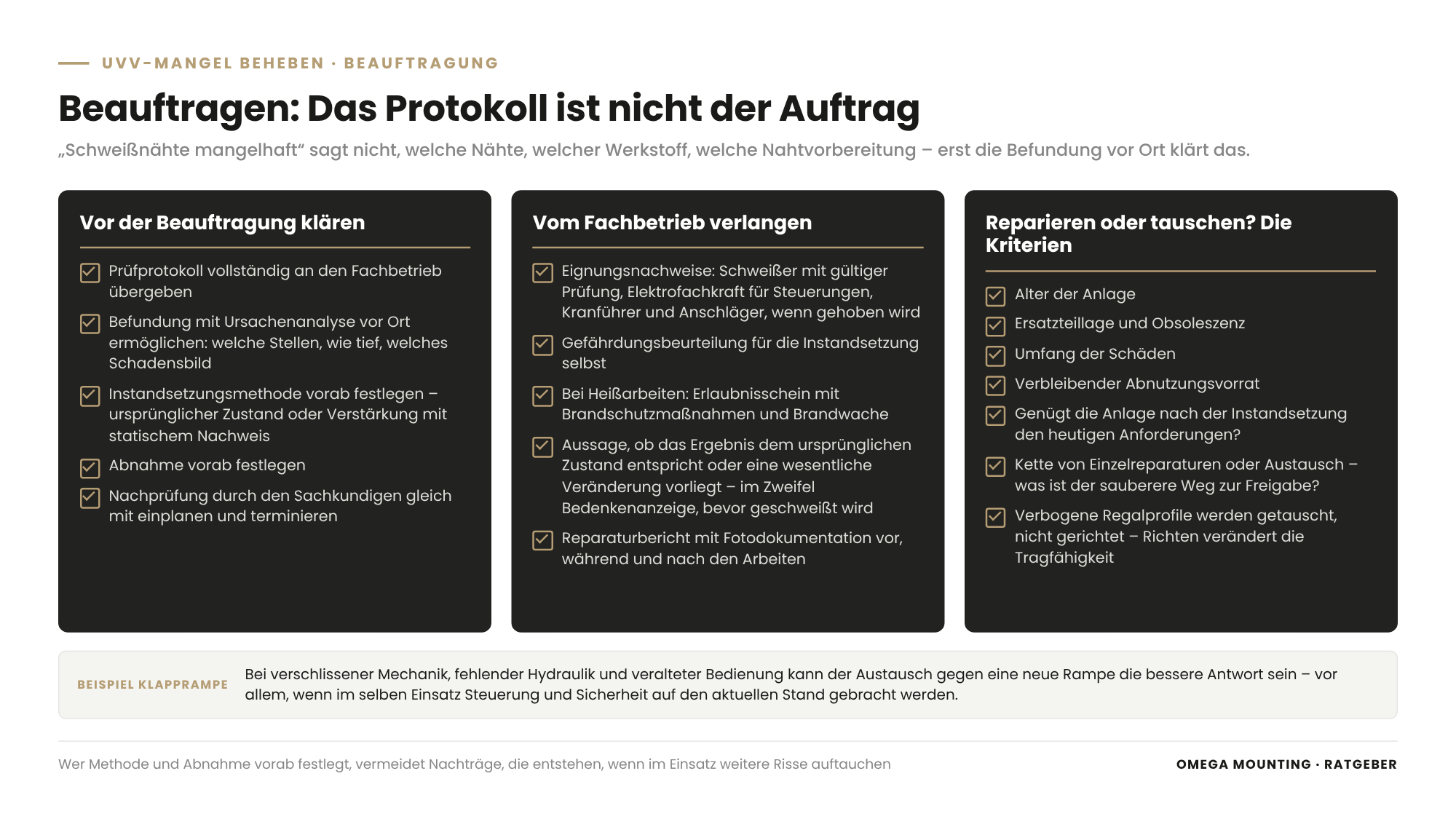
You correctly commission the rectification of a UVV defect by handing the specialist contractor the complete inspection report and enabling an on-site assessment. Define the repair method and acceptance in advance and plan the re-inspection by the qualified person right away. The report is the starting point, not the scope of works.
The report is not the order
A finding such as "welds defective" does not say which welds, which material, which weld preparation. That is why every repair on load-bearing parts must be preceded by an on-site assessment with root cause analysis. Which brackets are affected, how deep is the crack, what damage pattern is present? Can the original condition be restored or is reinforcement with structural verification needed? Only then is a quotation reliable. And only then can change orders be avoided that arise when further cracks appear during the job.
What you should require from the specialist contractor
- Proof of suitability for the work: welders with valid qualification test, qualified electrician for controls, crane operators and slingers if lifting is involved.
- A risk assessment for the repair itself, and for hot work a hot work permit as permit to work – the written release for welding, cutting and grinding work with fire protection measures and fire watch.
- A statement as to whether the result corresponds to the original condition or whether a substantial modification exists that must be assessed structurally or by the manufacturer – if in doubt as a formal notice of concern before welding.
- A repair report with photo documentation before, during and after the work.
Repair or replace?
Not every defect is worth a repair. For a hinged dock leveller with worn mechanics, missing hydraulics and outdated controls, replacement with a new leveller may be the better answer. This applies above all when control and safety are brought up to date in the same job. Criteria are age, spare parts situation and obsolescence, extent of damage, remaining wear reserve and the question of whether the plant will meet today's requirements after repair in its existing form.
How does the repair of a UVV defect proceed?
The repair usually proceeds in five steps: assessment and root cause analysis, securing the danger zone, professional repair or replacement of the component, restoration of corrosion protection and labelling, trial run by the specialist contractor. Re-inspection by the qualified person follows.
Example: weld repair on a dock bracket
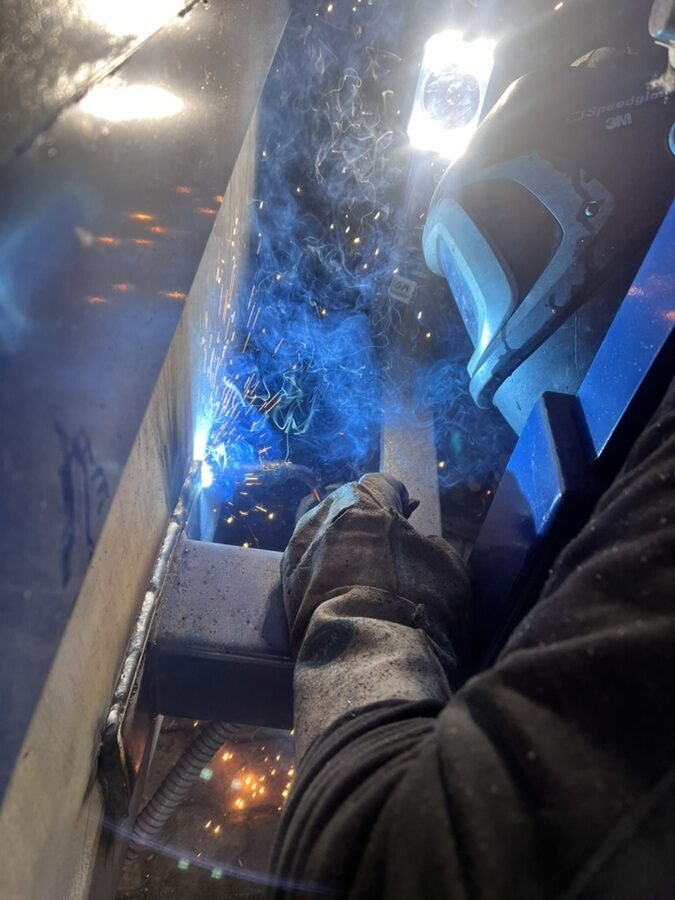
With cracked welds on brackets of loading docks, the old welds are completely ground out until sound material is reached – simply welding over the crack is not enough. Then they are re-welded with deep penetration using the MAG process (metal active gas welding, an arc process with wire electrode and active shielding gas that has proven itself for structural steel). Finally, corrosion protection follows with primer and top coat, because a bare weld outdoors rusts within months. Weather is not an obstacle but a factor: in sub-zero temperatures, the surroundings of the workpiece must be heated so that the weld does not cool too quickly.
Example: racking repair
With racking and other plant equipment , damaged uprights, beams and bracing are generally not straightened but replaced with identical parts. Straightening bent sections changes their load capacity and is not provided for in the racking standard. The work takes place with the racking bay unloaded and the aisle locked out; the rest of the operation can continue. That is separation of trades in a working warehouse, with traffic protection against forklift traffic. If the installation has not been maintained for a long time, cleaning and inspection of the drive stations are added before new technology is installed.
Example: platform and fall protection
With work and storage platforms, findings usually concern guardrails, knee rails and toe boards, stairs and connecting elements. Here: fall protection is non-negotiable. The workplace rule on protection against falls generally requires side protection or equivalent protective devices at fall heights of one metre or more. As long as the side protection is missing, the fitters work with fall arrest PPE on inspected anchor devices. When installing new platforms, you avoid later findings: survey the hall by laser before erection, align columns plumb, fully install guardrails, stairs and closures before the area is used.
What you should not do
No repairs on load-bearing parts without a specialist contractor, no welding over cracks, no straightening of racking sections. No recommissioning "on the nod" without release. And no continued operation with a defect because the repair is only possible next week.
How does the plant get re-released?
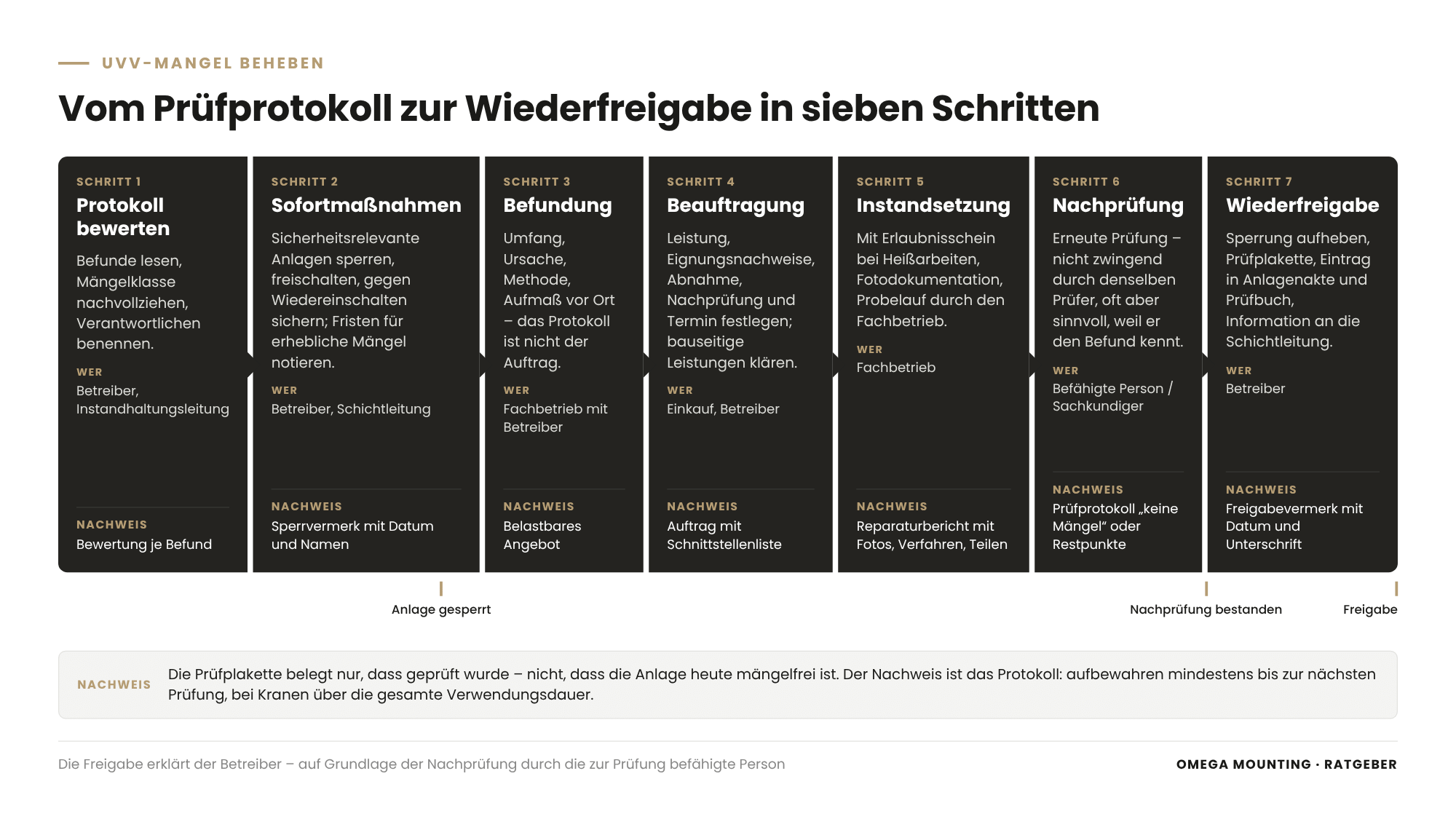
The plant is re-released through a documented re-inspection. After a repair that could affect safety, the ordinance provides for a renewed inspection by a competent person. Its positive result justifies lifting the lock-out. The release is declared by the operator – on the basis of this inspection.
The sequence in seven steps
- Receive and evaluate the inspection report: read findings, understand the defect class, name the responsible person.
- Immediate measures: lock out safety-relevant plant, isolate and secure against reactivation, note deadlines for significant defects.
- Assessment with the specialist contractor: scope, cause, method, site survey, quotation.
- Commissioning: define scope, proof of suitability, acceptance, re-inspection and date; clarify works by others such as isolation and access.
- Repair: with permit to work for hot work, photo documentation, trial run by the specialist contractor.
- Re-inspection by the competent person: inspection report with result "no defects" or punch list.
- Re-release: lift the lock-out, inspection sticker, entry in plant file and inspection logbook, information to shift management.
Who may carry out the re-inspection?
The same qualification as for the periodic inspection: a competent person or a qualified person for the type of plant. The rule on competent persons specifies relevant vocational training, professional experience with the type of plant and recent inspection activity. The responsibility for the selection remains with the operator, even if an external inspector comes. Therefore ask about the qualification before accepting a signature. It does not have to be the same inspector as for the initial inspection, but it is often sensible because they know the finding. In the case of a substantial modification of the design, an extended inspection by an authorised expert may be required.
Which documents you should have at the end
- The original inspection report with findings.
- The lock-out note with date and responsible person.
- The specialist contractor's repair report with photos, process and parts used.
- For welding work, the permit to work and – if required – welder certificates.
- The re-inspection report.
- The release note with date and signature.
Retention: at least until the next periodic inspection, for cranes according to the inspection rule over the entire service life; for the plant file we generally recommend considerably longer, because repeat findings make causes visible. And a note from the same inspection rule that is often overlooked in everyday practice: the inspection sticker only proves that an inspection took place – not that the plant is free of defects today. The evidence is the report, not the sticker.
How do you prevent the defect from recurring?
You prevent repeat findings by eliminating the cause instead of just the symptom. That means: absorb forklift impacts with collision protection, anticipate wear through adapted maintenance intervals, apply missing labelling permanently and compare findings in the plant file over years.
The most common cause: impact damage
Docks, doors, racking uprights and plant corners are hit by industrial trucks – not out of carelessness, but because traffic routes are tight and cycle times count. A worn dock bumper, a bent racking upright or a cracked bracket are often the result; the root cause analysis then does not end at the weld but at the traffic route. Robust impact protection that absorbs the energy before it hits the plant helps here – according to the maintenance standard DIN 31051 an improvement, not a repair. Whether a standard product is sufficient or a custom fabrication is needed depends on geometry, vehicle weight and speed – a separate practical article on this will appear in this knowledge base.
Adapting intervals to the loading
A dock in three-shift operation needs shorter visual check intervals than a dock used twice a day. The risk assessment allows and requires inspection intervals and maintenance intervals to be adapted to the actual loading. Supplement the annual qualified person inspection with documented visual checks by your own staff.
Making causes visible in the file
Anyone who welds the same bracket for the third time in the third year does not have a welding problem but a design or traffic problem. Only a continuously updated plant file shows that. More on how to organise and award maintenance can be found on our page on maintenance and servicing of industrial plant.
Rectifying UVV defects in the Rhine-Main region: how we do it
In the Rhine-Main region, it is above all logistics sites with loading, conveyor and storage technology in Frankfurt, Hanau, Dietzenbach and around Frankfurt Airport where we rectify UVV defects. Added to these are production companies in Offenbach, Darmstadt and Aschaffenburg. The calls often come on the day of the inspection: the sticker has been refused, the door is closed, loading is running via the neighbouring dock.
What helps us from Rodgau is the short distance – and our own workshop. We prefabricate brackets, dock bumpers, mountings or reinforcement plates there to site survey, so that on site, welding, installation and coating take place without waiting for parts. When the qualified person re-inspects, the repair report with photo documentation is already available.
For operators whose plant has not been inspected for a long time, we start with a site visit and assessment and prioritise with you by defect class.
How we do it in practice
Three jobs from our project diary show the route from finding to release. One of them shows the case in which replacement was the better solution.
Cracked welds on two loading docks: from refused inspection stamp to re-welding
With the UVV repair of defective welds on two loading docks at a logistics service provider, the inspector had classified the dock welds as defective and refused the inspection stamp. The dock door was locked out. Loading docks – often called dock levellers – are hydraulically moved steel plates that bridge the height difference between truck bed and hall floor. They are driven over by forklifts thousands of times a year; the welds on the brackets carry this load.
After the on-site assessment, two fitters ground out the old welds and re-welded the brackets using the MAG process; primer and paint restored the corrosion protection. The job took one day – in snowfall and sub-zero temperatures, which is why an industrial heater kept the workplace warm. The result: welds that the inspector could release, and a door that went back into operation.
Two hinged dock levellers at a logistics centre in Frankfurt: when replacement is the better repair
During the replacement of two hinged dock levellers at a logistics centre in Frankfurt , two manually operated old levellers were replaced by fully electric, hydraulic hinged dock levellers. The photos of the old loading point show worn dock bumpers – a typical finding at loading points with heavy traffic. The old levellers were cut from the steel structure with an angle grinder, the new levellers positioned by forklift and welded to the existing steel structure using the MAG process.
The two mechatronics technicians then installed the mechanics and hydraulics and set up two control cabinets with traffic lights inside the building. Because the final power connection was missing, a power distributor was installed; the in-house electrical department later took over the final supply. Both doors were finished in a single working day. The case shows: when the mechanics, controls and safety of a dock leveller are no longer up to date, replacement is the cleaner route to release than a chain of individual repairs.
Racking repair in Fulda: after years without inspection back to a valid racking inspection
With the racking repair following a defect list in Fulda , the installation had not been properly maintained and inspected for several years. Based on the defect list, spare parts were procured: uprights, beams and bracing. The repairs ran during ongoing operations; individual racking aisles were locked out as a danger zone during the work; a MEWP served as access.
Added to this was cleaning of the installation, because dust, dirt, wood residues and production emissions had formed deposits over the years. Only then could new sensors be installed for the planned conversion. After two days, the work was completed; the new racking inspection certified the proper condition for one year. Exactly this last step turns a repair into a re-release.
In addition: steel platform at Kassel Airport – building platforms so that the inspection finds nothing
With the installation of a steel platform in a production hall at Kassel Airport , it was not about a defect but the opposite. A mezzanine level for assembly and storage was built that is inspectable from the outset. The hall was surveyed by laser to identify deviations between plan and reality. Important points were marked, columns and posts erected and aligned plumb, sections and beams bolted. The floor panels were lifted in by the existing overhead crane. Finally came guardrails, stairs and a sheet-metal screening wall. Anyone who installs platforms this way is spared the finding "guardrail incomplete" at the first inspection.
Do you currently have an inspection report with findings – in Frankfurt, Hanau, Dietzenbach or elsewhere in the Rhine-Main region? Then get in touch with us: an on-site assessment usually clarifies within an hour whether to repair or replace and when the qualified person can come for the re-inspection.

What this means for your role
For buyers: Commission repairs on load-bearing parts only from contractors with proof of suitability: welder qualification test, qualified electrician, crane operator, business liability insurance. Include repair report, photo documentation and participation in the re-inspection as separate items in the scope of works. A framework agreement with call-off orders and agreed response time shortens the time to arrival in a breakdown. Link acceptance to the re-inspection report, not to the invoice.
For designers: Many UVV defects have their cause in the design: docks without collision protection, racking without impact protection, doors in forklift traffic without swept path and clearance. Design plant subject to inspection so that qualified persons can reach it – inspection openings, access for MEWPs – and load-bearing parts remain visible without dismantling. In the detailed design, define which inspection basis and which load assumptions apply to each plant, and hand over this information to the operator with the as-built documentation.
For project managers and site managers: When an inspection report reports defects on several plants at the same time, rectification becomes a project: prioritisation by defect class, commissioning, lock-out periods, re-inspection – with a punch list in the regular meeting. As project manager, you track the sequence from report to release. As site manager, you brief the repair teams on site, hand over the work area and coordinate hot work permit and cordoning with ongoing operations. You only release the plant again after documented re-inspection.
For maintenance managers: Define a fixed sequence – from receipt of the report to release – with responsible persons for each step, and keep an inspection logbook with inspection interval for each plant. Lock out consistently, document the lock-out note, and schedule the competent person for the re-inspection at the same time as the repair. Compare findings over years to identify the cause from the damage pattern, and classify impact protection and retrofits as improvement within the meaning of the maintenance standard in the maintenance schedule.
For safety officers and HSE coordinators: Check whether the risk assessment adapts the inspection intervals to the actual loading and whether visual checks between the qualified person inspections are documented. Make sure that hot work on docks and racking runs with permit to work and fire watch. Locked-out plant must be isolated and secured against reactivation, and shift management must know its stop-work authority.
For warehouse and logistics managers: A locked-out dock or racking bay hits your flow of goods immediately – so you need a fallback before the report arrives. Define which doors, docks and racking rows take over operations in the event of a lock-out, secure traffic routes around the work area and make sure your shift supervisors know and enforce lock-out notes. Report impact damage immediately as a finding instead of waiting for the next qualified person inspection.
Checklist "defect → repair → release": template on request
Our checklist guides you on one page through the seven steps from inspection report to re-release. For each step, it asks for the responsible person, the decision, the evidence and the date. It helps maintenance managers not to overlook anything, and buyers to describe the specialist contractor's scope completely in the scope of works. This way, the plant is released at the qualified person's first appointment. Request the checklist via our Contact form – keyword "UVV defect checklist".
Why Omega Mounting?
We are based in Rodgau near Frankfurt and can be reached via our 24-hour hotline when the sticker has been refused and the door is closed. We repair docks, doors, racking, platforms and cranes, weld using the MAG and TIG processes and prefabricate brackets, bumpers and mountings in our own workshop in Rodgau. The linked jobs show that we know the route from finding to release – from re-welding in snowfall via the dock leveller replacement in Frankfurt to the racking repair with subsequent inspection. This includes the documentation that the qualified person wants to see. With us you get a single point of contact for assessment, welding work, re-manufacture and installation. Repair from a single source, with short distances in the Rhine-Main region, so that as few days as possible lie between lock-out and release.
Conclusion
Rectifying a UVV defect is a process with clear stages: assess, lock out, repair professionally, re-inspect, release – and document every stage. Ordinance, accident-prevention regulations and standards follow one logic: the operator must know the condition of their plant, act on defects and prove both. Anyone who also eliminates the cause instead of just welding the seam will not see the same finding again next year. If you currently have a report with findings, send us the inspection report, photos of the defects and your preferred date. We will get back to you with an honest assessment of the fastest safe route to release.
Planning maintenance, moving in or installation in the Rhine-Main region?
Tell us briefly what it is about – we will come back to you with an honest assessment.
100% free and without obligation
You may also be interested in these guides
Maintenance & Servicing
Occupational safety

About the author
Tobias Schott
Managing director of Omega Mounting GmbH, Rodgau · more than 20 years of hands-on experience in installation and maintenance
A trained mechatronics technician, at home in maintenance, servicing and industrial installation since 2004 – first at his father's side, since 2012 with Omega Mounting: from the overhead conveyor in Frankfurt to the crane system in a new-build hall. Plans and leads lifting operations as appointed person in data centers and on industrial sites in the Rhine-Main region, is an instructor and examiner for cranes, mobile elevating work platforms and telehandlers, and a safety officer. On jobs abroad he is known as the “German Troubleshooter” – the one you call when things get stuck on site. He learned what quality means not from a manual but from his father: Made in Germany as a standard for his own work, not as a label. That is why it comes first at Omega Mounting – before speed and before price. He writes these guides from that practice: what works on our sites is in them – what only exists in the standard is not.
Frequently asked questions
"UVV" stands for Unfallverhütungsvorschrift (accident-prevention regulation) – today's DGUV Regulations. The UVV inspection is the periodic inspection of an item of work equipment by a competent person or a qualified person; the other legal basis is the BetrSichV (Industrial Safety Ordinance). The result is an inspection report, usually with an inspection sticker.
That depends on the defect class. With safety-relevant defects, continued operation is not permitted and the plant must be locked out immediately; with significant defects a deadline applies, with minor defects rectification at the next maintenance is sufficient. The operator is responsible for the decision, not the inspector.
Only qualified persons authorised by the operator – this is required by the ordinance. For load-bearing parts this means: specialist contractor with qualified welders; for controls, a qualified electrician; for lifting operations, crane operators and slingers. In-house maintenance can rectify minor defects if the qualification is available and the work is documented in the inspection logbook.
Yes, if the repair could affect the safety of the plant – which is regularly the case with welds, racking uprights, guardrails or crane components. The BetrSichV provides for a renewed inspection by a competent person. Only its positive result justifies lifting the lock-out and the new inspection sticker.
The racking standard DIN EN 15635 distinguishes green (within the limits, observe), amber (limits exceeded, unload, repair within four weeks, no reloading beforehand) and red (critical, unload and lock out immediately). Bent sections are replaced, not straightened. Inspection by a qualified person is required at least every twelve months.
That depends on scope, spare parts stock and the availability of the qualified person for the re-inspection. Pure weld repairs on brackets can often be completed in a single working day, as the job on two loading docks shows. From Rodgau we reach Frankfurt, Offenbach, Hanau and Darmstadt at short notice; you should schedule the re-inspection in parallel.
The original inspection report, the specialist contractor's repair report with photo documentation and details of the welding process, for welding work welder certificates if applicable, and in the case of a substantial modification of the design a structural verification. The more complete the documentation package, the shorter the re-inspection.
First an assessment of all affected plant, then prioritisation by defect class and lock-out of whatever is obviously unsafe. Then inspection by a qualified person, working through the defect list and re-inspection. The job in Fulda shows that even after several years without maintenance, the way back to a valid inspection can succeed in a few days.
By eliminating the cause: collision protection in front of docks, racking uprights and plant corners, adapting inspection intervals and visual checks to the loading, applying labelling permanently. And by comparing findings in the plant file over years – repeat findings reveal design or traffic problems that no weld will solve.
Via a short enquiry with three details: the inspection report with the points objected to, photos of the affected areas and the date by which the plant must be running again. We arrange an on-site assessment, clarify repair or replacement and send you a written assessment with a proposal for sequence, re-inspection and date. Your contact is Tobias Schott – reachable via our Contact form.
 English
 German