
- Guide – Occupational safety
Impact Protection: Buy Standard or Have It Built as a Bespoke Guard?
By Tobias Schott · Reading time approx. 23 minutes · Last updated: October 2026

A bespoke impact guard pays off when geometry, load assumptions or the connection to the existing plant differ from what catalogue products are designed for.
A forklift with a mesh box takes the corner too tightly, and the ventilation equipment on the hall column has a kink. A pallet slides against the pull-off rollers on the loading dock, and the conveyor system stops. A racking upright is bent because the aisle is narrower than the drivers drive it. In all three cases, impact protection helps – the only question is whether the one from the catalogue is enough or whether you need impact protection as a custom fabrication.
The decision is rarely made by price but by fit. A standard guard protects a standard case: straight wall, level floor, known industrial truck. As soon as a corner situation, a plant with an overhang, a steel floor instead of concrete or a high load assumption comes into play, the catalogue part becomes a stopgap. It gives way at the first real hit or – worse – damages the plant itself.
This practical article builds on our guide on rectifying UVV defects at the point where most repeat findings of the periodic inspection arise: collision protection. You will learn which forces impact protection must absorb, which materials and wall thicknesses are common and how it is anchored and marked. You will also read how installation during ongoing operations succeeds and by which criteria you decide between standard and custom fabrication.
Key points at a glance
- Impact protection (collision protection) absorbs the energy of an approaching vehicle before it hits plant, building or people. It is part of the technical protective measures under the hierarchy of controls of the ArbSchG (German Occupational Safety Act).
- The impact energy grows with the square of the speed – the actual driving speed in the hall is therefore the most important input parameter for the design.
- For racking uprights, DIN EN 15512 specifies minimum requirements for collision protection; for plant, building columns and loading points there is no comparable requirement, here the risk assessment decides.
- Standard products suit straight walls, level concrete floors and known vehicles; corner situations, connections to existing steel structures and special loads favour a custom fabrication.
- Typical materials are steel tube, steel angle and square tube with wall thicknesses in the range of several millimetres; bolted segments make replacement after a hit easier.
- The anchoring must suit the substrate: heavy-duty anchors or chemical anchors in the concrete floor, bolting with tapped threads in steel, never plugs in screed without verification of load capacity.
- Signal yellow (RAL 1003) and yellow-black marking in accordance with ASR A1.3 make the impact protection visible – visibility is the first protective effect, steel the second.
What is impact protection?
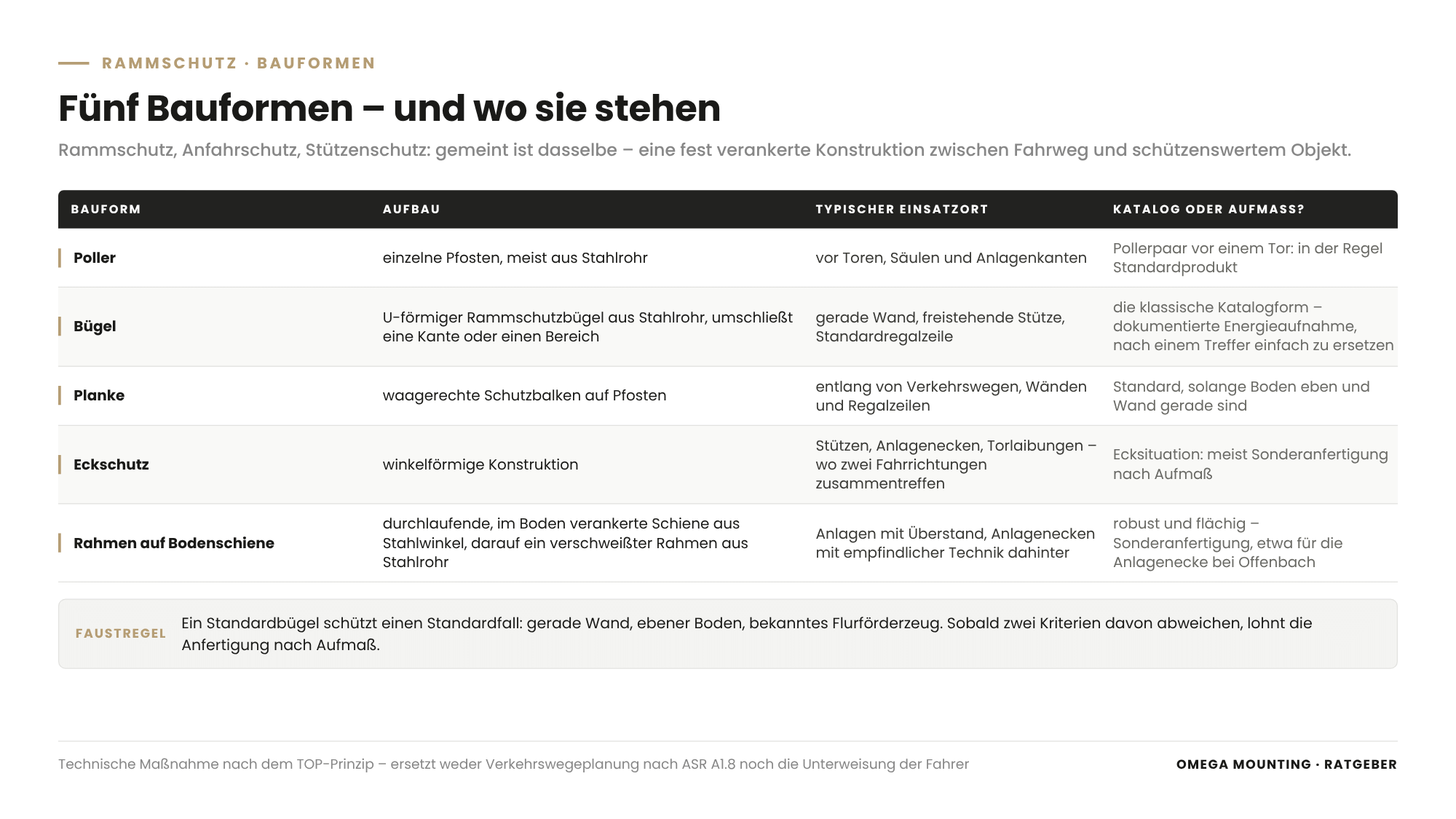
Impact protection is a firmly anchored protective structure made of steel, plastic or composite material that stands between the traffic route and the object worth protecting. It absorbs the energy of an approaching vehicle before it reaches plant, building or people. The term collision protection means the same; in racking construction, upright protection or frame protection are also used.
The most important designs
- Bollards: individual posts, usually made of steel tube, in front of doors, columns or plant edges.
- Guards: U-shaped impact guards made of steel tube that enclose an edge or an area – the classic catalogue form.
- Barrier rails: horizontal protective beams on posts along traffic routes, walls or racking rows.
- Corner guards: angled structures for columns, plant corners and door reveals where two directions of travel meet.
- Frame on floor rail: a continuous rail made of steel angle, anchored in the floor, on which a welded frame of steel tube stands – robust, extensive, for plant with an overhang.
Where impact protection stands in the protection logic
The ArbSchG requires hazards to be combated at source and technical measures to be preferred over organisational and personal ones – the hierarchy of controls. Impact protection is a technical measure: it works without anyone having to think about it. Collisions of industrial trucks with people, plant and building parts are among the mechanical hazards that the German technical rule TRBS 2111 (mechanical hazards) expects to be covered in the risk assessment. For you this means: impact protection is not an optional accessory but the documented answer to a hazard you have to assess anyway. However, it does not replace traffic route planning in accordance with ASR A1.8. Sufficiently wide routes, swept paths of the industrial trucks, safety distances and separate pedestrian routes come first. Driver briefing and the operating instructions for forklift traffic also remain necessary. If impact protection is missing or damaged, this regularly appears as a finding by the competent person in inspection reports. How to deal with this is described in our introductory article on rectifying UVV defects.
Which forces must impact protection absorb?
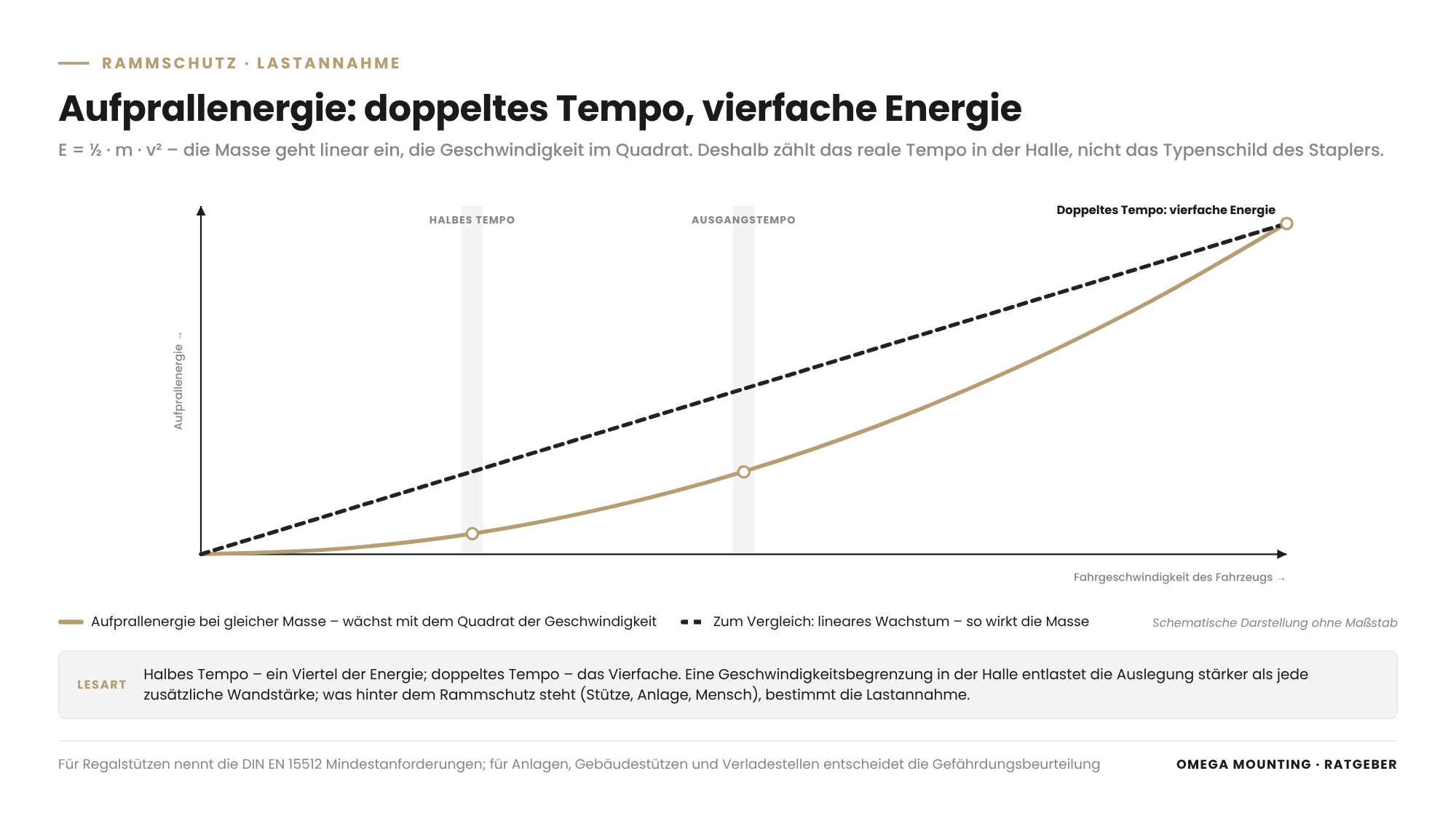
Impact protection must absorb the kinetic energy of the approaching vehicle, and this energy depends linearly on the mass but quadratically on the speed: E = ½ · m · v².
A worked example for orientation
A vehicle with a total of 3,000 kilograms – forklift including load – moves at 10 kilometres per hour, i.e. around 2.8 metres per second. Its kinetic energy is about 11.6 kilojoules. If the same vehicle travels at 20 kilometres per hour, it is around 46 kilojoules – four times as much. These figures are a calculation exercise with freely chosen assumptions. But they show that a speed limit in the hall relieves the design of the impact protection more than any additional wall thickness.
What the standard specifies for racking
For racking installations, DIN EN 15512 specifies minimum requirements for collision protection of uprights in aisles and at aisle ends. The protection should be at least 400 millimetres high and be able to absorb an energy of 400 newton metres. This is deliberately a minimum value for racking construction, not a design rule for plant, building columns or loading points. There is no comparable requirement for those. The load assumption – the force or energy for which a component is designed – follows from the operator's risk assessment. Input parameters are vehicle, load, speed, angle of impact and the consequence of a hit.
What is the consequence of a hit?
The load assumption depends not only on how hard the impact is but on what is behind it. A building column with ventilation equipment, a conveyor system with pull-off rollers, a control cabinet or a gas store require a different protective effect from a section of wall. When designing, ask: what happens if the impact protection gives way – a scratch, a breakdown with downtime or personal injury? The answer determines material, wall thickness and anchoring – and thus also the cost factors. Quantity of steel, anchoring effort, on-site adaptation and the installation window during ongoing operations weigh more heavily than the catalogue price of a guard. If a load-bearing building column stands behind it, the structural engineer also belongs at the table.
Where pedestrians and vehicles meet
The most dangerous places are those where footpath and traffic route cross or touch. Typical are doors that lead onto a forklift aisle, workstations at loading docks and maintenance access next to roller conveyors. The BG BAU/BAuA module "Site set-up – traffic areas, transport routes, storage and parking areas" requires pedestrian routing and vehicle traffic to be separated as far as possible, reversing to be avoided because of the blind spot and one-way routing to be preferred over a turning point. For you this means: where separation is not possible, impact protection becomes a measure to protect people. Its load assumption is then based on the person behind it, not on the component. The module also specifies an average illuminance of at least 20 lux for traffic routes – in a dark hall corner, even signal yellow is of little help.
Impact protection as custom fabrication or standard product – how do you decide?
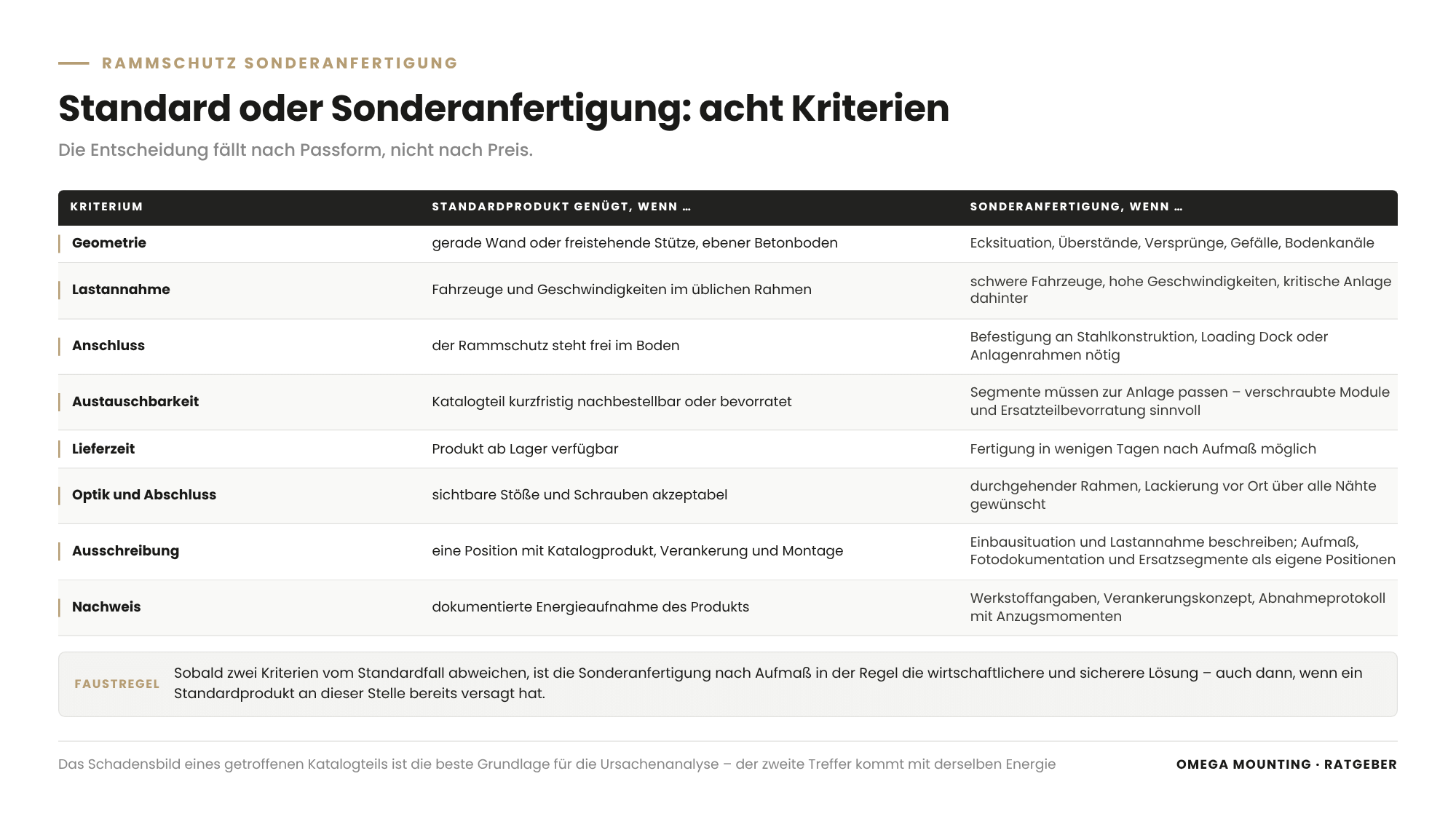
You decide on the basis of six criteria: geometry of the installation situation, load assumption, connection to existing components, interchangeability after a hit, delivery time and appearance. As soon as two of these criteria deviate from the standard case, a custom fabrication is usually the more economical and safer solution.
| Criterion | Standard product is sufficient if … | Custom fabrication if … |
|---|---|---|
| Geometry. | Straight wall or free-standing column, level concrete floor. | Corner situation, overhangs, offsets, gradients, floor ducts. |
| Load assumptions. | Vehicles and speeds within the usual range. | Heavy vehicles, high speeds, critical plant behind it. |
| Connection. | The impact protection stands free in the floor. | Fixing to steel structure, loading dock or plant frame required. |
| Interchangeability. | Catalogue part can be reordered at short notice or is in stock. | Segments must fit the plant. Bolted modules and spare parts stock advisable. |
| Delivery time. | Product available from stock. | Fabrication possible in a few days to site survey. |
| Appearance and finish. | Visible joints and bolts acceptable. | Continuous frame, on-site painting over all welds desired. |
When the standard product is the right choice
A tested catalogue guard in front of a straight wall, a pair of bollards in front of a door or upright protection on a standard racking row are quickly procured, have documented energy absorption and are easy to replace after a hit. Anyone ordering a custom fabrication here pays for design that nobody needs – in the scope of works, one item with catalogue product and installation is then sufficient.
When the custom fabrication is the right choice
Fabrication to site survey – the dimensional recording of the installation situation on site – is worthwhile as soon as one of these conditions applies: the impact protection stands at a plant with an overhang, has to intercept two directions of travel in a corner or is connected to an existing steel component. The same applies if it protects a plant whose failure stops operations. It also applies if a standard product has already failed. The second hit comes with the same energy, and the damage pattern of the first is the best basis for the root cause analysis.
More about what we fabricate in this area can be read on our page on Custom fabrication from our own workshop.
Which materials and wall thicknesses are common for custom impact protection?
Common is structural steel in the form of steel tube, square tube and steel angle with wall thicknesses in the range of several millimetres. Plastic or composite profiles supplement it where the vehicle is not to be damaged or flexible yielding is desired. The choice follows from load assumption, installation situation and the question of whether the impact protection should stop rigidly or absorb energy through deformation.
Steel: rigid and repairable
Steel is the standard for production and logistics. Two sections from our practice show the order of magnitude. For a plant corner in a production company near Offenbach, we fabricated a floor rail from 200 × 100 × 10 mm steel angle. On it stands a frame of 80 × 80 × 5 mm steel tube. For a loading dock at Frankfurt Airport, square tube with 10 mm wall thickness was used. These values are not a recommendation for your situation but examples that the wall thickness must match the load assumption. A tube with 2 mm wall looks similar and buckles at the first hit.
Fully welded or bolted?
A fully welded structure is stiff, has no bolted joints that can loosen, and can be coated seamlessly on site over all welds. Bolted segments, by contrast, can be replaced individually after a hit without dismantling the entire structure – sensible at loading points with a high probability of hits. They require lock nuts, a defined tightening torque and retightening after the first period of operation. Both have their place; the decision belongs in the site survey.
Chamfered corners as approach ramps
At loading docks and roller conveyors, a design has proven itself in which the corners of the impact protection are chamfered and welded in. Instead of stopping the load head-on, the chamfer deflects pallets or wheels and takes the peak force off the structure. That is typical custom fabrication: a catalogue product does not know the geometry of your roller conveyor.
Plastic and composite: yielding and low-maintenance
Plastic profiles and composite systems absorb energy through elastic deformation, are gentle on the vehicle and need no repainting. They suit traffic routes, walls and pedestrian areas with low speeds. In front of critical plant and with high loads, they reach their limits – there, steel remains.
How is impact protection anchored?
Impact protection is anchored so that the connection to the substrate absorbs at least as much energy as the structure itself. In a concrete floor, this means heavy-duty anchors; in steel, tapped threads or through-bolting. Plugs never belong in a screed whose load capacity has not been verified. The anchoring is the most common weak point of catalogue products that were installed "somewhere".
Concrete floor
In an industrial concrete floor, heavy-duty anchors – mechanical expansion anchors or chemical anchors (bonded anchors) that are bonded in the drill hole with chemical mortar – are the means of choice. Decisive are edge distance, drilling depth, the prescribed tightening torque and the question of whether services, heating or cavities lie beneath the floor. If in doubt, a service location survey before the first drill hole clarifies this. A floor construction with thin screed on insulation does not carry impact protection. Here the anchoring must reach into the load-bearing slab. Or a load-distributing base plate is needed that transfers the point load of the hit into the floor as an area load.
Steel structures and loading docks
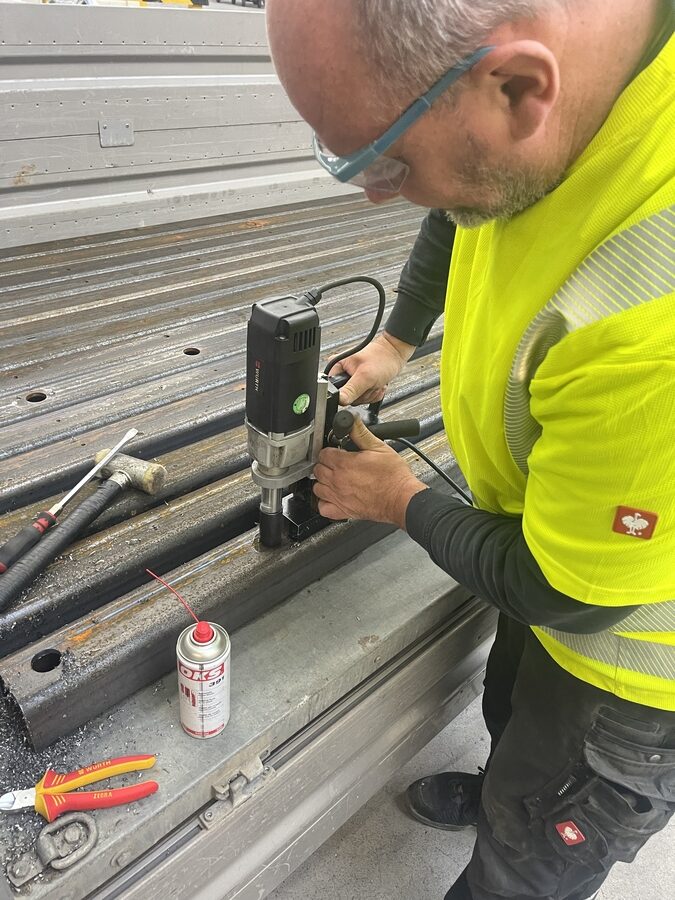
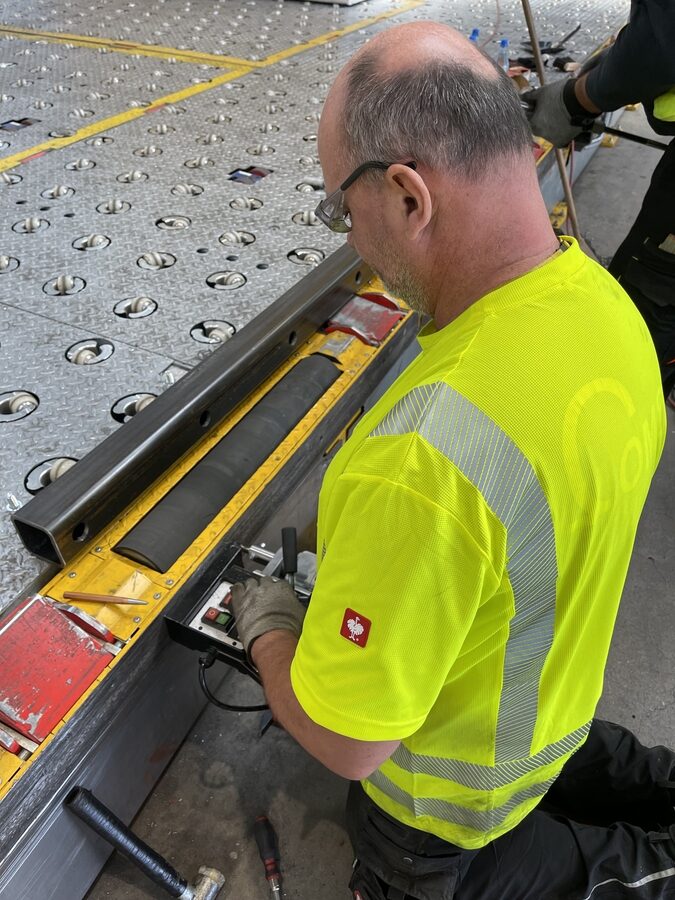
If the impact protection stands on or against a steel structure – a loading dock, a plant frame, a platform – drilling is done directly into the steel. Then threads are tapped or through-bolted. With a magnetic drill that clamps itself to the workpiece, and annular cutters under cutting oil cooling, clean, dimensionally accurate holes can be made even in thick steel. The machine then serves as a guide for the tap. Where welding is also done, a permit to work for hot work and a fire watch are needed.
Distance from the plant
Impact protection that touches the plant transfers the impact directly to it. Enough distance must remain between protection and object for the structure to deform without striking. The plant must also remain accessible for maintenance, inspection openings, doors and ventilation openings. When setting, the impact protection is aligned and set plumb; for frames, the diagonal dimension is checked. A guard standing askew loses part of its protective effect and looks like it has been hit after a week.
What role do signal colour and marking play?
Signal colour and marking are the first protective effect of impact protection: a clearly visible obstacle is hit less often than a grey one. ASR A1.3 governs how permanent danger points are to be marked with yellow-black stripes. A coating in signal yellow (RAL 1003) is common, with black stripes at the impact edges if required.
Coating system
On steel, a primer for corrosion protection belongs beneath the top coat, especially at loading points with moisture and road salt. If painting is done on site, all welds and transitions can be coated in one go – this gives continuous protection without joints where rust begins. Workshop painting, by contrast, is independent of the weather and cleaner, but requires rework at the installation welds.
Marking is no substitute
Paint makes visible but prevents nothing. That is why marking belongs with impact protection, not in its place. The same applies to floor markings, traffic mirrors and traffic protection of the route: sensible supplements, not an alternative. On the organisational side is the authorisation of the drivers. Anyone who independently operates an industrial truck needs a written authorisation from the employer under the technical rule for mobile work equipment. Impact protection in front of the plant and an authorised, briefed driver in front of it are two halves of the same measure.
How does installation during ongoing operations succeed?
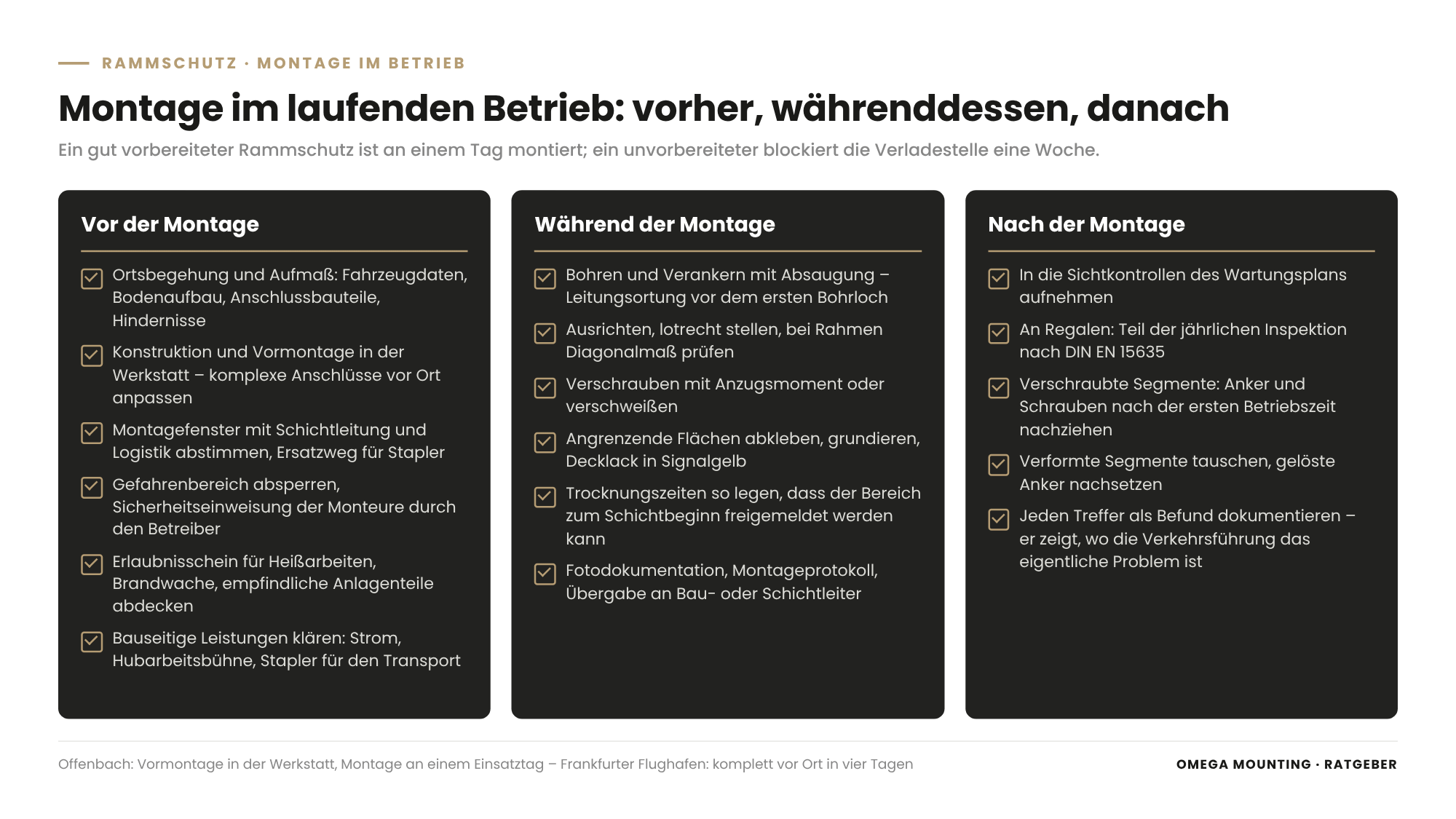
Installation during ongoing operations succeeds when site survey and pre-assembly in the workshop are done in advance and the installation area is cordoned off for a defined window. Drilling, anchoring, welding and coating then follow in a sequence that separates dust, flying sparks and drying times from operations. Well-prepared impact protection is installed in one day; unprepared, it blocks the loading point for a week.
Before installation
- Site visit and site survey with vehicle data, floor construction, connecting components and obstacles (ducts, services, doors, door clearances for transport).
- Design and pre-assembly in the workshop as far as the situation allows; for complex connections, adaptation on site.
- Coordination of the installation window with shift management and logistics, cordoning of the danger zone, alternative route for forklifts, induction of the fitters by the operator.
- Permit to work for hot work, fire watch, covering of sensitive plant parts, clarification of works by others (power, MEWP, forklift for transport).
During installation
- Drilling and anchoring with extraction, then aligning, positioning and bolting with tightening torque or welding.
- Masking adjacent surfaces, primer, top coat; schedule drying times so that the area can be released at the start of the shift.
- Photo documentation, installation report and brief handover to the site manager or shift supervisor: what was installed, how it is inspected, when the anchors are retightened.
After installation
Impact protection is work equipment like any other. It belongs in the visual checks of the maintenance schedule and – for racking – in the annual inspection in accordance with DIN EN 15635 by a competent person. Deformed segments are replaced, loosened anchors reset, every hit is documented as a finding. Anyone who does this recognises places where the traffic routing is the real problem.
How we do it in the Rhine-Main region
In the Rhine-Main region, we fabricate and install impact protection for production companies in Offenbach, Hanau and Darmstadt, for logistics centres in Dietzenbach and Rodgau and for loading points at Frankfurt Airport. Usually these are places where a standard product has already failed or does not fit from the outset. From our workshop in Rodgau, the distances are short: site survey in the morning, pre-assembly in the workshop, installation in the next free window.
Typical is the combination of workshop and site. Where the geometry is clear, we cut and weld in Rodgau beforehand and install on site in one day. Where the impact protection has to be adapted to an existing plant, we move fabrication entirely to the site and work there with magnetic drill, welding equipment and painting. In security areas such as the airport, access control, site passes, tool lists and escort requirements are added. What this means for planning is described on our page on industrial installation at airports and in security areas. For companies in Offenbach and the surrounding area, you can find our regional jobs on the page Industrial installation in Offenbach.
How we do it in practice
Two jobs from our project diary show the two routes to custom fabrication: workshop fabrication with installation in one day – and complete adaptation on site to an existing plant.
Custom impact protection for a plant corner near Offenbach: welded frame on anchored floor rail
With the custom impact protection for a production company near Offenbach , the task was to protect the ventilation equipment of a production plant at a building column. The hazard: brisk forklift traffic with mesh boxes in a corner situation. A catalogue guard would have covered neither the corner nor the overhang of the plant.
The solution: a floor rail made of 200 × 100 × 10 mm steel angle, anchored in the hall floor with heavy-duty anchors. On it stands a fully welded frame of 80 × 80 × 5 mm steel tube with two frame bays. Two people completed design and pre-assembly – cutting and welding – in about a day in our workshop in Rodgau. Two metalworkers carried out the installation on site in a single working day: align, anchor, mask, prime and paint in signal yellow, then completion notice to production. The painting was deliberately done on site so that the coating runs seamlessly over all welds. We also use the same design in logistics centres and at Frankfurt Airport.
Impact protection at the loading dock at Frankfurt Airport: adapted on site, bolted for replacement
With the made-to-measure impact protection for a loading dock at Frankfurt Airport , the pull-off rollers of a roller deck were to be protected. A roller deck is a roller floor with ball rollers on which pallets and containers are moved. Here, workshop fabrication was not an option: the impact protection had to be adapted exactly to the existing plant, so it was created entirely on site. That meant security area, access control, tool lists and an installation window agreed with the operator. What such jobs at the airport require beyond the impact protection is summarised in our guide on maintenance at Frankfurt Airport.
Three metalworkers pre-drilled the square tubes with 10 mm wall thickness using the magnetic drill and annular cutter under cutting oil cooling. Then they drilled the loading dock and tapped threads directly into the steel. The tubes were installed, bolted, welded in and painted in the colour matching the plant. Two details make the difference: the corners were chamfered and welded in so that they act as approach ramps and deflect loads instead of stopping them head-on. And the segments were bolted, not only welded – so that a hit part can be replaced individually without dismantling the entire impact protection. The job took four days.
What both jobs have in common
In both cases, the geometry was the reason for the custom fabrication – a corner with an overhang, a roller conveyor with pull-off rollers. In both cases, the anchoring decided the protective effect – heavy-duty anchors in concrete, tapped threads in steel. And in both cases, the job ended with photo documentation and handover to the operator. How impact protection interacts as part of Workshop equipment and loading and conveyor technology in logistics is shown on our service pages. Do you have a spot where there are regular collisions or where the catalogue guard does not fit? Then get in touch with us – a site visit with survey usually clarifies within an hour whether standard or custom fabrication is the right route.
What this means for your role
For buyers: Do not compare guard with guard but protective effect with protective effect. In the scope of works, describe the installation situation and the load assumption instead of a catalogue article, set up site survey and photo documentation as separate items and the spare segments as a contingent item. For the standard product, require the documented energy absorption; for the custom fabrication, material specifications, anchoring concept and an acceptance report with tightening torques. Clarify in the interface list what is provided by others: power, MEWP, cordoning.
For designers: Plan the impact protection together with the traffic routing, not afterwards. Define vehicle data, speeds, swept paths and floor construction as planning parameters before choosing designs. State the load assumption in the floor slab and keep distance between protection and plant for deformation, inspection openings and access. Corner situations, connections to steel components and reserve areas for later plant extensions are to be identified early as custom fabrication.
For project managers and site managers: When building or converting a hall, impact protection is often the last trade – and the first to be cut when the deadline is pressing. Include it as a separate milestone in the construction schedule. Clarify with preceding and following trades whether it is installed before or after the floor covering, because the anchoring depends on this. As site manager, you brief the fitters, coordinate site survey and installation window with ongoing forklift traffic and cordon off the danger zone. During the walk-round, you accept anchoring and coating and keep open points on the punch list before releasing the area.
For maintenance managers: Include the impact protection with an inspection interval in the maintenance schedule and in the annual inspection by the competent person. A deformed guard is a finding with a damage pattern – and an indication of where your traffic routing does not match the driving style. Document hits in the inspection logbook, even those without damage, and stock spare segments for places where there are regular collisions.
For warehouse and logistics managers: You know the travel routes, the speeds and the places where there are regular collisions – this knowledge belongs in the survey form before impact protection is designed. In the operating instructions for industrial trucks, define where collision protection takes precedence over parking space. In the briefing, make sure that forklift drivers report hits and near misses instead of concealing them.
Impact protection survey form: template on request
Our survey form summarises on one page what we need for made-to-measure impact protection. These are: sketch of the installation situation with dimensions, object to be protected and distance, vehicle type, total weight and usual speed. Plus floor construction and known services, connecting components made of steel, desired design, colour preference as well as time window and access conditions. It helps designers to make a complete enquiry and buyers to obtain comparable quotations based on a common specification – usually without a second site visit. Request the impact protection survey form via our Contact form – keyword "impact protection survey form".
Why Omega Mounting?
We fabricate impact protection in our own workshop in Rodgau near Frankfurt and install it in the Rhine-Main region during ongoing operations. Where necessary, we build it entirely on site onto the existing plant. The two linked jobs near Offenbach and at Frankfurt Airport show both routes. Welding, anchoring, coating, installation report and photo documentation come from a single source, and via our 24-hour hotline you can reach us even when a hit has just shut down the plant. For you this means: one contact from site survey to completion notice, short distances from Rodgau to Offenbach, Frankfurt, Hanau or Darmstadt – and impact protection that fits the plant rather than the other way round. Get in touch with us – we will tell you frankly whether the catalogue is enough.
Conclusion
Whether impact protection from the catalogue is enough or should be created as a custom fabrication is decided by geometry, load assumption and connection to the existing plant – not by price. The energy of the impact grows with the square of the speed. The anchoring must withstand at least as much as the structure, and signal colour is the first, steel the second protective effect. Anyone who treats impact protection as work equipment, inspects it and documents hits also recognises where the traffic routing is the real problem. Send us a photo of the spot, the vehicle data and the floor construction. We will get back to you with an honest assessment of whether a standard product is enough or custom impact protection is the better solution.
Planning maintenance, moving in or installation in the Rhine-Main region?
Tell us briefly what it is about – we will come back to you with an honest assessment.
100% free and without obligation
You may also be interested in these guides
Maintenance & Servicing
Maintenance & Servicing

About the author
Tobias Schott
Managing director of Omega Mounting GmbH, Rodgau · more than 20 years of hands-on experience in installation and maintenance
A trained mechatronics technician, at home in maintenance, servicing and industrial installation since 2004 – first at his father's side, since 2012 with Omega Mounting: from the overhead conveyor in Frankfurt to the crane system in a new-build hall. Plans and leads lifting operations as appointed person in data centers and on industrial sites in the Rhine-Main region, is an instructor and examiner for cranes, mobile elevating work platforms and telehandlers, and a safety officer. On jobs abroad he is known as the “German Troubleshooter” – the one you call when things get stuck on site. He learned what quality means not from a manual but from his father: Made in Germany as a standard for his own work, not as a label. That is why it comes first at Omega Mounting – before speed and before price. He writes these guides from that practice: what works on our sites is in them – what only exists in the standard is not.
Frequently asked questions
None – both terms describe a protective structure that absorbs the energy of an approaching vehicle. In racking construction, upright or frame protection is also used; on traffic routes, barrier rails. What matters is not the name but load assumption, anchoring and position.
For racking installations, DIN EN 15512 specifies minimum requirements for collision protection of uprights: at least 400 millimetres height and an energy absorption of 400 newton metres. For plant, building columns and loading points there is no comparable requirement. Here the load assumption follows from the operator's risk assessment.
For straight walls, free-standing columns, level concrete floors and vehicles within the usual range. Catalogue products have documented energy absorption and are quickly replaced; in the scope of works, one item with product, anchoring and installation is then sufficient. As soon as corner situations, overhangs, connections to steel components or critical plant are added, a custom fabrication to site survey is usually the safer solution.
That depends on vehicle mass, speed and the consequence of a hit – i.e. on the load assumption – and cannot be stated across the board. As an order of magnitude from our practice: for a plant corner near Offenbach, we used 80 × 80 × 5 mm steel tube on a 200 × 100 × 10 mm steel angle. For a loading dock at the airport, it was square tube with 10 mm wall thickness. The design belongs in the site survey.
In the concrete floor with heavy-duty anchors – mechanically expanding or as chemical anchors with bonding mortar. Edge distance, drilling depth, tightening torque and services in the floor must be checked. The designer provides the floor construction and the imposed load of the slab. On steel structures, drilling and tapping or through-bolting is done. Plugs in thin screed without verification are not anchoring.
Signal yellow (RAL 1003) makes the obstacle visible, and visibility is the first protective effect. ASR A1.3 governs the marking of permanent danger points with yellow-black stripes. On steel, a primer for corrosion protection belongs beneath the top coat, especially at loading points.
Yes, if site survey and pre-assembly are done in advance and the installation area is cordoned off for a defined window – with an alternative route for the forklifts, induction of the fitters and completion notice at the start of the shift. Near Offenbach, the prefabricated impact protection was installed and painted in a single working day; at the airport, the impact protection was created entirely on site in four days. Hot work needs a permit to work and a fire watch.
That depends on geometry and access. In a clear situation, the site survey is followed by pre-assembly in our workshop in Rodgau – near Offenbach about one day for two people – and installation in the next free window. For adaptation on site, for example at a loading dock at Frankfurt Airport, access control, tool lists and several days of work on site are added.
It is work equipment and belongs in the operator's visual checks according to the maintenance schedule; on racking installations, it is part of the annual inspection in accordance with DIN EN 15635 by a competent person. Deformed segments are replaced, loosened anchors reset, findings documented in the inspection logbook. Anyone who documents hits recognises where the traffic routing should be adjusted – as with all UVV findings: eliminate the cause, not just the symptom.
Send us via the Contact form three details. First, a photo or sketch of the installation situation with dimensions; second, vehicle type with total weight and usual speed; third, the floor construction or the steel component to which it is to be anchored. We will get back to you, arrange a site visit with survey if necessary and summarise the result in a written assessment with design, material and anchoring concept. Your contact is Tobias Schott.
 English
 German