
- Project report – impact protection made to measure
Custom impact protection: a heavy-duty one-off protects a production plant near Offenbach
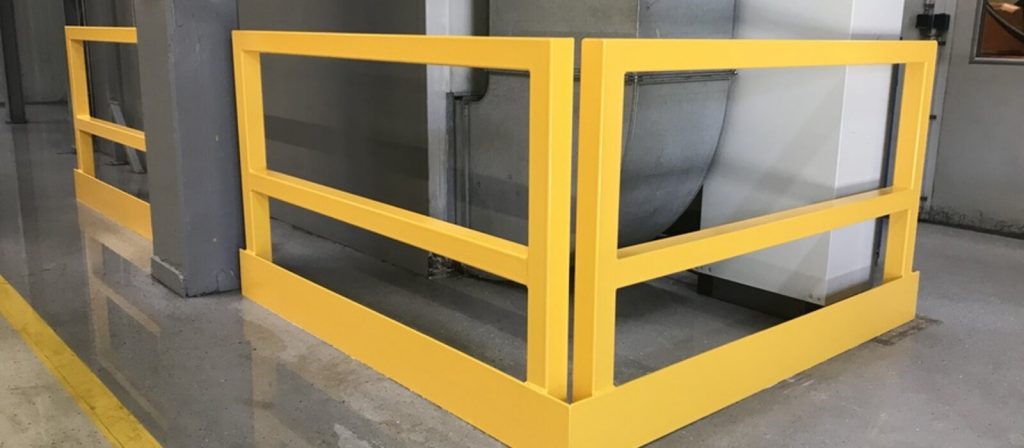
How our metalworkers designed an almost indestructible impact guard – welded in Rodgau, installed on site, anchored and painted in signal yellow
Where forklifts with mesh pallets rush past every few minutes, sensitive equipment stands little chance. At a production plant near Offenbach, a production line and its ventilation equipment were to be permanently protected against impact damage – at a point where the forklifts move back and forth very fast. Off-the-shelf impact protection would not have lasted long there.
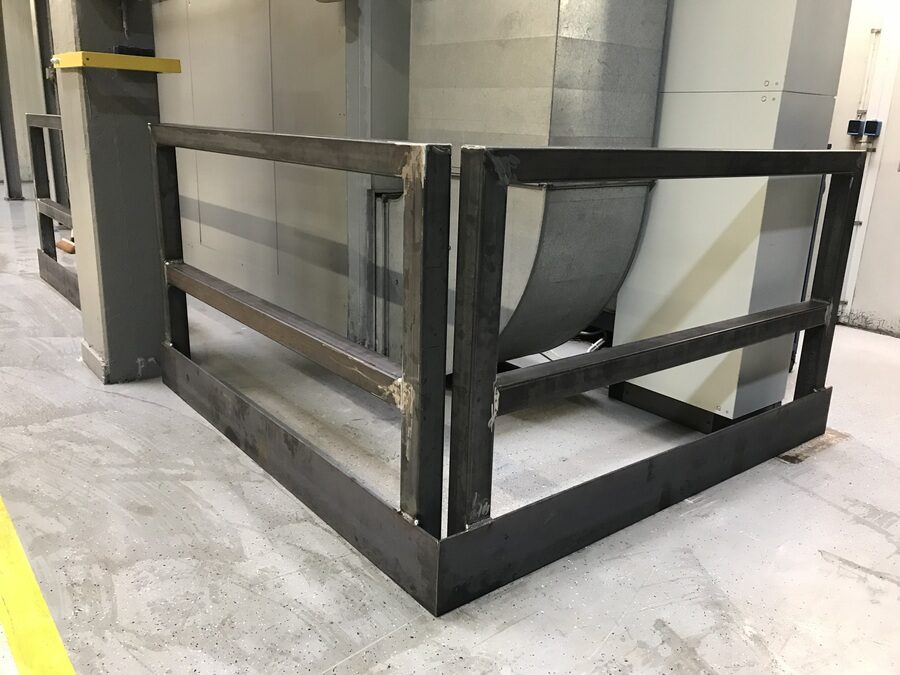
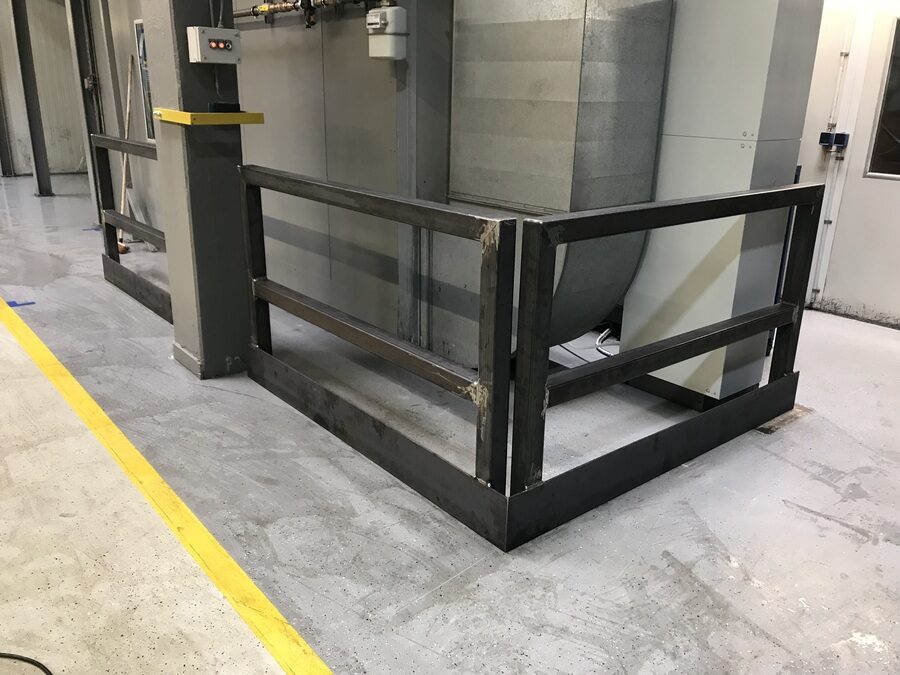
Our answer: anyone can do standard – we built it bespoke. In our workshop in Rodgau two men cut and welded the heavy structure in around a day. Two metalworkers then installed the guard on site in a single working day, anchored it into the floor with heavy-duty anchors, masked it up properly and painted it with hard-wearing signal yellow paint – primer first, then a good coat of yellow.
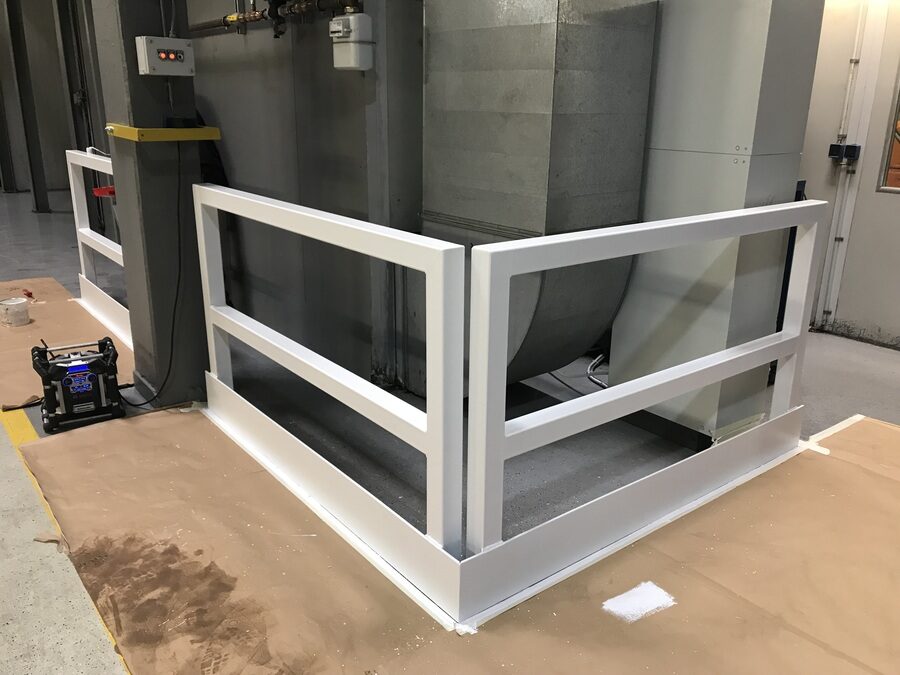
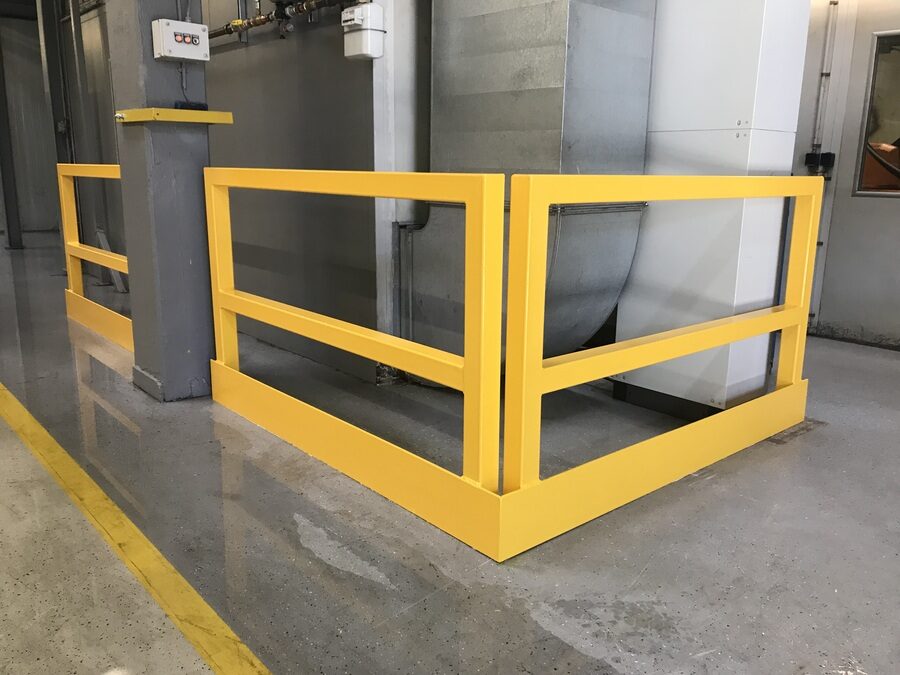
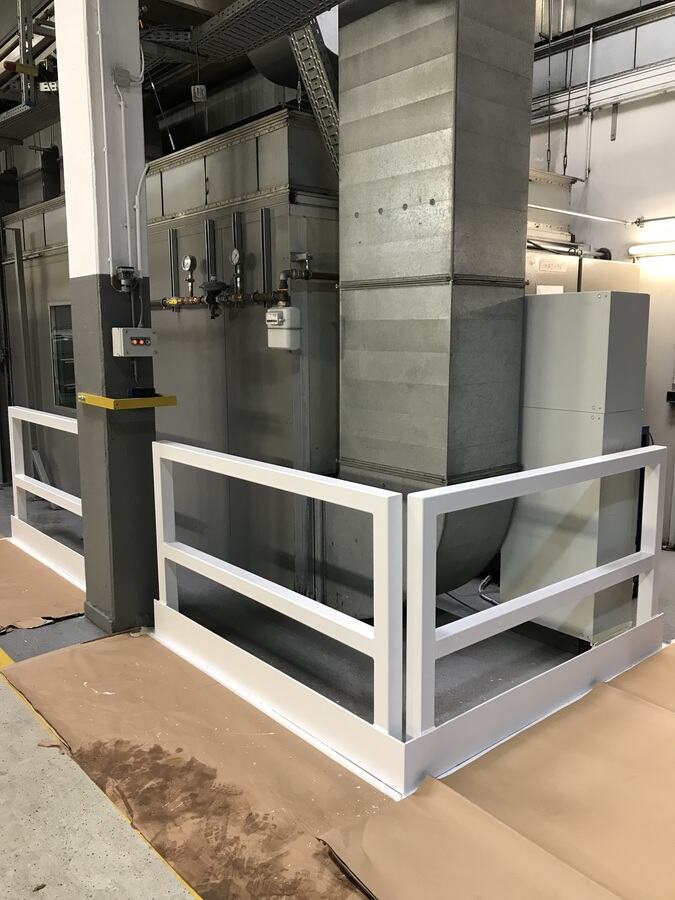
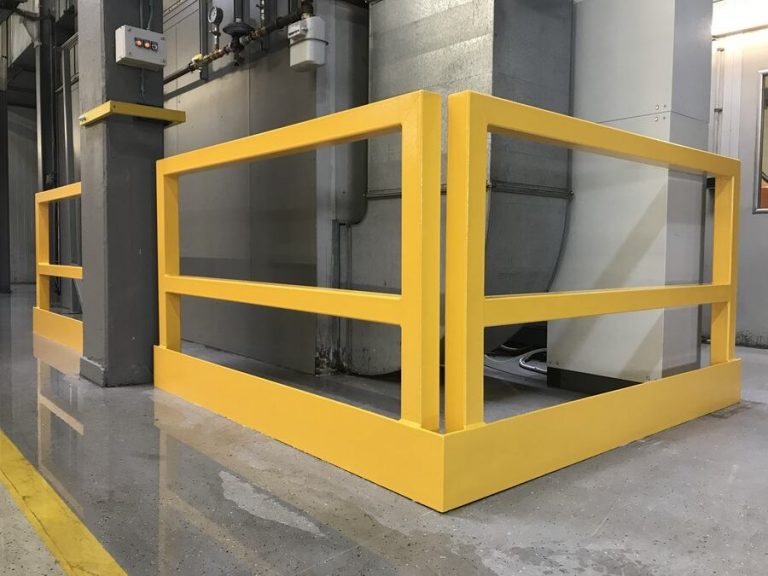
The photos show the whole process: the raw welded structure in black steel, the white primer – and the bright yellow end result now standing between the traffic route and the plant.
Project profile
- Scope: Design, fabrication and installation of a heavy bespoke impact guard – protecting a production line including its ventilation equipment from forklift traffic; anchored with heavy-duty anchors; masking, priming and painting in signal yellow on site
- Team: Fabrication in the Rodgau workshop (2 men, approx. 1 day including welding); installation and painting on site (2 metalworkers, 1 working day)
- Material: Steel angle 200 × 100 × 10 mm as an anchored floor rail, steel tube 80 × 80 × 5 mm as the guard frame
- Location: Production plant near Offenbach (customer anonymised)

What is impact protection?
Impact protection (also called collision protection) is a guard structure that keeps machines, plant, racking, columns or parts of a building safe from collisions with industrial trucks – forklifts, pallet trucks and tow trains. It absorbs the energy of an impact before it reaches expensive equipment: a bent guard rail costs a few hundred euros, a damaged ventilation duct or a wrecked production line quickly costs a production stoppage.
Impact protection is available as a standard catalogue item – bollards, rails, plastic hoops. For normal requirements that is often enough. It gets critical where heavy traffic, high speed and heavy loads come together: then the sheer mass of the structure and above all the anchoring decide whether the guard holds at the first real hit or is torn out of the floor.
Why was standard impact protection not enough here?
Because speed, frequency and load all come together at this point. The forklifts pass through the area very fast and continuously – loaded with mesh pallets whose corners and skids act like battering rams in a glancing blow. Directly behind: the production line and its ventilation equipment, whose sheet metal ducts are deformed by even a light knock.
For this requirement we designed a heavier guard structure than any catalogue offers – tailored to the plant, the corner situation at the building column and the traffic routes. Two frame bays enclose the corner of the plant and keep traffic at a distance without blocking maintenance access.
How is the structure built up?
Thought through from the bottom up – because the most dangerous zone is at floor level. Where the forklift tines travel, a heavy steel angle of 200 × 100 × 10 mm forms the base of the structure. It does two jobs at once: first, the entire guard is anchored into the floor through this angle with heavy-duty anchors – against buckling and being torn out on impact. Second, the angle acts as a continuous barrier against the tines themselves, which could otherwise run under any railing straight into the plant.
Above it, a frame of heavy 80 × 80 × 5 mm steel tube forms the actual guard: when a forklift comes in with its mesh pallet, this structure takes the blow – not the plant behind it. All joints are welded, not plugged together; the frame bays are built as a closed structure that transfers loads into the anchored floor rail.
Why is it primed and painted on site?
Because impact protection has two jobs: to protect – and to be seen. After installation our metalworkers masked the structure and the surrounding area properly and coated the steel completely: first a primer as corrosion protection, then a hard-wearing signal yellow topcoat. The signal colour makes the guard impossible for any forklift driver to miss, even from a distance – and the robust paint build-up shrugs off the rough day-to-day of industry with its scrapes and scratches.
Painting on site has a practical advantage: all welds, anchor points and adjustments made during installation disappear under one continuous, clean coating – with no transport damage to the finished surface.
A design that has proven itself
This is not the first time we have built to this design: guards on this principle – an anchored heavy-duty floor rail plus a welded steel tube frame – are already in service, made by us, in logistics centres and at Frankfurt Airport. The experience from those jobs feeds into every new installation, and the result is a design that is virtually indestructible in daily use.
Many of the guards we have welded stand in busy industrial plants – and achieve a long service life where standard solutions would have to be replaced regularly. That is exactly the difference between catalogue goods and bespoke metalwork.
Why Omega Mounting?
- Bespoke instead of catalogue: We design the protection your situation needs – not the one that happens to be in stock.
- Own workshop in Rodgau: Cutting, welding, prefabrication – a short path from the idea to a structure ready to install.
- Installation including anchoring: Heavy-duty anchors, exact alignment, adaptation to columns and plant – we design for the forces of an impact.
- Complete down to the finish: Masking, priming, painting in signal colour – ready for handover in a single job.
- A proven design: In service in logistics centres, industrial plants and at Frankfurt Airport – virtually indestructible, with a long service life.
- Rooted in the region: Workshop and base in Rodgau – quickly on site in Offenbach, Frankfurt, Hanau and the whole Rhine-Main region, working throughout Germany.
Conclusion
One day in the workshop, one day on site – and a production line with its ventilation now standing behind a virtually indestructible structure: an anchored floor rail of 200 × 100 × 10 mm steel angle against tines and pull-out, a heavy 80 × 80 × 5 mm steel tube frame against oncoming mesh pallets, signal yellow for visibility. Anyone can do standard – this guard is built for this exact place and this exact traffic.
If forklifts and sensitive equipment work too close together at your site, talk to us – before the first impact does.
Request a callback for your project now – Omega Mounting GmbH, Rodgau. As an installation company with its own workshop in the Offenbach district we are quickly on site in Offenbach, Frankfurt, Hanau and the whole Rhine-Main region – and we work throughout Germany.
More jobs in the city and our route from Rodgau: Industrial installation in Offenbach.
Photo gallery of the job


Are you planning a project of this kind?
Tell us briefly what it is about – we will come back to you with an honest assessment.
100% free and without obligation
Related guides for this project
Occupational safety
Maintenance & Servicing

About the author
Tobias Schott
Managing director of Omega Mounting GmbH, Rodgau · more than 20 years of hands-on experience in installation and maintenance
A trained mechatronics technician, at home in maintenance, servicing and industrial installation since 2004 – first alongside his father, and since 2012 with Omega Mounting: from the overhead conveyor in Frankfurt to the crane system in a new-build hall. As appointed person for lifting operations, he plans and leads lifting operations in data centers and on industrial sites in the Rhine-Main region, is an instructor and examiner for cranes, aerial work platforms and telehandlers, and a safety officer. On assignments abroad he is known as the "German Troubleshooter" – the one you call when things get stuck on site. He did not learn what quality means from a manual, but from his father: Made in Germany as a standard for his own work, not as a label. That is why quality comes first at Omega Mounting – before speed and before price. The project diary shows the jobs his team has planned and carried out – without customer names, but with everything that can be learned from them.
Frequently asked questions
Impact protection (collision protection) shields plant, racking, columns and parts of buildings from collisions with forklifts and other industrial trucks. It is essential wherever traffic routes pass close to sensitive or expensive equipment – an impact then hits the guard structure instead of the plant.
When speed, traffic density or loads go beyond the usual – or the installation situation does not fit the standard grid. On this project forklifts with mesh pallets pass very fast right by the plant; the solution was dimensioned more heavily than catalogue goods and fitted exactly to the corner, the column and the maintenance access.
Through a continuous floor rail – here a 200 × 100 × 10 mm steel angle – fixed into the hall floor with heavy-duty anchors. It prevents the structure from buckling or being torn out on impact and at the same time blocks the forklift tines at floor level.
So that it is recognisable as a barrier from a distance – visibility is part of the protective effect. On this project it was properly masked, primed and coated on site with a hard-wearing signal yellow topcoat; the primer additionally protects the steel against corrosion.
With heavy construction and correct anchoring: many years, even in busy industrial plants. Guards of this design made by us stand in logistics centres and at Frankfurt Airport among other places – in daily use the structure is virtually indestructible.
Yes – this guard was prefabricated in our workshop in Rodgau and installed at a production plant near Offenbach. In the Rhine-Main region we are quickly on site, and elsewhere in Germany on request.
 English
 German