
- Guide – Lift & Shift
Plant relocation planning: moving production without a supply gap
By Tobias Schott · Reading time approx. 24 minutes · Last updated: October 2026
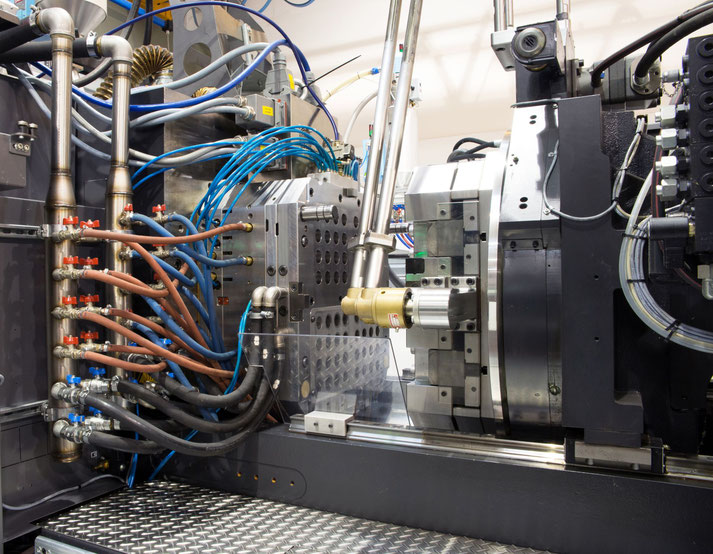
Planning a plant relocation means putting many machinery relocations into the right sequence – with a plant list that knows everything, a buffer stock that bridges the gap, and responsible persons who act at both sites at the same time.
The lease is expiring, the hall is too small, two plants are being merged. What begins as a location decision quickly becomes one question for project managers, buyers and plant managers: how do thirty machines get from here to there without customers noticing a supply gap? Anyone who has to move a machine park does not have a transport problem, but a sequencing problem.
A single machinery relocation is manageable: one machine, one window, one team. In a plant relocation, many machines are interlinked, two sites run at the same time, production must not stop, and every planning error comes back as waiting time at the new site. The lifting equipment is rarely the problem – the planning is.
This guide is the foundation page above our article on machinery relocation by a contractor, which describes the seven phases for a single machine. This one is about the whole: phases, sequence, roles, typical mistakes and award. You will not find prices or time promises – both only follow from the plant list and a site visit at both locations.
Key points at a glance
- A plant relocation differs from a machinery relocation in the number of machines, their interdependencies and the parallel operation at two sites.
- The plant list is the central document: for each machine, weight, dimensions, utilities, foundation, documentation and sequence.
- The destination site is checked before the first dismantling – floor load, access routes, foundations and utility connections must be ready when the first machine arrives.
- The sequence follows production: the bottleneck machine is dismantled last and reassembled first; the buffer stock bridges the time in between.
- Dismantling with labelling, interim storage with preservation and transport with load securing are three phases, each with its own responsibility.
- At the new site: align, anchor, commission mechanically, then hand over to the manufacturer – and inspect before recommissioning.
- A relocation project manager on the operator's side, an installation supervisor at the installation contractor and clear interfaces to manufacturer, haulier, electrical contractor and structural engineer hold the project together.
What is a plant relocation?
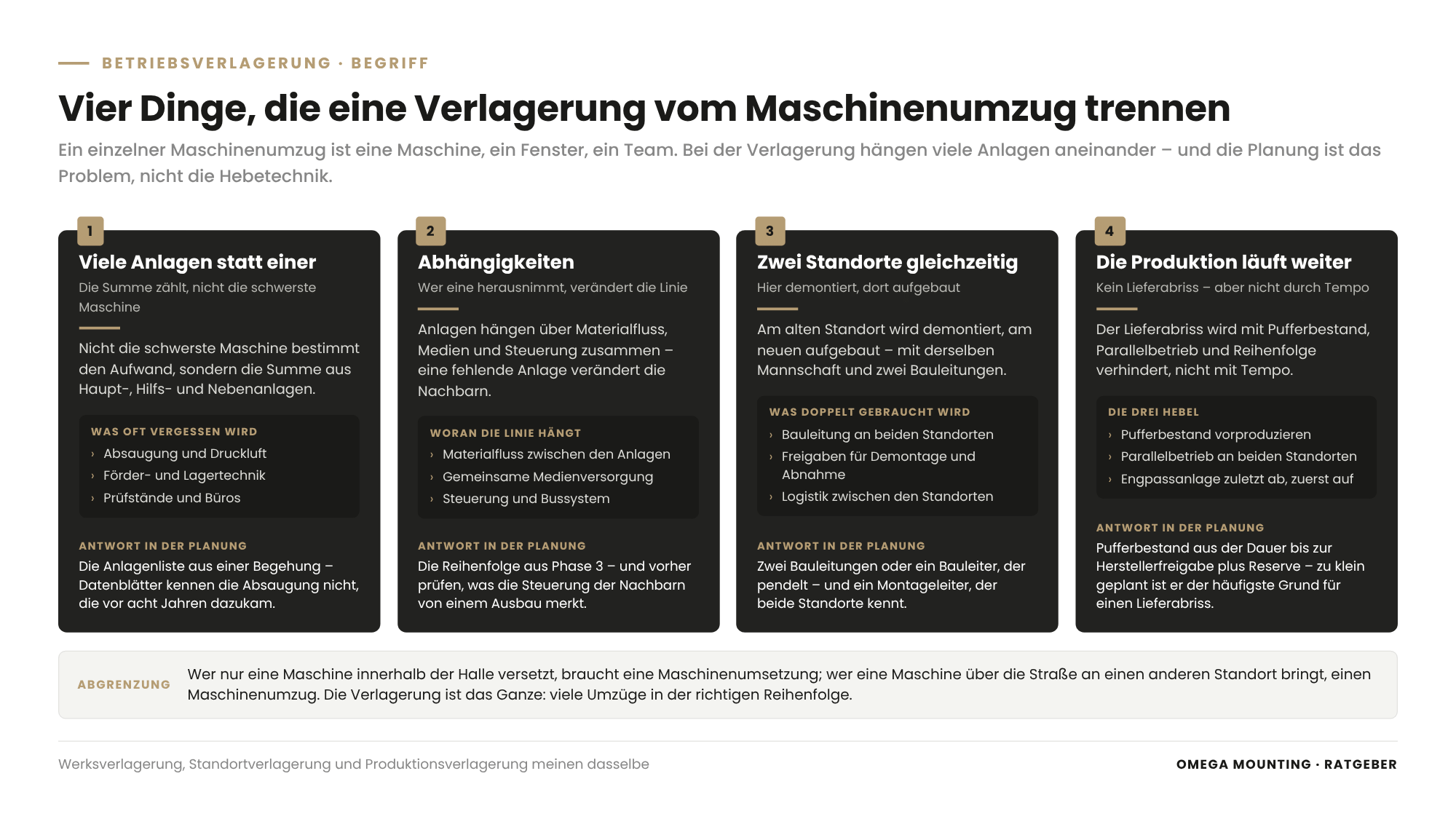
A plant relocation is the planned move of an entire production facility, a production line or a machine park from one site to another – including inventory, sequence, dismantling, interim storage, transport, reassembly, commissioning and acceptance, while production continues as far as possible.
The terms factory relocation, site relocation and production relocation are used interchangeably. The plant relocation differs from the single machinery relocation in four points:
- Many machines instead of one. It is not the heaviest machine that determines the effort, but the sum of main, auxiliary and ancillary equipment: extraction, compressed air, conveyor technology, storage technology, test rigs, offices.
- Interdependencies. Machines are linked via material flow, utilities and control; whoever removes one changes the line.
- Two sites at the same time. Dismantling at the old site, reassembly at the new one – with the same crew and two site managements.
- Production keeps running. The supply gap is prevented with buffer stock, parallel operation and sequence, not with speed.
Anyone who is only repositioning a machine within the hall will find the way in the guide on relocating a machine within the hall. What we take on as an installation contractor in relocations is shown on our service page on machinery relocation and plant relocation.
Plant relocation planning: the nine phases at a glance
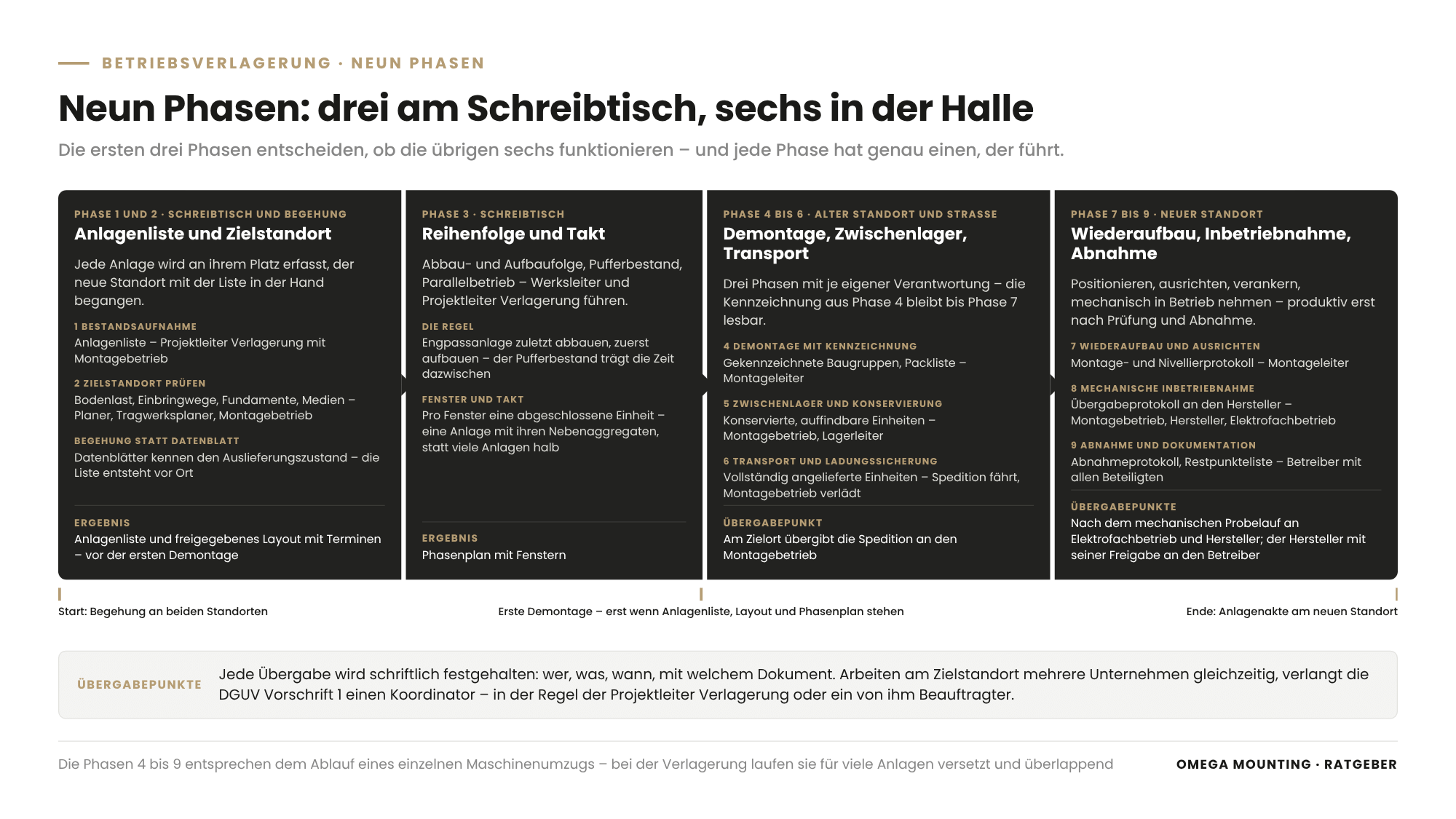
A plant relocation runs in nine phases, of which the first three take place at the desk and during site visits – and it is precisely these three that decide whether the remaining six work in the hall.
| Phase | What happens | Result | Who leads |
|---|---|---|---|
| 1 Inventory. | Record every machine in its place. | Plant list. | Relocation project manager with installation contractor. |
| 2 Check the destination site. | Floor load, access routes, foundations, utilities. | Released layout with dates. | Planner, structural engineer, installation contractor. |
| 3 Sequence and cycle. | Dismantling and reassembly sequence, buffer stock, parallel operation. | Phase plan with windows. | Plant manager, relocation project manager. |
| 4 Dismantling with labelling. | Break down into transportable units, label, photograph. | Labelled assemblies, packing list. | Installation supervisor. |
| 5 Interim storage and preservation. | Protect what is waiting. | Preserved, traceable units. | Installation contractor, warehouse manager. |
| 6 Transport and load securing. | Load, secure, drive. | Units delivered complete. | Haulier; installation contractor loads. |
| 7 Reassembly and alignment. | Position, level, align, anchor. | Installation and levelling record. | Installation supervisor. |
| 8 Mechanical commissioning and handover. | Mechanical trial run, then manufacturer for the control system. | Handover record to the manufacturer. | Installation contractor, manufacturer, electrical contractor. |
| 9 Acceptance and documentation. | Inspections, acceptance, plant file. | Acceptance record, punch list. | Operator with all parties involved. |
Phases 4 to 9 correspond to the sequence of a single machinery relocation – except that in a plant relocation they run staggered and overlapping for many machines.
Phases 1 and 2: plant list and destination site – the basis of every relocation
The plant list records every machine with weight, dimensions, utilities, foundation, documentation and sequence, and the check of the destination site ensures that each of these machines can get there, stand there and be connected – both before the first dismantling.
The plant list: seven columns per machine
Without a plant list, every relocation is a series of surprises. It is produced during a site visit, not from the data sheets – because data sheets know the as-delivered condition, not the extraction system that was added eight years ago.
- Machine. Designation, type, year of manufacture, location in the hall, condition.
- Weight. Total weight and weight of the heaviest assembly after disassembly, centre of gravity, lifting points.
- Dimensions. Installation dimensions and transport dimensions of the disassembled units – the largest part determines the route.
- Utilities. Power, compressed air, hydraulics, cooling water, extraction, data – with disconnection point and connected load.
- Foundation. Floor slab, individual foundation, vibration dampers, anchoring – and whether it has to be rebuilt at the new site.
- Documentation. Operating instructions, circuit diagrams, manufacturer's transport instructions, latest inspection records.
- Sequence. The machine's place in the dismantling and reassembly sequence – see phase 3.
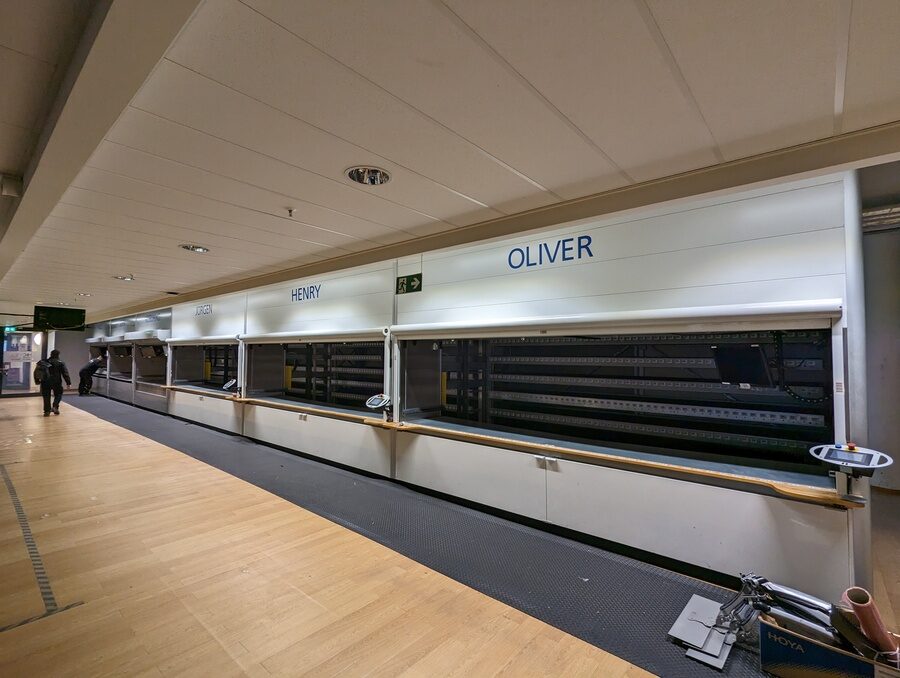
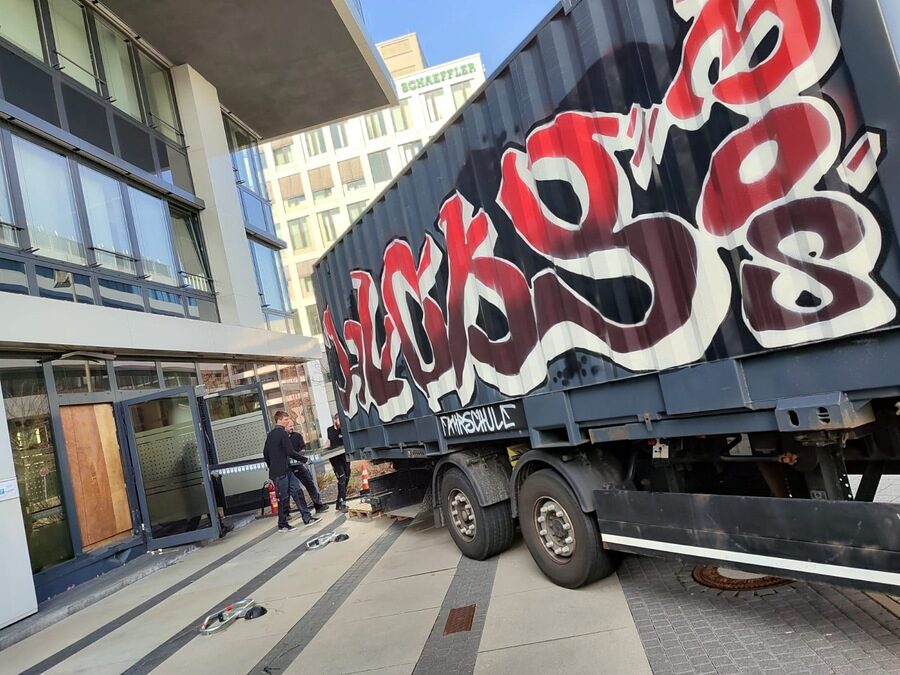
During the relocation of six storage lifts from an office building in Frankfurt three interior doors set the maximum dimension of every component. That was in no operating manual, but after the site visit it was in the plant list. Anyone taking over or handing over used machines adds the assessment from the guide on inspecting a used machine.
The destination site: what must be ready before the first machine arrives
The new site is walked with the plant list in hand. Four things are checked:
- Floor load and ceilings. Does the floor carry the machine in operation and the transport route with machine skates and point loads? That is for the structural engineer to clarify; the basics are in the guide on floor load when moving in.
- Access routes. Gates, door clearances, hall height, turning radii, crane set-up areas – measured against the transport dimensions from the list, not the installation dimensions.
- Foundations. New foundations need planning, construction and curing time. Anyone who only orders them once the machine has been dismantled has a machine in interim storage and a hall without a floor.
- Utility connections. Every connection from the utilities column must be present at the new position, correctly sized and released by the electrical contractor or installer.
The result is a layout with dates: by when is which area cleared, which foundation cured, which connection accepted? These dates become milestones in the phase plan. The enquiry sheet from our guide on Lift & Shift installation helps to collect the details for each machine.
Phase 3: sequence and cycle – what is dismantled last and reassembled first
The sequence of a relocation follows production: the machine on which delivery capability depends is dismantled last at the old site and reassembled first at the new one – and the buffer stock produced beforehand bridges the time in between.
Last out, first in
Every production facility has a bottleneck machine – the one without which nothing is shipped. It sets the cycle of the relocation. Before it, machines are relocated that are dispensable or whose output can be produced in advance: ancillary equipment, second lines, storage and conveyor technology, test rigs, offices. The bottleneck machine goes last and is the first to run again at the new site. Anyone who plans the other way round has a bottleneck machine without feeders at the old site – or a finished line without its main machine at the new one.
Buffer stock and parallel operation
The buffer stock is the pre-produced material that supplies customers while the bottleneck machine is between the sites. Its size follows from the duration of dismantling, transport, reassembly, commissioning and manufacturer release of this one machine – plus reserve. Planned too small, it is the most common cause of a supply gap. Parallel operation means that part of production is already producing at the new site while the other part is still running at the old one. That requires double utility supply, double crew and logistics between both sites – but it reduces the buffer stock.
Windows and cycle
From sequence and buffer stock comes the phase plan: which machine is dismantled, driven and reassembled in which window. It has proved effective to move one self-contained unit per window – one machine with its auxiliary units – rather than many machines half-way. During the relocation of an injection moulding machine dismantling took place over three weekends, and each weekend ended with a hall in which the neighbouring machines could continue producing on Monday. The rules for working alongside running production are in the guide on Maintenance during live operations; what an hour of downtime costs is shown by the calculation of downtime costs – without this figure, no buffer stock can be justified.
Phases 4 to 6: dismantling, interim storage and transport
In a relocation, dismantling, interim storage and transport are three separate phases, each with its own responsibility: the installation contractor disassembles and labels, the interim storage protects and keeps traceable, the haulier drives – and the labelling from phase 4 must remain legible through to phase 7.
Dismantling with labelling
Each machine is disassembled only as far as transport route and lifting equipment require. Every component receives a label with machine number, assembly, position and installation direction; every interface is photographed before being released, and every setting that will be lost is noted. In a relocation, one more level is added: the machine number from the plant list is on every crate so that no two lines get mixed up in interim storage. Before the first move, the utilities are isolated and secured against reconnection – as described in the guide on lockout and tagout (electrical isolation is the job of the qualified electrician). Labelling, photo documentation and packaging in detail are covered in the guide on dismantling and reassembly of a plant. What does not move with you becomes removal – see the guide on Industrial dismantling.
Interim storage and preservation
In a relocation, almost every machine waits somewhere: for the foundation, for the window, for the lorry. Interim storage is therefore a planned phase with location, duration and responsible person. Bare guideways, spindles and hydraulic connections are preserved, openings sealed, sensitive components stored dry and free from vibration. The longer the waiting time, the closer interim storage comes to decommissioning – the measures for that are in the guide on decommissioning and preserving a machine. Every crate remains traceable: the packing list refers to the machine number, the machine number to the storage location.
Transport and load securing
Transport on the road is handled by a haulier – as a partner, not as an ancillary service. The installation contractor loads, helps secure the load and hands over weight, centre of gravity and lifting points for each unit; abnormal and oversized transports need permits with lead time. How heavy goods are secured and handed over is described in the guide on Load securing for heavy goods. For a relocation abroad, export packaging is added: wooden crates to the international standard for wood packaging (ISPM 15), corrosion protection for sea freight, customs papers with packing list – customs and import are clarified by your haulier or customs agent, not by the installation contractor.
Phases 7 to 9: reassembly, commissioning and acceptance
At the new site, every machine is positioned, levelled, aligned and anchored, then mechanically commissioned and handed over to the manufacturer – and only returned to production after inspection and acceptance.
Reassembly and alignment
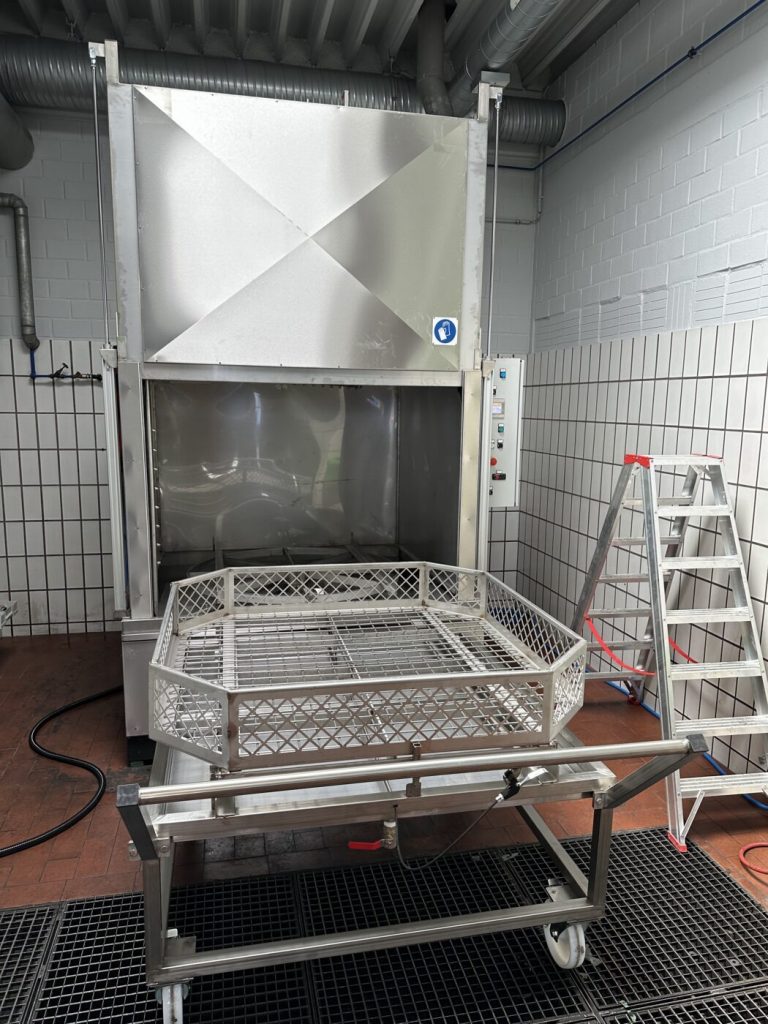
Reassembly follows the labelling in the reverse order of dismantling. The machine is set onto the prepared foundation, levelled with a laser or machinist's level, aligned to feeders, rails and neighbouring machines and only then anchored. For a line, the alignment of the whole line is surveyed, not just each machine on its own; the tolerances are specified by the manufacturer. During the installation of a parts washer in Kassel the plant, feeder trolley and rail had to be positioned exactly relative to each other so that the baskets roll in without lifting. The procedures are in the guide on aligning and anchoring machines.
Mechanical commissioning and handover to the manufacturer
Mechanical commissioning checks whether everything that moves runs: axes free, guideways lubricated, protective devices fitted, utilities connected, filled, bled, leak-tight. The electrical contractor connects and tests the electrical installation. Then follows the handover to the manufacturer: control system, parameters, sensors, calibration, software version and release of the safety functions are their job – and often a prerequisite for the warranty. During the storage lift relocation to Rodgau, we surveyed and levelled racks, guides and shafts; the manufacturer then adjusted the sensors, installed the software update and accepted. This boundary belongs in the interface list beforehand. Trial run, load run and handover are described in the guide on commissioning and handover of a plant.
Acceptance, inspection, documentation
A machine whose safety depends on the installation is inspected under the BetrSichV (German Industrial Safety Ordinance) before recommissioning at the new site – by the competent person, for cranes by the expert or the competent person, electrically by the qualified electrician. The risk assessment under the ArbSchG (German Occupational Safety Act) is updated for the new installation site, because traffic routes, neighbouring machines and escape routes are different. For you this means: the inspections are in the phase plan with date and inspector. Acceptance takes place per machine with record and punch list; the plant file at the new site contains the installation, levelling and torque records, manufacturer release and inspection certificate.
Who does what? Roles and interfaces in a relocation
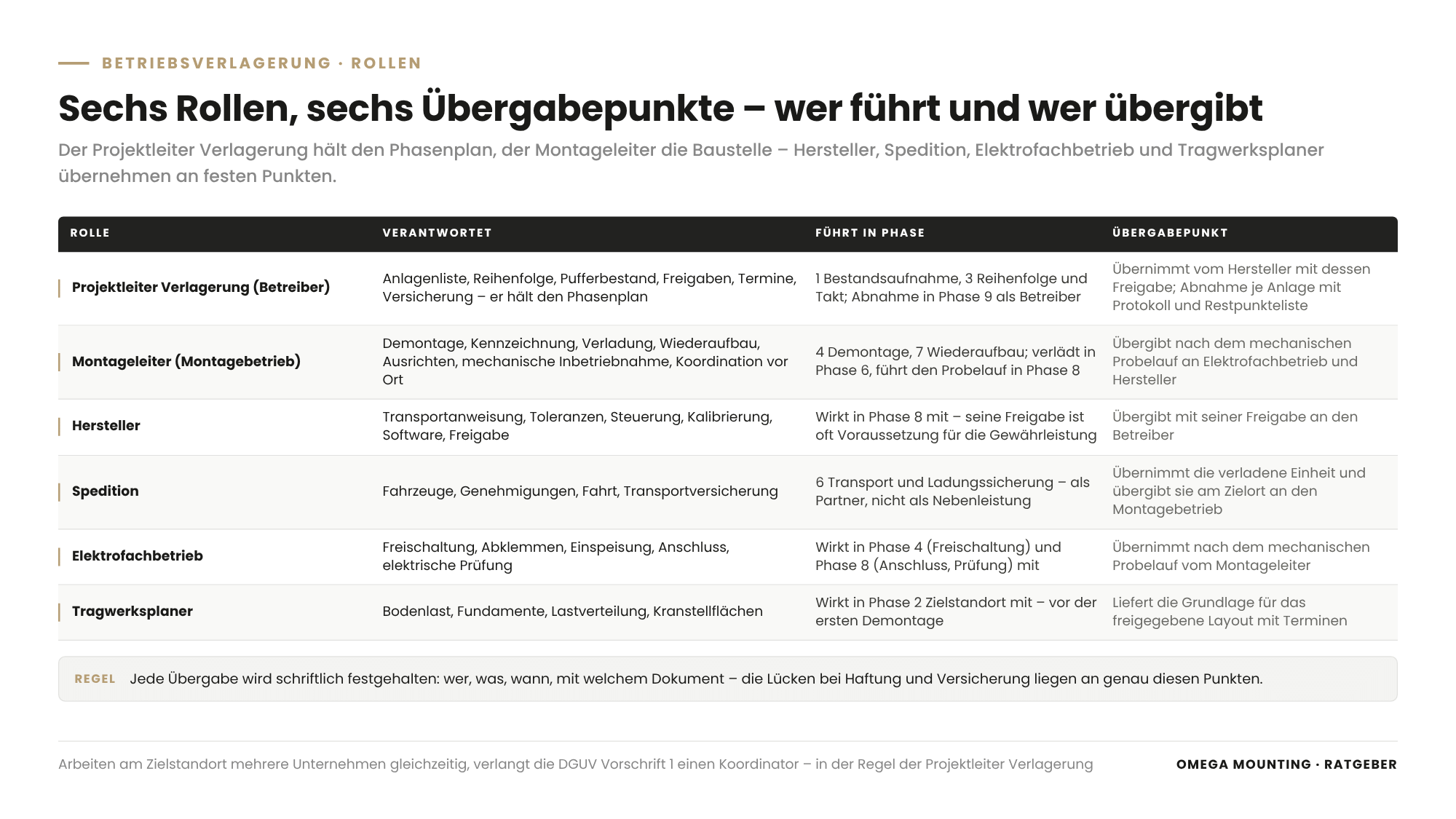
A plant relocation has six fixed roles – relocation project manager, installation supervisor, manufacturer, haulier, electrical contractor and structural engineer – and each phase has exactly one person who leads.
| Role | Responsible for |
|---|---|
| Relocation project manager (operator). | Plant list, sequence, buffer stock, releases, dates, insurance – they hold the phase plan. |
| Installation supervisor (installation contractor). | Dismantling, labelling, loading, reassembly, alignment, mechanical commissioning, coordination on site. |
| Manufacturer. | Transport instructions, tolerances, control system, calibration, software, release. |
| Haulier. | Vehicles, permits, journey, transport insurance. |
| Electrical contractor. | Isolation, disconnection, power supply, connection, electrical testing. |
| Structural engineer. | Floor load, foundations, load distribution, crane set-up areas. |
The handover points lie between the roles: the installation supervisor hands over to the electrical contractor and manufacturer after the mechanical trial run, the haulier hands over to the installation contractor at the destination, the manufacturer hands over to the operator with their release. If several companies work at the destination site at the same time, DGUV Vorschrift 1 (DGUV Regulation 1) requires a coordinator – in a relocation, usually the relocation project manager or someone appointed by them. Every handover is recorded in writing: who, what, when, with which document. How an interface list is structured is shown in the guide on interfaces in large projects; who is responsible for lifting operations, in the guide on the appointed person for lifting operations.
Plant relocation planning: seven typical mistakes
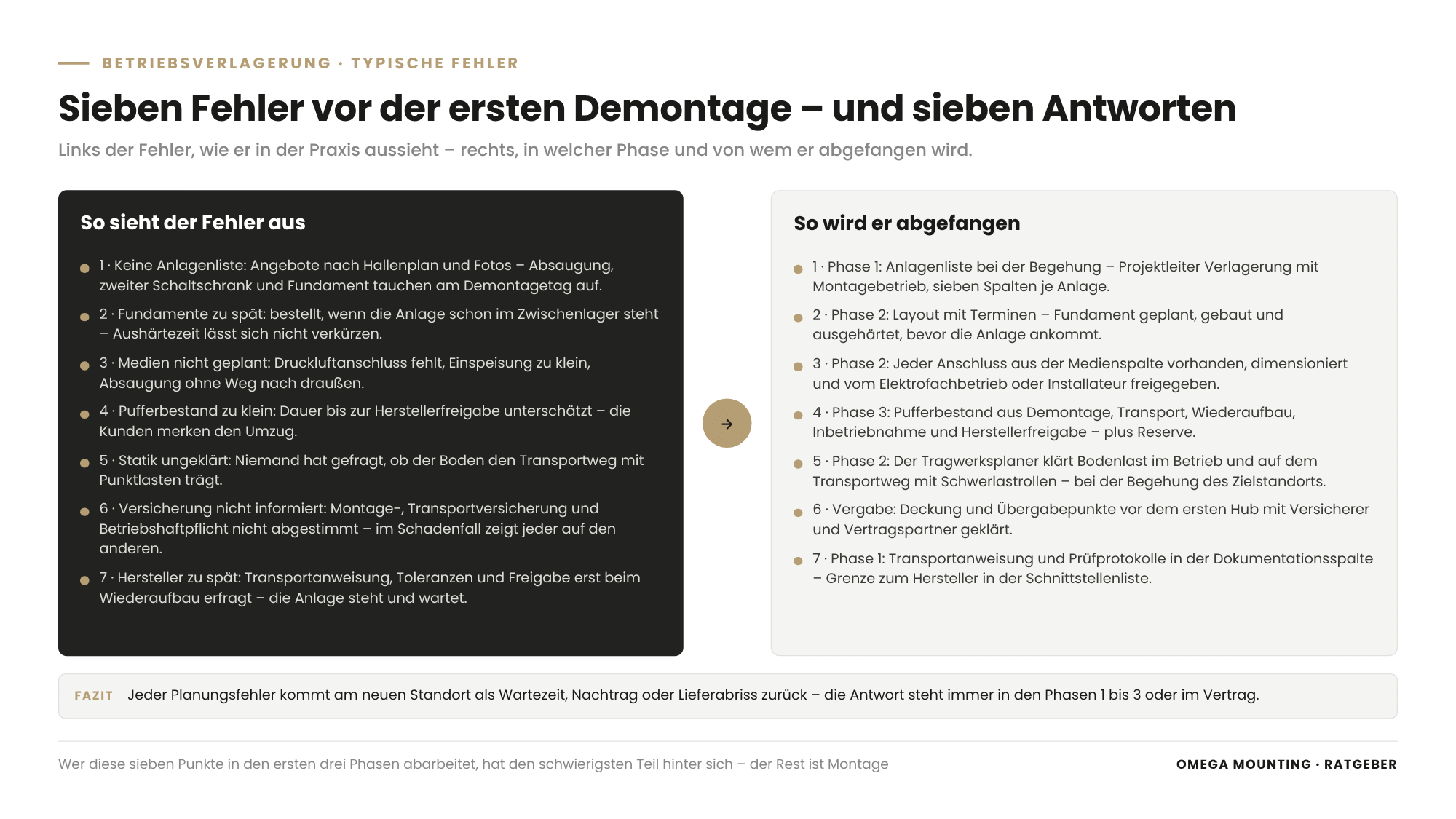
The seven most common mistakes in a plant relocation happen before the first dismantling – and all seven come back at the new site as waiting time, change order or supply gap.
- No plant list. Quotations are obtained from the hall plan and photos; the extraction system, the second control cabinet and the foundation turn up on dismantling day.
- Foundations too late. The new foundation is ordered when the machine is already in interim storage – curing time cannot be shortened.
- Utilities not planned. At the new position, the compressed air connection is missing, the power supply is too small, the extraction has no route outside.
- Buffer stock too small. The time until manufacturer release is underestimated; customers notice the move.
- Structural responsibility unclear. Nobody asked the structural engineer whether the floor at the new site carries the transport route with point loads.
- Insurer not informed. Erection insurance, transport insurance and the public liability of the parties involved are not coordinated; in the event of damage, everyone points at everyone else.
- Manufacturer involved too late. Transport instructions, tolerances and release are only requested during reassembly – then the machine stands and waits.
Anyone who works through these seven points in the first three phases has the hardest part of industrial relocation planning behind them – for operations and planners, the rest is installation.
Award: contract for work with a clear scope
A plant relocation is awarded as a contract for work with a clear scope per phase – with the plant list as an annex to the contract, an interface list for manufacturer, haulier, electrical contractor and client-provided services, and acceptance per machine as the handover point.
The contract for work owes a result: the machine stands aligned, anchored and mechanically commissioned at the new site. For the result to be describable, the tender needs the plant list – without it, three bidders offer three different scopes. For each machine, it is defined which phases the installation contractor takes on and where manufacturer, haulier and electrical contractor begin. Provisional items catch what only dismantling reveals: transport frames, adapter plates, wear parts. How an enquiry is structured is described in the guide on commissioning industrial installation; the line item structure for larger awards, the scope of works for installation and moving in.
The award includes the credentials: public liability insurance covering damage to property worked on, erection insurance, qualifications for crane operators, slingers and the appointed person, clearance and tax exemption certificates – which of these mean something is explained in the guide on subcontractor credentials. Liability and insurance are settled before the first lift with your insurer and your contractual partner – this guide is no substitute for legal advice; it tells you which questions should be clarified beforehand.
Rhine-Main: factory relocation between Frankfurt, Hanau and Aschaffenburg
In the Rhine-Main region, we relocate production facilities between sites that are often just one motorway exit apart – from Offenbach to Dietzenbach, from Hanau to Aschaffenburg, from Frankfurt into the Groß-Gerau district – and the proximity from Rodgau changes the planning.
Short distances allow what is not possible in a relocation over hundreds of kilometres: several site visits at both locations before the quotation, the crew shuttling between dismantling and reassembly on the same day, small windows instead of large blocks. A production site change within the region can thus be cycled in smaller units – the buffer stock gets smaller, the parallel operation shorter. If an adapter or a transport frame is missing at the new site, it comes from our workshop in Rodgau. The region is dense with production: suppliers in Hanau and Darmstadt, plastics and mechanical engineering between Aschaffenburg and Dieburg, logistics around Frankfurt Airport, data centers in Frankfurt. What we offer for the single machinery relocation is shown on our service page on Machinery relocation; why an installation contractor from the region is on site faster in a breakdown, the guide on the installation contractor in the Rhine-Main region.
How we do it in practice
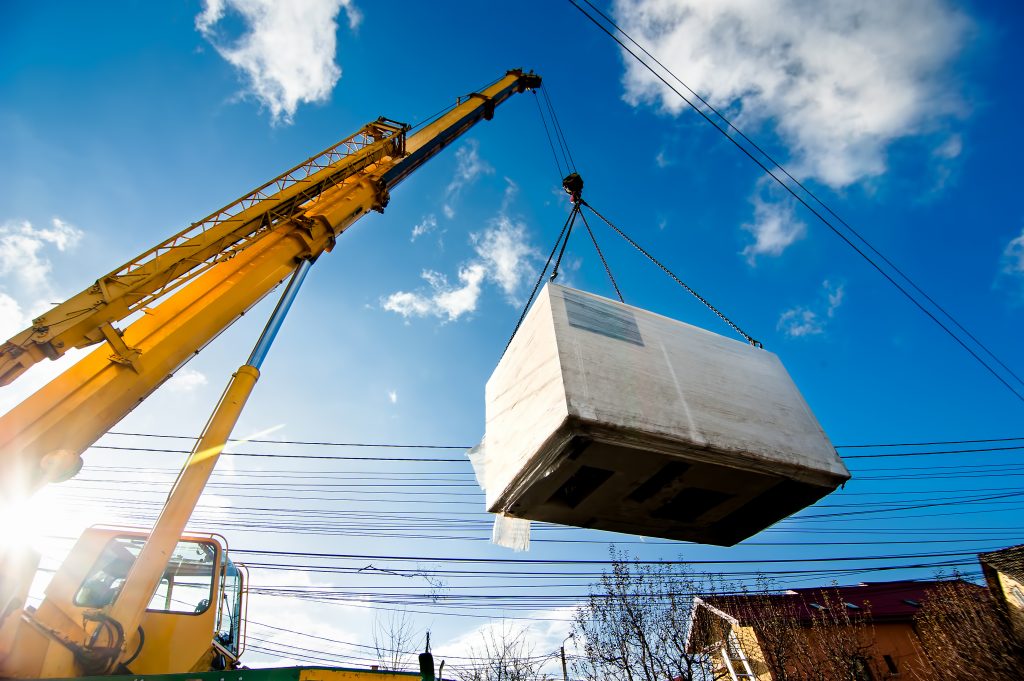
Five jobs from our project diary show the building blocks of a relocation – none was a complete factory relocation, but each shows one phase the way we bring it into every relocation project.
Injection moulding machine: dismantling in the running hall, packaging for overseas
During the relocation of an injection moulding machine six fitters disassembled the machine together with its guarding, removal robot and conveyor belts over three weekends – around 500 tonnes of material, the heaviest part the moving platen at 95 tonnes. In the same hall, the neighbouring machines continued producing and being set up. Lifting was done with the 50-tonne overhead crane, a 4-tonne forklift and a lifting system of the 100-tonne class. A packaging company packed everything in wooden crates and containers for overseas; the customer handled the reassembly itself. For your relocation, this means: dismantling and coordination of the trades can be awarded as a package – if the interface to reassembly is fixed beforehand.
Storage lifts: plant list, labelling, manufacturer release
During the relocation of six storage lifts from an office building near Frankfurt Airport to Rodgau three interior doors and a parquet floor determined the method: disassemble completely, dollies and muscle power only, every component labelled and photographed. Six fitters were on site for the loading. During reassembly, racks, guides and shafts were surveyed and levelled; the manufacturer then adjusted the sensors and accepted. For your relocation, this means: the boundary between installation contractor and manufacturer was fixed beforehand – so there was no discussion.
Industrial robot: one machine goes, the line keeps running
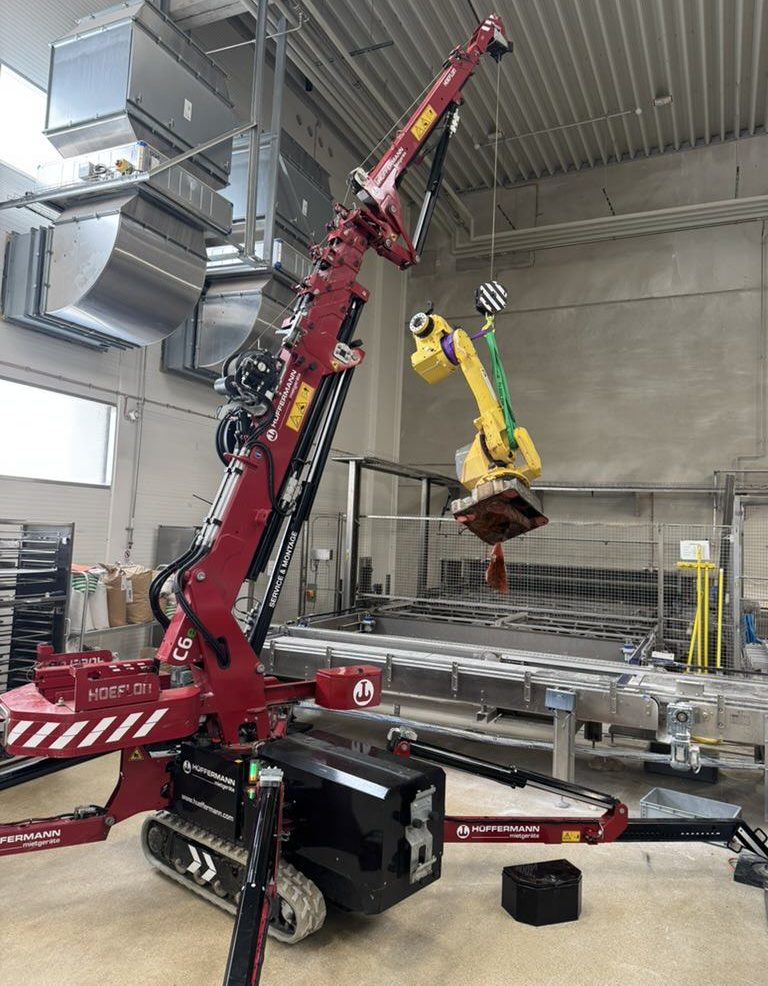
During the removal of an industrial robot at a bakery near Fulda two mechatronics technicians disconnected power, water and compressed air and bypassed the bus system so that the rest of the line kept running. A lifting manager and a crane operator lifted the roughly 600 kilograms over the production line with a mini crane and certified round slings; the removal took one day. For your relocation, this means: anyone taking a machine out of a line checks beforehand what the neighbours' control system will notice.
Paternoster and office container: what does not move and what creates space
With the dismantling of a paternoster storage unit and a hall office the power supply was removed, the unit disassembled, side panels set down with forklift and round slings and driven out of the hall on dollies, recyclables separated by type into containers and big bags. During the dismantling of an office container a production office was disassembled during live operations in a fixed sequence – electrics, floor, supply lines and air conditioning, roof, side walls – and reassembled elsewhere. For your relocation, this means: removal and repositioning of ancillary equipment belong in the plant list and sequence – they create the space the main machines need.
Are you facing a relocation in which production has to keep running?
Then get in touch with us. Send us your plant list – or whatever you have of it –, hall plans of both sites and the desired period. During a site visit at both locations in the Rhine-Main region, we tell you which sequence holds and where the buffer stock gets tight.
What this means for your role
For buyers: Tender the relocation with the plant list as a contract annex and have phases and interfaces confirmed per machine. A quotation that names manufacturer, haulier and electrical contractor as interfaces is comparable; one that names “relocation complete” as a lump sum is not.
For designers: Plan the new site with the transport dimensions of the disassembled units, not just the installation dimensions. Foundations, floor load and utility connections from the plant list belong in the construction sequence with dates – before the window in which the machine arrives.
For project managers and site managers: As relocation project manager, you keep plant list, sequence, buffer stock, releases and insurance in one phase plan – with a fallback level per window. As site manager, you release every dismantling at the old site and accept every machine with a record at the new one before the manufacturer takes over. Two sites need two site managements or one site manager who shuttles.
For maintenance managers: Use the relocation as an inspection window: what is being disassembled anyway can be assessed and rebuilt with new wear parts. Decide on the basis of the plant list which machine moves, which is replaced and which goes to removal. Build up spare parts stock, maintenance plans and inspection intervals for the new site before the first machine runs there.
For operations and plant managers: For you, the relocation is a question of delivery capability. Define bottleneck machine, buffer stock and windows before the tender runs – then the installation contractor plans around your production. Decide early whether parallel operation is possible.
For warehouse and logistics managers: Interim storage and logistics between the sites are your part of the project. Keep areas free with access for forklifts and lorries, keep the packing list with storage location per machine number and plan the shuttle traffic during parallel operation. What is in interim storage remains your responsibility – including preservation.
Relocation roadmap: template on request
The relocation roadmap is a two-page template for the first three phases. Part A is the plant list with the columns machine, weight, dimensions, utilities, foundation, documentation and sequence – one row per machine, to be filled in during the site visit. Part B is the phase plan from inventory to acceptance with responsible persons, releases and handover points between all parties involved. It deliberately contains no price fields. Request the template via our Contact form – quoting the keyword “Relocation roadmap”.
Why Omega Mounting?
We are based in Rodgau near Frankfurt, reachable via our 24-hour hotline, and have our own workshop that makes transport frames, adapter plates and brackets when something is missing at the new site. Our fitters are mechatronics technicians: they disassemble, label, load, align and commission mechanically – and they know where electrical contractor, structural engineer and manufacturer take over. The linked jobs show the building blocks: an injection moulding machine over three weekends in the running hall, six storage lifts through three interior doors, a robot out of a running line. For you this means: a single point of contact from the plant list to the acceptance of the last machine, dismantling, lifting and reassembly from a single source – and short distances in the Rhine-Main region.
Conclusion
Planning a plant relocation means turning many machinery relocations into one project with a sequence. The plant list knows every machine with weight, dimensions, utilities, foundation and documentation; the destination site is checked before the first machine is dismantled. The bottleneck machine goes last and arrives first; the buffer stock bridges the time in between. Every phase has a responsible person, and the interfaces to manufacturer, haulier, electrical contractor and structural engineer are fixed in writing. If your production has to move without customers noticing, send us the plant list, hall plans of both sites and your time period – we will get back to you with a site visit date and an honest assessment of the sequence.
Further reading: The individual relocation step by step: machinery relocation by a contractor. Basics of the trade: What is industrial installation?.
Planning maintenance, moving in or installation in the Rhine-Main region?
Tell us briefly what it is about – we will come back to you with an honest assessment.
100% free and without obligation
You may also be interested in these guides

About the author
Tobias Schott
Managing director of Omega Mounting GmbH, Rodgau · more than 20 years of hands-on experience in installation and maintenance
A trained mechatronics technician, at home in maintenance, servicing and industrial installation since 2004 – first at his father's side, since 2012 with Omega Mounting: from the overhead conveyor in Frankfurt to the crane system in a new-build hall. Plans and leads lifting operations as appointed person in data centers and on industrial sites in the Rhine-Main region, is an instructor and examiner for cranes, mobile elevating work platforms and telehandlers, and a safety officer. On jobs abroad he is known as the “German Troubleshooter” – the one you call when things get stuck on site. He learned what quality means not from a manual but from his father: Made in Germany as a standard for his own work, not as a label. That is why it comes first at Omega Mounting – before speed and before price. He writes these guides from that practice: what works on our sites is in them – what only exists in the standard is not.
Frequently asked questions
An industrial installation contractor that takes on dismantling, labelling, loading, reassembly, alignment and mechanical commissioning from a single source and coordinates the other trades: the haulier for transport, the electrical contractor for isolation and connection, the structural engineer for floor load and foundations, the manufacturer for control system and release. A haulier alone does not relocate a machine park – it drives it. Ask for references of comparable relocations and for the plant list as the basis of the quotation.
An installation contractor with experience in machinery relocation and its own lifting equipment that understands the line as a whole: sequence of the machines, alignment of the line during reassembly, handover to the manufacturer. Omega Mounting from Rodgau takes on such projects in the Rhine-Main region and throughout Germany – with plant list, phase plan and an installation supervisor who knows both sites. What matters is that one company leads the phase plan and the other trades cycle to it.
That depends on the number of machines, the degree of disassembly, the distance, the windows that production releases, the completion of foundations and utilities at the new site and the time until manufacturer release. A single machine can be in place in one day on site – like a parts washer in Kassel –; an injection moulding machine needed three weekends for the dismantling alone. Anyone planning a plant relocation only gets a reliable duration with a plant list and a site visit – then as a phase plan with milestones.
That cannot be said without a plant list – and with it only after a site visit at both locations. The cost types are: dismantling and reassembly per machine, lifting equipment and aids, packaging and interim storage, transport and permits, client-provided services at the new site, manufacturer services, inspections – and the downtime costs that the buffer stock avoids. Anyone who names a sum from the hall plan and photos has not seen the machines.
The phases remain; three things are added: export packaging with wooden crates according to the import rules of the destination country and corrosion protection for sea freight, customs and export papers with a packing list per crate, and a destination site that you can rarely visit beforehand. Plan the reassembly with a crew that knows the labelling, or with documentation that works without them. Customs and import are clarified by your haulier or customs agent.
Responsibility is usually shared: the haulier for the journey, the executing party for loading and load securing, the installation contractor for its installation service – each within the agreed scope and its own insurance. The gaps lie at the handover points; that is why it is documented per unit who took it over, when and in what condition. Clarify cover and handover points with your insurer and partners before the first lift, instead of relying on blanket terms.
Yes, if sequence, barriers and windows are right. Ancillary equipment and second lines move first while the bottleneck machine keeps running; it is dismantled last, and the buffer stock bridges the time until release at the new site. During the removal of a robot at a bakery near Fulda, the rest of the line kept running because the bus system was bypassed; with the injection moulding machine, the neighbouring machines continued being set up while dismantling took place.
Every machine whose safety depends on the installation is inspected before recommissioning at the new site – by the competent person, electrically by the qualified electrician, for cranes by the expert or the competent person. The risk assessment is updated for the new installation site, and the operators are briefed again. Omega Mounting prepares the inspections and documents them; the inspection itself is carried out by the persons authorised to do so.
Yes, the phases are the same, only the boundary conditions change: hygiene in the food business, access and dust protection in the data center, background checks at the airport. In the Rhine-Main region, we relocate storage technology from office buildings to Rodgau, production facilities between Hanau, Offenbach and Aschaffenburg and plant areas in Frankfurt – with short distances for site visits at both locations.
With an enquiry containing three details: the plant list or at least the machines with type and approximate weight, hall plans or photos of both sites and the desired period. We arrange a site visit at both locations, define sequence and buffer stock with you and send you a written assessment with phase plan and interface list. Your contact is Tobias Schott – reachable via our Contact form.
 English
 German