
- Guide – Lift & Shift
Load securing for heavy goods: machines and transformers safely on the lorry
By Tobias Schott · Reading time approx. 23 minutes · Last updated: October 2026

Load securing for heavy goods does not start with the ratchet strap but with three questions: Where is the centre of gravity? Where may the load stand on the vehicle? What holds it in place? Only then is it decided whether the machine arrives at its destination the way it left.
An injection moulding machine goes to a new site, a transformer has to come out of its cell, a tank has to go onto the low loader. In each of these cases, the load moves from the ground onto a vehicle – and responsibility is shared between installation contractor, loader, driver and haulier. Load securing for heavy goods is therefore not a side issue at the end of a project. It is the point where lifting technology, transport planning and law meet. Project managers, site managers and logistics managers usually only get to know it when a driver with two straps is standing in front of a machine without lashing points.
This article is the in-depth companion to our guide Lift & Shift installation: lifting, moving and placing heavy equipment. That guide covers the route to the installation position. This one covers what lies behind the search term “load securing for heavy goods”: the stage where the load goes onto the vehicle and comes off it again. With examples from the port of Aschaffenburg, a data center in the Frankfurt area, an industrial company in Fulda and data center construction in the Rhine-Main region.
Key points at a glance
- Loader, driver and vehicle keeper are jointly responsible for load securing of heavy goods. Whoever loads must load securely for transport; whoever drives must check the securing before setting off.
- The vehicle's load distribution plan defines where on the loading area a load of a given weight may stand.
- The load's centre of gravity determines slinging geometry, stability and the direction of the lashing forces – it must be known before loading, not estimated.
- Positive-fit securing holds the load by blocking against the headboard, wedges or stanchions; friction securing presses it onto the loading area by tie-down lashing. Heavy goods are almost always secured with both.
- If the machine has no lashing points, transport frames, slinging aids or anchoring points are created – not improvised.
- The handover to the haulier is documented – with photos of the securing, weight, centre of gravity position and a clear statement of who checked what.
What is load securing for heavy goods?
Load securing for heavy goods is the sum of all measures used to position, hold and protect a machine, transformer, generator or plant component on a vehicle. The aim is that the load neither slides nor tips, rolls or falls during braking, acceleration, cornering and over uneven road surfaces – and can be unloaded undamaged at its destination.
The difference from securing pallets and small parts lies in three points. First, the mass of the load becomes the determining factor. A machine weighing several tonnes can only be held by securing that takes centre of gravity and load distribution into account. Second, the load is rarely a box: machines have superstructures, a high or off-centre centre of gravity and hardly any suitable lashing points. Third, it is sensitive – a transformer or a machine tool tolerates no twisting of the frame and no strap across a panel.
Loading heavy goods therefore always includes the lifting equipment at the loading point: mobile crane, telehandler or reach stacker – a handling machine with a telescopic boom of the kind found in ports. If no lift is possible, a skidding system and machine skates take over. What Omega Mounting contributes here is described on our service page Machine relocation: dismantle, move, start up.
Who is responsible for load securing – loader, driver or vehicle keeper?

Loader, driver and vehicle keeper are jointly responsible for load securing. The loader must load the cargo securely for transport. The driver must check the securing before setting off and may only drive with a secured load. The vehicle keeper must provide a suitable vehicle with sufficient lashing points and lashing equipment.
Section 22 of the German Road Traffic Regulations (StVO) sets out how a load is to be stowed and secured. It must not slide, fall over, roll about or fall off even under emergency braking or a sudden evasive manoeuvre. The recognised rules of technology must be observed. For you this means: there is no “adequate” securing by feel. Whoever loads must know the rules of technology or bring in someone who does.
The German Commercial Code (HGB) distributes the tasks in the contract of carriage: under Section 412 HGB, the consignor must load, stow and fasten the cargo securely for transport. The carrier is responsible for operationally safe loading – that is, for the vehicle being roadworthy with this load. This distribution can be changed by contract. That is exactly what often happens in practice without anyone writing it down. For you this means: clarify in writing before loading day who carries out the load securing, who checks it and who provides the material.
At the ramp, there are usually three parties: your company as consignor, the haulier with driver and vehicle, and the installation contractor lifting the machine. Whoever applies the straps is loading; whoever stands beside them is not thereby relieved of responsibility. For loadings that we lift, we take on the load securing as a separate service with a securing concept, material and documentation. This is practice from our jobs and not legal advice; the allocation of responsibility in your case belongs in the transport contract.
How do you plan load distribution and centre of gravity on the vehicle?
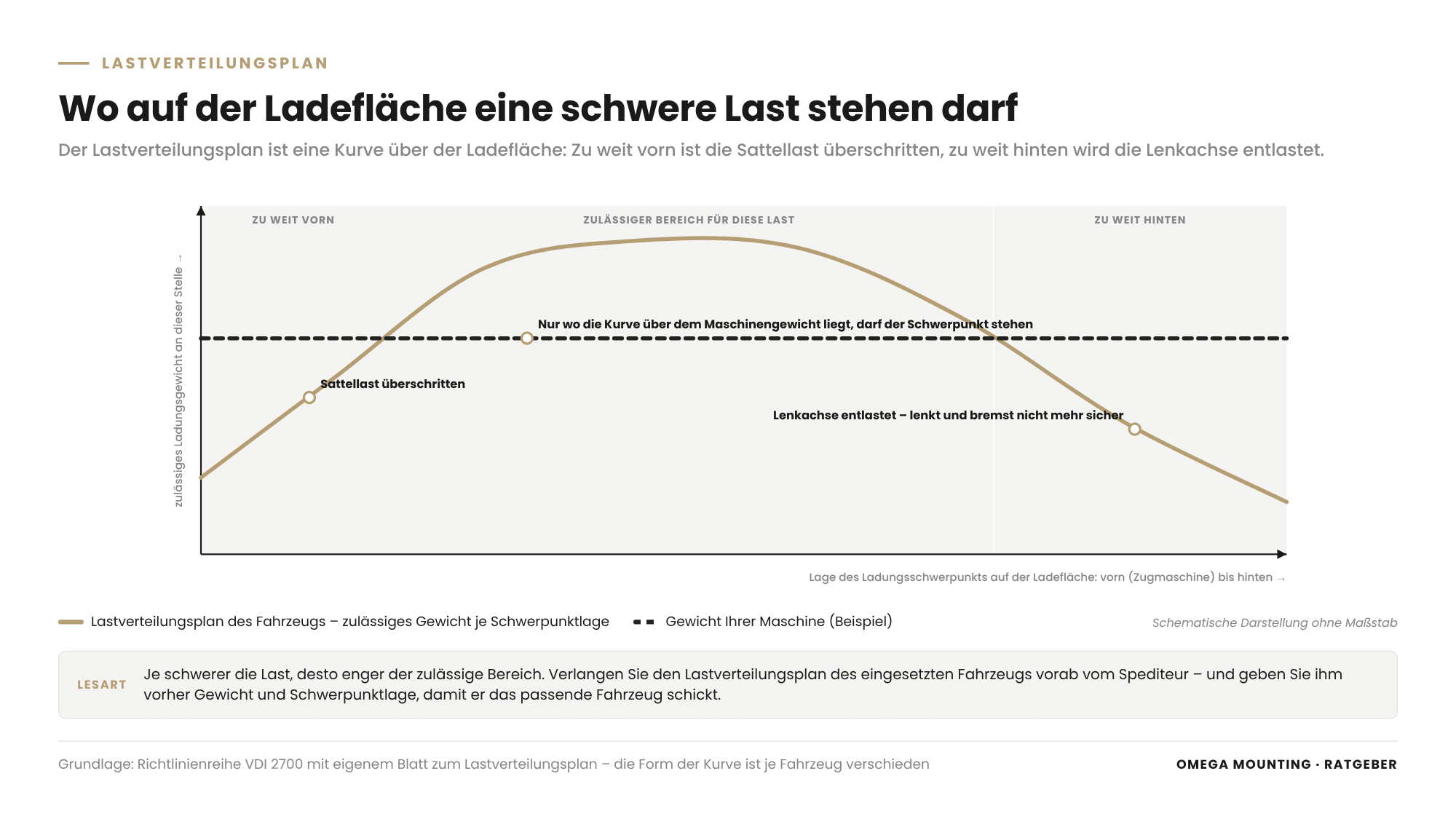
Load distribution and centre of gravity are planned before loading using the vehicle's load distribution plan. The plan shows at which point on the loading area a load of a given weight may stand. This ensures that no axle is overloaded and none is relieved so far that the vehicle no longer steers and brakes safely.
The load distribution plan is a curve across the loading area – the VDI 2700 series of guidelines, “Load securing on road vehicles”, devotes a separate part to it. For heavy single loads it is indispensable, because a single machine can account for the entire payload. If it stands too far back, the steering axle is relieved; too far forward, and the fifth-wheel load is exceeded. For you this means: ask the haulier for the load distribution plan of the vehicle in question in advance. Give them weight and centre of gravity position beforehand so they send the right vehicle.
The centre of gravity: the figure nobody knows
The weight of a machine is on the nameplate; the centre of gravity position rarely is. On a machine tool, the centre of gravity is often off-centre because the headstock or control cabinet sits on one side. On a transformer it is low; on a tank it is high above a small footprint. The centre of gravity determines how the load is slung so that it hangs level, where it stands on the loading area and in which direction the securing must act. We determine it before every loading – from manufacturer documents, from the geometry or by a trial lift. The load is raised a few centimetres and its tilt observed. How lifting points and centre of gravity interact in the choice of round sling, chain or spreader beam is described in our guide Lifting accessories for heavy loads: round sling, chain or spreader beam?.
A load with a high centre of gravity and narrow footprint can tip on the loading area before it slides. That is why, for tanks, control cabinets or cable drums transported upright, we check before lashing planning whether the load is stable in this position. Otherwise it travels lying down or with supports.
Positive fit or friction: which securing method suits which load?
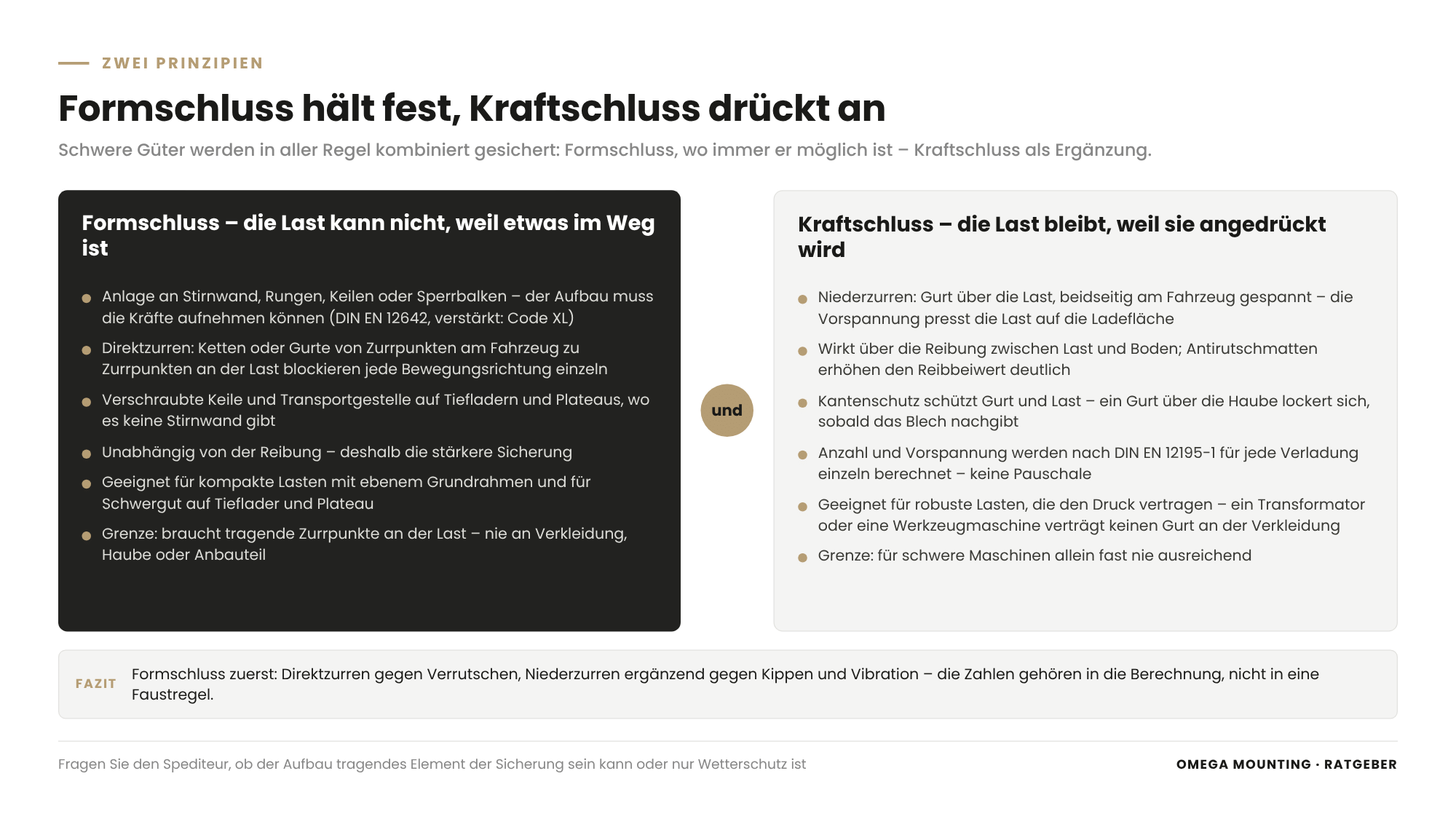
Positive-fit securing holds a load by having it bear directly against an obstacle – headboard, stanchions, wedges or direct lashing that mechanically blocks every movement. Friction securing holds it by tie-down lashing pressing the load onto the loading area and thereby increasing friction. Heavy goods are as a rule secured by a combination: positive fit wherever possible, friction as a supplement.
Positive fit: the load cannot move because something is in the way
Positive fit is the stronger securing because it does not depend on friction. A machine whose base frame bears against the headboard of a body cannot slide forward under braking – provided the headboard is designed for these forces. The strength of vehicle bodies is governed by the standard DIN EN 12642; reinforced bodies carry the Code XL marking. For you this means: ask the haulier whether the body can be a load-bearing element of the securing or is merely weather protection. On low loaders and flatbeds there is no headboard. There, positive fit is achieved by direct lashing: chains or straps run from lashing points on the vehicle to lashing points on the load and block each direction of movement individually. Add to that bolted wedges and transport frames.
Friction: the load stays because it is pressed down
In tie-down lashing, a strap runs over the load and is tensioned on both sides of the vehicle. The pre-tension presses the load onto the loading area and increases the friction force. The decisive factor is the friction coefficient between load and floor – a measure of how well two surfaces grip each other. Anti-slip mats increase it considerably. How many lashings with what pre-tension are needed is calculated individually for each loading according to the standard DIN EN 12195-1 – from weight, friction coefficient, lashing angle and pre-tension force. We deliberately give no figures here, because a rule of thumb at this point is more dangerous than none. For heavy machines, friction alone is almost never enough.
| Securing method | Principle | Typical means | Suitable for | Limits |
|---|---|---|---|---|
| Positive fit by blocking | Load bears against a load-bearing obstacle | Headboard, stanchions, wedges, locking bars | compact loads with a flat base frame | Body must be able to absorb the forces |
| Positive fit by direct lashing | Lashings block each direction of movement individually | Lashing chains, lashing straps, lashing points on load and vehicle | Heavy goods on low loaders and flatbeds | Lashing points on the load required |
| Friction by tie-down lashing | Pre-tension increases friction | Lashing straps, anti-slip mats, edge protectors | robust loads; supplement for heavy goods | Friction coefficient decisive, load must tolerate pressure |
Which lifting and lashing points does the load need – and what if there are none?
A load needs lifting points at which it is lifted and lashing points at which it is held on the vehicle. Both must be designed for the forces that occur, undamaged and arranged so that lifting and securing do not deform the load. If they are missing, they are created: through transport frames, slinging aids, spreader beams or anchoring points designed by a specialist contractor. Never by a strap around the nearest component.
Lifting points: lift where the manufacturer intends
Machines and units have lifting points specified by the manufacturer – lifting eyes, threaded holes for swivel eyebolts, recesses for forks or spreader beams. For standby generators, the manufacturer specifies the lifting points. We stick to them even when a different geometry would make the lift easier. On sharp edges, chains are used instead of round slings. We saw what improper slinging does at the port of Aschaffenburg. The central tubular shaft of a cable drum had cracked and deformed because it had previously been slung incorrectly. We repaired it by TIG welding.
Lashing points: on the vehicle and on the load
Lashing points on the vehicle are eyes, rings or perforated rails that the vehicle manufacturer has designed for defined forces. Many machines, by contrast, have none, because they were designed for installation, not for transport. Then there are three options.
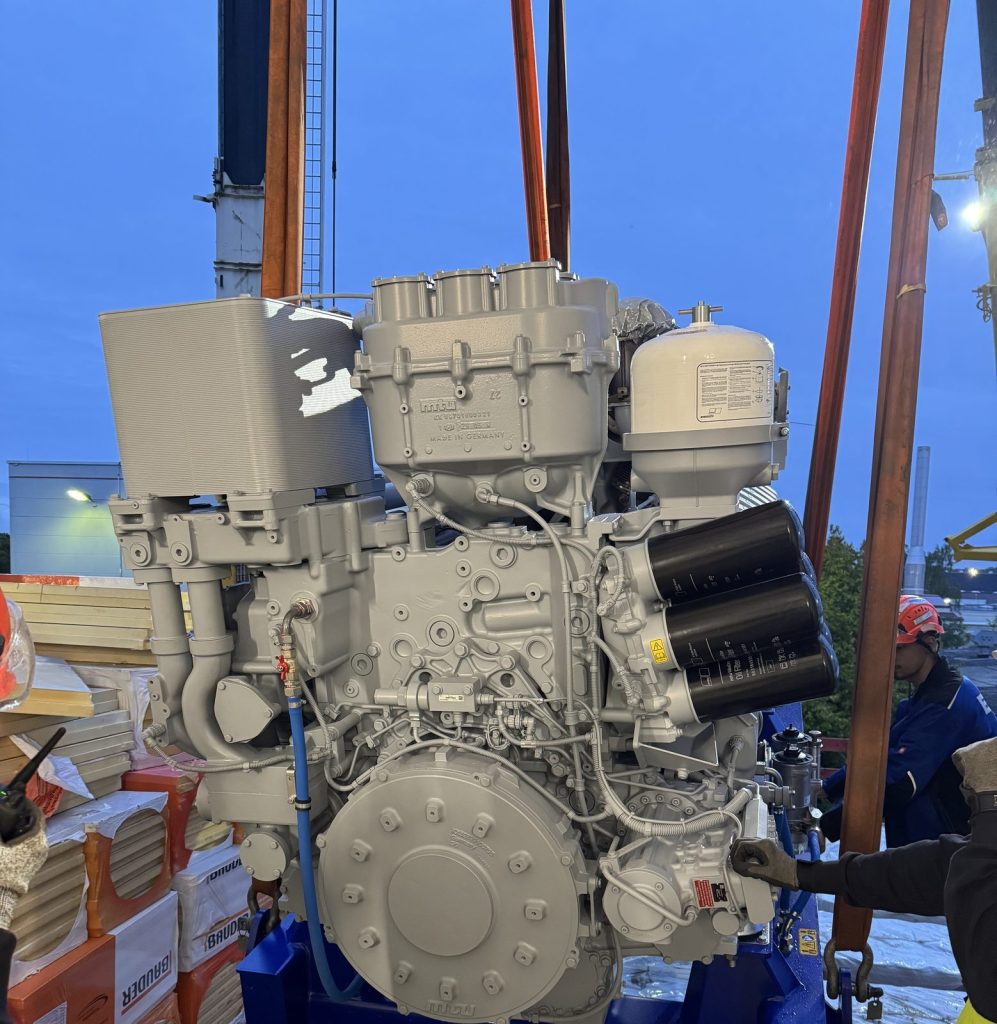
- Transport frame: The machine or assembly is placed on a steel frame and bolted to it. The frame has defined support and lashing points and is connected to the vehicle. That is how the diesel engine of a standby power system arrives on site.
- Slinging aids and adapters: For assemblies without eyes, we manufacture slinging aids, spreader beam adapters or bolt-on lashing brackets in our workshop in Rodgau. They transfer the forces into the base frame – not into panels or attachments.
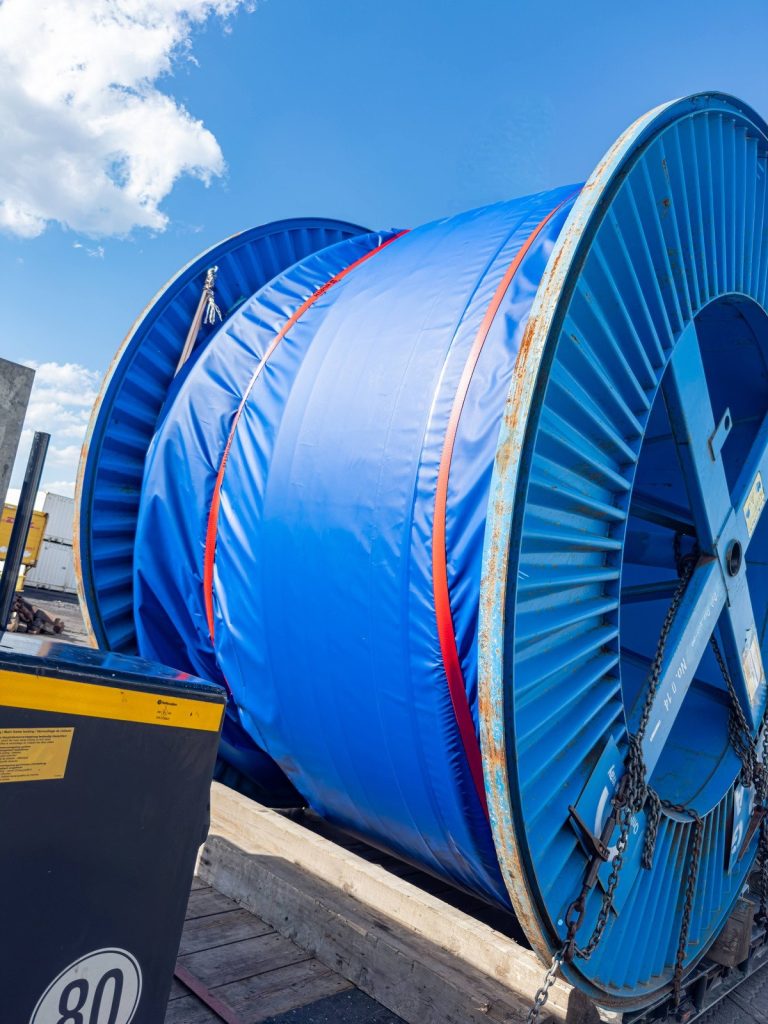
- Creating anchoring points: At the port of Aschaffenburg, the announced fastening system for the protective tarpaulin was missing for a cable drum weighing around 22 tonnes. Our team created anchoring points with clamps and wire ropes on the drum flange; ratchet straps took up the tensile forces. The improvisation was in the material, not in the safety.
Lashing straps, lashing chains and tensioning elements carry a label with their permissible lashing capacity and are checked for damage before every use. For you this means: a strap without a label is unusable, because nobody knows what it will hold.
How do you protect the load against weather, dust and transport damage?
The load is protected against weather, dust and transport damage by planning packaging and securing together. Protective covers, tarpaulins and edge protectors must withstand airflow, rain and sun over the entire route. They must not obstruct the lashings and must be removable at the destination without damaging the load.
A transformer arrives in its factory protective cover, and that stays on until the end. A transformer is not a steel component you can knock clean when it gets dirty. A machine tool needs corrosion protection on bare guideways, sealed media connections and a cover against dust. An open cable winding needs UV protection: the plastic sheath of power and medium-voltage cables ages under sunlight, becomes brittle and develops fine cracks through which moisture later penetrates.
Every cover offers the airflow a surface to attack. A tarpaulin of this size has area, and area pulls with every gust – that is what we experienced in Aschaffenburg. That is why a transport tarpaulin is fixed all the way round. Where lashing straps run over edges, edge protectors protect the strap from chafing through and the load from pressure marks. Anyone who lashes a machine with a strap over the hood has a dent at the destination and no securing: the hood yields, the strap slackens.
Transport position, duration and storage conditions at the destination therefore belong in the loading plan. What preparation a machine needs before relocation – draining, cleaning, securing moving axes, labelling – is described in our guide Machinery relocation for your company: from dismantling to commissioning.

How does loading heavy goods work – from the lift to the handover to the haulier?
Loading heavy goods runs in seven steps:
- Transport order with weight and centre of gravity
- Vehicle selection with load distribution plan
- Preparation of the load and the loading point
- Lift onto the vehicle
- Positioning according to the load distribution plan
- Securing according to the concept
- Documented handover to the driver
Every step is defined before loading day, not at the ramp.
Steps 1 to 3: order, vehicle, preparation
It all starts with the information the haulier needs: weight, dimensions, centre of gravity position, lifting and lashing points, sensitivities, transport position, loading point with access and lifting equipment. If any of this is missing, the haulier sends a vehicle that matches their assumption – not your load. Then the load is made ready for transport and the loading point prepared: load-bearing ground for crane or telehandler, outrigger pads, access, exclusion zone, banksman. How crane set-up area, ground bearing pressure and exclusion zone are planned is described in our guide Moving in a machine: the sequence from site survey to acceptance. The loading point is a moving-in point in reverse.
Step 4: the lift
Ideally, the lift onto the vehicle happens exactly once. With the transformer in the Frankfurt area, the load went directly from the trailer onto the skidding system – without being set down in between. Every additional lift is an additional risk and time during which a lorry stands idle. For the lift, the rules are: lift plan, lifting accessories as specified by the manufacturer, one person giving the commands, eye contact between banksman and operator, nobody under the load.
Steps 5 and 6: positioning and securing
The load is set down according to the load distribution plan – on anti-slip mats, timber baulks or load spreading plates. If positive fit by blocking is planned, the base frame stands against the headboard or wedges. Then follows securing according to the defined concept: direct lashing against sliding, tie-down lashing against tipping and vibration, edge protectors, checking of pre-tension and lashing angles.
Step 7: handover to the haulier
The driver checks the securing before setting off – that is their duty and their right. The handover is documented: photos of the secured load from several directions, weight, centre of gravity position, lashing equipment used, people involved, date and time. At the destination, this loading record is the proof of the condition in which the load left the plant.
When does loading become an abnormal load transport?
Loading becomes an abnormal load transport when the weight, dimensions or axle loads of the loaded vehicle exceed the generally permissible limits for road traffic. The transport then needs an official permit, a defined route, escort vehicles where required and a haulier specialised in oversized and heavy transports.
The limit is often invisible to the client because it is measured on the loaded vehicle. A transformer of around 52 tonnes is an abnormal load with any vehicle. A machine tool can become one if it is too wide or too high for normal traffic. The heavy haulage contractor is responsible for permit, route and journey. We plan and supervise the lift, make the load ready for transport and secure it – regularly as a subcontractor to crane and heavy haulage companies. For you this means: clarify early on which side of the limit your load falls, because permits need lead time.
Which typical mistakes do we see in load securing for heavy goods?
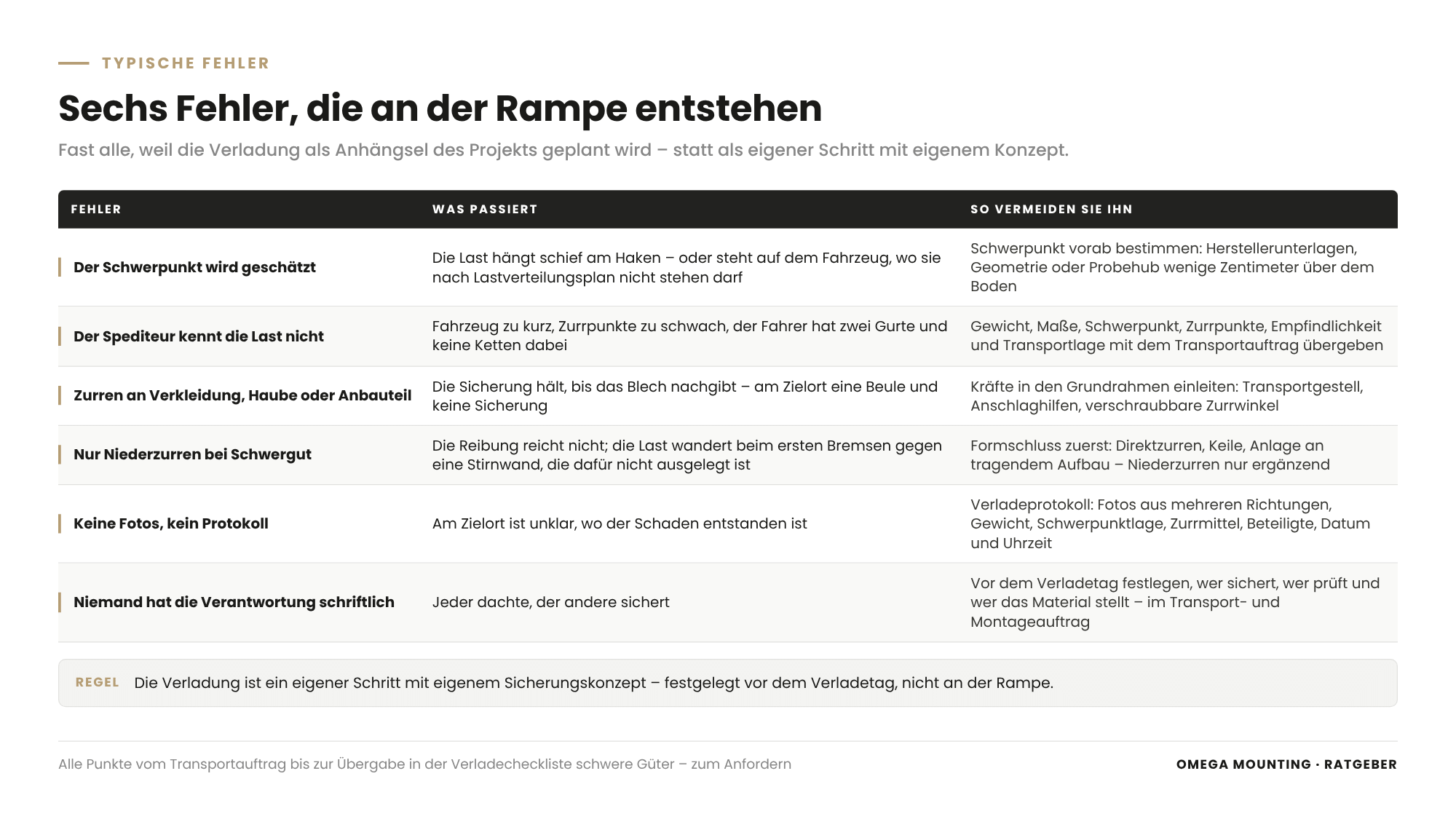
The most common mistakes in load securing for heavy goods are an unknown centre of gravity, a missing load distribution plan, lashing points on components that do not bear load, tie-down lashing as the only securing and a handover without documentation. Almost all arise because loading is planned as an afterthought to the project rather than as a step in its own right.
- The centre of gravity is estimated. The load hangs crooked – or stands on the vehicle where the load distribution plan says it may not.
- The haulier does not know the load. The vehicle is too short, the lashing points too weak, the driver has two straps and no chains with them.
- Lashing to panels, hoods or attachments. The securing holds until the sheet metal gives way.
- Tie-down lashing only for heavy goods. The friction is insufficient; the load moves at the first braking against a headboard that is not designed for it.
- No photos, no record. At the destination, it is unclear where the damage occurred.
- Nobody has the responsibility in writing. Everyone thought the other party was securing.
Load securing for heavy goods in the Rhine-Main region: how we do it
For us, loading heavy goods in the Rhine-Main region means three things. Machines leaving production plants in Hanau, Offenbach or Darmstadt for a new site. Transformers and standby power systems delivered to and collected from data centers in the Frankfurt and Raunheim area. Cable drums, tanks and plant components that have to go onto the low loader at the port of Aschaffenburg or on factory premises. We often work as a subcontractor to hauliers and to crane and heavy haulage companies.
Our loadings start with a site visit or, for standard cases, with a set of photos and the machine data. Where does the load stand, where can the lorry stand, which lifting equipment fits in between, where is the centre of gravity? From this we develop a securing concept, which we coordinate with the haulier. The workshop in Rodgau supplies what is missing: transport frames, slinging aids, lashing brackets, made-to-measure edge protectors. If something at the loading point differs from the plan, we have the short distances to procure material.
How we do it in practice
Four jobs from our project diary show what “load securing for heavy goods” means in practice.
Enclosing and loading a cable drum – port of Aschaffenburg
At the port of Aschaffenburg, we enclosed a cable drum weighing around 22 tonnes in UV-proof covering and prepared it for road transport. The low loader was on its way, the special tarpaulin was with the driver – but the announced fastening system was missing. Three fitters solved this in one day on site. The drum hung from the chain sling of a reach stacker; two fitters guided the tarpaulin in two layers around the circumference, the third worked on top of the drum. Anchoring points on the drum flange were made from clamps and wire ropes. At the suspended load, the rule was: one banksman with eye contact to the operator, hand signals instead of shouts. At the end of the day, the drum stood lashed and ready to go on the low loader.
Two transformers from the low loader into the cell
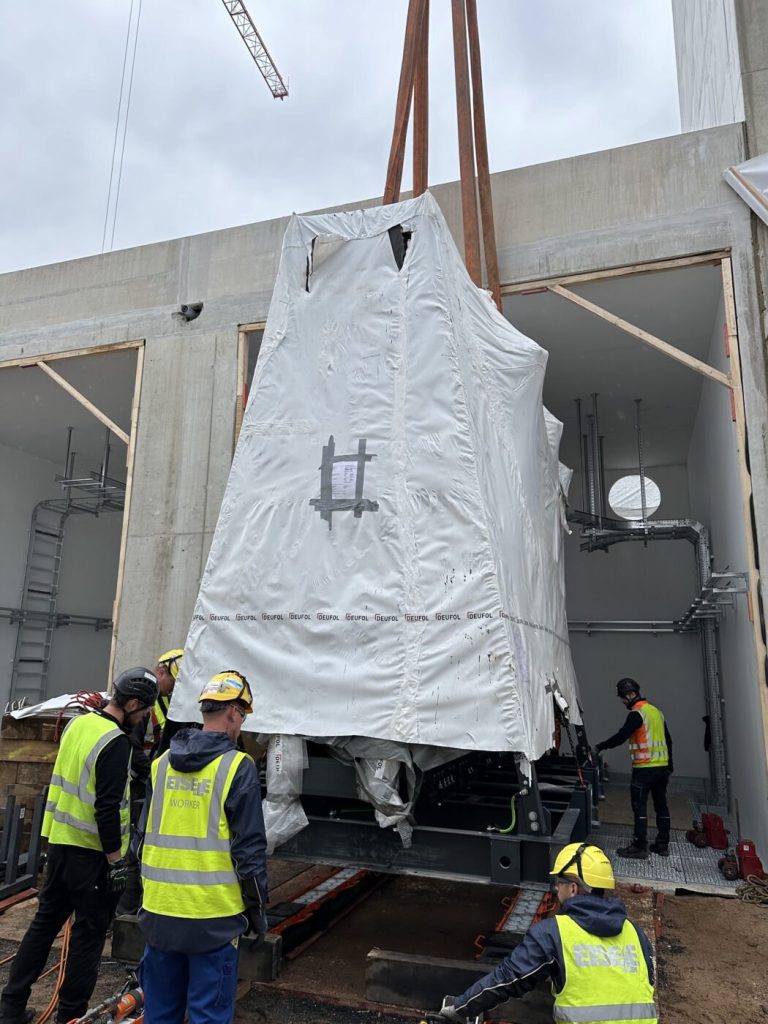
A data center in the Frankfurt area, two transformers of around 52 tonnes each. We unloaded them from the heavy-duty low loader and moved them into their cells on a skidding system. More than 100 tonnes in total in one day on site – with two fitters and a lifting supervisor, as a subcontractor to a heavy haulage and crane company. The transformer hung from the hook in its factory protective cover and went from the trailer onto the skidding system without being set down in between – a hydraulic rail system that pushes loads forward horizontally in short, controlled strokes. The real work was levelling the track, because a few support points generate surface pressures that no unprepared ground can bear.
Installing tanks with a lifting beam – industrial company in Fulda
For an industrial company in Fulda, we delivered, unloaded and installed tanks and silos made of glass-fibre reinforced plastic. The components arrived on lorries and low loaders, were manoeuvred on cramped company premises and unloaded with the telehandler. For the crane lift, a specially manufactured lifting beam was used that prevents angled pull on the vessels. Added to that were a tag line against swinging and a banksman by radio. The tanks were installed on cleaned concrete foundations with protective rubber mats and heavy-duty anchors. Loads with a high centre of gravity and a sensitive shell are handled differently from a steel frame, from the lorry to the foundation.
Delivering and moving in standby power systems – data center construction in the Rhine-Main region
Over the past three years, we have moved more than 60 standby generators into data centers. The heaviest single unit weighed a good 20 tonnes, the heaviest containerised solution 54 tonnes. For loading, this job teaches one thing above all: what hangs from the hook is not a steel component you can reorder, but a unit with no spare in stock. That is why the manufacturer specifies the lifting points, every lift is planned in advance in the lift plan, and the entire crew is briefed. Assemblies such as the diesel engine arrive on transport frames that turn a sensitive component into a load with defined support and lashing points.
Are you facing a loading where weight, centre of gravity or missing lashing points raise questions? Then get in touch with us. With photos, machine data and a site plan of the loading point, we can usually clarify in one conversation which lifting equipment, which vehicle and which securing concept fit.
What this means for your role
For buyers: Write load securing into the transport and installation order as a separate item. Clarify in it who secures, who provides lashing equipment, transport frames and packaging, and who documents the handover. A transport order that only says “free at loading point” leaves open exactly the interface where damage occurs. Ask the haulier for the load distribution plan, and the installation contractor for the securing concept and loading record.
For designers: Request centre of gravity position, lifting and lashing points and transport position from the manufacturer as part of the documentation – not just weight and dimensions. Plan the loading point at the destination too: access for low loaders, load-bearing crane set-up area, route from the vehicle into the building. An installation opening without a stand for the lorry in front of it is only half the planning.
For project managers and site managers: As project manager, you coordinate haulier, installation contractor and crane company so that vehicle, lifting equipment, material and releases all come together on loading day. You also clarify responsibility for load securing in writing. As site manager, you brief on site, define the exclusion zone and banksman, release the lift and sign off the handover to the driver with photos.
For maintenance managers: You know the machine – its bare guideways, its sensitive attachments, the panel that looks like structure but is not. Pass this knowledge on before loading: what has to be secured, drained or covered, where slinging is permitted and where it is not. Record the condition before transport.
For warehouse and logistics managers: Loading heavy goods across your ramp or yard needs space, time and exclusion zones that collide with day-to-day business. Define loading windows and check the load-bearing capacity of ramp and yard for crane or telehandler. Make sure your staff know what is happening on loading day.
For manufacturers and system builders looking for an installation partner: If you deliver units or machines to the end customer, you need a partner at the unloading point. They must comply with your slinging specifications, take the load off the vehicle, move it in and install it. We work as an extended workbench for manufacturers and suppliers, neutrally if desired, with our own lifting equipment and documentation to your project management.
Heavy goods loading checklist on request
The heavy goods loading checklist summarises on two pages what needs to be clarified from the transport order to the handover to the haulier. The points: weight and centre of gravity, load distribution plan, lifting and lashing points, securing method, packaging, lifting equipment at the loading point, exclusion zone and banksman, handover and photo documentation. A tick list for everyone responsible for a loading without doing it every day. Request the checklist via our Contact form – quoting the keyword “Loading checklist”.
Why Omega Mounting?
From Rodgau near Frankfurt, Omega Mounting makes machines, transformers, standby power systems, tanks and plant components ready for transport. We lift them onto the vehicle, secure them and hand them over to the haulier with documentation – or take them off at the destination and move them in. A cable drum of around 22 tonnes whose anchoring points were created on site. Transformers of around 52 tonnes each that went from the low loader onto the skidding system without being set down in between. More than 60 standby generators that reached their positions undamaged. We bring the lifting supervisor – the appointed person for lifting operations, appointed in writing – from our own company. What this role contributes is described in our guide on the appointed person for lifting operations. For you this means: one point of contact for lifting, transport readiness, securing and handover, a workshop in Rodgau for transport frames and slinging aids, 24-hour availability and short distances in the Rhine-Main region. One conversation is enough to clarify whether we are the right partner for your loading.
Conclusion
Load securing for heavy goods is decided before the first strap is applied. What matters is a known centre of gravity, a load distribution plan that has been read, lifting and lashing points that bear load, and a securing concept that puts positive fit before friction. Those who clarify responsibility between loader, driver and haulier in writing beforehand and document the handover have a machine at the destination that arrives the way it left. And proof, in case it does not. Those who plan “load securing for heavy goods” as a project step in its own right no longer have to improvise at the ramp. Send us photos of the load, weight and dimensions and a site plan of the loading point. We will get back to you with an honest assessment of which lifting equipment, which vehicle and which securing your loading needs.
Planning maintenance, moving in or installation in the Rhine-Main region?
Tell us briefly what it is about – we will come back to you with an honest assessment.
100% free and without obligation
You may also be interested in these guides

About the author
Tobias Schott
Managing director of Omega Mounting GmbH, Rodgau · more than 20 years of hands-on experience in installation and maintenance
A trained mechatronics technician, at home in maintenance, servicing and industrial installation since 2004 – first at his father's side, since 2012 with Omega Mounting: from the overhead conveyor in Frankfurt to the crane system in a new-build hall. Plans and leads lifting operations as appointed person in data centers and on industrial sites in the Rhine-Main region, is an instructor and examiner for cranes, mobile elevating work platforms and telehandlers, and a safety officer. On jobs abroad he is known as the “German Troubleshooter” – the one you call when things get stuck on site. He learned what quality means not from a manual but from his father: Made in Germany as a standard for his own work, not as a label. That is why it comes first at Omega Mounting – before speed and before price. He writes these guides from that practice: what works on our sites is in them – what only exists in the standard is not.
Frequently asked questions
That depends on who breached which duty. The German Road Traffic Regulations (StVO) place duties on driver and vehicle keeper. The German Commercial Code (HGB) places the duty of transport-safe loading on the consignor and operationally safe loading on the carrier; the loader also bears responsibility. After damage, several parties are therefore usually affected. Allocate responsibility in writing beforehand and document the securing. This article is no substitute for legal advice.
Positive-fit securing mechanically blocks the movement of the load – by blocking against the headboard, stanchions or wedges, or by direct lashing with chains and straps that block each direction individually. Friction securing presses the load onto the loading area by tie-down lashing and uses friction. Heavy goods are secured by a combination, because friction alone is insufficient for high masses.
A load distribution plan shows, for a specific vehicle, at which point on the loading area a load of a given weight may stand. This ensures that no axle is overloaded and the steering axle is not relieved too much. For a heavy single load that accounts for the entire payload, it is indispensable. Request it from the haulier before loading and give them weight and centre of gravity position in advance.
Then they are created – not improvised. Options are a transport frame with its own lashing points to which the machine is bolted, or slinging aids and lashing brackets that transfer the forces into the base frame. Positive fit by wedges, locking bars and blocking against load-bearing body parts is also possible. Straps around panels or hoods are not a solution, because these parts yield and the securing comes loose.
Bare guideways receive corrosion protection, media connections are sealed, moving axes secured, loose parts removed and labelled. Then follows a cover against dust and moisture, fixed all the way round so that the airflow does not loosen it. Sensitive units such as transformers stay in their factory protective cover until installation. Where straps run over edges, edge protectors protect load and lashing equipment.
As soon as the loaded vehicle exceeds the generally permissible dimensions, weights or axle loads, the transport requires a permit. It then needs a specialist haulier, a defined route and escort vehicles where required. A transformer of around 52 tonnes is always an abnormal load; a machine tool can become one through width or height. Clarify this early, because permits need lead time.
Yes – the principles are the same whether a generator goes into a data center, a tank into a bakery or switchgear into a hospital. What changes is the environment and the sensitivity of the load: food businesses require residue-free packaging, security areas regulated access for drivers and fitters. Centre of gravity, load distribution, positive fit and handover remain.
From Rodgau, Omega Mounting handles the loading of heavy goods in Frankfurt, Offenbach, Hanau, Darmstadt, Aschaffenburg, Raunheim and throughout the Rhine-Main region: making ready for transport, lifting, positioning, securing, handing over. We work together with hauliers and crane and heavy haulage companies, or as their subcontractor.
With a short enquiry containing three details: photos of the load with weight and dimensions, a site plan or photos of the loading point with access and lorry stand, and the preferred date with destination. We clarify centre of gravity, lifting equipment and securing concept – with a site visit if required – and send you a written assessment with the interfaces to your haulier. Your contact is Tobias Schott – reachable via our Contact form.
 English
 German