
- Project report – loading a cable drum in the port of Aschaffenburg
Enclosing a cable drum UV-safe and loading it in the port of Aschaffenburg

How three fitters enclosed a cable drum weighing around 22 tonnes in two layers of custom tarpaulin within a few hours – with a fastening that did not exist beforehand
The low-loader was already on its way. The custom tarpaulin was with the driver in the trailer. And only at the loading point in the port of Aschaffenburg did it become clear what was missing: the tarpaulin had eyelets, cleanly made, in the right size, all the way round. But there were neither anchor points on the drum nor the connecting elements to bring the two together. A complete fastening system had been announced. A tarpaulin was delivered.
From that moment on, every minute counted. A low-loader at the loading point does not wait, and the cable was supposed to go on the road protected from UV.
This is exactly where our team came in: three fitters from the Omega Mounting crew, one working day, a reach stacker from the port operator – and at the end a loaded low-loader with a drum whose cable was protected all round. The fastening solution was created on site, from available material, a short trip to the supplier and a team that divided up the task instead of postponing the date.
Project profile
- Scope: Transport preparation of a large cable drum for road transport – fitting a UV protection tarpaulin in two layers over the entire cable winding, development and execution of the complete fastening solution on site, procurement of the missing fastening material during the ongoing job, supervision of the lifting operation and signalling for the equipment operator, loading and securing the drum on the low-loader
- Team: 3 fitters from the Omega Mounting crew
- Project duration: one working day – loading was completed within a few hours
- Location: Handling area in bayernhafen Aschaffenburg
- Weight: around 22 tonnes, drum including cable
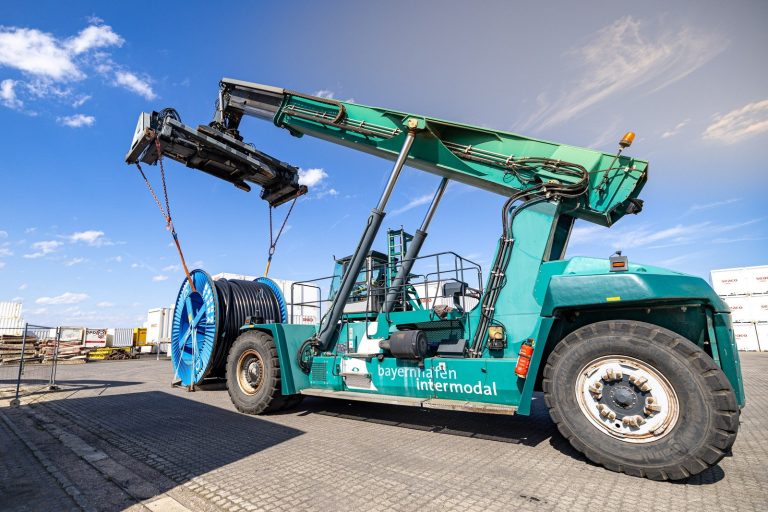
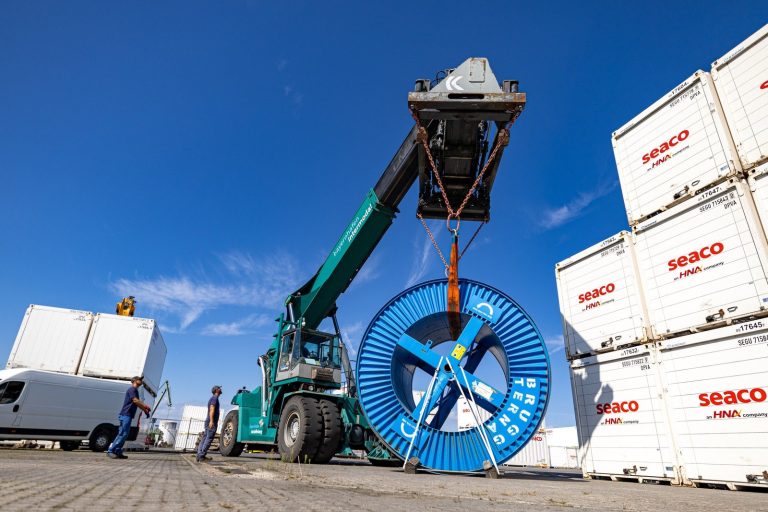
- Lifting equipment: Reach stacker from the port operator with chain sling on the spreader
- Client: Cable manufacturer – not named at the customer's request
- Special feature: The announced fastening material was missing on delivery – the complete solution was created at the loading point
- Result: Cable under two layers of custom tarpaulin, drum lashed on the low-loader, loading date kept

Why does a cable on the drum need to be protected from UV radiation?
Because the plastic sheath ages as soon as it lies unprotected in the sun. Power and medium-voltage cables have an outer sheath of polyethylene or PVC, and this reacts sensitively to UV radiation: the molecular chains break up, the sheath becomes brittle, fine hairline cracks form. Through these cracks, moisture and dirt later reach places where they have no business being – the conductive layer, the screen, in the worst case the insulation.
This is not damage you can see when unreeling. It shows up years later, when the cable has long since been laid.
Then there is the rain. On an open drum, water runs between the layers and stays there. No operator wants to take over a cable that has been wound wet for days, and no incoming inspection lets that pass.
With this drum, both came together: before loading, it had stood on the handling area in the port for several months – summer, sun, rain, all unprotected on the winding. For the journey at the latest, that was to end.
For transport this means: It is not the drum that needs protecting, but the cable on it. The drum is the means of transport; the cable is the value. That is why the client had a tarpaulin made to custom dimensions that fits exactly around this winding – large enough for two full layers so that no area remains open at the joints either.
How is a cable drum weighing 22 tonnes enclosed with a tarpaulin?
Suspended – there is no other way. As long as the drum stands on the ground, part of the winding rests on the contact surface and is inaccessible. Nor can a drum of this size be rolled aside briefly to pull the last section through.
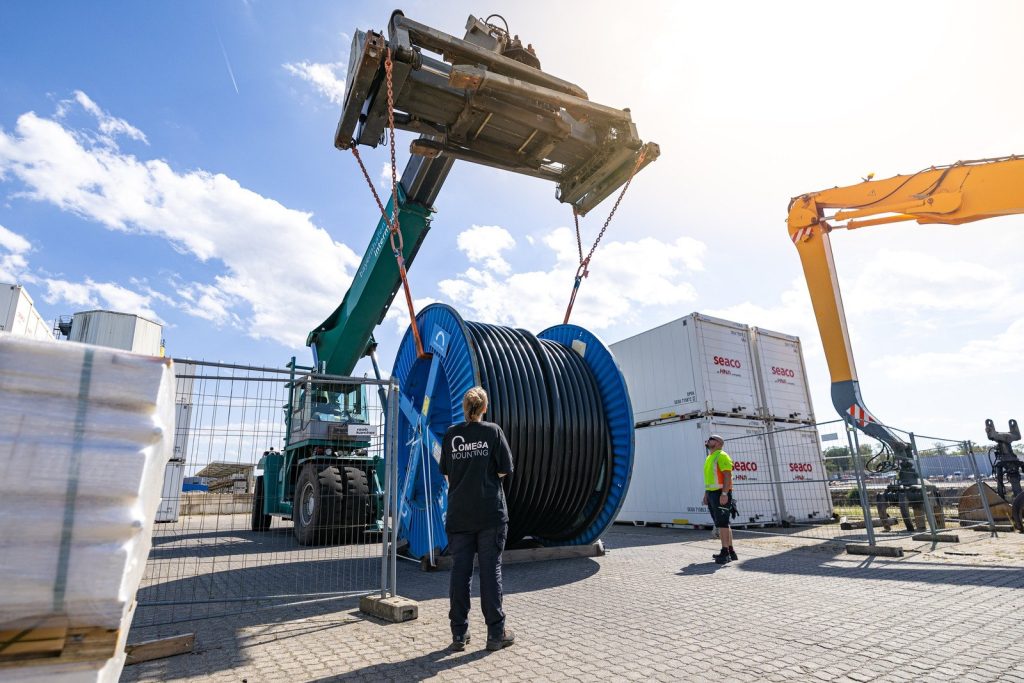
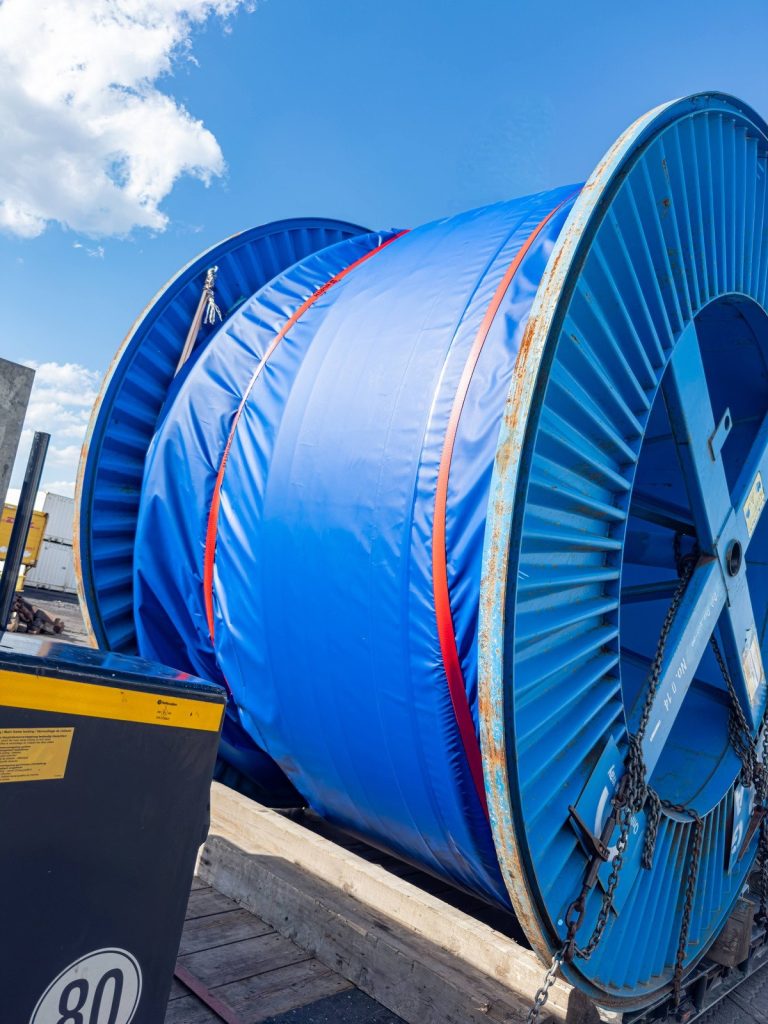
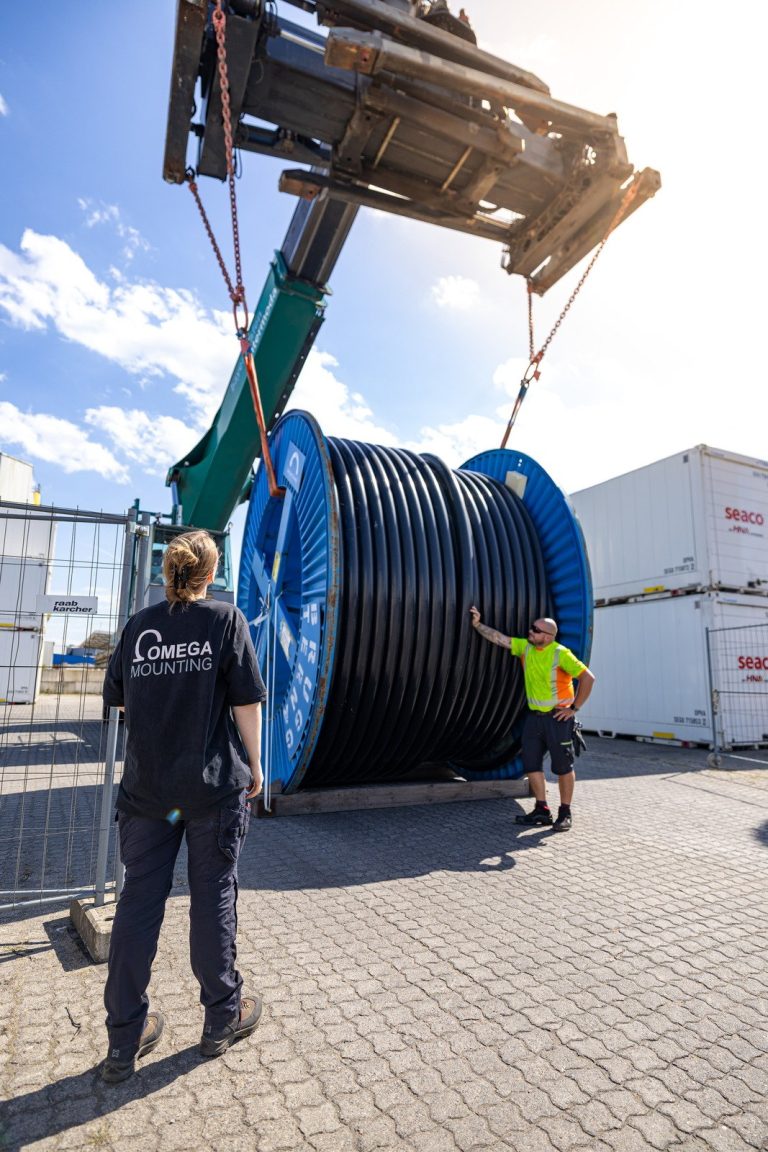
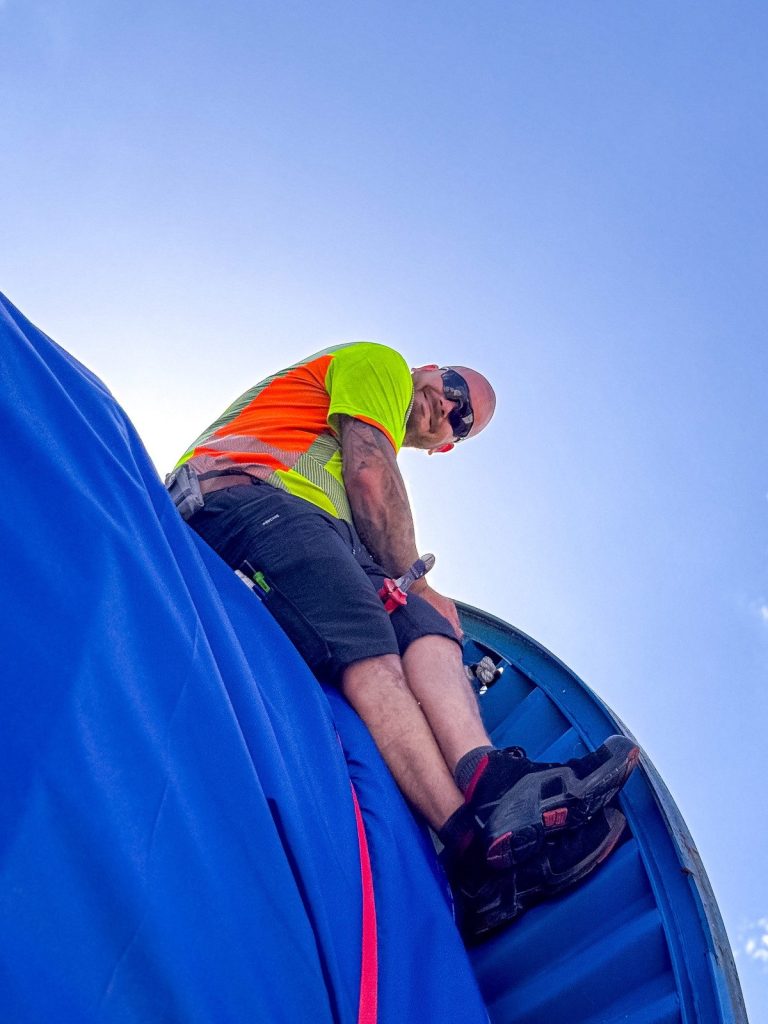
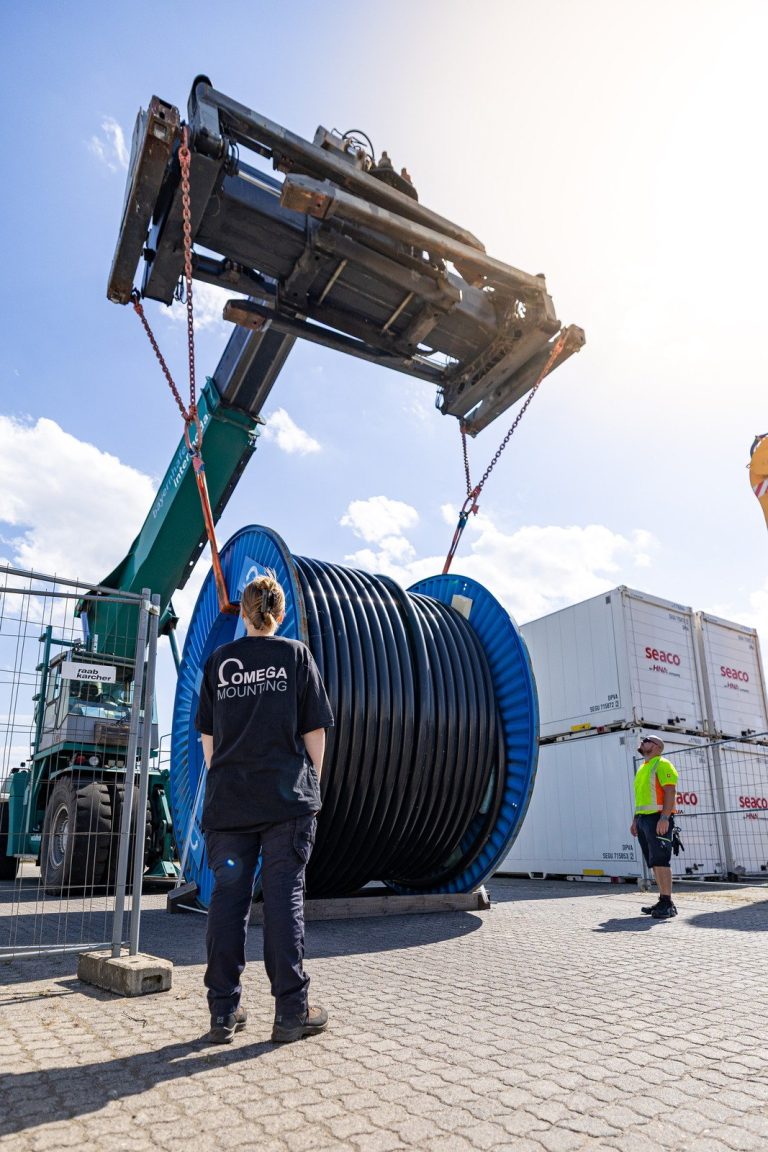
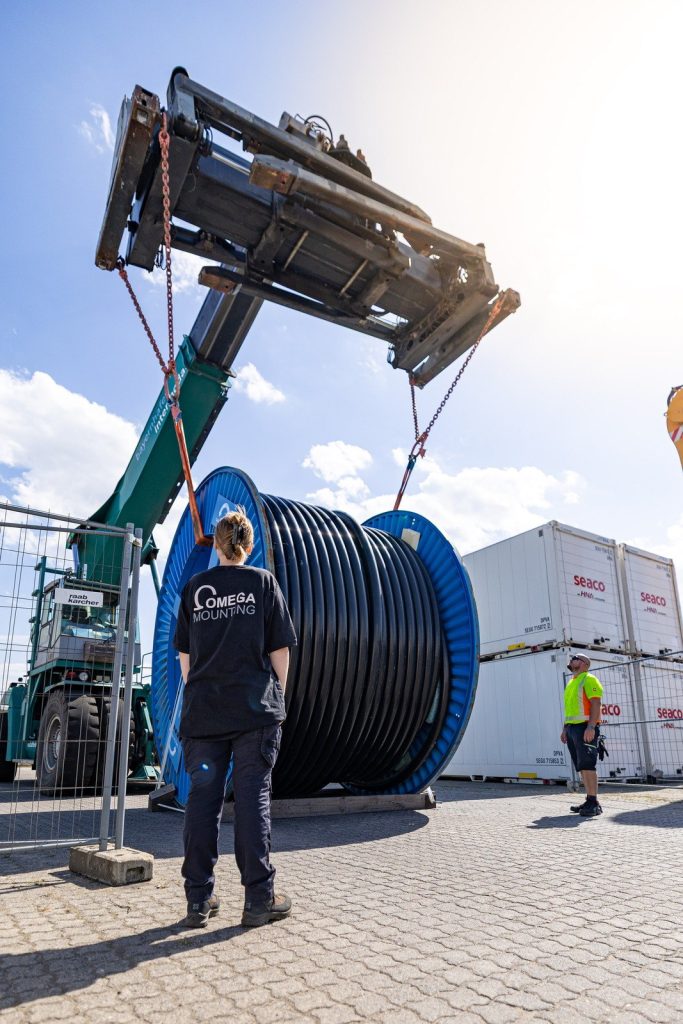
That is why the drum was raised by the reach stacker, held suspended, and the tarpaulin was laid over the winding from above and wrapped twice around the circumference. This moment is clearly visible in the photos: the drum hangs from the chain sling, two fitters guide and tension the tarpaulin material, the third works on top of the drum and aligns the layers.
This is the point at which an apparently simple task becomes real assembly work. A tarpaulin of this size has surface area, and surface area pulls with every gust of wind. Added to this is coordination with the operator of the lifting equipment: every movement of the load had to be called before it was carried out. Only when both layers lay clean and free of folds was the drum set down on the low-loader.


What happens when the announced fastening material does not arrive?
You procure it – while the lorry is standing.
The plan was for the custom tarpaulin to be delivered together with the matching fastening system. What arrived was the tarpaulin: cleanly made, in the right size, with eyelets all round. But the eyelets were worthless without a counterpart. The anchor points on the drum itself were missing, as were the connecting elements to couple tarpaulin and drum at all.
The chain behind it made things worse: the tarpaulin was sent by the client directly to the haulier and only brought to the loading point by them. So before delivery, nobody could check what was actually in the package – and the driver was already on his way at that point. In such constellations, the error structurally always comes to light only when it is most expensive.
Instead of abandoning the date, the team divided up the task. Two fitters continued working on site and prepared the drum for the lift and the tarpaulin handling, while the third procured the required material from our suppliers in parallel. He came back with ratchet straps, clamp fittings, wire ropes and cable ties.
The fastening was created from these: clamp fittings and wire ropes form the anchor points on the drum flange that did not exist before. The ratchet straps take the tensile forces and lay the tarpaulin tightly around the winding. The cable ties secure the tarpaulin edges and the rows of eyelets against flapping – the many small points where the airflow would otherwise take hold and turn a loose corner into a tear over 300 kilometres.
The requirement: the fastening must withstand the airflow over the entire transport route – and be removable without damage at the destination. A bolted or welded solution would have been quicker, but would have damaged the drum, which goes back into circulation afterwards.
For the customer, this was the difference between "the cable sets off today" and "the low-loader drives back empty".
What matters when working on a suspended load?
Three things: clear commands, a secured position and an equipment operator who holds the load steady.
A suspended drum is not a stable workplace. It swings, it rotates, and it reacts to every shift in weight. Anyone working on it has to know where the load will be in the next moment. That is why there was exactly one banksman with eye contact to the driver of the reach stacker – hand signals instead of shouts, every movement called, no movement while someone is working on the winding.
Our fitters are SCC-certified and trained for work under and on suspended loads. On the port premises, coordination with the port operator was added: the reach stacker, the sling and the handling area belong to bayernhafen Aschaffenburg, and the traffic around them continues. In such situations we work in step with the other parties involved instead of demanding a procedure of our own.
Improvisation expressly has no place here. Improvisation took place in fastening the tarpaulin – i.e. in the material. Not in safety.

Why is an assembly partner at the loading point worthwhile?
Because there is regularly a gap in responsibility between haulier, port operator and client.
The haulier provides the vehicle and load securing. The port provides the lifting equipment and the area. The client supplies goods and specifications. But nobody is responsible for working on the load itself: fitting a tarpaulin, setting a bracket, improvising a special construction, standing on top of a suspended drum and getting hands-on there.
That is exactly our role. We bring tools, material and the willingness to develop a solution on site that was not on paper beforehand. And we are there quickly: from our company headquarters in Rodgau it is around 35 kilometres to Aschaffenburg.
Why Omega Mounting?
- Solution instead of query: The announced fastening material was missing. We created the anchor points on the drum ourselves – on the same day, at the loading point.
- Short line to suppliers: While two fitters carried on working, the third was already at the supplier. Missing material does not stop a date with us.
- Working on the suspended load: Coordination with the equipment operator, clear commands, secured work on and on top of the drum – SCC-certified personnel, no improvisation in safety.
- Pace in handling operations: A low-loader at the loading point costs money. After a few hours it was loaded and on its way.
- Interface competence: Haulier, port operator, client – we work within other people's procedures without slowing them down.
- We already knew this drum: In spring 2026 we repaired its damaged tubular shaft in the same port using the TIG process – with the high-voltage cable fully wound on.
- Rooted in the region: From Rodgau we are quickly on site in Aschaffenburg, Hanau, Seligenstadt, Offenbach and the entire Rhine-Main region – and work throughout Germany.

The same drum, second job
We already knew this drum. In spring 2026 we repaired its central tubular shaft in the same port: it had cracked and deformed in several places due to improper slinging. It was repaired in one piece, using the TIG process, with precisely fitting tube segments from a donor drum – and the high-voltage cable weighing several tonnes remained wound on throughout the entire repair. The project diary entry repairing a cable drum in the port of Aschaffenburg documents the case.
After that, the drum stood in the port for several months. During loading in September, the repaired shaft carried the full weight of the winding without complaint – lifted on the chain sling, enclosed while suspended, set onto the low-loader.
For us, that is the best proof a repair can get: it holds when it matters. And for the customer it means that both tasks – repair and transport preparation – came from one team that already knew the equipment.

Conclusion
A custom tarpaulin without a fastening system, a drum weighing around 22 tonnes and a haulier already standing in the yard: at the end of the working day, the low-loader was loaded and the cable protected from sun and rain under two layers of tarpaulin. The anchor points needed for this did not exist in the morning.
If a load at your site needs to be made ready for transport, secured, packaged or transhipped – and you need someone who keeps working on site even when something is missing: that is exactly what we are here for.
Request a callback for your project now – tell us briefly what it is about, and we will get back to you with an honest assessment. Omega Mounting GmbH, Hügelstraße 5, 63110 Rodgau. As an assembly company from the Offenbach district, we are quickly on site in Aschaffenburg, Hanau, Seligenstadt, Offenbach and Frankfurt – and work throughout Germany. 100 % free of charge and without obligation.
Photo gallery of the job
Are you planning a project of this kind?
Tell us briefly what it is about – we will come back to you with an honest assessment.
100% free and without obligation
Related guides for this project
Maintenance & Servicing

About the author
Tobias Schott
Managing director of Omega Mounting GmbH, Rodgau · more than 20 years of hands-on experience in installation and maintenance
A trained mechatronics technician, at home in maintenance, servicing and industrial installation since 2004 – first alongside his father, and since 2012 with Omega Mounting: from the overhead conveyor in Frankfurt to the crane system in a new-build hall. As appointed person for lifting operations, he plans and leads lifting operations in data centers and on industrial sites in the Rhine-Main region, is an instructor and examiner for cranes, aerial work platforms and telehandlers, and a safety officer. On assignments abroad he is known as the "German Troubleshooter" – the one you call when things get stuck on site. He did not learn what quality means from a manual, but from his father: Made in Germany as a standard for his own work, not as a label. That is why quality comes first at Omega Mounting – before speed and before price. The project diary shows the jobs his team has planned and carried out – without customer names, but with everything that can be learned from them.
Frequently asked questions
Because the plastic sheath ages under UV exposure: it becomes brittle and develops fine cracks through which moisture can later penetrate. For longer storage or transport outdoors, a cover is therefore not a luxury but value preservation. It is the cable that needs protecting, not the drum.
The tarpaulin is guided over the raised drum, laid in two layers around the winding and then secured to the drum structure and against the trailer – not to the cable itself. In this case we created the anchor points with clamp fittings and wire ropes on the flange, tensioned with ratchet straps and secured the edges against flapping with cable ties. The decisive factor is that the fastening withstands the airflow and can be released again without damage at the destination.
Short-notice jobs are our normal case – including evenings, weekends and public holidays. On this project, loading was completed within a few hours. From Rodgau to Aschaffenburg it is around 35 kilometres. One call is enough for a first reliable assessment.
We keep working instead of postponing. On this project, the delivered custom tarpaulin had eyelets, but the anchor points on the drum and the connectors were missing – this was only noticed on delivery by the haulier. We split the team, procured the missing material from our suppliers and built the fastening on site. The loading date was kept.
Our personnel are SCC-certified, and we work with a risk assessment and a documented procedure. For jobs in security and special areas, we additionally hold airport ID cards, Avetta certification and a mining approval.
In this case, the port operator: the drum was lifted with a reach stacker from bayernhafen Aschaffenburg and a chain sling on the spreader. We then take over the work on the load and the signalling – we bring a mobile crane or our own lifting equipment if nothing is available on site.
Yes. From Rodgau we are on site in Aschaffenburg, Hanau, Seligenstadt and the entire Main corridor in a short time – and work throughout Germany. We have already worked in the port of Aschaffenburg several times, including on the weld repair of a cable drum.
Yes. In spring 2026 we repaired the damaged tubular shaft on the same drum in the same port using the TIG process – without unreeling the high-voltage cable. After that it stood in the port for several months until it was loaded in September. The repaired shaft carried the full weight during loading without complaint.
That depends on team size, duration and the material required. Call us or describe the task briefly – we will tell you honestly what is feasible and what it costs.
 English
 German