

- Project report – cable drum repair in the port of Aschaffenburg
Repairing a cable drum in the port of Aschaffenburg – weld repair of the tubular shaft on site
How two mechanics repaired a cracked tubular shaft in half a day – without unwinding the high-voltage cable weighing several tonnes
When cable drums for high-voltage cables are transported and handled, enormous forces act on the structure. Even small errors in slinging or lifting can lead to considerable damage – and in the worst case prevent the entire transport or any further use of the drum.
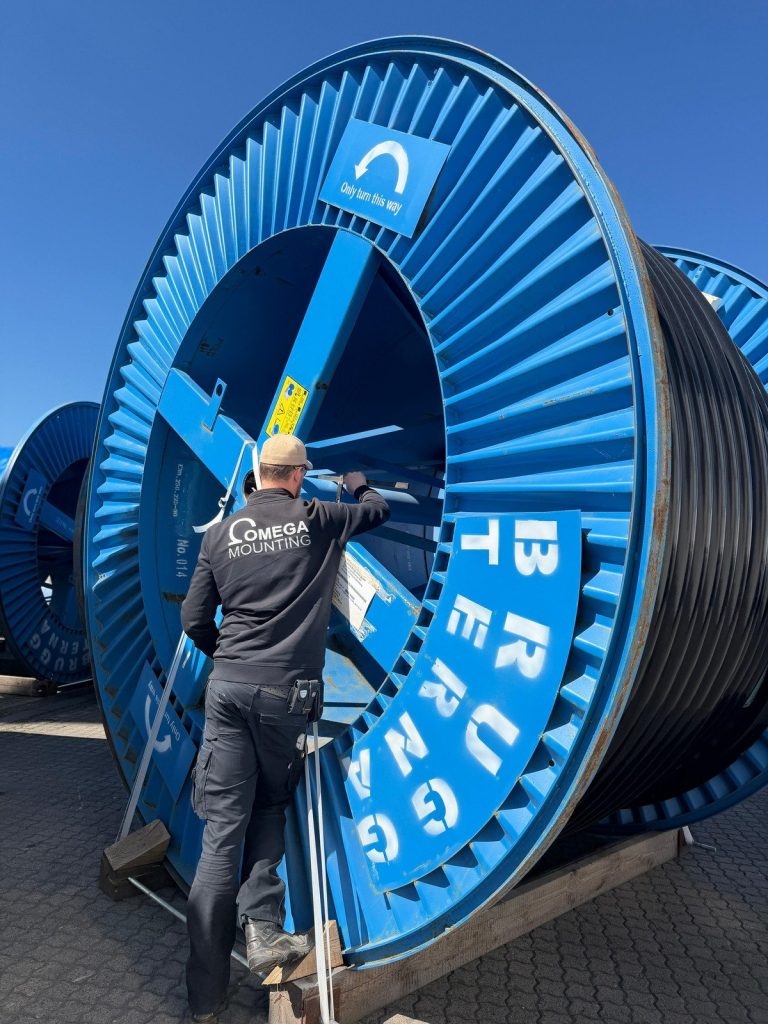
Omega Mounting was commissioned with exactly such a challenge in the port area of Aschaffenburg: the central tubular shaft of a large cable drum had been damaged by improper slinging – while the high-voltage cable weighing several tonnes was already fully wound onto the drum.
Our solution: a complete weld repair directly on site, using the TIG process, with precisely fitted repair pieces – without having to unwind the cable or move the drum.
Project profile
- Scope: Weld repair of the damaged tubular shaft of a cable drum directly on site – damage analysis, cutting out the damaged areas and grinding out all cracks, fabrication of precisely fitting repair pieces from an identical drum, fitting and TIG welding of the tube segments, partly in positional welding, protection of the wound high-voltage cable during all work, finishing, corrosion protection and recoating
- Team: 2 mechanics from Omega Mounting
- Project duration: Site visit with recording of the damage pattern in April 2026, repair in half a day at the end of May 2026
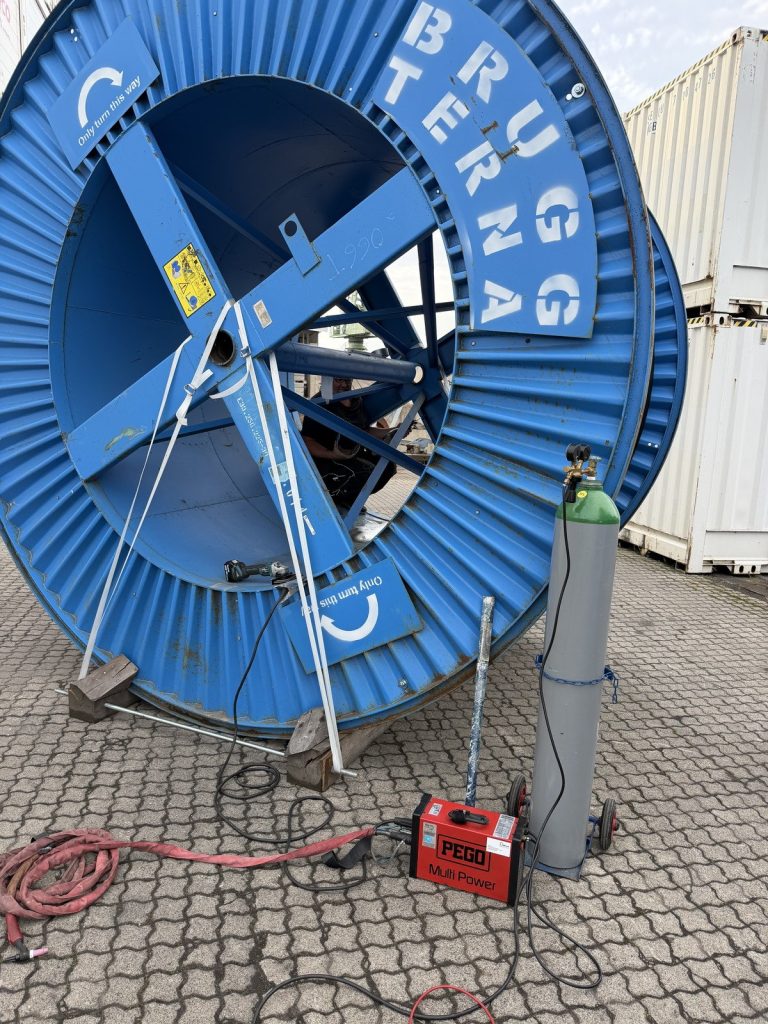
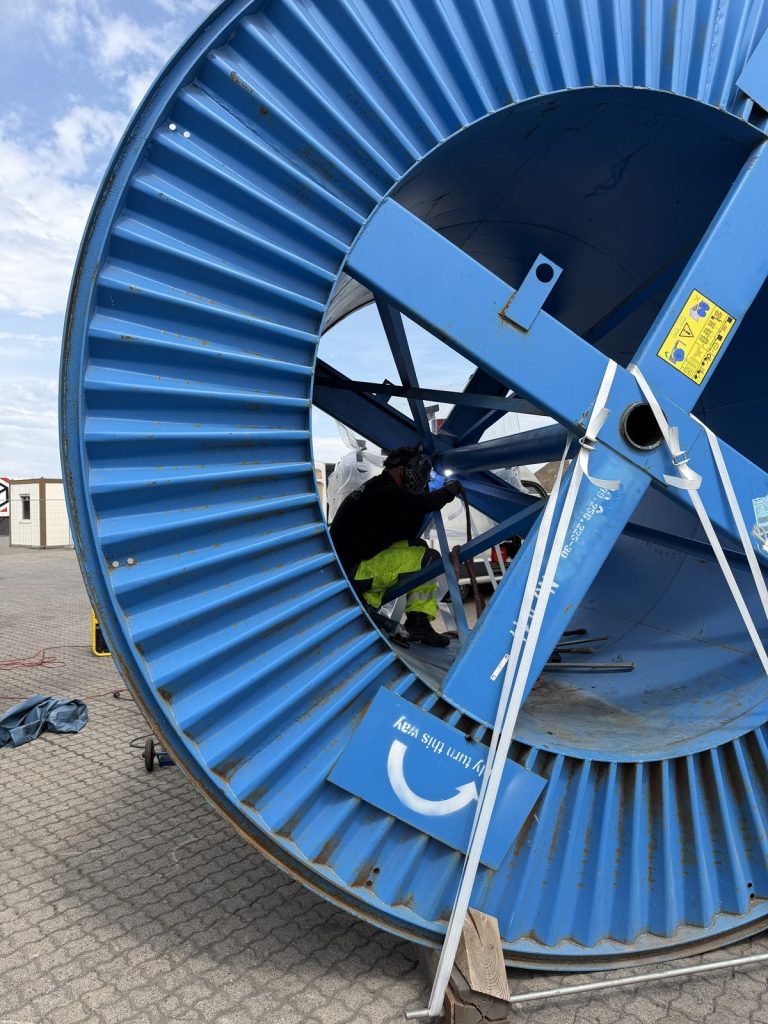
- Process: TIG welding with mobile equipment, work inside the drum in constrained positions up to overhead
- Location: Port area of Aschaffenburg (Bavarian Lower Main, around 30 km from our head office in Rodgau)
- Client: Cable manufacturer – not named at the customer's request
- Special feature: Repair in one piece – the high-voltage cable weighing several tonnes stayed on the drum throughout the entire repair
- Result: Load-bearing capacity and concentricity permanently restored, drum fully serviceable again – without unwinding and without procuring a replacement
Why are cable drums for high-voltage cables so sensitive?
A cable drum for high-voltage cables is far more than a transport frame: its central tubular shaft carries the entire weight of the wound cable – often several tonnes – and must run exactly on its bearing points when the cable is paid out.
If such a drum is slung incorrectly, for example with a chain directly on the shaft, point loads arise for which the structure is not designed. The result is cracks and deformation in the load-bearing structure. A damaged drum may not be lifted or unwound any further – the risk to cable, personnel and surroundings would be too high.
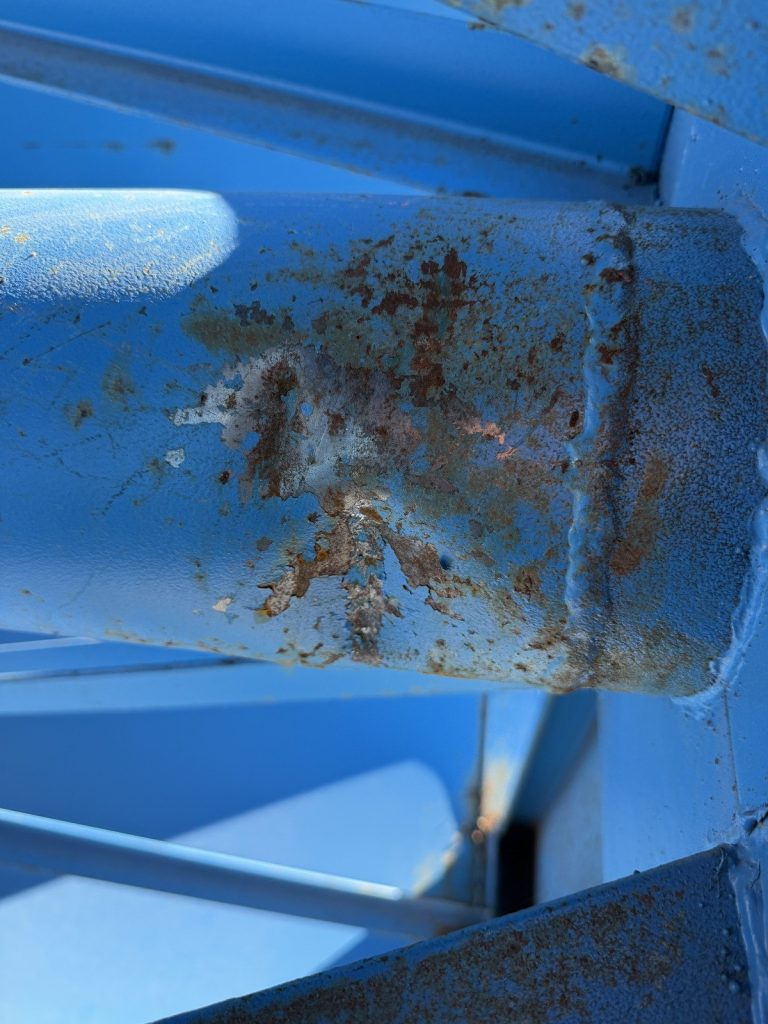
Exactly this case applied here: improper slinging with a chain had damaged the central tubular shaft in several places. Safe use was no longer guaranteed.
Why did the repair have to take place directly in the port?
The short answer: because the high-voltage cable was already fully on the drum. Unwinding it would have involved enormous logistical effort and time – and was therefore out of the question.
So only one way remained: the complete repair had to be carried out directly in the port area of Aschaffenburg – with mobile welding equipment, well-thought-out work preparation and a repair concept that permanently restores the drum's full load-bearing capacity.
How does a professional weld repair proceed?
It starts not with the welding set but with the damage analysis. Before the actual repair began, every damaged spot was carefully examined.
On this project, the damage analysis had its own appointment. In April we drove to the port for a site visit and recorded the damage pattern in full: every crack examined, photographed and measured. Only then was it clear how much tube had to come out, where the replacement pieces would come from and which material, tools and welding set would be needed on the repair day.
This separation is deliberate. Anyone who arrives with the welding set and only realises on site that a segment is missing or the access does not fit loses a whole day – and with a drum that may not be moved, that also means standing time for everyone involved. The actual repair at the end of May was therefore completed in half a day.
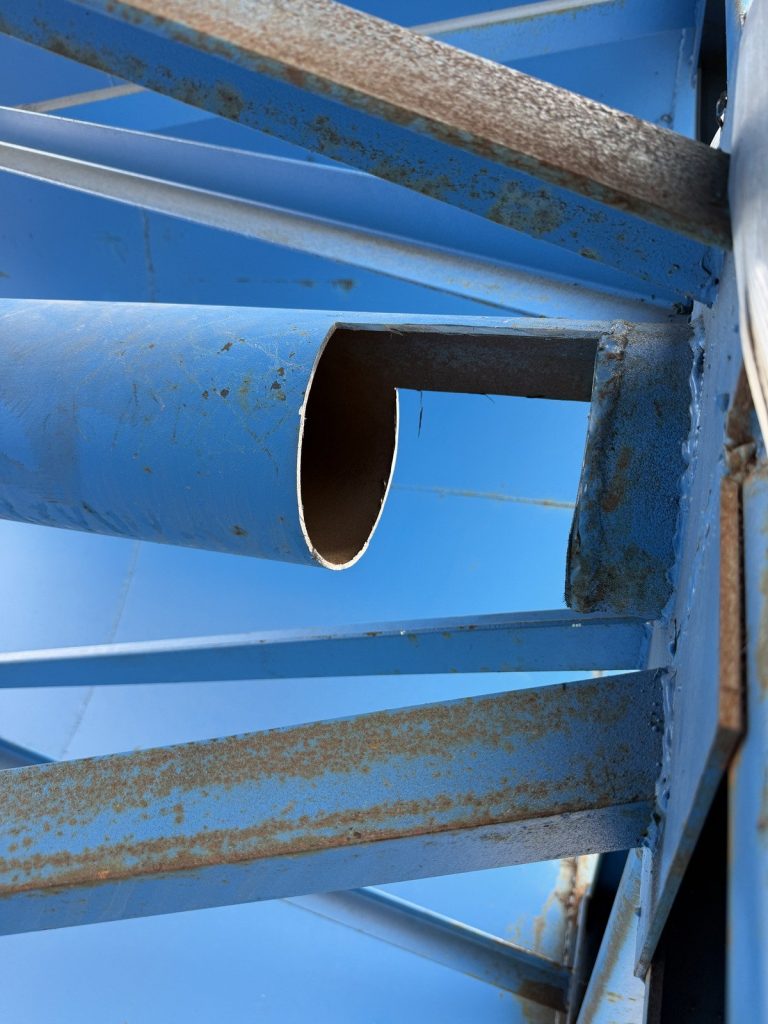
Our welders then removed the damaged area completely and ground out all cracks down to sound parent material. Only in this way can it be ensured that no pre-existing damage remains in the material and that the load-bearing capacity can be permanently restored.
This step is particularly clear in the pictures: the damaged tube sections were fully opened up and prepared for the subsequent repair.
Where did the matching replacement parts come from?
From an identical, likewise damaged cable drum – an economical and sustainable solution that we decided on together with the customer.
The required repair pieces were cut out of the donor drum. This provided exactly matching tube segments with identical diameter and the same wall thickness. After cutting, the replacement pieces were adapted and fitted to the millimetre.
This approach not only saves material and costs, but at the same time ensures an optimum fit – instead of replacing the entire drum.
Why TIG welding – and why in constrained positions?
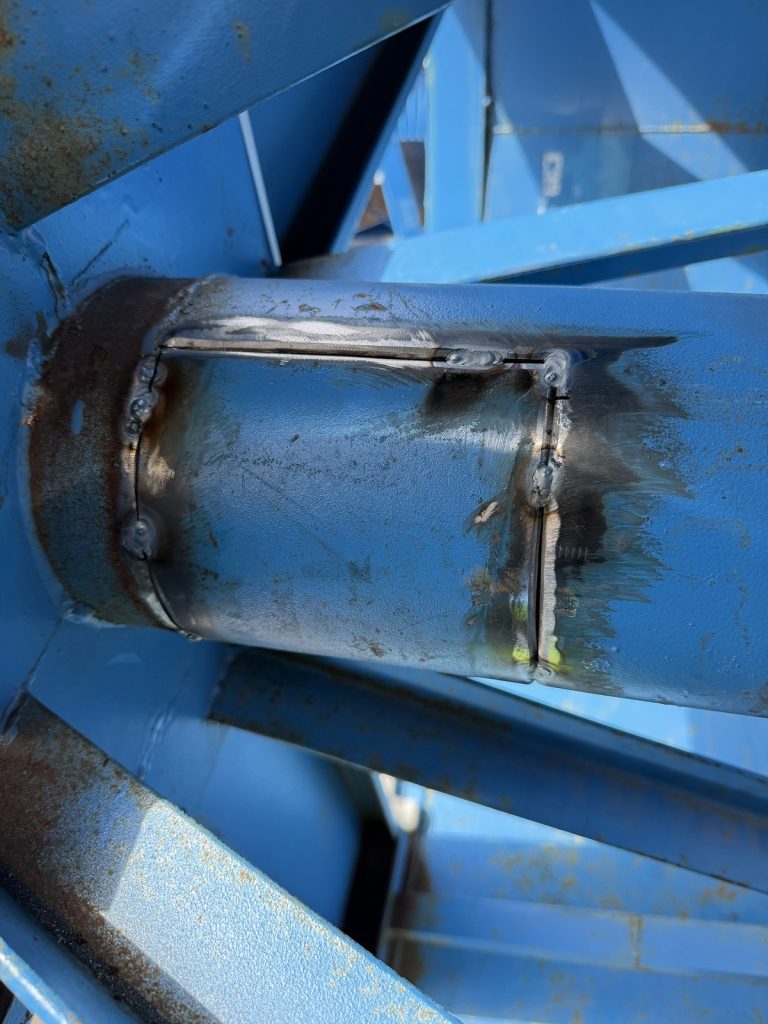
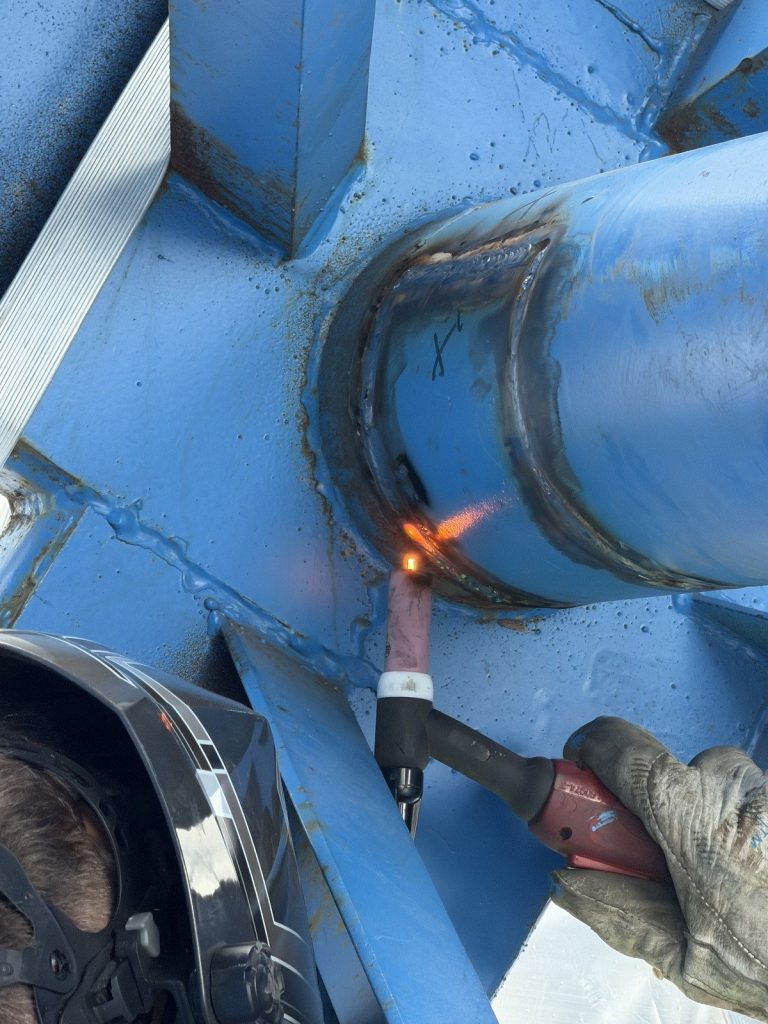
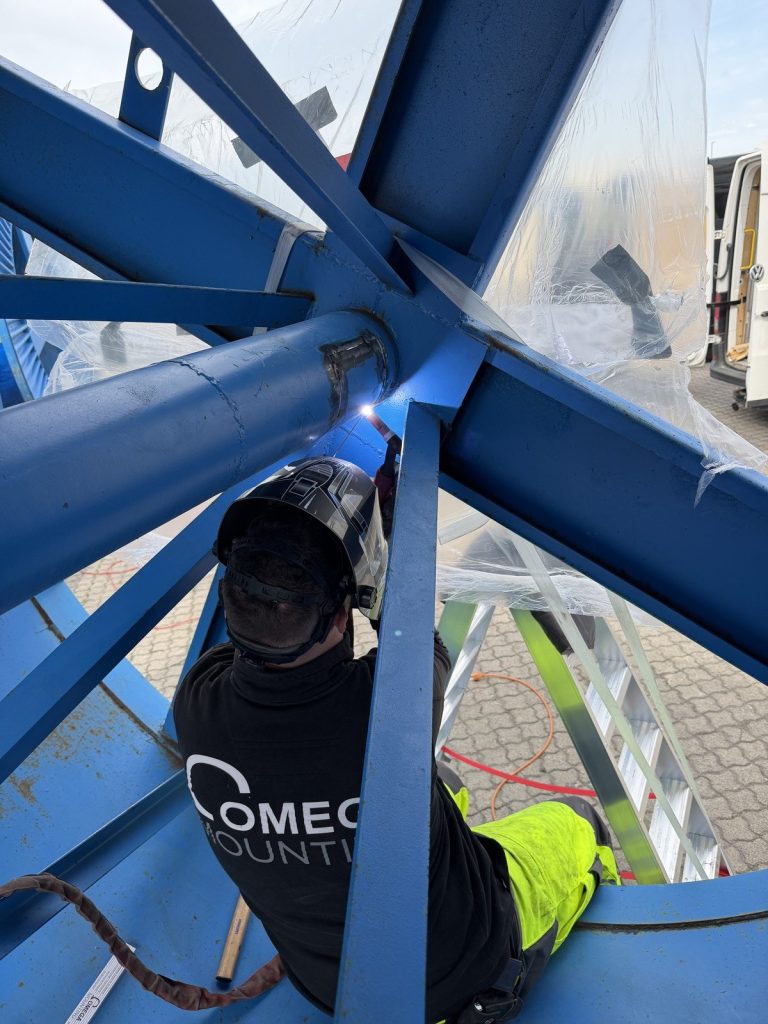
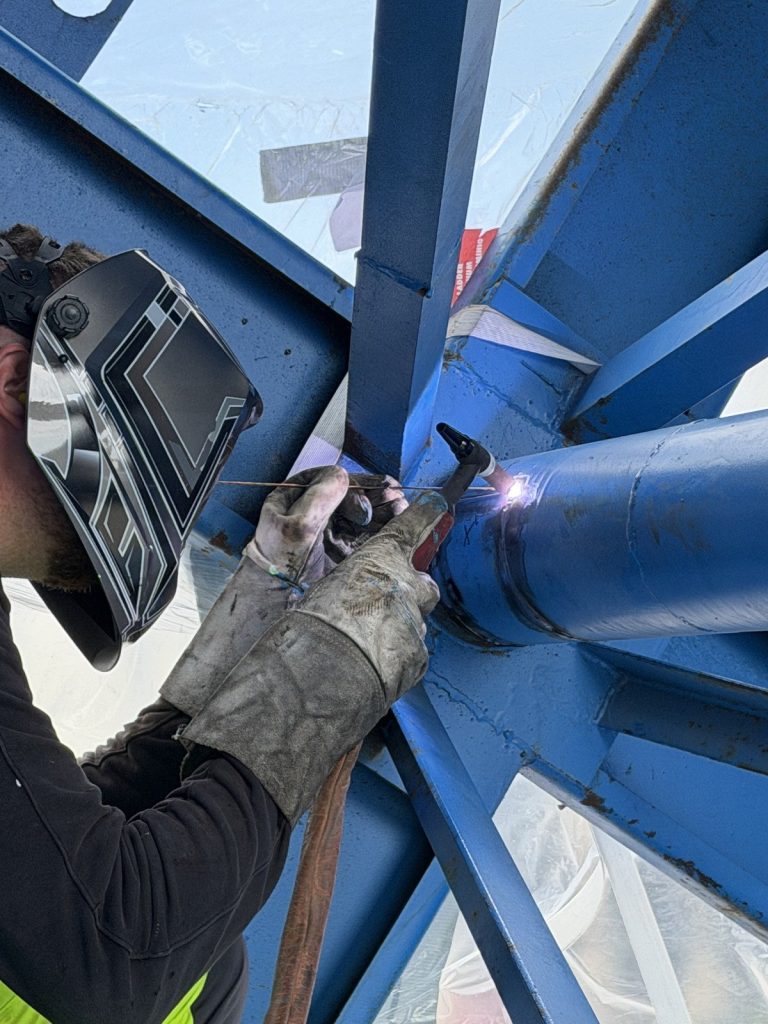
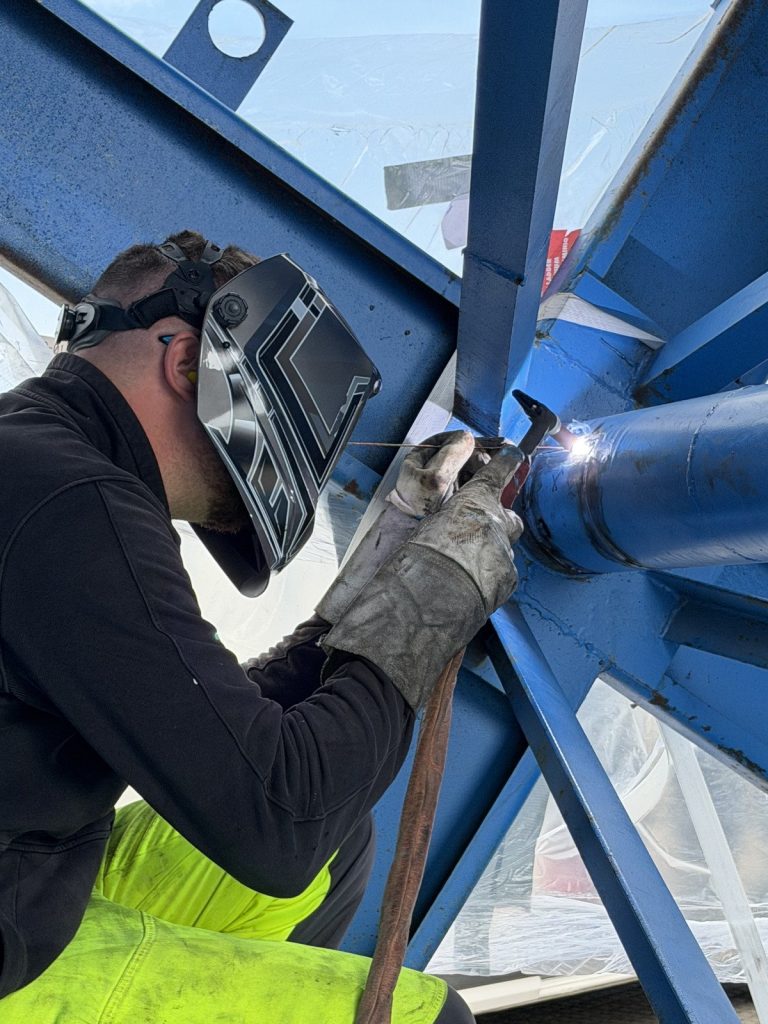
The TIG welding process is particularly suitable for high-quality repairs on load-bearing steel structures, as the heat input can be controlled very precisely. Especially at the drum's tube joints, uniform full-penetration welding was decisive: the repair pieces were welded all round and then finished in a controlled manner.
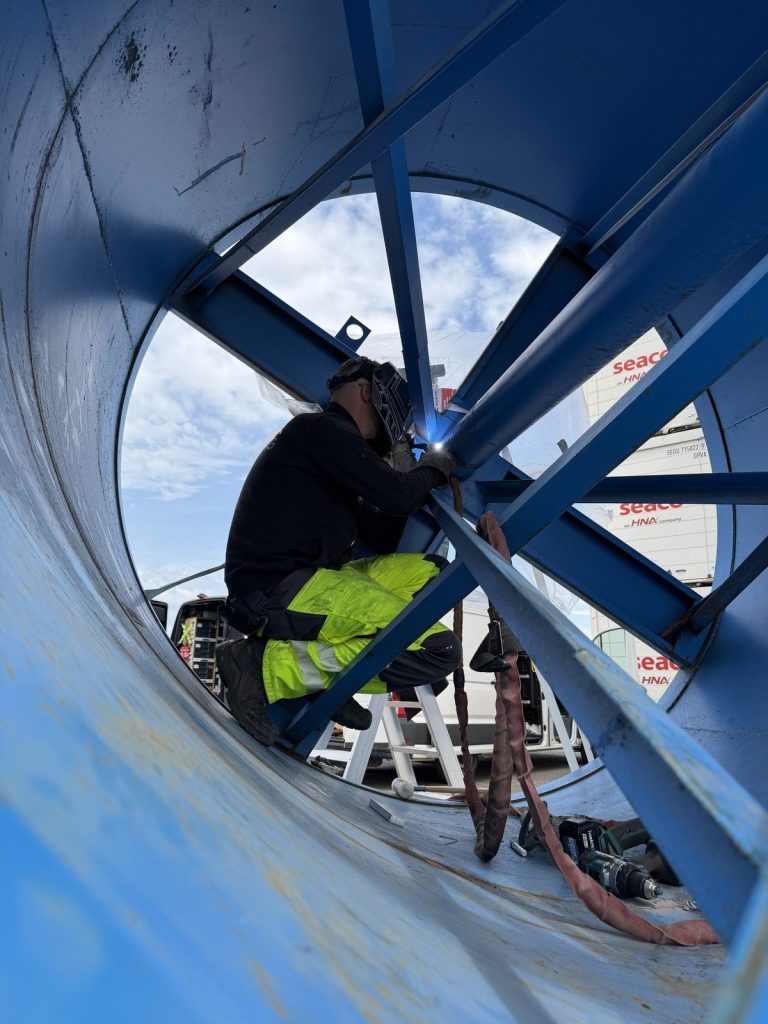
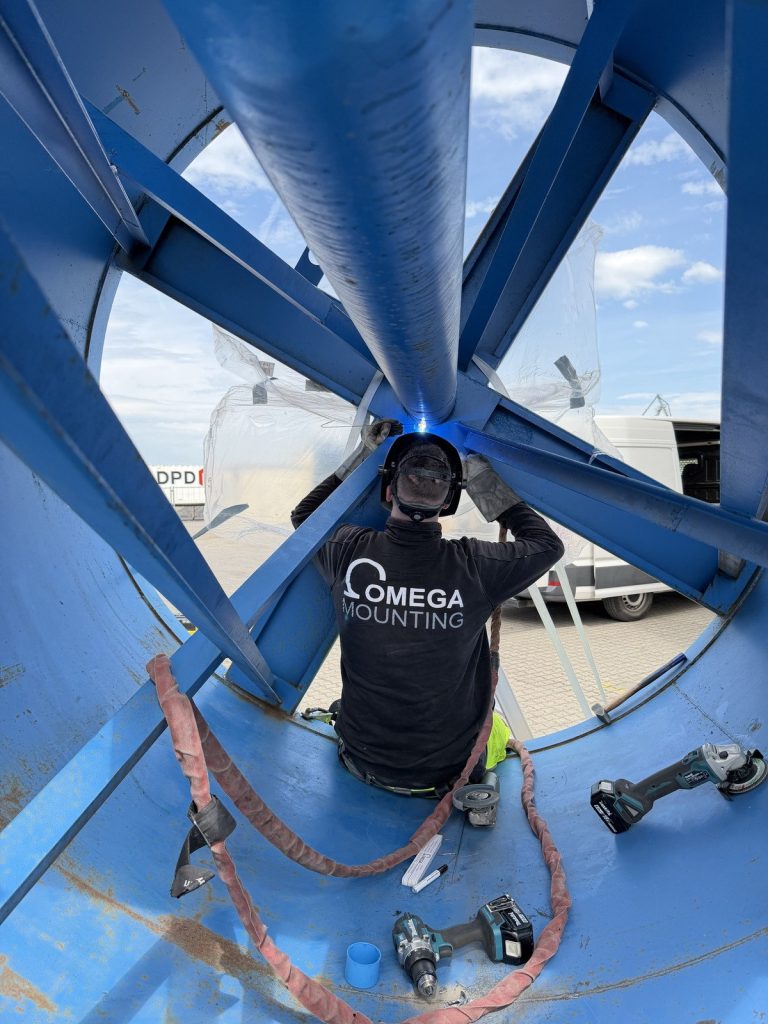
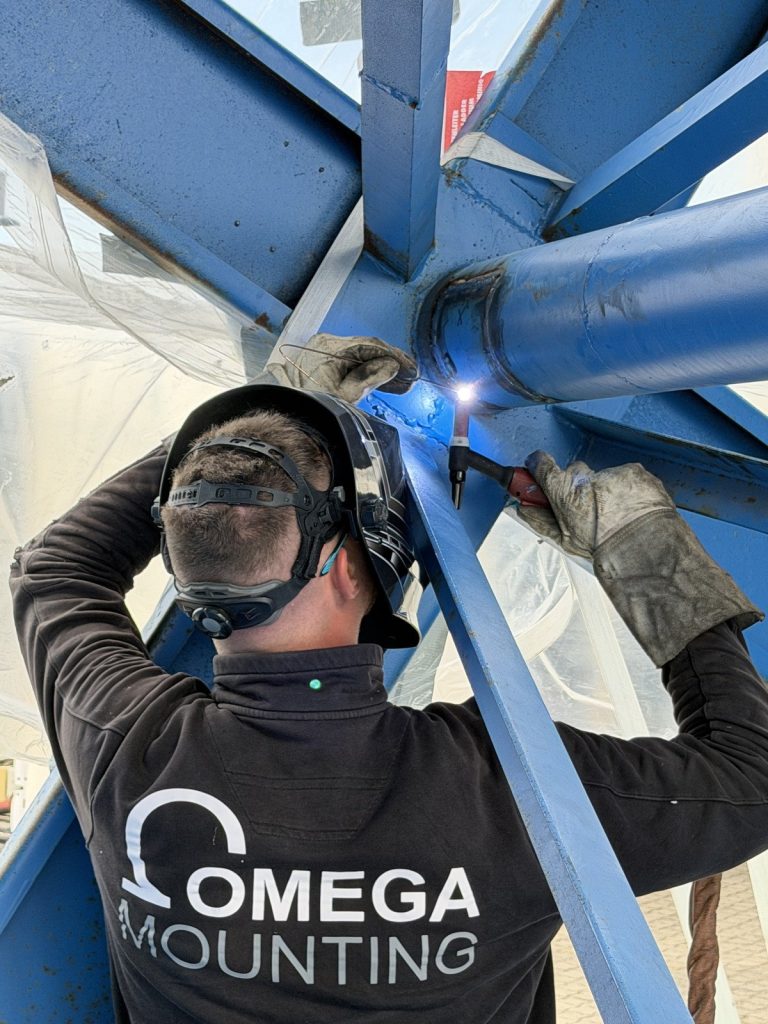
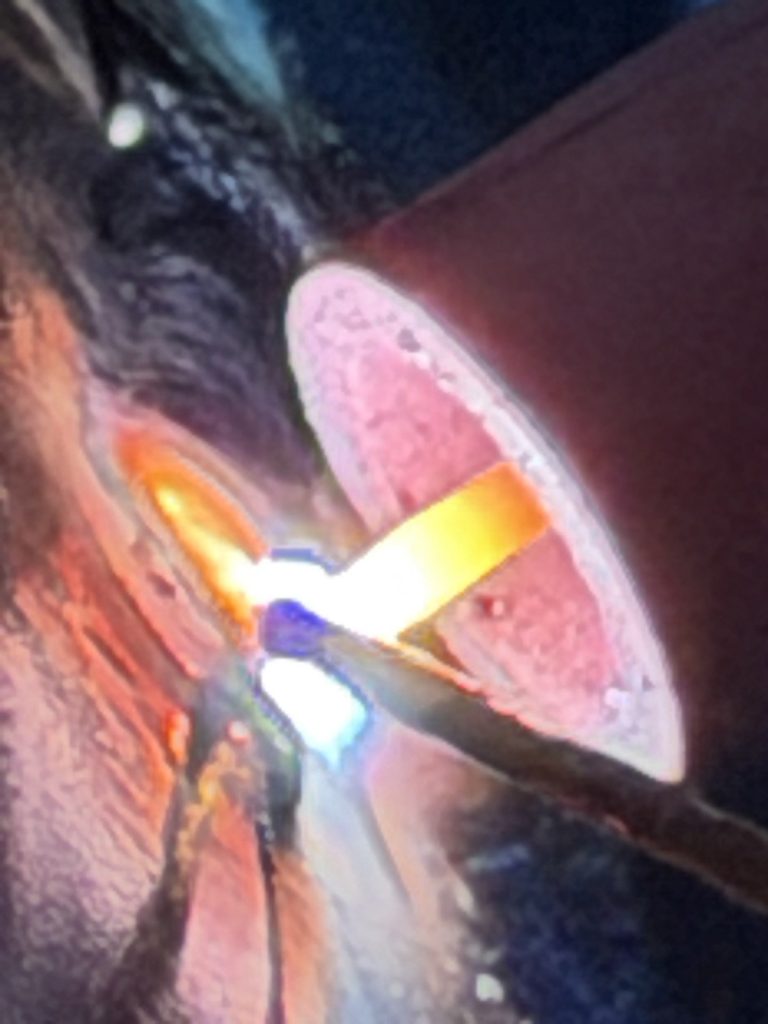
A large part of the welding work had to be carried out inside the drum in very confined conditions. Our welders worked partly kneeling or sitting between the struts and executed the seams in various constrained positions – including overhead. This demands the utmost concentration and craftsmanship, as the close-ups impressively show.
Repair while preserving the geometry
Since the drum must later run exactly on its bearing points again, it was not only the strength of the weld seam that was decisive. Equally important was the millimetre-accurate alignment of the inserted tube pieces, so that the shaft retains its original geometry and concentricity.
It is precisely this precision that distinguishes a professional repair from a simple fix.
How do you protect the high-voltage cable during welding work?
Since the high-value high-voltage cable remained on the drum throughout the repair, it had to be reliably protected.
The adjacent areas were therefore shielded with heat-resistant protective sheeting and covers. This kept weld spatter, grinding dust and sparks safely away from the sensitive cables.
Especially when working in the immediate vicinity of high-value components, this protection is for us a matter of course in professional work preparation.
Finishing and corrosion protection
After completion of the welding work, all weld seams were cleaned and the worked areas prepared for the new corrosion protection.
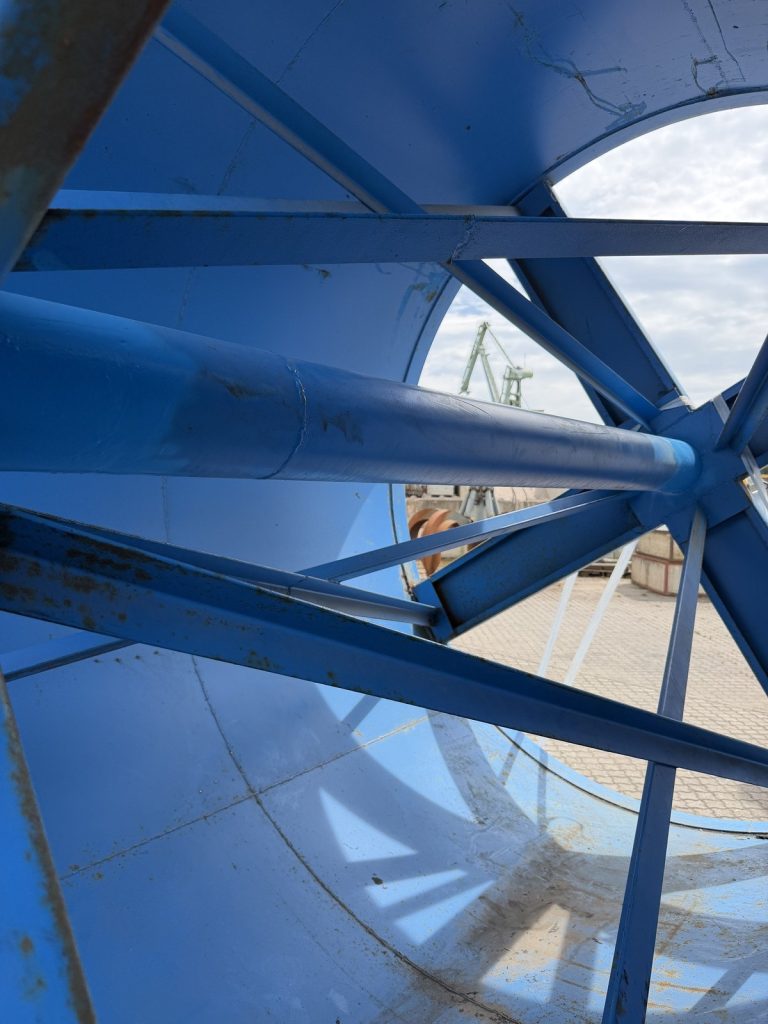
The repaired tubular shaft then received a new coating, so that the repair blends almost seamlessly into the existing structure. The finished pictures show clearly: visually, the repair can hardly be distinguished from the original structure.
Why Omega Mounting for on-site weld repairs?
As an installation and repair company from Rodgau, we are ready to deploy in the port of Aschaffenburg and throughout the Rhine-Main region in the shortest possible time – with everything an on-site repair needs:
- Mobile TIG welding equipment for jobs directly at the point of damage
- Experienced welders for constrained positions and confined spaces
- Careful damage analysis and precisely fitting fabrication of repair pieces
- Well-thought-out work preparation including protection of adjacent components
- Corrosion protection and clean handover
- Economical solutions instead of expensive complete replacement
Update September 2026: what happened next with this drum
The story did not end with the repair. The same drum then stood on the handling area in the port of Aschaffenburg for several months before it went onto a low-loader in September 2026 – and we were on the job again for this loading operation too.
This time it was not about welding but about transport preparation: a UV protection tarpaulin in two layers over the cable winding, fitted to the suspended drum, and a fastening solution that had to be devised on site because the announced material was missing. The case is documented in the project diary under Enclosing a cable drum UV-safe and loading it in the port of Aschaffenburg .
For us, this is the real point: repair in spring, storage over the summer, loading in autumn – the same equipment, the same place, two completely different tasks. That is exactly what maintenance looks like in practice.
Conclusion
Weld repairs on load-bearing steel structures require far more than good welding. What matters is a careful damage analysis, precisely fitting fabrication of the replacement parts, high-quality welding processes and well-thought-out work preparation.
The repair of this cable drum in the port area of Aschaffenburg is a prime example of how Omega Mounting delivers economical and technically high-quality solutions even under difficult conditions: the drum could be put back into full use without having to unwind or relocate the high-voltage cable – a considerable saving in time and cost for our customer, with permanently restored load-bearing capacity.
Do you need a weld repair directly on site? Whether damaged steel structure, transport damage or repair during ongoing operations: we repair where the damage is – with mobile welding equipment and experienced welders. From Rodgau we are quickly with you in Aschaffenburg, Hanau, Offenbach, Frankfurt and the entire Rhine-Main region.
Talk to us – request a call-back appointment for your project now.
Photo gallery of the job
Do you need a weld repair directly on site?
Tell us briefly what it is about – we will come back to you with an honest assessment.
100% free and without obligation
Related guides for this project
Occupational safety
Maintenance & Servicing
About the author
Tobias Schott
Managing director of Omega Mounting GmbH, Rodgau · more than 20 years of hands-on experience in installation and maintenance
A trained mechatronics technician, at home in maintenance, servicing and industrial installation since 2004 – first alongside his father, and since 2012 with Omega Mounting: from the overhead conveyor in Frankfurt to the crane system in a new-build hall. As appointed person for lifting operations, he plans and leads lifting operations in data centers and on industrial sites in the Rhine-Main region, is an instructor and examiner for cranes, aerial work platforms and telehandlers, and a safety officer. On assignments abroad he is known as the "German Troubleshooter" – the one you call when things get stuck on site. He did not learn what quality means from a manual, but from his father: Made in Germany as a standard for his own work, not as a label. That is why quality comes first at Omega Mounting – before speed and before price. The project diary shows the jobs his team has planned and carried out – without customer names, but with everything that can be learned from them.
Frequently asked questions
Yes – if the repair is professionally planned. On this project, the high-voltage cable weighing several tonnes stayed on the drum throughout the entire repair. The adjacent areas were shielded with heat-resistant protective sheeting so that weld spatter and sparks could not reach the cable.
Usually through improper slinging or lifting – for example when a chain is attached directly to the central tubular shaft. The point load leads to cracks and deformation in the load-bearing structure, which prevent safe use of the drum.
With TIG welding, the heat input can be controlled very precisely. This is decisive on load-bearing steel structures in order to achieve uniform, high-quality seams with full penetration – especially at tube joints that will later have to carry high loads again.
Constrained positions are welding positions away from the ideal flat position – for example vertical or overhead. On this repair, a large part of the seams had to be welded kneeling, sitting or overhead in the confined interior of the drum. This requires particularly experienced welders.
Ideally from an identical drum: on this project, the repair pieces were cut out of a likewise damaged donor drum. This provided tube segments with identical diameter and the same wall thickness – the most economical solution with an optimum fit.
Yes. Our head office in Rodgau is only around 30 kilometres from the port of Aschaffenburg. We carry out mobile weld repairs and refurbishments in Aschaffenburg, Hanau, Offenbach, Frankfurt and the entire Rhine-Main region – including at short notice.
Yes. The repaired drum initially remained in storage in the port of Aschaffenburg for several months and was loaded onto a low-loader in September 2026 – the tubular shaft carried the wound high-voltage cable without any issues. We also handled the transport preparation and loading.