
- Guide – Maintenance & Servicing
Standby generator maintenance: servicing, repairing, replacing – with redundancy and an emergency plan
By Tobias Schott · Reading time approx. 24 minutes · Last updated: October 2026
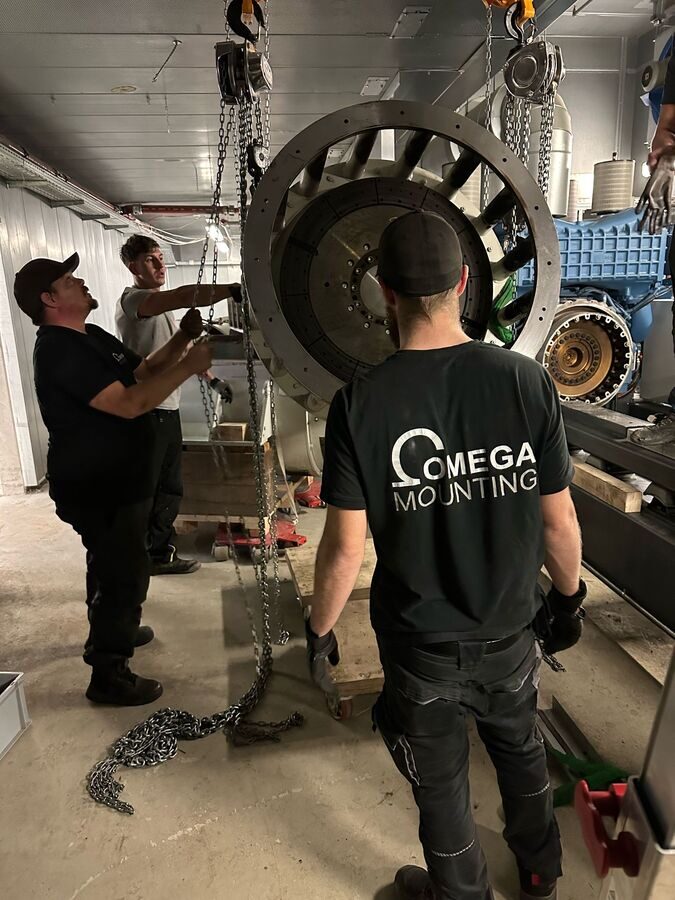
A standby generator almost never fails in operation, but at start-up. Whether it starts is decided months earlier during maintenance, test run and load test.
A standby power system is the only machine in the building that proves its worth precisely when everything else fails. In data centers, logistics centres and production plants, cooling, conveyor systems, security technology and data depend on it. In the data center it stands in the grayspace, the plant areas behind the data hall, and in an emergency carries the entire whitespace. All the more puzzling that standby generator maintenance in many companies is organised on the principle of “it isn't running, so it can't break”.
The reality is the reverse. A diesel generator set that stands idle for months ages differently from a machine in continuous operation. Starter battery, fuel, seals and coolant lose their properties. The exhaust line soots up if the set has only been test-run at idle. At the next real mains failure, what was neglected in the last twelve months then becomes apparent.
This guide describes what standby generator maintenance involves and how test run and load test differ. It shows how you plan inspection intervals and redundancy, when repair and when replacement makes sense, how replacement including moving in proceeds and what belongs in an emergency plan for a power failure. The examples come from our jobs on standby power systems in the Rhine-Main region – from Offenbach to Frankfurt.
Key points at a glance
- A standby generator (standby power system) is a combustion engine and generator unit that takes over the supply in the event of a mains failure and must therefore be kept ready to start at all times.
- Most start failures are caused by the starter battery, fuel quality, cooling system or controls – all assemblies whose wear reserve is made visible by regular inspection.
- A test run without load only checks the start; only a load test under real or simulated load (load bank) shows whether engine, generator and exhaust line will hold up in an emergency.
- Redundancy means planning for a failure: N+1 means one generator set more than required, 2N a complete second supply – both are only worth as much as the maintenance of each individual set.
- Repair in the installed condition, overhaul with removal or complete replacement: the decision depends on the damage pattern, accessibility and time window.
- Replacing a generator set is a lift-and-shift project: moving-in route, lifting method, crane set-up area and peripherals (cooling, exhaust, fuel, electrics) must fit together.
- An emergency plan defines in advance who does what in the event of a generator failure: fault pattern, backup supply, contacts, access and releases.
What is a standby generator?
A standby generator – technically a standby power system (German: Netzersatzanlage, NEA) – is a unit consisting of a combustion engine (usually diesel) and a generator. It starts automatically when the public grid fails and takes over the power supply of a building or plant for the duration of the outage.
The system comprises more than engine and generator:
- a fuel system with day tank and storage tank.
- a cooling system with radiator and fan that dissipates the heat from engine and generator.
- a starter battery with charger and usually an engine pre-heater.
- an exhaust line with manifold, expansion joints, silencers and, where applicable, exhaust aftertreatment.
- a control cabinet with controls and the mains changeover switch that switches between grid and generator set.
If one of these assemblies fails, the system fails.
The standby power system must be distinguished from the uninterruptible power supply (UPS). The UPS bridges the seconds between mains failure and generator start with batteries; the generator set carries the load over hours and days. For safety power supplies – for example in assembly venues or hospitals – separate standards additionally apply, with requirements for changeover time, design and testing.
Why do standby generators fail even though they hardly run?
Standby generators fail because standstill is not gentle operation for a combustion engine. Batteries discharge, fuel ages, coolant and oil lose their properties, seals dry out. Controls report faults that nobody reads until they prevent the start.
The starter battery
In practice, the starter battery is one of the most frequent causes of a start failure. It is kept on float charge by the charger but ages nonetheless – and a defective charger is often only noticed when the battery is flat. Voltage, acid density or internal resistance and age therefore belong in every maintenance visit.
The fuel
Diesel is not a commodity to be stored for years. Over time, deposits form, water collects at the bottom of the tank, and microorganisms grow in the boundary layer between water and fuel – colloquially “diesel bug”. Clogged filters and damaged injection components are the result. Fuel samples, water separators, filter changes and, if necessary, fuel polishing are part of maintaining a standby power system.
The cooling system
Coolant protects not only against frost but against corrosion and cavitation in the engine. It ages, the radiator clogs, fan belts become brittle, hoses porous. A leak on the radiator is not a cosmetic flaw but prevents operation: no coolant, no operation under load.
The exhaust line
A generator set that has only been test-run at idle or at low load does not reach its operating temperature. Unburnt fuel and soot are deposited in the exhaust line and in the generator's silencer – known in the industry as “wet stacking”. The consequences are loss of power, smoke and, in the worst case, a fire in the silencer. That is the technical reason why load tests are indispensable.
Controls and mains changeover
The controls detect the mains failure, start the engine, synchronise if required and switch over. An acknowledged fault, a failed sensor or a changeover switch that has not been operated for years is enough for nothing to happen in an emergency.
What does standby generator maintenance involve?
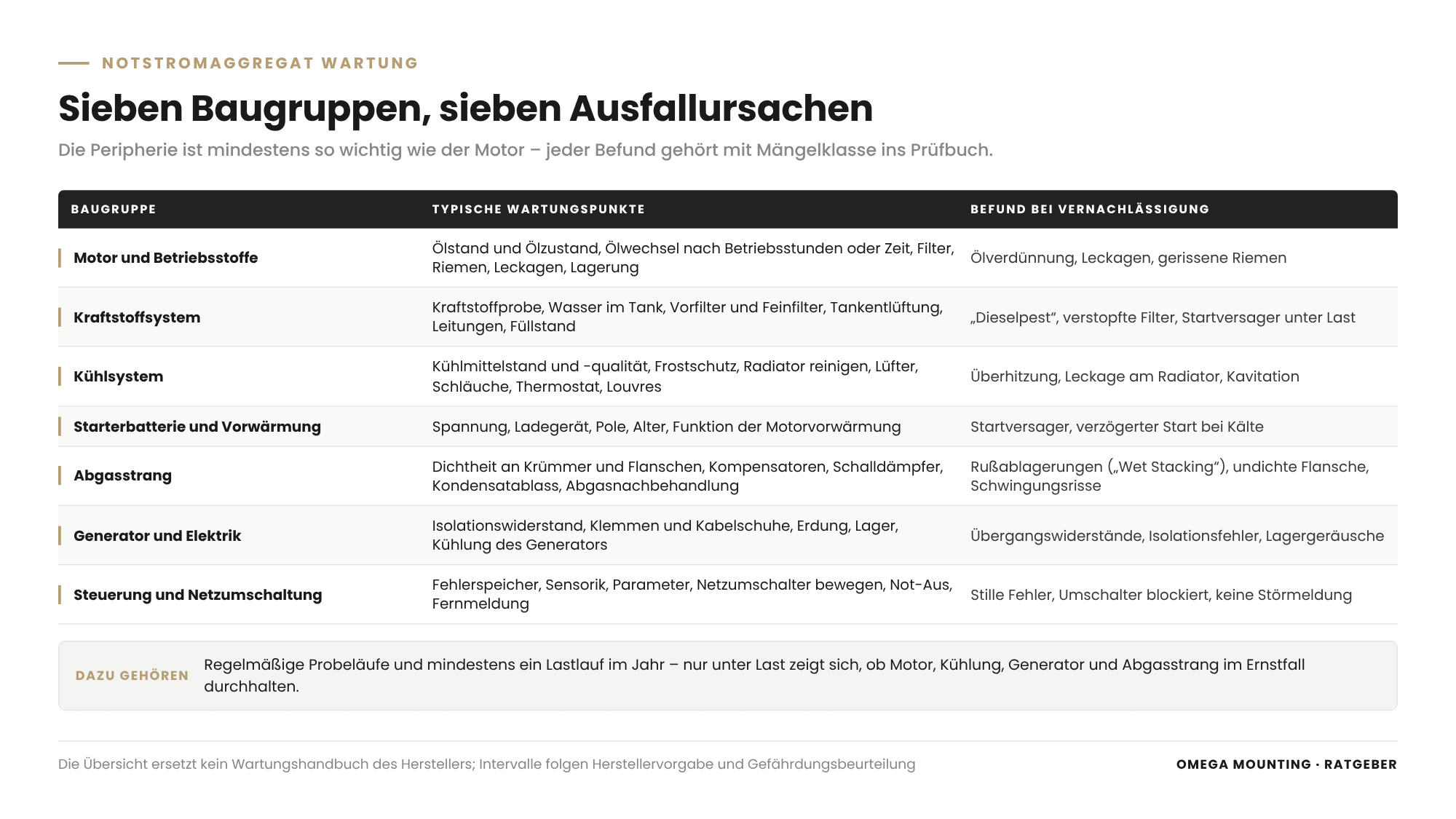
Standby generator maintenance comprises inspection and maintenance within the meaning of DIN 31051 on all seven assemblies. These are engine and operating fluids, fuel system, cooling system, starter battery and pre-heating, exhaust line, generator and electrics, and controls and mains changeover. Added to this are regular test runs and at least one load test per year in accordance with the manufacturer's specifications and the risk assessment.
| Assembly | Typical maintenance points | Typical finding when neglected |
|---|---|---|
| Engine and operating fluids | Oil level and oil condition, oil change by operating hours or time, filters, belts, leaks, bearings. | Oil dilution, leaks, broken belts. |
| Fuel system | Fuel sample, water in tank, pre-filter and fine filter, tank venting, lines, fill level. | Diesel bug, clogged filters, start failure under load. |
| Cooling system | Coolant level and quality, antifreeze, clean radiator, fan, hoses, thermostat, louvres. | Overheating, leak on the radiator, cavitation. |
| Starter battery and pre-heating | Voltage, charger, terminals, age, function of the engine pre-heater. | Start failure, delayed start in cold weather. |
| Exhaust line | Tightness at manifold and flanges, expansion joints, silencers, condensate drain, exhaust aftertreatment. | Soot deposits, leaking flanges, vibration cracks. |
| Generator and electrics | Insulation resistance, terminals and cable lugs, earthing, bearings, generator cooling. | Contact resistances, insulation faults, bearing noise. |
| Controls and mains changeover | Fault memory, sensors, parameters, operate mains changeover switch, emergency stop, remote signalling. | Silent faults, changeover switch jammed, no fault signal. |
The table is no substitute for the manufacturer's maintenance manual. But it shows that the peripherals are at least as important as the engine – and that every finding belongs in the inspection log with its defect class.
Test run or load test – what is the difference?
A test run checks start, speed, voltage and frequency without significant load. A load test loads the generator set over a longer period with real building load or a load bank. Only the load test shows whether engine, cooling, generator and exhaust line will hold up in an emergency.
The test run
The regular test run – weekly or monthly in many companies – confirms that the system starts and reaches its setpoints. For an emergency it is not meaningful: a generator set can start a hundred times at idle and shut down at the first load step.
The load test
During the load test, the generator set takes over a defined load for hours – ideally close to rated output. Either through real mains changeover of the building – in the data center only in the released maintenance window with a change request. Or, if live operation does not permit this, via a load bank that converts the power into heat. The load test brings the engine up to operating temperature, burns deposits out of the exhaust line and checks the cooling system under full load. It shows whether vibrations, pipework and flange connections hold. On a job at a data center in Offenbach, after installing intake silencers, we carried out the performance test and the noise measurement under full load. Only then was the conversion accepted.
Know the power classes
The standard ISO 8528-1 distinguishes power classes of generating sets – such as emergency standby power for a limited number of hours per year or continuous power at variable or constant load. The class determines how long and how heavily the set may be loaded – in the load test and in an emergency. Emission control requirements additionally limit operating hours and emissions. Exhaust aftertreatment such as SCR systems is therefore part of the scope of supply for newer systems.

How do you plan inspection intervals for standby generator maintenance?
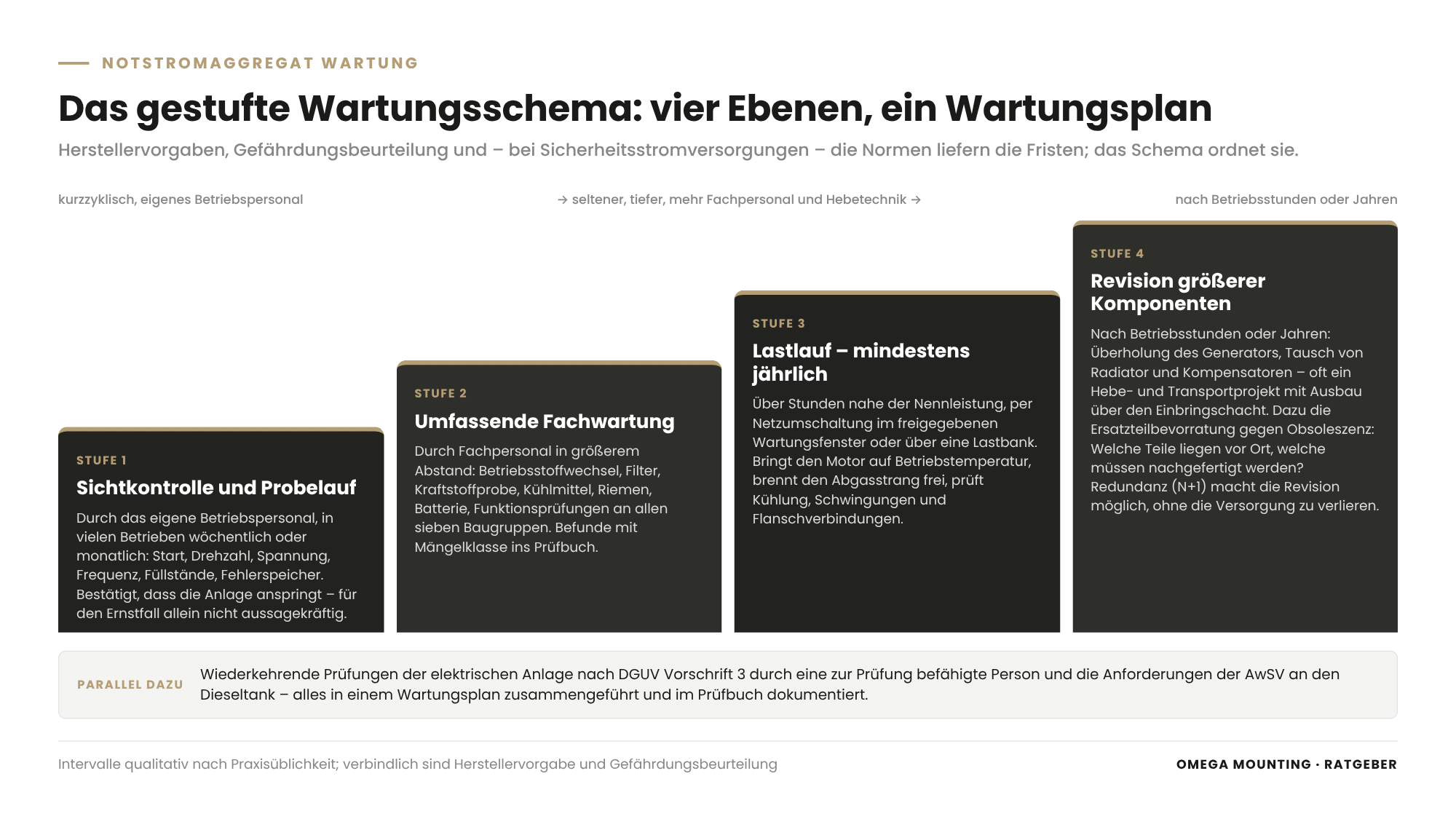
Inspection intervals for standby generator maintenance derive from three sources. First, from the manufacturer's specifications by operating hours and calendar time. Second, from the risk assessment under the BetrSichV (German Industrial Safety Ordinance) with the inspection intervals derived from it. Third – for safety power supplies – from the relevant standards.
In practice, a tiered scheme has proven itself:
- short-cycle visual inspections and test runs by the company's own operating staff.
- comprehensive maintenance with fluid changes and functional tests by specialist personnel at longer intervals.
- a load test at least annually.
- an overhaul of major components by operating hours or years – for example the overhaul of the generator or the replacement of radiator and expansion joints.
For older systems, spare parts stocking belongs in this scheme: which parts are threatened by obsolescence, which are available on site, which have to be remanufactured?
As an electrical installation, the standby power system is additionally subject to periodic inspections under DGUV Regulation 3 by a competent person. The diesel tank, as an installation for handling substances hazardous to water, falls under the AwSV (German ordinance on such installations) with its requirements for containment and inspection. Anyone who brings these inspection intervals together in a maintenance plan and documents them in the inspection log has the documents at hand for every inspection and every insurance meeting.
Anyone who outsources maintenance to a service provider remains responsible as operator for ensuring that the work is carried out by competent, authorised and briefed personnel. That is how the German technical rule TRBS 1112 (Maintenance) puts it. For you this means: in the maintenance contract for the standby generator, have not only intervals but also qualification and release procedures guaranteed. And check whether the provider from the Rhine-Main region can be on site at short notice if the load test produces a finding.
What does redundancy mean – N, N+1, 2N?
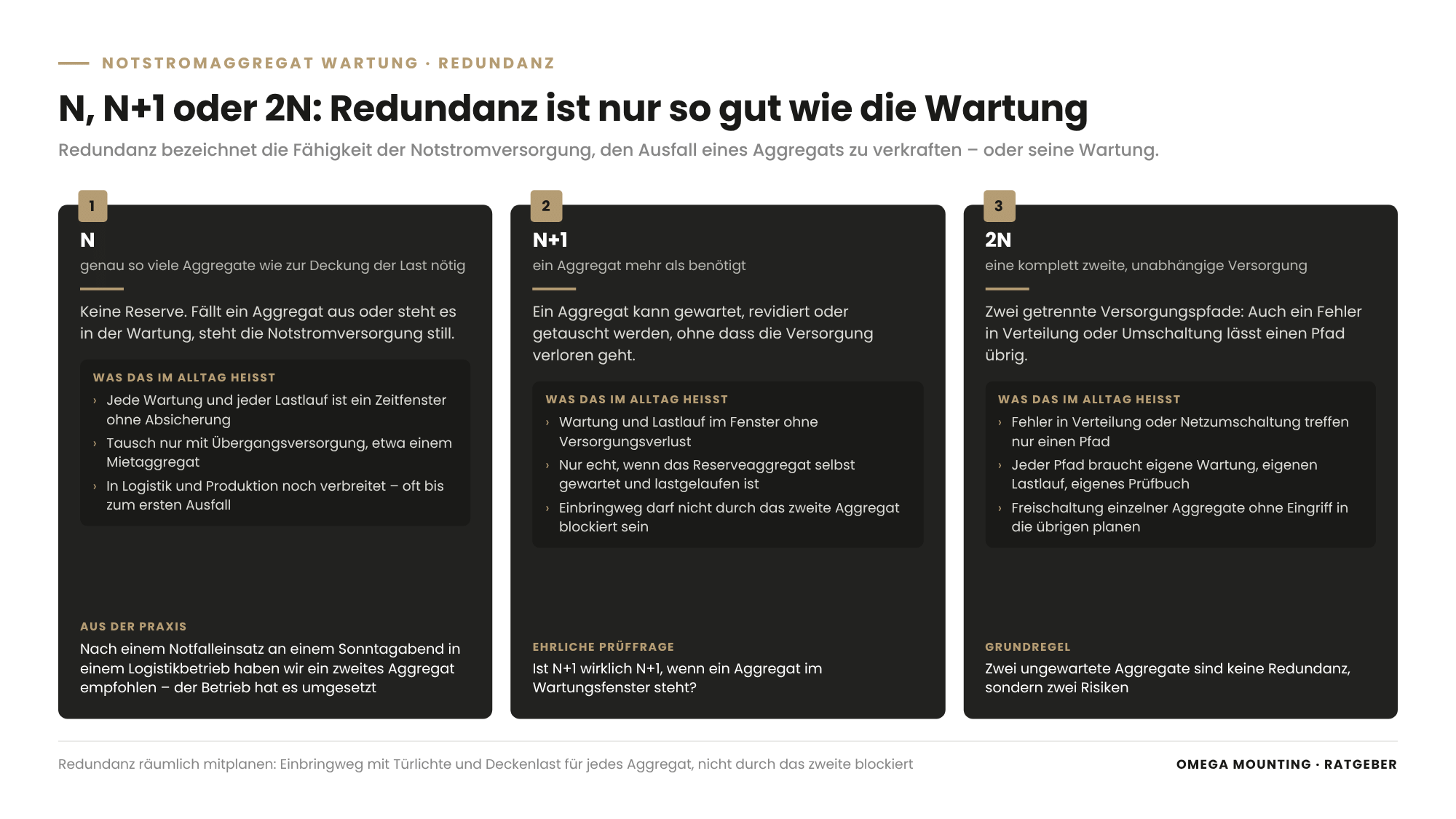
Redundancy describes the ability of a standby power supply to cope with the failure of one generator set. N means exactly as many sets as needed to cover the load, N+1 one set more, 2N a complete second, independent supply.
With N, the standby power supply is down in the event of a generator failure – or during maintenance. N+1 allows one set to be maintained or replaced without losing the supply. 2N separates two complete supply paths so that even a fault in distribution or changeover leaves one path. In logistics and production, N is still common – often until the first failure comes. During an emergency call-out on a Sunday evening at a logistics company, after replacing the failed set we recommended exactly that: a second generator set. The company implemented it.
Redundancy, however, is only as good as the maintenance of each individual set. Two unmaintained generator sets are not redundancy but two risks. And redundancy must be planned spatially as well. Anyone wanting to replace a set needs a moving-in route with sufficient clear door opening and floor load that is not blocked by the second set.
Repair or replace – how do you decide?
Whether a standby generator is repaired, overhauled or replaced is decided after assessment on four questions. What is the damage pattern? Is the damaged area accessible in the installed condition? How much time remains until the next required availability? And are spare parts and manufacturer support still available for the set – or is obsolescence looming?
Repair in the installed condition
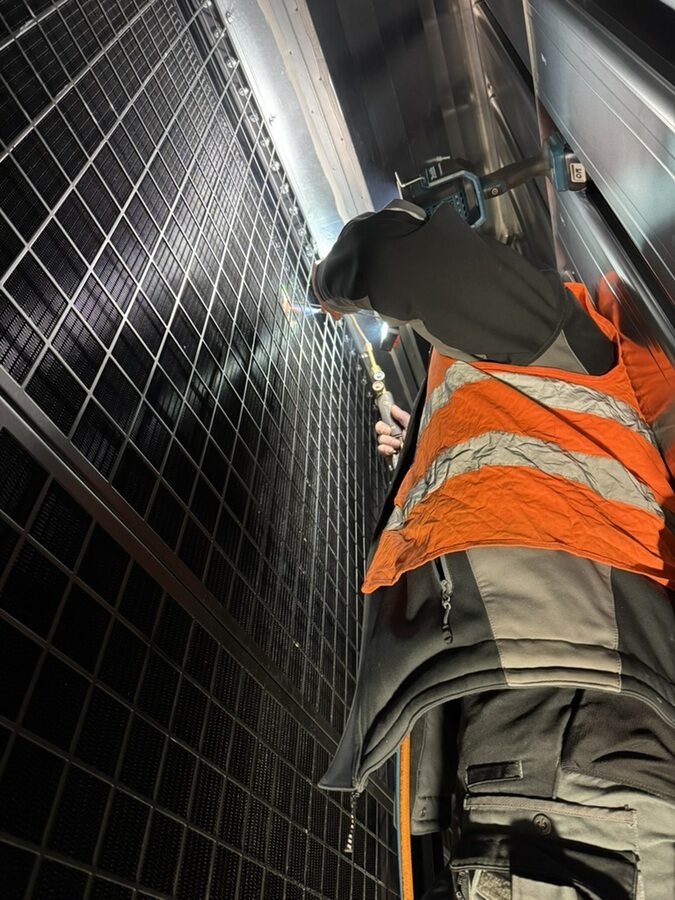
Minor damage to peripherals and pipework can often be rectified on site. In the case of a leak on the radiator of an already installed standby generator at a data center in Offenbach, four days remained until the site went live. Between radiator, louvre and silencer there was barely a hand's width of space. Welding was ruled out because the heat input would have destroyed the thin copper cooling fins. Instead, two fitters brazed the leak in one day on site, sealed it over a large area with metal adhesive and checked it for tightness with a pressure test. A professional interim solution that kept the schedule. The removal of the radiator by crane will follow as a planned measure.
Overhaul with removal
Larger components – generator, radiator, engine – are removed for overhaul. That is a lifting and transport project. In a building complex in the Rhine-Main region, we separated the generator of a standby power system from the drive engine using chain hoists on the support structure and dismantled the enclosure. A timber transport frame was made on site. The assembly was moved through the building corridors on machine skates and lifted vertically out through the installation shaft by mobile crane – the only way out. After the external overhaul it went back the same way, followed by reassembly and alignment in the plant room.
Complete replacement
If the set can no longer be economically repaired, spare parts are lacking or the output is no longer sufficient, it is replaced. That is the largest of the three measures and the one in which preparation matters most.
| Criterion | Repair on site | Overhaul with removal | Complete replacement |
|---|---|---|---|
| Typical trigger | Leak, crack in pipework, defective sensor, battery. | Bearing damage, generator overhaul, radiator replacement. | Ageing, lack of spare parts, changed output. |
| Availability during the measure | Briefly interrupted. | Days to weeks (redundancy required). | Weeks (plan interim supply). |
| Lifting equipment | Usually none. | Chain hoist, machine skates, mobile crane. | Mobile crane, tandem lift, machine skates, installation robot. |
| Decisive preparation | Accessibility, hot work permit. | Moving-in route, transport frame, crane set-up area, lift plan. | Moving-in route, foundation, peripherals, commissioning. |
How does the replacement of a standby generator proceed?
The replacement of a standby generator proceeds in six steps: secure an interim supply. Isolate and disconnect the old system. Move out the old system. Move in the new system and align it on the foundation. Connect the peripherals. Hand over the system for commissioning.
The moving-in route determines the method
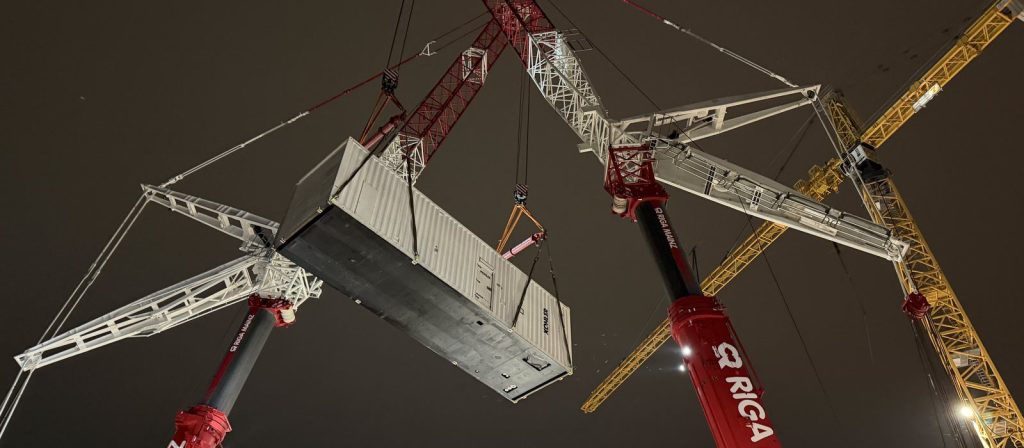
If the generator set stands as a containerised solution outdoors or on the roof, the mobile crane is the method of choice – for very heavy units as a tandem lift with two cranes. The appointed person for lifting operations (lifting supervisor) gives the commands. The lift plan defines the load distribution between the two cranes, radius, hook height and lifting accessories. The crane set-up area must take the ground bearing pressure of the outrigger pads – above underground car parks and utility lines the first question for the structural engineer. The BAuA practical guide on site set-up counts set-up areas for large equipment among the planning documents that the client releases before execution. For you this means: crane set-up area, load-bearing capacity and release belong in writing in the moving-in concept, not only in the conversation on the day of the lift. At a new data center build in the Frankfurt area, we moved in more than 60 generators over three years, the largest with two to three megawatts. The heaviest individual sets weighed a good 20 tonnes, the heaviest containerised solution 54 tonnes – by tandem lift with two 650-tonne mobile cranes to a height of around 16 metres. How that works in detail is described under Moving in standby generators: how a standby power system gets into a data center.
If the generator set stands inside the building, the route leads through an installation shaft, an installation opening in the facade or a door. Clear width, clear height and turning radius of the moving-in route determine what fits through undismantled. Then machine skates, hydraulic gantries or installation robots are used, on load spreading plates if the floor cannot bear the point load. Inside the building exclusively electrically powered, because combustion engines indoors are taboo. The set is often moved in dismantled into assemblies and assembled on site. We summarise these methods under Lift & Shift – heavy load installation .
Foundation, vibration, peripherals
A generator set tolerates no point loading on the wrong component and no twisting of the frame. That is why it is levelled on the foundation, the alignment is checked and the vibration dampers are balanced before the anchor bolts are set. All connections to moving parts receive flexible sections, because rigid pipework on a vibrating engine cracks over time.
Electrical interface and commissioning
The mechanical installation ends where the plant electrician or the manufacturer takes over: at the main switch, at the mains changeover, at commissioning. The set is handed over “commissioning-ready” – mechanically complete, piped, cabled, with installation report and photo documentation. In the data center, commissioning follows as a staged test: factory acceptance test (FAT) at the manufacturer, site acceptance test (SAT), load test and integrated systems test with UPS and distribution. The punch list from these stages is worked off before handover.
The lesson from the emergency
During a Sunday evening call-out at a logistics company, production was due to start on Monday at four o'clock. The replacement set had been delivered and positioned – but its connection panel had different dimensions from the old one. The night was spent on an interim supply via batteries and on procuring material. On Monday, cables were connected, diesel lines joined, the earthing driven in and measured – by midday the set was running. The lesson: connection panel, cable cross-sections, fuel connections and earthing belong on the checklist before every replacement.
Which occupational safety and legal requirements apply to work on standby generators?
Work on standby generators is governed by the BetrSichV (German Industrial Safety Ordinance) with risk assessment and inspection duties and the accident prevention regulation for the electrical installation. Added to this are the five safety rules of DIN VDE 0105-100 before work on electrical parts, the German Noise and Vibration Occupational Safety Ordinance for work in a running generator room, and the rules for hot work and hazardous substances. This guide is no substitute for legal advice.
In concrete terms: before work on generator, control cabinet or mains changeover, the system is isolated and locked out against re-energising – with lock and tag, internationally lockout/tagout (LOTO). Then the absence of voltage is verified, the system is earthed and short-circuited, and adjacent live parts are covered. The special feature of a standby power system: it is itself a voltage source. TRBS 1112 explicitly names generators and UPS as a cause of back-feed. An isolated mains connection therefore offers no protection as long as generator set and UPS can feed into the same busbar. For you this means: always isolate from both sides, automatic start blocked, remote start secured. In the data center, all of this runs via a permit to work and a method statement – in German terms: risk assessment plus work instruction – which the operator releases before work begins. The maintenance rule describes such release systems as standard for work with particular hazards. In the generator room under full load, hearing protection is mandatory. The Noise and Vibration Occupational Safety Ordinance sets the action values at 80 and 85 dB(A), and generator sets under load are well above that. Hot surfaces on exhaust line and engine, diesel fuel, coolant and oil as hazardous substances and exhaust gases in the room are further hazards that must appear in the risk assessment. For refuelling: unlike petrol, diesel does not form an explosive atmosphere at normal temperatures. The German technical rule for flammable liquids therefore treats it as an operating fluid without an Ex zone. Nevertheless, impact protection at the tank, a drip tray and supervision during refuelling by contractors are part of the picture.
Brazing and welding work on the set – for example on the radiator or pipework – is hot work within the meaning of DGUV Information 205-002. It is registered and released with a permit to work, the area is protected and a fire watch is provided. For lifting operations, the lift plan, a short briefing of all involved before the lift (toolbox talk) and inspected lifting accessories according to the manufacturer's specifications apply. Plus a banksman with visual contact to the crane operator and the prohibition on standing under a suspended load – with double protection by timber baulks as soon as a load is set down or propped.
What belongs in the emergency plan for a generator failure?
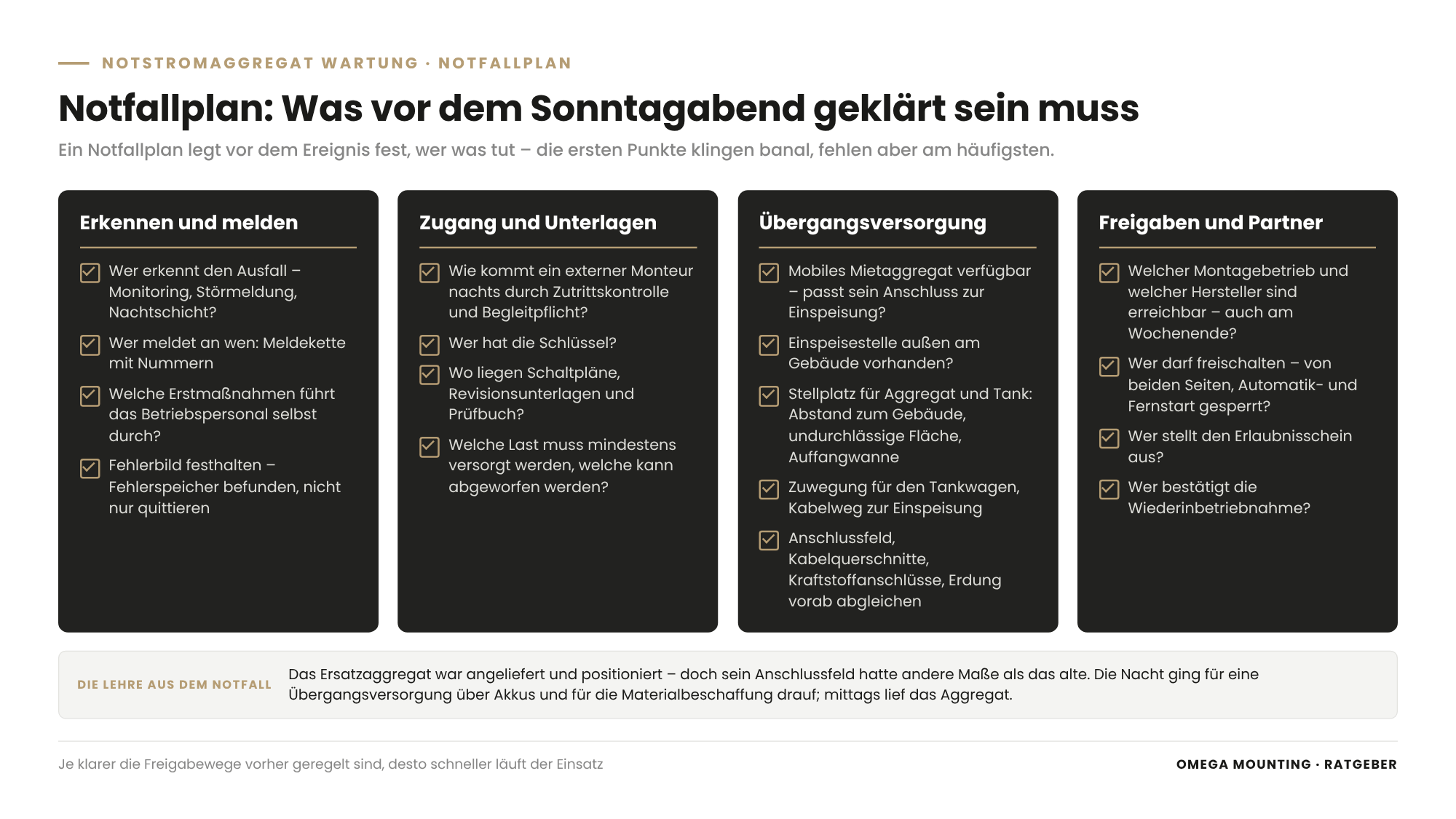
An emergency plan for a generator failure defines before the event who detects and reports the failure and which initial measures the operating staff carry out themselves. It regulates what an interim supply looks like, which installation contractor and which manufacturer can be reached, how access to the generator set is secured and who issues releases.
The first points sound banal but are often missing. How does an external fitter get in at night through access control and escort requirement? Who has the keys, where are the circuit diagrams, overhaul documents and inspection log? Which load must be supplied as a minimum and which can be shed? Then come the questions about the backup supply. Is there a mobile rental generator, does its connection match the feed-in, is there a feed-in point on the outside of the building? And where may the generator set and its tank stand?
The last question is easily underestimated. The BG BAU/BAuA module “Site set-up – utility supply” specifies for mobile tank installations a minimum distance of ten metres from buildings, a firm, impermeable set-up and refuelling area and a double-walled design or drip tray. For mobile generators it refers to DGUV Information 203-032 with its requirements for earthing and protective measures. For you this means: define the location for a rental generator with tank, access for the tanker and the cable route to the feed-in point in the emergency plan already. On a Sunday evening there is no time for that.
For the installation contractor, it is crucial that the plan regulates the release channels: who may isolate, who issues the permit to work, who confirms the return to service? The more clearly that is regulated beforehand, the faster the job runs.
How we do it in practice
Four jobs from our project diary show the range.
Twelve turbo silencers against the whistling in Offenbach
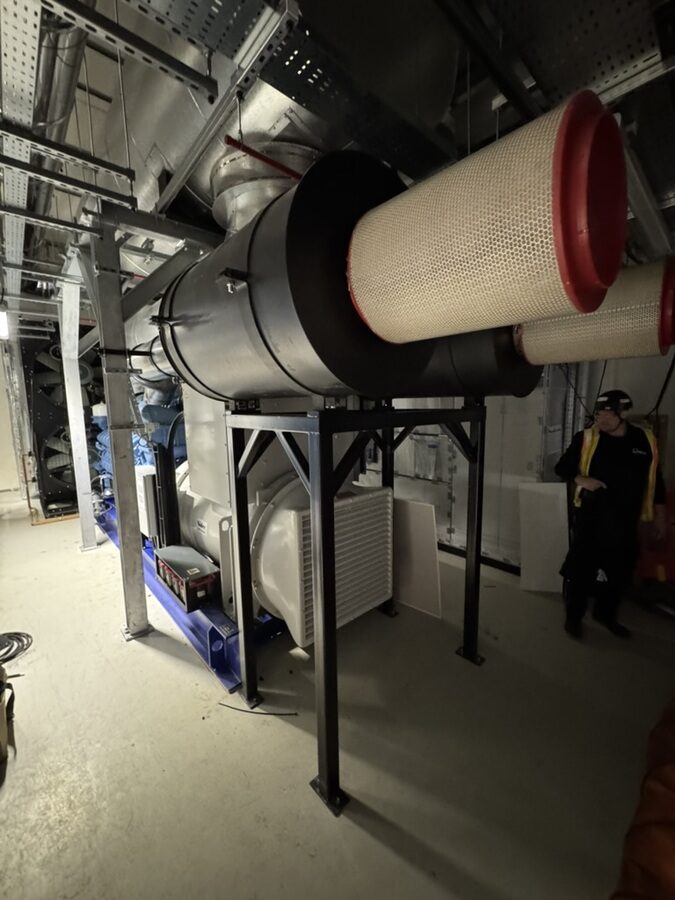
At a data center in Offenbach, the high-frequency turbocharger noise of the standby generators was disturbing the neighbourhood. Three fitters retrofitted twelve double turbo silencers on the intake side in several construction phases over several weeks. The base frames, over two metres high, were installed with winch stackers, because no crane was available in the generator room. Acceptance was by performance test and noise measurement under full load. The whistling was gone. Read more under Turbo silencers at a data center in Offenbach: 12 silencers against the whistling of the standby generators.
Radiator leak four days before go-live
Also in Offenbach: the leaking radiator described above, four days before go-live. One fitter handled the gas torch, the other secured, lit the area and passed tools through the narrow gap. Hot work registered, area protected, pressure test to finish. The data center went into operation on schedule. Details under Radiator repair on a standby generator: emergency call-out at a data center in Offenbach.
Generator overhaul through the installation shaft
The generator overhaul in a larger building complex described above was carried out by a team of one lifting contact – the appointed person for lifting operations – and three mechanics. Read about the job under Maintaining the generator of a standby power system – removal and moving in by mobile crane.
Sunday evening, production start Monday at four
The emergency call-out at a logistics company described above – troubleshooting on Sunday evening, replacement overnight, operational by Monday midday – is described under Emergency Call-out on a Sunday Evening.
How we do it in the Rhine-Main region
From Rodgau we reach Offenbach, Frankfurt, Hanau, Darmstadt and Dietzenbach in a short time. That counts when a generator set fails at the weekend or four days remain until go-live. The density of data centers in the Rhine-Main region has made us specialists in standby power systems. We bring the same experience to logistics centres and production plants. An overview is given on our page industrial installation for energy and standby power. Is an overhaul, a replacement or the maintenance of a standby generator coming up for you in the Rhine-Main region? Then get in touch with us – a walk-through of the generator room usually clarifies within an hour which route fits.
What this means for your role
For buyers: In the scope of works, separate recurring maintenance from replacement or major repair – the one as a framework agreement with call-offs, the other as an individual order. For maintenance, demand item descriptions per assembly with load test and inspection log keeping. For replacement, demand an offer from moving-in route to commissioning with an interface list to the electrical and fuel trades and an acceptance linked to the load test. Check evidence of suitability for lifting operations and on-call service outside business hours.
For designers: Every generator set you plan today will be maintained, repaired and at some point replaced – provide the route for that. Installation opening with clear door width and clear height, crane set-up area with payload for the outriggers and floor load on the transport route are part of it. Clearance to radiator and silencer and inspection openings for battery, filters and exhaust line later decide whether a repair in the installed condition is possible. For redundant systems, plan the isolation of individual sets without intervening in the others.
For project managers and site managers: Plan overhaul and replacement as a lift-and-shift project with lift plan, crane set-up area, transport frame, interim supply, connection panel, earthing, peripherals and commissioning. Scheduled in the construction programme, coordinated in the regular meeting with the electrical and fuel trades. As site manager, you induct, release the lift, keep the fallback ready and maintain the punch list until handover. The load test is part of the acceptance, not an optional extra.
For maintenance managers: Manage the standby power system as a separate asset under DIN 31051 with maintenance plan, inspection intervals, inspection log and annual load test. Do not let test runs pass as maintenance, assess the fault memory after every alarm and define which wear parts are stocked. Battery age, fuel samples and coolant values are your early warning systems for the wear reserve.
For facility managers and operators: Check your redundancy honestly: is N+1 really N+1 when one set is in its maintenance window? Is there a moving-in route that will still work in ten years? Is the emergency plan in place, and does the night shift know it? These three questions decide more about availability than the type plate.
Standby power system checklist: template on request
Our standby power system checklist summarises the inspection and maintenance points of this guide on one page. Structured by the seven assemblies, with columns for interval, finding, measure and release. A second block covers the preparation of a replacement: moving-in route, connection panel, earthing, peripherals, interim supply. Request the standby power system checklist via our Contact form – subject line “Standby power system checklist”.
Why Omega Mounting?
Omega Mounting is based in Rodgau near Frankfurt and can be reached via the 24-hour hotline – even on a Sunday evening. We work on standby power systems mechanically and electrically up to handover to the plant electrician and manufacturer. We move generator sets in and out by mobile crane, tandem lift, machine skates or through the installation shaft. And we make transport frames and adapter pieces in our own workshop in Rodgau. The linked jobs – up to more than 60 generators moved in in the Frankfurt area – prove it. For us, standby power systems are a core area of maintenance and servicing of industrial plant. For you this means a single point of contact for maintenance, repair, lifting and moving in – with short distances in the Rhine-Main region and a team that also comes when the failure does not fall within business hours.
Conclusion
A standby generator is an insurance policy whose premium is paid in maintenance. Anyone who, in standby generator maintenance, regularly checks battery, fuel, cooling, exhaust line and controls, runs the set under load at least once a year and documents the results holds good cards in a mains failure. Anyone who thinks of redundancy not only on paper but with moving-in routes and an emergency plan can also maintain and replace without losing the supply. Anyone who clarifies connection panel, earthing and peripherals before the replacement will not experience a Sunday evening like the one described above. Send us the generator set type, location and the reason – maintenance plan, finding or planned replacement. We will get back to you with an honest assessment of inspection intervals, redundancy and moving-in route.
Planning maintenance, moving in or installation in the Rhine-Main region?
Tell us briefly what it is about – we will come back to you with an honest assessment.
100% free and without obligation
You may also be interested in these guides
Maintenance & Servicing

About the author
Tobias Schott
Managing director of Omega Mounting GmbH, Rodgau · more than 20 years of hands-on experience in installation and maintenance
A trained mechatronics technician, at home in maintenance, servicing and industrial installation since 2004 – first at his father's side, since 2012 with Omega Mounting: from the overhead conveyor in Frankfurt to the crane system in a new-build hall. Plans and leads lifting operations as appointed person in data centers and on industrial sites in the Rhine-Main region, is an instructor and examiner for cranes, mobile elevating work platforms and telehandlers, and a safety officer. On jobs abroad he is known as the “German Troubleshooter” – the one you call when things get stuck on site. He learned what quality means not from a manual but from his father: Made in Germany as a standard for his own work, not as a label. That is why it comes first at Omega Mounting – before speed and before price. He writes these guides from that practice: what works on our sites is in them – what only exists in the standard is not.
Frequently asked questions
The inspection intervals for standby generator maintenance are set by the manufacturer's specifications, the risk assessment under the BetrSichV and – for safety power supplies – the relevant standards. A tiered scheme has proven itself: regular test runs by the operating staff, comprehensive specialist maintenance at longer intervals, at least one load test per year and overhauls by operating hours. Everything is documented in the maintenance plan and inspection log.
No. A test run without load only shows that the set starts and reaches its setpoints. Whether cooling system, generator and exhaust line hold up under load is only shown by a load test over several hours close to rated output. Anyone who only test-runs at idle also risks soot deposits in the exhaust line.
A load bank is a mobile resistive load that converts the generator set's power into heat in a controlled manner. It is used when a load test is required but operations cannot be switched to standby power or the real load is too low. This allows the set to be tested up to rated output without touching the building's supply.
N+1 means that one more generator set is available than would be needed to cover the load. If one fails or is under maintenance, the supply is maintained. 2N goes further and provides two completely independent supply paths. Redundancy, however, requires that each set is maintained individually and that each has its own moving-in route for overhaul or replacement.
Yes, if redundancy or an interim supply – such as a mobile rental generator with a matching feed-in – takes over the load and the maintenance window has been released by change request. The replacement itself is a lift-and-shift project with isolation, moving out, moving in, foundation work, peripherals and commissioning. Without redundancy, a time window with reduced risk must be chosen.
Work on the standby generator is governed by the BetrSichV with risk assessment, the accident prevention regulation for the electrical installation and the five safety rules – from both sides because of back-feed from generator set and UPS. In a running generator room, hearing protection is mandatory. Brazing and welding work is hot work with a permit to work and fire watch.
Because the high heat input during welding would destroy the thin copper cooling fins. The professional method is brazing, if necessary with additional sealing, followed by a pressure test. Such a repair is an interim solution; the permanent repair is the replacement or overhaul of the radiator.
Yes. Whether data center, logistics centre, production plant, hospital or assembly venue: assemblies, causes of failure, test run and load test are the same. What differs are redundancy requirements, standards for safety power supplies and the tolerance for downtime.
From Rodgau, Frankfurt, Offenbach, Hanau, Darmstadt and Dietzenbach are a short drive away, and our 24-hour hotline is staffed at weekends too. How quickly the set runs again depends on the damage pattern and on spare parts stocking. And on whether the company has prepared access, permit to work and isolation – an emergency plan shortens this time considerably.
Send us via the Contact form three pieces of information: generator set type with output, location with installation situation (plant room, container, roof) and your reason – maintenance plan, finding from the load test or planned replacement. We will get back to you, arrange a walk-through of the generator room and summarise the result in a written assessment of inspection intervals, redundancy and moving-in route. Your contact is Tobias Schott.
 English
 German