
- Guide – Occupational safety
MEWPs in Installation Work: Selection, Operators, Fall Protection
By Tobias Schott · Reading time approx. 24 minutes · Last updated: October 2026
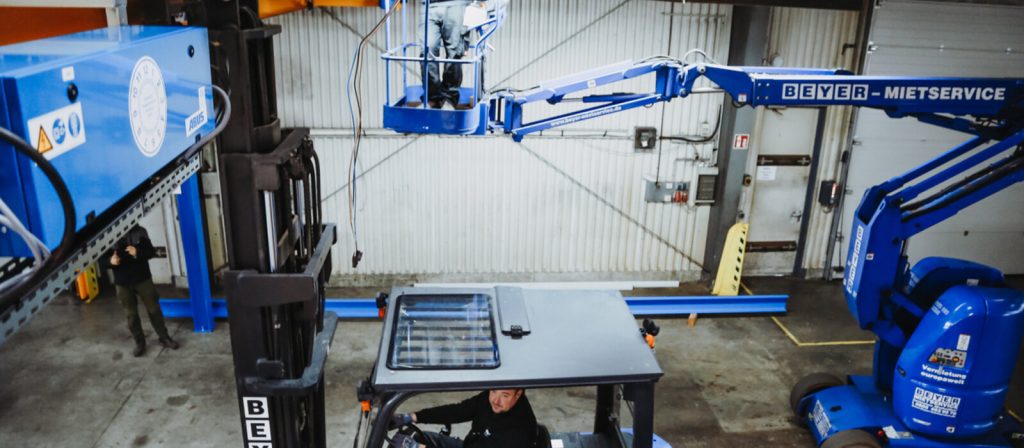
A mobile elevating work platform is what makes installation work at height safe in the first place – but only if platform type, ground, operator and fall protection are settled before the first lift.
Hardly any crane installation, hardly any conductor rail replacement, hardly any ceiling-mounted installation gets by without a mobile elevating work platform. Yet the MEWP on an installation job is often the piece of equipment that is talked about least. At some point it is standing on site, somebody climbs in, and off it goes. That is exactly where the problems behind the search term MEWP installation work begin: wrong platform type, unclarified ground, no proof of operator qualification, no restraint in the basket.
A platform that is not released on installation day costs the time window for which crane, fitters and closures were organised.
This guide explains how we at Omega Mounting select, check and use mobile elevating work platforms for installation work. Topics are platform types, operator qualification, ground and wind, fall arrest PPE in the basket, rescue in an emergency and the question of “provided by the client or brought along”. It goes deeper than the guide on the sequence of the installation day from T-4 weeks to T+1, in which the platform is just one aid among many.
Key points at a glance
- The MEWP is work equipment under the BetrSichV (German Industrial Safety Ordinance): use only with a risk assessment, valid periodic inspection and in accordance with the manufacturer's operating instructions.
- The platform type follows the task: scissor lifts lift vertically and carry a lot, telescopic and articulating boom lifts reach over obstacles but are more sensitive to operating errors.
- Operators need training with an examination, written authorisation by their employer and familiarisation with the specific platform.
- The ground decides stability: ground bearing pressure, voids, raised floors, gradients and, outdoors, excavations and overhead lines must be known and released before use.
- In boom lifts, a restraint system with a short lanyard attached to the manufacturer's anchor point is required – it prevents being catapulted out rather than arresting a fall.
- The greatest danger below the ceiling is being crushed between basket and structure – slow travel, eyes upward and protected control panels are mandatory.
- Whoever provides the platform is responsible for inspection and condition; whoever operates it is responsible for familiarisation and use – and for an emergency, emergency lowering, ground person and rescue plan are settled beforehand.
What is a mobile elevating work platform?
A mobile elevating work platform is a mobile machine with a work basket that lifts people with tools and material to a work position at height and holds them there. Unlike scaffolding, it is mobile. Unlike a ladder, the basket is protected on all sides by guardrails. Unlike a crane, it may only lift people – never serve as a lifting attachment for loads that are not in the basket.
On internationally run sites, the English term MEWP (Mobile Elevating Work Platform) is used – it refers to the same machine. The most important sets of rules are the BetrSichV and DGUV Information 208-019 “Safe handling of mobile elevating work platforms”. The training and authorisation of operators has its own basis, more on that below.
Important for the distinction: lifting people with work equipment not built for the purpose (work cage on a crane, work platform on forklift tines) is permitted only by way of exception. The German technical rule TRBS 2121 Part 4 requires a documented justification and strict conditions for this – never for scheduled installation or maintenance work. A work platform slotted onto the fork tines of a telehandler is explicitly classified as unsuitable by the same rule. Only a manufacturer's work platform on the quick coupler with controls operated from the platform is permitted. For you this means: a telehandler with a slip-on fork platform is no substitute for a MEWP built for exactly this purpose.
MEWP for installation work: which platform type suits which task?

The task determines the platform type – scissor lift or articulating boom lift is therefore not a matter of taste. Vertical work with a lot of material favours the scissor lift. Working over obstacles or at points that cannot be reached directly from below favours telescopic or articulating boom lifts. Anyone who selects the platform according to the rental fleet pays with repositioning time, improvisation and risk.
The platform therefore belongs in the same planning logic as crane and forklift. The BG BAU/BAuA module “Site set-up – large equipment” requires, for lifting equipment, the choice of location, the definition of the working area, suitable sizing and safety distances to other equipment, including delivery and collection.
Scissor lift
The scissor lift raises the basket vertically via a scissor mechanism. Its strengths: large platform area, high platform capacity, stable stance – ideal for conductor rails, cable trays, ceiling installations and two fitters with material. Its limit: it only gets to where it can stand directly below. If a machine or a control cabinet stands there, it is the wrong machine.
Telescopic boom
The telescopic boom lift extends the basket on a straight telescopic boom and thus reaches great heights and outreaches – the machine for high halls and points far from the set-up position. The basket is smaller, the platform capacity lower, and every movement of the boom is transmitted to the basket. That is why special requirements apply here for restraining the people in it.
Articulating boom
The articulating boom lift combines a knuckle boom with a telescope and works over obstacles “around the corner”. In existing buildings it is often the most versatile choice: it reaches the top of a crane girder, the back of a crane runway or an anchor point above a plant without space having to be cleared underneath.
Decision aid for the site manager
| Criterion. | Scissor lift. | Telescopic boom. | Articulating boom. |
|---|---|---|---|
| Lifting direction. | Vertical. | Straight, long outreach. | Articulated, over obstacles. |
| Platform area and capacity. | Large, high. | Small, limited. | Small, limited. |
| Space required on the ground. | Directly below the work point. | Set-up position at a distance possible. | Set-up position at a distance possible. |
| Typical installation task. | Conductor rail, cable tray, ceiling. | High halls, facades. | Crane girders, crane runways, backs of plant. |
| Restraint system in the basket. | According to risk assessment. | Yes, mandatory. | Yes, mandatory. |
| Sensitivity to uneven ground. | Medium. | High. | High. |
Two more things belong in the selection: the drive (electric for halls with running production, diesel for outdoor areas) and accessibility. Does the platform fit through gates, into lifts, over ramps and under crane runways to its set-up position? That belongs in the same site visit as the moving-in route and the crane set-up area, see the guide on the choice between spider crane and mobile crane for moving in.
What qualification does the operator of a MEWP need?

The operator of a MEWP needs three things: training with a theoretical and practical examination, written authorisation by his employer and familiarisation with the specific platform. If one of these is missing, he may not drive – no matter how experienced he is.
Training with examination
DGUV Principle 308-008 describes the training: prerequisites are legal age, physical and mental fitness and reliable conduct. The content covers legal basis, design and function of the platform types, stability, hazards, conduct in the event of a malfunction and practical operation. It ends with an examination and certificate – the so-called operator card.
Written authorisation
The certificate alone does not yet entitle the holder to drive. TRBS 1116 (Qualification, briefing and authorisation) lists MEWPs among the work equipment for which the employer must issue an explicit authorisation. It recognises this training as a suitable proof of qualification. The authorisation applies only to the work equipment named and is withdrawn after accidents or near misses. For you this means: ask not only for the operator card but for the authorisation for exactly this platform type. We submit these authorisations together with the training certificates when a client requires them in prequalification. Which evidence you may demand is described in our guide on evidence for subcontractors in lifting and installation work.
Familiarisation with the specific platform
Every platform is different: control panel, emergency lowering, load limiter, tilt cut-out. That is why, before first use, familiarisation with the specific machine based on the operating instructions, which must be present on the machine, is required. If the platform is provided by the client, this familiarisation is organised before installation day begins – not during it.
Briefing on site
In addition, the briefing duty under the ArbSchG (German Occupational Safety Act) applies: before taking up the activity and at least annually thereafter. The same technical rule makes clear that a new site or working environment counts as first-time use – and therefore needs its own briefing. On site, the client's safety induction and our short briefing before the start of work (toolbox talk) complement each other. Topics: set-up position, travel routes, danger zone, arrangements with other trades.
Which ground conditions must the site manager clarify before use?
Before use, it must be clarified whether the ground at the set-up position and along the travel route can take the platform's ground bearing pressure and whether there are voids beneath it. Ground bearing pressure is the pressure a wheel or an outrigger exerts on the ground. Because of the counterweight and small contact areas, it is often higher than the total weight would suggest.
Voids, shafts, raised floors
The classic problem spots are manhole covers, cable ducts, drainage channels, hollow floors above basement rooms and raised floors in data centers. A raised floor is designed for distributed loads from racks, not for the point load of a platform wheel. There, load spreading plates or a set-up position outside the area are mandatory, agreed with the structural engineer or operator. The same check is described in the guide on planning the moving in with openings, floor loads and transport routes.
Gradients, unevenness, outdoor areas
The tilt monitoring cuts out the lift in the event of an impermissible inclination. But it does not prevent a platform from tipping over a threshold or a hole when travelling with the basket raised. So the rule is: walk the travel routes, mark unevenness and ramps. Travel with the basket extended only where the operating instructions permit it and the ground is level.
Outrigger pads and timber baulks work because they enlarge the contact area. According to the large-equipment module, the outrigger force spreads in the ground at an angle of about 45 degrees. A shaft to the side of the wheel can therefore still lie within the loaded zone.
Excavations and trenches on outdoor sites
If the platform stands outdoors next to an excavation or a cable trench, the safety distances for large equipment under DIN 4124 apply, as reproduced in the module. At sloped excavations these are at least 1.00 metre up to 12 tonnes total weight and 2.00 metres from over 12 to 40 tonnes. In non-cohesive or backfilled soil, twice the excavation depth applies. With standard shoring it is 0.60 metres up to 12 tonnes and 1.00 metre up to 18 tonnes. The total weight is on the type plate and is part of the ground release.
Ground release as a document
We treat the ground release like a lift release. The site manager or operator confirms that set-up position and travel route can bear the intended platform and names restricted areas. The platform then appears in the lift plan with set-up position, travel route and total weight.
Which weather and wind limits apply to MEWPs?
The decisive factor is always the wind limit the manufacturer specifies in the operating instructions. Many platforms are approved for indoor use only, others for outdoor use up to a certain wind speed. For platforms approved for outdoor use, a design value of 12.5 metres per second, about Beaufort 6, is customary under the product standard. If the platform says “indoor use only” or “0 m/s”, it stays indoors – even in apparent calm.
Gusts, funnel effects, open halls
During the installation of a double-girder overhead crane in a new hall in the Aschaffenburg area, the wall panels were still open – an “indoor hall” with outdoor conditions. Open gates, through-halls and building corners create funnel effects with locally much higher wind speeds. An anemometer at the set-up position is therefore part of the equipment.
Large-area loads in the basket
Panels, cladding or cover sheets in the basket act like sails. The operating instructions therefore limit the wind-exposed area in addition to the platform capacity. Wet, frost and heat belong in the risk assessment.
What does correct fall protection in the work basket look like?
In telescopic and articulating boom lifts, the people in the basket wear a full-body harness with a short lanyard, attached to the anchor point in the basket provided by the manufacturer. That is a restraint system, not a fall arrest system. The basket guardrail is the collective fall protection. The fall arrest PPE is added because boom lifts have a hazard that the guardrail does not cover.
Why restraint instead of arrest?
The hazard in boom lifts is the whiplash or catapult effect. If the platform travels over an obstacle with the boom extended or the basket snags on a structure, it can be accelerated violently. People are then thrown over the guardrail. A short lanyard prevents exactly that: the person cannot leave the edge of the basket in the first place. A long lanyard with an energy absorber would be wrong here – the fall would only be braked after being thrown out, with a pendulum impact against boom or chassis.
Scissor lifts: according to risk assessment
In scissor lifts, the catapult effect is low by design, which is why fall arrest PPE is not required there as a matter of principle. The risk assessment can nevertheless demand it – for instance when work is done beyond the guardrail. The client can also impose a stricter site rule, as many internationally run sites in the Rhine-Main region do. We clarify that beforehand, not on site.
What remains prohibited in the basket
Climbing out of the raised basket onto girders, crane runways or roofs is not permitted as a matter of principle. Exceptions are conceivable only with a specific risk assessment, separate fall protection at the destination and a release. The destination then needs a three-part edge protection of top rail, intermediate rail and toe board or an anchor point for fall arrest PPE. On construction sites this applies at traffic routes from a fall height of more than 1.00 metre and at other workplaces from more than 2.00 metres. That is how DGUV Regulation 38 lays it down, as reproduced in the BG BAU/BAuA module “Site set-up – working and protective scaffolds, protection against falls”.
Equally prohibited: climbing onto the guardrail, using ladders or boxes in the basket, overloading the basket or using the platform as a crane.
Inspection of fall arrest PPE
Full-body harnesses and lanyards are visually checked by the wearer before each use and inspected at least annually by a qualified person. We inspect our own fall arrest PPE and also offer the qualified-person inspection to customers.
Which hazards lurk overhead: crushing, impact, trapping

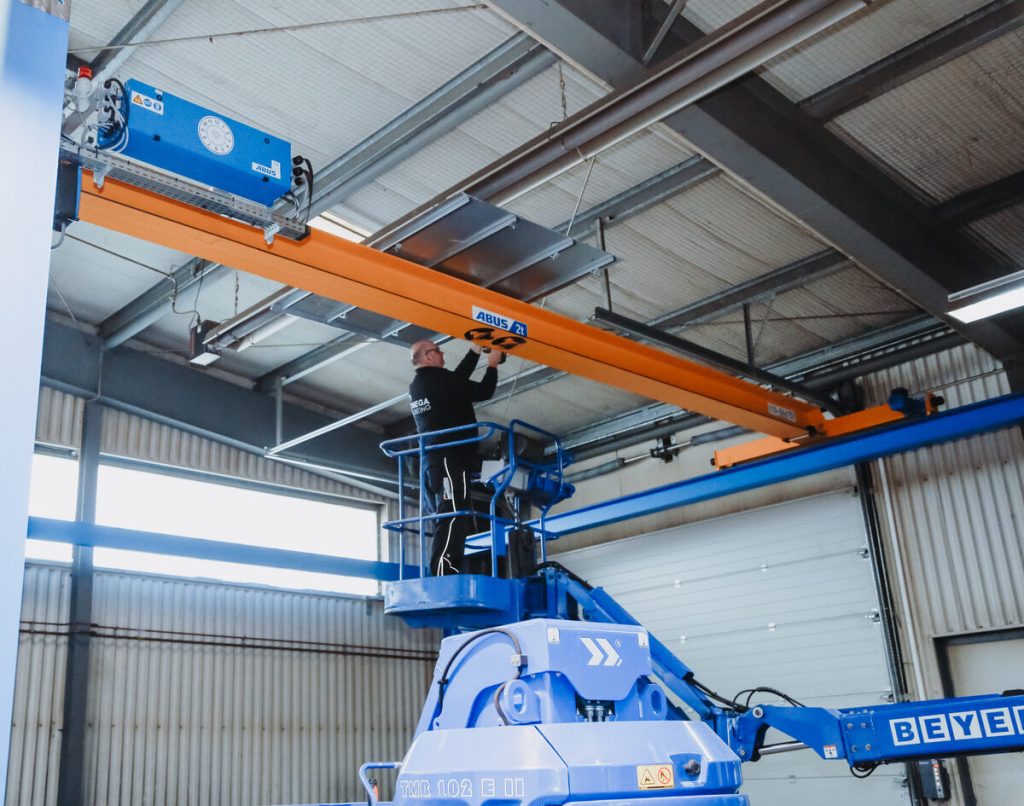
The most serious accidents with MEWPs during installation work occur when a person is crushed between the basket guardrail and a fixed structure above them. Such as hall girders, crane runway, ventilation duct, pipework. The mechanism is insidious: the operator looks at the workpiece, drives upward and hits it with back or head. In doing so he is pressed against his own control panel, which keeps the lift going.
Measures against crushing
- Before lifting, scan the airspace above the basket: girders, crane runways, lines, luminaires, sprinklers.
- Last metres to the work point only at creep speed, eyes upward, not on the workpiece.
- Use control panel protection that prevents unintentional pressing or stops the movement on impact.
- Work in pairs in the basket when the work point is close beneath a structure: one operates, one watches.
- Brief a ground person who knows the emergency lowering and can lower the basket if someone is trapped.
Impact with moving parts
During crane installations a second hazard is added: the overhead crane, mobile crane or pre-assembled crane bridge moves while the platform is stationary. Such sequences need a lift plan that includes the platform as an obstacle and as a workplace, and a banksman. Plus the rule: nobody in the basket within the slewing or load area while the load is being moved.
The large-equipment module requires, where several items of lifting equipment have overlapping slewing areas, agreed right-of-way rules and task areas, and for cranes additionally a scaled sectional drawing proving freedom from collision. We transfer that to platform, forklift and crane: who travels into which airspace and when is fixed before the first lift. Banksmen work with the hand signals of workplace rule ASR A1.3 so that all machine operators speak the same language.
Overhead lines outdoors
Telescopic and articulating boom lifts outdoors quickly reach the height of overhead lines. The safety distances the module gives for cranes apply to every item of lifting equipment. They are at least 1.00 metre up to 1,000 volts, 3.00 metres up to 110 kilovolts, 4.00 metres up to 220 kilovolts and 5.00 metres up to 380 kilovolts. If the voltage is unknown, 5.00 metres apply. Anyone who does not know the voltage keeps the largest distance or has the line de-energised.
Falling parts
Against tools and small parts falling from the basket, tool tethering, basket pouches, a cordoned-off danger zone and the prohibition on working beneath the basket help. The barrier consists of solid elements – site fencing, guardrails, chain or rope. According to the module, flutter tape is only a visual marking and is not permitted as a barrier.
Who provides the platform: provided by the client or brought along?
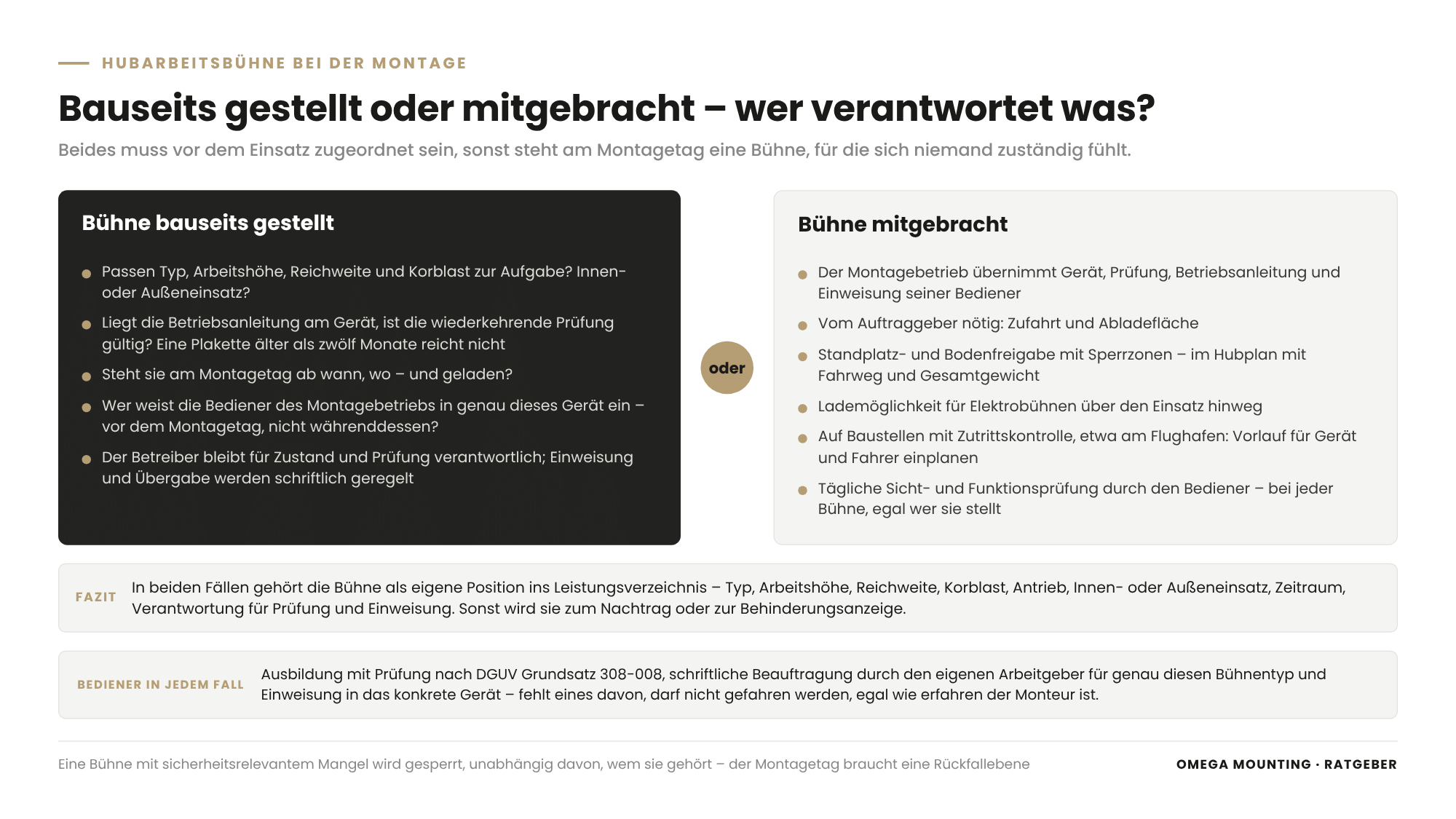
Whoever provides the MEWP – whether the client keeps it ready on site or the installation contractor hires it and brings it along – is responsible for its condition: inspection, operating instructions, charge and availability. Whoever operates it is responsible for familiarisation, use and the daily visual check. Both must be assigned before the job, otherwise on installation day there is a platform that nobody feels responsible for.
Provision by the client
“Platform by client” appears in many scopes of works because the client has platforms on site anyway. That makes sense if it is clarified: which type, which working height, outreach and platform capacity? Indoor or outdoor use? Are the operating instructions included, is the inspection valid? From when and where will it be standing on installation day, charged? Who familiarises our operators with this machine?
Platform brought along
If we bring the platform, we take care of the machine questions. From the client we need access and an unloading area, set-up position and ground release, charging facilities and exclusion zones. With short distances from Rodgau to Offenbach, Hanau or Darmstadt, that is easy. On an airport site with access controls it needs lead time.
What belongs in the scope of works
The platform belongs in the scope of works as a separate item – type, working height, outreach, platform capacity, drive, indoor or outdoor use, period, responsibility for inspection and familiarisation. Otherwise it becomes a change order or a notice of obstruction if it is missing or does not fit. How to avoid such gaps is described in our guide on the scope of works for installation and moving in.
Which inspections does the MEWP need before and during installation?
A MEWP needs a periodic inspection by a competent person with a documented result and, before every working day, a visual and functional check by the operator. Type, scope and intervals are set by the operator under the BetrSichV in its risk assessment. TRBS 1201 (Inspections and checks of work equipment) specifies an interval of once a year for MEWPs. After damage, modifications or prolonged standstill, an unscheduled inspection is added. For you this means: an inspection tag older than twelve months is not sufficient for the release on installation day.
The operator's daily check
- Visual check: damage, leaks, tyres, outriggers, guardrails, basket gate, anchor points.
- Functional check of all control functions from the basket and from the ground, emergency stop, emergency lowering, horn, tilt and load warning.
- Operating instructions and inspection record on the machine, inspection tag valid.
- Charge level or fuel supply for the working day.
- Ground and travel route still as at the time of release.
Defects and quarantine
A platform with a defect in safety-relevant parts is taken out of service – tagged, key removed, hirer or operator informed. Installation day needs a fallback for this: a second platform on site or a replacement platform that can arrive at short notice.
How is a person rescued from a MEWP in an emergency?
In an emergency, the basket is lowered from the ground using the emergency lowering. This is done by a ground person who has been familiarised with exactly this machine and stays within calling distance throughout the work. That is the normal case in the event of a power failure, hydraulic fault or an incapacitated operator. The rescue plan therefore does not begin with the emergency services but with the question of who is standing on the ground.
If the emergency lowering fails or the basket is jammed under a girder, the second level is needed: another platform with which the person is taken over, or a rescue device for lowering by rope. The BG BAU/BAuA module “Site set-up – emergencies and rescue measures” requires rescue equipment to be kept available at workplaces that are difficult to access. Rescue plans are to be rehearsed with everyone involved and adapted to each construction stage.
Then there is first aid: the module requires at least one first aider for up to 20 employees, two from 21 and a stretcher. For our installation crew, this means that a first aider is present on every site.
Three points that the module names explicitly and that are often forgotten in halls and data centers:
- The alarm plan with the numbers of the emergency services is posted visibly.
- Where mobile reception is not reliable – steel halls, basements, shielded plant rooms – a second means of alerting such as radio or landline is needed.
- The emergency access route is marked and named when raising the alarm. A guide meets the ambulance at the gate – on a site with access control, the difference between minutes and quarter-hours.
How we do it in the Rhine-Main region
In the Rhine-Main region, we settle the platform question at the site visit, not on installation day. From Rodgau, halls in Offenbach, Hanau, Aschaffenburg or Darmstadt are quickly reached. There we check gate widths, ramps, ceiling height, set-up positions below the work point, the hall floor and what lies within the hall floor.
In existing halls of the steel construction and mechanical engineering sectors around Babenhausen and Dieburg, the floor is usually load-bearing but the halls are full. Here the articulating boom lift decides reachability. In logistics halls in Raunheim or at Frankfurt Airport there is space, but operations are running. Here it is about electric drive, restricted areas and time windows. In data centers in Frankfurt and Offenbach, raised floors and load spreading plates dominate.
How we do it in practice
Gantry crane installation in Babenhausen. With the installation of a gantry crane at a steel construction company in Babenhausen , two fitters erected in two working days a free-standing steel gantry with runway girders and, on top, a single-girder crane bridge with a capacity of two tonnes. On the first day the gantry was erected, aligned by laser survey and grouted. On the second day the crane bridge, pre-assembled on the ground, was lifted onto the gantry runway by forklift. Then followed conductor rail, limit switches and electrics. Work at height was done from work platforms, final fitting from the articulating boom lift. The safety-critical point was the interplay of forklift and platforms: who lifts, who stands where, who gives the signal.
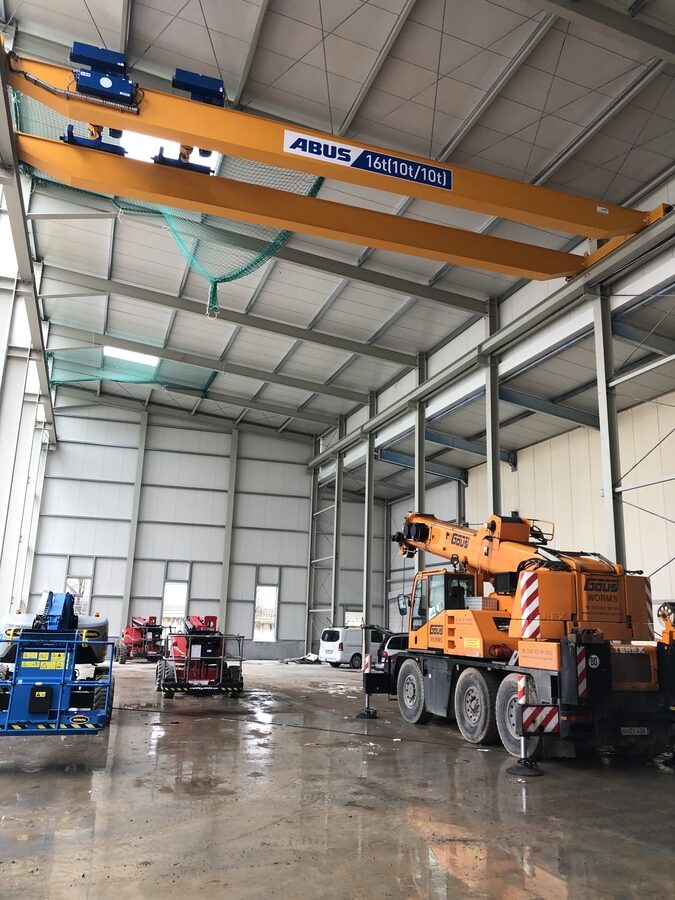
Double-girder overhead crane in Aschaffenburg. With the installation of a double-girder overhead crane with a capacity of 16 tonnes in a new hall near Aschaffenburg , two fitters pre-assembled the crane bridge on the ground in one working day. It was lifted under the hall roof with a mobile crane and swung onto the crane runway through the still open wall panels. Then followed conductor rail, limit switches, radio control and power connection. Two typical points: conductor rail and limit switches are at crane runway height. Open wall panels turn a hall into an outdoor site with wind.
16-tonne crane at a height of over 30 metres. With the installation of a 16-tonne crane at a height of over 30 metres , three fitters worked for one day alongside other trades. At this height there is no improvisation. Access, fall protection and rescue are settled beforehand, every platform and every anchor point is part of the plan.
Is a crane installation, a plant erection or work at crane runway height coming up for you? Then get in touch with us. At the site visit we usually clarify within an hour which platform will reach your work point and what the ground will bear.
What this means for your role
For buyers: Describe the MEWP in the scope of works as a separate item with type, working height, platform capacity and drive. Assign clearly who provides, who inspects and who familiarises. Demand operator certificates and written authorisations as part of the evidence of suitability.
For designers: When laying out the hall or plant room, think about the platform's set-up position below future work points. Crane runways, conductor rails, ventilation ducts and cable trays have to be maintained in operation. A scissor lift needs clear floor beneath them for that. Mark raised floors, hollow floors and shafts in the plan and define where load spreading plates are needed.
For project managers and site managers: Include the platform in the lift plan and site rules: set-up position, travel route, restricted areas, sequence with crane and forklift, banksman. The site manager releases ground and set-up position, checks the inspection tag of the client-provided platform and organises familiarisation. The project manager ensures that all this is done before installation day and that a fallback exists in case the platform fails. Also clarify the alarm plan, emergency access route and mobile reception before the first lift.
For maintenance managers: Set inspection intervals for your own platforms in the risk assessment, keep the inspection log and keep operating instructions on the machine. If contractors use your platforms, regulate familiarisation and handover in writing – as operator you remain responsible for the condition.
For safety officers and HSE coordinators: Check in the installation contractor's risk assessment whether platform type, ground, wind, fall arrest PPE and crushing hazard are dealt with specifically. Define the site rule on fall arrest PPE in scissor lifts beforehand. Pay attention to the emergency lowering familiarisation of the ground persons and the prohibition on climbing out of the raised basket. For workplaces that are difficult to reach, demand a rehearsed rescue plan with a named rescue device.
For manufacturers and system builders looking for an installation partner: Your cranes, conveyor systems or ceiling-mounted installations are installed at height at the customer's premises – often in existing halls whose floor and space you do not know. An installation partner who brings platform selection, ground release and operator qualification with them takes this interface off your hands.
Checklist “MEWP before first use”: template on request
The checklist summarises on one page what must be clarified before the first lift. It covers platform type and task, ground and travel route release, wind limit and overhead lines, inspection record, operator certificate and authorisation. Plus familiarisation, fall arrest PPE rule, emergency lowering and rescue, daily check and fallback – with release fields for site management and operator. Request the checklist via our Contact form – subject line “MEWP checklist”.
Why Omega Mounting?
From Rodgau near Frankfurt, we install cranes, conveyor systems, steel structures and plant in existing halls, logistics centres and data centers throughout the Rhine-Main region – almost always at height. Our fitters are trained as MEWP operators and authorised in writing. We bring a risk assessment and inspected fall arrest PPE for the MEWP with us and plan the platform as part of the lift plan. The linked jobs in Babenhausen, Aschaffenburg and at a height of over 30 metres show that. Via the 24-hour hotline we can be reached at weekends too. More on this under industrial installation in existing buildings and industrial installation for crane construction. For you this means: a single point of contact for platform, lifting and installation, short distances in the Rhine-Main region and no debate at the first lift. Get in touch, if you would like to have that checked for your project.
Conclusion
The MEWP makes installation work at height safe – if the selection fits the task and the ground has been checked. The operator must be trained, authorised and familiarised, the fall protection in the basket must match the platform type and the rescue must be settled beforehand. The crushing hazard under girders and crane runways remains the greatest risk and is controlled only by slow travel, line of sight and clear arrangements. Anyone who fixes platform, set-up position and responsibility in the scope of works and the lift plan saves the debate at the first lift on installation day. If you are planning a crane installation, a plant erection or maintenance work at height, send us the hall height, work point and preferred date. We will get back to you with an honest assessment of platform, access and restraint.
Planning maintenance, moving in or installation in the Rhine-Main region?
Tell us briefly what it is about – we will come back to you with an honest assessment.
100% free and without obligation
You may also be interested in these guides

About the author
Tobias Schott
Managing director of Omega Mounting GmbH, Rodgau · more than 20 years of hands-on experience in installation and maintenance
A trained mechatronics technician, at home in maintenance, servicing and industrial installation since 2004 – first at his father's side, since 2012 with Omega Mounting: from the overhead conveyor in Frankfurt to the crane system in a new-build hall. Plans and leads lifting operations as appointed person in data centers and on industrial sites in the Rhine-Main region, is an instructor and examiner for cranes, mobile elevating work platforms and telehandlers, and a safety officer. On jobs abroad he is known as the “German Troubleshooter” – the one you call when things get stuck on site. He learned what quality means not from a manual but from his father: Made in Germany as a standard for his own work, not as a label. That is why it comes first at Omega Mounting – before speed and before price. He writes these guides from that practice: what works on our sites is in them – what only exists in the standard is not.
Frequently asked questions
There is no official driving licence for MEWPs, but there is mandatory training with an examination, on the basis of which an operator card is issued. Added to this are the authorisation by the employer and familiarisation with the specific machine.
In scissor lifts, fall arrest PPE is not prescribed as a matter of principle because the catapult effect is low by design. The risk assessment or the client's site rule can nevertheless demand it. In telescopic and articulating boom lifts, a restraint system with a short lanyard is mandatory.
The operator sets the inspection intervals under the BetrSichV in its risk assessment. The inspection rule specifies once a year by a competent person for MEWPs. After damage or modifications, an extraordinary inspection is added. In addition, the operator checks the platform visually and functionally before every working day.
As a matter of principle, no – leaving the raised basket is one of the most frequent causes of serious fall accidents. Exceptions are conceivable only with a specific risk assessment, separate fall protection at the destination and explicit release. We plan the access so that the work can be done from the basket.
The decisive factor is the wind limit in the operating instructions: many platforms are approved for indoor use only, outdoor-capable ones usually up to a design value of 12.5 metres per second, about Beaufort 6. For overhead lines, the safety distances of the large-equipment module apply – from 1.00 metre up to 1,000 volts to 5.00 metres where the voltage is unknown.
Whoever provides the platform is responsible as operator for inspection, condition and operating instructions. Whoever operates it is responsible for familiarisation, daily visual check and intended use. Both responsibilities belong in writing in the scope of works. A platform with a safety-relevant defect is taken out of service, regardless of who owns it.
Only if the structural engineer or operator releases the point loads of the platform wheels for the raised floor, usually with load spreading plates. Raised floors are designed for distributed loads from racks. In data centers in Frankfurt and Offenbach we clarify this before the job and enter set-up position and plates in the lift plan.
Then a familiarised ground person lowers the basket using the emergency lowering – that is why with us someone always stays on the ground within calling distance. If the emergency lowering fails or the basket is jammed, the previously rehearsed rescue plan with a second platform or a rescue device takes effect. The alarm plan and a guide at the gate lead the emergency services quickly to the scene.
The basis is the BetrSichV (German Industrial Safety Ordinance) with risk assessment, inspections and operation in accordance with the manufacturer's specifications, together with the briefing duty under the ArbSchG. This is specified by DGUV Information 208-019 on the safe handling of MEWPs and DGUV Principle 308-008 on operator training. The German technical rules TRBS additionally govern authorisation, annual inspection and the exceptional lifting of people with other work equipment.
Send us via the Contact form three pieces of information: hall height and work point (such as crane runway, conductor rail, ceiling-mounted installation), floor construction with known shafts or raised floors and your preferred date. We will get back to you and arrange a site visit – from Rodgau at short notice in Offenbach, Hanau, Darmstadt or Aschaffenburg. You receive a written assessment with platform type, set-up position, operator certificates and rescue plan. Your contact is Tobias Schott.
 English
 German