
- Project report – double girder
Installing a double-girder overhead crane: 16-tonne crane beneath the hall roof near Aschaffenburg
How 2 fitters pre-assembled the overhead crane on the floor, lifted it beneath the roof with a special crane and rotated it onto the crane runway with millimetre precision – including conductor rails, controls and limit switches in one day
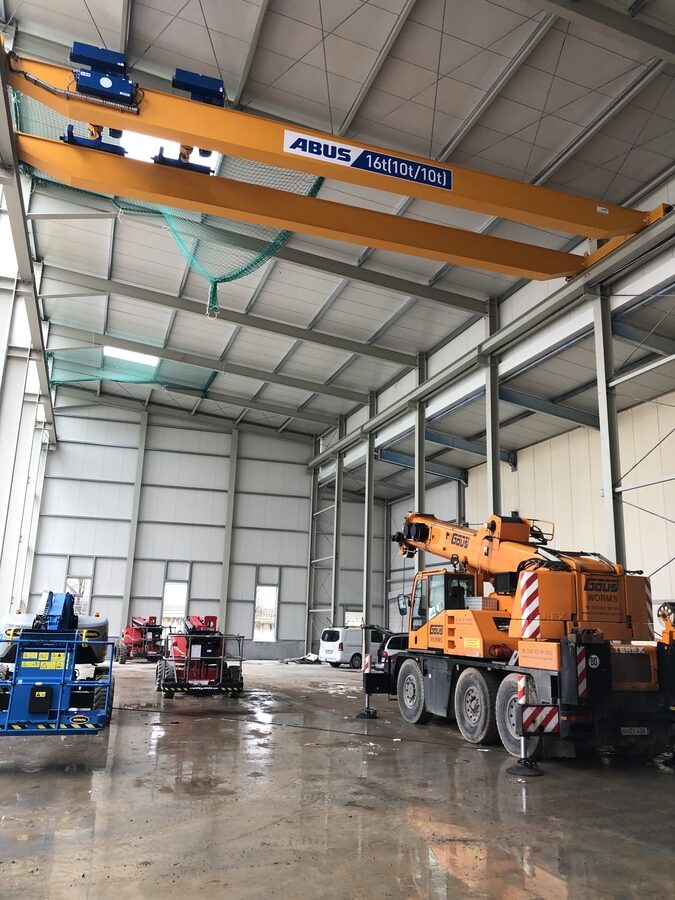
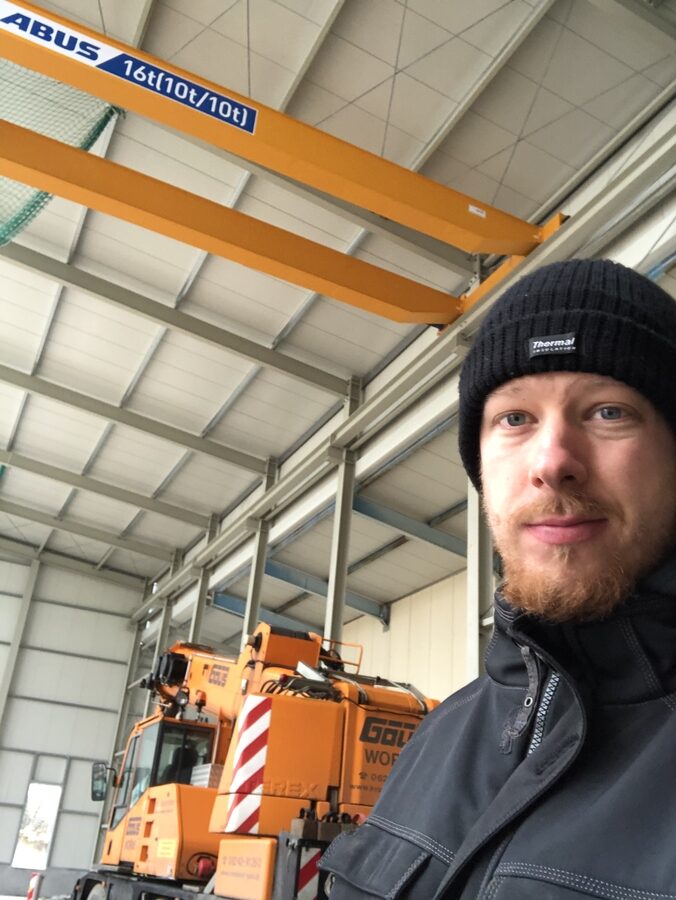
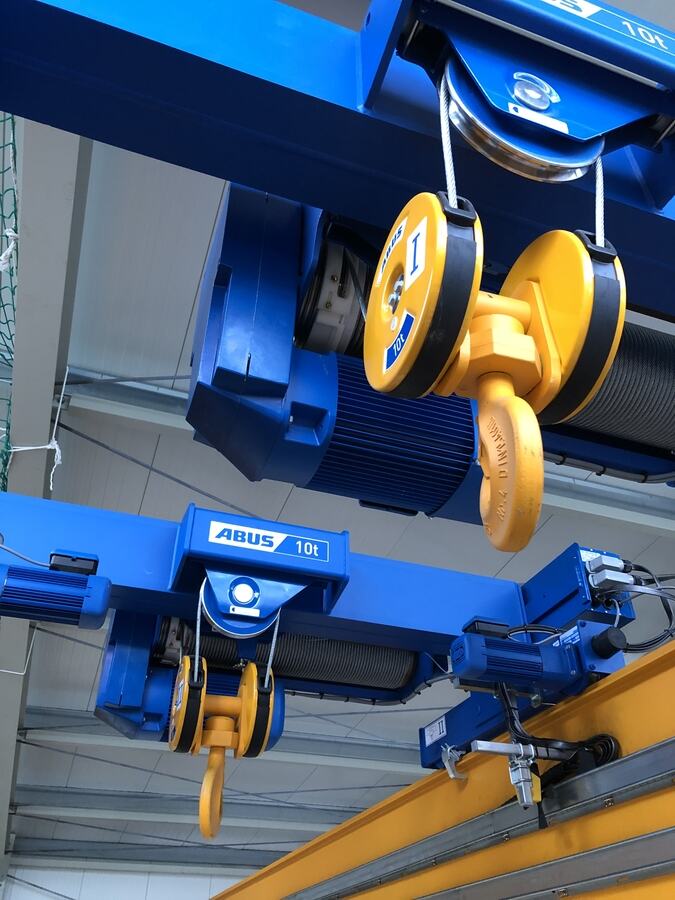
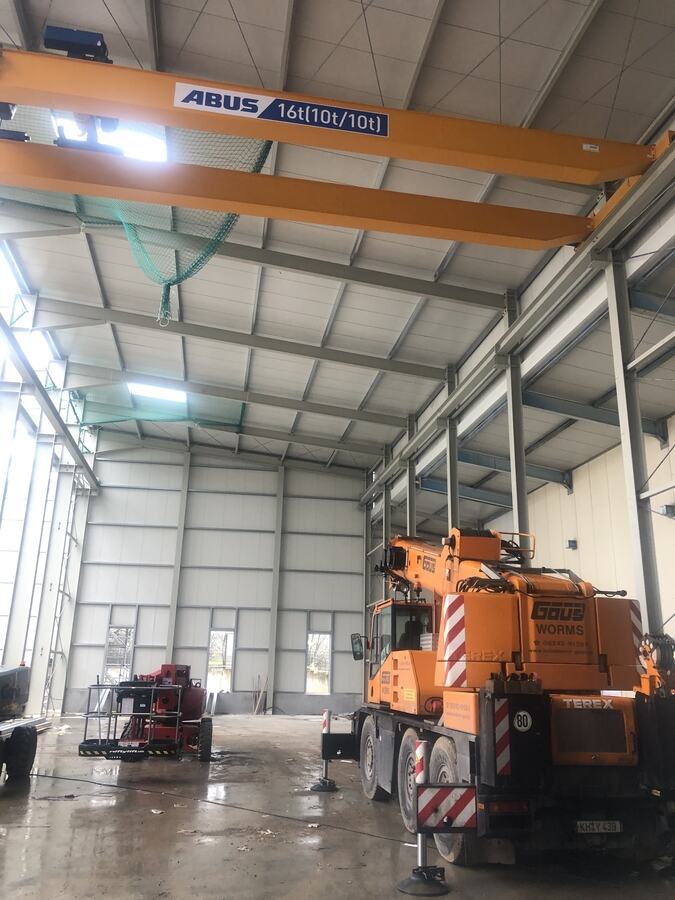
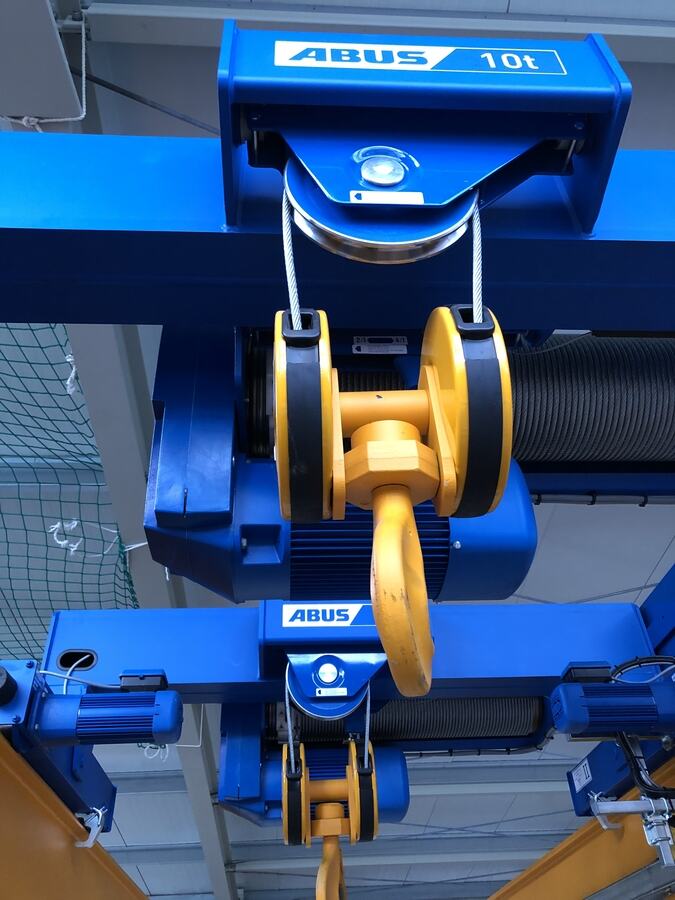
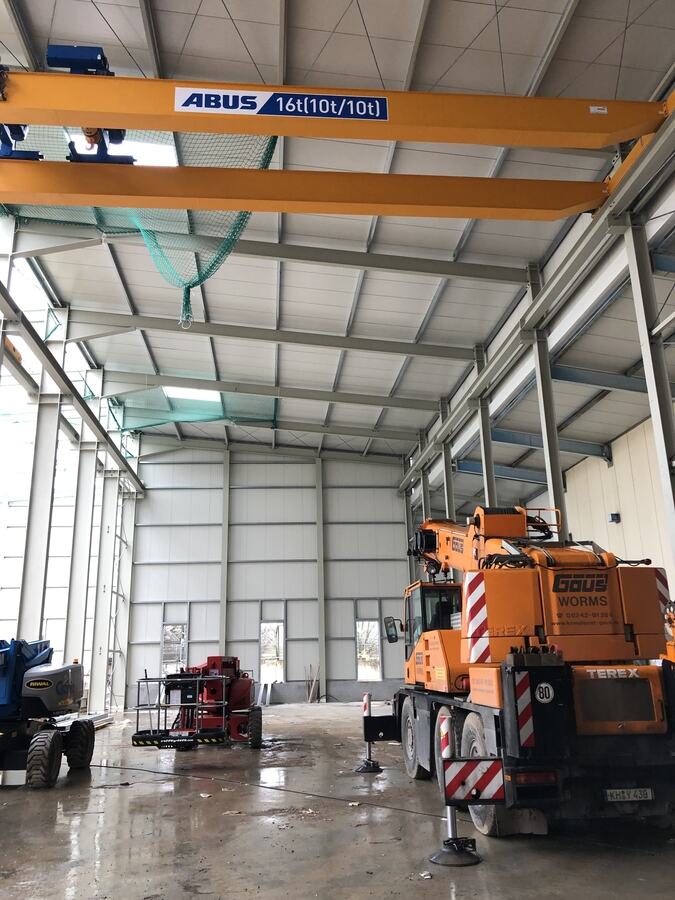
A new hall near Aschaffenburg receives its centrepiece: a double-girder overhead crane with a total lifting capacity of 16 tonnes and two crabs of 10 tonnes each, which can move material together in tandem. Our job – on behalf of the client, who like the end customer remains anonymous: the complete installation, from unloading to the main power switch.
Getting there was precision work: the crane was driven into the hall by lorry, unloaded there and pre-assembled on the floor as far as possible. A mobile crane of type AC 40 with fly jib then lifted the bridge beneath the hall roof – and rotated it onto the crane runway. It is exactly at this rotating-in stage that everything is decided with a double-girder overhead crane: the diagonal dimension of the structure determines whether the crane fits into the hall at all. 2 fitters, 1 working day, come wind or weather – by the evening the crane was sitting on its runway, wired up to the main switch.
Project profile
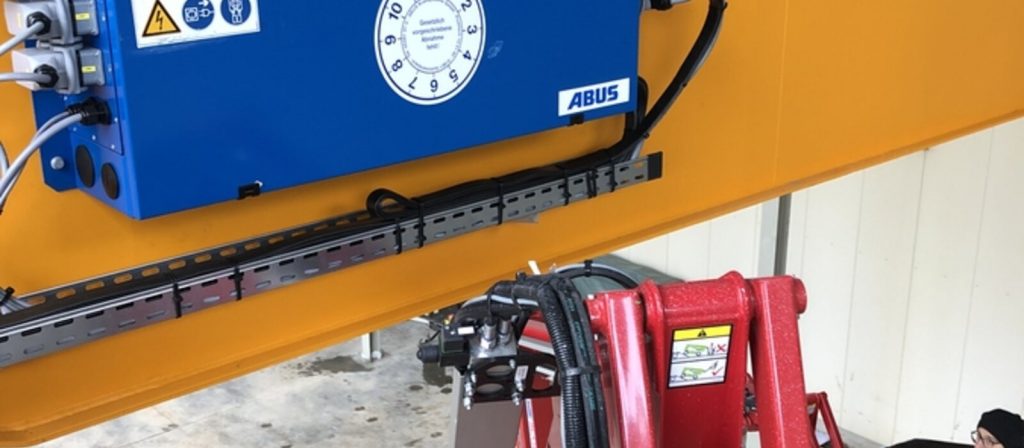
- Scope: Complete installation of a double-girder overhead crane (16 t total lifting capacity, 2 crabs of 10 t each with tandem operation) in a new hall – delivery by lorry into the hall, pre-assembly on the floor, lifting in with an AC 40 mobile crane with fly jib, rotating in and setting down on the crane runway; installation of the conductor rails, the pre-limit and end-limit switches, the controls including radio remote control and the power connection up to the main power switch
- Team: 2 fitters from Omega Mounting
- Project duration: 1 working day
- Location: New hall near Aschaffenburg (Bavaria); end customer and client anonymous
- Interface: From the main power switch onwards, the plant electrician took over – everything before that from a single source by Omega Mounting
What is a double-girder overhead crane?
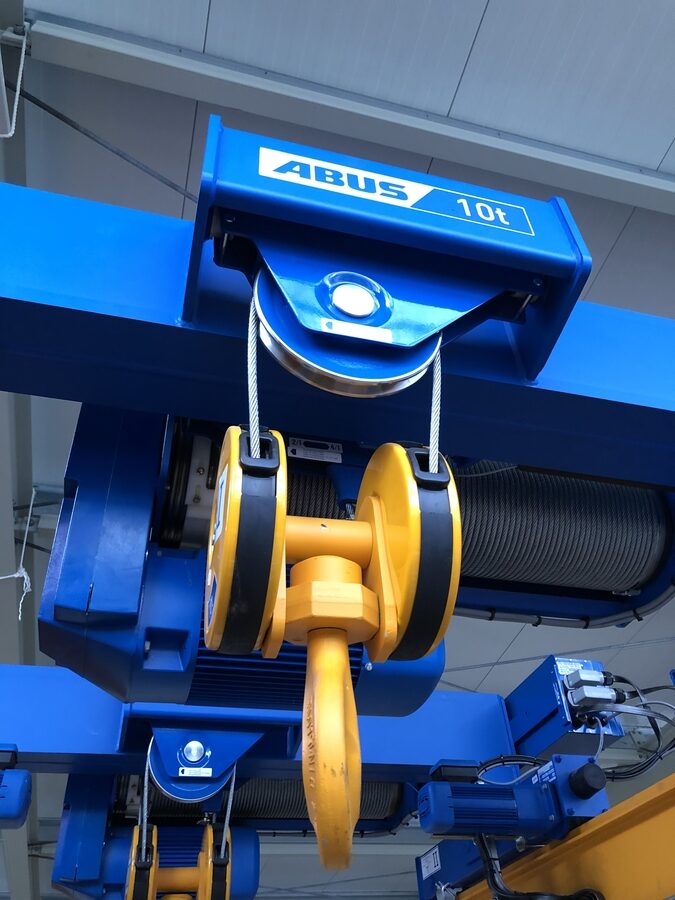
A double-girder overhead crane is the heavy-duty variant of the overhead travelling crane: instead of a single girder, two parallel bridge girders span the hall, and the crabs travel on top between the girders. This design carries considerably more than a single-girder crane, makes full use of the available hook height – and offers room for more than one hoist.
That is exactly what was required here: the installation carries a total of 16 tonnes and has two crabs with a lifting capacity of 10 tonnes each. The clever part is the tandem operation: both crabs can travel and lift together – ideal for long, bulky loads such as machine frames, beams or coils that have to be picked up at two points so they do not tip or swing. Two hooks, one control, one steady load.
How does a 16-tonne crane get into a finished hall?
Through the door – and then upwards, methodically. The crane bridge was driven directly into the hall by lorry and unloaded there. On the floor, our fitters pre-assembled everything that can be done faster and more safely at ground level – attachments, hoists, wiring preparation. Only then came the actual lift.
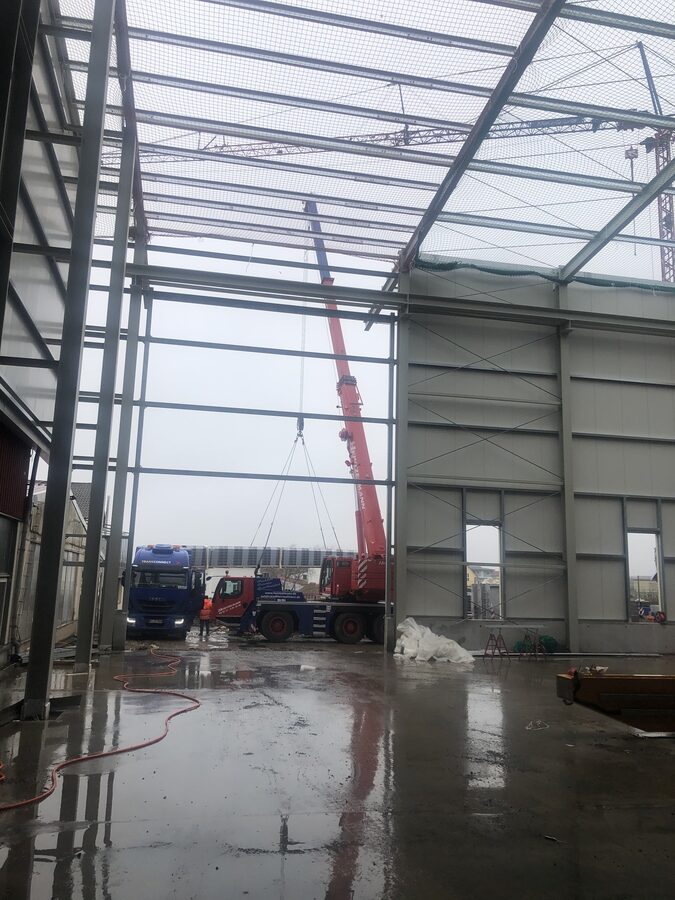
A special crane was on hand for this: an AC 40 with fly jib. The jib allows the load to be slung particularly short – decisive when there is little clearance between the hall roof and the crane runway. With this set-up, the complete bridge was lifted beneath the roof, rotated in above the crane runway and set down cleanly on both runways. The tighter the hall, the more important the crane technology, slinging geometry and a well-rehearsed team that coordinates the movements centimetre by centimetre.
Why is the diagonal dimension the critical figure?
Because a double-girder overhead crane needs more room when rotating in than you might think. Due to the two girders and, above all, the longer end carriages at the bridge ends, the diagonal of the structure is considerably larger than its span. When rotating onto the crane runway, however, the crane is moved precisely across this diagonal – and that is where the geometry may simply not fit through the hall: diagonally, the crane does not fit between the walls.
Then it is time to plan: you look for places between the hall columns where the diagonal just swings through – or you schedule the installation in a window when the hall is still open. On this site we were lucky in this respect: the walls were not yet fully installed, and rotating in went through the open wall panels without any millimetre gamble. For us, considerations like these are part of installation planning – because a crane that cannot be rotated in is, in the end, just expensive steel on the hook.
From steel to a working crane: the electrical installation
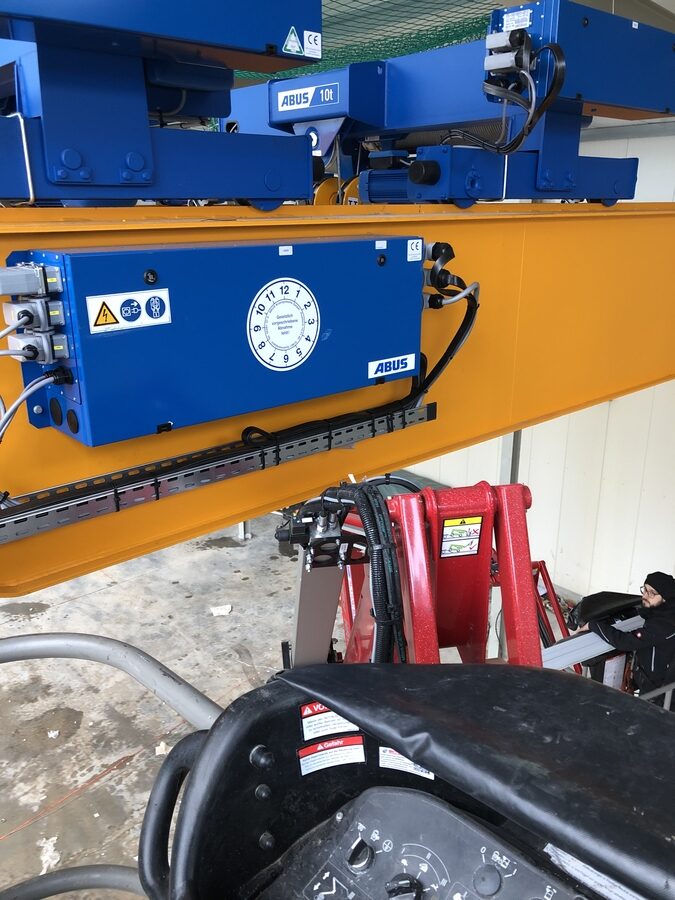
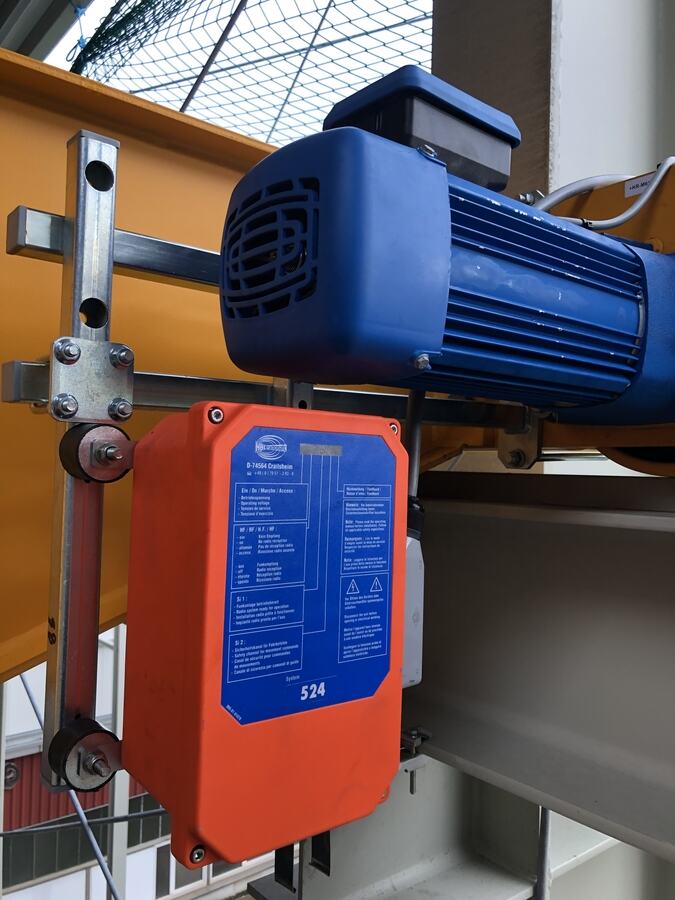
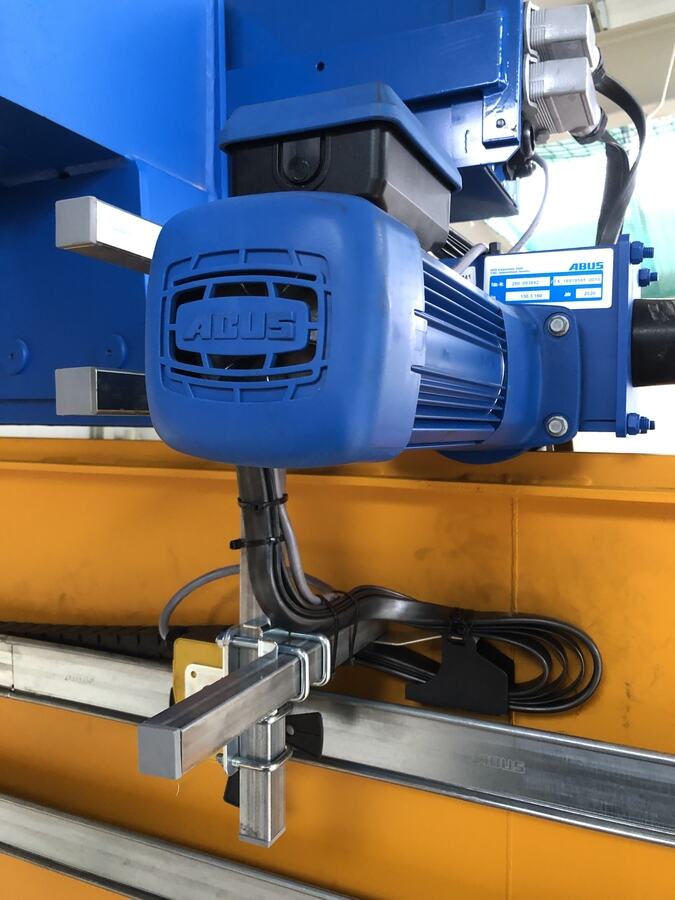
A crane sitting on its runway is only half the job – now it needs power, controls and safety. After the lift, our fitters installed the conductor rails along the crane runway, which supply the crane along its entire travel length. Then came the pre-limit and end-limit switches – the safety devices that first slow the crane travel before the end of the runway and then stop it, before mechanical buffers come into play at all – as well as the complete controls including radio remote control.
The final step was the power connection up to the main power switch. From this cleanly defined interface, the customer's plant electrician took over. For the client this means: we install the complete crane – mechanics, conductor rails, controls, pre-limit and end-limit switches and everything that goes with it – from a single source, come wind or weather. What is handed over is a crane that only needs to be switched on.
Why Omega Mounting?
- Crane technology routine: Crane runways, underslung cranes, double-girder overhead cranes – we install crane systems in new builds and existing halls.
- Moving-in planning included: Diagonal dimension, slinging geometry, special crane with fly jib – we think through the crane's route into the hall from the outset.
- Pre-assembly on the floor: Whatever can be assembled at ground level is assembled at ground level – faster, safer, more accessible.
- Mechanics + electrics from a single source: Conductor rails, pre-limit and end-limit switches, controls, main switch – right up to a clean handover interface to the plant electrician.
- Weatherproof: New hall without finished walls, wind and weather – our team still installs on schedule.
- Rooted in the region: The Aschaffenburg area is right in our catchment area – from Rodgau we are quickly on site in Aschaffenburg, Hanau, Frankfurt and the entire Rhine-Main region, and we work throughout Germany.
Conclusion
By lorry into the hall, pre-assembled on the floor, lifted beneath the roof with the AC 40 and fly jib, rotated in through the still-open wall panels and set down on the crane runway – plus conductor rails, pre-limit and end-limit switches, controls and main switch: after one working day with two fitters, the new hall near Aschaffenburg has its 16-tonne double-girder overhead crane with tandem crabs. If your hall is to receive a crane – and you want to know whether it will fit in at all – get in touch with us: we calculate the diagonal dimension before the steel is ordered.
Request a callback for your project now – Omega Mounting GmbH, Rodgau. As an installation company from the Offenbach district, we are quickly on site in Aschaffenburg, Hanau, Frankfurt and the entire Rhine-Main region – and we work throughout Germany.
Photo gallery of the job
Are you planning a project of this kind?
Tell us briefly what it is about – we will come back to you with an honest assessment.
100% free and without obligation
Related guides for this project

About the author
Tobias Schott
Managing director of Omega Mounting GmbH, Rodgau · more than 20 years of hands-on experience in installation and maintenance
A trained mechatronics technician, at home in maintenance, servicing and industrial installation since 2004 – first alongside his father, and since 2012 with Omega Mounting: from the overhead conveyor in Frankfurt to the crane system in a new-build hall. As appointed person for lifting operations, he plans and leads lifting operations in data centers and on industrial sites in the Rhine-Main region, is an instructor and examiner for cranes, aerial work platforms and telehandlers, and a safety officer. On assignments abroad he is known as the "German Troubleshooter" – the one you call when things get stuck on site. He did not learn what quality means from a manual, but from his father: Made in Germany as a standard for his own work, not as a label. That is why quality comes first at Omega Mounting – before speed and before price. The project diary shows the jobs his team has planned and carried out – without customer names, but with everything that can be learned from them.
Frequently asked questions
The double-girder overhead crane has two parallel bridge girders on which the crabs travel on top – this allows higher lifting capacities, better hook heights and several hoists. On this project: 16 t total lifting capacity with two 10 t crabs in tandem operation.
For long or top-heavy loads that have to be picked up at two points – machine frames, beams, pipes. Both crabs travel and lift together, and the load hangs steady and secure against tipping from two hooks.
On this project: driven into the hall by lorry, pre-assembled on the floor and lifted beneath the hall roof with an AC 40 mobile crane with fly jib. The jib allows the load to be slung short – necessary when there is little room between the roof and the crane runway.
Because of the long end carriages, the diagonal of a double-girder overhead crane is considerably larger than its span. When rotating onto the crane runway, precisely this diagonal has to fit through the hall – otherwise you need free spaces between the columns or a time window in which wall panels are still open, as with this new build.
The conductor rails along the crane runway, the pre-limit and end-limit switches as safety devices before the runway ends, the controls with radio remote control and the supply line up to the main power switch. From there the plant electrician takes over – a clean, clearly defined interface.
Yes – this double-girder overhead crane was installed in a new hall near Aschaffenburg, right in our catchment area. From Rodgau we are quickly on site in Aschaffenburg, Hanau, Frankfurt and the entire Rhine-Main region – and throughout Germany on request.
 English
 German