
- Guide – Occupational safety
Personal fall protection equipment during installation work: fall arrest, anchor points, rescue
By Tobias Schott · Reading time approx. 23 minutes · Last updated: October 2026
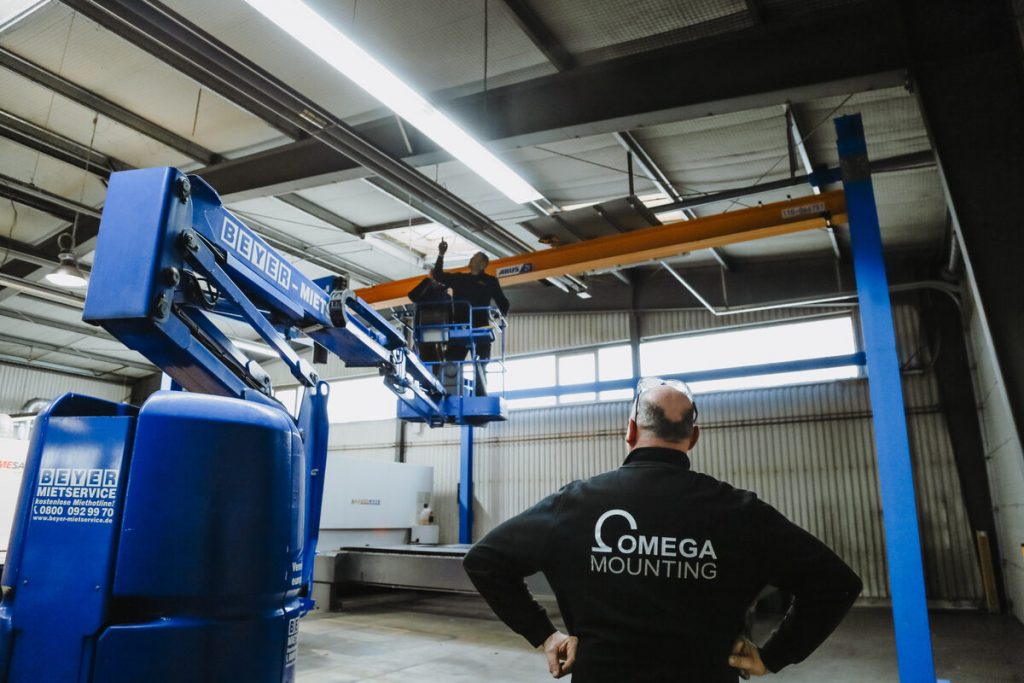
Fall arrest PPE – in German PSAgA, persönliche Schutzausrüstung gegen Absturz – is the last control in the hierarchy for installation work, not the first. It is used when guard rails, a platform or a net are not possible. And it is only permissible if suitable anchor points, briefed users and a rescue plan are in place.
A crane bridge is set onto the crane runway at a height of twelve metres, a pipe run is bolted beneath the hall roof, a transfer point is installed at a fall edge on the first floor. Work at height is part of almost every installation – and a misstep there can be fatal. Falls have been one of the most frequent causes of serious occupational accidents for decades. Anyone who uses fall arrest PPE in installation work or permits it as the client bears responsibility that goes beyond handing out a harness.
For you as safety officer, site manager or buyer, the question arises from two sides. How do you protect your own personnel's work at height? And what may you require of an installation contractor working at height on your premises? This guide answers both, working through the topic of fall arrest PPE in installation work from the hierarchy of controls to the rescue plan. It builds on our fundamentals article on the evidence you may require from a subcontractor for installation work by adding the topic of falls. And it shows how we put this into practice in crane, platform and plant installations between Babenhausen, Frankfurt and Kassel.
Key points at a glance
- Under the ArbSchG (German Occupational Safety Act), fall arrest PPE is the subordinate control. First, work at height is avoided, then collectively protected (guard rails, platform, scaffold), then arrested (net, catch scaffold) – and only then protected individually.
- A fall arrest system consists of an anchor device, a lanyard with energy absorber or a self-retracting lifeline, and a full-body harness; a restraint system prevents the fall edge from being reached at all.
- The anchor point is decisive: it must absorb the forces of an arrested fall, lie above the user where possible, and avoid swing falls and edge loading.
- Anyone using another company's scaffold inspects it themselves beforehand and changes nothing on it – this applies to every employer on the site.
- Anyone using fall arrest PPE needs a rescue plan: a person hanging in a harness must be rescued quickly by their own team – suspension trauma leaves no time to wait for outside help.
- Fall arrest PPE is visually checked before each use and inspected at least once a year by a qualified person; the briefing includes practical exercises – putting on, anchoring, hanging, rescuing.
- As the client, you may require from the installation contractor the risk assessment, rescue plan, inspection records for the fall arrest PPE and briefing records – and you should.
What is fall arrest PPE (PSAgA)?
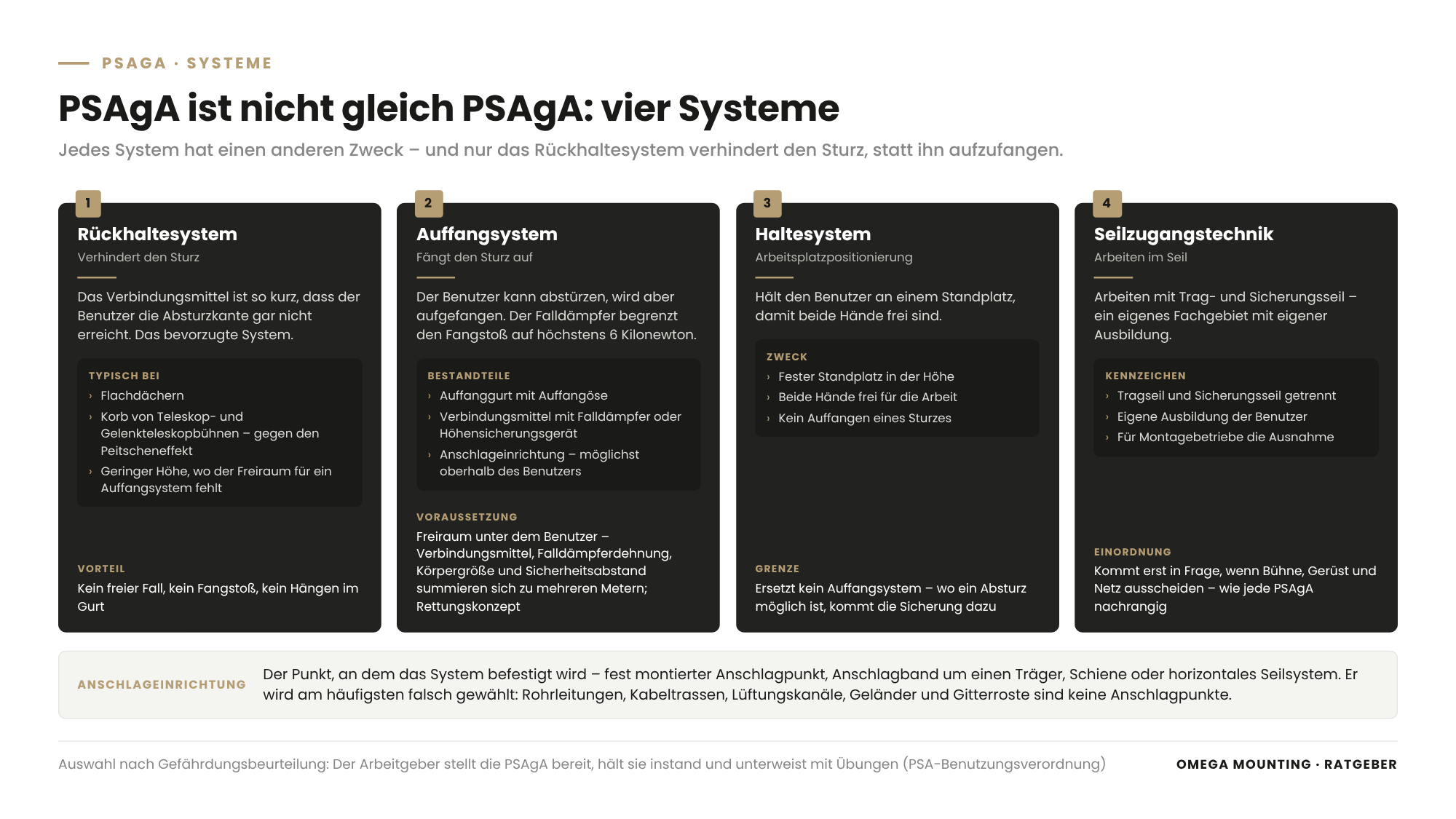
PSAgA is the German abbreviation for personal protective equipment against falls from height: a system of full-body harness, lanyard and anchor device. It either prevents a person from reaching the fall edge or arrests a fall in such a way that the forces acting on the body remain limited. Unlike collective measures such as railings or nets, fall arrest PPE protects only the person who is wearing it correctly and has anchored themselves.
DGUV Rule 112-198 "Use of personal protective equipment against falls from height" distinguishes several systems:
- Restraint system: The lanyard is so short that the user cannot reach the fall edge at all. It is the preferred system because it prevents the fall instead of arresting it – typical on flat roofs and in MEWPs.
- Fall arrest system: The user can fall but is arrested. This comprises the full-body harness with fall arrest attachment point, a lanyard with energy absorber or a self-retracting lifeline, and an anchor device. The self-retracting lifeline is a kind of inertia reel that locks under sudden pull. The energy absorber limits the arrest force – the force acting on the body when the fall is arrested – to a maximum of 6 kilonewtons.
- Work positioning system: The user is held at a working position to have both hands free; it does not replace a fall arrest system.
- Rope access: Working on ropes with working line and safety line – a specialist field with its own training, the exception for installation contractors.
The anchor device is the point at which the system is attached – a permanently installed anchor point, an anchor sling around a beam, a rail or a horizontal lifeline system.
Legally, fall arrest PPE is personal protective equipment within the meaning of the German PPE Use Ordinance (PSA-Benutzungsverordnung). The employer selects it on the basis of the risk assessment, provides it, maintains it and briefs the employees. For equipment against fatal hazards, this is expressly done with exercises.
When is fall arrest PPE permissible in installation work at all?
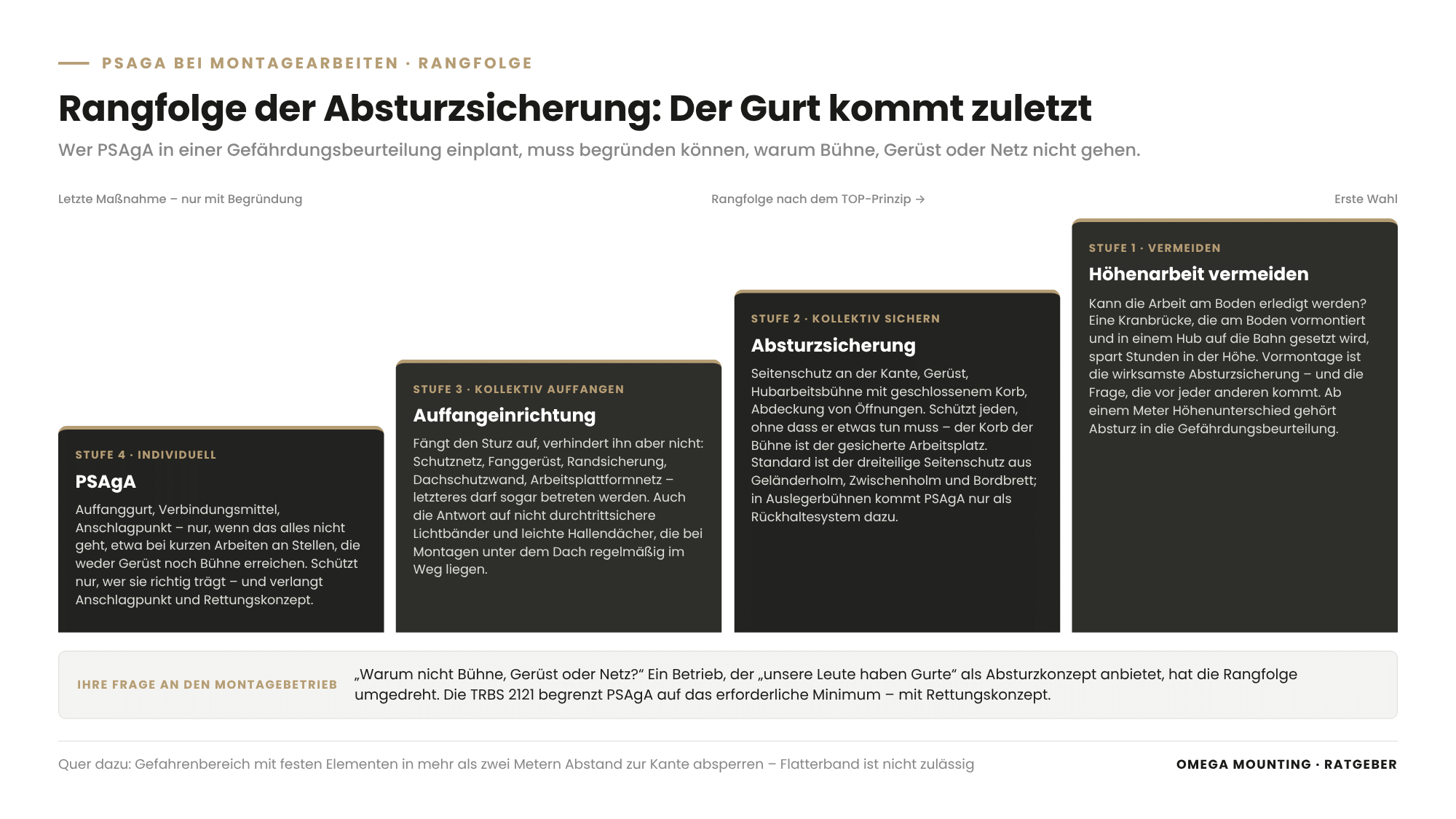
Fall arrest PPE is permissible if the risk assessment shows that fall protection by guard rails, scaffold or platform is not possible or not practicable. The same applies to fall arrest equipment such as a net or catch scaffold – and only then. This hierarchy is not a recommendation but the legal position. The ArbSchG (Section 4) requires hazards to be tackled at source and individual protective measures to be taken only as a subordinate option. The workplace rule ASR A2.1 puts this into concrete terms for fall edges. For work with and on work equipment, the German technical rule on falls, TRBS 2121, says the same: fall protection before fall arrest equipment before fall arrest PPE. Fall arrest PPE only "to the necessary minimum" and with a rescue plan, because a hanging person must be rescued quickly. For you, this means: anyone who plans fall arrest PPE in a risk assessment must be able to justify why a platform, scaffold or net is not feasible. Ask before you sign.
The hierarchy in detail
The so-called TOP principle orders controls into technical, organisational and personal. Applied to work at height, this means:
- Avoid: Can the work be done on the ground? A crane bridge that is pre-assembled on the ground and set onto the runway in a single lift saves hours at height. Pre-assembly is the most effective fall protection.
- Fall protection (collective, technical): Guard rails at the edge, scaffold, MEWP with closed basket, covering of openings. These measures protect everyone without them having to do anything.
- Fall arrest equipment (collective): Equipment that arrests a fall but does not prevent it. The BG BAU/BAuA module "Working and protective scaffolds, protection against falls" names edge protection, catch scaffolds and roof catch scaffolds, roof safety walls and safety nets. In addition, working platform nets, which may even be walked on. Safety nets are also the answer to non-load-bearing surfaces such as rooflights and lightweight hall roofs. These are regularly in the way during installations beneath the roof.
- Fall arrest PPE (individual): If none of this is feasible – for example for short tasks at points that neither scaffold nor platform can reach.
Cutting across all of this is the cordoning-off of the danger zone. Anyone who cannot reach the fall edge at all needs no protection at it. For this, the module requires fixed elements – site fencing, railings, chains or ropes – at a distance of more than 2.0 metres from the edge. Barrier tape as a visual marking is not permissible.
The fall height
From what height a fall edge must be protected is governed by workplace law and accident prevention regulations. In workplaces, ASR A2.1 requires fall protection at workstations and traffic routes from a fall height of more than one metre. For construction sites, the scaffold module reproduces the thresholds of DGUV Regulation 38. At traffic routes, stairs and openings, the threshold is more than 1.00 metre, at other workstations more than 2.00 metres. On flat roofs and floor slabs up to 50 square metres, it is more than 3.00 metres. Above water or substances in which a person can sink, the duty applies regardless of height.
Guard rails and openings
Where protection is collective, the module describes the standard. This is a three-part guard rail consisting of top rail, intermediate rail and a 150-millimetre-high toe board that retains tools and small parts. It may only be omitted if the distance between the deck edge and the structure is no more than 0.30 metres. Openings in floors and ceilings up to 9.00 square metres and 3.0 metres edge length may instead be secured with a proper cover. This counts for installation openings used for moving in equipment.
What this means for MEWPs
A MEWP is a collective fall protection measure – the basket with railing is the protected workstation. Nevertheless, in boom-type platforms, i.e. telescopic and articulating boom lifts, fall arrest PPE is worn as a restraint system with a short lanyard. The reason is the catapult effect, which can throw persons out of the basket. In scissor lifts, this is generally not required. We cover the use of MEWPs in installation work in a separate guide.
What applies if the installation contractor uses another company's scaffold?
Anyone who, as a subcontractor, uses a scaffold provided by another company must inspect it themselves before first use. Under the scaffold module, this duty applies to every employer who sends employees onto a scaffold, not only to the scaffold erector. On construction sites in the Rhine-Main region, this is our everyday reality. The facade or interior scaffold is already standing when we arrive with the crane runway, pipework or steel structure. Nobody answers for us whether it is suitable for our work.
The module describes the procedure. On completion, the scaffold erector establishes the proper condition and records it in a weatherproof document on the scaffold. They then hand the scaffold over to the users – ideally jointly and with documentation. After that, every user employer checks for obvious defects: missing guard rails, loose decks, missing anchoring. Structural changes are carried out exclusively by the erector. Anyone who removes a deck for a pipe penetration alters the scaffold.
We check three additional points. First, the load class: a facade scaffold does not automatically carry welding equipment, cylinder trolleys and installation material. The module requires scaffolds to be specifically designed for loads from material transport by winches, cranes or lifts and to be inspected particularly regularly. Second, access: stairs and hoists are to be preferred over ladders, internal ladders are permissible only up to 5 metres climbing height. Third, simultaneous use by several companies, which the module names as a particular hazard. Who works where and when on the scaffold belongs in the site meeting.
How are anchor points and anchor devices chosen correctly?
An anchor point must meet three conditions. It must safely absorb the forces of an arrested fall, be positioned so that fall height and swing movement remain minimal, and match the lanyard. Evidence of load capacity is required. For certified anchor devices, the manufacturer's specification provides it; for components of the plant or building, a competent assessment.
Certified anchor devices
Permanently installed anchor points, anchor rails and horizontal lifeline systems are certified, marked products. They are the norm on roofs, on crane runways or on plant that is regularly maintained. For designers and maintenance managers, this means: anyone who plans or operates a plant on which work at height is carried out repeatedly plans the anchor device with it. Its location belongs in the as-built documentation – without it, every fitter improvises differently. On sites with a crane, the lift plan is added: anchor points for persons must not lie within the slewing range of the load.
Plant components as anchor point
In existing halls, certified anchor points are often missing. Then steel beams, trusses or crane runway girders are used with anchor slings or beam clamps. This is permissible if a competent person, in case of doubt the structural engineer, confirms that the component can absorb the forces. In addition, the anchor sling must be suitable for edge loading. Not suitable are pipework, cable trays, ventilation ducts, railings and gratings, even if they look sturdy.
Position of the anchor point
The anchor point should be above the user where possible. What "above" means at a minimum is stated in TRBS 2121 Part 1 for scaffolders working with fall arrest PPE: at least one metre above the standing surface. We apply this value as the lower limit in installation work too. The lower the point, the greater the free fall height and arrest force become, and the more clearance is needed beneath the user. This clearance – the clear height to the next obstacle – is regularly underestimated. Lanyard, energy absorber extension, body height and safety margin add up to several metres. At low heights, a fall arrest system is therefore often worse than a restraint system or a self-retracting lifeline with a short braking distance.
Swing falls and edges
If the anchor point is offset to the side, the user swings during the fall – against columns, plant components or over an edge. Swing falls are avoided by placing the anchor point as vertically above the workstation as possible or by having a horizontal system travel along. If the lanyard runs over an edge, it must be tested for that. Edge-tested self-retracting lifelines are marked.
A distinction that is repeatedly confused on construction sites: lifting accessories for loads – round slings, chains, shackles – are not anchor devices for persons, and vice versa. Each has its own standards, inspections and markings. Which rules apply to loads is described in our guide on Lifting accessories for heavy loads.
What belongs in a rescue plan?
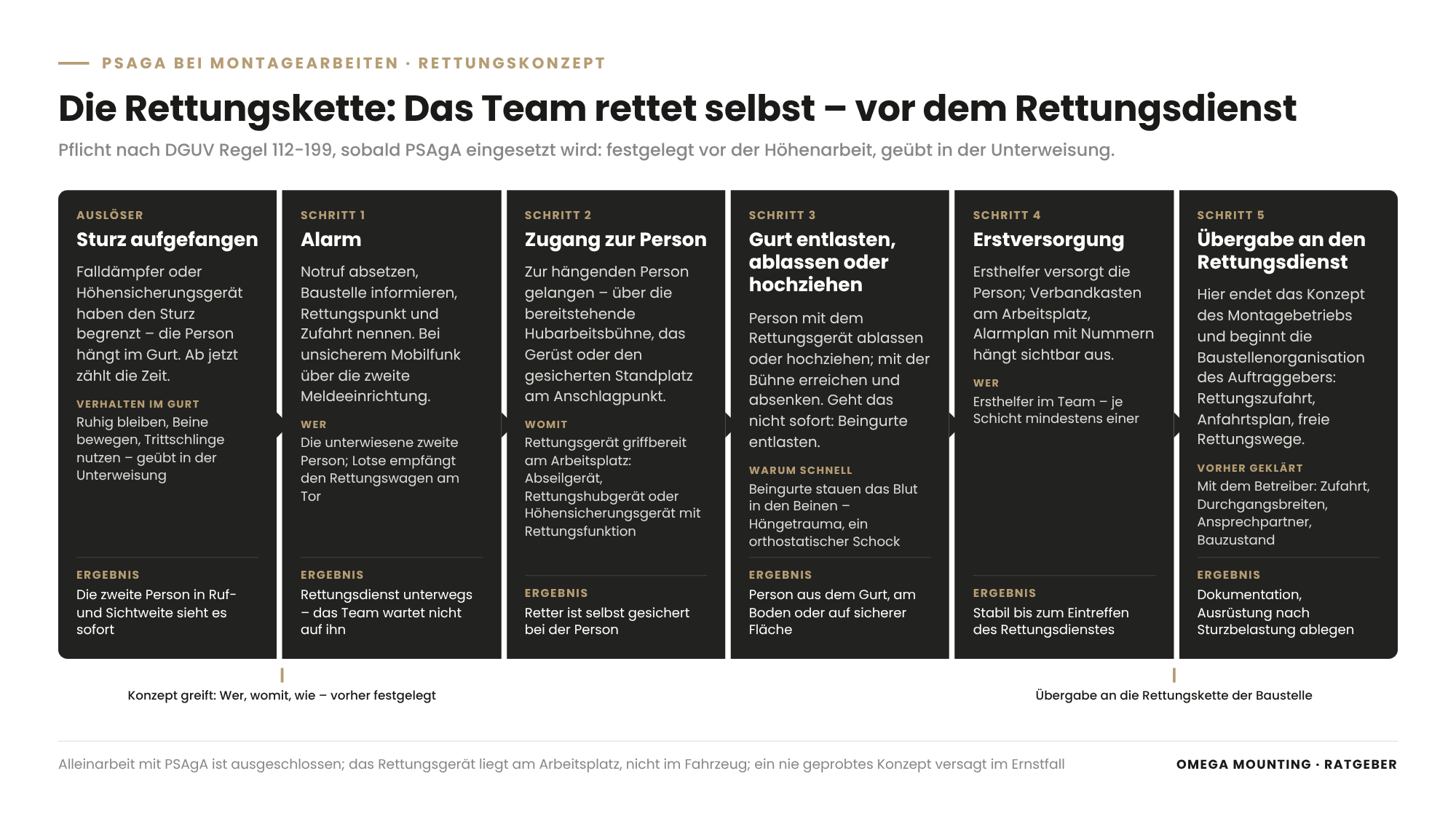
A rescue plan defines, before work at height begins, who rescues a person hanging in a harness or injured at height, how and with what. This is done by the team's own means, without waiting for outside help. DGUV Rule 112-199 "Rescue from heights and depths with personal fall protection equipment" makes it mandatory as soon as fall arrest PPE is used. It requires employees to be briefed and practised in it.
Why time is the decisive factor
Anyone hanging motionless in a harness after an arrested fall is in danger – even without injury. The leg straps pool the blood in the legs, and suspension trauma threatens. This is an orthostatic shock that becomes life-threatening within a short time. That is why "in an emergency we call the fire brigade" is not enough. A height rescue team takes longer to arrive than a hanging person can wait.
The building blocks
A sound rescue plan answers specifically:
- Who rescues? At least one second, briefed person is within calling and visual range – lone working with fall arrest PPE is ruled out.
- With what? A rescue device is kept within reach at the workstation, not in the vehicle: descender device, rescue lifting device or self-retracting lifeline with rescue function. Alternatively, a MEWP is on standby with which the person can be reached and lowered.
- How? The procedure is described: alarm, access to the person, relief of the harness, lowering or raising, first aid, handover to the emergency services. Anyone who cannot take the person down immediately relieves the leg straps – for example with trauma relief straps.
- Where to and who is called? Emergency call, rescue point, access for the emergency services, the operator's contact person.
- Has it been practised? A plan that has never been rehearsed fails in an emergency. Rescue belongs in the practical briefing.
The rescue chain on someone else's site
The installation contractor's rescue plan ends at handover to the emergency services. There, the site organisation of the client or general contractor begins, on which we have to rely. The BG BAU/BAuA module "Site set-up – emergencies and rescue measures" requires rescue plans to be drawn up for special sites and rehearsed with everyone involved. For workstations that are difficult to access, rescue devices for rescue from great heights must be kept available, and every construction stage must be reassessed. Where accessibility is restricted, it recommends planning possible operations together with the emergency services. This clarifies which passage widths and areas must remain clear.
What we therefore ask the site operator before every job at height is also in the module. The alarm plan with the numbers of the local emergency services is displayed visibly. The first aiders are known by name. Required are at least one first aider for up to 20 employees and two from 21, then also a stretcher. From more than 50 employees, a first aid room or container is added. Where mobile phone reception is not reliable, there is a second means of raising the alarm via landline or radio. The emergency access is signposted from the public road, an access plan is lodged with the emergency services, and a guide receives the ambulance at the gate. Escape and rescue routes remain clear – at least 1.00 metre wide for up to 20 persons, 1.20 metres for up to 200. In existing buildings, these are often the existing stairwells.
For clients, the rescue plan is a good touchstone for the quality of a subcontractor. Anyone who can explain who rescues on site and with what has thought work at height through to the end. In our guide on RAMS and risk assessment for installation work we show where the rescue plan has its place in the document package.
How is fall arrest PPE inspected in installation work and when must it be withdrawn?
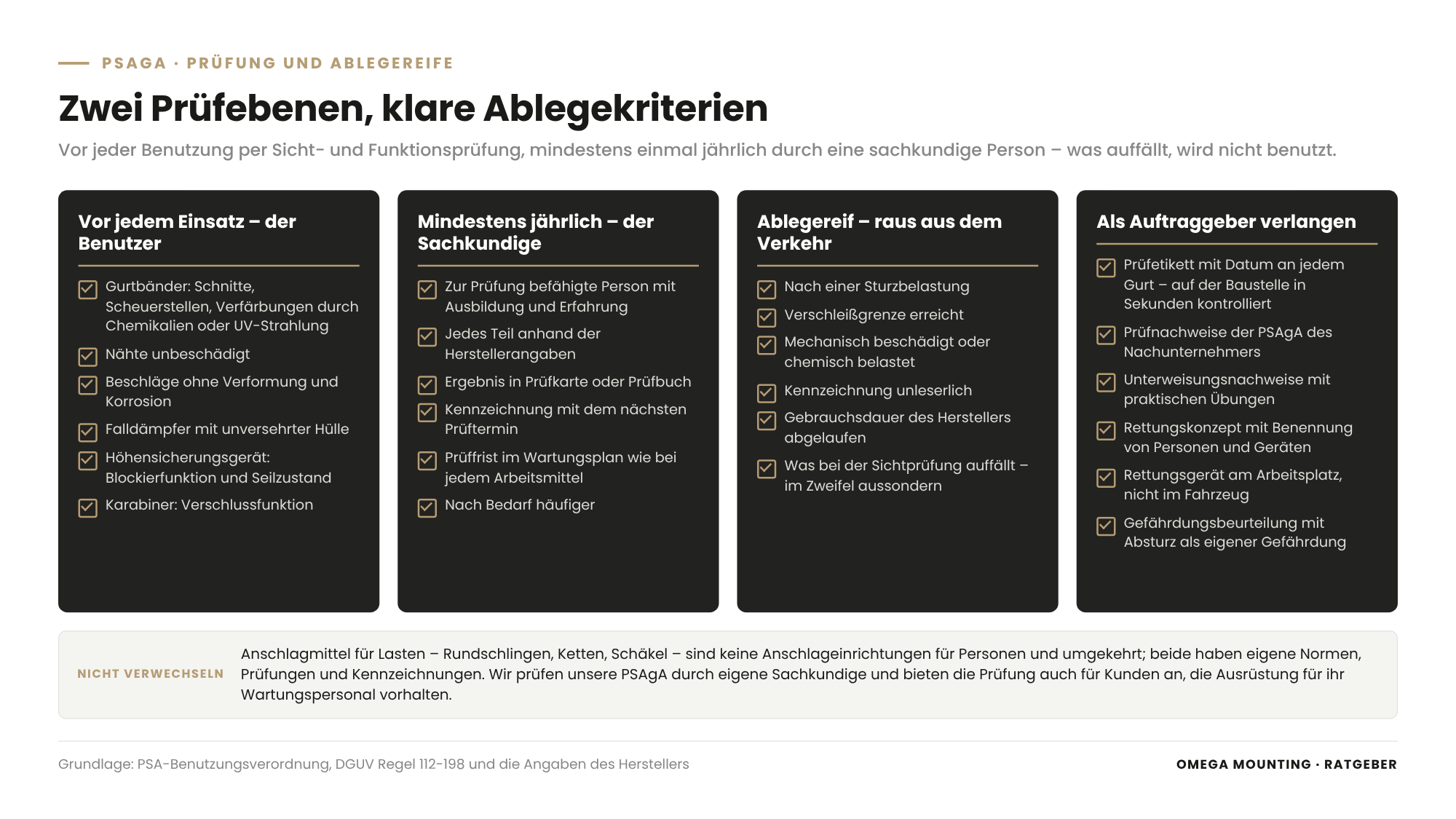
Fall arrest PPE is inspected at two levels. Before each use, the user carries out a visual and functional check. At least once a year – more often if needed – a qualified person inspects it. After a fall load, in the event of visible damage or after expiry of the service life specified by the manufacturer, the equipment is withdrawn from use. The basis is the German PPE Use Ordinance and the manufacturer's specifications.
The visual check before use
The user checks webbing for cuts, abrasion and discolouration from chemicals or UV radiation. They check seams for damage, metal fittings for deformation and corrosion, and energy absorbers for an intact cover. In addition, self-retracting lifelines for locking function and cable condition, and karabiners for gate function. Anything conspicuous is not used.
The inspection by a qualified person
The annual inspection is carried out by a qualified person – a person competent to inspect, with appropriate training and experience. They inspect every item against the manufacturer's specifications, document the result in the inspection card or log and mark the equipment with the next inspection date. The inspection interval belongs in the maintenance schedule like that of any other work equipment. Equipment that has reached its wear limit, is mechanically damaged or chemically contaminated must be withdrawn. Likewise if the marking is illegible or the service life has expired.
What clients may require
You may require evidence from every subcontractor that the fall arrest PPE used has been inspected. On site, this is checked in seconds, because every harness carries an inspection label with date.
Which briefing is required for work at height?
For work at height with fall arrest PPE, a briefing with practical exercises is required. The German PPE Use Ordinance expressly requires exercises for protective equipment against fatal hazards. The ArbSchG requires the briefing before the activity begins, when there are changes and at regular intervals. A signature under an operating instruction is not enough.
An effective briefing comprises:
- Putting on and adjusting the full-body harness – a harness that is too loose causes injury when a fall is arrested.
- Selection and assessment of the anchor point: position, clearance, swing fall.
- Handling of lanyard, energy absorber and self-retracting lifeline, including edge loading.
- Conduct in the harness after a fall: stay calm, move the legs, use the trauma relief strap.
- Rescue of a colleague with the available rescue device – practically, not as a lecture.
- Visual check before use and discard criteria.
On other companies' sites, the operator's induction is added. In the data center, this is the induction with permit to work for the work at height, daily toolbox talk and PPE requirements. For lifting work, coordination with the appointed person for lifting operations is added, who releases the lift and may abort it. How this role is appointed is explained in our guide on the appointed person for lifting operations. Work at height and crane work almost always coincide on installation sites.
How we do it in practice
In our practice, fall protection is decided anew for every installation – according to height, access, duration and hall. Four jobs from our project diary show the range.
Crane installation at a height of over 30 metres
For a customer in the hygiene and healthcare sector, we installed a 16-tonne crane at a height of over 30 metres – with three fitters in one day, alongside other trades. At this height there is no discussion about clearance and arrest force. Every workstation is collectively protected, or the fitter is anchored before leaving the protected area. And the rescue is clarified before the first step upwards.
Gantry crane in Babenhausen: work at height from the platform
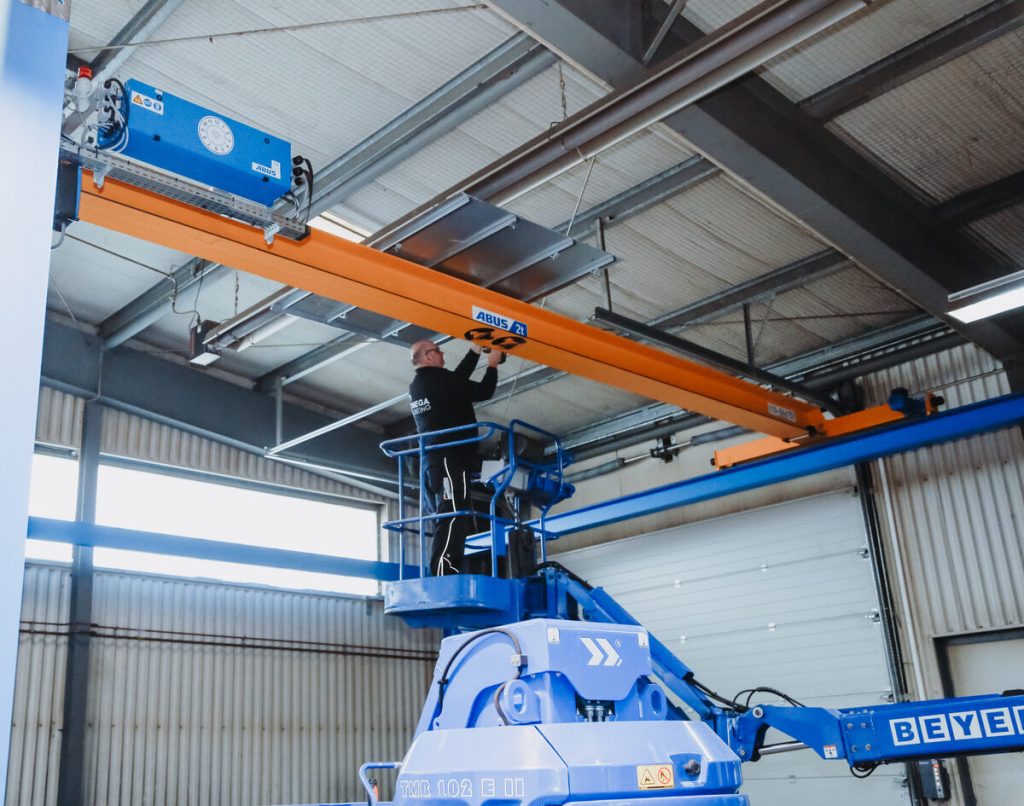
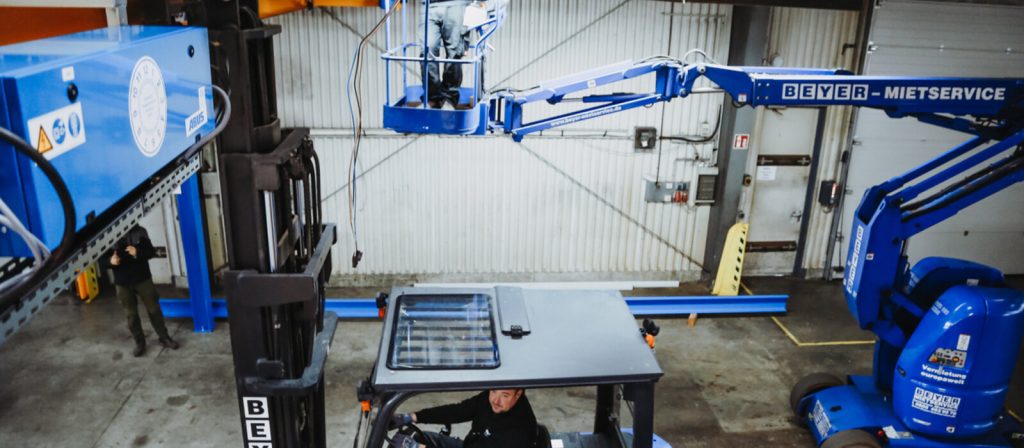
With the installation of a gantry crane in Babenhausen two fitters erected a crane gantry in two days, aligned it by laser and grouted it. On the second day, they pre-assembled the two-tonne crane bridge on the ground and set it onto the gantry runway in a single lift with the forklift. The work at height – guiding the runway beams, signalling the bridge in, fitting the end carriage, conductor rail and limit switch – was carried out from work platforms, the final assembly from an articulating boom lift. That is the hierarchy in its purest form. Pre-assembly on the ground reduces time at height, the platform is the collectively protected workstation. In the basket of the boom lift, fall arrest PPE serves as a restraint system.
Tilting pallet gate at the fall edge
At a production plant, we installed a tilting pallet gate as a pallet transfer point at a fall edge on the first floor. The gate solves a fall problem technically. The employee picks the goods into the gate and closes it by hand. Only then can it be collected from outside with the forklift, without anyone stepping up to the edge. The structure was fixed with heavy-duty anchors. For the installation itself, the rule was: protect first, then install.
Steel platform at Kassel Airport
When erecting a steel platform in a production hall at Kassel Airport we installed railings and stairs at the same time as the platform. So at no point did the new level have an unprotected fall edge. The railing brackets were connected to the load-bearing steel sections, not to the decking. An existing overhead crane made laying the floor plates easier.
Do you have an installation at height coming up – crane runway, platform, conveyor technology beneath the roof? Then get in touch with us. A site visit usually clarifies within an hour whether a platform or scaffold is sufficient, where to anchor and how rescue works.
What this means for your role
For buyers: Include work at height in suitability criteria and prequalification. This includes the risk assessment with falls as a separate hazard, rescue plan, inspection records for the fall arrest PPE and briefing records with exercises – alongside public liability insurance and the certificate of good standing from the employers' liability insurance association. Write into the interface list who provides MEWPs, scaffolds, anchor devices and first aid facilities. Unnamed "client-provided services" are the most common source of improvisation at height.
For designers: Plan anchor devices in wherever maintenance at height will later be carried out repeatedly – on crane runways, ventilation systems, roof structures, conveyor technology beneath the ceiling. Coordinate them with the structural engineer. In the installation planning, provide for access, inspection openings, standing areas for MEWPs and clearance for rescue devices. Document the load capacity of the anchor points in the as-built documentation so that no fitter has to estimate it later.
For project managers and site managers: The project manager ensures that the rescue plan and risk assessment are available before the first day on site, are dealt with in the site meeting and are included in the site rules. The site manager checks during the walk-round: does every harness carry a valid inspection mark, is the rescue device at the workstation, is the anchor point the one from the plan? Is the danger zone firmly cordoned off, is the alarm plan displayed? For lifting work, work at height belongs in the lift plan. The site manager has the authority to stop work – and should use it for work at height without a rescue plan.
For maintenance managers: Your own employees regularly work at height – on cranes, conveyor technology, ventilation. Include the inspection of fall arrest PPE with its interval in the maintenance schedule and name the qualified person. Define an anchor point for every workstation at height and practise the rescue. Where work is carried out on drives at height, isolation and lockout are part of it.
For safety officers and HSE coordinators: Check in the risk assessment, SiGe plan and contractor documents whether the hierarchy has been observed. Is fall arrest PPE justified, or is it the standard answer? Require the rescue plan with named persons and devices, not just a description of the procedure. Include the rescue exercise in the briefing schedule. Suspension trauma belongs in every briefing on work at height.
For manufacturers and system builders looking for an installation partner: If your equipment is installed at height, the installation partner is your face to the end customer – including on occupational safety. Ask about the rescue plan and fall arrest PPE inspection. Provide anchor points on your equipment to which installation and later maintenance can be safely anchored.
Checklist for work at height and rescue plan: template to request
Our checklist for work at height and rescue plan is a one-page template on the topic of fall arrest PPE in installation work. With it, site managers and safety officers tick off the points of this guide before an installation at height begins. These are the hierarchy of controls, anchor points with evidence of load capacity, fall arrest PPE with inspection date, briefing, another company's scaffold and the core of the rescue plan: who rescues, with what, how. With that, the workstation at height is released before the first fitter climbs up. Request the checklist via our Contact form – keyword "Checklist work at height".
Why Omega Mounting?
We install cranes, steel platforms, conveyor technology and plant at height – from Rodgau throughout the Rhine-Main region between Frankfurt, Offenbach, Hanau and Darmstadt. And nationwide, as the jobs in Babenhausen and at Kassel Airport show. Work at height is routine for us. We work according to the hierarchy, pre-assemble on the ground where possible and use MEWPs as the protected workstation. We inspect our fall arrest PPE through our own qualified persons and bring the rescue plan to every job. Our workshop in Rodgau manufactures brackets, anchor structures and railings that are missing on site – more on our page on Steel structures and work platforms. Via the 24-hour hotline you can reach us even when work at height has to be secured at short notice. For you, this means: an installation partnerthat delivers work at height in the Rhine-Main region with rescue plan, inspected equipment and its own workshop from a single source. And whose documents you as the client receive without having to ask.
Conclusion
Fall arrest PPE in installation work is the last control in the hierarchy – and when it is used, it must be thought through completely. This includes a suitable anchor point, the right system, inspected equipment and practised users. And a rescue plan that works without outside help and is integrated into the site's rescue chain. Anyone who reaches for the harness first has skipped the step before. As the client, you may require all of this from the installation contractor – we bring it with us. Send us photos or a drawing of the workstation at height, the hall height and your preferred date. We will get back to you with an honest assessment of access, protection and rescue.
Planning maintenance, moving in or installation in the Rhine-Main region?
Tell us briefly what it is about – we will come back to you with an honest assessment.
100% free and without obligation
You may also be interested in these guides
Occupational safety

About the author
Tobias Schott
Managing director of Omega Mounting GmbH, Rodgau · more than 20 years of hands-on experience in installation and maintenance
A trained mechatronics technician, at home in maintenance, servicing and industrial installation since 2004 – first at his father's side, since 2012 with Omega Mounting: from the overhead conveyor in Frankfurt to the crane system in a new-build hall. Plans and leads lifting operations as appointed person in data centers and on industrial sites in the Rhine-Main region, is an instructor and examiner for cranes, mobile elevating work platforms and telehandlers, and a safety officer. On jobs abroad he is known as the “German Troubleshooter” – the one you call when things get stuck on site. He learned what quality means not from a manual but from his father: Made in Germany as a standard for his own work, not as a label. That is why it comes first at Omega Mounting – before speed and before price. He writes these guides from that practice: what works on our sites is in them – what only exists in the standard is not.
Frequently asked questions
PSAgA stands for personal protective equipment against falls from height: full-body harness, lanyard with energy absorber or self-retracting lifeline, and an anchor device. In installation work, it is used when guard rails, scaffold, MEWP or net are not possible. This is the case, for example, for short tasks at points that are difficult to access, or as a restraint system in the basket of a boom lift.
In workplaces, fall protection is required from a fall height of more than one metre. On construction sites, the thresholds of the accident prevention regulation apply, as reproduced in the BG BAU/BAuA module on scaffolds and falls. At traffic routes, stairs and openings, this is more than 1.00 metre, at other workstations more than 2.00 metres. On flat roofs and floor slabs up to 50 square metres, it is more than 3.00 metres. Above water or substances in which a person can sink, the duty applies regardless of height. In practice, falls belong in the risk assessment from a height difference of one metre.
Because the ArbSchG requires hazards to be tackled at source and individual measures to be used only as a subordinate option. The technical rule on falls limits fall arrest PPE to the necessary minimum. Collective fall protection such as guard rails or a MEWP protects everyone without them having to do anything, and prevents the fall. Fall arrest PPE only arrests it and requires correct fitting, a suitable anchor point and a rescue.
Suspension trauma is a circulatory collapse that occurs when a person hangs motionless in a full-body harness. The leg straps pool the blood in the legs, and orthostatic shock threatens. DGUV Rule 112-199 therefore requires a rescue plan under which the team on site can quickly rescue a hanging person itself. Waiting for outside help alone is not enough.
Before each use, the user checks the equipment by visual and functional inspection. At least once a year, more often if needed, a qualified person inspects every item according to the manufacturer's specifications and documents the result. After a fall load, damage or expiry of the service life, the equipment is withdrawn from use. The basis is the German PPE Use Ordinance and DGUV Rule 112-198.
You may require the risk assessment with falls as a separate hazard, the rescue plan with named persons and devices, the inspection records for the fall arrest PPE and the briefing records with practical exercises. On site, you check the inspection mark on every harness and the rescue device at the workstation. A contractor that has these documents presents them without hesitation.
In boom-type platforms – telescopic and articulating boom lifts – yes, as a restraint system with a short lanyard at the designated anchor point in the basket. The reason is the catapult effect, which can throw persons out of the basket. In scissor lifts, this is generally not required. The manufacturer's operating manual and the risk assessment are decisive.
Yes, but not without checking. Under the scaffold module, every employer who sends employees onto a scaffold must inspect it beforehand for obvious defects. These are guard rails, decks, anchoring, load class, handover document on the scaffold. Structural changes remain reserved for the scaffold erector. Anyone who has to remove a deck for a pipe penetration clarifies this with them beforehand. Access via stairs is to be preferred over ladders.
From Rodgau, we install cranes, steel platforms, conveyor technology and plant in Frankfurt, Offenbach, Hanau, Darmstadt and throughout the Rhine-Main region. Risk assessment, rescue plan, inspected fall arrest PPE and briefed fitters are part of every job at height. On request, we also inspect the fall arrest PPE of your maintenance personnel.
Through a short enquiry with three details. Photos or a drawing of the workstation with height and access, what is to be installed (weight, dimensions) and your preferred date. We arrange a site visit and define access, protection and rescue route with you. Then we send you a written assessment with risk assessment and rescue plan as the basis. Your contact is Tobias Schott – reachable via our Contact form.
 English
 German