
- Guide – Maintenance & Servicing
Maintenance in food production and data centers: cleanliness, lubricants, approvals
By Tobias Schott · Reading time approx. 23 minutes · Last updated: October 2026
Maintenance in sensitive areas follows one simple rule: nothing stays behind that does not belong there – no swarf, no drop of the wrong grease, no tool, no speck of dust in the product or in the server supply air. And nobody works before the plant has given its release.
A fitter maintaining an overhead conveyor in a production hall works differently in a food plant than in an automotive plant – not in the mechanics, but in everything around them. Maintenance in a food plant involves hygiene airlocks, hairnets and face masks, lubricants that are permitted in production and a quality assurance department that checks after the work whether a foreign body could have been left behind. In the data center, the same attitude has a different name: access list, escort requirement, floor protection, permit to work for every job and an operator who wants to see every machine and every tool before it enters the data hall.
What both areas have in common is that the repair itself is rarely the problem. The problem is the collateral damage. A batch is destroyed because of a metal splinter. A rack fails because of drilling dust in the supply air. An audit finds grease without food-grade approval on a chain. Access is withdrawn because a tool was not on the list. These damages cost more than the maintenance – and they are avoidable if work preparation knows about them.
This guide goes deeper than our article on maintenance in live operation and the planning of maintenance windows for food plants and data centers. That article is about the time window; this one is about the space: which lubricants may be used in food plants? How does foreign-body control work, how do you control tools? How do you contain the work area and work with low dust, and what is different in the data center? And how does the release work by which production or the operator takes the plant back? We touch on pharma and cleanrooms at the end as an outlook.
Key points at a glance
- In food plants, only lubricants of category H1 may be used on plant with possible product contact. “Maintenance-free” is no reason to forgo lubrication, but a statement that must be checked in the plant documentation.
- Foreign-body control means: everything that goes into the work area is counted and comes out counted – tools, small parts, consumables. Quality assurance releases the area after cleaning.
- Drilling, grinding and cutting generate dust and swarf. The BAuA information on low-dust working requires extraction at the source and dust extractors of dust class M, and prohibits dry sweeping and blowing off with compressed air.
- Containment, covering of neighbouring plant and a separate access route separate the work area from production or the data hall. Hot work and dust-intensive work belong in the maintenance window or in the workshop.
- In the data center, access control, escort requirement, floor protection, inspected and documented work equipment and a permit to work per job are added. The mechanics are the same, the release is stricter.
- Stainless steel is TIG welded because this produces corrosion-resistant, smooth seams that can be cleaned. Remanufactured parts must be hygienically designed, without gaps and dead zones.
- For pharma and cleanrooms, the same principles apply in a stricter form – with cleanroom classes, airlocks and documentation according to the rules of Good Manufacturing Practice.
What is maintenance in sensitive areas?
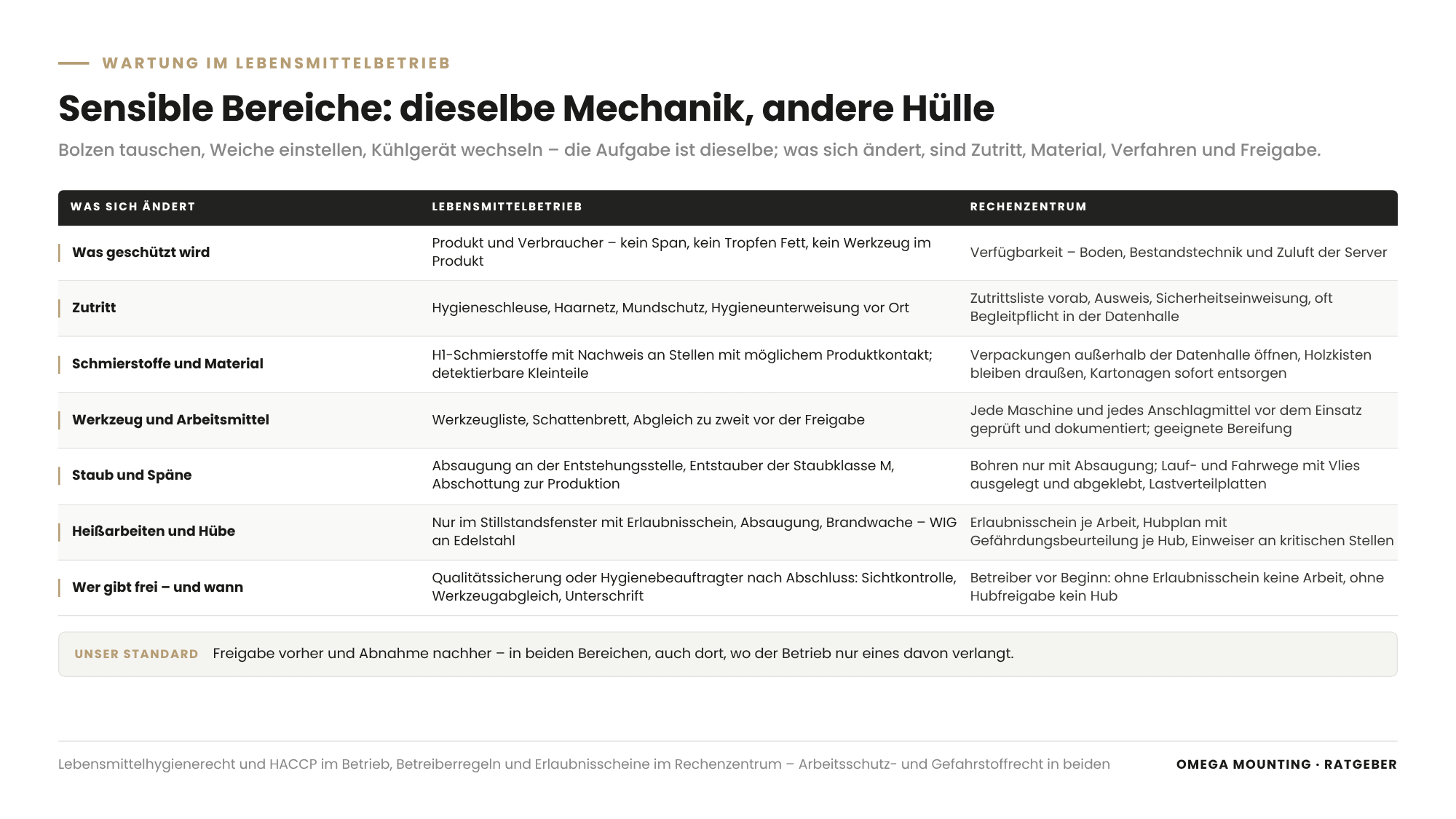
Maintenance in sensitive areas is maintenance of plant in environments in which contamination – particles, lubricants, foreign bodies, dust, moisture – directly endangers the product, the health of consumers or the operation of critical technology. That is why access, material, tools, methods and release are regulated more strictly there than in an ordinary production hall.
Food and beverage plants are the classic case: bakery, dairy, juice producer, meat processor. Maintenance in the food industry is governed by hygiene law: equipment must be maintained in such a way that the risk of contamination is kept as low as possible. Data centers are the second case: here the “product” is availability, and dust, vibration, moisture or a wrongly pulled plug threaten it directly. Then there are pharma, cleanroom manufacturing, hospitals and laboratories – with the same principles and even stricter rules.
For maintenance this means: the technical task – replacing a pin, adjusting a switch, replacing a CRAH unit – is the same as anywhere else. What changes is the envelope around the task: who may enter, what is taken in, how the work is done and cleaned up. And who says at the end that the plant may run again. What we deliver in food and beverage plants is described on our sector page; here it is about the how.
Which lubricants may be used in food plants?
In food plants, only lubricants of category H1 may be used at all points where technically unavoidable, incidental contact between lubricant and food is possible. Lubricants of category H2 are permitted where contact is ruled out. The classification comes from the internationally common registration system for lubricants in food processing. The standard ISO 21469 describes the hygienic requirements for their manufacture. An H1 grease is not a food. It is a lubricant whose components are chosen so that a small, unintended quantity in the product poses no health hazard.
Four rules follow from this for maintenance:
- Assignment per lubrication point: The lubrication schedule assigns a lubricant to every lubrication point and states whether it requires H1. Above a production line, on conveyor chains, hangers and switches of an overhead conveyor, on bearings of mixing and filling plant, the answer is almost always yes.
- No mixing: H1 and H2 lubricants are stored separately, labelled and applied with separate grease guns and brushes. A grease gun that pumped gear grease yesterday may not bring H1 grease into production today.
- Evidence in the file: The product data sheet and registration certificate of every lubricant used are held by the plant; the service provider brings them along or uses the plant's lubricants.
- Dosing instead of generosity: Excess grease drips – and in food production every drop is a foreign body. Cleaning is done after lubricating, not only before. How to define lubrication points, intervals and quantities systematically is shown in our guide on the lubrication schedule in maintenance.
The “maintenance-free” fallacy
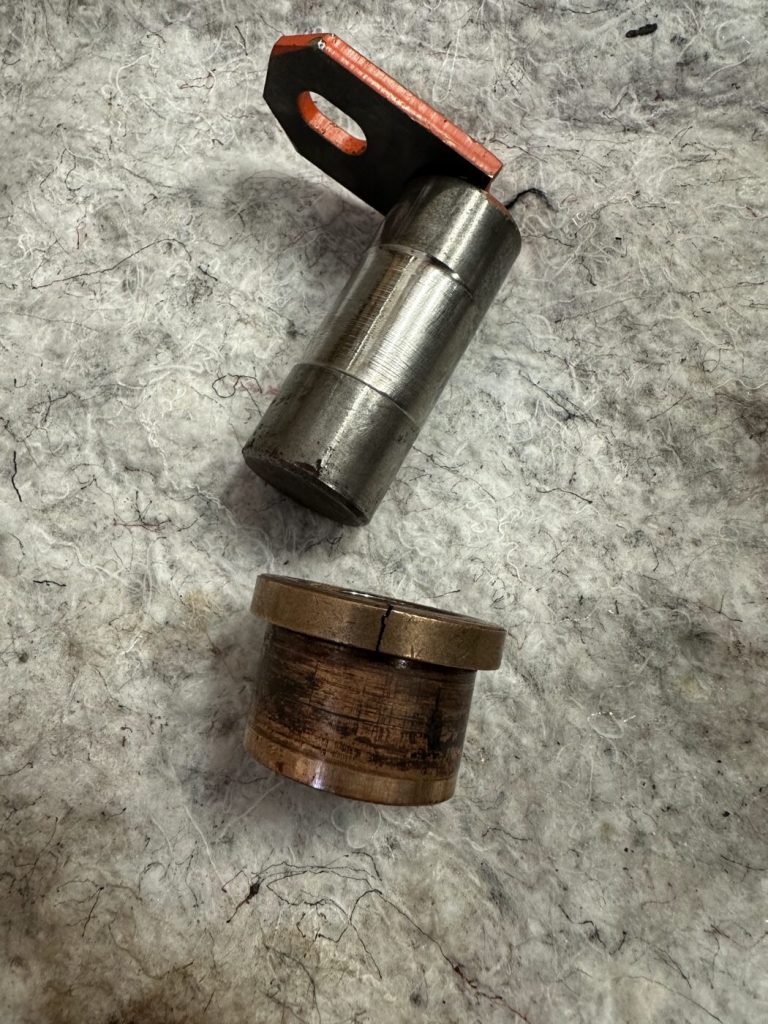
The second mistake after the wrong grease is the missing grease. During the refurbishment of 80 carriers of an overhead conveyor in a food plant the cause of squeaking and recurring failures was quickly found. A pulled pin was completely worn – with deep grooves, cracks and significant material loss; the bronze bushing likewise. Lubrication was practically non-existent. The in-house maintenance team had assumed the pins were maintenance-free. In fact, moving pin-and-bearing connections need regular lubrication: with small pivoting movements under load, no load-bearing lubricant film builds up. The connection runs in mixed friction, metal touches bearing material, and the abrasion acts like grinding paste. Such false assumptions are among the most frequent mistakes in in-house maintenancethat our guide on the subject compiles.
For you this means: check “maintenance-free” in the plant documentation, not from memory. Watch out for squeaking, creaking, visible play and rust-brown abrasion – fretting corrosion – as early warning signs. And if in doubt, pull a pin: its groove pattern and the condition of the grease show the condition of the entire fleet. Which other wear points on an overhead conveyor belong on the inspection list is shown in our guide on overhead conveyor maintenance with checklist.
How does foreign-body control work in maintenance?
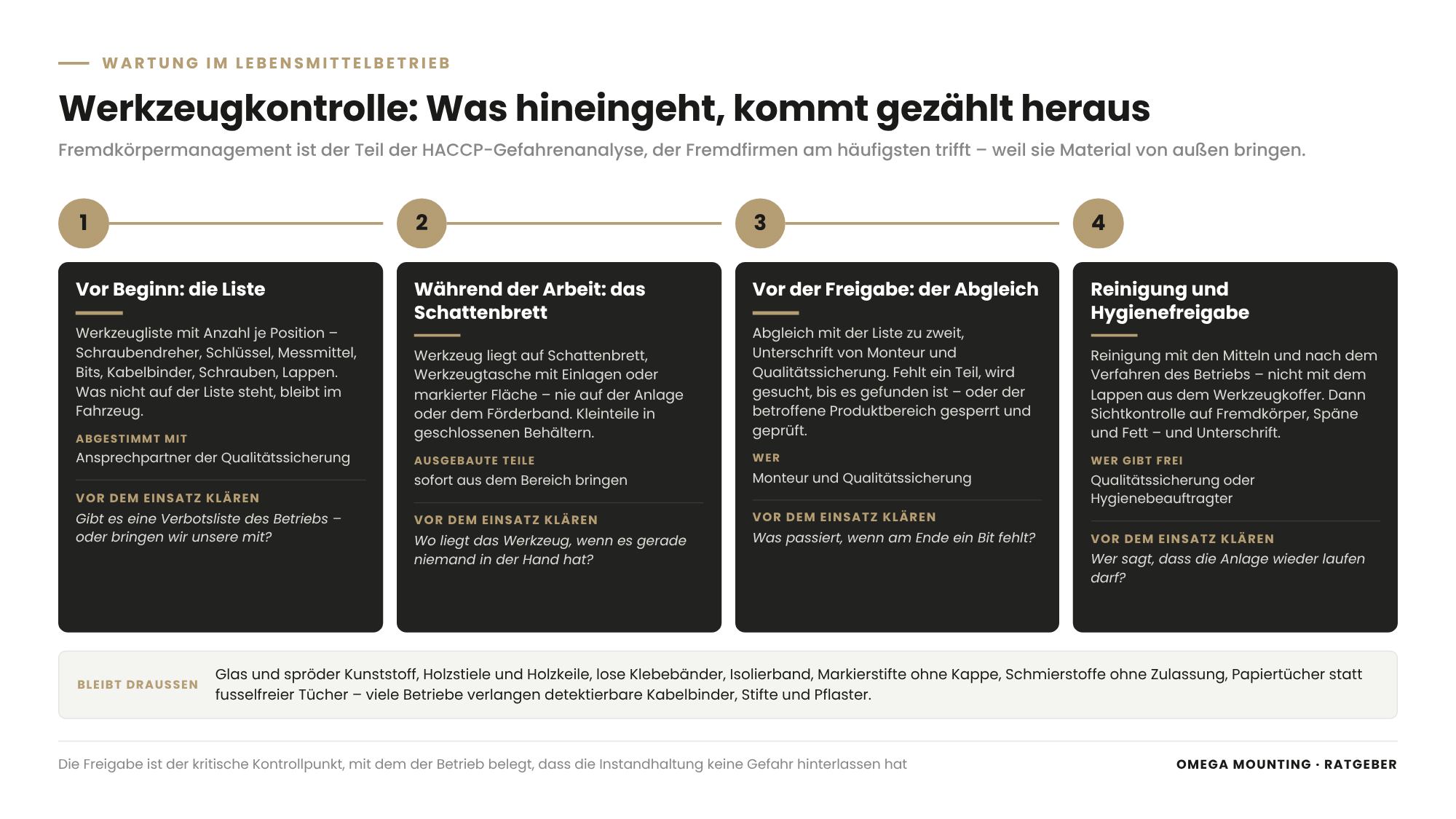
Foreign-body control in maintenance means: every tool, every small part and every consumable that enters the production area is recorded, checked during the work and removed again, counted, before release. Materials that can splinter, break or end up undetected in the product are not taken in at all. It is the part of the hazard analysis under the HACCP principles – the systematic analysis of hazards and critical control points in food production – that most frequently affects contractors. Because they bring material in from outside.
Tool control in three steps
- Before starting: Tool list with quantity per item – screwdrivers, spanners, measuring tools, bits, cable ties, screws, cloths. The list is agreed with the quality assurance contact; anything not on the list stays in the vehicle.
- During the work: Tools lie on a shadow board, a tool bag with inserts or a marked area, never on the plant or the conveyor belt. Small parts are kept in closed containers; removed parts are taken out of the area immediately.
- Before release: Reconciliation with the list by two people, signature of fitter and quality assurance. If a part is missing, the search continues until it is found – or the affected product area is blocked and checked.
What is not allowed in production
Stays outside:
- Glass and brittle plastic – light bulbs, thermometers, glasses without retainers.
- Wooden handles and wooden wedges.
- Loose adhesive tapes, insulating tape, marker pens without caps.
- Processes that generate metal swarf without extraction.
- Lubricants without approval.
- Paper towels instead of lint-free cloths.
Many plants require detectable materials – cable ties, pens, plasters with a metal content that the in-line metal detector will find. Ask for the plant's list before the first job; where none exists, bring your own.
Cleaning and hygiene release
After the work, the area is cleaned – with the plant's agents and according to its procedure, not with the cloth from the toolbox. Then comes the release by quality assurance or the hygiene officer: visual check for foreign bodies, swarf, grease, reconciliation of the tool list, signature. Only then does the plant run again. This release is not a formality. It is the critical control point with which the plant proves to customers and authorities that maintenance has left no hazard behind.
How do you contain the work area and work with low dust?
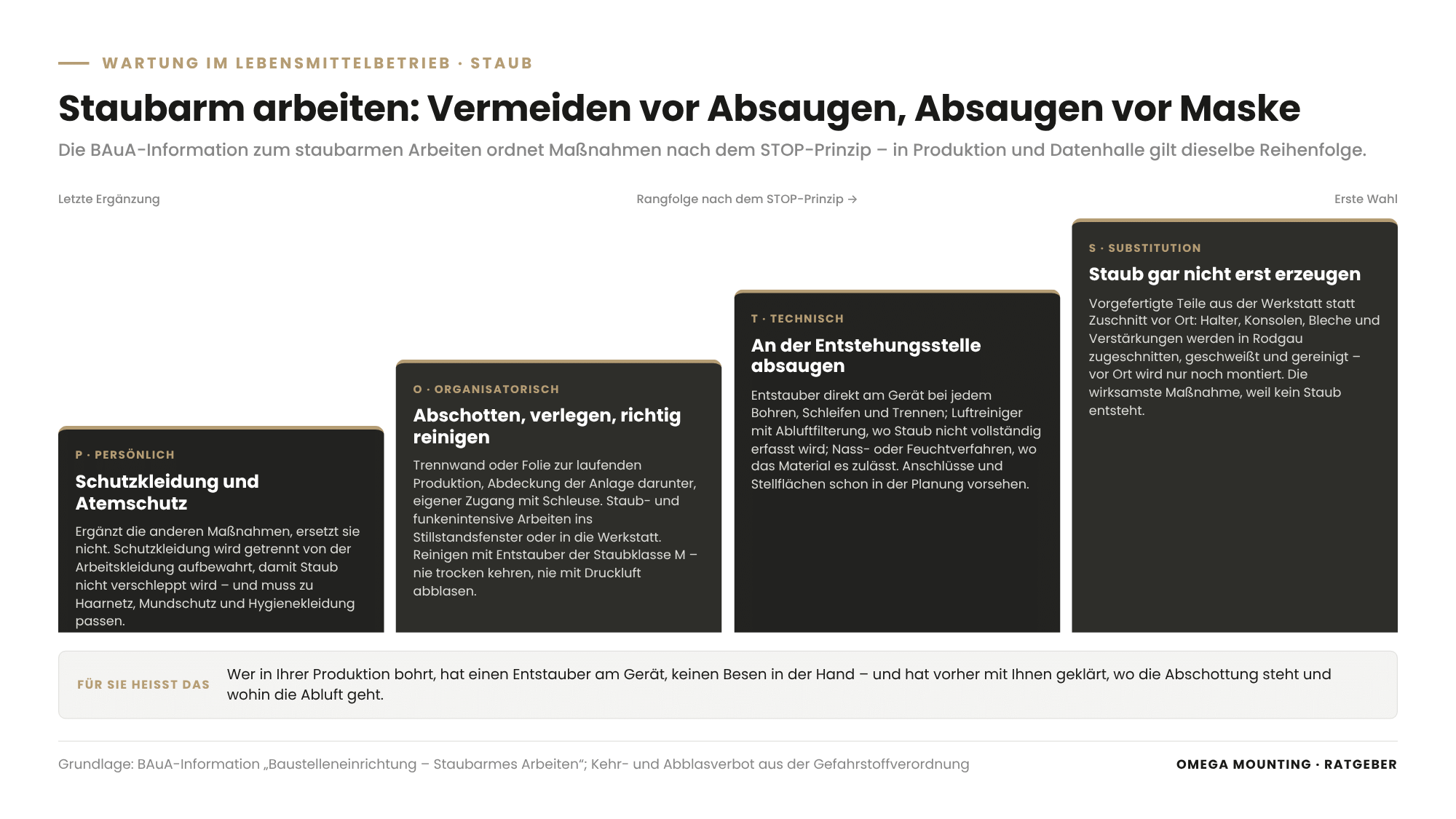
For maintenance work in running production, the work area is contained: by dust screens or sheeting, covering of neighbouring plant, a separate access route and extraction at the source. Dust- or spark-intensive work is moved into the maintenance window or into the workshop. Dust is the adversary in both worlds: in food production it is a foreign body and a carrier of germs; in the data center it settles in filters, fans and on circuit boards.
What the BAuA information on low-dust working specifies
The BAuA information “Site set-up – low-dust working” is written for construction sites, but its rules apply to every drilling, grinding and cutting operation in existing buildings. It requires protective measures according to the STOP principle: avoid dust wherever possible – for example through prefabricated parts from the workshop instead of cutting on site. Otherwise prevent release with technical measures, and only then organisational and personal measures. In concrete terms: extract dust at the source, with dust extractors and supplementary air cleaners with exhaust air filtration. Use wet or damp methods where the material allows. Clean workplaces regularly with dust extractors of dust class M. And – as a requirement of the GefStoffV (German Hazardous Substances Ordinance) – dry sweeping and blowing off with compressed air are not permitted as a matter of principle. The module also states that connections, containment and set-up areas for air cleaners should be considered at the planning stage. Protective clothing is stored separately from work clothing so that dust is not carried over.
For you this means: anyone drilling in your production has a dust extractor on the tool, not a broom in hand. And has clarified with you beforehand where the containment stands and where the exhaust air goes.
Containment in practice
- Partition or sheeting between work area and running production; for work above plant, additionally covering of the plant below.
- Separate access route with airlock so that fitters do not walk through production; protective clothing is changed there.
- Extraction at the source for every cutting process; air cleaner in the area if dust is not fully captured.
- Prefabrication in the workshop: brackets, consoles, sheets, reinforcements are cut, welded and cleaned in Rodgau – on site only assembly remains.
- Hot work in the maintenance window: welding and cutting only with permit to work, extraction, fire watch and contained from production.
Stainless steel and TIG
In food plants, stainless steel is the material, and the welding process of choice is TIG – tungsten inert gas welding. It works with a non-consumable electrode under shielding gas and produces low-spatter, smooth, corrosion-resistant seams that can be cleaned. When converting a robot cell at a bakery near Fulda, the reinforcements were therefore welded in using TIG. Remanufactured parts follow the principles of hygienic design: no gaps, no dead zones, no horizontal surfaces on which product remains. Seams are fully welded and ground, hollow sections closed.
What is different about maintenance in a data center compared with a food plant?
In the data center, the same principles apply – cleanliness, tool control, containment, release. But the release comes from the operator instead of quality assurance, and access is regulated by registration, ID and escort requirement. Every machine and every item of work equipment is inspected and documented before use. The protection is not for the product but for floor, existing technology and supply air. The mechanics of a replacement are the same as in an industrial hall; the envelope is tighter.
The rules every job needs
- Access: Access list in advance, safety induction on site, ID, often escort requirement in the data hall. Anyone not on the list does not get in – not even the stand-in.
- Work equipment: Every machine – lifting device, scissor lift, pallet truck – and every lifting accessory is inspected before use and the inspection documented. Tyres must be suitable for the floors, combustion engines are generally prohibited.
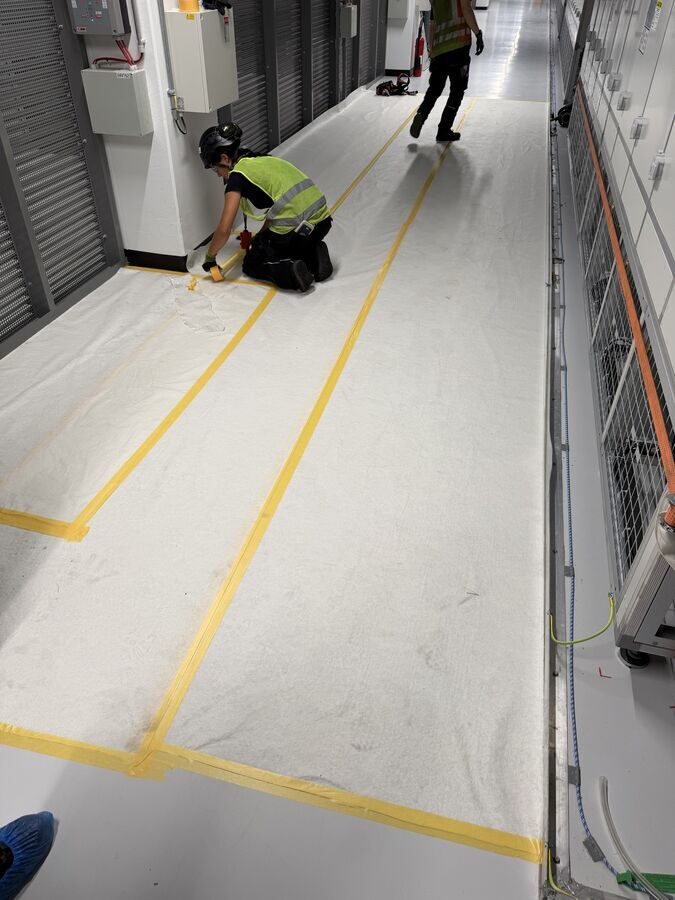
- Floor protection: Walkways and travel routes are laid with protective fleece and taped. Raised floor tiles may not serve as load spreaders; loads are carried over load spreading plates.
- Dust and swarf: Drilling only with extraction, packaging is opened outside the data hall, wooden crates stay outside, cardboard is disposed of immediately.
- Releases: Every job has a permit to work, every lift a lift plan with risk assessment, every movement at critical points a banksman. The release comes from the operator and is documented.
- Communication: Permanent coordination with the operator; changes to the sequence are registered, not improvised.
Which of these rules apply in detail to subcontractors in the data center – from registration to handover – is described in our guide on installation in data centers in detail. What we deliver for data centers is shown on our page on data center construction.
The difference in the release
In the food plant, quality assurance releases the area after the work is finished – the release comes at the end. In the data center, the release comes at the beginning: without a permit to work no work begins, without a lift release no lift. We apply both together – release beforehand and acceptance afterwards – as standard in both areas. Even where the plant only requires one of them.
How do you prepare contractors for maintenance in a food plant or data center?
Contractors are prepared for sensitive areas by the plant handing over its rules in writing before the first job, briefing the fitters on site and agreeing the tool and material list. It also names a contact for releases and defines the interfaces – who isolates, who cleans, who releases. The German technical rule TRBS 1116 (Qualification, briefing, authorisation) makes clear that a new working environment is to be treated as first-time use. The briefing of the contractor in the food plant therefore takes place before the start, with documentation of date, content and names. For you this means: your plant's hygiene briefing or your data center's safety induction is not a formality but the documented starting point of every job.
If several companies or your own maintenance team work on the plant at the same time, TRBS 1112 (Maintenance) requires a defined release procedure and the coordination of those involved. Who isolates, who holds the key, who reports completion? That is just as necessary in a bakery as in a data hall.
What we clarify before the first job
- Hygiene or access rules of the plant, protective clothing, airlock route.
- Tool and material list, detectable materials, lubricants (H1 evidence).
- Containment, extraction, set-up areas for air cleaners, exhaust air routing.
- Maintenance window for hot work and dust-intensive work.
- Isolation and lockout against re-energising, permits to work.
- Contact for release before starting and acceptance after completion.
- Cleaning procedures and agents of the plant, disposal of removed parts.
Outlook: pharma and cleanrooms
For pharmaceutical production, cleanroom manufacturing and laboratories, the same principles apply in a stricter form. Cleanroom classes define how many particles the air may contain; airlocks and cleanroom clothing regulate access. The rules of Good Manufacturing Practice require that every maintenance measure is planned, released, documented and its effect on the cleanroom status assessed. Tools, material and methods are qualified in advance, and after the work, cleaning and requalification of the area follow. Anyone who has mastered the rules in this article has the foundation; pharma maintenance builds on it with its own procedures.
Maintenance in sensitive areas in the Rhine-Main region: how we do it
Food plants and data centers in the Rhine-Main region are often only a few kilometres apart. Bakeries, beverage bottlers and meat processors are located in Offenbach, Hanau, Darmstadt and Aschaffenburg, data centers around Frankfurt. For us this means: a team that replaces pins on an overhead conveyor with H1 grease on Friday stands in a data hall with fleece and permit to work on Monday. The attitude is the same, the checklist is different – with us they are called “Maintenance food plant” and “Maintenance data center”.
That is why we work with area-specific work preparation: a tool and material list per job, lubricants with evidence, prefabrication in the workshop in Rodgau wherever it keeps dust and sparks out of production. Plus a release checklist that is signed at the beginning and at the end. From Rodgau, the distances are short enough to prepare a weekend window in Hanau or a two-day job in Frankfurt with a site visit. And via the 24-hour hotline we can be reached when a plant is down on the night shift.

How we do it in practice
Four jobs from our project diary show the rules of sensitive areas in everyday practice – two in food plants, one in a data center, one above production.
Series repair with lubrication concept: 80 overhead conveyor carriers in a food plant
With the refurbishment of the hanger pins on 80 overhead conveyor carriers in a food plant the root cause analysis came first. A pulled pin showed grooves, cracks and material loss, the bronze bushing was worn, lubrication practically non-existent. This became a refurbishment programme for the entire fleet in weekend jobs: jack up and unload the hanger, pull the pin, check the bearing seat, replace the bearing, fit a new pin – pin and bushing always as a pair. Two to three fitters managed 10 to 15 carriers per weekend in series. For the plant this meant: grease that is permitted in production, a lubrication interval that corrects the plant documentation and evidence that the carriers run free of play and quietly again.
Conversion between running conveyor belts: robot cell at a bakery near Fulda
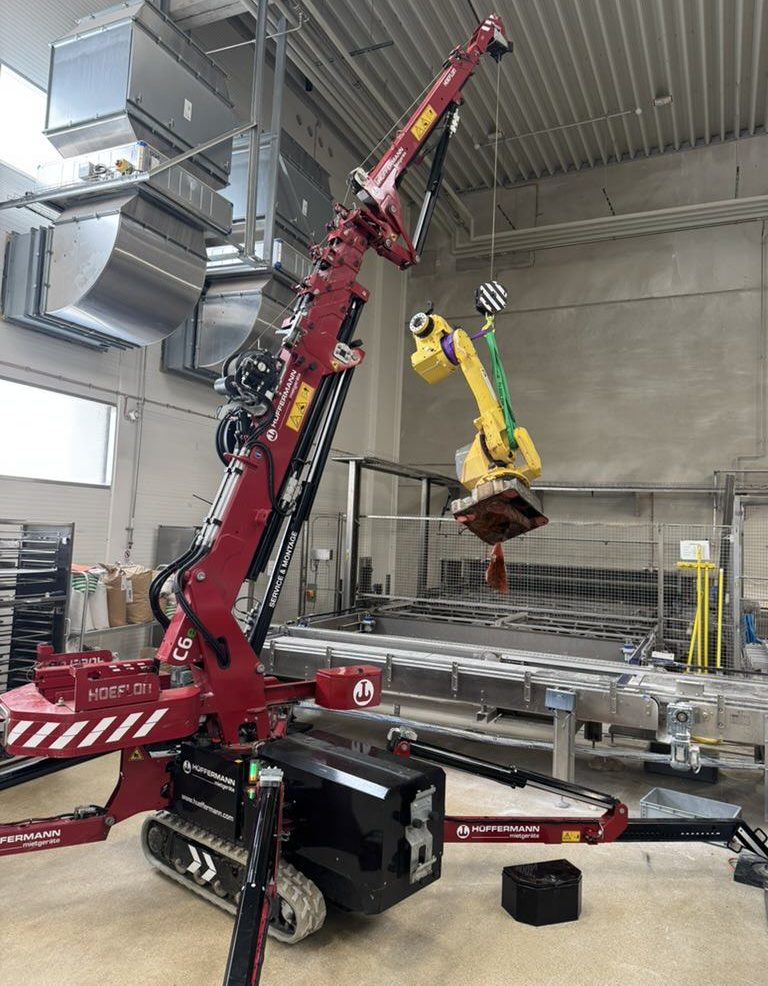
At an industrial organic bakery near Fulda we dismantled an industrial robot weighing around 600 kilograms with the mini crane out of a cell. We then converted the cell between running conveyor belts. The team – one person responsible for the lifting operations, one crane operator, two mechatronics technicians – worked throughout with hairnet and face mask and complied with all the operator's requirements. Supply lines for power, water and compressed air were checked and disconnected, the bus system bridged so that the rest of the line kept running. The robot went over the production belt as a whole, centimetre by centimetre. The removal took one day. The cell conversion with TIG welding work on stainless steel ran on the following days during a production shutdown – hot work does not belong next to running belts.
Equipment replacement in a live data center: CRAH unit in Frankfurt
During the replacement of a defective CRAH unit in a live data center in Frankfurt the heat exchanger was damaged. The new unit was delivered and moved in up to the second floor, the existing unit removed from the plant area and moved out. Two working days, one supervisor and three riggers. Before the first machine was used, all walkways and travel routes were completely laid with protective fleece and taped, and the machines checked for suitable tyres. At critical points, every movement was made only under the direction of the supervisor. For work right up to the ceiling, scissor lifts with full fall protection were used. All machines and lifting accessories were inspected and documented before each use, the work releases agreed with the operator. Narrow transport routes, finished floor coverings, sensitive technology on almost every square metre and round-the-clock operation – that is the envelope in which the actual mechanics take place.
Working above production: switch overhaul in Frankfurt
With the maintenance of a roughly 30-year-old overhead conveyor in Frankfurt the roughly 100 switches were located above the production and traffic areas. The team worked in weekend windows of sometimes only around 36 hours – four technicians, mobile scaffold towers, ladders, additional lighting. Anyone replacing rollers, welding brackets and relocating rails above a production area works to the same rules as in a food plant: covering of the areas below, small parts in closed containers, swarf and welding residues extracted rather than swept. And on Monday the area is as clean as production left it.
Is maintenance or a conversion coming up for you in an area where cleanliness and release decide success? In a bakery in Hanau, a beverage plant in Darmstadt or a data center in Frankfurt? Then get in touch with us. A walk-through with your quality assurance or your operator usually clarifies within an hour what belongs in the maintenance window, what in the workshop and what in the release checklist.
What this means for your role
For buyers: Write the rules of the sensitive area into the specification. These include hygiene or access rules, lubricant requirements with H1 evidence, tool control, containment and extraction, cleaning and release. Require the provider to describe how it fulfils them. An offer that only prices the mechanics has forgotten the envelope – and the envelope is the part that costs time in the maintenance window.
For designers: Design plant in sensitive areas for maintainability. That means: lubrication points centralised and reachable from outside the product zone, inspection openings, set-up areas for containment and air cleaners, access routes for lifting equipment that do not lead through production. Every lubrication point above an open product and every drilling point in a data hall that you avoid saves a release later.
For project managers and site managers: As project manager, you coordinate maintenance windows, releases and the sequence of trades. Dust- and spark-intensive work comes before cleaning, the release comes at the end. As site manager, you brief the crew on hygiene or access rules and check tool lists, containment and extraction on site. You obtain the release from quality assurance or the operator before the plant restarts.
For maintenance managers: Keep the lubrication schedule with H1 assignment per lubrication point and check every “maintenance-free” statement in the documentation. Define the tool and material rules for contractors together with quality assurance and name the contact for releases. Make sure that prefabrication in the workshop takes priority over cutting in production. The release checklist belongs in every plant file.
For facility managers and operators: In the data center, you are the one who releases – and who answers for it if dust remains in the supply air or a scratch in the floor. Demand from every service provider the inspection records of the work equipment before the job, the lift plan before the lift and a handover report with photos after the job. Check whether the redundancy of your cooling and power supply is maintained during the work.
For safety officers and HSE coordinators: Make sure that the contractor's risk assessment knows the sensitive area – dust, hot work, work above running plant, isolation. Hygiene and occupational safety rules must not conflict with each other: respiratory protection and face mask, protective clothing and hygiene clothing, fall protection and cleanroom clothing must fit together. The documented briefing on site is your evidence.
Release checklist for maintenance in food plants and data centers on request
The release checklist summarises on one page what maintenance, contractor and quality assurance or operator tick off together. Three columns – before starting, during the work, before release – cover the tool and small parts list, lubricant evidence, containment and dust protection, cleaning, foreign-body check and signatures. There is a “Maintenance food plant” version and a “Maintenance data center” version. Request the checklist via our Contact form – subject line “Release checklist”.
Why Omega Mounting?
We are based in Rodgau near Frankfurt. We maintain, repair and convert where cleanliness and release decide success – in food and beverage plants and in data centers in the Rhine-Main region. The linked jobs show this: the series repair of 80 overhead conveyor carriers with a corrected lubrication concept and the robot removal between running conveyor belts with hairnet and face mask. Plus the equipment replacement in a live data center with fleece, inspected work equipment and agreed releases. Parts that would generate dust and sparks on site, we prefabricate in our workshop in Rodgau. With us you get a single point of contact for maintenance, repair, conversion and lifting, who knows your hygiene or access rules before entering the hall. Plus short distances in the Rhine-Main region and a 24-hour hotline for breakdowns.
Conclusion
Maintenance in food plants and data centers differs from ordinary maintenance not in the mechanics but in the envelope. That means: lubricants of category H1 instead of any grease, tool control instead of a toolbox, extraction instead of a broom, containment instead of an open site, release instead of knocking off. Anyone who plans this envelope into work preparation – and moves dust and sparks to the workshop – gets maintenance that endangers no batch and no rack. Send us your plant list, the hygiene or access rules of your plant and the possible maintenance window. We will get back to you with an honest assessment of what should happen on site and what in the workshop.
Planning maintenance, moving in or installation in the Rhine-Main region?
Tell us briefly what it is about – we will come back to you with an honest assessment.
100% free and without obligation
You may also be interested in these guides
Maintenance & Servicing
Maintenance & Servicing

About the author
Tobias Schott
Managing director of Omega Mounting GmbH, Rodgau · more than 20 years of hands-on experience in installation and maintenance
A trained mechatronics technician, at home in maintenance, servicing and industrial installation since 2004 – first at his father's side, since 2012 with Omega Mounting: from the overhead conveyor in Frankfurt to the crane system in a new-build hall. Plans and leads lifting operations as appointed person in data centers and on industrial sites in the Rhine-Main region, is an instructor and examiner for cranes, mobile elevating work platforms and telehandlers, and a safety officer. On jobs abroad he is known as the “German Troubleshooter” – the one you call when things get stuck on site. He learned what quality means not from a manual but from his father: Made in Germany as a standard for his own work, not as a label. That is why it comes first at Omega Mounting – before speed and before price. He writes these guides from that practice: what works on our sites is in them – what only exists in the standard is not.
Frequently asked questions
In the internationally common registration system, H1 designates lubricants approved for incidental, technically unavoidable contact with food. H2 lubricants may only be used where contact is ruled out. In practice, food plants require H1 at all lubrication points above, on or in production lines – conveyor chains, hangers, switches, bearings of mixing and filling plant. The lubrication schedule assigns the lubricant to each point; the evidence is kept in the plant file.
Before starting, a tool and small parts list with quantity per item is drawn up and agreed with quality assurance. During the work, tools lie on a shadow board or marked area, small parts in closed containers. Before release, the list is reconciled by two people and signed. If a part is missing, it is searched for or the affected product area is blocked and checked. Glass, brittle plastic, wood and non-detectable small parts stay outside.
Only with extraction at the source, containment from running production and subsequent cleaning with a dust extractor of dust class M. Dry sweeping and blowing off with compressed air are not permitted under the GefStoffV. Wherever possible, we move cutting and welding work to the workshop and only assemble on site. Hot work belongs in the maintenance window with permit to work and fire watch.
The principles – cleanliness, tool control, containment, release – are the same. In the data center, access list and escort requirement, documented inspection of every item of work equipment before use, floor protection with fleece and load spreading plates and a permit to work per job are added. The operator grants the release before starting; in the food plant, quality assurance does so after completion. We apply both – release beforehand, acceptance afterwards.
Because TIG welding with a non-consumable electrode under shielding gas produces low-spatter, smooth and corrosion-resistant seams. They can be cleaned and form no gaps in which product or germs remain. Remanufactured parts follow the principles of hygienic design – fully welded, ground seams, no dead zones, no open hollow sections. During the cell conversion at a bakery near Fulda, the reinforcements were therefore welded in using TIG.
The European food hygiene regulation requires equipment to be maintained in such a way that the risk of contamination is kept as low as possible. Plants must also operate a procedure based on the HACCP principles – foreign bodies from maintenance are a hazard in it that must be controlled. For the work itself, the ArbSchG (German Occupational Safety Act) and the BetrSichV (Industrial Safety Ordinance) apply with the technical rules on maintenance and briefing, plus the GefStoffV (Hazardous Substances Ordinance) for dust. Retail customer standards build on these.
Yes – as a foundation. Pharmaceutical and cleanroom manufacturing tighten them through cleanroom classes, airlocks and cleanroom clothing, qualified tools and materials and documentation according to the rules of Good Manufacturing Practice. This includes assessing every measure for its effect on the cleanroom status and requalification afterwards. Anyone who has mastered tool control, dust avoidance and release in a food plant has the foundation; the additional procedures are defined per plant.
Omega Mounting maintains, repairs and converts in food and beverage plants in Offenbach, Hanau, Darmstadt and Aschaffenburg and in data centers around Frankfurt. We work with tool control, H1 lubricants with evidence, containment and extraction, prefabrication in the workshop in Rodgau and a release checklist that quality assurance or the operator co-signs. Overhead conveyors, conveyor systems, robot cells, cooling and standby power systems are part of our everyday work.
Through a short enquiry with three pieces of information: the plant and what needs to be done on it, the hygiene or access rules of your plant and the possible maintenance window. We arrange a walk-through with your quality assurance or your operator and clarify tools, lubricants, containment and release on site. We then send you a written assessment of what should happen on site and what in the workshop. Your contact is Tobias Schott – reachable via our Contact form.
 English
 German