
- Technology explained – technology and procedures
Orbital welding: how the weld head travels around the tube
By Tobias Schott · 6-minute read · Updated November 2026
In orbital welding the electrode in a weld head travels mechanically once around the stationary tube – this gives even, repeatable welds with a smooth inside, as required by paint lines, high-purity media and food plants.
Welding a tube all the way round by hand is difficult. At the top, at the side and overhead the welder has to keep adjusting posture, angle and speed. With many identical welds on thin-walled stainless steel tubes, this reaches its limits. Orbital welding takes this movement off the welder.
Here we explain how the process works, why the inside of the weld is so important, how to tell a good weld from a bad one and how welds are inspected and documented. First of all: orbital welding is work for specialist welding companies. We explain it because we work alongside these companies on site.
What is orbital welding?
Orbital welding is a mechanised welding process in which a weld head guides the electrode on a circular path around a stationary tube. The name comes from the Latin „orbis“, the circle.
Most welds are made with the tungsten inert gas process, TIG for short. A tungsten electrode creates the arc, and a shielding gas such as argon protects the weld pool. On thin tubes, melting the tube ends is enough. On thicker walls a filler wire is added.
The process is used wherever many identical tube welds are needed in high and consistent quality: in pharmaceutical and food technology, for high-purity media and gases, in semiconductor plants and in the paint supply of paint shops.
Key facts
- Process: mechanised TIG welding on a circular path.
- Materials: mainly stainless steel, also other steels and special materials.
- Weld heads: closed with a gas chamber or open with a clamp-type head.
- Protection inside: purge gas in the tube.
- Inspection: visual inspection inside and outside, radiography for high requirements.
- Execution: qualified operators of a specialist welding company.
- Our part: installation around it, conventional welding of frames and brackets.
How orbital welding works
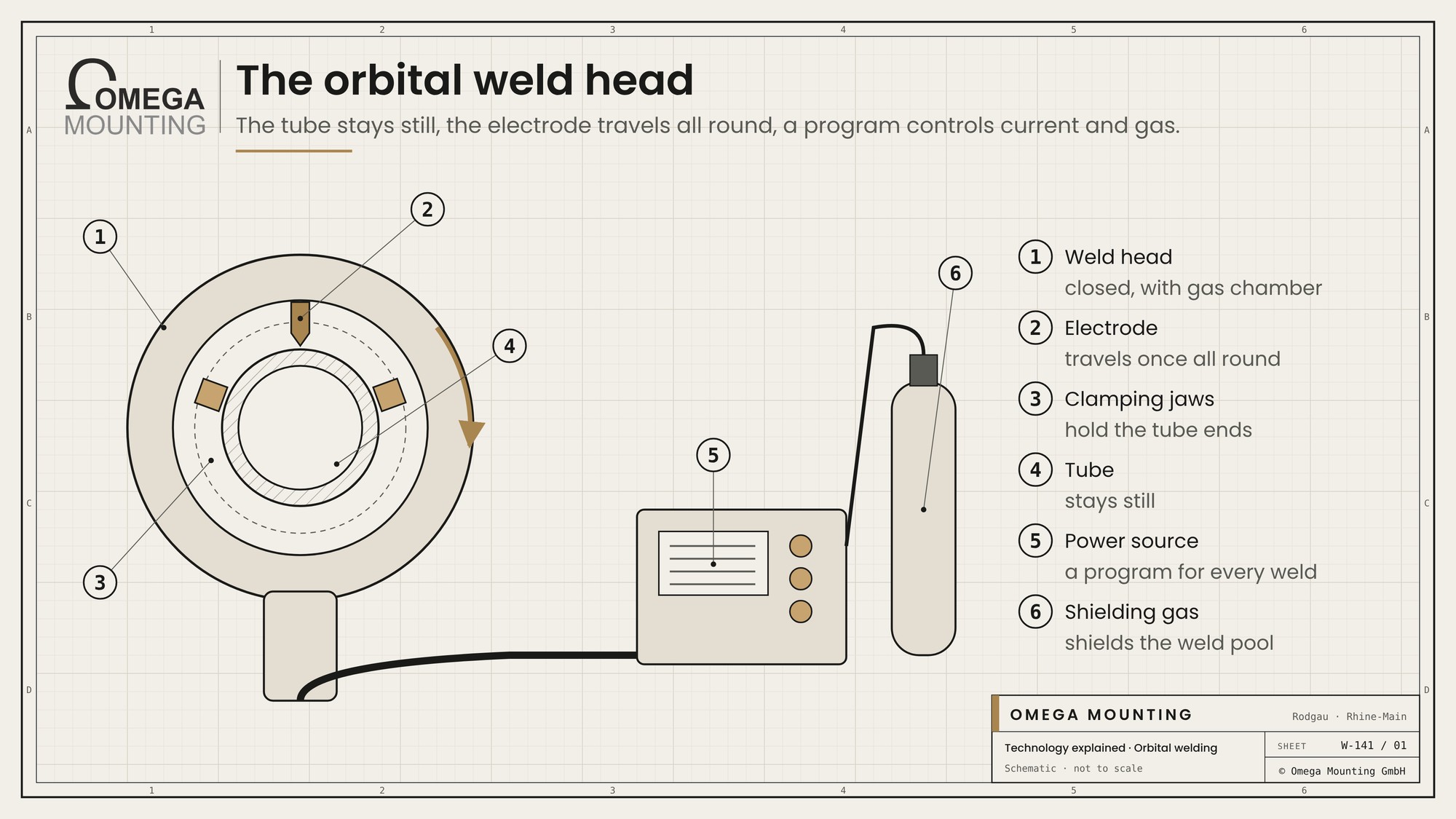
The tube stays still, the arc travels.
The weld head is clamped onto the two tube ends with clamping jaws. Inside the head sits a rotor that guides the electrode once all the way round. A power source with program control regulates the welding current, rotation speed and gas flow. Because the welding position changes around the tube, the program works in sectors: different at the top than at the bottom.
There are two types of weld head:
- Closed heads: They enclose the weld completely and fill the chamber with shielding gas. They are suitable for thin-walled tubes and small diameters, often without filler wire.
- Open heads: They sit on the tube like a clamp, and the electrode welds with a gas nozzle. They are used for larger diameters and thicker walls with filler wire.
The advantage lies in repeatability. Once a program has been set and tested for tube, material and wall thickness, every further weld is made under the same conditions.
Purging: protecting the inside
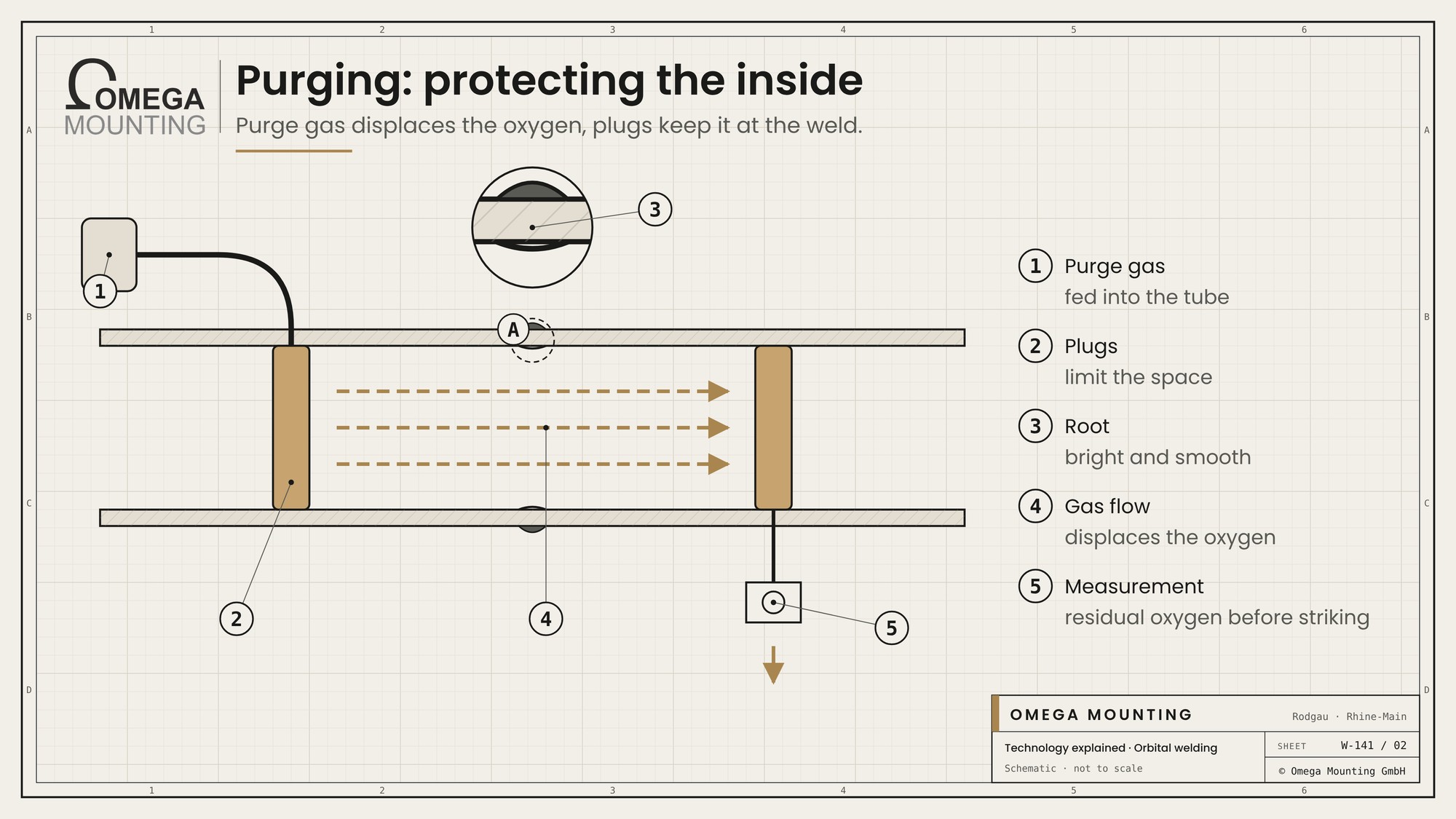
During welding it is not only the outside that gets hot. The metal also glows inside. If air reaches the root there, it oxidises. Heat tint forms, in the worst case a rough, scaled surface.
That is why the inside of the tube is purged. This means: a purge gas displaces the oxygen in the tube before and during welding. Plugs to the left and right of the weld keep the gas where it is needed. The residual oxygen is often measured before the arc is struck.
Why is the inside so important? Because the medium touches it. In a food line, germs settle on a rough root. In a high-purity gas line, particles come loose. In a paint line, paint sticks, and a pig can get caught on a protruding root. With stainless steel there is another point: heat tint weakens the corrosion protection.
Good weld, bad weld
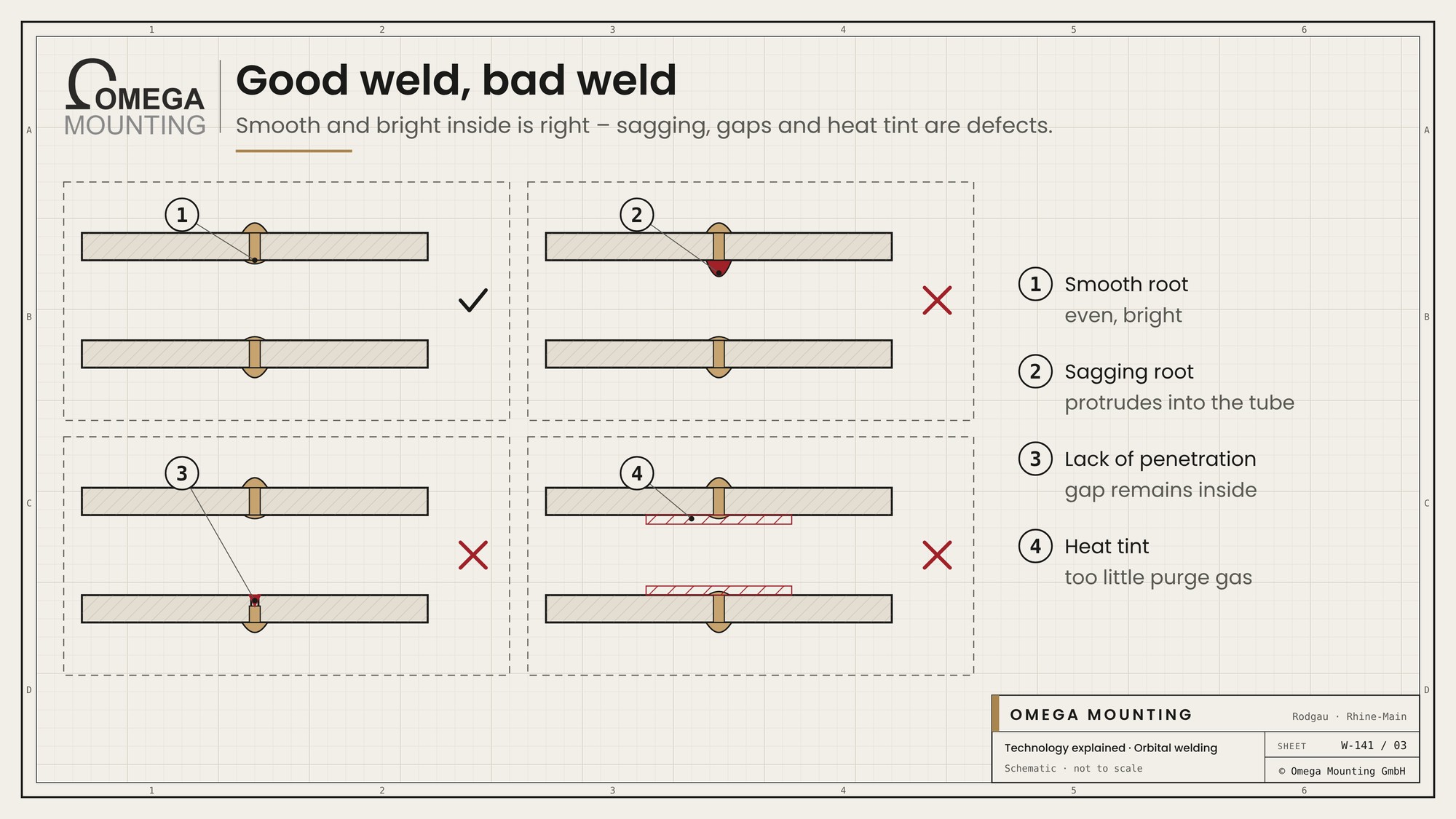
| Characteristic | Good weld | Defect |
|---|---|---|
| Root inside | Even, smooth, slightly convex. | Sagging or sunken. |
| Penetration | Complete all round. | Areas without penetration. |
| Colour inside | Bright or only slightly straw-coloured. | Blue to grey, scaled. |
| Outside | Even width all round. | Varying width, undercut on one side. |
| Tube joint | Without offset, without a gap. | Offset or gap before welding. |
Many defects arise not during welding but before it. The tube ends must be cut square and flat, deburred and clean. They must meet without a gap and without offset. Not even the best weld head can compensate for a tube cut at an angle.
Inspecting and documenting
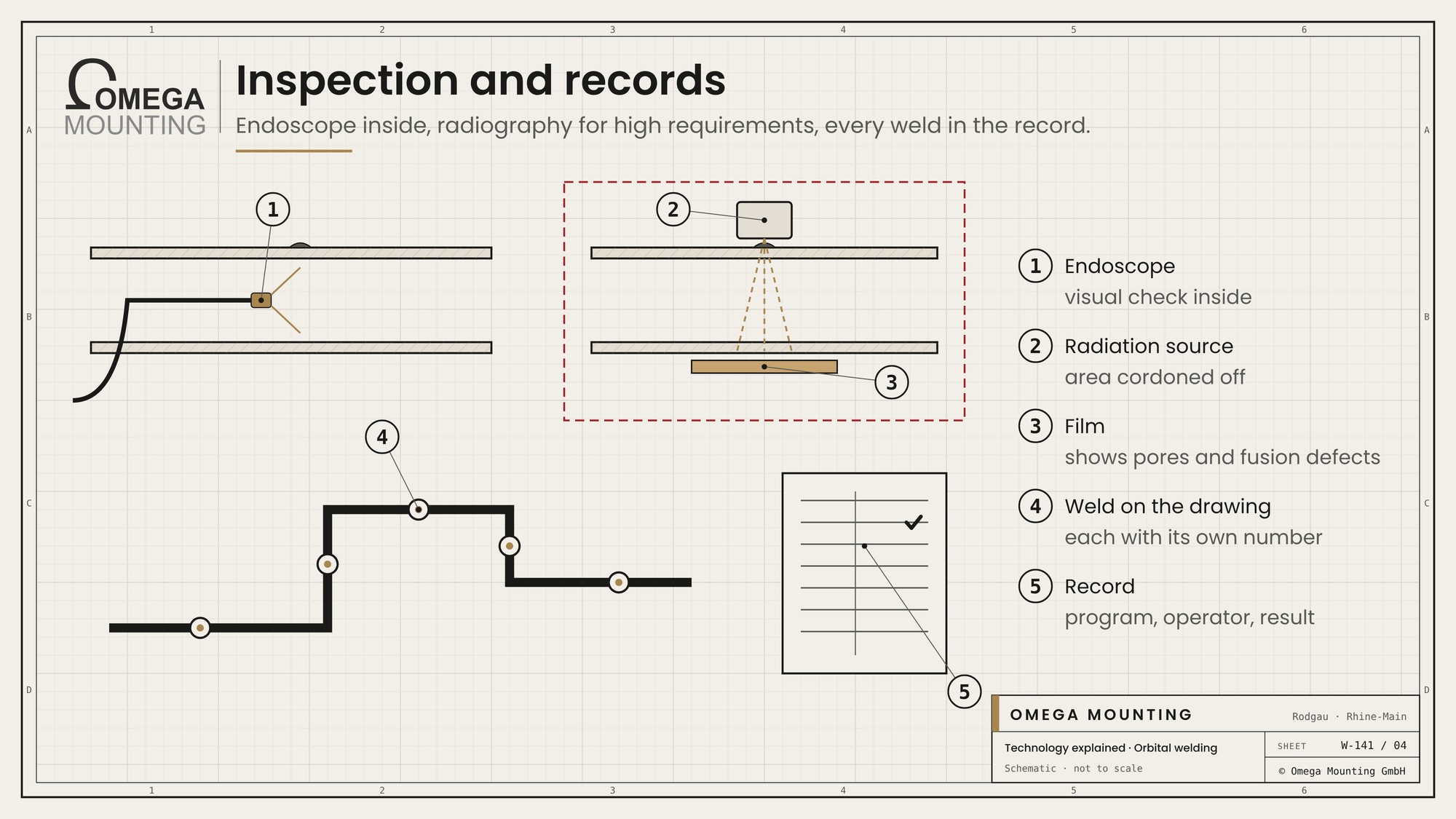
Orbital welds are inspected according to fixed rules:
- Visual inspection outside: width, evenness, surface.
- Visual inspection inside: with an endoscope or on test welds that are cut open.
- Radiography: For high requirements the weld is X-rayed. Pores, fusion defects and lack of penetration can be seen on the film.
- Leak test: The finished line is pressure-tested for leaks.
Then there are the records. Every weld is given a number on the piping drawing. The record shows the welder, program, date and inspection result. Many plants also require test welds at the start of each shift. This way every weld can be traced later.
Anyone who welds orbitally needs evidence. Operators of mechanised welding processes are qualified to their own standards, and the welding procedure itself is tested and approved in advance. The specialist welding company presents this evidence before the first weld is made on site. Which evidence a project requires is set out in the contract and the plant manufacturer's specification. This is not legal advice, but the usual procedure.
Orbital or by hand?
Not every tube weld is made orbitally. Both approaches have their place.
- Orbital: many identical welds, thin-walled stainless steel tubes, high requirements for the inside, complete records.
- By hand: individual welds, large or unusual components, tight spots where no weld head fits.
The weld head needs space around the tube. If the line runs too close to a wall or another line, it does not fit. That is why good pipework designers plan the spacing so that every weld remains accessible. Sections are often prefabricated in the workshop, and only the connecting welds are made on site.
For installation this means: hangers, brackets and penetrations must match the welding sequence. Anyone who bolts brackets tight too early prevents the tubes from meeting without a gap. Anyone who fits them too late leaves a freshly welded line hanging without support. That is why the sequence is agreed in advance.
What we pay attention to
We do not carry out orbital welding ourselves. On sites with orbital welds, we focus on the interfaces.
- We agree the sequence with the specialist welding company: align and fix first, then weld.
- We install brackets and hangers so that the line sits free of stress.
- We keep tubes closed and clean until welding.
- We protect finished welds from impacts and sparks.
- We carry out conventional stainless steel welding on frames, boxes and brackets ourselves.
Where we use it
When installing the paint supply of a paint shop in Italy, a specialist welding company orbital welded the paint lines. Alongside this, we conventionally welded frames, boxes and brackets in stainless steel and installed the colour changers. We also weld on site closer to home: during the Conversion of a test rig with oil sump we TIG welded all joints tight. What we take on in industrial installation is set out on our page on Industrial installation.
More technology explained
Technology explained
why a pig forgives no edge.
Guide
our guide to welding work on existing plants.
Do you have questions about how this works on your site?
Are you building a stainless steel line and need installation work around the orbital welds? We take care of frames, brackets and alignment and coordinate with your specialist welding company. Request a callback.
Free, no-obligation callback

About the author
Tobias Schott
Managing director of Omega Mounting GmbH, Rodgau · more than 20 years of hands-on experience in installation and maintenance
A trained mechatronics technician, working in maintenance, servicing and industrial installation since 2004 – first alongside his father, and with Omega Mounting since 2012: from overhead conveyors in Frankfurt to the crane system in a new-build hall. He plans and leads lifting operations as an appointed person (AP) in data centers and on industrial sites in the Rhine-Main region, trains and examines operators of cranes, mobile elevating work platforms and telehandlers, and is a qualified occupational safety specialist. On jobs abroad he is known as the “German Troubleshooter” – the person you call when a site gets stuck. He learned what quality means from his father, not from a manual: Made in Germany as a standard for his own work, not a label. That is why quality comes first at Omega Mounting – ahead of speed and price. The Technology explained articles cover the equipment and techniques his team uses every day: what counts on site is in them – what only appears in the brochure is not.
 English
 German