
- Guide – Maintenance
Servicing a folding dock leveller: lubricating hinges, adjusting spring and weight balance, inspecting safely and documenting
By Tobias Schott · 20-minute read · As of November 2026
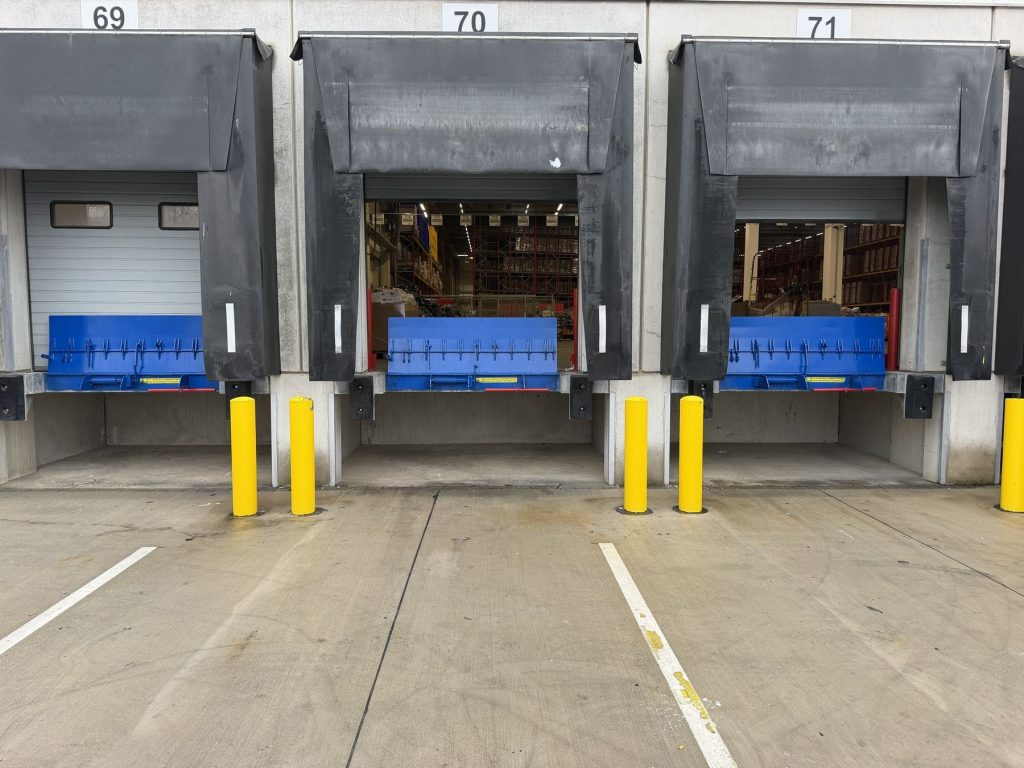
Servicing a folding dock leveller means: greasing hinges and lubrication points, checking and adjusting spring and weight balance, inspecting plate, lip and base frame and folding the leveller down fully once – with the leveller secured and two fitters. At the end, every loading bay has a record with a clear finding.
A mechanical folding dock leveller bridges the gap between the dock edge and the load bed. In its parked position it stands upright in front of the door, is folded forward by hand and rests on the lorry with its lip. A spring balances the weight of the plate so that one person can move it. That sounds simple – and that is exactly why its care is often forgotten.
Yet a folding dock leveller works hard. It stands outdoors, is moved for every lorry, and every forklift that drives over it loads the hinge, plate and anchoring. A dry hinge makes the leveller stiff, a tired spring lets it slam down, a crack in the frame stays invisible for a long time. Anyone who has their folding dock leveller serviced keeps operating force, safety and availability under control. If you search for folding dock leveller maintenance, servicing a dock leveller or dock leveller maintenance, you usually mean exactly that: servicing that looks at mechanics, spring and securing together.
This guide shows how to service a folding dock leveller – from the hinges through spring and weight balance to the function test and documentation. It is written for logistics and site managers, maintenance and technical managers, facility managers, occupational safety specialists, buyers, planners and project managers.
Key points at a glance
- Servicing a folding dock leveller means: lubricate hinges, check spring and weight balance, inspect plate, lip and frame, fold down fully and document.
- Safety-relevant. Forklifts with loads drive over the leveller. It must rest securely and must never fall uncontrolled.
- Hinges first. Dry hinges are the most common cause of a stiff folding dock leveller.
- Respect the spring. The spring stores force. It is only adjusted to the manufacturer's specification and with the leveller secured.
- Never under an unsecured leveller. Secure it mechanically first, then work.
- Work in pairs. One moves and secures the leveller, the other checks and lubricates.
- A record per leveller. Every inspection point with a finding, every defect with a rating: immediate, plannable or monitor.
- Servicing is not inspection. The recurring inspection by a competent person remains the operator's duty – servicing prepares for it.
What does servicing a folding dock leveller actually involve?
A folding dock leveller – also called a dock plate, loading bridge or dock leveller – connects the dock with the lorry. On the mechanical version, a person moves the leveller and the spring helps. There is no motor and no hydraulics that could mask faults. The operator feels every weakness straight away in their hand.
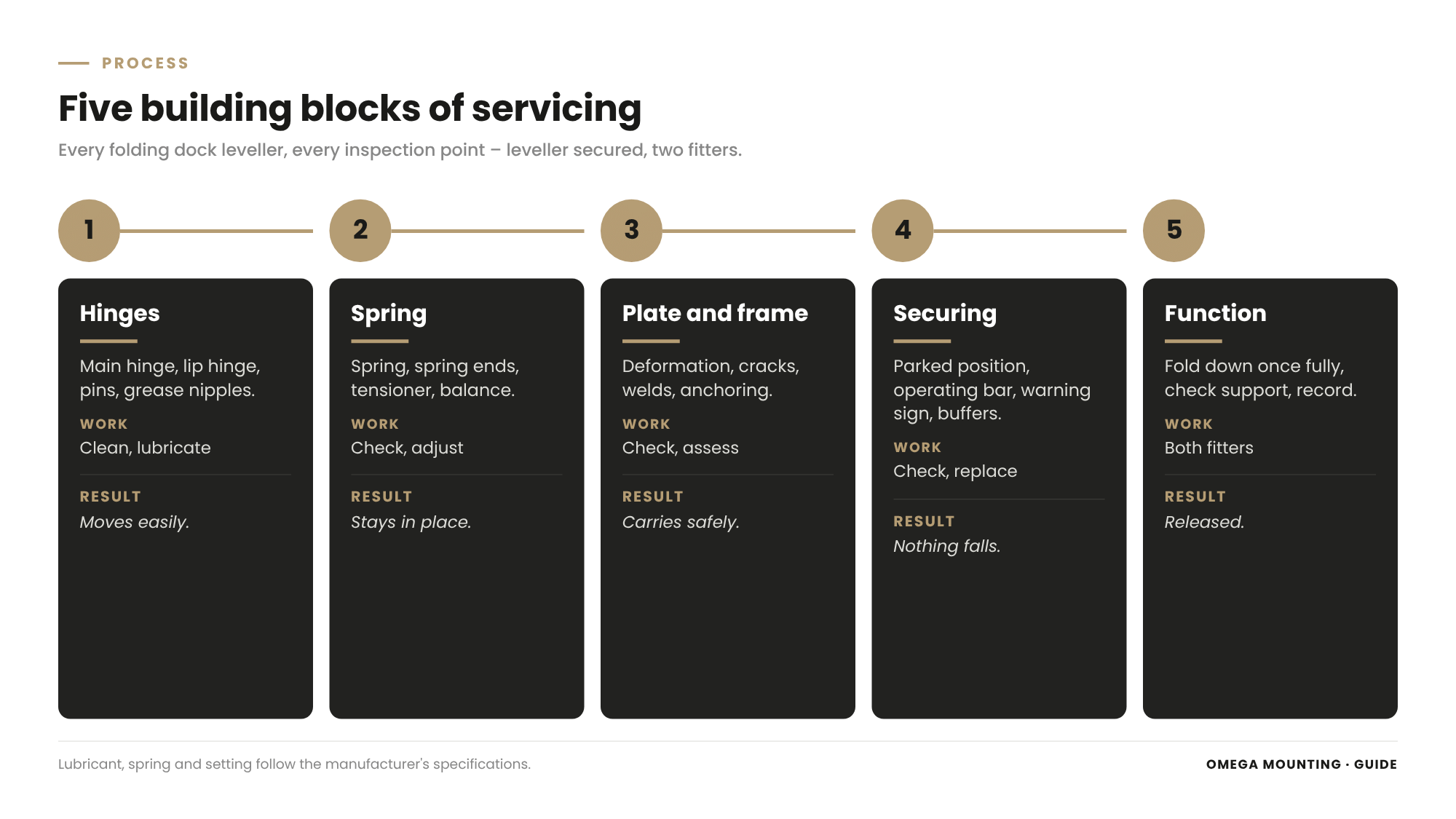
Anyone servicing a folding dock leveller works through five building blocks. Hinges and lubrication points: main hinge, lip hinge, pins, retainers, grease nipples. Spring and weight balance: spring, spring ends, tensioner, balance. Plate, lip and base frame: deformation, cracks, welds, anchoring, corrosion protection. Securing and marking: parked position, operating bar, warning sign, buffers. Function test with a record.
Servicing, inspection, testing
Servicing means looking after: cleaning, lubricating, adjusting, retightening. Inspection means establishing condition: play, wear, cracks, rust. Testing means confirming that the leveller is safe. Good servicing does the first two and prepares for the third.
Why regularly?
A folding dock leveller ages quietly. The grease in the hinge hardens, the spring slowly loses force, a weld starts to crack. The operator gets used to the leveller moving a little more stiffly – until it jams or slams down. Regular servicing finds these things beforehand. How loading bays are maintained as a whole is shown in the guide Loading dock maintenance.
How a mechanical folding dock leveller is built
Anyone who knows how the leveller works also knows where to look.
Base frame and dock edge
The base frame sits firmly in the dock edge. It is usually galvanised, cast in concrete or welded on and transfers all forces into the building. Brackets and stops at the sides often guide the leveller.
Main hinge
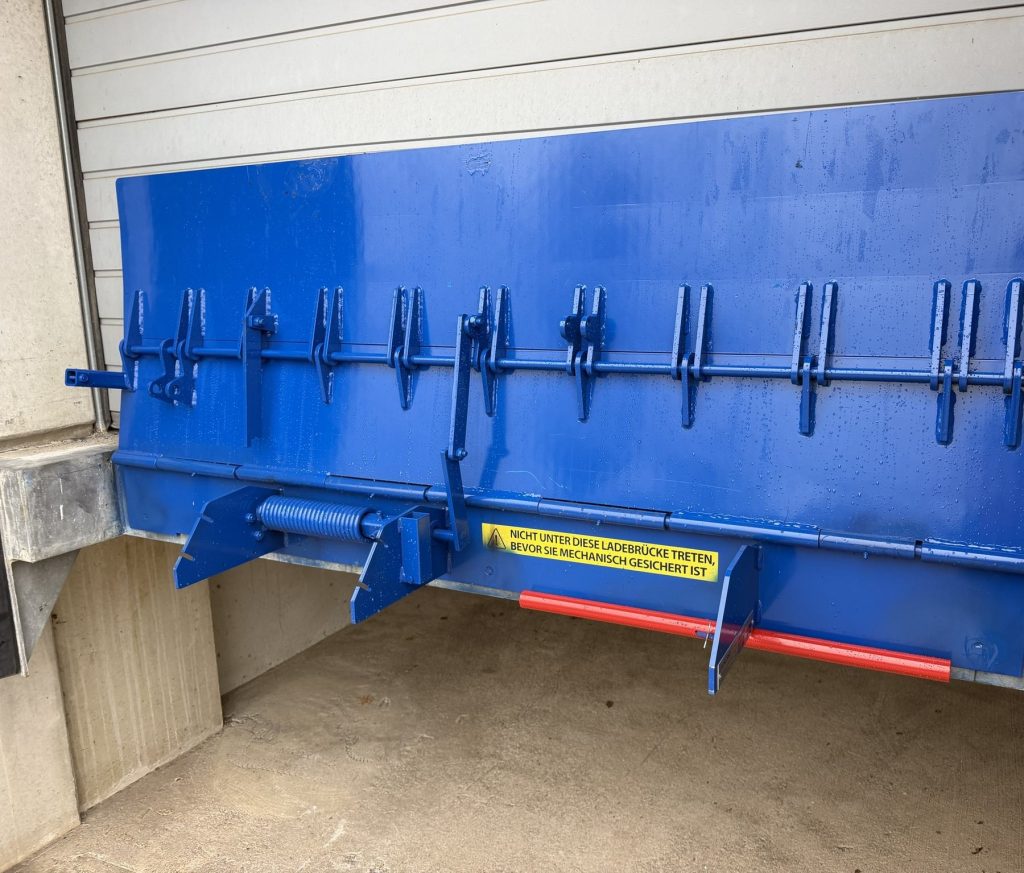
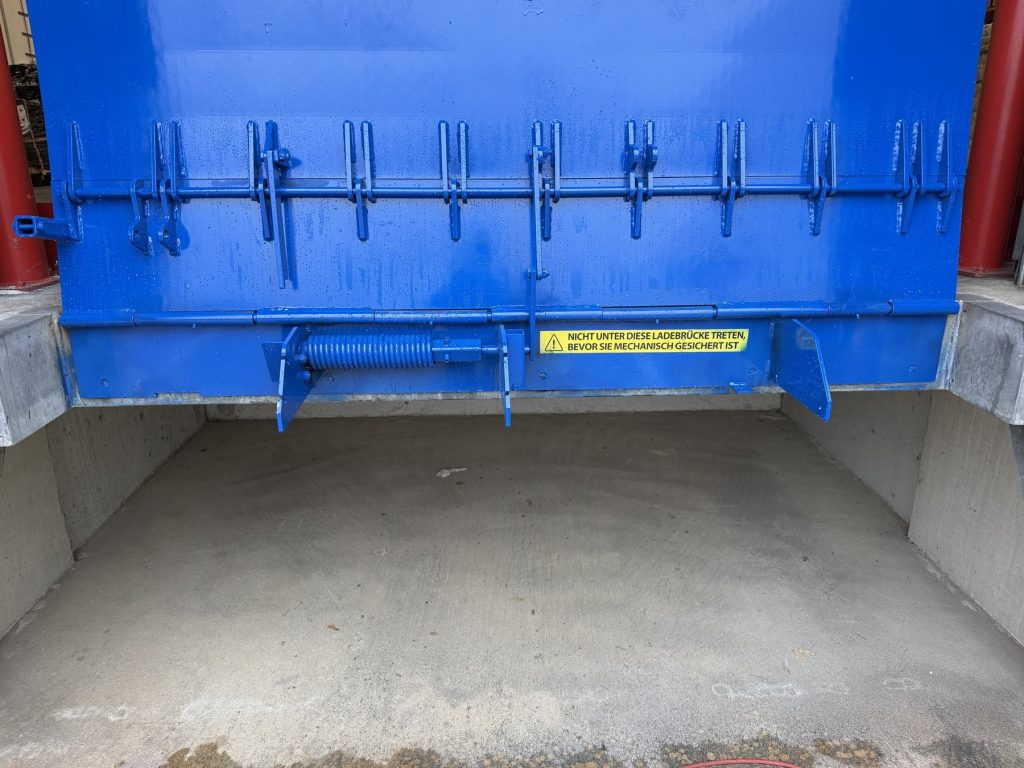
At the bottom, along the dock edge, lies the main hinge. A continuous hinge tube with many knuckles connects frame and plate. The whole leveller pivots about this axis. Grease nipples supply the bearing points.
Plate and lip
The plate is the driving surface for the forklift. At the top sits the lip, hinged on a second hinge bar. When the leveller is folded down, the lip rests on the load bed and evens out height differences. How hinged lip and telescopic lip differ is explained in the article The dock leveller.
Spring and weight balance
Below the main hinge sits the tension spring with its tensioner. It balances the weight of the plate. When set correctly, the leveller stays put in its parked position, can be lowered with little force and does not slam down.
Operating bar, warning sign and buffers
The operator uses the operating bar to pull the leveller out of its parked position. A warning sign reminds people not to step under the leveller before it is mechanically secured. Buffers beside the dock keep the lorry at a distance.
The inspection points on a folding dock leveller
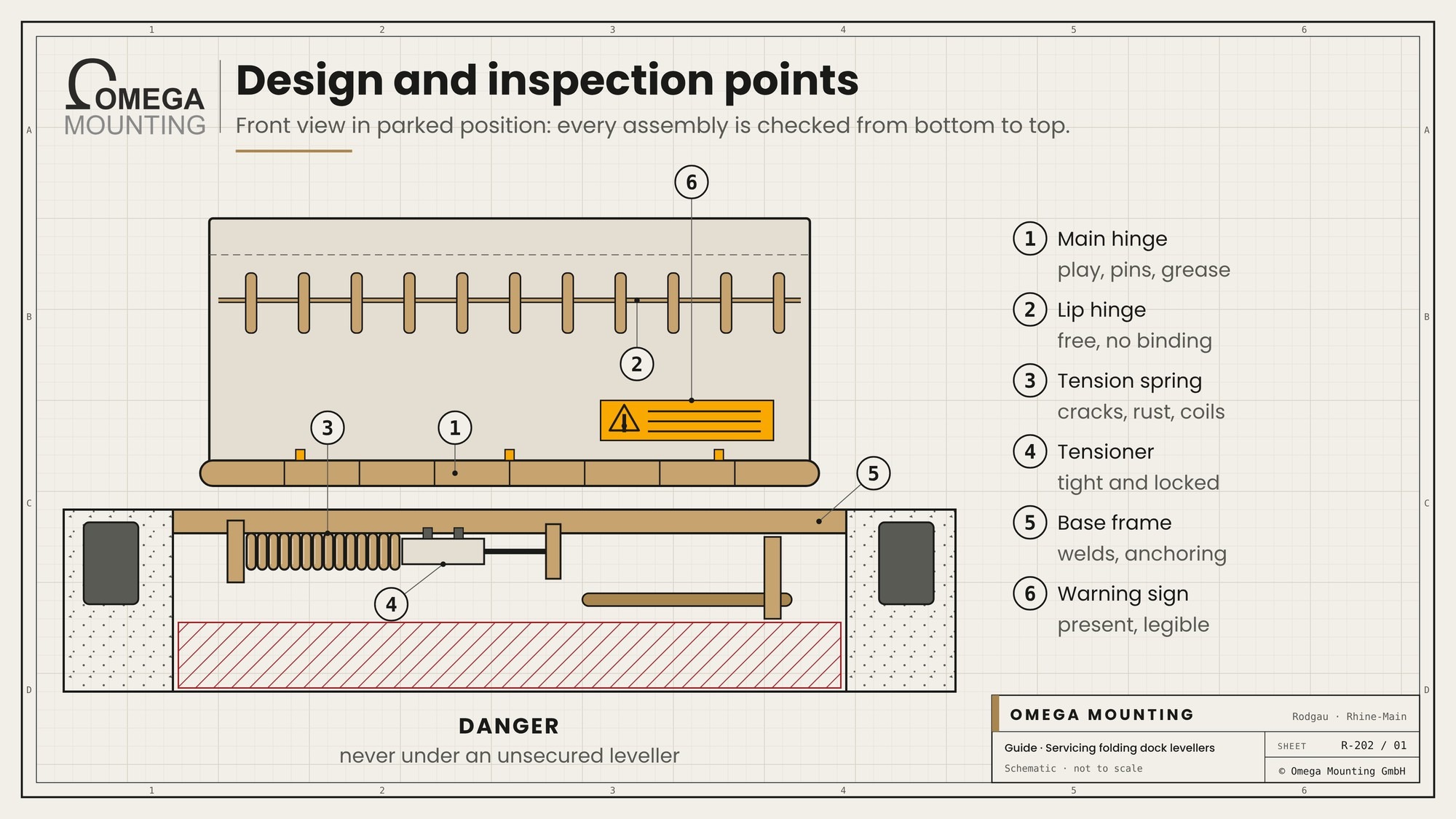
The same assemblies sit on every folding dock leveller. They are checked in a fixed order – from bottom to top, from the frame to the lip.
At the bottom on the dock edge
Base frame, anchoring, welds on the brackets and the main hinge. This is where the greatest forces act when a loaded forklift drives over the leveller.
On the spring
Spring, spring ends, mounting and tensioner. This is where the stored force sits that keeps the leveller in balance.
On the plate
Driving surface, lip hinge, lip and edges. This is where deformation, cracks and worn areas show up.
All around
Operating bar and holder, warning sign, buffers, pit and drainage. These parts are quickly checked and often forgotten.
Preparation: securing the loading bay and the leveller
Before servicing, the loading bay and the leveller are secured. This is especially important on a folding dock leveller because lubricating and checking often means working under or in front of the leveller.
Coordinating
The operator decides which doors are free when. Servicing is done door by door so that operations continue at the other doors.
Cordoning off
The area in front of the door is cordoned off and marked. No lorry may approach the dock while work is being done on the leveller. Inside, the door is secured so that no forklift drives onto the leveller.
Securing the leveller mechanically
Before anyone reaches or steps under the leveller, it is mechanically secured – to the manufacturer's specification, with the intended locking device or a suitable prop. The spring alone is not a safeguard. That is exactly what the warning sign at the dock says too.
Working in pairs
We always work in pairs on a folding dock leveller. One moves and holds the leveller, the other checks, lubricates and observes. When the spring is adjusted, one secures the leveller while the other makes the adjustment. What applies to lone working is shown in the guide lone working in maintenance.
Having documents to hand
The manufacturer's operating manual and servicing specifications are available. They determine lubrication points, lubricant and the spring setting.
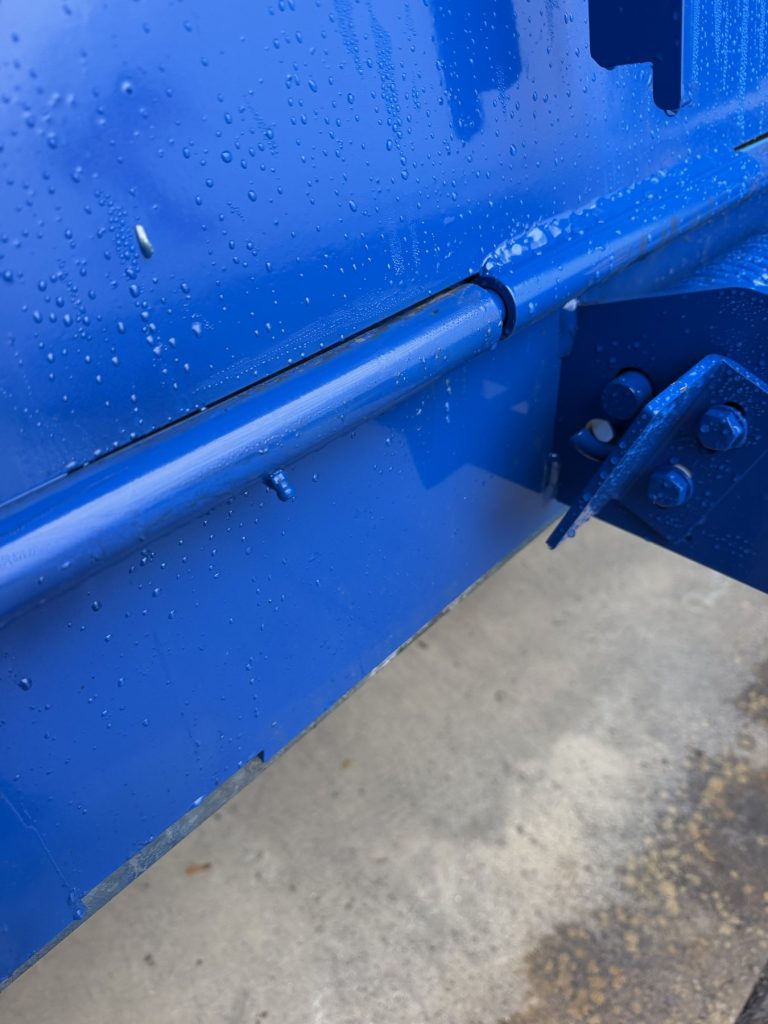
Hinges and lubrication points
The hinges are the heart of the folding dock leveller. They turn for every lorry and carry load for every forklift.
Main hinge
The main hinge is checked along its whole length: is the hinge tube firmly seated? Do the knuckles have play? Are pins and retainers complete? A worn hinge makes the leveller wobble and wears faster and faster.
Lip hinge
The hinge bar of the lip is checked in the same way. The lip must swing freely and rest cleanly on the load bed. If it binds, the leveller rests on one edge only.
Grease nipples
Every grease nipple is located, cleaned and lubricated – with the prescribed lubricant. Nipples that are blocked, broken off or painted over are cleared or replaced. How a lubrication plan is structured is shown in the guide lubrication schedule in maintenance.
After a repaint
When a folding dock leveller is recoated, paint can run into the hinge joints and cover grease nipples. After painting, nipples are cleared, joints checked and the leveller moved through its range. Otherwise the leveller looks good but moves stiffly.
Lubricating the hinge: step by step
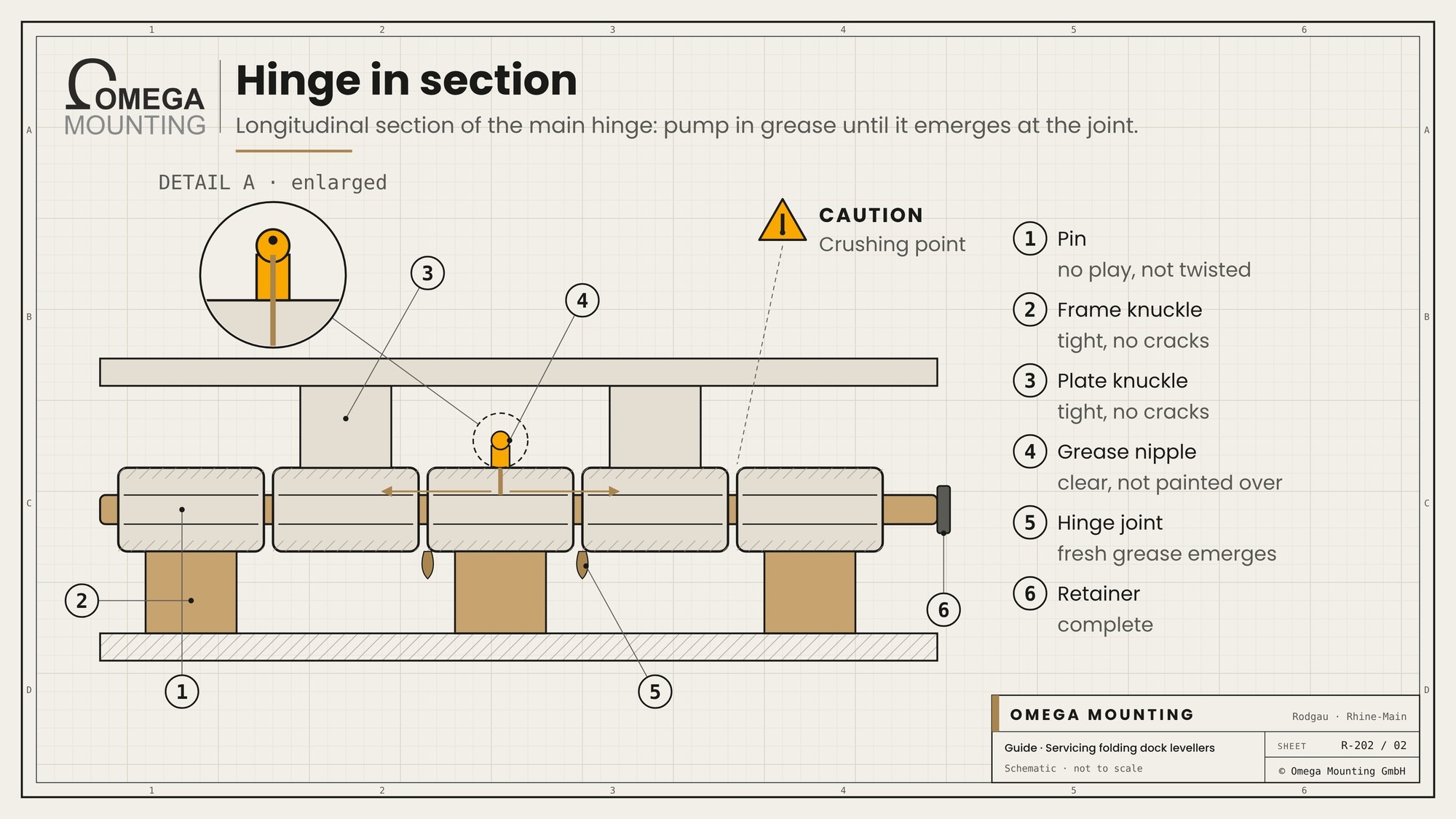
Lubricating sounds like a side issue. On a folding dock leveller it decides whether the leveller moves easily.
Cleaning
Dirt, old grease and water are removed around the nipple and hinge joint. Otherwise the grease gun pushes the dirt into the bearing.
Pumping in grease
Grease is pumped in until fresh grease emerges at the joint. Then the old grease has been displaced and the bearing point is full. Escaping grease is wiped off so that it does not bind dirt and nobody slips on it.
Moving it through
The leveller is moved through its full range several times. This spreads the grease in the hinge. Then grease is added again wherever no fresh grease has emerged.
Checking free movement
Finally, it is checked by feel: does the leveller run without jerking, clicking or catching? If resistance remains, the cause lies elsewhere – in the spring, a bent part or the lip.
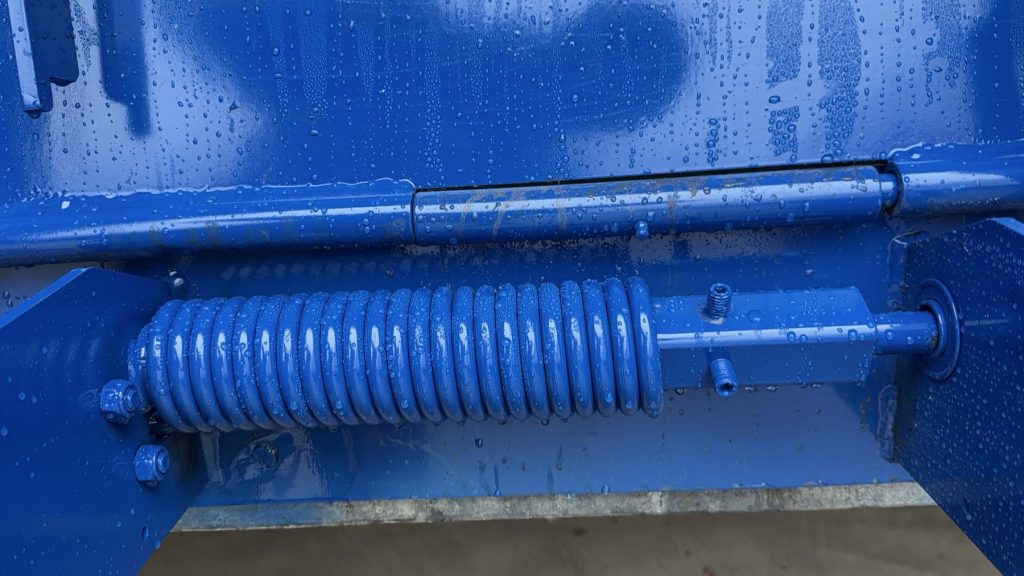
Spring and weight balance
The spring turns a heavy steel plate into a leveller that one person can move. If it is not right, the leveller becomes dangerous.
Checking the spring
The spring is checked for cracks, rust, deformation and even coils. Spring ends and mounting must not be worn out or cracked. A spring with cracks or heavy rust is not re-tensioned but replaced.
Checking the tensioner
The tensioner holds the spring at its preload. Threads, nuts and clamping screws must turn freely, be tight and be locked. A loose tensioner shifts by itself over time.
Checking the balance
With the surroundings secured, the behaviour of the leveller is checked. In the parked position it must stay put. When lowered, it must be guided with little force without falling forward. When folded up, it must not spring back.
How to recognise a tired spring
The leveller falls faster than before, slams hard onto the load bed or is hard to fold back up. Operators then often say: “It's heavy today.” Remarks like that belong in the record.
Adjusting the spring: keeping the leveller in balance
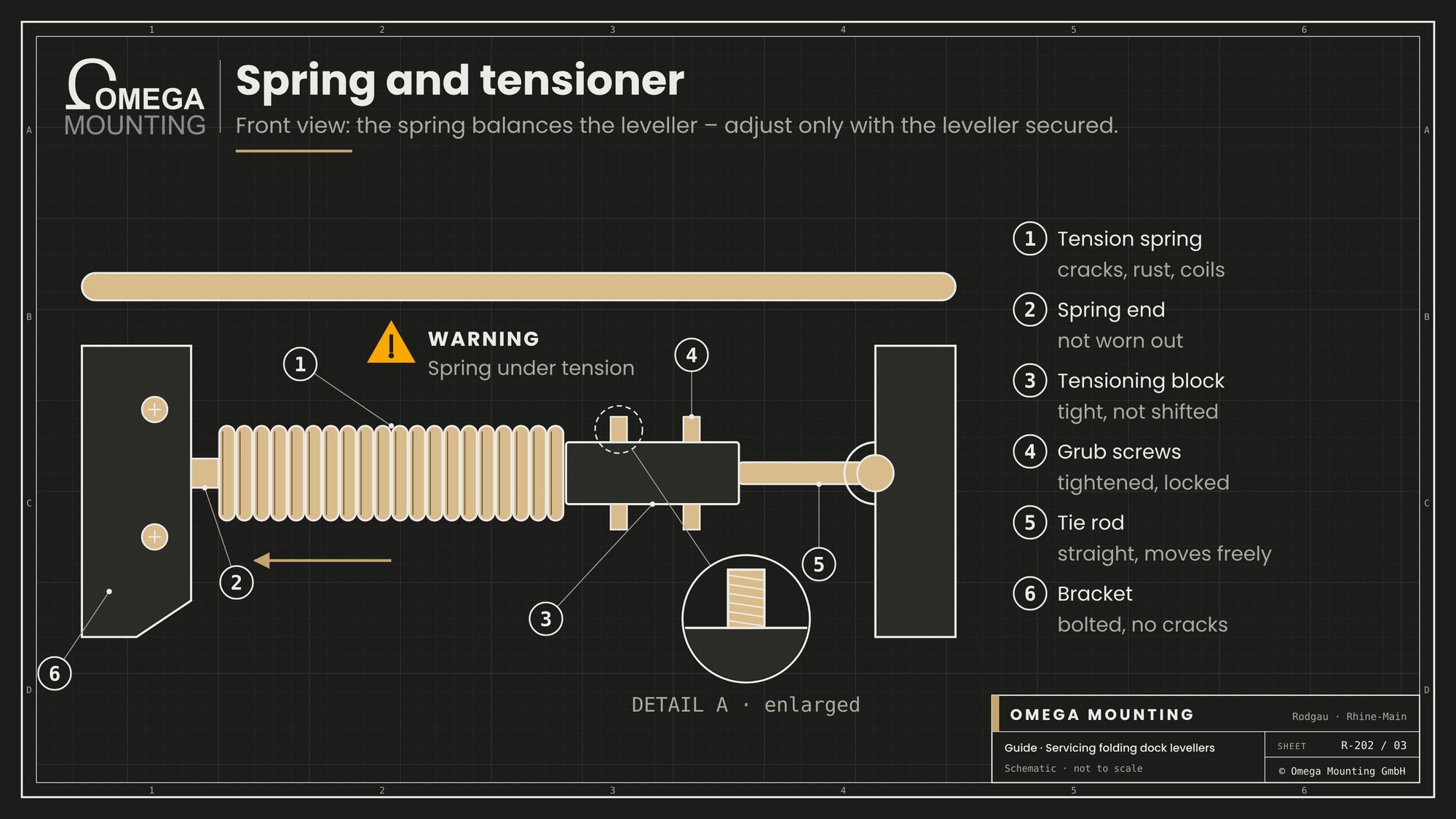
Anyone who wants to adjust the spring of a folding dock leveller works only to the manufacturer's specification and with the leveller secured. The spring stores a lot of force – a mistake can make the leveller slam or crush a hand.
Secure first, then adjust
The leveller is held in a safe position and mechanically secured. Only then is work done on the tensioner. Nobody stands in the swing range of the leveller.
In small steps
The preload is changed in small steps. After each step, the behaviour of the leveller is checked. This is how the point of balance is found.
Locking and documenting
Once the setting is found, the tensioner is locked. The setting is noted in the record so that next time it is visible whether the spring is weakening.
When the spring is replaced
If the balance can no longer be set or the spring shows damage, it is replaced – with the original part or a part approved by the manufacturer. Replacing a spring is work for specialists with the right tools.
Plate, lip and base frame
Plate, lip and frame carry the load. This is where damage shows up that stays invisible for a long time.
Plate
The plate is checked for deformation, cracks, worn areas and a safe driving surface. A bent plate no longer rests cleanly and gives under the forklift.
Lip
The lip is checked for deformation, broken edges and free movement. It must rest on the load bed with enough overlap.
Base frame and welds
Frame, brackets and welds are checked for cracks, especially at the transitions to the dock edge. A crack is marked, assessed and properly re-welded before it spreads. Which weld types exist is explained in the article Weld types.
Anchoring and corrosion protection
The anchoring in the concrete is checked for a firm fit. Galvanising and coating are checked. Where protection is missing, rust begins – first at edges, joints and undersides.
Function test: folding down fully once
Every service ends with the most important test: does the leveller work as a whole?
Complete cycle
The leveller is lowered from its parked position, laid on a test surface or a lorry and folded back up. One operates, the other watches hinges, spring and lip.
Checking the support
The lip must rest securely over its full width. There must be no trip edge and no dangerous gap.
Checking the parked position
In the parked position, the leveller must stay put and be secured against falling over. The operating bar belongs in its holder.
Approval
Only when all points are right is the leveller released for operation. If an immediate defect remains, the loading bay stays closed.
Documentation: a record per loading bay
Servicing without a record is of little value to the operator. They must be able to show that their dock levellers are in order.
A record per leveller
Each folding dock leveller gets its own record with the door number, the finding for each inspection point, the inspector and the date. The spring setting also goes in it.
Action plan
Each record comes with an action plan: defect, rating, recommended action and, as far as can be seen, the parts needed. The rating is simple: immediate, plannable or monitor.
Maintenance history
A history is kept for each leveller. It shows where a spring is weakening or a hinge keeps developing play. How to recognise wear early is shown in the guide Recognising wear on machines.
Servicing, inspection and everyday checks: who looks when?
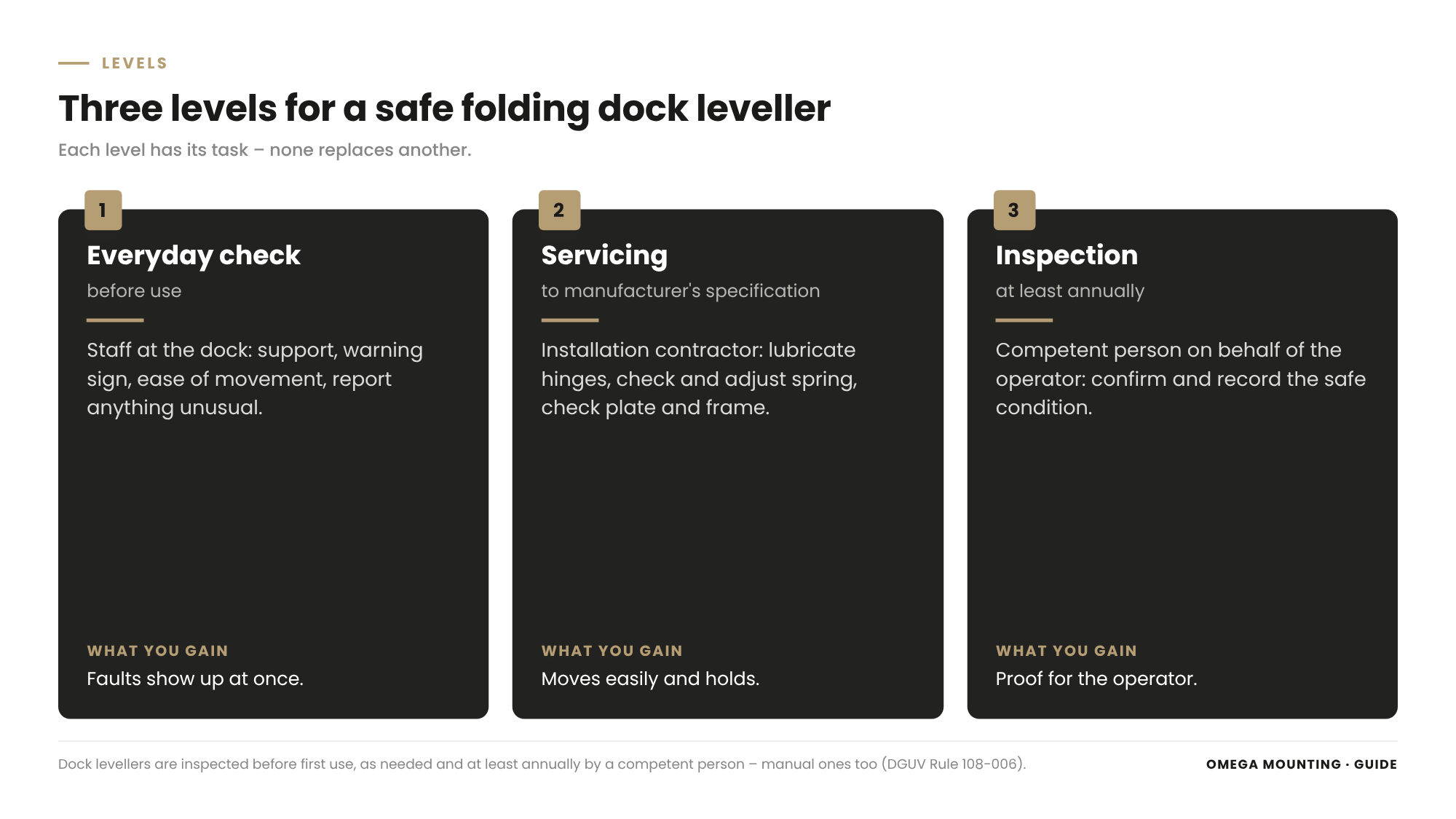
On a folding dock leveller, three levels interlock. Each has its own task.
Everyday check
Staff at the dock take a look before use: does the leveller rest cleanly? Is the warning sign there? Is the leveller heavier than usual? Anything unusual is reported and, if in doubt, the leveller is closed.
Maintenance
Servicing looks after the mechanics to the manufacturer's specification: hinges, spring, plate, frame. How often depends on use and environment. Doors with a lot of traffic are serviced more often.
Periodic inspection
Under the German accident insurance rule for dock levellers and mobile ramps, dock levellers are inspected by a competent person before first use, as needed and at least once a year – regardless of whether they are moved by hand or hydraulically. The operator organises the inspection. How inspection duties are organised is shown in the guide inspection obligations for operators.
How it fits together
Ideally, servicing takes place shortly before the inspection. Then the leveller goes into the inspection in good condition, and defects from the inspection can be fixed in the same go.
Typical defects and their causes
The same defects keep turning up during servicing.
- Folding dock leveller stiff: dry hinges, painted-over grease nipples.
- Leveller falls too fast: spring fatigued or tensioner shifted.
- Leveller springs back: preload too high.
- Leveller wobbles: knuckles and pins worn out.
- Lip rests unevenly: lip hinge binding or lip bent.
- Crack on the bracket: impacts from lorries and overload over time.
- Rust on edges and underside: damaged corrosion protection.
- Warning sign missing or illegible: weather and cleaning.
The defect behind the defects
Almost all these defects develop slowly. Anyone who services and documents regularly sees them coming – and fixes them before the leveller fails.
Spare parts and wear parts
Some parts wear in a predictable way. It is worth knowing them.
Typical wear parts
Grease nipples, pins and retainers, springs, tensioner parts, buffers and warning signs are among them. Exactly which ones is stated in the manufacturer's documentation.
Stock on site
With many doors, a small stock of the most common small parts is worthwhile. That way a broken grease nipple does not turn into a closure. Which parts belong in it is shown by the maintenance history.
Original parts
For safety-related parts such as spring, pins and hinge parts: original part or a part approved by the manufacturer. That secures function and warranty.
Servicing the folding dock leveller together with door, buffers and vehicle restraint
The folding dock leveller is part of the loading bay. It works together with the door, dock shelter, buffers and often a vehicle restraint.
One appointment, one loading bay
It is most efficient to service all components of a loading bay in one round. The door is only out of service once.
Door and dock shelter
How doors at the dock are maintained is shown in the article Sectional door at the dock.
Vehicle restraint
Where vehicle restraint systems are installed, they belong in the same appointment. What needs doing there is shown in the guide Servicing a vehicle restraint system.
Buffers and impact protection
Buffers beside the dock keep the lorry at a distance. If they are worn, the lorry strikes the frame and brackets – and that is exactly where the cracks then form.
Repair, retrofit or replace?
Not every folding dock leveller has to be replaced. But not every one is worth repairing.
Repair
Hinge parts, pins, spring, lip and individual welds can usually be repaired or replaced. That is often the quickest way back into operation.
Retrofit
Where levellers are moved many times a day, converting from manual to hydraulic operation can pay off. How such a replacement runs in a single day is shown in the report Replacing a folding dock leveller: from manual to hydraulic.
Replace
If the frame is badly corroded, the plate deformed or the anchoring loosened, replacement is usually the better choice. How that works during operation is shown in the guide Replacing a dock leveller.
Safety rules during servicing
A few rules apply to every service on the folding dock leveller.
The basic rules
- Loading bay cordoned off, no lorry and no forklift during the work.
- Never step or reach under an unsecured leveller.
- Always in pairs: one secures and moves, one checks.
- Adjust the spring only to the manufacturer's specification and with the leveller secured.
- Do not reach into hinge joints or the swing range.
- Lubricants and spare parts to the manufacturer's specifications.
- Release only after a complete function test.
Legal framework
Servicing and inspection are subject to, among other things, the German Occupational Safety Act (ArbSchG), the Industrial Safety Ordinance (BetrSichV), the accident insurance rule for dock levellers and mobile ramps, the safety standard for dock levellers and the manufacturer's requirements. This guide is not legal advice – which obligations and intervals apply in your case you should clarify with your occupational safety specialist.
Who does what when servicing a folding dock leveller?
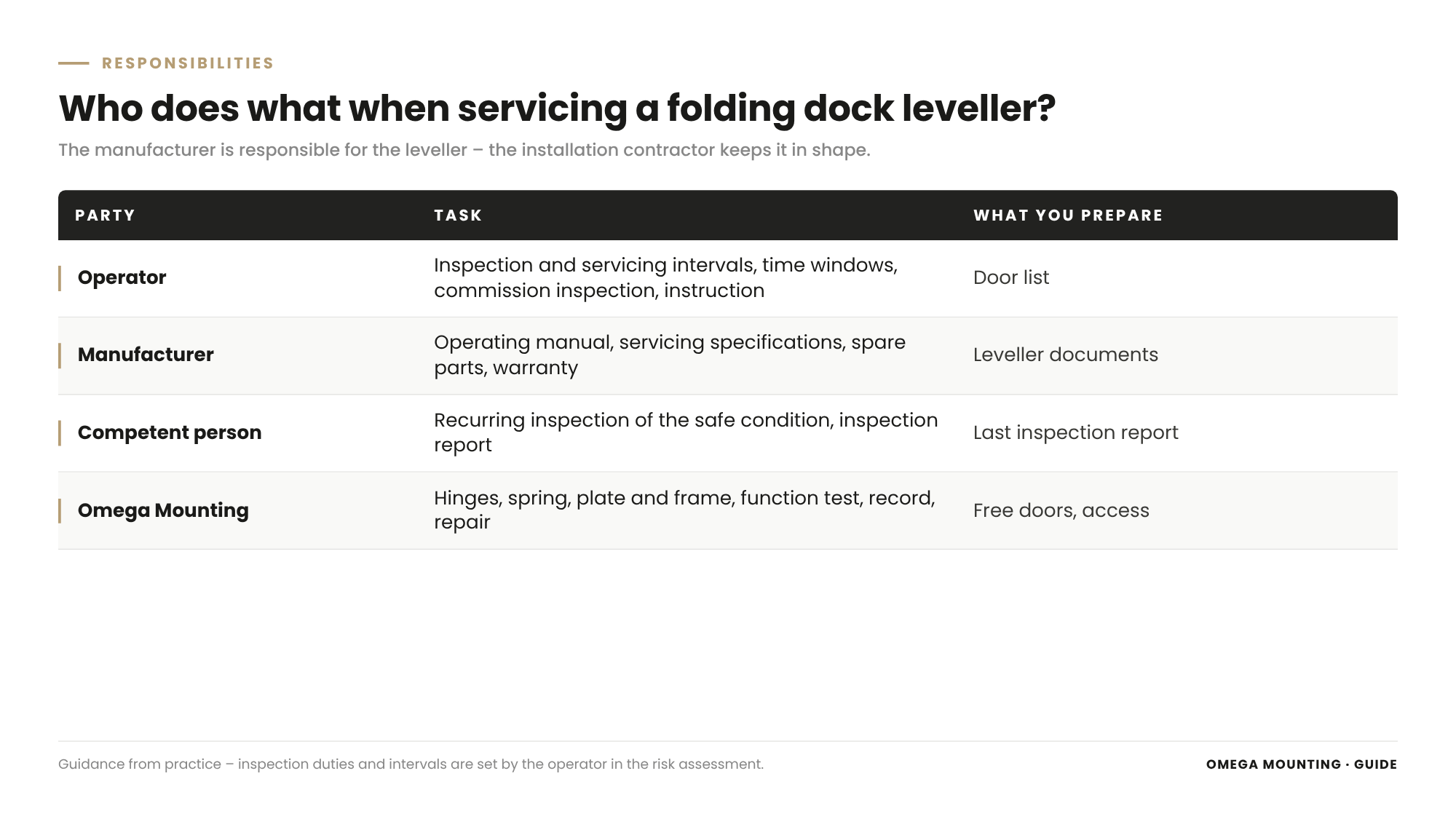
Several parties are involved.
Operator
The operator sets inspection and servicing intervals, releases doors and time windows, organises the recurring inspection by a competent person and the instruction of staff.
Manufacturer
The manufacturer supplies the operating manual, servicing specifications and spare parts, is responsible for the design of the leveller and handles the warranty.
Qualified inspector
The competent person regularly inspects the dock leveller for its safe condition and records the result.
Omega Mounting
We service hinges, spring and weight balance, check plate, lip and frame, fold the leveller through as a whole, document every loading bay and fix defects after release – with our own mechatronics technicians and fitters. Design and warranty remain with the manufacturer.
Servicing a folding dock leveller: what it means for your planning
Four questions help to set up servicing properly.
How many levellers and which type?
Mechanical, spring-assisted or hydraulic? Inspection points and effort follow from this.
When are the doors free?
Set time windows. This determines how many doors can be serviced per round.
When is the next inspection?
Schedule servicing shortly before the recurring inspection. Then the leveller goes into the inspection in good condition.
How should documentation be done?
Decide on record and action plan. This determines what you can prove later.
Typical mistakes when servicing folding dock levellers
Mistakes also happen during servicing itself.
- Reached under an unsecured leveller: the spring is not a safeguard.
- Only greased: spring, frame and lip were not checked.
- Spring re-tensioned blindly: without the manufacturer's specification, without checking the balance.
- Grease nipples overlooked: painted over or hidden.
- Worked alone: nobody held and watched the leveller.
- Combined record: individual levellers cannot be traced.
The mistake behind the mistakes
Almost all these mistakes happen when the folding dock leveller is seen as a simple piece of steelwork. It is a dock leveller with stored spring force – and must be serviced with the same care as a hydraulic unit.
Servicing folding dock levellers in the Rhine-Main region and throughout Germany: how we do it
From Rodgau we quickly reach Frankfurt, Offenbach, Hanau, Darmstadt, Aschaffenburg and the logistics areas of the region – and we work throughout Germany with our own teams. Anyone who wants their folding dock leveller serviced, whether in Rhine-Main or elsewhere in Germany, gets servicing, repair and welding from a single source with us.
We survey the levellers, agree time windows and manufacturer's specifications and service with two fitters per loading bay. How else we work in logistics is on our page on Logistics.
For you, that means folding dock levellers that move easily, rest securely and are demonstrably serviced.
Project examples
Two jobs show how we work on folding dock levellers.
Folding dock levellers serviced in a logistics centre
On a row of mechanical folding dock levellers in a logistics centre, we serviced hinges and lubrication points and checked and adjusted spring and weight balance. Door by door, the loading bay was closed, the leveller secured and the main hinge greased until fresh grease emerged at the joint. We then checked every spring for damage, inspected the tensioner and set the balance of the leveller so that it stays put in its parked position and can be lowered easily. Finally, each leveller was folded down fully once and released again.
From manual to hydraulic operation
In a logistics centre in Frankfurt, we cut out two old, manually operated folding dock levellers and replaced them with hydraulic ones – with mechanics, hydraulics and electrics from a single source. The job is described in the report Replacing a folding dock leveller: from manual to hydraulic.
Shall we service your folding dock levellers?
Send us the number, type and location of your loading bays and, if available, the manufacturer's documents – we will tell you what a service round could look like. Get in touch now.
What this means for your role
Buyers: Ask whether lubricant, small parts, a record per leveller and an action plan are included in the quote.
Planners: For new loading bays, provide access to lubrication points and spring and clarify early whether manual or hydraulic operation suits.
Project and site managers: After conversions, repainting or concrete work at the dock, servicing with a function test belongs before release.
Maintenance managers: Keep the maintenance history per leveller and schedule servicing shortly before the recurring inspection.
Logistics managers: Plan fixed service windows per door and take reports like “the leveller is heavy” seriously.
Occupational safety specialists: Check whether inspection intervals, securing of the leveller and instruction are defined.
Folding dock leveller servicing sheet: template on request
For your loading bays, we have put together the folding dock leveller servicing sheet. For each leveller it asks about hinges and lubrication points, spring and weight balance, plate, lip and frame, securing and marking, and the finding with rating. Request the template via our contact form – keyword “Folding dock leveller servicing sheet”.
Why Omega Mounting?
With over twenty years of experience in installation and maintenance – and from many loading bays that we have installed, repaired and replaced – we know that a folding dock leveller is only as safe as its spring and its hinges. That is why we always work in pairs, secure the leveller before we reach under it and document every leveller individually with a clear rating. We work to the manufacturer's specifications and can take care of welding and part replacement at the same time. For you, that means loading bays that work reliably and are demonstrably in order. Talk to us about your levellers – get in touch.
Conclusion
Servicing a folding dock leveller means greasing hinges and lubrication points, checking and adjusting spring and weight balance, inspecting plate, lip and frame and folding the leveller down fully once. Only then is it released.
With the leveller secured, two fitters per loading bay, servicing to the manufacturer's specification and a record per leveller, folding dock levellers stay easy to move and safe. If you want your folding dock levellers serviced, get in touch with us.
Planning a move-in, installation or maintenance in the Rhine-Main region?
Tell us briefly what you need – we'll come back with an honest assessment.
Free, no-obligation callback
You may also be interested in these guides
Maintenance & Servicing

About the author
Tobias Schott
Managing director of Omega Mounting GmbH, Rodgau · more than 20 years of hands-on experience in installation and maintenance
A trained mechatronics technician, working in maintenance, servicing and industrial installation since 2004 – first alongside his father, and with Omega Mounting since 2012: from overhead conveyors in Frankfurt to the crane system in a new-build hall. He plans and leads lifting operations as an appointed person (AP) in data centers and on industrial sites in the Rhine-Main region, trains and examines operators of cranes, mobile elevating work platforms and telehandlers, and is a qualified occupational safety specialist. On jobs abroad he is known as the “German Troubleshooter” – the person you call when a site gets stuck. He learned what quality means from his father, not from a manual: Made in Germany as a standard for his own work, not a label. That is why quality comes first at Omega Mounting – ahead of speed and price. He writes these guides from that practice: what works on our sites is in them – what exists only on paper is not.
Frequently asked questions
Hinges and lubrication points, spring and weight balance, plate, lip and base frame, securing and marking, a function test and a record per leveller.
Usually the hinges are dry or grease nipples have been painted over. If lubricating does not help, the cause is often the spring or a bent part.
Only to the manufacturer's specification, with the leveller secured and with expertise. The spring stores a lot of force. If in doubt, leave it to specialists.
Dock levellers are inspected by a competent person before first use, as needed and at least once a year – manual ones too. Servicing depends on the manufacturer's specification and use.
No. Servicing looks after the mechanics. The inspection confirms the safe condition and is organised by the operator. Ideally, servicing takes place shortly before the inspection.
Because one person has to secure and move the leveller while the other checks and lubricates. Alone, it would be neither safe nor meaningful.
Often yes, where levellers are moved very frequently or operators need relief. We assess this at your loading bay.
Yes. From Rodgau we are quickly on site in the region, and we work throughout Germany with our own teams.
Send us the number, design and location of your loading bays. We will assess the effort and come back with a proposal. Go to the contact page.
 English
 German