
- Technology explained – technology and procedures
Weld types: fillet weld, butt weld and what the throat thickness means
By Tobias Schott · 5-minute read · Updated November 2026
Welds differ in how the components lie to each other and how the weld is built up: butt welds join plates in one plane, fillet welds fill the angle between two parts – and the throat thickness says how much a fillet weld carries.
Anyone reading a welding drawing or ordering a repair comes across terms such as V weld, fillet weld, a 5 or root. Behind them is a simple logic: the position of the components determines the weld type, the plate thickness determines the preparation, and the load determines the weld size.
Here we explain the joint types, the common butt welds, the fillet weld with its throat thickness and how a weld is built up in passes.
What is a weld?
A weld is the place where two components are permanently joined by melted parent and filler material. Its shape depends on how the parts meet – the joint – and how the edges are prepared.
On drawings, welds are shown with symbols to ISO 2553: an arrow to the weld, a symbol for the weld type and a number for the size. Anyone who knows the symbols knows what is required before the first cut.
Key facts
- Joint types: Butt joint, T-joint, corner joint, lap joint.
- Butt welds: square (I) weld for thin plates, V, Y and X welds with bevel for thicker ones.
- Fillet weld: in the angle between two components, size given by the throat thickness.
- Passes: root pass, fill passes, cap pass, back run if needed.
- Penetration: how deep the weld reaches into the parent metal.
- Marking: Weld symbols to ISO 2553 on the drawing.
Which joint types are there?
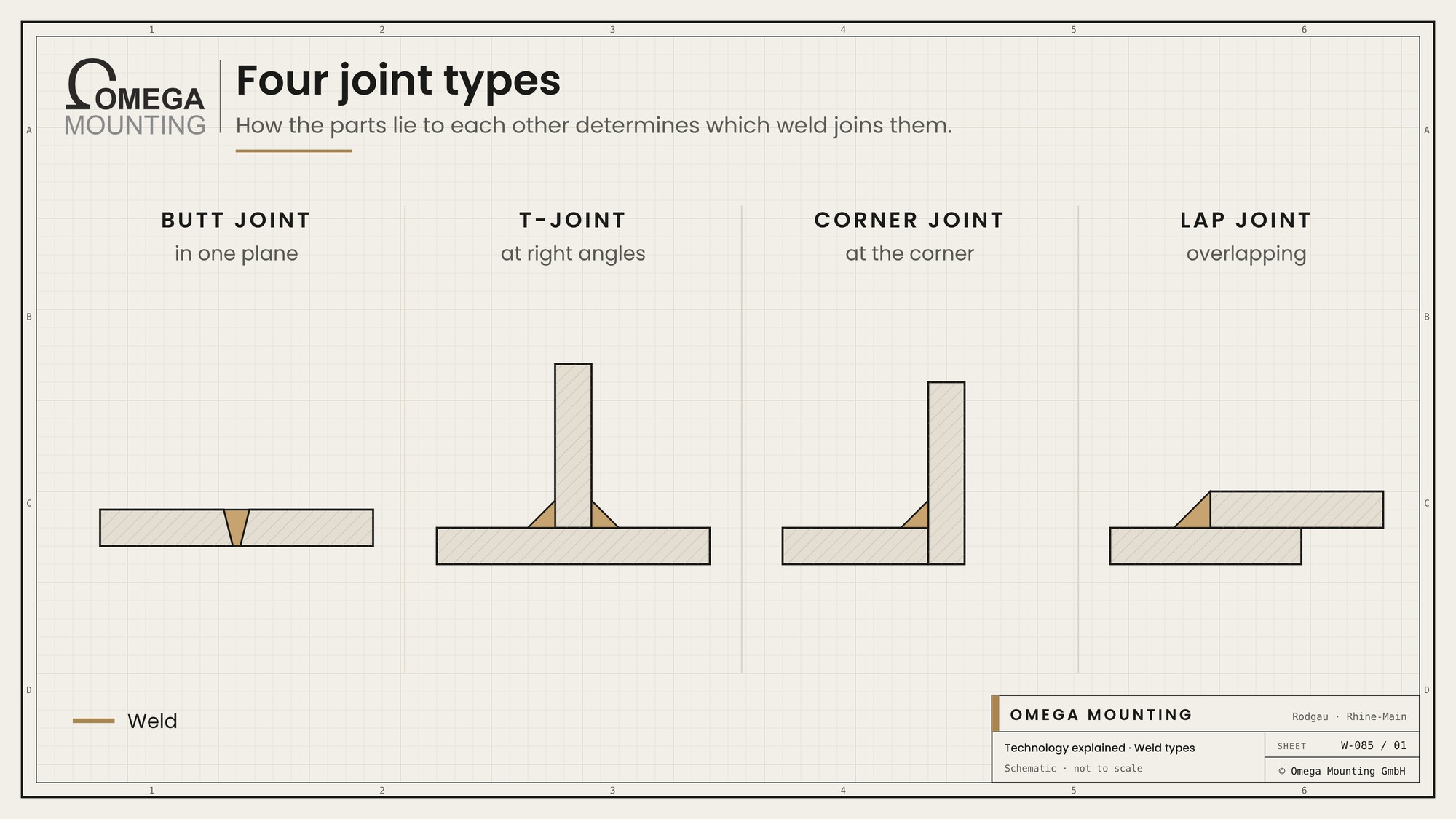
The joint describes how two components lie to each other.
- Butt joint: both parts lie in one plane, edge to edge.
- T-joint: one part stands at right angles on the other – typical for brackets, ribs and columns.
- Corner joint: two parts meet at a corner, as in boxes and frames.
- Lap joint: the parts overlap, the weld sits at the edge.
A butt joint usually has a butt weld, T, corner and lap joints usually a fillet weld. Which joint is chosen is decided by the designer – in a repair, the joint of the original is usually kept. Changing it also changes how the forces run through the component – that then belongs in the hands of a design engineer.
Butt welds: I, V and X
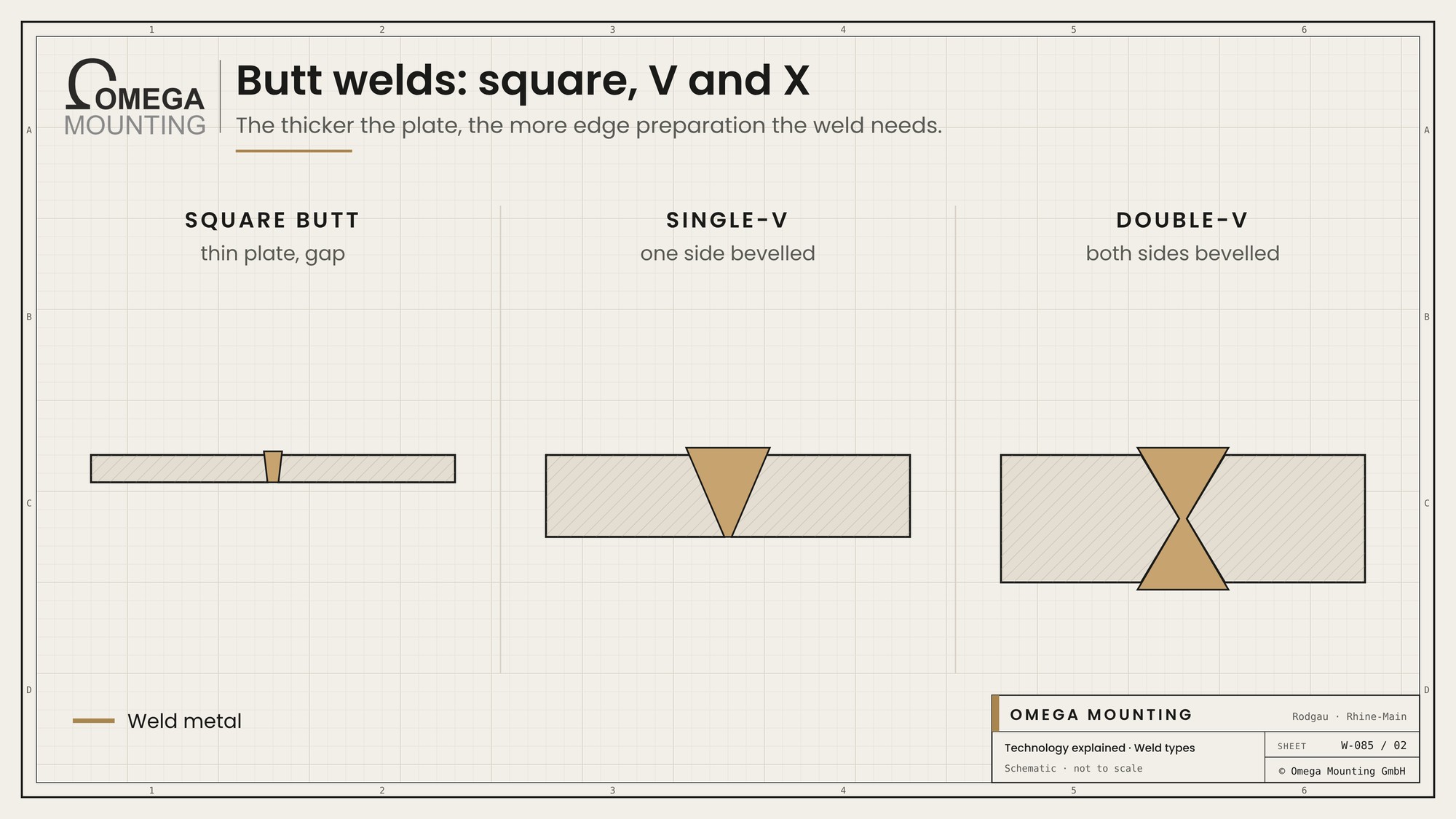
With butt welds, the weld must reach through the whole plate. The thicker the plate, the more preparation it needs.
| Weld | Preparation | Used for |
|---|---|---|
| I weld | Edges straight, small gap. | Thin plates that are fully penetrated in one pass. |
| V weld | One side bevelled, forms a V. | Medium thicknesses, welded from one side. |
| Y weld | Like V, but with a root face at the bottom. | When the root is to be better controlled. |
| X weld | Both sides bevelled. | Thick plates, welded from both sides – less distortion. |
The bevel gives the arc room right down to the bottom. Without preparation, thick plates are left with an unwelded core in the middle – invisible from outside, but a weak point.
The fillet weld and its throat thickness
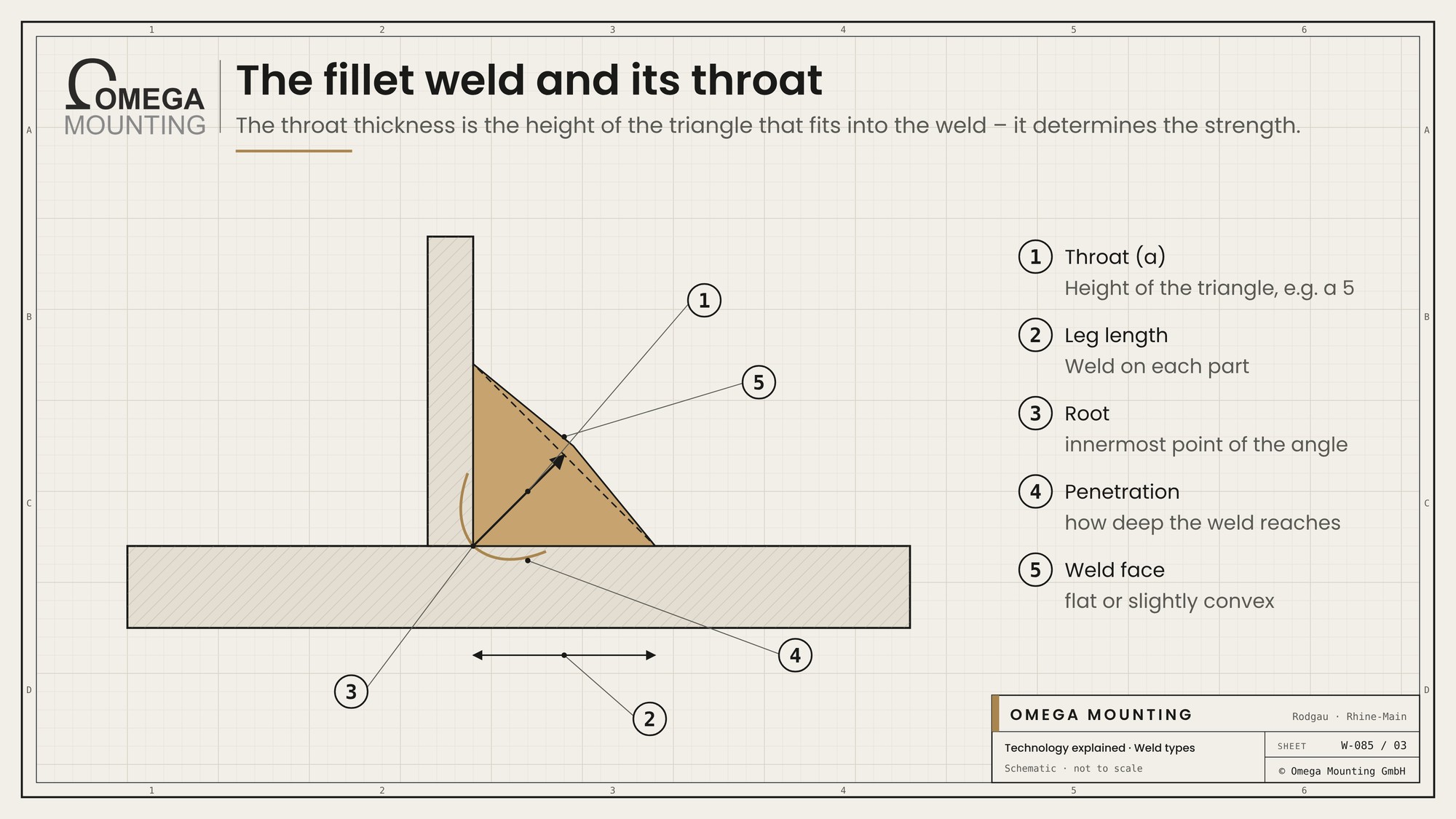
The fillet weld is the most common weld in installation and repair. It fills the angle between two components.
- Throat thickness (a): the height of the largest isosceles triangle that fits into the weld – measured from the root to the surface. The drawing shows, for example, “a 5”.
- Leg length: how far the weld reaches onto each component.
- Root: the innermost point of the weld in the angle.
- Penetration: how deep the weld reaches into the components.
The throat thickness determines how much force the weld can transmit. A weld that looks thick from outside but is not fused at the root carries less than it promises. That is why the rule for repairs is: better to weld with deep penetration than just to deposit a lot of material.
Passes: root, fill, cap
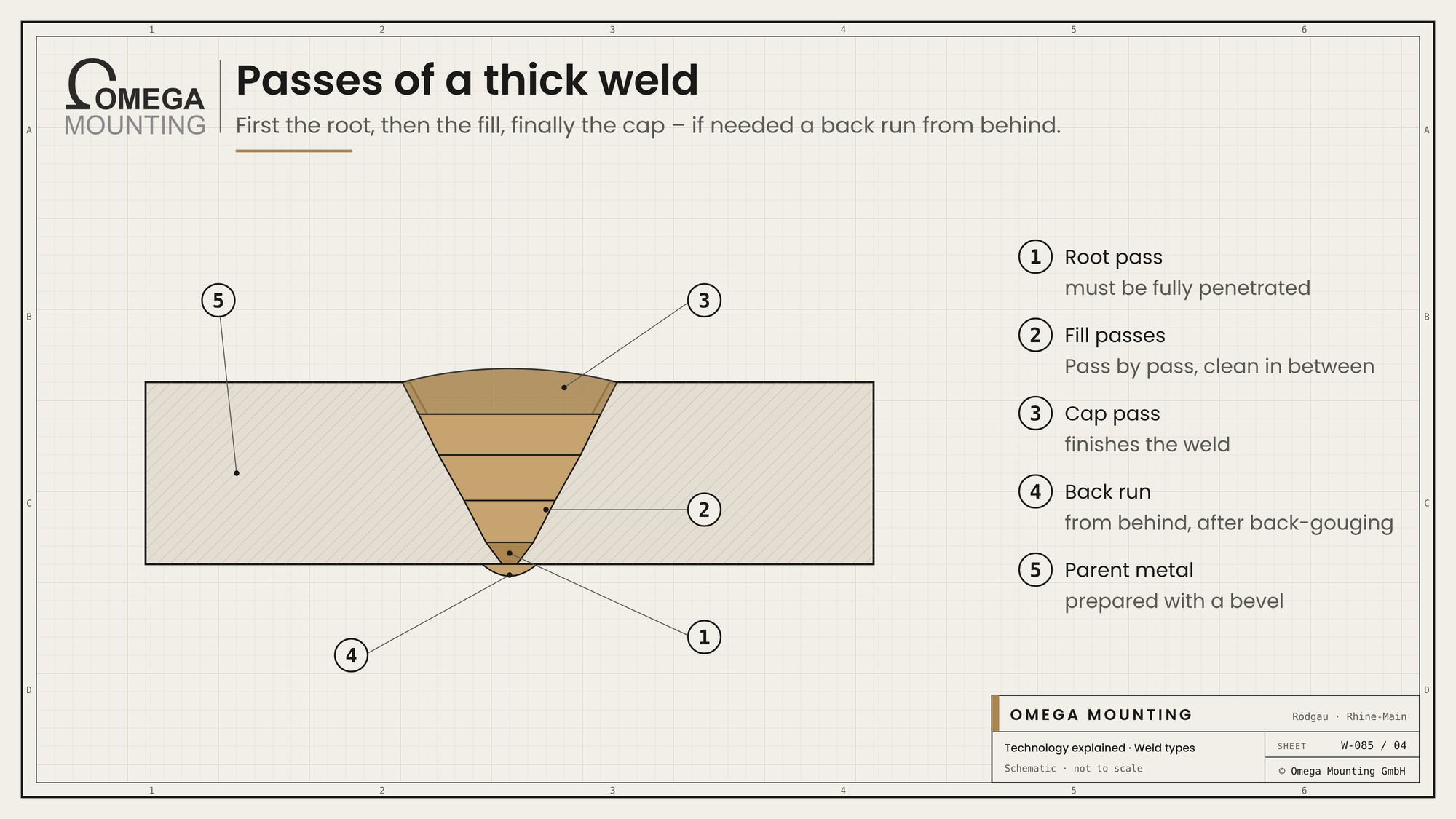
Thick welds are not made in one go, but in several passes.
- Root pass: the first pass right at the bottom – it decides whether the weld is fully penetrated.
- Fill passes: fill the groove pass by pass.
- Cap pass: finishes the weld on the outside and determines its surface.
- Back run: if needed from the back, after the root has been gouged out.
The weld is cleaned between passes so that no slag or oxide is trapped. How welds are tested afterwards is covered in our article on weld testing, which processes there are in the article on Welding processes.
Reading welds on a drawing
On site the weld usually arrives as a symbol on a drawing. We read these details before welding:
- Weld symbol: The symbol shows the type of weld: fillet weld, V butt, X butt and others.
- Reference line: Whether the symbol is above or below the line decides on which side the weld is made.
- Size: For fillet weld the throat thickness is next to the symbol. It is not a recommendation but a requirement.
- Length and pitch: Intermittent welds have details of the length and spacing of the individual sections.
- All round and site weld: A circle means weld all round; a flag stands for a weld made on site.
If a detail is unclear or does not match the situation on site, we ask the designer before welding. Changing a weld afterwards costs many times more than the question.
What we pay attention to
In repairs, what counts is that the new weld carries at least as well as the old one should have.
- We grind out rejected welds completely instead of laying new passes over old ones.
- We prepare edges so that the weld reaches through the whole groove.
- We weld with deep penetration, especially on components with load cycles.
- We clean between passes.
- We stick to the weld type and size on the drawing or agree them for repairs.
How an on-site repair is planned is described in our guide on repair welding.
Where we use it
At a loading dock, the inspector had found cracked welds on the brackets and rejected them. We ground out the old welds completely and re-welded them – with deep penetration, so that the joint withstands the constant load cycles.
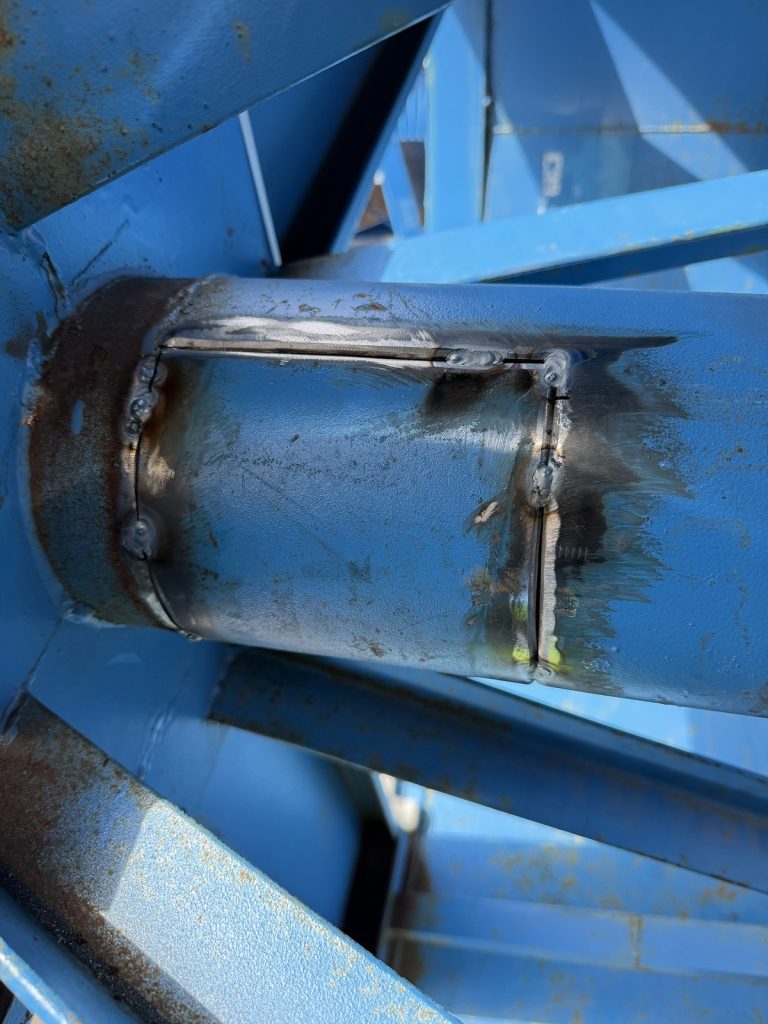
At the port of Aschaffenburg, on the tubular shaft of a cable drum we fitted repair pieces and welded them with circumferential welds. In Frankfurt we welded dock levellers to the steel structure – hinge strip and support feet included.
More technology explained
Technology explained
what the weld is made with.
Technology explained
where welds carry load every day.
Technology explained
when a lug is welded on.
Do you have questions about how this works on your site?
Do you have a cracked weld or a drawing with weld details that needs to be implemented? We prepare, weld and document. Request a callback.
Our service for this: Custom fabrication and welding →
Free, no-obligation callback

About the author
Tobias Schott
Managing director of Omega Mounting GmbH, Rodgau · more than 20 years of hands-on experience in installation and maintenance
A trained mechatronics technician, working in maintenance, servicing and industrial installation since 2004 – first alongside his father, and with Omega Mounting since 2012: from overhead conveyors in Frankfurt to the crane system in a new-build hall. He plans and leads lifting operations as an appointed person (AP) in data centers and on industrial sites in the Rhine-Main region, trains and examines operators of cranes, mobile elevating work platforms and telehandlers, and is a qualified occupational safety specialist. On jobs abroad he is known as the “German Troubleshooter” – the person you call when a site gets stuck. He learned what quality means from his father, not from a manual: Made in Germany as a standard for his own work, not a label. That is why quality comes first at Omega Mounting – ahead of speed and price. The Technology explained articles cover the equipment and techniques his team uses every day: what counts on site is in them – what only appears in the brochure is not.
 English
 German